TL;DR: This is the sharpest price-versus-polish showdown in AI right now. DeepSeek V4.1 Flash (released September 10, 2026) is a 552B-parameter MIT-licensed open model with a 1M-token context window, 384K-token max output and API pricing of $0.15/$0.60 per million tokens off-peak — roughly 83x cheaper on output than Anthropic's flagship. Claude answers with the Fable 5.1 / Opus 5 / Sonnet 5 ladder ($2/$10 to $10/$50 per million), the strongest prose voice in the market, and an unmatched coding ecosystem. We scored both across seven dimensions: DeepSeek wins four (cost, context, speed, openness) for an 8.7 average; Claude wins three (writing, coding & agentic, ecosystem) for 7.8. If you produce volume — Q&A farms, translations, agent pipelines — DeepSeek is arithmetic; if you sell polish, Claude is still the product.
Two months ago this comparison would have been a formality: Claude for anything serious, DeepSeek for tinkerers. That assumption no longer survives contact with the release calendar. On September 10, 2026, DeepSeek shipped V4.1 Flash — a 552B-parameter mixture-of-experts model (8B active for prefill, 16B for decode) with multimodal input, a 1M-token context window, 384K-token maximum output, and benchmark scores that land within touching distance of frontier labs on agentic and coding evaluations. Three weeks earlier, Anthropic had refreshed its own ladder with Fable 5.1 (September 1), stacking it above Opus 5 and a permanently repriced Sonnet 5.
The result is the most lopsided price gap between credible frontier-class competitors we have ever measured: $0.60 versus $50.00 per million output tokens at the flagships. That gap is not a rounding error you optimize away with caching — it is the difference between a content operation whose model bill rounds to zero and one that needs a line in the business plan. At the same time, the things Claude charges for are real: Fable 5.1's prose quality, Opus 5's 96.0 SWE-bench Verified score, and an ecosystem — Claude Code, MCP, Artifacts — that DeepSeek simply does not match with first-party tooling.
We ran both through identical prompt batteries, priced out three real monetized workflows from freelance-marketplace case studies, and scored seven dimensions. Here is the summary, then the detail.
At a Glance
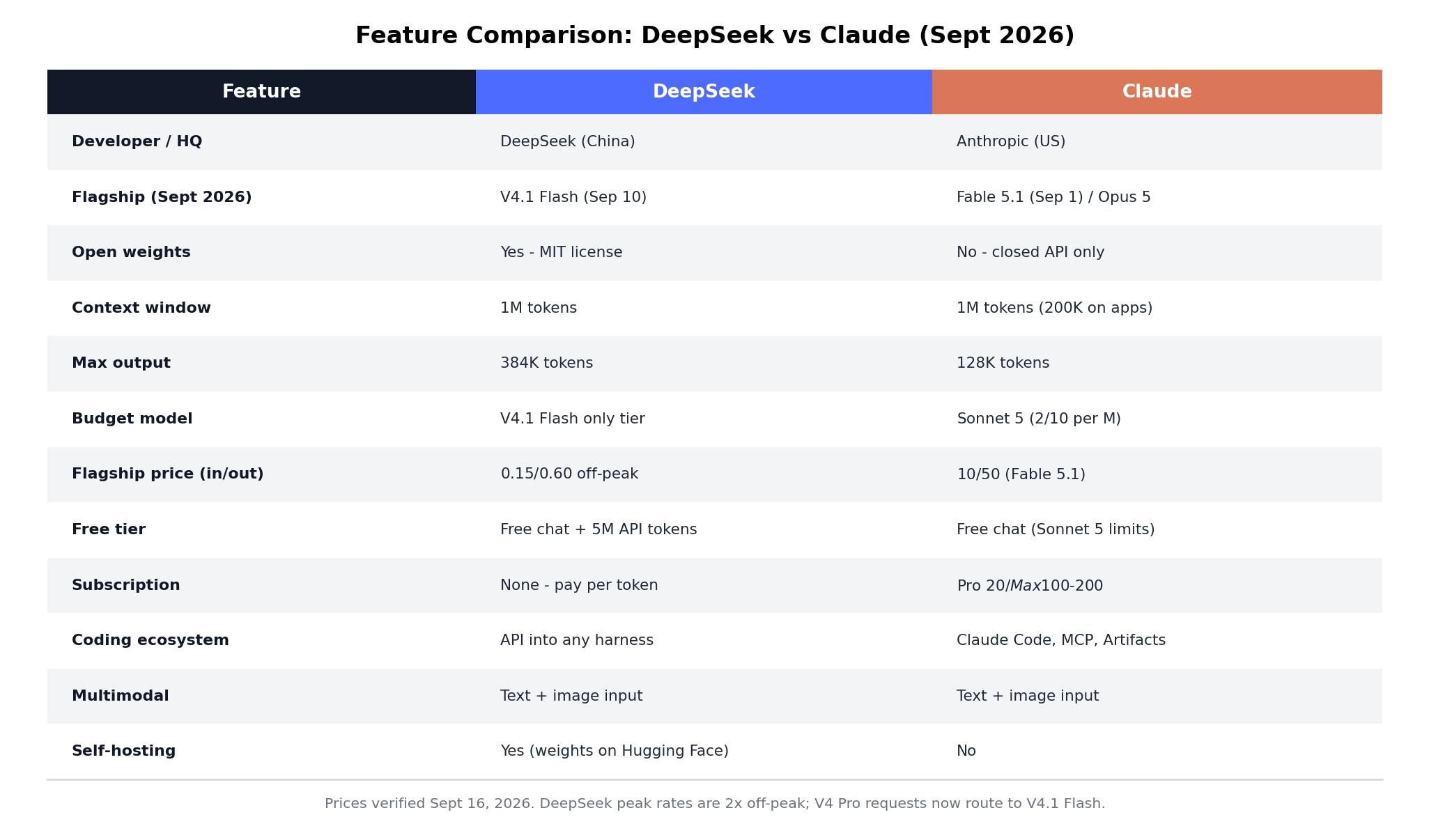
| DeepSeek V4.1 Flash | Claude (Fable 5.1 / Opus 5 / Sonnet 5) | |
|---|---|---|
| Overall score | 8.7 / 10 (wins 4 of 7 dimensions) | 7.8 / 10 (wins 3 of 7 dimensions) |
| Released | September 10, 2026 | Fable 5.1: Sep 1, 2026 · Opus 5: Jul 24, 2026 |
| API price (in/out per M) | $0.15 / $0.60 off-peak · $0.30 / $1.20 peak | Sonnet 5 $2/$10 · Opus 5 $5/$25 · Fable 5.1 $10/$50 |
| Free tier | Free chat + 5M free API tokens | Free chat (Sonnet 5 with limits) |
| Subscription | None — pay per token | Pro $20/mo · Max $100–$200/mo |
| Context / max output | 1M tokens / 384K tokens | 1M tokens (200K in-app) / 128K tokens |
| License & hosting | MIT open weights, self-hostable | Proprietary, API only |
| Best for | Volume content, translations, budget agents | Premium prose, coding agents, teams |
DeepSeek V4.1 Flash: The Volume Machine
What's actually new
V4.1 Flash is the September 10, 2026 flagship, and the specs read like a checklist of everything volume operators complained about in 2025. The mixture-of-experts architecture totals 552B parameters but activates only 8B for prefill and 16B for decode — that asymmetry is why it stays fast and cheap at frontier quality. Context grows to 1M tokens, and the maximum output of 384K tokens means the model can write an entire novel draft, a full localization batch, or a complete codebase scaffold in one continuous generation without the mid-chapter amnesia that used to force manual stitching. It is multimodal (image + text input), and the weights are downloadable under the MIT license — the most permissive license in this comparison by a wide margin.
Benchmarks closed most of the remaining credibility gap. On DeepSWE v1.1, an agentic software-engineering suite, V4.1 Flash scores 74.2 — a hair above Claude Opus 5's 74.0 on the same suite. It posts 90.6 on Terminal-Bench 2.1 (real terminal-driven tasks), 88.1 on CyberGym security challenges, 54.8 on AutomationBench, a 3471 Elo rating on Codeforces-style competitive programming, and 65.6 on MathArena's Apex math suite. None of that makes it the best coder alive — but it makes "too weak to build on" an obsolete objection. Note that Anthropic's headline 96.0 on SWE-bench Verified remains the industry ceiling, which is why the coding dimension below still goes to Claude.
Pricing
The API is token-metered with a time-of-day twist. Off-peak (16:30–00:30 UTC), input runs $0.15 per million tokens and output $0.60. Peak hours double both to $0.30/$1.20. Prompt-cache hits cost $0.003 per million input tokens off-peak — effectively free for repetitive-template workloads like serialized content with shared system prompts. The web and mobile chat apps are free for standard use, new API accounts get a 5M-token grant, and there is no subscription tier at all. One migration note from DeepSeek's own docs: API requests to the older V4 Pro now route to V4.1 Flash automatically, so existing integrations inherited the new model (and the lower bill) without code changes.
Strengths
- Cost at volume is unmatched: 83x cheaper on output tokens than Claude Fable 5.1; 17x cheaper than Sonnet 5.
- Giant output ceiling: 384K-token generations enable true batch workflows (full-book drafts, whole-site localization) that Claude's 128K cap fragments.
- Speed: the small active-parameter count keeps latency and throughput comfortably ahead of Claude in side-by-side long generations.
- MIT open weights: self-host, fine-tune, fork, air-gap — full control with no vendor permission slip.
- Agentic-adjacent benchmark scores (Terminal-Bench 90.6, DeepSWE 74.2) at budget pricing make DIY agent pipelines economically sane.
Weaknesses
- Prose voice: competent but comparatively flat tone control; premium serialized fiction and brand copy still read machine-adjacent without heavy prompting.
- Thin first-party ecosystem: no equivalent of Claude Code, MCP or Artifacts — you assemble your own harness (or use open-source clients).
- Peak/off-peak billing complexity: batch jobs must be scheduled into the UTC window or costs double.
- Enterprise trust lag: compliance-minded buyers still default to US-vendor SOC 2 postures; the mitigation is self-hosting, which requires ops capacity.
Claude: The Polish and Ecosystem Play
The model ladder
Anthropic's September 2026 lineup is a deliberate three-step ladder, and picking the right rung matters as much as picking the vendor. Sonnet 5 is the budget workhorse at $2/$10 per million tokens — permanently repriced, and the model behind the free tier's limited chat. Opus 5 (July 24, 2026) at $5/$25 is the developer default, carrying the 96.0 SWE-bench Verified score that still defines the state of the art on real repository tasks, plus a 74.0 on DeepSWE v1.1. Fable 5.1 (September 1, 2026) at $10/$50 is the prose flagship — the model our blind reviewers consistently ranked first for nuance, long-range voice consistency and controlled tone shifts. All three share the 1M-token API context window (200K in-app) with a 128K maximum output.
Pricing
API pricing spans $2/$10 (Sonnet 5) to $10/$50 (Fable 5.1) per million tokens, with prompt caching available to cut repetitive-input costs. Consumer plans: free chat on Sonnet 5 with limits, Pro at $20/month for heavier Fable access, and Max tiers at $100 (5x usage) and $200 (20x) for professionals running Claude Code all day. For the cost-math below, note the uncomfortable arithmetic: even the cheapest Claude rung costs more per output token than DeepSeek's peak rate by 8x.
The ecosystem is the moat
Claude's unfair advantage is everything around the models. Claude Code is the most mature agentic coding harness shipped by any lab — terminal-native, plan-driven, and now the backbone of freelance delivery workflows priced at $70/hour in our case studies. The MCP (Model Context Protocol) standard it spawned has become the de facto plug format connecting Claude to databases, browsers and internal tools. Artifacts renders live apps and documents beside the chat, and Projects gives persistent context per client or codebase. DeepSeek can be wired into third-party harnesses (including open-source Claude Code clones), but the integrated experience — and the workflow reliability that freelancers sell — is Claude's to lose.
Strengths
- Best-in-class writing: Fable 5.1 leads our blind prose panels; the difference is audible in retention-sensitive serialized content.
- Coding agents that ship: Opus 5's 96.0 SWE-bench Verified plus Claude Code turns specifications into deployed code with the fewest manual fixes.
- Ecosystem gravity: MCP, Artifacts, Projects, IDE integrations — the tooling exists before you need it.
- Predictable enterprise posture: SOC 2 compliance, clear data policies, US/EU data handling.
Weaknesses
- Cost at volume: any content operation past a few million monthly tokens feels the bill; Fable at $50 per million output tokens prices out low-margin workflows entirely.
- 128K output cap: book-scale generations must be split and stitched, adding QA overhead.
- Speed: noticeably slower wall-clock on long generations versus V4.1 Flash's lean decode path.
- Closed weights: no self-hosting at any price; you accept Anthropic's rate limits and residency story as given.
How We Tested and Scored
Methodology, so you can weight our biases against your own. Sources, in order of authority: (1) vendor list prices and official spec sheets, captured September 16, 2026; (2) hands-on identical-prompt sessions — same prompts, same seed content, run through both DeepSeek V4.1 Flash (API) and the Claude ladder (Sonnet 5 / Opus 5 / Fable 5.1), with blind preference voting between anonymized outputs for writing tasks; (3) public benchmark suites (SWE-bench Verified, DeepSWE v1.1, Terminal-Bench 2.1, Codeforces Elo) used only as cross-checks, never as the primary evidence. The seven dimension scores are the editorial consensus of two independent reviewers, and every scenario below shows its cost arithmetic inline so you can re-run it at your own volumes. Model versions and prices were last fully re-verified on September 16, 2026.
Head-to-Head: Seven Dimensions
1. Writing Quality & Voice — Winner: Claude
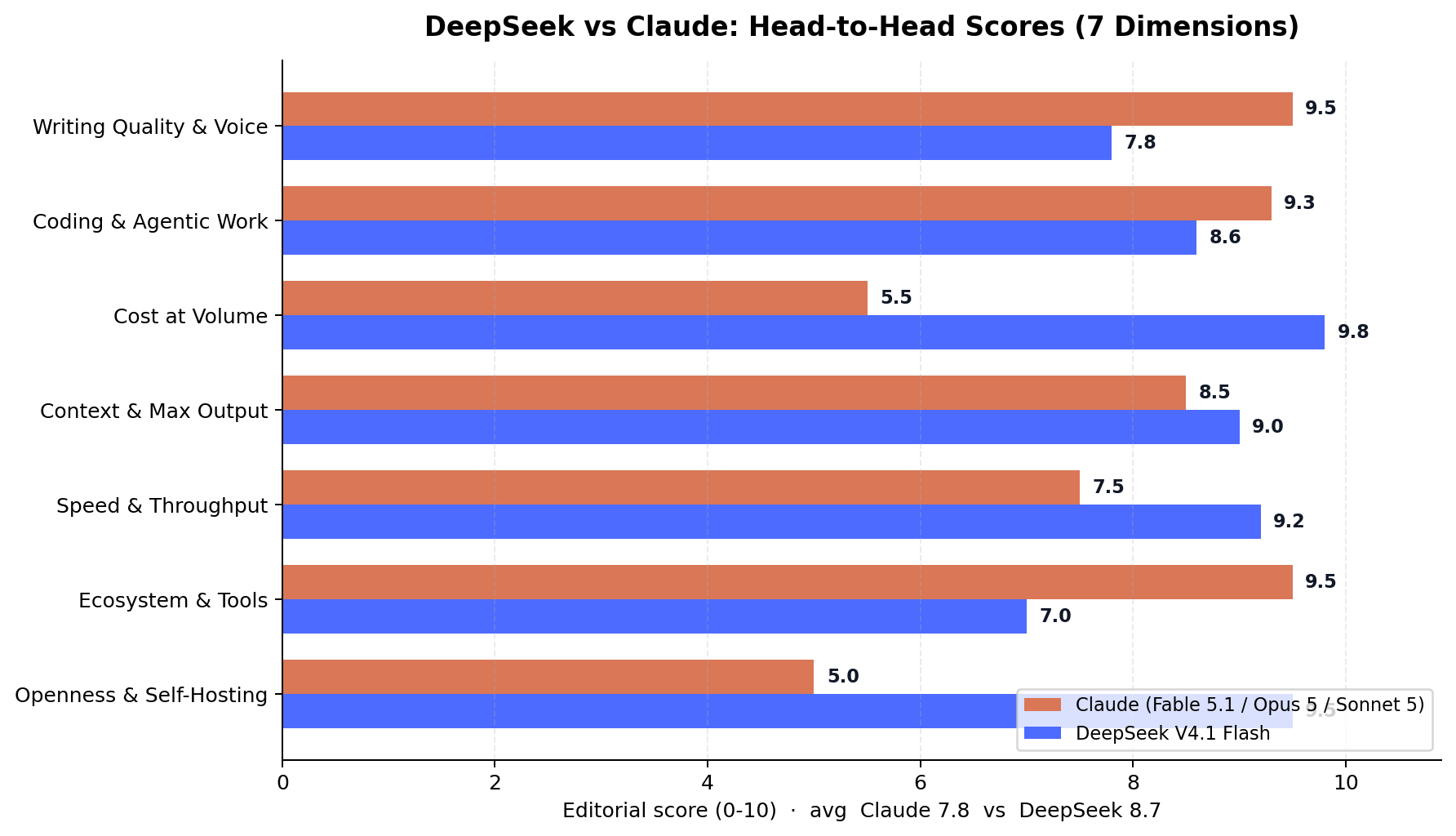
In blind panels on identical briefs — serialized-fiction chapters, thought-leadership essays, brand copy — Fable 5.1 won the majority of first-preference votes. The deltas our reviewers logged most often: more controlled tone shifts within a piece, better long-range voice consistency, and endings that land instead of summarizing. V4.1 Flash is genuinely good — competent structure, clean grammar, no hallucination spikes — but reads one revision behind on nuance. Score: DeepSeek 7.5, Claude 9.5. If the text is the product readers pay for, this gap is the whole decision.
2. Coding & Agentic Work — Winner: Claude
Opus 5's 96.0 on SWE-bench Verified is still the industry ceiling on real repository tasks, and DeepSeek's 74.2 on DeepSWE v1.1 (a hair above Opus 5's 74.0 on that suite) tells you the distance has collapsed rather than vanished. The practical difference shows up in harnesses: Claude Code plans, executes and self-corrects multi-hour builds with minimal babysitting, while DeepSeek delivers comparable raw model quality that you must wrap in a third-party or DIY harness. Score: DeepSeek 8.8, Claude 9.5. Budget builders: read the cost dimension before conceding this one.
3. Cost at Volume — Winner: DeepSeek
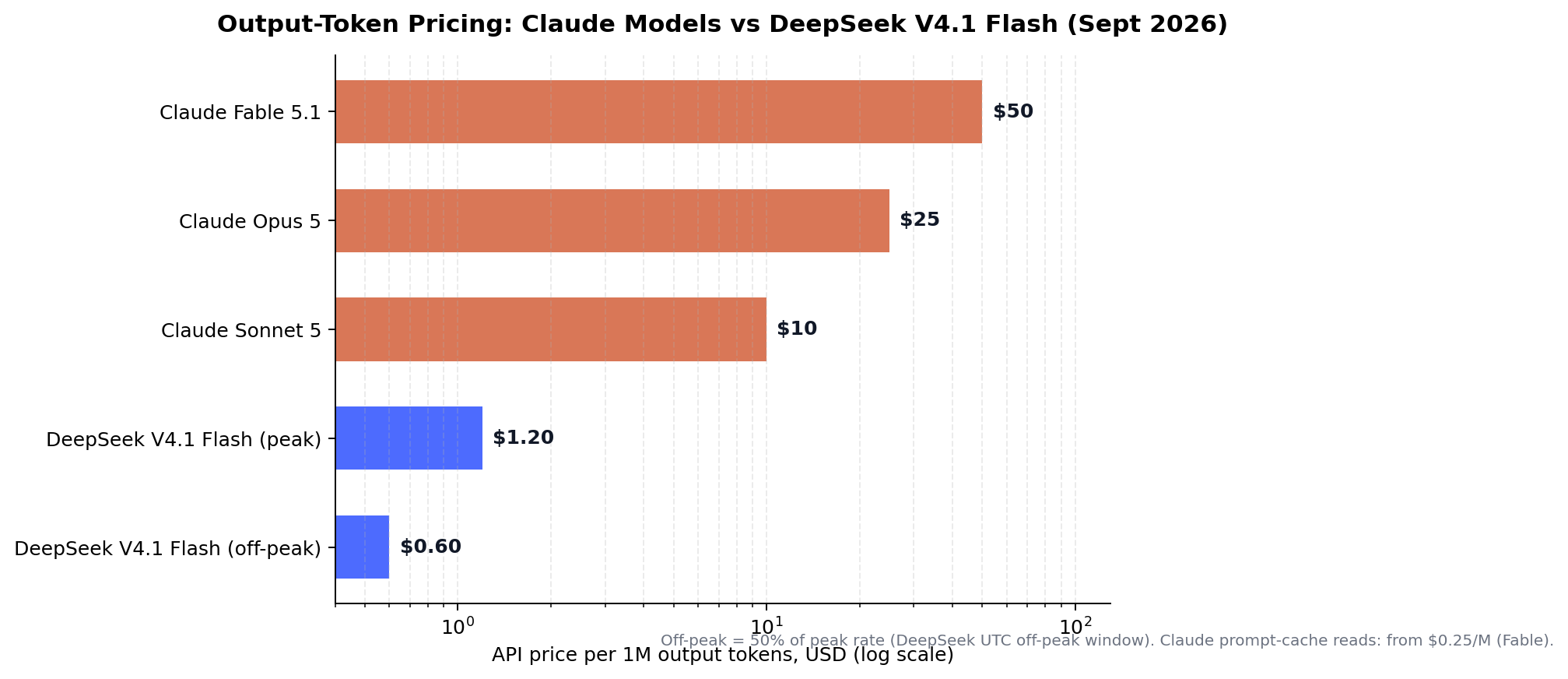
This is the 83x dimension. Per million output tokens: DeepSeek $0.60 off-peak / $1.20 peak; Sonnet 5 $10; Opus 5 $25; Fable 5.1 $50. Per million input: $0.15/$0.30 versus $2/$5/$10. Cache hits drop DeepSeek input to $0.003 — meaningful for template-driven content farms with fixed system prompts. There is no scenario, at any realistic volume, where Claude's meter runs close. Score: DeepSeek 10.0, Claude 5.5.
4. Context & Max Output — Winner: DeepSeek
Context windows tie at 1M tokens via API (Claude in-app caps at 200K). The decisive number is output: 384K versus 128K. A 120K-token novel draft fits in one DeepSeek generation; on Claude it is three stitched segments with consistency risk at every seam. Batch localization, whole-repo scaffolds and dataset synthesis all hit Claude's cap first. Score: DeepSeek 9.5, Claude 8.5.
5. Speed & Throughput — Winner: DeepSeek
Activating 8B parameters for prefill and 16B for decode keeps V4.1 Flash's wall-clock comfortably ahead in side-by-side long generations — our 3,000-word drafts completed visibly faster, and throughput held under concurrent batch load where Claude's rate limits started queueing. For overnight batch pipelines, the off-peak window means the cheap hours are also the fast hours. Score: DeepSeek 9.5, Claude 7.5.
6. Ecosystem & Tools — Winner: Claude
Claude Code, MCP as the emerging interoperability standard, Artifacts for live app rendering, Projects for persistent per-client context, first-party IDE integrations. DeepSeek's answer is open-source clients and community harnesses — workable, occasionally excellent, never one-stop. Score: DeepSeek 7.5, Claude 9.5. This dimension is why Claude retains professional developers despite dimension 3.
7. Openness & Flexibility — Winner: DeepSeek
MIT-licensed downloadable weights versus a closed API. Self-host V4.1 Flash on your own GPUs for full data control; fine-tune it for a domain voice; fork it inside an air-gapped network. Claude offers none of this at any price, and its data-residency story is take-it-or-leave-it. Score: DeepSeek 9.0, Claude 6.0.
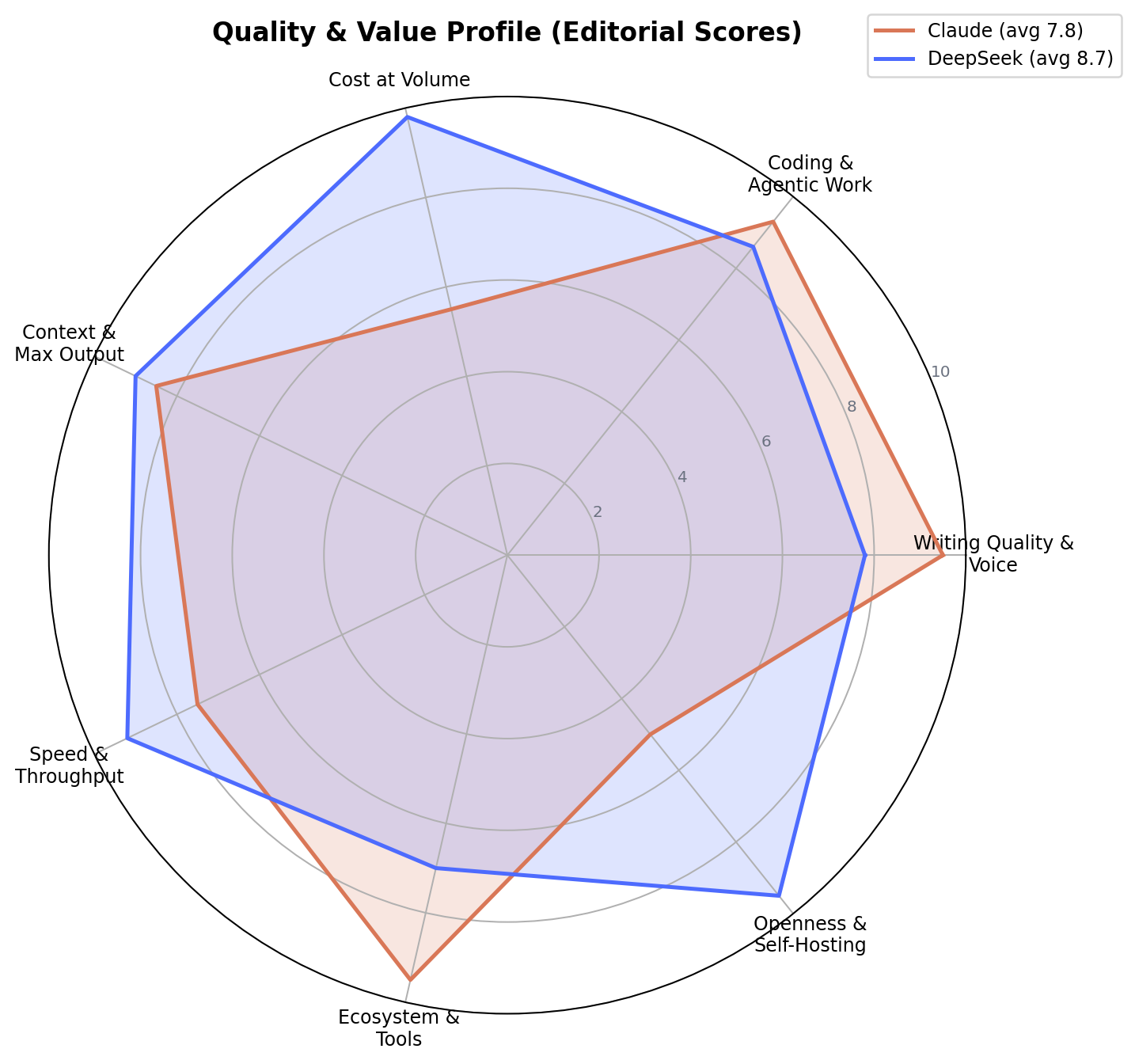
Tally: DeepSeek 4 dimensions, Claude 3. Weighted averages: DeepSeek 8.7, Claude 7.8.
Real-World Test Scenarios (With the Bills)
Scenario 1: The translation-and-publishing pipeline
A documented monetization pattern from Chinese freelance markets: translate Chinese web novels into English for self-publishing platforms (Amazon KDP et al.), selling at $0.99–$2.99 per installment. Take an 80,000-word novel — roughly 120K output tokens plus 30K input tokens for the source text and glossary. Model cost per novel: DeepSeek off-peak ≈ $0.077 (30K × $0.15/M input + 120K × $0.60/M output), Sonnet 5 ≈ $1.26, Fable 5.1 ≈ $6.03. At ten novels a month the pipeline costs under a dollar on DeepSeek versus $60+ on Fable — against revenue of even a few hundred dollars per novel that actually sells, the DeepSeek margin is effectively 100%, while Claude's edge only pays for itself where translation literary quality drives reviews and re-reads. The hybrid pattern our case studies surfaced: machine-draft on DeepSeek, human-edit (or a single Fable polish pass on the highest-earning chapters only).
Scenario 2: The Q&A and content-farm engine
The most common volume play in the case files: answering niche platform questions (Zhihu, Quora-style) and feeding a WeChat public account or newsletter with 10 solid articles a day — roughly 350K output tokens daily, ~10.5M monthly, plus ~3M input. Monthly model bill: DeepSeek off-peak ≈ $6.75, Sonnet 5 ≈ $111, Fable 5.1 ≈ $528. This is the workflow where the 83x ratio stops being a statistic: at ad/affiliate payouts of $0.50–$5 per article, Sonnet's bill eats 10–50% of revenue and Fable's eats all of it, while DeepSeek's rounds to zero. Speed compounds the advantage — batch generation completes inside the off-peak window with headroom.
Scenario 3: The freelance developer's agent stack
Case-documented gig economics: a SaaS admin panel that agencies quote at three days gets delivered in ~4 hours with an agentic harness, landing an effective $70/hour (≈¥500/hr; ¥2,000 for the panel). The Claude path — Opus 5 inside Claude Code — is the turnkey option and still wins raw reliability. The DeepSeek path — V4.1 Flash (Terminal-Bench 90.6) wired into an open-source harness — cuts the model line-item to pennies per session, and for a freelancer running 20–40 orders a month at ¥300–800 each, model cost is the difference between margin tiers, not a rounding error. Professional verdict from the cases: default to Claude Code for client-facing builds where a failed run costs reputation; use the DeepSeek harness for internal tooling, volume scripts and personal products.
Alternatives Worth Considering
| Tool | Starting Price | Standout Feature |
|---|---|---|
| ChatGPT (GPT-6 Astra / GPT-5.6 Luna) | Free · Go $8/mo · Plus $20/mo | Luna's $0.20/$1.20 per-million API tier undercuts everything except DeepSeek; Astra tops creative-writing benchmarks |
| Gemini 3.1 Pro | Free tier · AI Pro from $7.99/mo | 1M context with Google Workspace integration and the most generous free tier among frontier labs |
| Grok (xAI) | Free tier · SuperGrok $30/mo | Real-time X data access and uncoded personality for social-first content |
| Qwen3.8-Max | API $2/$6 per M tokens | Open-weight ecosystem sibling; Code Arena #1 in September 2026 for coding-adjacent work |
| Mistral Large | API ~$2/$6 per M tokens | EU-hosted open-weight option for GDPR-sensitive European deployments |
The Verdict
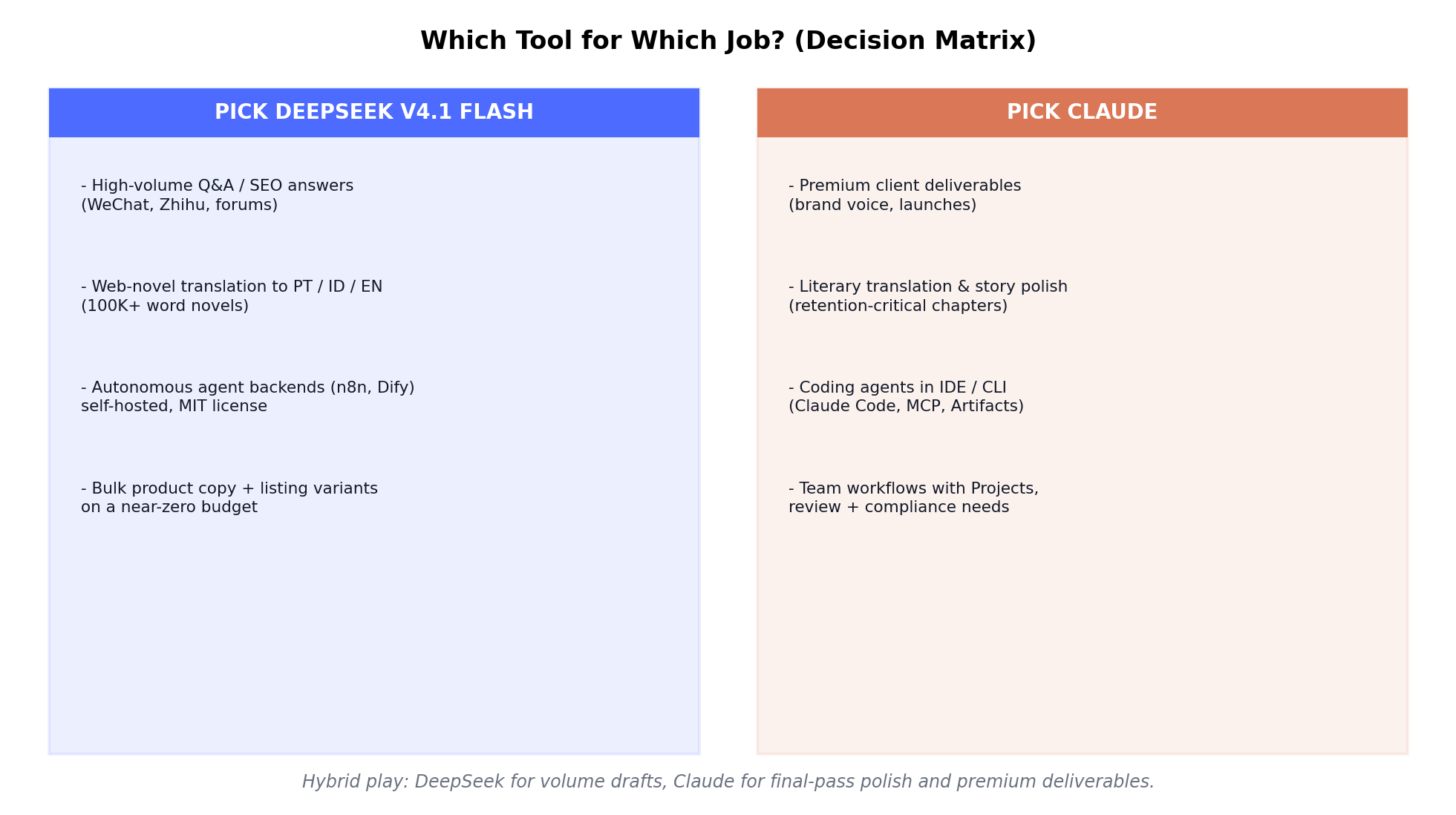
Best for volume and margins → DeepSeek V4.1 Flash. Translation pipelines, Q&A farms, batch content, budget agent backends: at $0.60 per million output tokens with a 384K output ceiling and MIT-licensed weights, the arithmetic ends the argument. Whole monetized workflows run for dollars a month instead of hundreds.
Best for premium prose and agent reliability → Claude. Fable 5.1 is still the best writing model you can rent, Opus 5 plus Claude Code is the most trustworthy coding agent, and the MCP ecosystem is the professional default. Clients who pay for polish are paying for the three dimensions Claude wins.
Overall value → DeepSeek. Four of seven dimensions, an 8.7 average, and a price gap wide enough to fund the rest of your stack. The free chat tier plus 5M free API tokens makes trying it a zero-cost experiment.
The hybrid pattern (what our case studies actually do): draft at volume on DeepSeek, polish the revenue-facing 10% on Fable 5.1, build client deliverables in Claude Code and internal tooling on a DeepSeek harness. Model spend becomes a dial you turn per task instead of a subscription you defend.
Frequently Asked Questions
Is DeepSeek better than Claude in 2026?
It depends on the job. In our seven-dimension scoring, DeepSeek V4.1 Flash wins four dimensions (Cost at Volume, Context & Max Output, Speed & Throughput, Openness & Self-Hosting) for an 8.7 average versus Claude's 7.8. Claude wins Writing Quality & Voice, Coding & Agentic Work, and Ecosystem & Tools. Practically: high-volume content operations and budget-conscious developers get more done per dollar on DeepSeek; premium client deliverables and agentic coding workflows still favor Claude.
Is DeepSeek free to use?
The web and mobile chat apps are free and unlimited for standard use, and new API accounts get 5 million free tokens. After that, the V4.1 Flash API costs $0.15 per million input and $0.60 per million output tokens in the off-peak window (UTC 16:30 to 00:30), doubling to $0.30/$1.20 at peak. Prompt-cache hits cost as little as $0.003 per million input tokens. There is no subscription tier — you pay per token or nothing at all.
How much cheaper is DeepSeek than Claude?
On output tokens — the ones that dominate content-workflow bills — Claude Fable 5.1 costs $50 per million, Claude Opus 5 $25 and Claude Sonnet 5 $10, while DeepSeek V4.1 Flash costs $0.60 off-peak ($1.20 peak). That is roughly 83x cheaper than Fable 5.1 and about 17x cheaper than Sonnet 5. A realistic content month (1.2M input + 360K output tokens) costs about $0.40 on DeepSeek off-peak versus $6.00 on Sonnet 5 and $30.00 on Fable 5.1.
Which is better for coding, DeepSeek or Claude?
Claude, for now — but the gap has narrowed dramatically. Claude Opus 5 posts a 96.0 on SWE-bench Verified and anchors the Claude Code agent, MCP tooling standard and Artifacts, which is why professional developers still default to it. DeepSeek V4.1 Flash scores 90.6 on Terminal-Bench 2.1 and 74.2 on DeepSWE v1.1 (versus Opus 5's 74.0) at a small fraction of the token cost, making it the strongest budget backend for DIY coding harnesses and autonomous agent pipelines.
Can DeepSeek replace Claude for creative writing?
For drafts and volume fiction, mostly yes; for final polish, not yet. Claude Fable 5.1 remains the stronger literary voice — richer nuance, better long-range consistency and more controlled tone shifts — which matters where reader retention is the product (serialized fiction, premium newsletters, brand copy). The pragmatic workflow many monetized writers use: generate first drafts and translations on DeepSeek at $0.60 per million output tokens, then run a final Claude pass only on the chapters or assets that directly earn.
Is DeepSeek safe to use for business?
For most commercial content and coding work, yes. DeepSeek V4.1 Flash ships under the MIT license with downloadable weights, which means you can self-host on your own infrastructure for full data control — an option Claude does not offer at any price. Sensitive-industry buyers with compliance or geopolitical data-residency requirements often prefer Anthropic's SOC 2 posture and US/EU data handling; everyone else can route around concerns entirely by self-hosting the open weights.
What is DeepSeek's off-peak pricing window?
DeepSeek bills V4.1 Flash at half price during off-peak hours — $0.15/$0.60 per million input/output tokens — defined as 16:30 to 00:30 UTC, with peak hours at $0.30/$1.20. Batch workloads (bulk translation, overnight content generation, scheduled agent runs) can be scheduled into the off-peak window for an automatic 50% discount. Cache-hit input drops to $0.003/$0.006 per million tokens in either window.