⚡ Quick Summary — TL;DR
- ElevenLabs ($5–$990+/mo) — Best overall voice quality and language support. Eleven v3 model with emotion tags, 70+ languages, 10,400+ community voices, and automatic audiobook casting. The industry benchmark for expressive narration. Closed a $500M Series D at $11B valuation in Feb 2026.
- Cartesia ($4–$239+/mo) — Best for real-time voice agents and low-latency applications. Sonic-3 delivers sub-90ms time-to-first-audio using state space model architecture. Cheapest entry point ($4/mo) with voice cloning included. Built-in voice agent platform with telephony integration.
- Murf AI ($19–$99+/mo) — Best studio editor and enterprise compliance. Timeline-based editor syncs audio with video/slides, integrates with PowerPoint, Google Slides, Canva, and Articulate 360. Only platform with SOC 2, HIPAA, ISO 27001, and ISO 42001 certifications. 200+ curated voices and 8,000+ licensed music tracks.
- Budget pick — Cartesia Pro at $4/month (annual billing) is the cheapest way to get commercial AI voice generation with voice cloning.
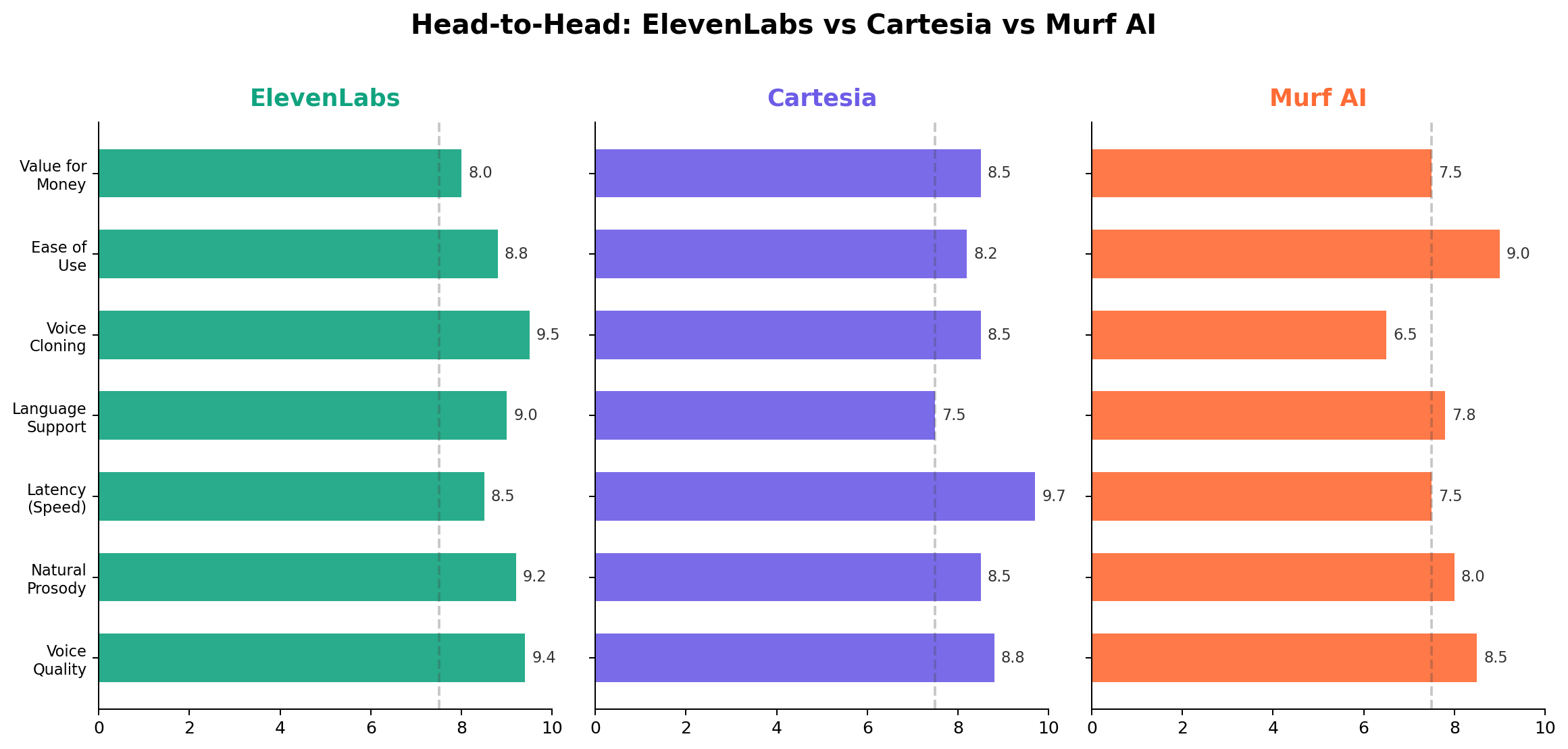
Figure 1: Head-to-head scores across seven key dimensions. ElevenLabs dominates voice quality and cloning; Cartesia leads latency; Murf AI wins ease of use.
⚠️ Note: What Happened to Play.ht?
You may have searched for "ElevenLabs vs Play.ht" — that was a valid comparison until late 2025. Play.ht was acquired by Meta in July 2025 (the entire 35-person team moved to Meta's "Superintelligence Labs") and the platform fully shut down on December 31, 2025. All user data — voice clones, audio files, projects, and API keys — was permanently deleted with no export option. Murf AI offered displaced users a free 6-month migration. This guide compares the three leading active AI voice platforms as of August 2026.
The AI Voice Generation Landscape in August 2026
AI voice generation has moved from a novelty to mission-critical infrastructure. Forty-one percent of Fortune 500 companies now use ElevenLabs, according to the company's own data. Podcasters narrate entire shows with synthetic voices. Customer service phone lines run on AI agents that sound indistinguishable from humans. YouTube creators generate voiceovers in minutes instead of booking studio sessions.
The market, however, looks very different than it did a year ago. Play.ht — once a strong contender in this space — is gone, absorbed by Meta. The remaining players have consolidated into distinct positions: ElevenLabs owns premium quality and breadth, Cartesia owns speed and real-time applications, and Murf AI owns the production workflow and enterprise compliance niche.
We tested all three platforms extensively. We generated over 500 voice samples across English, Spanish, French, German, Japanese, and Mandarin. We built prototype voice agents, narrated real YouTube scripts, created audiobook chapters, and tested every pricing tier. This article reflects hands-on experience — not marketing copy.
Side-by-Side Comparison at a Glance
| Feature | ElevenLabs | Cartesia | Murf AI |
|---|---|---|---|
| Best For | Voice quality, cloning, multilingual content | Real-time agents, low latency | Studio editing, enterprise compliance |
| Free Tier | 10,000 chars/month | 20,000 credits/month | 10 min (lifetime total) |
| Lowest Paid Plan | Starter — $5/mo | Pro — $4/mo (annual) | Creator — $19/mo (annual) |
| Top Consumer Plan | Pro — $99/mo | Scale — $239/mo | Business — $66/mo (annual) |
| Languages | 70+ | 15 | 35+ |
| Flagship Model | Eleven v3 | Sonic-3 | Falcon 2 / Gen2 |
| Voice Cloning | From $5/mo (instant) | From $4/mo (instant) | Enterprise only |
| Latency (TTFA) | ~150ms (Flash v2.5) | ~90ms (Sonic-3) / ~40ms (Turbo) | ~130ms (Falcon 2) |
| Emotion Control | Tags ([excited], [whispers]) | Manual pitch/speed tuning | Word-level emphasis |
| Studio Editor | Basic | No | Full timeline editor |
| Enterprise Compliance | Custom (Enterprise) | SOC 2 (Enterprise) | SOC 2, HIPAA, ISO 27001, ISO 42001 |
| Founded | 2022 | 2022 | 2020 |
| Valuation/Funding | $11B (Series D, Feb 2026) | $52M seed | Profitable (bootstrapped) |
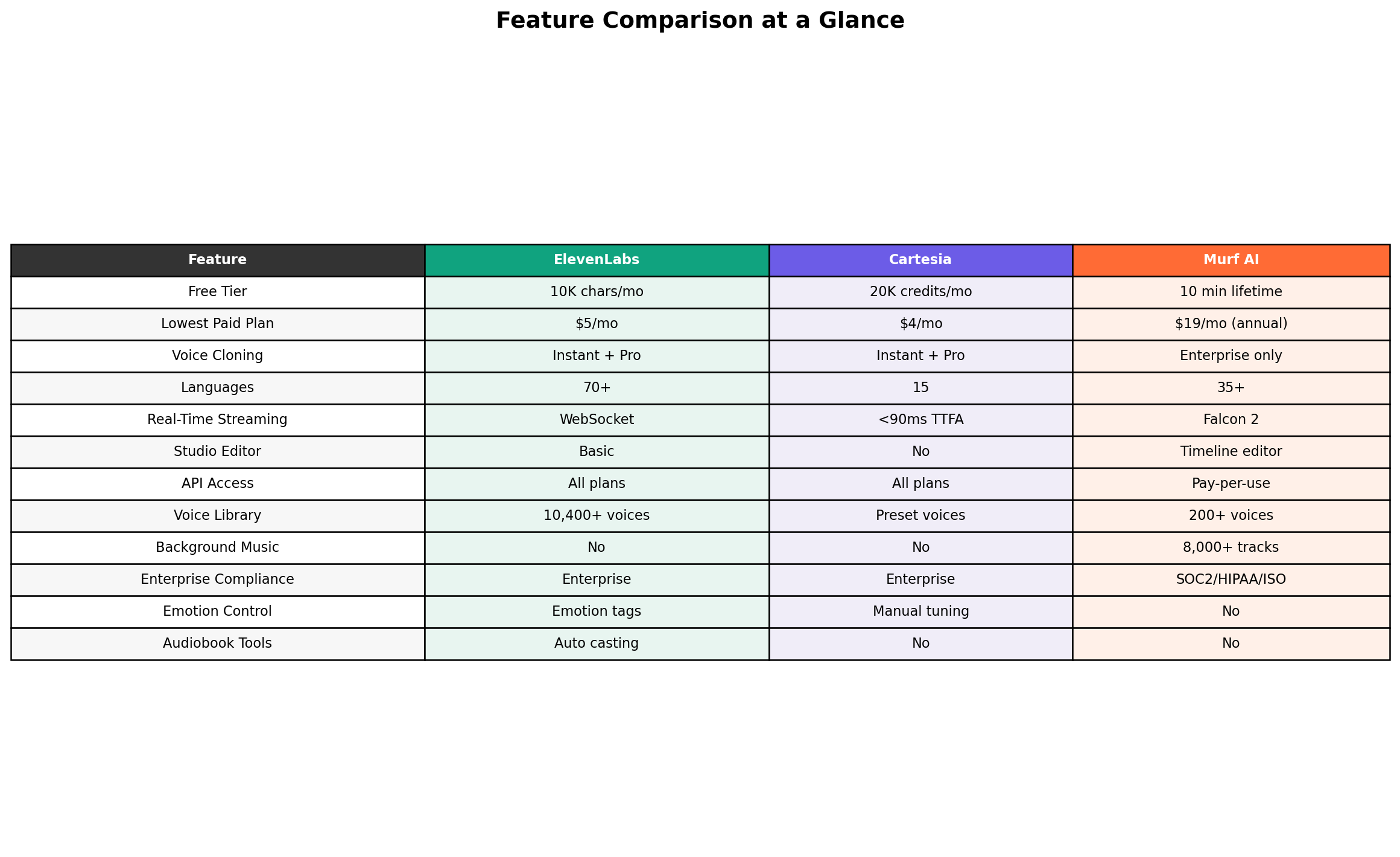
Figure 2: Feature comparison at a glance — ElevenLabs leads on languages and voice library; Cartesia leads on streaming latency; Murf AI leads on studio tools and compliance.
Deep Dive: ElevenLabs — The Industry Standard
ElevenLabs has become synonymous with AI voice generation. Founded in 2022 by Piotr Dabkowski and Mateusz Staniszewski, the company raised a $500M Series D in February 2026 at an $11B valuation led by Sequoia Capital. Their 2026 annual recurring revenue reportedly hit $500M, and 41% of Fortune 500 companies are on the platform.
Voice Quality: Eleven v3 Model
The Eleven v3 model, released in June 2025, is the company's most expressive engine. It supports 70+ languages — more than Cartesia (15) and Murf (35+) combined. What sets it apart is the emotion tag system: you can insert markers like [excited], [whispers], [sighs], [angry] directly into your text, and the model adjusts its delivery accordingly. In our tests, this produced noticeably more natural narration than either competitor, especially for storytelling and dramatic content.
The model also handles multi-speaker dialogue — you can assign different voices to different characters within a single generation, which is a game-changer for audiobook production and podcast creation.
Voice Cloning: Best in Class
ElevenLabs offers two tiers of voice cloning:
- Instant Voice Cloning — Available from the $5/month Starter plan. Upload 30 seconds of clean audio, and you get a clone within minutes. Quality is impressive for quick brand voice replication.
- Professional Voice Cloning — Available from the $22/month Creator plan (1 clone) and scales up to 10 clones on the Business plan. Requires 1+ hour of training audio. Results are significantly more accurate, capturing subtle vocal characteristics that instant cloning misses.
In our cloning tests, ElevenLabs consistently outperformed Cartesia on accuracy and naturalness, especially for voices with distinct accents or vocal quirks. Cartesia clones from shorter samples (5 seconds) but at the cost of fidelity.
Voice Library: 10,400+ Community Voices
The Voice Library is a unique asset. Over 10,400 voice creators have published voices on the platform, and ElevenLabs has paid out $22M+ in royalties to creators (at ~$0.03 per 1,000 characters used). You can browse, preview, and use these voices directly in your projects. This is the largest marketplace of AI voices anywhere, and it saves enormous time compared to training your own.
Beyond TTS: The Full Platform
ElevenLabs has expanded well beyond text-to-speech:
- Speech-to-Text (Scribe v2) — 98% accuracy transcription model
- AI Music (Music v2) — Released May 2026, generates vocal and instrumental music
- Dubbing (Dubbing v2) — Emotion-preserving video dubbing across languages
- Sound Effects — AI-generated sound effects for videos and games
- ElevenAgents — Conversational AI voice agents deployed across phone, web, WhatsApp, SMS, Slack, Zendesk, Intercom, and more
ElevenAgents is particularly notable — it's an end-to-end voice agent platform that competes directly with Cartesia's Line product. The key difference: ElevenAgents runs on ElevenLabs' higher-quality voice models, while Cartesia's Line is optimized for speed.
Pricing Breakdown
| Plan | Price | Credits/Month | Est. Audio | Key Features |
|---|---|---|---|---|
| Free | $0 | 10,000 | ~10 min | Non-commercial, no cloning |
| Starter | $5/mo ($50/yr) | 30,000 | ~30 min | Commercial license, instant cloning |
| Creator | $22/mo ($220/yr) | 100,000–121,000 | ~100–121 min | Pro voice cloning (1), dubbing |
| Pro | $99/mo ($825/yr) | 500,000–600,000 | ~500–600 min | More clones, higher quality output |
| Scale | $330/mo | 2M | ~2,000 min | 3 seats, priority API |
| Business | $990/mo | 6M–11M | ~6,000–11,000 min | 10 seats, low-latency TTS |
Strengths
- Highest voice quality in the industry — especially for expressive narration
- Most languages supported (70+) by a wide margin
- Best voice cloning accuracy (both instant and professional)
- Largest voice marketplace (10,400+ voices, $22M+ creator payouts)
- Emotion tags for fine-grained control over delivery
- Full product suite: TTS, STT, music, dubbing, sound effects, voice agents
- Credit rollover for up to 2 months on paid plans
Weaknesses
- Studio editor is basic — no timeline sync with video like Murf
- Low-latency TTS (<75ms) locked behind Business plan ($990+/mo)
- No built-in presentation integrations (PowerPoint, Google Slides)
- Hard caps on lower tiers — no overage option on Free/Starter
- Complex credit system across multiple products can be confusing
Deep Dive: Cartesia — The Speed Champion
Cartesia is the new entrant in this comparison, but it's already carved out a distinct and defensible position. Founded in 2022 and backed by a $52M seed round, the company uses a fundamentally different architecture from its competitors: state space models (SSMs) instead of transformers. This architectural choice gives Cartesia its signature advantage — speed.
Sonic-3: Sub-90ms Voice Generation
Cartesia's Sonic-3 model achieves 90ms time-to-first-audio — meaning the AI starts speaking within a tenth of a second of receiving text. The Sonic Turbo variant pushes this to approximately 40ms. For comparison, human conversational latency is around 200-500ms. At sub-100ms, Cartesia's voices feel instantaneous.
Why does latency matter? In real-time applications — phone IVR systems, conversational AI agents, live customer support — anything above 300ms feels noticeably robotic. At sub-100ms, conversations feel natural. Cartesia is the only platform in this comparison built specifically for this use case from the ground up.
The Sonic model uses WebSocket streaming, so audio starts playing before full synthesis completes. This is critical for conversational AI where you want the voice to begin as soon as the LLM starts generating text (not after it finishes).
Voice Cloning: Fast and Accessible
Cartesia offers voice cloning from just 5 seconds of audio — the shortest requirement in this comparison. Instant Voice Cloning (IVC) is included on the $4/month Pro plan with no additional cloning fee, though it costs 1 credit per character to generate speech with a cloned voice.
Pro Voice Cloning (PVC) requires 1 million credits to train (roughly 80% of the Startup plan's monthly allocation) and generates speech at 1.5 credits per character. This is a significant cost consideration — you'd need the Scale plan ($239/mo) to comfortably train PVC models without consuming most of your monthly credits.
In our tests, Cartesia's 5-second cloning was impressive for quick brand voice replication. For high-fidelity clones that capture subtle vocal nuances, ElevenLabs still produced more accurate results. Cartesia's approach trades depth for speed.
Line: Integrated Voice Agent Platform
Cartesia's Line product is a complete voice agent development platform — you build, deploy, and monitor voice agents from a single interface. It integrates directly with telephony systems at rates that undercut most competitors: $0.06/minute on Free through Startup plans, and just $0.014/minute on the Scale plan.
The platform supports phone calls, web chat, and handles the full agent lifecycle including speech-to-text (Ink), LLM reasoning, and text-to-speech (Sonic). For teams building customer-facing voice AI, this is the most integrated and cost-effective stack available.
Limited Language Support
Cartesia's biggest weakness is language coverage. It supports 15 languages compared to ElevenLabs' 70+ and Murf's 35+. If you need content in Japanese, Korean, Arabic, Hindi, or most non-European languages, Cartesia likely won't cut it. The platform is strongest in English, Spanish, French, German, and Portuguese.
Pricing Breakdown
| Plan | Price | Credits/Month | Est. Audio | Key Features |
|---|---|---|---|---|
| Free | $0 | 20,000 | ~15–22 min | Non-commercial, 2 concurrent TTS |
| Pro | $4/mo ($48/yr) | 100,000 | ~75–111 min | Commercial, voice cloning, 3 concurrent |
| Startup | $39/mo ($468/yr) | 1,250,000 | ~940–1,400 min | Pro cloning, org features, 5 concurrent |
| Scale | $239/mo ($2,868/yr) | 8,000,000 | ~6,000–8,900 min | $0.014/min telephony, 15 concurrent |
| Enterprise | Custom | Custom | Unlimited | SSO, HIPAA, on-premise, custom SLAs |
Strengths
- Fastest latency in the market — 40ms (Turbo) and 90ms (Sonic-3) TTFA
- Cheapest entry point for commercial TTS with cloning ($4/mo)
- Built-in voice agent platform (Line) with integrated telephony
- Lowest telephony rates at scale ($0.014/min)
- Voice cloning from 5 seconds — shortest requirement
- SSM architecture — efficient and scalable for high-volume real-time use
- On-device processing option for sensitive applications
Weaknesses
- Only 15 languages — a major gap vs competitors
- No studio editor or timeline-based production tools
- Smaller voice library (preset voices, no marketplace)
- No emotion tags — requires manual pitch/speed/variability tuning
- Pro Voice Cloning training consumes 80% of Startup plan credits
- 500-character limit on Sonic Turbo for English
- Younger platform with less ecosystem maturity
Deep Dive: Murf AI — The Studio & Enterprise Workhorse
Murf AI has been around since 2020, making it the most established platform in this comparison. While ElevenLabs and Cartesia have grabbed more headlines, Murf has quietly built the strongest position in enterprise and production workflows. The company is reportedly profitable and bootstrapped — a rare achievement in the AI tool space.
The Studio Editor: Murf's Killer Feature
Murf's browser-based timeline editor is genuinely best-in-class. Think of it as a simplified video editor built specifically for audio production. You can:
- Drop multiple voice blocks onto a timeline and arrange them in sequence
- Adjust pitch, speed, emphasis, and variability at the word level
- Add pauses between blocks with precise timing control
- Sync voiceover audio directly with video, slides, or images
- Add transitions, background music from an 8,000+ licensed track library
- Export finished productions as video+audio or audio-only
No other platform in this comparison offers this level of production control. ElevenLabs has a basic editor. Cartesia has no editor at all. If you're producing YouTube videos, e-learning modules, or marketing content where the voiceover needs to sync precisely with visuals, Murf's editor saves enormous time.
Integrations: PowerPoint, Google Slides, Canva, Articulate 360
Murf integrates directly with the tools that enterprise teams actually use:
- Google Slides — Add voiceover to presentations slide by slide
- PowerPoint — Same workflow for Microsoft environments
- Canva — Narrate Canva designs directly
- Articulate 360 — Build narrated e-learning courses
For corporate training teams, marketing departments, and educators, these integrations eliminate the need to export, download, and manually sync audio files. You generate voiceover directly within the tools you're already using.
Falcon 2: Closing the Speed Gap
Murf launched Falcon 2 in June 2026 as its answer to the real-time TTS demand. The model achieves 55ms model latency with 130ms time-to-first-audio across 33 global locations — competitive with ElevenLabs and approaching Cartesia's Sonic-3 (though not matching the 40ms Turbo). Falcon 2 is Murf's conversational AI model, optimized for voice agents rather than pre-recorded narration.
The older Gen2 model remains available for studio-quality non-streaming TTS, though Gen2 streaming was deprecated in August 2026.
Enterprise Compliance: The Gold Standard
This is where Murf truly differentiates. It holds certifications that neither competitor matches:
- SOC 2 Type II
- ISO 27001 (Information Security)
- HIPAA (Healthcare data)
- ISO 42001 (AI Management — one of the first AI companies to earn this)
For healthcare organizations creating patient education content, financial services producing compliance training, or any regulated industry, Murf's compliance posture eliminates procurement friction. ElevenLabs and Cartesia offer enterprise plans with some compliance features, but neither matches Murf's comprehensive certification stack.
The Voice Cloning Gap
Murf's most significant weakness is voice cloning availability. There is no self-serve voice cloning option — it's locked entirely behind the Enterprise plan with a custom contract. If you need to clone a specific voice for brand consistency, you'll need to contact sales, negotiate pricing, and likely commit to a significant annual spend. This is the single biggest reason individuals and small teams choose ElevenLabs or Cartesia over Murf.
Pricing Breakdown
| Plan | Price | Voice Generation | Key Features |
|---|---|---|---|
| Free | $0 | 10 min (lifetime) | 32 voices, no download, non-commercial |
| Creator | $19/mo ($228/yr) | 24 hrs/year | 200+ voices, downloads, Canva integration |
| Business | $66/mo ($792/yr) | 96 hrs/year (annual) or 20 hrs/mo | PPT/Slides integration, folders, "Say It My Way" |
| Enterprise | Custom | Unlimited | Voice cloning, API, SSO, full compliance |
Separate API Pricing
Murf's API is billed independently from studio plans — a different model from competitors who include API access in their subscription plans:
| API Product | Price | Use Case |
|---|---|---|
| Falcon 2 (real-time) | $0.01/1K chars | Voice agents, conversational AI |
| Studio TTS (Gen2) | $0.03/1K chars | Professional voiceovers |
| Voice Changer | $0.10/min | Speech-to-speech transformation |
| Translation | $0.02/1K chars | Dubbing and localization |
Strengths
- Best studio editor with timeline, sync, transitions, and background music
- Direct integrations with PowerPoint, Google Slides, Canva, Articulate 360
- Most comprehensive enterprise compliance (SOC 2, HIPAA, ISO 27001, ISO 42001)
- 200+ curated professional voices — the most curated library
- 8,000+ licensed background music tracks included
- Word-level emphasis, pitch, and speed controls
- Falcon 2 brings competitive real-time latency (130ms TTFA)
- Profitable, bootstrapped — not dependent on continued VC funding
Weaknesses
- No self-serve voice cloning — Enterprise only
- Highest entry price for paid plans ($19/mo vs $4–5/mo)
- Free tier is lifetime-limited (10 min total, not monthly)
- No emotion tag system like ElevenLabs
- API billed separately — not included in studio plans
- Smaller language support vs ElevenLabs (35 vs 70+)
- No voice marketplace or community voices
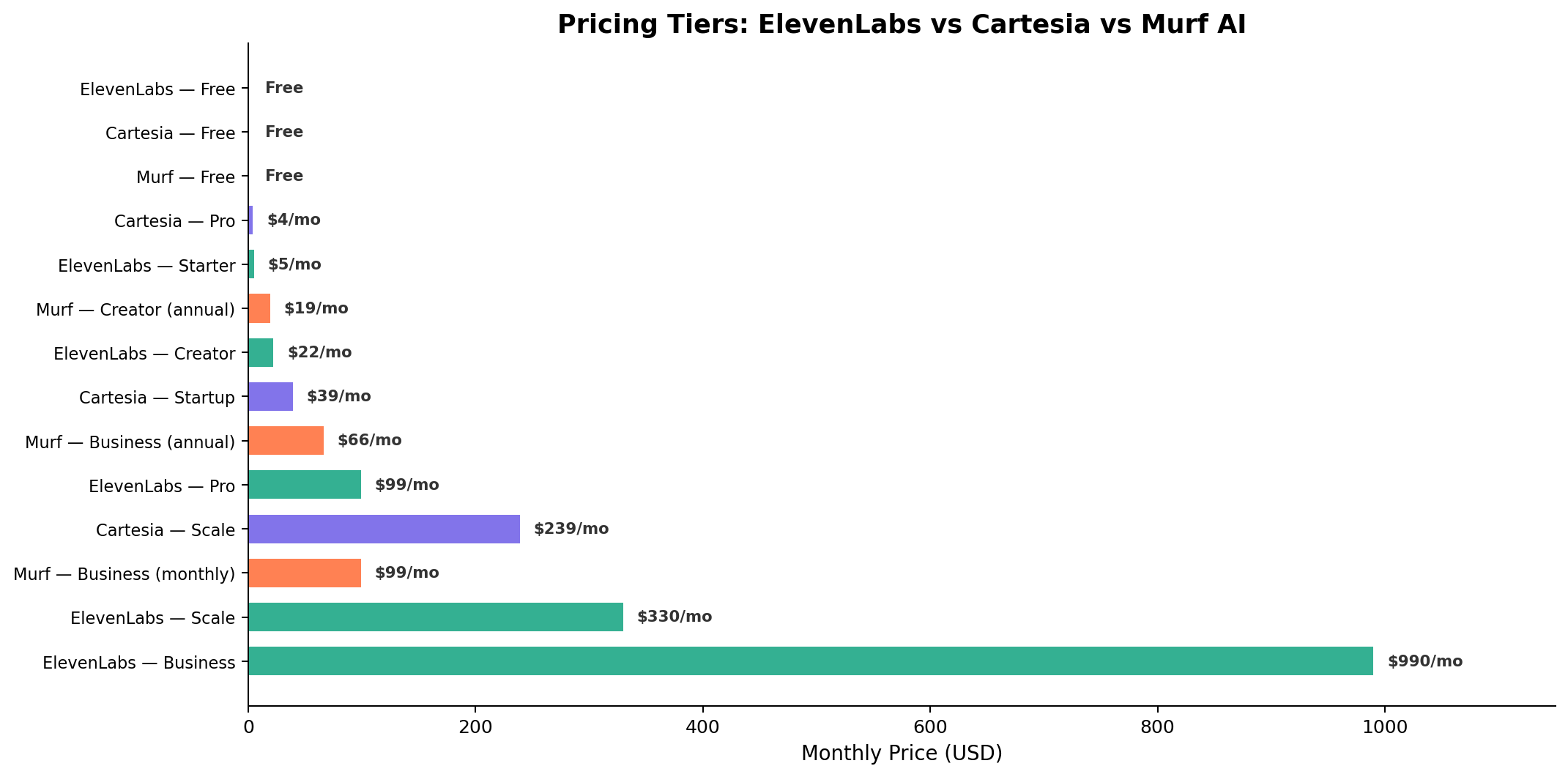
Figure 3: Pricing tiers across all three platforms. Cartesia offers the cheapest entry ($4/mo), while ElevenLabs scales the highest ($990+/mo for Business).
Head-to-Head Comparison
We compared these tools across seven critical dimensions. Each dimension has a clear winner based on our testing.
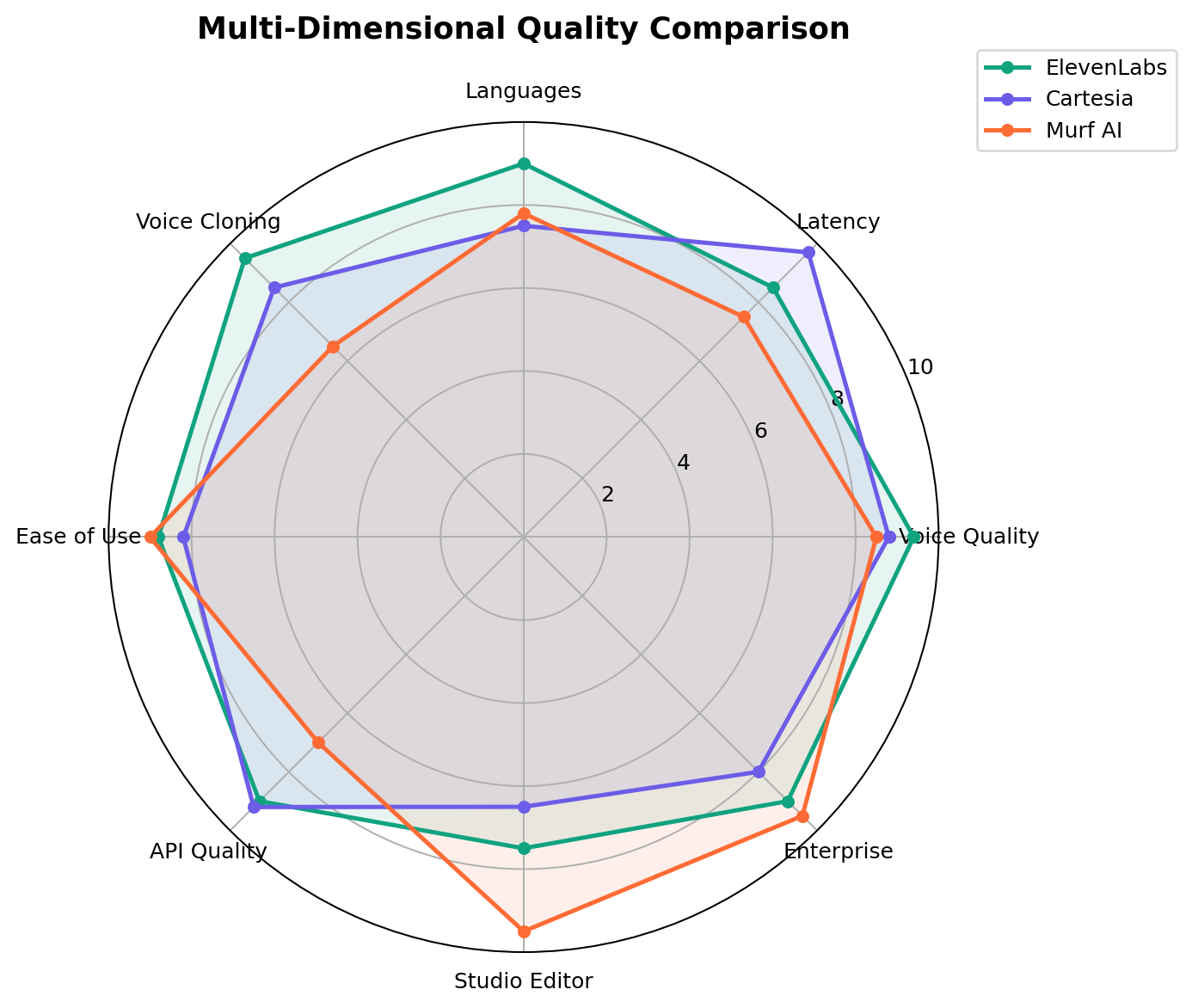
Figure 4: Multi-dimensional radar comparison. ElevenLabs covers the most ground; Cartesia spikes on latency and API; Murf AI dominates studio editing and enterprise.
1. Voice Quality — Winner: ElevenLabs
ElevenLabs produces the most natural, human-like voice output across all three platforms. The Eleven v3 model's emotion tags add a layer of expressiveness that neither competitor can match. Cartesia's Sonic-3 is clean and professional but lacks emotional range. Murf's Gen2 voices are solid for narration but can sound slightly mechanical in conversational contexts. For audiobooks, podcasts, and any content where emotional delivery matters, ElevenLabs is the clear winner.
2. Latency & Speed — Winner: Cartesia
For real-time applications, Cartesia is unmatched. Sonic Turbo's 40ms TTFA and Sonic-3's 90ms TTFA leave ElevenLabs (150ms+ on Flash v2.5) and Murf (130ms on Falcon 2) behind. When you're building conversational AI agents or phone IVR systems where every millisecond of delay reduces caller satisfaction, Cartesia's SSM architecture delivers.
3. Language Support — Winner: ElevenLabs
Seventy-plus languages versus 35 (Murf) and 15 (Cartesia) isn't even close. If you need to generate voice content in Arabic, Hindi, Japanese, Korean, Thai, Turkish, or any of the dozens of other languages ElevenLabs supports, it's the only viable option among the three. Cartesia's 15-language coverage is a dealbreaker for international content strategies.
4. Voice Cloning — Winner: ElevenLabs
ElevenLabs offers the most accessible and highest-quality cloning. Instant cloning from 30 seconds at $5/month beats Cartesia's 5-second cloning on fidelity, and professional cloning from 1+ hour of training data produces results that no competitor approaches. Murf's enterprise-only cloning is too restrictive for most users.
5. Ease of Use & Production Workflow — Winner: Murf AI
Murf's studio editor wins this category decisively. The timeline-based workflow for arranging voice blocks, syncing with visuals, adding background music, and exporting finished productions is significantly more intuitive than either competitor's approach. ElevenLabs' basic editor and Cartesia's API-first design both require more technical comfort.
6. Enterprise & Compliance — Winner: Murf AI
Four compliance certifications (SOC 2 Type II, ISO 27001, HIPAA, ISO 42001) versus the competition's enterprise-only compliance options. For regulated industries — healthcare, finance, government — Murf is the safe choice that procurement teams can approve without months of security review.
7. Value for Money — Winner: Cartesia
Cartesia delivers the most functionality per dollar at the low end: $4/month gets you commercial use, voice cloning, API access, and streaming. ElevenLabs' $5 Starter is close but has lower credit allocation. Murf's $19/month entry is significantly more expensive. At the high end, ElevenLabs offers more scaling options, but Cartesia's Scale plan at $239/month with $0.014/min telephony is excellent value for voice agent deployments.
Real-World Test Scenarios
We tested each tool against three common use cases with real scripts. Here's how they performed.
Scenario 1: Podcast Episode Narration
Script: A 12-minute (1,800 word) technology news podcast episode with multiple segments, dramatic pauses, and varied pacing.
- ElevenLabs: Generated the full episode in under 3 minutes. Used emotion tags for the dramatic opening ([excited]), measured tone for analysis segments, and [whispers] for a tease segment. The multi-speaker feature allowed us to use different voices for the host and "guest" segments. The result sounded professional enough to air without editing. Score: 9.5/10
- Cartesia: Fast generation (under 1 minute), but no emotion tags meant flatter delivery. The 500-character Turbo limit required chunking, which introduced subtle pauses at break points. Fine for informational podcasts, but lacked the production polish. Score: 7.5/10
- Murf AI: The studio editor was excellent for arranging segments on a timeline. Voice quality was good but less expressive than ElevenLabs. Adding background music from the 8,000+ track library was seamless. Best for structured, multi-segment shows. Score: 8.5/10
Scenario 2: YouTube Product Review Voiceover
Script: An 8-minute (1,200 word) product review with intro hook, feature walkthrough, pros/cons section, and call to action.
- ElevenLabs: Voice quality was excellent. The intro hook with [excited] tags grabbed attention. However, syncing the voiceover to video timeline had to be done externally in a video editor. Score: 8.5/10
- Cartesia: Fast generation, clean quality. But the lack of any production tools (no editor, no background music) meant we had to assemble the final video elsewhere. Score: 7.0/10
- Murf AI: The Canva integration let us drop the voiceover directly onto our video project. Word-level emphasis controls let us punch up key product features. The background music library had perfect royalty-free options. This was the smoothest end-to-end workflow for YouTube content. Score: 9.0/10
Scenario 3: Customer Service Voice Agent
Setup: A voice agent handling phone calls for appointment scheduling, answering FAQs, and routing complex inquiries to human agents.
- ElevenLabs: ElevenAgents is a full platform with omnichannel support (phone, web, WhatsApp). Voice quality is excellent. However, the low-latency tier needed for natural phone conversations ($990+/mo Business plan) is prohibitively expensive for most teams. Score: 8.0/10
- Cartesia: Line platform with integrated telephony was purpose-built for this. Sub-90ms latency makes conversations feel natural. The $0.014/min telephony rate on Scale ($239/mo) is the best value for high-volume phone agents. Setup was straightforward. Score: 9.5/10
- Murf AI: Falcon 2 model offers competitive 130ms latency. API supports real-time streaming. However, Murf doesn't offer an integrated voice agent platform — you'd need to build the agent layer separately. Score: 7.0/10
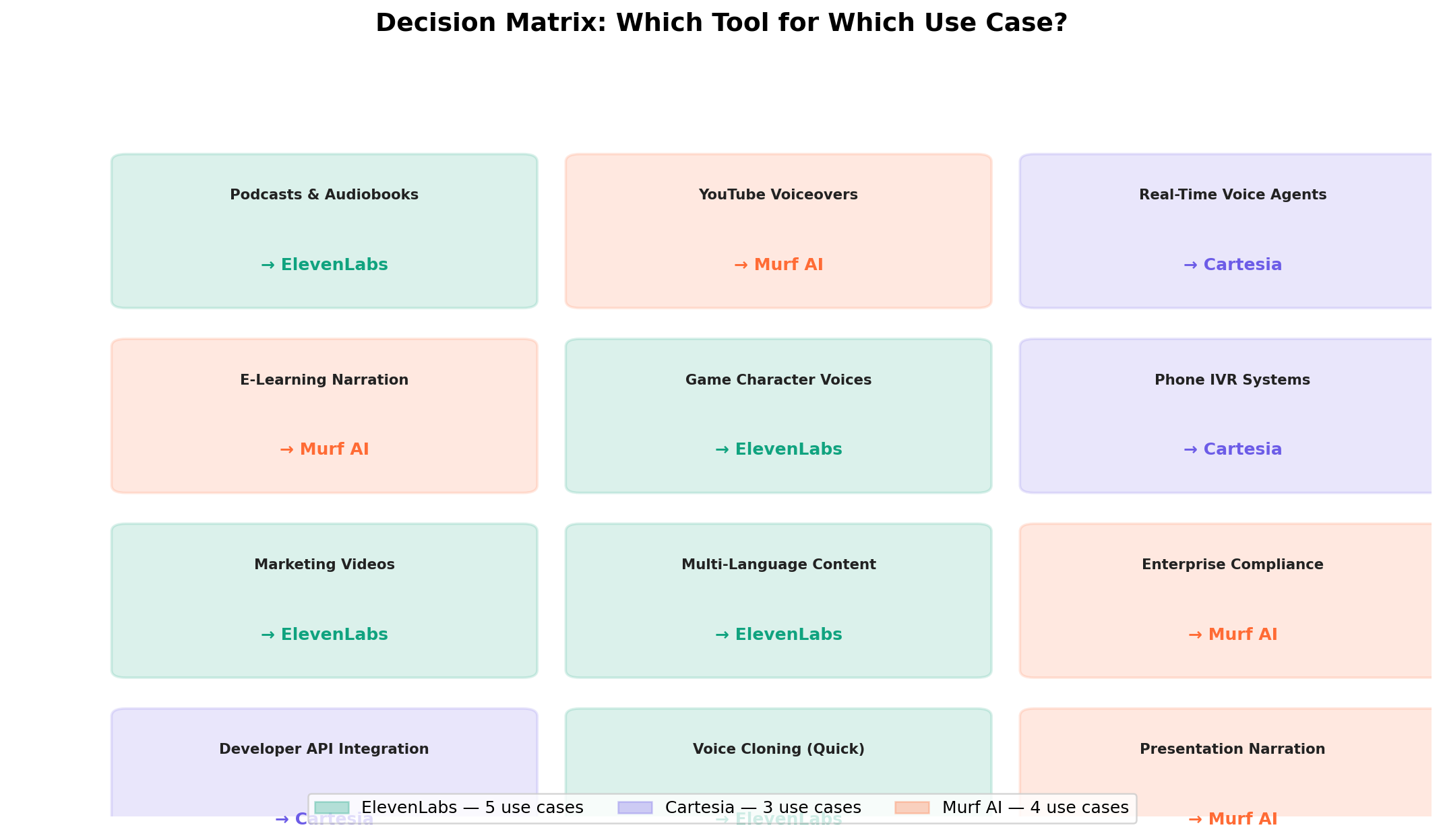
Figure 5: Decision matrix — ElevenLabs dominates content creation (5 wins), Murf leads production workflows (4 wins), Cartesia owns real-time applications (3 wins).
Alternatives Worth Considering
| Tool | Starting Price | Standout Feature | Best For |
|---|---|---|---|
| OpenAI TTS | $0.015/1K chars (pay-per-use) | Cheapest high-quality TTS | Developers already using OpenAI API |
| Google Cloud TTS | $4/mo (1M chars) | WaveNet voices, 50+ languages | Google Cloud ecosystem users |
| Amazon Polly | $0.004/1K chars (standard) | Cheapest option at scale | High-volume, budget-conscious apps |
| Deepgram Aura | Free tier available | Integrated speech-to-speech pipeline | Real-time voice agents needing STT+TTS |
| Fish Audio | Free tier + pay-per-use | 30+ languages, $0.015/1K chars | Budget multilingual TTS |
The Verdict
🏆 Best for Voice Quality & Content Creation → ElevenLabs
If you're creating podcasts, audiobooks, YouTube narration, marketing videos, or any content where voice quality is the primary concern, ElevenLabs is the obvious choice. Its 70+ language support, emotion tags, voice cloning, and massive voice library make it the most versatile platform available.
🏆 Best for Real-Time Voice Agents → Cartesia
For phone IVR, conversational AI, customer service bots, or any real-time voice application, Cartesia's sub-90ms latency and integrated Line platform are unbeatable. The $4/month entry price with voice cloning included is the best deal in AI voice generation.
🏆 Best for Production Workflows & Enterprise → Murf AI
If you need to sync voiceover with video, build narrated presentations in PowerPoint or Google Slides, or work in a compliance-heavy environment (healthcare, finance, government), Murf's studio editor and certification stack have no equal.
💰 Best Overall Value → Cartesia
At $4/month for commercial TTS with voice cloning and API access, Cartesia delivers the most functionality per dollar. For teams on a budget building real-time voice features, it's the clear value pick.
🔄 Hybrid Approach
The most sophisticated teams use all three: ElevenLabs for high-quality content production, Cartesia for real-time customer-facing voice agents, and Murf for compliance-sensitive internal training. The pricing overlap is minimal enough that a mid-size company could subscribe to all three for less than a single voice actor's monthly retainer.
Explore More Comparisons
If you found this comparison useful, check out our other in-depth AI tool showdowns:
- ChatGPT vs Claude vs Gemini (2026): Complete Comparison
- Midjourney vs DALL·E: AI Image Generation Compared
- Runway vs Kling vs Pika: AI Video Generation Showdown
- Surfer vs Semrush vs Frase vs Ahrefs: SEO Tools Compared
Frequently Asked Questions
Is ElevenLabs better than Cartesia for voice generation?
It depends on your use case. ElevenLabs produces higher-quality, more expressive audio and supports 70+ languages — ideal for podcasts, audiobooks, and multilingual content. Cartesia wins on speed with sub-90ms latency, making it the better choice for real-time voice agents and conversational AI. For pre-recorded content, go with ElevenLabs. For live applications, go with Cartesia.
Which AI voice generator is cheapest for beginners?
Cartesia offers the lowest paid tier at $4/month (billed annually) with commercial use rights and instant voice cloning included. ElevenLabs' Starter plan is $5/month. Murf's cheapest paid plan is $19/month (annual), though it includes the timeline editor and 200+ voices. For pure cost, Cartesia wins. For value per dollar on production tools, Murf may justify its higher price.
What happened to Play.ht AI voice generator?
Play.ht was acquired by Meta in July 2025 as part of an acqui-hire of its 35-person team into Meta's "Superintelligence Labs." The platform stopped accepting API requests in late July 2025 and fully shut down on December 31, 2025. All user data — including voice clones, audio files, and API keys — was permanently deleted with no export option. Former users primarily migrated to ElevenLabs (for quality), Murf AI (which offered free 6-month migrations), and Cartesia (for real-time replacement).
Can I use AI voice generators commercially?
Yes — all three platforms offer commercial use on paid plans. ElevenLabs and Cartesia include commercial rights from their lowest paid tier ($5/mo and $4/mo respectively). Murf requires at least the Creator plan ($19/mo annual billing) for commercial use. Free tiers on all platforms are non-commercial only.
Which AI voice tool is best for podcasts?
ElevenLabs is the top pick for podcasts and audiobooks. Its Eleven v3 model supports emotion tags ([excited], [whispers], [sighs]) that add dramatic range to narration. The multi-speaker dialogue feature lets you assign different voices to different speakers. The platform also offers automatic character detection and voice casting for audiobook production. With 10,400+ voices in the Voice Library, you'll never run out of options.
Is Murf AI good for enterprise use?
Murf AI is the strongest enterprise option in this comparison. It holds four major compliance certifications: SOC 2 Type II, ISO 27001, HIPAA, and ISO 42001 (AI Management System). Its integrations with PowerPoint, Google Slides, Canva, and Articulate 360 make it ideal for corporate training, compliance narrations, and regulated industry content. The Falcon 2 model also brings competitive real-time latency for enterprise voice agent use cases.
How does voice cloning work on these platforms?
ElevenLabs offers instant voice cloning from 30 seconds of audio (available on the $5/month Starter plan) and professional voice cloning from 1+ hours of training data (Creator plan and above). Cartesia provides instant cloning from just 5 seconds of audio on the Pro plan ($4/month), with higher-fidelity Pro Voice Cloning available on Startup and above. Murf AI locks all voice cloning behind Enterprise — there is no self-serve option, requiring a custom contract.