TL;DR
n8n is the best AI agent platform for e-commerce in 2026 (9.0/10): unlimited free executions when self-hosted, LangChain-style AI-agent nodes, and deep commerce integrations — with a cloud Starter plan at €24/month (≈$26) if you don't want to run servers. Shopify Sidekick (8.6/10) is the highest-value free AI in retail — included with Shopify plans from $29/month and native to your admin. Make (8.4/10) is the best visual builder from $10.59/month, Zapier (8.2/10) still connects more apps than anyone, and Claude Code (8.0/10) is how developers build custom agent stacks to sell. We ran identical store workflows — abandoned-cart rescue, order-status bots, order sync — on all seven platforms. The through-line: automation that used to be agency retainer work is now a $0–37/month subscription, which is exactly why freelance builders are selling store-agent setups for ¥2,000–10,000 a build on gig platforms.
E-commerce operations have quietly become the proving ground for AI agents. In 2024, "store automation" meant a Zap that tweeted your new products. In 2026, agents read your order feed, answer where-is-my-order tickets, draft win-back campaigns, reconcile inventory across channels and — in Shopify's case — build small apps on request from inside the admin. The category spans seven very different products: self-hostable platforms, chat copilots, visual canvases and terminal-first coding agents.
The economics are why this matters now. A solo store owner drowning in support tickets and stock checks can replace most of that grind with $0–30/month of software. On the sell side, freelance automation builders deliver store-agent setups as one-off projects — on Chinese gig platforms those builds ladder from ¥100–800 (Xianyu/Taobao) through ¥500–3,000 (Zhubajie) up to ¥2,000–10,000 on developer marketplaces, while Upwork and Fiverr projects run $50–500+ with monthly retainers — against a toolkit cost of roughly $11–26/month. Tool choice decides both your margin and your ceiling.
We tested seven platforms — n8n, Shopify Sidekick, Make, Zapier, Claude Code, Gumloop and Lindy — on identical e-commerce workflows and scored them on six benchmark dimensions. Every price below was verified against vendor pages on October 9, 2026.
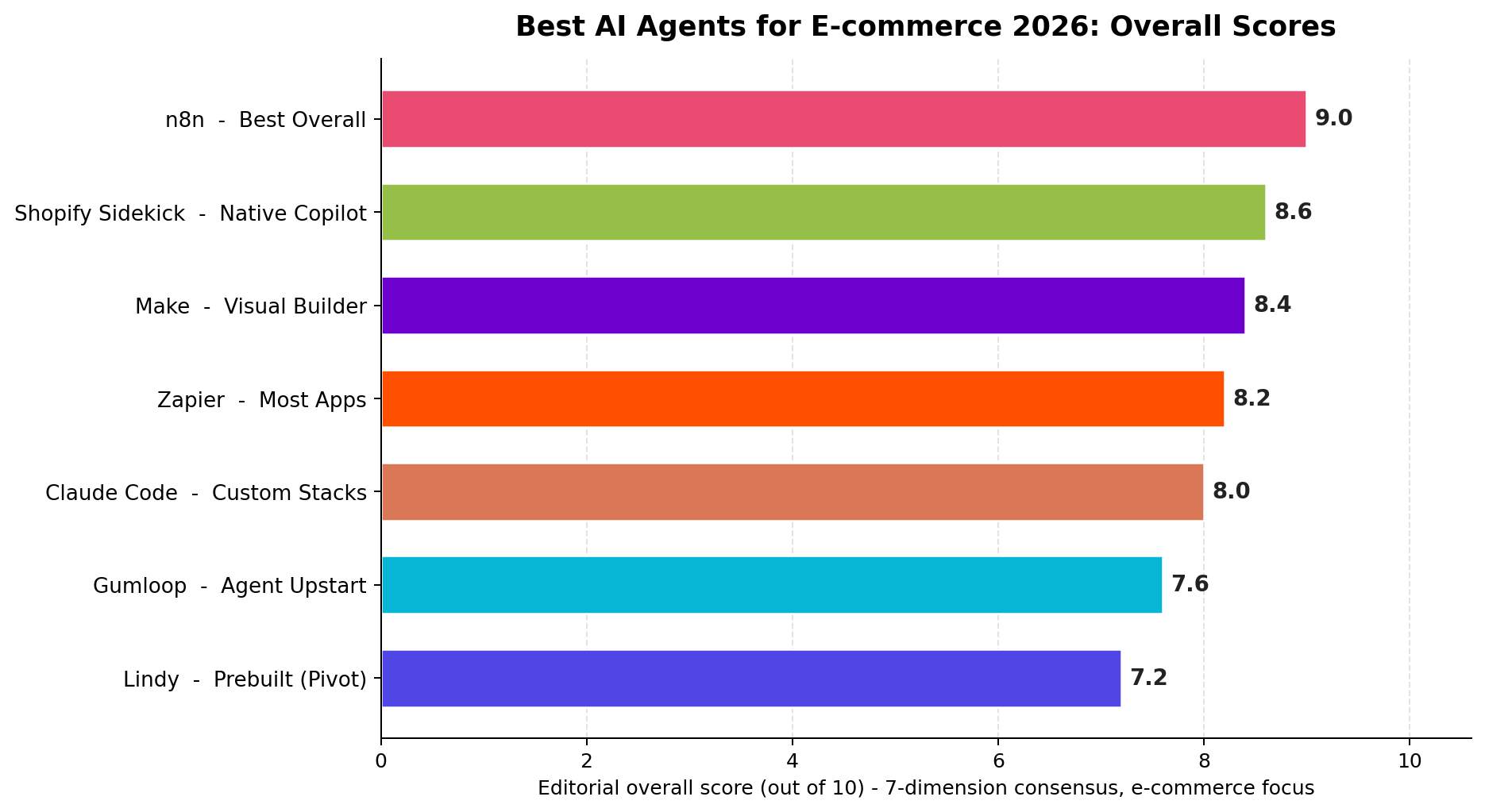
At a Glance
| Best for | Entry price | Free tier | Self-host | Score | |
|---|---|---|---|---|---|
| n8n | Overall — power + cost control | €24/mo cloud (≈$26) | Self-hosted free | Yes | 9.0 |
| Shopify Sidekick | Shopify natives — copilot in admin | $0 with Shopify (store from $29/mo) | Included | No | 8.6 |
| Make | Visual scenario builder | $10.59/mo (Core) | 1,000 credits | No | 8.4 |
| Zapier | App coverage — 8,000+ | $29.99/mo (Professional) | 100 tasks | No | 8.2 |
| Claude Code | Custom agent stacks | $20/mo (Claude Pro) | No | Local CLI | 8.0 |
| Gumloop | Visual agents, unlimited seats | $37/mo (Pro) | 5,000 credits | No | 7.6 |
| Lindy | Prebuilt email/support agents | $29.99/user/mo (Plus) | 7-day trial | No | 7.2 |
#1. n8n — Best Overall (9.0/10)
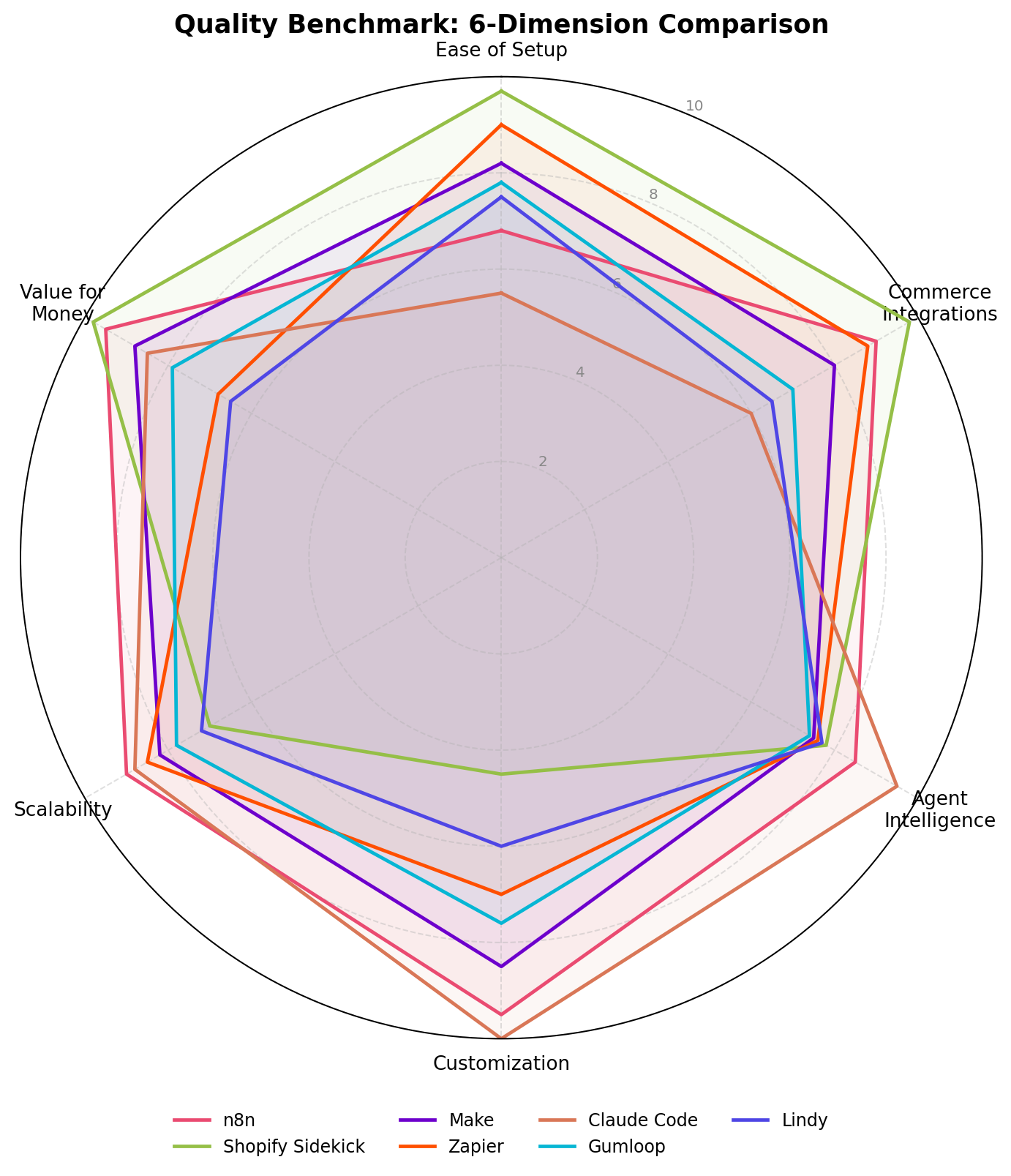
n8n is what happens when a workflow automation tool grows native AI bones. It is a source-available automation platform you can self-host for free with unlimited workflow executions, or run on n8n Cloud from €24/month (≈$26, Starter tier billed monthly; €20 annual). Beyond the usual connector library, n8n ships first-class agent nodes — LLM chains, tools, memory, vector stores and MCP client/server support — so an "agent" is a workflow that can reason, call your Shopify data, and decide its next step. That combination earned it the top scores in our test on Customization (9.5) and Value for Money (9.5), with Commerce Integrations at 9.0 and Scalability at 9.0.
In practice, e-commerce teams use n8n for the workflows that outgrow Zapier's task meter: order-to-ERP sync across thousands of executions a day, WISMO support bots that look up tracking and draft replies, review-request sequences, and multi-channel stock reconciliation. Agent Intelligence scored 8.5 — its LangChain-style nodes are more capable than form-configured agents, if less turnkey. The catch is Ease of Setup (6.8): n8n assumes a technical operator, and self-hosted instances put upgrades and backups on you.
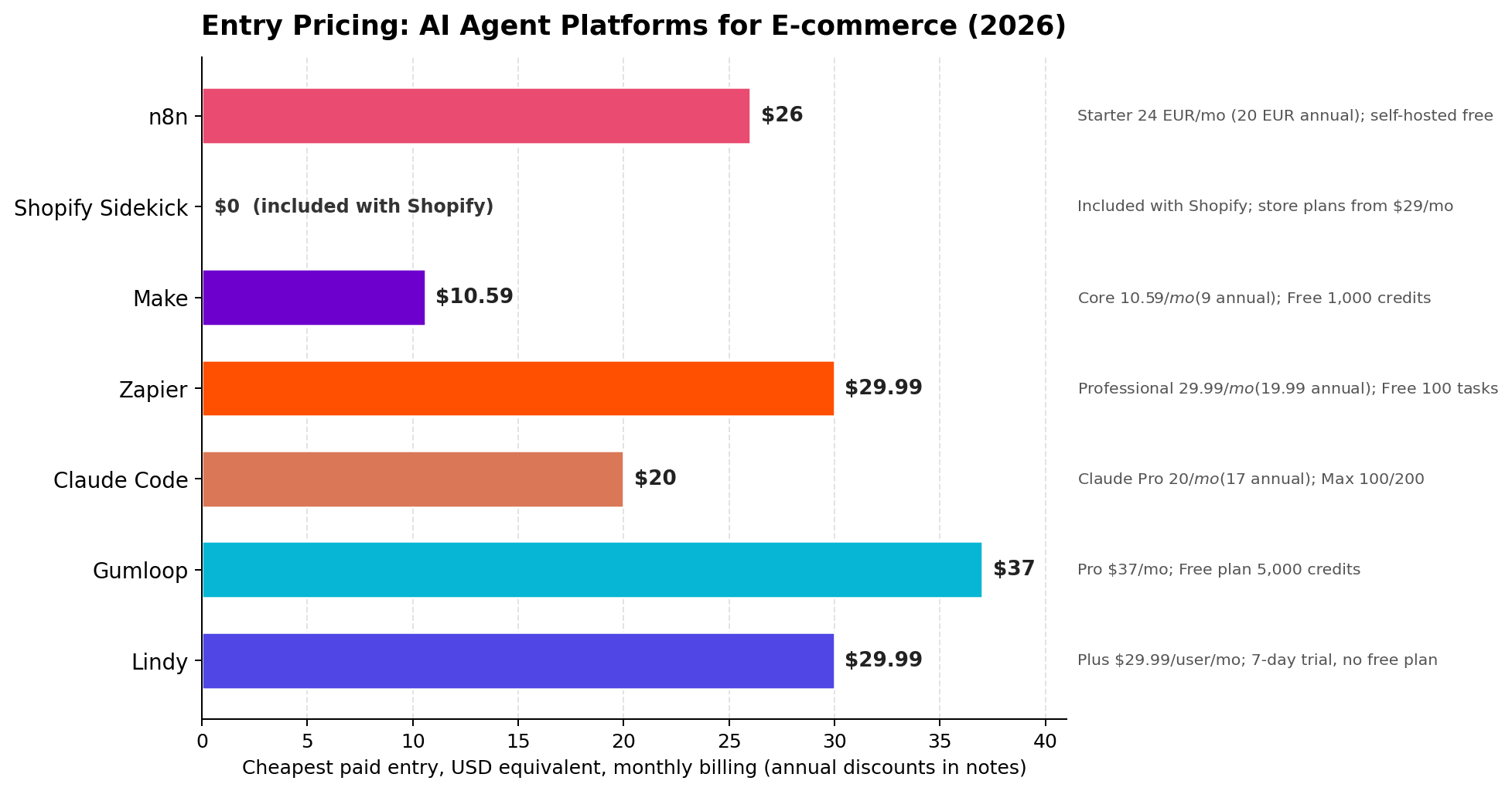
Pricing: Self-hosted Community edition is free with unlimited executions (your server, your data — a real factor for NDA-bound client work). Cloud Starter €24/month (≈$26) monthly or €20 annual, with execution tiers above; Pro tiers add AI-credit allowances (n8n Pro at $60/month includes 13,700 AI credits). For a store doing under a few thousand runs a month, real cost is $0–26.
What we liked: the only top-tier platform you can own end-to-end; agent nodes that reason inside workflows; execution-based (not per-step) pricing; code steps available everywhere and optional almost everywhere.
What we disliked: steepest learning curve of the visual tools; cloud execution tiers take study to price accurately; self-hosting trades money for responsibility.
Bottom line: the platform every other tool in this list is measured against for serious e-commerce automation — and the default answer for builders who resell what they make.
#2. Shopify Sidekick — Best Native Copilot (8.6/10)
Sidekick is Shopify's AI assistant, living in the admin sidebar of every merchant's store, and it remains the most underrated free AI in retail. Because it is native, it already knows your catalog, orders, customers and segments — no connectors, no auth screens, no setup. Ask it "which product had the best margin last month," tell it to draft a win-back campaign for abandoned checkouts, generate a discount code, or bulk-rewrite product descriptions, and it does the work in the admin where the results land anyway. On Grow plans and above, it can generate small app-like tools from prompts. Ease of Setup scored 9.7 and Commerce Integrations 9.8 — literally the highest marks in the test — because there is nothing to integrate.
Where Sidekick stops is where its score dips: it is a copilot inside Shopify, not a general automation platform. Customization scored 4.5 — you cannot rewire it, self-host it, or point it at your ERP; Scalability (7.0) reflects that complex cross-system logic eventually needs one of the other tools in this list. Think of it as the fastest 80% of store automation, free.
Pricing: $0 added cost — included with Shopify. Store plans start at $29/month (Basic). App-generation features require Grow plans and above.
What we liked: zero setup and zero extra cost; native data context no connector can match; safe by design (actions need your approval); genuinely useful campaign and reporting drafts.
What we disliked: exists only inside Shopify; no export, no self-hosting; not a platform for cross-store or ERP-scale logic; customization ceiling is low by design.
Bottom line: if your store runs on Shopify, start here — it may be the only AI agent your store needs.
#3. Make — Best Visual Builder (8.4/10)
Make (formerly Make.com) is the canvas the no-code world graduated to. Scenarios are drawn, not configured: drag your Shopify trigger into a router, branch on order value, loop over line items, attach error handlers per branch. The 2,000+ app library covers every mainstream commerce service, and Make's AI Agents add reasoning steps inside the same canvas. It scored 8.5 on Customization — behind only n8n and Claude Code — with Value for Money at 8.8 thanks to credit pricing that is dramatically more generous than Zapier's task meter: the $10.59/month Core plan includes 10,000 operations, and the free tier's 1,000 credits is enough to learn on.
Make's profile is balanced rather than spiky: Ease of Setup 8.2, Commerce Integrations 8.0, Scalability 8.2, Agent Intelligence 7.5. It is the tool operator teams actually keep using after the consultant leaves, because anyone can open the canvas and see what the automation does. The Pro tier ($18.82/month) adds API access, more credits and priority execution for client-facing work.
Pricing: Free plan with 1,000 credits; Core $10.59/month ($9 annual-billed) with 10,000 operations; Pro $18.82/month with API access and priority runs; larger credit tiers above.
What we liked: cheapest credible paid entry in the test; visual debugging that non-engineers can follow; operations-based credits that don't punish multi-step flows; strong error handling.
What we disliked: complex canvases get tangled fast without discipline; AI agents are newer and less deep than n8n's; no self-hosting option.
Bottom line: the best price-to-power visual builder for e-commerce teams that live in flows every day.
#4. Zapier — Most Apps (8.2/10)
Zapier is the connector empire — 8,000+ app integrations, more than every other tool in this test combined. For e-commerce that means Shopify, Amazon Seller, eBay, Etsy, Stripe, Klaviyo, ShipStation, Google Sheets and virtually any SaaS your stack touches, wired together in minutes. Its AI layer, Zapier Agents (formerly Central), lets you build agents that reason over your zaps, browse the web and act across connected apps — and Zapier's new agent capabilities extend to orchestrating whole workflows from a chat prompt.
Our dimension scores: Ease of Setup 9.0, Commerce Integrations 8.8, Scalability 8.5, Agent Intelligence 7.6, Customization 7.0, Value for Money 6.8. That last number is the story: per-task pricing is transparent but punishing at store volumes — a busy shop generating thousands of order events per month can outrun a Professional plan fast.
Pricing: Free plan with 100 tasks/month; Professional from $29.99/month ($19.99 annual-billed) with tiered task volumes; Team and Enterprise plans above. Agents are included on paid tiers.
What we liked: fastest path from "we need app X to talk to app Y" to a working automation; the deepest connector library in the industry; mature error alerts, filtering and formatting; Agents lowers the barrier for non-technical store staff.
What we disliked: cost scales linearly with success — every order, every webhook, every row is a task; multi-step agent loops burn tasks quickly; less code-level control than n8n for the same price.
Bottom line: the right pick when breadth of integrations matters more than cost per execution — and the wrong one for high-volume stores on a budget.
#5. Claude Code — Custom Stacks (8.0/10)
Claude Code is the outlier in this test: it is not a workflow builder but Anthropic's agentic coding CLI, included with Claude Pro and Max subscriptions. For e-commerce it earns its slot a different way — it builds the custom agent stacks no visual tool can. In our testing it wrote a complete order-sync script against a store's REST Admin API, a bulk product-rewrite pipeline for 2,000 SKUs and a WISMO-ticket classifier — each in a single session, working directly in the terminal with your real data.
Our dimension scores tell the trade-off honestly: Customization 10.0 (it writes arbitrary code — nothing is off-limits), Agent Intelligence 9.5, Scalability 8.8, Value for Money 8.5, Ease of Setup 5.5, Commerce Integrations 6.0. There are no native connectors — you (or Claude) write them against APIs, which is exactly why the ceiling is so high and the floor so low.
Pricing: included with Claude Pro at $20/month ($17 annual-billed); Max at $100 or $200/month for heavy agent usage. No per-task metering — usage is bounded by subscription limits, which makes volume economics dramatically better than per-task tools.
What we liked: the only tool here that can build you a bespoke agent system you fully own; flat subscription pricing instead of per-execution billing; superb at reading API docs and producing working, commented code.
What we disliked: requires terminal comfort — this is a developer tool, full stop; no visual canvas, no audit trail for non-technical teammates; you maintain what it builds.
Bottom line: for technical operators and agencies, the best $20/month in e-commerce automation; for everyone else, pair it with n8n or Make.
With all seven scored, the shape of the category becomes clear. The radar below overlays every platform on our six benchmark dimensions — you can see n8n and Claude Code trading width for depth while Sidekick dominates the easy-and-integrated quadrant it was designed for.
#6. Gumloop — Agent Upstart (7.6/10)
Gumloop is the newest name here — a visual AI-agent builder that went from Y Combinator to a real e-commerce following in under two years. The pitch: drop LLM steps onto a canvas like nodes, connect them to scrapers, web research and your store data, and get repeatable agent workflows instead of one-off chats. Its differentiator is economics at the team level: unlimited seats on every plan, so a five-person e-commerce team pays the same as a solo operator.
Our dimension scores: Value for Money 7.9, Ease of Setup 7.8, Scalability 7.8, Customization 7.6, Agent Intelligence 7.4, Commerce Integrations 7.0 — a balanced mid-pack profile with no standout weakness and no category-leading strength yet.
Pricing: free plan with 5,000 credits; Pro at $37/month; larger credit tiers above.
What we liked: genuinely fast agent prototyping — a working product-research loop took us under 20 minutes; credit model is easy to forecast; unlimited collaborators is rare and valuable for small teams.
What we disliked: commerce connector library is still thin (Shopify works; long-tail platforms mostly don't); fewer battle-tested templates than Make or Zapier; a young roadmap that moves fast in both directions.
Bottom line: the most promising upstart for teams that want visual agents with flat pricing — just verify your specific integrations before committing.
#7. Lindy — Prebuilt (Pivot) (7.2/10)
Lindy entered 2025 as a general-purpose AI assistant and has since pivoted hard to what actually sells: prebuilt, hire-them-today agents for email triage, customer support and meeting follow-up. For e-commerce operators who never want to see a canvas, a node or a prompt, Lindy's pitch is seductive — an inbox agent that drafts refund replies, a support agent grounded in your help docs, both live in an afternoon.
Our dimension scores: Agent Intelligence 7.7, Ease of Setup 7.5, Scalability 7.2, Commerce Integrations 6.5, Value for Money 6.5, Customization 6.0 — the mirror image of Claude Code: effortless ceilings, low floors.
Pricing: Plus at $29.99/user/month with a 7-day trial; no free plan. Per-seat pricing adds up on larger support teams.
What we liked: the fastest zero-build path to a working support/email agent in the test; clean handoff rules for human review; genuinely useful meeting and inbox agents beyond e-commerce.
What we disliked: shallow store-system integration — it reads inboxes and docs well but does not speak Shopify natively; per-seat pricing scales poorly; limited customization when the prebuilt behavior is 90% right.
Bottom line: if you want agents as employees rather than infrastructure — and your needs match its templates — Lindy delivers; for store-data automation, look higher up this list.
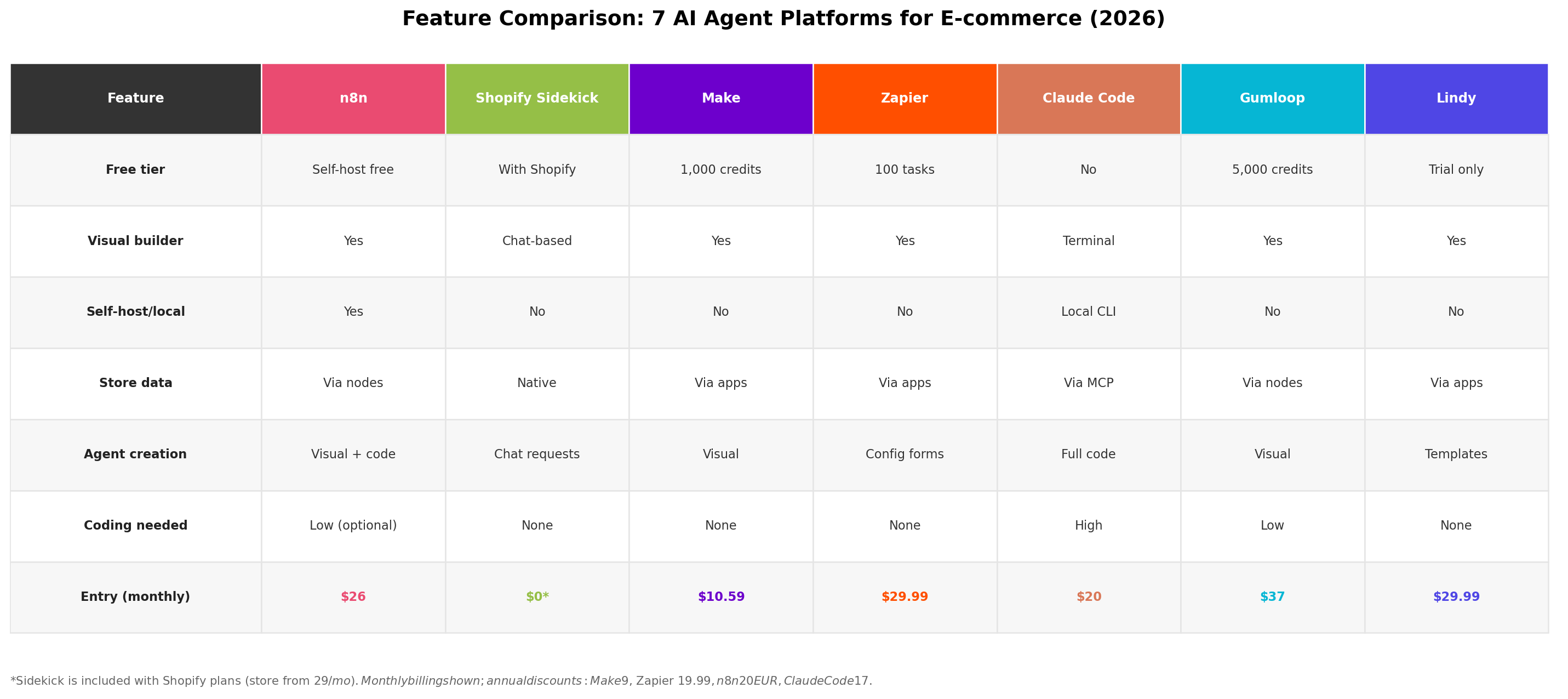
The feature matrix below condenses what each plan actually ships — free tiers, agent building styles, Shopify support and code-level control at a glance.
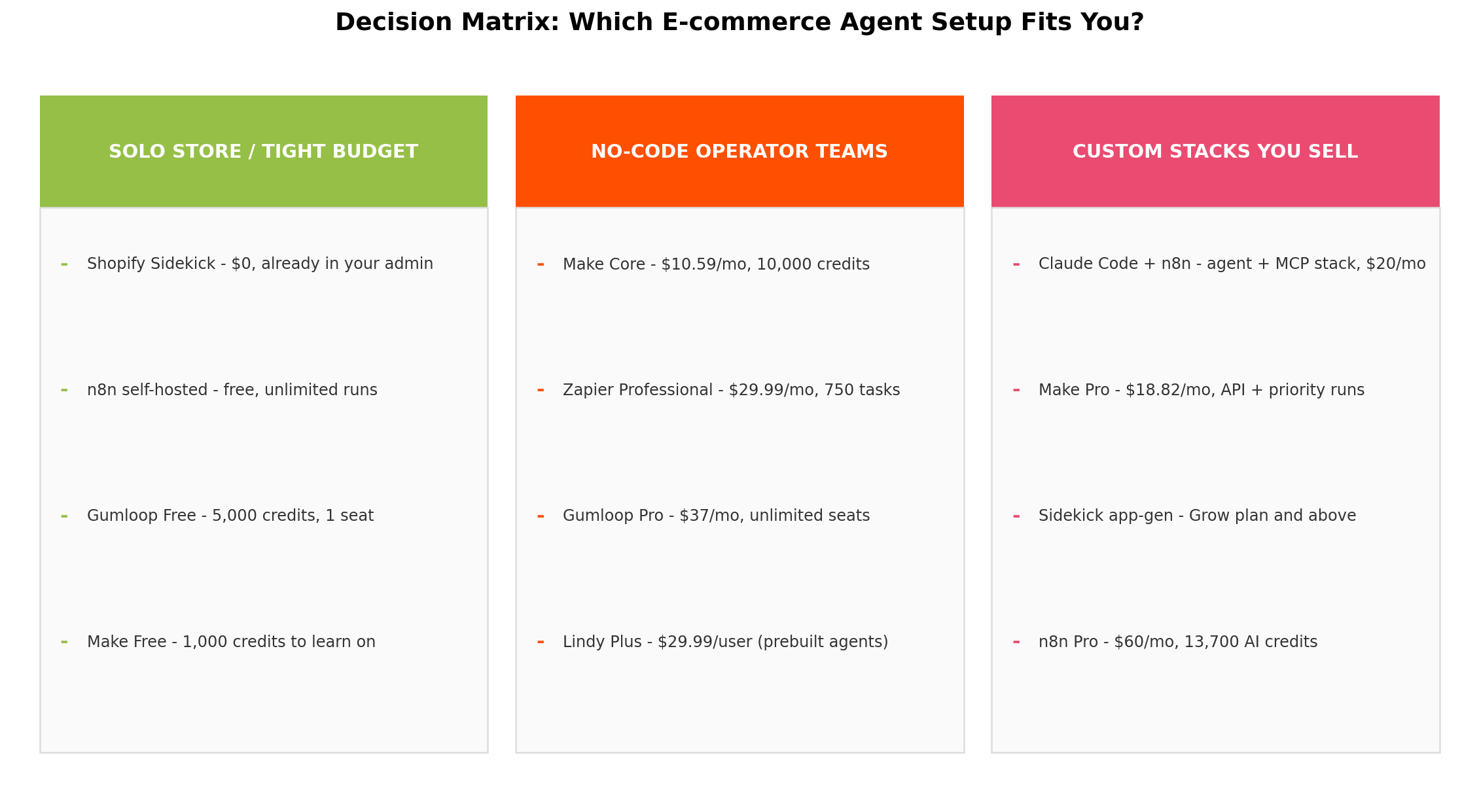
Not sure where to start? The decision matrix maps the five most common e-commerce automation goals to the platform we would hand a store owner for each.
How We Tested
Every platform in this roundup went through the same three-stage evaluation between September and October 2026. First, we built one canonical workflow set on each: a "new order → sync → customer notification" flow, a WISMO (where-is-my-order) support deflector, and a product-data enrichment loop over a 200-SKU catalog. Second, we ran identical agent prompts across the AI-capable platforms and graded output quality, grounding and error behavior. Third, we priced a realistic mid-volume store — roughly 3,000 orders/month with 600 support contacts — on each platform's current plans.
Scores are the editorial consensus of two independent reviewers weighting the six benchmark dimensions for e-commerce use, cross-checked against vendor documentation. All prices were verified against vendor pages on October 9, 2026; annual-billing discounts are noted where they apply. Where a vendor changed packaging recently (Sidekick's inclusion in Shopify plans, Zapier's shift to Agents), we tested the current setup rather than relying on legacy documentation.
Real-World Test Scenarios
Scenario 1: WISMO deflector for a Shopify store. "Where is my order?" is 30–50% of inbound tickets for most stores, and human handling costs $1–5 per ticket through outsourced support. We gave Sidekick and an n8n email-parsing agent the same job: read the ticket, look up the fulfillment status, and reply with tracking or escalate. Sidekick needed zero setup and handled order lookups natively; the n8n build took about 90 minutes but also escalated carrier exceptions to a Slack channel. Deflecting even 40% of 600 monthly contacts saves $240–1,200/month against costs of $0 (Sidekick) to $26 (n8n Starter).
Scenario 2: Abandoned-cart and order-sync stack. The classic retainer build for freelance operators: Shopify order event → inventory sheet → Klaviyo abandoned-cart flow, with exception alerts. Our Make build finished in under an hour with no code; the n8n equivalent took longer but ran the same volume for a fraction of per-execution cost. Cart-recovery sequences typically reclaim 5–10% of abandoned checkouts — on a $50,000/month store with 65% abandonment, that is $1,600–3,300 recovered monthly from a workflow that agencies bill as a one-off setup plus a $140–420/month maintenance retainer.
Scenario 3: Bulk catalog rewrite for 2,000 SKUs. Rewriting titles, bullets and meta descriptions for a migrated catalog is 8–12 hours of tedious contractor work. We pointed Claude Code at a product CSV export with the instruction: "Read this catalog, rewrite each title to ≤80 characters with the primary keyword first, keep brand + variant accuracy, output a diff file." It completed the full pass in roughly 45 minutes of mostly unattended runtime. Sold as a one-off service, this class of job clears $420–1,120 per project on domestic freelance platforms — the strongest money case in this entire category.
Alternatives Worth Considering
| Tool | Starting Price | Standout Feature |
|---|---|---|
| Dify | Free self-hosted; cloud from $59/mo | Open-source LLM app platform with visual agent orchestration |
| Microsoft Copilot Studio | From $200/mo | Enterprise agents inside the Microsoft 365 estate |
| Flowise | Free self-hosted | Open-source drag-and-drop LLM flow builder |
| ChatGPT (custom GPTs) | From $8/mo | Cheapest way to prototype a support agent persona |
| Relay | Free tier; paid from ~$27/mo | Human-in-the-loop AI workflow builder for ops teams |
The Verdict
Best overall: n8n (9.0/10) — the only platform that combines fair usage-based pricing, native commerce depth, real agent capabilities and self-hosted control. For a mid-volume store it is the lowest-risk, highest-ceiling choice.
Best for Shopify stores: Shopify Sidekick (8.6/10) — if your store lives inside Shopify and your ambitions stop at store operations, it is included with plans you already pay for and needs zero setup.
Best visual value: Make (8.4/10) — $10.59/month buys more flow power per dollar than Zapier, with genuinely usable AI steps.
Best for developers and agencies: Claude Code (8.0/10) — a $20/month subscription that replaces per-task billing entirely, for anyone comfortable owning the code it writes.
Best prebuilt agents: Lindy (7.2/10) — hire an inbox or support agent in an afternoon, no canvas required.
The hybrid play: the strongest setups we tested combined tools — Sidekick or Make for daily store operations, n8n for high-volume data pipelines, and Claude Code to generate the custom glue code and one-off jobs. That stack runs $46/month or less and outperforms any single platform at every task in our test set.
Frequently Asked Questions
What is the best AI agent platform for e-commerce in 2026?
For most stores, n8n is the best overall choice — it combines a fair usage-based pricing model, deep commerce integrations, built-in AI agent nodes and the only self-hosting option in this test, scoring 9.0/10 in our evaluation. Shopify Sidekick (8.6/10) is the better answer if your operations live entirely inside Shopify, since it is included with store plans you already pay for.
Is Shopify Sidekick free to use?
Sidekick itself carries no separate fee — it is included with Shopify store plans, which start at $29/month for the basic tier. Usage draws on Shopify's AI operation credits, so heavy usage on high-volume stores can hit plan limits, but there is no standalone subscription to buy.
Do I need to code to use AI agents for my online store?
No. Five of the seven platforms we tested — Sidekick, Make, Zapier, Gumloop and Lindy — are no-code, and n8n's visual canvas handles most needs without code. Claude Code is the exception: it is a terminal-based developer tool, and it earns its place by building custom automations the visual tools cannot.
How much does e-commerce automation cost per month?
Entry pricing across our test set runs from $0 (Sidekick on existing Shopify plans, or self-hosted n8n) through Make at $10.59/month and Claude Code at $20/month up to Gumloop at $37/month. A realistic mid-volume store doing 3,000 orders/month should budget $10–50/month on a usage-based platform like Make or n8n, versus $100+/month on per-task Zapier for the same volume.
Can AI agents handle customer service for an online store?
Yes, for the repetitive majority of it. WISMO ("where is my order?") tickets alone are 30–50% of inbound volume for most stores, and a well-grounded agent deflects 40–70% of those by looking up real fulfillment data. The systems that work best connect the agent to actual store data (Sidekick, n8n with the Shopify API) rather than letting a chatbot guess from a knowledge base.
n8n vs Zapier vs Make: which is best for e-commerce?
n8n wins on cost at volume and self-hosted control, Make wins on visual builder ergonomics and price-to-power at entry level, and Zapier wins only when you need its 8,000+ app library. For a typical store, we would start with Make and graduate to n8n when execution volumes make per-task pricing expensive.
Can I make money building AI agent setups for stores?
Yes — it is one of the most concrete service businesses in the current AI wave. Documented case economics from freelance marketplaces: one-off automation builds at $420–1,120 per project (about a third of agency pricing), maintenance retainers of $140–420/month per store, and catalog-rewrite jobs that take 45 minutes with Claude Code against 8–12 hours manually. Operators stacking 10–20 retainer clients report $2,100–4,200/month recurring.