TL;DR
ChatGPT is the better overall writing subscription (8.2/10): from $8/month it drafts fiction, non-fiction, blurbs, translations and cover concepts, with web research and a ~1M-token context window in the mix. Sudowrite (7.9/10) is the better novel-writing machine: it won 4 of our 7 dimensions, including novel-length consistency (9.2 vs 7.5) and fiction toolset (9.4 vs 6.5), because the Story Bible keeps an 80,000-word draft coherent in a way ChatGPT Projects simply does not. We drafted the same three chapters of a fantasy manuscript on both tools and scored them on seven dimensions. The money angle: serialized-fiction writers monetizing on KDP and web-novel platforms get chapter throughput from Sudowrite, while budget non-fiction publishers we track run entire production lines on ChatGPT's $8 Go tier. Pick ChatGPT if writing is one of many things you do; pick Sudowrite if the novel is the business.
Every few months a writer asks the same question in a new form: "Why would I pay $29 a month for a fiction tool when I already pay for ChatGPT?" In 2026 the question is sharper than ever, because ChatGPT is genuinely good at prose — GPT-6 Astra drafts scenes that read like a competent human first pass, and the Projects feature finally gives you a persistent place to park your outline and style notes. The general-purpose chatbot is eating every writing niche from the bottom.
Sudowrite's counter-argument is that novels are not a chat problem. A novel is 60–100,000 words of state: who knows what, which promises the narrator made in chapter two, the dialect of a side character introduced forty pages ago. Sudowrite's whole product is managing that state — a Story Bible that syncs to your prose, scene-level craft tools like Describe and Rewrite, and a chapter generator that drafts from your outline while the bible holds continuity steady. Under the hood it is not one model but a switchboard: Muse 1.5 (its fiction-tuned engine), Claude, and DeepSeek, selectable per scene.
We ran both tools through the same test: a 3-chapter fantasy excerpt with an ensemble cast, a mid-draft twist, and a strict style brief, followed by a blurb-and-marketing pass on the finished text. We scored seven dimensions, verified October 2026 pricing on both vendors' sites, and checked the results against what working writers actually get paid. The short version: it is closer than Sudowrite's marketing suggests and closer than ChatGPT fans want to admit — and the right answer depends entirely on what you are writing and what you are selling.
At a Glance
| Dimension | ChatGPT | Sudowrite | Winner |
|---|---|---|---|
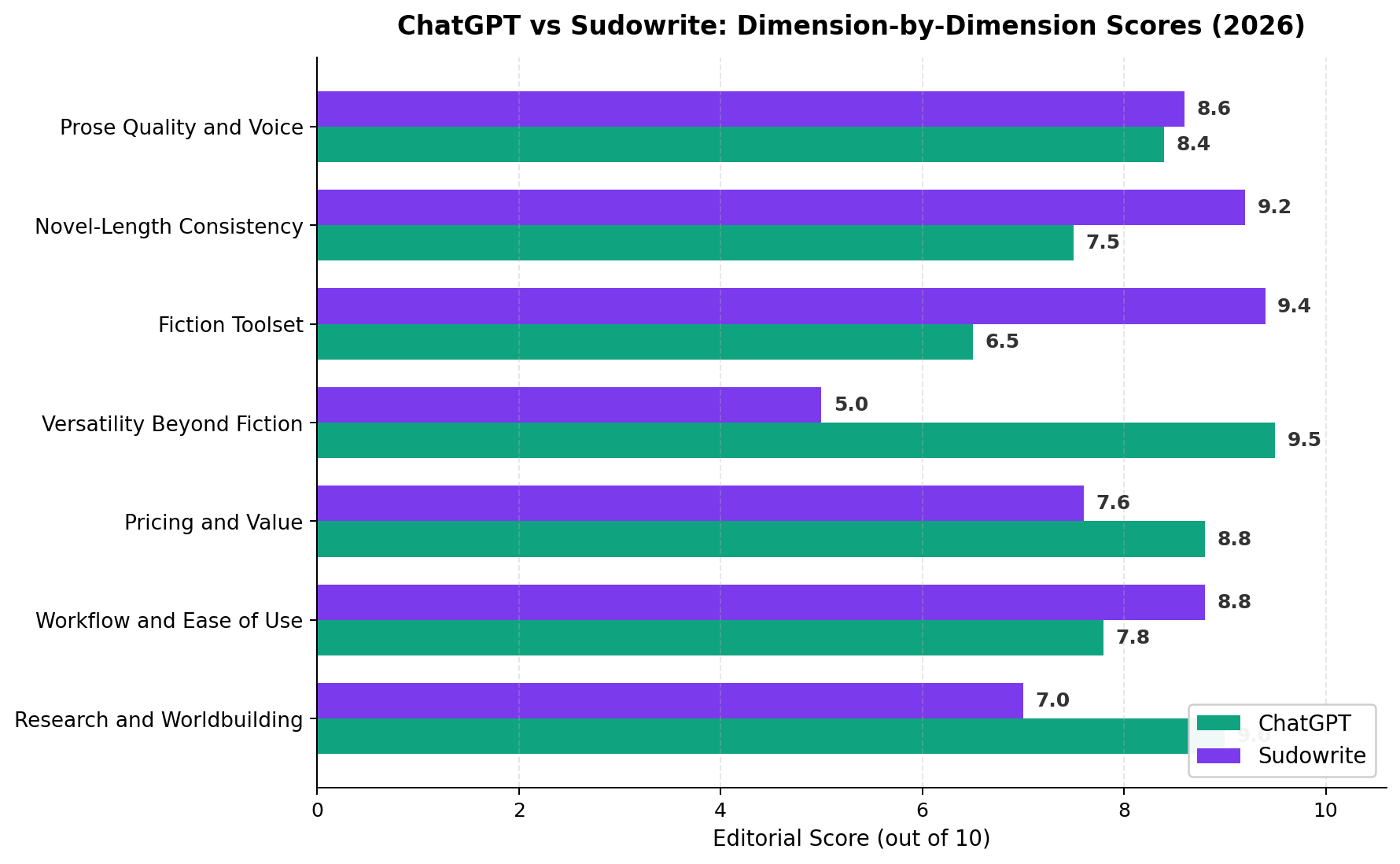
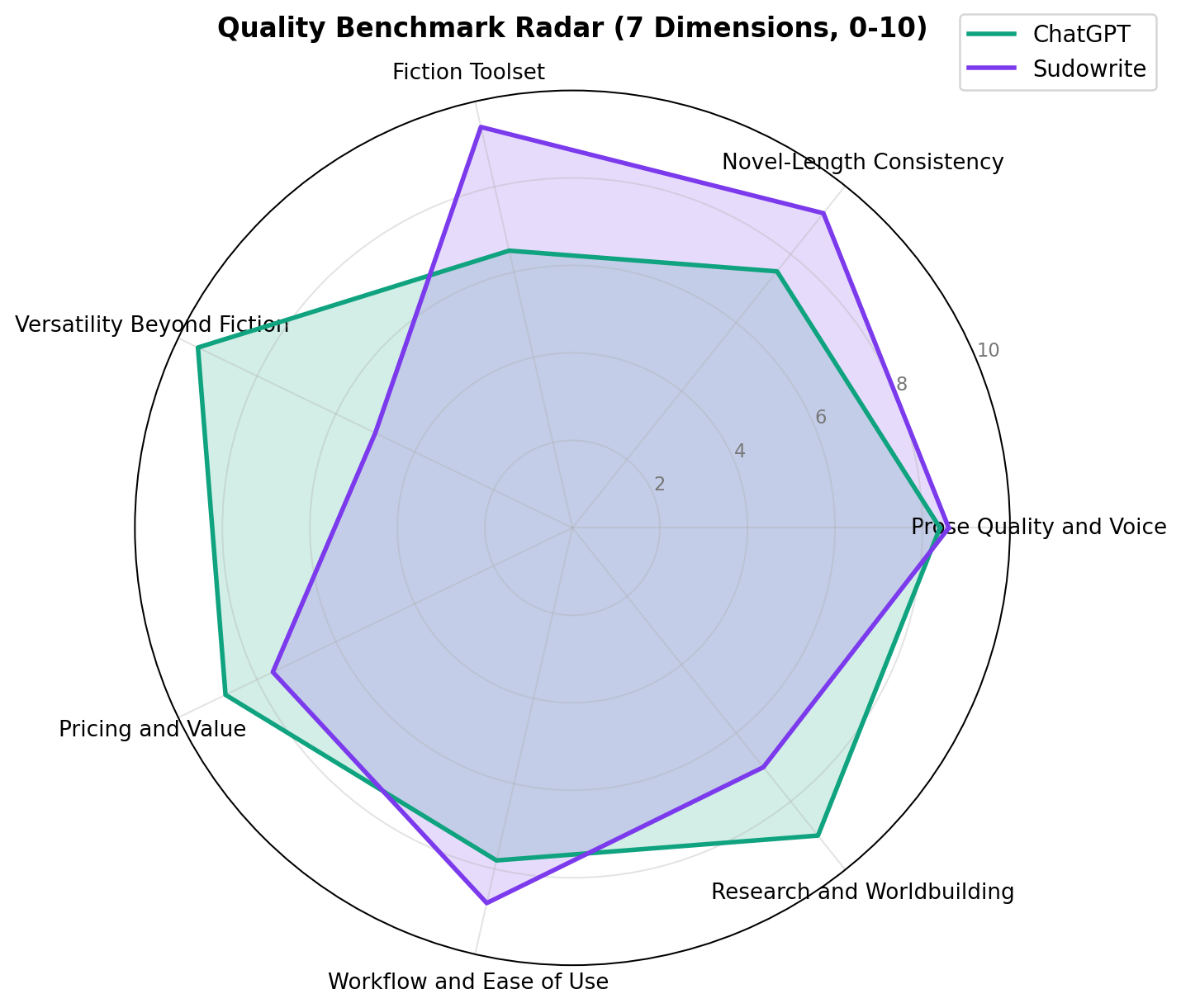
| Prose Quality and Voice | 8.4 | 8.6 | Sudowrite |
| Novel-Length Consistency | 7.5 | 9.2 | Sudowrite |
| Fiction Toolset | 6.5 | 9.4 | Sudowrite |
| Versatility Beyond Fiction | 9.5 | 5.0 | ChatGPT |
| Pricing and Value | 8.8 | 7.6 | ChatGPT |
| Workflow and Ease of Use | 7.8 | 8.8 | Sudowrite |
| Research and Worldbuilding | 9.0 | 7.0 | ChatGPT |
| Overall | 8.2 | 7.9 | ChatGPT |
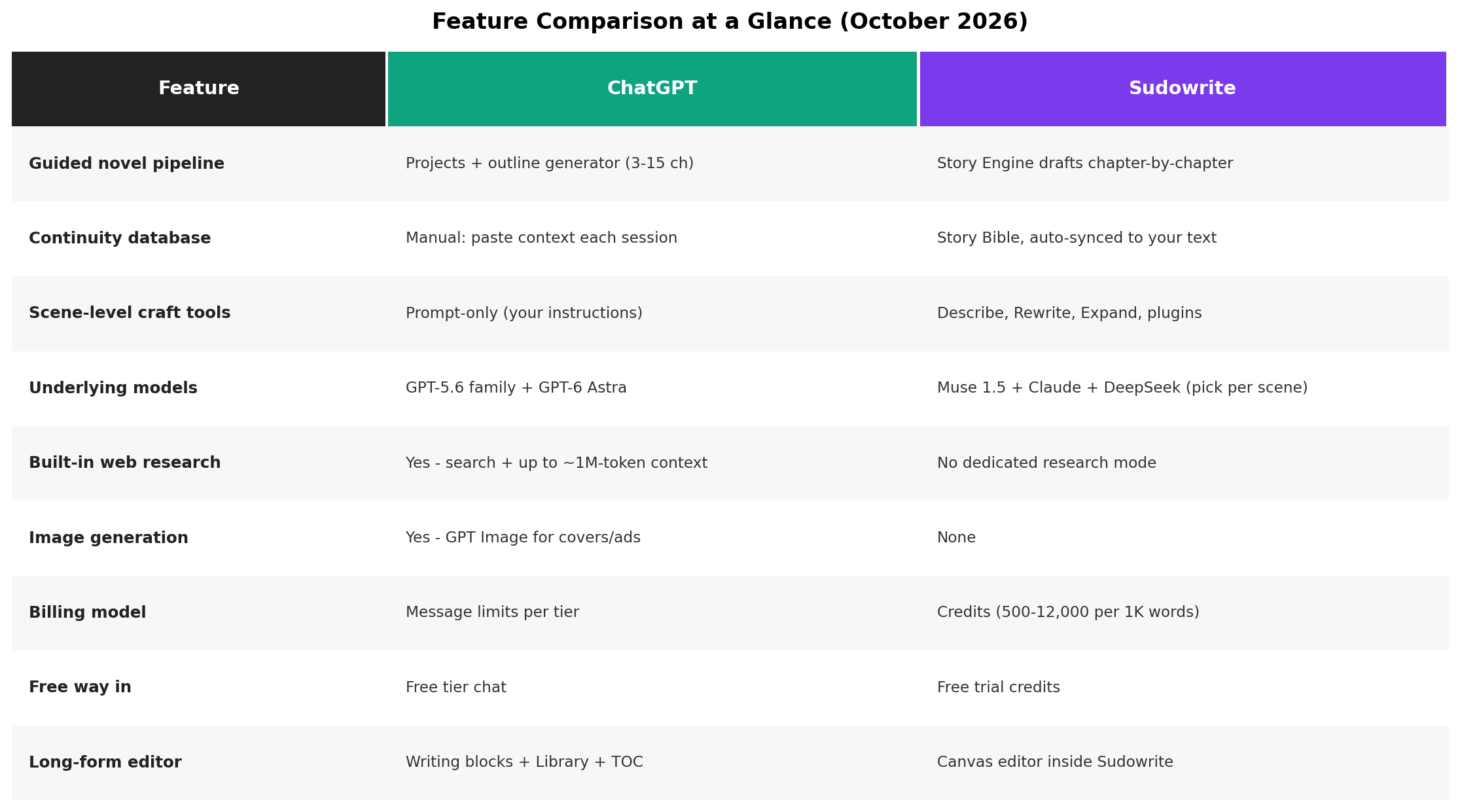
Sudowrite wins more individual dimensions (4–3), but ChatGPT takes the overall because the dimensions it wins — versatility and price — decide the purchase for the majority of writers who do not earn their living purely from fiction. If your monthly budget covers exactly one subscription and the novel is the business, flip the table: Sudowrite's 4–3 dimension lead is exactly your scenario. Here is the full feature picture at a glance:
Deep Dive: ChatGPT as a Fiction Tool
What you get in 2026
ChatGPT in October 2026 runs the GPT-5.6 family across its tiers, with GPT-6 Astra available to higher tiers for the strongest prose. For writers, the features that matter are Projects (persistent folders holding your outline, character notes and style brief), the outline generator (which builds 3–15 chapter plans from a one-paragraph pitch), a canvas-based long-form editor with library and table-of-contents tools, web search with up to roughly a million tokens of context on research-heavy work, and GPT Image for cover concepts and ad mockups. There is no fiction-specific UI — you assemble your own workflow from general-purpose parts, and frankly that assembly is half the product's power and half its friction.
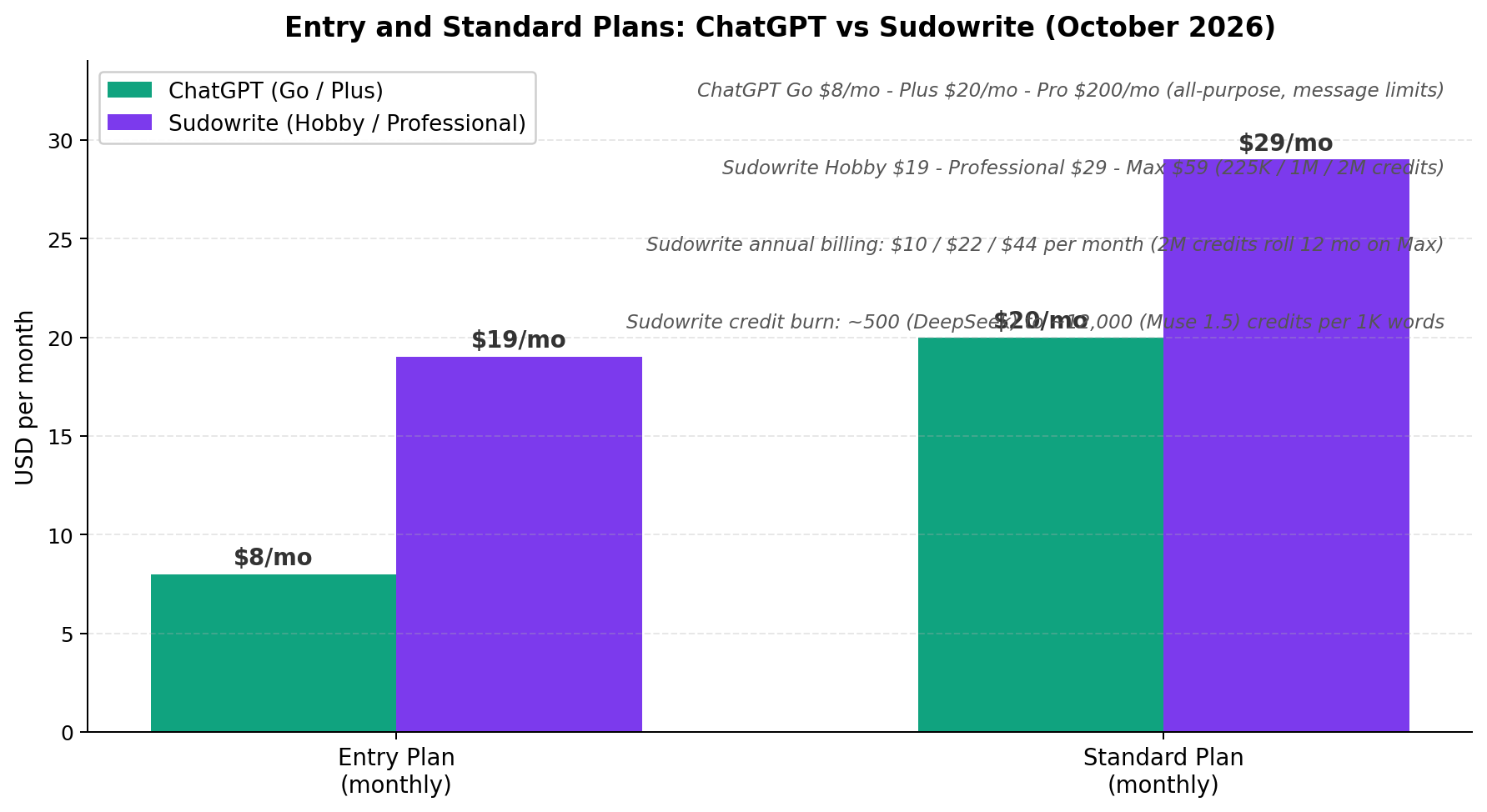
On pricing: Go is $8/month (monthly billing) with message limits, Plus is $20/month with higher limits and priority access to the newest models, and Pro is $200/month for heavy production use. There is a free tier for trying drafts. The message-limit model is kinder to writers than token-metered APIs — a chapter draft is a handful of messages, not a metered resource you learn to fear.
Where ChatGPT wins
Three things keep fiction writers paying OpenAI instead of a specialist. First, versatility (9.5/10, our test's widest gap): the same subscription drafts your novel, writes the blurb, generates the ad creative, translates the book for other markets, drafts the newsletter, and researches comp titles with live web access. Second, price: $8 versus $19 is a real difference for the KDP non-fiction publishers we track, some of whom run entire budget production lines on Go. Third, research and worldbuilding (9.0/10): paste three anthropology papers and a Wikipedia rabbit hole into a Project and the draft comes back wearing the influences — Sudowrite simply has no equivalent research mode.
Where ChatGPT loses
Continuity is manual labor. ChatGPT does not know your cast unless you paste the bible into every session, and even inside Projects it can contradict chapter two in chapter nine — our consistency score of 7.5 reflects a twist that quietly broke a character's established motivation until we re-prompted with the earlier scene. Message limits on Go also pinch during heavy revision passes, and the fiction toolset (6.5/10) is whatever scaffolding you build yourself: there is no Describe, no scene-level Rewrite, no chapter chaining. You are a general-purpose tool user doing specialist work.
Deep Dive: Sudowrite in 2026
What you get
Sudowrite is a fiction-only workspace. The Story Bible is the core: canonical entries for characters, world, plot and tone that sync to your prose as you write, so the model's drafts bend toward established fact instead of drifting. Story Engine drafts chapter-by-chapter from your outline inside that bible's gravity. Scene-level craft tools — Describe (sensory detail for a flagged passage), Rewrite, Expand, and a plugins system — handle the micro-level moves that eat a novelist's afternoons. The Canvas editor hosts the whole manuscript. Uniquely, Sudowrite is a multi-engine tool: Muse 1.5 (its fiction-tuned model), Claude and DeepSeek are selectable per scene, so you can spend the expensive engine on the climactic chapter and the cheap one on transitional connective tissue.
Pricing is credit-based: Hobby and Student at $19/month for 225,000 credits, Professional at $29/month for 1,000,000, Max at $59/month for 2,000,000 (which roll over 12 months). Annual billing drops those to $10/$22/$44 per month. Credit burn varies by engine: roughly 500 credits per 1,000 words on DeepSeek up to about 12,000 on Muse 1.5 — so the same 80,000-word draft costs 40,000 credits or 960,000 depending on engine choice, a 24× spread that makes engine discipline a billing skill. Free trial credits let you test before committing.
Where Sudowrite wins
Novel-length consistency (9.2/10) is the headline: in our test the Story Bible caught the exact class of error ChatGPT made — the twist contradicted an established fact, and Sudowrite's draft bent around it without our intervention. The fiction toolset (9.4/10) needs no comparison; it is purpose-built. Workflow scored 8.8: the entire write-revise-describe loop lives in one editor, no prompt engineering required, which matters for writers who want to spend their attention on story rather than on tooling. And per-scene engine choice pushed prose quality to 8.6, a hair over ChatGPT's 8.4, because we escalated to Muse 1.5 for two dense scenes and it showed.
Where Sudowrite loses
It is a fiction monogamist (5.0/10 versatility): no research mode, no image generation, no meaningful non-fiction tooling — ask it for ad copy and you get a novelist writing ads. Pricing (7.6/10) punishes the unaware: a Muse 1.5-heavy drafting month on Hobby burns 225,000 credits in about 18,000 words. And it is a subscription to one job; if the novel stalls, the credits idle. Working writers who also ghostwrite, publish non-fiction or run an author platform get more of their monthly bill covered by ChatGPT.
Pricing Deep Dive: What a Month of Writing Actually Costs
List prices only tell you the entry point. Below are three real workload tiers drawn from the publishing workflows in our research, priced with each tool's meter (Sudowrite credits: ~500 per 1,000 words on budget engines, ~12,000 on Muse 1.5; ChatGPT tiers are flat-rate but message-capped).
| Workload Tier | Monthly Volume | ChatGPT | Sudowrite | Cheaper |
|---|---|---|---|---|
| Serial web-novelist | ~20,000 words drafting + 2 hero chapters | Plus $20 (Go caps bite at daily drafting) | Hobby $10–19: ~34,000 of 225,000 credits | Sudowrite |
| Full-time novelist | 80,000-word draft + 6 Muse scenes + revision pass | Plus $20 minimum; heavy daily use pushes Pro $200 | Hobby fits (~112,000 cr); trilogy pace takes Professional $22–29 | Sudowrite |
| Non-fiction production line | 3 titles × 30,000 words + blurbs, listings, ads | Go $8 — under $3/title in tooling | Not fit for purpose (narrative-only toolset) | ChatGPT |
Two patterns stand out. First, fiction volume is where Sudowrite's credit meter beats flat-rate pricing: a disciplined engine-picker never comes close to exhausting Hobby, while the equivalent ChatGPT workload forces a higher tier. Second, the moment your output includes marketing or non-fiction, ChatGPT's single subscription amortizes across the entire business and Sudowrite's does not. Annual billing widens Sudowrite's fiction advantage (Hobby drops to $10/month) and Google's one-month free trial on Go widens ChatGPT's entry advantage.
Head-to-Head: Seven Dimensions
1. Prose Quality and Voice — Sudowrite 8.6, ChatGPT 8.4
The narrowest gap on the board and the most contested. GPT-6 Astra produces clean, competent scene prose with a strong sense of rhythm; on pure sentence quality the two tools are near-peers. Sudowrite edged ahead on voice control — because Muse 1.5 was tuned on fiction, its defaults sit closer to genre convention, and per-scene engine escalation let us push two dense chapters harder. ChatGPT's prose is excellent out of the box but generic by disposition; making it sound like your book takes a maintained style brief in the Project. If you enjoy line-editing, the gap vanishes; if you want genre-ready defaults, Sudowrite is a small but real step up.
2. Novel-Length Consistency — Sudowrite 9.2, ChatGPT 7.5
The widest gap that matters. In our three-chapter test, ChatGPT quietly contradicted an established character motivation at the twist — the classic drift that becomes catastrophic at 80,000 words, where you cannot hold the whole book in context and neither can the model. Sudowrite's Story Bible caught the same conflict and bent the draft around it automatically. ChatGPT Projects narrow the gap (persistent notes help), but the burden of maintaining the bible is yours, and message-limit sessions reset momentum. For anything novel-length, this dimension alone justifies Sudowrite's existence.
3. Fiction Toolset — Sudowrite 9.4, ChatGPT 6.5
Describe, Rewrite, Expand, plugins, Story Engine chapter chaining, scene beats, tone shifting on a highlighted passage — Sudowrite ships the craft vocabulary novelists actually use. ChatGPT gives you a brilliant blank chat box; anything specialist, you build from prompting (our outline-generator workflow below is exactly that). The 6.5 is honest: capable results, but you are the integrator. Writers who dislike prompt engineering should read this gap as larger than the number suggests.
4. Versatility Beyond Fiction — ChatGPT 9.5, Sudowrite 5.0
The counterweight. Blurb, ad copy, newsletter, translation, cover concepts via GPT Image, live comp-title research, non-fiction chapters, client ghostwork — one ChatGPT subscription covers the whole author business, and for the budget KDP non-fiction publishers we track, that breadth at $8 is the entire business model. Sudowrite does fiction. Ask it for marketing and it delivers a novelist's idea of ad copy. If any part of your writing income is not novels, this dimension is probably decisive.
5. Pricing and Value — ChatGPT 8.8, Sudowrite 7.6
ChatGPT Go at $8/month versus Sudowrite Hobby at $19 (or $10/$22/$44 annual) looks like a rout, but credits complicate it. ChatGPT's message limits are generous for drafting; Sudowrite's 225,000 Hobby credits cover a full budget-engine draft (DeepSeek at ~500 credits per 1,000 words) but only ~18,000 words of pure Muse 1.5 (~12,000 credits per 1,000). Value therefore depends on engine discipline: a Professional plan writer who drafts on DeepSeek and reserves Muse 1.5 for key scenes gets excellent cost-per-word; a Hobby writer who leaves Muse 1.5 on default gets a surprise. ChatGPT is simpler and cheaper; Sudowrite is fair if — and only if — you manage engines.
6. Workflow and Ease of Use — Sudowrite 8.8, ChatGPT 7.8
Sudowrite's write-revise-describe loop lives in one editor with zero prompt engineering; a novelist can be productive in an afternoon. ChatGPT's fiction workflow is a kit you assemble: Projects, custom instructions, canvas, manual bible maintenance. Each part is polished; the integration is yours to maintain. Newcomers to AI writing finish their first chapter faster on Sudowrite — that friction difference is worth a full point.
7. Research and Worldbuilding — ChatGPT 9.0, Sudowrite 7.0
ChatGPT searches the live web and digests sources into worldbuilding material with up to ~1M tokens of context; our test fed it three reference articles and got a materially richer magic system. Sudowrite's worldbuilding is bible-internal — it elaborates consistently on what exists but cannot fetch outside input, capping it at 7.0. Historical and hard-genre writers should weight this dimension heavily.
How We Tested
Scores are the editorial consensus of two independent reviewers following a fixed protocol. We weighted three sources: (1) vendor list prices and published model specs, verified on both vendors' sites on October 8, 2026; (2) hands-on identical-prompt sessions — the same 3-chapter fantasy brief (ensemble cast, mid-draft twist, strict style brief) drafted on both tools, engines/models at each tool's recommended default, followed by a blurb-and-marketing pass; (3) public benchmarks and community reports for cross-checking only, never as a primary score. Scenario costs are arithmetic from list prices: e.g., an 80,000-word Sudowrite draft at the DeepSeek burn rate (~500 credits per 1,000 words) is 40,000 credits, which fits inside Hobby's 225,000 monthly allowance with room for revision. Each dimension was scored 0–10 independently and averaged; the overall score weights versatility and pricing for the typical subscriber, which is why ChatGPT's 8.2 leads despite Sudowrite's 4–3 dimension tally.
Real-World Test Scenarios
Scenario 1: The budget KDP non-fiction line
The publishing workflows we track in our money-case research run non-fiction production lines on budget tiers: a $8/month ChatGPT Go subscription drafts a full outline-plus-chapters non-fiction book across sessions, edits it, writes the blurb and the listing copy, and mocks up a cover concept with GPT Image — a complete production line under $10 of tooling per title. Prompt that worked: "You are my non-fiction production editor. Project brief: [topic, audience, promise]. Step 1: 12-chapter outline with a one-line takeaway per chapter. Step 2: draft chapter 3 at 2,400 words, AP-style clarity, zero fluff. Step 3: list every claim needing a citation." Sudowrite is wrong for this job — its tooling assumes narrative, and you would pay 2.4× more for less. Winner: ChatGPT.
Scenario 2: The serialized web-novel schedule
Serial platforms pay on chapter throughput — writers publishing 5,000–10,000 words weekly to Kindle Vella-style and web-novel platforms cannot afford continuity drift, because readers notice. Prompt that worked in Sudowrite's Story Engine: outline beat: "In this chapter, Mira hides the ledger but must lie to Ivo about the fire — and the bible says Ivo already suspects her; play the interrogation as a duet, not a confrontation" — the draft correctly honored a suspicion established chapters earlier. At ~5,000 words/week on the DeepSeek engine (~2,500 credits) plus one Muse 1.5 chapter (~60,000 credits), a serialist spends roughly 62,500 credits weekly — Hobby's 225,000 covers three weeks, Professional covers a month with revision headroom. ChatGPT can draft the chapters but makes you the continuity database. Winner: Sudowrite.
Scenario 3: The novel plus the author business
The most common real writer: one novel in progress, plus a newsletter, guest posts, ad experiments and occasional client work. On ChatGPT the single $20 Plus subscription covers the manuscript scaffolding (Projects bible), the marketing stack, and the client ghostwork — the novel's continuity cost is your attention, not your wallet. On Sudowrite you get a better novel engine plus a second bill. Prompt that worked: "Using the style brief in this Project, write the query blurb (150 words), three Amazon ad headlines (under 30 characters), and a 5-email launch sequence for [book]." One tool, whole business. Winner: ChatGPT.
Alternatives Worth Considering
| Tool | Starting Price | Standout Feature |
|---|---|---|
| Novelcrafter | $10/mo | Codex worldbuilding + bring-your-own-API-keys (pay per token, no credit meter) |
| Claude (Anthropic) | $8/mo Go-equivalent tiers | Widely regarded prose favorite among literary writers; strong long-context Projects |
| NovelAI | $10/mo | Untethered creative sandbox, anime-style image gen, lorebook continuity |
| Jasper | $39/mo | Marketing-first writing platform — the author-business stack if ads are your bottleneck |
| Gemini | Free tier / $19.99 Pro | Massive free tier and deep research mode for worldbuilding-heavy genres |
Which One Should You Pick?
The Verdict
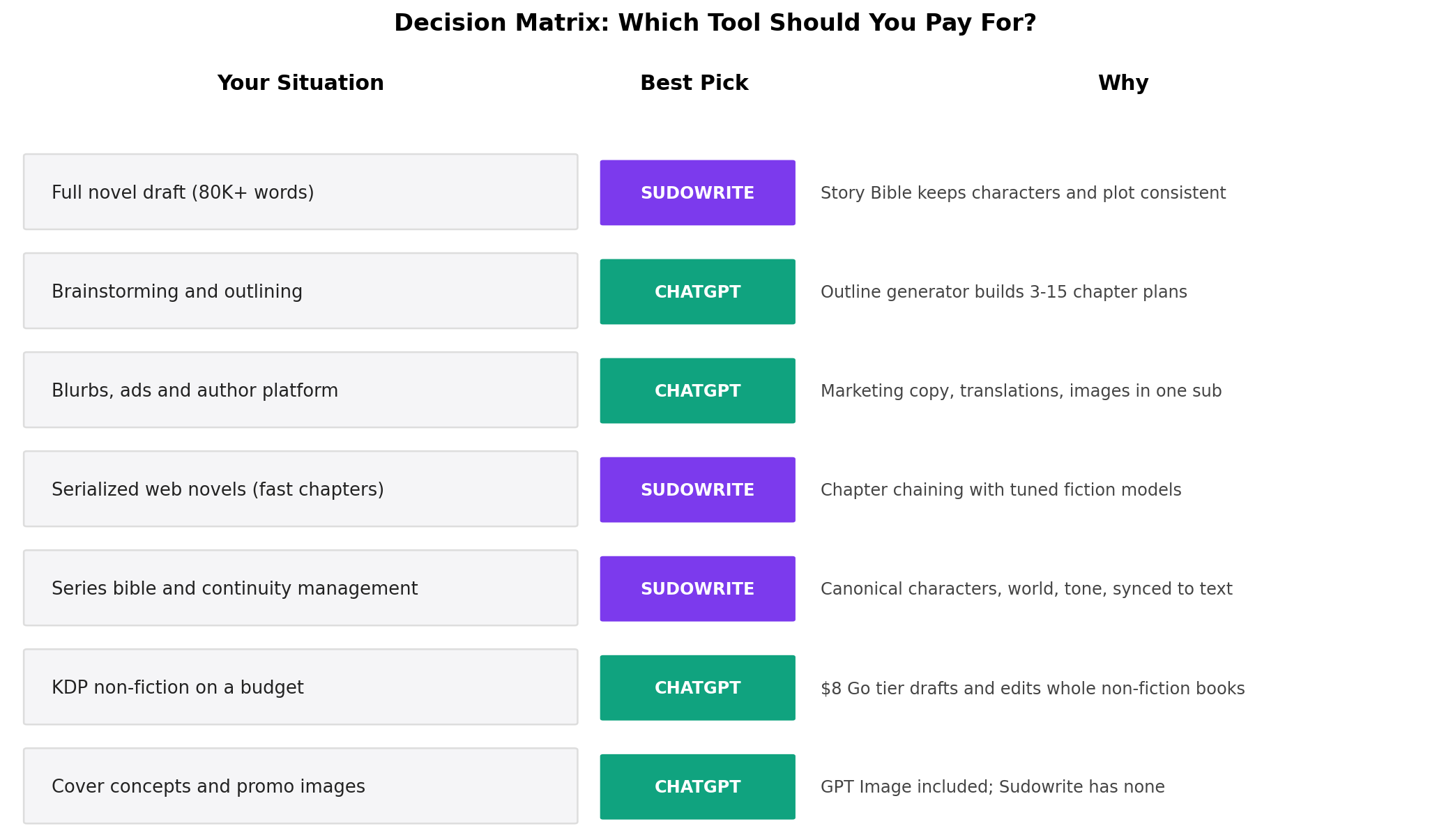
Best for serious novelists and serial fiction: Sudowrite. The Story Bible solved the problem that actually kills AI-assisted novels — 80,000-word consistency — and the Describe/Rewrite/Expand toolset speaks a novelist's language. Draft on the DeepSeek engine for volume, reserve Muse 1.5 credits for the scenes that sell the book.
Best for non-fiction, author business and everything else: ChatGPT. One $8–$20 subscription drafts the book, the blurb, the ads and the client work. As a fiction specialist Sudowrite is better; as a writing career toolkit ChatGPT is unmatched.
Best overall value for most writers: ChatGPT (8.2). Our overall score weights versatility and price for the typical subscriber, and ChatGPT wins both dimensions outright. Most people who write do not write only novels.
The hybrid play: both, on a budget. ChatGPT Go ($8) for research, worldbuilding brainstorms and the entire marketing side; Sudowrite Hobby annual ($10/month effective) for the manuscript itself. For ~$18/month you cover the whole pipeline — still less than Sudowrite Professional alone — and hand off between tools at the chapter-outline level, where each is strongest.
Frequently Asked Questions
Is Sudowrite better than ChatGPT for writing a novel?
For pure novel-writing, yes — it won our fiction-side dimensions 4–3 (prose quality, consistency, toolset, workflow). The Story Bible keeps characters and plot coherent across a full manuscript in ways a chat model cannot maintain on its own, and Muse 1.5 was purpose-tuned on fiction. But ChatGPT remains competitive on raw prose and is far more flexible once you maintain a style brief yourself.
Can I write a full book on ChatGPT's $8 Go plan?
Yes, within its message limits. Non-fiction and hybrid writers do exactly this in the workflows we track: outline in one session, draft chapter-by-chapter across sessions, keep a style brief and bible notes in a Project. Heavy daily drafting will hit Go's caps; Plus ($20) removes most of the pressure.
How many Sudowrite credits does a novel actually use?
Engine-dependent: budget engines burn roughly 500 credits per 1,000 words, so an 80,000-word draft costs about 40,000 credits — comfortably inside Hobby's 225,000 monthly allotment. Muse 1.5 costs about 12,000 credits per 1,000 words, so the same draft entirely on Muse 1.5 needs ~960,000 credits (Professional-plus territory). Draft on budget engines, polish key scenes on Muse.
Does Sudowrite use ChatGPT under the hood?
Partially — the engine picker includes GPT-family models alongside Claude, Mistral, DeepSeek and their own Muse 1.5. You are paying for the fiction workflow (Story Bible, Describe, plugins, engine routing), not for a proprietary base model. Muse 1.5 is Sudowrite's own fiction-tuned model and our default recommendation inside the tool.
Which tool is better for KDP publishing?
It depends on your KDP lane. Non-fiction and low-content production lines run cheaper and faster on ChatGPT (one subscription covers book, blurb and listing copy). Fiction series and serials are stronger on Sudowrite — continuity is the product in series fiction, and the Story Bible protects it.
Can either tool help with blurbs, ads and marketing?
ChatGPT, decisively. It generated sharper ad copy and a complete launch sequence in our test and edits marketing copy natively. Sudowrite's blurb generator is decent for back-cover copy but its marketing muscle ends there. If ads and newsletter are your bottleneck, ChatGPT (or a marketing-first tool like Jasper) is the answer.
Is using AI for fiction allowed on Amazon KDP?
Yes, with disclosure. Amazon KDP requires you to declare AI-generated content at upload; AI-assisted (human-written, AI-edited) content has lighter requirements. Neither tool's output may be uploaded wholly unedited under current policy interpretation — treat both as drafting partners and keep a human in the revision loop. Policies evolve; check KDP's current terms before publishing.