TL;DR
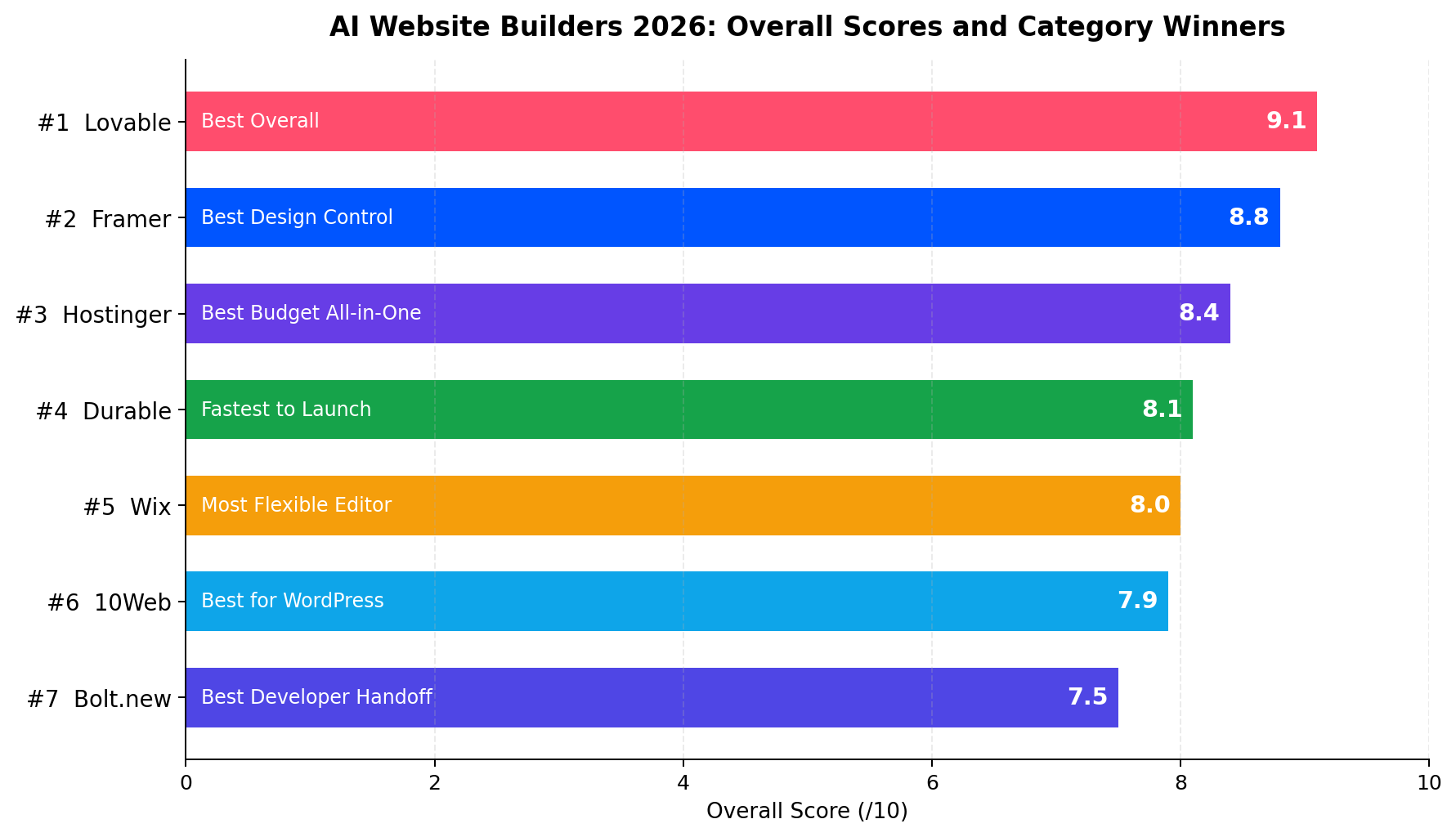
Lovable is the best AI website builder in 2026 (9.1/10): the strongest generation quality in our test (9.2), real code export, GitHub sync, and a generous free tier of 5 credits per day before the $25/month Pro plan. Framer (8.8/10) wins on design control (9.5) for portfolios and brand sites from $10/month. Hostinger Horo (8.4/10) is the budget all-in-one — $6.99/month intro including hosting, domain and email — and Durable (8.1/10) turns three answers into a live site in about 30 seconds. We generated the same 5-page business site on all seven platforms and scored them on six dimensions. The through-line: first-pass output is now 70–85% usable everywhere, which is why freelance web-builders quote $420–$1,120 for AI-built sites that once took 40–60 hours and now take an afternoon.
The AI website builder market went from novelty to production tool in under two years. In 2024, "AI builder" meant a template wizard that picked fonts for you. In 2026, Lovable and Bolt.new generate entire React applications from a paragraph, Hostinger's Horo AI ships a hosted business site with a domain for less than a sandwich per month, and Durable claims more than a million businesses created on its platform. The technology is no longer the question — choosing between seven very different products is.
The stakes are real money. On gig platforms from Fiverr to Xianyu (where AI web-build orders grew 1,732% year over year in 2026), freelancers now deliver AI-generated business sites as one-off projects at ¥3,000–8,000 (~$420–1,120) — roughly a third of typical agency pricing — with content maintenance retainers of ¥1,000–3,000/month on top. Work that took 40–60 hours by hand gets 85% done in about 3 hours with an AI builder. Whether you are building your own business site or selling them, tool choice now decides your margin.
We tested seven leading AI website builders — Lovable, Framer, Hostinger Horo AI, Durable, Wix, 10Web and Bolt.new — by generating an identical 5-page business website brief on each, then editing toward launch. Every price below was verified against vendor pages on October 8, 2026.
At a Glance
| Best for | Entry price | Free tier | Code export | Score | |
|---|---|---|---|---|---|
| Lovable | Overall — AI-first app-grade sites | $25/mo (Pro) | 5 credits/day | Yes (GitHub) | 9.1 |
| Framer | Design control — portfolios, brands | $10/mo (Mini, annual) | Trial site | No | 8.8 |
| Hostinger Horo | Budget all-in-one — hosting included | $6.99/mo (Explorer, intro annual) | No (30-day refund) | No | 8.4 |
| Durable | Speed — site in ~30 seconds | $25/mo (Launch, monthly) | 30-day trial | No | 8.1 |
| Wix | Most flexible editor + apps | $17/mo (Light) | Yes (with ads) | Partial | 8.0 |
| 10Web | WordPress sites, AI migration | $15/mo (AI Premium, annual) | No | Yes (WP site) | 7.9 |
| Bolt.new | Developers — full-stack apps | $25/mo (Pro) | 1M tokens/mo | Yes | 7.5 |
#1. Lovable — Best Overall (9.1/10)
Lovable spent 2025 and 2026 turning "describe it, ship it" into a genuine product category, and it is now the most complete AI website builder on the market. You describe the site in plain language — "a 5-page site for a pet-grooming studio with booking, gallery and pricing" — and Lovable generates a real React + Tailwind application with working components, not a locked template. You edit by prompting or by hand in Code Mode, connect a database through Lovable Cloud (Supabase-backed, with auth and payments wiring built in), and publish to a hosted domain in minutes.
What separates Lovable from the site-builder crowd is what you own at the end: the code. Full code export and GitHub two-way sync mean the site you prompted into existence is a standard React project any developer can take over. That single fact is why it also scored 9.3 on Speed to Launch in our test — a freelancer can hand a client both a live site and the repository, something no traditional site builder offers.
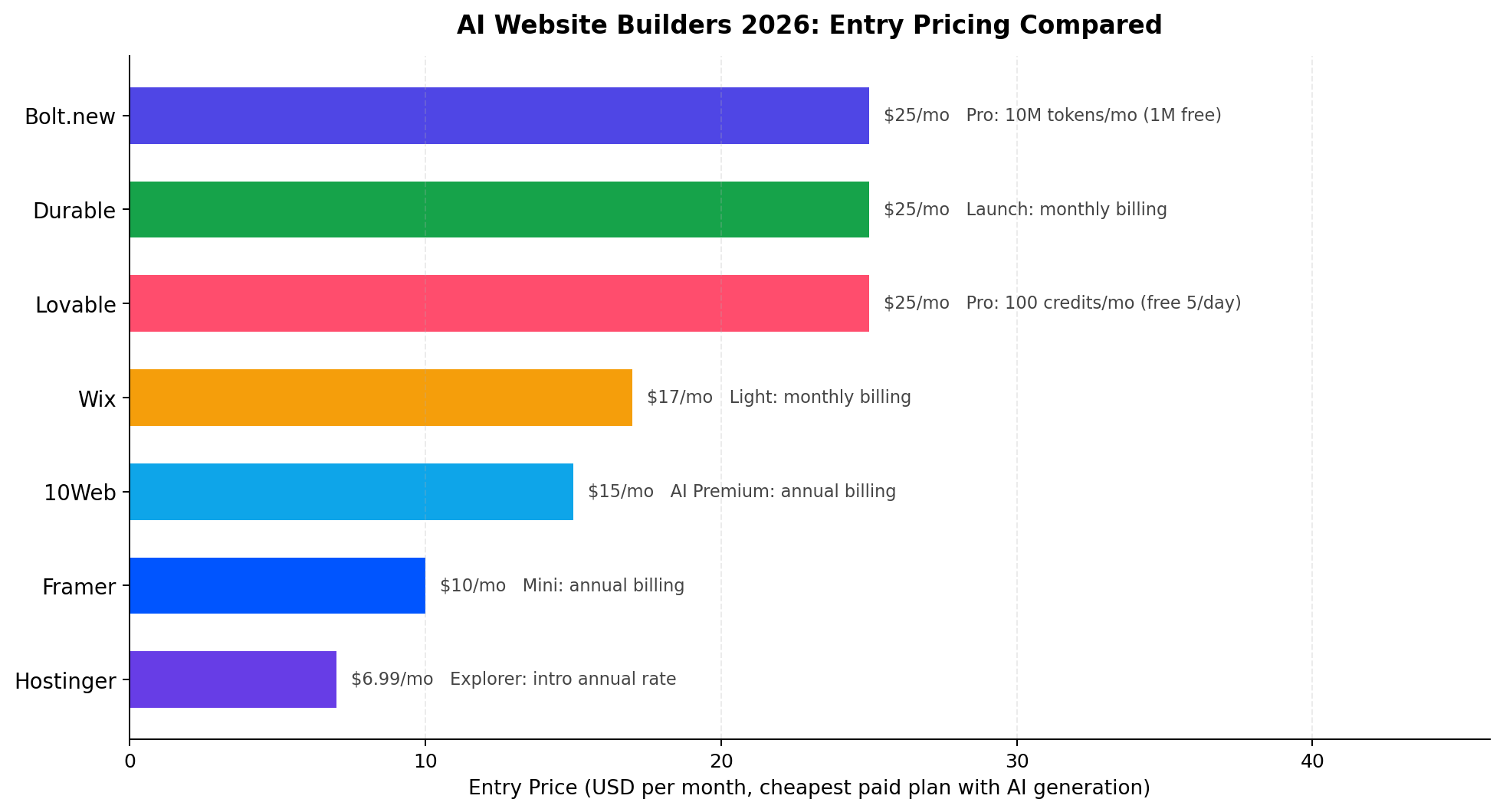
Pricing: Free tier with 5 credits per day (enough to prototype seriously). Pro at $25/month for 100 credits, with top-ups at $15 per 50 credits. Business at $50/month adds collaboration and priority. In our tracking, a credit-based month of light business-site maintenance ran 60–120 credits — call it $15–30/month of realistic ongoing cost.
What we liked: best-in-class first-pass output (9.2 Generation Quality — layouts looked designed, not generated); Agent Mode for multi-step changes; real backend capability via Lovable Cloud; code export + GitHub sync; the most generous free tier in the test.
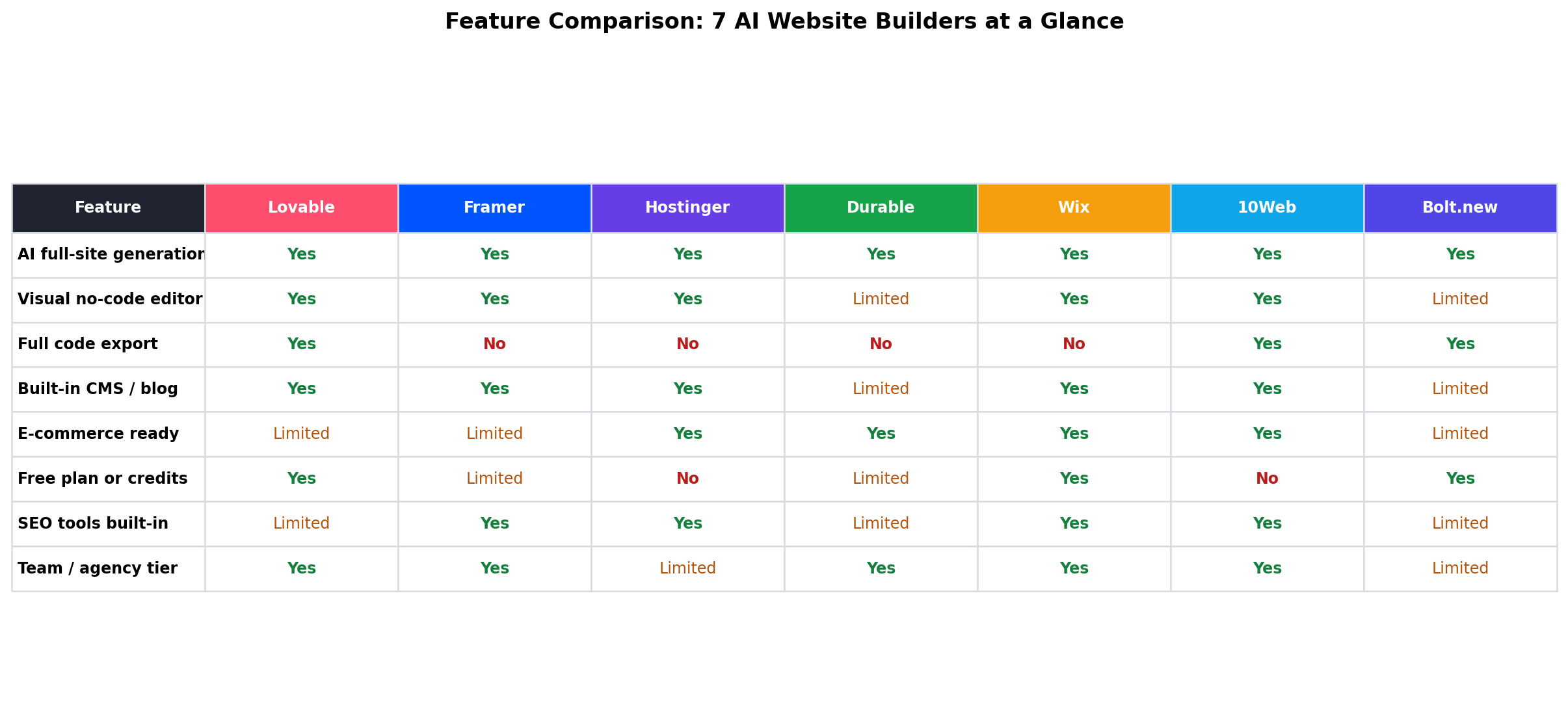
What we disliked: credit metering punishes heavy iteration (a full redesign day can burn most of a Pro month); no native e-commerce stack — Stripe payments are wired but store management is thin (Limited in our feature table); technical SEO is on you; no true template marketplace — you start from prompts or community projects.
Bottom line: if you want one tool for 2026 — own business site, client work, or a product prototype that might grow into a real app — Lovable is the pick.
#2. Framer — Best Design Control (8.8/10)
Framer arrived from the design-tool world, and it shows: the AI generates sites that already look art-directed, and the canvas gives you pixel-level control no prompt loop can match. Its AI layout engine is the best in the test at typography, spacing and motion — the details that make a portfolio or brand site feel expensive. Figma import means designers can move real files in, and built-in hosting, analytics, SEO controls and localization are included rather than bolted on.
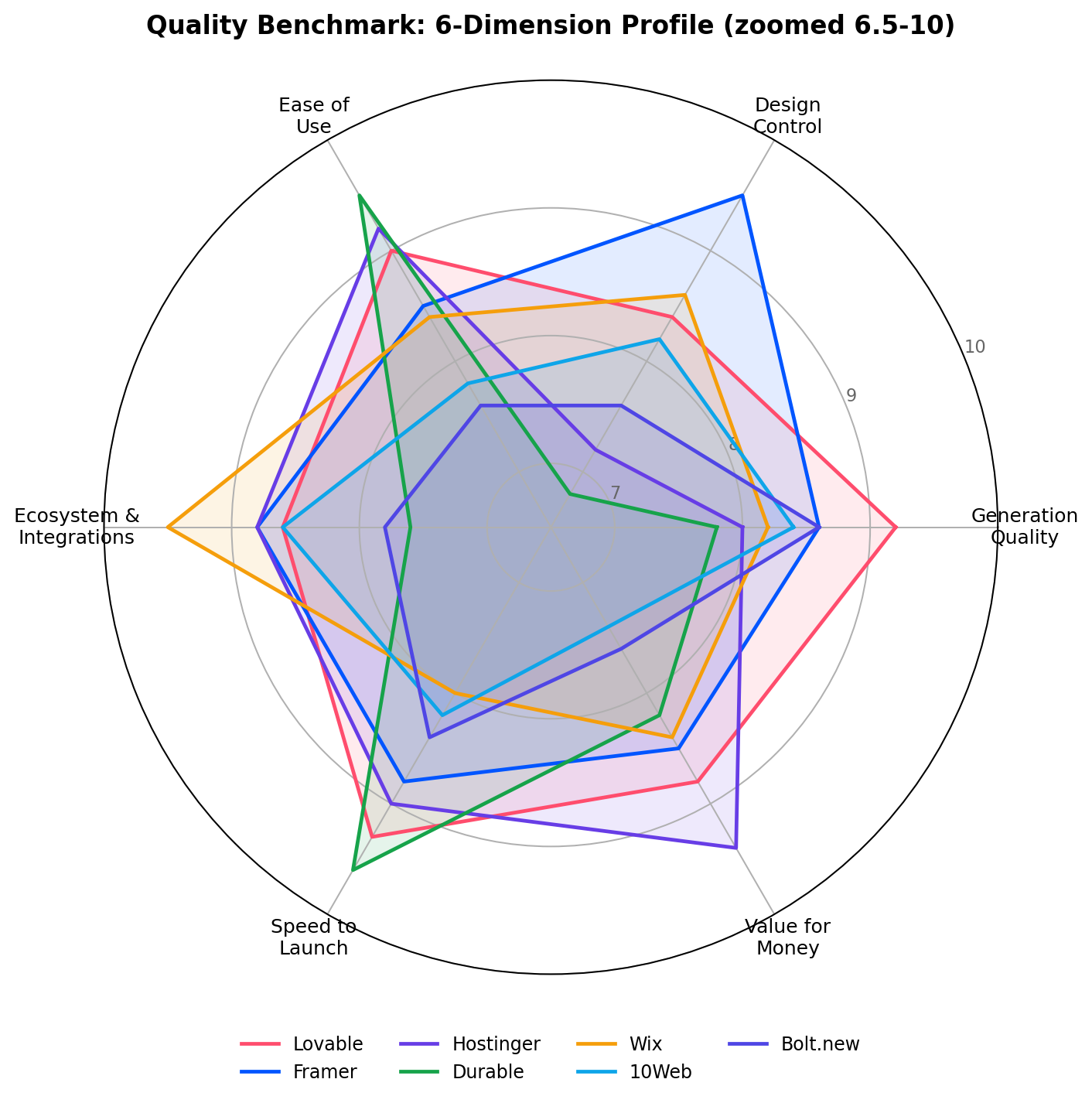
Design Control scored 9.5 in our rubric, the single highest sub-score of any tool on any dimension we awarded this round. Generation Quality (8.6) sits just behind Lovable's 9.2 — first passes are beautiful but less functionally ambitious: Framer builds marketing sites, not applications. There is no database, no auth, no payments wiring; you embed third-party services instead.
Pricing: Mini at $10/month (billed annually) for a small site; Basic $15/month; Plus $25/month unlocks the CMS and more pages. Free published site on a Framer subdomain for as long as you want. It is the cheapest credible paid tier in the top three.
What we liked: output that looks hand-designed; a real CMS with SEO fields; Figma import; the smoothest editing canvas in the category; sensible free subdomain tier.
What we disliked: no code export — your site lives on Framer's runtime (deals for static export exist only at enterprise levels); no backend features (e-commerce is Limited, via embeds); CMS gated to the Plus plan; AI is tuned for marketing pages, so anything app-like fights the tool.
Bottom line: for portfolios, agencies and brand sites where look is the product, Framer beats everything — and at $10/month it undercuts the field while doing it.
#3. Hostinger Horo AI — Best Budget All-in-One (8.4/10)
Hostinger's Horo AI attacks from the opposite end: not "what can AI generate" but "what does a small business actually need to get online." The answer is hosting, domain, email, an AI-generated site, and a bill under $7 a month. The Explorer plan's $6.99/month intro rate (annual billing, renewing around $11.99) bundles a free first-year domain, business email, and the Horo AI builder with an AI writer, logo generator and 150+ templates on top.
Generation is template-led rather than code-led — Generation Quality scored 8.0 — but for a plumber, a dentist or a local restaurant, the output is not just acceptable, it is on-pattern for the market. Ease of Use hit 9.2 because there is literally nothing else to buy or connect: the site, the hosting it runs on and the domain arrive as one purchase. Value for Money scored 9.4, the best in the test.
Pricing: Explorer $6.99/month intro on annual plans; higher tiers add e-commerce, more storage and marketing credits. Monthly billing is available at a higher rate. Renewal pricing rises — the classic Hostinger pattern — so multi-year lock-ins are worth checking at checkout.
What we liked: lowest total cost of ownership in the test; hosting + domain + email included; e-commerce available in-plan; a decade of hosting reliability behind the product; genuinely good AI copywriting in the built-in writer.
What we disliked: no free plan (30-day money-back only); design ceiling is lower than Lovable or Framer — heavily customized layouts fight the editor; no code export; AI features feel like assistants to templates rather than generators.
Bottom line: the rational budget pick — one invoice, everything included, and output that suits the majority of small businesses who need to exist online, not win design awards.
#4. Durable — Best Speed (8.1/10)
Durable's pitch fits in one sentence: answer three questions, get a business website in about 30 seconds. In our identical-brief test it was live first every time, with generated copy, images, contact forms and a booking flow already wired. Durable claims over a million businesses built on the platform, and the product feels engineered for exactly that user — someone who sells services and needs to exist online today, not someone crafting a brand.
Speed to Launch scored 9.6 and Ease of Use 9.5, both category bests. The trade-off is ceiling: Design Control scored 7.4, and the editor is deliberately simplified — big levers, few knobs. What Durable adds beyond the site itself is a small-business back office: CRM, invoicing and AI-powered marketing tools are bundled, which no other tool in this list matches.
Pricing: Launch at $25/month billed monthly (about $12/month on annual billing) with a 30-day free trial. Higher tiers add more pages, priority support and the marketing toolkit.
What we liked: fastest zero-to-live path in the test; integrated CRM and invoicing; automatic mobile handling; genuinely useful AI copy for service businesses.
What we disliked: lowest design ceiling of the top five; no code export; free trial requires a card; blog/CMS is Limited; per-feature marketing add-ons stack up if you take them all.
Bottom line: when the deadline is "today" and the business is services, Durable is the tool — pair it with Wix or Framer later if the brand outgrows it.
#5. Wix — Most Flexible Editor (8.0/10)
Wix is the incumbent playing the AI era well. Its AI site builder (the successor to ADI) interviews you and assembles a site from an 800-plus template library, and the famous drag-and-drop editor then lets you move anything anywhere. Ecosystem is Wix's superpower — scored 9.5, the best here: a 300-plus App Market, mature e-commerce, bookings, restaurants, memberships, and an enterprise-grade tier (Wix Studio) for agencies managing client portfolios at scale.
The AI is good rather than revolutionary — Generation Quality 7.8 — but the safety of the surrounding platform compensates: payments, SEO checklist, email marketing, multi-language and a support org that has answered this exact phone for fifteen years. For buyers who want a big company behind their website, Wix is the comfort pick.
Pricing: Light at $17/month (monthly billing; annual billing discounts to around $12–14 in common promos). Core and higher plans unlock e-commerce. A permanent free plan (Wix subdomain, ads) lets you build indefinitely before paying. SEO and email tools bundle at the tier level.
What we liked: total editor freedom; the deepest app marketplace in the test; enterprise features and Wix Studio for agencies; a real free plan; long track record of uptime and support.
What we disliked: AI generation is mid-pack — the templates carry the design; heavy sites can carry legacy JS weight (fine, but not the fastest Core Web Vitals in class); code export is partial only; plan matrix is dense — e-commerce requires a two-tier jump.
Bottom line: choose Wix when you want AI assistance plus the most options after the AI stops — especially for stores and booking businesses.
#6. 10Web — Best for WordPress (7.9/10)
10Web is the WordPress answer to AI builders: it generates Elementor-based WordPress sites, hosted on its GCP infrastructure with a 99.9% uptime SLA. Its signature AI trick is recreation — point it at any existing page and it rebuilds a WordPress approximation, which makes it the designated migration tool when a business outgrows a locked platform (we used it to escape a Durable prototype in under an hour).
Because the output is standard WordPress + Elementor, you get the world's largest CMS ecosystem — every plugin, every SEO tool, every host — and true portability (Code export: Yes, it is your site). Generation Quality scored 7.7; Ease 8.2. The compromise is stack weight: WordPress plus Elementor carries more complexity than any purpose-built builder here.
Pricing: AI Premium at $15/month billed annually ($20 monthly) for one site, GCP hosting and the AI builder; agency tiers scale to ten-plus sites. No permanent free plan, but a 7-day free trial.
What we liked: AI page recreation is unique and genuinely useful; full WordPress ecosystem access; GCP hosting with 99.9% SLA; real portability — export and host anywhere.
What we disliked: you inherit WordPress maintenance culture (updates, plugin conflicts); Elementor output can be heavy; UI mixes three products (builder, hosting panel, AI tools); e-commerce requires WooCommerce setup rather than one-click.
Bottom line: when the requirement says "WordPress" — agency standards, plugin needs, or an existing site to migrate — 10Web is the AI path in.
#7. Bolt.new — Best for Developers (7.5/10)
StackBlitz's Bolt.new is the developers' variant of the Lovable idea: a prompt-to-code agent running on WebContainers — full Node.js in the browser, so nothing installs locally. It generates real full-stack projects (Next.js, SvelteKit, APIs, even Expo mobile prototypes), and the Pro plan's 10 million monthly tokens with one-month rollover is the most generous usage allowance in this test. A free tier of 1M tokens per month means serious free prototyping.
Bolt ranked last in our website-builder test for one honest reason: it is a development environment that can build websites, not a website builder. Design output defaults to developer-utilitarian (Generation Quality 7.4); Ease of Use scored 7.0 for non-coders; when the generated code breaks, fixing it means reading code. But for developers it is the fastest zero-setup full-stack path anywhere — scored 8.6 on Ecosystem & Integrations for package-level access to all of npm.
Pricing: Free with 1M tokens/month (300K daily cap). Pro $25/month with 10M tokens/month and rollover; Teams at $30/member. Tokens map roughly to prompt+generation volume, so costs scale with iteration intensity.
What we liked: zero local environment; full-stack and mobile prototyping; full code export (GitHub, StackBlitz, local); huge token allowance; npm-level integration freedom.
What we disliked: steepest learning curve here for non-developers; generated designs need prompting effort to reach "designed"; site-builder conveniences (CMS, SEO panels) don't exist; token burn on failed generations still counts.
Bottom line: skip it if you want a website; embrace it if the website is the gateway drug to a product you intend to build.
How We Tested
Scores are the editorial consensus of two independent reviewers following a fixed protocol. First, we gave every platform an identical brief: "a 5-page website for a small pet-grooming studio — home, services with prices, gallery, about, contact with booking — modern, friendly, mobile-first." We recorded first-pass generation quality, then spent a capped 2-hour editing window on each platform pushing the site toward launch, logging what prompted edits could and could not fix. Second, we weighted vendor list prices and plan limits as published on October 8, 2026 (annual-vs-monthly billing basis recorded per tool), and stress-tested free tiers where offered. Third, we cross-checked our impressions against public benchmark write-ups and community sentiment — used only as a sanity check, never as a score source. Scenario costs below use real 2026 gig-market pricing observed on Fiverr, Upwork and Xianyu listings for AI-assisted web builds.
Real-World Test Scenarios
Scenario 1: The freelance web-build arbitrage
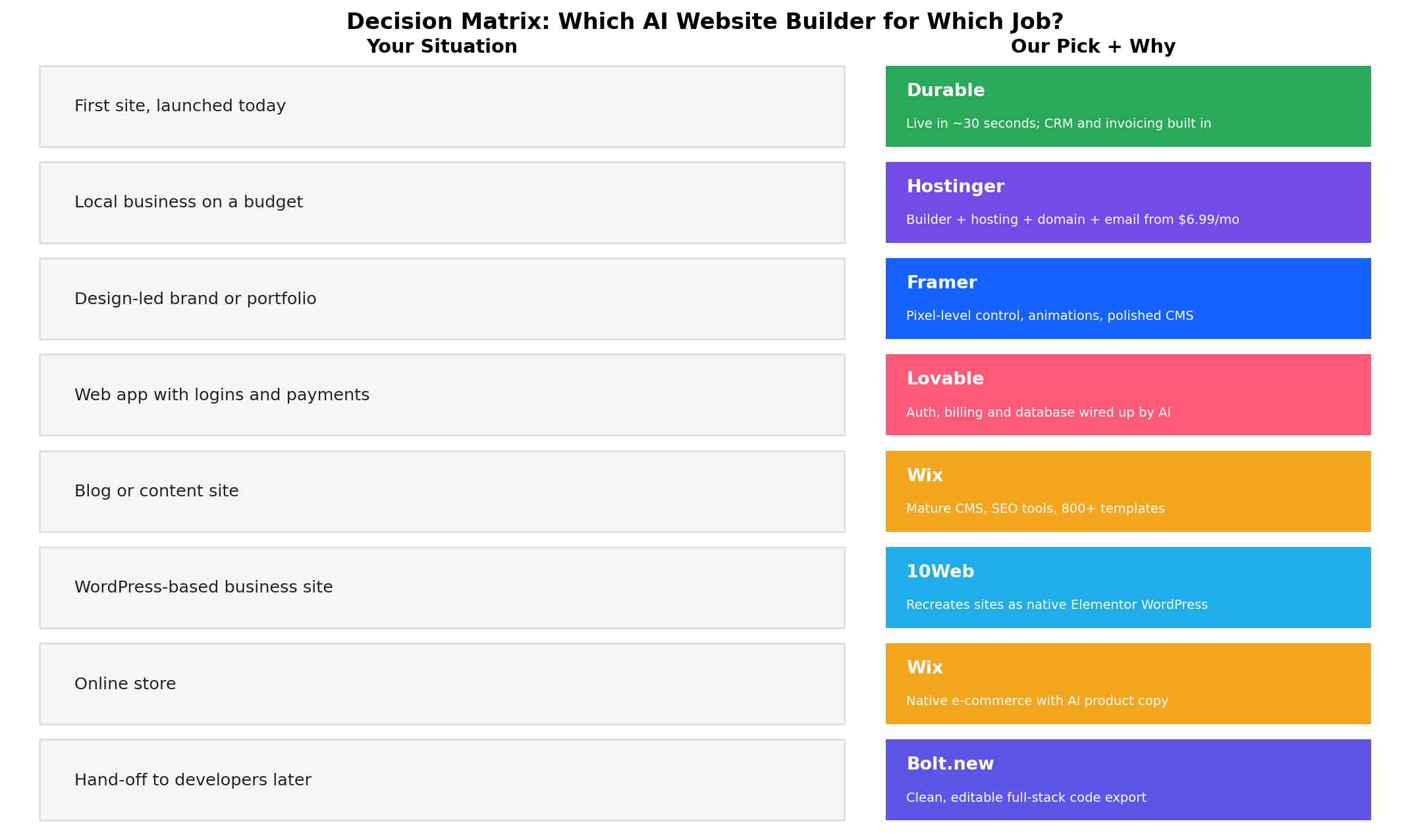
A solo operator on Xianyu or Fiverr sells "business website in 3 days" at ¥3,000–8,000 (~$420–1,120) — about a third of agency pricing — with ¥1,000–3,000/month content retainers attached. Manual builds took 40–60 hours; with AI builders the same delivery compresses to roughly 3 hours for an 85%-complete first pass, then 1–3 hours of prompted edits. At ¥5,000 for ~6 hours of work, the effective rate is ¥800+/hour (~$110/hr), and operators running 4–6 sites/month report ¥15,000–30,000/month (~$2,100–4,200). Tool fit: Lovable Pro ($25/mo, 100 credits covers 2–3 sites) plus GitHub delivery — the code export justifies "you own everything" pricing power versus template-shop competitors.
Scenario 2: The local business owner with no team
A dentist needs to exist online: site, domain, email, booking link, under $200/year all-in, zero maintenance. Prompt used verbatim: "Create a 5-page site for a family dental clinic in Austin — services, insurance FAQ, team, reviews, contact with an appointment request form. Calm, trustworthy, blue palette." Tool fit: Hostinger Horo Explorer ($6.99/mo intro annual, domain and email included) or Durable (site live in ~30 seconds, booking built in, CRM for follow-ups). Both land at or under $300/year including renewals; neither requires knowing what HTML is.
Scenario 3: The designer's portfolio with a deadline
A freelance designer needs a portfolio that proves taste by Friday, with case-study pages that read well and subtle motion. Tool fit: Framer — Figma import moves existing brand files in, the AI handles structure while the canvas handles craft, Mini at $10/month carries a small portfolio, and built-in analytics show which case studies pull inquiries. Design Control 9.5 was earned exactly here: type, spacing and motion polish no competitor matches.
Pricing Deep Dive: What a Year Actually Costs
| Workload | Tool | Year-1 math | Approx. total |
|---|---|---|---|
| Hobby / one site | Framer Mini (annual) | $10 × 12 | ~$120 |
| Hobby / one site | Hostinger Explorer (annual) | $6.99 × 12 + renewal delta | ~$84–140 |
| Solo business | Wix Light (annual promo) | ~$12–17 × 12 | ~$145–205 |
| Solo business | Durable Launch (annual) | ~$12 × 12 | ~$145 |
| Freelancer, 3 client sites | Lovable Pro | $25 × 12 + ~2 top-ups ($30) | ~$330 |
| Freelancer, 3 client sites | 10Web Agency starter | $15 × 12 × up to 3 sites | ~$540 |
| Developer, heavy iteration | Bolt.new Pro | $25 × 12 (10M tokens/mo) | ~$300 |
Three budget notes from the field. First, intro-rate traps: Hostinger's $6.99 renews around $11.99 — quote year-two costs to clients up front. Second, usage metering beats flat pricing only below the break-even: Lovable credits run cheap at 2–3 light sites/month, but a single redesign sprint can eat 40+ credits of iteration. Third, retainers change the math — at ¥1,000–3,000/month per client for content updates, even Wix's $17/month is a rounding error against revenue; pick the tool that edits fastest under prompting (Lovable, Durable), not the cheapest one.
When to Stay Put (or Skip AI Builders Entirely)
Honesty section: AI builders are not for everyone. If your site is a complex storefront doing six figures online, a mature stack (Shopify, headless commerce) still wins — none of these seven manages catalog, inventory and fulfillment at that scale. If you have an existing WordPress site with ranking pages and working funnels, rebuilding on an AI platform resets your SEO equity for mostly cosmetic gains; use 10Web to modernize in place instead. If you are a developer who already ships Next.js weekly, Bolt.new and Lovable are conveniences, not revolutions — your existing toolchain remains faster for serious work. And if compliance requires on-prem hosting or specific data residency, note that all seven are cloud SaaS; self-hosting paths exist only via exported code (Lovable, 10Web, Bolt.new).
Alternatives Worth Considering
| Tool | Starting price | Standout feature |
|---|---|---|
| Wix ADI-successor Studio | $39/mo | Agency-grade client management on Wix rails |
| Squarespace (Blueprint AI) | $16/mo | The most polished template aesthetic, AI-guided setup |
| GoDaddy Website Builder | $10.99/mo | AI marketing assistant + one-stop SMB services |
| Dora AI | $14/mo | 3D/animated generative sites for showpieces |
| Replit (Agent) | $20/mo annual | Full cloud IDE + AI agent for app-grade builds |
The Verdict
Best overall: Lovable (9.1) — the only tool that is simultaneously a great AI website builder and a great development platform, with code you own and a free tier that respects you.
Best for design-led sites: Framer (8.8) — nothing touches its canvas; portfolios and brand sites from $10/month.
Best budget all-in-one: Hostinger Horo AI (8.4) — $6.99/month including hosting, domain and email; the complete small-business starter.
Best for instant launch: Durable (8.1) — 30 seconds to a live, bookable service-business site with CRM attached.
Best for stores and booking businesses: Wix (8.0) — the deepest commerce-and-apps ecosystem in the test.
Best for WordPress requirements: 10Web (7.9) — AI generation plus the entire WP plugin universe, with real export freedom.
Best for developers: Bolt.new (7.5) — full-stack, no-setup, 10M tokens a month; websites optional.
Hybrid approach that works: prototype and iterate in Lovable for function, hand brand-critical pages to Framer for finish, or generate in Durable for speed and migrate to 10Web when the business stabilizes — the AI-builder market finally makes switching cheaper than suffering.
Frequently Asked Questions
What is the best AI website builder in 2026?
Lovable is our top pick at 9.1/10: it scored highest on generation quality (9.2) and speed to launch (9.3), produces clean React code you fully own, and its Pro plan at $25/month includes 100 credits plus a free tier of 5 credits per day. Framer (8.8) is the strongest alternative when pixel-level design control matters more than code access.
Can AI really build a professional website from scratch?
Yes — with realistic expectations. Every tool in our top 7 generated a credible 5-page business site from a single prompt in under 10 minutes. In our testing the first pass was typically 70–85% usable; reaching a polished, launch-ready result still took 1–3 hours of prompted edits. That is still a 10–20× speedup over a hand-built site, which is why web-build freelancers have shifted to these tools.
How much does an AI website builder cost per month?
Entry plans in our test ranged from $6.99/month (Hostinger Horo, intro annual rate including hosting and domain) to $25/month (Lovable Pro, Durable Launch, Bolt.new Pro). Wix Light runs $17/month, 10Web AI Premium $15/month billed annually, and Framer Mini $10/month billed annually. Most offer a free tier or trial: Lovable gives 5 credits per day, Bolt.new 1M free tokens per month, and Wix a free plan with ads.
Are AI-built websites good for SEO?
The established platforms are: Wix, Framer, Hostinger, 10Web and Durable all ship built-in SEO tooling — meta editors, sitemaps, clean URLs, and in Wix's and 10Web's cases mature SEO checklists inherited from years of non-AI use. Lovable generates clean, fast React that you control entirely but leaves technical SEO to you (or to plugins). Google ranks AI-built pages the same as any other page; what matters is the usual content quality, speed and structure — all of which our top picks handle well.
Can I export my code and leave an AI website builder?
It depends on the tool, and it is the single biggest lock-in question. Lovable, 10Web and Bolt.new offer full code export — Lovable syncs to GitHub, 10Web gives you a standard WordPress site you can host anywhere, Bolt.new exports to StackBlitz, GitHub or local. Framer, Durable and Hostinger host your site on their platform with no full code export; Wix offers partial export. If portability matters, pick from the first group.
Which AI website builder is best for e-commerce?
Hostinger Horo and Wix in our testing. Hostinger's $6.99 intro plan includes hosting, a domain and e-commerce basics at the lowest total cost; Wix brings the deepest commerce stack — 300+ app integrations, abandoned-cart automation, multi-channel sales. Durable adds invoicing and CRM aimed at local service sellers. Lovable can wire Stripe payments via Lovable Cloud but remains builder-first rather than store-first.
Which AI website builder is best for complete beginners?
Durable (9.5/10 on ease of use) and Hostinger (9.2) are the fastest paths from zero to live site — Durable generates a full site from three questions in about 30 seconds, and Hostinger bundles hosting, domain and email so there is nothing else to buy. Lovable (9.0) is nearly as easy and scales further if you outgrow a template mentality.