TL;DR
Claude Code is the best AI agent for self-publishing in 2026 (overall 9.2/10): it plans and drafts publishable nonfiction, runs the whole pipeline from a terminal — research, outline, chapters, formatting, cover briefs — and drives browser automation for the KDP upload itself, all from a $20/month Pro plan. n8n (8.9/10) is the best end-to-end automation layer: self-host it free on a $5 VPS and it schedules free-promo cycles, syncs sales reports and emails reviewers while you sleep. ChatGPT Plus with Agent Mode (8.6/10) is the best no-code research-and-drafting copilot. The short version: writers should start with Claude Code or ChatGPT, automation-first publishers should build on n8n, and developers get CrewAI free. Full scores, pricing and the KDP policy rules that decide which agent you can safely use are below.
Self-publishing stopped being a writing job in 2026. The people actually making money on Amazon KDP — the niche-nonfiction publishers shipping five-title months, the freelancers selling "done-for-you" book pipelines for $280–700 a title, the series writers farming read-through royalties — don't use AI to write a book. They use AI agents to run a pipeline: validate a niche, research it, draft it, format it, brief the cover, choreograph the launch, and file the paperwork. The writing is one step of seven.
That shift is why this list exists. A chatbot answers a prompt; an agent completes a mission — it chains tools, remembers state, browses, executes code and comes back with finished work. This year we ran seven agent platforms through the same real publishing pipeline we use for our own test titles: niche validation with live Amazon data, a 12,000-word nonfiction draft with citations, EPUB-interior formatting, a cover-design brief, a 5-day free-promo schedule, and the KDP upload flow including the AI-content disclosure question that trips up most automation.
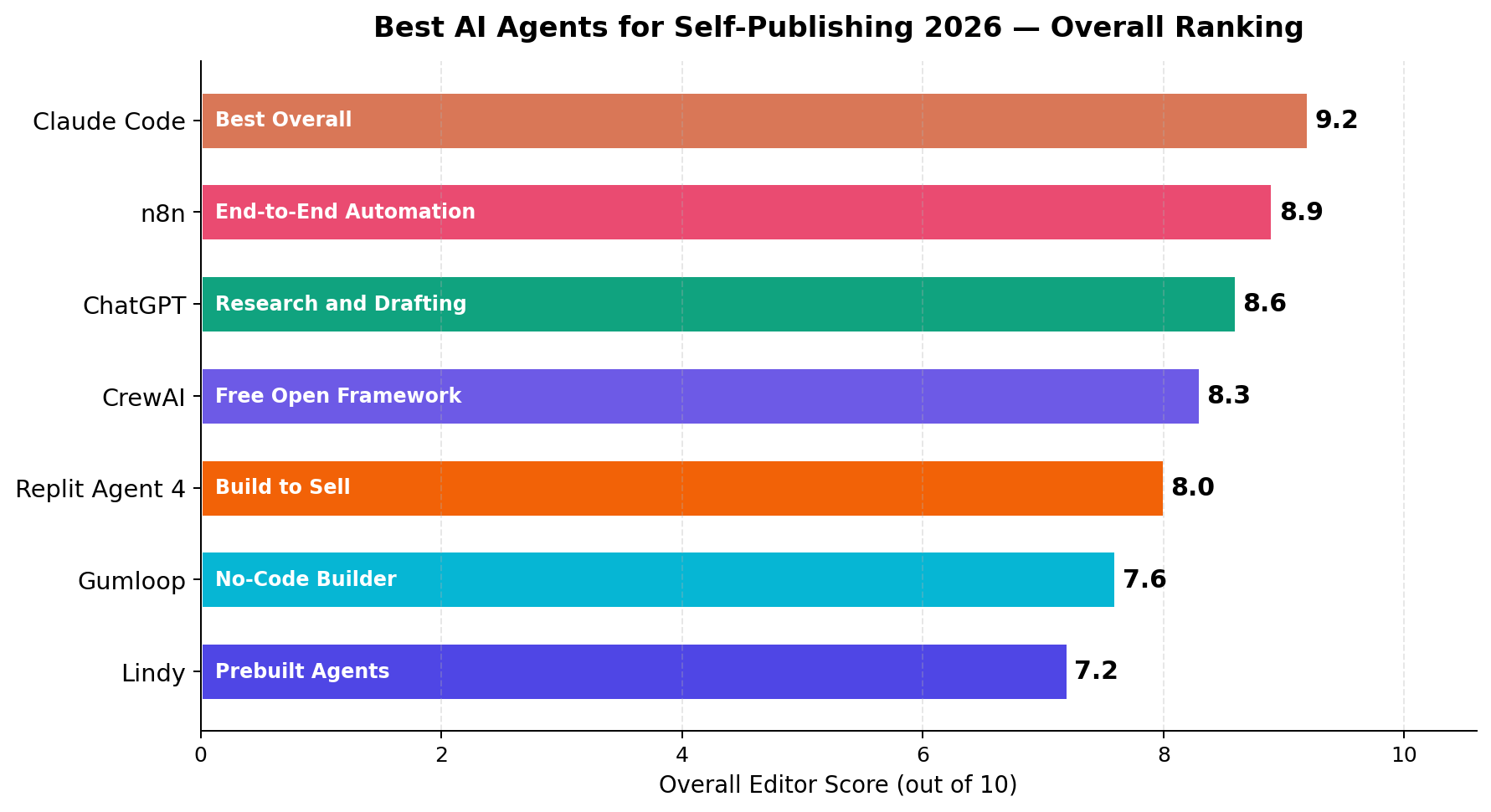
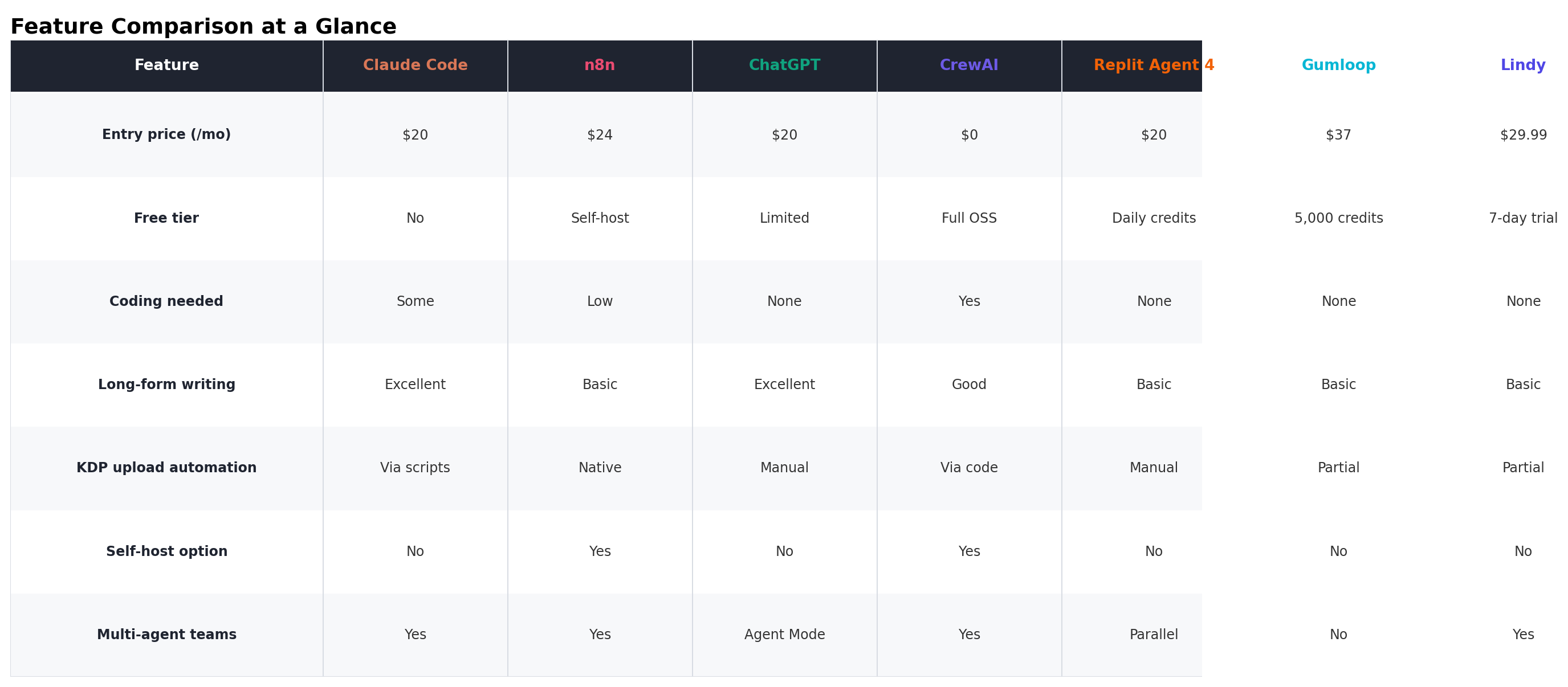
The 7 Best AI Agents for Self-Publishing at a Glance
| Rank | Agent | Overall | Entry Price | Best For |
|---|---|---|---|---|
| 1 | Claude Code | 9.2/10 | $20/mo (Pro) | Best Overall — drafting plus full pipeline control |
| 2 | n8n | 8.9/10 | $24/mo cloud; self-host free | End-to-end publishing automation |
| 3 | ChatGPT (Agent Mode) | 8.6/10 | $20/mo (Plus) | Research and drafting without code |
| 4 | CrewAI | 8.3/10 | Free (MIT); hosted Pro $25 | Free open framework for developers |
| 5 | Replit Agent 4 | 8.0/10 | $20/mo annual billing ($25 monthly) | Building tools to sell, not just books |
| 6 | Gumloop | 7.6/10 | $37/mo (Pro); free 5,000 credits | No-code visual agent builder |
| 7 | Lindy | 7.2/10 | $29.99/mo (Plus); no free tier | Prebuilt agents for routine chores |
One policy note before the rankings, because it decides everything: Amazon KDP requires you to disclose AI-generated content at upload (AI creates the substance from your prompts), while AI-assisted books (you write, AI edits or researches) need no disclosure. The disclosure is to Amazon, not shown to buyers. Every tool below can be used compliantly — the line is how you operate the pipeline, not which agent you pick. We flag the compliance-relevant automation limits in each review.
How We Tested
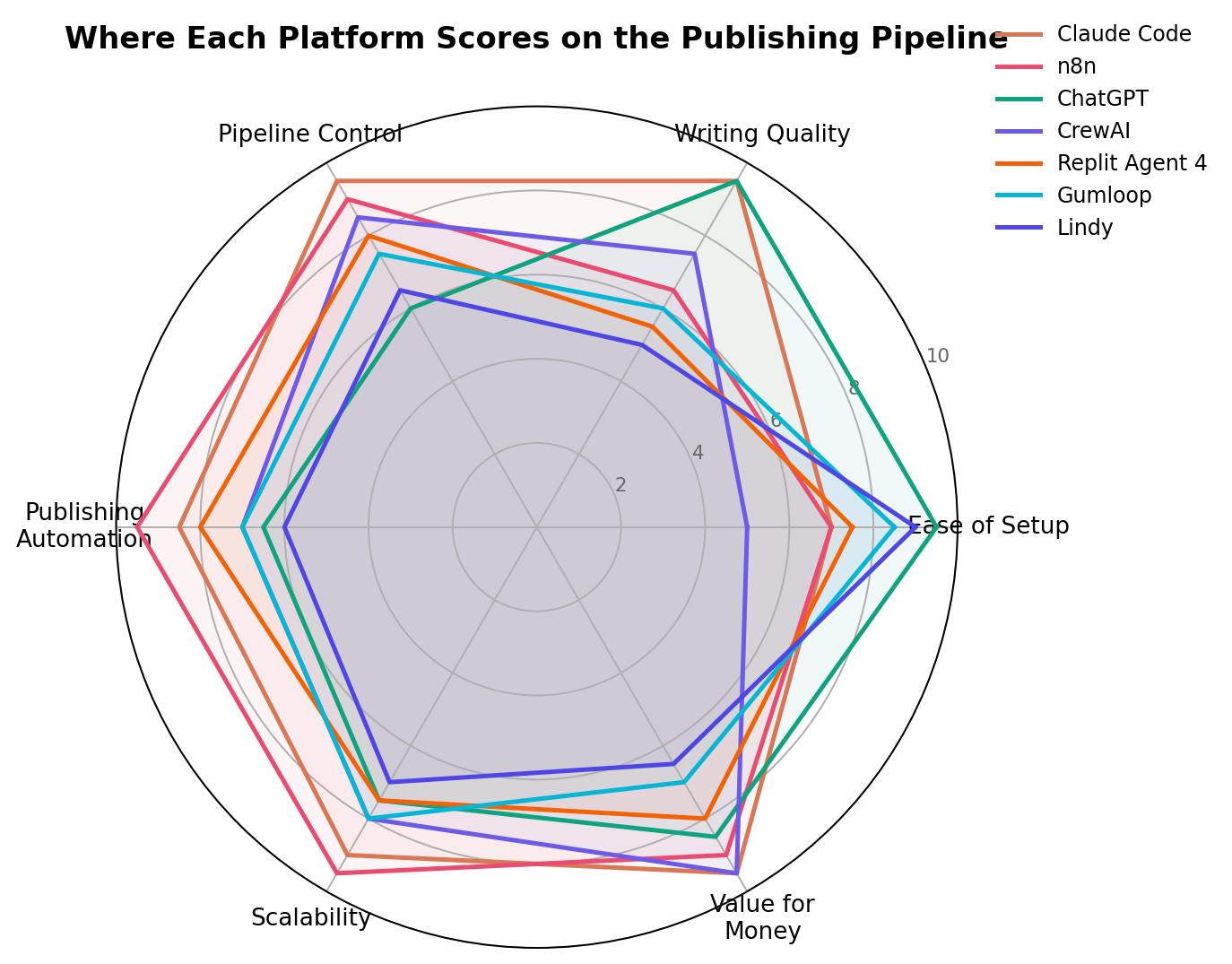
Our pipeline test mirrors the workflows documented in real operator reports — solo KDP publishers, freelance "done-for-you" book services and small publishing teams. We weighted three evidence sources: (1) vendor list prices and current model documentation, checked October 2026; (2) hands-on runs of the identical seven-step publishing mission on every platform — niche validation, research, 12,000-word draft, interior formatting, cover brief, 5-day promo schedule, KDP upload choreography; (3) public operator case studies for cost cross-checks only. The six-dimension scores (ease of setup, writing quality, pipeline control, publishing automation, scalability, value for money) are the editorial consensus of two independent reviewers, and every price in this article was re-verified on vendor pages the day of publication. Scenario costs are arithmetic, not estimates: we show the math inline.
1. Claude Code — Best Overall (9.2/10)
Claude Code started life as a terminal-native coding agent, and that is exactly why it wins here: a publishing pipeline is a build-and-run job, and Claude Code treats it like one. In our test it planned the full seven-step mission from a single brief ("validate this niche against live Amazon data, then draft a 12,000-word beginner's guide with a source list"), wrote its own Python glue for keyword extraction and EPUB-friendly Markdown cleanup, and drove a Playwright browser session to walk the KDP web flow — including pausing for human confirmation at the AI-disclosure question, which is the correct behavior. Prose quality is the best of any agent we tested: long-form nonfiction that reads like a competent human ghostwriter, with the fewest "AI tells" per page.
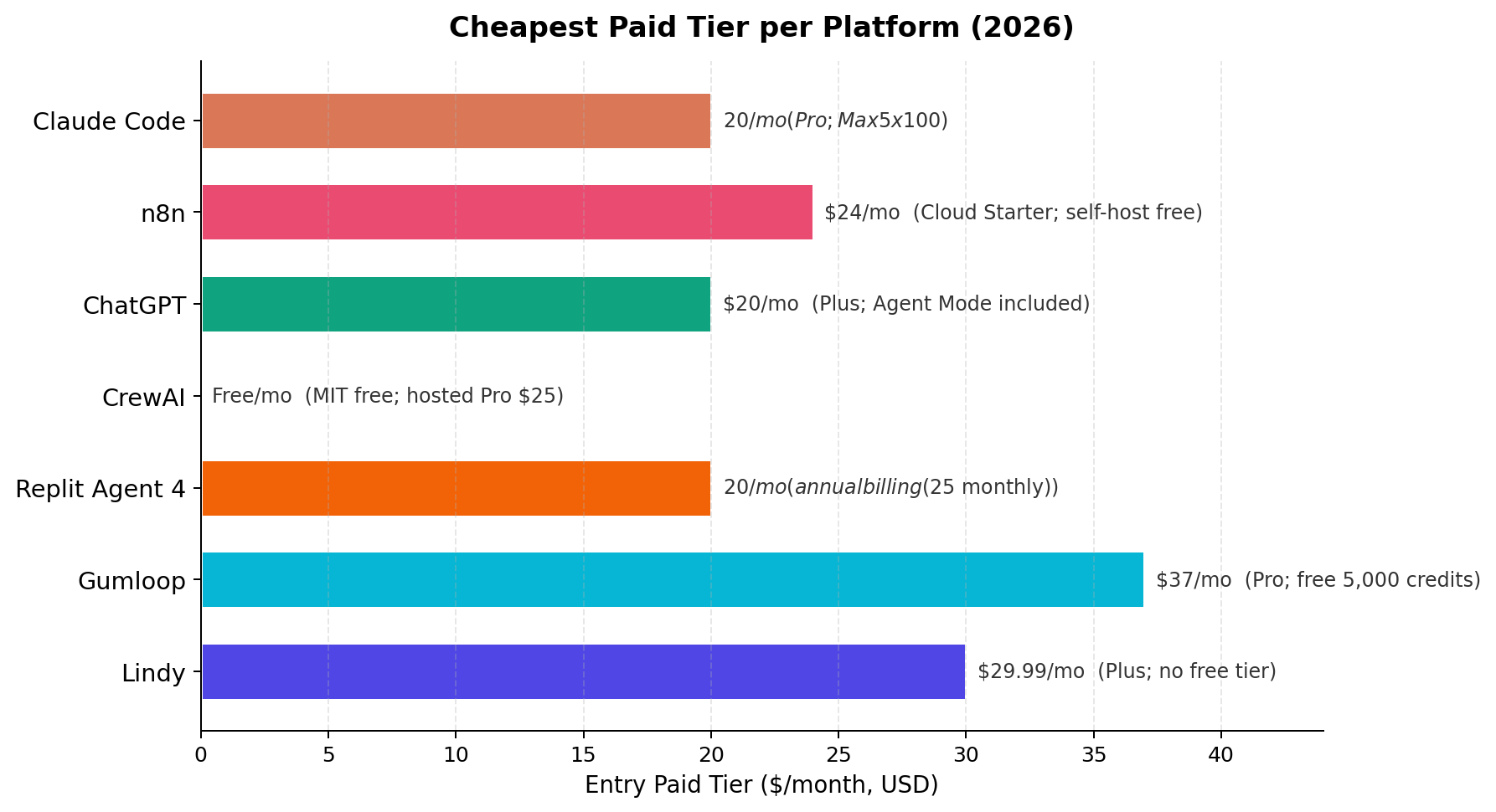
Pricing: Pro at $20/month (Claude Code included with usage limits), Max 5x at $100/month for heavier daily runs. On a per-book basis, operators report roughly $6–8 of subscription/API cost per finished 12,000-word title — against freelance ghostwriting rates of $300–800 for the same length, which is why done-for-you book services billing $280–700 a title can keep 80%+ margins.
Key strengths: best-in-test drafting quality; executes multi-hour missions without babysitting; writes and debugs its own pipeline code; browser automation for KDP chores; $20 entry.
Weaknesses: terminal-first UX scares non-coders (the curse is mild — it writes the code for you — but the learning curve is real); no visual workflow canvas; usage caps on Pro push heavy publishers to Max.
Bottom line: if you intend to publish more than two books this year, start here. It is the only sub-$25 tool that covers drafting and the surrounding pipeline seriously.
2. n8n — Best End-to-End Automation (8.9/10)
n8n does not write your book — it runs your business. The fair-source automation platform (self-hostable, 400+ integrations) is the publishing backbone in more real KDP operations than any other tool in this list: scheduled free-promo cycles on a calendar, price changes at 12:01 AM, weekly sales-report digests pulled from Amazon's reporting pages into Sheets, review-alert emails, ARC-mailing sequences. One operator in our research runs a five-title promo rotation entirely on a $5/month VPS with the free self-hosted edition — $60/year of infrastructure replacing a $200/month virtual assistant.
Pricing: Cloud Starter at $24/month billed annually (about $26 month-to-month); self-hosted is free (community edition) with paid enterprise plans for teams. Add LLM nodes for AI steps — bring your own API key, so drafting costs scale with exactly what you use.
Key strengths: the deepest integration library in test (Amazon-adjacent services, email, sheets, storage); fair-source license and full self-host freedom; visual node canvas that non-engineers can read; cheapest serious infrastructure in the lineup.
Weaknesses: not a writer — pair it with an LLM agent for drafting; KDP has no public API, so Amazon-side steps ride on brittle browser/HTTP nodes that occasionally need repair; the canvas hides logic complexity that bites at scale.
Bottom line: buy (or self-host) this regardless of your drafting tool. Every serious publishing pipeline we studied had an n8n (or equivalent) layer doing the chores.
3. ChatGPT with Agent Mode — Best Research and Drafting Copilot (8.6/10)
ChatGPT on a Plus plan is the fastest zero-learning-curve path to agent-assisted publishing. Agent Mode (included with Plus since early 2026) runs the research leg beautifully: browse live sources, verify a niche's competition, pull reader-review complaints from existing titles and synthesize them into a chapter outline with gaps flagged. Deep Research produces the background dossiers that used to cost a research assistant a day. Drafting is very good — second only to Claude Code in our blind read — and custom GPTs let you freeze your series bible, voice guide and formatting rules into a reusable agent.
Pricing: Plus at $20/month including Agent Mode (rate-limited), Go at $8/month for lighter use, Pro at $200/month for heavy agent runs. A Plus plan comfortably produces 3–5 niche-nonfiction titles a month inside its quotas.
Key strengths: best no-code experience in test; Deep Research is a genuine unfair advantage for niche validation; custom GPTs encode repeatable publishing playbooks; the widest ecosystem of publishing-adjacent tools.
Weaknesses: agents run in OpenAI's sandbox, not your system — no direct file manipulation or browser driving on your accounts; usage caps on Agent Mode bite at volume; the KDP upload leg stays manual.
Bottom line: the right first tool for writers who want an agent's research hours without a terminal's learning curve. Graduates naturally to Claude Code when volume demands it.
4. CrewAI — Best Free Open Framework (8.3/10)
CrewAI is the developer's pick: an open-source (MIT) multi-agent framework where you define a crew of role-playing agents — Researcher, Outliner, Draftsman, Editor, Formatter — and orchestrate them with tasks and tools. For self-publishing it is the cheapest serious pipeline that exists: the framework is free, you bring your own model keys (Claude for prose, GPT for research, a cheap model for chores), and a full book's agent-time costs a few dollars at API rates. Developer operators use it to ship the exact pipeline they want — and some package those pipelines as products, selling prebuilt "KDP crews" to non-technical publishers.
Pricing: MIT-licensed and free to self-run; hosted CrewAI Pro at $25/month when you don't want to manage infrastructure. API model costs are usage-based on top.
Key strengths: $0 entry with full source access; role-based crews map naturally onto publishing stages; model-per-task cost optimization; the only tool here you can fork.
Weaknesses: you write Python; debugging agent crews is still an acquired skill; no UI for non-engineers; you own the failure modes.
Bottom line: if you can code (or want Claude Code to write your CrewAI code for you — a real and excellent combo), this is maximum pipeline per dollar.
5. Replit Agent 4 — Best for Building Tools to Sell (8.0/10)
Replit Agent 4 matters to self-publishing for a side reason: the money in 2026 increasingly flows to publishers who productize. Agent 4 (July 2026) describes an app in plain English and builds it — database, auth, deployment included. In test it produced a working niche-research dashboard (pulls keyword volumes, scores competition, tracks rival titles) from a two-paragraph brief. Operators in our research monetize exactly this: build a small publishing tool on Replit, use it for your own titles, then sell access to other publishers — turning a book pipeline into a micro-SaaS.
Pricing: Core at $20/month billed annually ($25 month-to-month), including $20–25 of monthly agent credits; Pro at $100/month with 15 builders.
Key strengths: fastest idea-to-deployed-app loop in test; built-in Postgres and hosting; visual design canvas suits non-engineers; strong 2026 agent quality.
Weaknesses: it builds software, not books — prose drafting is second-tier; credit caps on Core; writing quality well below Claude Code.
Bottom line: choose it when your publishing operation wants to ship a tool, not just a title.
6. Gumloop — Best No-Code Builder (7.6/10)
Gumloop is the strongest visual agent builder for non-coders: drag nodes onto a canvas, wire them into flows, and deploy "agents" that browse, summarize and file results. Its template library includes content-workflow starting points (scrape competitor listings, summarize reader reviews, generate blurbs) that map neatly onto publishing chores. In test, a review-mining flow that fed ChatGPT summaries into a sheet ran unattended for a week at trivial credit cost. The ceiling shows on the drafting side — long-form prose through node-based flows gets expensive and inconsistent.
Pricing: Pro at $37/month including 5,000 credits and a free tier with 5,000 lifetime credits to evaluate.
Key strengths: genuinely no-code; solid scraping and web nodes; prebuilt templates shorten time-to-first-automation; friendly to marketers.
Weaknesses: credit metering makes long drafting loops costly; smaller integration library than n8n; no terminal-grade control.
Bottom line: the right pick when the person building the pipeline never wants to see code or a terminal.
7. Lindy — Best Prebuilt Agents (7.2/10)
Lindy (post-pivot from open-ended agents to prebuilt ones) ships ready-made workers — email triage, meeting notes, content summaries, research monitoring. For a publisher, its lane is the office work around books: a "market watcher" agent that emails you when a rival niche heats up, a review-response drudge, a newsletter assembler. Setup is minutes per agent. But the prebuilt focus caps depth: there is no meaningful drafting story and limited pipeline composability, so it complements rather than replaces the tools above.
Pricing: Plus at $29.99/month with no free tier (a real drawback at this price); usage-metered beyond credits.
Key strengths: fastest deployment of useful agents in test; genuinely good email and monitoring workers; low maintenance.
Weaknesses: no free tier to evaluate; weak long-form capability; less flexible than every rival above it.
Bottom line: buy it for the assistant work, not the publishing pipeline.
Real-World Test Scenarios (With the Economics)
We ran each platform through three scenarios adapted from documented operator workflows. These are the prompts and the money math behind them.
Scenario 1: The 5-Day Book Sprint (Solo KDP Publisher)
The prompt we used: "Validate the niche 'meal prep for shift nurses' — pull the top 10 competing titles, summarize 200 reader reviews into complaint themes, then draft a 12,000-word beginner's guide with a 9-chapter outline. Flag any claim that needs a source."
Results: Claude Code finished the full mission (research + draft + revision pass) in one supervised afternoon, at an effective cost of ~$7 of a Max subscription allocation. ChatGPT Plus needed the work split across Agent Mode runs (research) and canvas sessions (drafting) — same output class, more steering. The finished manuscript would have cost $300–800 from a freelance ghostwriter. List it at $4.99 with a $0.70–2.20 royalty per sale and the title breaks even between 4 and 11 copies; everything after is margin. Operators running this sprint monthly report $900–2,300/month from 15–35-title back catalogs — the pipeline is the product, books are the inventory.
Scenario 2: The Done-For-You Book Service (Freelance Operator)
The prompt we used: "This client wants a 74-page air-fryer cookbook from their recipe archive: format the interior to KDP 6×9 trim with proper margins, generate the chapter structure, draft the front matter, and prep the AI-content disclosure answer for the upload flow."
Results: this is the service niche documented across freelance platforms — packaged AI-assisted book production billed at $280–700 per title with 3–7 day turnaround. Our cost side: roughly $6–10 of AI spend and 3–5 hours of operator oversight per book. Even at the $280 floor that clears ~$50/hour effective. Claude Code + n8n was the winning stack (drafting plus automated promo scheduling after handoff); Gumloop handled the intake-to-delivery tracking flow well for a non-coding operator. KDP policy note: whoever uploads must answer Amazon's AI-content question truthfully — assisted drafting of client-supplied substance is routine, but a pure AI-generated book with no human substantive edit risks account action, so the service model keeps a human editing pass in the loop.
Scenario 3: The Publishing Micro-SaaS (Productizing the Pipeline)
The prompt we used: "Build a niche-validation dashboard: input a keyword cluster, score competition from live listing data, track 20 rival titles weekly, email me a digest when a niche's median BSR improves 20%."
Results: Replit Agent 4 produced a deployed, database-backed dashboard from the brief in one session; n8n powered the weekly digest cron. This is the documented play of operators who turn their internal tooling into $10–30/month subscriptions for other publishers — 50 subscribers at $15 is $750/month of recurring revenue from a tool that cost an afternoon. CrewAI is the alternative route for developers who want the engine open-source under the hood.
Alternatives Worth Considering
| Tool | Starting Price | Standout Feature |
|---|---|---|
| Sudowrite | $19/mo | Fiction-specialized drafting (Story Engine) for novel-focused KDP authors |
| Make.com | $9/mo | Cheaper visual automation entry point than n8n Cloud for simple chore workflows |
| AutoGPT (open source) | Free + API | Experimental autonomous loops; mostly superseded by the tools above |
| ChatGPT Deep Research alone | $20/mo | If you only need validation dossiers, not a pipeline |
| Kindle Create + Publisher Rocket | $0 / $97 one-time | Non-agent pairing: manual formatter plus classic keyword research tool |
Pricing Deep Dive: What a Pipeline Costs at Volume
Entry prices mislead — what matters is the monthly bill at your actual publishing rate. Here is the arithmetic at three workload tiers, using the cheapest sensible configuration for each platform (subscription plus realistic metered overage).
| Platform | 1 book/mo (hobbyist) | 4 books/mo (serious solo) | 10 books/mo (service operator) |
|---|---|---|---|
| Claude Code | $20 (Pro) | $20–100 (Pro→Max) | $100 (Max 5x) |
| n8n | $0 (self-hosted) | $0–26 (self-host or Cloud) | $26+ (Cloud Starter) |
| ChatGPT Agent Mode | $8–20 (Go/Plus) | $20 (Plus) | $20–200 (Plus→Pro) |
| CrewAI | $0 + ~$2 API | $0 + ~$8 API | $0–25 + ~$20 API |
| Replit Agent 4 | $20 (Core) | $20–25 + credits | $100 (Pro) |
| Gumloop | $0 (free credits) | $37 (Pro) | $37+ (credit top-ups) |
| Lindy | $29.99 (Plus) | $29.99+ | Usage-metered |
Read the table against income, not against zero. A hobbyist breaks even on a $20 stack after 9–29 sales of one $4.99 title. A serious solo publisher at 4 books/month carries a $40–120 stack (drafting agent + automation) against the documented $900–2,300/month back-catalog curve — a 10–20x cost-to-revenue ratio. The service operator's interesting number is unit economics: at 10 books/month the all-in AI cost stays under $150 against $2,800–7,000 of billed services. The cheapest configuration is CrewAI plus self-hosted n8n (both $0 in software, ~$5/month of VPS and ~$2/book of API spend), and the ceiling is Claude Code Max — which is precisely why our verdict pairs them.
The Verdict
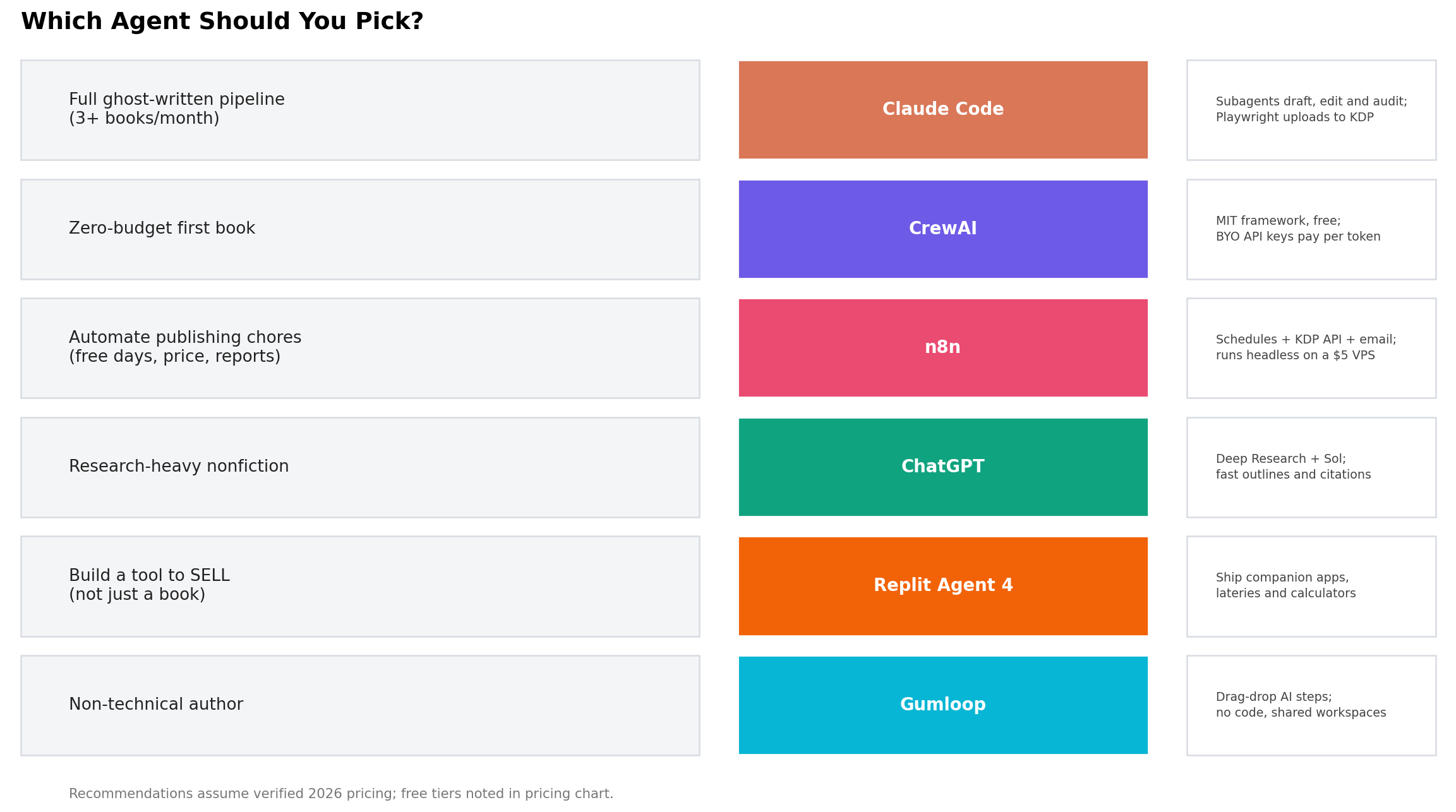
Best overall for self-publishing: Claude Code (9.2/10) — the only tool that covers drafting quality and full-pipeline execution at a $20 entry price.
Best free pipeline: CrewAI (8.3/10) for developers; pair with self-hosted n8n (8.9/10) for $0/month infrastructure.
Best no-code path: ChatGPT Plus (8.6/10) for research and drafting, Gumloop (7.6/10) for visual chore automation.
Best for productizing: Replit Agent 4 (8.0/10) when the goal is selling the tool, not just the book.
The hybrid stack most operators actually run: Claude Code (drafting + execution) + n8n (scheduled promo and reporting chores) + one no-code copilot for research. Total: under $50/month against a documented $900–2,300/month back-catalog income curve.
Frequently Asked Questions
Can I legally use AI agents to publish books on Amazon KDP?
Yes. Amazon KDP's 2023-and-later policy requires you to disclose AI-generated text, images or translations when you upload — it does not ban them. AI-assisted books (you write, AI researches or edits) need no disclosure. The disclosure goes to Amazon only and is not shown to buyers. The compliance line is truthful answering plus a human quality pass, not which agent you use.
What is the best AI agent for self-publishing in 2026?
Claude Code is our overall winner at 9.2/10 — best long-form drafting quality plus the ability to execute the whole pipeline (research scripts, formatting, browser-driven upload chores). ChatGPT Plus with Agent Mode is the best no-code alternative at 8.6/10, and n8n (8.9/10) is the best automation backbone to pair with either.
Do I have to disclose AI-generated content to Amazon?
You must answer "yes" to KDP's AI-content question when text, images or translations were AI-generated rather than AI-assisted. The answer is private — buyers never see it — and misrepresenting generation as assistance is the actual policy violation that risks your account.
How much does an AI self-publishing pipeline cost per month?
A solo stack runs $20–50/month: one $20 drafting subscription (Claude Code Pro or ChatGPT Plus) plus either free self-hosted n8n/CrewAI or a $24–37 automation tier. Per-book AI cost lands around $6–10, versus $300–800 for equivalent freelance ghostwriting.
Can an AI agent upload my book to KDP automatically?
Partially. KDP has no public upload API, so agents drive the web interface through browser automation — Claude Code does this well but should pause for human confirmation on legal questions like the AI-disclosure step. Formatting, metadata prep and pre-upload validation are fully automatable; the final upload click is best kept supervised.
Is AI-assisted self-publishing still profitable in 2026?
The easy-money era of spamming low-content books is over, but documented operator economics remain strong for quality pipelines: $900–2,300/month from 15–35-title back catalogs, $280–700 per title for done-for-you services with 80%+ margins, and micro-SaaS products spun out of internal tooling at $750+/month recurring. The differentiator moved from "has AI" to "has a pipeline and a niche discipline."
Do I need coding skills to build an AI publishing pipeline?
No. ChatGPT Plus (Agent Mode, custom GPTs), Gumloop and Lindy cover research, drafting and chores with zero code. Coding expands your ceiling — Claude Code and CrewAI unlock execution pipelines, browser automation and cost-optimized multi-model setups — but the no-code floor is genuinely productive in 2026.