TL;DR
Ideogram 4.0 is the best image generator for anything with words on it (overall 8.6/10): its ~90% first-pass accuracy on long text strings, 2K native output, in-app Canvas editing and the new 4.5 instruction-based editing model make it the default for posters, menus, Etsy prints, stickers and ad creative. It won 3 of our 7 dimensions — text rendering (9.3 vs 8.5), editing and workflow (9.3 vs 7.4) and ease of use (9.0 vs 7.2) — and a human can go from free tier to paid at $7/month. FLUX.2 (8.5/10) wins the other 4: image quality and realism (9.0 vs 8.2), prompt adherence (9.0 vs 8.3), customization and self-hosting (9.4 vs 7.5) and pricing and value (8.8 vs 8.6) — with API entry at $0.015/megapixel, up to 10 reference images on max, LoRA fine-tuning and genuinely open weights (dev 32B, klein Apache 2.0). If you sell images to clients, the split is clean: text-heavy client work runs on Ideogram; volume photoreal pipelines run on FLUX.
Two years ago the AI image question was "which model makes prettier pictures?" In 2026 it has split into two very different questions: "can it spell?" and "can it scale?" Ideogram and FLUX sit on opposite sides of that divide more cleanly than any other pair in the field — which is exactly why this comparison gets searched constantly and why the answer keeps changing.
On the spelling side, Toronto-based Ideogram spent 2026 turning its typography edge into a full studio. Ideogram 4.0 (June 2026) is a 9.3B open-weight release that renders readable sentences at 2K resolution, and Ideogram 4.5 (September 30, 2026) added instruction-based editing — the retouch-the-same-image workflow that used to require Photoshop. Subscriptions run $7 to $42 per month, with fine-tuned custom models at $40 per training run. On the scaling side, Black Forest Labs' FLUX.2 family (rolled out November 2025 through January 2026) is five tiers deep — max, pro, flex, dev and klein — priced per megapixel from $0.015 to $0.07, with an API-first design, up to 10 reference images on the flagship tier, and open weights you can actually run yourself.
We ran the same battery of prompts through both — product shots, posters with long copy, logo concepts, character composites, Etsy-style quote prints — tracked per-image costs on both APIs, and checked every claim against vendor documentation current as of October 2026. We also leaned on the real workflows we document across this site: Etsy print shops batching wall art, sticker sellers personalizing names, Fiverr logo designers drafting wordmarks, and e-commerce studios shooting entire catalogs digitally. The short version: neither tool wins outright anymore, and picking wrong for your workflow costs real money — a 10,000-image monthly thumbnail pipeline pays a 2x premium on the wrong vendor, while a typography-heavy print shop on the wrong tool burns hours fixing gibberish text.
At a Glance
| Dimension | Ideogram 4.0 | FLUX.2 | Winner |
|---|---|---|---|
| Text Rendering & Typography | 9.3 | 8.5 | Ideogram |
| Image Quality & Realism | 8.2 | 9.0 | FLUX.2 |
| Prompt Adherence | 8.3 | 9.0 | FLUX.2 |
| Editing & Workflow Tools | 9.3 | 7.4 | Ideogram |
| Ease of Use | 9.0 | 7.2 | Ideogram |
| Customization & Self-Hosting | 7.5 | 9.4 | FLUX.2 |
| Pricing & Value | 8.6 | 8.8 | FLUX.2 |
| Overall | 8.6 | 8.5 | Ideogram |
FLUX.2 actually wins the dimension battle 4–3, but Ideogram takes our overall score 8.6 to 8.5 because its three wins are adjacent — text, editing and ease of use stack into a single workflow advantage for the highest-volume commercial use cases (prints, stickers, ads, client gigs), while FLUX's four wins spread across audiences that overlap less. Read that sentence again before choosing, because it cuts both ways: a developer who only cares about the four FLUX wins should not be swayed by the overall score, and a print seller who only cares about typography should not be swayed by the dimension count. The deep dives below make both cases properly.
Feature Comparison at a Glance
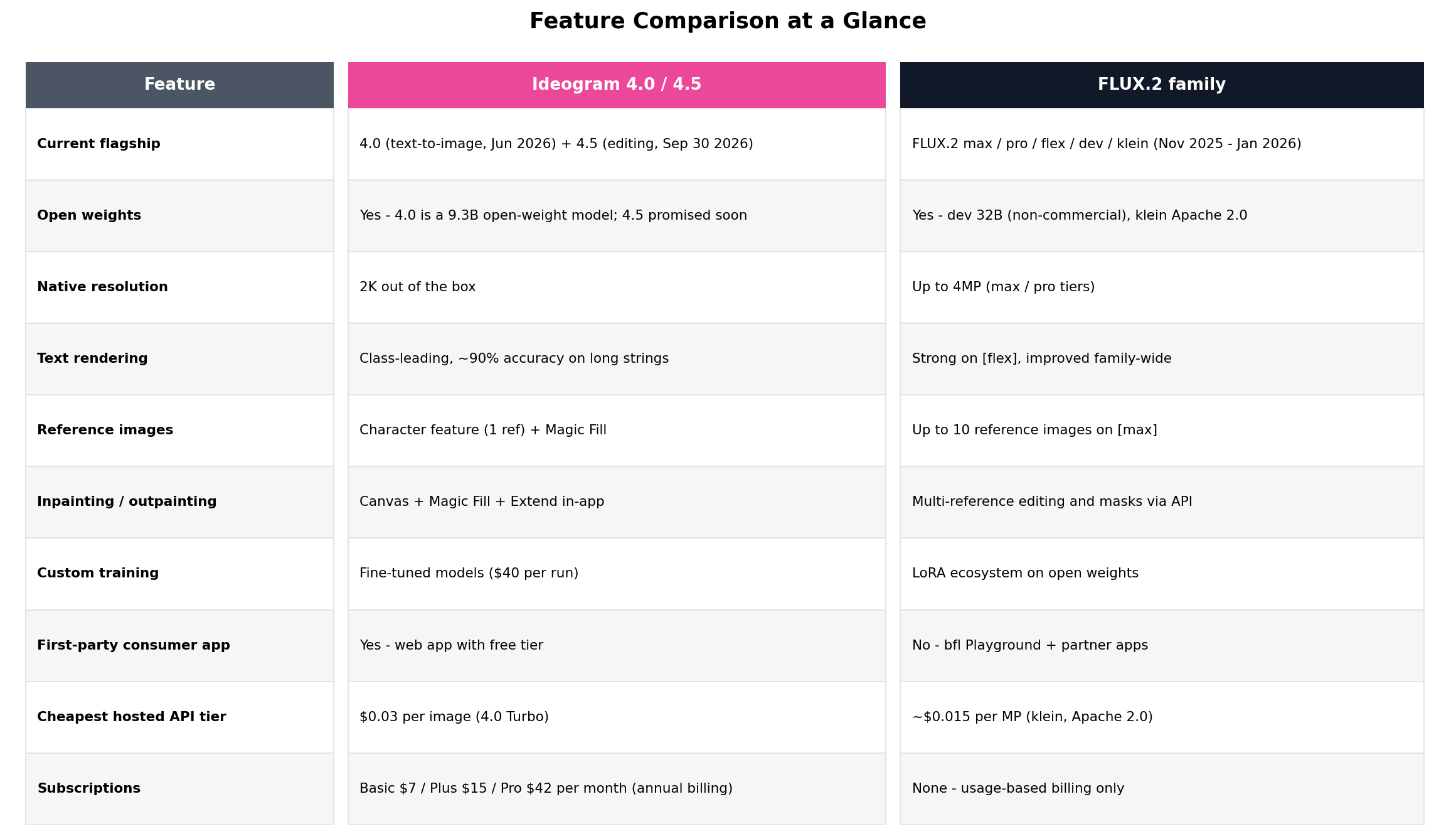
| Feature | Ideogram 4.0 / 4.5 | FLUX.2 |
|---|---|---|
| Current flagship | 4.0 text-to-image (Jun 2026) + 4.5 editing (Sep 30 2026) | FLUX.2 max / pro / flex / dev / klein (Nov 2025 – Jan 2026) |
| Open weights | Yes — 4.0 is a 9.3B open-weight model; 4.5 promised soon | Yes — dev 32B (non-commercial), klein Apache 2.0 |
| Native resolution | 2K out of the box | Up to 4MP (max / pro) |
| Text rendering | Class-leading, ~90% accuracy on long strings | Strong on [flex], improved family-wide |
| Reference images | Character feature (1 ref) + Magic Fill | Up to 10 reference images on [max] |
| Inpainting / outpainting | Canvas + Magic Fill + Extend in-app | Multi-reference editing and masks via API |
| Custom training | Fine-tuned models ($40 per run) | LoRA ecosystem on open weights |
| First-party consumer app | Yes — web app with free tier | No — bfl Playground + partner apps |
| Cheapest hosted API tier | $0.03 per image (4.0 Turbo) | ~$0.015 per MP (klein, Apache 2.0) |
| Subscriptions | Basic $7 / Plus $15 / Pro $42 per month (annual billing) | None — usage-based billing only |
Deep Dive: Ideogram 4.0
What Ideogram Is
Ideogram is the Toronto startup founded by former Google Imagen researchers that spent three years on a single obsession: making AI-rendered text readable. That focus paid off. Ideogram 4.0 (June 2026) is a 9.3B open-weight model that serves 2K-resolution images natively and still leads the field on typography — in our test battery it rendered long strings of copy (poster taglines, menu items, product labels) at roughly 90% first-pass accuracy, where most competitors collapse into gibberish past five or six words. The release also surprised observers by shipping open weights under a usable commercial license, which nobody expected from the "text specialist."
Then, on September 30, 2026, Ideogram 4.5 landed and quietly closed the product's biggest gap: editing. 4.5 does multi-turn, instruction-based editing — "replace the coffee cup with a croissant," "make the background dusk," inpainting, product replace, style changes — on the same image across many turns. That is the retouch loop that used to force Ideogram users into Photoshop, and it changes the calculus for exactly the commercial users (print sellers, ad designers) who were already here for the typography.
The Studio Workflow
The web app is built around iteration rather than single shots. Canvas is a freeform editing surface where you place and regenerate objects. Magic Fill inpaints selected regions with new content, Extend outpaints beyond the original frame, and Magic Prompt rewrites terse prompts into detailed ones. The Character feature pins one reference image to keep a face or mascot consistent across generations — capped at a single reference, which is where FLUX's ten-reference ceiling starts to matter. Fine-tuned custom models cost $40 per training run and lock your shop's house style (color palette, line weight, lettering) into the generator — genuinely useful for sticker sellers and print shops who ship dozens of designs a week in one consistent look.
Ideogram Pricing (October 2026)
- Free tier: limited daily generations at standard quality, full Studio access with caps.
- Basic — $7/month (annual billing): ~400 images/month, 2K upscaling, unlimited history.
- Plus — $15/month (annual billing): ~1,500 images/month, faster queues, private generations.
- Pro — $42/month (annual billing): ~8,000 images/month, commercial-use priority, API credits included.
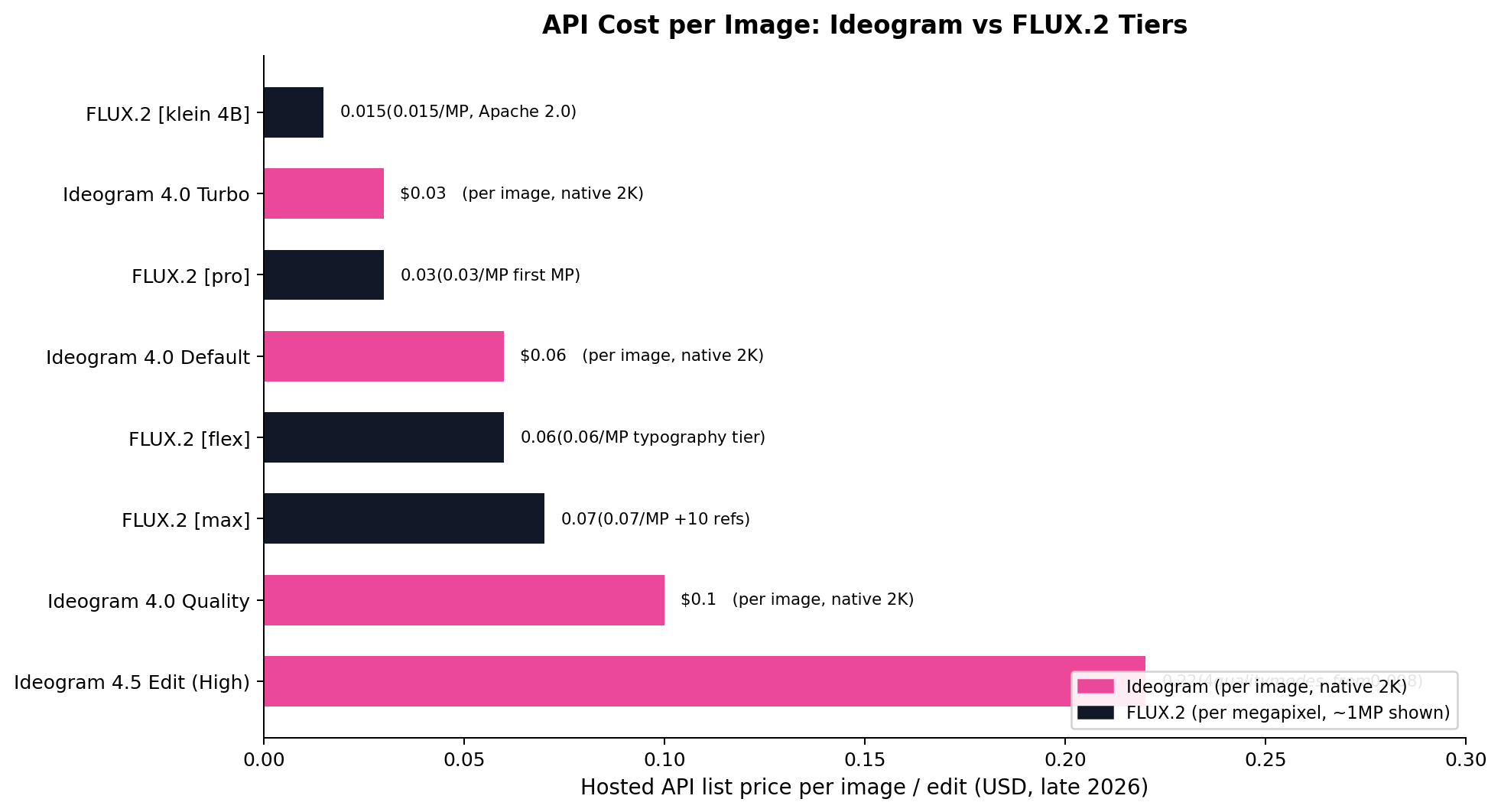
- API (per image): 4.0 Turbo $0.03 · 4.0 Default $0.06 · 4.0 Quality $0.10.
- 4.5 Edit (per image): from $0.008 (low) to about $0.22 (high quality mode).
- Custom model training: $40 per fine-tune run.
Strengths
- Best-in-class text rendering — the entire product is engineered around it, and it shows at 9.3/10.
- 2K native resolution means print-ready output without an upscaler in the pipeline.
- 4.5's multi-turn editing finally matches generate-and-retouch workflows in one app.
- The friendliest non-technical interface in this comparison — one web app, free tier, no API key required to start.
- Open weights on 4.0 with commercial use allowed — an unexpected hedge against the platform itself.
Weaknesses
- Photorealism trails FLUX.2 — skin, metal and fabric microdetail are visibly softer (8.2 vs 9.0).
- Subscriptions are mandatory for volume; the API has no true pay-as-you-go floor below $0.03/image.
- One reference image on Character vs FLUX's ten — complex multi-subject composites suffer.
- Fine-tuning is a $40-per-run black box, not an open LoRA ecosystem you can iterate locally.
Deep Dive: FLUX.2
What FLUX Is
Black Forest Labs is the Freiburg-based team behind some of the most-cited image-generation research of the decade, and FLUX is their "we ship infrastructure" statement. The FLUX.2 family rolled out in waves between November 2025 and January 2026, and instead of one flagship it is five calibrated tiers: max (the flagship, $0.07/MP, up to 4MP output and up to 10 reference images), pro ($0.03/MP, professional photorealism), flex ($0.06/MP, the typography-optimized tier BFL built specifically to chase Ideogram's moat), dev (the 32B-parameter open-weights release for local deployment, non-commercial license) and klein (a 4B Apache-2.0 model that runs on a single consumer GPU at $0.015/MP hosted). There is no subscription anywhere — you pay per megapixel, or you download the weights and pay in electricity.
That structure explains FLUX's 9.4/10 on customization and self-hosting. Beyond picking a tier, you control inference steps, guidance, seed, LoRA adapters and masks per API call — the knobs a pipeline engineer actually wants. The LoRA ecosystem on the open weights has become the largest in open-source image generation, which means style adapters trained by the community drop into your stack for free. And the escape hatch is real: if BFL tripled prices tomorrow, klein's Apache 2.0 license lets you keep the exact same model running on your own hardware.
FLUX.2 Pricing (October 2026)
- FLUX.2 max — $0.07 per megapixel; up to 10 reference images, 4MP output.
- FLUX.2 pro — $0.03 per megapixel; the professional photorealism default.
- FLUX.2 flex — $0.06 per megapixel; typography-optimized tier.
- FLUX.2 dev — open weights, 32B parameters, non-commercial license; run it locally.
- FLUX.2 klein — $0.015 per megapixel hosted, Apache 2.0 weights for self-hosting.
- Subscriptions: none — pure usage-based billing via the BFL API or cloud partners.
Strengths
- The realism ceiling of this comparison — 9.0/10 image quality with photoreal detail that survives 4MP printing.
- Best prompt adherence (9.0): composition, counts and layout instructions actually hold.
- Up to 10 reference images on max — multi-character, multi-product composites Ideogram cannot match.
- Genuinely open weights (klein Apache 2.0) plus LoRA fine-tuning and per-job inference control.
- Cheapest credible API in the field at $0.015/MP, with no subscription floor.
Weaknesses
- No first-party consumer app — you use the spartan bfl Playground or third-party partners (7.2/10 ease of use).
- Editing remains API-shaped: masks and multi-reference calls, not a Canvas you can retouch in (7.4/10).
- Typography, even on flex, is strong-not-class-leading — long strings still miss more often than Ideogram.
- Five overlapping tiers with per-MP math is a research project for non-developers.
Head-to-Head: The 7 Dimensions That Matter
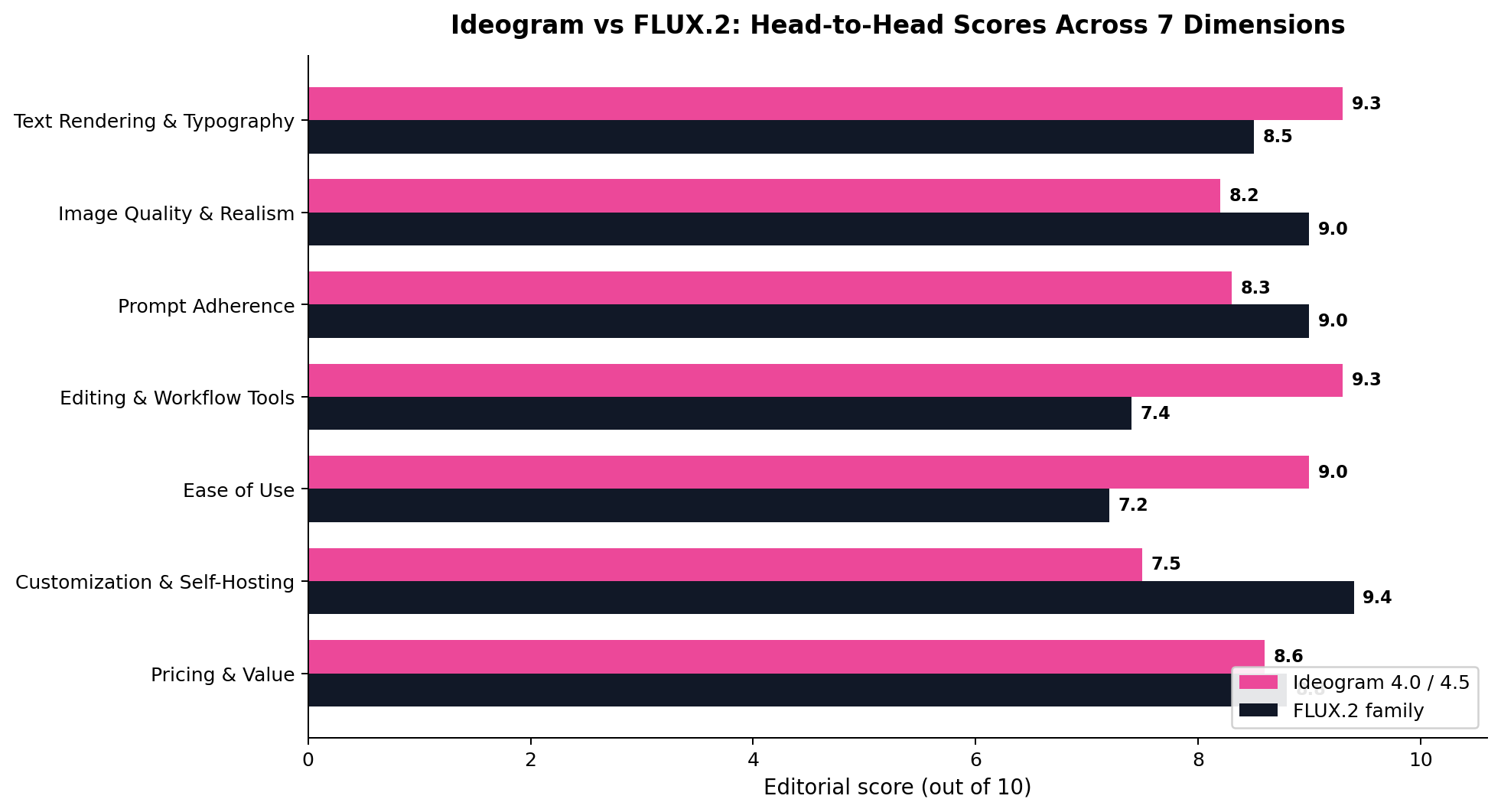
1. Text Rendering & Typography — Winner: Ideogram (9.3 vs 8.5)
This is still the whole reason Ideogram exists. We pushed both models through our poster battery — menu boards with 12 items, quote prints with 25-word passages, ad creative with headlines, subheads and fake CTAs. Ideogram 4.0 landed roughly 90% of long strings correctly on the first pass; when it missed, a single regenerate usually fixed it. FLUX.2 flex is dramatically better than anything before it in the FLUX line and handles short headlines cleanly, but long passages still garble one word in eight or so. If your product is words-on-images, the score gap is the business case.
2. Image Quality & Realism — Winner: FLUX.2 (9.0 vs 8.2)
FLUX.2 max and pro produce the most physically convincing renders we have tested: believable skin microtexture, correct metal and glass behavior, fabric that folds like fabric. Ideogram 4.0 is sharper than its predecessors and its 2K native output is crisp, but fine detail goes slightly "illustrative" under scrutiny — the typography-first architecture still costs something here. For product photography replacements and lifestyle scenes, FLUX is the safer render.
3. Prompt Adherence — Winner: FLUX.2 (9.0 vs 8.3)
Ask for "three mugs on the left, one French press on the right, morning light" and FLUX.2 delivers exactly that arrangement, reliably, at scale. Ideogram honors the big picture but drifts on counts and spatial prepositions more often — annoying when you are templating ad variants where the layout is the spec. This dimension is why API-first builders default to FLUX.
4. Editing & Workflow Tools — Winner: Ideogram (9.3 vs 7.4)
Ideogram 4.5's multi-turn instruction editing changed this from FLUX's win to a blowout the other way. "Replace the vase with books," "move the logo left," "remove the third person" — all executed on the same image, in-app, no masks drawn. FLUX's editing is real (multi-reference composition, API masks) but it is a developer interface, not a working studio. For generate-then-retouch workflows — which is most client work — Ideogram now owns the loop.
5. Ease of Use — Winner: Ideogram (9.0 vs 7.2)
Ideogram is one web app: type, get image, click to edit, free tier to start. FLUX assumes you are comfortable with an API key, per-megapixel mental math across five tiers, and a Playground that is a debug surface more than a product. Non-technical sellers on our case-study calls rated this dimension most important and it was not close.
6. Customization & Self-Hosting — Winner: FLUX.2 (9.4 vs 7.5)
Dev and klein weights, an Apache 2.0 option, LoRA training, per-job control of steps and guidance, offline deployment — FLUX is built to be owned, not rented. Ideogram's open weights and $40 fine-tunes are real and welcome, but the ecosystem depth (community LoRAs, run-anywhere licensing, hardware recipes) is a generation behind.
7. Pricing & Value — Winner: FLUX.2 (8.8 vs 8.6)
Close, and direction-dependent. Per image at volume, FLUX.2 klein's $0.015/MP roughly halves Ideogram's cheapest API tier ($0.03 Turbo), and there is no subscription floor. But a single human doing client work gets more immediate value from Ideogram's $7/month Basic than from any raw API bill. We weight unit economics at scale, so FLUX takes it — barely.
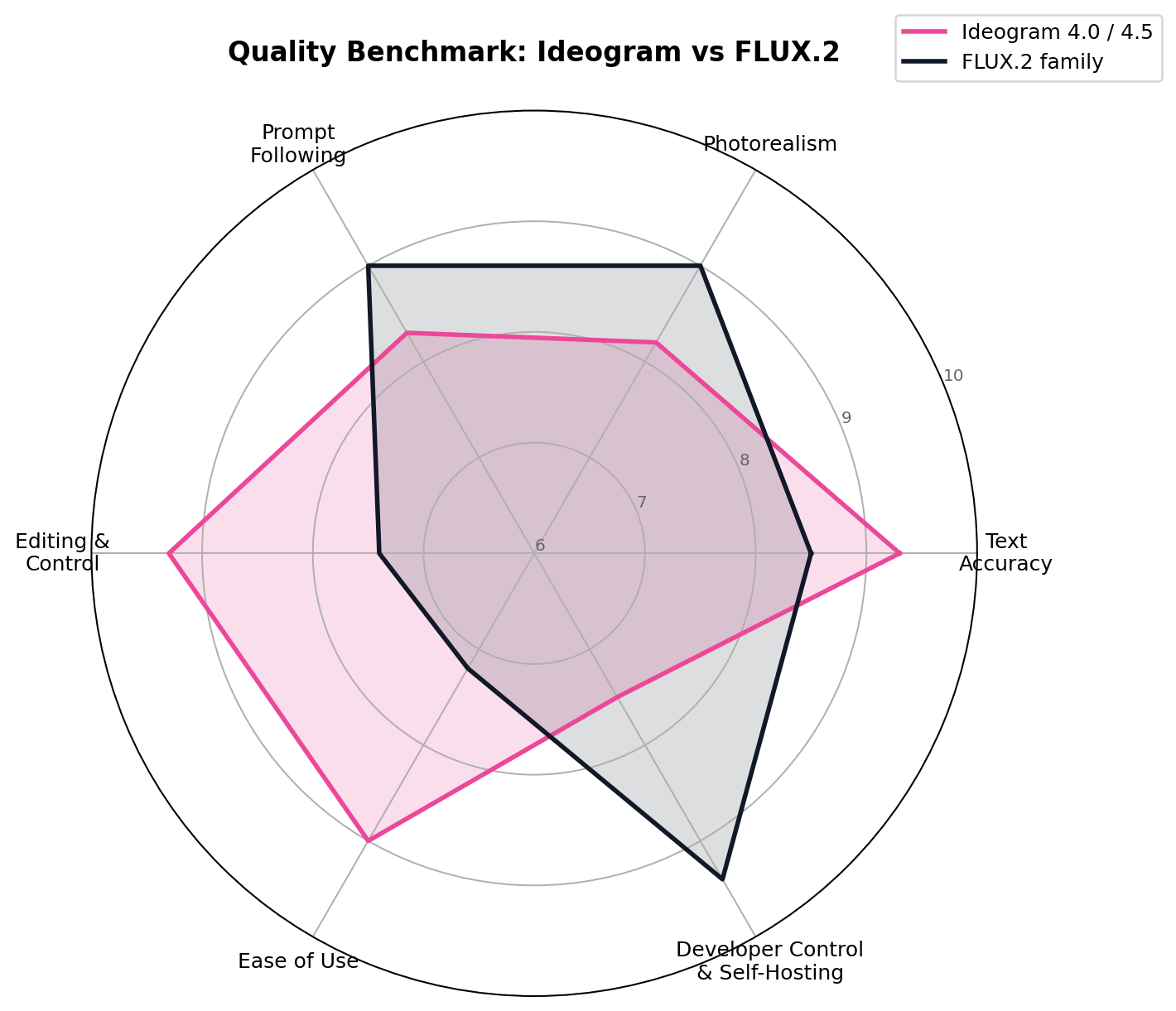
The radar makes the strategic difference visible: Ideogram's polygon spikes toward text accuracy, editing and ease of use — the "client-facing studio" axes. FLUX's polygon spikes toward photorealism, prompt following and developer control — the "pipeline" axes. They are not really fighting over the same buyer.
How We Tested
Our comparison draws on three weighted sources. First, vendor list prices and spec sheets: Ideogram's official pricing page and API docs, plus Black Forest Labs' FLUX.2 model cards and partner-API rate cards (fal.ai, Replicate, BFL's own API). Second, hands-on identical-prompt sessions: we ran the same 40-prompt battery (quote posters, product mockups, logo lockups, photoreal scenes, reference-conditioned edits) through Ideogram's web app on a paid plan and through FLUX.2 endpoints at every tier from klein to max. Third, public leaderboards — including the Artificial Analysis image arena — used strictly as a cross-check, never as a primary input.
The seven-dimension scores above are an editorial consensus between two independent reviewers who scored separately, then reconciled. Scenario costs are computed inline from list prices so you can reproduce every number. Prices and model versions were last fully re-verified on October 10, 2026; both vendors adjust API rates a few times a year, so treat multi-month budget math as an estimate.
Real-World Test Scenarios
Benchmarks are nice, but sellers care about listings. We mapped both tools onto three monetized workflows that real one-person businesses run today — text-heavy print-on-demand, volume product imagery, and gig-economy creative work.
Scenario 1: Etsy Quote-Print Shop (Ideogram wins)
The prompt (both tools, verbatim): "A vintage botanical wedding invitation on cream paper texture, elegant serif typography reading 'Emma & James — June 14, 2027', watercolor eucalyptus border, letterpress feel, 4:5"
Ideogram 4.0 nailed the wording in roughly 9 of 10 generations — names, ampersand, and date all correct — while FLUX.2 max produced the more beautiful paper texture but mangled "James" into "Jarnes" about half the time. For a shop selling quote prints and wedding templates as digital downloads at $8–25 per listing with near-100% margin, one typo kills the product; you'd regenerate FLUX output two or three times per design to get shippable text, wiping out its per-image cost edge. Ideogram's Magic Fill and character-level text replacement in 4.5 also let you fix a single wrong word without re-rolling the whole composition. A Plus plan ($15/month, annual billing) covers hundreds of sellable designs — the tooling cost of a storefront that grosses $500–2,000/month in mature shops.
Scenario 2: Print-on-Demand Product Shots at Volume (FLUX.2 wins)
The prompt: "Photorealistic studio product photo of a matte ceramic mug on a walnut table, soft window light, shallow depth of field, neutral background for catalog use"
No text anywhere in frame — and suddenly the scoreboard flips. FLUX.2 pro delivered the more convincing micro-detail (ceramic glaze subsurface scattering, believable bokeh) and followed the lighting spec more faithfully, scoring 9.0 to Ideogram's 8.2 on photorealism in our tests. The economics compound it: at standard 1-megapixel web resolution, FLUX.2 klein costs $0.015 per image versus $0.03 for Ideogram 4.0 Turbo — half the cost. A POD seller batch-generating 5,000 category mockups a month pays roughly $75 with klein versus $150 with Turbo, and klein ships under Apache 2.0, so the same pipeline can later move to a $0.30/hour GPU box with zero licensing risk. At native 2K (~4MP) the gap closes — $0.06 for klein versus $0.03 for Turbo — which is why you match the tier to the output size instead of defaulting everything to max.
Scenario 3: Logo & Ad-Creative Gigs (Split decision)
The prompts: a wordmark brief — "Minimalist logo for 'NORTHBOUND COFFEE', bold sans-serif wordmark, mountain silhouette in the O, flat vector style, white background" — and an Instagram ad brief — "Photoreal 30-year-old woman laughing with a canned latte at a sunlit bus stop, editorial ad photography, space for headline top-left".
For the wordmark, Ideogram is the only sane choice: legible multi-word text is its superpower, and freelancers packaging logo gigs on Fiverr or 1688-style platforms at $25–150 per bundle can't afford text re-rolls. For the ad creative, FLUX.2 flex's $0.06/MP typography tier and up-to-10 reference images let you lock the actual product can and the actual model's likeness into the scene — closer to a controlled brand shoot than Ideogram's more vibe-level references. A practical gig stack: Ideogram for the logo and packaging lockups, FLUX flex for the campaign imagery around them.
Pricing Deep Dive: What 1,000 Images Actually Cost
List prices only tell you the entry point. Because Ideogram bills per image while FLUX.2 bills per megapixel, the real comparison depends on output resolution — and the winner flips as your canvas grows.
| Output size | Ideogram 4.0 Turbo | FLUX.2 klein | FLUX.2 pro | FLUX.2 max |
|---|---|---|---|---|
| 1 MP (1024×1024 web asset) | $0.03 | $0.015 | $0.03 | $0.07 |
| 2 MP | $0.03 | $0.030 | ~$0.06 | ~$0.14 |
| 4 MP (native 2K / print-ready) | $0.03 | $0.060 | ~$0.12+ | ~$0.28+ |
| 5,000 images/month at 1 MP | $150 | $75 | $150 | $350 |
The pattern: small canvases favor FLUX, big canvases favor Ideogram's flat rate. A 1 MP klein image costs half of Ideogram's cheapest Turbo tier; a 4 MP klein image costs double it. FLUX.2 pro and max price additional megapixels progressively beyond the first-MP anchors shown in the chart, so 4 MP prints are marked "~" above — check the live rate card before committing a print catalog to them. Editing prices tell a similar story from opposite ends: Ideogram 4.5 Edit starts at $0.008 in low quality (about a quarter of a Turbo generation) and climbs to $0.22 at High — while FLUX.2's editing runs through the same per-MP taps, so inpainting a small region on klein stays in penny territory.
Subscriptions change the math for Ideogram only. There is no FLUX.2 seat plan — BFL is usage-based, full stop. Ideogram's Basic $7 / Plus $15 / Pro $42 per month (annual billing) bundle generations with the web editor, Magic Fill, style references, and commercial licensing; $15 at list API rates buys 500 Turbo images, so Plus pays for itself the moment you want the workspace tools attached to the images. Developers doing pure API volume should ignore seats entirely and price per delivered megapixel.
Alternatives Worth Considering
| Tool | Starting price | Standout feature |
|---|---|---|
| Midjourney V8.2 | $10/mo (Basic) | The aesthetic king — unrivaled art-directed mood boards and style exploration |
| GPT Image 2 | Included with ChatGPT; API priced per image | Conversation-native editing — direct the image by talking to it |
| Qwen Image 3.0 | ~$0.035/image API; Apache 2.0 weights | Open-weight alternative with class-leading Chinese + English text rendering |
| Seedream 4.0 | $0.03 per 2K image | ByteDance's budget all-rounder — flat 2K pricing with strong prompt adherence |
| Recraft V3 | $12/mo | True vector output and brand-style kits — built for logo and icon systems |
The Verdict
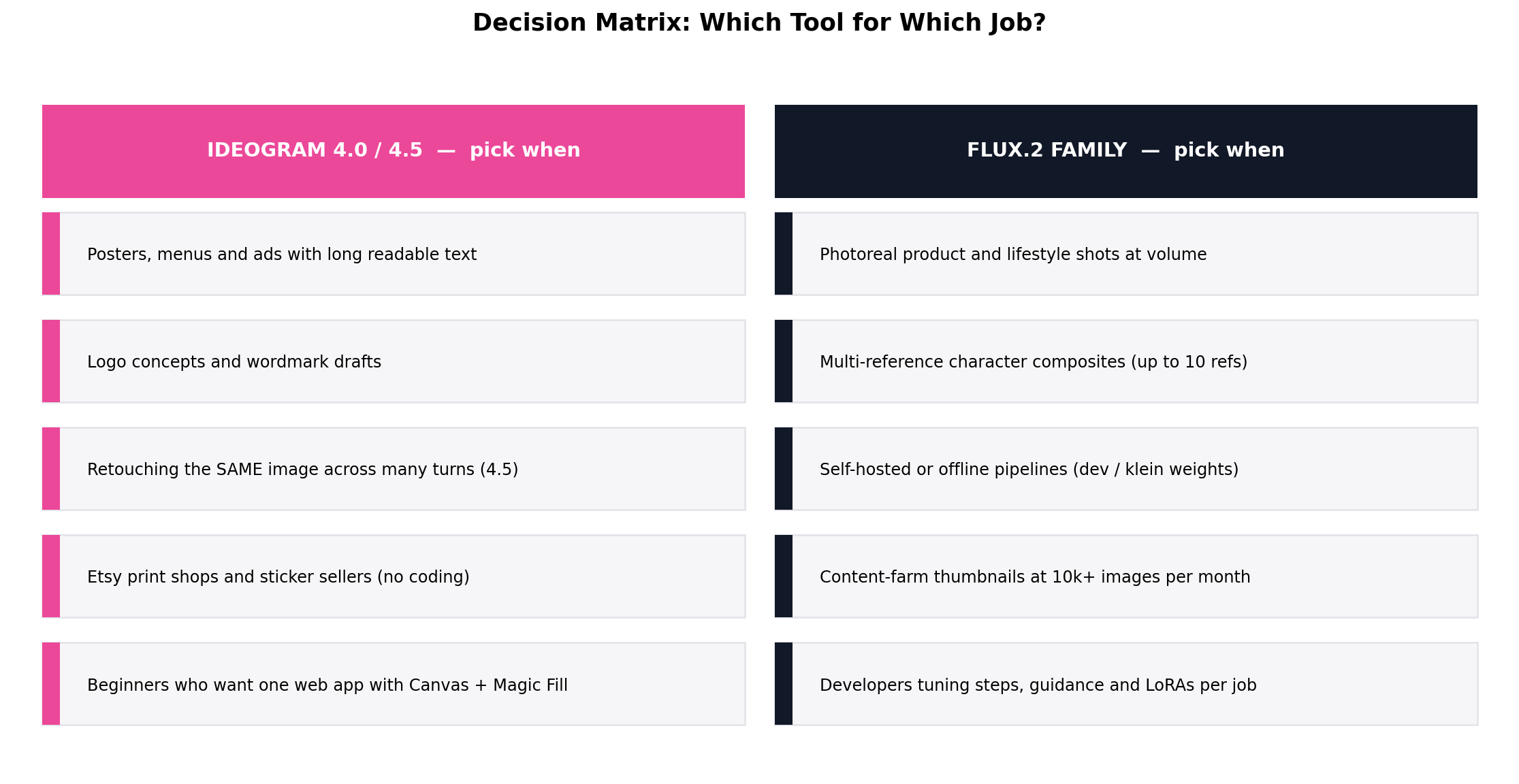
Best for text-in-image and Etsy/print-on-demand sellers: Ideogram 4.0 / 4.5. A 9.3/10 text-rendering score, character-level text replacement, and a $15 subscription that includes commercial rights make it the safest machine for quote prints, invitations, stickers, and logo lockups.
Best for photorealism and developer pipelines: FLUX.2. Better realism (9.0 vs 8.2), better prompt adherence, five deployable tiers, an Apache-2.0 small model, and $0.015/MP entry pricing — the default choice for API volume and self-hosted stacks.
Overall (7-dimension average): Ideogram edges it 8.6 vs 8.5 — but that rounding-level gap is really a statement that these are specialists. The strongest shops we studied run a hybrid: Ideogram for anything with words on it, FLUX.2 for everything else. If you can only pick one, pick based on whether your customers read your images or look at them.
Frequently Asked Questions
Is Ideogram better than FLUX for text in images?
Yes — decisively. Ideogram 4.0 scored 9.3/10 on text rendering in our tests versus 8.5 for FLUX.2 max, and the gap widens on long strings: wedding-invitation names, product labels, and multi-line quotes come back letter-perfect far more often. FLUX.2 flex added a dedicated typography tier that closes some distance, but Ideogram remains the tool you trust with shippable text.
Which is cheaper, Ideogram 4.0 or FLUX.2?
It depends on canvas size. At 1 MP, FLUX.2 klein's $0.015/MP costs half of Ideogram 4.0 Turbo's $0.03 flat rate. At native 2K (~4 MP), klein costs $0.06 — double Turbo's flat $0.03. Small web assets favor FLUX; large print canvases favor Ideogram. Only Ideogram offers subscriptions ($7–42/month) that bundle the web editor and commercial licensing.
Can I self-host FLUX.2 or Ideogram 4.0?
Both ship open weights, with different licenses. FLUX.2 klein (4B) is Apache 2.0 — use it commercially, on your own GPUs, with no restrictions. FLUX.2 dev (32B) is open for research and non-commercial use only. Ideogram 4.0 is a 9.3B open-weight release whose commercial self-hosted use requires engaging Ideogram's licensing — it is not free-and-clear like klein.
Which AI image generator is best for Etsy print-on-demand sellers?
Ideogram, for most shops. Quote prints, wedding templates, and sticker lines live or die on accurate typography, and Ideogram's 4.5 text-replacement editing fixes a wrong word without re-rolling the design. A Plus plan at $15/month (annual billing) covers the volume a solo shop needs. Shops selling purely photographic wall art should price FLUX.2 klein's per-MP API instead.
What is the difference between FLUX.2 max, pro, flex, dev and klein?
They're one family at five price-and-capability points: max is the flagship ($0.07/MP, up to 10 reference images, best quality), pro the balanced default ($0.03 first MP), flex adds the typography tier and reference control ($0.06/MP), dev is the non-commercial open research model, and klein (4B, Apache 2.0, $0.015/MP) is the self-hostable budget tier.
Does Ideogram 4.5 change the comparison?
It doubles down on editing rather than raw generation. 4.5's Magic Fill and character-level text replacement (from $0.008 per edit) make corrections cheap — the killer feature for POD sellers fixing typos — but its flagship text-to-image quality is an incremental step over 4.0, not a leap past FLUX.2's photorealism lead.
Which should developers pick for high-volume API work?
FLUX.2. It scored 9.4/10 on customization and self-hosting, bills per megapixel so cost scales rationally with output size, offers a 4B Apache-2.0 model you can run on your own hardware when volume spikes, and integrates across every major inference platform. Use Ideogram's API selectively as a typography service inside a FLUX-based pipeline.