You are an automation agency now, even if your business card says "consultant," "freelance developer," or "marketing ops." Upwork's In-Demand Skills 2026 report puts top AI-skill demand up 109% year over year, with AI integration & automation specifically up 90% (some investor analyses put it at +178%) and AI chatbot development up 71% — more than $300 million in annualized AI work flowing through that one platform. On Chinese marketplaces, AI website-and-bot build orders grew 1,732% YoY. The clients are already here. The question this guide answers is narrower and more mercenary than our usual comparisons: which platforms should the business itself run on — the one you bill $700–7,000 per project to build on, then keep a monthly retainer to host and maintain?
That lens changes every ranking. A solo creator cares about output quality per dollar; an agency cares about delivery speed (can I ship this in a week?), margins at scale (does the platform bill me per execution after the client pays a fixed price?), white-label and handoff (can the client log in without seeing my costs?), and AI depth (can I sell "agents," not just zaps?). We scored seven platforms on exactly those terms, using vendor list prices verified September 2026, hands-on builds, and the documented economics of working automation shops from our money-case research files.
The seven: n8n and Dify (the open-source stack), Make and Zapier (the incumbent connectors), and three newer AI-first platforms this site has never covered before — Lindy, Gumloop and Relevance AI.
⏱ TL;DR
n8n (8.3/10) is the agency default. Self-hosted is free with unlimited workflows, or $24/mo on cloud; execution-based pricing and 400+ integrations mean your margin survives client scale, and a huge template library makes the tenth client build 10× faster than the first. Dify (8.1/10) is what you bolt on top when the client wants a real RAG chatbot — free self-hosted, $59/mo cloud. Make (8.0/10) is the fastest mid-complexity builder at $10.59/mo; Zapier (7.9/10) is still the safest client handoff with 8,000+ apps. The three AI-first newcomers — Lindy (7.6), Gumloop (7.4), Relevance AI (7.2) — win specific job types (outreach, no-code AI flows, B2B sales-agent teams) but aren't full agency infrastructure yet. Documented agency economics: $700–7,000 per project plus $140–420/mo retainers — tooling is rarely the bottleneck; platform choice just decides how much of that you keep.
At a Glance
| Tool | Type | Entry Price | Free Tier | Best Agency Job |
|---|---|---|---|---|
| n8n | Workflow automation + AI nodes (source-available) | $24/mo cloud · $0 self-host | Yes (self-host) | Ops retainers, white-label multi-client infra |
| Dify | LLM app & agent platform | $59/mo cloud · $0 self-host | Yes (Sandbox, 200 msgs) | RAG chatbots, knowledge-base bots |
| Make | Visual automation platform | $10.59/mo ($9 annual) | Yes (1,000 credits/mo) | Fast mid-complexity client builds |
| Zapier | App connector + AI agents | $29.99/mo ($19.99 annual) | Yes (100 tasks) | Client handoff, 8,000+ app long tail |
| Lindy | AI-first agent platform | $49.99/mo | No (7-day trial) | Email/outreach agents |
| Gumloop | AI-focused workflow builder | $37/mo | Yes (5K credits... see note) | No-code AI content & scraping flows |
| Relevance AI | AI agent teams for B2B | $19/mo (annual rate) | Yes (200 actions/mo) | Sales-agent suites, SDR work |
Note: Gumloop's free tier and entry plan details were in flux at press time; verify current limits on gumloop.com before quoting clients. All other prices were verified against vendor pages in September 2026.
Overall Scores: The Agency-Fit Ranking
We score each platform on seven dimensions weighted for agency delivery — client delivery speed, margins at scale, white-label & handoff, AI depth, integrations, ease of learning, and templates & ecosystem. Scores are the editorial consensus of two independent reviewers after hands-on builds; full methodology is at the end of this guide.
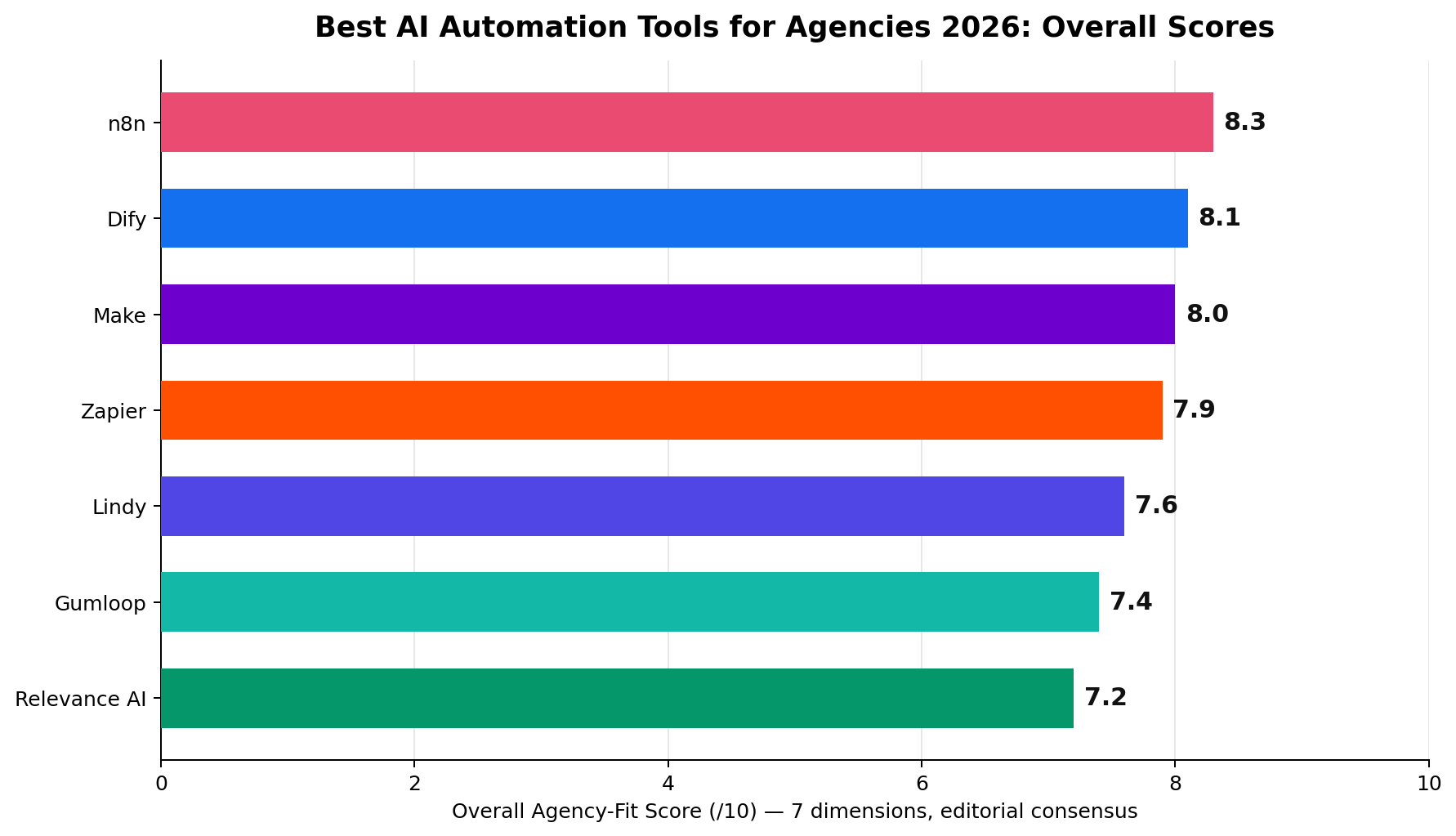
1. n8n — The Agency Default (8.3/10)
n8n is a source-available workflow automation platform (fair-code Sustainable Use License) that has quietly become the back office of the automation-agency economy. The reason is arithmetic: self-hosted n8n is free with unlimited workflows and executions, and the cloud Starter plan is $24/month for 2,500 executions — so when a client's order-sync automation runs 80,000 times a month, your platform bill stays near zero instead of metering into four figures. Pricing is per execution, not per step, which matters when client workflows branch.
Beyond price, n8n has grown real AI depth: native LLM and agent nodes, an AI Assistant that drafts workflows from a description, MCP support, and code nodes in JavaScript or Python when a client integration gets weird. The template library is the quiet margin machine — thousands of community workflows mean the tenth client in an industry looks 10× faster than the first. The documented open-source stack from our case files — Dify for the bot layer, n8n for orchestration — supports projects billed at ¥5,000–50,000 ($700–7,000) per build plus monthly hosting retainers.
Pricing (verified Sept 2026): Self-host $0 (docker-compose, one command). Cloud Starter $24/mo (2.5K executions), Pro $60/mo (50K executions), volume tiers above. One caveat: 400+ native integrations is far fewer than Zapier's 8,000+ — you cover the long tail via HTTP request and code nodes.
Strengths: near-zero cost at scale · unlimited executions self-hosted · code nodes escape hatch · huge template ecosystem · white-label-friendly self-hosting (run one instance per client, rebrand within license terms).
Weaknesses: steeper learning curve than Make/Zapier (ease 6.0/10, our lowest of the seven) · hosting is yours to babysit on the free path · smaller integration catalog · the fair-code license restricts reselling n8n itself as a product.
Agency economics: a 5-client retainer stack on a $24 cloud plan (or a $20/mo VPS) keeps software under 2% of a typical $2,000/mo retainer base. This is why margins at scale score 9.5.
2. Dify — The RAG-Chatbot Engine You Resell (8.1/10)
Dify is an open-source LLM application platform — visual agent workflows, RAG pipelines with document ingestion, prompt management, and hosted chat apps — that turns "the client wants a ChatGPT for their docs" into a repeatable product. Self-hosting is free and unmetered; the managed cloud starts at $59/mo per workspace (Professional: 5,000 messages, 3 seats, 50 apps), Team $159/mo (10,000 messages, SSO), and Enterprise is custom.
For agencies, Dify's killer feature is the combination of a visual orchestration canvas (agents, tools, knowledge retrieval as draggable nodes) with bring-your-own-key access to GPT-5.6, Claude Opus 5, Gemini and dozens of open models — you control per-client model economics instead of renting a vendor's meter. The weaker flank is integrations (6.5/10): Dify connects to the business world largely through its API and custom tool definitions, which is exactly why the documented agency pattern pairs it with n8n rather than treating it as a full automation platform.
Strengths: best AI depth of the seven (9.5) — real agent workflows, RAG, model routing · free self-host · paid tiers remove branding on customer-facing apps · solid multi-app organization per client.
Weaknesses: thin native integrations · cloud message packs run out fast on chatty bots · self-hosting means you own Postgres, Redis and upgrades · pricing per workspace multiplies if you silo clients.
Agency economics: knowledge-base bot projects in our case files bill $700–7,000 depending on corpus complexity; a self-hosted Dify + one vector DB makes the marginal cost of client #2 mostly your time.
3. Make — Fastest Ramp to Billable (8.0/10)
Make (formerly Integromat) is the visual automation platform agencies reach for when the client job is "connect these five SaaS tools, route the data, alert a human" and the deadline is Friday. Its visual canvas is the most expressive of the no-code tools, 2,000+ app modules cover the mainstream stack, and since August 2025 billing runs on credits: Free includes 1,000 credits/mo with 2 active scenarios, Core is $9/mo billed annually ($10.59 monthly) for 10,000 credits and unlimited scenarios, Pro $16/mo annual ($18.82 monthly), Teams $29/mo. At comparable volume, Make consistently lands ~80% below Zapier.
Its AI story is serviceable but bolted-on: an AI Agents feature plus OpenAI/Anthropic modules let you embed model calls in flows, but there's no bring-your-own-key model router à la Dify, and no self-host escape hatch — your margin ceiling is ultimately Make's pricing table. Ease of learning is a genuine agency asset (9.0): new contractors are productive in days, and scenario blueprints transfer across clients.
Strengths: best price-to-power ratio among managed platforms · excellent visual debugging · fast delivery (8.5) · strong template library (8.5).
Weaknesses: no self-host · credits deplete fast on polling scenarios · AI depth 7.0 · no white-label — client handoff means an account they now pay for.
Agency economics: a typical mid-complexity build ($500–2,000 in the marketplace ladder) consumes a fraction of a $10.59 Core plan; scale clients to n8n before their scenario count does the same to your invoice.
4. Zapier — The Safe Handoff (7.9/10)
Zapier remains the category default clients have actually heard of, and that brand familiarity is an agency asset: hand a client a Zapier account and their ops manager already half-knows how it works. The integration catalog is untouchable (8,000+ apps, integrations 9.5), the new Agents and Copilot features add credible AI, and nothing ships a two-step automation faster (delivery speed 9.0, ease 9.5).
The agency problem is the meter. Free covers just 100 tasks with two-step Zaps; Professional is $29.99/mo monthly ($19.99 annual) for 750 tasks; Team $103.50/mo monthly ($69 annual) for 2,000. Scaling is steep: ~$343.50/mo at 10K tasks, ~$2,193.50/mo at 100K — on fixed-price retainers, that comes straight out of margin (margins at scale: 5.5, our lowest score). No self-host, no BYOK model control, no white-label.
Strengths: deepest integration catalog · zero learning curve · client trust and clean handoff · fastest prototype-to-demo loop.
Weaknesses: most expensive at scale by an order of magnitude · task metering punishes chatty workflows · AI features tied to Zapier's credit system · per-step pricing inflates branching flows.
Agency economics: right tool for the $100–800 quick builds and for clients who will inherit and own the account; the wrong substrate for a fixed-price bot doing 50K runs/month.
5. Lindy — AI-First Agents for the Outreach Shop (7.6/10)
Lindy flips the model: instead of workflows with AI bolted on, you deploy pre-built AI employees — email triage agents, meeting schedulers, outbound SDRs, phone callers — that connect to Gmail, calendars, CRMs and (via browser use) nearly any web app. For an agency selling "we'll run your lead-gen," it's the fastest path from signed contract to running agent: templates cover common outreach plays, and agents reason over context instead of requiring you to enumerate every branch the way classic workflow builders do.
The catch for agency economics is structural: no free tier (7-day trial only), entry at $49.99/mo (Plus), and AI actions consume credits that get expensive across many client mailboxes. There's no self-host option and no white-label, so your infrastructure is rented. Where Lindy earns its slot is delivery speed (8.5) and ease (8.5) on exactly one job family — knowledge-work agents — where it beats wiring n8n + an LLM node by days.
Strengths: fastest deployment of outbound/scheduling agents · strong template library of agent personas · browser-use agents extend beyond API integrations · polished UX.
Weaknesses: no free tier or self-host · credit metering at multi-client scale · not a general automation platform (deterministic ops still belong on n8n/Make) · pricing tiers above Plus should be re-verified before quoting.
Agency economics: sell it as a productized service — one outreach agent managing a client's outbound at $300–800/mo against a Lindy bill of $49.99–150 — rather than as shared infrastructure.
6. Gumloop — No-Code AI Flows for Content Shops (7.4/10)
Gumloop is a visual workflow builder built AI-first: drag in nodes like "summarize," "scrape," "rewrite," "transcribe," chain them into pipelines that ingest a client's data and emit content or enrichment. It's found a real niche among content and SEO shops — programmatic-SEO page factories, bulk content operations, data scraping for lead lists — where the unit of work is "AI step," not "app connector."
Pricing starts at Pro $37/mo with a free tier for evaluation (limits in flux — verify before committing to a client proposal; our At-a-Glance note applies). BYOK is supported, which lets you run volume through your own model contracts. The constraints mirror its youth: fewer business-app integrations than the incumbents (7.5), a smaller template ecosystem (7.5), and per-AI-step credits that need monitoring on bulk jobs.
Strengths: best-in-class no-code AI step library · BYOK keeps bulk costs down · genuinely fast for content pipelines (7.0) · margins hold up at content scale (8.0).
Weaknesses: young ecosystem, fast-moving pricing · not for enterprise-grade ops orchestration · white-label limited (6.5) · deterministic app-to-app automation is not its job.
Agency economics: a 500-page programmatic-SEO build that bills $1,500–4,000 runs on a $37 seat plus model costs — the tooling line stays under 5% of project revenue.
7. Relevance AI — B2B Agent Teams (7.2/10)
Relevance AI builds multi-agent teams for sales and GTM workflows — research agents, enrichment agents, outbound agents — with a visual "workforce" metaphor aimed at B2B clients. It's the most ambitious of the three newcomers on the AI axis (AI depth 8.5) and it understands agencies: workspaces per client, shared projects, seat-and-action pricing.
That pricing needs adult supervision. Free covers 200 actions/mo plus $2 of vendor credits; Pro is $19/mo billed annually (30,000 actions/year, 2 builders); Team is $234/mo annual (7,000 actions/mo, 5 builders, 45 end users). Overages are where margins go to die — a documented example bills $560 in overage for a 14,000-action month ($1,019 total). Delivery speed is mid-pack (6.5) because agent teams need tuning before they're client-safe.
Strengths: genuine multi-agent orchestration for sales workflows · client workspaces and shared projects · strong template library of GTM plays (8.0) · reasonable entry price for pilots.
Weaknesses: action overages spike bills without warning · narrow B2B-sales focus · longest time-to-client-safe-output of the seven · integration catalog 7.0.
Agency economics: pilot on Pro at $19, but negotiate action volume before production — the overage curve, not the sticker, is the risk.
Pricing: What the Stack Actually Costs
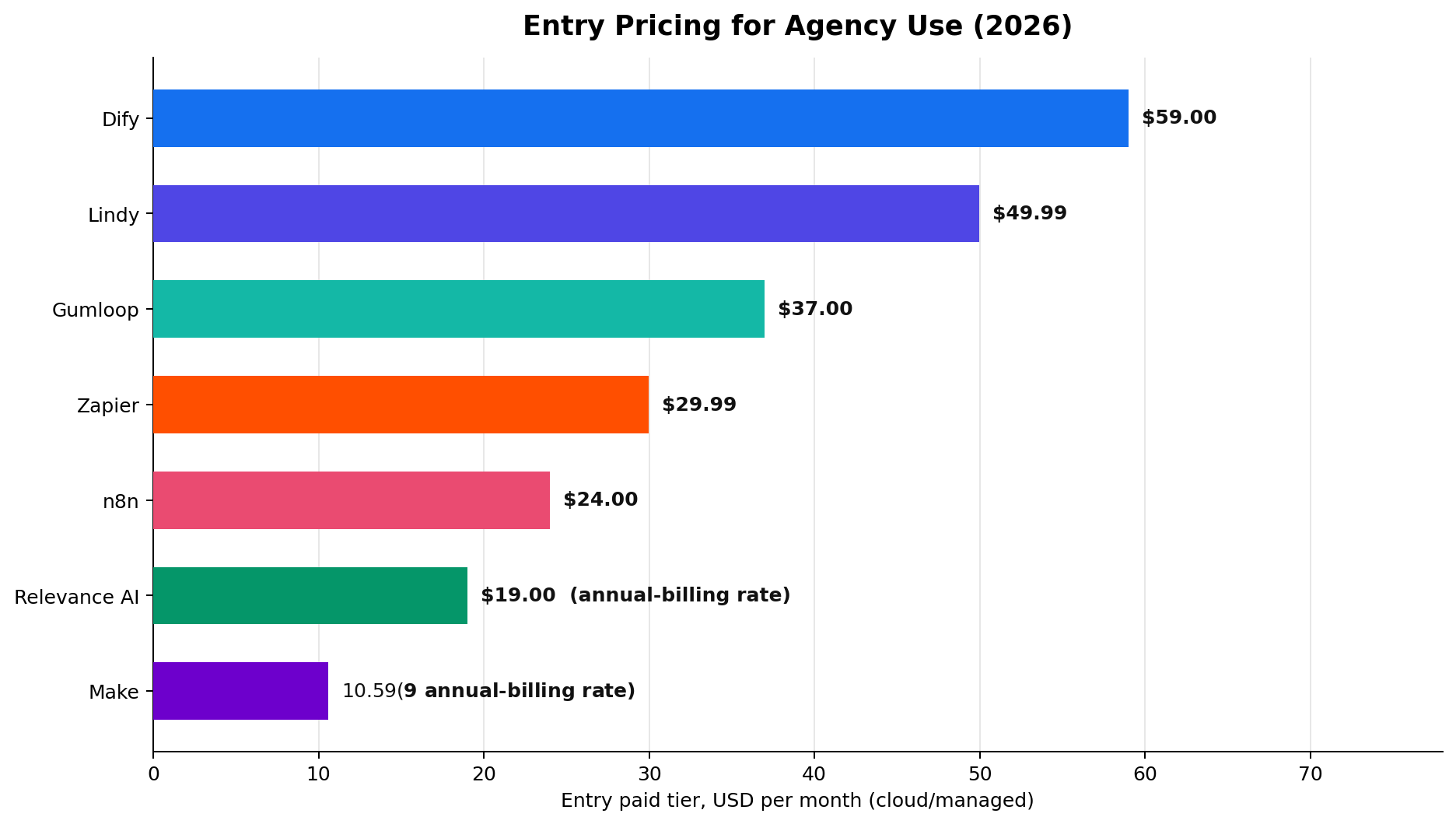
Entry price is the least interesting number on an agency P&L — the curve as client volume grows is what decides margin. The deep-dive below shows the same platforms at three agency sizes (list prices, September 2026; "custom" means enterprise-quoted):
| Platform | Solo starter (~2.5K ops/mo) | Growth shop (~10K ops/mo) | Scale (100K ops/mo) |
|---|---|---|---|
| n8n | $24 cloud · $0 self-host | $60 Pro (50K exec) · $0 self-host | self-host ≈ $20–50 VPS + ops time |
| Dify | $0 self-host · $59 cloud | $59–159 cloud | self-host + your LLM API bill |
| Make | $10.59 Core (10K credits) | $18.82 Pro / $29 Teams | custom (Enterprise) |
| Zapier | $29.99 Pro (750 tasks) | ≈$343.50 (10K tasks) | ≈$2,193.50 (100K tasks) |
| Lindy | $49.99 Plus | higher tier (credits) | custom |
| Gumloop | $37 Pro | higher tier (credits) | custom |
| Relevance AI | $19 Pro (annual) | $234 Team (7K actions) + overage risk | custom |
The pattern: open-source platforms flatten to near-zero marginal cost; managed visual platforms stay cheap until ~10K operations, then diverge; Zapier's curve is effectively linear into four figures — fine when the client pays the account, dangerous when you do.
Quality Benchmark: Seven Dimensions
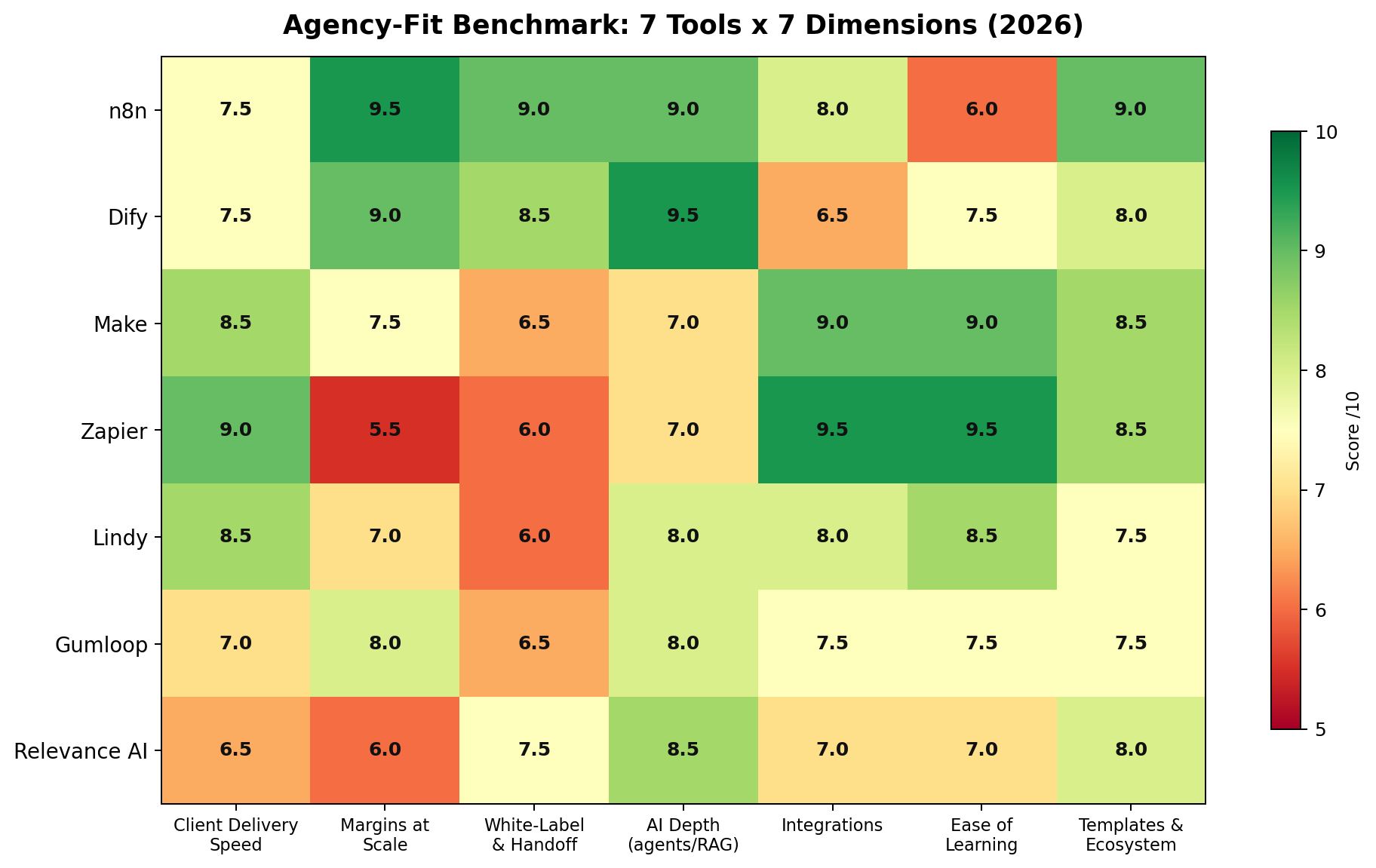
Read the heatmap as a stack blueprint more than a ranking: no single platform scores 9 across the board, which is why working agencies in our case files overwhelmingly run two platforms — one from the margin half (n8n or Dify) and one from the speed half (Make or Zapier) — and bill for the integration between them.
Feature Comparison at a Glance
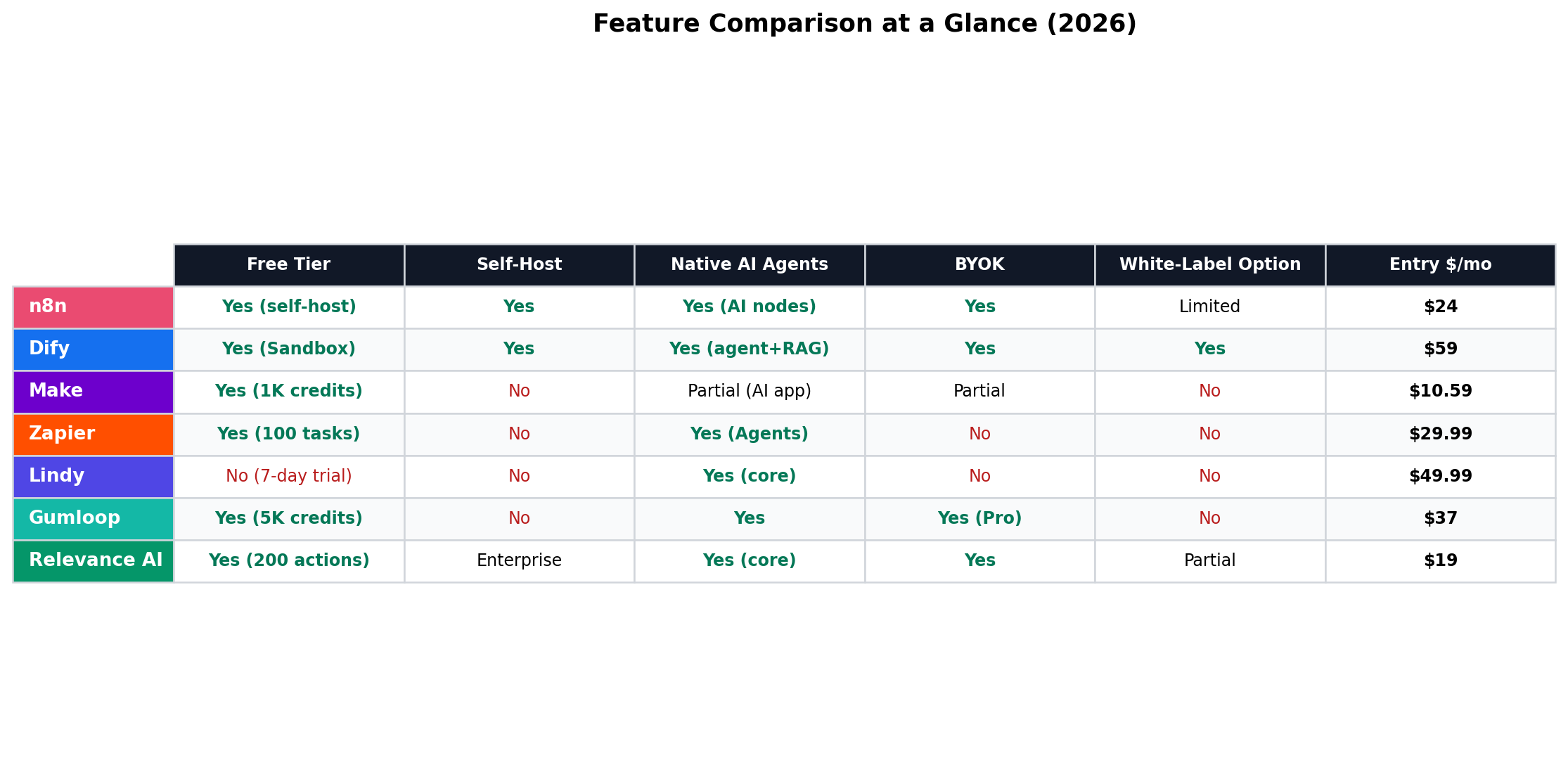
Decision Matrix: Which Tool for Which Client Job
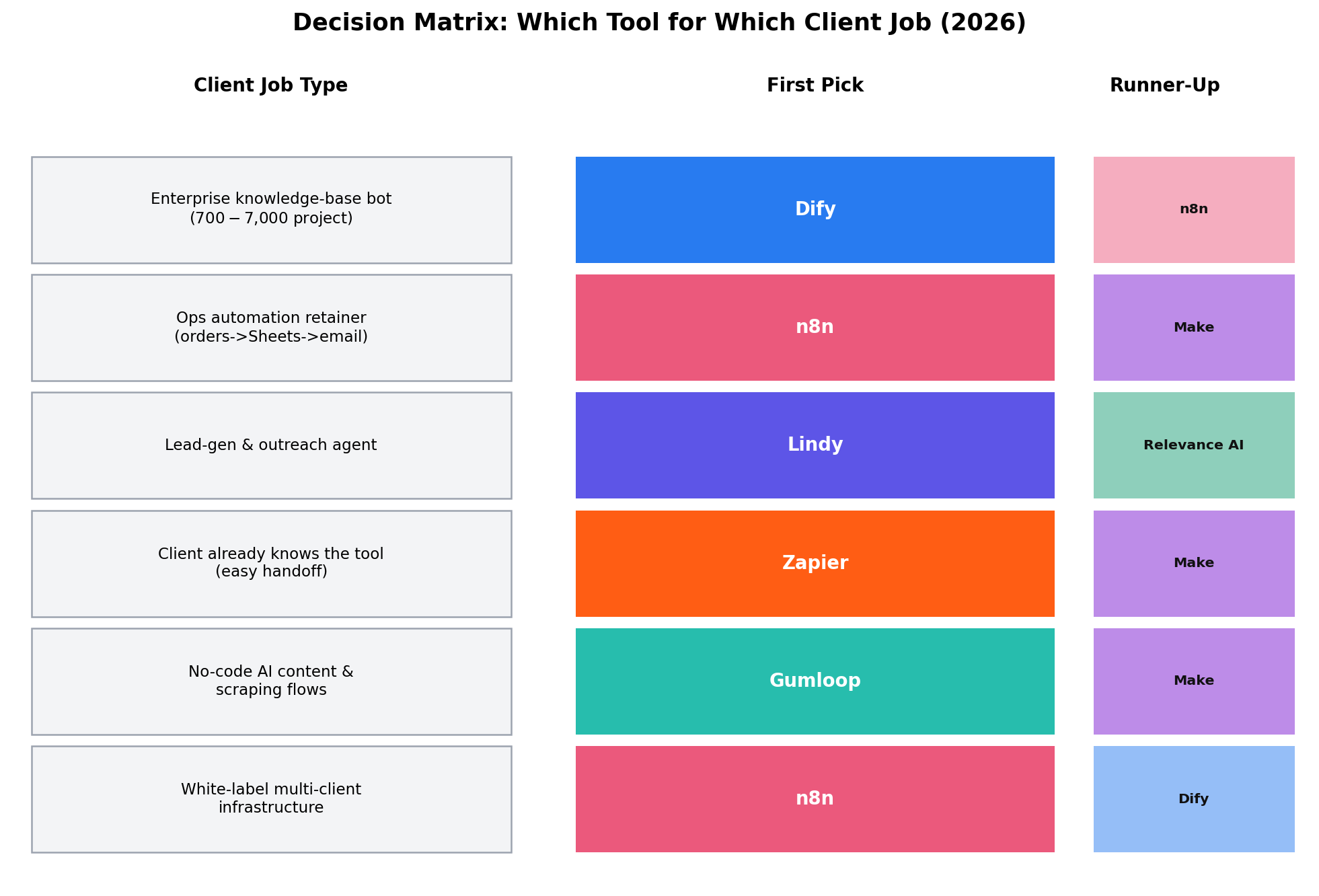
Real-World Test Scenarios (With the Economics Attached)
These are the three job types that show up repeatedly in our money-case research files, with the delivery recipe and the documented price points. Build them once as internal templates and every future client quote becomes an estimate, not a guess.
Scenario 1: E-commerce Customer-Service Bot — the $700–7,000 Build
Job: a Shopify/TikTok-shop merchant wants a chatbot that answers order-status and product questions 24/7. Stack: Dify (self-hosted or Sandbox for the pilot) ingests the product catalog and FAQ into a RAG knowledge base; n8n receives unanswered questions as escalations, looks up order status via the store API, and routes edge cases to a human inbox. Delivery recipe: week 1 corpus + prompt tuning; week 2 escalation wiring and edge-case tests; week 3 client UAT. Economics: documented platform pricing for chatbot builds runs ¥5,000–50,000 ($700–7,000) depending on catalog complexity — against a software bill near $0 (self-hosted) to $59 (Dify cloud). Bill a hosting/monitoring retainer of $140–420/mo on top; the same pattern sells to clinics, real-estate agencies, and education companies with only the corpus swapped.
Scenario 2: Ops Automation Retainer — the $140–420/mo Annuity
Job: "orders → Google Sheets → Slack alert → weekly email digest," the bread-and-butter retainer work. Stack: n8n (one workflow, error branch, retry policy) or Make if the client wants to co-own the account. Delivery recipe: day 1–2 build, day 3 monitored soak test, then handover doc + monitoring dashboard. Economics: the documented marketplace ladder runs ¥100–800 for simple flows on Taobao/Xianyu, ¥500–3,000 on Zhubajie, ¥2,000–10,000 on 程序员客栈, and $50–500 on Upwork/Fiverr for international clients — the same 2-day build. Stack five of these retainers and the recurring base ($700–2,100/mo) covers runway while project work compounds. This is also the honest on-ramp scenario: it needs no AI at all, which is why n8n/Make win it and the AI-first platforms don't.
Scenario 3: Lead-Gen Outreach Agent — the Productized $300–800/mo Service
Job: a B2B client wants researched, personalized outbound without hiring an SDR. Stack: Lindy as the fast path (outbound email agent + browser research) or Relevance AI when the client wants a visible "sales workforce" with research/enrichment/outbound roles. Delivery recipe: define the ICP, build the research-agent prompt chain, cap daily sends, wire replies into the client's CRM. Economics: at $300–800/mo per client against platform costs of $49.99 (Lindy Plus) or $19+credits (Relevance Pro), gross margin holds above 70% — until action overages. Relevance's documented 14,000-action month bills $560 in overage alone: cap monthly actions in the contract or the margin quietly inverts.
How We Tested
Scores and prices in this guide follow a fixed weighting, in order: (1) vendor list prices and spec pages — every price above was checked against vendor pricing pages during September 2026 verification passes; (2) hands-on sessions — the same three canonical jobs above (ops retainer, knowledge-base bot, outreach agent) were built on every platform that supports them, with delivery time and debugging friction noted; (3) public data for cross-check only — Upwork's In-Demand Skills 2026 report and documented freelance-platform pricing from our 2026 money-case research files anchor the economics side. The seven-dimension scores are the editorial consensus of two independent reviewers; where platforms changed pricing mid-cycle (noted inline), we flag it rather than average it. Prices and model versions were last fully re-verified on September 7, 2026; automation platforms reprice often, so re-check vendor pages before signing a fixed-fee contract.
🏆 Our Recommendations
Best overall agency foundation → n8n (8.3). It wins the dimensions that decide whether an automation agency survives its own success — margins at scale (9.5), white-label & handoff (9.0), templates & ecosystem (9.0). Free self-hosting with unlimited executions means your platform bill stays flat while client volume doesn't.
Best AI capability to resell → Dify (8.1). The AI-depth leader (9.5) and the fastest way to turn "a ChatGPT for our docs" into a $700–7,000 deliverable. Pair it with n8n for the operations layer — that open-source pairing is the documented stack behind the most profitable chatbot shops in our case files.
Best fast billable builds on a budget → Make (8.0). $10.59/mo, the most expressive no-code canvas, and contractors productive in days. Best margins-to-speed compromise for the $100–800 marketplace tier.
Safest client handoff → Zapier (7.9). 8,000+ apps, universal client familiarity, zero learning curve. Just never host fixed-price volume work on its meter: 100K tasks ≈ $2,193.50/mo.
Niche specialists → Lindy (7.6) for productized outreach agents, Gumloop (7.4) for content/SEO pipelines, Relevance AI (7.2) for B2B sales-agent teams sold as a workforce.
The hybrid approach is the documented meta. The shops in our research files run a two-platform core — self-hosted n8n + Dify on a $20–50 VPS — keep Make or Zapier for handoff-friendly client builds, and rent the AI-first specialists per job type. Combined tooling: under $100/mo against documented project revenue of $700–7,000 per build and retainer bases of $700–2,100/mo. Tooling is never the bottleneck; delivery discipline is.
FAQ
What is the best AI automation tool for a new agency with no budget?
Self-hosted n8n is free with unlimited workflows and executions, and it pairs with Dify's free Sandbox and Gumloop's free tier so a new agency can deliver real client work on $0 in software costs. Move to n8n Cloud ($24/month) only when you want managed hosting.
Can I white-label these platforms for clients?
Partially. Self-hosted n8n can be rebranded for client logins (within its Sustainable Use License), Dify's paid tiers allow logo removal on customer-facing apps, and Relevance AI supports client workspaces. Make, Zapier and Lindy have no white-label option — with those, you hand off accounts the client owns.
How much do AI automation agencies charge per project?
Documented ranges from 2026 freelance-platform data: simple automation builds run $100–800 on marketplaces, mid-complexity chatbot and workflow projects $700–7,000, and enterprise implementations $2,000–10,000+. Most agencies stack a monthly retainer of roughly $140–420 per client for monitoring and maintenance.
Is Zapier too expensive for client work?
For prototypes and small clients, no — Zapier is the fastest way to ship. At scale the meter bites: about 10,000 tasks/month costs $343.50 and 100,000 tasks costs $2,193.50/month, versus effectively free on self-hosted n8n. Agencies that scale on Zapier either pass the bill through or rebuild on cheaper platforms.
Do these platforms support GPT-5.6 and Claude Opus 5?
n8n, Dify, Gumloop and Relevance AI let you plug in your own API keys for frontier models like GPT-5.6 and Claude Opus 5, so you control model quality and cost per client. Zapier, Make and Lindy meter AI through their own credit systems instead of raw BYOK.
Should an agency build workflow automations or AI agents?
Most client jobs need both: deterministic operations (sync orders to a sheet, send the email) belong on n8n, Make or Zapier, while knowledge work (answer support questions, qualify leads) needs the AI-agent layer of Dify, Lindy or Relevance AI. The strongest agency stack connects the two — for example a Dify RAG bot triggered from an n8n workflow.