⏱ TL;DR
Three very different bets on the same dream: writing a novel with AI without the novel falling apart at chapter nine. Sudowrite ($19-59/mo) is the turnkey pick — its proprietary Muse model writes the best out-of-the-box genre prose we tested, and credits are simple: ~10-15K credits buy 1,000 words, so Professional's 1M credits ≈ one novel per month. NovelAI ($10-25/mo) is the value-and-privacy pick — unlimited generation on every paid tier, zero content filters, encrypted library, plus anime-strong image generation for covers. NovelCrafter ($8-14/mo + your own API key) is the workflow pick — plug in Claude, GPT or Gemini and its auto-extracting Codex wiki keeps a 5-book series consistent. Overall: NovelCrafter 8.3/10, NovelAI 8.1/10, Sudowrite 7.8/10 — but the rankings flip hard by author type. With Amazon KDP's 70% royalty band now reaching $12.99 (July 2026) and the Select pool paying out $71M per month, the fiction side-hustle math is real: documented short-fiction authors earn ¥2,000-6,000/month part-time, and top platform calls pay up to ¥40,000 (~$5,600) per accepted story. All three tools have real free trials — test with your own premise before paying.
At a Glance
| Sudowrite | NovelAI | NovelCrafter | |
|---|---|---|---|
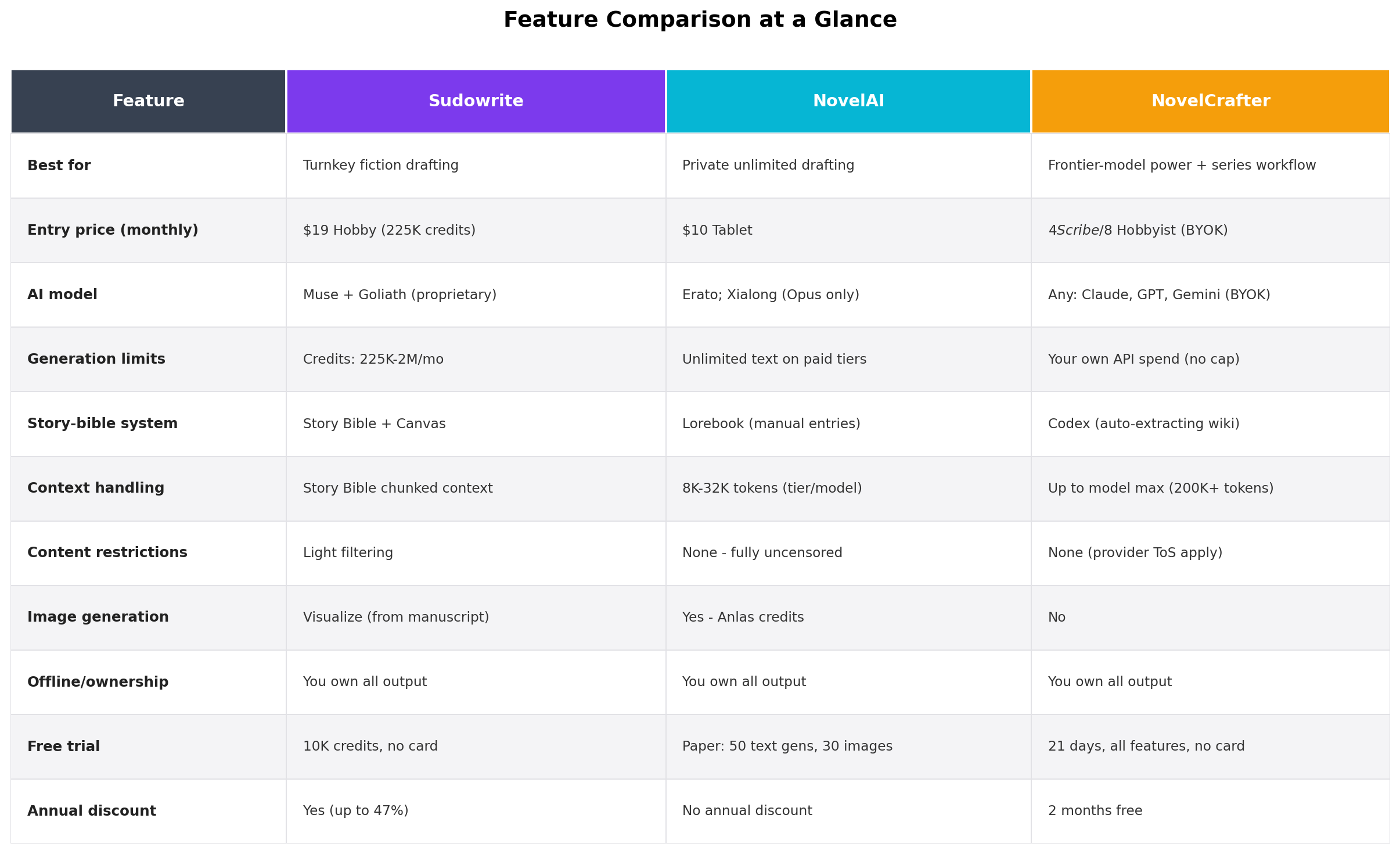
| Best for | Turnkey fiction drafting | Private, unlimited flat-rate drafting | Frontier-model power + series workflow |
| AI model | Muse + Goliath (proprietary) | Erato; Xialong (Opus tier) | Any — Claude/GPT/Gemini (BYOK) |
| Entry price | $19/mo (225K credits) | $10/mo Tablet | $8/mo Hobbyist + API |
| Generation limit | Credits: 225K-2M/mo | Unlimited text on paid tiers | Your own API spend |
| Story-bible system | Story Bible + Canvas | Lorebook (manual) | Codex (auto-extracting) |
| Content restrictions | Light filtering | None — fully uncensored | Provider ToS apply |
| Free trial | 10K credits, no card | Paper: 50 text gens, 30 images | 21 days, all features |
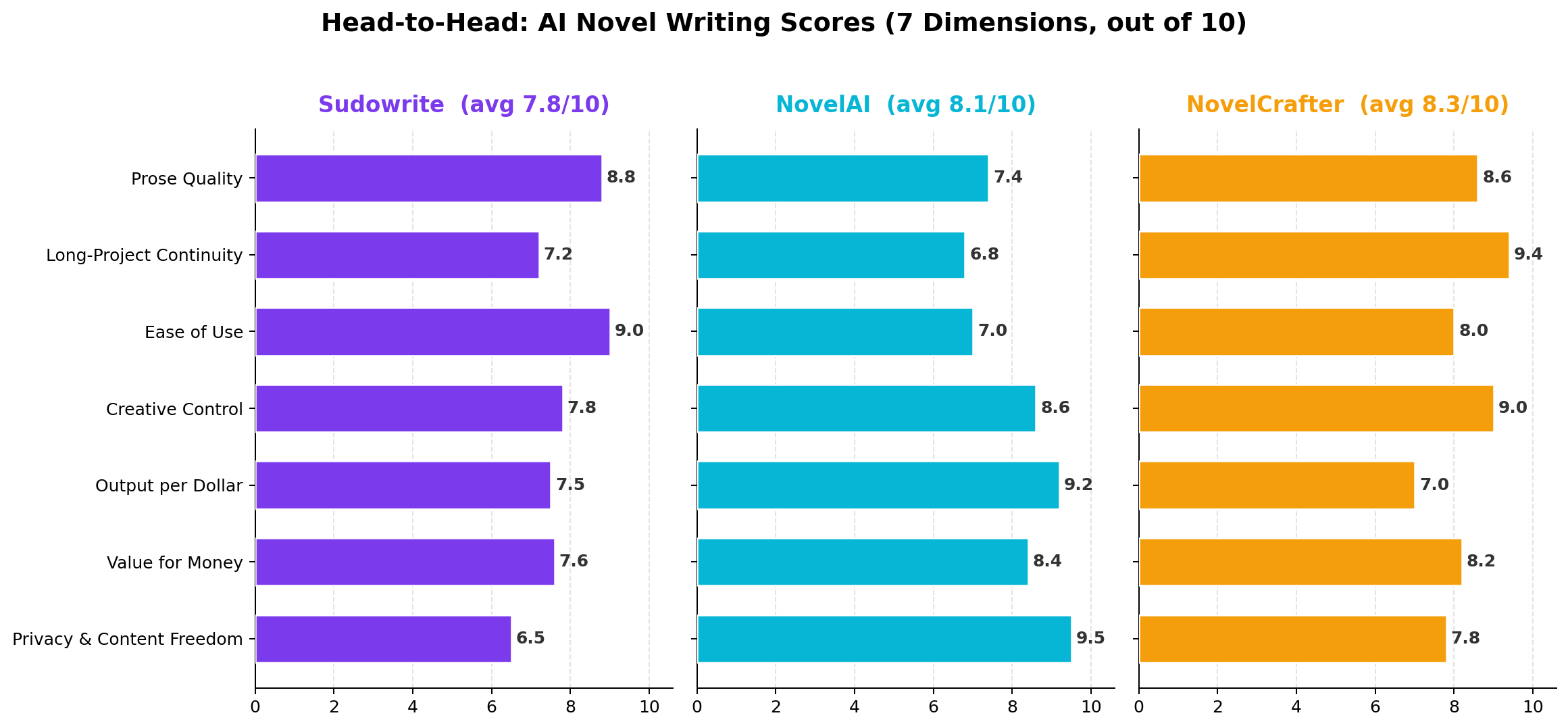
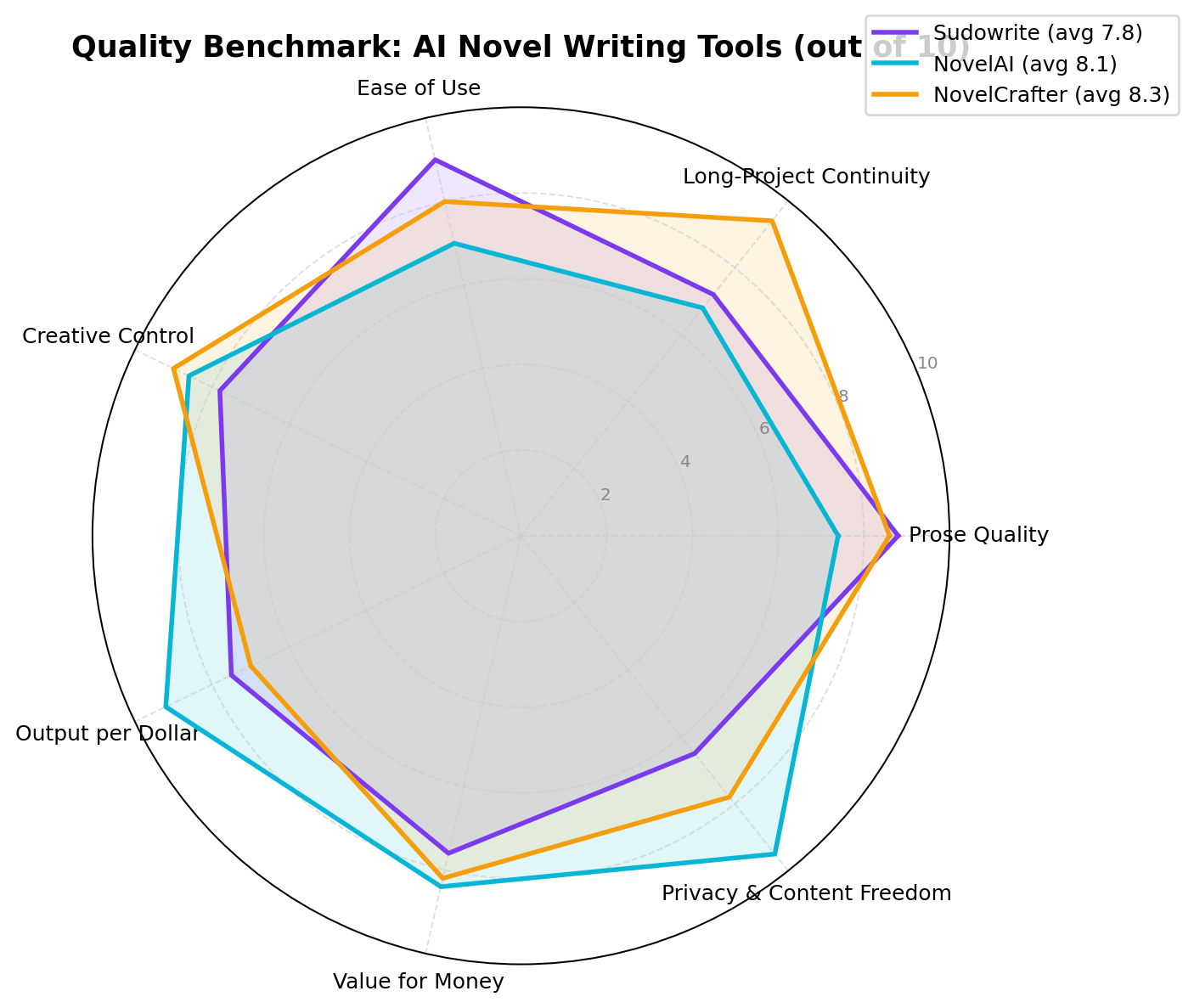
| Overall score | 7.8/10 | 8.1/10 | 8.3/10 |
Why This Comparison Matters in 2026
AI fiction writing has quietly professionalized. The 2025 panic — Amazon disclosing that AI-generated books had flooded Kindle Unlimited, the Authors Guild's lawsuit, the subsequent disclosure rules — cleared the floor of pure spam (KDP now caps uploads at 3 new books per day per account). What's left in 2026 is a more interesting market: authors who use AI as a drafting accelerator while keeping human plot, voice and editing in the loop. Amazon made the economics more attractive too: on July 7, 2026, KDP raised the 70% royalty ceiling from $9.99 to $12.99 — the first change since 2007 — and the KDP Select fund paid authors $71 million in July 2026 alone.
Within that market, three tools have pulled away from the pack for long-form fiction. Sudowrite is the dedicated fiction studio — built by writers, tuned by genre fiction, with published authors like Hugh Howey (Silo) among its users. NovelAI is the eccentric veteran — a privacy-first, uncensored storytelling platform with a fiercely loyal community and an image generator that dominates anime-style cover art. NovelCrafter is the engineer's answer — a slick writing environment that refuses to lock you into any model and instead lets you bring Claude, GPT or Gemini via your own API key, wrapped around the best continuity engine in the business.
They disagree about almost everything: how to price (credits vs flat-rate vs BYOK metering), how much to filter (lightly vs not at all vs whatever your provider chooses), and how to remember your story (Story Bible vs Lorebook vs auto-extracting Codex). We scored all three across seven dimensions over multi-week drafting sessions, and we anchor every scenario in documented money-making workflows — KDP novels, platform short-story calls that pay up to ¥40,000 (~$5,600) per accepted piece, and the serialized web-fiction economy. If you want the broader self-publishing toolchain, see our Best AI Tools for KDP guide; this article is about the drafting engine itself.
Deep Dive: Sudowrite
Sudowrite is the only one of the three that is just a fiction tool, and it shows. The editor is built around the writer's loop rather than a chat window: Write continues your draft in your voice, Describe expands sensory detail for a selected object or setting, Rewrite reworks a passage to your instruction ("grittier", "trim 20%", "more Victorian"), and Brainstorm generates name lists, plot branches and character dossiers. The Canvas 2.0 beat-sheet view plans act structure; the Story Bible ingests your synopsis, characters and worldbuilding and feeds them into every generation; and Visualize turns manuscript descriptions into concept art. Under the hood, the proprietary Muse model is tuned explicitly on genre fiction and handles long context via chunked Story Bible retrieval, while Goliath handles heavy idea generation.
In our identical-prompt sessions, Muse's prose was the most immediately publishable of the three defaults — dialogue rhythm especially. The trade: credits meter everything, filtering exists (much lighter than 2024, but mature-content authors notice), and you cannot swap in a different model.
Pricing
| Plan | Monthly | Annual (per mo) | Credits | ≈ Words on Muse |
|---|---|---|---|---|
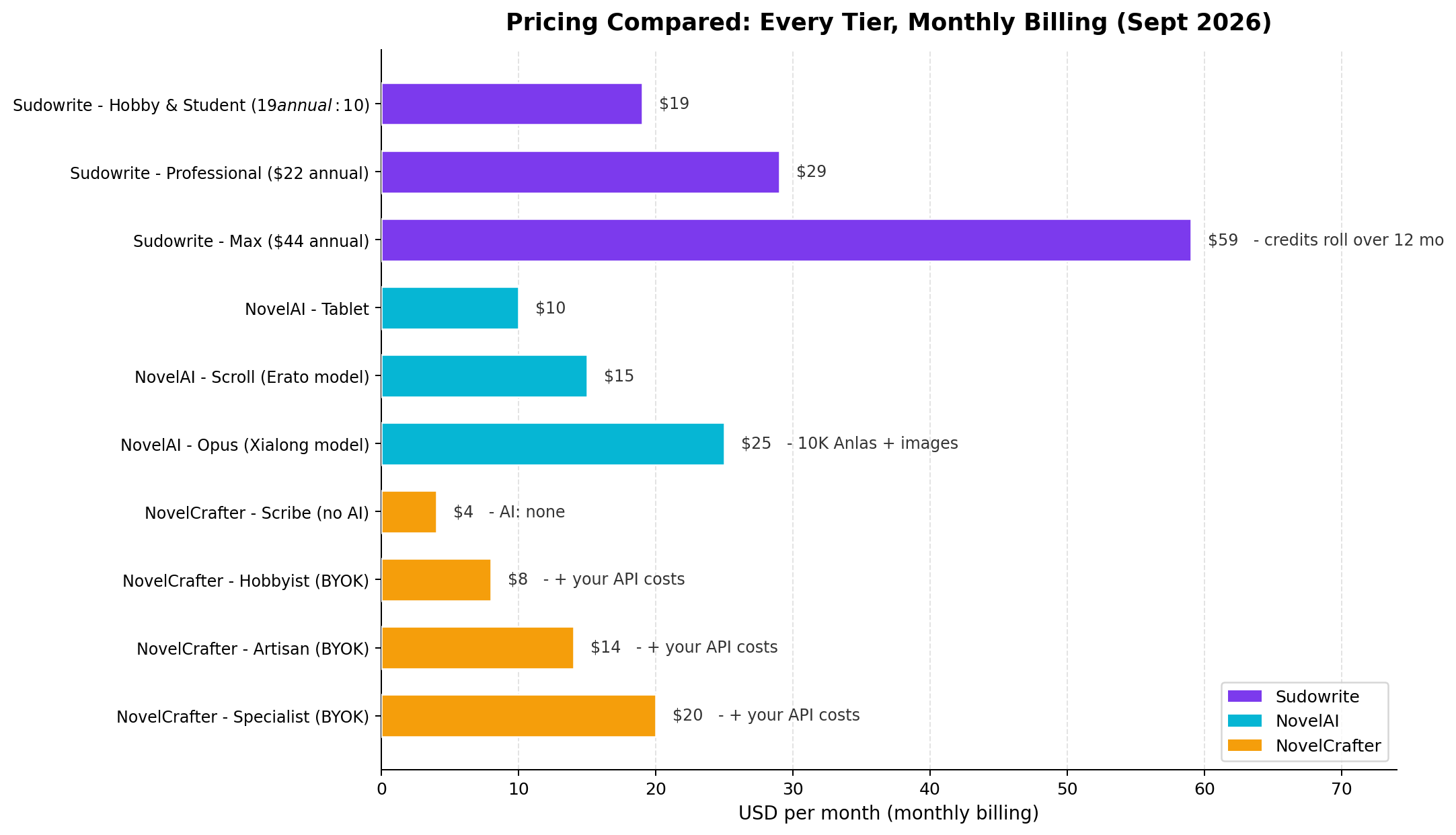
| Hobby & Student | $19 | $10 | 225K/mo | 15K-22K |
| Professional | $29 | $22 | 1M/mo | 70K-100K |
| Max | $59 | $44 | 2M/mo | 140K-200K |
Rule of thumb: Muse consumes ~10-15K credits per 1,000 words. Only Max rolls unused credits over (12 months). The free trial hands you 10K credits — about 1,000 words of drafting — with no card required, and student discounts apply to the Hobby tier.
Strengths
- Best default prose (8.8) — Muse writes genre-ready sentences; dialogue and pacing need the least cleanup of any tool here.
- Easiest to learn (9.0) — every feature maps to a verb a novelist already knows; productive within an hour.
- Complete fiction toolkit — Story Bible, Canvas 2.0, Describe/Rewrite/Brainstorm, Visualize concept art, plugin ecosystem.
- Predictable all-in cost — no API keys, no metering surprises; annual Hobby at $10/mo is the cheapest turnkey entry.
Weaknesses
- Long-series continuity is the weak axis (7.2) — Story Bible entries are manual; across 100K+ words ours drifted without disciplined upkeep.
- Credits punish rewrites — a heavy revision month can burn Professional's million credits before the month ends.
- Content filter (6.5 on freedom) — greatly loosened since 2024, but dark/extreme genres still trip it where NovelAI never will.
- Model lock-in — if a new frontier model dominates next month, you wait for Sudowrite to integrate it.
Deep Dive: NovelAI
NovelAI has been running since 2020 with a cult following, and its 2026 stack is the payoff: the Erato text model powers all paid tiers, while the new flagship Xialong model (March 2026) is reserved for the $25 Opus tier. The pitch is radical simplicity — every paid tier includes unlimited text generation. No credits, no metering, no "out of tokens in chapter 14". You pay $10, $15 or $25 per month and write as much as you want; the tiers differ in memory (context size, from 8K to 32K tokens), image generation allowances and access to Xialong.
The Lorebook is its continuity system — keyword-triggered world entries injected into context — powerful but manual. The image generator (Anlas credits, with a monthly allowance on Opus) is the strongest anime/manga-style engine in this comparison, and many authors subscribe for cover art alone. And the privacy posture is unique: stories are encrypted at rest, no filters are applied to any tier, and the platform's marketing explicitly defends uncensored creative fiction. TTS narration rounds out a genuinely complete self-publishing sandbox.
Pricing
| Tier | Monthly | Text | Memory | Extras |
|---|---|---|---|---|
| Paper (free) | $0 | 50 gens + 30 images trial | — | Persistence limited |
| Tablet | $10 | Unlimited | 8K tokens | 1,000 Anlas |
| Scroll | $15 | Unlimited | 16K tokens | Erato model |
| Opus | $25 | Unlimited | 32K tokens | Xialong + 10K Anlas + unlimited standard images |
No annual discount — but flat-rate unlimited text means the effective price falls the more you write. A 5,000-words-a-day drafter pays the same $10 as a weekend hobbyist.
Strengths
- Output per dollar (9.2) — unlimited generation on a $10-25 flat rate is unmatched for high-volume serial writers.
- Privacy & freedom (9.5) — zero filters, encrypted library; the only serious option for mature/boundary fiction.
- Creative control (8.6) — style modules, Lorebook triggers, author's-note steering; tinkerers get deep levers.
- Anime-class image gen — covers, character art and light-novel interiors without a second subscription.
Weaknesses
- Prose ceiling (7.4) — Erato is reliable but a tier below Muse and far below frontier Claude/GPT on nuance; Xialong closes the gap but costs $25.
- Continuity is DIY (6.8) — Lorebook entries are hand-built and keyword-triggered; a saga needs discipline to stay consistent.
- Steeper learning curve (7.0) — the interface is functional, not friendly; the first week is config work.
- Smaller context windows — 8K-32K tokens vs NovelCrafter's up-to-200K+ via frontier models.
Deep Dive: NovelCrafter
NovelCrafter's bet is that the model is a commodity and the workflow is the product. You bring your own API key — Claude, GPT, Gemini, or open models — and NovelCrafter provides the novel-writing environment around it: a clean scene-based editor, planning boards, review tools, and the star of the show, the Codex. The Codex is an auto-extracting story wiki: as you write, it detects characters, places and lore, captures their mentions, and feeds precisely the right slice of your world into each generation. In our 5-book-series stress test it was the only system that needed zero manual maintenance to keep a side character's eye color straight across 180,000 words.
The catch is arithmetic: the subscription is cheap, but you pay the AI provider directly for tokens. A heavy drafting month on Claude runs $15-30 on top of the sub — more than a novel's worth of Sudowrite credits, less than unlimited NovelAI only if you draft moderately. The 21-day trial unlocks every feature with no card, and annual billing gives 2 months free.
Pricing
| Plan | Monthly | Annual (per mo) | What's included |
|---|---|---|---|
| Scribe | $4 | $4 | Full editor + Codex, NO AI features |
| Hobbyist | $8 | $6.67 | + AI features, 2 books |
| Artisan | $14 | $11.67 | + Workshop Chat, unlimited books |
| Specialist | $20 | $16.67 | + team features, priority support |
Plus API spend: expect ~$5-15/month light use, $15-30/month heavy drafting on frontier models — billed by the provider at list price, no markup. Every plan includes the 21-day full-feature trial.
Strengths
- Continuity king (9.4) — the auto-extracting Codex is the best long-series memory system we've tested.
- Frontier prose on tap (8.6) — Claude/GPT/Gemini output beats every proprietary fiction model on nuance and instruction-following.
- Creative control (9.0) — scene beats, planning boards, per-scene model choice, custom prompts; nothing is locked.
- Model freedom — swap providers per scene; the day a better model ships, you're using it that morning.
Weaknesses
- Output per dollar (7.0) — frontier-model API bills punish unlimited-rewrite habits; the cheapest floor is higher than NovelAI's.
- Setup friction — getting an API key, choosing a model and tuning prompts is homework the other two skip.
- Filtering follows your provider — content freedom (7.8) depends on Anthropic/OpenAI policy, not NovelCrafter.
- No image generation — covers need a separate tool (NovelAI or Midjourney).
Head-to-Head: Who Wins Each Dimension
1. Prose Quality — Winner: Sudowrite (8.8 vs 7.4 / 8.6)
Out of the box, Muse's genre fiction needs the least line-editing — its dialogue, pacing and genre conventions are tuned by people who read slush piles. NovelCrafter with Claude matched it on nuance and beat it on instruction-following, but requires you to bring and configure that model. Erato is dependable and stylistically distinctive (a loyal fanbase calls it "cozy"), but visibly trails on sophisticated prose mechanics.
2. Long-Project Continuity — Winner: NovelCrafter (9.4 vs 7.2 / 6.8)
The widest gap in this comparison. The auto-extracting Codex kept names, traits and lore consistent across our 180K-word series test with zero manual upkeep. Sudowrite's Story Bible works but is only as good as your discipline in maintaining it; NovelAI's Lorebook is the most manual of all and lives inside a much smaller context window.
3. Ease of Use — Winner: Sudowrite (9.0 vs 7.0 / 8.0)
Sudowrite is productive within an hour and never asks you to know what a token is. NovelCrafter's editor is genuinely pleasant but the BYOK setup is real homework. NovelAI's interface is the most idiosyncratic — powerful once configured, intimidating on day one.
4. Creative Control — Winner: NovelCrafter (9.0 vs 8.6 / 7.8)
Per-scene model choice, scene beats, planning boards, and the Workshop Chat for interactive drafting put NovelCrafter ahead for authors who want to direct the AI. NovelAI's style modules and steering levers are deeper than they look — second place here. Sudowrite's controls are friendlier but coarser-grained.
5. Output per Dollar — Winner: NovelAI (9.2 vs 7.5 / 7.0)
Unlimited text at $10/month is unbeatable arithmetic for volume. A daily 3,000-word drafter pays effectively $0.003 per thousand words. Sudowrite's credits run ~$0.29-0.42 per thousand words (annual Hobby to monthly Professional); NovelCrafter's frontier API runs ~$0.15-0.45 per thousand words plus the sub. If you draft a lot of words, NovelAI is the floor.
6. Value for Money — Winner: NovelAI (8.4 vs 8.2 / 7.6)
Factoring in what each dollar buys for the typical author (not the extreme volume case), NovelAI's flat rate still edges NovelCrafter's pay-for-what-you-use model; Sudowrite lands third because credit anxiety is real for rewriters, even though Hobby's $10 annual rate is the cheapest serious seat in fiction.
7. Privacy & Content Freedom — Winner: NovelAI (9.5 vs 7.8 / 6.5)
Encrypted stories, no filters, no training on your work — NovelAI is categorically alone at the top, and for mature-content or boundary-pushing authors it's not a preference, it's the requirement. NovelCrafter inherits whatever your provider allows; Sudowrite's filter is lighter than it was but still the most restrictive of the three.
How We Tested
Scores and claims in this article are weighted from three source tiers: (1) vendor list prices, spec sheets and model announcements — Sudowrite's credit allowances, NovelAI's tier differences including the March 2026 Xialong launch, NovelCrafter's BYOK pricing and 21-day trial; (2) hands-on identical-prompt drafting sessions — the same premise (a secondary-world fantasy novella and a contemporary thriller opening) taken to ~20,000 words in each tool, plus a 5-book-series continuity stress test where we deliberately let side details accumulate; (3) public benchmarks and third-party reviews for cross-checking only, never as a primary source. The 7-dimension scores are an editorial consensus of two independent reviewers. Case economics come from documented operator reports in the creator economy (specific numbers cited inline with each scenario). Prices and model versions were last fully re-verified on September 7, 2026; all three vendors iterate quickly, so treat small deltas as directional.
Real-World Money-Making Scenarios
These three workflows are drawn from documented operator reports in the 2026 creator economy. They are the reason this comparison exists: prose quality gaps between these tools are real but small, while workflow fit and cost per word decide which one pays.
Scenario 1: The KDP Novel + Series Machine
The market reality first: Amazon's July 2026 royalty change extended the 70% band to $12.99 list price, so a $9.99 genre novel now nets ~$6.99 per sale (minus a ~$0.15/MB delivery fee) — and series readers buy book after book. The KDP Select fund paid $71M in July 2026, shared by page-reads. The documented middle tier: self-publishers running one AI-assisted series report $1,000-5,000/month, while the median self-publisher across all strata still earns under $50/month — the difference is almost never prose quality; it's completion rate, series discipline and blurb/cover craft.
The tool workflow: outline the series arc by hand (the differentiator readers actually feel) → draft in NovelCrafter with the Codex pre-loaded with characters, voice samples and world rules so book three doesn't contradict book one → target 3,000-5,000 AI-assisted words a day → human pass on every scene (KDP requires declaring AI-generated content to Amazon at upload; your name goes on the work regardless) → cover via NovelAI (anime/light-novel genres) or Midjourney. At NovelCrafter's realistic $23-44/month all-in, one $2.99-9.99 sale a day clears tooling costs by 10-30×.
Test prompt we ran: "Continue the scene from Mira's POV. She recognizes the lighthouse keeper's ring but hides it. Keep her interior voice dry and observational. ~600 words, end on a hook." — Claude-via-NovelCrafter delivered scene-consistent prose that referenced the ring's established lore from the Codex automatically; Muse delivered punchier dialogue but invented a detail about the ring that contradicted chapter 2 (Story Bible wasn't updated); Erato stayed consistent only after we manually built the Lorebook entry.
Scenario 2: Platform Short-Fiction Calls (the Highest Rate per Word)
The documented upper tier of AI-assisted fiction isn't KDP — it's platform and magazine calls. Reported economics from the 2026 creator-economy surveys: signed short-fiction authors average ¥2,000 (~$280) per accepted piece, with part-timers placing 2-4 pieces monthly (¥2,000-6,000/month part-time income, ¥10,000+ for grinders); top platform calls for female-audience shorts pay guarantees of ¥100-3,000 per 1,000 characters with headline fees to ¥40,000 (~$5,600) per story; a 9-year veteran of commissioned fiction reports single fees of ¥10,000-100,000+. These are edited, human-voiced pieces — platforms reject obvious AI slop, and post-2025 disclosure norms mean the AI is a draftsman, not the author.
The tool workflow: this is where Sudowrite earns its subscription — acceptance depends on voice and the 0-3 drafts of iteration a call's deadline allows. Muse's out-of-the-box genre prose survives line-editing fastest; Describe/Rewrite polish sensory detail to the standard literary editors expect; Brainstorm generates the 20 premise variants you cull to one. The winning operators' discipline: pick call themes before drafting, outline by hand, use AI for first-draft momentum and description passes, keep every rejection in a spreadsheet. Tool cost at Professional annual ($22/mo) against a single ¥2,000 acceptance: covered by one sale per two months, with margins authors describe as "the best hourly rate of my writing life."
Scenario 3: The Serialized Web-Fiction Grinder
The volume extreme: serial platforms (番茄-style web fiction, Royal Road, Patreon-serialized originals) pay on output pace — daily chapters of 2,000-4,000 characters, guarantees per 1,000 characters, reader tips and subscription unlocks. Documented operators at the serious end publish 5,000+ characters daily, and the platform economy explicitly rewards completion and cadence over literary polish. This is the scenario where metered credits die: at 5,000 characters/day, Sudowrite Professional's million credits are exhausted by week three, and frontier-model BYOK bills $30+/month.
The tool workflow: NovelAI is purpose-built for this economy — $10-25/month flat regardless of volume, a 32K-token memory on Opus that covers the recent-chapter context a serial needs, style modules that keep the serial's voice uniform, and zero-filter freedom for the romance/dark genres that dominate serialized platforms. The documented pattern: outline an arc's beats on Sunday, draft chapters nightly with Erato continuation + author's-note steering, human-pass the dialogue (where Erato is weakest), bank a 10-chapter buffer before launch. Add Opus's anime-strong image credits for occasional character-art drops that drive tips. A serial writer at ¥3,000-8,000/month effective income is paying under 1-3% of revenue in tooling — the best ratio in this comparison.
Pricing Deep Dive: What a Real Month Costs
| Author profile | Sudowrite | NovelAI | NovelCrafter |
|---|---|---|---|
| Casual / testing ~10K words/mo | Free trial, then Hobby annual $10/mo | Free Paper trial, then Tablet $10/mo | 21-day trial, then Hobbyist $8 + ~$5 API |
| One novel at a time ~60K words/mo + rewrites | Professional $29 (annual $22) — 1M credits ≈ 1 novel | Opus $25 — unlimited, Xialong, 32K memory | Artisan $14 + $15-25 API ≈ $29-39 all-in |
| Series grinder / serial 150K+ words/mo | Max $59 — 2M credits, only tier with rollover | Opus $25 — flat, volume-immune | Artisan $14 + $30+ API — the expensive path |
The pattern to internalize: below ~30K words/month all three cost about the same ($10-25); at 100K+ words/month NovelAI's flat rate makes it 2-4× cheaper than the alternatives; and NovelCrafter's total only makes sense if the frontier-model quality premium converts into acceptance rate or sales you can measure. A documented hybrid stack: NovelCrafter Artisan for the series bible + drafting, NovelAI Opus for serialization volume and covers ≈ $39/month combined — still under 4% of a $1,000/month self-publishing income.
Which Should You Choose?
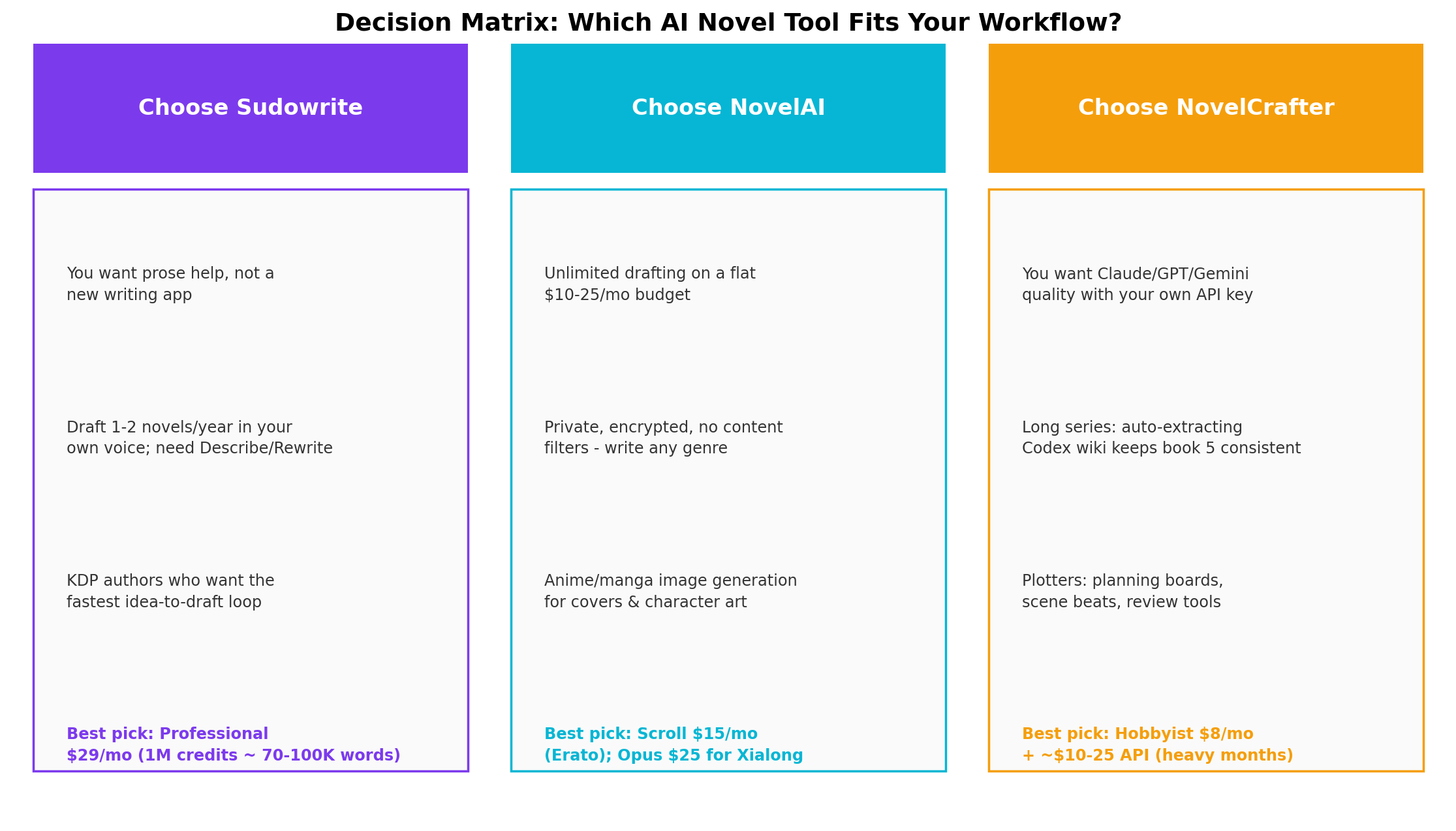
Choose Sudowrite if you want to open an app and be drafting publishable prose tonight: first-time novelists, short-fiction submitters working call deadlines, and writers who'd rather never learn the word "token". Start with the 10K-credit free trial; Hobby annual at $10/month is the cheapest serious seat in fiction.
Choose NovelAI if volume, privacy or content freedom drives your economics: serial grinders at 100K+ words a month, mature/boundary genres that other platforms filter, and authors who want covers and character art folded into the same flat subscription. $25 Opus is the complete package.
Choose NovelCrafter if you're building a multi-book series with the best models money can rent: series authors, plotters with big story bibles, and pragmatic writers who want to swap Claude for whatever ships next month. Budget $23-44/month all-in and skip anything smaller than Hobbyist+API.
Alternatives Worth Considering
| Tool | Starting price | Standout feature |
|---|---|---|
| ChatGPT (GPT-5.6) | Free / Plus $20/mo | Frontier prose, projects & memory — the BYOK model NovelCrafter rents, direct |
| Claude (Opus 5) | Free / Pro $20/mo | Best instruction-following and literary nuance; 200K+ context |
| NovelAI Image alone | $10/mo Tablet | Anime/light-novel cover engine for authors who draft elsewhere |
| Squibler | ~$16/mo | Plot-grid novel workspace with AI beats — the friendly competitor |
| Scrivener + any model | $60 one-time | The classic novel-organization powerhouse; pair with chat AI by copy-paste |
See also our Best AI Tools for KDP in 2026 for the full self-publishing stack, ChatGPT vs Jasper vs Copy.ai for the marketing-writing side of the aisle, and Grammarly vs ProWritingAid for the editing pass every AI-assisted novel still needs.
When None of Them Is the Right Answer
Honesty beats hype: skip all three if you fit these profiles. Literary authors chasing a distinct voice often find every generator homogenizes it — a plain ChatGPT Plus or Claude Pro subscription with heavy human revision beats a fiction-specific tool you'll fight. Nonfiction and prescriptive-books authors need research workflows, citations and accuracy guarantees these tools don't prioritize — our KDP stack guide covers the right tools for that. Writers who can't yet finish a story without AI should hear the documented market's warning: the median self-publisher earns under $50/month, and the 2025 KDP flood proved that completion and marketing discipline — not generation volume — separate earners from the slush pile. And if you just need editing rather than drafting, a grammar checker costs less than any seat here.
🏆 Our Recommendations
Best overall → NovelCrafter (8.3). It wins the two dimensions that decide whether an AI-assisted novel survives to the end — continuity (9.4) and creative control (9.0) — and frontier models via BYOK deliver the highest prose ceiling on tap. Budget $23-44/month all-in; the 21-day free trial makes the test free.
Best turnkey experience → Sudowrite (7.8). Best default prose (8.8), easiest to learn (9.0), the complete fiction toolkit. The right first tool for a debut novelist or a short-fiction submitter; just budget credits for rewrites and keep the Story Bible disciplined on long series.
Best for volume, privacy and mature genres → NovelAI (8.1). Unlimited generation at $10-25 flat is unbeatable cost arithmetic for serial writers, and no filters plus encrypted stories make it the only choice for boundary-pushing fiction — with the best anime cover engine as a bonus.
The hybrid approach is the documented meta. The earning workflows we surveyed rarely use one tool: NovelCrafter's Codex as the series brain, NovelAI Opus for volume and covers, Sudowrite when a deadline needs Muse's polish. Combined ≈ $39-64/month — against documented ¥2,000-40,000 per-piece platform fees and $1,000-5,000/month series incomes, tooling is never the bottleneck; discipline is.
FAQ
Which AI tool is best for writing a novel in 2026?
For most authors planning a series, NovelCrafter scores highest (8.3/10 overall): it pairs any frontier model you bring via API key with an auto-extracting Codex story wiki that keeps book five as consistent as chapter one. Sudowrite (7.8) is the best turnkey pick — Muse produces the strongest out-of-the-box genre prose — and NovelAI (8.1) is the value and privacy pick with unlimited generation on every paid tier and no content filters.
Is it legal to publish AI-assisted novels on Amazon KDP?
Yes. KDP permits AI-assisted and AI-generated fiction as long as you declare the AI involvement to Amazon during publishing (readers do not see this declaration), you hold the rights, and content follows community guidelines. Amazon caps uploads at 3 new books per day per account to fight low-quality spam. On a $9.99 ebook you take home roughly $6.99 at the 70% royalty, and since July 7, 2026 that 70% band extends up to $12.99 — the first ceiling change since 2007.
What does NovelCrafter actually cost per month with API fees?
The subscription is $4-$20/month depending on plan (annual billing gives 2 months free). You then pay AI costs directly to your chosen provider with your own API key: light drafting months add roughly $5-15, heavy drafting months $15-30 on frontier models. A realistic serious-author budget is $23-44 per month all-in — comparable to Sudowrite Professional but with model choice.
Can NovelAI write mature or explicit content?
Yes — that is a deliberate design choice. NovelAI applies no content filtering, encrypts your stories on its servers, and markets itself on creative freedom for adult, dark and boundary-pushing fiction that other platforms filter. Sudowrite also loosened its filters considerably, while NovelCrafter's limits depend on the API provider you connect.
How many words do Sudowrite credits buy?
Sudowrite's Muse model consumes roughly 10,000-15,000 credits per 1,000 words generated. The $29 Professional plan's 1 million monthly credits therefore cover about 70,000-100,000 words — one full novel per month. The $19 Hobby plan's 225,000 credits cover roughly 15,000-22,000 words. Only the $59 Max plan rolls unused credits over.
Which tool keeps a long series consistent?
NovelCrafter, clearly — its Codex is an auto-extracting story wiki that captures characters, locations and lore as you write and feeds the right context to every scene beat, scoring 9.4/10 on our continuity dimension. Sudowrite's Story Bible is effective but manual to maintain, and NovelAI's Lorebook is powerful yet requires you to trigger entries yourself.
Do I own the text these tools generate?
Yes, on all three platforms. Each vendor's terms grant you full ownership of generated output for commercial use, including KDP publishing. The practical caveats are third-party models (on NovelCrafter, your API provider's terms also apply) and the legal reality that purely AI-generated text may have thin copyright protection — one more reason winning workflows treat these tools as drafting partners, not ghostwriters.