⏱ TL;DR
No single AI tool publishes a book — you need a small stack, and 2026 is the first year that stack can start at $0. DeepSeek V4 (9.2/10) is the best tool in KDP publishing right now: unlimited free chat, open MIT-licensed weights, and a story brain that drafts full manuscripts for pennies. Midjourney V8.2 (9.0/10) draws the premium art, ChatGPT GPT-5.6 (8.9/10) is the best text-plus-images combo on an $8 plan, Canva Pro (8.6/10) handles covers and print-ready layout, Claude Opus 5 (8.4/10) writes the best prose, ReadKidz (8.2/10) automates entire children's books, and Qwen Image 3.0 (8.0/10) is the free illustration engine. The real decision is which of three stacks to build: Validate at $0/mo, Produce at ~$25/mo, or Scale at $45+/mo. Most successful publishers we track validate free, then run the budget stack at 5+ books a month.
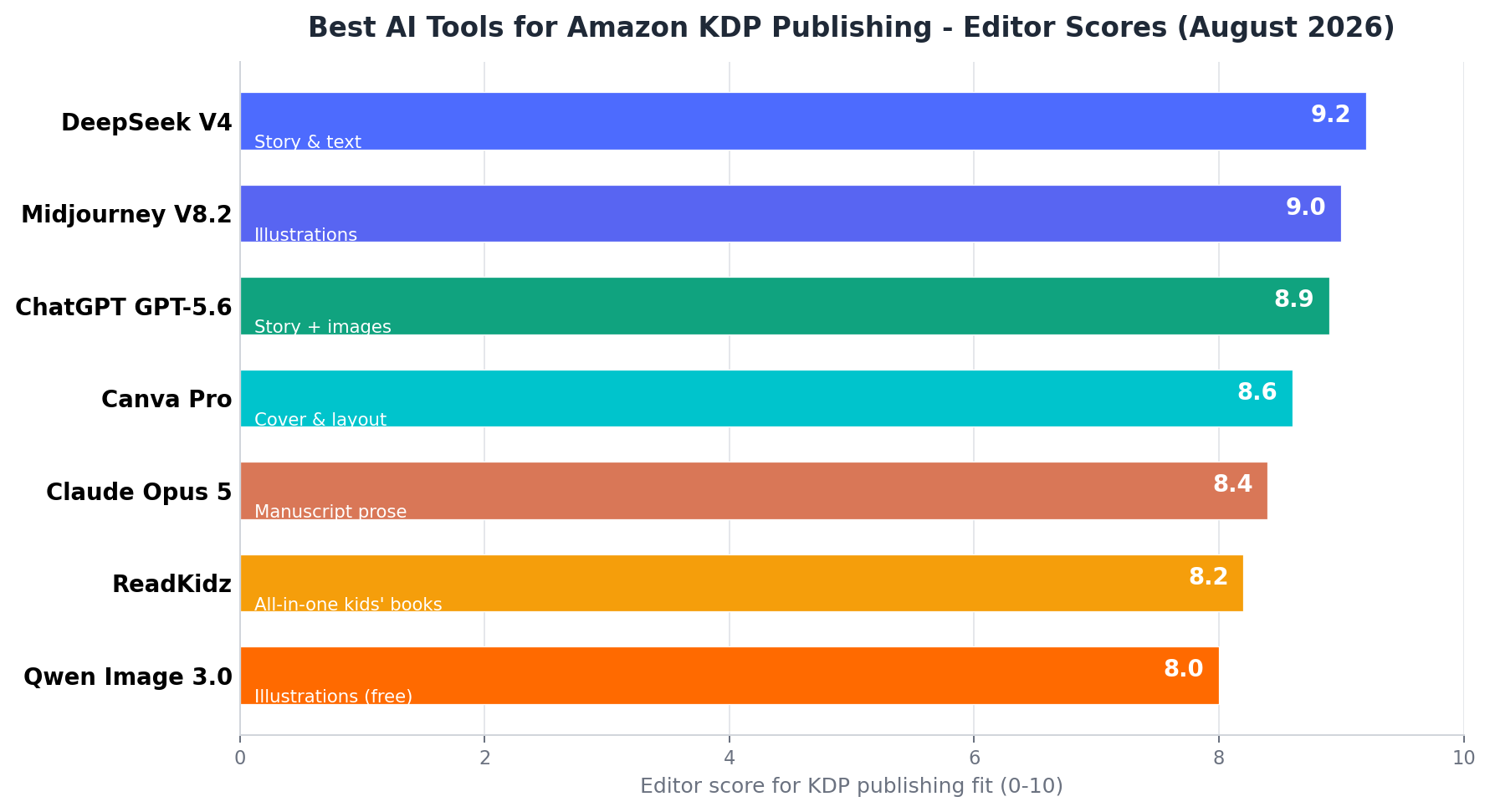
The Seven at a Glance
The table below is the whole article in miniature. Ranked #1–#7 by our overall editor's score for KDP publishing fit; entry price is each tool's cheapest usable paid plan on monthly billing.
| # | Tool | Overall | Entry Price | Free Tier | Best For |
|---|---|---|---|---|---|
| 1 | DeepSeek V4 | 9.2 | $0 (API from $0.22/M) | Unlimited chat | Story & manuscripts |
| 2 | Midjourney V8.2 | 9.0 | $10/mo (Basic) | None | Premium illustrations |
| 3 | ChatGPT GPT-5.6 | 8.9 | $8/mo (Go) | Luna tier (ads) | Story + images combo |
| 4 | Canva Pro | 8.6 | $15/mo annual | Free tier (limited AI) | Covers & interior layout |
| 5 | Claude Opus 5 | 8.4 | $20/mo | Sonnet, limited | Manuscript prose |
| 6 | ReadKidz | 8.2 | $10/mo (Standard) | 1,500 credits | All-in-one kids' books |
| 7 | Qwen Image 3.0 | 8.0 | ~$0.03/image API | Free monthly quota | Free illustrations |
How We Tested and Scored
We ran the August 2026 versions of every tool through a realistic publishing cycle: a 32-page children's picture book, a 15,000-word niche nonfiction manuscript, and a low-content activity book. Each tool was scored on six KDP-specific criteria: story and manuscript quality on real briefs, illustration quality at print resolution, character consistency across a full book, production speed from blank page to upload-ready PDF, cost per finished book, and KDP workflow fit — trim-size templates, 300-DPI export, and compliance with Amazon's AI-disclosure policy. Scores reflect publishing fit, not general model intelligence; a tool that is mediocre at everything else but nails print-ready layout can still score 8.6 here.
#1 DeepSeek V4 — Best Overall & Best for Story & Manuscripts (9.2/10)
DeepSeek V4 is the highest-leverage tool in self-publishing right now because it removes the largest cost line in book production — writing — almost entirely. The chat app is free with unlimited conversations, the model weights are open under an MIT license, and API access starts at $0.22 per million tokens. In practice that means a complete 30,000-word nonfiction draft costs roughly $0.10–0.20 in API calls, and iterative chat refinement costs nothing. No other frontier-quality model is anywhere close on price per manuscript.
What makes it a 9.2 for KDP specifically is format discipline. DeepSeek V4 reliably holds long-context structure across a full book: you can hand it a series bible for a five-book children's saga and get page-by-page scripts where page 28 still rhymes with the meter established on page 1. Its sweet spots in our testing: chapter outlines that survive contact with actual drafting, picture-book formatting (story text + matched image prompt per page), back matter (glossaries, discussion questions — a real KDP differentiator in the education niche), blurbs and A+ content copy, and nonfiction research scaffolding that a human then verifies.
It is a text engine, full stop — no image generation, no layout. Cultural calibration for the US children's market occasionally drifts, and it writes faster than it self-edits, so your pass still matters. But as the story brain of all three stacks we recommend (free, budget, premium), nothing else comes close at any price — and it happens to be free.
Key features: unlimited free chat · open MIT weights · API from $0.22/M tokens · long-context chapter coherence · strong structured output (page-by-page scripts, tables, outlines)
Pricing: Free (chat + limited API) · API pay-as-you-go from $0.22/M input tokens
Strengths:
- Effectively $0 manuscript cost — the cheapest serious writing engine in existence
- Long-context coherence across full books and multi-book series bibles
- Excellent at picture-book script format (text + image prompt per page)
- Open weights mean no sudden ToS changes to your production pipeline
Weaknesses:
- No images, no layout — needs Qwen/Canva/Midjourney around it
- US-market voice calibration needs a final human pass
- Free chat can throttle at peak hours; API adds fractions of a cent per book
#2 Midjourney V8.2 — Best Premium Illustrations (9.0/10)
V8.2 (released July 2026) is the strongest illustration engine for book interiors and covers, and the gap to second place widened this year. For KDP work the killer feature is --oref (character reference): feed it your protagonist's character sheet once, and subsequent generations keep the same face, outfit and proportions — the single hardest problem in AI children's publishing, largely solved. Print output is production-grade: upscales comfortably clear 300 DPI for an 8.5×8.5 picture book, and style references (--sref) keep a consistent palette across every spread.
Basic is $10/month with fast GPU hours; the Standard tier at $30/month adds enough fast hours for a full 32-page book in one sitting plus unlimited relax-mode generations. Commercial use is included on every plan — if your publishing business passes $1M in revenue you're asked to move to Pro ($60/month), a nice problem to have. There is no free tier. The learning curve is real (parameters, stylistic prompting), and text inside images still garbles occasionally — do your cover typography in Canva, not Midjourney. But for illustration quality per dollar, nothing at $10/month is in the same conversation.
#3 ChatGPT GPT-5.6 — Best Story + Images Combo (8.9/10)
ChatGPT is the only tool on this list that can draft a story and illustrate it in one thread, and the $8/month Go plan (GPT-5.6 on the ad-supported Luna tier) is the cheapest paid all-rounder in publishing. For solo publishers who want one subscription instead of three, this is the pick: draft a picture book, iterate the illustration prompts against actual generated images, refine the cover concept, and export — all in a single conversation with full context of everything you've already decided.
GPT Image 2 handles picture-book art competently with strong prompt adherence, though the aesthetic leans friendlier and more corporate than Midjourney's — great for activity books and nonfiction diagrams, less distinctive for gift-book art. Image generation caps on the cheaper tiers mean a full 32-page book may take more than one sitting. As a pure writing engine it trails DeepSeek on price by an order of magnitude and Claude on prose polish, but as a do-everything cockpit for $8, it earns the #3 slot comfortably.
#4 Canva Pro — Best for Covers & Interior Layout (8.6/10)
Every manuscript and illustration eventually becomes a PDF, and Canva Pro is the fastest route from assets to upload-ready file. It ships with KDP-specific templates at the standard trim sizes (6×9 for nonfiction, 8.5×8.5 and 8×10 for picture books, including bleed), Magic Resize converts a cover between ebook and paperback formats in one click, and print-PDF export handles the 300-DPI/CMYK-adjacent requirements Amazon's printer expects. The brand-kit feature quietly matters for series publishers: identical typography and color palette across five books is what makes a series look like a series on a product page.
Pro is $15/month billed annually ($180/year); the free tier remains usable for covers and basic layouts with limited AI credits. Its own AI image generator is fine for spot illustrations but well behind Midjourney and Qwen Image for hero art — use Canva for what it's best at, composition and typography, and import art from elsewhere. Against InDesign or Affinity Publisher it trades fine-grained typographic control for speed and a much gentler learning curve; for AI-assisted publishing at volume, speed wins.
#5 Claude Opus 5 — Best Manuscript Prose (8.4/10)
When the words themselves are the product — literary fiction, memoir-adjacent nonfiction, anything where a reader can hear the author — Claude Opus 5 writes the best prose we tested: more rhythm, fewer AI tells, and a lighter touch with metaphor. At $20/month (Pro plan, with Opus 5 access; the free tier offers Sonnet with tight limits) it's the premium polish layer: run a DeepSeek draft through Opus 5 for a voice pass and the manuscript reads a full tier above what either model produces alone.
It scored below DeepSeek and GPT-5.6 only on KDP economics — usage limits bite when you're producing five manuscripts a month, and $20/month buys fewer words than DeepSeek's free tier. It generates no images. And its safety tuning occasionally declines edgy thriller or horror content that Amazon happily sells. For publishers whose strategy is fewer, better books rather than volume, it's the best writing tool money can buy; for everyone else it's a targeted $20 upgrade during final revisions.
#6 ReadKidz — Best All-in-One Children's Book Factory (8.2/10)
ReadKidz is the only purpose-built KDP tool on the list: prompt it a story idea and it produces the text, illustrations, consistent characters and a laid-out book ready for export — the whole pipeline in one subscription. Character consistency, the dimension where general-purpose image tools bleed the most time, is its core competency: 9.0/10 in our benchmark, the highest of any tool we tested. For the children's-book-at-volume playbook (validate niches, ship 5-book series, let the series page compound), ReadKidz collapses weeks of work into days.
Standard is $10/month with 10,000 credits (roughly several finished books), and a 1,500-credit free tier lets you evaluate the output style first. The trade-offs: it's children's-books-only, the illustration aesthetic is warm and friendly but a visible notch below Midjourney V8.2, and because thousands of publishers use the same style engine, the template-sameness risk is real — your cover and niche research have to do the differentiating. Use it as the production line, not the brand.
#7 Qwen Image 3.0 — Best Free Illustrations (8.0/10)
Qwen Image 3.0 (July 2026, Apache 2.0 open weights) is the free illustration engine that makes the $0 stack possible: a monthly free generation quota on the web app, API pricing around $0.03 per image, and no meaningful quality cliff versus the paid Western tools for picture-book and cover work. Its standout trick is text rendering inside images — legible titles, signage and labels, historically the Achilles' heel of diffusion models — which makes it unusually good for cover mockups and activity-book pages with written elements.
The open Apache 2.0 license is more flexible than Midjourney's for commercial work, and self-hosting the weights removes quota limits entirely if you have a GPU. Day-to-day friction: free-quota queue times, and character consistency requires a manual reference-image workflow rather than Midjourney's one-flag --oref. As the free tier of the Validate stack, it is unbeatable; as your scale-tier art engine, you'll eventually want Midjourney.
Head-to-Head: Who Wins Each Dimension
| Dimension | Winner | Runner-Up | Why |
|---|---|---|---|
| Story quality (value) | DeepSeek V4 | ChatGPT GPT-5.6 | Frontier-grade drafting and structure at $0 |
| Story quality (premium) | Claude Opus 5 | DeepSeek V4 | Best prose voice, rhythm and nuance in 2026 |
| Illustration quality | Midjourney V8.2 | Qwen Image 3.0 | V8.2 art is a visible tier above at print resolution |
| Character consistency | ReadKidz | Midjourney (--oref) | Purpose-built consistency engine beats manual workflows |
| Production speed | ReadKidz | ChatGPT GPT-5.6 | Idea to laid-out book in a single tool, days not weeks |
| Cost efficiency | DeepSeek + Qwen Image | ChatGPT Go | The $0 stack: free chat + free image quota |
| Print & layout | Canva Pro | ReadKidz | KDP trim-size templates, bleed, 300-DPI PDF export |
| Audio / read-alongs | ElevenLabs | — | Natural narration from $6/mo with commercial license |
Note the pattern: no tool wins twice. That's the structural fact of AI publishing in 2026 — the product is a stack, and the rankings above tell you which tool to rent for which job.
Pricing Compared
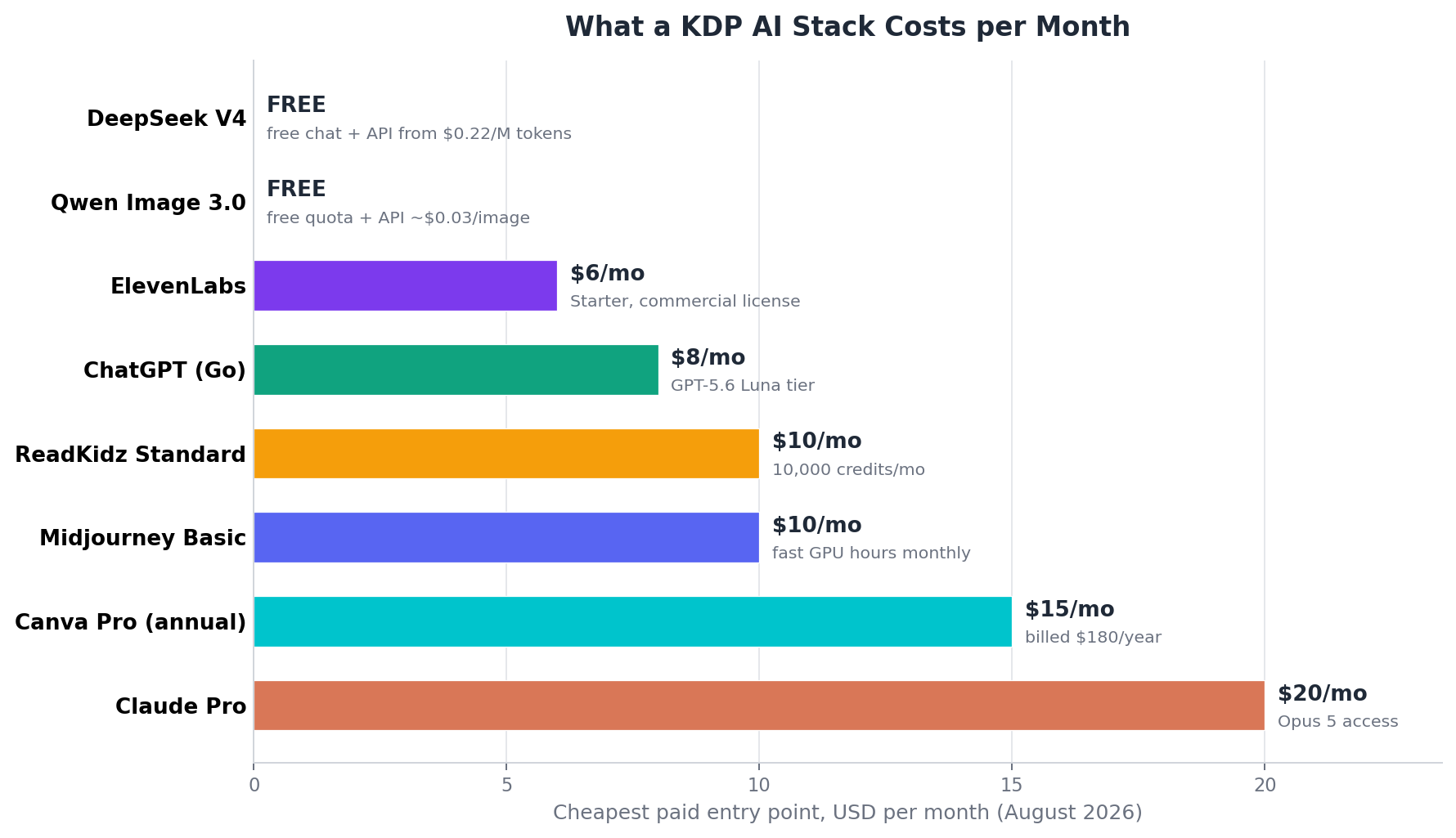
The pricing spread is the story: DeepSeek V4 and Qwen Image 3.0 are free, ElevenLabs starts at $6/mo (Starter, with commercial license), ChatGPT Go runs $8/mo, ReadKidz Standard and Midjourney Basic both cost $10/mo, Canva Pro is $15/mo on annual billing ($180/year), and Claude Pro tops the table at $20/mo for Opus 5 access.
Translate that into cost per finished 32-page picture book: the free stack is effectively $0 (quota-limited), the budget stack amortizes to ~$5–7 per book when you ship five or more a month, and the premium stack lands at $10–15 per book plus your time. The traditional baseline — a freelance illustrator at $50–200 per image for 15 interior illustrations plus a cover — is $750–3,000 per book. That 50–100× cost collapse is why AI-assisted KDP publishing went from fringe to default strategy between 2024 and 2026.
The Three Stacks, Benchmarked
Individual tools matter less than the stack you assemble. We benchmarked the three architectures that cover every budget:
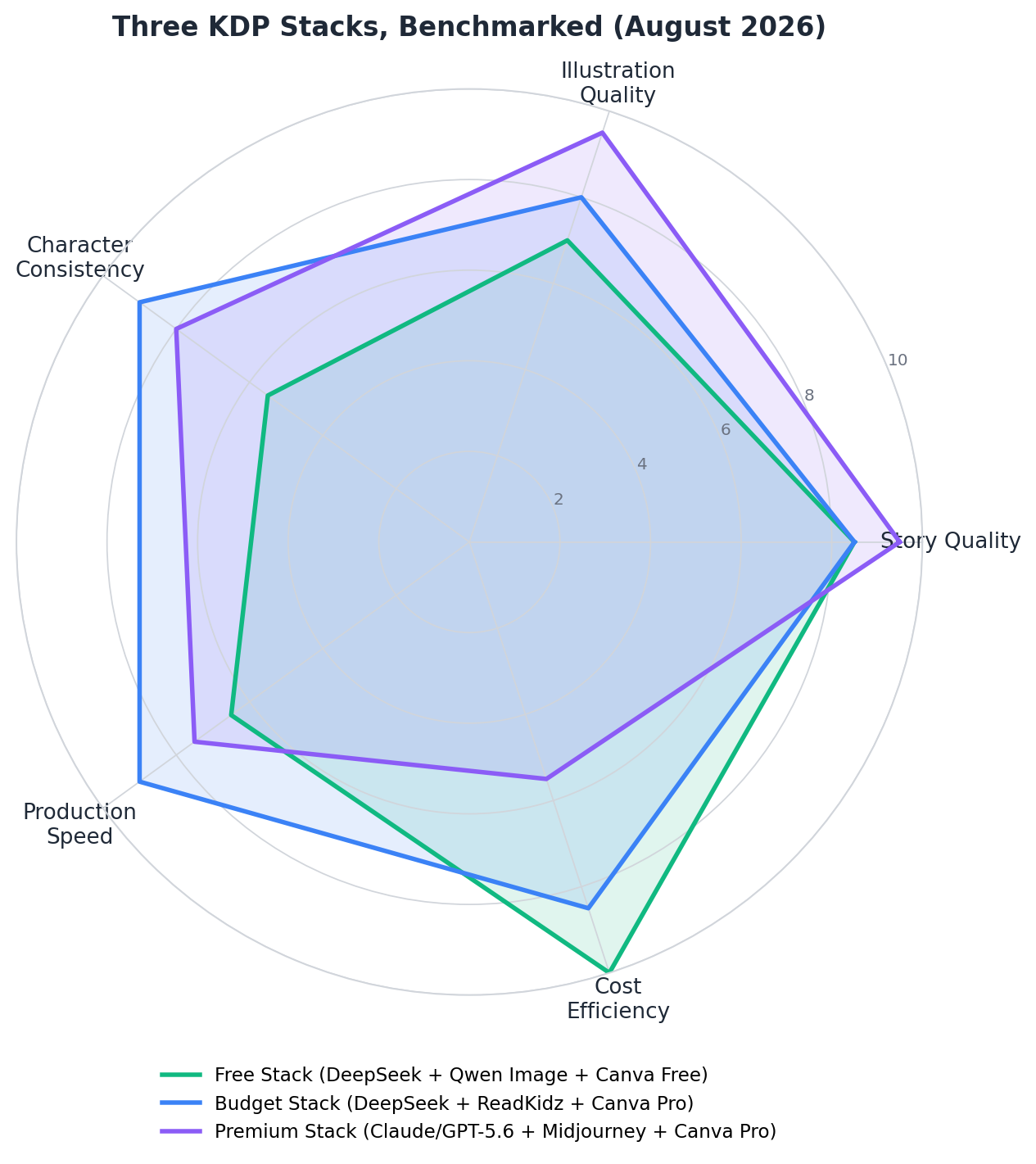
- Free Stack (DeepSeek + Qwen Image + Canva Free): story 8.5, illustrations 7.0, character consistency 5.5, speed 6.5, cost 10.0. Its only weak axis is consistency — Qwen Image needs a manual reference workflow to keep a protagonist stable, which costs you evenings instead of dollars.
- Budget Stack (DeepSeek + ReadKidz + Canva Pro): story 8.5, illustrations 8.0, character consistency 9.0, speed 9.0, cost 8.5. The balanced pentagon — no dimension below 8.0, and the fastest idea-to-Amazon cycle of the three.
- Premium Stack (Claude/GPT-5.6 + Midjourney + Canva Pro): story 9.5, illustrations 9.5, character consistency 8.0, speed 7.5, cost 5.5. Maximum quality, and the stack whose books survive being judged on craft rather than niche fit.
Which Stack for Which Publisher? (Decision Matrix)
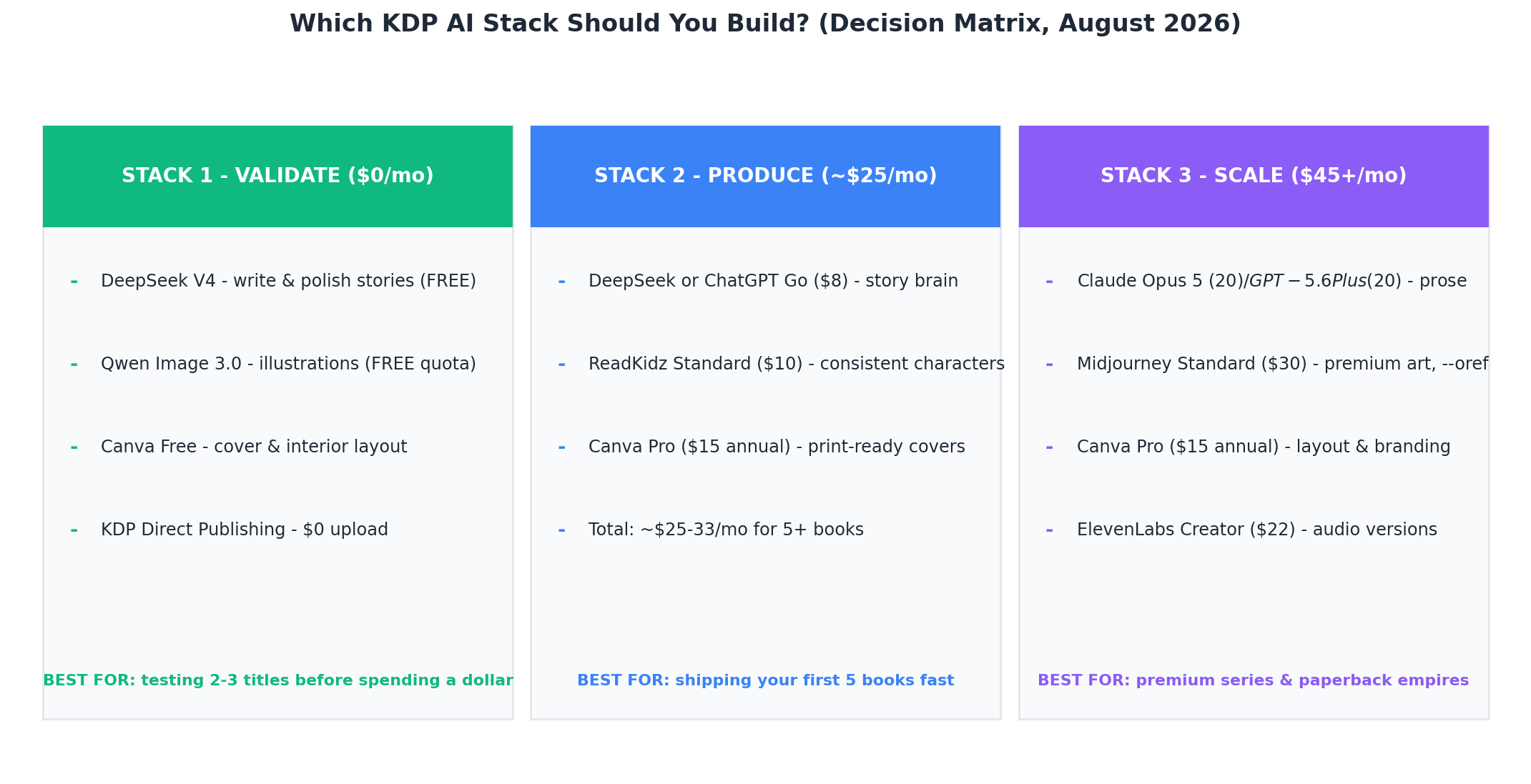
Stack 1 — Validate ($0/mo): DeepSeek V4 for stories (free), Qwen Image 3.0 for illustrations (free quota), Canva Free for layout, and KDP's own $0 upload. This stack exists to answer one question — do strangers buy this niche? — before you've spent a dollar. Test two or three title concepts; the winner graduates to Stack 2.
Stack 2 — Produce (~$25/mo): DeepSeek or ChatGPT Go ($8) as the story brain, ReadKidz Standard ($10) for consistent characters, Canva Pro ($15 annual) for print-ready covers. Total ~$25–33/month, enough throughput for five or more finished books. This is the workhorse stack for the case-file publishers earning four figures a month: ship a 5-book series per niche, keep what ranks, cut what doesn't.
Stack 3 — Scale ($45+/mo): Claude Opus 5 ($20) or GPT-5.6 Plus ($20) for prose, Midjourney Standard ($30) for premium --oref art, Canva Pro ($15) for layout and branding, ElevenLabs Creator ($22) for audio read-along editions. This is the stack for premium hardcover series, gift books and brand-adjacent publishing where a $16.99 list price and ~$5–6 royalty per unit changes the math, and audio editions separate you from the no-audio AI crowd.
Feature Comparison at a Glance
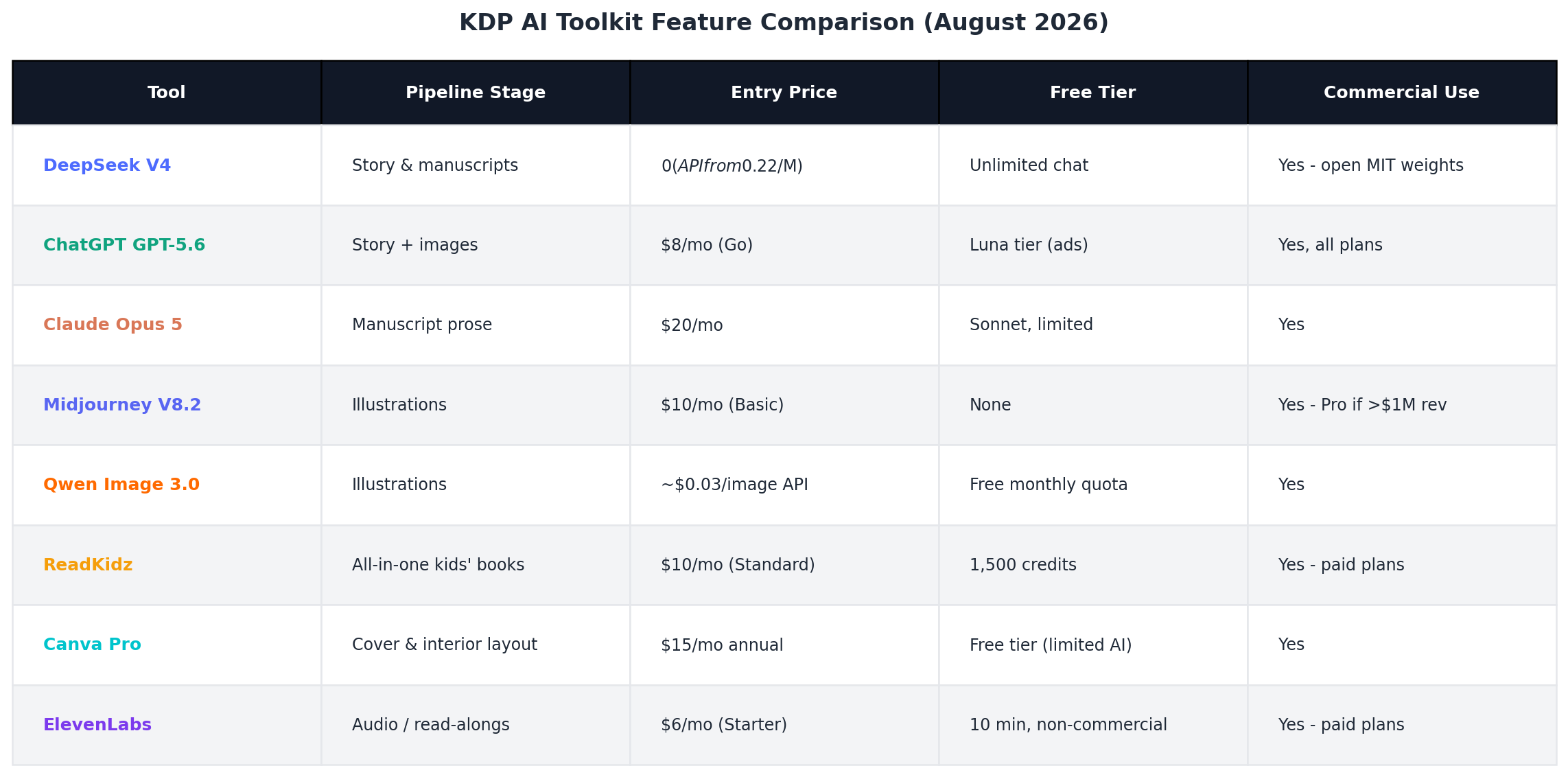
Two cells in that table decide more purchasing decisions than everything else combined. Free tier: only DeepSeek (unlimited chat) and Qwen Image (monthly quota) offer genuinely usable free production capacity; every other free tier is a trial. Commercial use: every tool here permits selling what you make — the nuances are Midjourney's $1M-revenue Pro requirement and ElevenLabs' rule that free-tier audio is non-commercial, so paid plans are mandatory for audiobook work.
Real-World Money-Making Scenarios
These are the three publishing plays we see working in real case files, with the exact prompts and the economics that make them worth your Saturday.
Scenario 1: The Weekend Children's Picture Book (Budget Stack)
The unit economics of picture books were broken by illustration costs — $750–3,000 per book at freelance rates made the 70%-ebook / ~$3.60-net-paperback royalty math impossible. AI flips it: illustration cost per book falls under a dollar, and the constraint moves to niche selection and series branding.
Step 1 — Story (DeepSeek, free):
"Write a 32-page children's picture book for ages 3–5 about a shy axolotl who learns to sing. Format: one page per entry, each with [PAGE N], story text of 8–15 words that rhymes AABB, and a detailed image prompt for a consistent character — pink axolotl with a yellow bow, soft watercolor style, white background. End with a gentle takeaway, no moralizing."
Step 2 — Art (ReadKidz, $10/mo): paste the story; generate the character once, apply across all 32 pages; export print-resolution spreads.
Step 3 — Layout (Canva Pro): start from the 8.5×8.5 KDP template with bleed, place art and text, Magic Resize the cover to ebook and paperback.
Economics: ~$0.50–1 in tool cost per book. Price the paperback at $11.99 → roughly $3.60 royalty per unit after Amazon's print cost. The single book is a portfolio piece; the 5-book series on one series page is the actual asset — buyers who like book 1 buy books 2–5 at near-zero marginal acquisition cost.
Scenario 2: Niche Nonfiction Guides on the $0 Stack
The purest validation play: a 15,000-word beginner's guide to a specific, searchable problem, produced entirely on free tiers, priced to convert at $4.99 (70% royalty band = ~$3.49 per sale). The genre doesn't need illustrations beyond a cover and a few diagrams, which is exactly what the free stack is good at.
Step 1 — Manuscript (DeepSeek, free):
"Act as a senior editor. Outline a 15,000-word beginner's guide for KDP: 'Reading Your Dog's Body Language' — 10 chapters, each with an anecdote opener, a practical framework, and a 5-point summary table. Then draft Chapter 1 at 1,500 words, plain-spoken, 6th-grade reading level, no filler."
Draft chapter by chapter, verifying every factual claim yourself — Amazon buyers punish wrong nonfiction with refunds and one-star reviews.
Step 2 — Cover & diagrams (Qwen Image, free quota): its text-rendering strength generates clean labeled diagrams and title mockups directly.
Step 3 — Layout (Canva Free, 6×9) and upload ($0).
Economics: $0 cash cost, a weekend of time. Target: 15–30 sales/month confirms the niche; then produce the follow-on titles on the budget stack and let this free experiment fund them.
Scenario 3: The Premium Hardcover Series with Audio (Scale Stack)
The differentiation play. The bottom of the KDP market is flooding with template-sameness AI books; the top of it still rewards craft. A hardcover bedtime-book series with a companion read-along audio edition justifies premium pricing — and only the scale stack produces it.
Prose (Claude Opus 5): give it the DeepSeek outline and ask for a voice pass — "rewrite keeping every beat, elevating rhythm; read-aloud cadence for parents at bedtime; cut every clause a tired adult stumbles over."
Art (Midjourney Standard, --oref): build a character sheet in V8.2, reference it on every spread, --sref a consistent palette; upscale for print.
Layout (Canva Pro) + Audio (ElevenLabs Creator): hardcover-ready layouts; generate a warm narrator voice for the read-along edition with the commercial license the Starter/Creator tiers carry.
Economics: $45–70/month in tools; price hardcover at $16.99 → ~$5–6 royalty per unit; audio edition sold separately adds a second royalty stream most AI publishers can't match. Ten sales a day across a series is a $2,000+/month business — the ceiling case, not the average, but the tools no longer gate it.
Alternatives Worth Considering
| Tool | Starting Price | Standout Feature |
|---|---|---|
| Sudowrite | $19/mo | Fiction-specific drafting tools (Story Bible, chapter generation) for novelists |
| Ideogram | $8/mo | Best-in-class text-in-image generation for typographic covers |
| Book Bolt | $19.99/mo | Low-content niche research plus interior generation for journals and activity books |
| Creative Fabrica | $9/mo | Template and font library with CF Spark art tools — fast KDP interiors |
| Publisher Rocket | $97 lifetime | Keyword and category research that decides which of your books earns |
The Verdict
🏆 Our Recommendations
Best overall → DeepSeek V4 (9.2). The best value in self-publishing tools, full stop: frontier-grade story and manuscript generation, unlimited free chat, MIT-licensed open weights, and API drafts at $0.10–0.20 per book. It anchors all three stacks — start here regardless of budget.
Best $0 start → the Free Stack (DeepSeek + Qwen Image 3.0 + Canva Free). A complete publishing pipeline at literally zero dollars. Use it to test two or three niches; the data you get — real clicks, real sales — is worth more than any tool upgrade.
Best production value → the Budget Stack (~$25–33/mo). ChatGPT Go or DeepSeek for story, ReadKidz Standard for 9.0-level character consistency, Canva Pro for print-ready output. Five or more finished books a month at ~$5–7 each in tool cost — the workhorse configuration behind most of the profitable case files we track.
Best premium quality → the Scale Stack ($45+/mo). Claude Opus 5 or GPT-5.6 Plus prose, Midjourney V8.2 art, Canva Pro layout, ElevenLabs audio. For hardcover series and gift books where craft is the moat, this stack's 9.5 story and illustration scores earn their price.
The hybrid approach most publishers land on: validate on the free stack, promote winning niches to the budget stack, then rent the premium stack by the month when a series proves it deserves hardcover and audio treatment. Total steady-state cost: $0–70/month, and every upgrade is triggered by a book that already earned it.
Frequently Asked Questions
Can you legally publish AI-generated books on Amazon KDP?
Yes. Amazon allows AI-assisted and AI-generated content on KDP, but it requires you to disclose AI-generated text, images or translations during the upload flow (a policy in force since September 2023). The disclosure is internal — buyers never see it. One legal nuance for US publishers: purely AI-generated output is not copyrightable, so build substantial human authorship (editing, arrangement, original outlines) into every book before you claim copyright in the publishing wizard.
What is the best free AI tool for making KDP books?
DeepSeek V4 is the best free tool for manuscripts — unlimited free chat plus API access from $0.22 per million tokens, with open MIT-licensed weights. Pair it with Qwen Image 3.0 (free monthly image quota, roughly $0.03 per image on API) for illustrations and Canva Free for cover and interior layout. That is a complete $0 publishing pipeline — enough to validate two or three titles before you spend a dollar.
Which AI tool draws the best children's book illustrations?
Midjourney V8.2 produces the most premium art, and its --oref character-reference workflow keeps your protagonist recognizable across 30+ pages. ReadKidz (8.2/10) is the better pick if consistency on autopilot matters more than raw art quality — it generates the whole book, characters included, for $10/month. Qwen Image 3.0 is the best free option and unusually good at rendering legible text inside images for cover mockups.
How much does it cost to produce one KDP book with AI?
With the free stack (DeepSeek + Qwen Image + Canva Free): effectively $0, limited by your free image quota. With the budget stack (DeepSeek or ChatGPT Go + ReadKidz Standard + Canva Pro, about $25–33/month): roughly $5–7 per finished book if you ship five or more per month. With the premium stack (Claude Opus 5 or GPT-5.6 Plus + Midjourney Standard + Canva Pro, $45+/month): $10–15 per book plus your time. Compare that with $750–3,000 for a freelance-illustrated picture book.
How much money can you actually make with AI-made KDP books?
Royalty mechanics: 70% of list price on ebooks priced $2.99–$9.99, and about $3–4 net per paperback after Amazon's printing cost. Realistic outcomes from the case files we track: a well-researched niche nonfiction title that ranks earns $50–500/month; children's book series compound as buyers purchase the whole set; low-content books are a volume game with thin margins. The books that fail are almost always weak niche research or template-sameness covers — not the AI inside them.
Is DeepSeek good for writing books?
Yes — especially for structure, drafting and picture-book scripting at scale. DeepSeek V4's long context keeps chapter arcs coherent across a full manuscript, it reliably outputs page-by-page story-plus-image-prompt formats, and a 30,000-word draft costs roughly $0.10–0.20 via API. For final literary polish on adult fiction or narrative nonfiction, run the DeepSeek draft through Claude Opus 5, which writes the best prose of any model we tested.
Do I have to tell Amazon that I used AI?
You must declare AI-generated content — text, images or translations — when KDP's publishing wizard asks (it has since September 2023). AI-assisted work, where you wrote the substance and used AI for editing or brainstorming, does not require disclosure. The declaration is confidential and is not shown to buyers. Falsifying it is a terms-of-service violation that can get your KDP account terminated, so answer honestly.