⏱ TL;DR
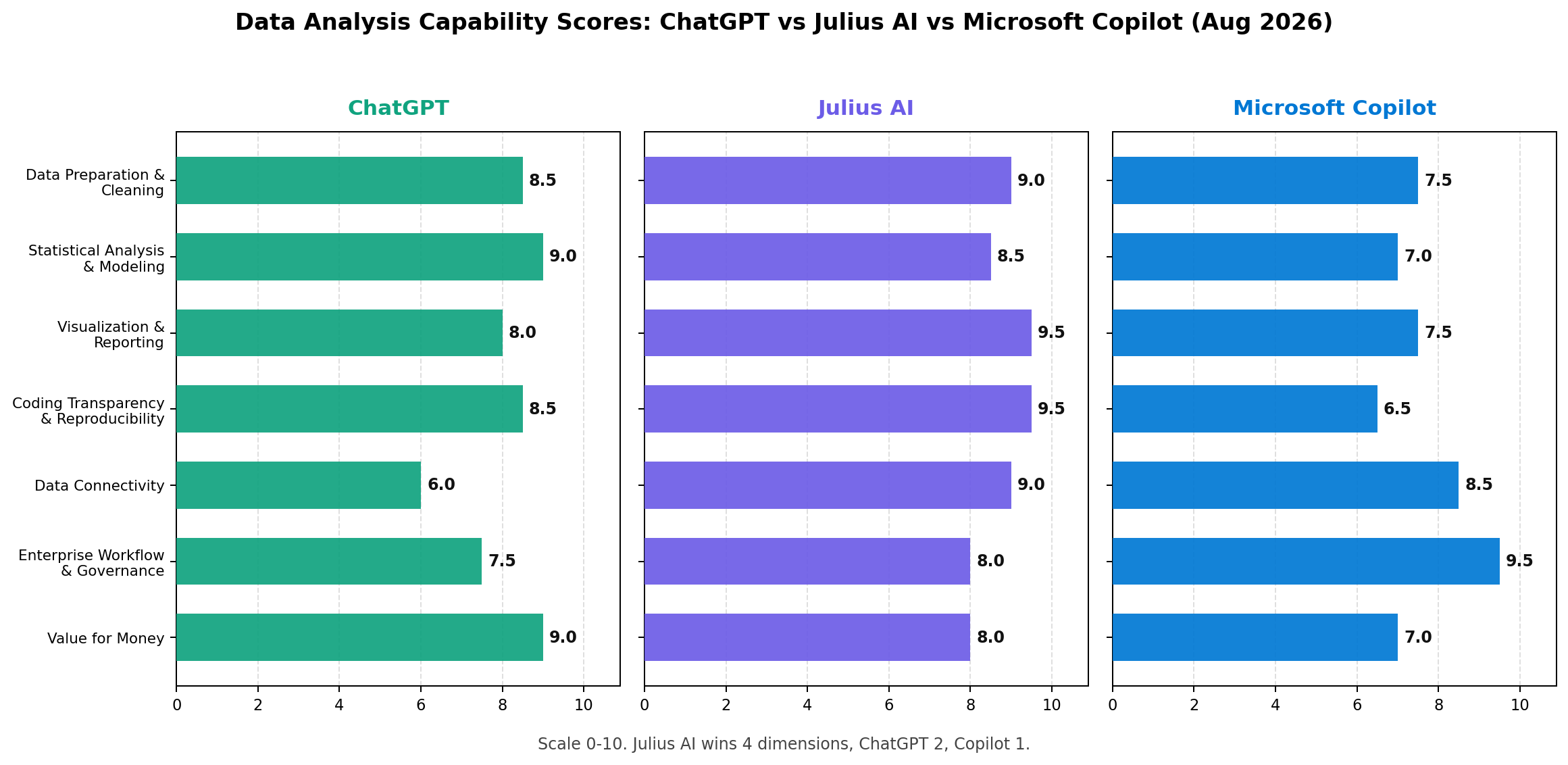
In August 2026 there are three serious ways to hand your data to an AI, and they are not interchangeable. ChatGPT (GPT-5.6 family, from $8/mo) is the strongest raw analyst brain in a general-purpose chat — unmatched statistical reasoning, but files-in-files-out only. Julius AI (from $20/mo) is a purpose-built analysis workspace: direct Snowflake/BigQuery/Postgres connectors, editable Python for every step, 10M+ visualizations created, and scheduled recurring reports. Microsoft Copilot ($18–$30/seat/mo) brings Agent Mode and the Analyst reasoning agent inside Excel itself — 20M+ paid seats strong. Our head-to-head across 7 dimensions: Julius wins 4 (Data Prep 9.0, Visualization 9.5, Coding Transparency 9.5, Data Connectivity 9.0), ChatGPT wins 2 (Statistical Analysis 9.0, Value for Money 9.0), Copilot wins 1 (Enterprise Workflow & Governance 9.5). Solo analysts and freelancers selling analysis → Julius. Hardest stats questions, tightest budget → ChatGPT. Your data already lives in Excel inside a big org → Copilot. The $28/mo stack (ChatGPT Go + Julius Plus) covers both halves of the brain.
At a Glance
| ChatGPT | Julius AI | Microsoft Copilot | |
|---|---|---|---|
| What it is | General AI chat with sandboxed Advanced Data Analysis | Purpose-built AI data analysis workspace | AI embedded across Excel and Microsoft 365 |
| Current engine | GPT-5.6 family: Sol / Terra / Luna (GA July 2026) | GPT-5.6 + Claude Sonnet 5 / Claude Fable 5 by tier | Frontier models + Agent Mode + Analyst agent in Excel |
| Entry price | Free; $8/mo (Go) | Free daily credits; $20/mo (Plus) | Free Chat; $18/seat/mo promo (Business) |
| Pro-tier price | $100–$200 (Pro) | $45/mo (Pro, 5,000 credits) | $30/user/mo (Enterprise) |
| SQL / warehouse access | No — upload files (512 MB each) | Yes — Snowflake, BigQuery, Postgres, MySQL, SQL Server | Indirect — Power Query / Fabric ecosystem |
| Code transparency | Viewable Python behind answers | Editable Python notebook per analysis | Analyst agent exposes query code |
| Best for | One-off deep analysis, hardest stats | Recurring analyst workflows on live data | Enterprise Excel and M365 shops |
Deep Dive: ChatGPT — the Strongest Generalist Analyst
ChatGPT's Advanced Data Analysis mode (formerly Code Interpreter) remains the most capable adversary you can hand a messy dataset. Since the GPT-5.6 family went generally available on July 9, 2026 — Sol as flagship, Terra and Luna as mid and light tiers — the statistical reasoning ceiling here is the highest of any consumer-accessible tool. Upload a CSV (up to 512 MB per file), describe the question, and the model writes and executes sandboxed Python, shows its work, and iterates in plain English.
Key capabilities: exploratory analysis on messy files (deduplication, type coercion, outlier flagging) handled conversationally; full scipy/statsmodels-grade statistics when you ask for them; chart generation inline; export of cleaned data and charts; and reasoning that survives multi-step inference chains — the thing specialized wrappers still occasionally fumble. OpenAI's mid-2026 folding of agent mode into Work features means the chat remains exactly that: a chat, not a pipeline.
Pricing (Aug 2026): Free ($0, GPT-5.6 Luna with limited analysis) → Go ($8/mo) → Plus ($20/mo) → Pro ($100–$200/mo, two tiers since April 2026) → Business ($25/seat/mo monthly, $20 annual) → Enterprise (custom). Roughly 800 million weekly users by mid-2026, per third-party estimates.
Strengths: the deepest reasoning per dollar ($8 Go tier is absurd value for a student or freelancer); analysis, writing, coding and research in one window; no workflow lock-in.
Weaknesses: no live data connections — every analysis starts with a file upload; charts are serviceable, not publication-grade; nothing is scheduled or reproducible unless you copy the code out yourself; context limits tax very large datasets.
Deep Dive: Julius AI — the Purpose-Built Analysis Machine
Julius AI raised a $10 million seed round led by Bessemer Venture Partners and has spent 2026 compounding: 2M+ users, 10M+ visualizations created, and north of 4 million lines of analysis code executed daily. The pitch is simple — chat with your data the way you'd brief a junior analyst, and get editable Python notebooks, polished charts and scheduled reports instead of one-off chat answers. The April 2026 pricing restructure moved the platform from message limits to a credit system, and model access now spans GPT-5.6 and Claude Sonnet 5 (Plus tier and up) with Claude Fable 5 on Pro.
Key capabilities: direct connectors to Google Drive, OneDrive and SharePoint for files, and — the killer feature versus ChatGPT — native queries against Snowflake, BigQuery, PostgreSQL, MySQL and SQL Server through a semantic layer; every answer backed by Python code you can inspect and edit; publication-quality chart generation; scheduled recurring analyses (Pro tier, 3 concurrent); shared workspaces for teams. Julius claims a 31% math accuracy improvement over the GPT-4 era — self-reported, but the platform's G2 rating of 4.5/5 across ~96 reviews suggests the reliability is real. SOC 2 Type II certified.
Pricing (Aug 2026, post-restructure): Free (daily credits, Lite models) → Plus ($20/mo, $16 annual, 2,000 credits) → Pro ($45/mo, $37 annual, 5,000 credits + scheduled runs) → Max ($200/mo, 25,000 credits) → Business ($450/mo, up to 50 members, 60,000 credits) → Enterprise (custom).
Strengths: the only tool of the three that queries your warehouse directly; reproducibility by default; charts good enough for client decks; scheduling turns one-off analysis into a product.
Weaknesses: it's a data tool, not a general assistant — don't ask it to write your newsletter; credits require capacity planning on heavy months; no Excel-native surface; the free tier's Lite models are noticeably weaker than paid.
Deep Dive: Microsoft Copilot — the 20-Million-Seat Incumbent
Microsoft Copilot stopped being a chat sidebar in 2026. In Excel, Agent Mode — generally available this year — doesn't just suggest formulas; it edits charts, restructures workbooks and executes multi-step transformations on instruction. The Analyst reasoning agent performs genuinely deep analysis and, in a nod to transparency, exposes the Python query code behind its conclusions. Python in Excel is native. The old App Skills framework was deprecated in February 2026 as Agent Mode took over. The numbers behind this: 20M+ paid seats, roughly 70% of the Fortune 500, and 41% of Microsoft 365 enterprise customers carrying Copilot licenses by Q1 2026.
Key capabilities: Agent Mode and Analyst in Excel; Copilot across Word, Outlook, PowerPoint and Teams (research, drafting, meeting synthesis); Researcher and Facilitator agents; IT-managed deployment through the E3/E5 compliance stack; adjacency to Power BI and Microsoft Fabric for real BI workloads.
Pricing (Aug 2026): Copilot Chat (free) → M365 Premium for consumers ($19.99/mo or $199.99/yr — Copilot Pro was retired into this in late 2025) → M365 Copilot Business ($18/seat/mo promo, $21 standard, for SMBs) → M365 Copilot Enterprise ($30/user/mo, annual commitment).
Strengths: zero migration — the analysis happens where 400 million office workers already live; enterprise governance, compliance and admin controls none of the others match; GitHub Copilot cross-subsidizes an enormous AI org.
Weaknesses: real-world weekly active usage among licensed seats runs an estimated 20–30% — seats are bought top-down faster than habits change; the deepest analysis still trails ChatGPT-class reasoning; $30/seat adds up fast for teams that only wanted Excel help; lock-in is the point.
The Capability Picture
Overlay the three tools on six capability axes and the geometry is clarifying: Julius owns the analyst-workflow half of the hexagon (Visualization 9.5, Data Connectivity 9.0, Transparency 9.5), Copilot owns Workflow Automation (9.0), and ChatGPT owns raw Statistical Depth and Ease of Getting Started.
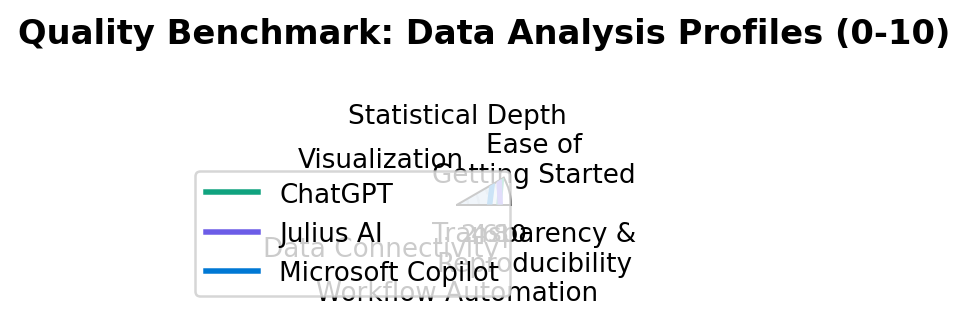
Read the radar as three distinct bets. ChatGPT (9.0 / 8.0 / 6.0 / 7.0 / 8.5 / 9.5): brain-first, connectivity-last. Julius (8.5 / 9.5 / 9.0 / 8.5 / 9.5 / 9.0): the most balanced polygon — strong everywhere except it concedes raw reasoning depth to ChatGPT. Copilot (7.0 / 7.5 / 8.5 / 9.0 / 6.5 / 7.5): automation and enterprise reach over analyst-grade depth and transparency.
Head-to-Head: Seven Dimensions, Seven Verdicts
1. Data Preparation & Cleaning — Winner: Julius AI (9.0)
All three will dedupe a messy export, but only Julius treats cleaning as a first-class, repeatable pipeline step whose Python you can edit and rerun when next month's file arrives with new formatting crimes. ChatGPT (8.5) is brilliant at one-shot rescues of catastrophic files; Copilot (7.5) handles structured Excel hygiene well but chokes on genuinely dirty multi-file merges.
2. Statistical Analysis & Modeling — Winner: ChatGPT (9.0)
This is GPT-5.6 Sol's home turf: model selection justification, assumption checking, regression diagnostics, Bayesian reasoning, and the ability to argue back when your question is statistically malformed. Julius (8.5) runs the same model class but through a harness tuned for execution over open-ended reasoning. Copilot (7.0) is improving fast via the Analyst agent but isn't in this fight yet.
3. Visualization & Reporting — Winner: Julius AI (9.5)
Ten million visualizations created is not a marketing number; it's a charting engine that has been hardened by user volume. Charts arrive styled, annotated and exportable at deck quality. ChatGPT (8.0) produces matplotlib defaults with occasional flair; Copilot (7.5) produces Excel charts — which is either the whole point or a limitation, depending on your employer.
4. Coding Transparency & Reproducibility — Winner: Julius AI (9.5)
Every Julius answer is a notebook you can inspect, edit and rerun — the difference between an analyst and a black box. ChatGPT (8.5) shows its Python but you must extract it yourself to rebuild the pipeline. Copilot (6.5) exposes code in Analyst mode only; Agent Mode workbook edits are powerful but hard to audit line-by-line.
5. Data Connectivity — Winner: Julius AI (9.0)
The single biggest architectural difference. Julius queries Snowflake, BigQuery, Postgres, MySQL and SQL Server directly. Copilot (8.5) reaches org data through Excel, Power Query, SharePoint and Fabric — broad but indirect. ChatGPT (6.0) uploads files, full stop; its Business connectors ground chat in cloud apps rather than run SQL.
6. Enterprise Workflow & Governance — Winner: Microsoft Copilot (9.5)
For a CIO, this dimension outranks everything else. Conditional access, sensitivity labels, E3/E5 compliance, audit trails, tenant-scoped data boundaries, and a procurement path that already exists. Julius Business (8.0) carries SOC 2 Type II for teams up to 50. ChatGPT Business (7.5) offers SSO and no-training-by-default, but OpenAI is a consumer company doing enterprise, while Microsoft is the reverse.
7. Value for Money — Winner: ChatGPT (9.0)
$8/month for GPT-5.6-class reasoning with sandboxed Python is the best analysis dollar in software. Julius (8.0) justifies its $20–$45 with connectors and scheduling if analysis is your job. Copilot (7.0) at $30/seat is only cheap when it replaces an Excel consultant across a whole department — which, to be fair, it sometimes does.
Pricing: Three Very Different Ladders
The entry points cluster — $8, $18–$20 — but the ladders diverge sharply at the top, and per-seat vs per-account pricing changes the math entirely for teams.
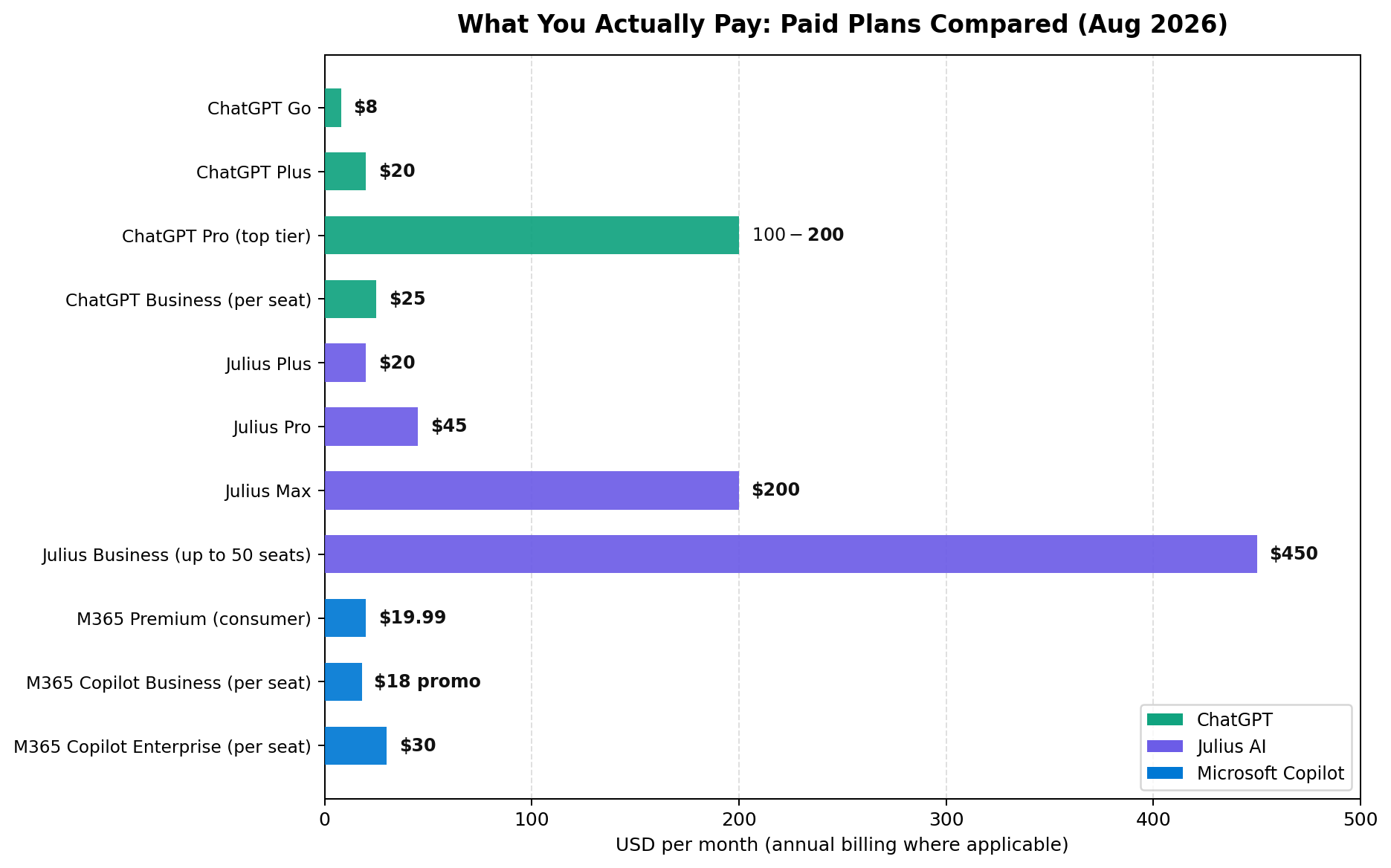
ChatGPT: Free → Go $8 → Plus $20 → Pro $100–$200 → Business $25/seat (monthly; $20 annual).
Julius: Free → Plus $20 (2,000 credits) → Pro $45 (5,000 credits + 3 scheduled runs) → Max $200 (25,000 credits) → Business $450 (60,000 credits, up to 50 members).
Copilot: Chat free → M365 Premium $19.99 → Business $18/seat (promo; $21 standard) → Enterprise $30/seat.
The honest team math: five analysts on ChatGPT Business is $100–$125/mo with no connectors; Julius Business is $450/mo flat for up to 50 people with connectors; five Copilot Enterprise seats are $150/mo inside the stack IT already manages. None of these is "cheapest" — they're different purchases.
Real-World Test Scenarios (The Money-Making Kind)
Benchmarks don't bill. We mapped the three tools onto three workflows where people are genuinely earning with AI analysis in 2026.
Scenario 1: Freelance Data-Analysis Gigs ($50–$300 per analysis)
The setup: the fastest-growing freelance category on marketplaces in 2026 is "send me your spreadsheet, get back clean data, three charts and a one-page summary." Solo operators run these as productized services; the winning skill is turnaround speed with zero errors on files they've never seen.
"Clean this 50,000-row sales export: dedupe on order_id, standardize the SKU casing, flag rows with missing region. Then give me monthly revenue by category as an annotated line chart, and a one-paragraph summary of the three biggest anomalies."
What happened: ChatGPT nailed the anomaly narrative; Copilot needed the file inside Excel first; Julius returned the chart, the summary and an editable notebook the freelancer could rerun next week for the same client as a retainer. Winner: Julius AI — in a $50–$300 market, the reusable notebook converts one-off gigs into recurring revenue.
Scenario 2: E-Commerce Store Owner's Monday Report (replaces a $500–$1,500/mo analyst retainer)
The setup: store owners paying for weekly performance reporting discover that a scheduled AI analysis against the live orders table does 80% of the job for 3% of the retainer.
"Every Monday 8am: query the orders table for the last 7 days — revenue by channel, AOV, top 10 SKUs by units, and flag any product with a margin drop over 20%. One-page summary, one chart, email it to me."
What happened: only one tool can actually do this end-to-end: Julius connects to Postgres/BigQuery directly and runs scheduled analyses from the Pro tier ($45/mo). ChatGPT requires a human to export and upload every Monday; Copilot needs Power Query plumbing plus Fabric for a true scheduled pipeline. Winner: Julius AI — the only one where "recurring" is a product feature, not a habit.
Scenario 3: Corporate Analyst Who Lives in Excel (~2 hours saved per week, $5K–$10K/yr per analyst)
The setup: the 2026 enterprise case studies (Campari et al.) all share one shape: analysts aren't leaving Excel, so the AI has to come to them. Agent Mode edits the workbook; Analyst explains the margin drop.
"In this workbook: Central region margin fell 3 points versus last quarter. Break it down by product line, isolate the top three drivers, and insert a chart showing each driver's contribution to the decline."
What happened: this is the scenario Copilot was built for — it worked directly in the .xlsx, added the chart to the right sheet, and kept the audit trail inside the tenant. Julius can analyze an Excel file from SharePoint but answers in its own workspace; ChatGPT analyzes a copy, and the copy promptly forks from reality. Winner: Microsoft Copilot — when the deliverable is the workbook, the tool must live in the workbook.
Alternatives Worth Considering
The AI-analysis market didn't stop at three players — these are the ones we'd shortlist next.
| Tool | Starting Price | Standout Feature |
|---|---|---|
| Google Gemini | Free; $19.99/mo (AI Pro) | Sheets-native analysis plus massive context in Workspace |
| Claude | Free; $20/mo (Pro) | Reasoning plus artifacts — strong on analysis write-ups and code |
| DeepSeek | Free | Frontier-tier reasoning and file analysis at zero cost |
| Hex Magic | Free tier; paid from ~$25/mo | Notebook-first analytics built for data teams |
| Rows AI | Free tier; from ~$15/mo | Spreadsheet with native AI analysis formulas |
For the general-purpose side of ChatGPT, see our ChatGPT vs Claude vs Gemini comparison; for the coding-adjacent use case, ChatGPT vs Claude for Coding.
Which Should You Choose?
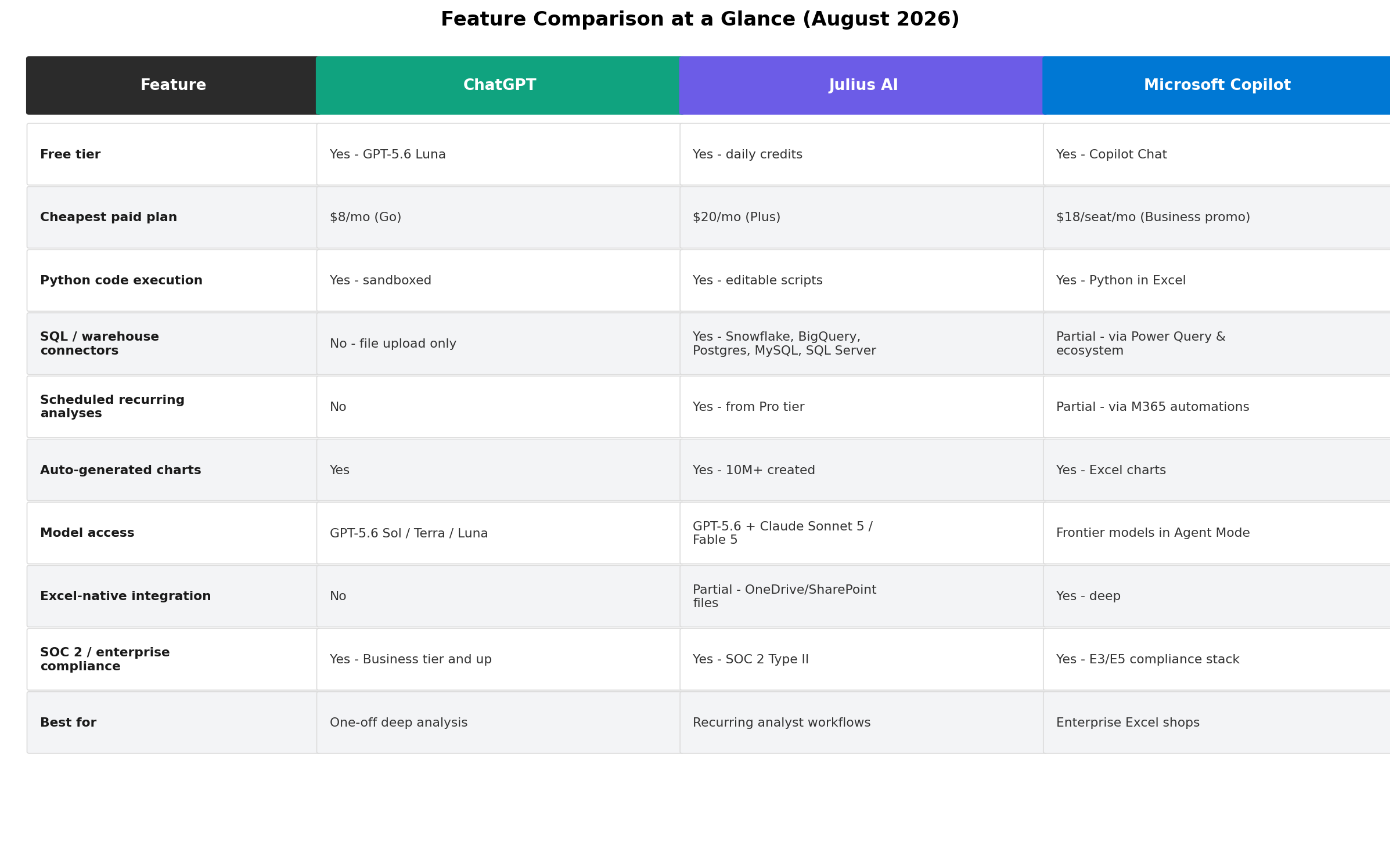
The Verdict
🏆 Our Recommendations
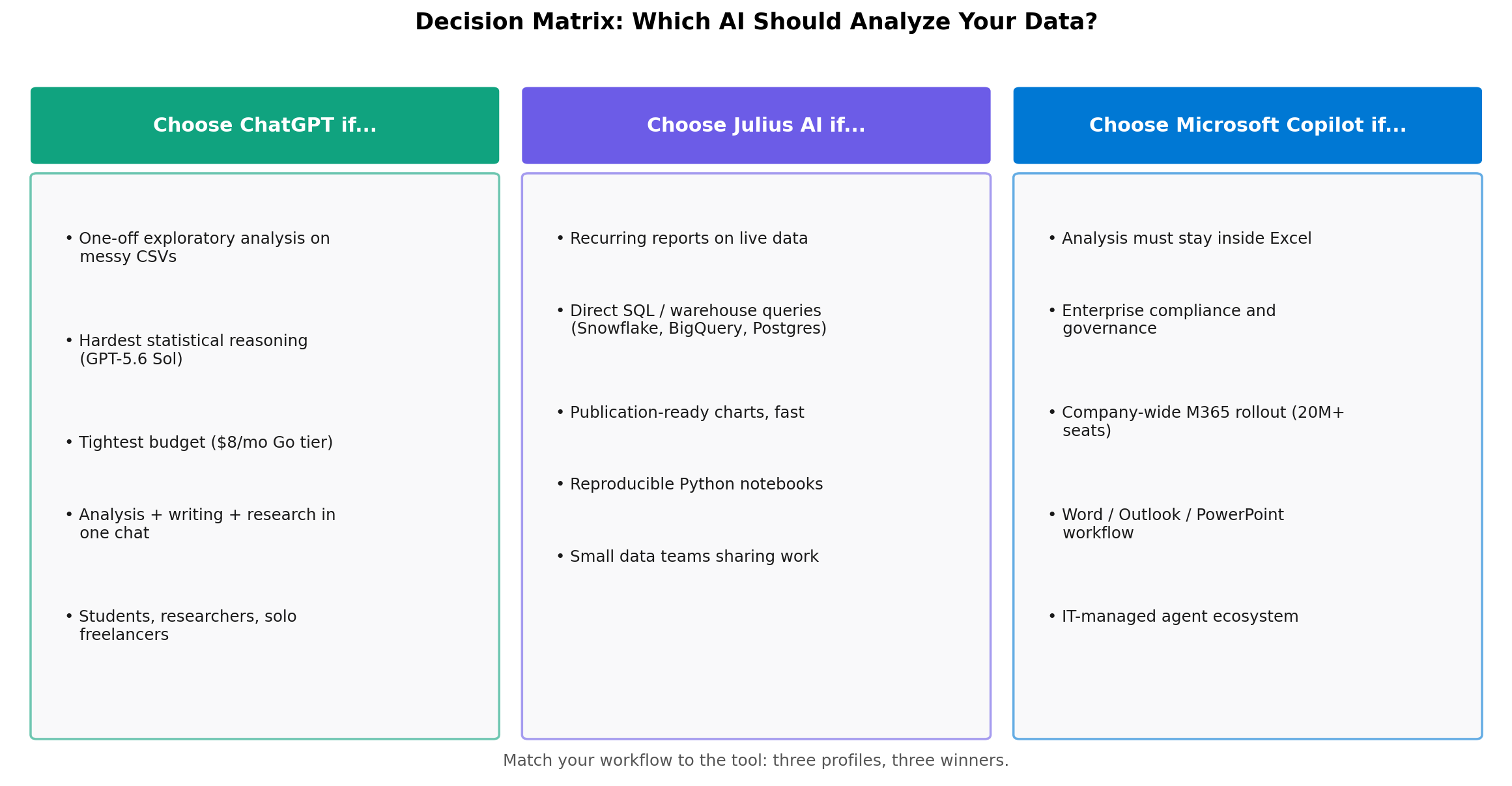
Best dedicated data analyst → Julius AI. It won 4 of 7 dimensions — Data Preparation (9.0), Visualization (9.5), Coding Transparency (9.5) and Data Connectivity (9.0) — and its connectors-plus-scheduling architecture turns analysis into infrastructure. If data work is your job or your product, this is the tool that compounds. Realistic budget: Pro at $45/mo.
Best raw reasoning and best value → ChatGPT. GPT-5.6 Sol is the strongest statistical mind of the three, and the $8 Go tier makes it the cheapest serious analyst on the market. It won Statistical Analysis & Modeling (9.0) and Value for Money (9.0). What it gives up in connectivity and repeatability, it repays in sheer intelligence per dollar.
Best inside Microsoft shops → Copilot. The Enterprise Governance win (9.5) understates it: Agent Mode and Analyst working natively inside Excel, wrapped in E3/E5 compliance, is the only option that doesn't ask a 400-person org to change tools. Realistic budget: $30/user/mo, and only buy seats for people who'll actually use them.
Overall (4–2–1) → Julius AI. On the seven dimensions that define data-analysis work, the purpose-built tool beat the generalist and the incumbent. But the honest read of 2026: these tools are converging from three directions — ChatGPT adding connectors, Julius adding reasoning, Copilot adding depth — and the right answer depends on where your data lives.
The hybrid play → ChatGPT Go + Julius Plus, $28/mo. The stack we'd actually recommend to a solo analyst or freelancer: ChatGPT for the brutal one-off reasoning questions, Julius for everything recurring, connected and client-facing. Together they cost less than one Copilot seat and cover both halves of the analytical brain.
Frequently Asked Questions
Is Julius AI better than ChatGPT for data analysis?
For dedicated, recurring data work, yes — Julius won our head-to-head 4 dimensions to 2: Data Preparation (9.0 vs 8.5), Visualization (9.5 vs 8.0), Coding Transparency (9.5 vs 8.5) and Data Connectivity (9.0 vs 6.0). ChatGPT wins Statistical Analysis & Modeling (9.0 vs 8.5 on GPT-5.6 Sol) and Value for Money ($8/mo Go tier). One-off exploratory work and the hardest statistical questions → ChatGPT; repeatable workflows on live data → Julius.
How much does Julius AI cost in 2026?
After the April 2026 switch to credits: Free (daily credits, Lite models) → Plus $20/mo ($16 annual, 2,000 credits) → Pro $45/mo ($37 annual, 5,000 credits + 3 scheduled runs) → Max $200/mo (25,000 credits) → Business $450/mo (up to 50 members, 60,000 credits) → Enterprise custom.
Can Microsoft Copilot do data analysis in Excel?
Yes — Copilot Agent Mode is generally available in Excel in 2026 and edits formulas, charts and workbooks on instruction, while the Analyst reasoning agent performs multi-step deep analysis and exposes the Python query code it used. Python in Excel is native. The older App Skills were deprecated in February 2026.
What is the cheapest way to get serious AI data analysis?
ChatGPT Go at $8/month, which includes expanded file uploads and sandboxed Python analysis on the GPT-5.6 family. For free, Julius's daily-credit tier and Copilot Chat inside Excel both handle light work; the practical paid entry points are Julius Plus ($20/mo) and M365 Copilot Business ($18/seat/mo promo).
Can these tools connect directly to SQL databases?
Julius queries Snowflake, BigQuery, PostgreSQL, MySQL and SQL Server directly through a semantic layer. ChatGPT cannot — it analyzes uploaded files (up to 512 MB each). Copilot reaches data through Excel, Power Query and the Microsoft 365/Fabric ecosystem rather than direct warehouse connections.
Which is best for enterprise data teams?
Microsoft Copilot is the enterprise default: $30/user/month, 20M+ paid seats, ~70% of the Fortune 500, full E3/E5 compliance and governance. Julius Business ($450/mo, up to 50 members, SOC 2 Type II) targets small data teams. ChatGPT Business adds SSO and no-training-by-default at $25/seat/month (monthly billing).
Will AI data analysis tools replace spreadsheets and analysts?
No — they replace the scripting grunt work. Julius alone executes 4M+ lines of analysis code daily; Copilot keeps the work inside Excel rather than killing it. The 2026 pattern: analysts who orchestrate these tools replace analysts who only write formulas.