⏱ TL;DR
In August 2026 the coding crown sits with Claude, but it has never been closer — or cheaper, to take either side. Claude Opus 5 resolves 96% of SWE-bench Verified issues versus 85% for ChatGPT's best coding model (GPT-5.3 Codex), carries a 1M-token context window by default, and Claude Code has become the reference agentic CLI. ChatGPT fights back on economics and breadth: a $8/mo Go tier no rival matches, faster and cheaper high-volume work (AA Coding Index 80.0 vs 77.2), the strongest learning experience for new developers, and one subscription that also writes, researches and generates images. We scored both across 7 dimensions — Claude won 4 (Code Quality & Correctness 9.5 vs 9.0, Agentic Coding 9.5 vs 9.0, Debugging 9.0 vs 8.5, Long-Context Work 9.5 vs 8.5), ChatGPT won 3 (Speed & Cost Efficiency 9.0 vs 8.0, Ecosystem & Integrations 9.0 vs 8.5, Learning & Tutorials 9.0 vs 8.5). If code is your profession: Claude. If code is one of many things you do: ChatGPT. If it's your business: run both — $28/mo covers it.
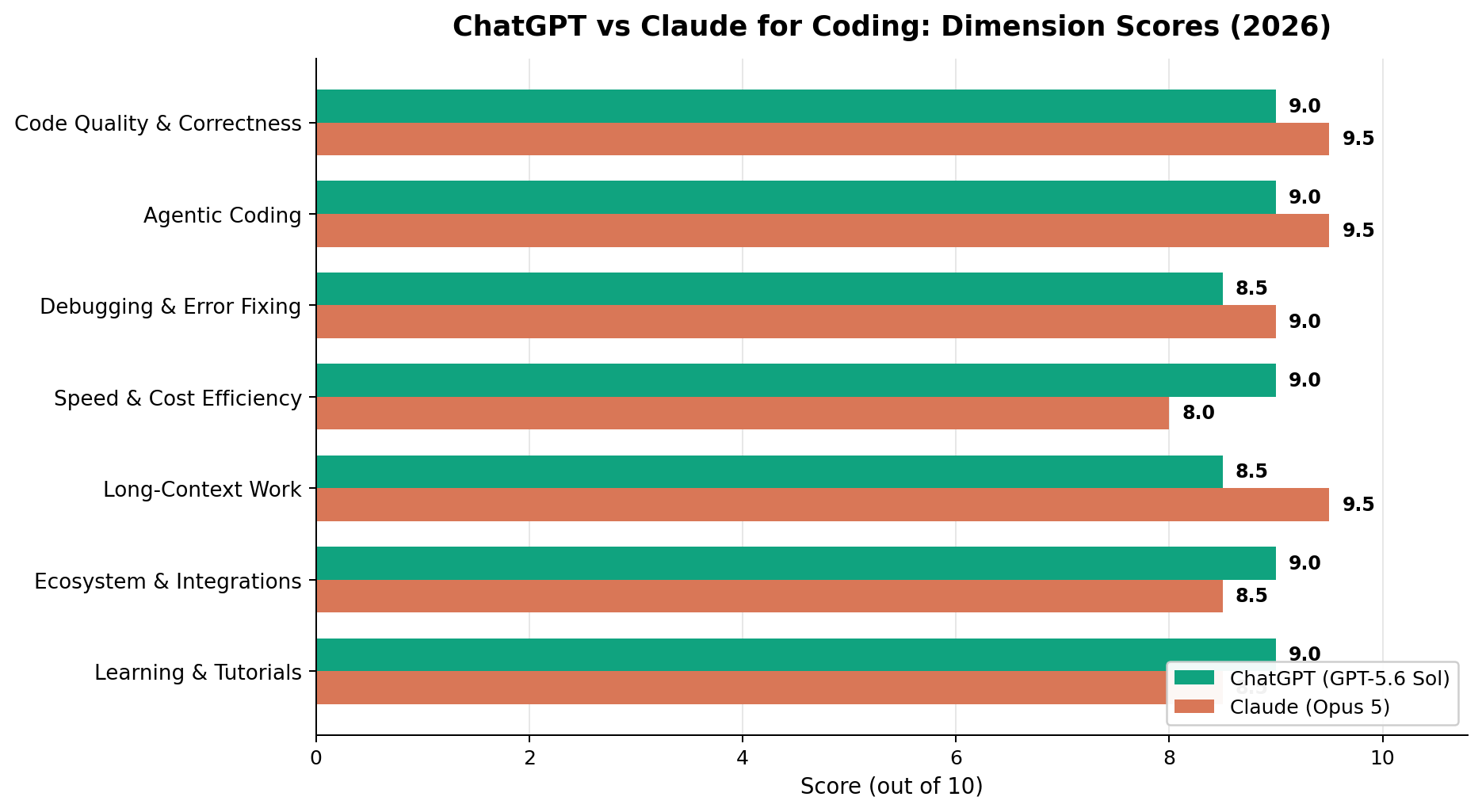
At a Glance
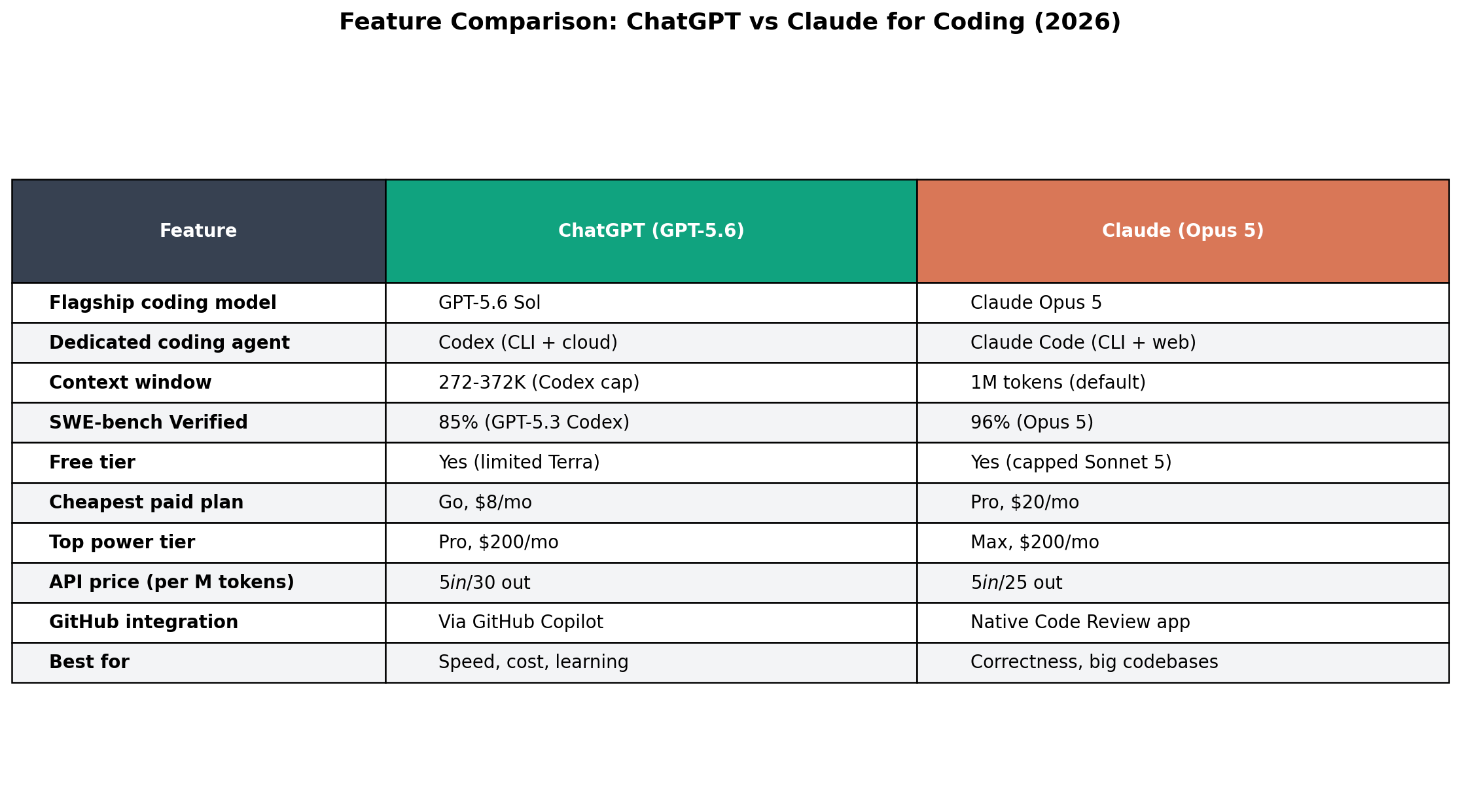
| ChatGPT (GPT-5.6 + Codex) | Claude (Opus 5 + Claude Code) | |
|---|---|---|
| Flagship coding model | GPT-5.6 Sol | Claude Opus 5 |
| Dedicated coding agent | Codex (CLI + cloud) | Claude Code (CLI + web) |
| SWE-bench Verified | 85% (GPT-5.3 Codex) | 96% (Opus 5) |
| Context window | 272–372K (Codex cap) | 1M tokens (default) |
| Free tier | Yes (limited Terra) | Yes (capped Sonnet 5) |
| Cheapest paid plan | Go, $8/mo | Pro, $20/mo |
| Top power tier | Pro, $200/mo | Max, $200/mo |
| API price (per M tokens) | $5 in / $30 out | $5 in / $25 out |
| GitHub integration | Via GitHub Copilot | Native Code Review app |
| Best for | Speed, cost, learning | Correctness, big codebases |
Deep Dive: ChatGPT for Coding
OpenAI's coding stack in 2026 is a two-layer system. GPT-5.6 Sol is the flagship general model — it reasons, writes and debugs across the whole ChatGPT surface — while the Codex line is the specialist: GPT-5.3 Codex holds the family's best SWE-bench Verified score at 85%, and GPT-5.2 Codex posts 88.0 on LiveCodeBench. Codex itself has evolved from a curiosity into a real agentic environment, available as a CLI in your terminal and as a cloud agent that takes a task, works in a sandbox, and opens a pull request when it's done.
What makes ChatGPT compelling for coders is less any single benchmark than the surrounding economics. The Go tier at $8/month is the cheapest serious coding subscription on the market — no Claude equivalent exists at that price. On the API side, the high-volume Luna tier lets heavy users push costs down further, and the AA Coding Index (a composite of agentic-coding evals) still favors GPT-5.6 Sol at 80.0 versus Claude's 77.2. ChatGPT remains the faster, cheaper workhorse for high-volume, latency-sensitive work: Terminal-Bench 3.0 aside, its throughput on bulk tasks and its ecosystem reach — GitHub Copilot in every major IDE, plus a library of integrations built over four years — are why it keeps the Ecosystem & Integrations crown at 9.0 vs 8.5.
Strengths
- $8/mo Go tier: the lowest-cost entry into frontier-model coding anywhere; students and hobbyists ship real work on it.
- Speed & cost efficiency (9.0): fastest perception-to-patch loop of the pair, and Luna API pricing rewards volume.
- Ecosystem (9.0): powers GitHub Copilot; first-party Codex CLI + cloud agents; the biggest integration surface in the industry.
- Learning & tutorials (9.0): the best explainer and study companion — patient, step-by-step, endlessly rephrasable.
- Composite agentic strength: AA Coding Index 80.0 vs 77.2; LiveCodeBench 88.0 vs 89.8 is effectively a tie.
Weaknesses
- SWE-bench Verified 85% vs 96%: on the benchmark closest to real bug fixing, GPT-5.3 Codex trails Opus 5 by 11 points.
- 272–372K context cap: Codex tops out where Claude begins; monorepos and long sessions hit the ceiling sooner.
- API output at $30/M: 20% pricier than Opus 5's $25/M on the token type coding generates most.
- Free tier is limited Terra: useful for learning, frustrating for real projects.
Deep Dive: Claude for Coding
Anthropic built its 2026 reputation on one thing: code that's correct the first time. Claude Opus 5 resolving 96% of SWE-bench Verified is the headline number in coding right now — and it's not a lab trick, because the benchmark consists of real GitHub issues validated by humans, patched against the project's actual test suite. Around the flagship sits a deliberate model ladder: Fable 5 handles the throughput-oriented evals (80.0 on SWE-bench Pro, 89.8 on LiveCodeBench), while Sonnet 5 — capped but free — anchors the free tier.
The delivery vehicle is Claude Code, the CLI-plus-web agentic tool that reads your repository, plans multi-file changes, runs the tests and iterates until they pass. Its default 1M-token context window is the practical superpower: whole mid-sized codebases fit in one session, which is why Claude takes Long-Context Work at 9.5 vs 8.5 and Agentic Coding at 9.5 vs 9.0. Teams get something ChatGPT doesn't offer — a native GitHub Code Review app that automatically reviews pull requests with repository context, leaving inline comments before a human ever looks. For consultancies and agencies billing for code quality, that combination — highest correctness plus automated review — converts directly into fewer billed rework hours.
Strengths
- 96% SWE-bench Verified (Opus 5): the industry's best score on human-validated real-world bug fixing.
- 1M-token context by default: legacy codebases and monorepos fit whole; Long-Context Work scores 9.5 vs 8.5.
- Claude Code agentic loop: CLI + web, plan → edit → test → iterate; the reference implementation other agents are measured against.
- Native GitHub Code Review app: automated, repository-aware PR review for teams.
- API output $25/M: cheaper than GPT-5.6 Sol's $30/M on output tokens — where coding bills concentrate.
Weaknesses
- No budget tier: entry is Pro at $20/mo — 2.5× ChatGPT's Go plan.
- Speed & cost efficiency 8.0 vs 9.0: Opus 5 thinks longer; high-volume bulk work costs more per hour of wall-clock.
- Ecosystem 8.5: fewer first-party surfaces than OpenAI's four-year head start; you often reach Claude through third-party tools.
- Learning content 8.5: good explanations, but a thinner beginner-tutorial corpus than ChatGPT's.
Head-to-Head: 7 Dimensions, 7 Winners
We scored both platforms on the seven dimensions that decide real coding outcomes. Final tally: Claude 4 – 3 ChatGPT. Here's each round, with the winner and why.
1. Code Quality & Correctness — Winner: Claude (9.5 vs 9.0)
Opus 5's 96% SWE-bench Verified resolution rate means it fixes real GitHub issues, against real test suites, first try almost every time. GPT-5.6 Sol is excellent — but its family-best 85% (GPT-5.3 Codex) still leaves an 11-point gap on the eval that most resembles professional software maintenance. In practice: Claude's patches need fewer follow-up rounds, which is the metric that matters when you bill by the hour.
2. Agentic Coding — Winner: Claude (9.5 vs 9.0)
Agentic coding — give the tool a goal, let it plan, edit multiple files, run tests, iterate — is the defining capability of 2026, and Claude Code is the reference implementation. Its default 1M-token window lets the agent hold an entire mid-sized repository in working memory; Codex's 272–372K cap forces more session resets on the same task. SWE-bench Pro, which stresses longer agentic sessions, tells the story: Fable 5 scores 80.0 versus GPT-5.6 Sol's 64.6.
3. Debugging & Error Fixing — Winner: Claude (9.0 vs 8.5)
Reproducing a root cause inside unfamiliar code is exactly what SWE-bench Verified measures, and Claude's dominance there carries over to daily debugging. Terminal-Bench 3.0 — driving a real shell to diagnose and fix environment failures — is brutal for every model, but Opus 5's 42.7 versus GPT-5.6 Sol's 34.6 is the difference between an agent that rescues a broken deploy and one that gives you homework.
4. Speed & Cost Efficiency — Winner: ChatGPT (9.0 vs 8.0)
This is ChatGPT's clearest win. The $8/mo Go tier, cheaper high-volume Luna API pricing, and a faster perception-to-patch loop make it the economical default for bulk work: boilerplate generation, log triage, bulk refactors of the mechanical kind. Claude thinks longer and bills more for output tokens at scale — worth it on hard problems, wasteful on easy ones.
5. Long-Context Work — Winner: Claude (9.5 vs 8.5)
1M tokens by default versus a 272–372K Codex cap is not a subtle difference. Whole legacy modules, dependency-heavy files, multi-hour sessions — all fit in one Claude context without the summarization drift that degrades quality when a session gets compacted. If your job is "understand this 400K-token codebase nobody remembers," there is no second choice in August 2026.
6. Ecosystem & Integrations — Winner: ChatGPT (9.0 vs 8.5)
Four years of platform gravity: GPT models power GitHub Copilot across every major IDE, Codex ships first-party CLI and cloud agents, and the plugin/integration surface around ChatGPT is the largest in the industry. Claude's native GitHub Code Review app is genuinely better for team PR review — but as an overall ecosystem, OpenAI's reach still wins the round.
7. Learning & Tutorials — Winner: ChatGPT (9.0 vs 8.5)
If you're learning to code, ChatGPT is the better teacher: more patient step-by-step explanations, a much larger body of beginner-level walkthroughs in its training and tooling, and study features that go beyond code. Claude explains well but assumes more. The free Terra tier plus the $8 Go plan makes ChatGPT the lowest-cost serious learning environment available.
The Benchmark Picture
One chart, six benchmarks, and a more nuanced story than the SWE-bench headline suggests. Each axis shows each vendor's best score on that benchmark — model-by-model attribution is in the caption.
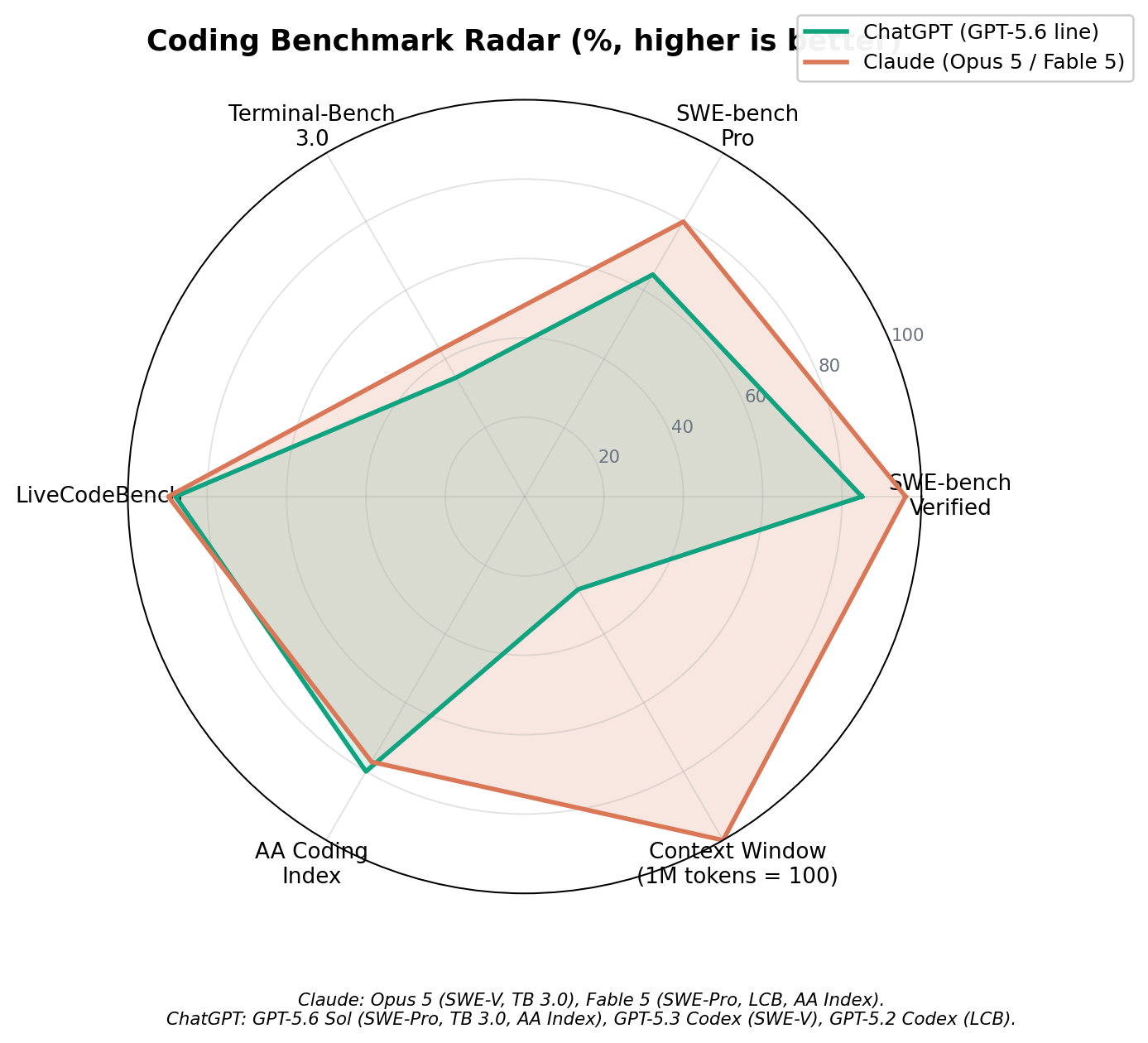
Read it in three bands. Real-world issue resolution (SWE-bench Verified, SWE-bench Pro, Terminal-Bench 3.0): Claude leads every one — 96.0 vs 85.0, 80.0 vs 64.6, 42.7 vs 34.6. Algorithmic/competitive coding (LiveCodeBench): a statistical tie at 89.8 vs 88.0 — the Fable 5 and GPT-5.2 Codex lines are both exceptional at self-contained puzzles. Agentic composite and context (AA Coding Index, context window): split — GPT-5.6 Sol's 80.0 beats 77.2, while Claude's 1M-token window dwarfs the 272–372K Codex cap. The honest summary: Claude wins where code meets reality; ChatGPT wins at scale, speed and puzzle-style problems; and neither sweeps.
Pricing: Parallel Ladders, One $8 Wildcard
By August 2026 the two subscription ladders are almost mirror images: a free tier, $20, $100 and $200 monthly plans on both sides. The differences are at the edges — and they matter.
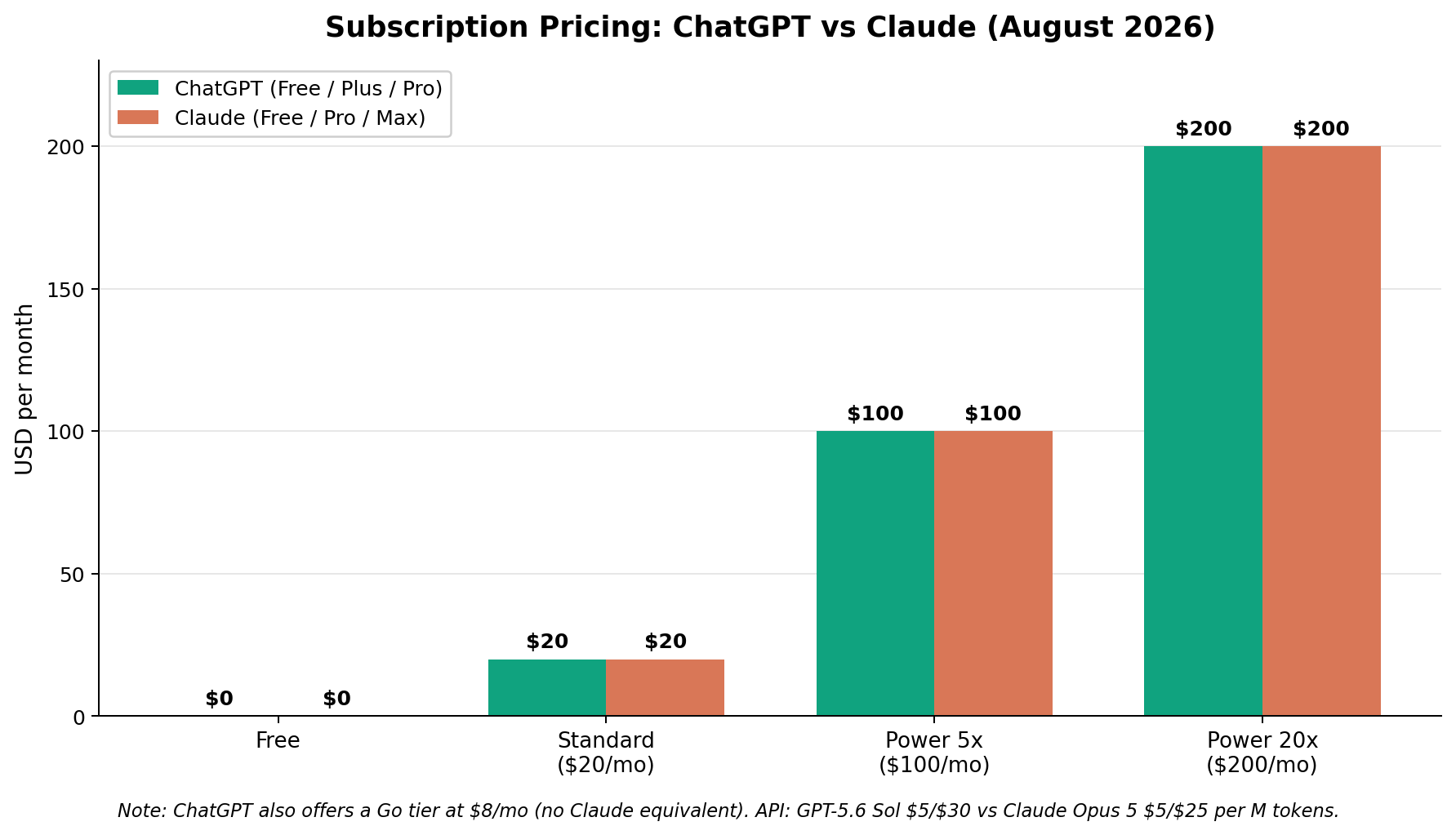
ChatGPT: Free (limited Terra model), Go at $8/mo, Plus at $20/mo, and Pro topping the ladder at $200/mo. The Go tier is the story — it's the only sub-$10 frontier-coding subscription on the market, and it exists precisely to capture the student and side-hustle segment Claude ignores.
Claude: Free (capped Sonnet 5), Pro at $20/mo, Max 5x at $100/mo, Max 20x at $200/mo. The Max tiers are aimed squarely at heavy Claude Code users — more usage headroom for agentic sessions that burn tokens fast.
On API, input pricing is identical at $5 per million tokens for both GPT-5.6 Sol and Claude Opus 5. Output — where coding generates most of its cost — runs $30/M for GPT-5.6 Sol versus $25/M for Opus 5, a 20% Claude advantage. High-volume operators can push ChatGPT costs lower through the Luna API tier. Net: expensive professional work favors Claude's pricing, bulk economical work favors ChatGPT's.
Real-World Test Scenarios (The Money-Making Kind)
Benchmarks are inputs; invoices are outputs. We ran three scenarios drawn from how people actually earn with AI coding tools in 2026 — freelance product builds, bug-fix contracts, and e-commerce automation gigs.
Scenario 1: Shipping a Client SaaS MVP ($1,500–$3,000 builds)
The setup: a freelance developer sells a fixed-price "MVP in two weeks" package — Next.js front end, Supabase back end, Stripe subscriptions. The winning skill is keeping a whole multi-file project coherent across dozens of edits.
"This repo is a Next.js 14 app with Supabase auth and Stripe checkout. Read the whole codebase first. Then add a usage-based billing page: fetch Stripe metered events, display a table of the current month's usage, and gate the route behind the existing middleware. Run the existing tests, write new ones for the billing logic, and don't break the checkout flow."
What happened: Claude Code's 1M-token context held the entire repo plus Stripe docs in one session and produced a passing PR in a single run; the Codex attempt needed a session reset at the context cap and one manual fix. Winner: Claude — on a $2,000 build, one avoided rework round is worth more than a year of the price gap.
Scenario 2: Legacy Bug-Fix Tickets ($150–$500 per fix)
The setup: agencies and maintainers post "this 8-year-old code crashes intermittently, nobody here understands it" tickets — the exact shape of SWE-bench Verified problems.
"Here is a 60-file legacy PHP + jQuery codebase (attached). Intermittent race condition: duplicate orders appear under load. Trace the order-creation path, identify the root cause, and propose a minimal patch — no framework migrations, this must deploy on the current stack."
What happened: Opus 5 traced the missing transaction lock across four files and shipped a 12-line patch; GPT-5.6 Sol found the right file but proposed a heavier rewrite the client would have rejected. Winner: Claude — at a 96% vs 85% first-try resolution rate, the difference is fewer tickets you don't get paid twice for.
Scenario 3: E-commerce Automation Scripts ($50–$200 gigs)
The setup: Shopify and Etsy sellers buy small scripts — CSV→catalog importers, price updaters, cron jobs. High volume, low complexity, thin margins: cost efficiency decides profit.
"Write a Python script that reads products.csv, maps columns to Shopify's Admin API format, uploads each product with a 0.5s delay and retry-on-429, logs failures to errors.csv, and is idempotent so I can re-run it safely. Include a --dry-run flag."
What happened: both produced working scripts first try; ChatGPT delivered it faster and the whole job ran comfortably inside a Go-tier month. Winner: ChatGPT — when five $80 gigs pay for your entire subscription, the $8 tier isn't a compromise, it's the business model.
Alternatives Worth Considering
The model-vs-model question isn't the only question — editor-integrated tools bundle these models (and others) into different workflows.
| Tool | Starting Price | Standout Feature |
|---|---|---|
| Cursor | $20/mo (Pro) | AI-native IDE with agent mode; choose GPT or Claude models per task |
| GitHub Copilot | $10/mo | Deep GitHub integration; OpenAI models inside VS Code and JetBrains |
| Google Gemini | Free / $19.99/mo | Huge context windows and generous free tier; strong multimodal docs |
| Windsurf | $15/mo | Agent-first editor with Cascade flows for multi-step tasks |
| Cline | Free (bring API keys) | Open-source VS Code agent; pay only the API tokens you burn |
If you mainly want a smarter editor rather than a standalone assistant, our Cursor vs GitHub Copilot and Cursor vs Windsurf vs Copilot comparisons cover that layer in depth — and note that picking Cursor is largely a decision about which of today's two combatants you want driving it.
Which Should You Choose?
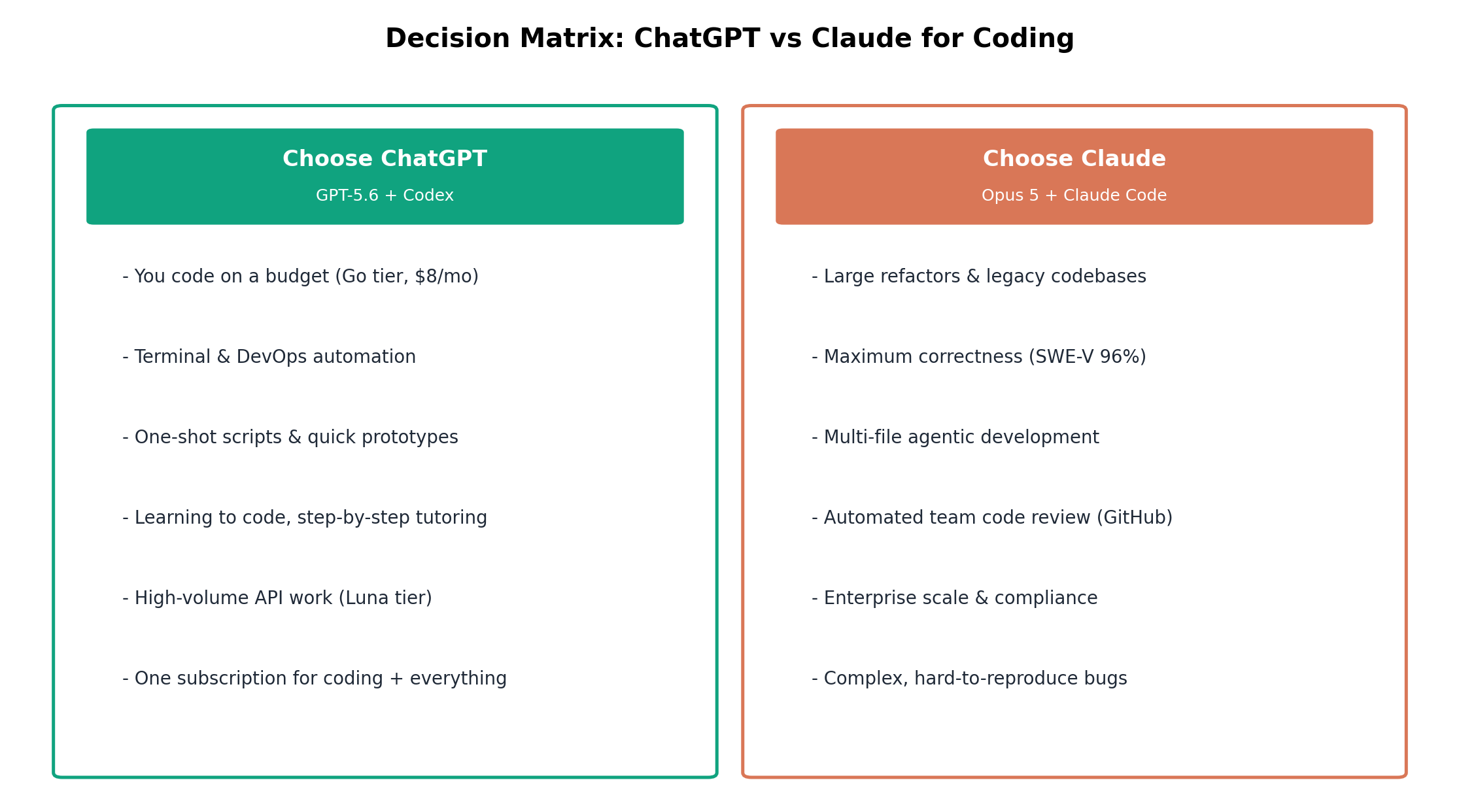
The Verdict
🏆 Our Recommendations
Best for professional software work → Claude. If you write code for a living — especially across large or legacy codebases — Opus 5's 96% SWE-bench Verified rate, the 1M-token window, Claude Code's agentic loop and the native GitHub Code Review app form the strongest professional package in 2026. Claude won 4 of our 7 dimensions, including the three that map to billable quality. Pro at $20/mo; Max 5x ($100) once Claude Code becomes your daily driver.
Best for budget, speed and learning → ChatGPT. The $8/mo Go tier is unmatched value; GPT-5.6 Sol is the faster workhorse; the ecosystem (Copilot, Codex CLI + cloud, integrations) and the best-in-class learning experience make it the right default for students, hobbyists, side-hustlers and anyone whose subscription also needs to write, research and brainstorm.
Overall winner (4–3) → Claude. The dimensions Claude wins — correctness, agentic coding, debugging, long-context — are the ones that decide whether professional code ships. ChatGPT's wins are real but situational by comparison.
The hybrid play → both, for $28/mo. This is what more working developers actually run in 2026: ChatGPT Go or Plus for daily questions, quick scripts and learning; Claude Pro for refactors, gnarly bugs and agentic sessions. On API, route by task — input tokens cost the same $5/M either way, so send volume to GPT-5.6 Sol and hard problems to Opus 5.
Frequently Asked Questions
Is ChatGPT or Claude better for coding in 2026?
Claude wins on raw coding quality: Opus 5 scores 96% on SWE-bench Verified versus 85% for GPT-5.3 Codex, and Claude takes 4 of our 7 dimensions (code quality, agentic coding, debugging, long-context work). ChatGPT wins on speed and cost efficiency, ecosystem breadth and learning support — and its $8/mo Go tier is the cheapest serious coding subscription anywhere. For professional software work, pick Claude; for budget and general-purpose use, pick ChatGPT.
What is SWE-bench Verified and why does Claude score higher?
SWE-bench Verified is a benchmark of 500 human-validated real GitHub issues where an AI must produce a patch that passes the project's own tests. Claude Opus 5 resolves 96% of them versus 85% for GPT-5.3 Codex. The gap reflects Claude's strength at reproducing root causes in unfamiliar codebases — exactly what real bug fixing demands. ChatGPT's best model lines still lead or tie on other benchmarks (AA Coding Index 80.0 vs 77.2; LiveCodeBench is near-even at 88.0 vs 89.8), so the right choice depends on which kind of work you do most.
How much do ChatGPT and Claude cost for coding?
Both run parallel ladders: a free tier, $20/mo, $100/mo and $200/mo plans. ChatGPT uniquely adds a Go tier at $8/mo (cheapest paid plan), with Plus at $20 and Pro topping out at $200. Claude's paid plans are Pro $20, Max 5x $100 and Max 20x $200. On API, GPT-5.6 Sol costs $5/$30 per million tokens in/out while Claude Opus 5 is $5/$25 — Claude is cheaper on output, which is where coding bills accumulate.
Is Claude Code better than Codex?
Claude Code is the stronger agentic tool in 2026: it runs in the CLI and on the web, defaults to a 1M-token context window versus the 272–372K Codex cap, and Anthropic ships a native GitHub Code Review app that reviews team pull requests automatically. Codex counters with a polished cloud + CLI experience, tight OpenAI ecosystem integration and access to the high-volume Luna API tier. If your work is multi-file agentic development or team code review, Claude Code wins; for terminal automation and one-shot tasks, Codex holds its own.
Can I use both ChatGPT and Claude for coding?
Yes, and many professional developers do. A common hybrid: ChatGPT Go or Plus ($8–$20/mo) for daily questions, quick scripts, learning and general productivity, plus Claude Pro ($20/mo) or Max ($100–$200/mo) for large refactors, legacy codebase work and hard-to-reproduce bugs. Teams on API often route between GPT-5.6 Sol and Claude Opus 5 by task, since input pricing is identical at $5/M tokens.
Do ChatGPT and Claude work inside my IDE?
Both reach your editor through agentic CLIs and third-party surfaces. ChatGPT's coding models power GitHub Copilot in VS Code and JetBrains, and Codex ships as a first-party CLI plus cloud environment. Claude Code is a first-party CLI with a web counterpart, and Claude models are selectable inside editor tools like Cursor and Cline. Neither vendor ships its own full IDE — agents and integrations are the 2026 model.
Which is better for beginners learning to code?
ChatGPT. It scored 9.0 vs Claude's 8.5 on Learning & Tutorials thanks to more patient step-by-step explanations, a larger body of beginner-friendly walkthroughs, and study features beyond coding. Start on the free tier (limited Terra model) or the $8/mo Go plan, then graduate to Claude when you're shipping real multi-file projects where correctness matters more than hand-holding.