⏱ TL;DR
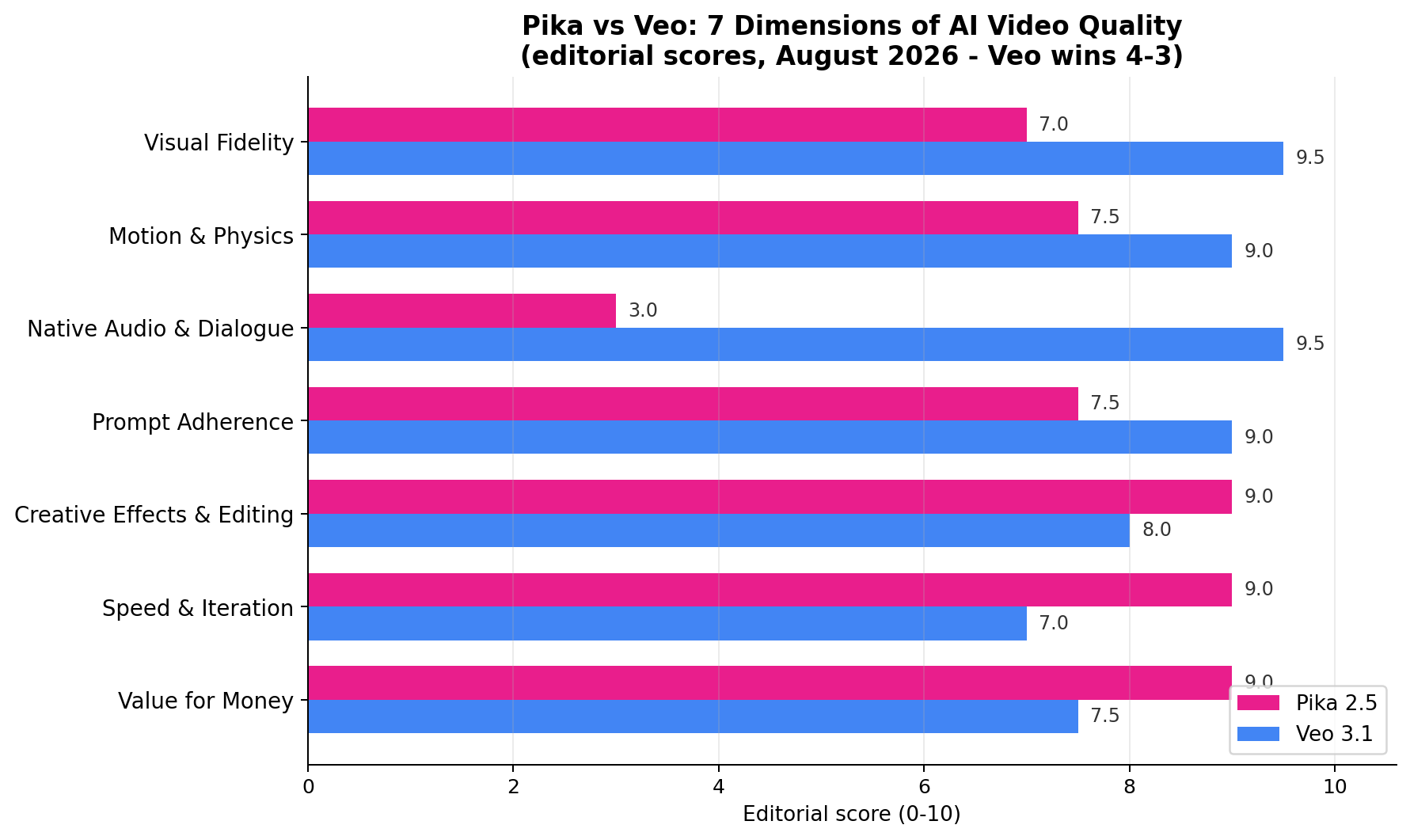
In August 2026, Google's Veo 3.1 makes the best-looking AI video you can buy, and Pika 2.5 makes making that video cheap, fast and fun. Veo wins our head-to-head 4–3: Visual Fidelity 9.5 vs 7.0, Native Audio & Dialogue 9.5 vs 3.0 (Veo writes its own dialogue, sound effects and ambience; Pika doesn't generate audio at all), Motion & Physics 9.0 vs 7.5 and Prompt Adherence 9.0 vs 7.5. Pika takes the three dimensions that decide volume economics — Creative Effects & Editing 9.0 vs 8.0 (Pikaffects, Pikaswaps, Pikaformance), Speed & Iteration 9.0 vs 7.0, and Value for Money 9.0 vs 7.5. Pricing is nearly a tie at entry: Pika Standard at $8/mo vs Google AI Plus at $7.99/mo — but they scale differently ($76 Fancy vs $100–$200 Ultra). With Sora discontinued since April 2026, this is the quality-vs-economics choice in AI video. Client-facing, cinematic, needs sound → Veo. Social-first, high-volume, effects-driven → Pika. Running both costs $28/mo and is what most working creators we tracked actually do.
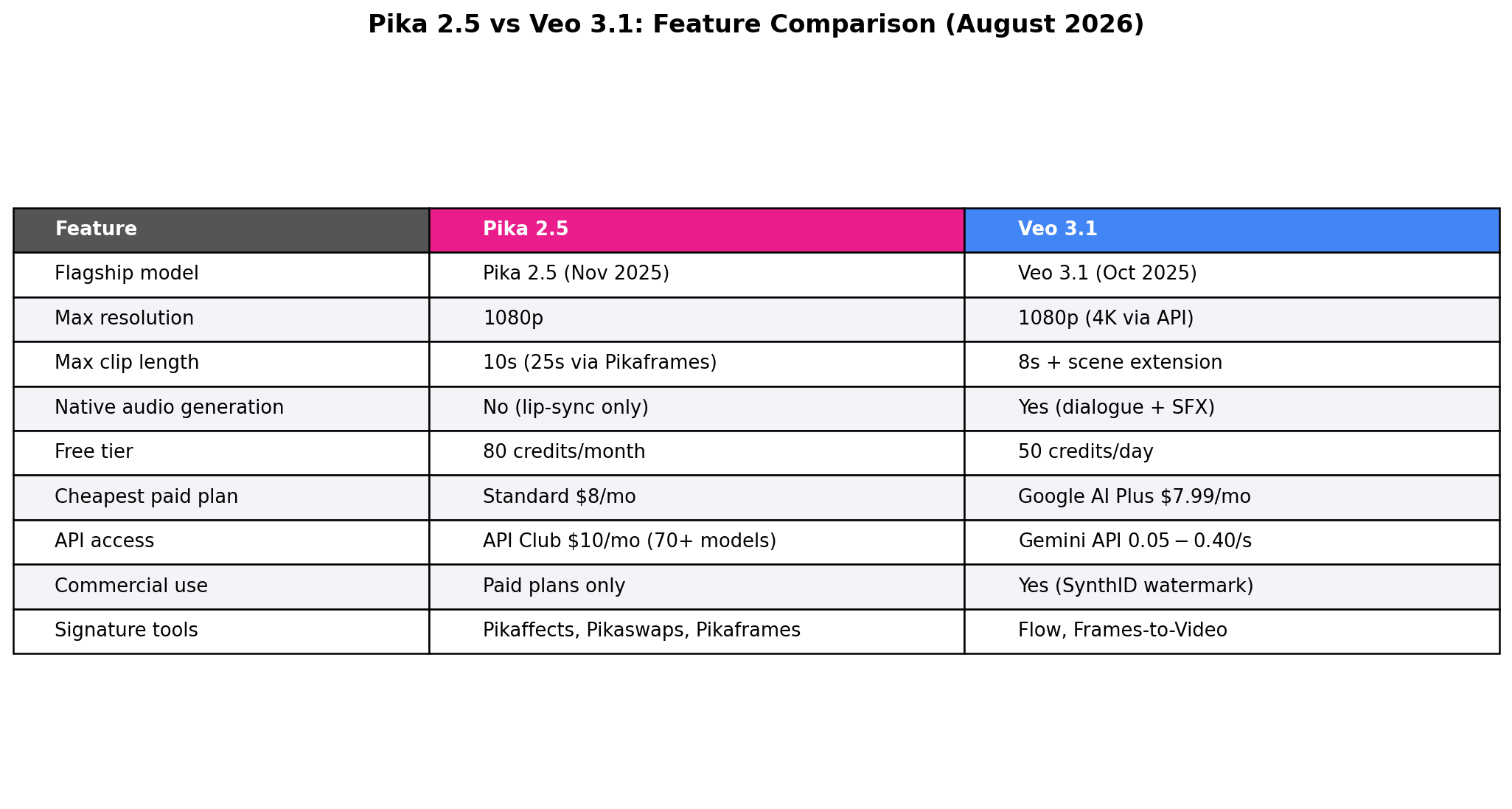
At a Glance
| Pika 2.5 | Veo 3.1 | |
|---|---|---|
| Flagship model | Pika 2.5 (Nov 2025) | Veo 3.1 (Oct 2025) |
| Max resolution | 1080p | 1080p (4K via API) |
| Max clip length | 10s (25s via Pikaframes) | 8s + scene extension |
| Native audio | No (lip-sync only) | Yes (dialogue + SFX) |
| Free tier | 80 credits/month | 50 credits/day |
| Cheapest paid plan | Standard $8/mo | Google AI Plus $7.99/mo |
| Premium tier | Fancy $76/mo | AI Ultra $100–$200/mo |
| API pricing | API Club $10/mo (70+ models) | $0.05–$0.40 per second |
| Commercial use | Paid plans only | Yes (SynthID watermark) |
| Signature tools | Pikaffects, Pikaswaps, Pikaframes | Flow, Frames-to-Video |
| Best for | Social video, effects, volume | Cinematic quality, ads, sound |
Deep Dive: Pika 2.5
Pika's pitch in 2026 is creativity per dollar. The Pika 2.5 model (November 2025) generates 1080p clips up to 10 seconds, and the platform's real moat is its effect stack: Pikaffects applies physics-defying transformations — Squish, Crush, Explode, Melt, Inflate, Levitate — that turned into an entire genre of viral social content; Pikaswaps masks any object or person in uploaded footage and replaces them with anything you prompt; Pikaformance re-lips any clip to new dialogue in multiple languages (up to about 30 seconds); and Pikaframes chains keyframe images into sequences up to 25 seconds long — the longest structured clips in this comparison.
Economically, Pika is built for iteration volume. The free tier gives 80 credits monthly; Standard at $8/mo (annual billing) covers a working creator's draft loop; Pro at $28/mo and Fancy at $76/mo add resolution, length and priority. There's no native audio generation — sound is a post-production step — and commercial rights only arrive on paid plans. For the UGC-ad and faceless-channel economies we profile below, none of that is a dealbreaker: those workflows cut music and voice-over in a separate editor anyway, and Pika's per-iteration cost is the lowest of any mainstream generator.
Strengths
- Creative Effects & Editing (9.0): Pikaffects, Pikaswaps and Pikaformance form the strongest effect toolbox in AI video — no competitor matches the viral-format catalog.
- Speed & Iteration (9.0): fast generation plus cheap credits means 5× more concept iterations per dollar than Veo at the entry tier.
- Value for Money (9.0): 1080p, 10s clips, commercial rights and 700 credits from $8/mo — the best volume economics anywhere.
- Pikaframes to 25 seconds: keyframe-chained sequences run 2.5× longer than Veo's base clip, ideal for structured short-form narratives.
- API Club ($10/mo): one subscription exposes 70+ video models — useful when a client job needs a different look mid-project.
Weaknesses
- No native audio (3.0): zero dialogue, SFX or music generation; every sound is a separate production step.
- Visual Fidelity (7.0): fine on social, visibly behind Veo on skin texture, lighting and lens realism at full screen.
- Motion & Physics (7.5): fast camera moves and crowd scenes still produce morphing artifacts.
- Commercial use gated: free tier output is watermarked and non-commercial — budget for at least Standard.
Deep Dive: Google Veo 3.1
Veo 3.1 (October 2025) is the current ceiling on generated video realism — it tops the VBench leaderboard and behaves like it. Clips render at 1080p (4K through the API) with accurate faces, consistent hands, physically plausible motion and lighting that looks lit, not painted. The headline capability is native audio: every generation arrives with synchronized dialogue (lip-synced), sound effects and ambience — a full AV clip out of the box. Since Sora's shutdown in April 2026, Veo is the reference point professional post houses benchmark against.
Veo lives inside Google's Flow workspace: Frames-to-Video animates between reference images, scene extension grows clips past the 8-second base, and an ingredients system keeps characters and settings consistent across shots — the closest thing to an AI edit suite. Access is subscription-shaped: Flow free (≈50 credits/day), Google AI Plus $7.99/mo, AI Pro $19.99/mo, and AI Ultra at $100–$200/mo for maximum limits and early features. The Gemini API sells generation at $0.05–$0.40/second by tier. Two caveats: generation is slower and pricier per iteration than Pika, and every output carries Google's invisible SynthID watermark — commercial use is allowed, but AI provenance is permanently embedded.
Strengths
- Visual Fidelity (9.5): the most photorealistic mainstream generator — faces, hands, fabric, glass and light behave.
- Native Audio & Dialogue (9.5): lip-synced speech plus SFX and ambience in one generation; no other tool at this price does it.
- Motion & Physics (9.0): the fewest morph artifacts and the most convincing camera moves we tested.
- Flow workspace: frames, ingredients and scene extension give real shot-to-shot consistency for multi-scene work.
- Commercial on every tier: watermark is invisible SynthID, not a visual logo.
Weaknesses
- Speed & Iteration (7.0): slower generations and stingier credit pools make brute-force iteration expensive.
- Value for Money (7.5): meaningful 1080p volume effectively needs AI Pro ($19.99); 4K needs API spend.
- Fewer toys: no equivalent of Pikaffects — playful virality is not the design goal.
- SynthID forever: provenance watermark cannot be removed, even for paid enterprise work.
Head-to-Head: 7 Dimensions, 7 Winners
We scored both platforms across the seven dimensions that decide whether AI video earns its keep. Final tally: Veo 4 – 3 Pika.
1. Visual Fidelity — Winner: Veo (9.5 vs 7.0)
This is the widest gap on the board. Veo 3.1 renders skin with pores, metal with reflections and depth of field that behaves optically; Pika 2.5's output is clean and social-ready but reads as "AI video" at full screen. For client deliverables and anything destined for a display larger than a phone, Veo's 2.5-point lead is decisive.
2. Motion & Physics — Winner: Veo (9.0 vs 7.5)
Veo's characters keep limb counts and object permanence through fast motion; Pika morphs when scenes get busy. Pikaffects deliberately breaks physics — but when you need physics respected (product pours, fabric, crowds), Veo holds up.
3. Native Audio & Dialogue — Winner: Veo (9.5 vs 3.0)
A near-shutout because Pika doesn't play the game: no audio generation at all, only lip-syncing existing footage via Pikaformance. Veo 3.1 writes the line, performs it with lip-sync, and layers sound design — ambience, footsteps, impact SFX — automatically. If your video needs a voice, this single dimension settles the matchup.
4. Prompt Adherence — Winner: Veo (9.0 vs 7.5)
Give Veo a five-element prompt — subject, wardrobe, camera move, lighting, mood — and it delivers all five. Pika honors the gist and drops details under load, which costs an extra regeneration cycle or two per complex concept.
5. Creative Effects & Editing — Winner: Pika (9.0 vs 8.0)
Where Pika earns its keep. Pikaffects' physics-play catalog, Pikaswaps' object replacement and Pikaformance's multilingual re-dubbing are one-click formats that have minted entire accounts — no Veo equivalent exists. Veo's Flow is a better filmmaking tool, but for social-format invention Pika is unmatched.
6. Speed & Iteration — Winner: Pika (9.0 vs 7.0)
Concept development is a numbers game: the creator who tests 40 hooks beats the one who tests 8. Pika generates faster and its credit pools go further — Standard's 700 monthly credits fund dozens of full experiments. Veo's slower renders and credit costs force you to commit earlier.
7. Value for Money — Winner: Pika (9.0 vs 7.5)
Entry pricing is a coin flip ($8 vs $7.99), but Pika's ladder tops out at $76 while delivering 1080p, 10s clips and commercial rights from the bottom rung. Veo's premium tiers buy real quality — but per usable finished second, Pika costs a fraction as much.
The Capability Picture
The radar makes the division of labor obvious: Veo owns the quality half of the hexagon, Pika owns the economics half — and the Audio & Dialogue axis is a canyon.
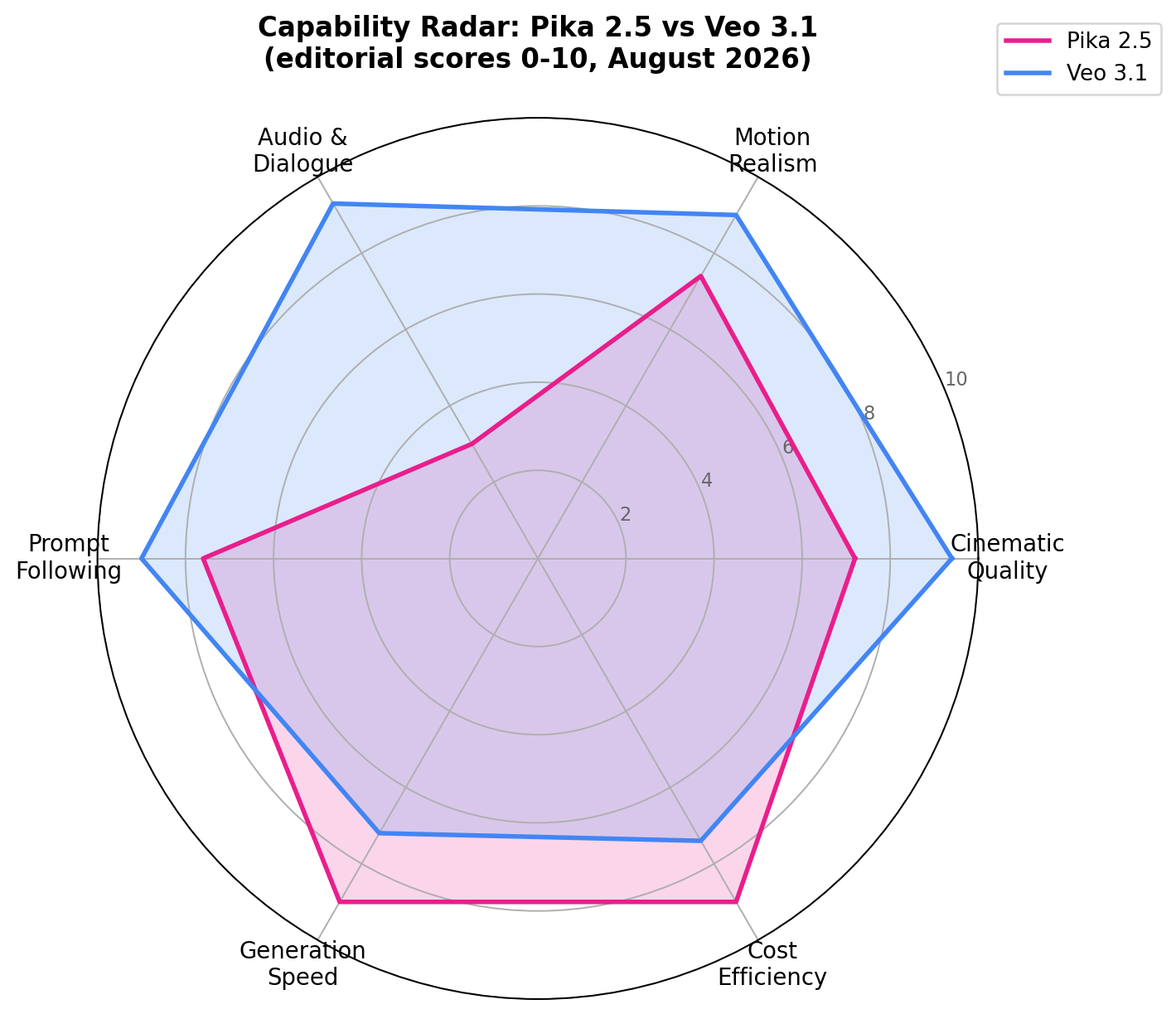
Read it in two halves. Quality half (Cinematic Quality, Motion Realism, Audio & Dialogue, Prompt Following): Veo sweeps — 9.4 vs 7.2, 9.0 vs 7.4, 9.3 vs 3.0 and 9.0 vs 7.6. Economics half (Generation Speed, Cost Efficiency): Pika sweeps — 9.0 vs 7.2 and 9.0 vs 7.4. That geometry is the entire buying decision in one image: what are you paying for?
Pricing: A $0.01 Gap That Isn't the Story
On paper the entry tiers are identical: Pika Standard at $8/mo versus Google AI Plus at $7.99/mo (both annual-billing rates). The real differences are what each dollar buys and where each ladder ends.
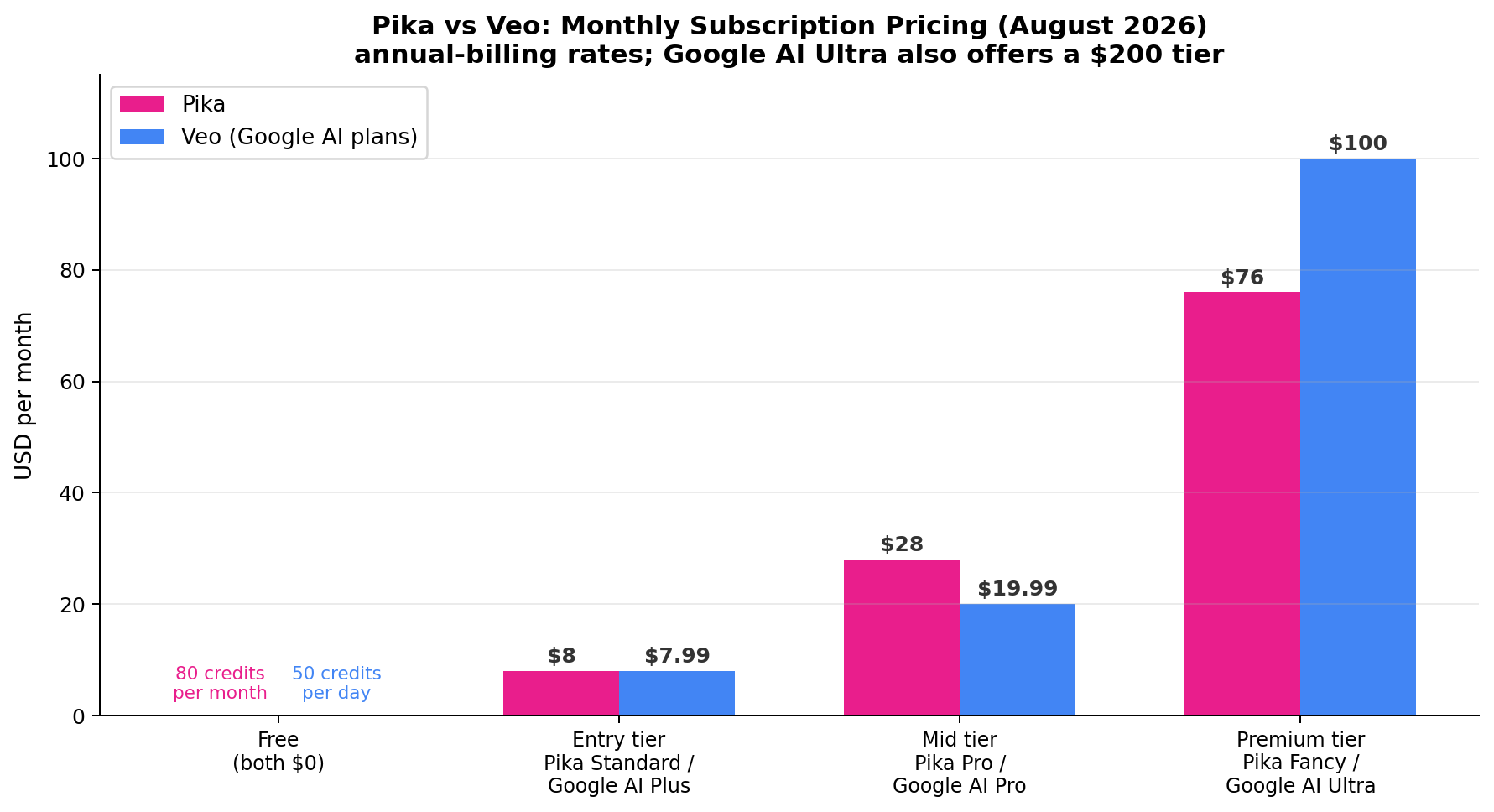
Pika: Free (80 credits/mo, watermarked, non-commercial) → Standard $8 → Pro $28 → Fancy $76. Higher tiers add credits, resolution, length and priority. The separate API Club at $10/mo exposes 70+ video models through one interface — a genuinely unusual offering that makes Pika a gateway to the whole market.
Veo: Flow free (~50 credits/day, enough for a few seconds) → Google AI Plus $7.99 → AI Pro $19.99 → AI Ultra $100 and $200. The Pro tier is where Veo becomes practical for regular 1080p work; Ultra targets studios. On the Gemini API, pricing runs $0.05–$0.40 per second — a 30-second finished Veo 3.1 spot at top spec costs roughly $24 in raw generation, before the 20-to-1 generation-to-usable ratio that real production imposes.
The honest math: a serious month of Pika costs $8–$28. A serious month of Veo costs $19.99–$100. You're paying the difference for fidelity and audio — and for client work, that's usually the correct purchase.
Real-World Test Scenarios (The Money-Making Kind)
Benchmarks don't pay invoices. We mapped both tools onto three workflows where people are genuinely earning with AI video in 2026.
Scenario 1: UGC-Style Ad Creative ($50–$100 per video, $500–$1,000/mo retainers)
The setup: brands buy "creator-style" short ads in volume — hooks, product close-ups, text overlays. Freelancers sell these as packages; the winning skill is testing many hook variations cheaply, then syncing the best to music and voice-over in an editor.
"Generate 10 hook variations: handheld selfie-style shot of a woman opening a package on her couch, morning light, excited reaction, 3 seconds each, vertical 9:16. Then one hero shot: slow macro push-in on the serum bottle with water droplets."
What happened: Pika's Standard tier burned through all 10 variations plus retries inside a rounding error of budget, and Pikaffects-style exaggeration ("Inflate" reactions) gave the ads native social flavor; Veo's hero shot was visibly superior — but at 3–4× the iteration cost for the volume part. Winner: Pika — in a $50-per-video market, per-iteration cost is the margin.
Scenario 2: Faceless YouTube Channel ($15–$40 RPM in finance/tech niches)
The setup: faceless channels monetize via ad RPM, so profitability = seconds of watchable b-roll per dollar. A 10-minute weekly video needs 30–60 clips; none of them need dialogue — narration is recorded separately.
"Consistent b-roll set: 20 clips of abstract data visualization, glowing stock charts, city timelapses at dusk, cinematic teal-and-orange grade, slow camera drift, no people, 5 seconds each."
What happened: both tools produced usable b-roll; Pika produced ~2.5× more of it per dollar, and Pikaframes chained establishing shots into longer sequences for segment intros. Veo's clips were prettier — but viewers don't pay per pixel, and YouTube b-roll plays at 480p on most screens anyway. Winner: Pika — volume economics dominate this business model.
Scenario 3: A Solo 30-Second Commercial Spot (~$2,000 all-in vs six-figure agency production)
The setup: the Kalshi-style playbook that circulated through the ad industry — a solo creator produces a broadcast-quality 30-second spot with AI in days. The math that made it famous: ~300–400 generations to land 15 usable clips, roughly $2,000 total spend, versus traditional production budgets starting at six figures.
"30-second spec commercial: a cowboy rides through the desert at golden hour, storm clouds gathering; he dismounts, looks to camera and delivers the line 'It's gonna rain on the doubters'; thunder rolls; cut to product card with rain SFX. Cinematic anamorphic, 24fps motion feel."
What happened: this scenario is Veo's home turf. Native dialogue with lip-sync, thunder and ambience generated in-shot, and fidelity that survives a full-screen render — assembling it in Pika would require separate voice production and still land short on realism. Winner: Veo — when the deliverable itself is the product, quality is the business model.
Alternatives Worth Considering
The 2026 field didn't end when Sora exited — Runway, Kling and others keep this market honest.
| Tool | Starting Price | Standout Feature |
|---|---|---|
| Runway | $15/mo (Standard) | Mature Gen-4.5 toolset and the deepest professional editing suite |
| Kling 2.0 | Free; ~$8/mo | Excellent motion physics and the longest single clips among rivals |
| Luma Dream Machine | Free; $29.99/mo | Consistent image-to-video for animators and motion design |
| Hailuo AI (MiniMax) | Free; $9.99/mo | A rising quality competitor punching above its price |
| Higgsfield | Free; $16/mo | Character consistency for storytelling and character-driven content |
For the full three-way picture including Pika, see our Runway vs Kling vs Pika comparison — the landscape has shifted since Sora's discontinuation, and that piece covers where each of the four survivors wins.
Which Should You Choose?
The Verdict
🏆 Our Recommendations
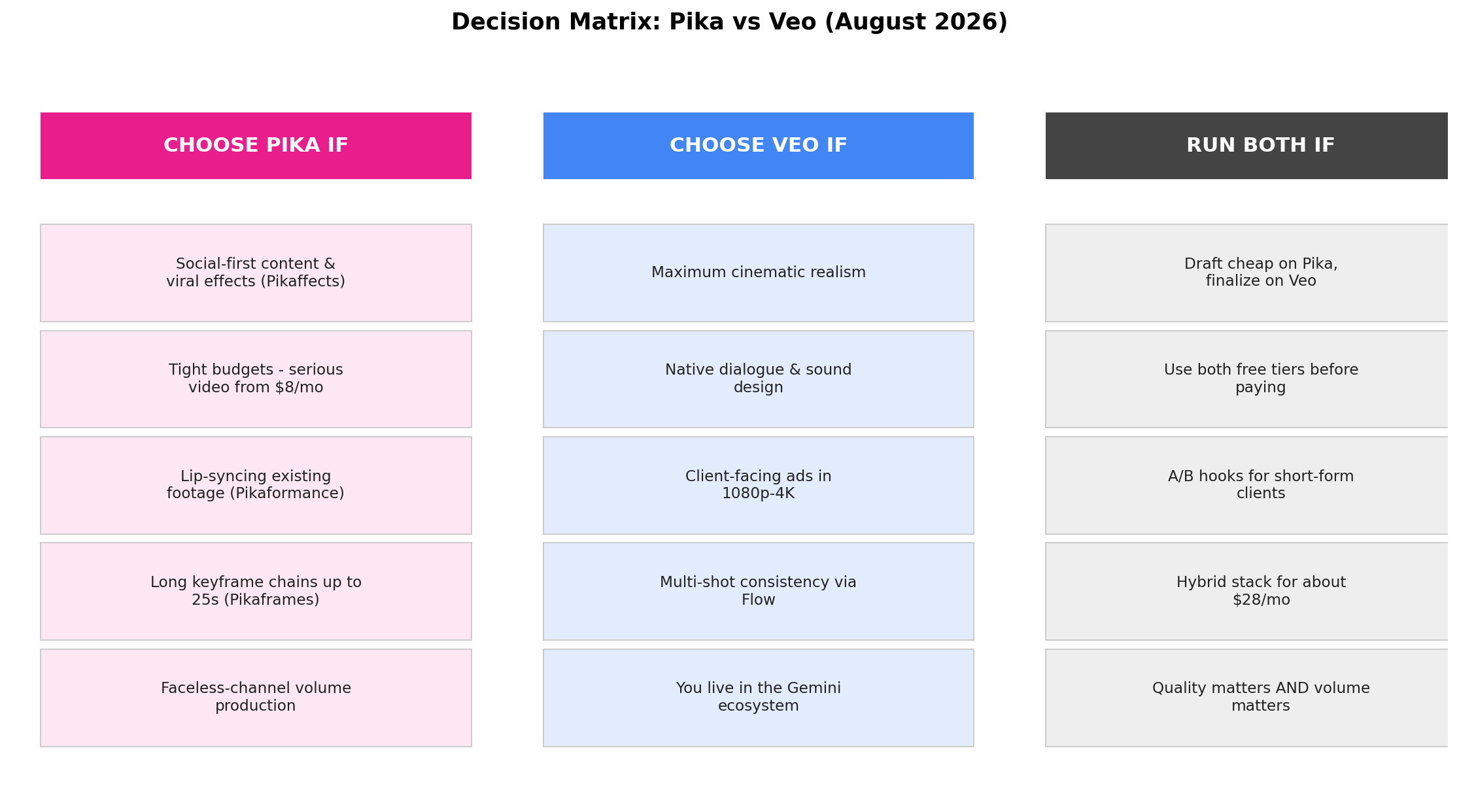
Best for client work, ads and anything with a voice → Veo 3.1. Native audio, top-of-market realism and Flow's shot consistency make it the only choice when the deliverable faces a client or a cinema screen. It won 4 of 7 dimensions, including the three quality axes that are hardest to fix in post. Realistic budget: Google AI Pro at $19.99/mo.
Best for social creators, volume production and tight budgets → Pika 2.5. The effects toolbox (Pikaffects, Pikaswaps, Pikaformance) is a content-format machine, and $8/mo buys enough iteration volume to power a whole content business. It won Creative Effects, Speed & Iteration and Value for Money — exactly the axes that decide margin in UGC and faceless-channel work.
Overall winner (4–3) → Veo. The dimensions Veo wins are the ones money follows uphill: fidelity, sound, physics, adherence. Pika's wins are real but concentrated in the volume segment.
The hybrid play → both, for $28/mo. The pattern we saw most among working creators: draft and test on Pika Standard ($8), regenerate the winning shots on Veo via Google AI Pro ($19.99) for native audio and finish. You get Pika's iteration economics and Veo's ceiling for less than the price of either premium tier alone.
Frequently Asked Questions
Is Pika or Veo better in 2026?
Veo 3.1 is the better generator — it won 4 of our 7 dimensions, including Visual Fidelity (9.5 vs 7.0), Native Audio & Dialogue (9.5 vs 3.0) and Motion & Physics (9.0 vs 7.5). Pika 2.5 is the better deal, winning Creative Effects & Editing, Speed & Iteration and Value for Money with paid plans from $8/month. Choose by deliverable: client-facing cinematic work → Veo; high-volume social content → Pika.
How much does Pika cost per month?
A free tier with 80 credits per month (watermarked, non-commercial), then Standard at $8/mo, Pro at $28/mo and Fancy at $76/mo on annual billing — $10/$35/$95 if billed monthly. The separate API Club subscription starts at $10/mo and includes access to 70+ video models.
How much does Veo cost per month?
Veo 3.1 is available through Flow's free tier (~50 credits/day) and Google AI subscriptions: AI Plus at $7.99/mo, AI Pro at $19.99/mo, and AI Ultra at $100 or $200/mo. Via the Gemini API, generation costs $0.05–$0.40 per second depending on model tier, resolution and whether audio is included.
Does Pika 2.5 generate audio?
No. Pika doesn't generate dialogue, sound effects or music. Its Pikaformance feature lip-syncs existing uploaded footage to new audio in multiple languages (up to ~30 seconds), but sound design remains a separate production step. Veo 3.1 generates native lip-synced dialogue, SFX and ambience in every clip.
Can I use Pika or Veo videos commercially?
Yes, with conditions. Pika grants commercial rights on paid plans only ($8/mo and up) — the free tier is watermarked and non-commercial. Veo output is commercially usable on every tier, but all videos carry Google's invisible SynthID watermark marking them as AI-generated.
What happened to Sora — is it an alternative?
No — OpenAI discontinued Sora in April 2026. The professional market consolidated around four survivors: Google Veo, Runway, Kling and Pika. Former Sora users wanting maximum quality land on Veo 3.1; those wanting fast, cheap iteration land on Pika.
Can I use Pika and Veo together?
Yes, and it's often optimal. The common 2026 setup: iterate concepts and effects cheaply on Pika Standard ($8/mo), then regenerate the 3–5 winning shots on Veo via Google AI Pro ($19.99/mo) for native audio and maximum fidelity — a $28/month stack that beats either tool's premium tier on flexibility.