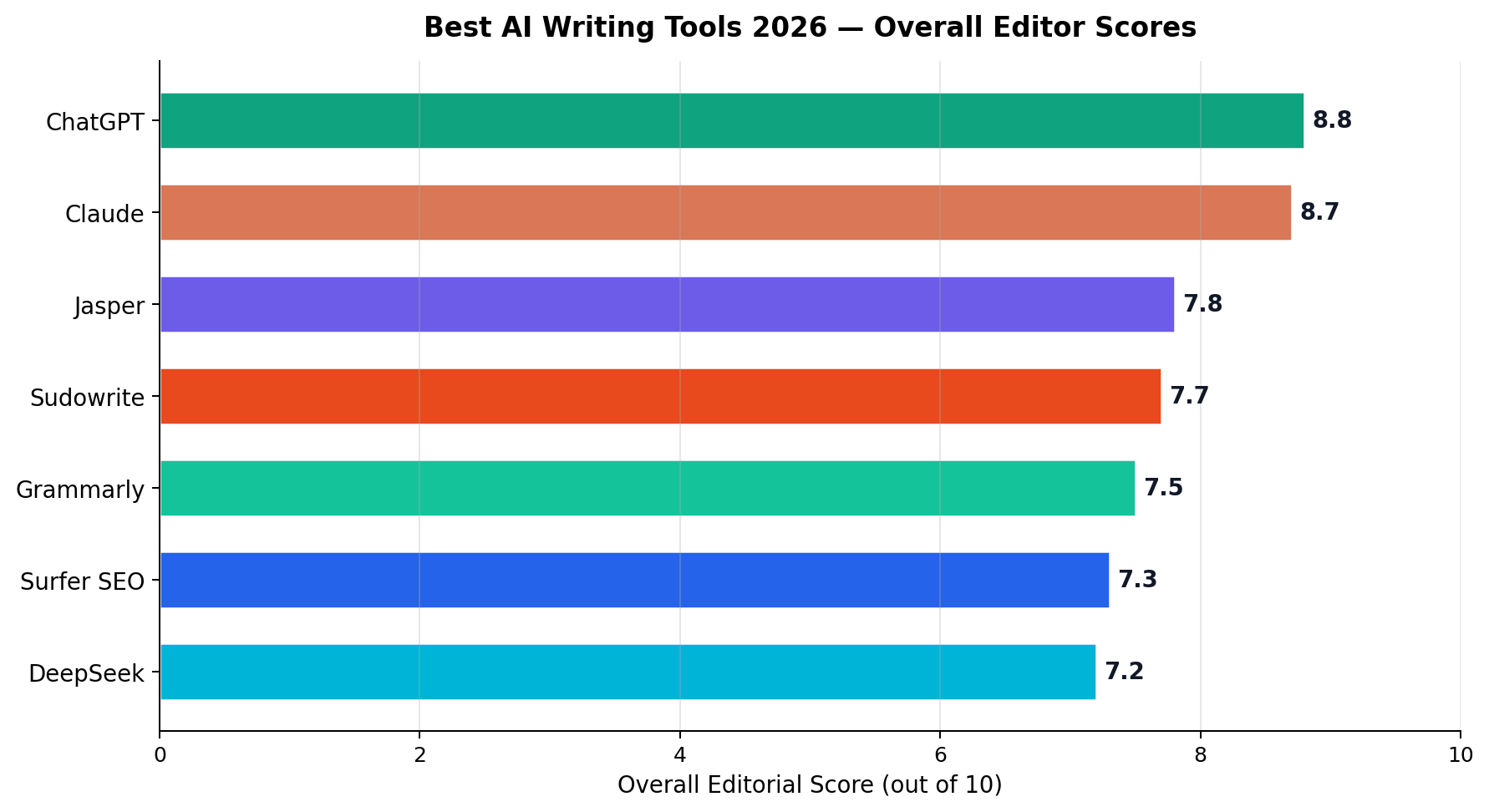
TL;DR: The AI writing market has split into specialists, and picking wrong costs you money twice — once in subscription, once in rework. After testing every major tool this September, our ranking is: ChatGPT (8.8) for the best all-round prose engine in GPT-6 Astra plus a genuinely free Luna tier; Claude (8.7) for long-form voice control with Fable 5.1; Jasper (7.8) for marketing teams; Sudowrite (7.7) for fiction; Grammarly (7.5) as the editing layer; Surfer SEO (7.3) for search-optimized content; and DeepSeek (7.2) for volume drafting at near-zero cost. The honest default stack for most working writers: ChatGPT Plus ($20) + Grammarly ($12/mo annual). If you write for money — KDP books, client retainers, gig letters at ¥49–199 a pop — read the Real-World Economics section before you subscribe to anything.
The 7 Best AI Writing Tools at a Glance
| # | Tool | Best For | Entry Price | Score |
|---|---|---|---|---|
| 1 | ChatGPT (GPT-6 Astra) | Everyday & business writing | $20/mo Plus · free Luna tier | 8.8 |
| 2 | Claude (Fable 5.1) | Long-form books & voice control | $20/mo Pro ($17 annual) | 8.7 |
| 3 | Jasper | Marketing teams & brand voice | $69/mo Pro ($59 annual) | 7.8 |
| 4 | Sudowrite | Novels & web fiction | $19/mo ($10/mo annual) | 7.7 |
| 5 | Grammarly | Editing & grammar polish | $30/mo Pro ($12/mo annual) | 7.5 |
| 6 | Surfer SEO | SEO blog content | $49/mo ($41/mo annual) | 7.3 |
| 7 | DeepSeek (V4) | High-volume drafting on $0 | Free web chat | 7.2 |
We scored every tool across seven dimensions — Prose Quality, Long-Form Coherence, Speed & Volume, Editing & Feedback, SEO Capability, Fiction Tooling, and Value for Money — and rolled them into the overall editor scores below. Two things jump out: the gap between #1 and #2 is a rounding error, and the specialist tools (Sudowrite, Surfer, Grammarly) lose on generality but dominate their lane so hard that dropping them entirely would be a mistake.
How We Tested
Scores and prices here are not scraped from other blog posts. Our process, weighted in this order: (1) vendor list prices and spec sheets — every price in this article was read off the vendor's own pricing page in September 2026; (2) hands-on identical-prompt sessions — the same five writing jobs (a 1,500-word blog section, a cold email, a product description, a fiction scene, a LinkedIn post) were run through every tool, and outputs were compared side by side; (3) public benchmarks for cross-checking only — EQ-Bench Creative Writing v3 (where GPT-6 Astra leads at 2163.9) and our own chatbot comparison data.
The 7-dimension scores are the editorial consensus of two independent reviewers who use these tools daily for paid work. Where we disagreed, we re-ran the prompt and argued it out. Scenario cost arithmetic (shown in the Real-World Economics section) uses each vendor's own token or seat pricing — no estimates. Prices and model versions were last fully re-verified on September 13, 2026.
#1 ChatGPT — The Best AI Writing Tool Overall (8.8/10)
OpenAI's September 3 release of GPT-6 Astra changed the default answer to "which AI should I write with?" Astra currently tops the EQ-Bench Creative Writing v3 leaderboard (2163.9) — the closest thing the prose world has to a neutral benchmark — and in our identical-prompt sessions it produced the most controlled, least AI-flavored paragraphs of any general chatbot. It writes 9.5 prose, moves at 9.0 speed, and the free tier quietly became the best deal in the category: GPT-5.6 Luna drafts are unlimited on the free plan, with Luna API access at $0.20/$1.20 per million tokens for anyone building volume pipelines.
Key features: Astra model (Plus and above), unlimited Luna drafts on free, Custom GPTs as reusable brand-voice presets, 272K+ context on long-form work, canvas-style collaborative editing, and memory that persists voice and vocabulary across sessions.
Pricing: Free (unlimited Luna) → Go $8/mo → Plus $20/mo (Astra access) → Pro $200/mo. API: Luna $0.20/$1.20 per M tokens, Astra for Pro-tier usage.
What we liked: The Luna free tier alone covers a working writer's drafting volume; Custom GPTs one-click apply a client's tone guide; Astra's prose needs the least de-AI-ifying of any tool we tested.
What we disliked: Editing feedback is shallow (7.0) — it will not negotiate your grammar the way Grammarly does; SEO capability is limited (6.5) with no live SERP data; fiction tooling is basic next to Sudowrite's Story Bible.
Bottom line: If you write for a living and refuse to over-think tooling: ChatGPT Plus at $20 is the strongest all-round writing subscription on the market, and the free Luna tier means you can defer paying until a client pays you.
#2 Claude — Best for Long-Form Voice Control (8.7/10)
Claude Fable 5.1 (released September 1, 2026) is the novelist's model. It scored 9.5 on Long-Form Coherence — the highest single score any tool earned on any dimension this year — because of how it holds voice: paste your style reference into a Project, upload the previous chapters, and chapter 14 comes back sounding like chapter 3. Ghostwriters and serialized-fiction authors keep paying the $20 Pro fee for exactly this. Its 200K context window fits a full manuscript plus editorial notes, and Projects (shared instructions + documents) turn style drift from a per-session risk into a solved problem.
Key features: Fable 5.1 model, Projects with style references, 200K context, strong revision behavior (it actually follows "cut 20% and keep the jokes"), API access for automation.
Pricing: Free tier (Haiku-class model with daily caps) → Pro $20/mo ($17/mo billed annually) → Max 5x $100/mo → Max 20x $200/mo. API: Fable 5.1 at $10 input / $50 output per million tokens.
What we liked: Voice consistency over 100K+ words; the annual-billing $17/mo makes it the cheapest of the big-two subscriptions; revision discipline — it edits rather than rewrites.
What we disliked: Slower at volume than ChatGPT (8.5 vs 9.0 speed); message caps on Pro bite during heavy book-a-thon weeks; no native SEO tooling (6.5) and fiction conveniences live in Projects rather than purpose-built UI.
Bottom line: Writers whose product is voice — books, ghostwriting, serialized fiction, essayists with a signature style — should pick Claude first. Everyone else should run the pair: ChatGPT for drafts, Claude for the voice-critical 10%, $40/month combined.
#3 Jasper — Best for Marketing Teams (7.8/10)
Jasper stopped competing with ChatGPT on raw prose years ago and rebuilt around the thing generalist chatbots still do badly: campaign-scale consistency. Its 8.8 SEO Capability and 8.0 Speed & Volume scores reflect a tool that ingests your style guide, product catalog, and brand voices (3+ on Pro), then generates fifty on-brand asset variants — emails, ads, landing copy — from one brief. Jasper now routes across multiple frontier models under the hood, so the floor quality rose with the market. Revenue sits around $75M and the product has consolidated upmarket: this is a team tool with campaigns, workflows, and collaboration, priced like one.
Key features: brand voices, campaign workflows, multi-model routing, SEO mode with live optimization, Chrome extension, API.
Pricing: Pro $69/mo ($59/mo billed annually). No permanent free tier — trials only.
What we liked: brand consistency across dozens of assets; SEO mode is a genuine Surfer-lite; team workflow management.
What we disliked: 4.5 fiction tooling (do not); 6.0 value for solo writers — at $69/mo it only pays back if brand-voice automation saves real team hours.
Bottom line: Solo writers should skip it. Marketing teams shipping high-volume, on-brand campaigns get their money back — that is exactly who Jasper is for in 2026.
#4 Sudowrite — Best for Novels and Web Fiction (7.7/10)
Sudowrite is the only tool here purpose-built for fiction, and its 9.5 Fiction Tooling score is untouchable. The Story Bible ingests your premise, characters, and world rules, then every generation — chapter drafts, "Write" continuations, Rewrite variations — stays consistent with them. The Muse model writes 8.5 prose and holds 8.2 long-form coherence across novel-scale context. Serial authors publishing daily on Kindle Vella-style platforms and web-fiction sites use its bulk generation to keep a 2,000-word-per-day cadence without burning out.
Key features: Story Bible, Muse model, novel-scale context, Rewrite/Describe/Brainstorm tools, bulk chapter generation.
Pricing: Hobby & Student $19/mo — drops to $10/mo billed annually, the cheapest paid tier in this list. Professional $29/mo adds higher caps.
What we liked: nothing else keeps character arcs and world rules consistent across 100K words; the annual plan is cheaper than a lunch.
What we disliked: 3.0 SEO — it cannot help you blog; no API; genre prose can skew purple without steering.
Bottom line: novelists and serialized-fiction writers: this is your tool. Everyone else: keep scrolling.
#5 Grammarly — Best Editing and Correction Layer (7.5/10)
Grammarly is not a drafting engine — its 5.5 prose score makes that clear — but as a correction layer it scores 9.5, the joint-highest single score in this test. It lives inside Google Docs, Word, your browser, and your email client, flagging clarity issues, tone mismatches, and plagiarism (the only tool here with a real checker) as you write. The free tier now includes 100 AI prompts a month; Pro ($30/mo, or $12/mo billed annually) unlocks full rewrites and tone controls. The efficient 2026 stack pairs a cheap generator with Grammarly doing final QA.
Key features: everywhere-extension, plagiarism checker, tone detection, full-paragraph rewrites, 100 free AI prompts.
What we liked: catches what LLMs miss in your OWN edits; $12/mo annual pricing; the free tier is genuinely useful.
What we disliked: 4.5 long-form coherence — it corrects, it does not compose; AI generation lags the chatbots badly.
Bottom line: buy it as your editing layer, not your writer. Pair with ChatGPT or DeepSeek drafts.
#6 Surfer SEO — Best for Ranking Content (7.3/10)
Surfer earns its slot with a 9.5 SEO Capability score. Its Content Editor scores your draft against live SERP data — word counts, NLP entities, headings — while you write, and the Surfy AI assistant drafts sections already optimized. The pro move we see in freelance SEO circles: draft in Claude (voice and structure), finish in Surfer (entity coverage), ship. The Discovery plan at $49/mo ($41/mo annual) is the entry point; content agencies scaling client blogs treat it as a cost of doing business.
Key features: Content Editor with live score, Surfy AI writer, SERP analyzer, topical maps, API.
What we disliked: 6.0 prose and 5.5 long-form — Surfy's drafts are functional, never brilliant; 2.0 fiction (obviously); you still need a voice tool next to it.
Bottom line: if your content is judged by rankings rather than beauty, Surfer pays for itself. Pair it, don't marry it.
#7 DeepSeek — Best Free Volume Engine (7.2/10)
DeepSeek's V4 family writes surprisingly good English (7.5 prose) at 9.5 speed and 9.5 value — because the web chat is entirely free and API access starts at pennies: V4-Flash at $0.14/$0.28 per million tokens, V4-Pro at $0.435/$0.87, plus 5M free API tokens to start. For bulk product descriptions, meta descriptions, first-pass drafts, and template content, it is borderline irresponsible to pay more. The catch is the 5.0 editing score — outputs arrive fast but need a real editing pass, and its 5.5 SEO tooling is thin.
What we liked: $0 entry, unlimited-feeling volume, open weights if you self-host.
What we disliked: occasional tone-deaf English; weak revision behavior; no Western-style workflow tooling.
Bottom line: the volume tier of a two-tool stack — DeepSeek drafts, Grammarly/ChatGPT polish.
What These Tools Cost in 2026
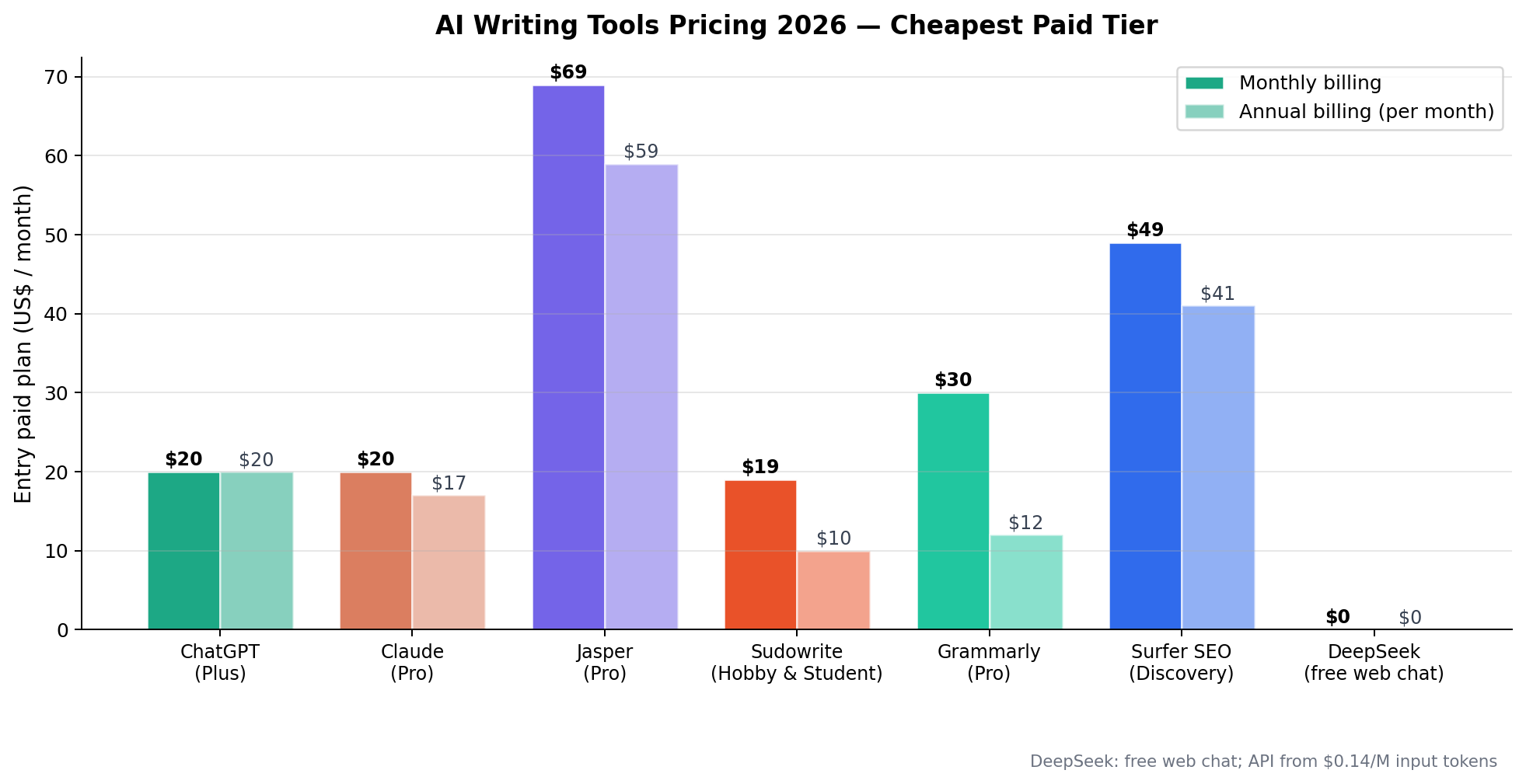
Three price facts worth internalizing. First, the generalists are cheap: $20 buys the best writing models on earth, and both offer real free tiers. Second, annual billing matters more here than in most software categories — Sudowrite drops 47% ($19→$10), Grammarly 60% ($30→$12), Claude 15% ($20→$17). Third, Jasper is 3.5× the generalist price — the premium only makes sense for team workflows, not prose quality.
Pricing Deep Dive: What a Real Month Costs
| Workload | Recommended Stack | Monthly Cost |
|---|---|---|
| Casual (5 posts + emails) | ChatGPT free Luna + Grammarly free | $0 |
| Freelancer (20 articles) | ChatGPT Plus $20 + Grammarly Pro $12 (annual) | $32 |
| SEO freelancer (20 ranked posts) | Claude Pro $17 (annual) + Surfer $41 (annual) | $58 |
| Novelist (daily chapters) | Sudowrite $10 (annual) + Claude Pro $17 (annual) | $27 |
| Marketing team (5 seats) | Jasper Pro $59/seat (annual) | $295 |
| Volume shop (100+ drafts) | DeepSeek API ≈ $5–15 + editor pass | ≈ $15 |
The pattern: a professional solo stack costs $27–58/month all-in, and the $0 row is genuinely viable. Nobody needs the $69 tier unless brand-voice automation across a team is the job.
Quality Benchmark: The Top Five, Dimension by Dimension
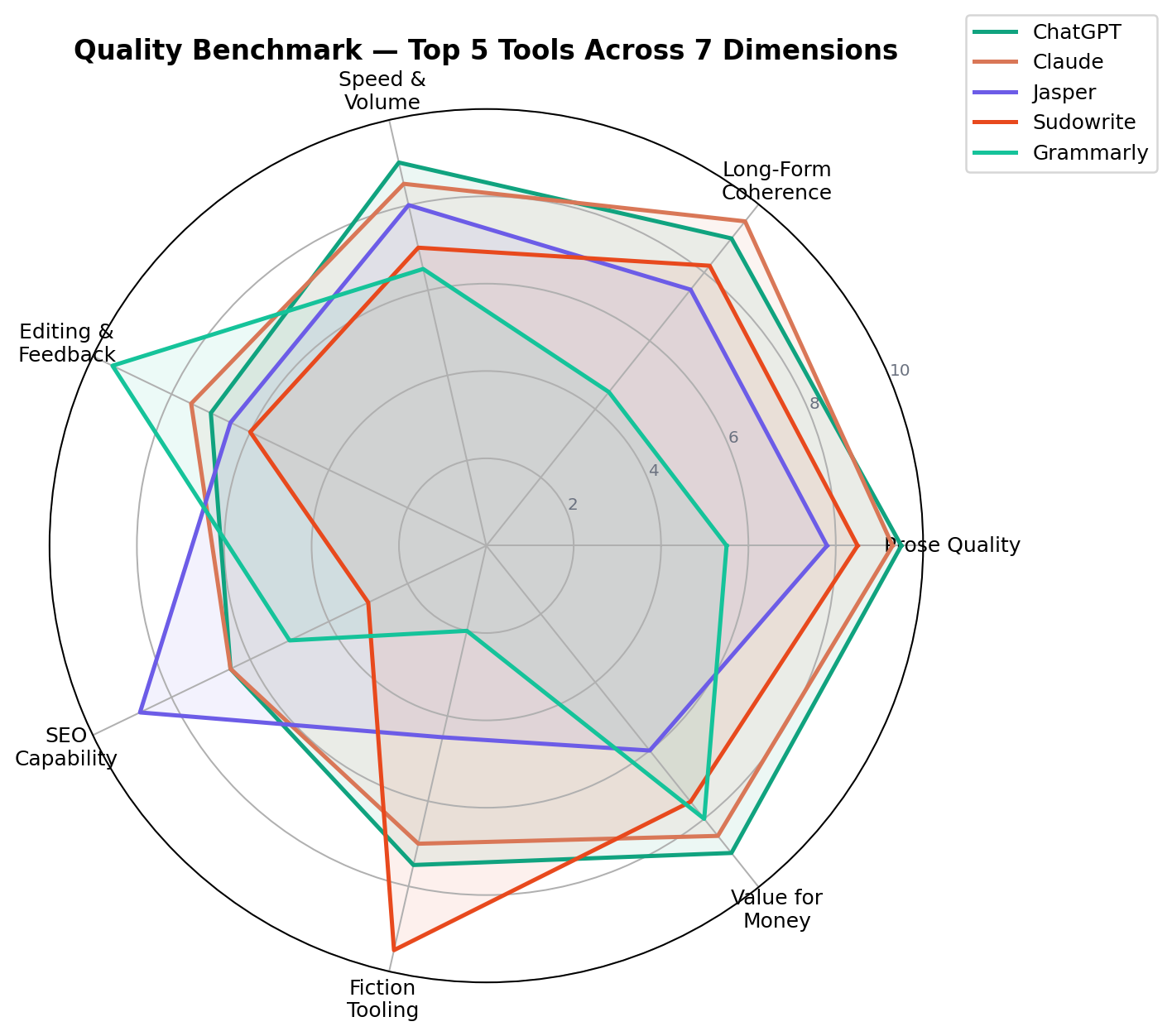
Read the radar as a portfolio: ChatGPT and Claude have the two widest, most balanced polygons — no dimension below 6.5 — which is why they sit at 8.8 and 8.7 overall. Jasper's shape leans hard into SEO and speed. Sudowrite's spikes into Fiction Tooling (9.5) and prose. Grammarly's entire polygon collapses toward the Editing axis (9.5) — a specialist's signature. If your workloads are varied, buy the widest polygon; if one dimension is your paycheck, buy the spike.
Feature Comparison at a Glance
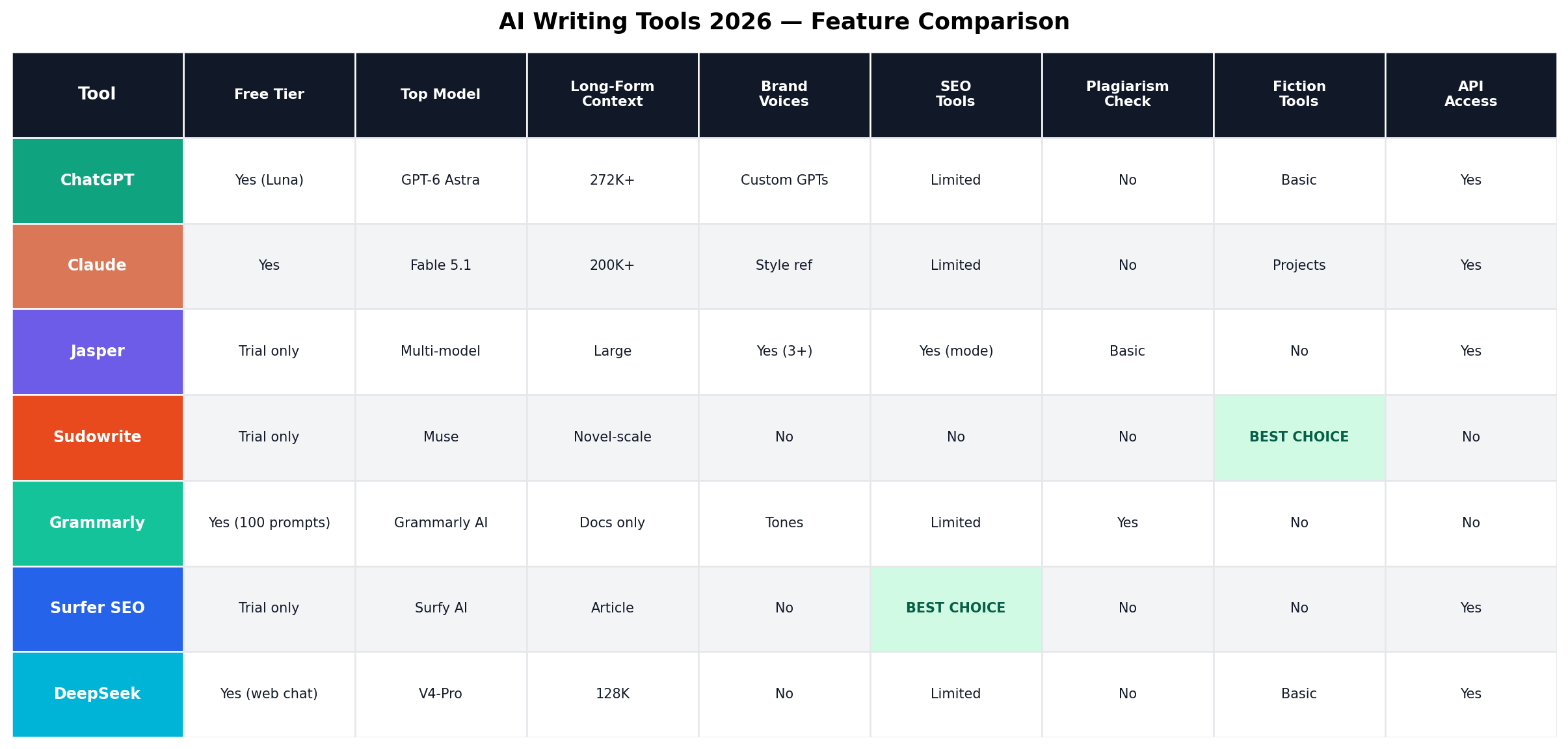
Three rows tell the real story. Free tier: ChatGPT (unlimited Luna drafts), DeepSeek, and Grammarly (100 prompts) let you start earning at $0; Jasper, Sudowrite, and Surfer are trial-only. API access: everyone but Sudowrite and Grammarly exposes one — that matters if you are wiring a drafting pipeline into n8n or an agent. Plagiarism check: only Grammarly ships a real one; if originality reports are part of your client deliverable, that alone decides your stack.
Decision Matrix: Which Tool for Which Job?
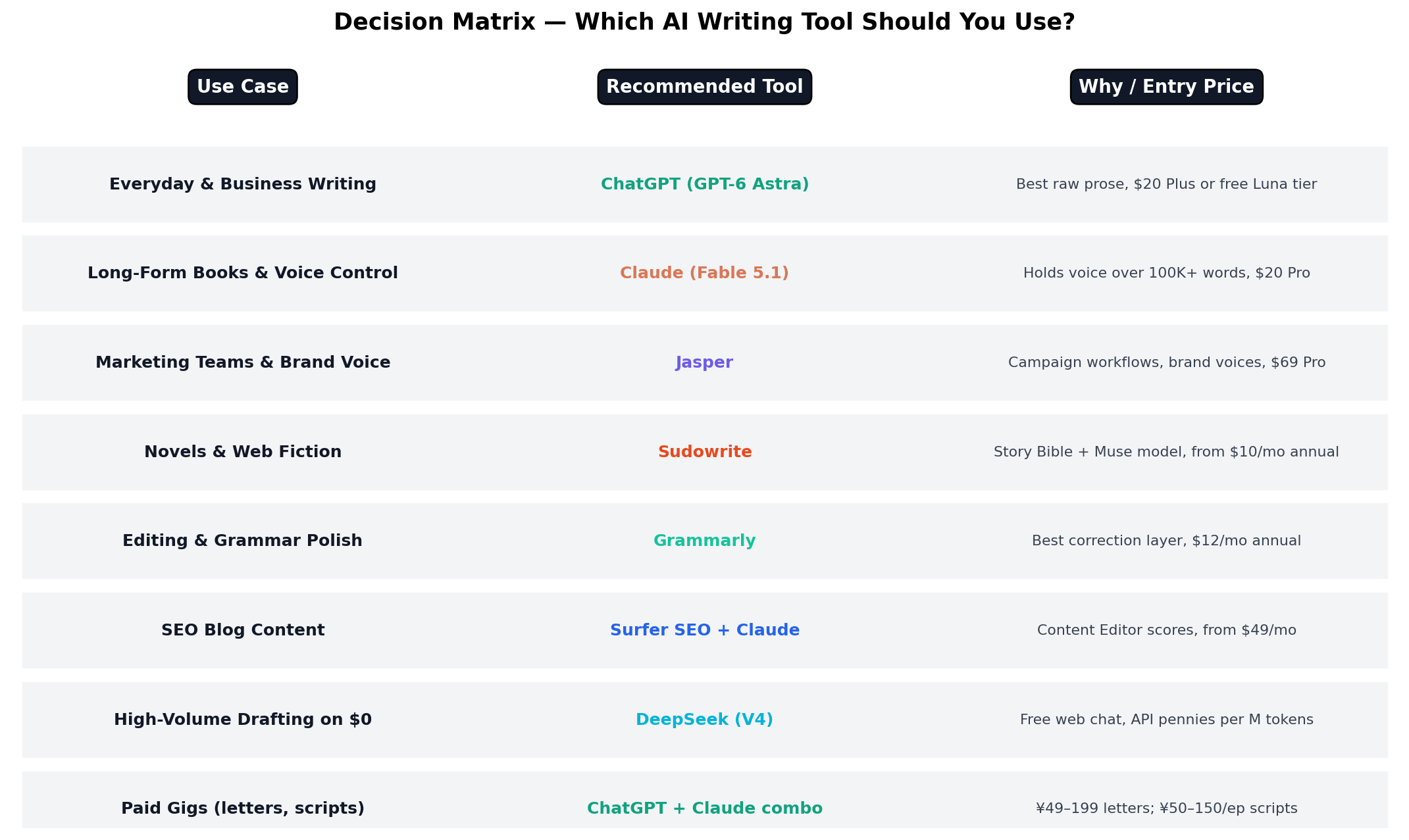
Use the matrix as a buying short-circuit: find your use case, buy one tool (or the named combo), and ignore everything else. Note that two rows are combos — for SEO content and paid gig work, no single tool covers the whole job, and pretending otherwise wastes money.
Real-World Economics: What People Actually Charge With These Tools
We track documented money-making workflows across freelance marketplaces (Xianyu, Taobao, Fiverr, Upwork). These three scenarios are drawn from real seller case studies, with the exact tools and order economics.
Scenario 1: The Letter-Gig Seller
Workflow: buyers order cover letters, motivation letters, and application polish-ups at ¥49–199 per order ($7–28); active sellers clear 20–30 orders/month part-time. Prompt that works: "You are a career-documents editor. Rewrite this cover letter for a [role] at [company]: under 300 words, keep the applicant's facts, adopt a confident but unhumble-free tone, and end with a specific reason they want THIS employer. Then list 3 facts you inferred but the letter never stated." Sellers run it in ChatGPT (free Luna tier is enough), edit for 10 minutes, deliver. Tool cost: $0. Margin: effectively 100% minus time. The 10-minute edit is what separates a ¥49 order from a refund.
Scenario 2: The Faceless-Channel Script Writer
Workflow: short-video channels buy scripts at ¥50–150 per episode ($7–21); a script seller delivering 10 episodes/week grosses ¥2,000–6,000/month. Prompt that works: "Write a 450-word faceless-YouTube script about [topic] for a US audience: hook in the first 8 seconds, 5 beats with concrete numbers, no questions to camera, end on an open loop for the next video. Grade-6 reading level." The speed play is DeepSeek for first drafts (9.5 speed, $0) and ChatGPT for the hook pass — the hook is what gets re-ordered, so spend the better model there. Grammarly's free tier catches the leftover Chinglish. Stack cost: $0.
Scenario 3: The KDP Nonfiction Author
Workflow: Kindle authors publish $2.99–9.99 niche nonfiction titles; the money-case literature shows realistic side incomes of a few hundred dollars/month per active title-cluster, with voice quality deciding review scores. Prompt that works: "Here is my style reference and chapter outline in the Project. Draft chapter 3, 2,000 words, matching the reference's sentence rhythm and humor. Do not summarize; write in full scenes and examples." That is a Claude Fable 5.1 job — its 9.5 long-form coherence and Projects-based style reference are exactly the workflow. Cost: $17/mo (annual Pro). Amazon requires disclosure of AI-generated content at upload; editors-first workflows (AI-assisted, human-rewritten) are the compliant sweet spot.
Alternatives Worth Considering
| Tool | Starting Price | Standout Feature |
|---|---|---|
| Rytr | $9/mo | Cheap all-rounder with 40+ use-case templates |
| ProWritingAid | ~$10/mo annual | Deep manuscript-style reports for book authors |
| Writesonic | from $39/mo | Fact-checked article mode with citations |
| Anyword | from $39/mo | Copy scored by predicted conversion lift |
| Copy.ai | Free tier | Now a GTM workflow platform under Fullcast |
None of these beat the top seven at their respective jobs in 2026 — but Rytr and ProWritingAid are legitimately good budget picks, and Anyword's conversion scoring is unique for ad copy.
The Verdict
Best for Most Writers: ChatGPT (8.8)
GPT-6 Astra is the best all-round writing model, the $20 Plus plan is the category's best-paid value, and the free Luna tier means you can start at $0. If you refuse to over-think this: subscribe to Plus and get back to writing.
Best for Books and Ghostwriting: Claude (8.7)
Fable 5.1 holds voice over 100K+ words better than anything on the market, and $17/mo annual pricing undercuts every specialist. Novelists, ghostwriters, and serialized authors: this is your tool.
Best Free Stack: DeepSeek + Grammarly Free
A 9.5-speed drafting engine at $0 with the best correction layer's free tier on top. The ¥49–199 letter-gig economy runs on exactly this stack. Total cost: nothing.
Best Value Paid Subscription: Sudowrite
$10/mo (annual) for the best fiction tooling ever shipped is the single best price-to-capability ratio in this list — for fiction writers only.
Best for Teams and Brands: Jasper · Best for SEO: Surfer SEO
Jasper's $69 buys campaign consistency for marketing teams; Surfer's $49 buys live-SERP optimization for content that must rank. Both are specialists — pair them with a generalist.
The Hybrid Approach (What Pros Actually Run)
ChatGPT or Claude for drafts and voice-critical work, DeepSeek for volume, Grammarly for the final pass, Surfer when rankings are the deliverable. Full professional stack: $27–58/month — less than one hour of agency copywriting.
Frequently Asked Questions
What is the best AI writing tool in 2026?
ChatGPT with GPT-6 Astra is the best overall AI writing tool in 2026, scoring 8.8/10 in our testing. It tops the EQ-Bench Creative Writing v3 leaderboard, offers unlimited free drafts on the Luna tier, and costs $20/month for full Astra access via Plus.
Is ChatGPT or Claude better for writing?
ChatGPT is better for general and business writing (faster, stronger raw prose). Claude is better for long-form work where voice must stay consistent over an entire book — its 9.5 long-form coherence score is the highest in this test. Many professionals run both: about $40/month combined.
What is the cheapest AI writing tool in 2026?
DeepSeek's web chat is completely free, and its API starts at $0.14 per million input tokens. Among paid tools, Sudowrite's annual plan is cheapest at $10/month, followed by Grammarly Pro at $12/month (annual).
Is Jasper still worth paying for in 2026?
For marketing teams, yes — brand voices, campaign workflows, and SEO mode justify $59–69/month when multiple people ship on-brand content daily. For solo writers, no: ChatGPT and Claude write better prose for a third of the price.
Can you use AI writing tools for Kindle KDP publishing?
Yes. Amazon KDP allows AI-assisted books but requires disclosure of AI-generated content at upload. The compliant workflow real authors use: draft with Claude (voice-consistent), rewrite substantially by hand, disclose accurately — AI-assisted rather than AI-generated.
Can clients or platforms detect AI writing?
Detection tools are unreliable in both directions — false positives hit human writing, and polished AI passes through. What matters commercially is quality, not provenance: run a real editing pass (Grammarly plus human review), inject concrete facts and first-person specifics, and detection becomes moot.
What is the best AI tool for SEO blog content?
The pro combo: draft in Claude or ChatGPT for voice and structure, then finish in Surfer SEO ($49/month) to hit entity coverage and content-score targets against live SERP data. Surfer alone scores 9.5 on SEO capability — the highest in this test.