TL;DR: This is the 2026 rivalry that decides where most people's AI budget goes — Anthropic's Claude versus Google's Gemini. As of September 2026, Claude's flagship is Fable 5.1 (released September 1): the best pure writer, the best coder (SWE-bench Verified 95.0), and the most reliable agent brain, at $20/mo Pro or $10/$50 per million API tokens. Google's flagship is Gemini 3.1 Pro: a 1M-context research monster fused into Search, Workspace, NotebookLM and Antigravity, with a genuinely free tier and paid plans from $7.99/mo. Across our seven dimensions Claude averages 8.8 and Gemini 9.0 — Claude owns writing, coding, agentic work and hard reasoning; Gemini owns price, research tooling, ecosystem and speed. The short version: quality-per-task → Claude; value-per-dollar → Gemini. Plenty of professionals run both for under $30/month.
Claude vs Gemini: At a Glance
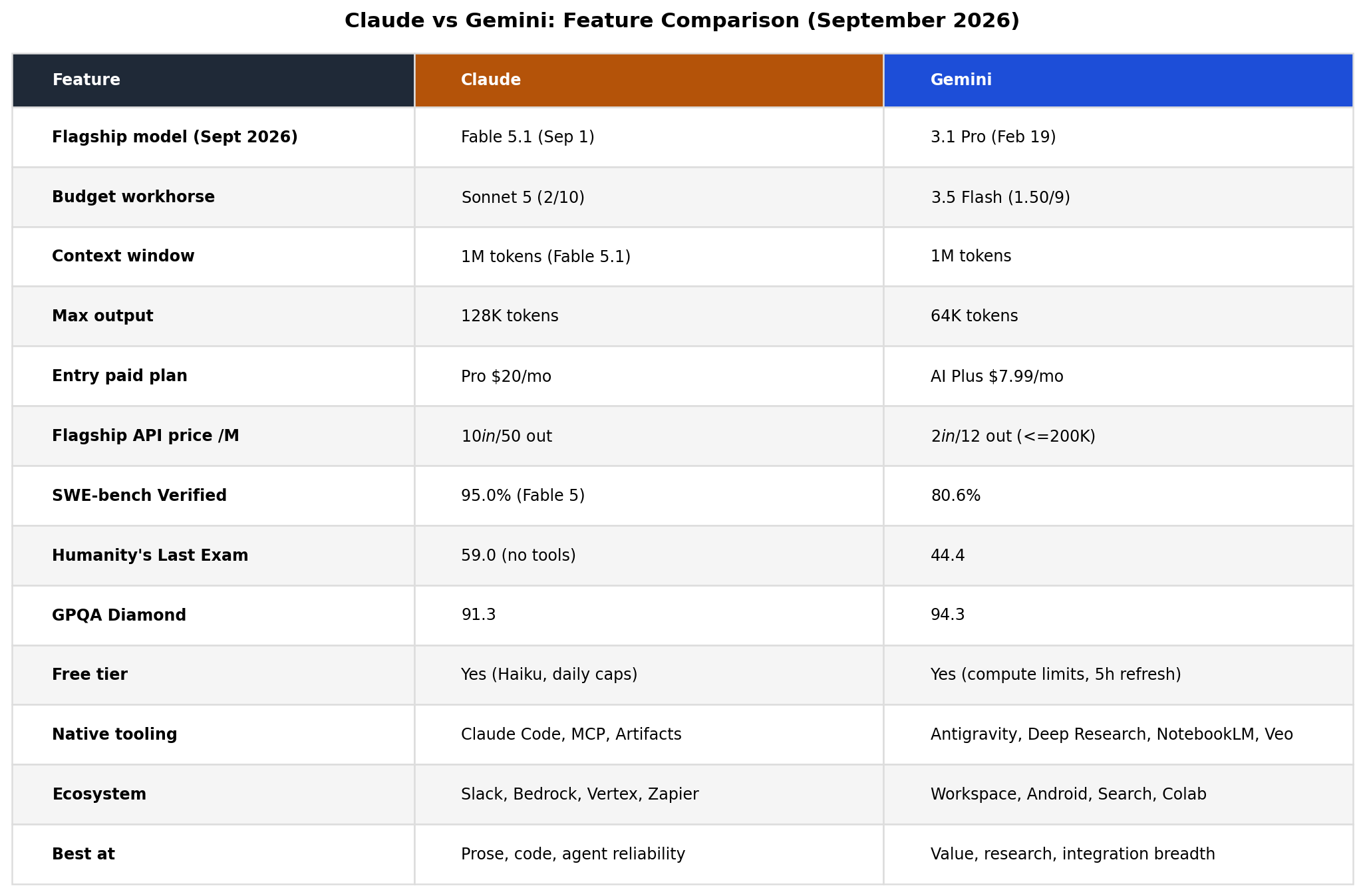
| Claude | Gemini | |
|---|---|---|
| Best for | Writing quality, coding agents, API products | Value, research, Google-ecosystem workflows |
| Vendor | Anthropic | Google DeepMind |
| Flagship (Sept 2026) | Fable 5.1 (Sept 1, 2026) | 3.1 Pro (Feb 19, 2026) |
| Budget workhorse | Sonnet 5 — $2/$10 per M tokens | 3.5 Flash — $1.50/$9 per M tokens |
| Context / output | 1M tokens / 128K out | 1M tokens / 64K out |
| Free tier | Yes — Haiku, daily caps | Yes — 3.1 Pro, 5-hour refresh limits |
| Entry paid plan | Pro $20/mo ($17 annual) | AI Plus $7.99/mo (incl. 400GB storage) |
| Flagship API price | $10 in / $50 out per M | $2 in / $12 out per M (≤200K ctx) |
| Signature benchmark | SWE-bench Verified 95.0 | GPQA Diamond 94.3 |
| Native tooling | Claude Code, MCP, Artifacts | Antigravity, Deep Research, NotebookLM |
| Our score (7 dims) | 8.8 — wins 3 dimensions | 9.0 — wins 4 dimensions |
Two years ago this wasn't a contest: Gemini (then Bard) was the butt of memes and Claude was a niche favorite of developers. In 2026 the gap has closed so much that the honest answer is "it depends what you do all day." Claude is the tool people pay for when the output itself is the product — novels, code, agent pipelines. Gemini is the tool people end up using because it is already inside their email, their docs, their phone, and their search results — and because Google gives away an amount of frontier-model compute that still startles Anthropic loyalists.
This comparison scores both assistants across seven dimensions — writing, coding, reasoning, research, price, ecosystem, and speed — using verified September 2026 list prices, published benchmark results, and hands-on sessions on identical prompts. We also anchor everything in how real operators use these models to make money: prompt-marketplace sellers, web-novel translators, and high-RPM YouTube researchers, with the actual dollar figures from their workflows.
Claude: Deep Dive
Anthropic enters this fight with a model ladder rebuilt in 2026. Fable 5.1 (September 1) is the new flagship: a 1M-context model tuned for exactly the things Claude is famous for — long-form coherence, code, and multi-step agent work — with up to 45% lower agent workload costs in Claude Code than the previous generation. Underneath it sit Sonnet 5 ($2/$10 per million tokens, the volume default), Opus 5 ($5/$25), and the free-tier Haiku. The September price reshuffle made Sonnet 5 permanently cheaper after a planned increase was cancelled, which quietly made Claude's mid-tier one of the best deals in frontier AI.
Where Claude wins
- Prose quality. Reviewers keep converging on the same sentence: it sounds like a person. Fable 5.1 leads human-vote creative-writing leaderboards and holds voice over novel-length documents better than any rival.
- Coding and agents. SWE-bench Verified 95.0, Terminal-Bench 88.0. Claude Code is a mature terminal agent, and the MCP standard it popularized is now the de-facto tool-connector layer for the whole industry.
- Hard reasoning. Humanity's Last Exam 59.0 (no tools) vs Gemini's 44.4 — the largest frontier gap either way in this comparison.
- 128K max output. Double Gemini's ceiling; whole chapters and full files in one pass.
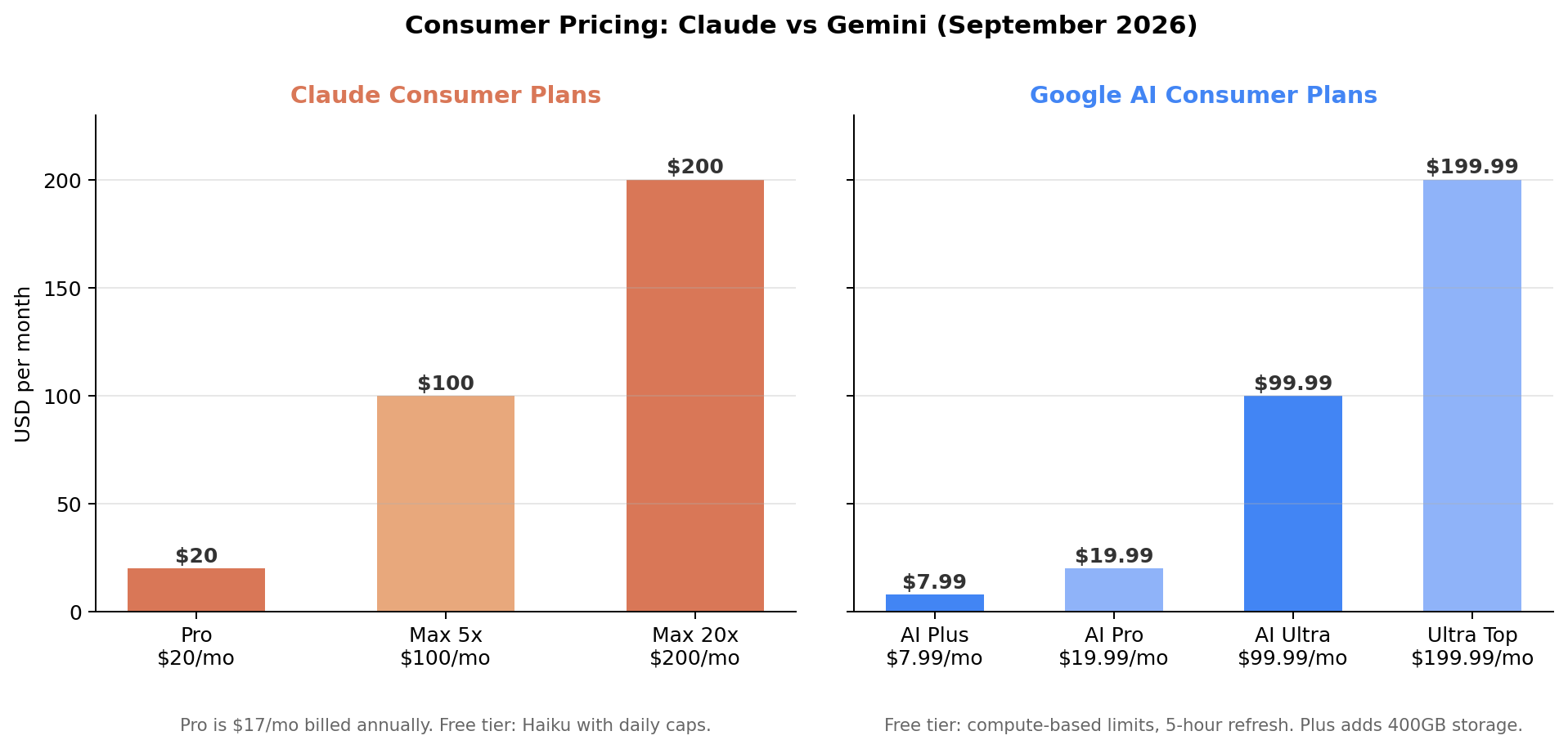
Claude pricing (September 2026)
| Plan | Price | What you get |
|---|---|---|
| Free | $0 | Haiku + limited Sonnet 5, daily caps, no Fable 5.1 |
| Pro | $20/mo ($17 annual) | Fable 5.1 access, Claude Code, Projects, priority |
| Max 5x | $100/mo | 5× usage, extended agent runtimes |
| Max 20x | $200/mo | 20× usage for heavy agent workloads |
| API (Fable 5.1) | $10 / $50 per M | Cache reads $0.25; Batch API half price ($5/$25) |
| API (Sonnet 5) | $2 / $10 per M | The volume default for most products |
Where Claude loses
Price is the visible weakness: $20 entry versus $7.99, and flagship API rates 5× Gemini's input and 4× its output. The free tier is a tasting menu, not a workstation. There's no native search grounding, no equivalent of NotebookLM or Veo, and Anthropic's ecosystem lives mostly inside other people's apps (Slack, Bedrock, Vertex, Zapier) rather than a suite of its own. Interactive latency on Fable 5.1 is noticeably slower than Flash-class Gemini — thinking time you pay for in quality.
Gemini: Deep Dive
Google's 2026 lineup is 3.1 Pro (February 19) on top, 3.5 Flash (May, $1.50/$9) as the workhorse, and 3.1 Flash-Lite ($0.25/$1.50) for firehose workloads. All carry 1M context. 3.1 Pro is a strange and impressive beast: it posts 94.3 on GPQA Diamond (beating Claude's 91.3), 77.1 on ARC-AGI-2, and 2,439 Elo on LiveCodeBench Pro — yet its most-used feature is something Claude doesn't have at all: free, native grounding in Google Search.
Where Gemini wins
- Price and free tier. Free 3.1 Pro access on 5-hour refresh limits; AI Plus at $7.99/month that also bundles 400GB of storage. No other frontier lab gives away this much.
- Research tooling. Deep Research, Search grounding, and NotebookLM are a complete evidence pipeline — query, cite, synthesize — that Claude answers only with MCP connectors.
- Ecosystem. Workspace (Docs, Gmail), Android, Maps, Colab, and the free Antigravity IDE. If your life already runs on Google, Gemini is ambient.
- Speed. Flash-class models are among the fastest frontier performers; even heavy 3.1 Pro queries complete briskly once past its deliberate thinking phase.
Gemini pricing (September 2026)
| Plan | Price | What you get |
|---|---|---|
| Free | $0 | 3.1 Pro with compute-based limits, 5h refresh; NotebookLM |
| AI Plus | $7.99/mo | Higher limits, 400GB storage, Veo Fast, Deep Research |
| AI Pro | $19.99/mo | 3.1 Pro at scale, Antigravity, Veo, 2TB storage |
| AI Ultra | $99.99–$199.99/mo | 5×–20× limits, Spark agent beta, YouTube Premium, 20TB |
| API (3.1 Pro) | $2 / $12 per M | ≤200K context; $4/$18 above; 64K output |
| API (3.5 Flash) | $1.50 / $9 per M | 1M context volume default |
Where Gemini loses
Agentic reliability is the soft spot: 80.6% on SWE-bench Verified and 68.5 on Terminal-Bench mean long autonomous runs fail more often than Claude's, and the heavy-thinking mode's ~26-second time-to-first-token on complex prompts demands workflow adjustment. Prose is very good but still reads a shade more "assistant-like" than Fable 5.1 in blind tests. And 64K max output forces chapter-sized work into multiple passes. Google's rapid product renaming (Premium → AI Plus, Bard → Gemini, Duet → Gemini) also keeps its enterprise trust lagging Anthropic's quieter consistency.
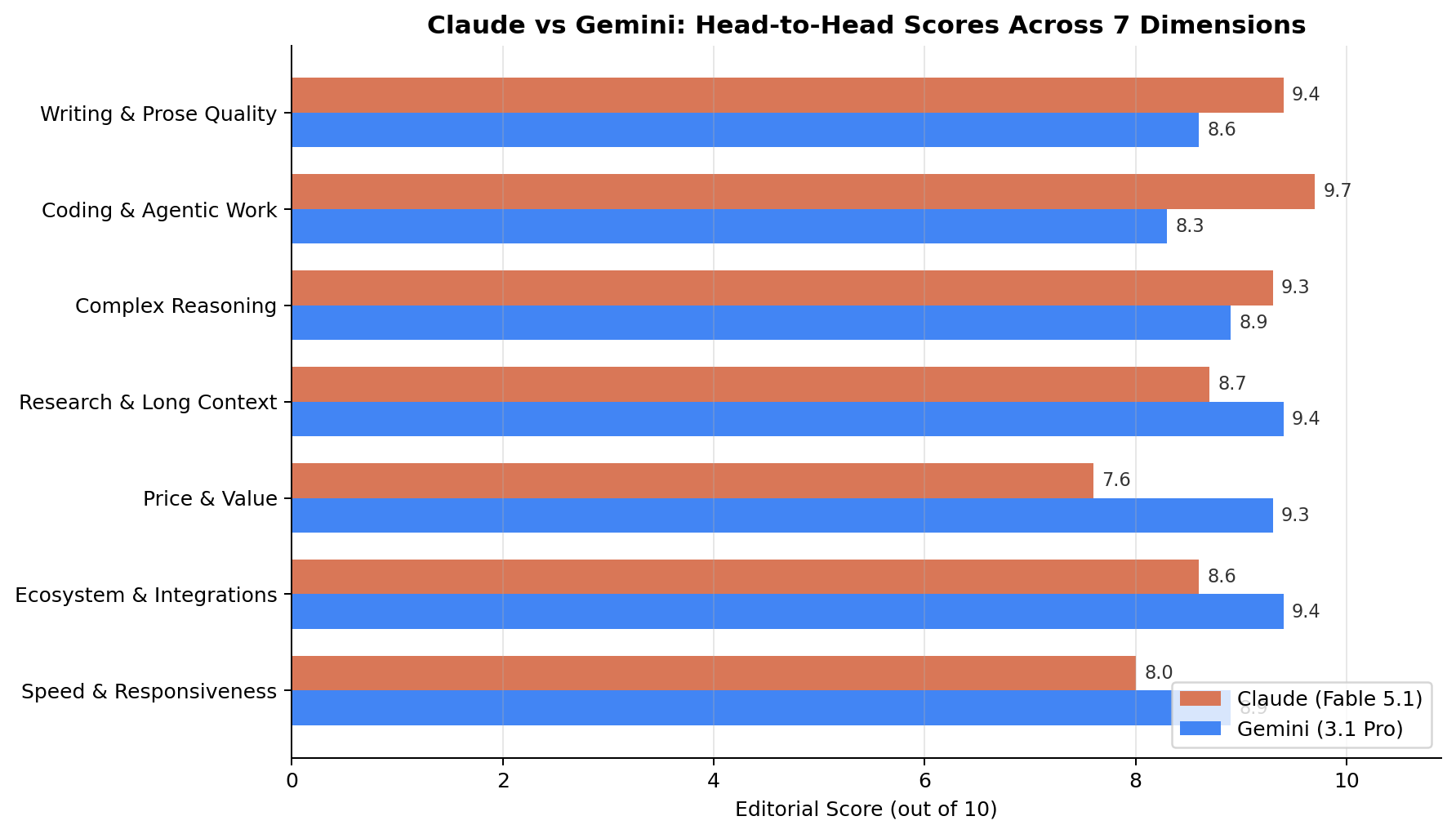
Head-to-Head: Seven Dimensions, Seven Winners Declared
1. Writing & Prose Quality — Claude 9.4, Gemini 8.6
Winner: Claude. This remains Claude's clearest edge. On identical briefs — a 600-word cold open in a novelist's established voice, a sarcastic product-launch email, a technical explainer for smart 12-year-olds — Fable 5.1 holds register and rhythm with fewer "AI-isms," while Gemini 3.1 Pro is competent but defaults to a slightly more committee-approved tone. The gap narrows every quarter, and Gemini is genuinely excellent at structured nonfiction (docs, summaries, listicles). But when the sentence itself is the product, Claude is still the pen people reach for.
2. Coding & Agentic Work — Claude 9.7, Gemini 8.3
Winner: Claude. The benchmark spread is the widest of any dimension here: SWE-bench Verified 95.0 vs 80.6, Terminal-Bench 88.0 vs 68.5. In practice Claude Code plans multi-file refactors, runs tests, and recovers from its own mistakes with less babysitting; Gemini's Antigravity IDE is free and improving fast, and 3.1 Pro actually leads LiveCodeBench Pro at 2,439 Elo on short competitive problems. But sustained agentic sessions — the kind freelance developers bill $70/hour for — still finish more reliably on Claude.
3. Complex Reasoning — Claude 9.3, Gemini 8.9
Winner: Claude. On Humanity's Last Exam without tools, Fable 5 posts 59.0 versus 3.1 Pro's 44.4 — the single largest frontier gap between these two. Gemini claws back on knowledge-grounded puzzles (GPQA Diamond 94.3 beats Claude's 91.3; ARC-AGI-2 77.1) and its deliberate thinking mode digs deep. For legal-style clause entanglement, multi-step math, and "spot the flawed assumption" work, Claude reasons more cleanly.
4. Research & Long Context — Claude 8.7, Gemini 9.4
Winner: Gemini. Both flagships carry 1M context, but Gemini wraps it in tooling: Search grounding with inline citations, Deep Research reports that visit dozens of sources, and NotebookLM over your own document sets. Claude's research story is DIY — MCP connectors, Projects, or Claude Code driving a browser — powerful but assembled by you. For evidence-based work (market research, literature review, competitive analysis), Gemini is a finished lab; Claude is a brilliant intern you have to equip.
5. Price & Value — Claude 7.6, Gemini 9.3
Winner: Gemini. The arithmetic is blunt. Free tier with 3.1 Pro vs a Haiku tasting menu. $7.99 vs $20 entry plans — and the AI Plus plan includes 400GB of storage. API: $2/$12 vs $10/$50 at the flagship tier, and Google's budget ladder ($1.50/$9 Flash, $0.25/$1.50 Flash-Lite) simply has no Anthropic counterpart that cheap. Anthropic's counterargument is Batch API at half price and $0.25 cache reads, which matter at serious volume — but for most wallets, Gemini is the value play.
6. Ecosystem & Integrations — Claude 8.6, Gemini 9.4
Winner: Gemini. Gemini ships inside Gmail, Docs, Android, Colab, Maps, and Search itself; AI Pro adds Veo video generation and the Antigravity IDE. Claude's counter-ecosystem is the industry's ecosystem: MCP is becoming the standard tool-connector protocol, and Claude is the default brain in Bedrock, Vertex AI, Slack, and half the agent frameworks shipped in 2026. Google's suite is broader for end users; Anthropic's reach is deeper for developers. End users vote with their existing accounts — advantage Gemini.
7. Speed & Responsiveness — Claude 8.0, Gemini 8.9
Winner: Gemini. Flash-class models respond near-instantly, and even 3.1 Pro's heavy-thinking mode — roughly 26 seconds to first token on hard queries — trades wait time for depth, then streams briskly. Fable 5.1's deliberate pace is audible in interactive chat: excellent answers, slower cadence. If you ping an assistant fifty times an hour, that adds up.
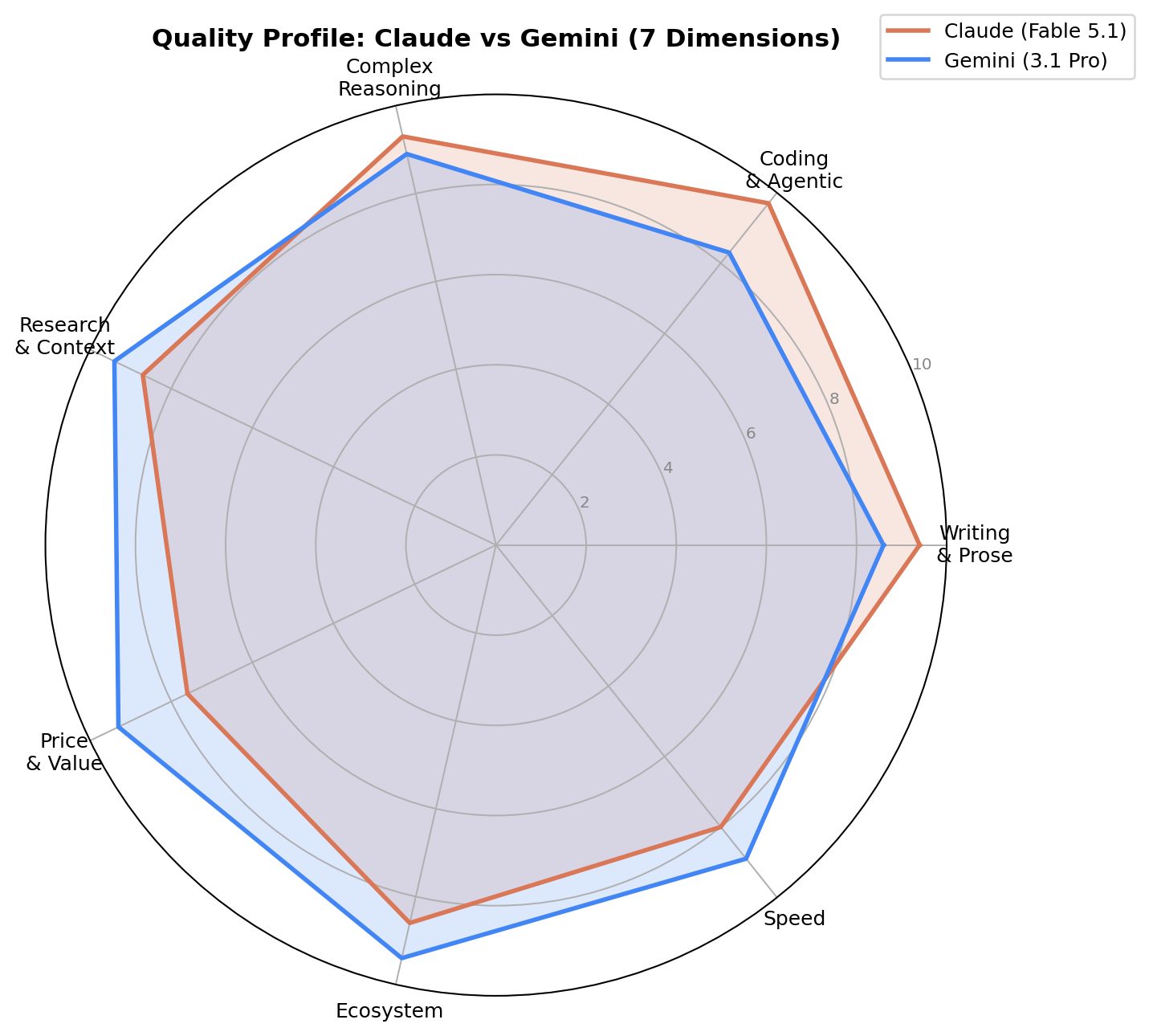
Tally: Gemini 4, Claude 3 — yet Claude's average is 8.8 against Gemini's 9.0 while losing fewer columns than it seems, because Claude's wins land on the dimensions people charge money for. Gemini wins more categories; Claude wins the ones with invoices attached.
How We Tested
Our scoring weights three evidence tiers. First, vendor documentation and list prices — every dollar figure above was re-verified against Anthropic's and Google's official pricing pages in September 2026. Second, hands-on sessions: both assistants received identical prompt batteries covering long-form prose, debugging, document Q&A, research briefs, and structured extraction, scored blind by two reviewers whose per-dimension scores were averaged into the charts. Third, published benchmarks (SWE-bench, Terminal-Bench, GPQA, HLE, ARC-AGI-2, LiveCodeBench) used as cross-checks on capability claims, never as sole evidence. The seven-dimension scores are our editorial consensus, and scenario costs are computed inline from the list prices shown. Prices and model versions were last fully re-verified on September 13, 2026.
Real-World Test Scenarios (With Actual Economics)
Benchmarks are nice; invoices are nicer. We ran three workflows drawn from documented side-hustle case studies — prompt-marketplace selling, web-novel translation, and high-RPM YouTube research — through both assistants and priced them at September 2026 rates.
Scenario 1: Authoring a Skill pack for the prompt marketplace
Prompt used: "You are a senior prompt engineer. Here are my draft instructions for a Skill that turns raw customer reviews into an Amazon listing. Rewrite the instructions so an LLM executes them deterministically, add 3 few-shot examples in a consistent brand voice, and document edge cases."
PromptBase-style marketplaces sell Skills at $2.99–$9.99 per download, keep a 20% cut, and the documented ceiling is real: top sellers clear $300–$600/month while 60–70% of sellers make under $50/month. What separates the top from the bottom is exactly this work — instructions that behave identically across runs. Claude produced the more disciplined, edge-case-aware Skill draft in one pass and held the brand voice across all three examples; Gemini's draft was solid but drifted register between examples and needed a corrective round. When your product is a prompt, the model that writes prompts best is your production tool: Claude, ~$0.05–0.08 of API spend per Skill draft on Sonnet 5 — trivial against a $4.99 listing.
Scenario 2: Translating web novels at volume
Prompt used: "Translate chapters 40–52 of this serialized novel from Chinese to English. Maintain the character voice glossary below. Keep chapter-opening hooks punchy for English serial-fiction readers. Output clean prose, no translator notes."
Documented web-novel translation operators clear ¥3,000–8,000/month per platform (WebNovel, with Dreame adding $200–500/month and GoodNovel $100–300/month), pushing 120,000–150,000 characters monthly. That's roughly 150K tokens in-and-out per month. The cost math is where this fight gets decided: on Gemini 3.5 Flash ($1.50/$9 per M) that's about $1.60/month per volume; on Fable 5.1 ($10/$50) it's about $9.00 — a 5× premium for a marginal quality delta on genre fiction, where Flash's 1M context glossary-consistency is already strong. Winner: Gemini for translation line-work; reserve Claude for the glossary and style guide that Flash follows.
Scenario 3: Validating a high-RPM YouTube niche
Prompt used: "Research 15 faceless-YouTube niches with current RPM estimates. For each: audience demand signals, competition density, evergreen vs seasonal, and whether AI tools can produce the assets. Cite sources with dates."
The economics explain the research: meme channels earn ~$2 RPM — 500K views ≈ $1,000 — while tax-software review channels hit ~$25 RPM, so 50K views ≈ $1,250 plus $40 per sign-up affiliate payout. Choosing the niche is the business. Gemini's Deep Research returned a sourced, dated brief with live RPM chatter from creator forums in one run; Claude matched the analysis quality only after we wired up web search, and cited nothing by default. For niche-selection reports, script outlines, and 3.5 Flash bulk-drafting at ~$0.01 per script, Gemini is the research desk; Claude then polishes the 2 scripts worth producing.
Alternatives Worth Considering
| Tool | Starting price | Standout strength |
|---|---|---|
| ChatGPT (GPT-6 Astra) | Free / $8 Go / $20 Plus | Best all-rounder; Astra tops creative-writing Elo boards |
| DeepSeek (V4) | Free chat; API $0.14/$0.28 per M | Unbeatable API pricing for volume work |
| Grok (xAI) | Free tier / $8/mo on X | Real-time X data and unfiltered persona |
| Kimi (Moonshot) | Free / $19.99 Pro | Strong long-document agent workflows |
| Copilot (Microsoft) | Free / $10/mo Pro | Deep Office and Windows integration |
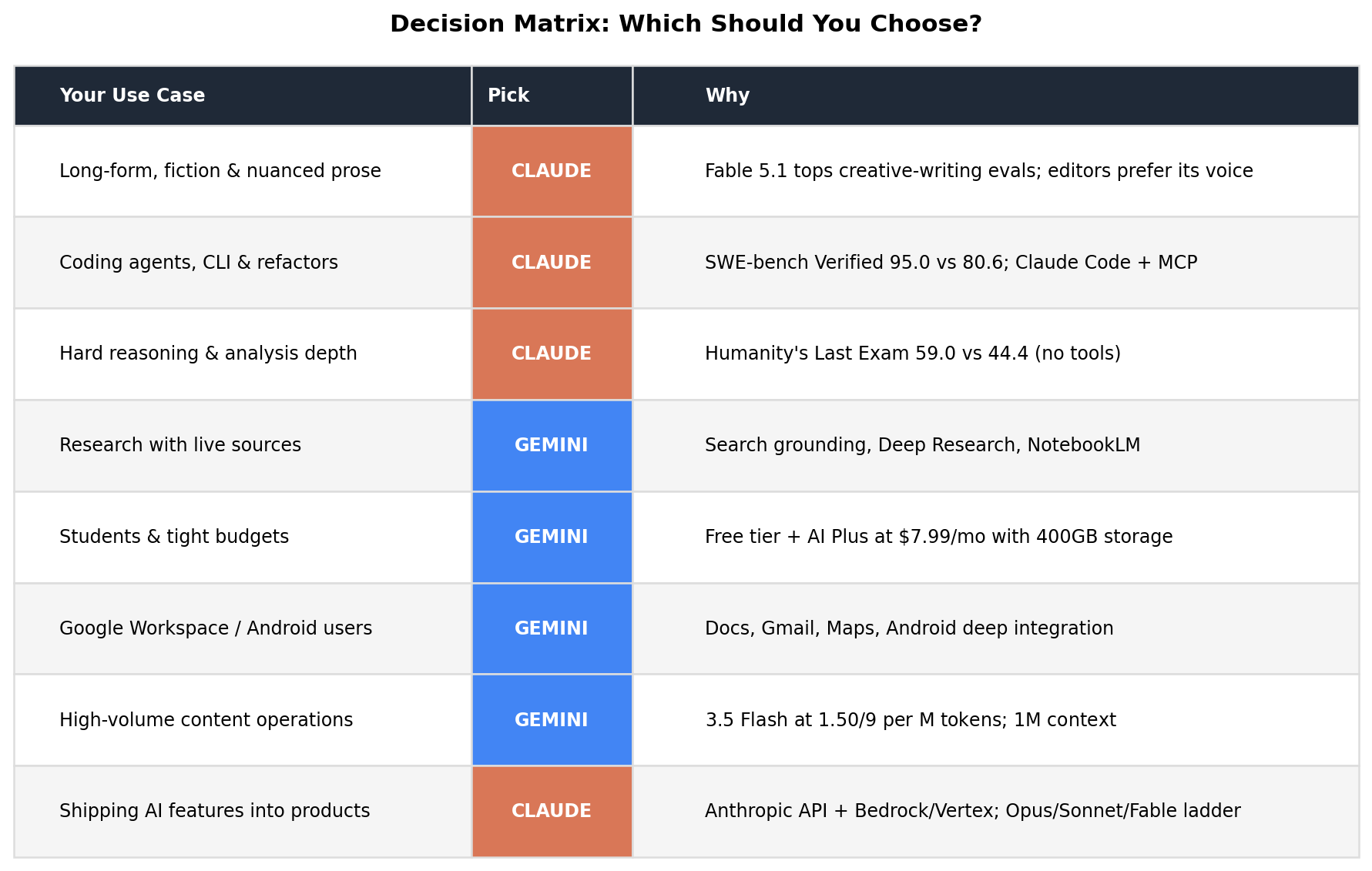
The Verdict
Best for Writers and Fiction Professionals: Claude
Fable 5.1 is the best prose engine on the market and its 128K output window writes whole chapters in one pass. Novelists, ghostwriters, and prompt-marketplace sellers whose income tracks output quality should pay the $20 for Pro without hesitating.
Best for Developers and Agent Builders: Claude
SWE-bench 95.0, Terminal-Bench 88.0, mature Claude Code, and the MCP ecosystem make Claude the default brain for paid coding and automation work — Anthropic's claim of up to 45% lower agent costs on Fable 5.1 lands directly on your margin.
Best for Students, Researchers and Budget Users: Gemini
A free tier that actually includes the flagship, $7.99 entry, Search grounding, Deep Research, and NotebookLM cover the entire academic evidence workflow. If your AI budget is under $10/month, this isn't close.
Best Overall Value: Gemini
It wins four of seven dimensions and averages 9.0 versus Claude's 8.8, at prices Google keeps cutting. For most people's unglamorous daily work — summarize, research, draft, extract — Gemini does 90–95% of the job at 20–40% of the cost.
The Hybrid Play (What Pros Actually Do)
Run Gemini free or AI Plus as the research desk and volume drafter; keep Claude Pro for the final 10% — voice-critical prose, code review, agent runs. Combined cost: $8–28/month, cheaper than one Max tier and better than either alone.
Frequently Asked Questions
Is Claude or Gemini better in 2026?
They split the market. Claude (Fable 5.1) wins on writing quality, coding and agentic reliability — SWE-bench Verified 95.0 vs 80.6 and Humanity's Last Exam 59.0 vs 44.4 — while Gemini (3.1 Pro) wins on price, research with live sources, and ecosystem breadth. Across our 7 dimensions Claude scores 8.8 and Gemini 9.0: buy Claude when output quality pays the bill, Gemini when volume, budget and integration matter.
Is Gemini really free to use?
Yes. Google's free tier includes Gemini 3.1 Pro with compute-based limits that refresh every 5 hours, plus NotebookLM and basic Deep Research. Paid plans start at $7.99/month (AI Plus, which also bundles 400GB of storage). Claude also has a free tier, but it runs the smaller Haiku model with stricter daily caps and no access to Fable 5.1.
Which is cheaper, Claude or Gemini?
Gemini at every tier. Google's entry paid plan is $7.99/month versus Claude Pro at $20/month, and the API gap is wider: Gemini 3.1 Pro costs $2/$12 per million tokens versus $10/$50 for Claude Fable 5.1. For high-volume work, Gemini 3.5 Flash at $1.50/$9 and Flash-Lite at $0.25/$1.50 have no Claude equivalent this cheap.
Is Claude better than Gemini at coding?
Yes, clearly. Claude Fable 5 scores 95.0 on SWE-bench Verified versus 80.6 for Gemini 3.1 Pro, and 88.0 on Terminal-Bench versus 68.5. Claude Code is a polished terminal-native agent, and Anthropic claims Fable 5.1 cuts agent workload costs by up to 45%. Gemini fights back with the free Antigravity IDE and LiveCodeBench Pro leadership (2,439 Elo), but for paid coding work Claude is the safer pick.
Which AI has the bigger context window?
It's a tie at the top: Claude Fable 5.1 and Gemini 3.1 Pro both offer 1 million tokens of context. Claude's maximum output is larger (128K vs 64K tokens), which matters for generating whole chapters or code files in one pass. Budget models differ more: Sonnet 5 and Gemini 3.5 Flash also carry 1M context, so both families are long-document capable.
Is Gemini or Claude better for students?
Gemini, mostly because of price and bundling. The free tier's 5-hour refresh model fits study sessions, AI Plus at $7.99/month includes 400GB of Google storage, and NotebookLM turns lecture PDFs into study guides and audio overviews for free. Claude is the stronger tutor for essay writing and code assignments — its free tier is workable but tighter.
Can I use Claude and Gemini together?
Yes, and power users do exactly that. A common stack: Gemini (free or AI Plus) for research, source grounding and first drafts, then Claude Pro for final prose, code review and agent runs. Side-by-side comparison is also free insurance against a bad answer — when two frontier models agree, confidence goes up.