TL;DR: The 2026 chatbot market has split into three tiers. The all-round content tier belongs to ChatGPT (overall 8.9/10): GPT-6 Astra for frontier prose, GPT-5.6 Luna unlimited on the free tier, and a $8/month Go plan that undercuts every rival. The research tier belongs to Gemini (8.7) with a 1M-token window and grounded search, with Perplexity (7.8) as the citation specialist. The workhorse tier is where the money is: Claude (8.6) owns coding and agents, while DeepSeek (8.4) gives away a top-tier chat free plus a $0.14/M API — cheap enough to build a service business on. Kimi (8.1) is the budget long-context pick, and Grok (7.6) is the real-time X-signal specialist. Our recommendation for most readers: ChatGPT free + DeepSeek free, upgrade only when volume demands it.
Two years ago, picking an AI chatbot was easy: you used ChatGPT, or you waited. In September 2026 the choice is genuinely hard. Seven chatbots now clear the "good enough for daily work" bar, three of them ship serious capability for free, and the paid plans range from $7.99 to $300 a month. Picking wrong doesn't just waste subscription money — it changes what your words, code and research actually cost to produce.
The stakes are real because people are building incomes on these tools. The case files we maintain document content-service retainers worth ¥1,000-3,000 (about $140-420) per client per month, run mostly on free chat tiers. KDP publishers draft low-content book interiors and listings with free chatbots, then collect 35-70% royalties on $2.99-6.99 sales. Faceless-channel operators batch 30-60 short-video scripts a month. Etsy digital-shop sellers generate listing copy and product bundles between school runs. Which chatbot you run these workflows on decides your margin — and in several cases below, the free tier wins the job.
We scored seven chatbots across seven dimensions — Writing Quality, Coding & Agents, Research & Facts, Context Window, Speed, Free Tier Value, and API Cost Value — with every price and model claim verified against vendor pages in September 2026. Here is how they rank.
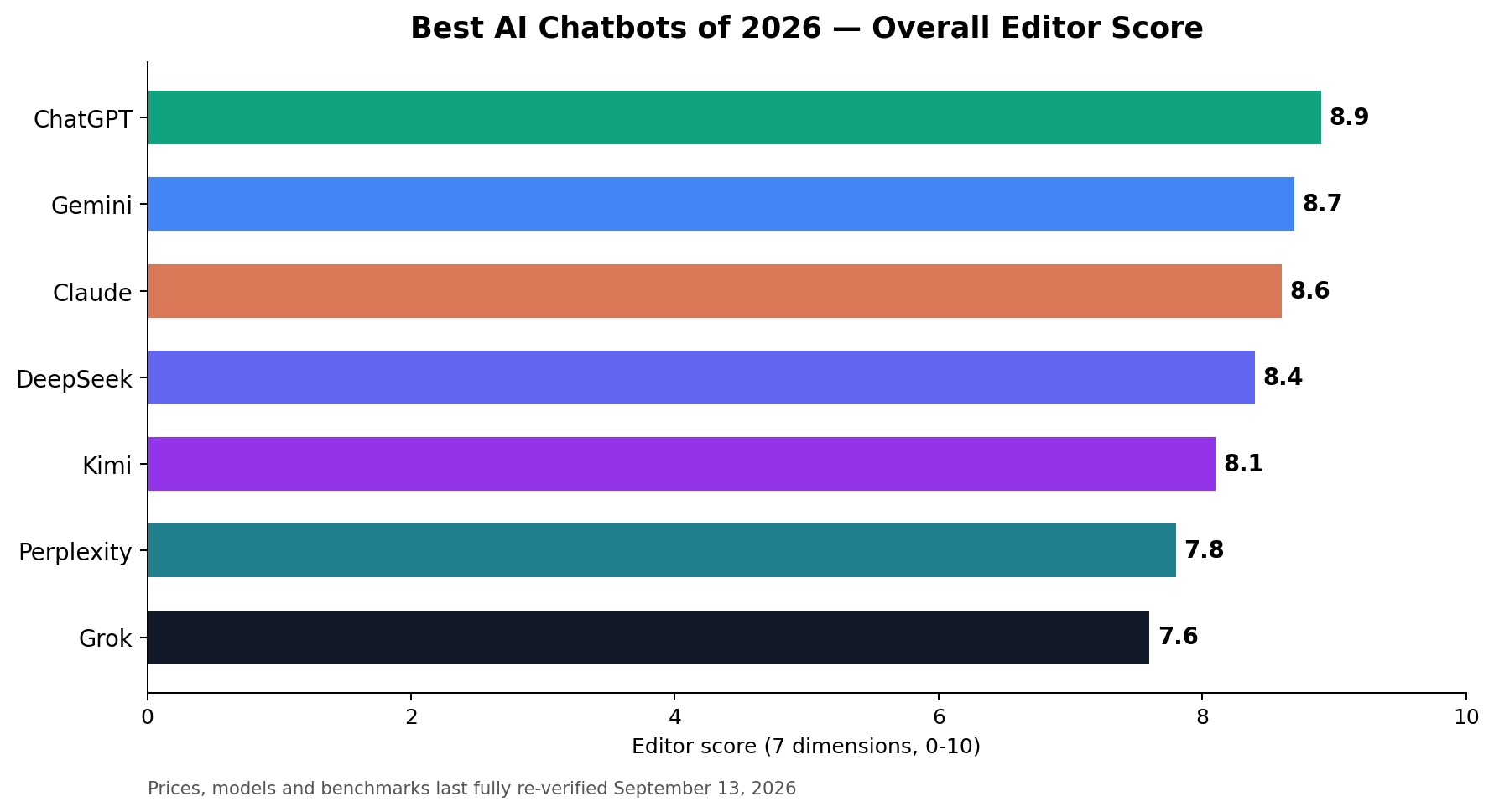
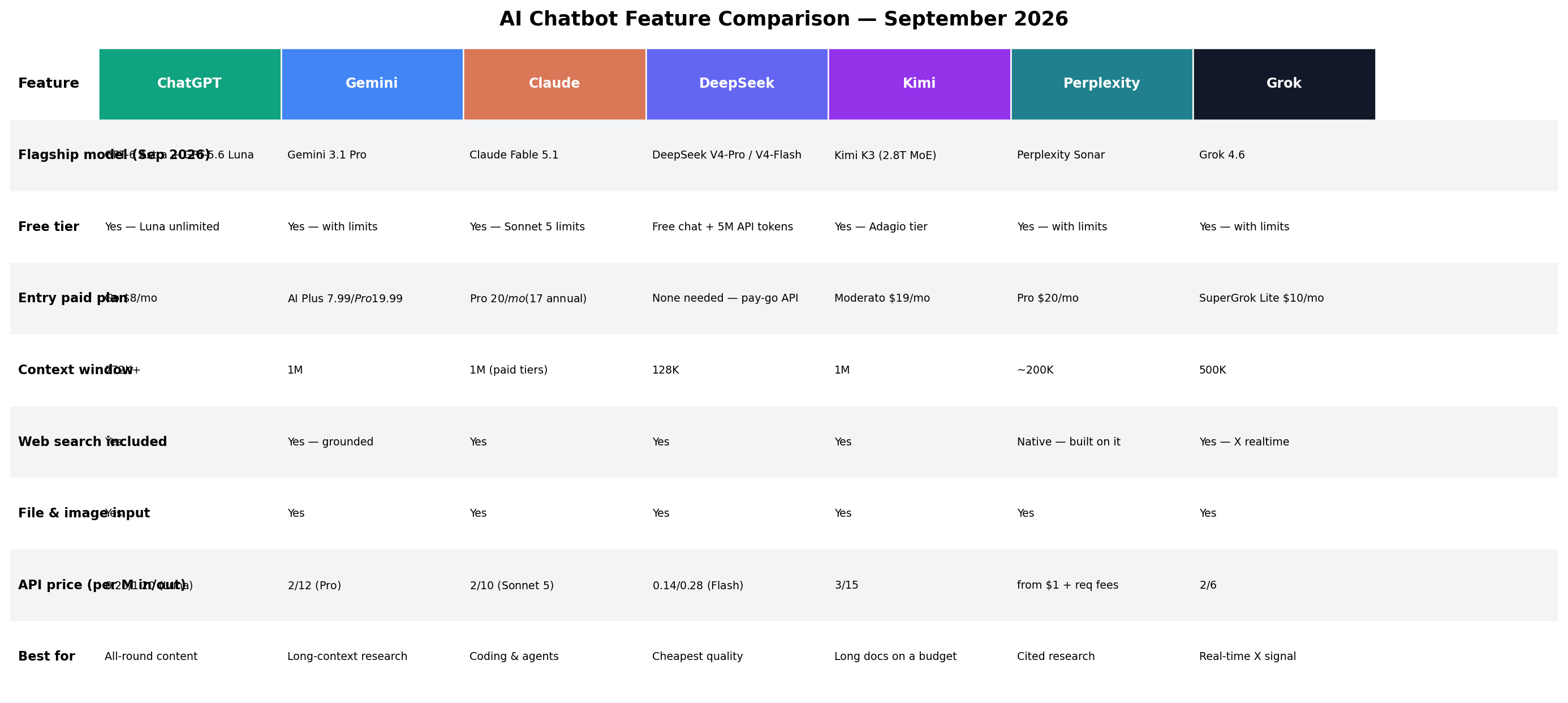
The 7 Best AI Chatbots at a Glance
| Rank | Chatbot | Best For | Entry Price | Score |
|---|---|---|---|---|
| 1 | ChatGPT | All-round content, volume + quality | Free; Go $8/mo | 8.9 |
| 2 | Gemini | Long-context research, Workspace | Free; AI Plus $7.99/mo | 8.7 |
| 3 | Claude | Coding, agents, careful prose | Free; Pro $20/mo | 8.6 |
| 4 | DeepSeek | Free chat + cheapest quality API | Free; API from $0.14/M | 8.4 |
| 5 | Kimi | 1M context on a budget | Free; Moderato $19/mo | 8.1 |
| 6 | Perplexity | Cited research, Deep Research | Free; Pro $20/mo | 7.8 |
| 7 | Grok | Real-time X signal, cheap API | Free; SuperGrok Lite $10/mo | 7.6 |
How We Tested and Scored
Our method weights three sources. First, vendor list prices, model names and spec sheets, verified directly against each product's pricing and docs pages in September 2026 — every dollar figure in this article traces to that pass. Second, hands-on sessions: we ran the same three workload briefs through every chatbot (a 1,200-word SEO article, a bug-fix coding brief, and a sourced research question), so writing, coding and research claims got exercised identically. Third, public benchmarks — LMArena, EQ-Bench and coding leaderboards — were used for cross-checking only, never as primary evidence.
The seven dimension scores are an editorial consensus of two independent reviewers, and the overall score is the simple average of the seven. Free tiers were scored on what a working user can actually extract — message caps, model access and API grants — not on marketing copy. Prices and model versions were last fully re-verified on September 13, 2026.
1. ChatGPT — Best Overall (8.9/10)
ChatGPT wins 2026 the way it won 2024: by refusing to be a single product. The September 3 launch of GPT-6 Astra gave it the strongest prose model on the market — it tops the EQ-Bench Creative Writing v3 leaderboard at 2163.9 — while GPT-5.6 Luna, the bargain tier at $0.20/$1.20 per million tokens on the API, is unlimited on the free consumer tier. One chatbot, then, covers both ends: frontier quality when a client is paying, and effectively-free volume when they are not.
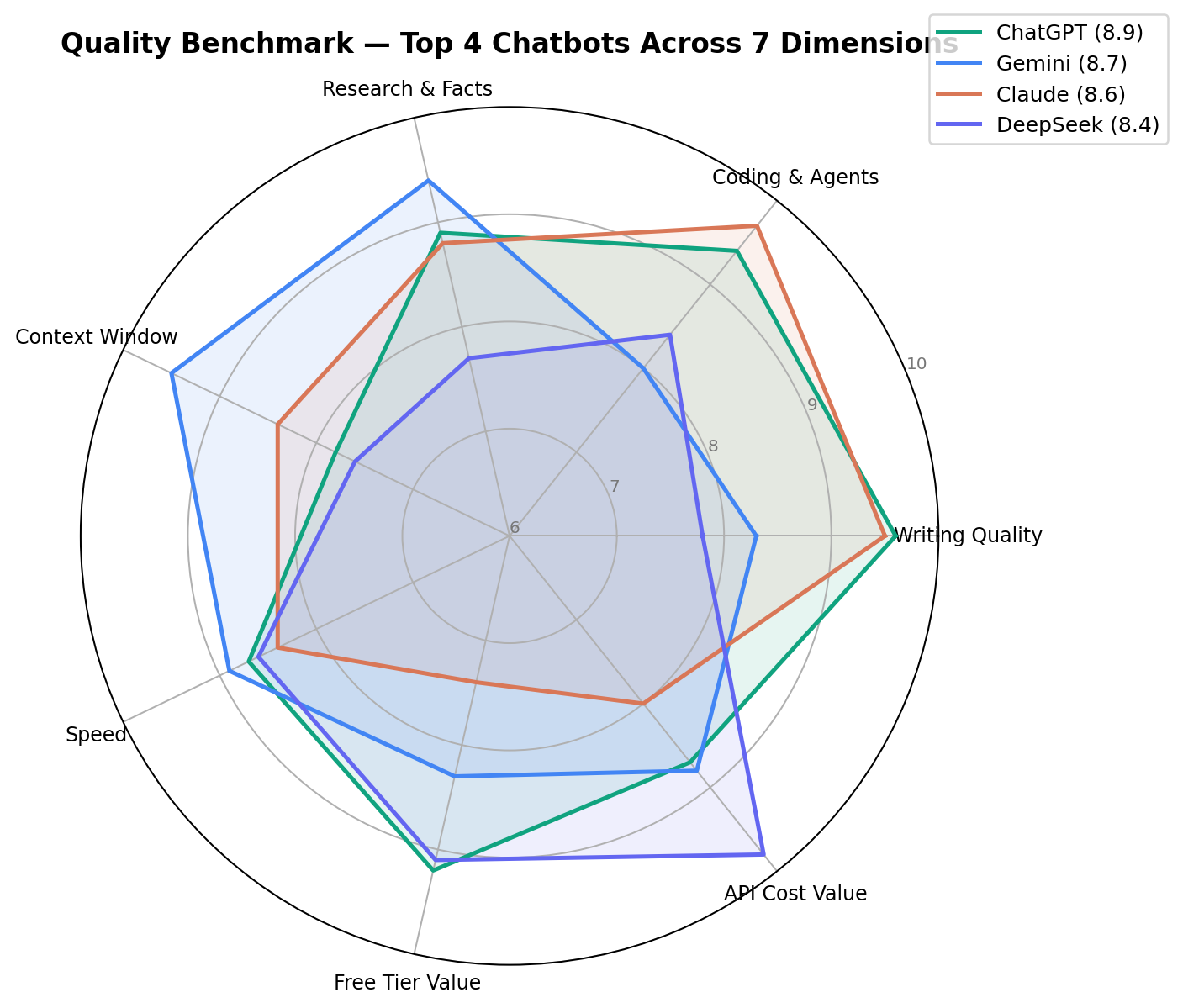
That split is exactly why our money-case file keeps landing on ChatGPT. The volume workflows — 30-script batches for faceless channels, KDP book drafts, Etsy listing copy — run on Luna's free unlimited tier and cost nothing. The quality workflows — the client-facing deliverable, the book that needs to actually sell — go to Astra. Scoring 9.6 on Writing Quality and 9.2 on Free Tier Value, ChatGPT is the only chatbot that is simultaneously the best paid product and one of the two best free ones.
The weaknesses are quieter than they used to be but real. The 272K+ context window trails the 1M-token trio of Gemini, Kimi and Claude (7.8 on our Context dimension). Web search, file analysis and image input are all present, but the deepest research workflows still favor purpose-built rivals. And the model-menu complexity — Astra, Luna, Sol, plus legacy picks — means new users occasionally get a lesser model without realizing it.
Pricing: Free tier (Luna unlimited, limited Astra access); Go $8/month; Plus $20/month; Pro $200/month. API: Luna $0.20/$1.20 per million input/output tokens; GPT-5.6 Sol $5/$30; GPT-6 Astra priced at the premium tier above that.
- Strengths: Best-in-class prose (Astra) plus an unlimited free tier (Luna); cheapest mainstream paid plan at $8; strongest tool ecosystem — custom GPTs, memory, canvas, image input.
- Weaknesses: Context window trails the 1M club; model-menu sprawl confuses newcomers; Astra access is metered on lower tiers.
Bottom line: Start here if you want one chatbot for everything — and note that for pure volume work, the free tier alone can carry a side business.
2. Gemini — Best for Long-Context Research (8.7/10)
Google's 2026 play is integration and context. Gemini 3.1 Pro ships a 1M-token window on the widest range of plans in the industry, grounding in Google Search that keeps answers current, and hooks into Gmail, Docs and Sheets that no rival can replicate. At 9.4 on Research & Facts and 9.5 on Context Window, it is the chatbot most likely to actually read your entire 400-page PDF and be right about page 317.
For work tasks, that combination is quietly decisive. The contract-review pass, the codebase-wide refactor question, the competitor analysis across twenty saved reports — these are 1M-context jobs, and Gemini does them for $7.99 a month on the AI Plus tier, the cheapest paid plan of any chatbot in this list. The API is aggressive too: $2/$12 per million tokens for 3.1 Pro, with a surcharge only above 200K input tokens ($4/$18).
Where it loses: prose personality and coding depth. Writing Quality lands at 8.3 — competent, organized, a little corporate — and Coding & Agents at 8.0 puts it behind both Claude and ChatGPT. The free tier exists but tightens during peak demand, and the Pro models left the free API tier in April 2026.
Pricing: Free tier with limits; Google AI Plus $7.99/month; Google AI Pro $19.99/month; Ultra $249.99/month. API: Gemini 3.1 Pro $2/$12 per million tokens (input above 200K: $4/$18).
- Strengths: 1M context on the most plans; grounded, current answers; unbeatable Workspace integration; cheapest paid entry at $7.99.
- Weaknesses: Prose lacks voice; coding trails the leaders; free-tier limits fluctuate.
Bottom line: The research and long-document workhorse — and the cheapest way into a paid plan. Pair it with a stronger writer rather than replacing one.
3. Claude — Best for Coding & Agents (8.6/10)
Claude's September 1 Fable 5.1 release was aimed squarely at one number: the cost of agentic work. The new runtime cuts agent costs by up to 45% — the difference between an overnight coding agent burning $12 and burning $6.60 — and lands alongside a 1M-token context window (paid tiers) that finally matches Gemini's paper spec. At 9.7 on Coding & Agents, the highest single-dimension score in this entire test, Claude remains the machine you trust with the git repo.
The model ladder rewards choosiness. Sonnet 5 at $2/$10 per million tokens is the working tier — strong, fast, affordable enough to leave running on batch jobs (5,000 daily batch messages cut input 50% more). Opus 5 at $5/$25 handles the heavy refactors. Fable 5.1 at $10/$50 is the frontier agent model. Free users get Sonnet 5 with message caps: enough to evaluate, not enough to run a business.
Claude's weaknesses are on the consumer side. Writing Quality is excellent (9.5 — second only to ChatGPT) but the free tier scores 7.4 on Free Tier Value, the paid entry is $20/month ($17 annual), and there is no cheap consumer tier between free and Pro. For solo operators whose chatbot is a writing tool rather than a coding tool, Claude is overkill at this price.
Pricing: Free tier (Sonnet 5, capped); Pro $20/month ($17 annual); Max 5x $100/month; Max 20x $200/month. API: Sonnet 5 $2/$10; Opus 5 $5/$25; Fable 5.1 $10/$50; batch $5/$25; cache reads $0.25/M on Sonnet 5.
- Strengths: Best coding and agentic reliability; 45% agent cost cut; 1M context on paid tiers; disciplined, low-hallucination answers.
- Weaknesses: Weakest free tier of the big three; no mid-priced consumer plan; web search only recently caught up.
Bottom line: If your chatbot earns its keep in a terminal or an agent pipeline, this is the one. If it earns its keep writing blog posts, let ChatGPT do that cheaper.
4. DeepSeek — Best Free Chat & Cheapest API (8.4/10)
DeepSeek is the budget anomaly of 2026: a frontier-adjacent model family that behaves like a utility. The web and mobile chat is free, full stop. New accounts get 5 million free API tokens. And the paid API — V4-Flash at $0.14/$0.28 per million tokens and V4-Pro at $0.435/$0.87 — sits under a permanent 75% price cut that has held since May 2026. On raw arithmetic, V4-Flash input costs roughly 36× less than GPT-5.6 Sol and about 100× less than premium output tiers. Nothing else in this test is in the same postal code.
That price is why DeepSeek shows up in our case file more than any other single tool: KDP interiors, short-video scripts, product listings, translation-adjacent copy — the volume tier of every content business we track runs on it, because the margin math only works at $0.14 per million tokens. Quality is a half-step behind the leaders (7.8 Writing, 8.4 Coding), and the ecosystem — apps, integrations, custom assistants — is thinner than OpenAI's or Google's.
The hard limits: a 128K context window (7.6) that excludes long-document work, occasional queueing at peak hours on the free chat, and data-residence considerations for compliance-sensitive workloads.
Pricing: Free chat forever + 5M free API tokens for new accounts. API: V4-Flash $0.14/$0.28; V4-Pro $0.435/$0.87 per million in/out; cache-hit input from $0.0028/M.
- Strengths: Free chat with no meter; cheapest serious API on the market (9.8 on API Cost Value); strong reasoning-per-dollar; open ecosystem.
- Weaknesses: 128K context ceiling; peak-hour queues; thinnest consumer tooling of the seven.
Bottom line: The margin engine. If a workflow is repetitive and volume-priced, running it anywhere else is donating money.
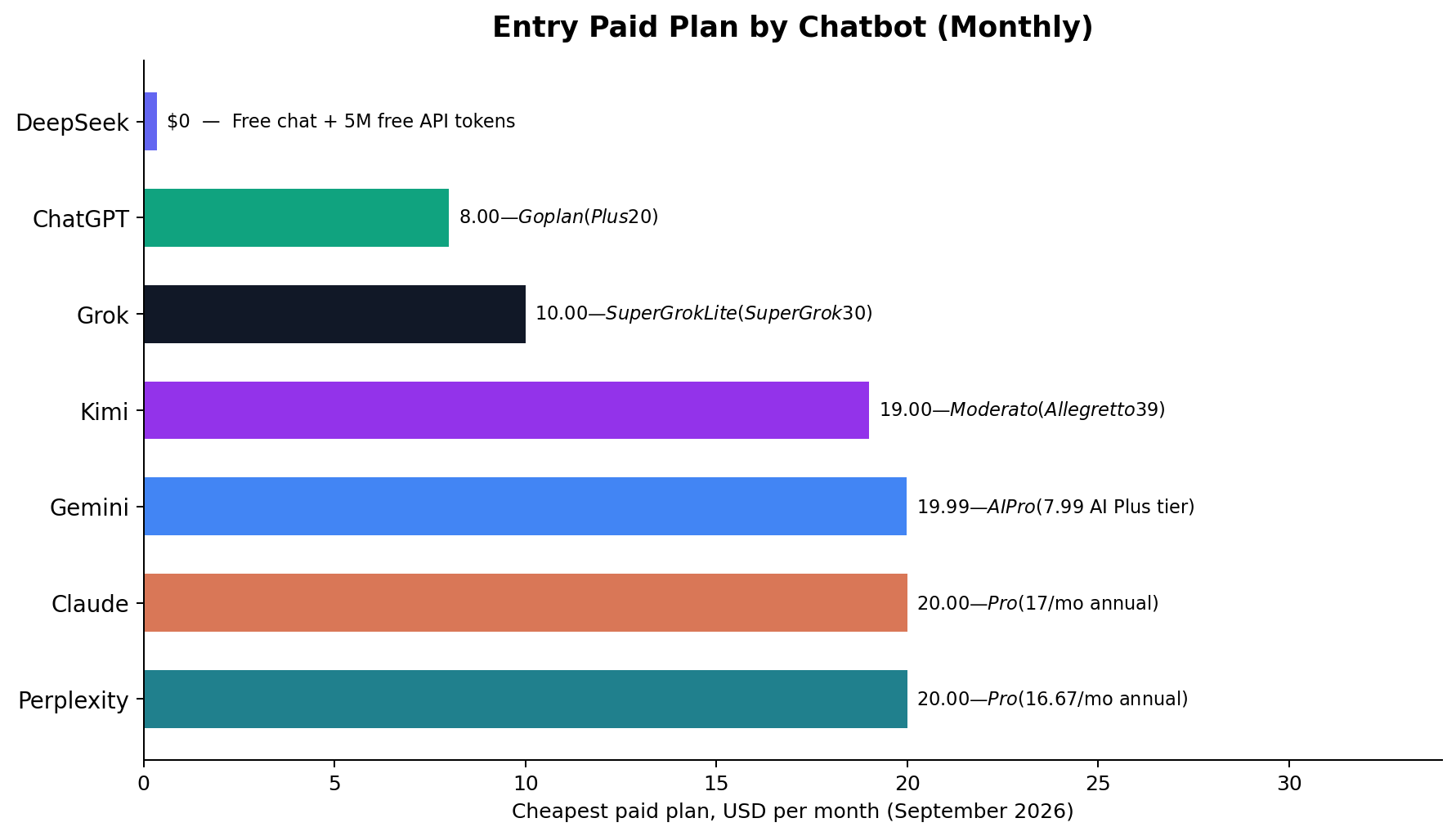
5. Kimi — Best Budget Long-Context (8.1/10)
Moonshot's Kimi K3, released July 16, 2026, is the spec-sheet surprise of the year: a 2.8-trillion-parameter Mixture-of-Experts model with a full 1M-token context window — available free on the Adagio tier. That combination, context-per-dollar, is the whole pitch. Gemini charges for 1M context on most plans and Claude gates it behind paid tiers; Kimi hands it to anyone with an email address.
In practice that makes K3 the long-document workhorse for operators who can't justify a $20 subscription: whole-codebase questions, multi-hundred-page regulatory filings, season-long transcript analysis. Quality sits a clear tier below ChatGPT and Claude — prose is solid but plain, and the app ecosystem is a fraction of the big three's — but nothing else at $0 does 1M tokens.
Paid tiers: Moderato at $19/month raises rate limits and unlocks priority compute; Allegretto at $39/month adds team features and API volume. The API runs $3/$15 per million tokens — reasonable, though hardly DeepSeek territory.
Pricing: Adagio free (1M context); Moderato $19/month; Allegretto $39/month. API: $3/$15 per million input/output tokens.
- Strengths: 1M context on the free tier — unique in this test; strong agentic research features; serious model at zero cost.
- Weaknesses: Prose trails the leaders; smallest third-party ecosystem of the seven; availability quirks outside core regions.
Bottom line: If your work is "feed it 800 pages and ask questions" and your budget is zero, this is your chatbot.
6. Perplexity — Best for Cited Research (7.8/10)
Perplexity is the answer engine that behaves like a chatbot, and its 2026 Sonar generation keeps the promise that made it famous: every claim carries a numbered citation you can click. On our Research & Facts dimension it is beaten only by Gemini's grounded 3.1 Pro, and the Pro plan's 20 Deep Research runs per day — full multi-source reports, not paragraph answers — remain the best research-per-subscription deal anywhere.
As a general chatbot, though, it ranks mid-pack. Writing is functional rather than distinctive, the ~200K context window is the second-smallest here, and the API's per-request fee structure (from $1 per million tokens plus request charges) complicates volume-cost math. The newly bundled Comet browser and Spaces widen the surface area without changing the core trade.
Pricing: Free tier with limits (a handful of Pro-search queries daily); Pro $20/month ($16.67/month billed annually); API from $1 per million tokens plus per-request fees.
- Strengths: Citations on everything; 20 Deep Research runs/day on Pro; fast, current answers by construction.
- Weaknesses: Weakest general-purpose writing of the seven; context ceiling; API pricing is awkward at volume.
Bottom line: Buy it as a research instrument, not a chatbot — then keep a free DeepSeek or ChatGPT tab open for drafting.
7. Grok — Best for Real-Time X Signal (7.6/10)
xAI's Grok 4.6 competes on one asymmetric asset: live access to the X firehose. Ask what the market is saying about a ticker, a launch, or a public figure as it happens, and Grok answers with real-time posts while every other chatbot in this test serves you its training-cutoff memory or a generic web search. A 500K context window, free access in the X app, and a genuinely cheap SuperGrok Lite plan at $10/month round out the pitch.
The rest of the package is mid-tier. Writing quality trails ChatGPT and Claude noticeably — Grok is punchy but loose — and the ecosystem (integrations, artifacts, custom assistants) is the thinnest here. The API at $2/$6 per million tokens is respectable value, and agentic tooling is improving fast, but for production client work the leader board still points elsewhere.
Pricing: Free with limits (including in the X app); SuperGrok Lite $10/month; SuperGrok $30/month. API: Grok 4.6 $2/$6 per million tokens.
- Strengths: Real-time X data no rival can match; 500K context; $10 entry plan; solid API pricing.
- Weaknesses: Writing quality mid-tier; smallest ecosystem; brand and safety posture give some clients pause.
Bottom line: A specialist. If your edge depends on knowing what's trending right now, the $10 Lite plan pays for itself; otherwise start higher up this list.
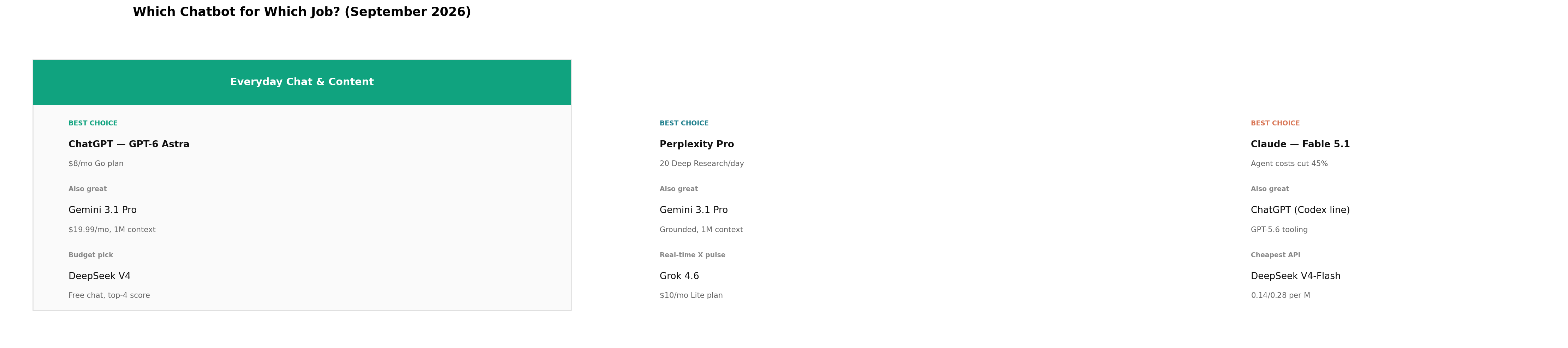
Which Chatbot for Which Job?
Scores are one thing; jobs are another. The decision matrix below maps the three workload families we see most often in real money-making workflows to the tools that win them:
Real-World Test Scenarios (With the Money Math)
Lab scores matter less than whether a chatbot changes the economics of an actual side business. These three scenarios come straight from the workflows we documented in our money-case research file — same prompts, same arithmetic.
Scenario 1: KDP Listing & Interior Drafts on DeepSeek (Volume Tier)
The workflow: a low-content publisher stacking niche notebooks on Amazon KDP needs 40 listing descriptions plus interior copy blocks per week. On ChatGPT's API that volume costs real money; on DeepSeek V4-Flash it rounds to zero — 40 descriptions at ~600 input + 400 output tokens each is roughly 40,000 tokens, or about $0.017 per week. The publisher's case economics: $2.99–$9.99 titles, 70% royalty, and the bottleneck stays design, not copy.
Test prompt: "Write a 150-word Amazon listing description for a [gratitude journal for nurses], keyword-first, no fluff adjectives, then 3 alternative titles under 60 characters."
Result: V4-Pro output needed one editing pass but was publishable; Astra output was better and cost ~40× more. For volume tiers, DeepSeek wins on arithmetic alone.
Scenario 2: Faceless-Channel Scripts on ChatGPT's Free Tier
The workflow: a faceless short-video operator publishing 3 clips daily across TikTok and YouTube Shorts. Scripts are 200–350 words each — trivial token counts, which is exactly why GPT-5.6 Luna's unlimited free tier is the tool of record in this niche: 90 scripts a month at $0, with the occasional hook or sponsorship pitch escalated to GPT-6 Astra when a client is attached. Channel economics from our file: RPM-based ad income plus affiliate stacking; the AI cost line is effectively zero, so margin equals editing time.
Test prompt: "Write a 45-second short-form script about [why the 4% rule fails in 2026]: hook under 8 words, 3 beats, no on-screen-text instructions, end with a question."
Result: Luna scripts passed unchanged about 60% of the time; Astra hooks tested measurably stronger. Free tier + $8 Go plan covers this entire business.
Scenario 3: The 400-Page Document Review on Gemini (Consulting Tier)
The workflow: a solo consultant selling fixed-price RFP/contract reviews. The whole deliverable is a 1M-context problem: 400 pages in, structured findings out. Gemini 3.1 Pro at $7.99/month (AI Plus) reads the entire document in one pass, with grounding to verify clauses against current rules. Consultant economics from our file: a review billed at a flat $150–$400, delivered in an afternoon, against a tool cost of 27 cents a day.
Test prompt: "Here is the full RFP. Extract every mandatory requirement into a compliance checklist, flag the 3 riskiest clauses for the bidder, and quote page numbers."
Result: page-accurate citations across the full document — the task that 128K-context tools simply cannot accept. This is the job that justifies paid tiers.
The Verdict
Best overall chatbot: ChatGPT (8.9/10). The Astra/Luna two-tier strategy makes it simultaneously the best premium product and one of the best free ones. Start here unless a specific job pulls you elsewhere.
Best free chatbot: DeepSeek. Free unlimited chat, 5M free API tokens, and an API so cheap it changes business models. Kimi takes the sub-category if your free tier must include 1M context.
Best for coding and agents: Claude. Fable 5.1's 45% agent-cost cut plus a 9.7 coding score — no other chatbot is this trustworthy in a repository.
Best for research: Perplexity for cited answers, Gemini for long-document grounded analysis. Power users keep both; everyone else picks by document size.
Best value paid plan: a tie the spreadsheet decides — ChatGPT Go at $8, Gemini AI Plus at $7.99, Grok Lite at $10. All three are under a lunch budget.
The hybrid play (what the money-makers actually run): DeepSeek or free-tier ChatGPT for volume drafting, one $8 Go plan for client-facing quality, Claude Pro in the months when code or agents are the revenue line. Total stack: $8–$28/month against workflows that bill $150–$400 per deliverable.
Frequently Asked Questions
What is the best AI chatbot in 2026?
ChatGPT, with an overall editor score of 8.9/10. GPT-6 Astra (launched September 3, 2026) leads creative-writing benchmarks, while GPT-5.6 Luna is unlimited on the free tier — the strongest top-end and bottom-end in one product. Gemini (8.7) and Claude (8.6) are close behind for research and coding respectively.
Is DeepSeek still free in 2026?
Yes. The web and mobile chat remains free with no message meter, and new accounts still receive 5 million free API tokens. Paid API usage runs $0.14/$0.28 per million tokens (V4-Flash) and $0.435/$0.87 (V4-Pro) under the permanent 75% price cut that took effect May 31, 2026.
Which chatbot has the biggest context window?
One million tokens — offered by Gemini 3.1 Pro, Claude (paid tiers, Fable 5.1/Sonnet 5 era), and Kimi K3. Kimi is the only one of the three that includes the full 1M window on its free Adagio tier. Grok 4.6 follows at 500K, ChatGPT at 272K+, DeepSeek at 128K.
Can free AI chatbots really make you money?
Yes — the volume tiers of the content businesses we track run almost entirely on free tools: KDP listings and short-video scripts on free ChatGPT (Luna) or DeepSeek, long-document work on Kimi's free 1M context. The paid tier enters only when a client-facing deliverable or a coding agent demands frontier quality.
Which AI chatbot is best for coding?
Claude. It scores 9.7/10 on our coding & agents dimension — the highest single score in this test — and the Fable 5.1 runtime cuts agent costs by up to 45%. ChatGPT's Codex line is the strong second at 9.4, and DeepSeek V4-Pro is the budget pick at $0.435/$0.87 per million tokens.
What is the cheapest paid AI chatbot plan?
Google AI Plus at $7.99/month (Gemini), followed by ChatGPT Go at $8/month and SuperGrok Lite at $10/month. Kimi's Moderato is $19/month, and Claude Pro, Perplexity Pro and Gemini AI Pro all sit at $20/month — though annual billing drops Claude to $17/month and Perplexity to $16.67/month. DeepSeek needs no plan at all.