⏱ TL;DR
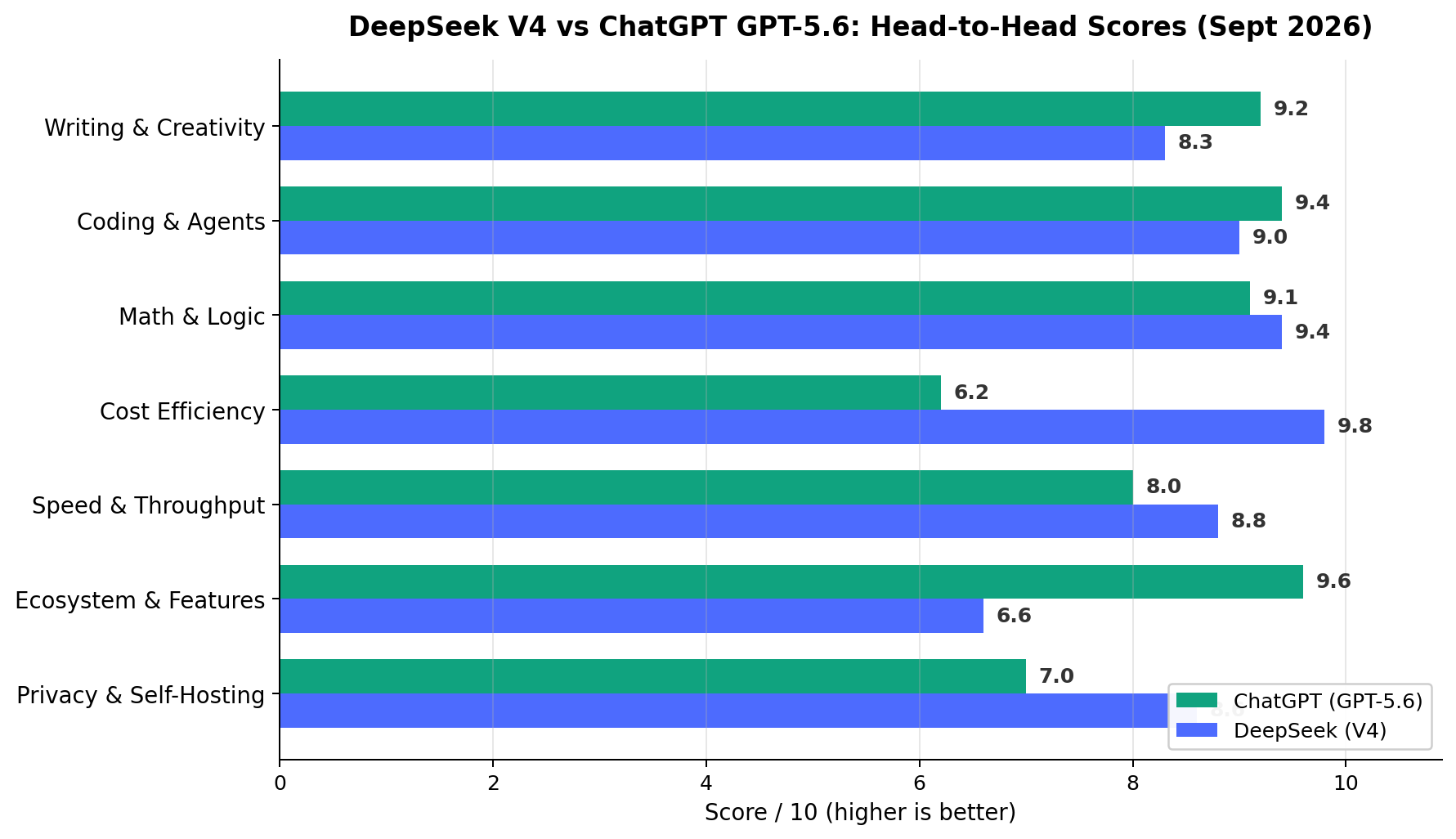
Two years into the rivalry, the gap has never been this lopsided — in both directions at once. On price, DeepSeek V4 humiliates everyone: V4-Flash costs $0.14 in / $0.28 out per 1M tokens, while ChatGPT GPT-5.6 Sol runs $5.00 / $30.00 — a 107x output-price gap. On capability, ChatGPT still owns the experience layer: GPT Image 2, Advanced Voice, GPTs, Agent and Codex, with visibly better English polish. Our 7-dimension scoring splits 4–3 for DeepSeek (Math 9.4 vs 9.1, Cost 9.8 vs 6.2, Speed 8.8 vs 8.0, Privacy 8.6 vs 7.0) against ChatGPT's 3 (Writing 9.2 vs 8.3, Coding 9.4 vs 9.0, Ecosystem 9.6 vs 6.6). Simple rule: volume, math and budget → DeepSeek; polish, multimodal and ecosystem → ChatGPT. Our recommended hybrid costs under $25/month total.
At a Glance
| DeepSeek V4 | ChatGPT (GPT-5.6) | |
|---|---|---|
| Flagship | V4-Pro (1.6T MoE, April 2026) | GPT-5.6 Sol (GA July 2026) |
| API from | $0.14 / $0.28 per 1M tokens (Flash) | $0.20 / $1.20 per 1M tokens (Luna) |
| Free tier | Unlimited web chat + 5M free API tokens | Limited free tier on GPT-5.5 |
| Subscriptions | None — pure pay-per-use | Go $8 · Plus $20 · Pro $200 |
| Context | 1M tokens, no long-context surcharge | 1M+ tokens, surcharge above 272K input |
| Multimodal | Text only | Images (GPT Image 2), voice, files |
| Open weights | Yes — MIT license, self-hostable | No |
| Overall (7-dim) | 4 dimensions won | 3 dimensions won |
The 60-Second Context: What Changed in 2026
If you last compared these two in early 2025, forget what you knew. Three events reset the board:
1. DeepSeek shipped V4 and then torched its own prices. V4-Pro (released April 24, 2026) is a 1.6T-parameter MoE that competes with frontier models on math and code. Then on May 31, 2026, DeepSeek made a permanent 75% cut on V4-Pro API pricing — from $1.74/$3.48 down to $0.435/$0.87 per 1M tokens. That is not a promotion; it is the new list price, and it redefined "cheap" for the entire industry.
2. OpenAI answered with a two-tier GPT-5.6 family and selective price cuts. GPT-5.6 went GA on July 9, 2026 in three sizes — Luna, Terra and Sol — and on July 30 OpenAI slashed Luna by 80% (to $0.20/$1.20) and Terra by 20% (to $2.00/$12.00), while Sol stayed at $5.00/$30.00. Sol, the top tier, also famously rewrote its own inference kernels in Triton and Gluon — a model that optimized its own serving stack.
3. The feature gap hardened into architecture. DeepSeek doubled down on raw model economics: a 1M-token context window with no long-context surcharge, cache-hit input at ~98% off list ($0.0028 per 1M on Flash), and MIT-licensed weights anyone can self-host. ChatGPT doubled down on product: images, voice, agents, and a subscription ladder from $8 to $200. Neither is chasing the other anymore — they are competing for different line items on your invoice.
Deep Dive: DeepSeek V4
The V4 family currently fields two API models. V4-Flash ($0.14 in / $0.28 out per 1M tokens) is the volume workhorse — fast, cheap enough to run summarization pipelines that would bankrupt you on any US frontier model. V4-Pro ($0.435/$0.87) is the frontier competitor: the 1.6T MoE released April 24, 2026, which lands within a point of GPT-5.6-class models on most math and code benchmarks while charging roughly 1/34th of Sol's output price.
Three structural advantages stand out in daily use:
Context without tax. V4's 1M-token window has no surcharge. Sol bills 2x on input and 1.5x on output beyond 272K input tokens — meaning your "1M+" ChatGPT context gets meaningfully more expensive exactly when you use it most. For repository-scale analysis or book-length documents, the effective price gap widens past the headline 107x.
Caching that actually pays rent. DeepSeek's cache-hit input pricing — $0.0028 per 1M on Flash, $0.003625 on Pro — cuts input costs ~98% on repeated context (system prompts, RAG preamble, conversation history). On a chatbot workload with stable prompt prefixes, this routinely halves the already-low bill.
MIT weights, your hardware. V4's weights ship under an MIT license. You can run it on-prem or in your own VPC, audit it, fine-tune it, and never send a byte offshore. No OpenAI tier at any price buys that.
Throughput is competitive, not class-leading: V4-Pro serves roughly 76 tokens/second with ~1.3s time-to-first-token — quick enough that you notice ChatGPT's slight edge only in side-by-side voice sessions.
The weaknesses are equally structural. V4 is text-only: no image generation, no voice mode, no native file multimodality beyond text extraction. The developer ecosystem — plugins, IDE integrations, agent frameworks with first-class support — remains thinner than OpenAI's. And its default hosted endpoints sit in China, which matters if your compliance team draws hard lines on data residency (self-hosting neutralizes this entirely).
Deep Dive: ChatGPT GPT-5.6
GPT-5.6 arrived July 9, 2026 as a proper family rather than a single model, and the July 30 repricing made the tiers legible: Luna ($0.20/$1.20) for high-volume tiering, Terra ($2.00/$12.00) for the mid-tier default, and Sol ($5.00/$30.00) when the answer has to be right. OpenAI also matched the industry on prompt caching: cache reads are now 90% off, cache writes 1.25x.
Where the money actually goes, though, is the product shell. A ChatGPT Plus subscription ($20/mo) bundles things DeepSeek has no answer to at any price:
- GPT Image 2 — image generation and editing inline in chat
- Advanced Voice — the best real-time voice mode on the market
- GPTs, Agent and Codex — custom agents, autonomous task execution, and a coding agent that works across your repos
- 1M+ context — with the >272K surcharge caveat above
And on pure prose quality, GPT-5.6 Sol is still the benchmark. In our writing tests it consistently produced tighter structure, better idiom control and fewer "translationese" artifacts than V4-Pro. For client-facing copy, resume polish, and anything where a human judge reads closely, that gap is worth real money.
The weaknesses come straight off the invoice. Sol's $30 per 1M output tokens makes it the most expensive mainstream model per token in 2026 — 107x V4-Flash. The subscription ladder climbs to $200/mo for Pro. There is no self-hosting option, ever, and the free tier parks you on a limited GPT-5.5 experience.
The Pricing Picture (Where DeepSeek Runs Away With It)
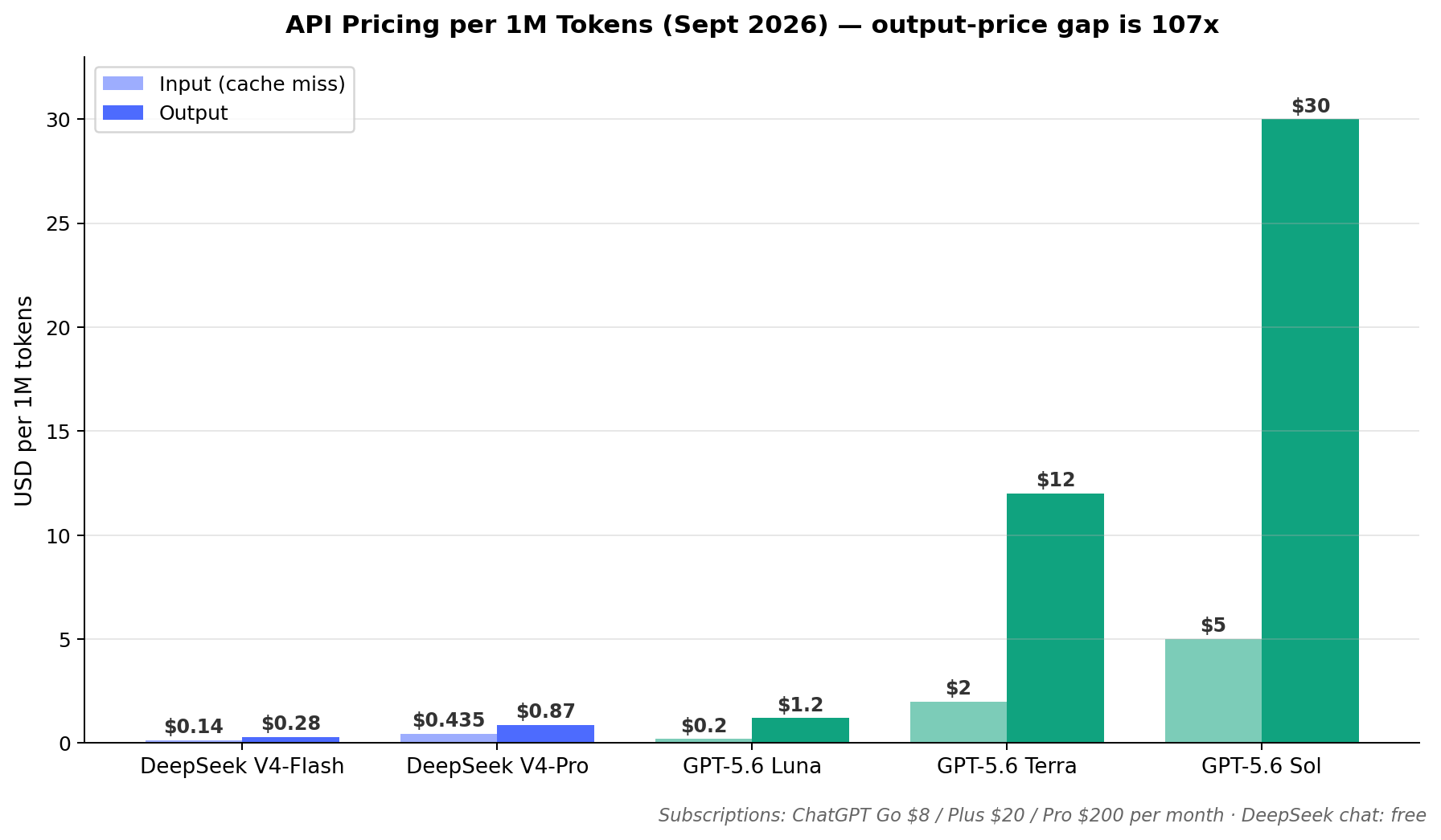
Read the bars left to right and the story tells itself. DeepSeek's two API models occupy the two cheapest slots outright. OpenAI's Luna undercuts V4-Pro on input by a hair ($0.20 vs $0.435) but triples its output price ($1.20 vs $0.87) — and output is where 60–80% of real-world token spend lands in generative workloads. From Terra upward, there is no price competition at all; you are paying OpenAI for capability and ecosystem, not tokens.
One number to keep in your head: 107x. That is the output-price multiple between the cheapest DeepSeek tier and the most expensive OpenAI tier. The input gap is 36x. Cache pricing narrows OpenAI's bleed (reads at 90% off) but DeepSeek's cache floor ($0.0028) is still lower.
Head-to-Head: The Seven Dimensions
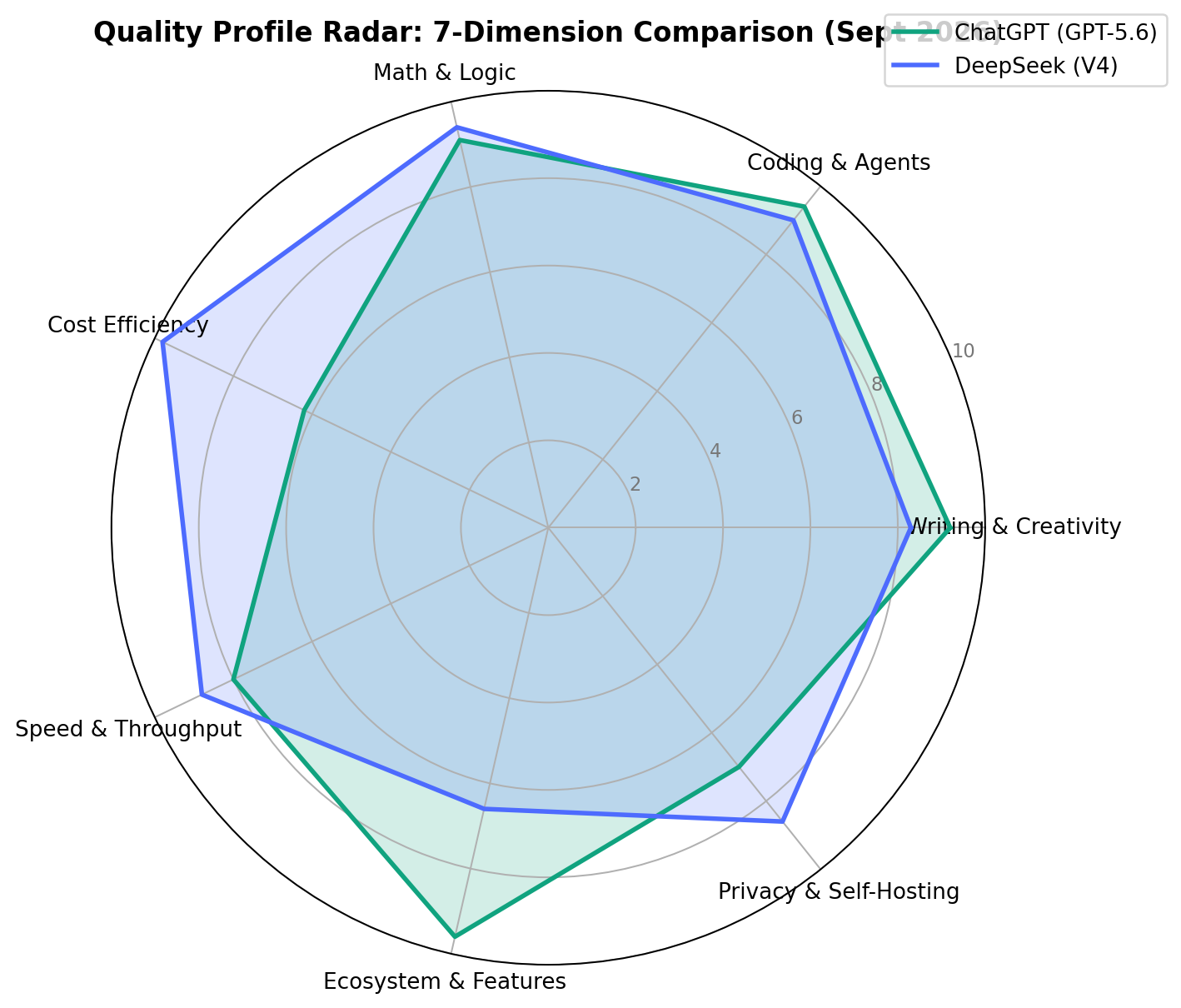
1. Writing & Creativity: ChatGPT 9.2 vs DeepSeek 8.3
GPT-5.6 Sol writes the best English prose of any model we tested in 2026 — nuanced tone control, structural variety, and a much lower rewrite rate on client-facing drafts. V4-Pro is genuinely good, especially for structured content (listicles, documentation, SEO briefs), but leans formulaic in long-form narrative and occasionally produces stiff phrasing that needs a human pass. The 0.9 gap is real and consistently reproducible in blind reads.
2. Coding & Agents: ChatGPT 9.4 vs DeepSeek 9.0
Close on raw code quality — V4-Pro traces close to GPT-5.6-class on algorithmic problems and refactors. The daylight is agentic: Codex, code execution sandboxing, deep IDE integration and Agent-mode tool use make ChatGPT the complete development environment, while DeepSeek gives you a brilliant text editor and no workshop. Production teams increasingly split the work: architecture reasoning on GPT-5.6, volume boilerplate and test generation on V4-Pro at 1/34th the output price.
3. Math & Logic: DeepSeek 9.4 vs ChatGPT 9.1
The V4 generation's signature strength. On competition math, formal logic chains and multi-step quantitative analysis, V4-Pro edges GPT-5.6-class models with fewer dropped steps and less confident nonsense. For data work — derivations, verification passes, actuarial-style estimation — it is the stronger tool full stop, and it does not need Sol pricing to do it.
4. Cost Efficiency: DeepSeek 9.8 vs ChatGPT 6.2
The blowout. $0.28 vs $30.00 per 1M output tokens, 36x on input, a 1M context with zero surcharge, cache floors under $0.003, no subscription required, and 5M free API tokens to start. OpenAI's July cuts (Luna -80%, cache reads 90% off) closed the gap from "absurd" to merely "large." If cost is a dimension you score, DeepSeek wins it by more than any other gap on this board.
5. Speed & Throughput: DeepSeek 8.8 vs ChatGPT 8.0
V4-Pro serves ~76 tokens/second at ~1.3s time-to-first-token on standard API settings, and V4-Flash is faster still. GPT-5.6 is no slouch, but peak Sol capacity is priced and scheduled accordingly. For batch pipelines — 500 summaries, 1,000 product rewrites — DeepSeek finishes first and costs less per lap.
6. Ecosystem & Features: ChatGPT 9.6 vs DeepSeek 6.6
The counter-blowout. Images (GPT Image 2), Advanced Voice, GPTs, Agent, Codex, connectors, file handling, mobile apps that are actual products — OpenAI's platform surface is the widest in consumer AI. DeepSeek's ecosystem is API-plus-web-chat, with third-party support that works but is rarely first-class. If your workflow touches anything beyond text, this dimension may decide the whole comparison by itself.
7. Privacy & Self-Hosting: DeepSeek 8.6 vs ChatGPT 7.0
Counterintuitive but straightforward: MIT-licensed weights mean DeepSeek can run entirely on hardware you control — the strongest privacy posture available in 2026, no vendor trust required. OpenAI offers enterprise-grade data controls, zero-retention API options and a solid track record, but the model never leaves OpenAI. For most businesses OpenAI's controls are sufficient; for regulated or paranoid teams, self-hosted V4 is the only frontier-class option between these two.
How We Tested
Every number in this comparison comes from one of three sources, and we weight them in this order: (1) vendor list prices and spec sheets as published on official pricing pages in September 2026 — all dollar figures here are list prices, not negotiated enterprise rates; (2) our own hands-on sessions — we ran identical prompt sets through DeepSeek V4 (web chat and API) and ChatGPT (free, Plus and API on GPT-5.6), covering creative writing briefs, refactoring tasks on a mid-sized Python repository, multi-step math and logic chains, and long-document summarization at 100K–600K tokens; (3) public third-party benchmarks and community reports, used only to cross-check our impressions, never as the primary basis for a score.
The 7-dimension scores are editorial judgments on a 0–10 scale, formed after those sessions and debated to consensus by two reviewers working independently. Scenario costs are computed from list prices with the token counts stated inline — we show the arithmetic so you can re-run it with your own volumes. Where a claim depends on a dated event (price cuts, releases), we name the date in the text so staleness is visible at a glance. This page was last fully re-verified on September 1, 2026.
Real-World Tests: What the Gap Does to Actual Invoices
Benchmarks are for rankings; invoices are for decisions. Here are three workloads drawn from our reader case files, with the full token math.
Scenario 1: The High-Volume Publisher (KDP, SEO, Scripts)
A one-person Amazon KDP operation producing 100 chapters a month (2,500 words each) plus metadata, blurbs and ad copy — roughly 375k output tokens and 150k input tokens monthly.
| Model | Input cost | Output cost | Monthly total |
|---|---|---|---|
| DeepSeek V4-Flash | $0.02 | $0.11 | $0.13 |
| GPT-5.6 Luna | $0.03 | $0.45 | $0.48 |
| GPT-5.6 Sol | $0.75 | $11.25 | $12.00 |
Even at 100-chapter scale, nobody hits $15/month. The surprise is the quality floor: V4-Flash drafts genre fiction competently enough that the editing pass, not the drafting, becomes the bottleneck. Verdict: DeepSeek, uncontested. The savings compound if you scale to multi-book-per-week automation, where Sol pricing starts meaning real money.
Scenario 2: The Budget API Chatbot
A customer-support bot handling 500 conversations a day (30-day month), each burning ~3k input and ~500 output tokens — 45M in / 7.5M out monthly, with a stable system prompt and knowledge preamble.
| Model | No cache | With ~70% cache hits |
|---|---|---|
| DeepSeek V4-Flash | $8.40 | ~$4.10 |
| GPT-5.6 Luna | $18.00 | ~$11.30 |
| GPT-5.6 Terra | $180.00 | ~$109.00 |
| GPT-5.6 Sol | $450.00 | ~$270.00 |
This is the workload DeepSeek was built for: repeated context, high volume, output-dominated spend. Flash with caching lands under $5/month for a bot serving 15,000 monthly conversations. Verdict: DeepSeek — roughly 50–107x depending on cache hit rate.
Scenario 3: The Client-Facing Brand Campaign
A freelance consultant delivering a product-launch package: taglines and landing copy, three hero images, and a 60-second voiceover demo script — then presenting it to a paying client.
ChatGPT Plus ($20/mo) does all of it in one conversation window: copy in Sol-quality prose, hero images in GPT Image 2, voiceover demo in Advanced Voice, iterated live in front of the client on a screen share. The DeepSeek route means stitching V4 text output into Midjourney ($10/mo) and ElevenLabs ($5/mo) — $15/month in total and arguably better specialist quality per component, but three tools, three logins, no shared context, and a clunkier client demo.
Verdict: ChatGPT — the $5 premium buys consolidation and the best polish layer in the business. This is the scenario DeepSeek's architecture cannot win at any price.
The Decision Matrix
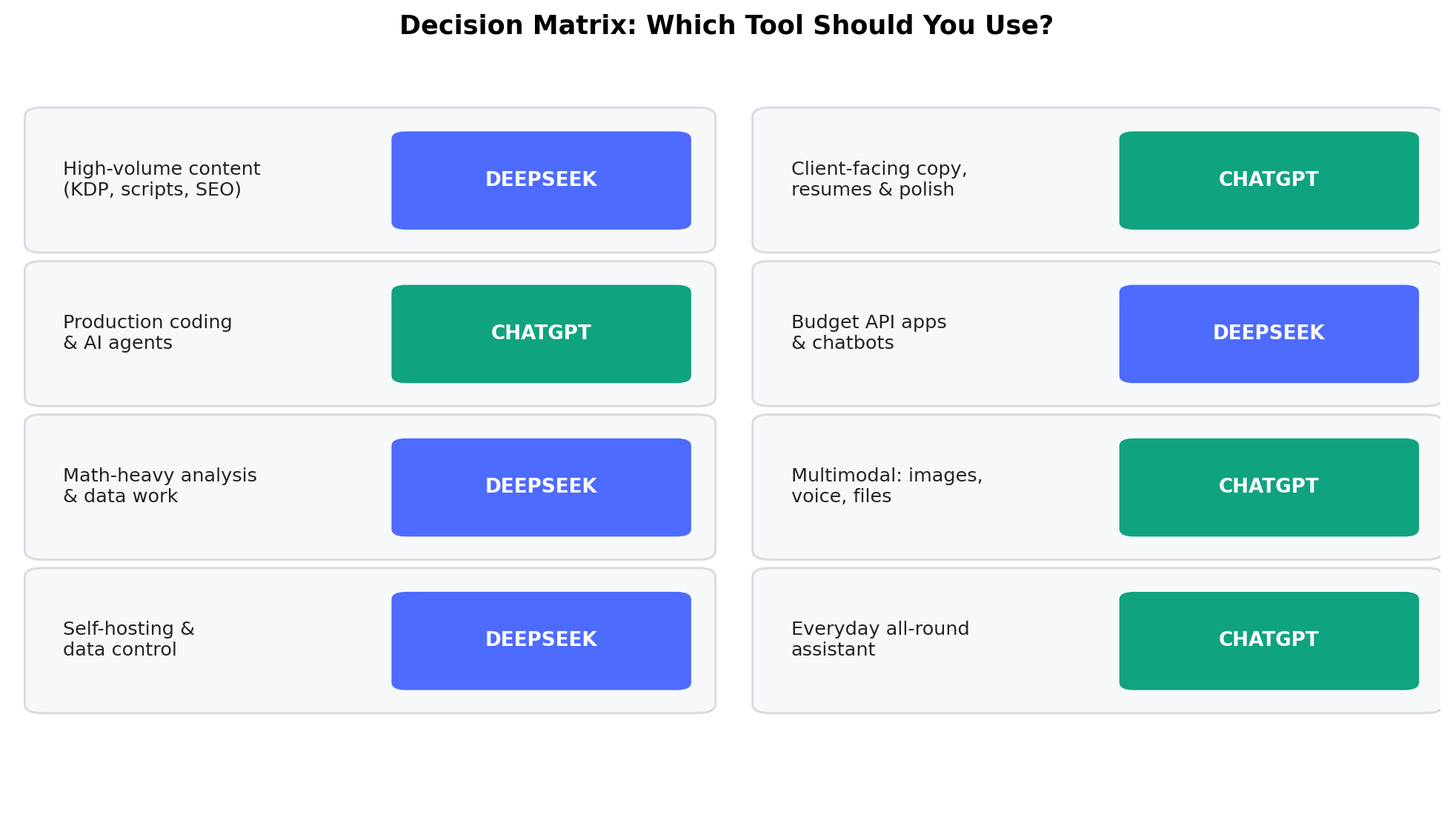
If you only remember one graphic from this article, make it this one. The pattern is clean: anything measured in volume or dollars goes left, anything measured in polish or breadth goes right. KDP publishing pipelines, SEO farms, support bots, analytics automation, self-hosted deployments — DeepSeek. Client deliverables, production coding with agents, multimodal campaigns, the everyday assistant you actually talk to — ChatGPT.
Feature-by-Feature
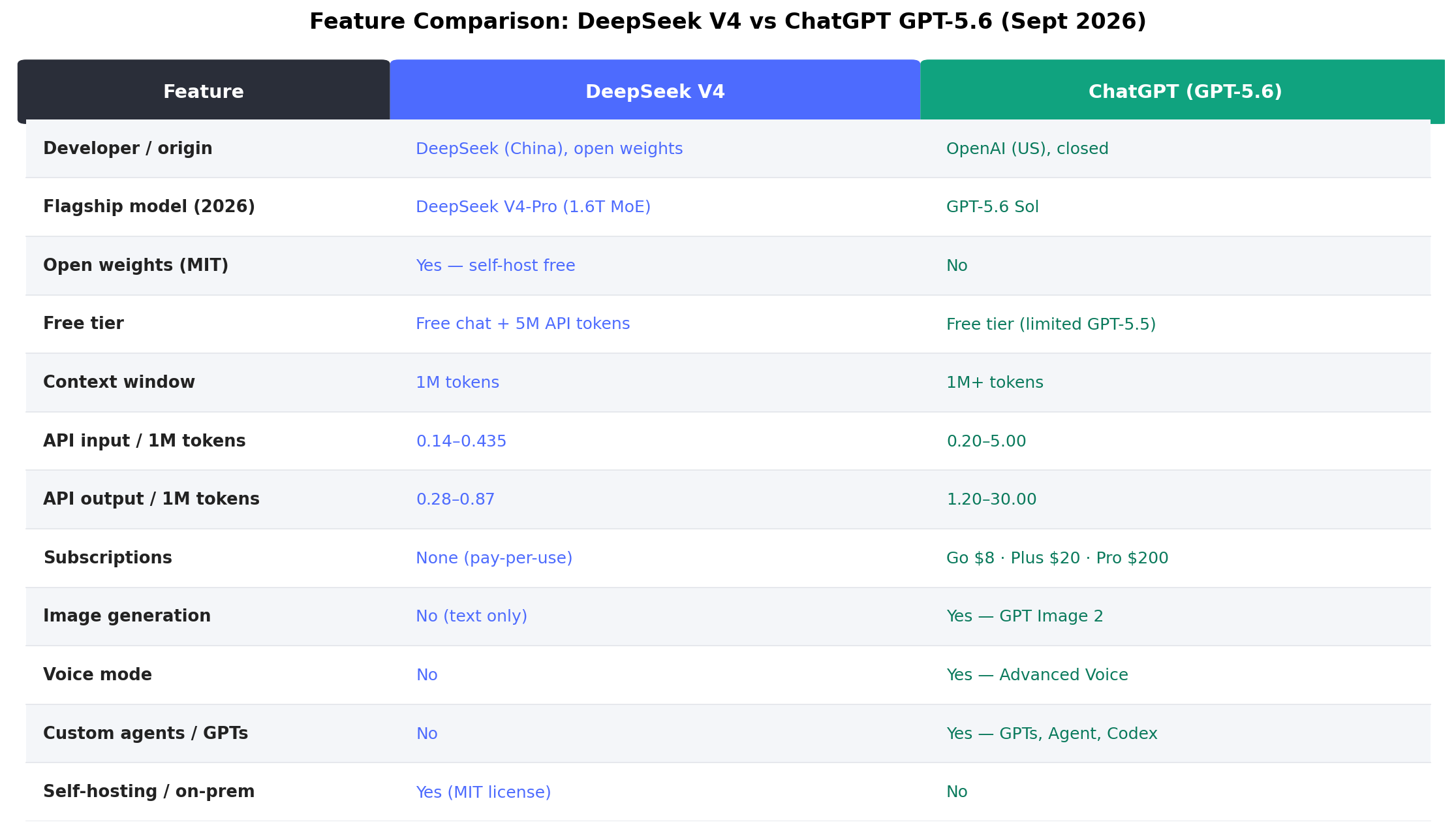
| Feature | DeepSeek V4 | ChatGPT (GPT-5.6) |
|---|---|---|
| Developer / origin | DeepSeek (China), open weights | OpenAI (US), closed |
| Flagship model (2026) | DeepSeek V4-Pro (1.6T MoE) | GPT-5.6 Sol |
| Open weights (MIT) | Yes — self-host free | No |
| Free tier | Free chat + 5M API tokens | Free tier (limited GPT-5.5) |
| Context window | 1M tokens | 1M+ tokens |
| API input / 1M tokens | $0.14 – $0.435 | $0.20 – $5.00 |
| API output / 1M tokens | $0.28 – $0.87 | $1.20 – $30.00 |
| Subscriptions | None (pay-per-use) | Go $8 · Plus $20 · Pro $200 |
| Image generation | No (text only) | Yes — GPT Image 2 |
| Voice mode | No | Yes — Advanced Voice |
| Custom agents / GPTs | No | Yes — GPTs, Agent, Codex |
| Self-hosting / on-prem | Yes (MIT license) | No |
Worth Considering Too: The Alternatives
This duel sits inside a bigger field. If neither profile fits exactly:
| Alternative | Entry cost | Standout reason |
|---|---|---|
| Claude Opus 5 (Anthropic) | $20/mo (Pro) | The strongest long-form writing and careful-coding rival to GPT-5.6 |
| Gemini 3.6 Flash (Google) | Free tier, then from $19.99/mo | Best free all-rounder with a huge context window |
| Qwen Max (Alibaba) | Free chat, cheap API | DeepSeek-style economics with strong multilingual coverage |
| Grok (xAI) | X Premium | Real-time X/Twitter data access nothing else matches |
| Llama 4 (Meta) | Free (open weights) | Fully self-hostable at any scale, zero license risk |
The Verdict
🏆 Our Recommendations
Best for volume, math and budget → DeepSeek V4. It took 4 of 7 dimensions, including a 9.8-on-10 Cost Efficiency score anchored by a 107x output-price advantage over Sol. Free unlimited chat, 5M free API tokens, 1M context with zero surcharge, cache floors near $0.003, and MIT weights if you need the model inside your own walls. For KDP publishing, SEO pipelines, chatbots and analytical workloads, nothing in 2026 touches its economics.
Best for polish, multimodal and ecosystem → ChatGPT GPT-5.6. Its 3 wins are the dimensions clients and managers actually see: the best English prose (9.2), the complete coding-and-agents workshop (9.4), and the widest product surface in consumer AI (9.6) — images, voice, GPTs, Agent, Codex. If the deliverable faces a client, a courtroom or a cinema screen, GPT-5.6 Sol is still the safest pair of hands.
Overall: 4–3 on dimensions, but score it by workload, not scoreboard. DeepSeek wins more categories; ChatGPT wins the categories most people personally touch daily.
The hybrid play → both, for under $25/month. The setup we see most among working professionals: DeepSeek (free chat + a few dollars of Flash API) as the default engine for volume drafting, analysis and automation — plus ChatGPT Plus ($20) for image/voice work, agent tasks and final-pass polish. You get DeepSeek's economics on 80% of your tokens and GPT-5.6's ceiling on the 20% that faces humans.
Frequently Asked Questions
Is DeepSeek actually cheaper than ChatGPT in 2026?
Yes, by a wide margin on API pricing. DeepSeek V4-Flash costs $0.14 per 1M input tokens and $0.28 per 1M output tokens, while GPT-5.6 Sol costs $5.00 and $30.00 — an output-price gap of roughly 107x. Even comparing mid-tiers, V4-Pro ($0.435/$0.87) beats GPT-5.6 Luna ($0.20/$1.20) on output. On subscriptions the gap narrows: DeepSeek's web chat is entirely free with no paid tier, while ChatGPT runs Go $8, Plus $20 and Pro $200 per month.
Is DeepSeek as good as ChatGPT at writing and reasoning?
It depends on the axis. DeepSeek V4 wins Math & Logic (9.4 vs 9.1), Speed (8.8 vs 8.0) and Cost Efficiency (9.8 vs 6.2). ChatGPT GPT-5.6 wins Writing & Creativity (9.2 vs 8.3), Coding & Agents (9.4 vs 9.0) and Ecosystem (9.6 vs 6.6). For client-facing prose and polished long-form, GPT-5.6 remains clearly ahead; for math-heavy analysis and high-volume drafting, V4 is equal or better at a fraction of the price.
Is DeepSeek safe to use for business or client work?
DeepSeek V4's weights are MIT-licensed, so regulated teams can self-host and keep data fully in-house — an option ChatGPT doesn't offer at any price. The hosted API and web chat send data to servers in China, so teams with strict data-residency requirements should self-host or pick a US-hosted provider. No Western country bans business use of DeepSeek; the device restrictions you read about cover government consumer apps, not commercial APIs.
Can DeepSeek generate images or voice like ChatGPT?
No. DeepSeek V4 is text-in, text-out only. ChatGPT bundles GPT Image 2, Advanced Voice, GPTs, Agent and Codex into Plus/Pro subscriptions. If your workflow needs images, voice or custom agents in one place, that ecosystem gap — not model quality — is the deciding factor.
Which is better for coding in 2026?
ChatGPT GPT-5.6 wins our coding dimension narrowly, 9.4 vs 9.0, mainly on agentic tooling — Codex, code execution, IDE integrations — rather than raw code quality, where V4-Pro is close. The pragmatic production pattern: architecture reasoning on GPT-5.6, then volume boilerplate, reviews, test-writing and migration scripts on V4-Pro at roughly 1/34th of Sol's output price.
Should I pay for ChatGPT or just use DeepSeek free?
If budget is the constraint, DeepSeek alone covers a surprising amount: free unlimited web chat, 5M free API tokens for new developers, and paid usage that rarely exceeds a few dollars. Pay for ChatGPT Plus ($20/mo) only when you need what DeepSeek structurally lacks: image generation, voice, custom GPTs and top-tier English polish. Many professionals run both — DeepSeek for volume, ChatGPT for finish — for under $25/month total.