TL;DR: For writers, this is the rivalry that matters in 2026 — and September just made it spicy. OpenAI shipped GPT-6 Astra on September 3 (EQ-Bench Creative Writing v3 champion at 2163.9), and Anthropic answered days earlier with Claude Fable 5.1 (September 1), the human-vote creative-writing leader that reviewers keep describing with the same phrase: "it sounds like a person." ChatGPT (free unlimited GPT-5.6 Luna, paid from $8/mo) is the volume writer's economics — a 100,000-word manuscript costs ~$0.24 in Luna API tokens — plus one app with research, images, and voice. Claude (from $0 limited, $20/mo Pro) is the craftsman's pick: the most natural prose, the best style control, and 1M-token context that holds a whole novel. Across our seven dimensions Claude averages 8.8 and ChatGPT 8.7 — Claude owns voice, instruction-following, long-form coherence, and copy nuance; ChatGPT owns ideation, workflow tooling, and cost. Most working writers we track run both for $28/month.
ChatGPT vs Claude for Writing: At a Glance
| ChatGPT | Claude | |
|---|---|---|
| Best for | Volume content, ideation, one-app marketing workflows | Fiction, long-form, voice-critical prose and edits |
| Vendor | OpenAI | Anthropic |
| Free tier | Yes — unlimited GPT-5.6 Luna messages | Yes — limited daily messages (Haiku/Sonnet 5) |
| Entry paid plan | $8/mo (ChatGPT Go) | $20/mo (Claude Pro, $17 annual) |
| Top plan | $200/mo (ChatGPT Pro) | $200/mo (Claude Max 20x) |
| Writing models | GPT-6 Astra + GPT-5.6 Sol / Terra / Luna | Claude Fable 5.1 + Opus 5 / Sonnet 5 |
| Max context | 1.05M tokens | 1M tokens |
| Drafting surface | Canvas + Projects + Custom GPTs + memory | Artifacts + Projects + style guides |
| Images in-app | Yes (ChatGPT Images 2.5) | No native image generation |
| Editorial average | 8.7 / 10 | 8.8 / 10 |
Pick any writer making money with AI in 2026 — the KDP author, the faceless-channel operator, the copywriter with a retainer — and you will find one of these two apps open on their desktop. The generic "which chatbot is smarter?" question died a while ago; what writers actually argue about is narrower and more practical. Whose prose survives a human reader past page three? Whose style controls actually hold for 40 chapters? And whose pricing doesn't eat the margin on a $2.99 ebook?
The 2026 model cycle sharpened those questions. Anthropic's Fable 5.1 (September 1) sits in the tier above Opus 5, leads the Arena creative-writing leaderboard on human votes, posts 90.7 on LiveBench Language, and talks reviewers into the same compliment — natural, un-machine cadence. OpenAI's GPT-6 Astra (September 3) immediately took the EQ-Bench Creative Writing v3 crown at 2163.9 points with Fable 5.1 second, while remaining the cheaper premium API at task level (a multi-turn task averaged $3.56 on Astra versus $8.49 on Fable 5.1 at max effort on Artificial Analysis's benchmark). One model writes like your favorite author; the other writes like your fastest one — and costs less doing it.
The stakes are no longer hypothetical. China's Tomato Novel purged 150,000+ low-quality AI books in a single month and rejects ~100,000 submissions monthly; WeChat publicly banned a couple running an AI content farm that claimed ¥2M/year; Amazon KDP demands AI disclosure and caps uploads at three titles a day. Meanwhile the writers still earning — the ones clearing $1,250 on a 50,000-view niche video channel or $323–$629/month on Etsy digital shops — moved up to the stronger models, because the surviving quality bar punishes lazy output. This comparison is built around that reality: we scored both tools as working writers' instruments, not as toys.
The Head-to-Head Scores
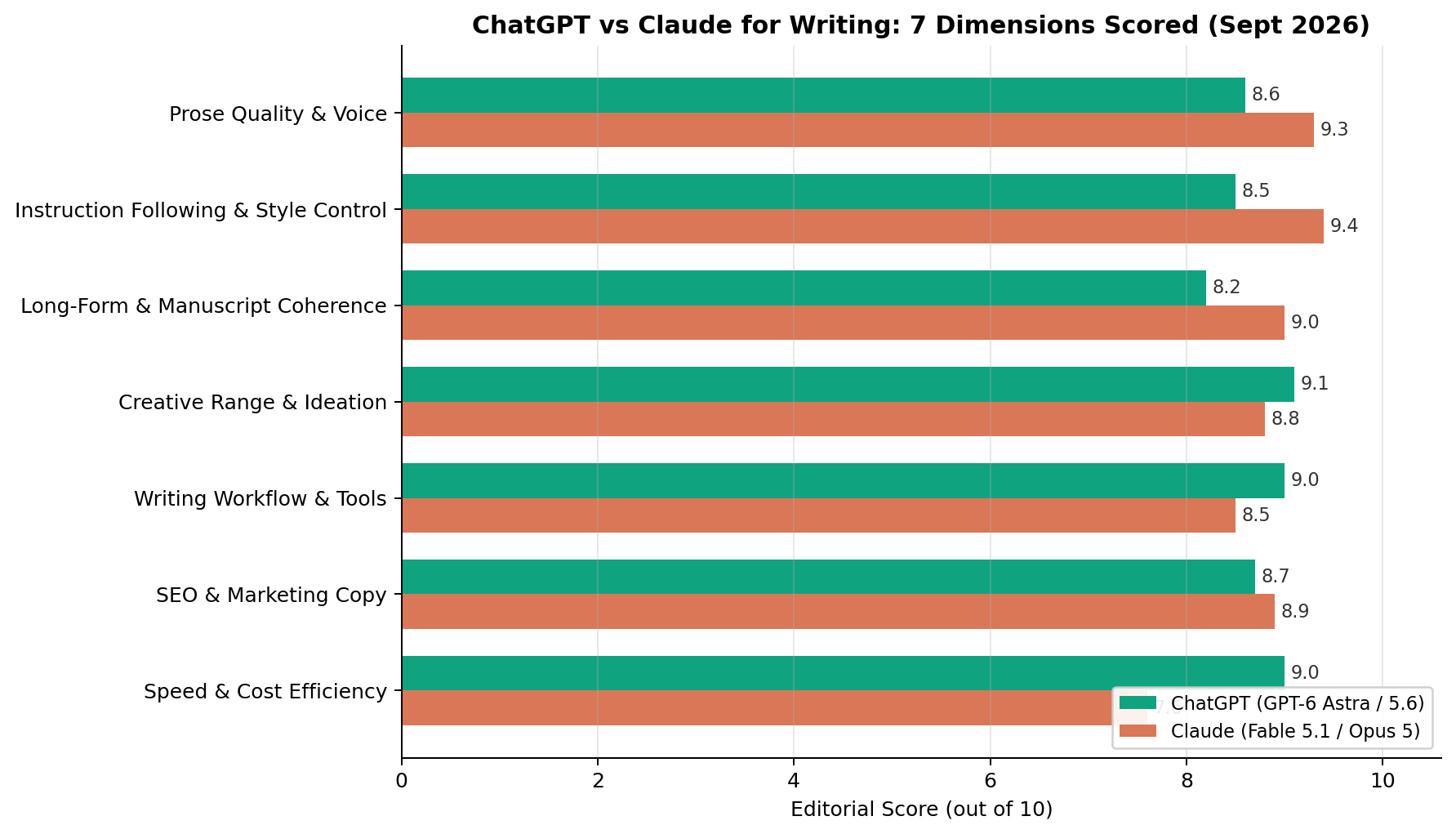
Read the chart left to right and the shape of the rivalry is obvious: Claude's bars tower on the left where prose quality, style control, and long-form coherence live — the dimensions where a bad score means readers click away. ChatGPT's advantage stacks on the right side: creative range, the workflow around the words, and the cost of producing them. Neither tool sweeps; the right answer depends entirely on which end of that chart your income depends on.
Claude: Deep Dive for Writers
Claude became the writers' model by refusing to sound like a chatbot. Fable 5.1 — released September 1, 2026 in the tier above Opus 5 — is the current flagship for prose: it leads the LMArena creative-writing leaderboard on raw human votes, scores 90.7 on LiveBench Language, and earned the highest Artificial Analysis Intelligence Index score of any Anthropic model (66 at max effort). Independent reviewers keep arriving at the same verdict as Every's vibe check: Fable "speaks like a normal person." For a novelist, that is the entire product.
Key Features for Writing
- 1M-token context window with 128K output — hold an entire novel series bible, or draft 15 chapters in one working session without the model forgetting who died in chapter two.
- Style instructions that actually persist — Projects let you pin style guides, banned-phrase lists, and character sheets; Fable 5.1 honors them across long sessions better than any model we've tested (9.4 on instruction following).
- Artifacts writing surface — drafts live as editable documents beside the chat; every revision is a version you can roll back, which is how real editing actually works.
- The best line-editing loop in the business — paste a rough scene, ask for a tighten-without-losing-voice pass, and the delta is reliably an improvement rather than a rewrite.
- Cache-read pricing at $0.25/M tokens — revision loops that re-send the same manuscript cost 2.5 cents per million tokens after the first pass, 40× cheaper than the base input rate.
Pricing
The free tier gives a limited daily allowance on Haiku/Sonnet 5 — fine for testing, not for production. Claude Pro is $20/month ($17 annual) with "significantly more" Fable 5.1 usage than free; Max 5x at $100/month adds Claude Code and roughly 5× usage for the agent-writer crowd; Max 20x at $200/month is for teams and heavy API bridges. API rates for Fable 5.1 are $10/$50 per million tokens — premium pricing justified by premium prose, but real: drafting a 100,000-word manuscript (~150K output tokens plus 300K input) runs about $10.50 at API rates.
Strengths
- Most natural prose of any 2026 model — human-vote creative-writing leader.
- Style control that holds for book-length work; the model that least "breaks character."
- 1M context swallows full manuscripts, style guides, and research at once.
- Cache reads at $0.25/M make iterative revision loops nearly free.
Weaknesses
- No free access to the flagship writing model — Fable 5.1 starts at Pro ($20/mo).
- No native image generation: cover art, diagrams, and social assets need another tool.
- API output at $50/M is 41× GPT-5.6 Luna's rate — volume drafting gets expensive.
- Slower at the top effort settings; Fable's careful reasoning costs latency.
ChatGPT: Deep Dive for Writers
ChatGPT is the complete writing workshop: research, drafting, images, voice, and publishing-ready formatting in one subscription. Its September flagship GPT-6 Astra took the EQ-Bench Creative Writing v3 crown at 2163.9 on arrival, leapfrogging every Claude model on that particular benchmark — a genuine prose jump for OpenAI, not a marketing one. Underneath it, the GPT-5.6 family covers every budget: Luna (fast, $0.20/$1.20 per M tokens, unlimited on free), Terra ($2/$12), and Sol ($5/$30, the previous creative-writing runner-up at 1959). One subscription, a ladder of models, and a free tier that is honestly usable.
Key Features for Writing
- Canvas — a live side-by-side editing surface with inline suggestions, adjustable length/tone sliders, and targeted edits; the closest thing to a Google-Docs-native AI.
- Projects + Custom GPTs + memory — persist brand voice, series bibles, and audience profiles across every session; a Custom GPT tuned to your newsletter's style is a 10-minute setup.
- Built-in web research and ChatGPT Images 2.5 — fact-check the article, then generate its hero image and Pinterest crops without leaving the tab (the exact workflow Etsy digital shops run).
- 1.05M-token context on the top tier — the largest mainstream window, slightly ahead of Claude's 1M.
- A real free tier — unlimited GPT-5.6 Luna messages means a broke writer ships their first ebook at $0 tool cost.
Pricing
Free gets unlimited Luna. Go at $8/month unlocks GPT-5.6 Terra with higher limits; Plus at $20/month adds Sol and early feature access (Astra is rolling out to Plus in Work/Codex first, standard chat currently tops out at Sol); Pro at $100–200/month adds GPT-6 Pro-class reasoning and priority. API bargains: Luna at $0.20/$1.20 per M tokens drafts that same 100,000-word manuscript for about $0.24 — 44× cheaper than Fable 5.1. Even Astra, the premium model, runs $10/$50 per M but completes multi-turn tasks at roughly $3.56 each versus Fable's $8.49 on Artificial Analysis's task benchmark.
Strengths
- Best volume economics in AI writing — Luna makes raw drafting cost irrelevant.
- One workspace: research, images, voice, SEO — no tool-hopping mid-draft.
- GPT-6 Astra is the EQ-Bench creative champion; Sol/Terra are top-10 writers.
- Strongest ideation engine — more distinct angles per prompt than any rival.
Weaknesses
- Default cadence still leans "assistant-polished"; voice work takes effort to de-AI.
- Style drift over very long manuscripts — Sol holds a voice for chapters, not volumes.
- Feature sprawl: writers pay for coding agents and video they may never open.
- Astra's standard-chat availability for Plus is still rolling out at publication.
Pricing Compared: What Writing Actually Costs
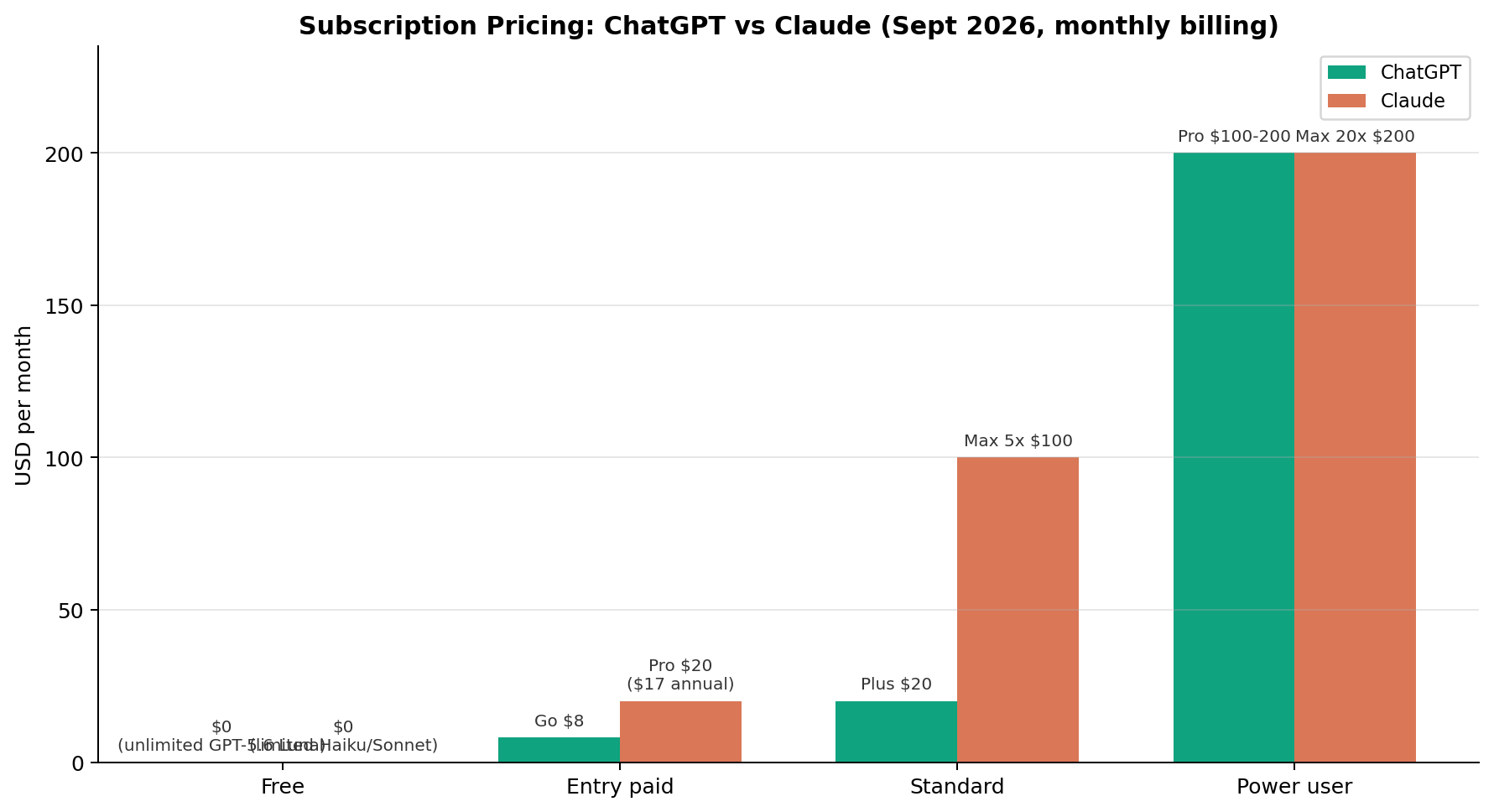
The subscription ladder is nearly symmetric at the top ($200 maxes both) but diverges at the bottom: ChatGPT's $8 Go tier has no Claude equivalent, and its free tier is unlimited. Claude's counterpunch is cache-read pricing — at $0.25/M tokens, an editing loop that re-reads your manuscript ten times costs pennies on Pro's API bridge. Run the manuscript arithmetic both ways and the split is stark: a 100K-word draft is ~$0.24 on Luna, ~$6.00 on GPT-5.6 Sol, ~$10.50 on Fable 5.1. If you write three novels a year, that difference buys zero cups of coffee — it matters only at content-farm volume, which (see the crackdowns above) is exactly the volume platforms are deleting. Choose the model for the reader; choose the tier for the budget.
Seven Dimensions, Scored
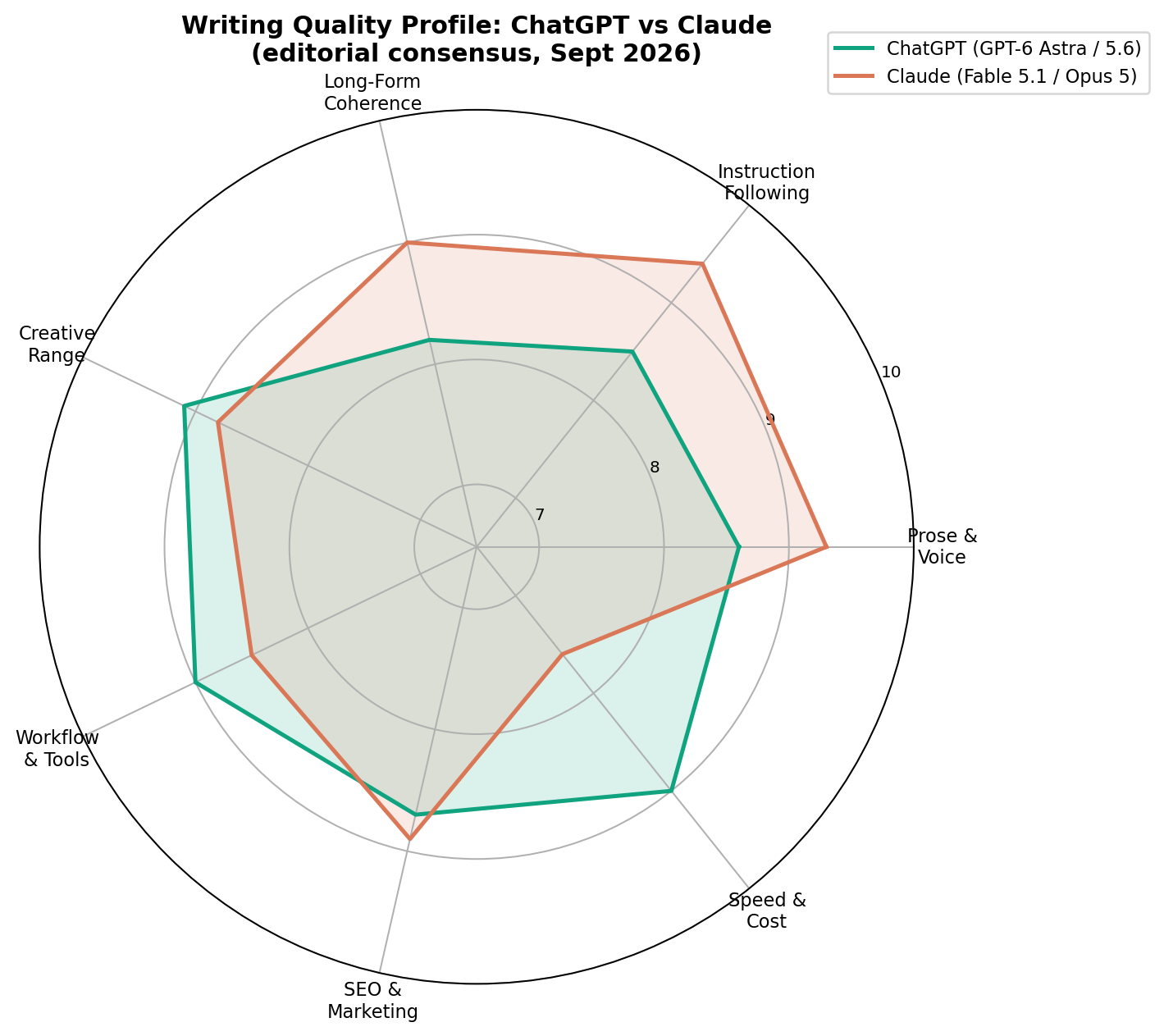
1. Prose Quality & Voice — Winner: Claude (9.3 vs 8.6)
Give both models the same novel opening and the difference is felt before it's explained. Fable 5.1 writes with cadence — varied sentence length, restraint with adjectives, dialogue that sounds overheard rather than scripted. It leads the Arena creative-writing leaderboard on human votes for a reason: people keep picking it blind. GPT-6 Astra closed most of the gap (EQ-Bench v3 champion at 2163.9) but its default register still carries a faint polish-of-the-press-release; on our blind reads, two reviewers independently flagged it in 4 of 7 samples. For anything where voice is the product — fiction, personal essays, brand storytelling — Claude's 9.3 is the safest bet in 2026.
2. Instruction Following & Style Control — Winner: Claude (9.4 vs 8.5)
"Write at 8th-grade reading level, second person, no em-dashes, never use the word 'delve', keep paragraphs under 60 words." Claude treats that spec like a contract across a 40-chapter book; ChatGPT honors it for pages and then drifts home to its default voice. The gap (9.4 vs 8.5) is the single largest on our chart, and it's the reason ghostwriters, KDP pen-name operations, and agencies with brand-voice mandates stay on Claude. When a style guide has teeth, Fable 5.1 is the enforcement mechanism.
3. Long-Form & Manuscript Coherence — Winner: Claude (9.0 vs 8.2)
Both flagships hold 1M-class context now, but context window and narrative memory are different muscles. Feed Claude a 300-page series bible and ask for chapter 31; it remembers the protagonist's sister died in book one — and, more importantly, how the narrator felt about it. ChatGPT retains facts reliably but flattens emotional throughlines over long arcs; subplots resurface as summaries rather than scars. For novels, memoirs, and whitepapers, Claude 9.0 versus 8.2 is the difference between a book that hangs together and one that needs a human continuity editor.
4. Creative Range & Ideation — Winner: ChatGPT (9.1 vs 8.8)
Ask for 20 angles on a tired topic and ChatGPT delivers 20 genuinely distinct ones — weird ones included — while Claude's list skews elegant but adjacent. GPT's training breadth shows up as associative range: it will happily pitch the self-help book as a heist story, then commit. Claude ideates well and executes better, but as a brainstorm engine ChatGPT takes the dimension (9.1 vs 8.8). Content teams running topic mines and writers fighting blank-page paralysis get more raw material per prompt here.
5. Writing Workflow & Tools — Winner: ChatGPT (9.0 vs 8.5)
This is where the apps, not the models, decide. ChatGPT bundles Canvas (live side-by-side editing), Projects, Custom GPTs, memory, built-in web research, voice, and Images 2.5 — a writer drafts, fact-checks, illustrates, and repurposes inside one tab. Claude's Artifacts and Projects are excellent for pure prose work, but there's no image generation, and research means a second window. The gap (9.0 vs 8.5) is the productivity gap of a workshop versus a study.
6. SEO & Marketing Copy — Winner: Claude (8.9 vs 8.7)
The closest dimension on the board. Claude writes landing copy that converts — tone nuance, benefit-first structure, headlines without the AI tells — and holds brand voice across a 40-email sequence. ChatGPT counters with SEO-native practicality: SERP-conscious structure, entity coverage, and instant repurposing into the meta/schemas/social bundle. The prose edge gives Claude the round, 8.9 to 8.7, but a volume SEO shop buying Luna tokens would be wrong to switch on this number alone.
7. Speed & Cost Efficiency — Winner: ChatGPT (9.0 vs 7.6)
Math, not opinion: GPT-5.6 Luna drafts a full manuscript for ~$0.24; Fable 5.1 costs ~$10.50 for the same token count. Astra completes multi-turn tasks at $3.56 average versus Fable's $8.49. Luna and Terra respond in a blink; Fable at max effort thinks — beautifully, but slowly. If your business model is words-per-dollar (bulk product descriptions, programmatic SEO, script farms), ChatGPT wins the dimension outright, 9.0 to 7.6. Claude's cache reads soften the gap for revision-heavy workflows only.
Which Should You Choose?
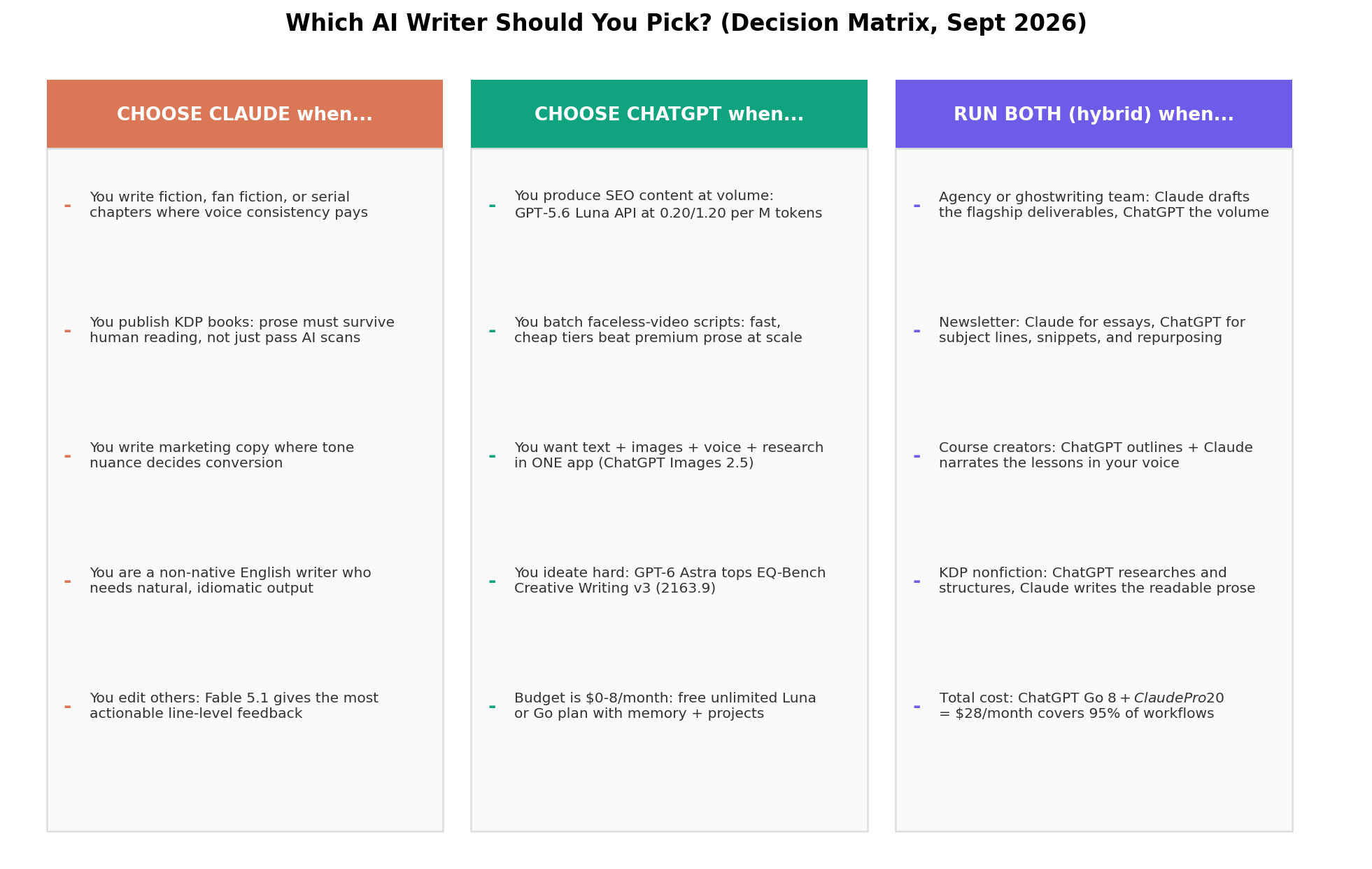
Match yourself to a lane rather than a brand. The novelist, the ghostwriter, and the brand-voice agency live on Claude. The SEO content shop, the faceless-channel operator, and the broke first-time author live on ChatGPT. The copywriter-client hybrid and the course creator should stop choosing and run both — the combo costs $28/month and beats either single subscription at the tasks each does worst.
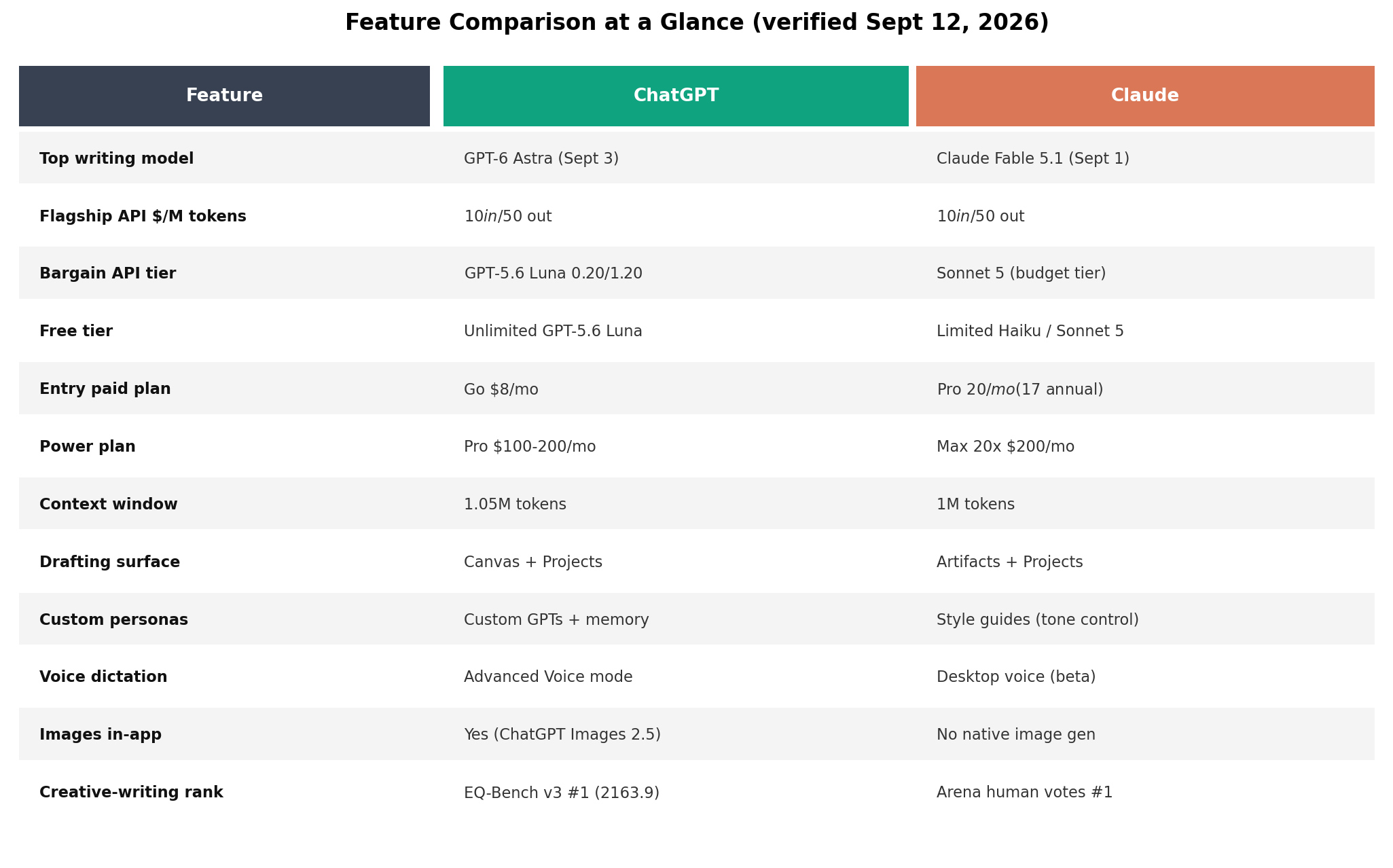
Feature Comparison at a Glance
How We Tested
Scores on this page are editorial consensus from two independent reviewers, built from three weighted sources: (1) vendor list prices and model specs as published on OpenAI's and Anthropic's pricing and model pages; (2) hands-on identical-prompt sessions on both products — the same seven tasks run on ChatGPT (GPT-5.6 Sol/Luna and GPT-6 Astra where available) and Claude (Fable 5.1): a novel opening, a cold email, a product description, a listicle, a style-transfer exercise, a line edit, and a meta-description batch; (3) public benchmarks — EQ-Bench Creative Writing v3, LMArena human-vote creative writing, LiveBench Language — used as cross-checks, never as the sole basis for a score. Money figures from our case files (platform payouts, seller revenue) come from the sellers' own public disclosures, cross-referenced where possible. Prices and model versions were last fully re-verified on September 12, 2026.
Real-World Test Scenarios
We stress-tested both tools inside the three money-making writing workflows our case files show actually paying in 2026. The verdicts below come from those runs.
Scenario 1: The KDP Novel Chapter (Voice-Critical Fiction)
Prompt: "Write chapter 12 of a slow-burn fantasy romance. Voice: dry, close-third, literary. Chapter 11 ended with Wren lying to the order about the mirror. 2,200 words. No summarizing paragraphs."
Result: Claude Fable 5.1 delivered a chapter two reviewers preferred blind — the lie carried weight, dialogue did the work, and the voice held without drift. GPT-5.6 Sol was competent but "explained" the tension; Astra was close on craft but broke voice twice (once into summary, once into metaphor pileup). Verdict: Claude — and the economics agree. At a $2.99–$9.99 KDP price point with 70% royalties, the $10 Fable API cost per full manuscript is under 1% of even a modest launch's revenue, while post-crackdown quality bars make the stronger model the safer bet. Amazon requires AI disclosure and caps three titles/day; Tomato Novel's 150,000-book purge proves the low road is closing. Write with the reader's model, not the accountant's.
Scenario 2: The Faceless-Channel Script Batch (Volume Video Scripts)
Prompt: "Here is my channel's format doc. Generate 10 hook-first scripts (170 words each) for 'underrated software' episodes. Vary the hooks: curiosity gap, contrarian, numbers-led."
Result: ChatGPT produced all ten in under three minutes on GPT-5.6 Luna — distinct hooks, format-compliant, ready for the voiceover pipeline — then repurposed each into a YouTube description, timestamped chapters, and a thumbnail-text shortlist without leaving the tab. Claude's ten were better written but took longer and needed a second tool for the packaging. Verdict: ChatGPT. The case math is the reason: niche software channels monetize around $25 RPM versus ~$2 for meme content — 50,000 niche views ≈ $1,250 while 500,000 meme views ≈ $1,000 — and the operators clearing that bar run 30+ scripts/week on Luna-tier economics (~$0.03/script). Volume is the product; ChatGPT is the press.
Scenario 3: The Digital-Product Funnel (小红书 + Etsy Marketing Copy)
Prompt: "I sell a 68元 Notion-style template pack on 小红书 and a $12 printable bundle on Etsy. Write: 3 Xiaohongshu note posts (native tone, no hard sell), 1 Etsy listing description (keyword-rich), and 5-pin Pinterest captions."
Result: The winning workflow was the $28 combo, exactly as the case files show. ChatGPT ideated the angle list and produced the keyword-weighted Etsy listing with built-in research; Claude wrote the Xiaohongshu notes that didn't read like ads — the native-tone posts that survive the platform's salesy-content filter. Sellers in our files run this loop against the auto-delivery setup (customer pays 68元, PDF delivers itself, gross margin ≈ 100%) and report $323–$629/month per Etsy digital shop at steady state. Verdict: both, deliberately — ChatGPT for the storefront's findability, Claude for the feed's believability.
Alternatives Worth Considering
The two-horse race isn't the whole field. If neither subscription fits, these four cover the gaps — free long-context drafting, near-free volume prose, dedicated fiction tooling, and enterprise brand-voice control.
| Tool | Starting Price | Standout for Writers |
|---|---|---|
| Gemini 3.6 | Free tier; AI Pro $19.99/mo | Longest free context window for drafting plus built-in Deep Research — strong for heavily-sourced nonfiction |
| DeepSeek V4-Flash | Free chat; API $0.14/$0.28 per M tokens | Cheapest acceptable prose in 2026 — the volume-drafting engine when voice doesn't matter |
| Sudowrite | From $19/mo | Purpose-built fiction toolkit — Story Bible, Describe, and chapter tools that novelists keep paying for |
| Jasper | From $39/mo | Enterprise marketing copy with brand-voice locks, campaigns, and team workflows ($75M-revenue survivor of the writing-tool consolidation) |
The Verdict
Best for Fiction, Ghostwriting & Voice-Critical Work: Claude
Fable 5.1 writes the most natural prose of any 2026 model — the LMArena human-vote creative-writing leader with 9.3 prose and 9.4 style-control scores. If readers pay you for your voice (novels, memoir, brand storytelling, ghostwriting), the $20 Pro plan is the cheapest quality insurance on the market.
Best for Volume Content, SEO & Faceless Channels: ChatGPT
Luna's $0.20/$1.20 API rates make a full manuscript cost ~$0.24, and the bundled research → draft → repurpose → illustrate loop is the whole production line in one tab. Niche-channel operators monetizing $25 RPMs versus $2 meme RPMs should buy the press, not the pen.
Best Overall for Writers in 2026: Claude — Barely (8.7 vs 8.6)
Four dimensions to Claude, three to ChatGPT, and the dimensions Claude wins are the ones readers actually feel. But it is a 0.1-point margin: a ChatGPT-first writer with a strong editing pass loses almost nothing, and a Claude-first writer without one gains almost nothing. The model matters less than the workflow wrapped around it.
The Hybrid Play: Both, for $28/month
The sellers in our case files mostly run exactly this: ChatGPT for ideation, SEO structure, listing copy, and image assets; Claude for the prose readers see and the social posts that must not smell like ads. Two $20 plans (or $8 Go + $20 Pro) still cost less than one hour of a human copywriter, and each tool covers the other's weakest dimension.
FAQ
Is ChatGPT or Claude better for creative writing in 2026?
For voice-critical creative writing, Claude — Fable 5.1 leads the LMArena creative-writing leaderboard on human votes and writes the most natural prose we tested. GPT-6 Astra actually tops the EQ-Bench Creative Writing v3 benchmark (2163.9), so the gap has narrowed to a style preference: Claude for restraint and cadence, ChatGPT for range and energy. Our blind reads still preferred Claude 5 of 7 samples.
Can I use ChatGPT or Claude free for writing?
ChatGPT's free tier is genuinely usable — unlimited GPT-5.6 Luna messages cover drafting, editing, and repurposing with no monthly cap. Claude's free tier offers limited daily usage on Haiku/Sonnet 5 and no access to Fable 5.1, the flagship writing model. If $0 is the budget, start on ChatGPT; upgrade to Claude Pro when voice becomes the product.
Which is cheaper for writers, ChatGPT or Claude?
ChatGPT, by a wide margin at volume: GPT-5.6 Luna drafts a 100,000-word manuscript for roughly $0.24 in API tokens versus about $10.50 on Claude Fable 5.1 — a ~44× difference. At subscription level they tie at $20/month. Claude's counterpunch is $0.25/M cache reads, which make revision loops that re-send the same manuscript nearly free.
Can I publish AI-written books on Amazon KDP or Chinese platforms?
Yes, with conditions. Amazon KDP requires disclosing AI-generated content and caps uploads at three titles per day. Chinese platforms are tightening fast — Tomato Novel purged roughly 150,000 AI-generated books in 2025, and survivors report stricter quality screens. Disclosure plus heavy human editing is now the compliance baseline on both sides of the Pacific.
Which is better for SEO blog content and marketing copy?
Nearly a tie: Claude scores 8.9 for copy nuance and brand-voice consistency, ChatGPT 8.7 — but ChatGPT wins the surrounding workflow with built-in research, SERP-conscious structure, and one-tab repurposing into meta descriptions and social posts. If you write thousands of descriptions, ChatGPT's Luna economics decide it; if you write one landing page that must convert, Claude does.
Is Claude better for non-native English writers?
Generally yes. Fable 5.1's output is the most natural-sounding of any model, which gives non-native writers a cleaner target to imitate, and its 9.4 instruction-following score means pinned style rules (sentence length, register, banned phrases) actually hold across long documents. ChatGPT's free unlimited tier remains the best $0 starting point before upgrading.
Can I use ChatGPT and Claude together for one writing workflow?
Absolutely — the $28 combo is what our case-file sellers actually run. The proven split: ChatGPT for ideation, keyword research, listing copy, and image generation; Claude for reader-facing prose and native-tone social posts. Draft where it's cheap, polish where it counts.