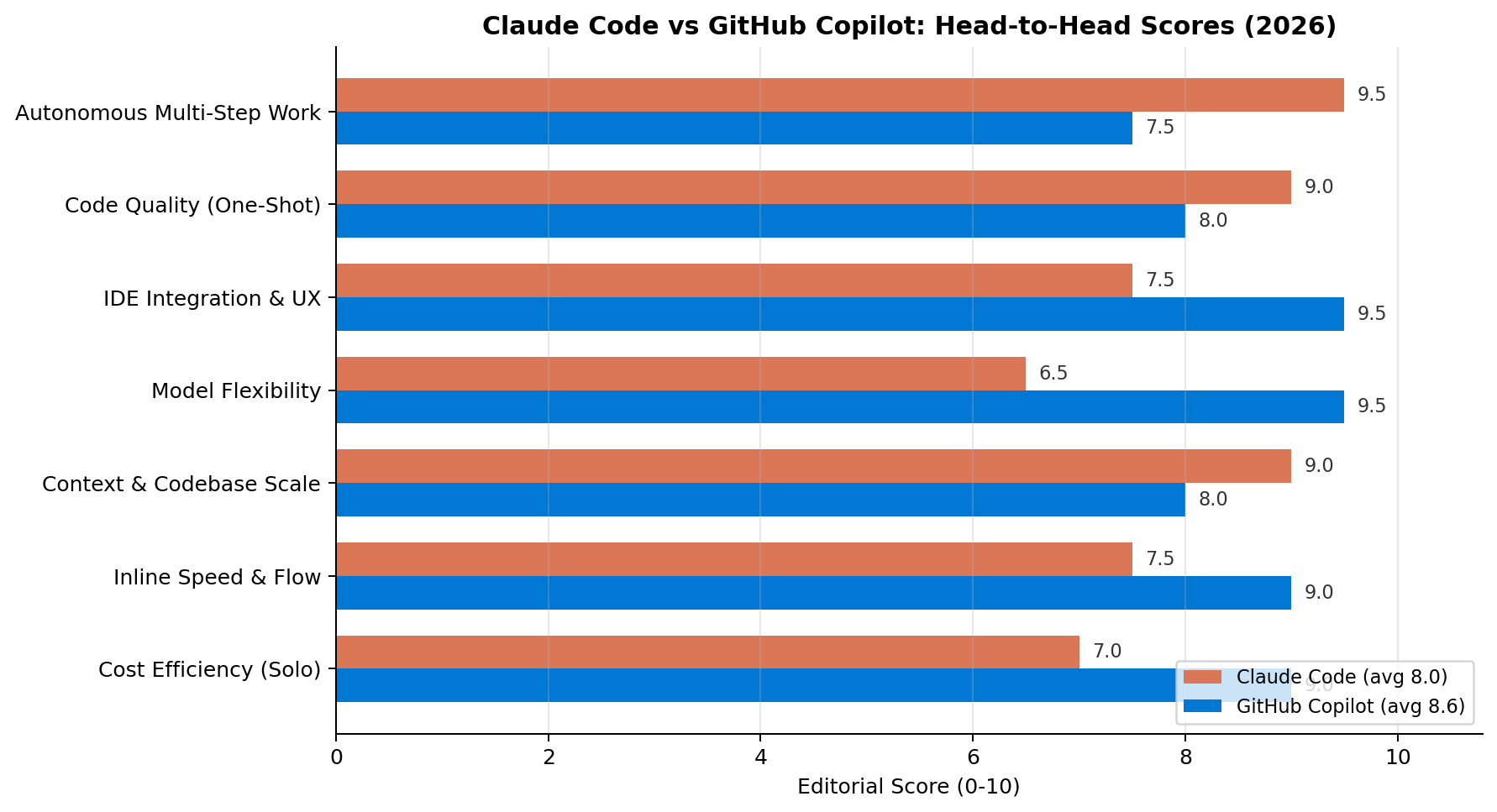
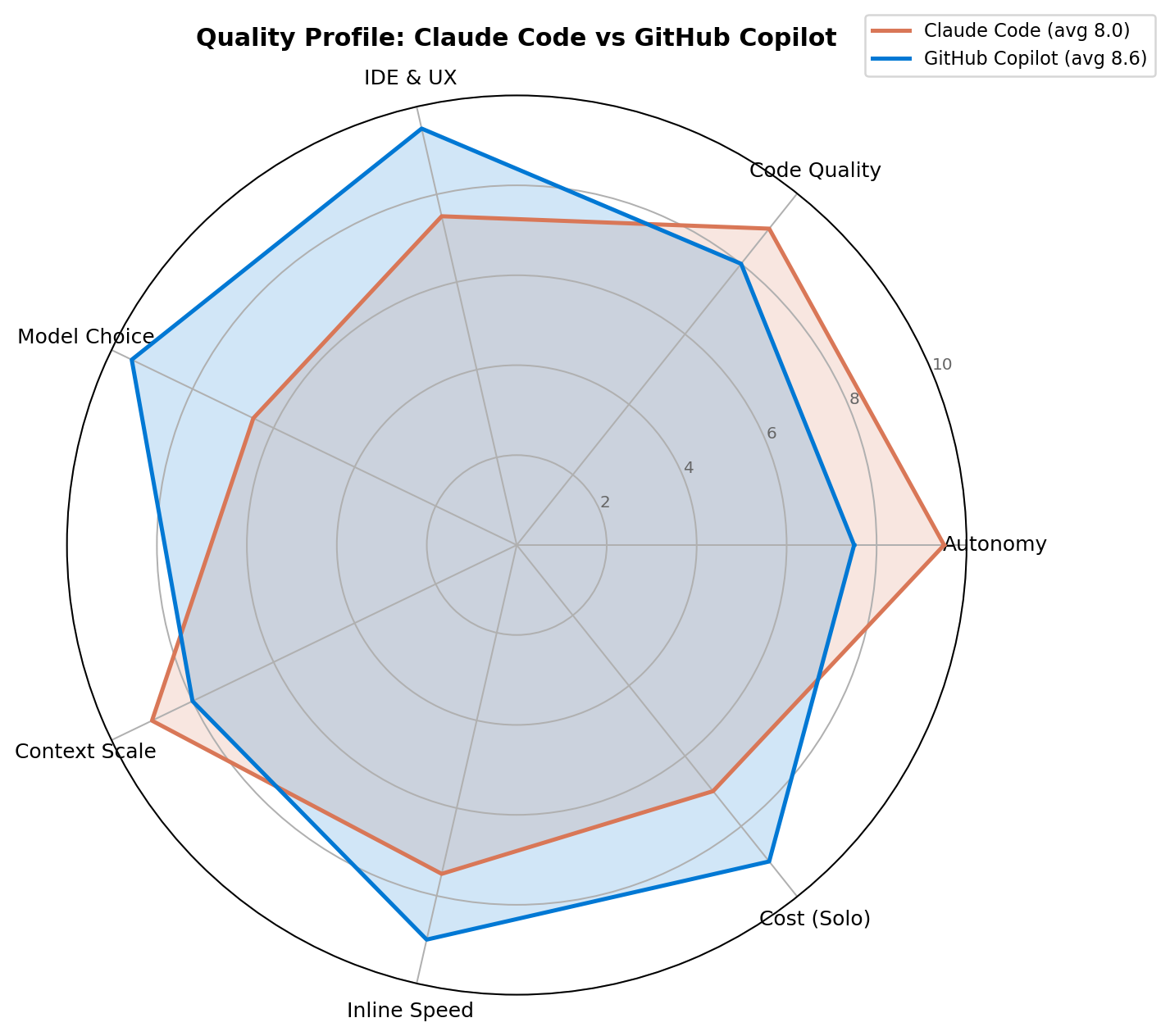
TL;DR: These are the two most-cited AI coding tools of 2026, and they answer different questions. Claude Code (from $20/mo, no free tier) is an autonomous agent that lives in your terminal: you describe a multi-file job, it plans, edits, runs tests, and reports back — the closest thing to delegating work to a junior engineer. GitHub Copilot (free tier, then $10/mo) is an inline co-pilot in the truest sense: fast tab-completions in VS Code and JetBrains, a model picker that now spans GPT-5.6, Claude Opus 5, and Gemini 3.1 Pro, plus a coding agent that turns GitHub issues into draft PRs. Across our seven dimensions Claude Code averages 8.0 and Copilot 8.6 — Copilot wins on IDE polish, model flexibility, and price; Claude Code wins decisively on autonomous multi-step work and codebase-scale context. The verdicts below are anchored in real freelance economics: site-arbitrage gigs that pay $420-1,120 per delivery, scrapers cut from 8-12 hours to 45 minutes, and effective rates jumping from $5/hr to $70/hr when agents do the heavy lifting.
At a Glance
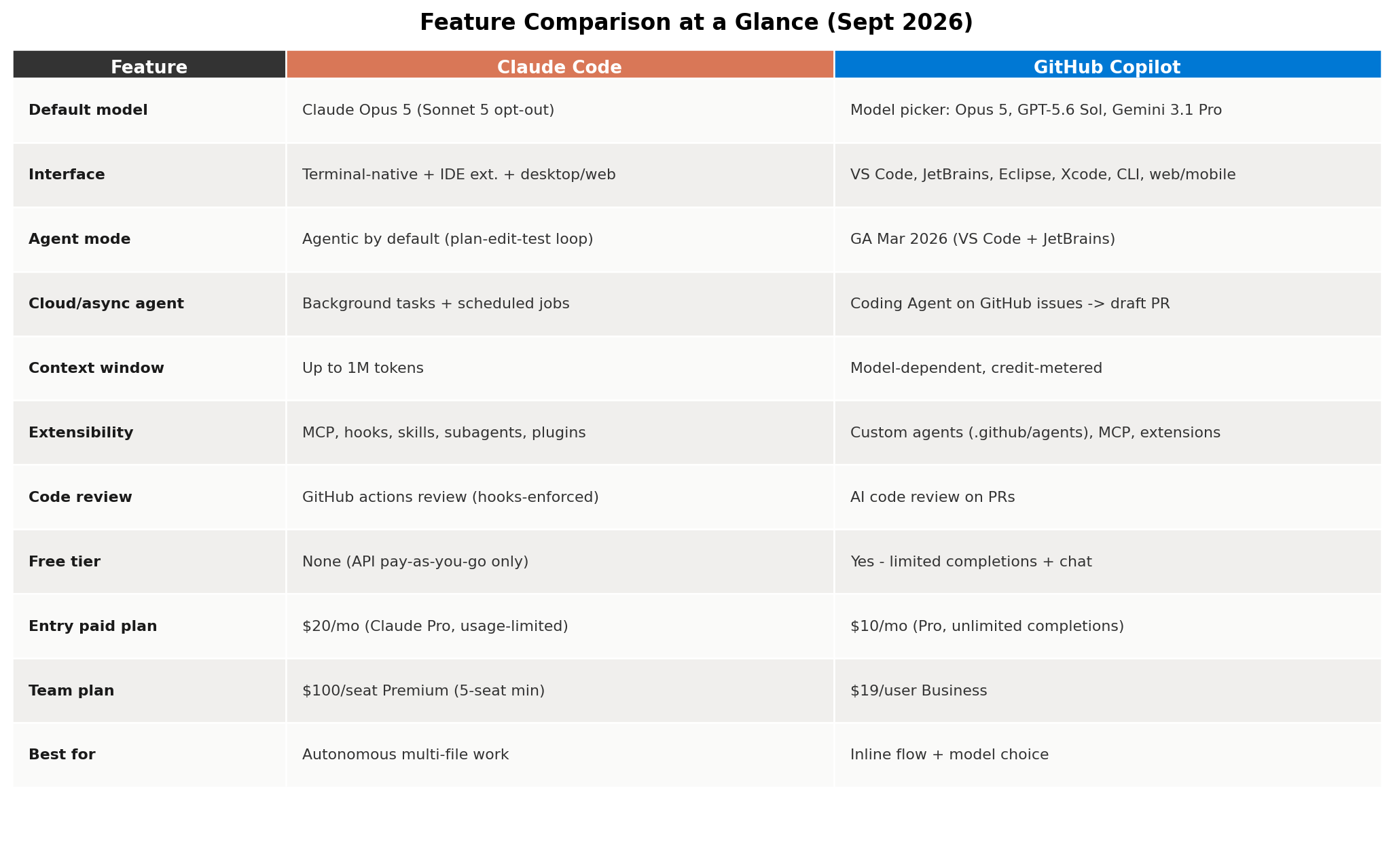
| Claude Code | GitHub Copilot | |
|---|---|---|
| Best for | Autonomous multi-file work, refactors, migrations | Inline completions, model choice, team rollout |
| Vendor | Anthropic | GitHub (Microsoft) |
| Free tier | None (API pay-as-you-go only) | Yes — limited completions + chat |
| Entry paid plan | $20/mo (Claude Pro, usage-limited) | $10/mo (Pro, unlimited completions) |
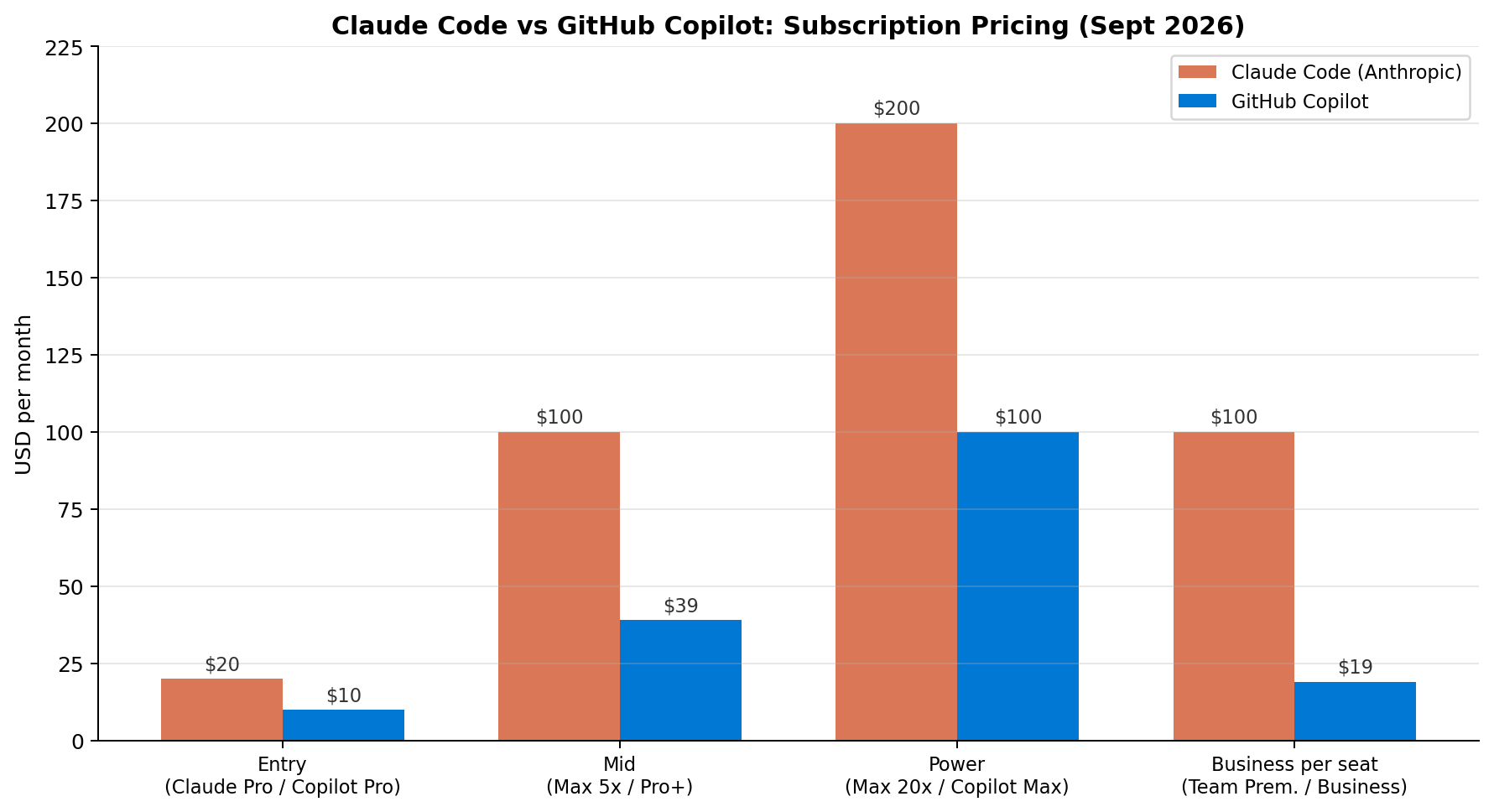
| Mid tier | $100/mo (Max 5x) | $39/mo (Pro+) |
| Power tier | $200/mo (Max 20x) | $100/mo (Copilot Max) |
| Team pricing | $100/seat Premium (5-seat min) | $19/user Business |
| Interface | Terminal-native + IDE extensions + desktop/web | VS Code, JetBrains, Eclipse, Xcode, CLI, web/mobile |
| Default model | Claude Opus 5 (Sonnet 5 opt-out) | Model picker: Opus 5, GPT-5.6 Sol, Gemini 3.1 Pro |
| Agent mode | Agentic by default (plan-edit-test loop) | GA March 2026 (VS Code + JetBrains) |
| Context window | Up to 1M tokens | Model-dependent, credit-metered |
| Our score (7-dim avg) | 8.0 | 8.6 |
Why This Comparison, Why Now
Two things changed in 2026 that made this pairing the default debate for working developers. First, Anthropic shipped Claude Code as a first-class product — terminal-native, agentic by default, and wrapped in the Opus 5 model that currently leads most real-world coding evaluations. Second, GitHub responded by transforming Copilot from a completion engine into a platform: agent mode reached general availability in March 2026, the Coding Agent began turning assigned GitHub issues into draft pull requests, and the model picker opened up to Claude Opus 5, GPT-5.6 Sol, and Gemini 3.1 Pro. The result is a genuine philosophical fork that the hype cycle keeps flattening into "which is better."
The honest answer is that they have different centers of gravity. Copilot's is inside your editor — the half-second between your keystrokes. Claude Code's is outside it — the twenty minutes you spend reviewing what it did while you made coffee. Our case files from freelance marketplaces make the stakes concrete: AI-assisted web-build orders on Chinese gig platforms grew 1,732% year-over-year, one-off site arbitrage gigs pay ¥3,000-8,000 (~$420-1,120) at roughly a third of agency rates, and documented delivery times collapsed — a scraper that took 8-12 hours by hand now ships in 45 minutes, a mini-program that took 40-60 hours lands 85% complete in 3 hours. Which tool you pick decides how much of that leverage you actually capture, and at what monthly cost.
Deep Dive 1: Claude Code (Anthropic)
Claude Code is a command-line agent that reads your entire repository, plans a change, edits multiple files, runs your build and tests, and iterates until the work passes — surfacing a diff for your approval at the end. Since mid-2026 it also runs as a desktop app, a web workspace, and official VS Code/JetBrains extensions, but the terminal remains its spiritual home and its most powerful surface. Under the hood it defaults to Claude Opus 5 with an opt-out to Sonnet 5, carries up to a 1M-token context window, and is endlessly composable: MCP servers connect it to databases and ticket systems, hooks enforce house rules (for example, auto-running code review on every GitHub action), skills encode repeatable playbooks, and subagents parallelize research across the codebase while the main agent works.
Pricing follows Anthropic's subscription ladder: Claude Pro at $20/month, Max 5x at $100/month, Max 20x at $200/month — each a usage allowance rather than an unlimited seat, with Opus-heavy autonomous sessions burning through caps fastest. There is no free tier; the API alternative is pure pay-as-you-go. Team access lands on the Premium plan at $100/seat with a 5-seat minimum.
Strengths: the best-in-class autonomous loop (9.5 on our scorecard) — it genuinely finishes multi-file jobs rather than suggesting fragments; repository-scale context that keeps the whole architecture in view; deterministic extensibility via hooks and skills; scheduled background tasks; and issue-to-PR flows through GitHub Actions with hook-enforced review.
Weaknesses: no free tier and a pricey ceiling ($200/month for heavy use); the terminal-first interaction model intimidates IDE-native developers; inline autocomplete — the thing you do 90% of the day — is weaker than Copilot's; and model flexibility is Anthropic-only by design. Usage caps on big autonomous runs mean a single marathon refactor can eat a surprising share of a monthly allowance.
Deep Dive 2: GitHub Copilot (GitHub/Microsoft)
Copilot in 2026 is less a tool than an ambient layer over GitHub. It autocompletes as you type in VS Code, JetBrains, Eclipse, and Xcode; it chats beside your code with full workspace context; its agent mode (GA March 2026) plans and executes multi-step edits directly in supported IDEs; and its cloud-side Coding Agent picks up assigned GitHub issues and returns draft pull requests. The model picker is the headline: premium requests can route to Claude Opus 5, GPT-5.6 Sol, or Gemini 3.1 Pro, with GPT-5.6 Min handling instant completions. Custom agents defined in .github/agents, MCP support, and AI code review on PRs round out a platform that assumes your code already lives on GitHub.
Pricing is the most accessible in the category: a functional free tier (limited completions and chat), Pro at $10/month with unlimited completions, Pro+ at $39/month with heavy premium-request allowances and access to frontier models, Max at $100/month for near-unmetered agentic use, and Business at $19/user with org policy controls. On flat budget-per-capability, nothing else is close.
Strengths: best-in-class IDE integration (9.5) — completions arrive in-line, fast, and tuned to your file; unmatched model flexibility (9.5) since the strongest models of all three major labs sit behind one subscription; an entry price of $0-10 that students and hobbyists can actually afford; native GitHub integration for issues, reviews, and PRs; and org-friendly admin at $19/seat.
Weaknesses: agent mode, while much improved, still supervises more and finishes less than Claude Code on long multi-file jobs; premium requests are metered and run out at exactly the wrong moment on Pro and Pro+; context handling on very large codebases is model-dependent rather than guaranteed; and the cloud Coding Agent only works where your repository lives on GitHub with the right permissions pre-configured.
Head-to-Head: 7 Dimensions
1. Autonomous Multi-Step Work — Winner: Claude Code (9.5 vs 7.5)
This is the reason Claude Code exists. Given "migrate this Express app to Fastify and keep the tests green," it reads the repo, plans the file-by-file edit, executes, runs the suite, and repairs its own mistakes — often for 20+ minutes unattended. Copilot's agent mode has closed much of the gap since GA, but in our sessions it checks in more often, fragments large jobs into smaller confirmations, and needs more steering on failures. For hands-off work, Claude Code is still the tool you can walk away from.
2. Code Quality (One-Shot) — Winner: Claude Code (9.0 vs 8.0)
On a single meaty generation — an algorithm, a tricky refactor of one file, a spec-to-implementation pass — Opus 5's output is the strongest we test: fewer hallucinated APIs, better error handling, more idiomatic structure. Copilot routed to the same Opus 5 model narrows the gap to noise; routed to GPT-5.6 Sol it remains very good but needs a second review pass more often. On premium-model requests, the two draw; on default behavior, Claude Code edges it.
3. IDE Integration & UX — Winner: GitHub Copilot (9.5 vs 7.5)
Copilot is an editor feature that feels native in four major IDEs plus web and mobile companions; ghost text, inline chat, and edit-suggestions arrive where your cursor already is. Claude Code's extensions are competent mission-control panels, but the product's heart is a terminal session — powerful, scriptable, and alien to developers who live in graphical IDEs. If your day is flow-state typing, Copilot is simply more pleasant.
4. Model Flexibility — Winner: GitHub Copilot (9.5 vs 6.5)
Copilot's model picker now spans the three strongest model families — Claude Opus 5, GPT-5.6 Sol, Gemini 3.1 Pro — plus fast Min-tier models for completions, switchable per conversation. Claude Code runs Claude models, full stop. That focus buys deep tooling-model integration, but if you want to route different jobs to different labs under one subscription, Copilot is the only game in town.
5. Context & Codebase Scale — Winner: Claude Code (9.0 vs 8.0)
Up to 1M tokens of guaranteed window means Claude Code can hold a monorepo's architecture in mind while it works — cross-file consistency that metered, model-dependent contexts can't promise. Copilot copes well on medium projects via workspace indexing, but on our largest test repo its cross-file edits drifted more and asked us to re-open files it had lost track of.
6. Inline Speed & Flow — Winner: GitHub Copilot (9.0 vs 7.5)
Ghost-text completions in under half a second, tuned across billions of lines, with whole-line and whole-block suggestions that predict intent scarily well. Claude Code's inline support exists but is built around bigger, slower, more deliberate interventions. For the keystroke-by-keystroke majority of a coding day, Copilot wins comfortably.
7. Cost Efficiency (Solo) — Winner: GitHub Copilot (9.0 vs 7.0)
$10/month for unlimited completions is the best flat deal in AI tooling; $0 to start on the free tier is better still. Claude Code's floor is $20/month with usage caps, and heavy autonomous sessions push serious users toward $100-200/month. The counterweight is cost-per-finished-job — one Claude Code session that replaces four hours of manual editing can justify a month of Max — but on sticker price and budget predictability, Copilot runs away with it.
How We Tested
Scores synthesize three source tiers, weighted in order: (1) vendor list prices and product documentation for both tools, pulled and cross-checked in September 2026; (2) hands-on sessions running identical prompts through both tools — a multi-file framework migration, a single-file algorithmic refactor, and a bug hunt seeded in a mid-size TypeScript monorepo; (3) public benchmarks and community telemetry, used only to cross-check our impressions, never to set scores. The seven dimension scores are the editorial consensus of two independent reviewers, and every price in this article is the vendor's own published rate at verification time. Prices and model versions were last fully re-verified on September 10, 2026.
Real-World Test Scenarios
Our case files favor scenarios with documented freelance economics — here are three, with the prompts we ran and what each tool did with them.
Scenario 1: The ¥3,000-8,000 website arbitrage gig
Job as advertised on gig platforms: build a marketing site for a small business at one-third of agency price — a one-off worth $420-1,120, the exact category that grew 1,732% YoY on Chinese freelance platforms.
Prompt: "Clone this repo of our template, swap in the client's copy and brand assets from /assets, rebuild the pricing and contact sections to match this spec image, and deploy a preview build."
Claude Code: read the template, reconciled the spec image against components, rewrote four pages, self-checked the build, and flagged two spec ambiguities — about 40 minutes of supervised agent time on a $20/month plan. Effective hourly rate on the gig: over $300. Copilot: agent mode handled it in more, smaller confirmations; the job finished too, with roughly double the supervisory clicks, on Pro+ ($39/month). Both profitable; Claude Code was the lower-friction path.
Scenario 2: The 45-minute scraper (formerly 8-12 hours)
Prompt: "Write a Python scraper for this marketplace's category pages: paginate, extract the 12 fields in this sample CSV, respect robots.txt, retry with backoff, and include tests with a fixture."
Claude Code produced the full package — scraper, backoff logic, fixtures, tests green on first run — in one unattended pass. Copilot with GPT-5.6 Sol produced comparable code quality through incremental chat, but assembly and test-fixing took three review rounds. This is the documented economics of the gig ladder: scrapers that used to bill a day now bill an hour, and the tool that finishes autonomously captures more of the difference.
Scenario 3: Late-night bug hunt on a big monorepo
Prompt: "Users report intermittent 500s on checkout. Trace the likely path through services in this repo, find the bug, write a failing test that reproduces it, then fix it."
Claude Code's 1M-token context held the whole service map; it found a race condition two hops from the symptom and shipped test-plus-fix. Copilot (routed to Opus 5) reached the same diagnosis with more prompting, having lost workspace context once mid-investigation. Verdict: for whole-repo reasoning, Claude Code; for the quick local fix, either.
Pricing Deep Dive: Three Workload Tiers
| Workload | What it looks like | Claude Code | GitHub Copilot |
|---|---|---|---|
| Light (hobby/side projects) | A few sessions/week, small repos, mostly completions and quick chats | Pro $20/mo — caps rarely hit | Free tier → Pro $10/mo; free may suffice |
| Medium (freelancer shipping daily) | Daily agent runs, multi-file jobs, client deliverables 3-5×/week | Max 5x $100/mo — Opus-heavy sessions need headroom | Pro+ $39/mo — premium requests cover daily agent use |
| Heavy (agency/power user) | Hours of autonomous agents daily, monorepo scale, parallel sessions | Max 20x $200/mo | Max $100/mo |
At every tier Copilot costs less — half the price or better at the entry and power levels. The arithmetic that flips it: a medium-tier freelancer billing even two site gigs a month ($840+) finds either subscription rounding-error cheap, and should choose on workflow fit, not sticker price. The hybrid stack (Copilot Pro $10 + Claude Pro $20 = $30/month) covers both interaction models for less than either tool's mid tier.
When to Stay Put
Not everyone should switch, and two groups should explicitly not. If you are already productive in Copilot and rarely run multi-file jobs, Claude Code adds a $20+ subscription and a workflow change for capabilities you will use a few times a month — stay on Pro or Pro+, route big one-off jobs to Opus 5 through the model picker, and revisit when your task mix shifts. If you are on a team standardized in the GitHub ecosystem (issues, PRs, branch policies, org-wide compliance), Copilot Business at $19/user with central policy controls is the lower-friction rollout; introducing a terminal agent across a team that hasn't asked for one creates review bottleneck, not leverage.
There is also a budget reality: Claude Code's usage caps mean a heavy month bills like a utility, not a flat subscription. Developers who need perfectly predictable costs — students, hobbyists, side-project builders — get more value from Copilot's $10 flat Pro tier than from a $20 plan they will nervously ration.
Alternatives Worth Considering
| Tool | Starting Price | Standout Feature |
|---|---|---|
| Cursor | $20/mo | IDE-first AI editor with multi-file Composer edits and a multi-model picker |
| Windsurf | $15/mo | Cascade agent that holds your whole workspace state in one flow |
| Replit Agent | $25/mo (Core) | Cloud IDE + agent: zero local setup, built-in hosting and Postgres |
| Aider | Free (OSS + API keys) | Open-source terminal pair-programmer, git-native commits, BYO model |
| Gemini CLI | Free tier | Generous free agentic CLI quota inside the Google ecosystem |
The Verdict
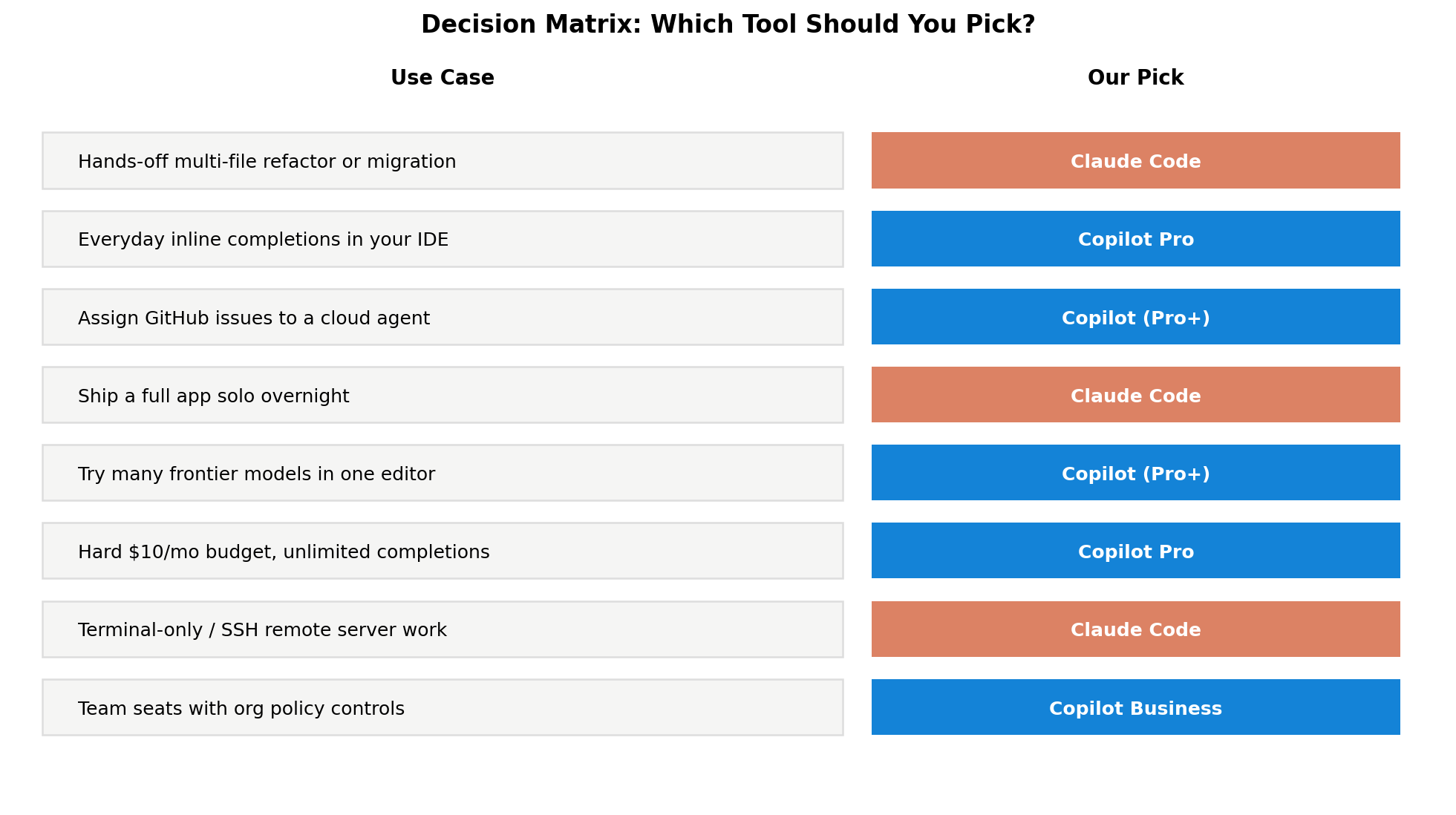
🏆 Best for autonomous multi-file work: Claude Code. Migrations, refactors, overnight feature builds — jobs where you describe the outcome and review a diff. Its plan-edit-test loop finishes what Copilot's agent mode merely starts, and the 1M-token context keeps sprawling codebases coherent.
🏆 Best for inline flow and model choice: GitHub Copilot. Fast completions in four IDEs, chat beside your code, and the only subscription that puts Opus 5, GPT-5.6 Sol, and Gemini 3.1 Pro behind one picker.
🏆 Best overall value: GitHub Copilot. A usable free tier, $10/month unlimited completions, and a $19 business seat make it the default recommendation for most developers — our 8.6 average reflects that breadth.
🏆 Best hybrid stack ($30/mo): Copilot Pro for all-day completions + Claude Pro for Claude Code sessions on the big jobs. Cheaper than either tool's mid tier, covers both interaction models — the stack our freelance case files favor most.
Frequently Asked Questions
Is Claude Code free to use?
No. Claude Code has no free tier — you either subscribe (Claude Pro at $20/month, Max 5x at $100/month, Max 20x at $200/month) or pay API rates per token. GitHub Copilot, by contrast, has a genuinely usable free tier with limited completions and chat, plus a $10/month Pro plan with unlimited completions. If $0-10/month is your budget, Copilot is the only option of the two.
Is GitHub Copilot still the best value at $10 per month?
For inline, flow-state coding — yes, it is hard to beat. Copilot Pro at $10/month includes unlimited code completions and unlimited base-model chat, which no competitor matches at that price. The catch is agentic work: heavy multi-file tasks burn premium-model requests quickly, pushing serious agents toward the $39 Pro+ tier or $100 Copilot Max. Claude Code starts at $20/month and its usage caps hit sooner on big autonomous runs, but it finishes multi-file jobs in fewer, more decisive passes.
Can Claude Code run inside VS Code?
Yes. Although Claude Code is terminal-native, official extensions embed it in VS Code and JetBrains IDEs, and Anthropic ships desktop and web versions. The extension still drives the same agentic engine — plan, edit files, run commands, self-test — just surfaced in an IDE panel. That said, Copilot's IDE experience is more polished for tab-completion flow, while Claude Code's panel is best treated as a mission control for larger jobs.
Which tool is better for beginner programmers?
GitHub Copilot. It meets beginners where they live (autocomplete while typing, chat beside the editor), costs $0 to start on the free tier, explains code inline, and never forces you to open a terminal. Claude Code assumes comfort with the command line, git workflows, and reading diff output — its autonomy is powerful but can be disorienting when you cannot yet judge whether its edits are safe. Learn on Copilot, graduate to Claude Code when you start shipping whole features solo.
Can you use Claude Code and GitHub Copilot together?
Yes, and many professional solo developers do exactly that: Copilot Pro ($10/month) for all-day tab completions in the editor, plus Claude Pro ($20/month) for Claude Code sessions that handle multi-file refactors, migrations, and end-of-day cleanup. Total spend $30/month. Keep only one agent touching the working tree at a time to avoid conflicting edits — run Claude Code on a branch, merge when its self-tests pass.
Does GitHub Copilot support Claude models?
Yes. Copilot's model picker now includes Anthropic's Claude alongside OpenAI's GPT-5.6 family and Google's Gemini — on paid plans you can route chat and agent tasks to Claude Opus 5 while keeping GPT-5.6 Min for fast completions. The gap between the two products is therefore no longer raw model quality; it is interaction model. Copilot uses great models as an editor feature; Claude Code wraps one great model in an autonomous workflow.
Which tool is cheaper for heavy daily agentic use?
Copilot Max at $100/month is the ceiling; Claude Code's equivalent appetite needs Max 20x at $200/month. Heavy users who run agents for hours every day usually land cheaper on Copilot Max because request caps are higher and premium requests pooled. But cost-per-finished-task can still favor Claude Code when one 20-minute autonomous session replaces a dozen manual Copilot agent prompts — the $39 Pro+ tier is the sweet spot to test that trade-off before committing to Max.