⏱ TL;DR
These three platforms answer three different questions. Coze (ByteDance) is the fastest way to publish a working chatbot — a $0 start with 10 free credits refreshing daily, 9 chat channels, and a 10-minute first build; it wins Ease of Use (9.0) and Pricing & Free Tier (8.5). Dify is the AI-native app platform — the best RAG pipeline, 50+ model providers including local Ollama, and full Docker self-hosting; it wins Agent & LLM Flexibility (8.5) and Self-Hosting & Control (9.0). n8n is the automation backbone — 500+ app integrations, unlimited free self-hosting, and the richest paid-work market ($40–100/hr on Upwork); it wins Integrations (9.5) and Earning Potential (9.0).
On total score across six dimensions, n8n edges it at 48.5/60, with Dify at 47.5 and Coze at 46.5 — a 3-point spread that means the right answer depends on what you sell, not on which badge says "best." For client chatbot gigs, start on Coze. For privacy-sensitive RAG builds, Dify. For a serious automation agency, n8n.
Why This Comparison Matters More Than Ever
2026 is the year AI agents went from demo to paycheck. Gartner projects that 40% of enterprise applications will include task-specific AI agents by the end of 2026, up from under 5% a year earlier — and small businesses are racing to catch up. Every merchant wants a support bot that actually answers, every consultancy wants a knowledge assistant trained on their documents, and every agency wants to automate the grunt work in between.
That demand created a new freelance economy. On Chinese marketplaces, "AI customer-service bot setup" gigs built on Coze and Dify typically bill ¥500–2,000 per project plus ¥100–500/month retainers. On Upwork, n8n automation specialists command $40–100/hour, and productized agent services sell as $99–999/month subscriptions. The tools in this comparison are the three platforms that economy runs on.
They also happen to be having a moment. n8n took a strategic investment from SAP in May 2026 at a $5.2 billion valuation — double its October 2025 Series C — and is being embedded into SAP Joule Studio. Dify raised a $30M round led by HSG in March 2026 at a $180M valuation. Coze shipped version 3.0 in June 2026 with multi-agent collaboration and integrated ByteDance's Doubao 2.1 model. All three are well-funded, shipping fast, and safe to bet a service business on.
The catch: they represent three different archetypes. Dify is an LLM application platform. Coze is a chatbot publisher. n8n is an automation backbone that grew AI superpowers. Picking the wrong archetype for your use case is the single most expensive mistake in this category — so let's compare them properly.
At a Glance
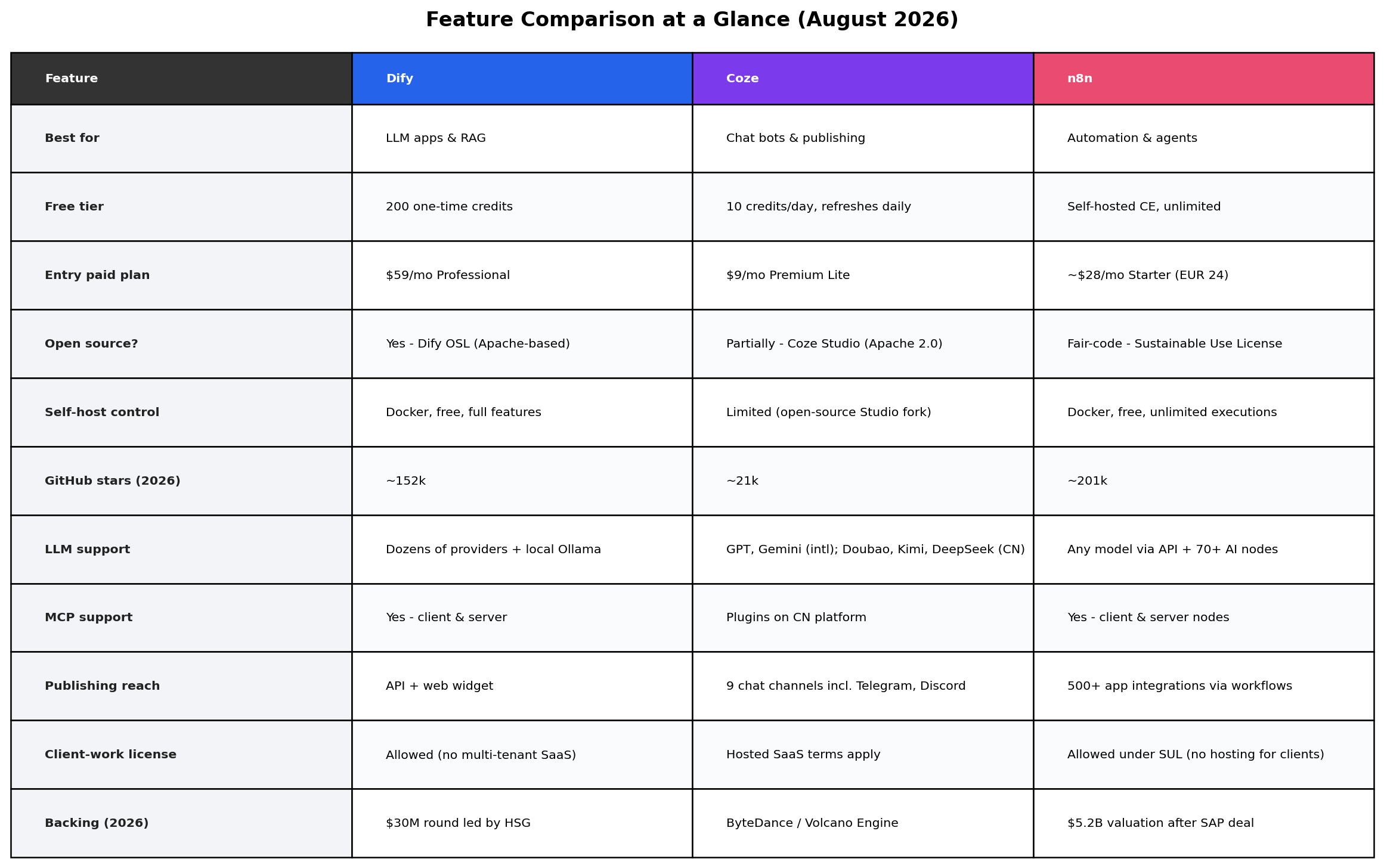
| Feature | Dify | Coze | n8n |
|---|---|---|---|
| Best for | LLM apps & RAG | Chat bots & publishing | Automation & agents |
| Free tier | 200 one-time credits | 10 credits/day, refreshes daily | Self-hosted CE, unlimited |
| Entry paid plan | $59/mo Professional | $9/mo Premium Lite | ~$28/mo Starter (EUR 24) |
| Open source? | Yes — Dify OSL (Apache-based) | Partially — Coze Studio (Apache 2.0) | Fair-code — Sustainable Use License |
| Self-host control | Docker, free, full features | Limited (open-source Studio fork) | Docker, free, unlimited executions |
| GitHub stars (2026) | ~152k | ~21k | ~201k |
| LLM support | Dozens of providers + local Ollama | GPT, Gemini (intl); Doubao, Kimi, DeepSeek (CN) | Any model via API + 70+ AI nodes |
| MCP support | Yes — client & server | Plugins on CN platform | Yes — client & server nodes |
| Publishing reach | API + web widget | 9 chat channels incl. Telegram, Discord | 500+ app integrations via workflows |
| Client-work license | Allowed (no multi-tenant SaaS) | Hosted SaaS terms apply | Allowed under SUL (no hosting for clients) |
| Backing (2026) | $30M round led by HSG | ByteDance / Volcano Engine | $5.2B valuation after SAP deal |
Deep Dive: Dify
Dify, from Tokyo-based LangGenius, is what happens when you build a platform for LLM applications rather than bolting AI onto something else. Its visual workflow builder, RAG pipeline with hybrid search and reranking, and support for dozens of model providers — OpenAI, Anthropic, Google, xAI, DeepSeek, Qwen, plus local models via Ollama — have made it the default open-source choice for serious AI app builders, with roughly 152k GitHub stars and over a million deployed apps.
What's new in 2026
The pace has been relentless. v1.12 (February 2026) added the Summary Index for cheaper long-document RAG. v1.14.x (May 2026) shipped team workflow reuse and, alongside it, the Creator Center and Template Marketplace — 200+ ready-made app templates you can clone and resell as implementations. July 2026 brought difyctl, a one-command CLI that dramatically simplified self-hosted operations. In March 2026 the company raised a $30M round led by HSG at a $180M valuation, with GL Ventures, 5Y Capital and Mizuho participating.
Pricing (August 2026)
Cloud: Sandbox is free with a one-time pool of 200 credits — enough to evaluate, not to run anything real. Professional runs $59/month (or $590/year) with 5,000 monthly credits, 3 seats and 50 apps. Team is $159/month with 10,000 credits, 50 seats and 200 apps. Enterprise is custom (AWS Marketplace listings reportedly start around $150K/year). Self-hosting is free — budget $5–50/month for a VPS plus model API costs, which typically land around $100–150/month for a bot handling ~10K conversations.
Strengths
- The best RAG pipeline of the three — hybrid search, reranking, and the Summary Index make document-heavy assistants genuinely accurate
- Model freedom — 50+ providers plus local Ollama models; swap models without rebuilding the app
- Full Docker self-hosting with every feature — the client's data never leaves their server (9.0/10 Self-Hosting & Control)
- MCP client and server support — Dify agents can both call and expose tools in the emerging agent-interoperability standard
- Observability built in — Langfuse, Opik and Arize Phoenix integrations for debugging production agents
Weaknesses
- The license has teeth — the Dify Open Source License forbids reselling it as a multi-tenant SaaS without written authorization; chatbot agencies planning to host many clients on one instance need to read it carefully
- Credits drain fast on cloud — heavy RAG indexing eats the 5,000-credit Professional pool quickly
- Steeper learning curve than Coze (7.5 vs 9.0 Ease of Use) — concepts like knowledge bases, chunking strategies and rerank models take a day to internalize
- Ops responsibility — self-hosted means you own upgrades, backups and the occasional breaking change (the v1.13 Weaviate/gRPC issue bit many deployments)
Deep Dive: Coze
Coze is ByteDance's bet that most people don't want a "platform" — they want a bot, live, today, on the channel their customers already use. It shows. You describe what the bot should do, pick a model, connect a knowledge base and plugins, and publish to Telegram, Discord, Slack, LINE, Messenger, Instagram, or a website widget. First working bot in about ten minutes is a realistic claim, and no other platform in this comparison gets there that fast.
One thing to understand upfront: Coze.com (international) and Coze.cn (扣子, China) are separate platforms with separate accounts and data. The international side publishes to Western chat channels and offers GPT/Gemini-family models. The China side publishes to WeChat, Feishu, Douyin and Doubao, and got the bigger 2026 upgrade wave — Coze 2.0 in January, 2.5 in April, and 3.0 on June 1, 2026, which added multi-agent collaboration, Industry Skill Packs, project management, desktop/mobile apps, and Agent Plan autonomous planning. Doubao 2.1 was integrated platform-wide on June 23.
What's new in 2026
Beyond the version train: Coze Studio was open-sourced under Apache 2.0 (repository public since mid-2025, ~21k stars by August 2026), a Go backend with a React frontend you can Docker-deploy on a 2-core/4GB box — though some commercial features like voice customization stayed closed. First institutional adoption arrived too: Guangfa Securities shipped a skill pack on Volcano Coze.
Pricing (August 2026)
Coze.com: Free tier with 10 credits that refresh daily — indefinitely usable for a low-traffic bot, which is rare. Premium Lite at $9/month (100 credits/day), Premium at $19/month (400 credits/day), Premium Plus at $39/month (1,000 credits/day). Coze.cn uses RMB pricing with free and Team/Enterprise tiers. The self-hosted Coze Studio fork is free but misses commercial-only features.
Strengths
- Fastest path from idea to published bot — 9.0/10 Ease of Use, the highest score in this comparison
- 9 publishing channels including Telegram, Discord, Messenger and Instagram — no other platform here makes distribution this easy
- The best free tier for ongoing use — daily-refreshing credits mean a hobby bot costs $0 forever (8.5/10 Pricing & Free Tier)
- 60+ official plugins and a store with hundreds more, plus a built-in database and long-term memory variables
- UI builder included — ship an actual chat interface, not just an API endpoint
Weaknesses
- Walled garden — credits flow through the platform, models are locked to the approved list, and there's no self-hosting the commercial cloud (6.0/10 Self-Hosting & Control)
- RAG is coarser than Dify — fewer knobs for chunking, retrieval tuning and reranking
- The visual engine adds latency — fine for chat, noticeable if you try to use it as a request backend
- Data-residency optics — ByteDance ownership is a dealbreaker for some Western clients; you'll want an alternative story for procurement-heavy deals
Deep Dive: n8n
n8n isn't a chatbot platform — it's a workflow automation engine that became an AI agent platform almost by accident, and it's now the most bankable skill of the three. Its AI Agent node (LangChain-based) supports tool calling, memory and sub-agents; 400+ integration nodes connect SAP-adjacent enterprise systems, CRMs, databases and SaaS tools; and the template library runs to thousands of community workflows. In May 2026, SAP made a strategic investment (~$60M secondary) at a $5.2B valuation, and n8n is being embedded directly into SAP Joule Studio — enterprise validation none of its no-code rivals can match.
What's new in 2026
The headline change for AI builders: n8n removed the AI surcharge model entirely — one agent run = one execution, with LLM tokens billed only by the provider. AI Workflow Builder credits were raised to 2,300/month on Starter and up to 13,700/month on Pro. The SAP deal (May 12, 2026) is the strategic story of the year in automation. Pricing itself stayed stable: Starter around $28/month (EUR 24) on cloud, Pro around $70 (EUR 60), Business at $800/month for teams that need SSO and environments.
Pricing (August 2026)
The twist is that n8n's best plan isn't a cloud plan. The self-hosted Community Edition is free with unlimited executions — the $0 option in our pricing chart is genuinely unlimited, not a trial. Cloud Starter (~$28/month) is fine for client work you don't want to host, but note the 5-minute execution cap per workflow on that tier. Self-host under the fair-code Sustainable Use License: internal business use is unrestricted; you just can't resell n8n itself as a hosted product.
Strengths
- 500+ app integrations — the widest reach of any platform in this comparison (9.5/10 Integrations)
- Unlimited free self-hosting — Docker, one command, and your automation stack costs nothing but the server (8.5/10 Self-Hosting)
- The richest paid-work market — $40–100/hour rates on Upwork and a template economy that sells itself (9.0/10 Earning Potential)
- Agents as one node in bigger workflows — combine multi-step business logic, human approval steps and AI in one canvas
- MCP client and server nodes — same interoperability standard Dify supports
Weaknesses
- No polished end-user chat UI — the Chat Trigger node exists, but you'll build or borrow the front-end; n8n is automation-first (7.0/10 Pricing & Free Tier reflects the cloud cost for chat-only use)
- Steepest learning curve here (6.5/10 Ease of Use) — expressions, data transformation and execution logic take real practice
- 5-minute execution cap on Starter cloud trips up long-running agents
- Fair-code, not open source — the SUL's restrictions confuse buyers who ask "is it open source?" and hear "no"
Pricing Compared
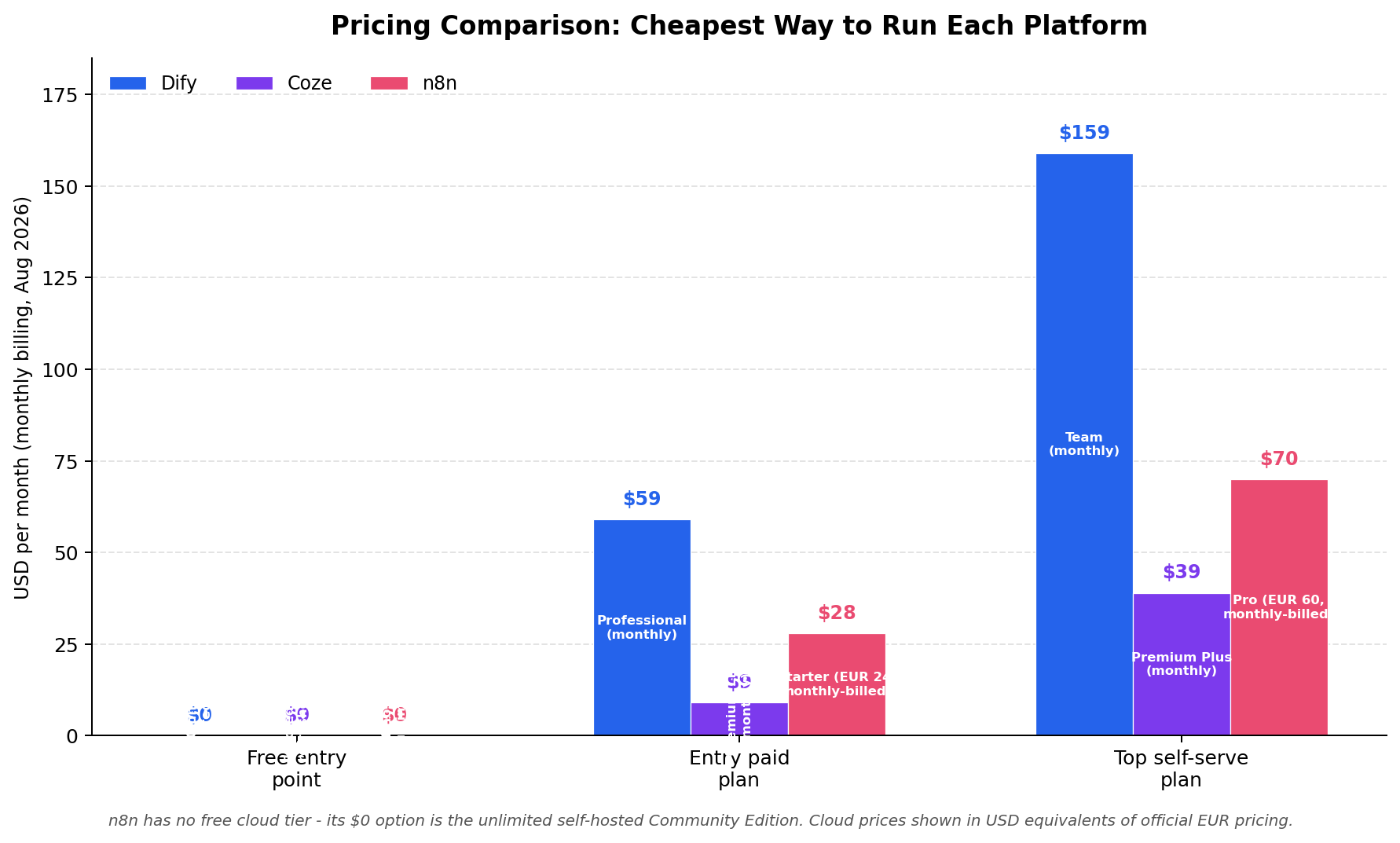
The chart above shows the cheapest way to run each platform, and the shapes tell three stories. Coze's bars barely leave the floor — $0 free tier with daily-refreshing credits, $9 entry, $39 top self-serve plan. If your budget is literally zero, Coze is the only platform here where a live production bot costs nothing indefinitely.
Dify's cloud is the priciest — $59 to $159/month — because credits bundle compute and platform features. But its real pricing story is the escape hatch: self-host free, pay $5–50/month for a VPS plus ~$100–150/month in model API for a mid-traffic bot, and your unit costs stop scaling with a vendor's credit multiplier.
n8n inverts the model entirely — its $0 option is the unlimited self-hosted Community Edition, and paid cloud (~$28/$70) is really buying convenience, not capability. For an agency running client automations, that means margin: your infrastructure cost can stay near zero even as you bill $99–999/month subscriptions.
Head-to-Head: 6 Dimensions, 6 Winners
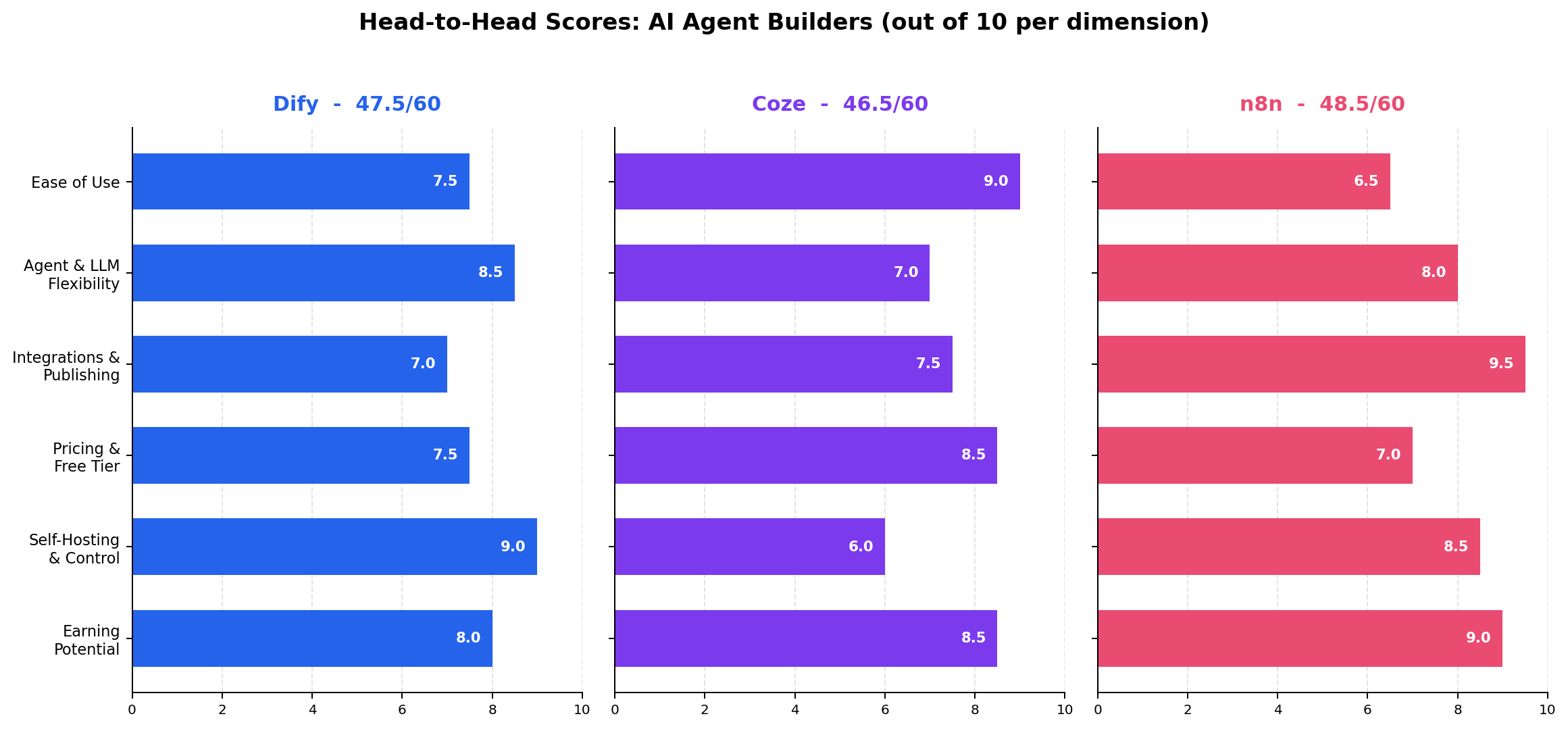
We scored all three platforms on six dimensions that matter for building — and billing — AI agents. The totals are close: n8n 48.5/60, Dify 47.5/60, Coze 46.5/60. Here's where each point was won.
1. Ease of Use — Winner: Coze (9.0 vs 7.5 vs 6.5)
Coze is the only platform where a non-technical person goes from signup to published bot in one sitting. Dify's workflow canvas is clean but its concepts (knowledge bases, retrieval tuning) demand a learning day. n8n's expressions and data-passthrough model are a real skill — worth learning, but not "10-minute first build" territory.
2. Agent & LLM Flexibility — Winner: Dify (8.5 vs 7.0 vs 8.0)
Dify's 50+ model providers, local Ollama support and swappable-model architecture give it the edge: you can architect an app, then race models against each other on cost and quality. n8n's LangChain-based agent nodes are close behind (8.0) with sub-agents and tool calling. Coze (7.0) locks you to its platform model list — convenient, but you can't bring a custom fine-tune.
3. Integrations & Publishing — Winner: n8n (9.5 vs 7.5 vs 7.0)
This one isn't close. n8n's 500+ integrations touch everything from Postgres to SAP-adjacent enterprise systems. Coze earns its 7.5 with 9 native chat channels — unmatched for pure chatbot distribution. Dify's 7.0 reflects its API-and-widget orientation: it publishes into your app, not into nine chat networks.
4. Pricing & Free Tier — Winner: Coze (8.5 vs 7.5 vs 7.0)
Daily-refreshing free credits and a $9 entry plan win on hosted pricing. n8n's "free" is bigger (unlimited self-hosting) but scores 7.0 because chat-only cloud use is proportionally expensive. Dify's 7.5 balances a pricier cloud against a genuinely free self-host with full features.
5. Self-Hosting & Control — Winner: Dify (9.0 vs 6.0 vs 8.5)
Docker-deploy Dify and you keep everything — every feature, your data, your upgrade cadence. n8n's Community Edition is equally free and unlimited (8.5), edged out only by Dify's broader feature parity in self-hosted form. Coze's 6.0 is the open-source Studio fork minus commercial features — self-hosting exists, but you're running a subset.
6. Earning Potential — Winner: n8n (9.0 vs 8.5 vs 8.0)
Follow the money: n8n freelancers bill $40–100/hour, productized automation services run $99–999/month, and the SAP partnership is pushing enterprise demand further. Coze's 8.5 comes from sheer gig volume — the China market's bot-setup economy (¥500–2,000 + retainers) runs on it. Dify's 8.0 reflects higher-value but fewer, more technical deals.
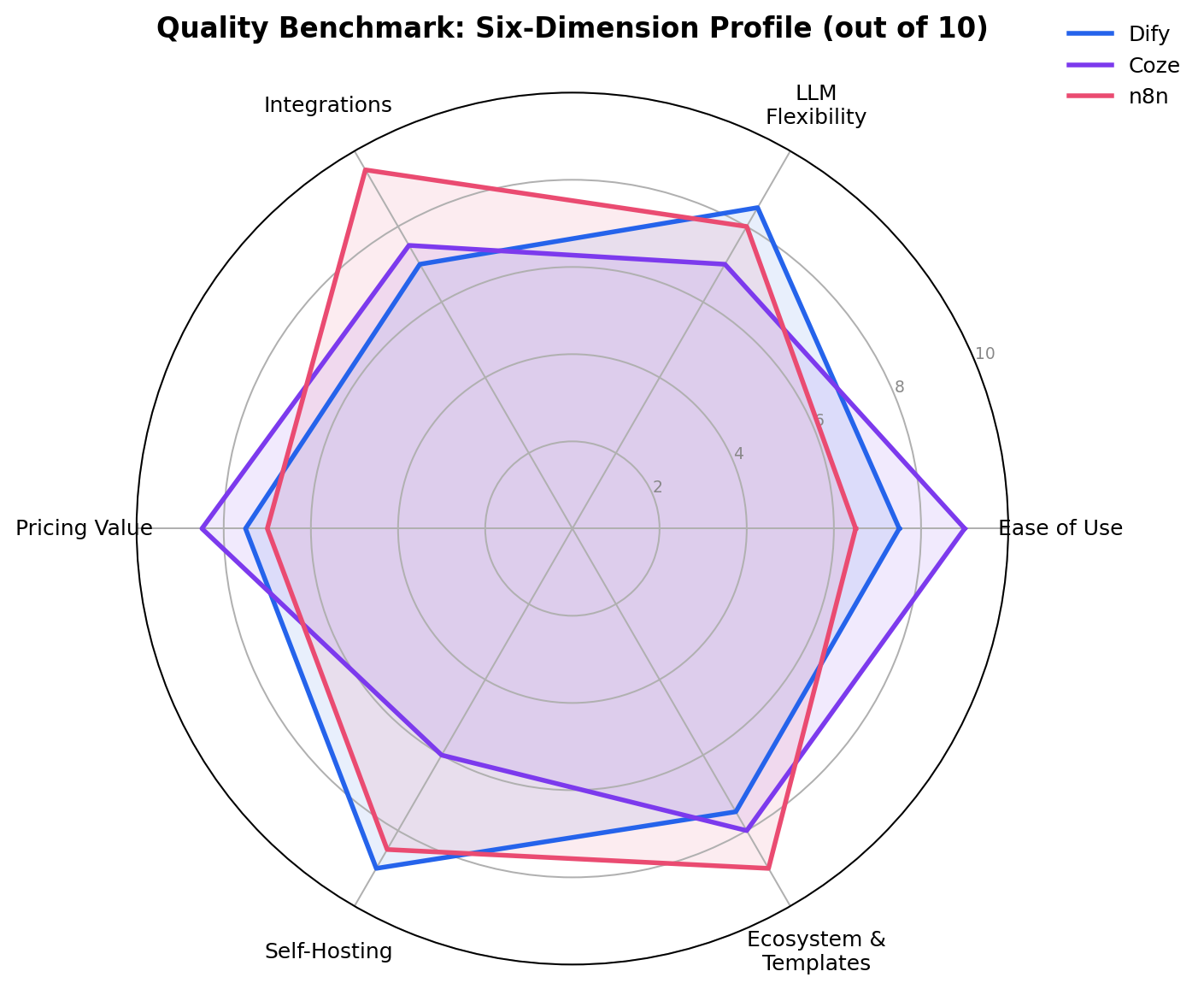
The radar view adds a dimension the bar chart doesn't: Ecosystem & Templates. n8n leads there too (9.0) with thousands of community workflows and clone-ready templates; Coze (8.0) counters with its plugin and bot store; Dify (7.5) has momentum — the May 2026 Template Marketplace launched with 200+ templates and is growing. Each platform's shape is distinct: Coze spikes on ease, Dify on control, n8n on reach — pick the spike that matches your business, not the biggest polygon.
Real-World Money-Making Scenarios
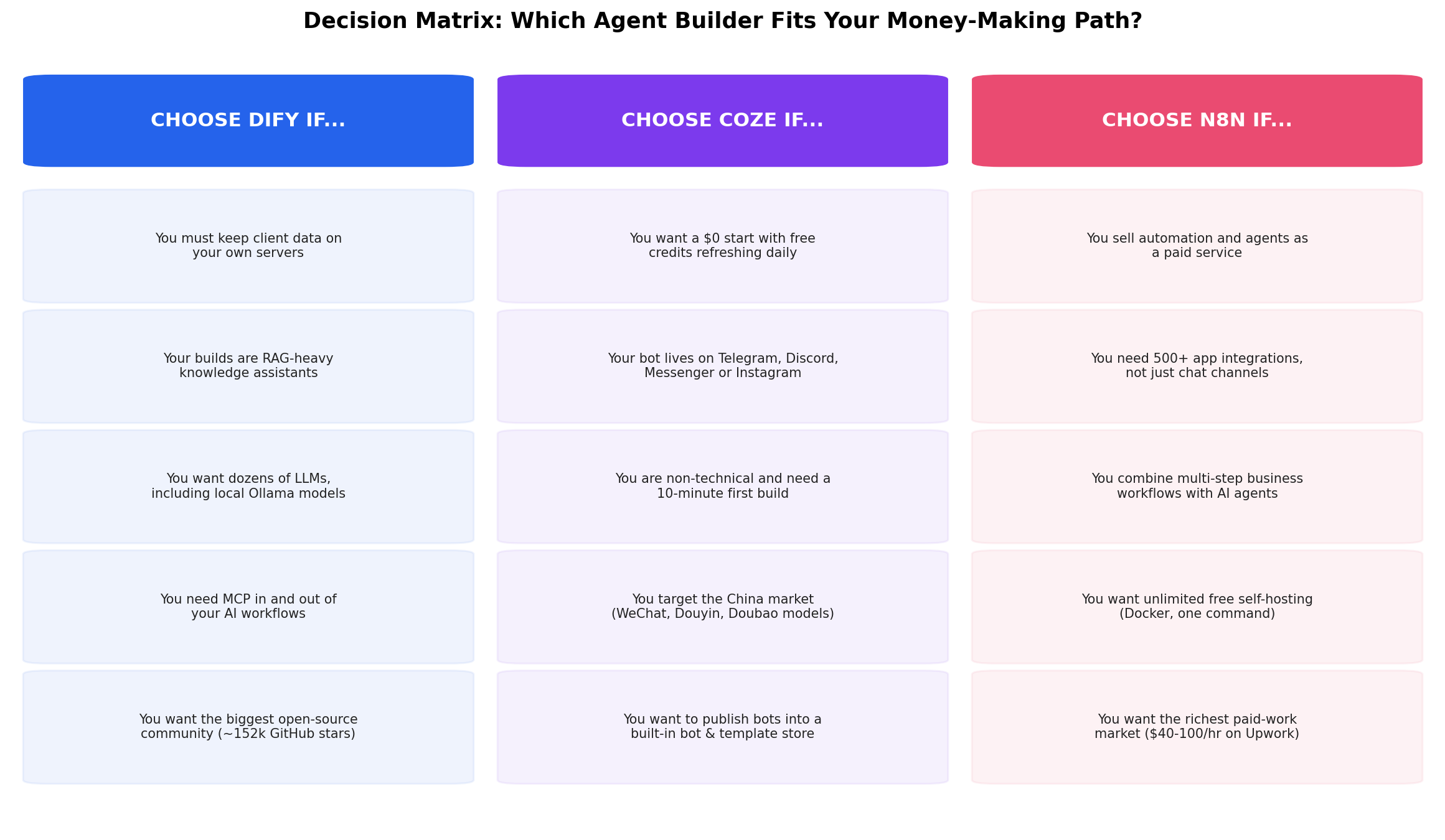
The decision matrix above maps each platform to the situations where it earns its keep. Here are three concrete gigs, priced from the actual freelance market.
Scenario 1: E-commerce Support Bot Gig (Coze runs away with it)
The most common entry-level gig: a merchant drowning in "where is my order?" messages. Build an AI customer-service bot on Coze — import the merchant's FAQ, product manual and return policy as a knowledge base, wire up order-lookup plugins, deploy to their chat channel, and replace the first tier of human support. In China this exact workflow (documented in 10-minute tutorial form on Tencent Cloud's community) sells on 闲鱼 and 猪八戒 for ¥500–2,000 per setup plus ¥100–500/month maintenance; Coze's free tier is enough to build it, so your cost basis is time alone. Internationally, the same build targeting Telegram, Discord or Messenger DMs bills $500–800. Platform pick: Coze, unambiguously — channel reach, speed, and $0 tooling.
Scenario 2: Private Knowledge Assistant for a Professional Client (Dify's home turf)
A law office, clinic, or consultancy wants a Q&A assistant over their internal documents — and their procurement rules say the data cannot leave their server. This is Dify's pitch in one sentence: Docker-deploy on the client's infrastructure, Ollama or their API keys for models, hybrid-search RAG with reranking for accuracy, MCP hooks for future expansion. Freelance rates for RAG knowledge-assistant builds run $1,000–2,500, with more complex SME deployments starting around $3,000. You keep full margin — infrastructure is their $20/month VPS. Platform pick: self-hosted Dify, because data control and RAG quality are the whole product.
Scenario 3: Productized Automation Agency (n8n pays the mortgage)
The highest-ceiling path: sell outcomes, not bots. An n8n agency packages workflows — new lead → enrich → route → CRM; order placed → stock sync → Slack alert → invoice follow-up — with an AI agent node handling the fuzzy steps. Bill $40–100/hour on Upwork for custom work, or productize into $99–999/month retainer subscriptions. Self-hosted Community Edition keeps your infra cost near zero across all clients (each client runs their own instance per the SUL), and the SAP-embedded enterprise wave is raising demand for exactly this skill. Platform pick: n8n — integrations are the product, and no chatbot platform has 500 of them.
Alternatives Worth Considering
| Tool | Starting Price | Standout Feature |
|---|---|---|
| Flowise | Free (open source) | Drag-and-drop LangChain UI; easiest open-source path to custom LLM chains |
| Langflow (IBM) | Free (open source) | Visual LLM pipelines with IBM backing post-DataStax acquisition |
| Make | From $9/mo | Friendlier visual automation than n8n; strong app coverage |
| Zapier | From $20/mo | 8,000+ app integrations and Zapier Agents for zero-learning-curve automation |
| Botpress | Free tier + usage-based | Chat-first platform with built-in analytics and conversation testing |
The Verdict
🏆 Our Recommendations
Best for client chatbot gigs and $0 starts → Coze. Nothing matches its speed-to-published-bot, 9 chat channels, and a free tier that refreshes daily forever. At $9–39/month it's also the cheapest platform you'd actually bill against. Just know the walled garden: platform-billed credits, locked model list, and ByteDance ownership that requires an alternative story for privacy-sensitive Western clients.
Best for RAG applications and data control → Dify. The strongest retrieval pipeline here, 50+ model providers including local Ollama, and full-feature Docker self-hosting make it the platform clients' compliance teams sign off on. The $59/$159 cloud is priciest, but the free self-hosted edition is where serious builders live. Read the license before hosting many tenants.
Best for automation agencies and maximum earnings → n8n. It won the total score (48.5/60) on the strength of 500+ integrations, unlimited free self-hosting, and the richest freelance market of the three — now amplified by the SAP partnership and $5.2B valuation. The trade: the steepest learning curve and no turnkey chat UI.
The hybrid play most pros converge on: Coze for the customer-facing bot where speed and channels matter, n8n as the operational backbone behind it (order lookups, CRM sync, alerting), and Dify when a client's data policy demands on-prem RAG. The three archetypes genuinely complement each other — and knowing which to quote for which gig is itself a billable skill.
Frequently Asked Questions
Is Dify free and open source?
Partially. The source is public under the Dify Open Source License — Apache 2.0-based, but you can't resell it as a multi-tenant SaaS without written authorization, and branding must be preserved. Self-hosting via Docker is free (you pay only server and model API costs); the cloud runs from a free 200-credit Sandbox to $59/month Professional and $159/month Team.
Is Coze free to use?
Coze.com's free tier gives 10 credits that refresh daily, indefinitely — enough to run a low-traffic bot at $0. Paid plans: $9/month Premium Lite, $19/month Premium, $39/month Premium Plus. Coze.cn has separate free and RMB-priced team tiers, and Coze Studio (the builder) is self-hostable under Apache 2.0 with some commercial features missing.
Which platform is best for building chatbots for clients?
Match the platform to the client. Small merchants wanting a channel bot fast → Coze. Clients with privacy requirements and document-heavy knowledge → self-hosted Dify. Automation-heavy engagements where chat is one piece → n8n. Most freelancers end up offering all three as a menu.
Can you make money building AI agents with these tools?
Yes — this is one of the most liquid freelance skills of 2026. China market: ¥500–2,000 per bot setup plus ¥100–500/month retainers. International: $500–800 no-code setups, $1,000–2,500 RAG builds, $2,500–5,000 multi-channel deployments. n8n specialists bill $40–100/hour, and productized services sell at $99–999/month.
Is n8n open source?
It's fair-code. The Sustainable Use License allows free self-hosting with unlimited executions for internal business use, including client work where each client runs their own instance — but you cannot offer n8n itself as a hosted product to others. Cloud plans start around $28/month (EUR 24).
Which of the three supports the most LLMs?
Dify, with dozens of providers including local models via Ollama. n8n accepts essentially any model through API nodes plus 70+ dedicated AI nodes. Coze restricts you to its platform list — GPT/Gemini families internationally, Doubao/Kimi/DeepSeek on Coze.cn.
What is the difference between Coze.com and Coze.cn?
Separate platforms, separate accounts, separate data. Coze.com publishes to Telegram, Discord, Slack, LINE, Messenger and Instagram with GPT/Gemini models. Coze.cn (扣子) publishes to WeChat, Feishu, Douyin and Doubao with China-market models like Doubao 2.1. Bots can't be moved between them.