⏱ TL;DR
Qwen Image is 2026's best value in AI image generation: a genuinely free chat tier, a pay-per-image API at roughly $0.035, open Apache 2.0 weights, best-in-class text rendering in 12 languages, and a full instruction-based editing suite with character consistency. Midjourney remains the aesthetics king — V8.2 (July 2026) still produces the most art-directed, gallery-ready images of any mainstream tool, backed by a 20M-strong community and a polished web editor. But it starts at $10/month with no free trial, no API, and unreliable text.
Pick Qwen Image if you sell at volume, need text in your images, edit photos (pet portraits, product shots), or build automated pipelines. Pick Midjourney if the image itself is the premium product — wall art, brand hero visuals, cinematic concept work — and you ship dozens of images, not thousands.
Why This Comparison Matters More Than Ever
In 2024, "free vs Midjourney" wasn't a real question — the free options were visibly worse. In 2026 it is the question, because Alibaba's Qwen family did to image generation what DeepSeek did to reasoning models: matched the leaders on capability while charging an order of magnitude less. Qwen-Image 3.0 landed on July 21, 2026 and Midjourney answered with V8.2 on July 24 — three days apart. This comparison reflects both.
Here is why the stakes are financial, not philosophical. While researching creator businesses for this site, the same pattern keeps appearing: volume sellers have abandoned paid subscriptions for free image tools. Pet portrait artists who work at $15–60 per commission and deliver 5–15 images per order cannot justify $10/month minimums plus slow iteration when a free tool edits directly from the buyer's pet photos. Etsy sticker shops shipping name-personalized packs need text that renders correctly the first time. Meanwhile, premium print-on-demand sellers still swear by Midjourney because art direction is literally what their customers pay $30–45 for.
The scale behind each contender: Qwen's app family has reached 234 million users and the Qwen model family passed 3 billion cumulative downloads — over half of all open-model downloads worldwide. Midjourney hit roughly $500M annualized revenue with zero venture funding and about 1.4M paying subscribers. One is free infrastructure; the other is a paid taste brand. Which one makes you money depends entirely on what you sell — so we tested both through that lens.
At a Glance
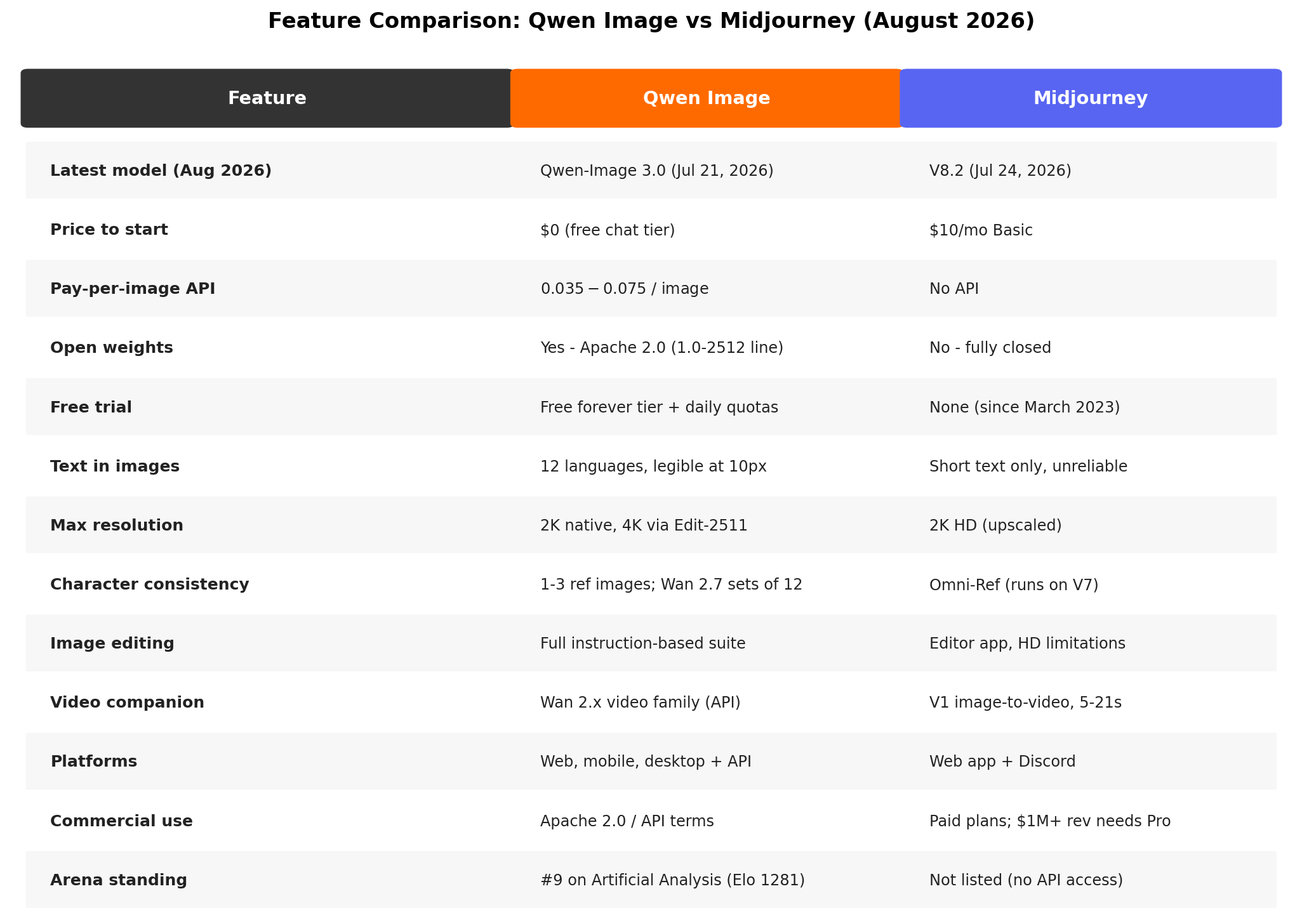
| Feature | Qwen Image | Midjourney |
|---|---|---|
| Best for | Volume sellers, text-heavy products, photo editing, automation | Premium art direction, brand visuals, cinematic concept work |
| Current model | Qwen-Image 3.0 (Jul 21, 2026) + open-weight 2512 line | V8.2 (Jul 24, 2026, now default) |
| Free tier | Yes — chat.qwen.ai daily quotas, forever | None — no free trial since March 2023 |
| Entry price | $0; API from $0.035/image | $10/mo Basic (~200 fast images) |
| API & automation | DashScope API, 120 RPM, LoRA fine-tuning | No public API |
| Open weights | Yes — Apache 2.0 (Qwen-Image 1.0–2512) | No — fully closed |
| Text in images | 12 languages, legible at 10px, LaTeX, infographics | Short text only, frequently garbled |
| Photo editing | Full instruction-based suite, 4K, ID consistency | Web Editor (inpaint, retexture); HD edits downgrade resolution |
| Max resolution | 2K native; 4K via Edit-2511 | 2K HD (upscaled) |
| Character consistency | 1–3 reference images; Wan 2.7 consistent sets of 12 | Omni Reference (still executes on V7) |
| Commercial use | Apache 2.0 — no royalties, no revenue share | Paid plans; $1M+ revenue requires Pro/Mega |
| Arena standing (Aug 2026) | #9 Artificial Analysis (Elo 1281, 3.0 Pro) | Not listed — no API access for benchmarking |
Deep Dive: Qwen Image
Qwen Image is Alibaba's flagship text-to-image line, and in eighteen months it has gone from "impressive for a free model" to top-10 on the global image arena. The family runs on two tracks: the open-weight line (Qwen-Image 1.0, the Edit series, 2511, 2512 — all Apache 2.0 on Hugging Face and ModelScope) and the hosted frontier line (Qwen-Image 2.0, 2.0 Pro, and now 3.0) available through chat.qwen.ai and the DashScope API.
What's new in 2026
Qwen-Image 2.0 (February 10) rebuilt the architecture — a 7B diffusion decoder with an 8B Qwen3-VL encoder, down from 20B parameters — and unified generation and editing in one model with native 2K output and 1K-token prompts. It briefly took the #1 spot on AI Arena at launch. Qwen-Image 3.0 (July 21) pushed control further: prompts up to 4,500 tokens, text legible at 10 pixels in 12 languages, 100+ style presets, 1–3 reference images for consistency, and single-pass multi-panel output — the demo that went viral in July was a full 3×3 infographic generated from one 3.7K-token prompt.
Around the image line sits the rest of the stack: Qwen-Image-Edit 2511 (December 2025) handles identity-preserving edits at 4K from multiple reference photos — the engine behind serious pet-portrait and product-photo workflows — and the Wan 2.7 model (April 2026) added chain-of-thought "thinking mode," hex-color control, and consistent 12-image character sets. One caveat for open-source purists: the 3.0 weights have not been released; the Apache 2.0 line stops at 2512. The frontier models are API-first.
Pricing (August 2026)
- Qwen Chat (chat.qwen.ai) — $0: image generation included free with daily quotas. Web, iOS, Android, and desktop apps. This is the tier most volume sellers live on.
- DashScope API — $0.035/image (qwen-image and 2.0), $0.075/image (2.0 Pro and Max), $0.043/image (Edit). New accounts get roughly 100 free images in 90 days; failed generations are not billed. 120 requests/minute.
- Self-hosted — $0 license fee: Apache 2.0 weights for the 1.0–2512 line, officially supported LoRA fine-tuning via diffusers. You pay only for GPU time (your own or ~$0.003–0.04/image on hosts like Together or Atlas).
Strengths
- Cost structure. Free tier, $0.035 API images, and no subscription. For a sticker shop generating 2,000 images a month, that is $70 versus $360/year minimum at Midjourney — and the free tier may cover it entirely.
- Text rendering. The best in the business right now across both Chinese and English: 10px legibility, 12 languages, formulas, and full infographic layouts. If your product contains words, this decides the purchase.
- Editing and consistency. Instruction-based edits, multi-image identity preservation at 4K, and consistent character sets — the exact capabilities photo-derived products (pet portraits, couple illustrations, brand mascots) require.
- Automation and control. A real API with 120 RPM, LoRA fine-tuning, and open weights. You can build a pipeline, a product, or a business on it. Midjourney offers none of these.
Weaknesses
- The aesthetics ceiling. Qwen output is very good and improving, but side-by-side, Midjourney V8.2 still wins lighting, composition, and that hard-to-define "expensive" look. For premium wall art, buyers can tell.
- Community and curation. There is no equivalent of Midjourney's 20M-member style-sharing culture, prompt libraries, or personalization ecosystem. You are mostly on your own for art direction.
- Frontier models are closed. The free Apache 2.0 line stops at 2512; the best models (2.0 Pro, 3.0) are API-only, and hosted tiers sit under Alibaba's content policy rather than your own GPU.
- Self-hosting skill floor. Running the open weights well means ComfyUI or diffusers proficiency — trivial for some sellers, a real barrier for others.
Deep Dive: Midjourney
Midjourney is the independent lab that defined AI aesthetics — no investors, roughly 100–165 employees, an estimated $500M in annualized revenue, and a reputation that still sets the visual tone of the industry. In 2026 it completed its transition from a Discord bot to a web-first product: midjourney.com now carries Create, Organize, and a full Editor with inpainting, panning, zoom, and Retexture, while Discord remains the community layer.
What's new in 2026
V8 Alpha (March 17) was a ground-up rewrite — off TPUs onto GPU-native PyTorch, roughly 5× faster, native 2K. V8.1 (default April 30–June) restored image prompts and weights, added a Prompt Shortener and Raw mode, and made HD the default. The current V8.2 (July 24) focuses on "aesthetics, personalization, and image quality" and is the default model as of this writing. Underneath, the V7 feature set still matters: Draft Mode (10× faster ideation at half cost), Omni Reference for character consistency, Personalization (rate ~200 images and the model learns your taste), and moodboards. Niji 7 serves the anime segment, and a V1 video model does image-to-video up to ~21 seconds.
Pricing (August 2026)
- Basic — $10/mo ($8/mo annual): ~3.3 fast GPU hours (roughly 200 images), no Relax mode. The entry ticket.
- Standard — $30/mo ($24/mo annual): 15 fast hours + unlimited Relax generations.
- Pro — $60/mo ($48/mo annual): 30 fast hours + Stealth Mode (private generations) — required in practice for client work under NDA.
- Mega — $120/mo ($96/mo annual): 60 fast hours for production teams.
- No free trial (since March 2023). Extra GPU time runs about $4/hour. Companies above $1M gross revenue must be on Pro or Mega for commercial rights.
Strengths
- Aesthetics, still. V8.2 produces the most consistently art-directed output of any mainstream generator. Cinematic lighting, coherent palettes, gallery-ready composition — this is why it retains a loyal paying base despite cheaper rivals.
- Taste machinery. Personalization, style references, and moodboards encode your look and reproduce it across thousands of images — the closest thing to a "brand engine" in image AI.
- The community. 20M+ Discord members, an enormous shared prompt/style culture, and Explore as a trend feed. For freelancers, being fluent in Midjourney is itself a marketable skill.
- Product polish. The web Editor consolidates nine tools in one canvas; Organize handles libraries at scale. It feels like a professional tool, because it is one.
Weaknesses
- Paywall with no taste of the product. $10/month minimum, no trial, and Basic's ~200 fast images run out quickly; real usage means $30/month.
- No API, no automation. You cannot integrate Midjourney into a pipeline, batch-generate from a spreadsheet, or fine-tune it. Every image passes through the web UI by hand.
- Control gaps. Text rendering remains unreliable; prompt adherence trails Qwen and GPT Image 2 for literal layouts; Omni Reference still executes on V7; HD inpainting drops output to standard resolution.
- Legal weather. The Disney/NBCUniversal/DreamWorks suit is in private mediation (status conference Aug 31, 2026). It targets character generation, not ordinary commercial art — but it is a live case against your tool vendor. Also note: generations are public by default unless you pay for Pro-level Stealth.
Pricing Compared
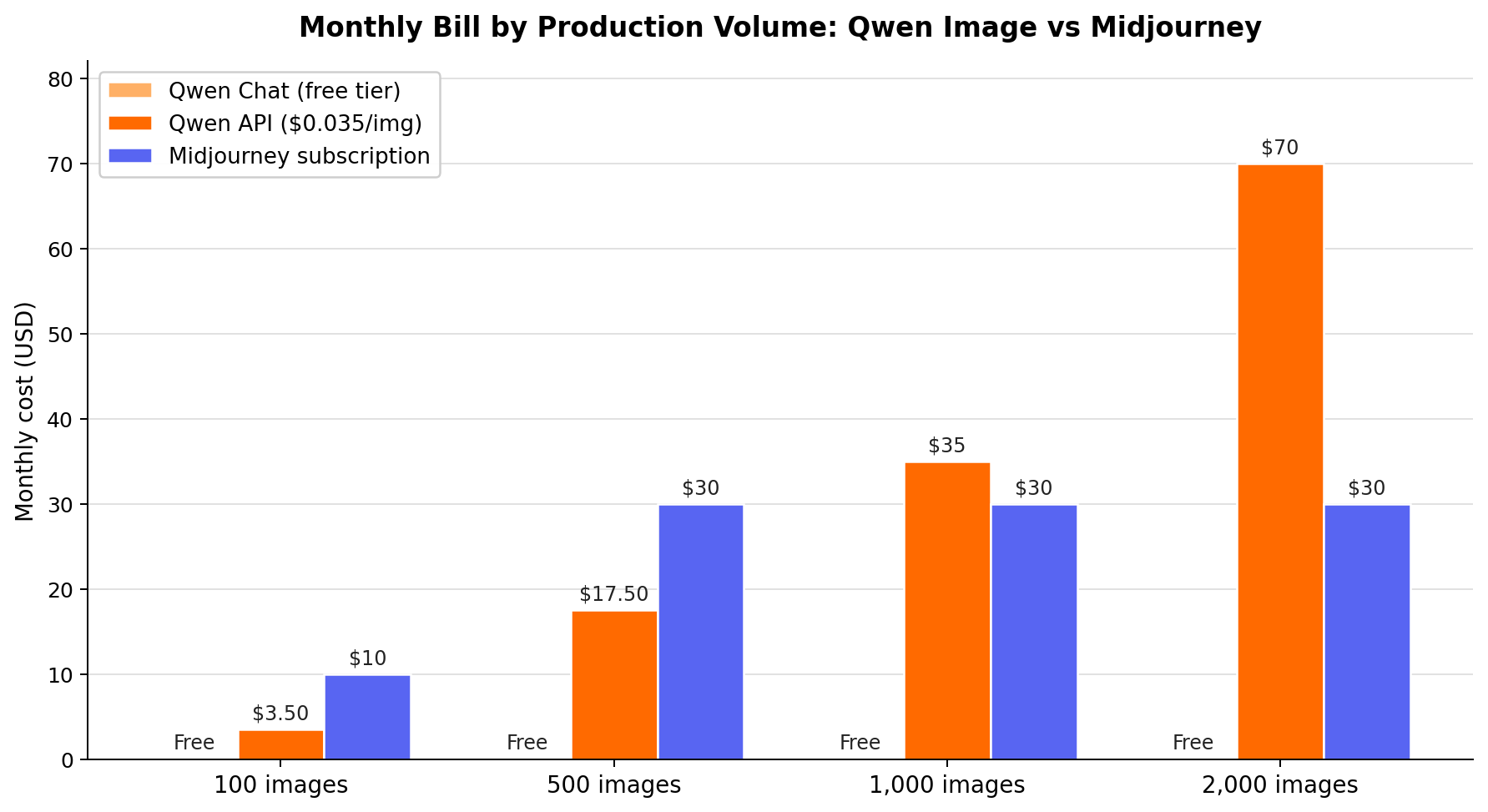
The pricing philosophies could not be more different, and the crossover point matters. Below ~200 images/month, Midjourney Basic at $10 is a flat, predictable cost. Above it, you are pushed to Standard at $30 — so a 1,000-image/month sticker business pays $360/year whether it generates 500 images or 5,000 Relax-mode images. Qwen's API scales linearly instead: 1,000 images cost $35/month at $0.035 each, and if the free chat quota covers your volume, the line simply stays at zero. At 2,000 images/month the gap is $70 (Qwen API) versus $360 (Midjourney Standard) — a $290/month difference that goes straight to margin. And unlike Midjourney, Qwen's cost stops entirely when you stop generating: no idle subscription.
Head-to-Head: 8 Dimensions, 8 Winners
One benchmark note before the dimensions: Midjourney does not appear on the Artificial Analysis image arena because it offers no API for evaluation — its stale V7 Alpha entry sits around #92. Qwen-Image 3.0 Pro ranks #9 globally (Elo 1281), behind GPT Image 2 (1369) and ahead of every other open or cheap model. So for Midjourney we weigh community consensus and our own testing rather than Elo.
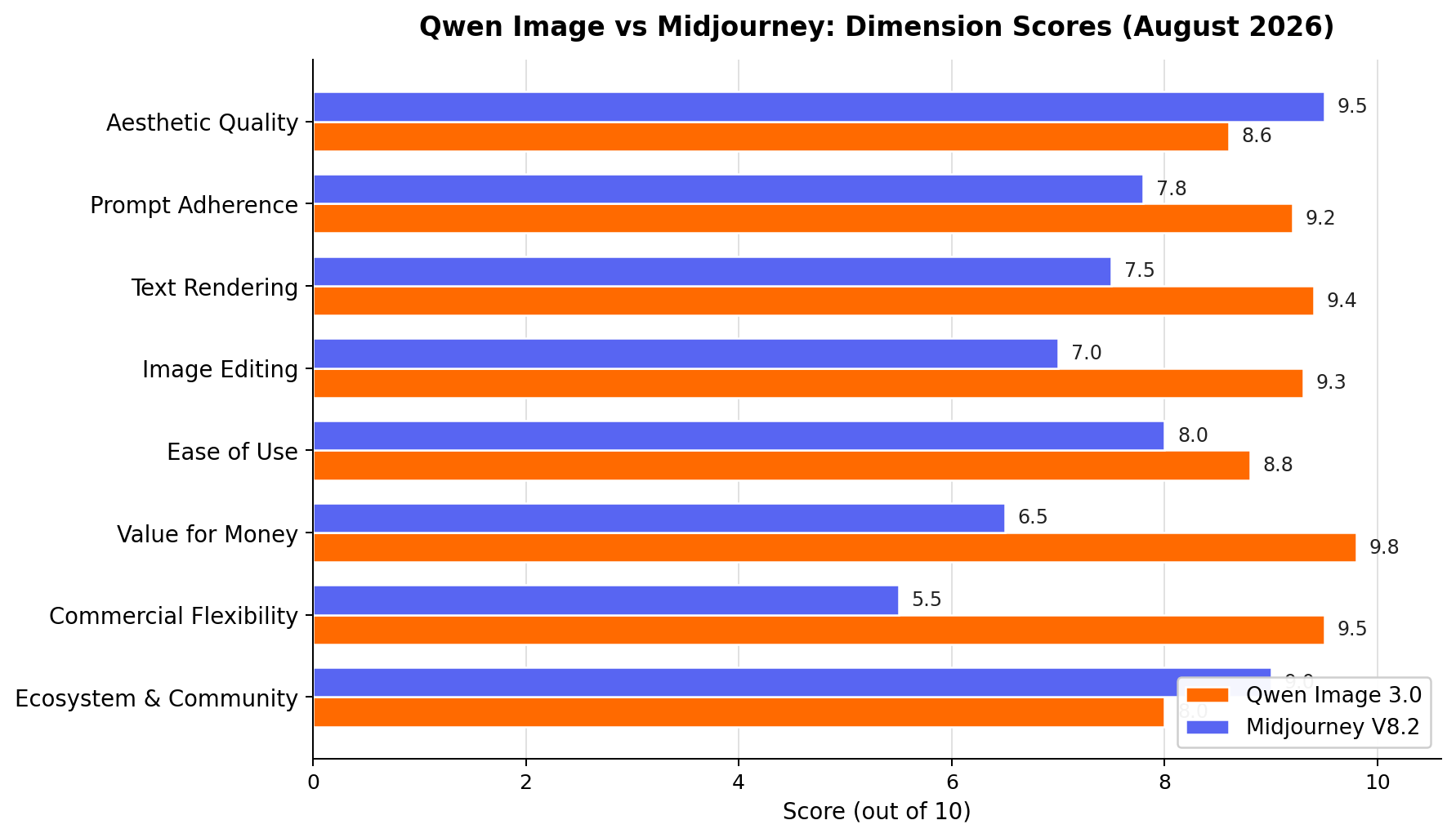
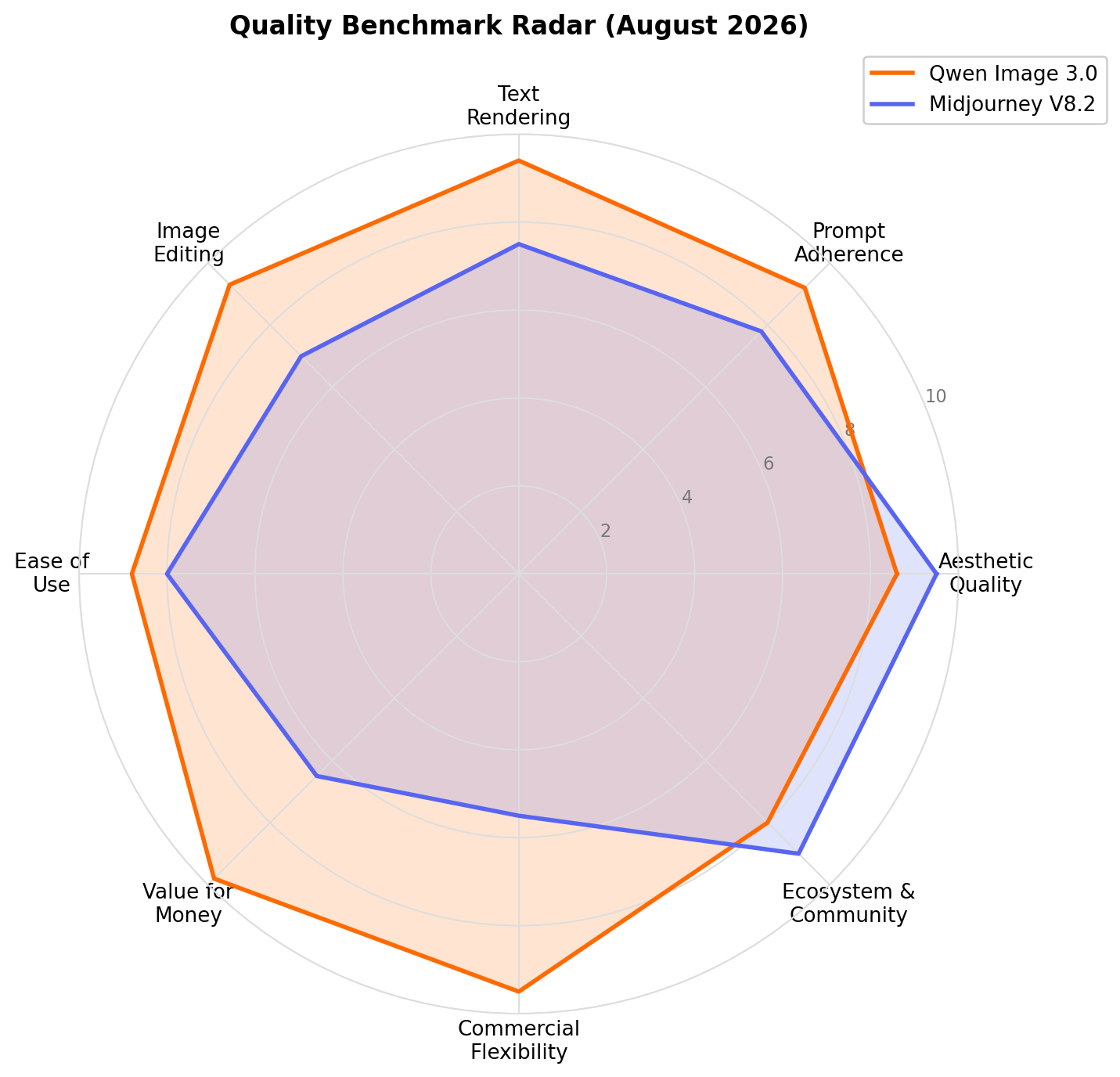
1. Aesthetic Quality — Winner: Midjourney (9.5 vs 8.6)
This is still Midjourney's crown. V8.2 delivers superior lighting, composition instinct, and stylistic coherence — the qualities that make a stranger stop scrolling. Qwen 3.0 is excellent and occasionally brilliant, but its default output leans "clean and correct" where Midjourney leans "art-directed." If the image is the product at a premium price point, this dimension can decide everything.
2. Prompt Adherence — Winner: Qwen Image (9.2 vs 7.8)
Qwen 3.0 accepts 4,500-token prompts and follows them: layout order, object counts, spatial relations, panel structure. Midjourney has improved with Raw mode and the Prompt Shortener, but it still interprets artistically — wonderful for vibe, frustrating when the client asked for "exactly five bottles, left to right, decreasing height."
3. Text Rendering — Winner: Qwen Image (9.4 vs 7.5)
Not close. Qwen renders legible text at 10px in 12 languages, handles formulas and multi-panel infographics in one pass, and is the reason it dominates sticker, menu, and thumbnail work. Midjourney V8.1 improved short phrases but still garbles longer strings. For any product where words appear inside the image, this is a disqualifier for Midjourney.
4. Image Editing — Winner: Qwen Image (9.3 vs 7.0)
Qwen's Edit line is a full instruction-based editor: add, remove, restyle, and 4K identity-preserving edits from reference photos. Midjourney's web Editor is genuinely good — Retexture is clever — but HD edits downgrade resolution and omni-reference still runs on the V7 engine. For photo-derived products (portraits from buyer photos, product shots), Qwen is in a different class.
5. Ease of Use — Winner: Qwen Image (8.8 vs 8.0)
Both are approachable, but Qwen wins on friction-to-first-image: open a chat, type, done — free. Midjourney demands payment before you generate anything, and its parameter culture (--sref, --cref, weights, version flags) rewards study. Power users call that depth; beginners call it homework.
6. Value for Money — Winner: Qwen Image (9.8 vs 6.5)
The blowout. Free tier, $0.035 API images, Apache 2.0 weights, no minimum commitment. Midjourney's $10–30/month is fair for what it delivers aesthetically, but "fair" loses to "free at comparable quality" for anyone whose margin depends on image cost.
7. Commercial Flexibility — Winner: Qwen Image (9.5 vs 5.5)
Apache 2.0 means no royalties, no revenue-share, no $1M-revenue plan tier, and the option to self-host or fine-tune a LoRA on your own product style. Midjourney grants commercial rights on paid plans but: public-by-default gallery, Stealth locked to Pro, no indemnification, and a live Disney case in mediation. Both are usable commercially; only one is flexible.
8. Ecosystem & Community — Winner: Midjourney (9.0 vs 8.0)
Midjourney's 20M-member community, style-reference culture, and Explore feed form a learning engine no competitor matches — including an entire cottage industry of prompt marketplaces. Qwen's ecosystem is growing fast (300k+ derived models across the Qwen family) but its image community is younger, more technical, and less curated.
Real-World Money-Making Scenarios
We test image tools the way people actually use them to earn. These three workflows come from documented creator business patterns, with the real numbers attached.
Scenario 1: Pet Portrait Commissions (Qwen Image runs away with it)
The business: Custom pet portraits sold on Etsy, Fiverr, and Instagram — digital files at $15–$40, printed canvases at $45–$60+ via print-on-demand. Successful sellers deliver a set (3–5 poses/styles) per order and run 10–30 orders a month. The buyer sends 1–3 photos of the pet; everything after that is conversion of photos into sellable stylized art.
The workflow: Ingest the buyer's photos as reference images, generate a style sheet (watercolor, line art, festive, Renaissance), iterate on the strongest pose, then keep the pet's identity locked across the set. That last step is the whole game — buyers reject portraits that look like "a generic golden retriever." Qwen-Image-Edit 2511 does exactly this: multi-photo identity preservation, instruction-based restyling, 4K output for print, at ~$0.043 per edited image — call it $0.50–1.00 in generation cost per $40 order. On the free chat tier it can literally be $0. Midjourney's Omni Reference is capable but still executes on V7, and its $10/month minimum plus slower iteration loops make it the wrong economics for a $15 digital file.
Tool verdict: Qwen Image, decisively. Cost per deliverable near zero, identity consistency built for this exact job, and 4K for print upsells. Typical solo sellers report $500–2,000/month on 15–50 orders; the tool bill rounds to nothing.
Scenario 2: Etsy Sticker & Personalized Product Packs (Qwen Image, because of the text)
The business: Digital sticker packs, lunchbox name labels, teacher rewards, quote prints — sold at $3–$6 per pack on Etsy, often personalized with names. Volume sellers list 200–500 SKUs and win on search coverage; margins are thin, so every cent of generation cost and every retake matters.
The workflow: Generate themed sheets where each sticker contains short text ("Mia's pencils," motivational quotes, café menu items). Text must render correctly on the first or second try — at $4/pack, you cannot spend 20 generations per sticker. This is Qwen's fortress: 10px-legible text in 12 languages and single-pass multi-panel layouts mean one prompt can yield a full sheet. A 2,000-image/month operation costs $70 on the API or $0 on the chat tier, versus $360/year at Midjourney minimum — and Midjourney's garbled text would force you to composite text in Canva or Photoshop anyway, adding a whole production step.
Tool verdict: Qwen Image. Between the text reliability, the linear API pricing, and no subscription floor, it is structurally built for high-SKU, low-price digital products. Use Canva for the final pack layout and delivery PDF.
Scenario 3: Premium Wall Art & Print-on-Demand (Midjourney earns its fee)
The business: Selling art prints, canvas wraps, and digital downloads on Etsy and personal Shopify stores at $25–$45 for prints and $60–$150+ for framed pieces — plus licensing to interior-decor dropshippers. Here the buyer is paying for the look: cohesive palettes, gallery-grade lighting, a style that survives being hung on a wall for years.
The workflow: Build a personalization profile by rating ~200 images, assemble moodboards of your store's aesthetic, then generate series with style references so every new piece matches the collection — buyers of art collections punish style drift. Midjourney V8.2 is unmatched at exactly this: aesthetics first, taste encoding, and consistent series output. Generate dozens of candidates in Draft Mode at half cost, upscale the winners to 2K, and Stealth Mode (Pro) keeps unreleased collections private. Qwen can produce good wall art, but its "clean and correct" bias shows at this price point — buyers comparing listings can feel the difference.
Tool verdict: Midjourney, at Standard or Pro ($24–48/month annual). Against $60–150 average order values, the subscription is rounding error, and the aesthetic edge is the product. A common hybrid: Midjourney for hero pieces, Qwen's free tier for listing variants and market tests.
Alternatives Worth Considering
| Tool | Starting Price | Standout Feature |
|---|---|---|
| FLUX.2 [pro] | ~$0.04/image API; open [dev] weights | Top-tier prompt adherence and speed — the developer favorite between Qwen and the closed labs (#17 and #30 on the arena) |
| GPT Image 2 | ChatGPT Plus $20/mo; API ~$0.21/image | The arena leader (Elo 1369) — unmatched instruction-following and editing inside ChatGPT |
| Nano Banana 2 | Free tier in Gemini; AI Pro $19.99/mo | Conversational photo editing (Elo 1320) — edit by chatting, fastest fix-and-iterate loop |
| Ideogram 3.0 | Free tier; Plus $8/mo | Typography-first design generation — logos, posters, and packaging with clean baked-in text |
| Stable Diffusion (self-hosted) | $0 + GPU | Total control: custom LoRAs, ComfyUI pipelines, offline privacy for sensitive client work |
The Verdict
🏆 Our Recommendations
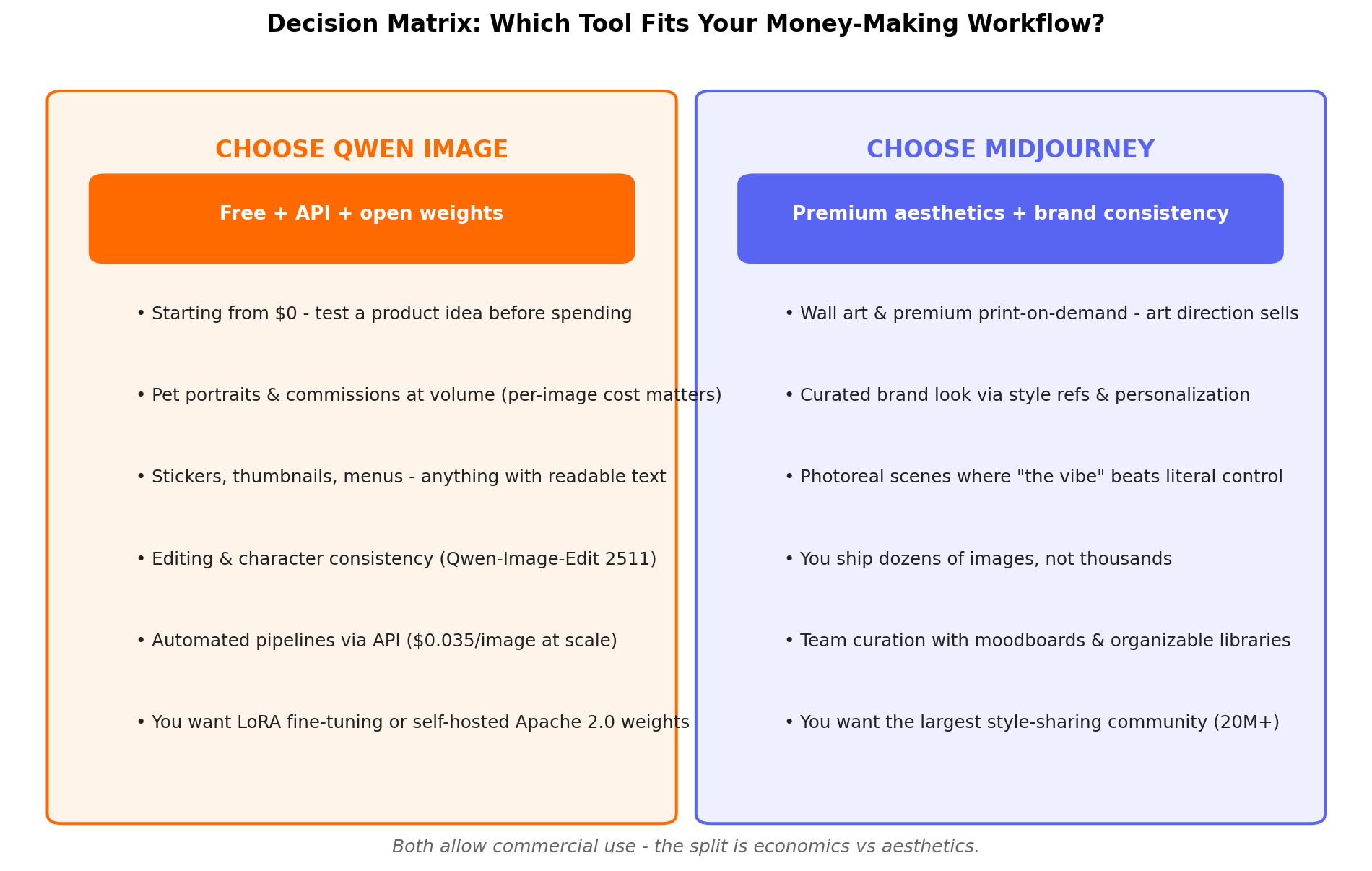
Best for volume sellers & photo-derived products → Qwen Image. Pet portraits, sticker packs, personalized products, thumbnails, menus — anywhere text must render, identity must hold, or margin is calculated per image. Free tier, $0.035 API images, Apache 2.0 commercial rights. It wins six of our eight dimensions.
Best for premium art direction → Midjourney. Wall art, brand hero visuals, concept work, anything where the aesthetic is the product. V8.2 plus personalization and moodboards is still the strongest taste engine in image AI — worth $24–48/month annual if your average order is $30+.
Best overall value → Qwen Image (9.8/10 on value). For every dollar it doesn't charge, it delivers top-10 arena quality, the industry's best text rendering, and the only real API + open-weights story in this pairing. In 2026, "free" finally doesn't mean "compromise."
The hybrid playbook used by real sellers: Qwen Image (free tier + API) as the production workhorse for volume, variants, and text-heavy products; Midjourney Standard annual for the premium hero pieces your store is known for. Total: $24/month for a two-tool stack that covers the entire $3-sticker to $150-canvas range.
Frequently Asked Questions
Is Qwen Image really free to use?
Yes. Qwen Image is free on chat.qwen.ai with daily image-generation quotas for free accounts, and Alibaba gives new DashScope API users roughly 100 free images in their first 90 days. After that, the API costs about $0.035 per image for the standard model and $0.075 for Pro tiers. The open-weight Qwen-Image models (1.0 through 2512) are also downloadable under Apache 2.0, so you can run them yourself on a GPU for the cost of electricity.
Can I sell art made with Qwen Image or Midjourney commercially?
Both allow commercial use. Qwen's open-weight models are Apache 2.0 licensed: you can sell the images you generate with no royalties or revenue share. Midjourney includes commercial rights on all paid plans, but companies with more than $1M in gross annual revenue must be on the Pro ($60/mo) or Mega ($120/mo) plan, and there is no IP indemnification on any tier. Qwen is the cheaper and more flexible path for high-volume sellers like Etsy sticker shops and pet portrait services.
Which one is better for pet portrait commissions?
Qwen Image. Pet portrait sellers typically charge $15–$60 per commission and work on tight margins, so a $0 minimum tool with strong photo-based editing wins. Qwen-Image-Edit 2511 accepts 1–3 reference photos and keeps the pet's identity consistent across a whole set in up to 4K, at roughly $0.043 per edited image via API. Midjourney produces more art-directed output, but its Omni Reference still executes on the older V7 engine, and the $10/month minimum eats margin on low-volume shops.
Does Midjourney have a free trial in 2026?
No. Midjourney has had no free trial since March 2023. The cheapest way in is the Basic plan at $10/month (or $8/month billed annually), which includes about 3.3 fast GPU hours — roughly 200 images — with no Relax mode. If you need more than that, the Standard plan at $30/month adds unlimited Relax-mode generations.
Which tool renders text inside images better?
Qwen Image, decisively. Qwen-Image 3.0 renders legible text down to about 10 pixels in 12 languages, including full Chinese and English typography, LaTeX-style formulas, and multi-panel infographics in a single pass. Midjourney V8.1 improved short-text rendering but remains unreliable for anything beyond a few words — a real constraint for stickers, thumbnails, menu designs, and Etsy quote products.
Is Qwen Image actually as good as Midjourney?
On measurable control — prompt adherence, text, editing, consistency — Qwen now leads. Qwen-Image 3.0 Pro ranks #9 on the Artificial Analysis image arena (Elo 1281) and the 2.0 release briefly hit #1 on AI Arena in February 2026. Midjourney does not participate in those leaderboards because it has no API, but community consensus still gives V8.x the edge in pure aesthetics, cinematic lighting, and art direction. The honest answer: Qwen wins on capability-per-dollar, Midjourney wins on look.
Is Midjourney safe to use commercially given the Disney lawsuit?
For typical commercial work, yes with care. The Disney/NBCUniversal/DreamWorks lawsuit (filed June 2025) targets Midjourney over generated depictions of copyrighted characters, not ordinary users selling landscapes or product art. The case went to private mediation in August 2026 with a status conference set for August 31. The practical rule for any generator: do not prompt for named characters and franchises, keep your prompts original, and your risk profile stays low.