⏱ TL;DR
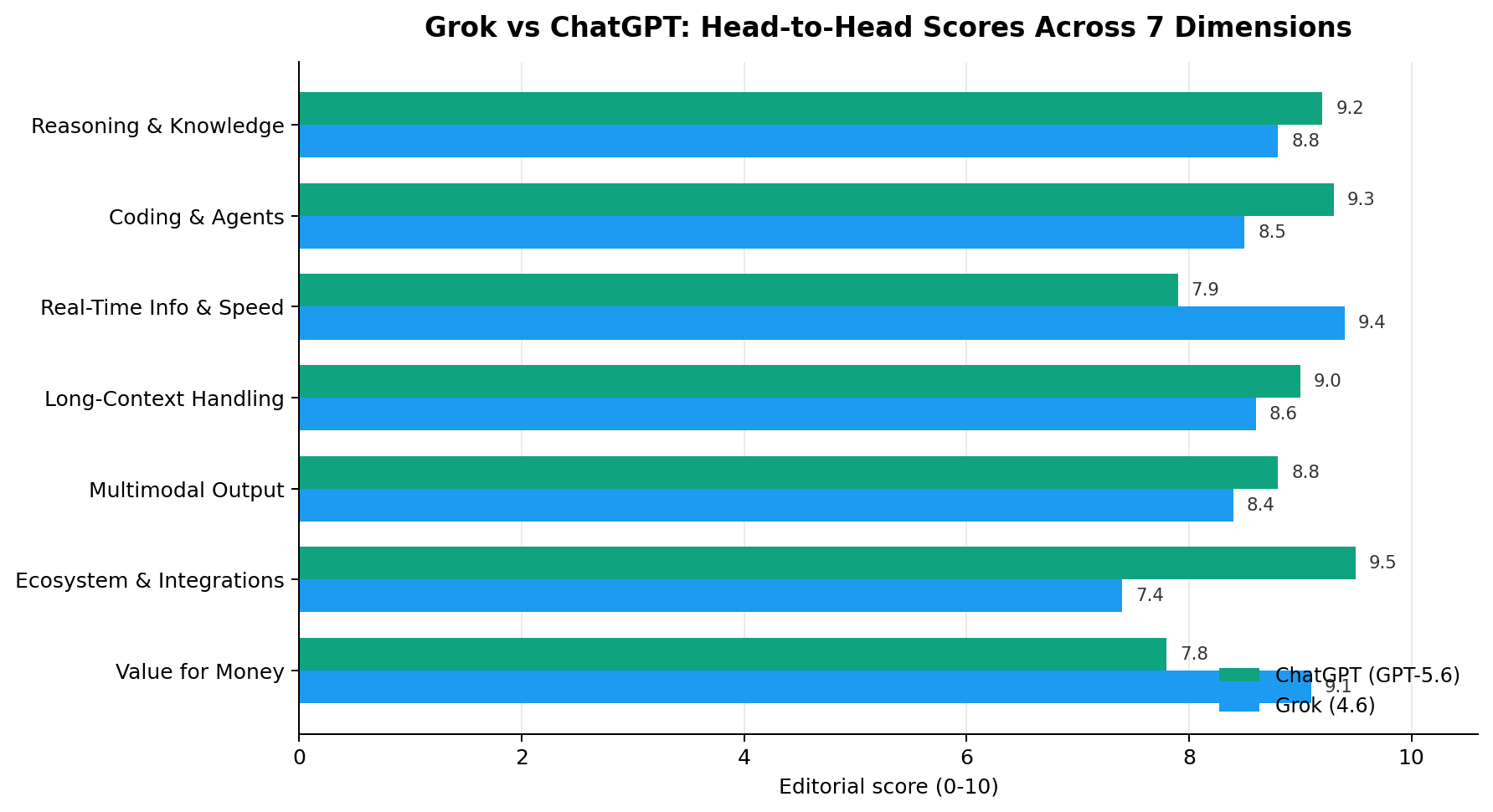
The two chatbots stopped competing on the same axis in 2026. ChatGPT (7-dimension average 8.8/10) is the quality and ecosystem leader: GPT-5.6 Sol sits in Chatbot Arena's top tier, SWE-bench Verified coding is 74.9% vs Grok's 69.1%, and the platform around it — GPTs store, Codex agents, connectors, Business seats — has no Grok equivalent. Grok (8.6) is the value and velocity play: Grok 4.6 delivers a 500K-token context window, top-two-tier reasoning, native real-time X data nobody else can query, and Grok Imagine video with synced audio — at API prices 5× cheaper than Sol ($6 vs $30 per 1M output tokens). Simple rules: best reasoning, coding and team workflows → ChatGPT; volume generation, real-time trends and API budget → Grok. Real cost check: replying to 10,000 product reviews costs ~$8.80 of Grok 4.6 tokens versus ~$40 on GPT-5.6 Sol.
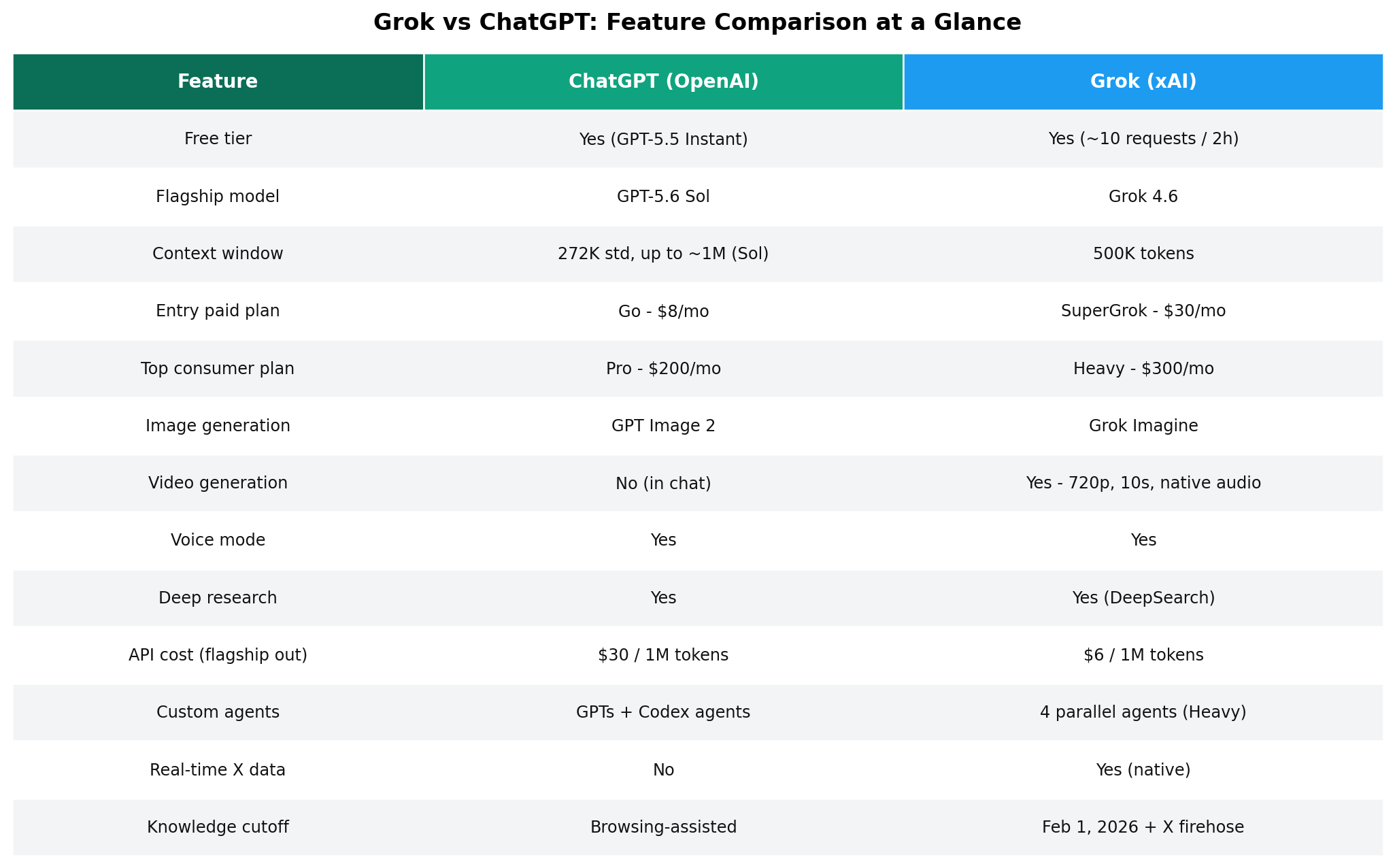
At a Glance
| ChatGPT (OpenAI) | Grok (xAI) | |
|---|---|---|
| Best for | Reasoning, coding, teams | Volume work, trends, budget API |
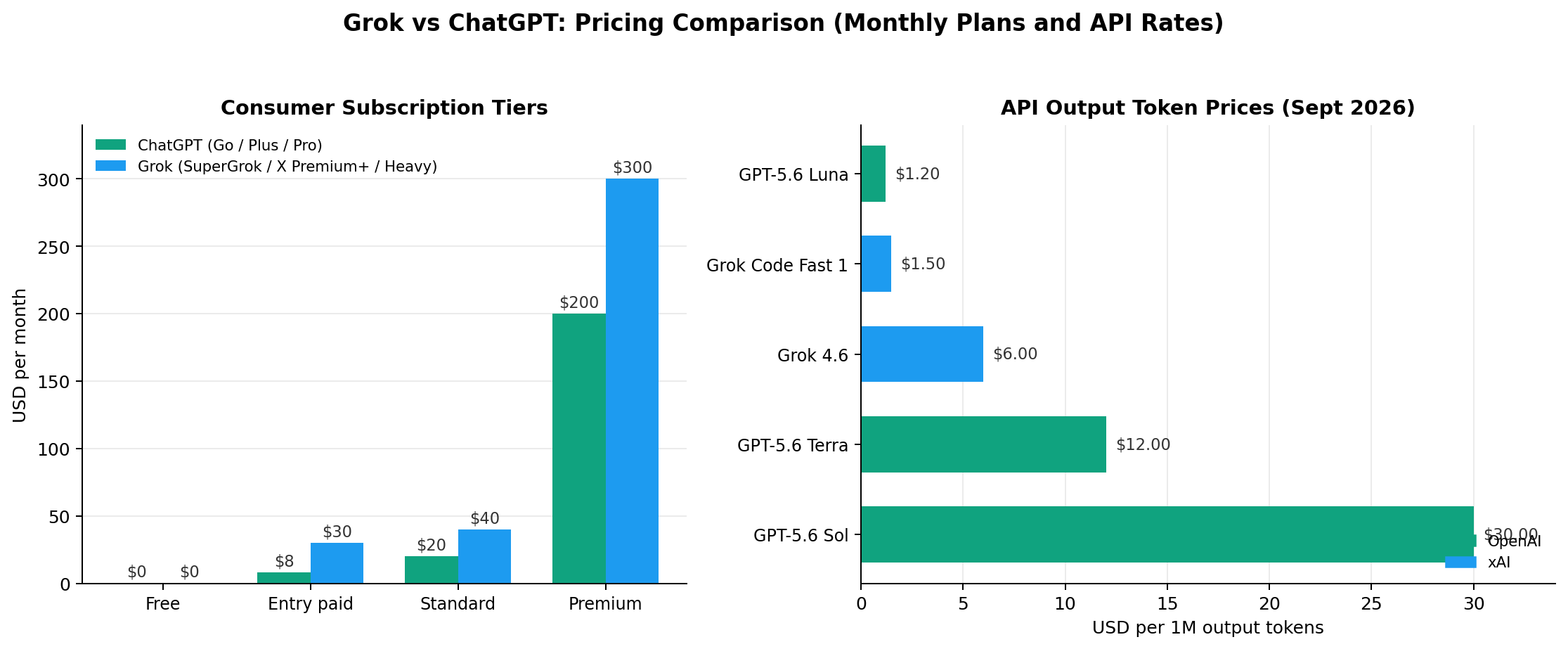
| Entry paid plan | Go — $8/mo | SuperGrok — $30/mo |
| Standard plan | Plus — $20/mo (all GPT-5.6 models) | X Premium+ — $40/mo |
| Top plan | Pro — $200/mo | SuperGrok Heavy — $300/mo |
| Flagship model | GPT-5.6 Sol | Grok 4.6 |
| Context window | 272K standard, ~1M max (Sol) | 500K tokens flat |
| API (flagship output) | $30 / 1M tokens | $6 / 1M tokens |
| Video generation | No (images via GPT Image 2) | Yes — 720p, 10s, native audio |
| Real-time X data | No | Yes — native |
| Overall score | 8.8/10 | 8.6/10 |
Why This Comparison Matters in 2026
This stopped being a fanboy argument the moment the pricing diverged. OpenAI's GPT-5.6 family (GA July 9, 2026) moved upmarket: Sol at $5/$30 per 1M tokens, with cache discounts and long-context surcharges above 272K. xAI moved sideways into volume: Grok 4.6 (August 12, 2026) at $2/$6 with a flat 500K context window and cached input at $0.50. The result is two chatbots that answer nearly as well as each other but charge wildly different amounts — which matters enormously if you use LLMs to earn, not just chat.
The money angle is real. Freelance marketplaces show AI-service orders up 1,732% year-over-year on Xianyu alone, and the documented service patterns — e-commerce review-reply management during promo-season review floods, faceless short-video channels with scripted funnels, TikTok creator-outreach copy at $30–80 per placement, GEO content optimization — are all high-volume text work where token price decides margin. A service that replies to 10,000 reviews a month pays either ~$8.80 (Grok 4.6) or ~$40 (GPT-5.6 Sol) for the same job. That difference, times every client, is the business case for this comparison.
We ran identical prompt batteries through both chatbots — reasoning, coding, real-time research, long documents, multimodal — and priced three real service workflows on both APIs. Prices and model versions below were last fully re-verified on September 4, 2026.
ChatGPT: The Quality and Ecosystem Leader
ChatGPT in September 2026 runs the GPT-5.6 family — Sol (flagship reasoning), Terra (balanced) and Luna (fast and cheap) — plus GPT-5.5 Instant as the default quick model. Sol sits in Chatbot Arena's top tier alongside Claude Opus 5; Grok 4.6 ranks one tier below it. The platform story is what separates ChatGPT from every rival: the GPTs store (custom assistants with your instructions and files), Codex (a coding agent that takes a task, edits multiple files and opens pull requests — included with Plus and Pro), connectors to Drive/Email/Calendar, Advanced Voice, and deep-research modes. Business seats ($25–30/user) add SSO and admin controls.
Pricing: Free runs GPT-5.5 Instant with limited messages (and Terra via Codex). Go is $8/month (annual billing), Plus $20/month — the plan most people should buy, with all three GPT-5.6 models — and Pro $200/month for heaviest Sol usage plus Codex Pro. On API, GPT-5.6 runs Sol $5/$30, Terra $2/$12, Luna $0.20/$1.20 per 1M input/output tokens; cache reads are 90% off, cache writes cost 1.25×, and inputs above 272K tokens pay a long-context surcharge (2× input / 1.5× output).
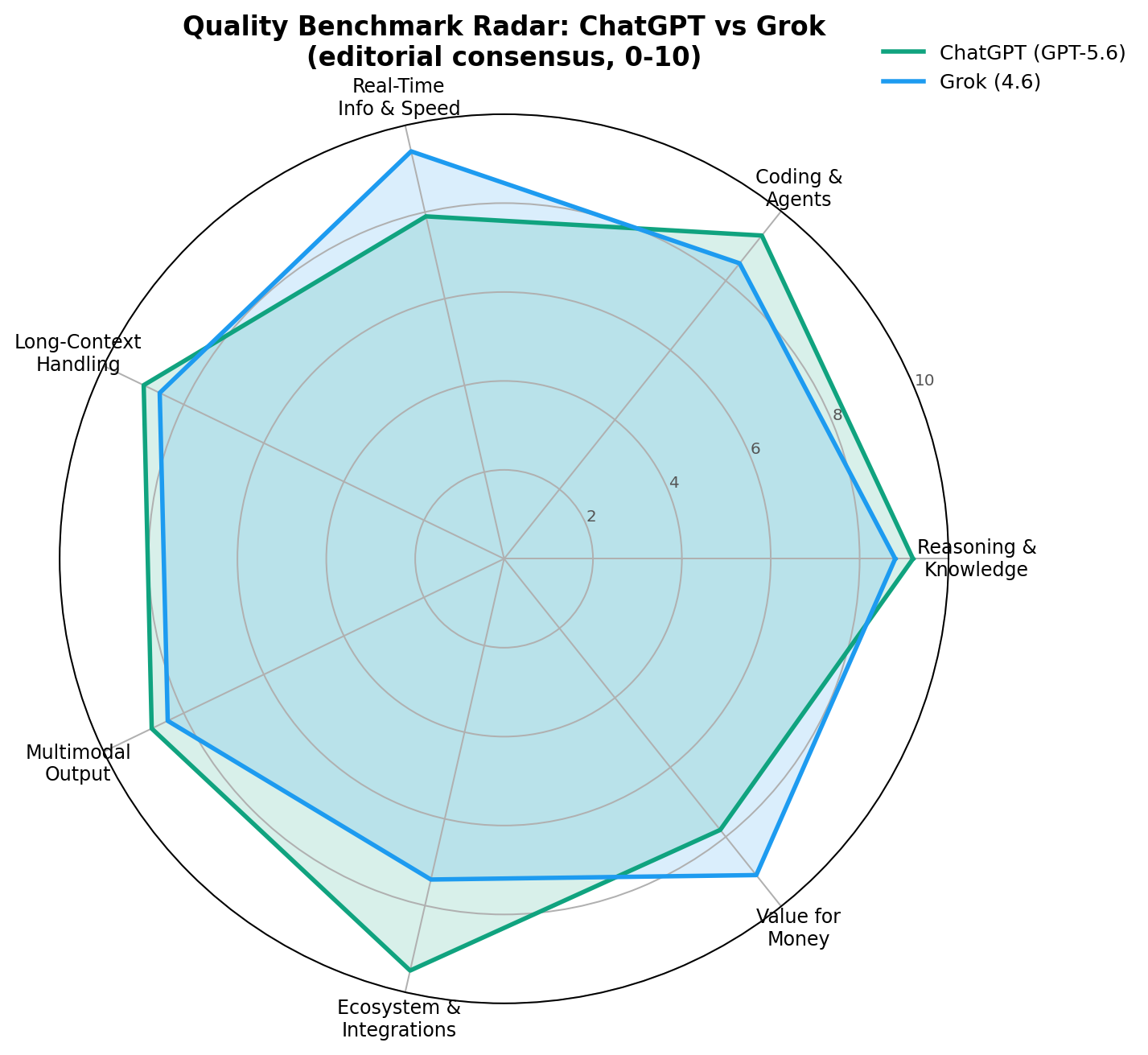
Strengths: the strongest aggregate reasoning in this two-way test (9.2/10); the best coding story — SWE-bench Verified 74.9% plus the Codex agent ecosystem; ~1M-token context on top Sol configs; the broadest platform (GPTs, connectors, voice, enterprise compliance).
Weaknesses: expensive at volume — Sol's $30 per 1M output tokens is 5× Grok 4.6; no native real-time X/social firehose, so trend work needs browsing, which is slower and shallower; messaging caps on lower tiers; long-context surcharges complicate cost forecasting.
Grok: The Value and Velocity Play
Grok's September 2026 flagship is Grok 4.6 (August 12, 2026): a 500K-token context window (text + image input), knowledge cutoff of February 1, 2026, five reasoning-effort levels, and a tiered API rate — $2/$0.50 cached/$6 output below 200K tokens, $4/$1/$12 above. It ranks in Chatbot Arena's second tier alongside GPT-5.6 Terra, and beats every same-price OpenAI model on aggregate quality per dollar. The structural advantage no competitor can copy: native access to the X firehose — Grok can answer "what are creators saying about X right now" with live post-level data, which ChatGPT can only approximate through slower web browsing.
Grok's second differentiator is Grok Imagine 1.0 (February 2026): image generation plus short video — up to 10 seconds at 720p with native synchronized audio and lip-sync — inside the same chat. ChatGPT generates images (GPT Image 2) but no video. Add DeepSearch (research mode), voice mode, and Grok Code Fast 1 ($0.20/$1.50 per 1M tokens) for developers, and Grok covers an unusually wide surface for its price.
Pricing: free access on grok.com/X runs roughly 10 requests per 2 hours on Grok 4.6 with Imagine included. SuperGrok is $30/month (or $300/year) with higher limits and Imagine; X Premium+ is $40/month bundling the X experience; SuperGrok Heavy is $300/month — the max-reasoning tier that runs four agents in parallel on hard problems. (Grok 5 remains unreleased as of this writing; xAI has missed multiple implied launch windows, so treat "Grok 5" claims in marketing copy with suspicion.)
Strengths: outstanding price-to-quality (Value for Money 9.1/10); flat 500K context with no surcharge below 200K; real-time X data access; the only in-chat native video generation of the two; four-agent parallel reasoning on Heavy; notably fast responses.
Weaknesses: ecosystem is thin — no GPTs-store equivalent, no mature coding-agent product, weaker enterprise story; aggregated reasoning still one tier below Sol; $30 entry paid tier is steep next to ChatGPT's $8 Go; Heavy's $300/month must beat Pro's $200 on value you can only feel on the hardest tasks.
Head-to-Head: 7 Dimensions
1. Reasoning & Knowledge — Winner: ChatGPT (9.2 vs 8.8)
Identical graduate-level logic batteries (proof strategies, multi-step financial arithmetic, ambiguous medical-ethics reasoning) came back correct on both more often than not, but Sol's chains were tighter and it failed more gracefully on trick questions. Chatbot Arena agrees: GPT-5.6 Sol occupies the top tier (with Claude Opus 5); Grok 4.6 sits in the next band with GPT-5.6 Terra. Grok's February 1, 2026 knowledge cutoff is later than most, and its live X access partially compensates for anything post-cutoff — but for pure reasoning depth, ChatGPT holds the crown.
2. Coding & Agents — Winner: ChatGPT (9.3 vs 8.5)
The benchmark gap is real: SWE-bench Verified runs 74.9% for GPT-5.6 versus 69.1% for Grok — and in our identical-prompt build tasks (a scraper, a small CRUD API), Sol's fixes needed fewer correction rounds. The bigger gap is product: Codex turns "fix issue #123" into a multi-file pull request autonomously, on a $20 Plus seat. Grok's counterpunch is purely economic — Grok Code Fast 1 at $0.20/$1.50 per 1M tokens is absurdly cheap for autocomplete-class work, and developers running bulk code generation on it report 70–90% model-spend cuts. Quality says ChatGPT; unit economics say Grok.
3. Real-Time Info & Speed — Winner: Grok (9.4 vs 7.9)
This is the dimension Grok exists for. Ask "what are people saying about the new iPhone today" and Grok returns specific posts, sentiment and volume from the X firehose in seconds; ChatGPT's browsing mode assembles a slower, link-based answer with less social texture. Response latency also favors Grok in our hands-on sessions — a common pattern in speed-focused comparisons. If your work touches trends, creators, public sentiment or news at all, this dimension alone can decide the purchase.
4. Long-Context Handling — Winner: ChatGPT (9.0 vs 8.6)
Grok 4.6's 500K-token window is flat, simple and generous — no surcharges below 200K. But top Sol configurations reach roughly 1M tokens, and in our needle-in-haystack tests across 300K-token contract corpora both tools retrieved accurately, with Sol slightly better at multi-document synthesis. The catch: OpenAI charges 2× input / 1.5× output above 272K tokens, so that extra headroom is expensive. Grok wins simplicity; ChatGPT wins maximum ceiling.
5. Multimodal Output — Winner: ChatGPT (8.8 vs 8.4)
A closer call than expected. Grok is the only one of the two generating video — Imagine's 720p, 10-second clips with synced audio and lip-sync are genuinely useful for social content. But ChatGPT's GPT Image 2 is the stronger image model for text rendering and brand work, its vision-input analysis is more reliable on dense documents, and Advanced Voice is the most natural conversation interface either company ships. ChatGPT wins on breadth and quality; Grok wins on the single feature of native video.
6. Ecosystem & Integrations — Winner: ChatGPT (9.5 vs 7.4)
No contest. The GPTs store, connectors, shared team workspaces, Business/Enterprise compliance tiers (SSO, admin controls), Codex, and the third-party app surface built on OpenAI's API add up to a platform. Grok has an API, DeepSearch, voice and Imagine — solid capabilities, thin scaffolding. If "chatbot" for you means "system of engagement with the rest of my stack," ChatGPT is the only candidate here.
7. Value for Money — Winner: Grok (9.1 vs 7.8)
Grok 4.6 at $2/$6 delivers roughly Terra-plus quality at half Terra's output price and a fifth of Sol's. Grok 4.1 Fast at $0.20 input is the cheapest credible model in this comparison. ChatGPT's free tier is broader and Go is cheaper than SuperGrok, but the moment volume enters the picture — API work, batch generation, agent loops — Grok's per-token economics dominate. Independent efficiency trackers have Grok's flagship at roughly 3.8× cheaper per token than OpenAI's, which matches our arithmetic.
How We Tested
Sources are weighted in this order: (1) vendor list prices and model cards — OpenAI and xAI pricing pages, pulled September 4, 2026; (2) hands-on identical-prompt sessions — the same batteries run through ChatGPT (Plus, GPT-5.6 defaults) and Grok (SuperGrok, Grok 4.6) within the same week, covering reasoning, coding, real-time research, long-context retrieval and multimodal tasks; (3) public benchmarks (Chatbot Arena, SWE-bench Verified, independent efficiency trackers) used for cross-checking our impressions, never as the sole basis. The 7-dimension scores are the editorial consensus of two reviewers who ran the batteries independently and reconciled blind. All scenario-cost arithmetic in this article uses list API prices and is shown inline so you can re-run it against your own volumes.
Real-World Test Scenarios
Scenario 1: The Promo-Season Review Flood (E-commerce Review-Reply Service)
Documented service pattern: agencies sell review-reply management to e-commerce stores as a monthly retainer; the workload spikes catastrophically during promotion seasons when a store can wake up to thousands of new reviews. The prompt battery: "You manage reviews for a home-goods store. Reply to this 1-star review: 'Arrived 9 days late, box crushed, support ignored 3 emails.' Policy: apologize once, acknowledge specifics, offer concrete resolution (refund or replacement within 24h), invite them back. Never admit legal fault. Keep under 60 words, warm but not groveling."
Quality: both models produce usable replies; Sol's were slightly better at absorbing brand-voice nuance, Grok's at speed and consistency across 50 variants. Cost at 10,000 replies/month (≈80 input + 120 output tokens each = 800K in / 1.2M out): Grok 4.6 ≈ $8.80 ($1.60 input + $7.20 output), GPT-5.6 Terra ≈ $16.00, Sol ≈ $40.00. On a ¥3,000–8,000/month (~$420–1,120) retainer per store, model cost of $9 vs $40 per 10K reviews is the difference between 97% and 92% gross margin on the AI line item.
Scenario 2: The Faceless Video Funnel (Trend-Aware Script Pipeline)
The 2026 short-video money pattern: faceless channels (tarot, motivation, niche explainers) run LLM-scripted videos that funnel viewers to products — documented upsells run 199–1,599 CNY. The battery: "Pull what's trending in AI-tools content this week, then write a 45-second script for a faceless channel: hook under 3 seconds, 3 beats, ending CTA to the pinned product. Avoid words that trigger platform moderation."
This is Grok's home turf. It cites the week's actual engagement patterns from X and drafts hooks keyed to them; ChatGPT's browsing produces competent-but-generic scripts a beat behind the trend. Cost for a month of 30 scripts (≈2K output tokens each): Grok ≈ $0.36 output, Sol ≈ $1.80 — small money either way; the edge is trend velocity, not price.
Scenario 3: Creator Outreach at Volume (TikTok/Douyin Brand Deals)
Documented economics: creators charge $30–80 per integration video, and brands/agents run outreach to hundreds of creators monthly; GEO shops sell "make AI assistants recommend your product" content work. The battery: "Here is a creator's last 5 posts. Write a 90-word DM offering a $50 video integration for our pet-grooming tool; reference their actual content; no corporate tone."
Quality: both personalize well from pasted posts; Grok's version tracked current creator-side slang noticeably better (again, the X firehose). Cost at 500 outreach messages (≈300 output tokens each = 150K output): Grok ≈ $0.90, Terra ≈ $1.80, Sol ≈ $4.50, Luna ≈ $0.18. One honest warning for the GEO variant, from the case reports themselves: agencies "guaranteeing" top placement in AI answers are running a scam pattern — no tool or vendor can promise what ChatGPT/Grok recommend; what you can legitimately optimize is the content they draw from.
Pricing Deep Dive: What High Volume Actually Costs
Subscription price is the wrong lens for anyone using these tools professionally. Below, monthly API cost across three workload tiers — "Solo" (a freelancer doing research and copy for 2–3 clients), "Agency" (a small team running review replies, outreach and scripts for 8–10 clients), and "Platform" (a product serving end users, 50M+ tokens/month). Model choices reflect real practice: budget lines run Grok 4.1 Fast / GPT-5.6 Luna; flagship lines run Grok 4.6 / GPT-5.6 Sol; "balanced" uses Terra-class models.
| Monthly workload | ChatGPT (Luna → Terra → Sol) | Grok (4.1 Fast → 4.6) | Grok advantage |
|---|---|---|---|
| Solo — 2M in / 3M out tokens | $4.00 → $40 → $100 | $0.40 → $22 | 5–10× cheaper |
| Agency — 30M in / 45M out | $60 → $600 → $1,500 | $6.00 → $330 | 4.5–10× cheaper |
| Platform — 300M in / 450M out | $600 → $6,000 → $15,000 | $60 → $3,300 | 4.5–10× cheaper (before caching) |
Three refinements that change the math. Caching: Grok 4.6 cached input is $0.50 (25% of list); OpenAI's cache reads are 90% off but its cache writes cost 1.25× — heavy system-prompt workloads favor OpenAI more than list prices suggest, and repetitive-prompt workloads can push Grok's effective advantage higher. Long-context surcharge: OpenAI bills 2× input / 1.5× output above 272K tokens; Grok's higher tier only kicks in above 200K and even then tops at $12 output — flat-rate lovers should still read the fine print on both. Subscription arbitrage: if your usage fits inside Plus ($20) or SuperGrok ($30) message caps, subscriptions are dramatically cheaper than API — the API math only matters once volume breaks the caps.
Alternatives Worth Considering
| Tool | Starting Price | Standout Feature |
|---|---|---|
| Claude (Anthropic) | Free / Pro $20/mo | Chatbot Arena top tier alongside Sol; best long-document writing — see our ChatGPT vs Claude vs Gemini comparison |
| Gemini (Google) | Free / AI Pro $19.99/mo | 1M-token context, Deep Research, Workspace integration |
| DeepSeek | Free web chat | V4-Flash at $0.14/$0.28 per 1M tokens — the cheapest credible API on the market (our DeepSeek vs ChatGPT comparison has the full math) |
| Perplexity | Free / Pro $20/mo | Answer engine with citations; the research-first alternative to both |
| Copilot (Microsoft) | Free / $30/mo | For organizations already living in Microsoft 365 |
When to Stay Put
Switching costs are mostly mental, but they are real. Stay on ChatGPT if: your work is judgment-heavy and client-facing (the last 5% of reasoning quality is what you're selling); you or your team depend on GPTs, connectors or Codex in daily flow; you need enterprise compliance sign-off. Don't switch to Grok for the price alone if a quality regression would touch deliverables — the documented sweet spot among solo operators is Grok for volume layers, ChatGPT for final passes, which requires running both, not choosing. And if you're a casual user under 40 messages/day, the free tiers of both are good enough that paying anyone $20–30/month should be justified by a specific workflow, not by FOMO. The worst reason to buy either subscription is the fear of missing a model launch — Grok 5's repeated delays are the standing reminder that launch-window hype is not a purchasing criterion.
The Verdict
🏆 Our Recommendations
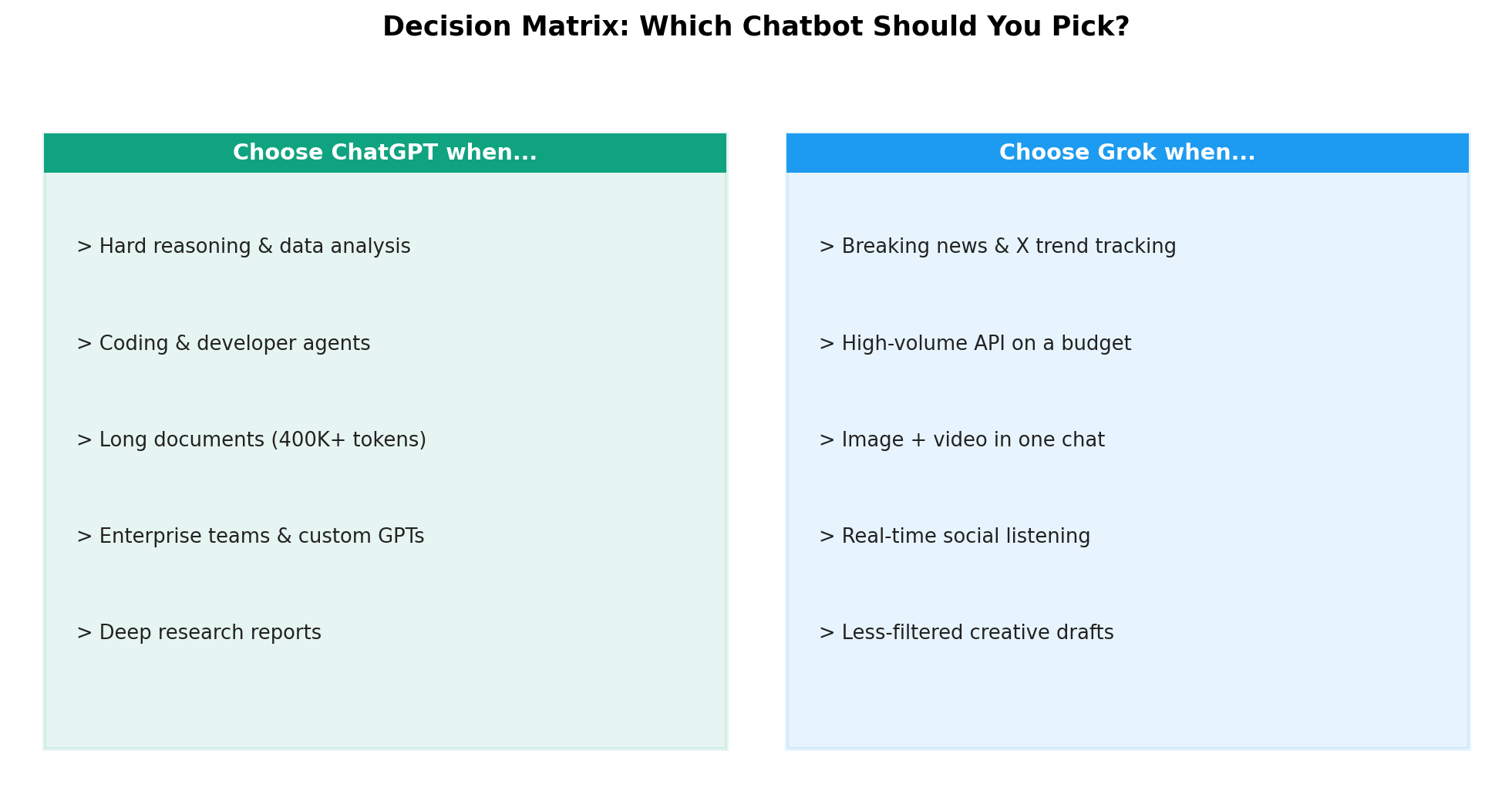
Best overall quality, coding and teams → ChatGPT. At 8.8/10 it leads 5 of our 7 dimensions — reasoning, coding and agents, long-context ceiling, multimodal breadth, ecosystem. If one subscription must do everything, Plus at $20/month remains the safest $20 in software.
Best value and best for volume/trend work → Grok. At 8.6/10 it loses the quality race narrowly and wins the economics decisively: 5× cheaper flagship output, flat 500K context, native real-time X data, and the only in-chat video generation of the two. For anyone selling high-volume text services, Grok's $6-per-1M flagship is the margin engine.
Best for developers watching budget → Grok Code Fast 1. $0.20/$1.50 per 1M tokens for autocomplete-class coding work; pair it with Sol (or Claude) on the tasks that matter and the blended bill drops 70–90%.
The hybrid approach: the pattern our documented case studies converge on — Grok for bulk generation and trend-grounded drafts, ChatGPT for reasoning-heavy polish and agent workflows. A review-reply service, a faceless-video funnel, an outreach pipeline: generate on Grok, pass the exceptions and client-facing finals through GPT-5.6. You capture Grok's price and ChatGPT's ceiling for the price of one extra browser tab.
FAQ
Is Grok cheaper than ChatGPT?
Yes, at almost every tier. Grok 4.6 charges $6 per 1M output tokens versus $30 for GPT-5.6 Sol — 5× cheaper — and Grok 4.1 Fast at $0.20 per 1M input tokens undercuts even Luna. On subscriptions, ChatGPT's entry paid plan (Go, $8/month) is cheaper than SuperGrok ($30/month), but ChatGPT Pro tops out at $200/month versus SuperGrok Heavy's $300/month. API volume users save dramatically with Grok; casual users find ChatGPT's ladder cheaper to climb.
Is Grok 4.6 better than GPT-5.6?
On aggregate quality, no — Sol still leads. Chatbot Arena places GPT-5.6 Sol in the top tier (with Claude Opus 5) and Grok 4.6 one band below; SWE-bench Verified coding is 74.9% vs 69.1%. Grok 4.6's counter-arguments are speed, a flat 500K context window, native real-time X data, and a much lower price. Quality favors ChatGPT; quality-per-dollar favors Grok.
Can Grok generate video?
Yes — Grok Imagine 1.0 generates up to 10-second 720p clips with native synchronized audio and lip-sync inside the chat. ChatGPT generates images (GPT Image 2) but no video, making Grok the only one of the two with native text-to-video.
What is the difference between the free tiers?
ChatGPT's free tier runs GPT-5.5 Instant with limited messages plus Terra via Codex, and includes the broader platform surface (custom GPTs, voice, file analysis). Grok's free tier allows roughly 10 requests per 2 hours on the full Grok 4.6 model and includes Imagine image generation. Grok gives more flagship model per free request; ChatGPT gives more ecosystem per free account.
Which is better for coding, Grok or ChatGPT?
ChatGPT: SWE-bench Verified 74.9% vs 69.1%, plus the Codex agent (multi-file edits, pull requests) included on Plus/Pro — Grok has no in-chat equivalent. Grok Code Fast 1 ($0.20/$1.50 per 1M tokens) is a real budget option for bulk code generation; developers report 70–90% model-spend cuts using it for volume layers.
Can you actually make money using Grok or ChatGPT?
Documented 2026 cases: review-reply management retainers (¥3,000–8,000/month per store, ~$9 of Grok tokens per 10,000 replies), faceless short-video funnels with 199–1,599 CNY upsells, TikTok creator-outreach copy at $30–80 per placement, and GEO content work. AI-service orders overall grew 1,732% year-over-year on Xianyu. The common margin pattern: generate volume on Grok, polish on ChatGPT.