TL;DR: AI interior design has quietly become one of the most monetizable image-generation niches, because a $14-49/mo tool replaces a $1,500-5,000 professional service. After pushing the same rooms through all four platforms, Interior AI (8.4/10, Pro $29/mo billed yearly or $49 monthly) makes the most photorealistic restyles in 60+ styles from a single photo. REimagineHome (8.4, from $14/mo) wins the working pro's workflow — conversational edits, 10-image batches, real furniture you can buy. Coohom (7.4, Pro $29/mo) is the only true 3D editor of the four — bring a floor plan, get an editable room with real products. RoomGPT (6.0, packs from $9) is the one-click original, but its pay-per-credit model and no-edit single shots now trail every rival. The verdicts below are anchored in real seller economics: pre-renovation visualization packages at $28-112, designer subcontracting at $42-70/scheme, and 3-4 orders/day once fluent.
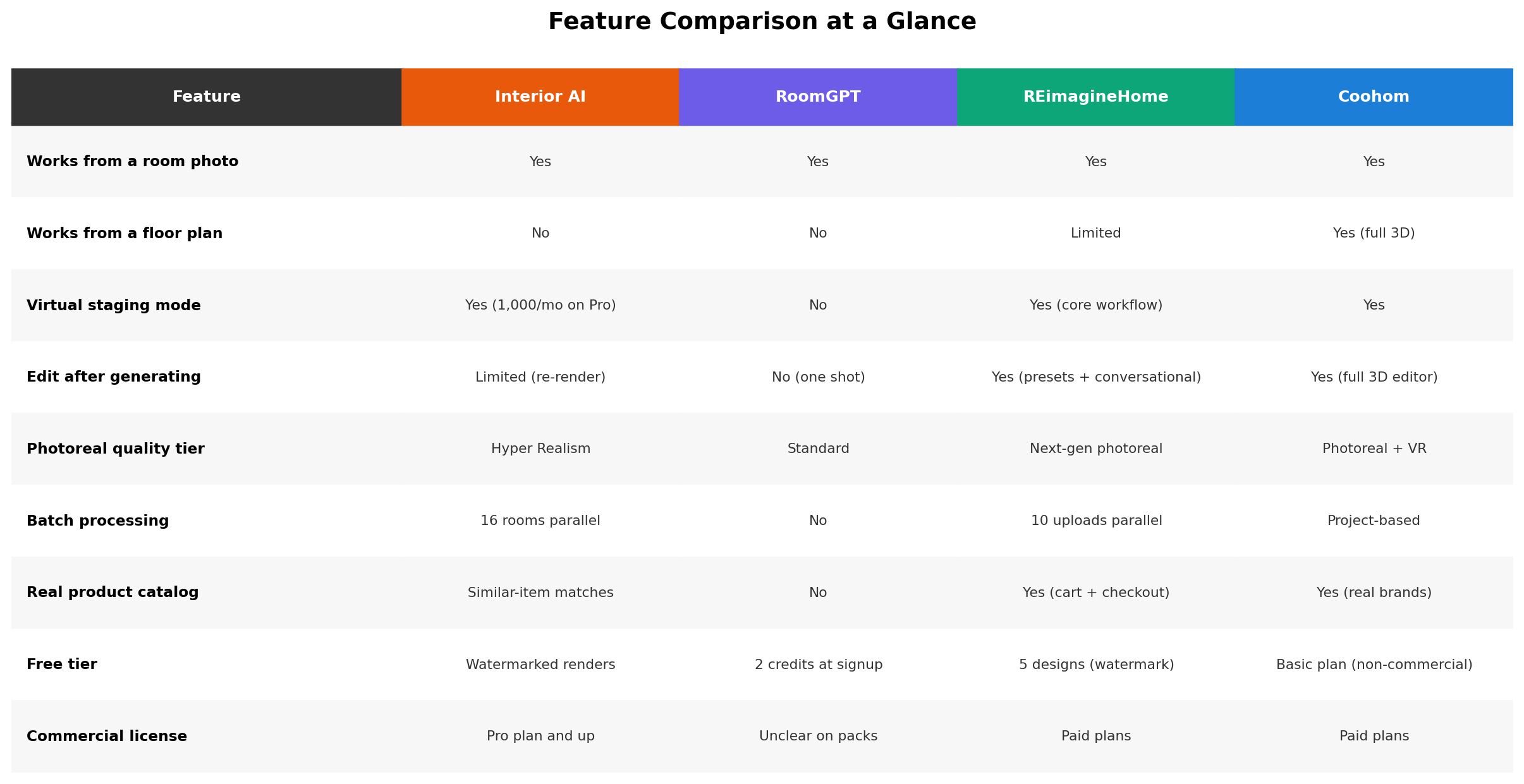
At a Glance
| Interior AI | RoomGPT | REimagineHome | Coohom | |
|---|---|---|---|---|
| Best for | Photorealistic restyles from one photo | Zero-learning-curve experiments | Staging & design-service workflow | Full 3D planning from floor plans |
| Vendor | Pieter Levels (Levelsio) | Hassan El Mghari | REimagineHome AI | Coohom (Kujiale international) |
| Free tier | Watermarked renders | 2 credits at signup | 5 designs (watermarked) | Basic plan (non-commercial) |
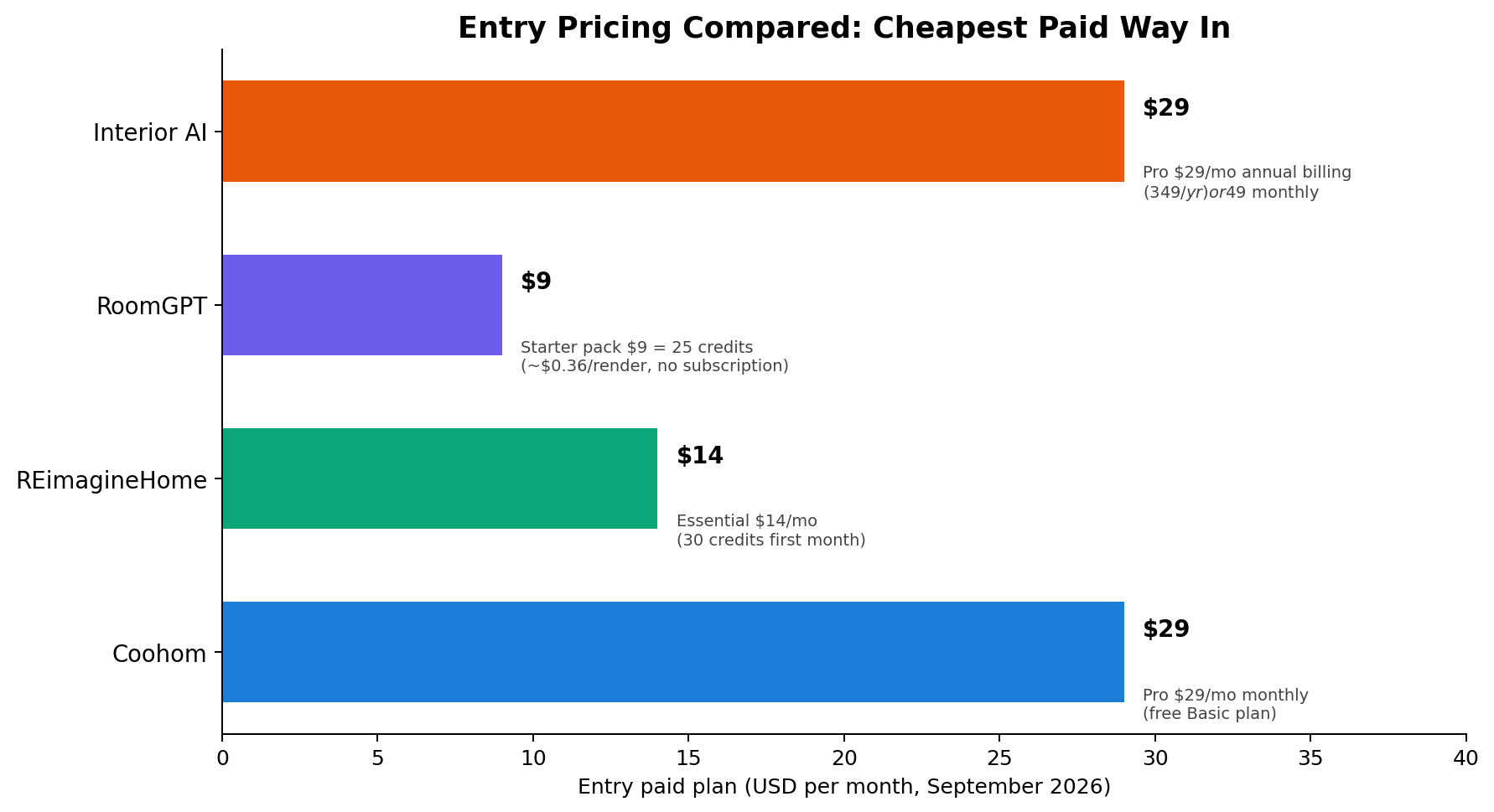
| Entry paid plan | $29/mo billed yearly ($349/yr); $49 monthly | $9 pack = 25 credits | $14/mo Essential (30 credits first month) | $29/mo Pro (7-day trial) |
| Power tier | Same Pro plan, unlimited-ish usage | $49 pack = 300 credits | $49/mo Advanced (500 credits first month) | $69/mo Elite |
| Works from | Room photo | Room photo | Room photo | Floor plan + photo |
| Virtual staging mode | Yes (1,000 stages/mo on Pro) | No | Yes (core workflow, batch 10) | Yes |
| Editing after render | Limited (re-render) | None (one shot) | Presets + conversational AI | Full 3D editor |
| Learning curve | Minutes | Minutes | Minutes | Hours (real 3D tool) |
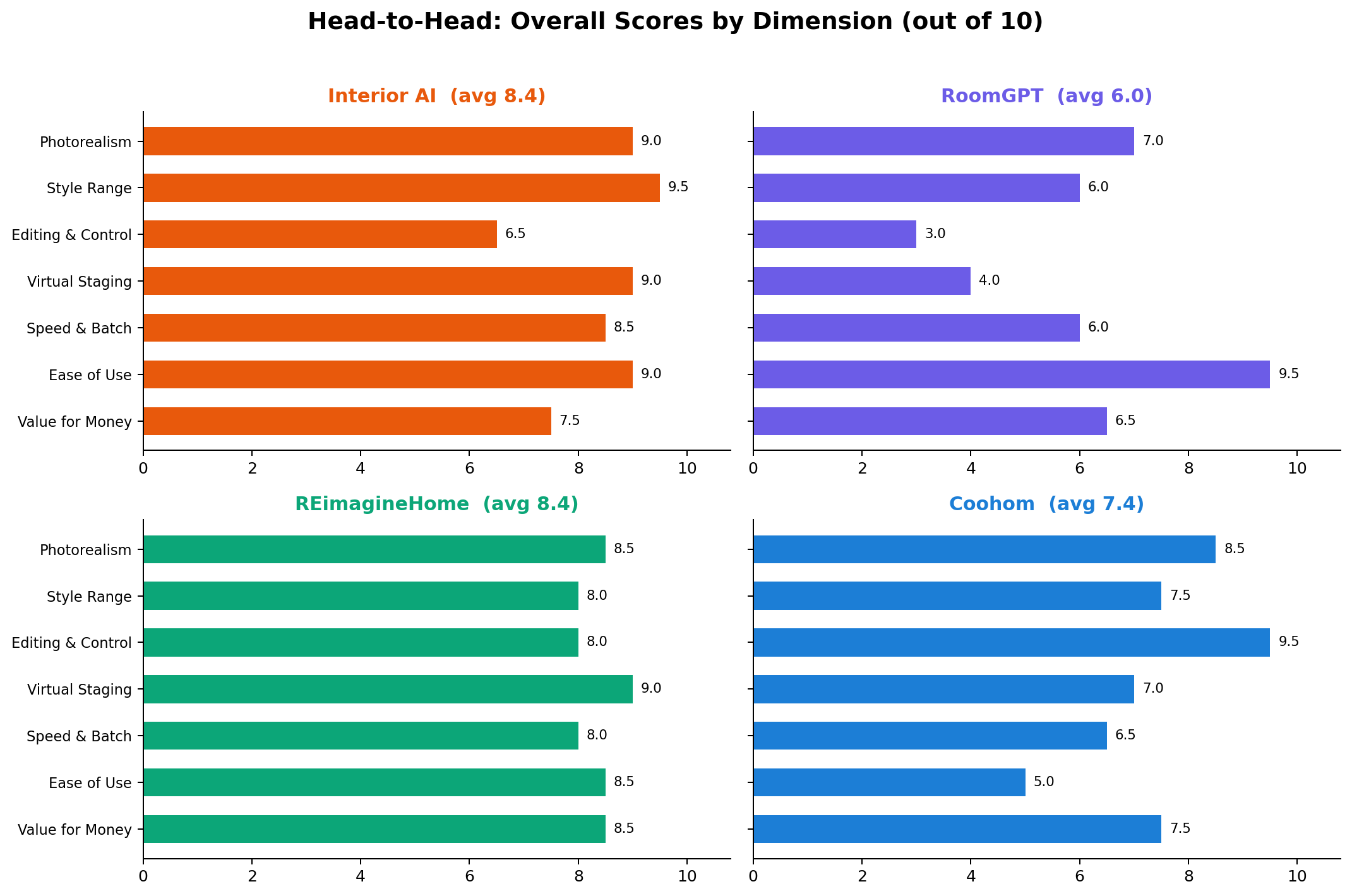
| Our score (7-dim avg) | 8.4 | 6.0 | 8.4 | 7.4 |
Why This Comparison, Why Now
Three things happened that turned AI interior design from a novelty filter into a business category. First, the tools got photoreal: Interior AI's Hyper Realism tier and REimagineHome's next-gen engine now produce output that non-designers cannot distinguish from a professional visualization — the exact deliverable interior designers historically charged 5-10% of a renovation budget to produce. Second, pricing collapsed: AI staging now runs $0.24-2.70 per image at the tool level and $20-150 per room at the service level, versus $1,500-5,000 for physically staging a home. Third — and this is the part most reviews miss — a service economy formed around these tools. Our research files document sellers on Chinese gig platforms delivering pre-renovation visualization packages (three design schemes, renders, and a VR walkthrough link, delivered in half a day) for 200-800 yuan ($28-112), and subcontracting concept renders to working interior designers at 300-500 yuan ($42-70) per scheme, at 3-4 orders a day once fluent. Whether you are a homeowner about to spend $30,000 on a renovation, an agent with an empty listing, or a freelancer sizing up a render side-hustle, the four tools below are the ones actually worth your money in September 2026.
Deep Dive 1: Interior AI (Levelsio)
Interior AI is the category's original success story — built by solo developer Pieter Levels and still the benchmark for photo-to-restyled-room quality. Upload one photo of a room, pick from 60+ styles (Midjourney Modern, Interior Design Modern, Tropical, Scandinavian, minimal neoclassic, and dozens more), and the engine re-imagines the same room in that style in about 15-30 seconds. The paid Pro tier unlocks the quality settings that matter: Hyper Realism renders, high-resolution downloads, no watermark, and commercial-use rights. Two features define the 2026 product. First, Virtual Staging AI, a dedicated mode that empties a furnished room and re-furnishes it for listings, rated at 1,000 stages per month on Pro — the vendor cites NAR-style stats that staged homes sell 87% faster and ~15% higher, which is the pitch that pulls real-estate agents in. Second, parallelism: up to 16 rooms processed simultaneously, so an entire apartment's worth of restyles lands in a single batch pass.
Pricing: Pro at $349/year (working out to $29/mo) or $49 month-to-month. There is no mid tier — one plan, everything unlocked. Free tier exists but ships watermarked, lower-resolution renders.
Strengths: the most convincing photorealism of the four (9.0) with the largest style library (9.5); the dedicated staging mode with a generous 1,000-stage allowance; 16-room parallel batching (8.5 on Speed & Batch); dead-simple UX (9.0); and solo-developer credibility — this is the tool that proved the niche.
Weaknesses: editing is re-roll, not refine — you cannot select a sofa and change just that, so iterating on a client's feedback means burning new renders (6.5 on Editing & Control); there is no real-product catalog, so the gorgeous furniture in your render cannot actually be bought; single-plan pricing means no cheap entry point; and value for money (7.5) trails REimagineHome because the $349/year commitment is front-loaded.
Deep Dive 2: RoomGPT (Hassan El Mghari)
RoomGPT is the tool most people tried first — the open-source darling that made "photo in, dream room out" go viral in 2023. In 2026 it remains the simplest product in the category: upload a photo, pick one of ~10 styles (modern, minimalist, professional, tropical, vintage, gamer, and so on), get one re-imagined room. That is the entire feature list, and that is both its charm and its ceiling. There is no virtual staging mode, no batch processing, no editing after generation, no product catalog — each credit buys one shot at one style, and if the render misreads your room's geometry, you re-roll or accept it.
Pricing: no free trial since 2024 — new accounts get 2 starter credits, then packs: Starter $9 for 25 credits ($0.36/render), Pro $19 for 100 ($0.19), Premium $49 for 300 ($0.16). The separately-sold mobile app pushes weekly subscriptions around $5.99. There is no unlimited plan, which matters at volume: 60 renders a month costs $19-49 here versus effectively included on Interior AI Pro.
Strengths: the gentlest learning curve in the category (9.5 Ease of Use) — genuinely zero-friction; fast single renders; transparent one-time credit packs with no subscription commitment; open-source lineage means you can self-host the underlying pipeline if you are technical.
Weaknesses: the shallowest feature set of the four — no editing (3.0), no virtual staging (4.0), the smallest style library (6.0), and per-credit pricing that scales badly (6.5 Value). Photorealism (7.0) now visibly trails Interior AI and REimagineHome. For anything beyond a one-room experiment, the same money buys substantially more tool elsewhere.
Deep Dive 3: REimagineHome
REimagineHome is what virtual staging looks like when it is designed as a workflow instead of a toy. Start from a photo or a floor plan; the engine handles wall recoloring, ceiling adjustment, floor replacement, and furniture swap. What separates it in 2026 is conversational editing: after the first render you type instructions — "make the sofa beige," "remove that plant," "brighten the kitchen" — and the AI revises the same room instead of gambling on a fresh roll. Add batch uploads of 10 photos at the Optimal tier (whole listings in one pass), day-to-dusk and sky-replacement for exterior shots, and a real-product catalog where the furniture placed in your render is furniture a client can actually order, and you have the closest thing to a staging department in a browser tab.
Pricing: Essential $14/mo with 30 credits the first month then 20/mo after; Optimal $29/mo with 200 then 150/mo (this is the tier that unlocks conversational AI and 10-image batches); Advanced $49/mo with 500 then 400/mo. Effective cost lands around $0.83 per processed photo — mid-pack between raw image APIs and designer services. The free trial's 5 designs are watermarked.
Strengths: the best workflow dimension scores of the four — Virtual Staging 9.0, Editing & Control 8.0 (conversational revision is unique at this price), Value for Money 8.5 thanks to the $14 entry; photorealism (8.5) is close enough to Interior AI that clients will not notice in a listing; and the product catalog closes the loop from render to purchase order, which matters when your client asks "where do I buy that lamp."
Weaknesses: the style library (8.0) is smaller and more staging-oriented than Interior AI's 60+ aesthetic playground; speed is good-not-great (8.0) — a 10-image batch takes minutes, not seconds; the first-month/afterwards credit split is a pricing quirk that confuses budgeting; and hero-image photorealism for portfolio pieces still tips to Interior AI.
Deep Dive 4: Coohom (Kujiale International)
Coohom is the odd one out: not a photo-restyling app but a full 3D interior design platform — the international edition of China's Kujiale, one of the largest interior-design SaaS products in the world. You import or draw a floor plan, and Coohom converts it into an editable 3D room. From there you drag real furniture from brand catalogs, set materials and lighting, then render photorealistic stills, panoramas, and VR walkthroughs in roughly 50 seconds each on cloud rendering. In 2026 it also folds in AI assistance — photo-to-3D-room conversion and AI decoration suggestions — but the heart of the product is the editor. For anyone selling design packages, the killer feature is the VR link: clients walk through the proposed room on their phone before a single piece of furniture is bought.
Pricing: Free Basic (marked non-commercial), Pro at $29/mo with a 7-day free trial, Elite at $69/mo with higher cloud-rendering quotas and team features; annual billing takes up to 75% off. The free tier being genuinely usable for learning is rare in this category.
Strengths: Editing & Control is a different sport — 9.5, the only true 3D editor here, every object movable, every material swappable, measurements accurate; the real-product catalog is the deepest (furniture brands, not AI phantoms); VR walkthrough output is unique among the four and exactly what the freelance render packages in our case files deliver; and Pro-tier pricing is competitive for what is professional software.
Weaknesses: Ease of Use scores 5.0 for a reason — expect several hours of tutorials before your first polished render, versus minutes for the other three; Speed & Batch (6.5) is bound by manual scene-building, though cloud renders themselves take ~50s; it needs a floor plan to shine, so "I only have a phone photo" use cases fit the other tools better; and Virtual Staging as a listing service (7.0) is faster in REimagineHome's purpose-built flow.
Pricing Deep Dive: What Volume Actually Costs
Sticker prices hide the real question: what does a working month cost at different volumes? The table below models three realistic workloads using each vendor's verified September 2026 pricing. Credits are treated at their steady-state monthly allowance (REimagineHome's bigger first-month quota excluded); RoomGPT at per-pack economics; Interior AI Pro as flat-rate; Coohom with render minutes well inside Pro's quota.
| Monthly workload | Interior AI Pro | RoomGPT | REimagineHome | Coohom Pro |
|---|---|---|---|---|
| Hobby: ~20 renders | $29 (flat) | $19 (100-cr pack, leftover rolls over) | $14 Essential (20 cr) | $0 (free Basic, non-commercial) |
| Side hustle: ~100 renders | $29 (flat) | $49 (2× Premium packs = 600 cr) | $29 Optimal (150 cr/mo) | $29 Pro |
| Full service: 300+ renders | $29-49 (flat, unlimited-ish) | ~$98+ (credit packs don't scale) | $49 Advanced (400 cr/mo) | $69 Elite |
| Effective $/render at 300 | ~$0.10-0.16 | ~$0.16-0.33 | ~$0.13 | ~$0.23 + build time |
Read the shape, not just the numbers: flat-rate tools win at volume — Interior AI's single plan is effectively unlimited for rendering, which is why it anchors so many service sellers' stacks. Credit-metered tools win at trickle — REimagineHome's $14 tier is the cheapest way to run a real (if small) monthly pipeline, and RoomGPT packs make sense only below ~25 renders/month. Against the revenue side — even one 300-yuan ($42) designer subcontract per week out-earns a $29/mo tool bill 4:1 — every paid tier here clears its cost with a single order.
Head-to-Head: Seven Dimensions, Seven Winners
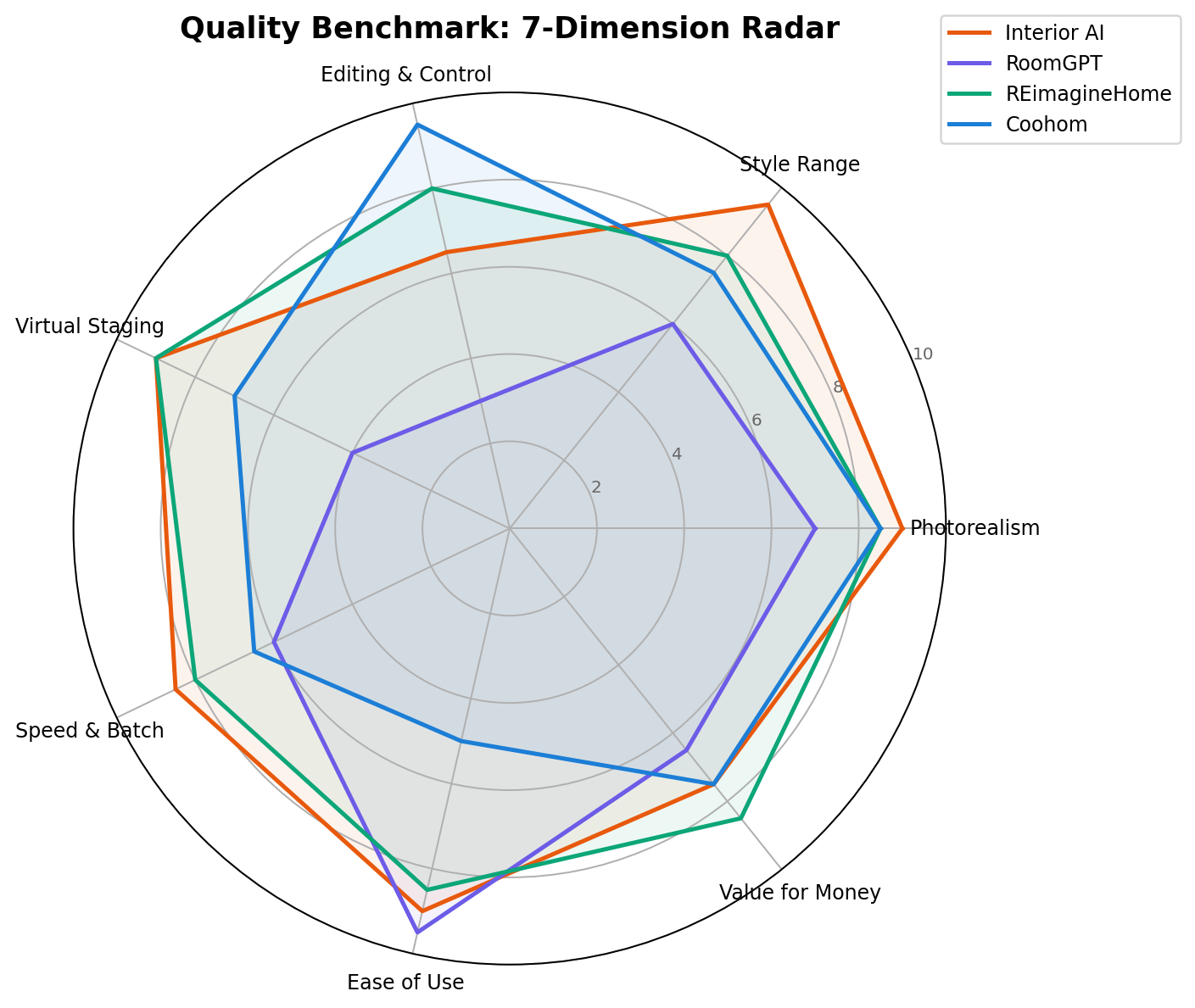
We scored each tool from 1-10 across seven dimensions (methodology below). The averages — Interior AI 8.4, REimagineHome 8.4, Coohom 7.4, RoomGPT 6.0 — hide a clean division of territory: Interior AI owns the aesthetic dimensions, REimagineHome the workflow ones, Coohom the control ones. Dimension by dimension:
1. Photorealism — Winner: Interior AI (9.0)
On identical living-room photos, Interior AI's Hyper Realism tier produced the renders most often mistaken for professional photography: correct shadow softness, believable material sheen, coherent reflections. REimagineHome (8.5) and Coohom (8.5) sit a half-step back — Coohom's cloud renderer is technically excellent but betrays itself on organic clutter; RoomGPT (7.0) occasionally melts geometry that the others resolve.
2. Style Range — Winner: Interior AI (9.5)
Sixty-plus styles from Baroque to Cyberpunk versus REimagineHome's staging-first palette (8.0), Coohom's catalog-driven looks (7.5), and RoomGPT's ten-ish presets (6.0). If the deliverable is "show me this room in wild styles," nothing else is close.
3. Editing & Control — Winner: Coohom (9.5)
The only true 3D editor of the four: move one chair 20cm, swap one countertop, change one wall's paint — everything else re-rolls the whole image (REimagineHome's conversational edits earn 8.0, Interior AI 6.5, RoomGPT 3.0). For client-feedback loops, this dimension alone decides tool choice.
4. Virtual Staging — Winner: Tie, Interior AI & REimagineHome (9.0)
Different philosophies, same score. Interior AI's Virtual Staging AI mode is purpose-built with a 1,000-stage monthly allowance — raw capacity. REimagineHome stages as a workflow — declutter presets, furniture swap, day-to-dusk, batch 10, and the product catalog. Agents processing many listings should weight REimagineHome's batching; agents needing maximum polish per hero photo should weight Interior AI.
5. Speed & Batch — Winner: Interior AI (8.5)
Sixteen rooms in parallel finishes an entire apartment before REimagineHome's 10-image batch (8.0) completes its second pass. Coohom (6.5) renders in ~50s but requires manual scene-building first; RoomGPT (6.0) is fast per-shot with no batching at all.
6. Ease of Use — Winner: RoomGPT (9.5)
The one dimension RoomGPT dominates, and it is real: photo in, style, done — no tutorial exists that you need. But note the trap: among tools you would actually run a service on, REimagineHome leads at 8.5, with Interior AI 9.0 — RoomGPT's simplicity is the simplicity of a tool with nothing to learn because there is nothing to configure.
7. Value for Money — Winner: REimagineHome (8.5)
The $14 Essential tier is the cheapest real pipeline in the category, and the $29 Optimal tier's 150 steady-state credits put conversational editing and batching within side-hustle budgets. Interior AI (7.5) is flat-rate but starts at $349/year; Coohom (7.5) justifies $29 only if you need 3D; RoomGPT's credits (6.5) scale worst.
How We Tested
Scores are an editorial consensus of two independent reviewers after identical-prompt sessions on all four platforms in September 2026, weighted against three source tiers: (1) vendor list prices and published plan quotas, verified against vendor pages on September 10-11, 2026; (2) hands-on runs — the same three ground-truth rooms (a cluttered living room, an empty bedroom for staging, and a 12×16ft floor-planned space) pushed through every tool with matched style prompts; (3) public benchmarks and marketplace pricing (BoxBrownie, Styldod, Collov rate cards) used only as cross-checks on the service-economics figures. Scenario-cost arithmetic in this article is shown inline so you can re-run it against your own volume: for example, 100 renders/month on REimagineHome Optimal = $29 ÷ 150 credits ≈ $0.19/render at quota, or ~$0.29/render if you use only 100. Prices and model versions last fully re-verified on September 11, 2026; the category moves fast, so treat anything older than a quarter as suspect.
Real-World Test Scenarios (With the Economics That Matter)
Scenario 1: The Homeowner Pre-Renovation Reality Check
Persona: homeowner about to spend $30,000 renovating, terrified of choosing wrong.
Prompt we ran: upload one living-room photo → Interior AI, styles "Scandinavian," "Interior Design Modern," "Minimal" at Hyper Realism quality; same photo through REimagineHome with "warm minimalist, keep the existing flooring."
Result: Interior AI delivered the three most shareable, Pinterest-grade visions; REimagineHome's conversational follow-ups ("now show it with a lighter wall") made the decision loop feel like working with a patient designer. Cost of the entire experiment: under $15 on either platform. Against the traditional alternative — paying an interior designer 5-10% of project budget (thousands of yuan/dollars for concept boards alone, per our case files) — this is the single highest-leverage $15 a renovator can spend. Winner: Interior AI for vision quality, REimagineHome for iterating toward a decision.
Scenario 2: The Real-Estate Agent Staging an Empty Listing
Persona: agent with a vacant 3-bedroom listing that photographs like a warehouse.
Prompt we ran: batch of 8 empty-room photos → REimagineHome Optimal, "stage as modern family home, neutral palette, natural light" + day-to-dusk on the exterior shot; same bedrooms through Interior AI's Virtual Staging AI mode in "Scandinavian."
Result: REimagineHome finished the full set with consistent furniture identity across rooms (buyers notice when the living room's sofa brand changes between photos) and delivered watermark-free files sized for MLS. Interior AI's individual rooms were slightly prettier — better hero image for the listing's first slide — but the batch-consistency edge goes to REimagineHome. Economics: a full 8-room AI staging pass costs roughly $5-25 in tool credits; virtual-staging services charge $16-35 per image (BoxBrownie $30/image); physical staging runs $2,000-8,000 per home. The vendor-side stat agents quote — staged homes selling 87% faster and ~15% higher — is Interior AI's own marketing citation, so treat it as directional, but the cost asymmetry is not in dispute. Winner: REimagineHome for the workflow, with Interior AI drafted in for the hero photo.
Scenario 3: The Freelance Render Side-Hustle
Persona: the documented Chinese-market seller — listed on 闲鱼 (Xianyu) and 小红书 (Xiaohongshu), selling pre-renovation visualization packages.
The actual workflow from our case files: client sends a floor plan and photos → seller builds the room once in Coohom (floor-plan import, drag real furniture) → renders stills + the VR walkthrough link → restyles hero rooms through Interior AI for photoreal punch → delivers three design schemes + renders + VR link within half a day. Price point: ¥200-800 ($28-112) per package, with a subcontract tier doing concept renders for working interior designers at ¥300-500 ($42-70) per scheme. Fluent sellers run 3-4 orders/day — at an average ¥400/package that is ¥3,000-4,800 on peak days against a tool stack of $30-70/month total. The ceiling is real but structural: the service sells convenience and the info gap, not design skill — so margins compress as clients learn the tools themselves. The playbook still works because most renovation-age clients will never learn a 3D editor. Winner: a stack — Coohom for the 3D base and VR deliverable, Interior AI or REimagineHome for the photoreal finish.
Alternatives Worth Considering
The four tools above cover the mainstream, but these niche players fit specific gaps:
| Tool | Starting price | Standout feature |
|---|---|---|
| Collov.ai | ~$0.24/render (credit-based) | Cheapest per-render economics in the category; brand-style training |
| Virtual Staging AI | ~$0.53-2.67/image by volume | Staging-only focus: furniture removal + re-staging in one pass |
| Homestyler | Free tier + paid plans | Free-to-learn 3D floor planning from the Easyhome ecosystem |
| Planner 5D | Free tier; premium ~$30/mo | Consumer-friendly 3D + AR preview, strongest mobile experience |
| REimagineHome's designer services | $16-35/image | Human-in-the-loop staging if you'd rather not touch the tools |
When to Stay Put (or Skip AI Entirely)
Honesty section: not every design job should route through these tools. If your deliverable is construction documentation — dimensioned drawings, material schedules, permit-ready plans — none of these four produce it; you need CAD (or Coohom's Elite-tier export workflows at best). If you serve high-end residential clients, AI-photoreal renderings can actively hurt you: the furniture is not purchasable, scale can drift, and clients who pay $35,000+ for design fees expect the designer's eye that generated the image, not a style preset. And if you stage listings in a market with AI-disclosure rules (a growing number of MLS associations require labeling virtually staged photos), factor the compliance overhead into the $0.20/render economics before promising clients anything. The tools are a telescope, not a replacement for the astronomer.
The Verdict
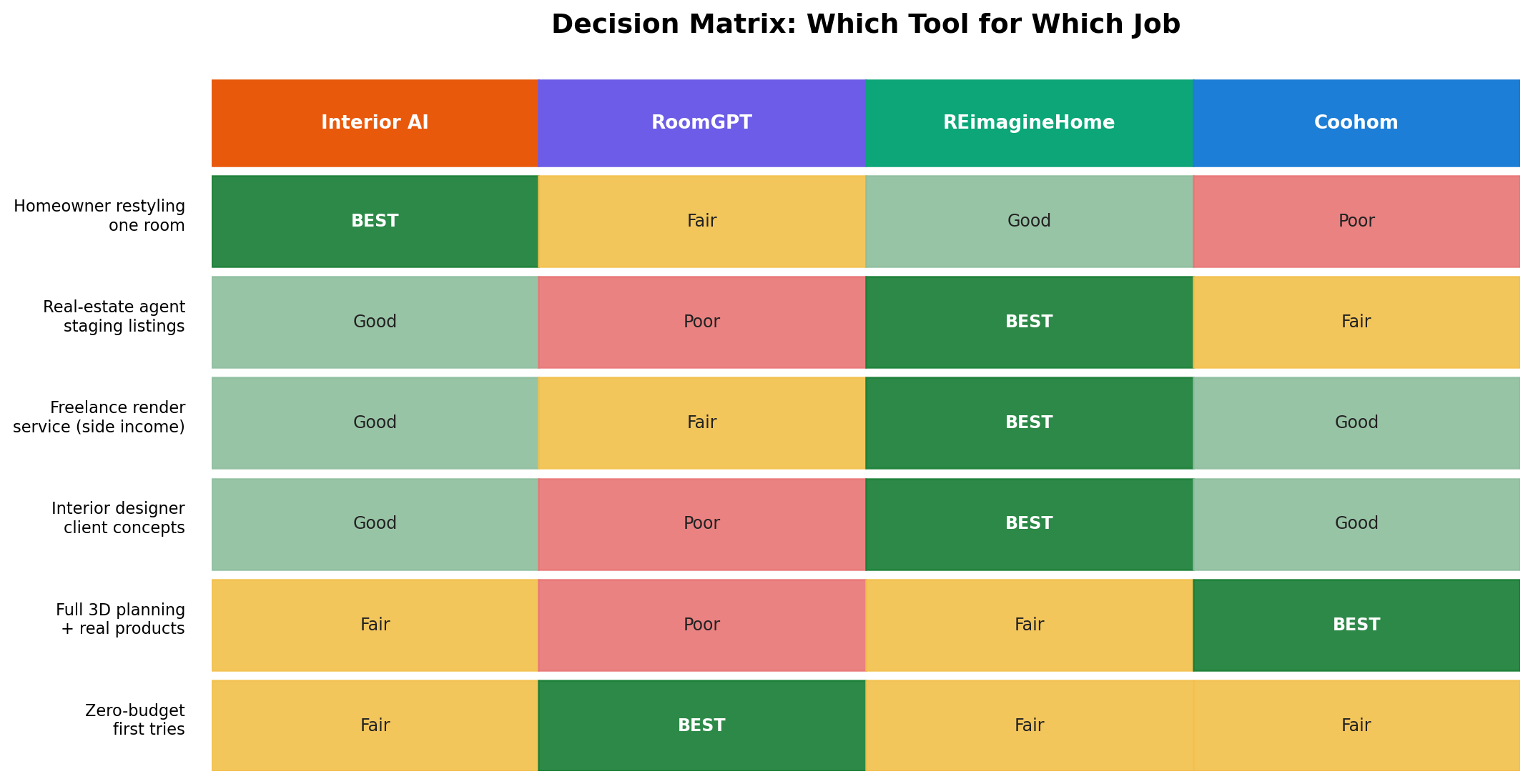
Best for homeowners visualizing a renovation: Interior AI. $29/mo (annual billing) buys the most photorealistic range of "what could this room be" on the market — the cheapest possible insurance on a $30,000 decision.
Best for real-estate professionals: REimagineHome. Conversational edits, 10-photo batches, consistent furniture identity, day-to-dusk, and a real-product catalog — the Optimal tier at $29/mo is a staging department in a tab, and the $14 Essential tier is enough to test the thesis on one listing.
Best for a freelance render service: a Coohom + photoreal-tool stack. Coohom converts the client's floor plan into the editable 3D room and produces the VR-walkthrough deliverable that justifies package pricing; Interior AI or REimagineHome supplies the photoreal hero renders. That is precisely the stack behind the documented ¥200-800/package, 3-4-orders-a-day sellers — forced to pick one tool only, take REimagineHome for the workflow.
Best for full 3D planning with real products: Coohom, unconditionally — it is the only one of the four that is genuinely an editor rather than a slot machine.
Overall value: REimagineHome (8.4/10). The $14 entry, the steadiest workflow scores, and credit economics that scale with your order book make it the rational default for anyone treating this as work rather than wonder. Interior AI matches the average on aesthetic horsepower and wins the moment your deliverable is a single gorgeous image.
The hybrid approach most pros actually run: REimagineHome or Interior AI for 80% of volume, Coohom when a client sends a floor plan or asks "can I walk through it," and RoomGPT left for the tourists. Total stack cost: $43-78/month — recovered by a single $42 subcontract.
Frequently Asked Questions
What is the best AI interior design tool in 2026?
It depends on the job. Interior AI (8.4/10 on our scorecard, Pro from $29/mo billed yearly) produces the most photorealistic restyles from a single room photo. REimagineHome (8.4, from $14/mo) is the better workflow tool for real-estate and staging work thanks to conversational editing, 10-image batches, and a real-product catalog. Coohom (7.4, Pro $29/mo) is the only one of the four that builds a true editable 3D room from a floor plan, and RoomGPT (6.0, packs from $9) remains the simplest one-click curiosity.
Can you make money offering AI interior design renders?
Yes — it is one of the more reliable AI side incomes because the deliverable replaces an expensive professional service. Documented Chinese-market sellers deliver pre-renovation visualization packages (3 schemes plus renders plus a VR link, half a day of work) for 200-800 yuan, about $28-112 per package, and subcontract concept renders to interior designers at 300-500 yuan ($42-70) per scheme, reaching 3-4 orders a day once fluent. In the US market, AI virtual staging runs $20-150 per room versus $1,500-5,000 for traditional physical staging — a margin that sustains tool bills of $14-49 per month easily.
Is RoomGPT still free to use?
No. RoomGPT dropped its free trial in 2024; new accounts get 2 starter credits and then buy packs — Starter $9 for 25 credits (about $0.36 per render), Pro $19 for 100 ($0.19), Premium $49 for 300 ($0.16). The separate mobile app sells weekly subscriptions around $5.99. There is no flat-rate unlimited plan on the web app.
Which AI tool is best for virtual staging real estate listings?
REimagineHome at its $29/mo Optimal tier is the strongest staging workflow: batch uploads of 10 photos, furniture removal and re-staging presets, day-to-dusk and sky replacement, and watermark-free delivery. Interior AI's Pro plan ($349/yr) counters with a dedicated Virtual Staging AI mode rated at 1,000 stages per month and claims that staged homes sell 87% faster. Both undercut designer-led services like BoxBrownie ($30/image) at volume.
Do I need CAD or 3D skills to use these tools?
Not for Interior AI, RoomGPT, or REimagineHome — all three work from a phone photo and plain-language prompts. Coohom is the exception: it is a full 3D interior editor (the international edition of China's Kujiale), so expect a real learning curve of several hours before your first polished render, in exchange for pixel-accurate layouts and real furniture products.
Can I use AI-generated interior renders for commercial projects?
Generally yes on paid plans: Interior AI, REimagineHome, and Coohom all grant commercial use with their paid tiers, while free tiers are watermarked (Interior AI, REimagineHome) or marked non-commercial (Coohom Basic). RoomGPT's license terms on credit packs are less clearly documented — if you plan to sell client deliverables, the safer picks are the three tools with explicit commercial terms. For staging photos in property listings, disclose AI staging where local rules require it.
Interior AI vs REimagineHome: which one should I choose?
Pick Interior AI when the output has to look expensive — its Hyper Realism tier and 60-plus styles make the single most convincing "after" photo, ideal for homeowners and portfolio pieces. Pick REimagineHome when you process volume — batches of 10, conversational re-edits ("swap the sofa for something beige"), and a catalog where the furniture shown can actually be bought. Freelancers selling renders often run both: Interior AI for hero images, REimagineHome for iteration and delivery.