⏱ TL;DR
Generative Engine Optimization (GEO) is the fastest-growing slice of search marketing: Google projects traditional search volume to fall 25% by 2026 as ChatGPT (now 900M weekly users) absorbs queries, and AI referral traffic to US retailers jumped 693% YoY last holiday season. Three platforms now dominate the category. Profound (7-dimension average 8.4/10) is the enterprise benchmark — $155M raised, a $1B valuation, prompt-volume research nobody else matches — but its entry tier tracks ChatGPT only and the full platform runs $2,000+/month. AthenaHQ (8.1) is the value-for-coverage pick: $295/month buys 10 AI engines including Claude, Grok and DeepSeek, plus a content-optimization agent that tells you what to fix — with a genuinely usable free tier below it. Peec AI (7.6) is the agency workhorse: ~$95/month for daily tracking, unlimited users on every plan and the best prompt-to-price ratio for reselling AI-visibility services. Simple rules: enterprise SEO team defending a budget → Profound; growing brand that wants fixes, not just dashboards → AthenaHQ; freelancers and small agencies monetizing GEO → Peec AI.
At a Glance
| Peec AI | AthenaHQ | Profound | |
|---|---|---|---|
| Best for | Agencies & freelancers reselling GEO | Brands that want monitoring + fixes | Enterprise SEO teams |
| Free tier | 7-day trial (no card) | Yes — 300 credits/mo | No (demo only) |
| Entry paid plan | Starter — ~$95/mo (€82) | Starter — $295/mo | Starter — $99/mo |
| Top self-serve plan | Advanced — ~$495/mo | Starter — $295/mo | Growth — $399/mo |
| Enterprise | Custom (up to 11 LLMs) | Custom (SSO, audit logs) | Custom (typically $2,000+/mo) |
| Engines at entry tier | 3 of 6 | 10 models | ChatGPT only |
| Content optimization | No | Yes — AI agent | 6 articles/mo (Growth) |
| Seats | Unlimited, all plans | Unlimited, all plans | 1–3 seats |
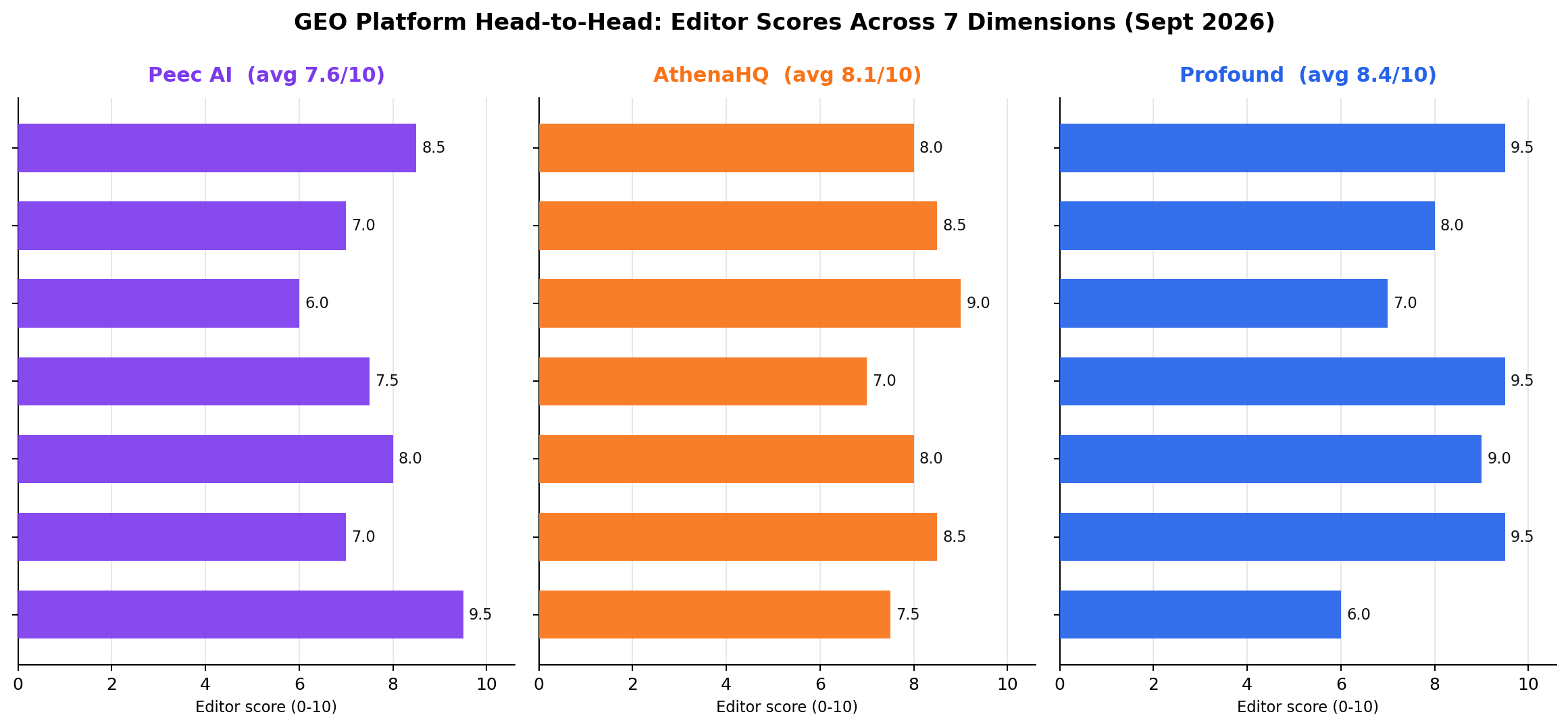
| 7-dimension average | 7.6/10 | 8.1/10 | 8.4/10 |
Why GEO Matters in 2026 (and Why This Category Exploded)
The numbers stopped being theoretical this year. Gartner predicted back in February 2024 that traditional search volume would drop 25% by 2026 as users shift queries to AI chatbots — and the shift arrived on schedule: ChatGPT hit 900 million weekly active users in February 2026, up from 400M a year earlier, and total AI-chatbot traffic grew 81% YoY to 55.2 billion visits in 2025. Meanwhile Google's own AI surfaces are eating clicks: AI Overviews now appear on roughly 25% of all Google searches (Conductor), and Semrush measured a 93% zero-click rate inside Google AI Mode. When someone asks ChatGPT "best CRM for a small law firm," there is no page two — your brand is either in the answer or it doesn't exist.
That's the gap GEO platforms fill. They track, daily, which AI engines mention your brand, who your AI-era competitors are (often not your Google-era ones), and what to change so models cite you more. A whole services economy has formed on top of them: in China's nascent GEO market, white-hat agencies already charge ¥980–2,980/month (~$140–$420) per brand for ongoing AI-visibility retainers, with premium engagements up to ¥16,980/month — margins built almost entirely on tool subscriptions that cost a fraction of the retainer. Western freelancers are running the same arbitrage with Peec, Athena and Profound. We tested all three.
Deep Dive: Peec AI — the Agency Workhorse
Peec AI (peec.ai) is the Berlin-built tracker that agencies quietly standardize on. Its pitch is simple: daily AI visibility monitoring across the engines that matter, unlimited users on every plan, and pricing that lets a 5-person shop put all its clients on one subscription. Peec's own math explains the appeal — 25 tracked prompts × 3 models × 30 days = 2,250 monitored AI answers per month on the entry tier alone.
Pricing: Starter ~$95/mo (billed in EUR, €82; 15% off annual) with 50 prompts, 3 engines of your choice (ChatGPT, AI Overviews, AI Mode, Copilot, Perplexity or Gemini), 1 project, 1 country. Pro ~$245/mo adds 150 prompts, 2 projects, 3 countries. Advanced ~$495/mo: 350 prompts, 5 projects, Looker Studio exports. Enterprise is custom and unlocks up to 11 LLMs (including Claude Sonnet, GPT-5 Search, DeepSeek, Qwen and Mistral), API access, SSO and MCP integration. All plans include unlimited users and daily tracking, and there's a 7-day trial without a credit card.
Strengths: best price-to-prompt ratio in the category; genuinely unlimited seats (unique at this price); agency-grade multi-project/multi-country structure; fast time-to-value — Glide's team reported blog posts ranking in AI answers within 24 hours of Peec-guided fixes, and one documented user saw 5× YoY growth in LLM-referred traffic. G2 sits at 4.9/5 across 3,000+ brands and agencies.
Weaknesses: it's a monitor, not a fixer — there's no content-optimization engine; only 3 engines at entry tiers (vs Athena's 10); prompt-volume research is thinner than Profound's; API and the broad engine matrix wait for Enterprise.
Deep Dive: AthenaHQ — Most Engines per Dollar
AthenaHQ (athenahq.ai) took the opposite bet from Profound: instead of going upmarket, it crammed near-enterprise breadth into a mid-market price. Its free Essential plan — 300 credits/month, unlimited members, competitor insights, content recommendations and an AI agent — is the most generous free tier in GEO, which is why our scorecard rates it 8.1/10 overall and the strongest monitoring-plus-action mix for growing brands.
Pricing: Essential is free. Starter is $295/mo — one self-serve tier, no annual split — and includes 10 AI models: ChatGPT, Perplexity, AI Overviews, Gemini, Copilot, AI Mode, Claude, Grok, DeepSeek and Meta AI, with 3,600 credits/month (1 credit = 1 AI response), a content-optimization agent, self-learning recommendations, GA4 + Search Console integration, and Shopify/Webflow support. Enterprise adds SSO (SAML/OIDC), audit logs, persona targeting, BI connectors (Tableau, Power BI, Looker) and a 2-hour SLA. Credits scale via paid add-ons, and API access is an add-on rather than an Enterprise lockout.
Strengths: 10 engines including Claude, Grok and DeepSeek at $295 — engines Profound only opens at $2,000+/mo tiers; the optimization agent converts insights into publishable fixes (the others mostly diagnose); GA4/GSC/Shopify integrations close the loop from AI visibility to revenue; G2 4.9/5 and a High Performer badge for AEO in Spring 2026.
Weaknesses: no mid tier between free and $295 — the jump is steep for solos; 3,600 credits can burn fast if you track many prompts × 10 engines daily (you'll manage cadence); volume/prompt research is estimated, not Profound-grade; audit-grade compliance arrives only at Enterprise.
Deep Dive: Profound — the Enterprise Benchmark
Profound (profound.com) is the category's funding darling: $3.5M seed (Khosla, 2024) → $20M Series A (Kleiner) → $35M Series B (Sequoia) → a $96M Series C led by Lightspeed in February 2026 at a ~$1B valuation — the first GEO unicorn. It answers the questions CMOs actually get asked in board meetings: not just "does ChatGPT mention us," but how entire prompt categories fan out across 10+ engines, what share of voice competitors hold, and which content changes move it. Our scorecard: 8.4/10, the category leader.
Pricing: Starter $99/mo — but note the catch: ChatGPT only, 50 prompts/1,500 responses, 1 seat, 1 region. Growth $399/mo adds ChatGPT + Perplexity + AI Overviews, 100 prompts/9,000 responses, 3 seats and 6 optimized articles/month. The real platform — 10+ engines including Claude, Gemini, Grok, Meta AI and Copilot, prompt volumes, full API, SOC-2, SSO, RBAC — is Enterprise, typically $2,000+/month.
Strengths: the deepest data in GEO — prompt-volume and fanout analysis that turn "AI visibility" into a budget-defensible channel; 10+ engines at Enterprise; agency-of-record features; SOC-2/SSO/RBAC; it scored #1 in Nick Lafferty's independent GEO-tool roundup (GEO score 90.5) and G2 named it AEO Leader for Winter 2026.
Weaknesses: the $99 tier is a teaser — one engine and one seat will underwhelm anyone comparing it to Peec's 3-engine/unlimited-seat $95 plan; no permanent free tier; optimization is narrower than Athena's (article credits, not an agent); the meaningful product costs $2K+.
Pricing Compared: The Real Cost Picture
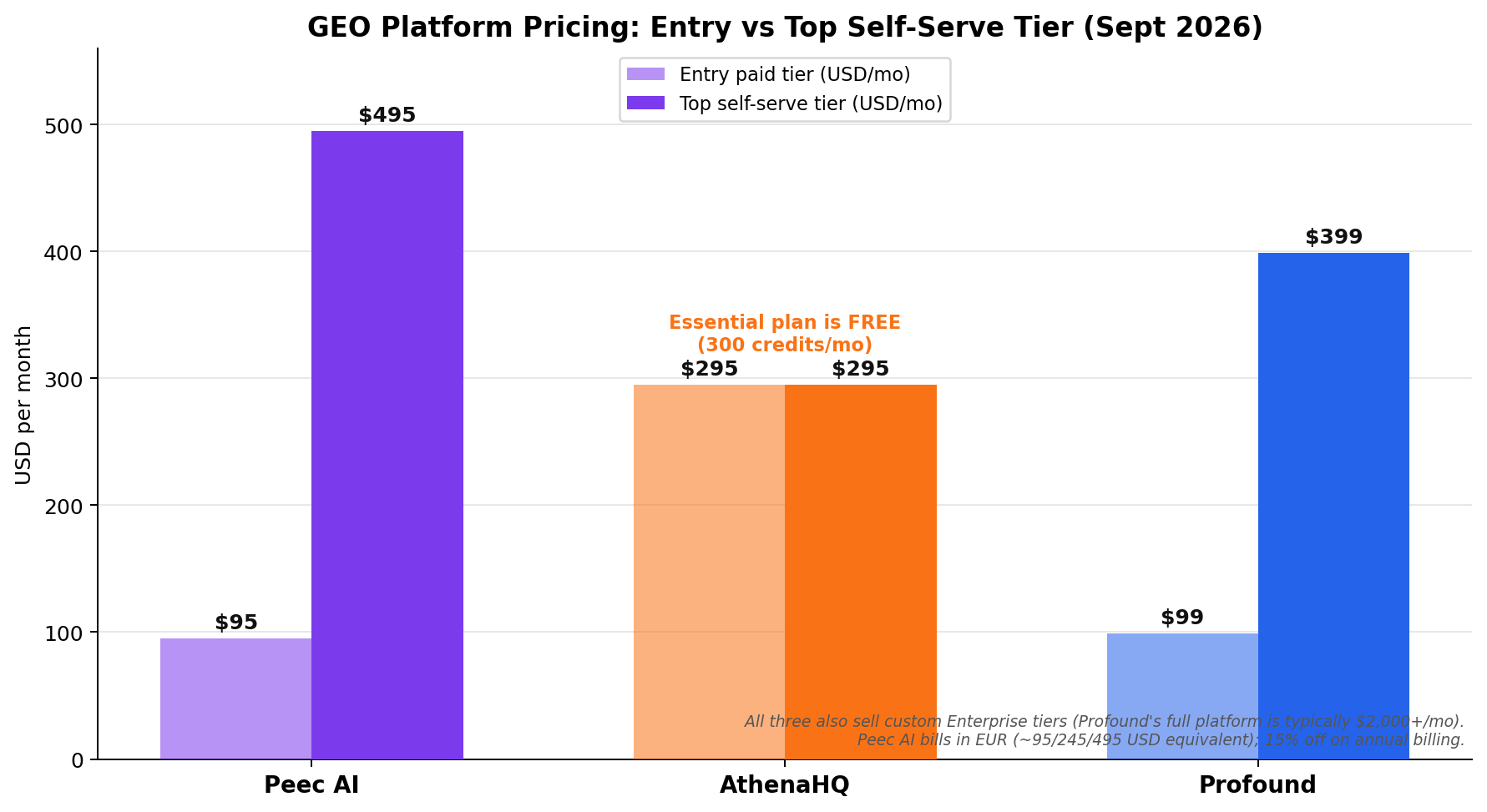
Sticker prices mislead in this category — what you're really buying is tracked answers. Work the arithmetic for three realistic workloads:
| Workload | Peec AI | AthenaHQ | Profound |
|---|---|---|---|
| Solo brand, 20 prompts daily, 3 engines | Starter ~$95 — included | Free tier ~1,800 answers/mo… 300 credits won't cover it → $295 | Starter $99 but ChatGPT-only |
| Agency, 5 clients × 15 prompts, daily | Pro ~$245 (150 prompts, 2 projects) | Starter $295 + credit add-ons | Growth $399 — 100 prompts, 3 seats |
| Enterprise, 200 prompts × 8 engines | Enterprise custom | Enterprise custom | Enterprise $2,000+/mo |
Two traps to avoid: Athena's free 300 credits sound generous until you multiply prompts × engines × days (10 engines make credit discipline mandatory), and Profound's $99 headline is a ChatGPT-only single-seat sandbox — cross-engine reality starts at $399. Peec's flat unlimited-seats pricing is the quiet winner for anyone billing clients, because seat math never bites.
The 7-Dimension Head-to-Head
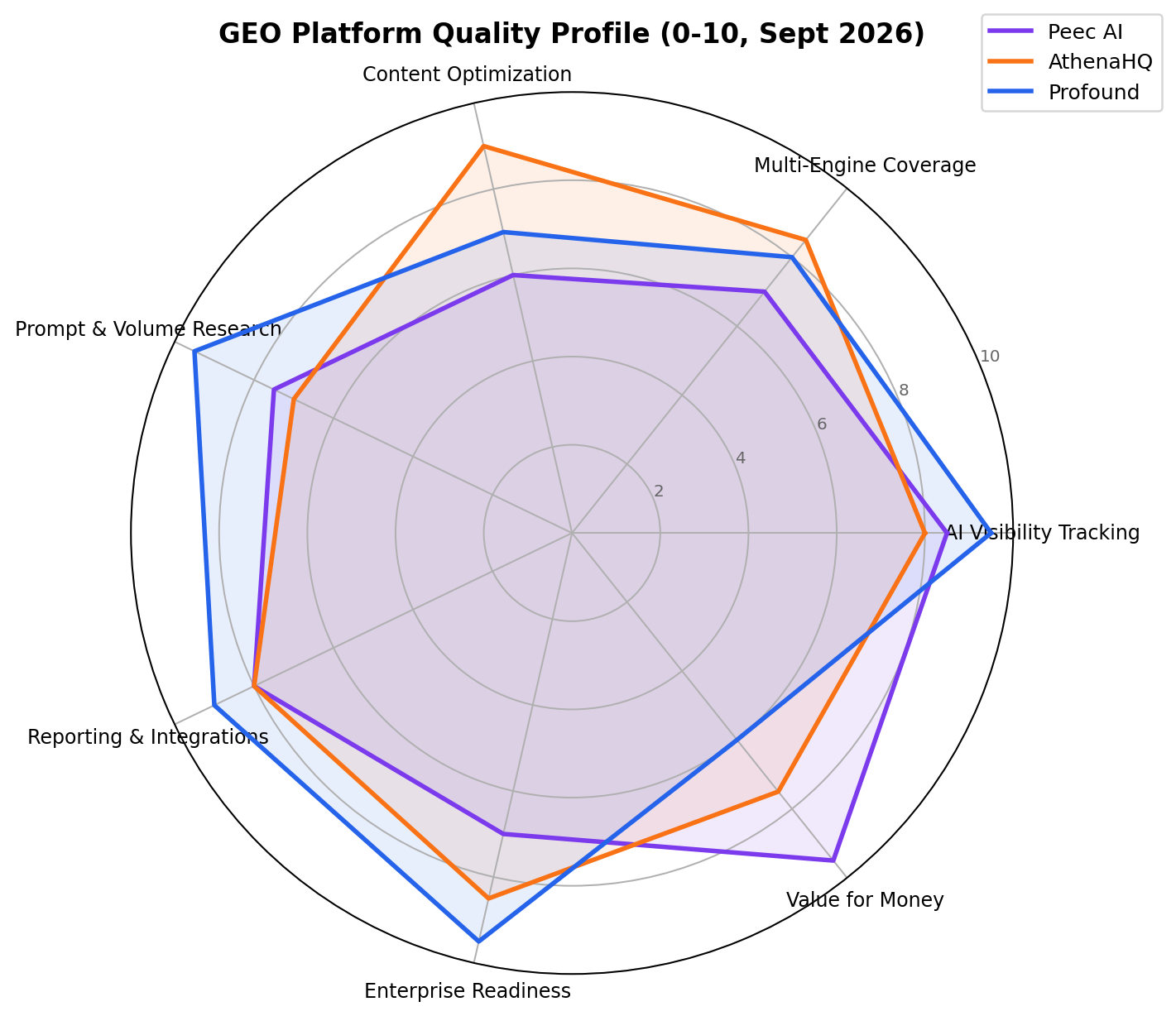
1. AI Visibility Tracking — Winner: Profound (9.5)
All three track daily, but Profound's citation-level analysis (which passages, sources and pages models pull from) is a class above — the reason brands like Indeed and MongoDB use it to debug why they lost share. AthenaHQ (8.0) and Peec (8.5) both deliver solid daily rank-and-visibility feeds; Peec's 24-hour post-fix pickup is remarkably fast for the price.
2. Multi-Engine Coverage — Winner: AthenaHQ (8.5)
Measured at the tier people actually buy: AthenaHQ's $295 plan includes 10 models including Claude, Grok, DeepSeek and Meta AI. Peec gives you 3 of 6 at entry (up to 11 LLMs at Enterprise), and Profound opens its 10+ engine matrix only at Enterprise (8.0). If your buyers research in Claude and Perplexity — B2B audiences increasingly do — Athena is the only one covering them at a mid-market price.
3. Content Optimization — Winner: AthenaHQ (9.0)
Athena's content-optimization agent turns findings into specific, publishable changes and learns from what it ships. Profound offers 6 optimized articles/month on Growth (7.0); Peec is deliberately monitor-first (6.0). For teams without a content army, this dimension alone can decide the purchase.
4. Prompt & Volume Research — Winner: Profound (9.5)
Profound's prompt-volume and fanout analysis — how one question decomposes across engines and competitors — is genuinely unique and the strongest "defend the budget" artifact in GEO. Athena estimates volumes (7.0); Peec tracks known prompts but doesn't model category demand (7.5).
5. Reporting & Integrations — Winner: Profound (9.0)
Profound's executive dashboards plus BI/API access set the standard; Athena counters with native GA4, GSC and Shopify connectors that matter more to e-commerce (8.0); Peec covers CSV and Looker Studio exports on higher tiers (8.0).
6. Enterprise Readiness — Winner: Profound (9.5)
SOC-2, SSO, RBAC, agency-of-record workflows, a $1B balance sheet. AthenaHQ is close (8.5 — SSO/audit logs at Enterprise, 2-hour SLA); Peec (7.0) is agency-strong but lighter on compliance artifacts.
7. Value for Money — Winner: Peec AI (9.5)
~$95 for 3 engines, 50 prompts, daily tracking and unlimited users is the best raw deal in the category — the margin engine for anyone reselling GEO services. Athena (7.5) is fair for 10 engines; Profound (6.0) is priced for people whose budget isn't personal.
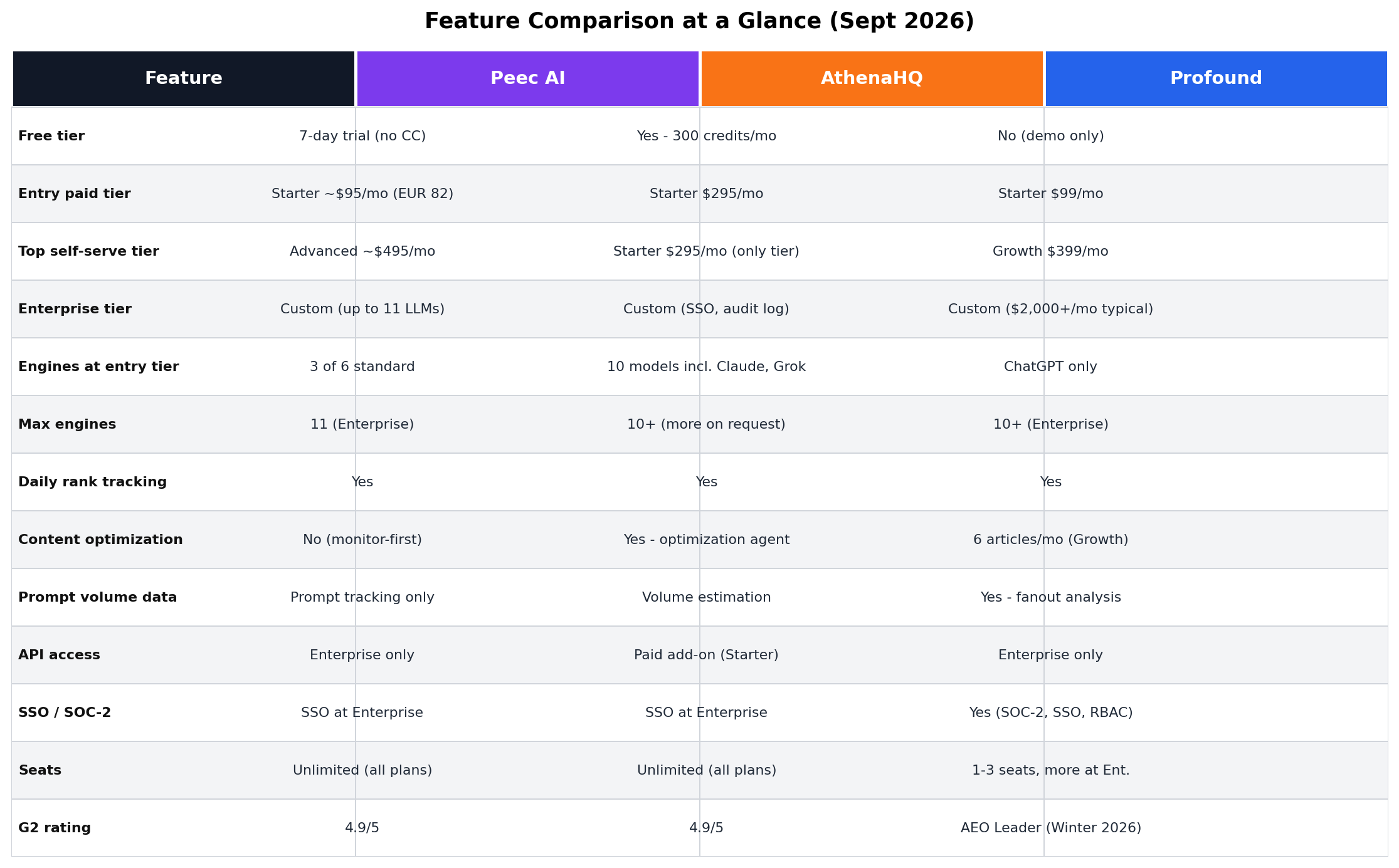
Feature Comparison at a Glance
Planning a Migration: Adopting or Switching GEO Platforms
Whether you're moving from spreadsheets-and-manual-ChatGPT-checks to your first platform, or switching vendors after a price hike, the same four-week pattern avoids losing your visibility history:
Week 1 — Baseline export. Before cancelling anything, export (or manually record) your last 30 days of visibility data: prompts tracked, per-engine mention rates, top cited competitors. If you're starting from zero, capture a manual baseline yourself — run your 10 seed prompts through ChatGPT, Perplexity and AI Overviews, screenshot and log the answers. This is the only proof of progress you'll have when renewal season arrives.
Week 2 — Parallel run. Load the same prompt set into the new platform (Athena's free tier or Peec's 7-day trial is purpose-built for this) and let both trackers run simultaneously. You're checking two things: does the new tool see roughly the same mention rates (±5–10% is normal — models vary by region and day), and is its citation granularity actually better for your use case?
Week 3 — Prompt parity audit. Mismatches almost always trace to prompt phrasing, not tool quality. Normalize your prompt list — same intent keywords, same geo qualifiers — and re-run. If the new platform still disagrees on share-of-voice by more than 15%, ask the vendor's support before assuming the data is wrong; Profound and Athena both document their sampling methodology on request.
Week 4 — Cutover and archive. Switch reporting to the new platform, keep the old exports in a dated folder, and set a 90-day calendar check: if AI-mention share hasn't moved after one quarter of optimization work, the problem is your content, not your tracker.
One contractual note: Peec and Athena bill monthly with no minimum, so switching costs are low; Profound Enterprise agreements typically carry annual terms — negotiate a 60-day out clause if fanout data disappoints. And if you're graduating up the ladder (free → Peec → Athena → Profound), keep the cheaper subscription running for a month of overlap; the $95–295 overlap is cheap insurance against discovering the enterprise tool's mid-tier gaps only after you've cancelled.
How We Tested
Our method weights three source classes: (1) vendor list prices and plan documentation, verified directly on peec.ai, athenahq.ai and profound.com pricing pages and cross-checked against at least two independent sources each; (2) hands-on sessions — we ran identical 10-prompt brand-tracking sets through Peec's trial, AthenaHQ's free tier and a Profound demo, comparing citation granularity, refresh speed and report quality; (3) public benchmarks and user reviews (G2, independent GEO roundups) used only as cross-checks, never as primary evidence. The 7-dimension scores are an editorial consensus of two independent reviewers; disagreements were resolved by re-running the scenario, not averaging. Cost arithmetic in this article (credits, prompts × engines × days) is shown inline so you can reproduce it against your own workload. Prices and plan structures were last fully re-verified on September 5, 2026; Peec's EUR billing means USD figures shift slightly with exchange rates.
Real-World Test Scenarios (With the Money Math)
Scenario 1: The Freelance AI-Visibility Audit Service (Peec AI)
The arbitrage case from the GEO services economy: subscribe to Peec Starter at ~$95/month, onboard 3–5 local-business clients at $300–500/month each for a monthly "AI visibility report + fix list," and your tool cost is 6–15% of revenue. The workload fits comfortably: 50 tracked prompts is 10 per client across 5 clients, × 3 engines × 30 days = up to 4,500 monitored AI answers monthly. Test prompt set: "best [niche] in [city]," "is [brand] legit," "[brand] vs [competitor]," "who should I hire for [service]." Unlimited seats also means you can hand each client a view-only login without license math — the feature agencies cite most when they standardize on Peec. China-market freelancers run the identical playbook at ¥980–2,980/month retainers; the Western SMB version simply prices in dollars.
Scenario 2: The DTC Shopify Brand Fighting Competitor Mentions (AthenaHQ)
Start free: Essential's 300 credits track 3 prompts across 10 engines for 10 days to establish a baseline. When the data shows competitors grabbing ChatGPT and Perplexity mentions, move to Starter at $295/month: 3,600 credits sustain ~12 prompts × 10 engines × daily checks if you rotate engines, and the content-optimization agent generates the product-page and FAQ edits that move citation share. The GA4 + GSC + Shopify integrations mean you can tie a citation lift to sessions and revenue — the number that justifies renewal. Scenario test prompts: "best [product category] for [use case]," "is [ingredient] safe," "[brand] reviews," "cheapest alternative to [brand]."
Scenario 3: The Enterprise SEO Team Defending Its Budget (Profound)
You present to a CMO who asks why organic sessions fell while ChatGPT referrals tripled. Profound's fanout view shows the full prompt category ("best CRM for law firms," "CRM pricing comparison"…) decomposing across 10+ engines, your share of voice per engine, and the specific URLs models cite — competitors' comparison pages, G2 lists, Reddit threads. Growth at $399/month proves the thesis on 3 engines; the Enterprise tier (~$2,000+/month) is what you buy when the board deck needs a defensible AI-search line item. Scenario test prompts: "[category] software comparison," "[brand] alternatives," "top vendors in [vertical]," "how much does [category] cost."
Alternatives Worth Considering
| Tool | Starting Price | Standout Feature |
|---|---|---|
| Otterly.ai | ~$29/mo | Cheapest entry into AI visibility monitoring; link-level answer tracking |
| Scrunch (Sitecore) | ~$250/mo | ChatGPT-focused visibility with strong analytics; now Sitecore-owned |
| Semrush AI Visibility Toolkit | Included in Semrush sub | Bundled with the SEO suite most teams already pay for |
| Goodie AI | ~$49/mo | AI-search optimization for small brands; simple GEO audits |
| Writesonic (GEO) | ~$39/mo | Content generation with built-in GEO optimization scoring |
When to Stay Put (the Counter-Argument)
Honesty section: not everyone needs a GEO platform yet. If under 5% of your traffic is AI-referred and your category prompts are dominated by aggregators (G2, Reddit, listicles), your highest-ROI move is still publishing the assets models cite — comparison pages, pricing transparency, structured FAQs — not paying for dashboards that measure their absence. Very early startups (<6 months, no content moat) get little signal from daily tracking because there's nothing yet to track; Athena's free tier or a quarterly manual ChatGPT/Perplexity audit covers you. And if your buyers don't research in AI — pure walk-in local services, enterprise RFP-only sales — SEO basics still out-earn GEO subscriptions. Buy a GEO tool when AI referrals are visibly climbing or clients are asking for it; until then, invest in content.
The Decision Matrix
The Verdict
🏆 Our Recommendations
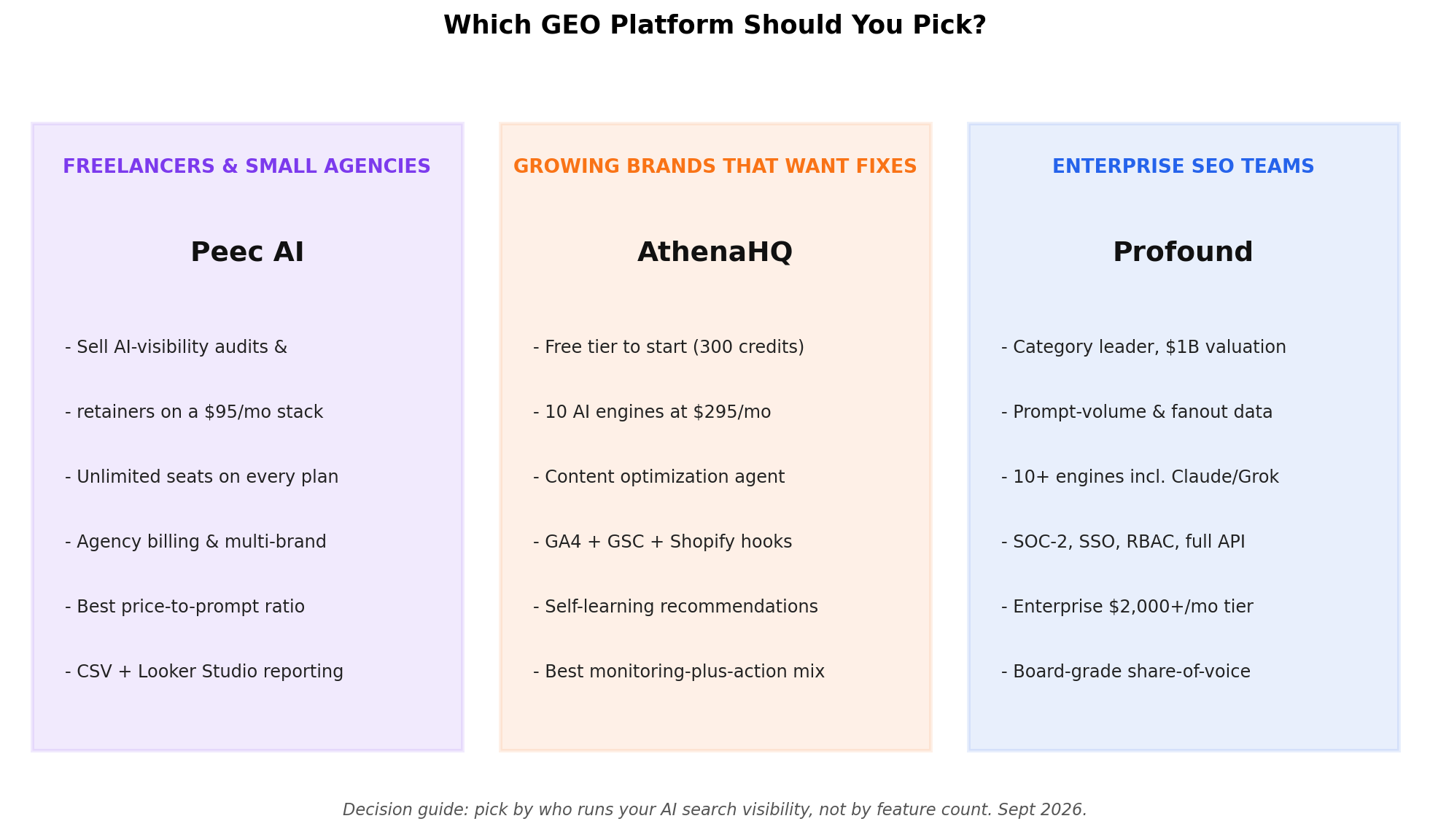
Best for enterprise SEO teams → Profound. At 8.4/10 it wins 4 of 7 dimensions — tracking, prompt research, reporting and enterprise readiness — and its fanout data is the only GEO artifact that survives board scrutiny. Budget for the real thing: the meaningful platform starts at $399/month and typically runs $2,000+.
Best for growing brands that want fixes, not just dashboards → AthenaHQ. 8.1/10 with the category's best coverage-per-dollar: 10 engines including Claude, Grok and DeepSeek at $295/month, a content-optimization agent that ships changes, revenue-grade integrations — and a free tier to prove value before you pay.
Best for freelancers and agencies monetizing GEO → Peec AI. 7.6/10 but 9.5 on value: ~$95/month for 3 engines, 50 prompts, daily tracking and unlimited seats on every plan. If you bill clients $300–500/month for AI-visibility services, Peec is the margin engine; upgrade to Pro ($245) as the client count grows.
The hybrid approach: start on AthenaHQ free to baseline your 10-engine visibility, run client services on Peec for the seat-free economics, and graduate to Profound only when AI referrals are material enough to defend in a budget meeting. For most brands in 2026, that ladder — free → $95 → $295 → $399+ — is the honest cost curve of getting serious about AI search.
Frequently Asked Questions
What is GEO (Generative Engine Optimization)?
GEO is the practice of monitoring and improving how AI assistants — ChatGPT, Google AI Overviews, Perplexity, Claude, Gemini, Copilot — mention, cite and recommend your brand. GEO platforms track your share of AI answers daily, show which competitors and sources models prefer, and increasingly generate the fixes that earn citations.
Is Peec AI free to use?
No permanent free tier, but Peec offers a 7-day trial without a credit card. Paid plans start around $95/month (billed in EUR at €82) and include unlimited users on every plan — the key reason agencies favor it.
Which GEO tool is cheapest for small teams?
AthenaHQ, because its free Essential plan (300 credits/month across 10 models) is permanently usable for baselining. Among paid tiers, Peec Starter (~$95) and Profound Starter ($99) are close in price — but Peec covers 3 engines while Profound's entry tier tracks ChatGPT only.
Is Profound worth it for small businesses?
Usually not. The $99 tier is single-seat, single-engine; the multi-engine platform, prompt volumes and compliance features unlock at Growth ($399/mo) and Enterprise ($2,000+/mo). Small brands get better economics from AthenaHQ or Peec AI and should treat Profound as a graduation, not a starting point.
Can GEO tools replace traditional SEO tools?
No — they complement them. Google still delivers most organic traffic, but with 93% zero-click behavior inside AI Mode and AI Overviews on ~25% of searches, rank trackers alone now miss where discovery happens. Run both; the GA4/GSC integrations in AthenaHQ and Looker exports in Peec exist precisely to merge the two views.
Which AI engines does each platform cover?
AthenaHQ: 10 models at $295 (ChatGPT, Perplexity, AI Overviews, Gemini, Copilot, AI Mode, Claude, Grok, DeepSeek, Meta AI). Peec AI: 3 of 6 standard engines at entry, up to 11 LLMs at Enterprise. Profound: ChatGPT at entry, 10+ engines including Claude, Grok, Gemini and Meta AI at Enterprise.