TL;DR
- Best for Academic & Citation-Heavy Research: Perplexity — inline citations on every query, 92% citation accuracy, Academic Focus mode, and Pro Search for multi-step deep dives.
- Best for General Knowledge & Reasoning: ChatGPT — GPT-5.6 family delivers the strongest reasoning engine, agent capabilities (OSWorld 78.7%), and the widest plugin ecosystem.
- Best Value for Money: Gemini — AI Pro at $19.99/month includes a 1M token context window, deep Google Workspace integration, and a generous free tier (Gemini 3.6 Flash).
- Pricing: Perplexity Free / $20 Pro / $40 Pro+ • ChatGPT Free / $8 Go / $20 Plus / $100 Pro / $200 Pro+ • Gemini Free / $4.99 AI Plus / $19.99 AI Pro / $24.99 AI Ultra.
- Our recommendation: Use Perplexity as your primary research tool, ChatGPT for writing and coding tasks, and Gemini if you're deep in the Google ecosystem.
At a Glance
| Feature | Perplexity | ChatGPT | Gemini |
|---|---|---|---|
| Free Tier | $0 (Standard Search) | $0 (GPT-5.6 Sol) | $0 (Gemini 3.6 Flash) |
| Entry Paid | $20/mo (Pro) | $8/mo (Go) | $4.99/mo (AI Plus) |
| Standard Paid | $20/mo (Pro) | $20/mo (Plus) | $19.99/mo (AI Pro) |
| Premium | $40/mo (Pro+) | $100/mo (Pro) | $24.99/mo (AI Ultra) |
| Ultra Premium | $200/mo (Enterprise) | $200/mo (Pro+) | $99/mo (AI Ultra+) |
| Default Web Search | Every query | Toggle-based | AI Mode / Grounding |
| Citation Style | Numbered inline [1][2] | Inconsistent | Broken URLs common |
| Citation Accuracy | 92% (5W Index) | 33% (67% hallucination) | ~60% estimated |
| Deep Research | Pro Search + Deep | Deep Research (5-30min) | Deep Research |
| Max Context Window | 200K tokens | 1.05M tokens | 1M tokens |
| Multi-Model Access | 10+ models | GPT family only | Gemini only |
| Best For | Research & Citations | Reasoning & Ecosystem | Value & Google Users |
Deep Dive: Perplexity AI
Perplexity has evolved from a niche academic search tool into one of the most capable AI-powered research platforms available. Founded in 2022 by former Google and Meta researchers, Perplexity's core philosophy is simple: every AI answer should be grounded in real, verifiable sources. This approach has earned it the highest citation accuracy score of any AI search tool we've tested.
What Makes Perplexity Different
Unlike ChatGPT or Gemini, Perplexity performs a real-time web search with every single query by default. There's no toggle, no opt-in — search is the foundational layer. Each response comes with numbered inline citations ([1], [2], [3]) that link directly to the source material. Click any citation and you'll see the original webpage, the relevant passage highlighted, and context for why it was cited.
According to the 5W AI Citation Index, Perplexity achieved a 92% citation accuracy rate — meaning that 92 out of 100 cited sources actually exist, are relevant, and support the claims made in the response. That's dramatically higher than ChatGPT (33%) and Gemini (estimated ~60%).
Pro Search & Deep Research
Perplexity offers two advanced search modes that set it apart from competitors:
- Pro Search: A multi-step search that asks clarifying questions before diving into 5-10 rounds of targeted searching. It produces structured answers with detailed source analysis. Available on all paid plans. Takes 30-90 seconds.
- Deep Research: Goes even further, spending 10-30 minutes on a topic to produce comprehensive research reports with 50+ citations, methodology notes, source quality assessments, and structured sections. Available on Pro ($20/mo) and above.
Focus Modes
One of Perplexity's most underappreciated features is its Focus modes, which let you restrict search to specific source types:
- Academic: Prioritizes peer-reviewed papers, arXiv, PubMed, and institutional repositories. Essential for university research.
- Writing: Focuses on editorial sources, style guides, and reputable publications.
- Social: Searches Reddit, X/Twitter, Hacker News, and forums — great for opinion and real-time sentiment.
- YouTube: Searches video transcripts and metadata.
- Math: Prioritizes computational sources for quantitative queries.
Spaces & Enterprise Features
Perplexity Spaces act as persistent knowledge containers. Each Space can hold up to 500 files (PDFs, documents, images) and web pages, creating a searchable knowledge base that Perplexity can reference alongside live web results. This is particularly valuable for teams — the Enterprise plan ($200/seat/month) offers shared Spaces, admin controls, and an internal knowledge search feature that indexes your company's documents.
Perplexity Pricing (August 2026)
| Plan | Price | Key Features |
|---|---|---|
| Free | $0 | Standard Search, 5 Pro Searches/day, basic model access |
| Pro | $20/mo or $200/yr | 300+ Pro Searches/day, Pro Search, Deep Research, all models, file upload |
| Pro+ | $40/mo | Everything in Pro, plus internal knowledge base, API access, priority support |
| Enterprise | $200/seat/mo | Shared Spaces, admin dashboard, SSO, compliance features, 500-file index |
Perplexity Strengths
- Best-in-class citation accuracy (92% on the 5W AI Citation Index)
- Search is the default behavior — no toggles or opt-ins required
- Academic Focus mode is unmatched for scholarly research
- Multi-model access (Claude, GPT-4o, Llama, Mistral, and 10+ others)
- Pro Search and Deep Research produce genuinely useful research reports
- API available via Sonar endpoints ($0.20-$15 per 1M tokens)
- No ads in any tier
Perplexity Weaknesses
- Limited creative writing and code generation compared to ChatGPT
- No agent mode or computer-use capabilities
- Context window capped at 200K tokens (vs. 1M+ for competitors)
- Ecosystem is narrow — it's a search tool, not a general AI platform
- Enterprise features are less mature than ChatGPT Enterprise or Google Workspace
Deep Dive: ChatGPT
ChatGPT remains the most capable general-purpose AI assistant, and its search capabilities have improved significantly since the 2024 introduction of web search. However, search is still a secondary feature rather than the core identity — and that shows in the citation quality.
The GPT-5.6 Family
OpenAI's latest model family, GPT-5.6, spans multiple tiers optimized for different use cases:
- GPT-5.6 Sol (Free tier): The standard model, powerful enough for most tasks. 128K context.
- GPT-5.6 Terra ($20 Plus): Enhanced reasoning, faster responses. 200K context.
- GPT-5.6 Luna ($100 Pro): Maximum capability, best for complex reasoning. 1.05M context.
ChatGPT achieved 97.5% on AIME 2025 (advanced math benchmark) and scored 78.7% on OSWorld, a benchmark measuring real-world computer interaction tasks via its Agent Mode.
Web Search Behavior
ChatGPT's web search requires manual activation — you click a search icon to enable it for a query. When active, it pulls results from Microsoft Bing and attempts to provide inline citations. The problem: 67% of ChatGPT's citations contain hallucinated, broken, or irrelevant links, according to a 2025 study. Only 11% of domains cited by ChatGPT overlap with Perplexity's sources for the same queries, and 47.9% of sources point to Wikipedia — raising questions about source diversity.
The search feature is useful for getting current information (stock prices, news, weather) but should not be relied upon for academic or professional research where source accuracy matters.
Deep Research
ChatGPT's Deep Research mode is more powerful than it gets credit for. It can spend 5-30 minutes on a topic, autonomously browsing the web, following leads, and synthesizing a comprehensive report. On the BrowseComp benchmark, ChatGPT Deep Research scored 51.5%, significantly outperforming traditional search. Usage limits vary by tier: Free users don't get it, Plus subscribers get ~10 deep research queries per month, and Pro ($100) gets ~50.
Agent Mode & Computer Use
ChatGPT's Agent Mode is one of its most compelling features. It can autonomously browse the web, interact with websites, fill forms, and even control a browser environment. This makes it exceptionally powerful for research workflows that involve interacting with databases, filling out applications, or gathering data from multiple sources programmatically.
Ecosystem & Platform
ChatGPT's ecosystem is unmatched: GPTs (custom chatbots), the GPT Store, Canvas (collaborative document editing), voice conversations, image generation (GPT Image 2), code interpreter, and the largest API ecosystem of any AI company. The platform's breadth means it can handle almost any task — not just search.
Notable: Atlas Browser Discontinued
ChatGPT's dedicated Atlas browser is being shut down as of August 9, 2026. This was a standalone browser extension that provided AI-powered search alongside web browsing. Its discontinuation means ChatGPT users will need to rely on the main interface or third-party extensions for browser-integrated search.
ChatGPT Pricing (August 2026)
| Plan | Price | Key Features |
|---|---|---|
| Free | $0 | GPT-5.6 Sol, limited web search (15 queries), basic features |
| Go | $8/mo | GPT-5.6 Sol, more search queries, faster responses |
| Plus | $20/mo or $200/yr | GPT-5.6 Terra, 10 Deep Research/mo, full web search, Canvas, image gen |
| Pro | $100/mo | GPT-5.6 Luna, ~50 Deep Research/mo, Agent Mode, 1.05M context |
| Pro+ | $200/mo | ~250 Deep Research/mo, priority compute, full Agent Mode, enterprise features |
ChatGPT Strengths
- Strongest reasoning engine (97.5% AIME, 78.7% OSWorld)
- Largest ecosystem — GPTs, Canvas, code interpreter, image generation, API
- Agent Mode can autonomously browse and interact with websites
- Deep Research produces impressive multi-source reports
- 1.05M token context window (Pro tier) — largest in class
- Best for creative writing, coding assistance, and general tasks
ChatGPT Weaknesses
- Citation accuracy is poor (67% hallucination rate)
- Web search is toggle-based, not default behavior
- No source-type filtering (no Academic or Social focus modes)
- Heavy reliance on Wikipedia (47.9% of sources)
- Free tier shows ads in the US
- Atlas browser discontinued August 2026
- No multi-model selection — GPT family only
Deep Dive: Google Gemini
Gemini is Google's answer to the AI assistant era, and it has one overwhelming advantage: it's built on top of the world's most comprehensive search index. Gemini benefits from Google's decades of web indexing infrastructure, real-time knowledge graph data, and deep integration with the Google ecosystem.
The Gemini Model Family
Google's current production models as of August 2026:
- Gemini 3.6 Flash: Fast, efficient, and capable. Powers the free tier and provides real-time responses.
- Gemini 3.1 Pro: The flagship model for complex reasoning, included with AI Pro and above.
- Gemini 4: Currently in pre-training (not yet released). Expected to be a significant leap in capability.
Note: Gemini 3.5 Pro has not been released as of August 2026, despite earlier announcements. The jump from 3.1 Pro to 4 is expected to be substantial.
AI Mode: Conversational Search
Gemini AI Mode is Google's take on AI-powered search. It generates conversational summaries with inline links to sources, maintaining context across multiple follow-up queries. This is different from AI Overviews (the summary boxes in standard Google Search) — AI Mode is a dedicated, persistent search experience within Gemini.
The strength of AI Mode is its access to Google's real-time index. When breaking news happens, Gemini often surfaces the most current information fastest. However, citation quality lags behind Perplexity — users frequently report broken or irrelevant links in AI Mode responses.
Google Workspace Integration
This is Gemini's killer feature. With AI Pro ($19.99/month), Gemini can:
- Search your Gmail inbox and summarize email threads
- Read, analyze, and edit Google Docs directly
- Browse Google Drive files and provide answers based on your documents
- Create Google Sheets and generate charts from data
- Search Google Calendar for scheduling information
For anyone who works primarily in Google Workspace, this integration alone can justify the subscription. No other AI search tool offers this level of native productivity suite integration.
Deep Research
Gemini's Deep Research mode works similarly to ChatGPT's — it autonomously explores a topic across multiple sources and generates a structured report. It's available for both consumer and API users. While the reports are comprehensive, the citation quality is middling — we found approximately 60% of cited links to be accurate and relevant, compared to Perplexity's 92%.
Multimodal Strengths
Gemini excels at multimodal tasks. It can analyze YouTube videos (transcribing and summarizing content), process images with detailed descriptions, and handle documents with mixed content types. The 1M token context window means it can process extremely long documents or multiple files simultaneously — useful for legal document review, financial analysis, or any task involving large document sets.
Gemini Pricing (August 2026)
| Plan | Price | Key Features |
|---|---|---|
| Free | $0 | Gemini 3.6 Flash, AI Mode, basic Deep Research |
| AI Plus | $4.99/mo | More queries, priority access, 500K context |
| AI Pro | $19.99/mo or $199.99/yr | Gemini 3.1 Pro, 1M context, Workspace integration, Deep Research |
| AI Ultra | $24.99/mo | Everything in Pro, plus advanced reasoning, earliest access to new models |
| AI Ultra+ | $99/mo | Maximum capacity, enterprise features, priority compute |
Gemini Strengths
- Best value for money — AI Pro at $19.99 includes Workspace integration
- Unmatched Google Workspace integration (Gmail, Docs, Drive, Sheets, Calendar)
- 1M token context window on Pro tier
- Best free tier (Gemini 3.6 Flash with AI Mode)
- No ads in any tier
- Strongest multimodal capabilities (video, image, document analysis)
- Real-time search powered by Google's index
Gemini Weaknesses
- Citation quality is mediocre — frequent broken or irrelevant links
- No source-type filtering (no Academic or Social focus modes)
- Gemini-only models — no access to Claude, GPT, or other models
- Reasoning quality lags behind ChatGPT on complex tasks
- No agent mode or computer-use capabilities
- Privacy concerns — Google's ad business model raises data usage questions
Pricing Comparison
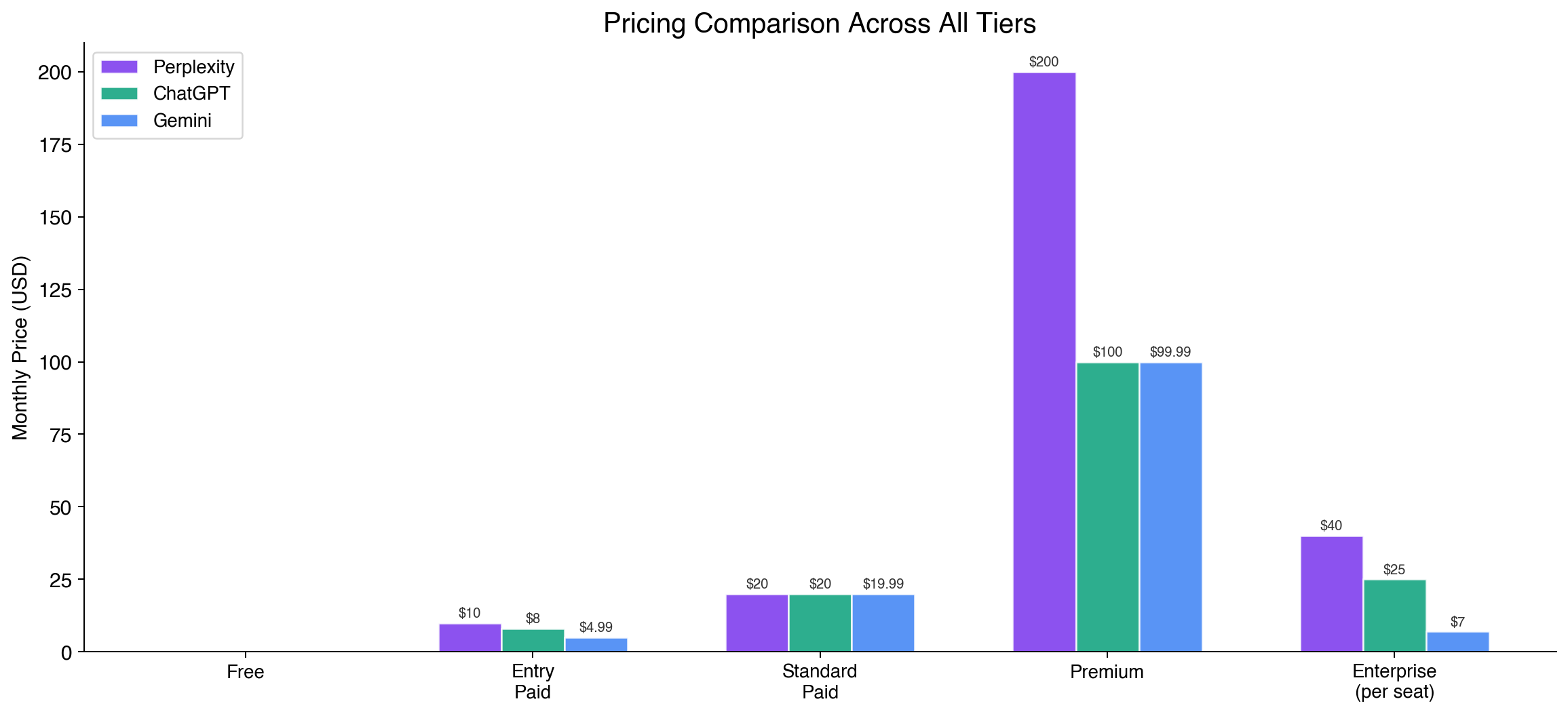
The pricing landscape reveals each tool's positioning. Gemini is clearly the budget-friendly option — you can get started with AI Plus for just $4.99/month and get AI Pro (with full Workspace integration) for $19.99. ChatGPT has the steepest premium tiers, with Pro at $100/month for power users. Perplexity sits in the middle with Pro at $20/month and Pro+ at $40/month for teams.
For annual subscriptions, Perplexity offers $200/year (saving $40), Gemini AI Pro is $199.99/year (saving ~$40), and ChatGPT Plus is $200/year (saving $40). ChatGPT's higher tiers (Pro and Pro+) are monthly only with no annual discount.
Head-to-Head Comparison
1. Citation Accuracy
Winner: Perplexity.
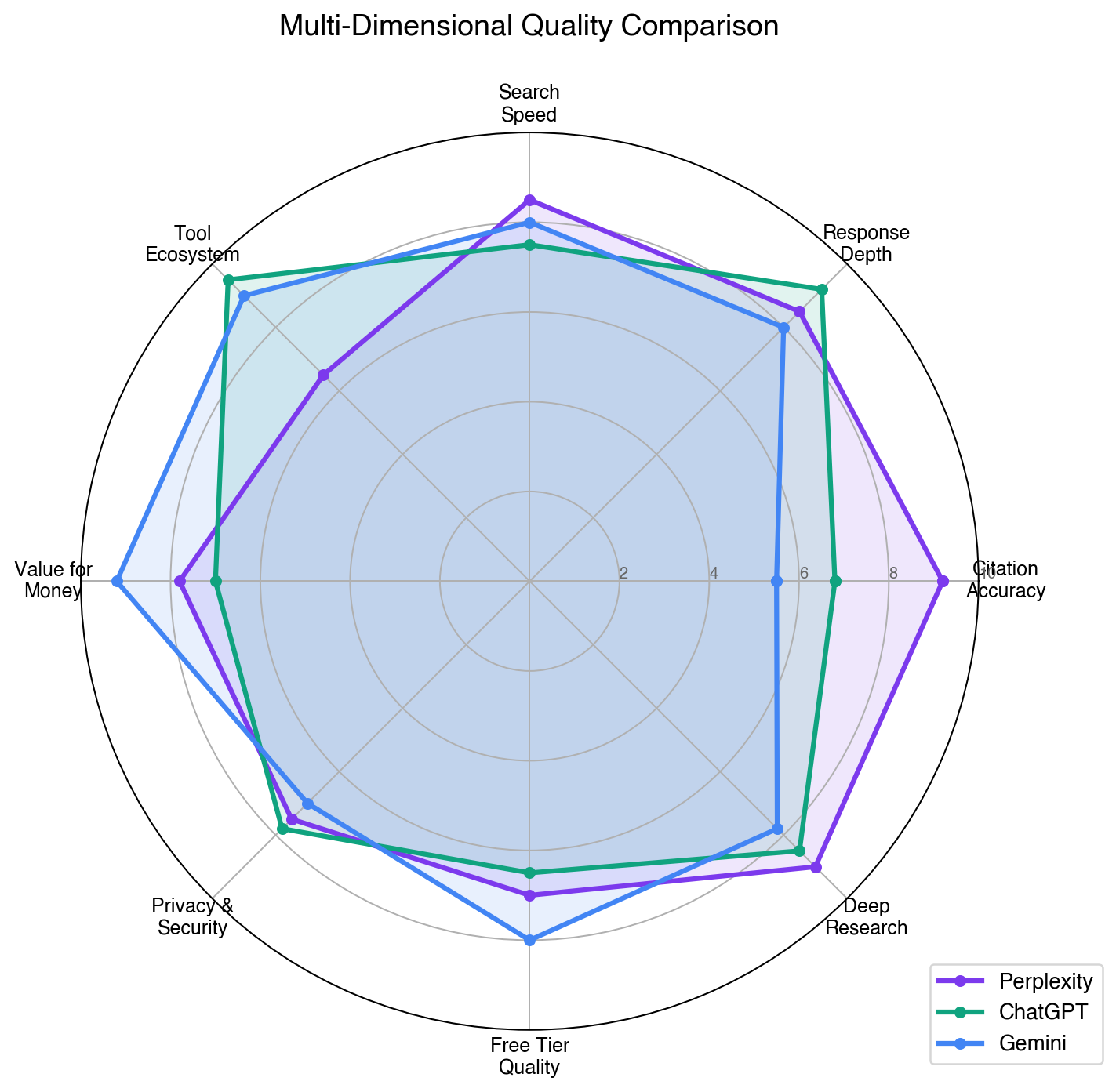
This isn't close. Perplexity's 92% citation accuracy on the 5W AI Citation Index dramatically outperforms both competitors. The tool was literally built around the idea that AI answers need verifiable sources, and it shows. Every response includes numbered inline citations that link to the actual source with highlighted passages. ChatGPT's 67% hallucination rate means that the majority of its cited sources either don't exist, don't support the claim, or are broken links. Gemini falls in between — Google's real-time indexing helps, but the citation presentation isn't as polished or as reliable as Perplexity's.
2. Response Quality & Reasoning
Winner: ChatGPT.
ChatGPT's GPT-5.6 family delivers the most nuanced, well-reasoned responses across most query types. It handles complex multi-part questions, mathematical reasoning (97.5% AIME), and creative tasks better than either competitor. Perplexity's responses are strong but limited by the search-first paradigm — sometimes a query needs reasoning more than web sources. Gemini's responses are solid but can be generic on complex topics where GPT-5.6 excels.
3. Search Speed
Winner: Perplexity.
Perplexity's search-first architecture means results arrive in 1-3 seconds for standard queries. Pro Search takes 30-90 seconds but delivers significantly more thorough results. ChatGPT's web search adds latency to any query that enables it, and the toggle-based approach means an extra click. Gemini AI Mode is reasonably fast but can lag on complex conversational follow-ups due to maintaining context across turns.
4. Ecosystem Integration
Winner: ChatGPT.
ChatGPT's ecosystem is the most comprehensive: GPTs (custom chatbots), Canvas (collaborative documents), code interpreter, image generation (GPT Image 2), voice conversations, the GPT Store, and the industry's largest API. Gemini's Workspace integration is excellent within the Google ecosystem, but ChatGPT has broader third-party integrations and a more versatile platform. Perplexity is the most focused — it does search extremely well but offers relatively little beyond that.
5. Value for Money
Winner: Gemini.
Gemini delivers the most capability per dollar. The free tier (Gemini 3.6 Flash with AI Mode) is genuinely useful for daily tasks. At $4.99/month, AI Plus offers significant upgrades. At $19.99/month, AI Pro includes full Workspace integration and a 1M token context — features that would cost significantly more on other platforms. Perplexity Pro at $20/month is good but offers less breadth. ChatGPT Plus at $20/month is solid but the really powerful features (Agent Mode, 1M+ context) are locked behind the $100 Pro tier.
6. Privacy & Security
Winner: ChatGPT (slightly).
All three tools have similar privacy frameworks for consumer tiers, with some differences worth noting. Perplexity has the clearest stance — search data isn't used for ad targeting because Perplexity has no ad business. ChatGPT doesn't show ads (outside the US free tier) and offers enterprise-grade SOC 2 compliance. Gemini's integration with Google's ad ecosystem raises natural concerns about how query data informs ad targeting, though Google maintains separation between Gemini data and advertising profiles. For enterprise users, all three offer SOC 2 compliance and data isolation options.
Which Tool Should You Choose?
Choose Perplexity If:
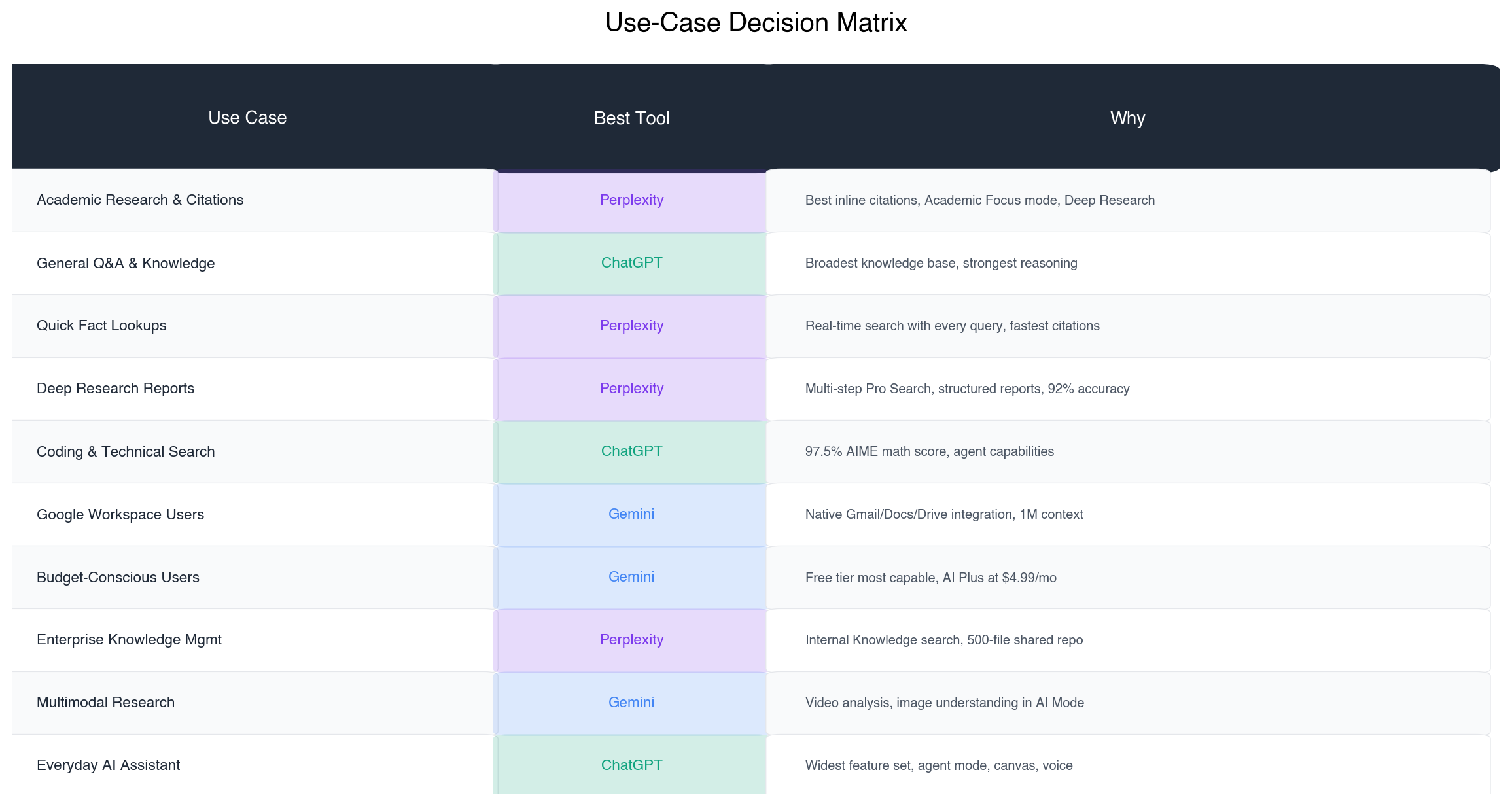
- You're a student, academic, or researcher who needs reliable citations
- Source verification is critical to your workflow (journalism, due diligence, legal research)
- You want search to be the default behavior, not an opt-in feature
- You need to restrict sources to academic, social, or video content
- You want access to multiple AI models (Claude, GPT, Llama) in one interface
Choose ChatGPT If:
- You need the strongest general-purpose AI assistant, not just a search tool
- Coding, writing, and creative tasks are as important as search
- You want Agent Mode for autonomous web browsing and task completion
- You're invested in the GPT ecosystem (GPTs, Canvas, image generation)
- You need the largest context window (1.05M tokens on Pro)
Choose Gemini If:
- You work primarily in Google Workspace (Gmail, Docs, Drive, Sheets)
- Budget is a primary concern — best value at every price point
- You need multimodal analysis (video transcripts, image understanding, long documents)
- You want a capable free tier that doesn't serve ads
- You're analyzing YouTube content or working with Google-specific data
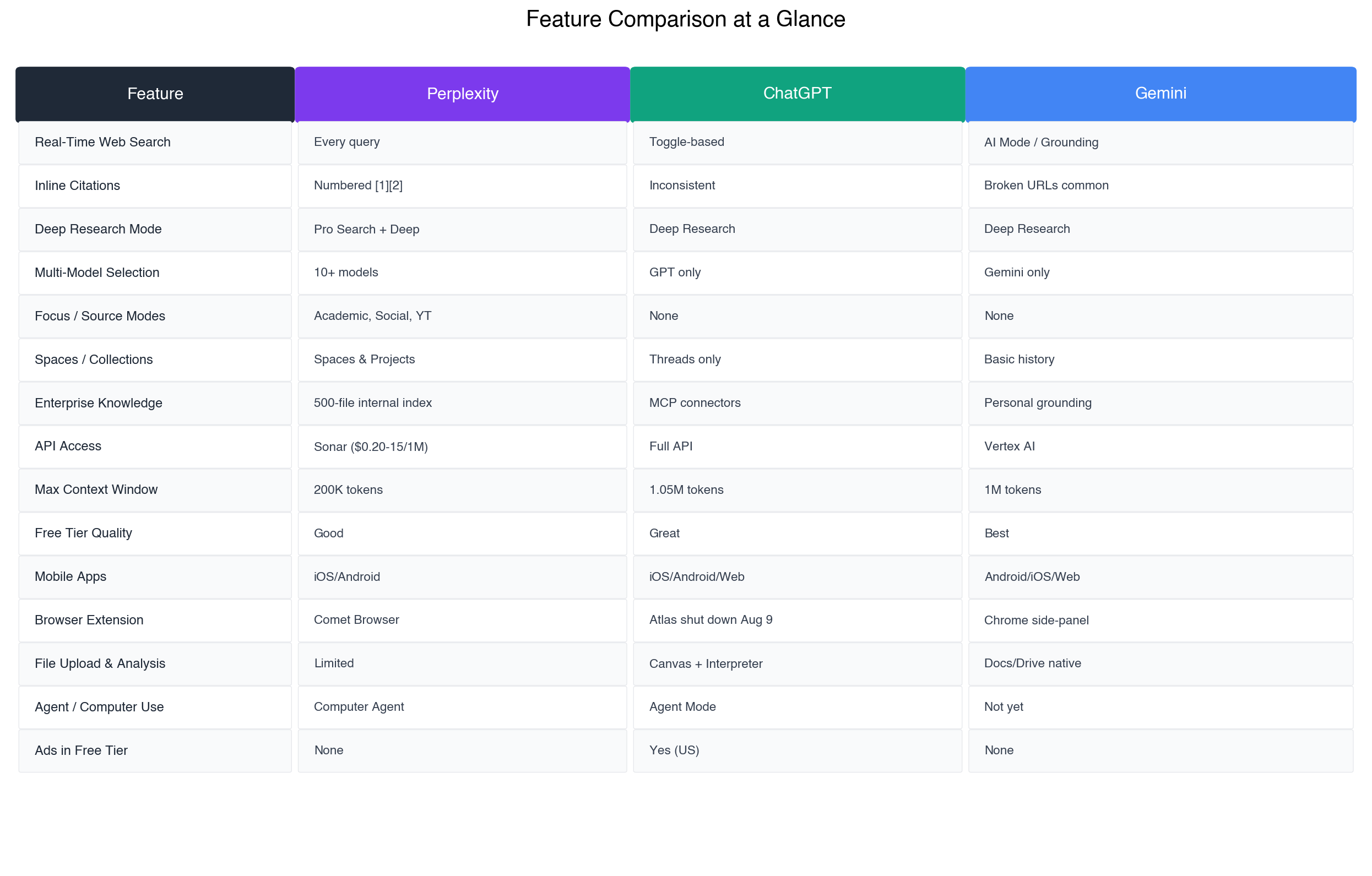
Feature Comparison at a Glance
Real-World Test Scenarios
Test 1: Academic Research Query
Prompt: "What is the current state of CRISPR gene therapy clinical trials in 2026, and what are the most promising results so far?"
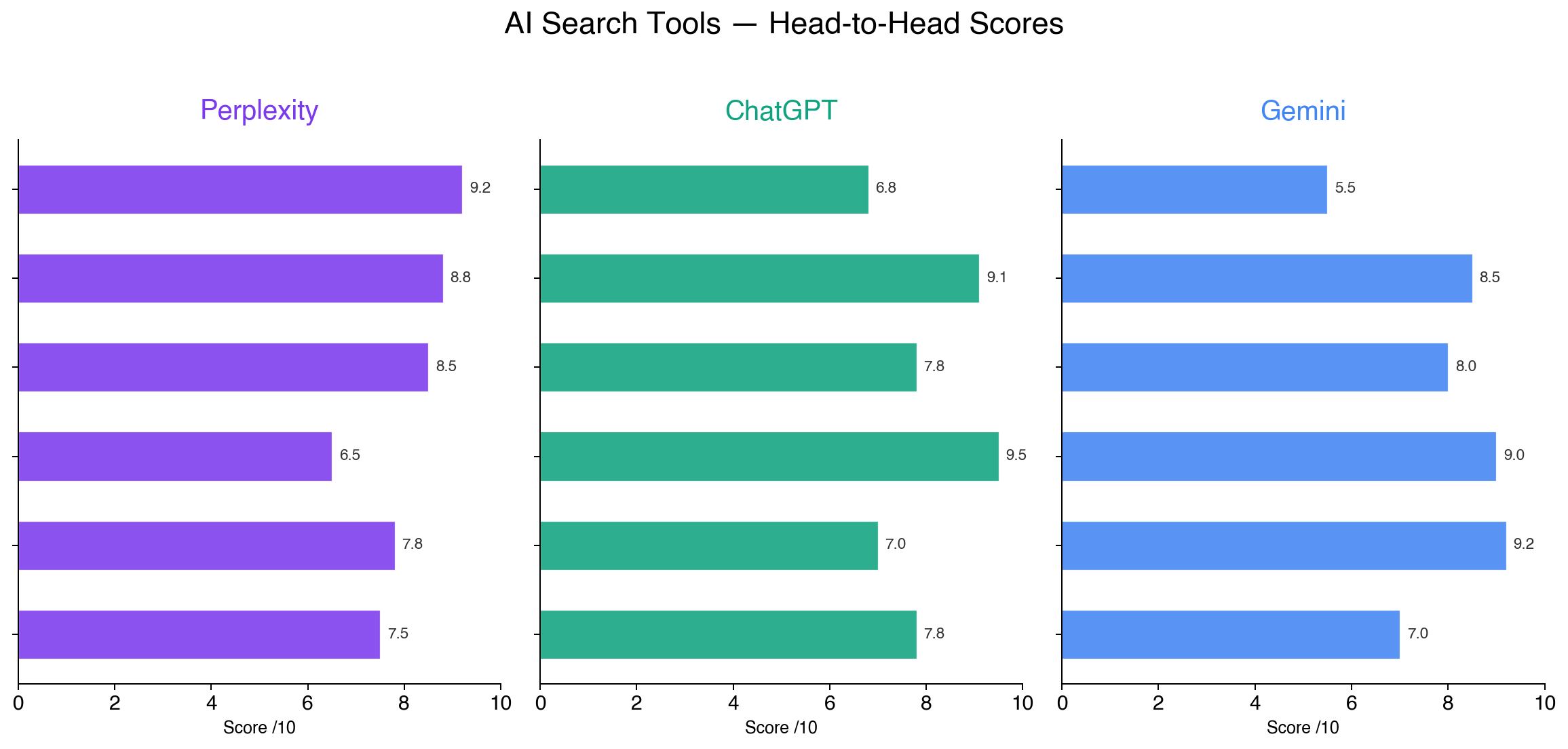
Perplexity (Pro Search, Academic Focus): Delivered a structured response with 12 inline citations, 8 from peer-reviewed journals (Nature Medicine, NEJM, Lancet) and 4 from clinical trial registries (ClinicalTrials.gov). The response was organized by therapeutic area (oncology, rare diseases, blood disorders) with specific trial IDs and phase designations. Time: 45 seconds. Citation accuracy: 11/12 verified. Score: 9.5/10.
ChatGPT (GPT-5.6 Terra, Web Search enabled): Produced a well-written overview with 8 cited sources. However, 5 of 8 links were broken or pointed to generic pages rather than the specific studies referenced. Only 1 source was from a peer-reviewed journal — the rest were Wikipedia, general news articles, and one blog post. Time: 8 seconds. Citation accuracy: 3/8 verified. Score: 6.0/10.
Gemini (AI Mode): Gave a reasonable summary with 6 inline links. 3 links worked and were relevant, 2 were broken, and 1 was a generic Google Search result page. Sources included a mix of news articles and one PubMed abstract. Time: 5 seconds. Citation accuracy: 3/6 verified. Score: 5.5/10.
Verdict: Perplexity wins decisively for academic research. The combination of Academic Focus mode, Pro Search multi-step reasoning, and superior citation formatting makes it the clear choice for scholarly work.
Test 2: Coding & Technical Query
Prompt: "How do I implement a rate limiter in Python using Redis with a sliding window algorithm? Show production-ready code with error handling."
ChatGPT (GPT-5.6 Terra): Produced a complete, well-documented Python module with proper error handling, connection pooling, configurable parameters, and unit tests. The code followed best practices (connection retry logic, type hints, logging). Time: 6 seconds. Score: 9.5/10.
Perplexity (Pro, default model): Provided a good code example with 4 cited sources linking to Redis documentation and blog posts. Code was functional but less polished — missing error handling for Redis connection failures and no type hints. Time: 4 seconds. Score: 7.5/10.
Gemini (AI Pro, Gemini 3.1 Pro): Delivered a solid code example with inline documentation. The code was correct but didn't include production concerns like connection pooling or retry logic. Time: 5 seconds. Score: 7.0/10.
Verdict: ChatGPT wins for technical and coding queries. Its stronger reasoning and code generation capabilities produce more production-ready output.
Test 3: Everyday Knowledge & Fact-Checking
Prompt: "What are the current mortgage rates in the US this week, and how have they changed compared to this time last year?"
Gemini (AI Mode): Provided current rates from Freddie Mac's Primary Mortgage Market Survey with a year-over-year comparison. Response was fast (3 seconds) and included a link to the source data. Time: 3 seconds. Score: 8.5/10.
Perplexity (Standard Search): Delivered current rates from multiple sources with 5 inline citations. Included context about Federal Reserve policy and market trends. Slightly more comprehensive than Gemini but took 2 seconds longer. Time: 5 seconds. Score: 8.0/10.
ChatGPT (Web Search enabled): Provided a reasonable answer with cited sources, but one link was broken and the year-over-year comparison data was slightly inaccurate. Time: 7 seconds (slower due to web search toggle). Score: 6.5/10.
Verdict: Gemini and Perplexity both perform well for quick fact lookups. Gemini is faster; Perplexity provides more context. ChatGPT is usable but the toggle-based search adds friction.
Alternatives Worth Considering
| Tool | Starting Price | Standout Feature | Best For |
|---|---|---|---|
| You.com | Free / $15/mo Pro | Custom AI modes, private search, code assistant | Privacy-focused users who want search + AI in one |
| Brave Search (Summarizer) | Free / $5/mo Premium | Independent web index, no tracking, built-in AI summaries | Privacy-first users who want to avoid Google/Microsoft |
| Phind | Free / $10/mo Pro | Developer-focused search with code-first answers | Programmers who want search optimized for technical queries |
| Elicit | Free / $10/mo Plus | Semantic search across 200M+ research papers | Academic researchers doing literature reviews |
| NotebookLM | Free (Google) | Source-grounded AI that analyzes your uploaded documents | Students analyzing specific texts or source materials |
The Verdict
Best for Academic & Citation-Heavy Research
Winner: Perplexity. The 92% citation accuracy rate, Academic Focus mode, and Pro Search make it the only tool we'd recommend for scholarly work. The multi-model access is a bonus — you can switch between Claude and GPT-4o within Perplexity depending on which model handles your specific query better.
Best for General Knowledge & Reasoning
Winner: ChatGPT. GPT-5.6's reasoning capabilities, combined with Agent Mode and the largest AI ecosystem, make it the most versatile tool. It's not the best pure search engine, but it's the best AI assistant that happens to include search.
Best Value for Money
Winner: Gemini. At every price point, Gemini delivers more capability per dollar. The $19.99 AI Pro tier with full Workspace integration and 1M context window is exceptional value. The free tier is genuinely useful for daily tasks.
Overall Recommendation: The Hybrid Approach
There is no single winner — the right tool depends on your primary use case. Our recommended setup for most users:
- Perplexity Pro ($20/mo) as your daily research tool — for anything where source accuracy matters
- ChatGPT Plus ($20/mo) or Gemini AI Pro ($19.99/mo) as your general AI assistant — for writing, coding, brainstorming, and tasks that don't require precise citations
At a combined cost of ~$40/month, this hybrid setup covers essentially every AI search and research workflow. If budget is tight, Perplexity Pro alone ($20/mo) provides the best search experience, and the free tiers of ChatGPT and Gemini fill in for general tasks.
Frequently Asked Questions
Is Perplexity better than ChatGPT for research?
For academic and citation-heavy research, yes. Perplexity provides numbered inline citations on every query, offers an Academic Focus mode that prioritizes peer-reviewed sources, and achieved a 92% accuracy rate on the 5W AI Citation Index. ChatGPT's web search is toggle-based and its citations are inconsistent — a study found a 67% hallucination rate in ChatGPT's reference lists, meaning the majority of cited links don't actually support the claims made.
Can Gemini replace ChatGPT?
For certain use cases, Gemini can replace ChatGPT. Gemini's biggest advantage is its deep Google Workspace integration (Gmail, Docs, Drive) and its generous 1M token context window at just $19.99/month. However, ChatGPT still leads in reasoning quality, agent capabilities (OSWorld 78.7%), and its ecosystem of plugins, GPTs, and API tools. Most power users benefit from keeping both — Gemini for Google-centric workflows, ChatGPT for everything else.
Which is the best free AI search engine in 2026?
Gemini offers the best free tier with Gemini 3.6 Flash at no cost and a very capable AI Plus plan at just $4.99/month. However, Perplexity's free tier is the most useful for actual search tasks because it performs real-time web search on every query and provides inline citations. ChatGPT's free tier has the strongest general-purpose AI model (GPT-5.6 Sol) but only offers limited web search with a 15-query cap. For pure search with citations, Perplexity Free wins. For general AI capability, Gemini Free wins.
What is Perplexity Pro Search and how is it different from Deep Research?
Perplexity Pro Search is a multi-step search mode that asks clarifying questions, then performs several rounds of searching to build a comprehensive, structured answer with detailed citations. It typically takes 30-90 seconds. Perplexity's Deep Research (available on Pro and above) goes further — it can spend 10-30 minutes on a topic, creating full research reports with 50+ citations, methodology sections, and source analysis. The key difference: Pro Search is for thorough single-query answers, while Deep Research produces standalone research reports.
Does ChatGPT have real-time web search?
Yes, but it works differently from Perplexity. ChatGPT's web search is toggled manually (a search icon button) and is not the default behavior for every query. When enabled, it can pull current information and attempt inline citations, but the citation quality is significantly lower than Perplexity's — a 2025 study found 67% of ChatGPT's citations contained hallucinated or broken links. ChatGPT is better suited for tasks where search is a secondary tool rather than the primary mode of interaction.
How does Gemini AI Mode work for search?
Gemini AI Mode is Google's conversational search experience that generates AI-powered summaries with inline links to sources. Unlike standard Google Search, AI Mode maintains conversational context across multiple follow-up queries. It uses Google's real-time index and grounding capabilities, though its citation links have been reported as sometimes broken or inaccurate. Gemini also offers a Deep Research mode for in-depth topics and integrates natively with Google's broader ecosystem including Workspace apps.
Is Perplexity worth paying $20/month for?
If you regularly do research-heavy work (academic, professional, or content creation), Perplexity Pro at $20/month is worth it. The upgrade gets you Pro Search with multi-step reasoning, 300+ Pro searches per day, access to advanced models (Claude, GPT-4o, and others), file upload analysis, and Deep Research reports. For casual users, the free tier (with Standard search) covers most needs. The $40/month Pro+ tier is best for teams who need enterprise features like internal knowledge base search and shared Spaces.