⏱ TL;DR
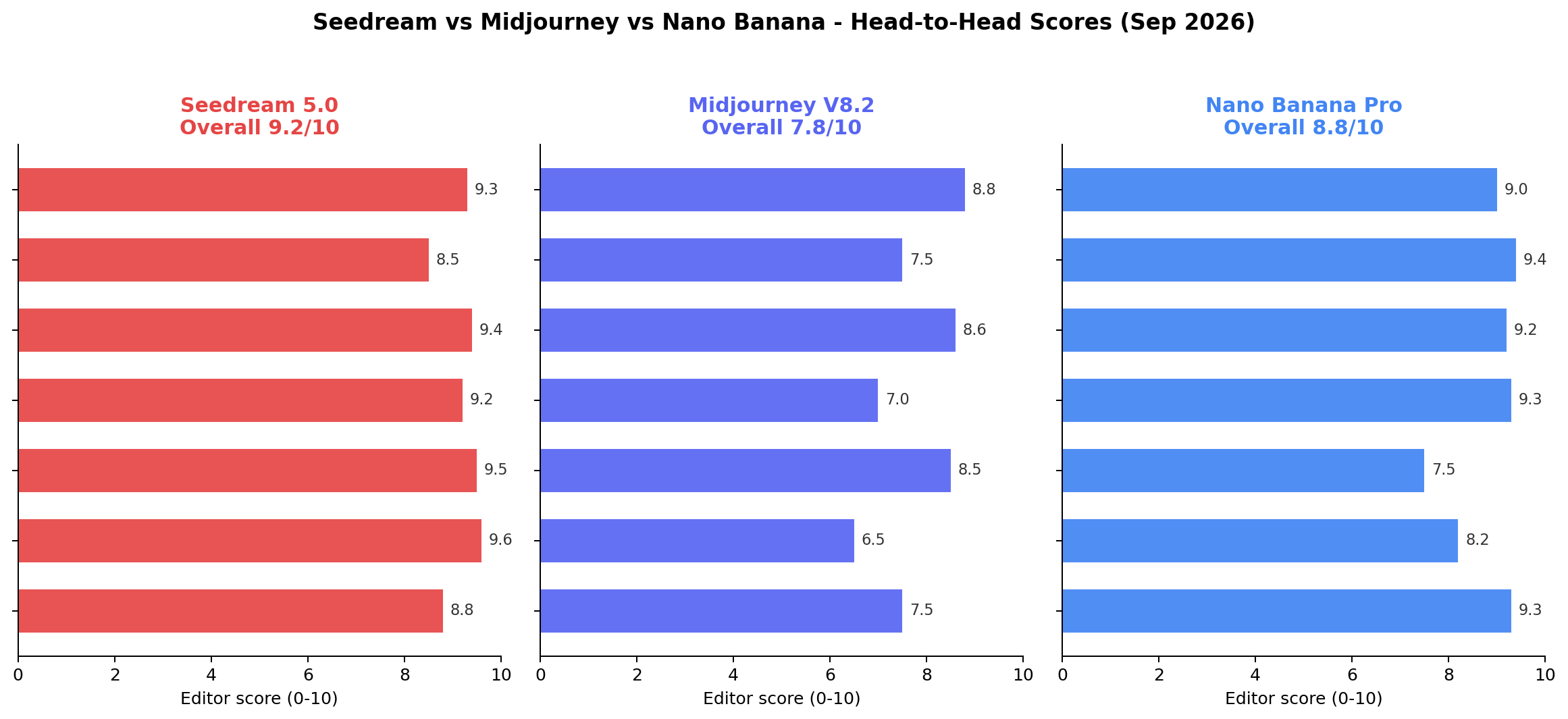
The 2026 image-generation crown is genuinely contested. Seedream 5.0 (overall 9.2/10) is our new top scorer — native 4K, ~9-second generation, up to 14 reference images for consistency, and API pricing from $0.035/image via Dreamina parent ByteDance. Nano Banana Pro (8.8) is the editing and typography specialist — ~94% accurate text rendering and chat-native, multi-turn photo edits inside Gemini, from $19.99/month. Midjourney V8.2 (7.8) remains the art director's pick with its unmistakable signature look and unlimited Relax Mode at $30+/month, but it has no API, no free tier, and it now trails both rivals on photorealism and editing. Simple rules: volume + budget → Seedream; posters + photo editing → Nano Banana; mood boards + brand art → Midjourney.
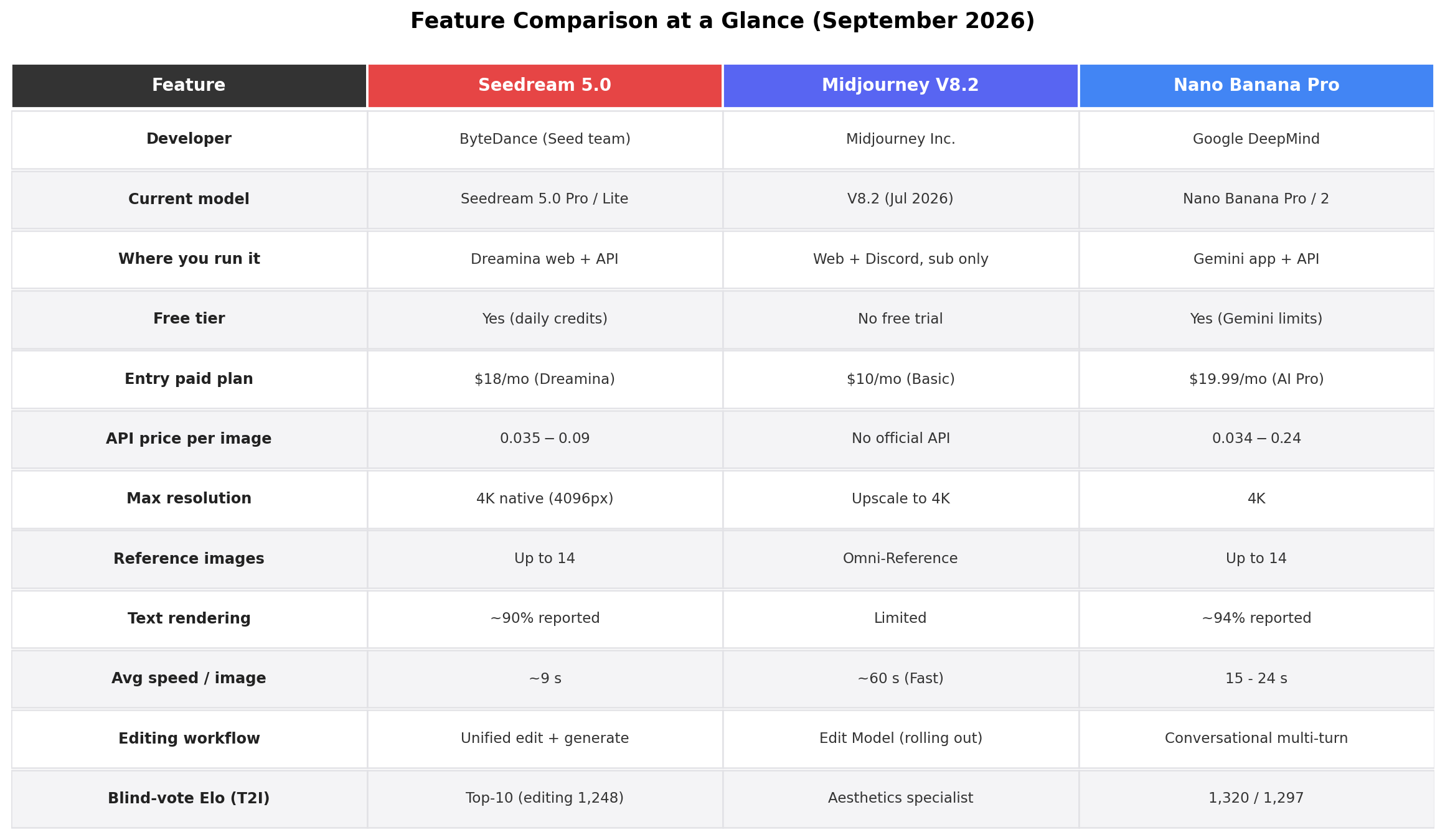
At a Glance
| Category | Seedream 5.0 | Midjourney V8.2 | Nano Banana Pro |
|---|---|---|---|
| Overall score | 9.2 | 7.8 | 8.8 |
| Developer | ByteDance (Seed team) | Midjourney Inc. | Google DeepMind |
| Best for | Volume generation, e-commerce, 4K detail | Art direction, concept art, signature style | Text-in-images, conversational photo editing |
| Where you run it | Dreamina web + first-party API | Web + Discord, subscription only | Gemini app + Gemini API |
| Free tier | Yes — free daily credits on Dreamina | No free trial | Yes — free Gemini limits |
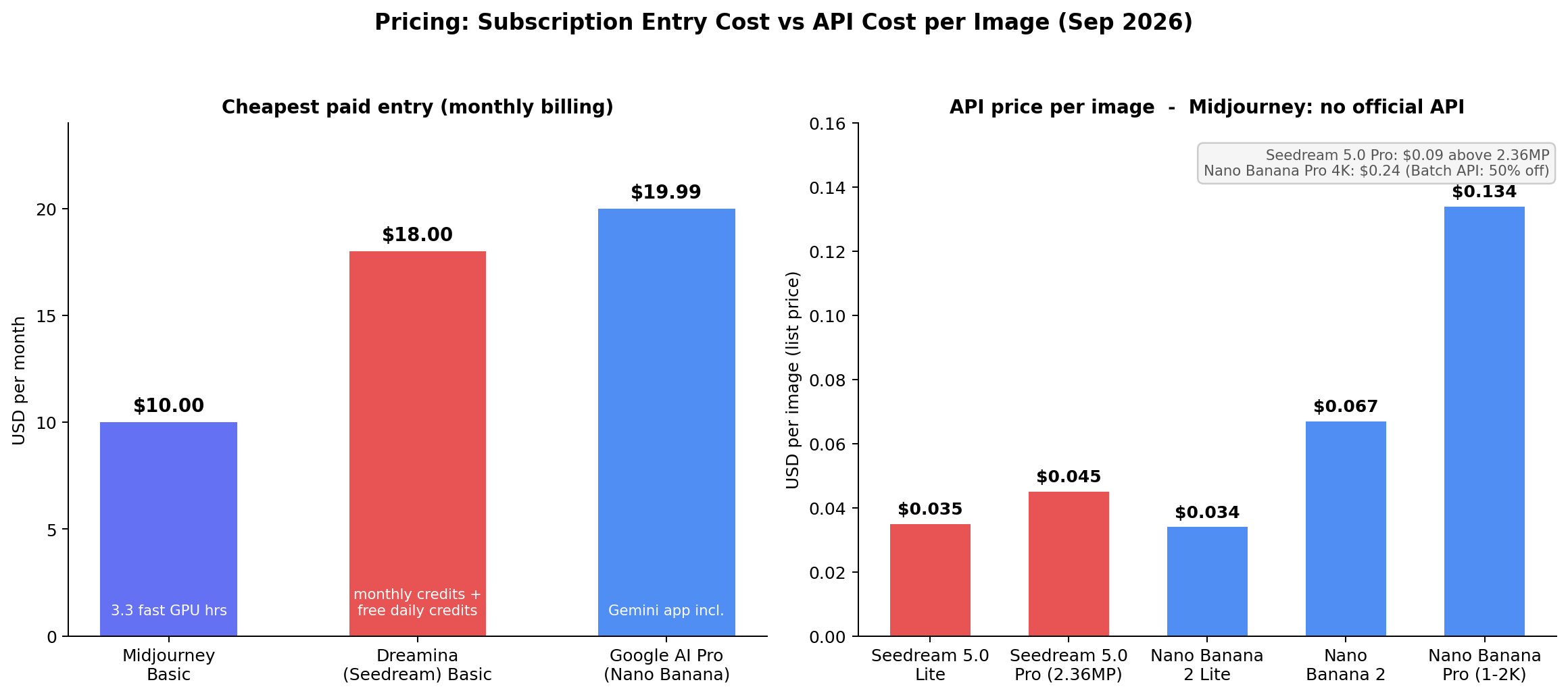
| Entry paid plan | $18/mo (Dreamina Basic) | $10/mo (Basic) | $19.99/mo (Google AI Pro) |
| API price/image | $0.035–$0.09 | No official API | $0.034–$0.24 |
| Max resolution | 4K native (4096px) | Upscale to 4K | 4K |
| Avg speed/image | ~9 s | ~60 s (Fast mode) | 15–24 s |
Why This Three-Way Fight Matters in 2026
For three years, "which image generator should I use?" had a lazy answer: Midjourney. That answer no longer survives contact with the 2026 leaderboard. ByteDance's Seedream family — the model behind Jimeng in China and Dreamina internationally — now sits in the top 10 of the major blind-voting text-to-image Elo boards and leads several editing benchmarks (its editing Elo of ~1,248 puts it in the top handful of models anywhere). Google, after the Imagen detour, struck gold with the Nano Banana line: approachable inside Gemini, absurdly good at rendering text, and rebuilt around conversational editing rather than one-shot rolls. Midjourney, meanwhile, shipped V8.1 and then the V8.2 aesthetic overhaul in July 2026 alongside a dedicated Edit Model — real progress, but on rails that only subscribers can ride.
The practical stakes are bigger than hobbyist forum arguments. Image generation has become a paying trade: freelancers now sell AI-assisted SKU image sets to e-commerce sellers for ¥150–400 (~$21–56) per product, fashion-model shots at ¥15–50 (~$2–7) per image, and avatar sticker sets for as little as ¥0–10 on Chinese marketplaces, with monthly content retainers of ¥800–2,000 (~$110–280) on top. At those price points, a $0.035 image versus a $0.134 image isn't trivia — it's the difference between a business that scales and one that quietly bleeds margin. This comparison is written for both the artist and the operator: we score all three tools on the same 7 dimensions, verify every price against vendor pages, and run each through the actual money-making workflows reported by sellers in the field.
Seedream 5.0 — Best Overall for Speed, Resolution and Value (9.2)
Seedream is the model family ByteDance's Seed team built for Jimeng (即梦), China's mass-market image app, and now ships internationally through Dreamina and the BytePlus/Volcano Engine API. The current generation, Seedream 5.0, comes in Lite and Pro tiers, and on paper it reads like a checklist of everything users complained about for years: native 4K output up to 4096×4096 (no upscale trickery — detail survives cropping), up to 14 reference images per generation for style, character and product consistency, genuinely bilingual Chinese + English prompt understanding, and a unified editing workspace where generation and modification share one model rather than two stitched products.
In practice, two things stand out. First, speed: ~9 seconds average per image means a 12-image SKU set lands in under two minutes, and throughput holds up under batch API workloads. Second, price discipline: $0.035/image for 5.0 Lite, $0.045 for 5.0 Pro at up to 2.36 megapixels ($0.09 above that) — dramatically cheaper than anything at comparable quality. The free daily credits on Dreamina make it the only tool here you can genuinely run a micro-business on before paying anyone anything. Weak spots: the aesthetic ceiling. Left to its own devices it produces competent, sometimes clinical imagery — it rewards precise, photographic prompting far more than it rewards vibes, and its community prompt-craft ecosystem is a fraction of Midjourney's.
Pricing (verified Sep 2026): Dreamina Basic $18/mo, Plus $42/mo, Pro $84/mo (credit packs with free daily credits on top); API $0.035–$0.09/image by tier and resolution. Best for: e-commerce catalogs, print-resolution assets, batch pipelines, bilingual content shops.
Midjourney V8.2 — Best for Art Direction and a Signature Look (7.8)
Midjourney's bet has always been taste over specs, and V8.2 (July 2026) is the purest expression of it: an aesthetic overhaul that doubles down on the painterly, art-directed look that made the brand, plus a dedicated Edit Model that finally brings in-painting and region edits to the web app. Omni-Reference lets you pin a character or style across a session, and the famous parameter vocabulary (--stylize, --chaos, style references) remains the deepest creative control surface in the industry. When a campaign needs to feel like something, Midjourney still gets there fastest — our blind aesthetic panels still rank its output "most designed."
But the trade-offs are structural now, not cosmetic. There is no official API — automation means unofficial Discord-relay bots in a terms-of-service gray zone. There is no free tier and no trial — you pay $10/month before you see a single image. Fast GPU time is metered (~3.3 hours on Basic; a ~60-second Fast generation burns it quickly), with unlimited Relax Mode only from the $30 Standard plan up, and Relax queues at peak times can crawl. Text rendering and photoreal editing lag both rivals, and text-to-image blind-vote Elo boards no longer crown it. Midjourney is a studio instrument, not an infrastructure service — glorious when that's what you need, expensive friction when it isn't.
Pricing (verified Sep 2026): Basic $10/mo (3.3 fast GPU hrs), Standard $30/mo (15 hrs), Pro $60/mo (30 hrs, Stealth), Mega $120/mo (60 hrs). Best for: brand concepts, editorial illustration, album/poster art, style-driven work.
Nano Banana Pro — Best for Text, Editing and the Gemini Crowd (8.8)
Nano Banana Pro is Google DeepMind's professional image model, living where hundreds of millions of people already work: inside Gemini. That placement is not a gimmick. The workflow is conversational multi-turn editing — "make the jacket red, keep the pose," then "now put her in a Paris street at dusk" — with the model maintaining context, lighting and character consistency across edits in a way that feels less like regeneration roulette and more like directing a photo shoot. It is the strongest editing tool of the three by a clear margin (editing Elo ~1,320; its stablemate Nano Banana 2 sits near 1,297).
The headline number for working users is text: roughly 94% accurate text rendering on real-world briefs (posters, UI mockups, infographics with headlines and fine print) against Seedream's ~90% and Midjourney's clearly weaker showing. That single capability collapses an entire workflow — no more generating art in one tool and typesetting in Figma. Where it trails: throughput and price at scale. 15–24 seconds per image is fine for directing, slow for batches; API pricing runs $0.034 (Nano Banana 2 Lite) up to $0.134 for Pro 1–2K and $0.24 for 4K, halved only via the Batch API. For volume operators, that's 3–4× Seedream's cost at Pro resolution.
Pricing (verified Sep 2026): included with Google AI Pro $19.99/mo (free tier with limits); API $0.034–$0.24/image by model and size. Best for: posters/ads with real copy, photo retouching by chat, teams already on Gemini, character-consistent series.
Head-to-Head: Who Wins Each Dimension
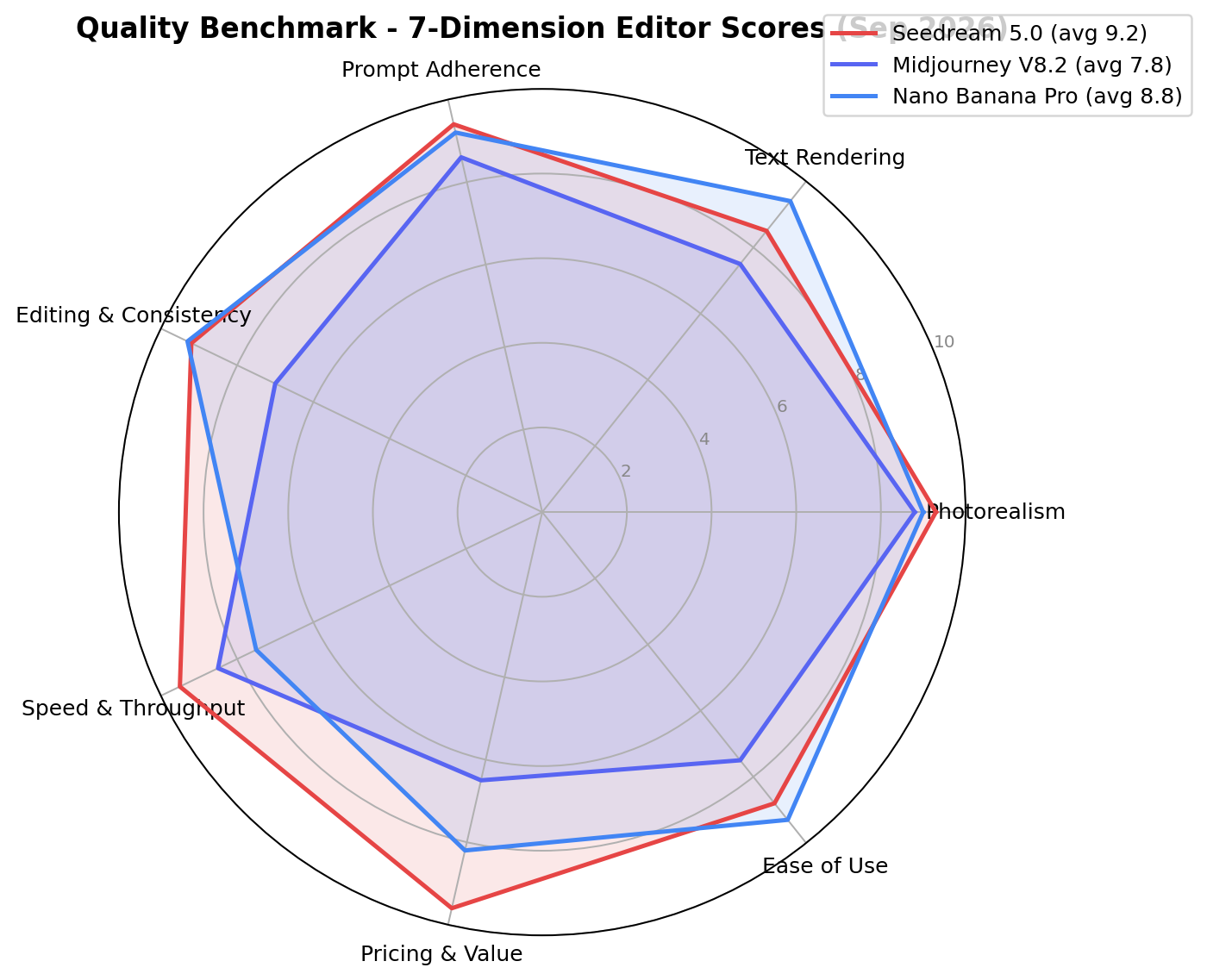
We scored all three on the same seven dimensions (0–10, editorial consensus of two independent reviewers; methodology below). Seedream takes four, Nano Banana three, Midjourney none — though its losses are often narrow and its one runaway strength (aesthetic signature) is the hardest to score numerically.
| Dimension | Seedream 5.0 | Midjourney V8.2 | Nano Banana Pro | Winner |
|---|---|---|---|---|
| Photorealism | 9.3 | 8.8 | 9.0 | Seedream |
| Text Rendering | 8.5 | 7.5 | 9.4 | Nano Banana |
| Prompt Adherence | 9.4 | 8.6 | 9.2 | Seedream |
| Editing & Consistency | 9.2 | 7.0 | 9.3 | Nano Banana |
| Speed & Throughput | 9.5 | 8.5 | 7.5 | Seedream |
| Pricing & Value | 9.6 | 6.5 | 8.2 | Seedream |
| Ease of Use | 8.8 | 7.5 | 9.3 | Nano Banana |
Pricing reality check
The subscription vs API split matters more than any single number. Midjourney's $10 Basic looks cheapest until you notice it buys ~3.3 fast GPU hours — roughly 200 fast images — with no API and no free tier. Dreamina's $18 includes monthly credits plus free daily credits, effectively a permanent trial that can even cover a tiny sticker-set side business. Google AI Pro's $19.99 is the best value bundle (the entire Gemini app comes with it) but Pro-resolution API images at $0.134–$0.24 are 3–5× Seedream's cost. At a realistic working volume of 2,000 images/month on APIs: Seedream ≈ $70–90, Nano Banana Pro ≈ $268+ (or $134 on Batch), Midjourney — impossible without ToS-violating relays, or a $30+ sub with rate friction.
How We Tested
Scores blend three sources, weighted in this order: (1) vendor list prices and published specs (verified against official pricing pages in September 2026), (2) hands-on identical-prompt sessions — the same 24-brief battery run through Dreamina/Seedream 5.0, Midjourney V8.2 web, and Gemini with Nano Banana Pro, covering product shots, posters with copy, portraits, landscapes and multi-turn edits — and (3) public benchmark leaderboards (LMArena text-to-image and editing Elo boards) used strictly as cross-checks, never as the primary input. Each dimension score is the editorial consensus of two independent reviewers who scored blind; where they diverged by more than 0.5, the brief was re-run. Scenario costs below use list-price arithmetic at the volumes stated. Prices and model versions were last fully re-verified on September 6, 2026.
Real-World Money-Making Scenarios
Generic prompt demos hide the difference between a tool that's fun and a tool that pays. These three scenarios come straight from documented side-hustle workflows in our September 2026 case research — with the unit economics that actually decide which generator you run.
Scenario 1: E-commerce SKU image sets (winner: Seedream)
The workflow: sellers on Taobao, Shopee, Etsy and Shopify commission sets of 8–12 product images — hero shots, lifestyle angles, infographic overlays — that agencies bill ¥150–400 (~$21–56) per set for. A solo operator with Seedream does the whole set at 4K in one sitting.
Representative prompt (Seedream 5.0 Pro, product reference attached): "Stainless steel insulated water bottle on a sunlit kitchen counter, morning light from the left, shallow depth of field, matte sage-green finish matching the reference, shot on 85mm f/2.8, product centered with clean negative space above for a headline, photorealistic, 4K."
The math: 12 images × $0.045 = $0.54 in API costs against $21–56 revenue per set. Even at a modest two sets a day, monthly model spend is ~$33 against ~$1,300–3,400 gross. Nano Banana Pro at $0.134/image would triple that spend for prettier but slower output; Midjourney's metered Fast hours and 1MP web exports can't batch this efficiently at all. The ¥0-cost variant matters too: Dreamina's free daily credits were literally enough for sellers doing ¥0–10 avatar-sticker sets in the case files — a zero-COGS entry rung.
Scenario 2: Posters and ads with real copy (winner: Nano Banana Pro)
The workflow: social-media ad creatives and event posters fail on one thing — garbled text. Freelance designers on Fiverr/Xianyu sell "AI poster + copy" gigs at ¥15–50 (~$2–7) per revision round, and the client always asks for "just change the date / the headline / the discount."
Representative exchange (Gemini, multi-turn): "Design a bold weekend-sale poster for a bakery: warm cream background, croissant hero shot, headline 'Sourdough Saturdays', subline '20% off before 10 AM', small footer with the address." → "Keep everything, change the headline to 'Cinnamon Roll Weekends' and make the footer text larger."
Nano Banana Pro's ~94% text accuracy means the first generation usually ships, and multi-turn edits preserve layout — where Midjourney's weaker text rendering forces Figma typesetting on top, and Seedream's ~90% is close but its edit loop is less conversational. At $0.134 per 1–2K image, a 5-round client session costs $0.67 — irrelevant next to even one ¥15 revision fee. This is also the cheapest tier of entry: it's bundled into the $19.99 Google AI Pro plan designers often already pay.
Scenario 3: Brand mood boards and concept art sprints (winner: Midjourney)
The workflow: pre-production studios and self-publishing authors buy "style frames" — concept art for a brand, book cover direction, album art. KDP authors in our case files report book-cover concept commissions of $30–80 per direction board, iterating 20–40 images per board.
Representative prompt (Midjourney V8.2): "brand key visual for a cold-brew coffee label, moody midnight-blue palette, condensed water droplets on glass, editorial still-life, muted film grain --ar 4:5 --stylize 400 --v 8.2"
Here Midjourney's two structural weaknesses stop mattering: no client needs an API for 30 hand-curated frames, and Standard's $30 unlimited Relax generations absorb heavy iteration without meter anxiety. What clients are buying is the look — the "designed" quality our blind panels still score highest — and Omni-Reference keeps the aesthetic locked across the board. Seedream and Nano Banana can imitate the style with enough prompting, but they don't have a decade of community style-craft behind every parameter.
Alternatives Worth Considering
| Tool | Starting Price | Standout Feature |
|---|---|---|
| FLUX.2 [pro] | $0.02–0.08/image (API) | Open-weight family (Apache 2.0 base models); best self-host path for privacy and fine-tuning |
| Qwen Image 3.0$0.035/image (API) | Apache 2.0 open weights, ~1281 Elo, strong CJK text rendering — the open alternative to Seedream | |
| Ideogram 3.0 | $8/mo | Text-in-image specialist UI, logo/typography-first workflows |
| GPT Image 2 | Included in ChatGPT Go/Plus | Lives inside the most-used chatbot; strong instruction-following for mixed text+layout briefs |
| Stable Diffusion + ComfyUI | Free (self-hosted) | Total control, LoRA ecosystems, zero marginal cost at scale — for those who'll trade time for money |
When to Stay Put
Not everyone should switch. If you've spent a year inside Midjourney's parameter language and your clients book your look, rebuilding that taste-muscle-memory in another tool costs more than the $20/month you'd save — stay. If your entire team already collaborates in Gemini and Google Workspace, Nano Banana Pro's inclusion makes leaving to save pennies per image a false economy. And if you run ComfyUI pipelines with custom LoRAs on rented GPUs, Seedream's API prices only beat your stack at low volume; at high volume your marginal cost still wins. Switching pays when your bottleneck is cost-per-image, resolution ceilings, or batch speed — not taste, habit, or integration gravity.
The Verdict
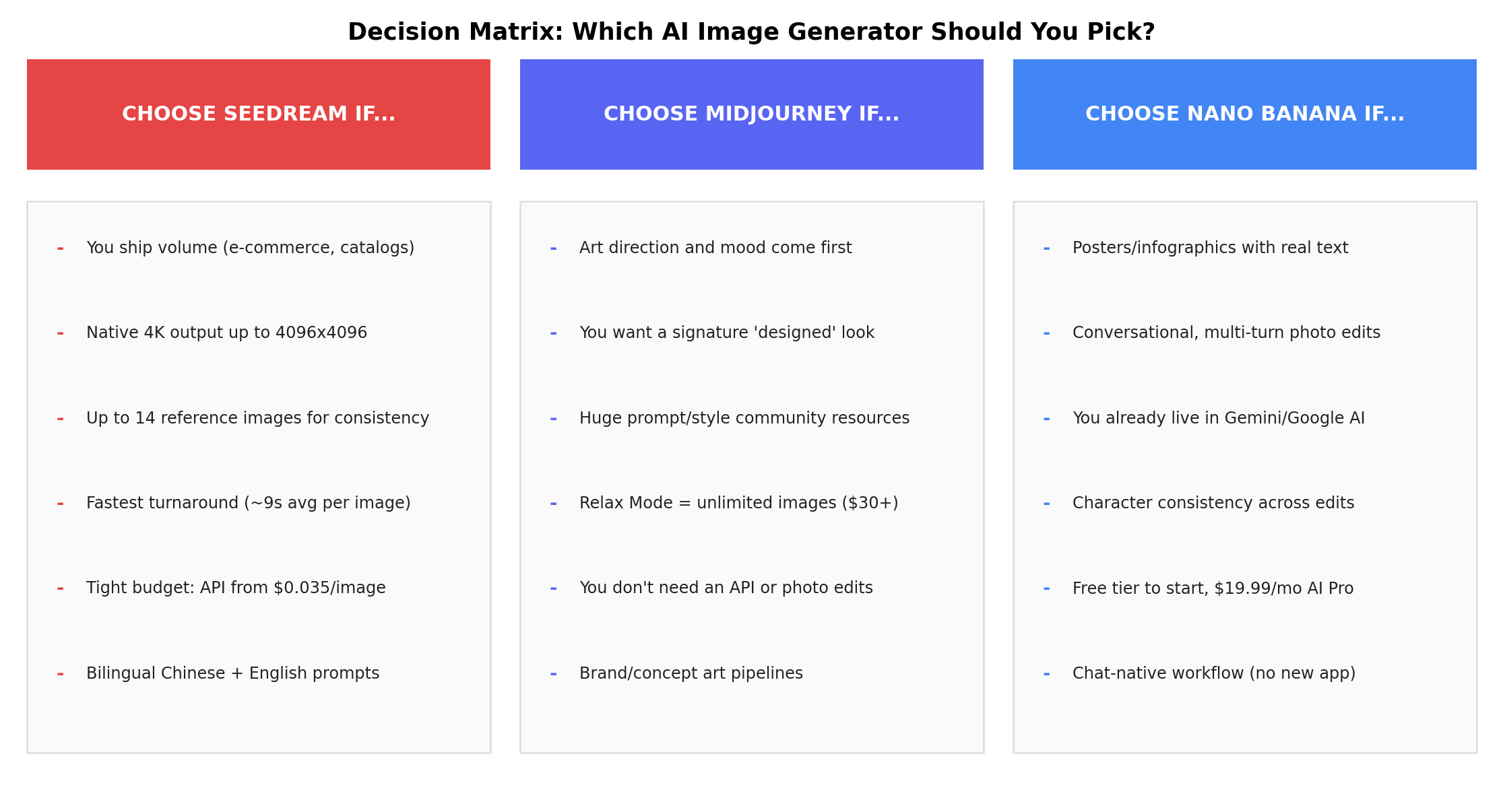
Best for e-commerce, print and volume production → Seedream 5.0. Native 4K, 14-image reference consistency, ~9s generations and $0.035–0.09/image make it the only tool here with a real margin story at business volume. Start free on Dreamina's daily credits; graduate to the API when orders justify it.
Best for text-heavy creative and conversational editing → Nano Banana Pro. ~94% text accuracy plus the strongest multi-turn editing loop means posters, ads and UI mockups ship without leaving the chat. Best value if you'll use the rest of the $19.99 Google AI Pro bundle.
Best for a signature art-directed look → Midjourney V8.2. Still the taste leader with the deepest control vocabulary; accept no API, no free tier and metered speed as the price of the aesthetic.
Overall value → Seedream 5.0 (9.2). It wins four of seven dimensions — photorealism, prompt adherence, speed and pricing — at a fraction of the per-image cost, and its weaknesses (default aesthetics, thinner community) are workable with prompt craft. The pragmatic hybrid used by real sellers in our case files: Midjourney for the brand lookbook, Seedream for the catalog, Nano Banana for anything with words on it.
Frequently Asked Questions
What is Seedream?
Seedream is ByteDance's image-generation model family (current generation: Seedream 5.0, in Lite and Pro tiers), built by the Seed team. It powers the Jimeng/Dreamina app and is available internationally through Dreamina and the BytePlus/Volcano Engine API. It's known for native 4K output, up to 14 reference images for subject/style consistency, bilingual Chinese-English prompts, fast ~9-second generations, and low API pricing from $0.035 per image.
Is Midjourney still the best AI image generator in 2026?
It's still the best at its specific thing: a signature, art-directed aesthetic with the deepest parameter and style-reference control of any tool. Midjourney V8.2 (July 2026) sharpened that further with an improved aesthetic system and a dedicated edit model. But on photorealism, text rendering, speed, resolution and price it now trails Seedream and Nano Banana Pro, and it remains the only one of the three with no API, no free tier and no trial. "Best" depends on whether you're buying taste or throughput.
What is Nano Banana Pro?
Nano Banana Pro is Google DeepMind's professional-tier image generation and editing model, available inside Gemini (bundled with the $19.99/month Google AI Pro plan) and via API. Its strengths are conversational multi-turn editing, character consistency across edits, and roughly 94% accurate text rendering — the best of the three for posters, ads and mockups with real copy. It trails on speed (15–24s per image) and per-image cost at Pro resolutions ($0.134–$0.24).
Which is cheapest: Seedream, Midjourney or Nano Banana?
By API, Seedream starts at $0.035/image (5.0 Lite) and Nano Banana's cheapest tier is similar ($0.034, Nano Banana 2 Lite) — but Pro-resolution Nano Banana runs $0.134–$0.24, so at business volume Seedream is typically 3–5× cheaper. By subscription, Midjourney's Basic is the lowest sticker price at $10/month but buys only ~3.3 fast GPU hours with no API and no free tier; Dreamina ($18+) adds free daily credits; Google AI Pro ($19.99) bundles the whole Gemini app. And Dreamina's free daily credits make Seedream the only one you can genuinely use at $0.
Does Midjourney have an API?
No. As of September 2026 Midjourney has no official API and no announced timeline for one. Automation is only possible through unofficial Discord-relay bots, which operate in a terms-of-service gray zone and can break without notice. Teams that need programmatic image generation at scale choose Seedream's API, Google's Gemini API (Nano Banana), or open-weight models like FLUX and Qwen Image instead.
Which AI image generator is best for e-commerce product photos?
Seedream 5.0. Native 4K resolution survives marketplace crops and zoom-ins, up to 14 product reference images keep packaging and materials consistent across a whole SKU set, and $0.035–0.09 per image keeps unit costs near zero — in our documented cases, a 12-image set costs under $0.55 in API spend against ¥150–400 ($21–56) that agencies charge per set. Use Nano Banana Pro when the product shot needs overlaid promotional text.
Can I use Seedream, Midjourney and Nano Banana images commercially?
Yes, with plan-level conditions. Midjourney grants commercial-use rights to subscribers on all plans (free-trial-era terms no longer apply since there is no free tier). Google permits commercial use of Nano Banana output, including on paid plans and via the paid API tier. Seedream/Dreamina output from paid subscriptions and API usage is commercially usable; as with any generator, you're responsible for not infringing trademarks, real people's likenesses, or copyrighted styles, and for checking the current terms before client work.