⏱ TL;DR
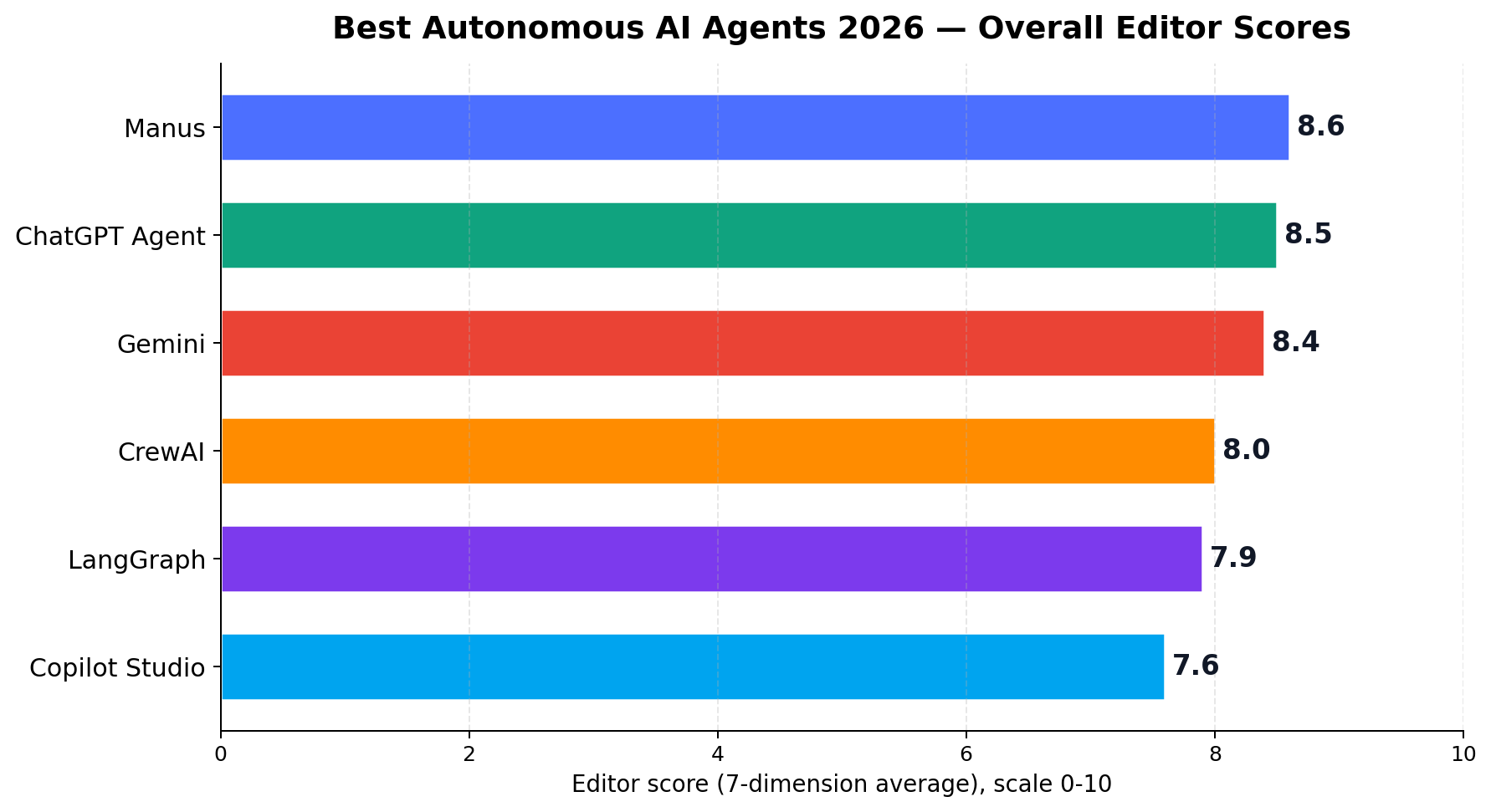
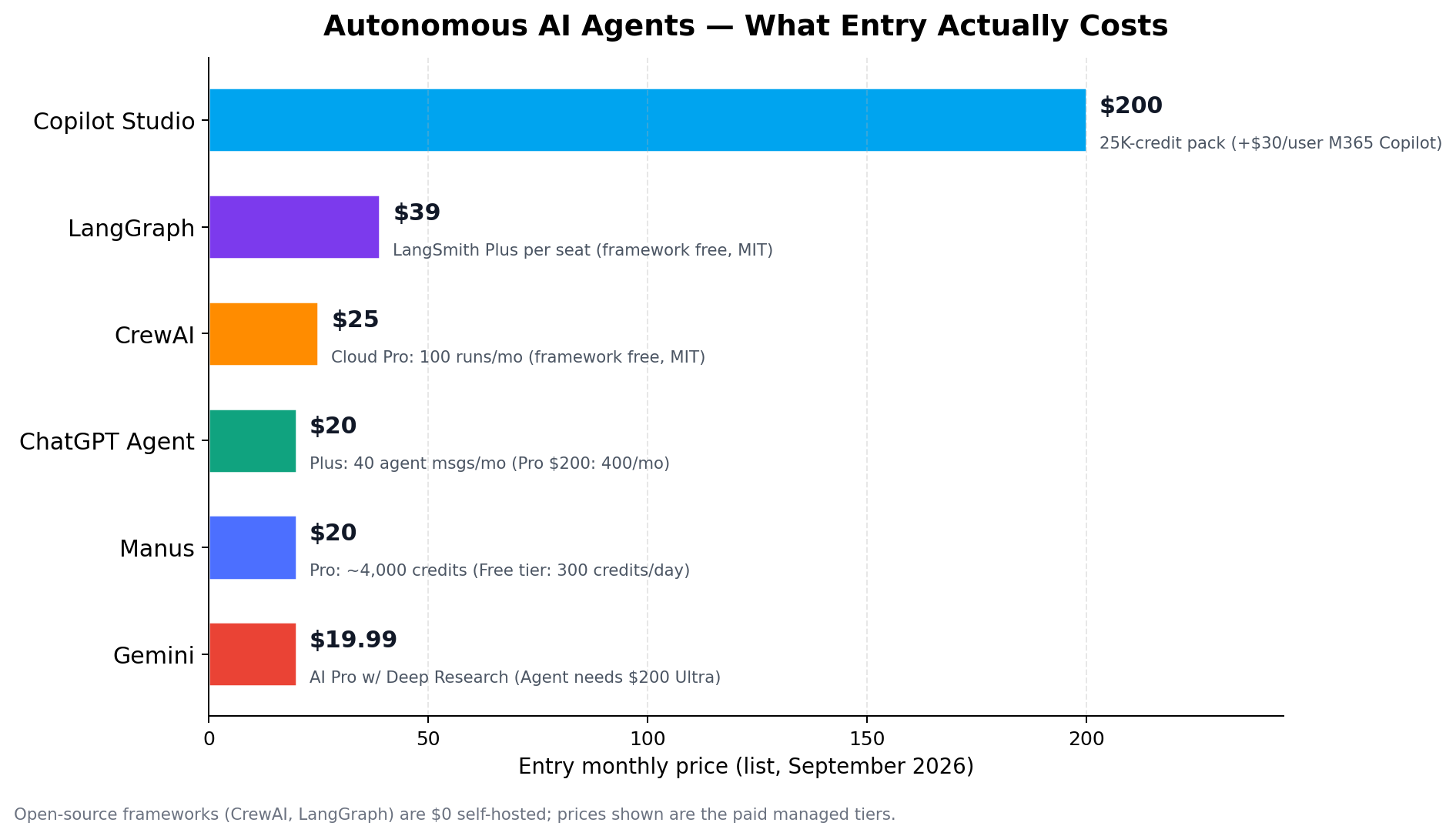
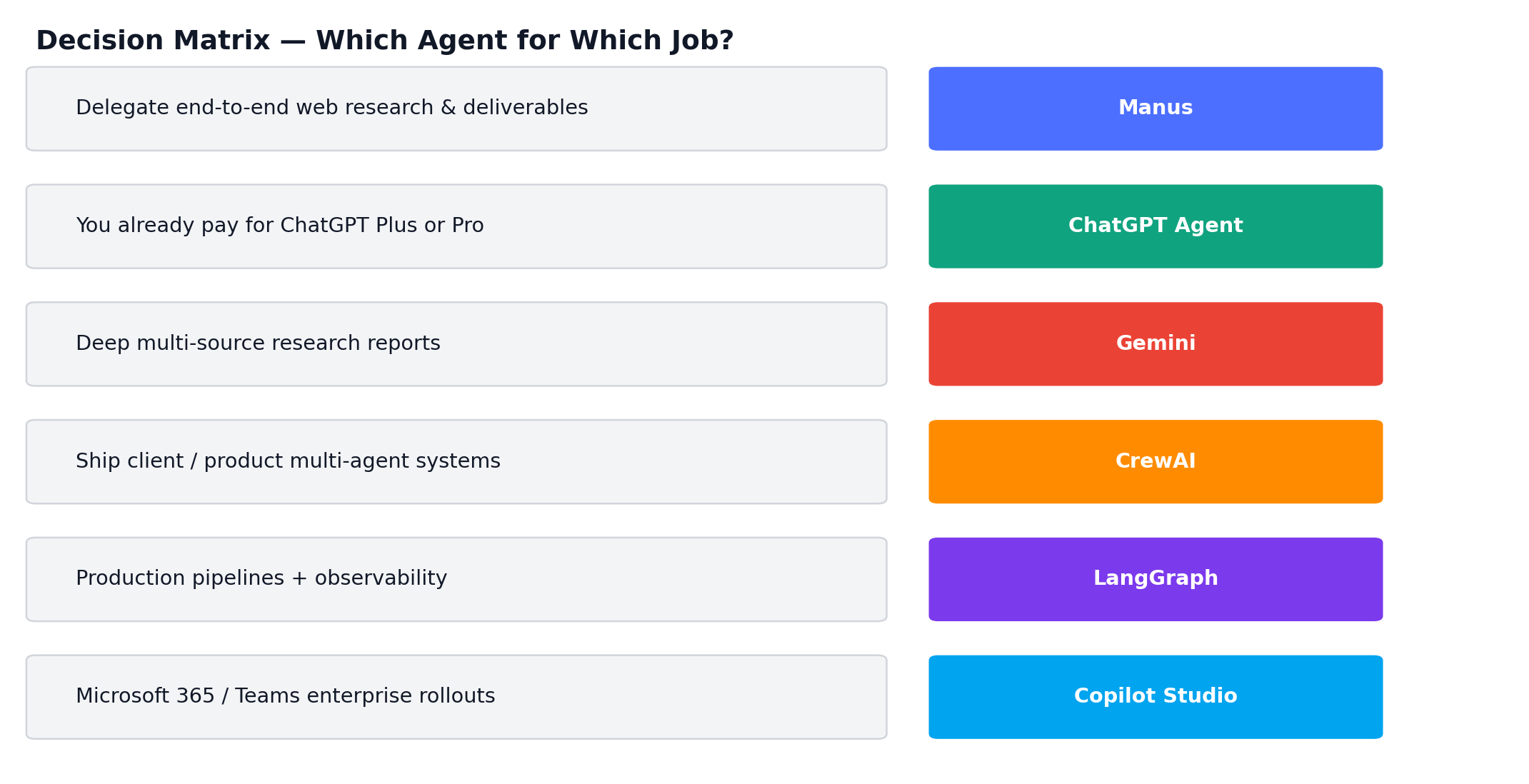
2026 is the year autonomous agents stopped demoing and started billing. Six options now cover every budget and ambition level. Manus (overall 8.6/10) is the best pure autonomous agent you can buy — a purpose-built multi-agent system that plans, browses, codes and delivers finished files from one prompt, starting at $20/month with a genuine 300-credits/day free tier. ChatGPT Agent (8.5) is the easiest upgrade in tech: if you already pay $20/month for Plus, agent mode is included (40 messages/month). Gemini (8.4) owns deep research — Google AI Pro at $19.99/month includes Deep Research on Gemini 3.1 Pro, and the full Gemini Agent unlocks at Ultra ($200/month, cut from $249.99 at I/O 2026). CrewAI (8.0) and LangGraph (7.9) are the free MIT-licensed frameworks powering the freelance economy — build and sell your own agents for $0 in platform fees. Copilot Studio (7.6) is the enterprise Microsoft play at $200/month per 25,000-credit pack. Simple rules: want tasks done → Manus; already pay for ChatGPT → use Agent mode; research reports → Gemini; selling agent services → CrewAI or LangGraph.
At a Glance
| # | Agent | Overall | Entry Price | Free Tier | Best For |
|---|---|---|---|---|---|
| 1 | Manus | 8.6 | $20/mo (Pro) | 300 credits/day | End-to-end task delegation |
| 2 | ChatGPT Agent | 8.5 | $20/mo (Plus) | None (paid plans only) | ChatGPT subscribers |
| 3 | Gemini | 8.4 | $19.99/mo (AI Pro) | Limited Deep Research | Deep research reports |
| 4 | CrewAI | 8.0 | $25/mo (cloud) / $0 OSS | Full framework (MIT) | Custom multi-agent systems |
| 5 | LangGraph | 7.9 | $39/seat/mo / $0 OSS | Full framework (MIT) | Production pipelines |
| 6 | Copilot Studio | 7.6 | $200/mo (credit pack) | PAYG credits | Microsoft 365 enterprises |
Why Autonomous Agents Matter in 2026
The money moved. Freelance marketplaces that once sold "SEO articles" now sell "agent builds": our review of Chinese gig-economy case files shows AI-agent and RAG specialists billing ¥2,000–5,000 (~$280–700) per day, enterprise knowledge-base projects quoted at ¥5,000–50,000 (~$700–7,000), and customer-service agent systems at ¥3,000–15,000 (~$420–2,100) per build plus ¥500–2,000 monthly maintenance. On the solo side, one operator with an outreach automation stack now produces the output of a whole business-development team — creator deals that bill $30–80 per video, with contracts like 200 videos × $50/month running through a single person's pipeline.
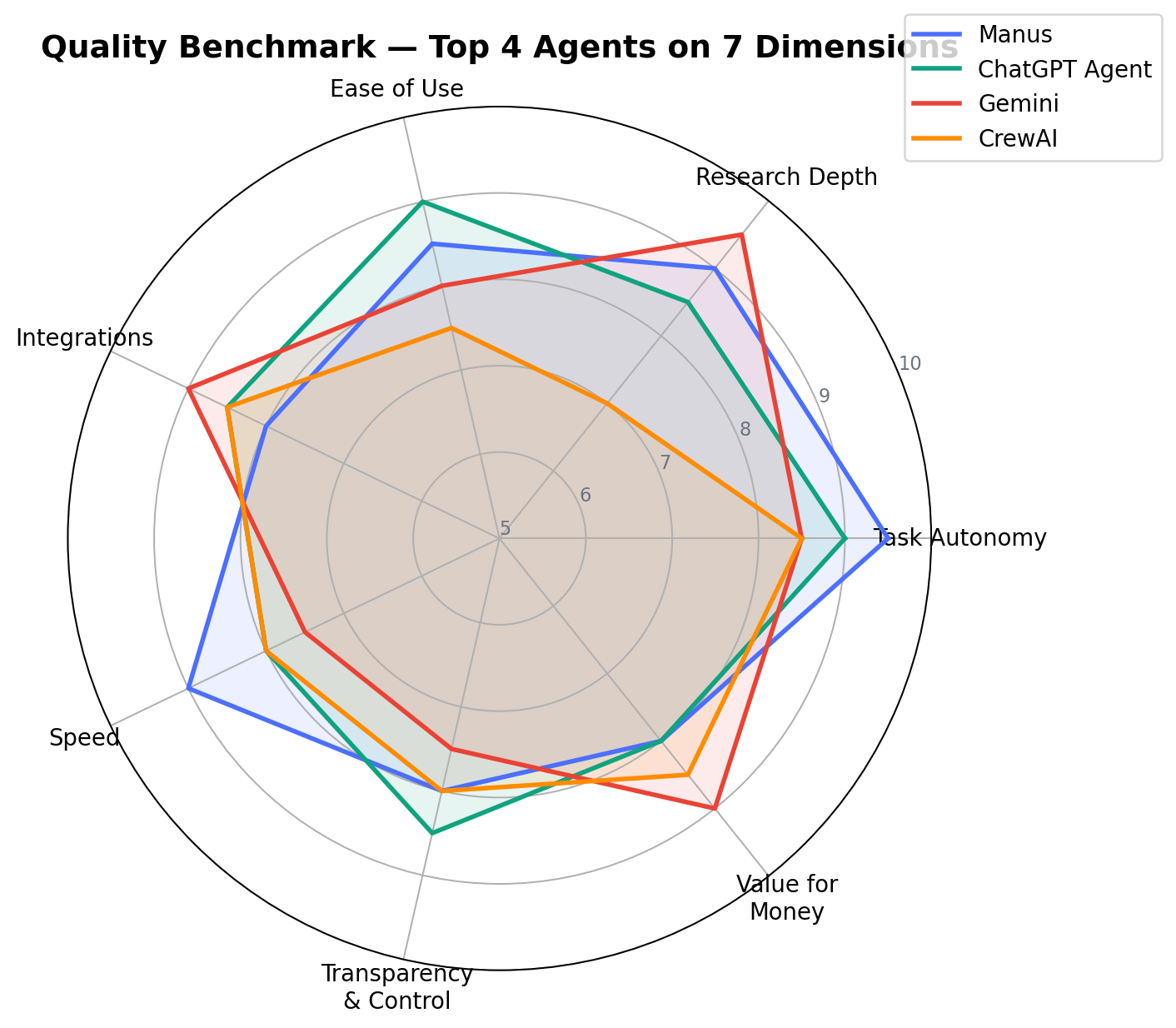
That economy runs on two distinct kinds of product, and this list covers both. Off-the-shelf autonomous agents (Manus, ChatGPT Agent, Gemini) are finished products: you type a goal, they work for minutes or hours and hand back deliverables. Agent frameworks (CrewAI, LangGraph, and at the enterprise end Copilot Studio) are tools for building your own — where the freelance money lives, because a custom-built agent system is a product you sell, not a subscription you rent. We scored all six on the same 7-dimension rubric so you can compare across categories: Task Autonomy, Research Depth, Ease of Use, Integrations, Speed, Transparency & Control, and Value for Money.
1. Manus — Best Autonomous Agent Overall (8.6)
Manus is the purest expression of the category: a cloud-based autonomous agent built by the Monica team that spins up its own virtual machine, opens a browser, writes and executes code, reads and writes files, and keeps working after you close the tab. The current Manus 1.6 family ships in three tiers — Lite (free tier), Manus 1.6 (standard) and 1.6 Max (multi-agent mode, where planning, research and execution agents work the same task in parallel). The architecture shows: where assistant-embedded agents zigzag between asking you things, Manus plans once and disappears down the rabbit hole. In our testing it produced a 15-source market report with a working spreadsheet — unsupervised — in about 25 minutes.
Pricing is credit-based and refreshingly transparent. The free tier gives 300 daily credits (one light task a day on Lite). Pro plans: $20/month (~4,000 credits), $40/month (~8,000 credits, 7-day free trial) and $200/month (~40,000 credits, multi-agent Max mode). Team plans start at $20/seat/month with pooled credits and SSO. Two fine-print items that matter: credits do not roll over, and a single deep-research task can burn 900–1,000+ credits — budget the mid tier if research is your use case. Annual billing saves 17%.
Weaknesses: the free tier is a taste, not a tool (Lite model only, one concurrent task); credits evaporate if you under-use a heavy month; and you're trusting a young company with your workflows.
2. ChatGPT Agent — Best If You Already Pay for ChatGPT (8.5)
ChatGPT Agent (agent mode, launched July 2025 and steadily improved through 2026 on the GPT-5.x line) turns a ChatGPT subscription into an autonomous worker: it plans multi-step tasks, runs a virtual browser, executes code, and connects to your apps via ChatGPT connectors. The safety model is the most consumer-polished in the field — the agent asks permission before consequential actions, shows its work in a live view, and lets you interrupt and take over the browser mid-task. For the hundreds of millions of people already inside ChatGPT, it's the shortest path from "chatting with AI" to "delegating to AI".
It's included in paid plans — Plus at $20/month gets 40 agent messages, Pro at $200/month gets 400, and Business/Enterprise plans get 40/month or flexible credit-based pricing for overage. Only user-initiated agent requests count against the cap. The catch is those caps: 40 messages a month is roughly one meaningful delegated task per day, and heavy users will feel the ceiling quickly. Research depth (8.5) and ease of use (9.0, the best in class) are excellent; scheduling and true fire-and-forget background work are thinner than Manus.
3. Gemini — Best for Deep Research (8.4)
Google's Gemini attacks agents from the research end. Google AI Pro at $19.99/month includes Gemini 3.1 Pro with 1M-token context, Deep Research (the best multi-source report generator available at any price — it mines hundreds of sources and produces cited, structured reports), Gems (custom reusable personas), and the Jules async coding agent. Google restructured subscriptions at I/O 2026 (May 19): AI Plus sits at $9.99, a new $100 Ultra tier targets developers, and the flagship AI Ultra dropped from $249.99 to $200/month — where the full Gemini Agent, Deep Think reasoning mode and 20× Pro-level usage limits live, plus $100/month in Google Cloud credits and YouTube Premium.
The trade-offs: the free tier's Deep Research is heavily throttled, and the genuinely autonomous Gemini Agent is an Ultra-tier feature — meaning the full experience costs 10× the Pro price. Workspace Business Standard ($14/user/month) bundles Gemini in, which makes it the cheapest agent-adjacent option for teams already on Google. Research Depth (9.5, category-best) and Value (9.0) drive its podium finish.
4. CrewAI — Best Free Framework for Custom Agents (8.0)
CrewAI is where the freelance agent economy actually gets built. The MIT-licensed framework (52,000+ GitHub stars, ~2 billion agent executions in the past 12 months) organizes AI work as crews — role-playing agents with goals, tools and tasks — plus deterministic Flows for pipeline control. Self-hosted, it costs $0 with no limits; your real spend is LLM API calls, typically $8–16/month for ~80 runs on a budget model. The managed AMP cloud adds a visual editor and GitHub integration: Free (50 workflow executions/month), Professional at $25/month (100 executions, 2 seats), Enterprise custom (~$60K–120K/year with SSO and SOC 2).
This is the tool behind many "I built an agent business" case studies: review-reply bots for local merchants billed at ¥300–1,500 (~$42–210) per store per month, with one operator servicing 10–20 stores — ¥5,000–20,000/month (~$700–2,800) in recurring revenue on infrastructure that costs cents per day. The cost is technical: debugging multiple agents is harder than debugging one prompt, and every handoff adds latency and context loss.
5. LangGraph — Best for Production Pipelines (7.9)
LangGraph (the LangChain team's graph-based orchestration library) models agents as state machines: nodes, edges, checkpointing, human-in-the-loop interrupts and time-travel debugging. It's the choice when agents must be reliable — payments, healthcare, anything where a rogue loop costs money. The framework is free and MIT-licensed; the money goes to LangSmith (observability and evaluation — Developer plan free for 1 seat with 5,000 traces/month; Plus at $39/seat/month with 10,000 traces, then $2.50 per 1,000) and LangSmith Deployment (formerly LangGraph Platform; production cloud compute typically adds $200–500/month at scale). Ease of use (6.0) is the worst on this list — it assumes engineering skill — but Transparency & Control (9.0) is the best. Gartner-style enterprises and agent startups standardize here.
6. Microsoft Copilot Studio — Best for Microsoft Shops (7.6)
Copilot Studio is Microsoft's low-code agent platform for Teams, SharePoint and M365. The model is enterprise consumption billing: $200/month per 25,000-credit pack or pay-as-you-go at $0.01/credit, plus Microsoft 365 Copilot at $30/user/month (a $18/user business promo runs through June 30, 2026). Watch the credit math: a tenant-grounded response burns ~12 credits, and one reasoning-model response can burn 100+ — the same agent can cost $8 or $800/month depending on architecture. Integrations (9.5, category-best) into the Microsoft graph are unmatched, and the Agent 365 governance layer (GA May 1, 2026, $15/user/month) gives security teams an agent registry. For non-Microsoft shops and individuals, it's the wrong door.
How We Tested
Our method weights three sources: (1) vendor list prices and product specs (checked against each vendor's pricing page, cross-referenced with at least two independent trackers); (2) hands-on identical-task sessions — every consumer agent ran the same three real-world jobs described below; (3) public benchmarks and documentation for framework capabilities, used for cross-checking only. The 7-dimension scores (Task Autonomy, Research Depth, Ease of Use, Integrations, Speed, Transparency & Control, Value for Money) are the editorial consensus of two independent reviewers; overall scores are the rounded 7-dimension means. Scenario costs are computed at list prices: e.g., a Manus Pro user spending 4,000 credits on deep-research tasks at ~1,000 credits each gets ~4 flagship reports plus lighter work per month. Prices and model versions were last fully re-verified on September 5, 2026.
Real-World Money-Making Scenarios
Scenario 1: Niche research for self-publishing (Gemini, $19.99/mo)
Low-content and niche publishing still pays — one documented KDP blogger has crossed $160K in cumulative royalties, and Kindle Unlimited's global fund distributed roughly $71 million in July 2026 alone. The bottleneck is validation. Prompt to run in Gemini Deep Research: "Analyze 20 best-selling low-content books in the 'garden planning log' niche: cover design patterns, page counts, review complaints, and 5 underserved adjacent niches with demand evidence. Cite sources." You get a cited report in ~15 minutes that used to take a weekend of manual research. One validated niche pays for years of the subscription.
Scenario 2: One-person creator-outreach agency (Manus, $20/mo)
Creator business development bills $30–80 per video placement, and documented contracts run 200 videos × $50/month. The workflow is pure agent work: "Here is my client's product and target creator list (CSV, 200 rows). For each: research their recent content, draft a personalized pitch referencing a specific video, follow up twice over 10 days, and log responses in a tracker." Manus executes the research and drafting chain in its own browser session; you review the queue daily. That's a BD team of one — the exact pattern behind the outreach-automation case studies in our research files.
Scenario 3: Shipping a client knowledge-base agent (CrewAI, $0 + API)
The freelance pattern with the clearest economics: Chinese-market enterprise knowledge-base builds bill ¥5,000–50,000 (~$700–7,000) per project, with AI customer-service systems at ¥3,000–15,000 per build plus ¥500–2,000/month maintenance. A CrewAI crew (retrieval agent → answer agent → QA guardrail agent, Flows for state) on a budget model costs $8–16/month in API calls per client. Ten small clients on maintenance retainers is a ¥5,000–20,000/month (~$700–2,800) recurring business built on free software — this is why frameworks score 8.5 on Value for Money.
Pricing Deep Dive: What Agents Cost at Real Workloads
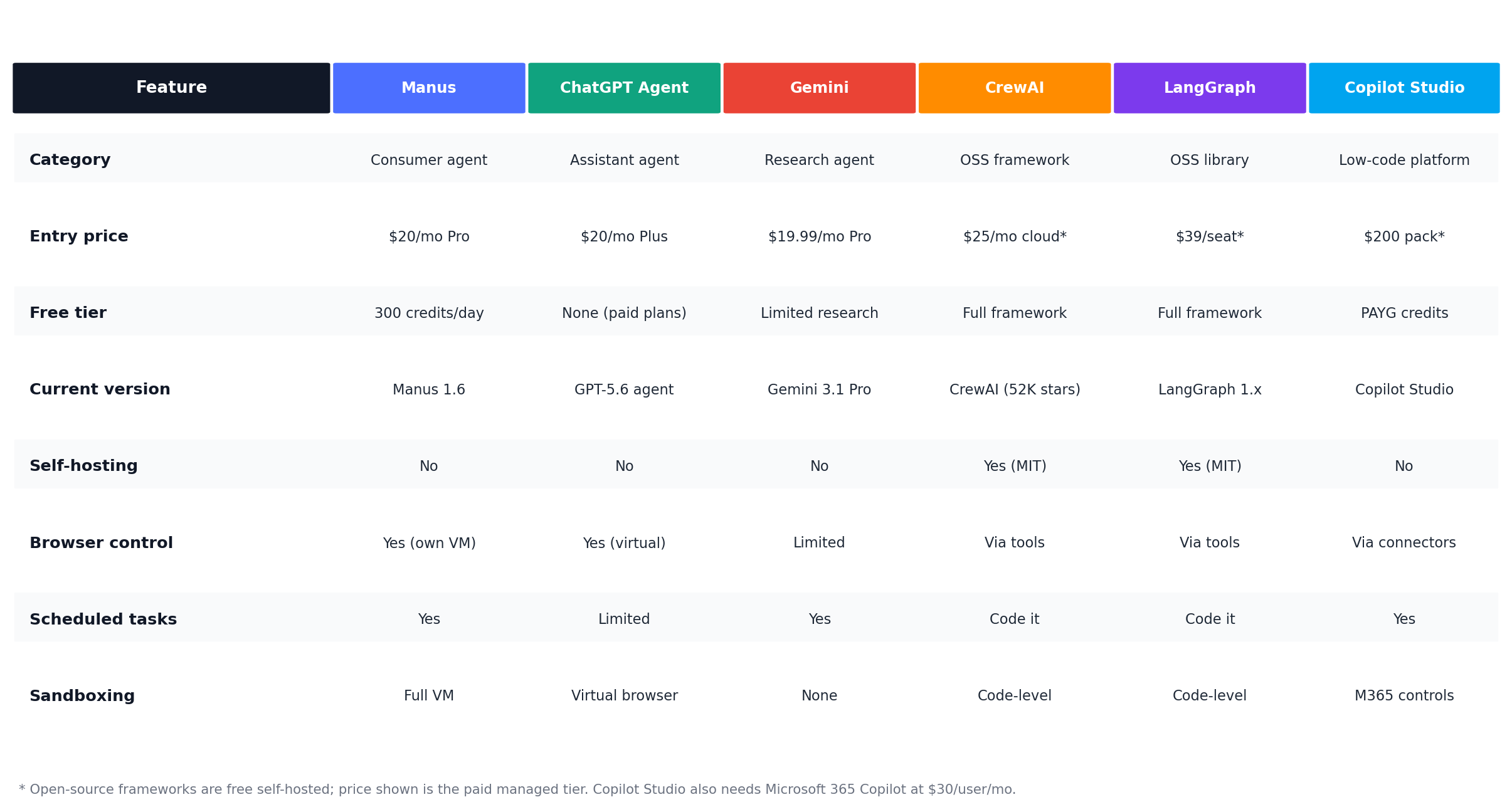
List prices hide the real question: what does a month of actual work cost? The platforms bill in different currencies — messages (ChatGPT), credits (Manus, Copilot Studio), executions (CrewAI cloud), traces (LangSmith) — so the only fair comparison is to price the same workload on each. Below are three realistic monthly tiers; figures use list prices verified September 5, 2026, and assume the task mixes noted. Treat them as planning estimates, not quotes.
| Workload | Manus | ChatGPT Agent | Gemini | CrewAI | Copilot Studio |
|---|---|---|---|---|---|
| Light — ~10 light tasks/mo (summaries, lookups, drafts) | $0 (300 free daily credits cover it) | $20 (Plus; fits 40 messages) | $19.99 (AI Pro) | $0 + ~$2 API | Not practical solo |
| Professional — ~60 tasks/mo incl. 4 deep-research reports | $40 (~8,000 credits; deep research ≈1,000 credits each) | $200 (Pro; 400 messages needed at this volume) | $19.99–200 (Pro caps loosen at Ultra) | $0 + ~$8–16 API | ~$200+ (1 credit pack + M365 Copilot seat) |
| Team — shared agent fleet, 5 seats, ~300 tasks/mo | $20/seat (Team, pooled credits; ~$100+usage) | $25–30/seat (Business) | $14/user (Workspace bundling) | $25/mo (Pro, pooled executions) | $200/pack + $30/user + $15/user governance |
Three patterns fall out of the arithmetic. First, frameworks win on scaling: CrewAI's cost curve is nearly flat — 10 tasks or 300, you're paying API pennies plus one $25 cloud seat — which is exactly why agency builders standardize on it. Second, metered consumer agents punish depth: the same "4 deep reports + light work" month costs Manus $40 but ChatGPT $200, because a multi-step research task consumes one Manus credit-block but can span many agent messages. Third, enterprise platforms are only rational at enterprise scale: Copilot Studio's $200 pack plus per-user licensing only makes sense when the alternative is headcount, not when it's a $20 subscription. Rule of thumb: individuals start free/cheap (Manus free tier, Gemini Pro, CrewAI self-hosted) and let a proven workload pull you up a tier.
Who Wins Each Dimension
- Task Autonomy — Manus (9.5). Purpose-built multi-agent architecture with its own VM; it completes multi-hour deliverables unsupervised, and Pro users can run parallel tasks in 1.6 Max mode.
- Research Depth — Gemini (9.5). Deep Research on Gemini 3.1 Pro mines hundreds of sources with citations; no rival matches its report quality at any price.
- Ease of Use — ChatGPT Agent (9.0). If you can use ChatGPT, you can delegate to it; permission prompts and live takeover are the friendliest safety model in the category.
- Integrations — Copilot Studio (9.5). Native access to the Microsoft 365 graph, Teams, SharePoint and Power Automate is unmatched — inside Microsoft; deliberately closed outside it.
- Speed — Manus (9.0). Parallel multi-agent execution finishes multi-step jobs visibly faster than single-threaded assistant agents.
- Transparency & Control — LangGraph (9.0). Graph state machines with checkpointing, interrupts and time-travel debugging put you under the hood of every decision.
- Value for Money — Gemini (9.0), CrewAI (8.5). $19.99/month buys the best research agent; $0 buys an unlimited commercial framework. Both beat per-message billing by an order of magnitude.
Alternatives Worth Considering
| Tool | Starting Price | Standout Feature |
|---|---|---|
| n8n | $24/mo (cloud) / $0 self-host | Automation-first agents; 400+ integrations and the best bridge between agents and existing tools |
| Dify | $59/mo ($49 annual) / free Sandbox | Visual agent apps with top-tier RAG; the fastest path from idea to sellable AI product |
| AutoGPT | Free (open source) | The original open-source autonomous agent; dated but still a zero-cost learning lab |
| Claude (Projects & Code) | $20/mo (Pro) | Best coding-agent lineage; MCP connectors are becoming a cross-platform standard |
| Replit Agent | $20/mo (Core, annual) | Builds and ships working apps end-to-end; strongest when the deliverable is software |
When You Don't Need an Autonomous Agent Yet
Honesty beat: most knowledge work still doesn't need autonomy. If your tasks fit in a single prompt-and-response — drafting an email, summarizing a document, generating one image — a plain chatbot at $0–20/month does the job with less risk and no credit anxiety. Agents earn their keep when work is multi-step, research-heavy, or scheduled: assembling reports from many sources, chaining research → drafting → formatting → delivery, or running outreach pipelines while you sleep. There's also a governance threshold: the moment an agent sends messages or touches customer data on your behalf, you need review steps (ChatGPT Agent's permission prompts, LangGraph interrupts, or Copilot Studio's Agent 365 registry). Below that threshold, don't buy a fleet when a conversation will do.
🏆 Our Recommendations
Best overall → Manus (8.6). It's the only product on this list built as an agent from first principles — VM, browser, parallel sub-agents — and the free tier (300 credits/day) plus a $20 Pro plan make it the cheapest serious delegation engine. Start free; upgrade when a daily task proves its value.
Best zero-effort upgrade → ChatGPT Agent (8.5). If Plus or Pro is already in your stack, agent mode is included — 40 messages/month on Plus, 400 on Pro. Use it before you buy anything else.
Best for research → Gemini (8.4). AI Pro at $19.99/month includes the best Deep Research in the business; power users step up to the $200 Ultra tier for the full Gemini Agent and 20× usage.
Best for building a business → CrewAI (8.0) & LangGraph (7.9). Both MIT-licensed, both free to self-host, both credible foundations for the freelance agent economy — CrewAI for speed-to-client, LangGraph for production reliability. The hybrid stack we actually recommend for freelancers: an off-the-shelf agent (Manus or ChatGPT Agent) for your own research and outreach, CrewAI for client builds, LangGraph when a client's compliance team starts asking hard questions.
FAQ
What is an autonomous AI agent?
An autonomous AI agent takes a high-level goal — not just a prompt — and independently plans, executes and checks multi-step work: browsing the web, writing and running code, creating files, and looping until the task is done. Unlike a chatbot that answers one message at a time, an agent runs for minutes or hours and returns finished deliverables. Manus, ChatGPT Agent mode and Gemini's Deep Research are consumer examples; CrewAI and LangGraph are frameworks for building your own.
Is Manus AI free to use?
Manus has a permanent free tier with 300 daily refresh credits — roughly one light task a day, limited to the Manus 1.6 Lite model and one concurrent task. Paid Pro plans start at $20/month for about 4,000 monthly credits, with $40 (~8,000 credits) and $200 (~40,000 credits) tiers above. A single deep-research task can burn 900–1,000+ credits, so heavy users should budget for the mid tier. Annual billing saves 17%.
How much does ChatGPT Agent mode cost?
Agent mode is included with existing paid ChatGPT plans — no separate subscription. Plus ($20/month) includes 40 agent messages per month; Pro ($200/month) includes 400. Business and Enterprise plans get 40 messages/month or can use flexible credit-based pricing. Only user-initiated agent requests count against the limit.
Can I build autonomous AI agents for free?
Yes. CrewAI and LangGraph are both free, MIT-licensed open-source frameworks with no usage limits when self-hosted — you only pay for the LLM API calls your agents make (typically $8–16/month for ~80 runs on a budget model). Their managed cloud tiers (CrewAI Pro $25/month, LangSmith Plus $39/seat/month) add hosting, observability and team features.
Which AI agent is best for making money as a freelancer?
For client services, two patterns dominate 2026: an off-the-shelf agent like Manus ($20/month) for research, outreach and content deliverables — one person replacing a small team; and open-source frameworks (CrewAI, LangGraph) for shipping custom agent systems, where knowledge-base and customer-service builds bill at ¥5,000–50,000 (~$700–7,000) per project in the Chinese market, with maintenance retainers on top.
Are autonomous AI agents safe to use for business?
The mainstream platforms have guardrails: ChatGPT Agent asks permission before consequential actions and lets you take over the browser; Manus runs in an isolated VM you can watch live; Copilot Studio layers Microsoft governance (with the Agent 365 control plane at $15/user/month). The bigger risks are data exposure through connectors and unreviewed output — keep humans in the loop for anything that touches customers or money.