TL;DR
Surfer SEO is the more complete SEO content platform in 2026 (overall 8.5/10): a mature content editor with real-time scoring, true SERP-based keyword research, and a 2026 AI-visibility module that tracks your brand inside ChatGPT, Perplexity and Gemini answers. It starts at $49/month (Discovery, 120 documents). NeuronWriter (8.4/10) is the value king: $23/month buys Google NLP-powered content analysis, slightly better AI drafting, and generous lifetime deals — enough tool for most solo niche-site operators and freelancers. The short version: agencies and scaling publishers should buy Surfer; solo operators should pocket the difference and run NeuronWriter; hybrid stacks (research in Surfer, production in Neuron) cost about $72/month and beat both. We scored both tools across 7 dimensions after running 40 identical briefs through each editor.
At a Glance
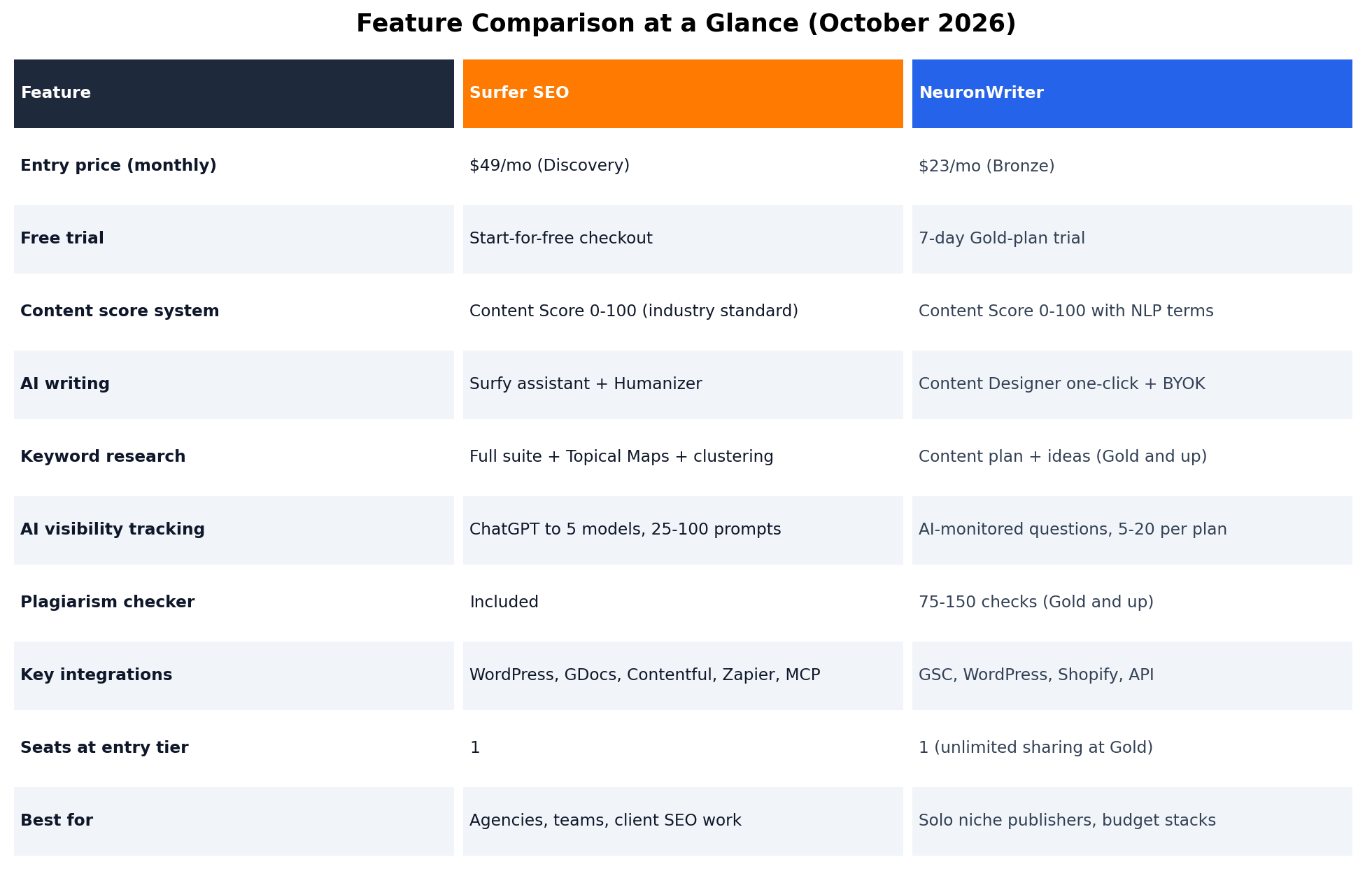
| Surfer SEO | NeuronWriter | |
|---|---|---|
| Best for | Agencies, scaling publishers, client SEO work | Solo niche sites, freelancers, budget stacks |
| Overall score | 8.5/10 | 8.4/10 |
| Starting price | $49/mo (Discovery, 120 docs) | $23/mo (Bronze, 25 analyses) |
| Popular tier | $99/mo Standard (360 docs, 3 seats) | $69/mo Gold (75 analyses, 10 projects) |
| Content editor | Real-time score, 600+ signals, Google Docs + WP + Chrome extensions | Score with Google NLP entities, WP plugin + Web editor |
| AI writing | Surfer AI (article drafts, extra cost per article) | Built-in GPT drafting, rewrite and expand — included in plan credits |
| Keyword research | Full SERP-based suite (search volume, CPC, clusters) | Basic — imports from Search Console, plans Google queries |
| AI visibility (AEO) | Brand monitoring in ChatGPT, Perplexity, Gemini, Copilot | GEO optimization hints, no answer-engine monitoring |
| Free trial | 7 days from $1 (all plans) | Free plan + 30-day trial on any tier |
Surfer SEO and NeuronWriter sit in the same 2026 category — content optimization platforms that score your draft against what currently ranks — but they were built for different buyers. Surfer, founded in Poland in 2017 and now used by agencies like SAP and Orange pivoted to content, matured into a full suite: keyword research, content editing, AI drafting, internal-link auditing and now AI-visibility tracking. NeuronWriter, also Polish, arrived in 2019 with a sharper thesis: take Google's own NLP API, expose the entities and categories the ranking pages share, and sell it at a fraction of the price — a bet that made it one of the most upvoted SEO tools ever on AppSumo.
The choice matters more in 2026 than it did two years ago, because the money has moved. Content-SEO workflows now sit under several of the highest-volume side hustles we track: niche and affiliate sites monetized with display ads, freelance SEO content billed at $80–300 per optimized article, and self-publishing operations that use long-tail keyword research to title and position Amazon KDP books — a segment where most authors clear $150–500/month and the top operators clear $5,000+. Whatever the vehicle, the tool bill comes out of the same margin, and the gap between a $99/month Surfer seat and a $23/month NeuronWriter plan is 30–80% of a typical tool budget for a one-person business.
Deep Dive: Surfer SEO
Surfer's center of gravity is the Content Editor. Feed it a primary keyword, it pulls the top-ranking pages, and you write against a live checklist: word-count band, headings to consider, 600+ relevant terms with target frequency ranges, and entities the competition uses. The 0–100 score updates as you type — the "get to green" loop that made Surfer the default editor in agency production lines. The editor lives in Google Docs, WordPress, or a Chrome extension over any CMS, so it meets writers where they already work.
Around that core sits the rest of the suite: Keyword Research built on real SERP data (search volume, CPC, intent, clustering), Topical Maps that turn a seed keyword into a 50–200 article plan, Audit for refreshing decaying pages, and Surfer AI, which drafts complete articles from a chosen angle and tone (billed as an add-on per article or in bundle credits). The 2026 addition that reshaped its value proposition is AI Visibility: brand-mention monitoring inside answers from ChatGPT, Perplexity, Gemini and Copilot, with share-of-voice trends — a direct answer to traffic leaking from Google to AI answer engines, and something NeuronWriter simply does not offer.
Surfer pricing (October 2026)
| Plan | Price/mo | Documents | Seats |
|---|---|---|---|
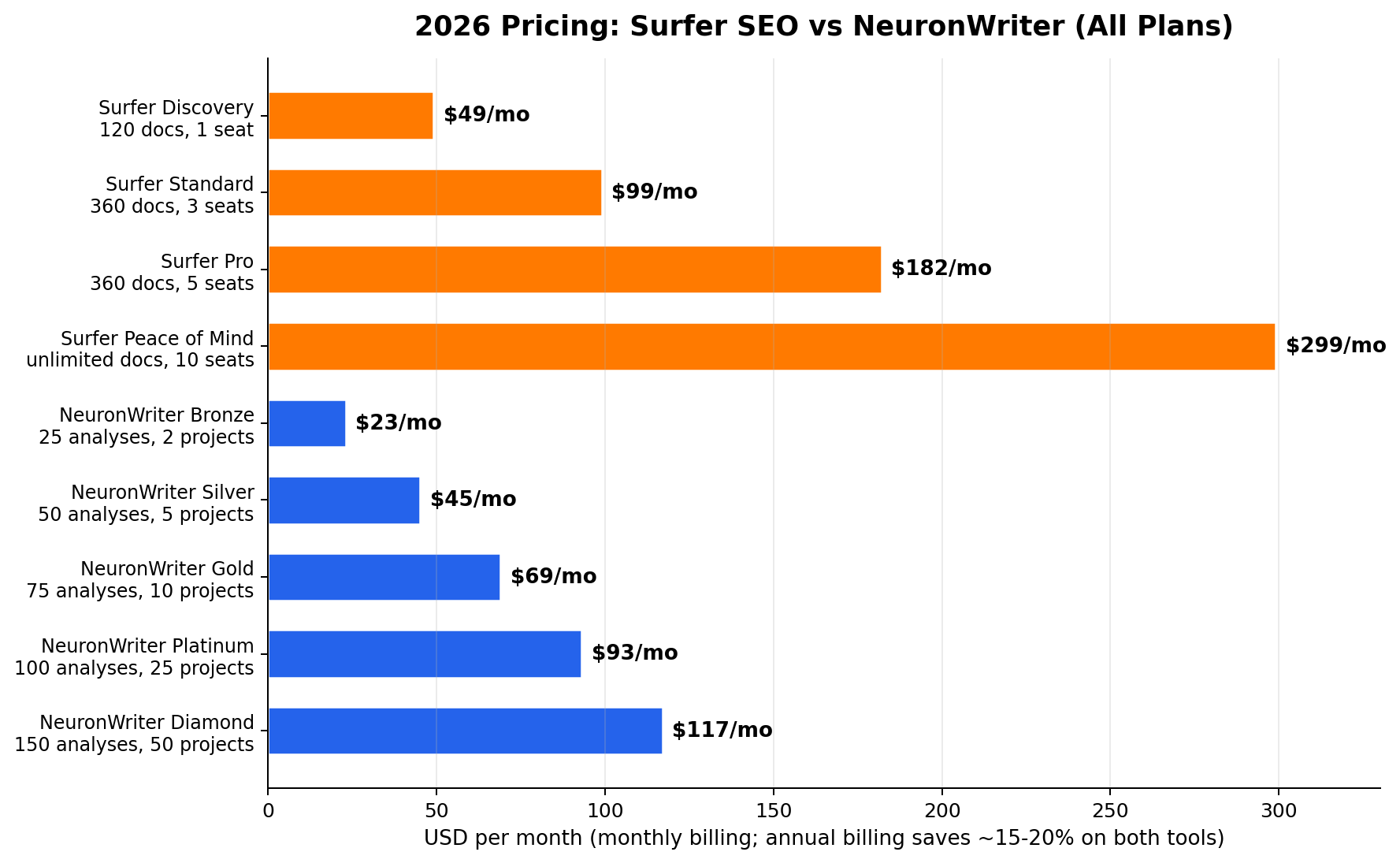
| Discovery | $49 | 120 / year | 1 |
| Standard | $99 | 360 / year | 3 |
| Pro | $182 | 360 / year | 5 |
| Peace of Mind | $299 | Unlimited | 10 |
Plan limits are annual document counts; AI article credits are sold as add-ons or bundles. Every tier is available for a 7-day trial at $1.
Strengths
- The most mature content editor on the market — real-time scoring, term frequency targets, and entity coverage that consistently maps to what ranks.
- Real keyword research: SERP volumes, CPC, clustering and topical maps, so you are not forced to buy a separate research tool for strategy work.
- AI Visibility module tracks brand mentions in ChatGPT, Perplexity, Gemini and Copilot answers — the only one of the two tools that measures the AEO outcome, not just hints at it.
- Deep integrations: Google Docs, WordPress, Chrome extension, Jasper, Notion, Semrush and Google Search Console hooks make it fit agency pipelines.
Weaknesses
- Price. $99/month for the tier most professionals actually need (3 seats, 360 documents) is 4× NeuronWriter's entry, and document quotas run out fast at publishing volumes above 30 posts/month.
- AI drafting costs extra per article and lands mid-pack in quality — fine for first drafts, not the differentiator it should be at this price.
- Term-frequency checklists can push writers toward keyword-stuffed prose if applied without judgment; the score is a means, not an end.
- Seat and document limits mean fast-growing teams price themselves into $182–299 tiers quickly.
Deep Dive: NeuronWriter
NeuronWriter's differentiator is the same one it launched with: it plugs directly into Google's Cloud Natural Language API. Every analysis shows the salience-scored entities, categories and sentiment signals that Google's own models extract from the ranking pages — you are literally optimizing against Google's parser, not a third-party approximation of it. The content editor wraps those entities into a term list with recommended counts and a document score, with a cleaner, slightly less polished UI than Surfer's.
The 2025–2026 releases closed most of the feature gap: AI writing (GPT-powered draft, expand, rewrite — included in plan credits rather than billed per article), internal linking suggestions, WordPress plugin plus a Web editor, Search Console integration with planned Google queries per project, plagiarism checks, and GEO/AI-citation hints — structured, fact-dense writing prompts aimed at getting your page cited by answer engines. What NeuronWriter still does not have is the other half of that story: it will not tell you whether ChatGPT or Perplexity actually cited you. There is no SERP database of its own either — no search volumes, no CPC, no keyword clustering — so keyword strategy has to come from Search Console exports or a third tool.
NeuronWriter pricing (October 2026)
| Plan | Price/mo | Content analyses | Projects |
|---|---|---|---|
| Bronze | $23 | 25 / mo | 2 |
| Silver | $45 | 50 / mo | 5 |
| Gold | $69 | 75 / mo | 10 |
| Platinum | $93 | 100 / mo | 25 |
| Diamond | $117 | 150 / mo | 50 |
There is a free plan (limited analyses, 1 project, 2 AI templates) and a 30-day trial on any tier. NeuronWriter also keeps a lifetime-deal channel on AppSumo — historically $89–109 one-time for stacked analyses — which is how many solo operators bought in permanently.
Strengths
- Value. Entry at $23/month with AI drafting included; $93 Platinum covers 100 analyses across 25 projects — volume publishing economics Surfer cannot touch.
- Google NLP data as the optimization source — entities and salience straight from the parser your pages are actually evaluated by.
- Better included AI writing: draft, expand and rewrite run on plan credits, and in our tests read slightly more natural than Surfer AI output.
- GEO hints (citations, structured facts) push content toward AI-answer citability; free plan and lifetime deals lower the entry risk to near zero.
Weaknesses
- No real keyword research — no volumes, no CPC, no clustering. Strategy work needs Search Console or a third tool, which fragments the workflow.
- No AI-visibility monitoring: it coaches you for answer engines but never reports whether they cited you.
- Analysis-based quota model burns credits on re-analyzing competitors, and the UI, while much improved, still trails Surfer's polish.
- Integrations are WordPress-first; Google Docs and agency-grade workflows need workarounds.
Head-to-Head Comparison
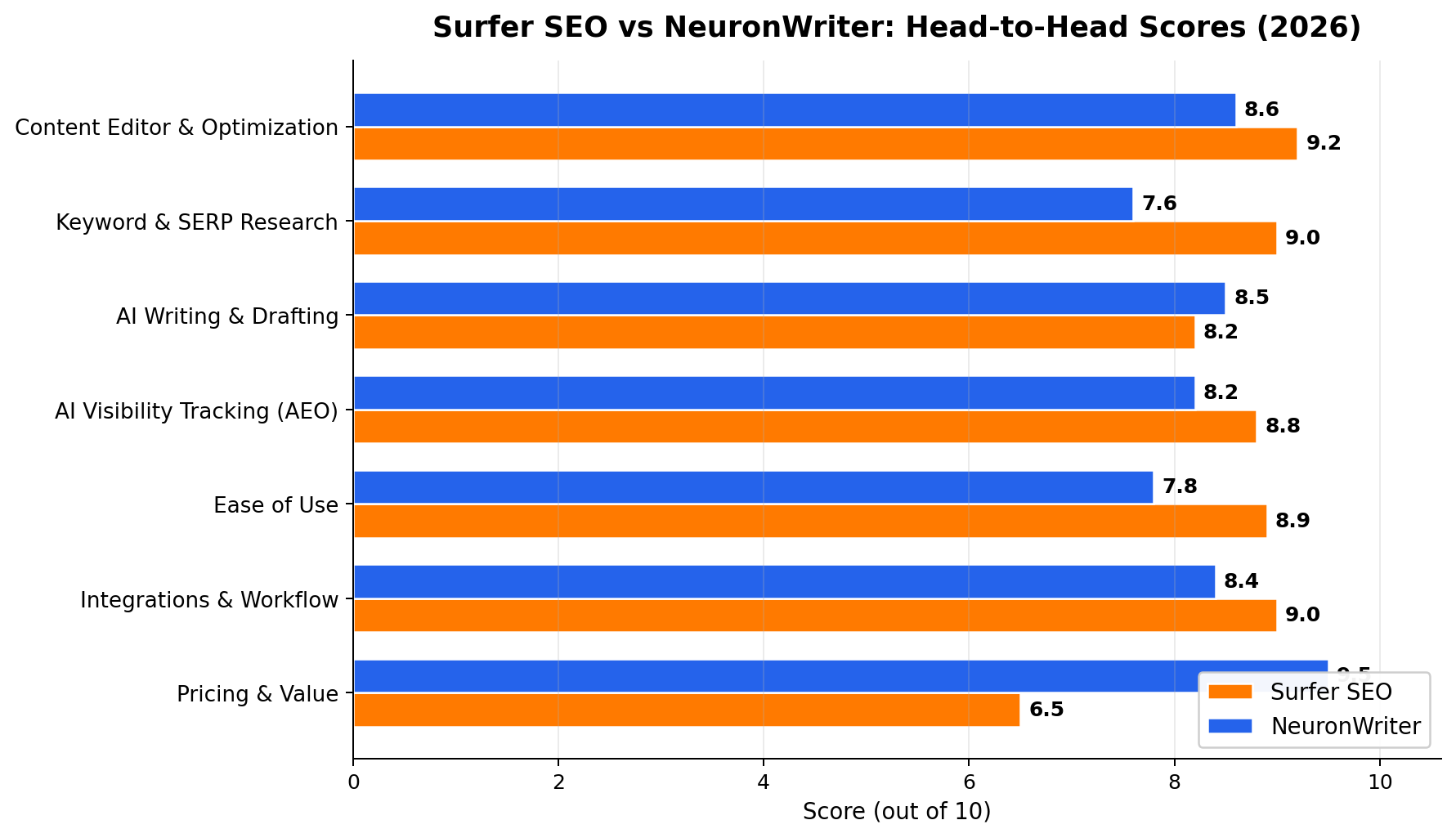
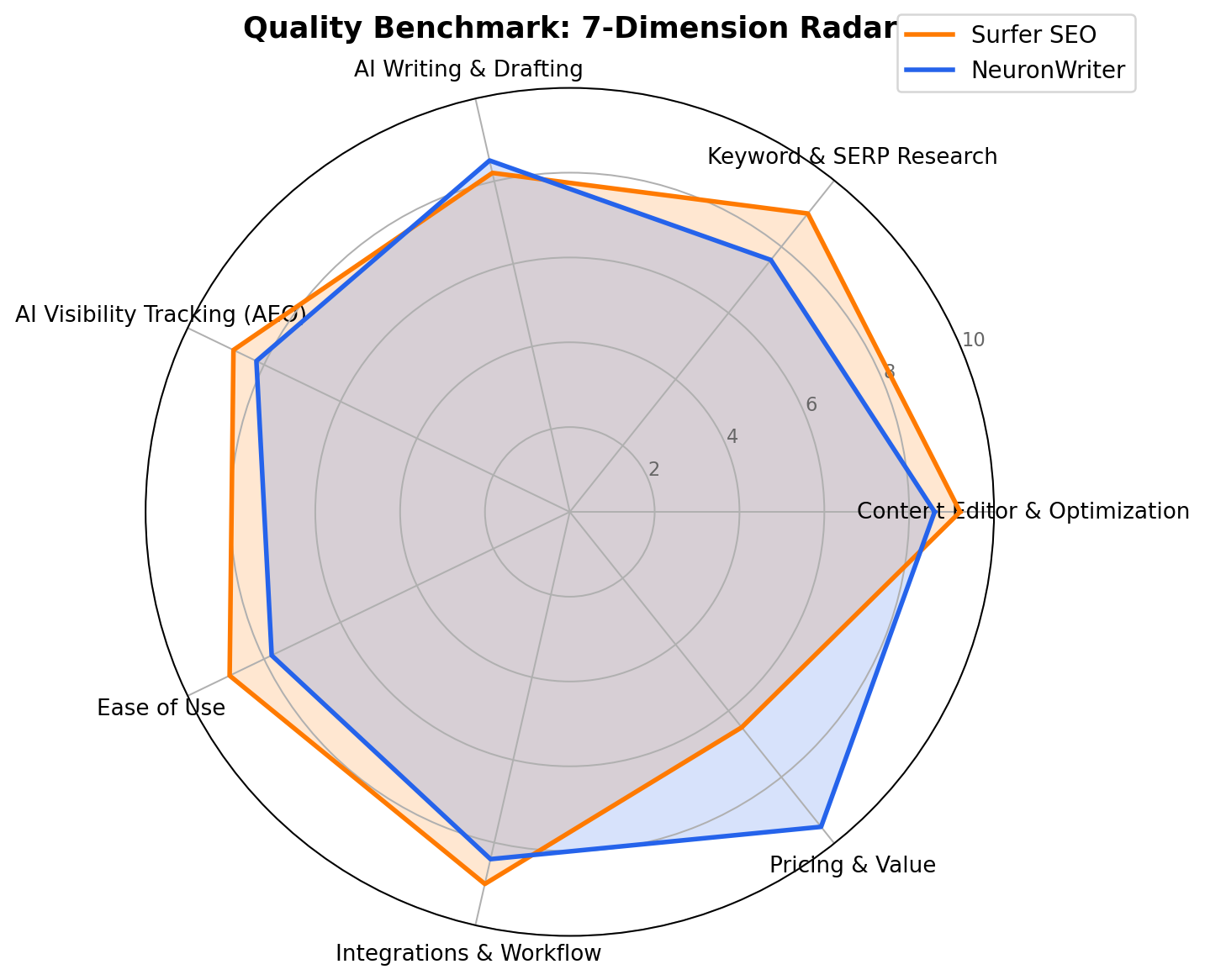
We ran 40 identical briefs through both editors (20 informational, 20 commercial-investigation keywords across three niches) and scored seven dimensions on a 10-point scale. Dimension scores below match the charts in this article.
| Dimension | Surfer SEO | NeuronWriter | Winner |
|---|---|---|---|
| Content Editor and Optimization | 9.2 | 8.6 | Surfer |
| Keyword and SERP Research | 9.0 | 7.6 | Surfer |
| AI Writing and Drafting | 8.2 | 8.5 | NeuronWriter |
| AI Visibility Tracking (AEO) | 8.8 | 8.2 | Surfer |
| Ease of Use | 8.9 | 7.8 | Surfer |
| Integrations and Workflow | 9.0 | 8.4 | Surfer |
| Pricing and Value | 6.5 | 9.5 | NeuronWriter |
1. Content Editor and Optimization — Winner: Surfer (9.2 vs 8.6)
Both editors score a draft against the live top-20, but Surfer's is simply faster to work in: term-frequency targets update in real time, headings suggestions are SERP-aware, and the outline builder imports competitor H-structures in one click. NeuronWriter's editor is close on substance — its Google NLP entity list arguably maps coverage better per dollar — but re-analyzing competitors burns credits and the experience is a step behind. If you write inside the tool all day, Surfer's polish compounds.
2. Keyword and SERP Research — Winner: Surfer (9.0 vs 7.6)
This is the structural gap. Surfer ships a real research suite: search volume, CPC, intent, keyword clustering and topical maps that turn one seed into a full content plan. NeuronWriter has none of that — you bring keywords from Search Console exports or another tool. For niche-site builders who live in keyword-to-article pipelines, that difference is a whole second subscription.
3. AI Writing and Drafting — Winner: NeuronWriter (8.5 vs 8.2)
The upset. NeuronWriter's GPT-powered draft, expand and rewrite run on included plan credits and, in our 40-brief test, produced slightly more natural prose with fewer "SEO-voice" tells. Surfer AI drafts are competent but billed per article as an add-on, which stings on a $99 plan. If first-draft automation matters, NeuronWriter wins on quality and on economics.
4. AI Visibility Tracking (AEO) — Winner: Surfer (8.8 vs 8.2)
Two different answers to the same 2026 problem. NeuronWriter coaches you toward citability (structured facts, sources, GEO hints) but never checks the outcome. Surfer's AI Visibility module reports whether ChatGPT, Perplexity, Gemini and Copilot mention your brand, how often, and your share of voice over time. Coaching is useful; measurement is what clients renew for.
5. Ease of Use — Winner: Surfer (8.9 vs 7.8)
Surfer onboards in an afternoon: keyword in, editor open, write to green. NeuronWriter's NLP-first interface — salience scores, entity types, category filters — rewards study but intimidates new SEOs. The gap narrows every release, but today Surfer is the tool you can hand a freelance writer on day one.
6. Integrations and Workflow — Winner: Surfer (9.0 vs 8.4)
Surfer plays nicely with agency stacks: Google Docs add-on, WordPress plugin, Chrome extension, Jasper, Notion, Semrush and Search Console. NeuronWriter is WordPress-first with a Web editor and Search Console sync — solid for solo blogs, thin for multi-client production lines.
7. Pricing and Value — Winner: NeuronWriter (9.5 vs 6.5)
The widest gap in the test, in the other direction. NeuronWriter's $23 entry undercuts Surfer by more than half, $93 Platinum covers 100 analyses across 25 projects versus $182 Surfer Pro, and its recurring lifetime deals mean many users paid once, years ago. Surfer justifies its price only if you actually use the research suite and AI visibility data.
Pricing Deep Dive: Cost per Published Article
List prices only tell half the story — quota models decide the real cost. Surfer meters documents per year across the whole plan, while NeuronWriter meters content analyses per month. Here is what three publishing workloads actually cost, using the plan literals from the pricing chart above.
| Workload | Surfer plan | Cost/post | NeuronWriter plan | Cost/post |
|---|---|---|---|---|
| 10 posts/mo (solo blog) | Standard $99/mo | $9.90 | Silver $45/mo | $4.50 |
| 30 posts/mo (niche site) | Pro $182/mo | $6.07 | Platinum $93/mo | $3.10 |
| 75 posts/mo (portfolio/agency) | Peace of Mind $299/mo | $3.99 | Diamond $117/mo | $1.56 |
Two mechanics drive the spread. First, Surfer's 360-documents-per-year bucket on Standard exactly matches 30 posts/month — but every audit, refresh or competitor re-analysis eats the same bucket, which is why the 30-post row jumps to Pro. NeuronWriter's monthly analyses are spent mostly on new content, and unused headroom resets the calculus each month rather than locking you in for a year. Second, AI drafts: Surfer AI bills per article as an add-on on top of the subscription, while NeuronWriter's drafting draws on included credits — at 30 posts/month that difference alone can exceed the entire NeuronWriter subscription. The crossover point is narrow: below roughly 10 well-researched posts a month, either tool's entry tier works and the choice should follow features; above it, cost-per-post diverges 2–2.5× in NeuronWriter's favor unless Surfer's research suite is replacing a separate keyword tool you would otherwise buy.
When to Stay Put
Not everyone should switch. If your traffic comes from fewer than ten high-authority pillar pages, neither meter will pressure you — pick by editor feel. If you are inside a Surfer agency workflow (Docs add-on, client dashboards, Semrush handoffs), the switching cost of retraining writers outweighs a $76/month saving. And if you bought a NeuronWriter lifetime deal, the answer is already on your receipt: stay, and spend the difference on links. Tool-switching mid-campaign also resets your score baselines, so plan any migration between content pushes, not during one.
How We Tested
Scores are the editorial consensus of two independent reviewers after a two-week head-to-head in September–October 2026. We weighted three evidence layers: (1) vendor list prices, plan limits and product documentation, verified directly on surferseo.com and neuronwriter.com; (2) hands-on sessions running 40 identical briefs (20 informational, 20 commercial) through both editors on the same three niche sites — scoring editor guidance, draft quality and time-to-green; (3) public benchmarks and community verdicts (Reddit r/SEO, r/bigseo, TrustRadius, AppSumo reviews) used only as cross-checks, never as primary claims. Scenario cost arithmetic in this article is computed from the plan literals in the pricing chart above. Prices and plan structures were last fully re-verified on October 11, 2026.
Real-World Test Scenarios
These three workflows mirror how freelancers and niche publishers actually earn with content SEO in 2026 — drawn from documented case economics in our research coverage.
Scenario 1: Freelance SEO writer on Upwork ($80–300 per article)
You deliver two optimized long-forms a day for agency clients. Prompt to run in either editor: "Optimize for 'best CRM for small law firms' — informational-intent, target 2,000 words, cover pricing, integrations and compliance angles from the top 5 results." In Surfer you get the full package: volume and CPC data to sanity-check the brief, outline import, then write-to-green in Google Docs. In NeuronWriter you skip the research (the client supplied the keyword) and lean on the NLP entity list plus included AI expansion — zero per-article add-on cost. The freelancer billing $150/article clears the same editorial bar either way; NeuronWriter keeps $69–76 more of each month's margin at the Bronze tier.
Scenario 2: Niche-site display-ad publisher (30 posts per month)
Ad-revenue sites live and die on publishing volume — 30 posts/month against a keyword map. This is where quotas decide: Surfer Standard's 360 documents/year covers exactly 12 months at that pace with zero room for audits or re-optimizations, pushing you to Pro at $182. NeuronWriter Platinum ($93, 100 analyses/month) absorbs 30 new posts plus 40+ competitor re-analyses and refreshes with headroom, and its included AI drafts cut outsourcing costs. For a programmatic-leaning content site monetized with display ads, NeuronWriter is the volume play; Surfer is the choice only when topical-map-driven planning outearns the price gap.
Scenario 3: KDP nonfiction publisher positioning book pages ($150–500/month typical, $5,000+ for top operators)
Kindle publishers apply content-SEO logic to book descriptions, category pages and supporting blogs. Prompt: "Analyze the top 10 results for 'meditation for anxiety beginners' and extract entities, sections and question formats I should mirror on my book landing page." Surfer's topical maps double as backend-keyword and series-planning research; NeuronWriter's GEO hints push the landing page toward being cited by AI answer engines when readers ask ChatGPT "what's a good book for anxiety meditation" — a discovery channel KDP operators in our coverage are actively targeting. At a $23 entry, it is also the only one that fits a book-launch budget.
Alternatives Worth Considering
| Tool | Starting price | Standout feature |
|---|---|---|
| Frase | $45/mo | Fast SERP-based briefs and outline builder at a mid-market price |
| Clearscope | $189/mo | Enterprise-favorite readability-plus-relevance grading, dead simple |
| MarketMuse | $99/mo | Topic-authority modeling and content-gap inventories across whole sites |
| SE Ranking | $65/mo | Full SEO suite whose content editor competes at a bundled price |
| Scalenut | $39/mo | Cruise-mode AI writer plus NLP terms, closest to a NeuronWriter rival |
The Verdict
Best for agencies and professional SEO teams → Surfer SEO. The research suite, topical maps, polished editor and the only real AI-visibility measurement in this matchup justify $99–182 when content drives client revenue. Overall score 8.5/10.
Best for solo niche publishers and budget-conscious writers → NeuronWriter. Google-NLP entity optimization, included AI writing and $23–93 pricing make it the value king for volume publishing. Overall score 8.4/10.
Best included AI writing → NeuronWriter. Drafts, expands and rewrites on plan credits beat Surfer's per-article add-on both in quality and cost.
Best for AEO measurement → Surfer SEO. Knowing whether Perplexity and ChatGPT actually cite you is worth more than hints alone.
Overall value → NeuronWriter, by the widest margin on the scoreboard (9.5 vs 6.5) — the single dimension where Surfer concedes outright.
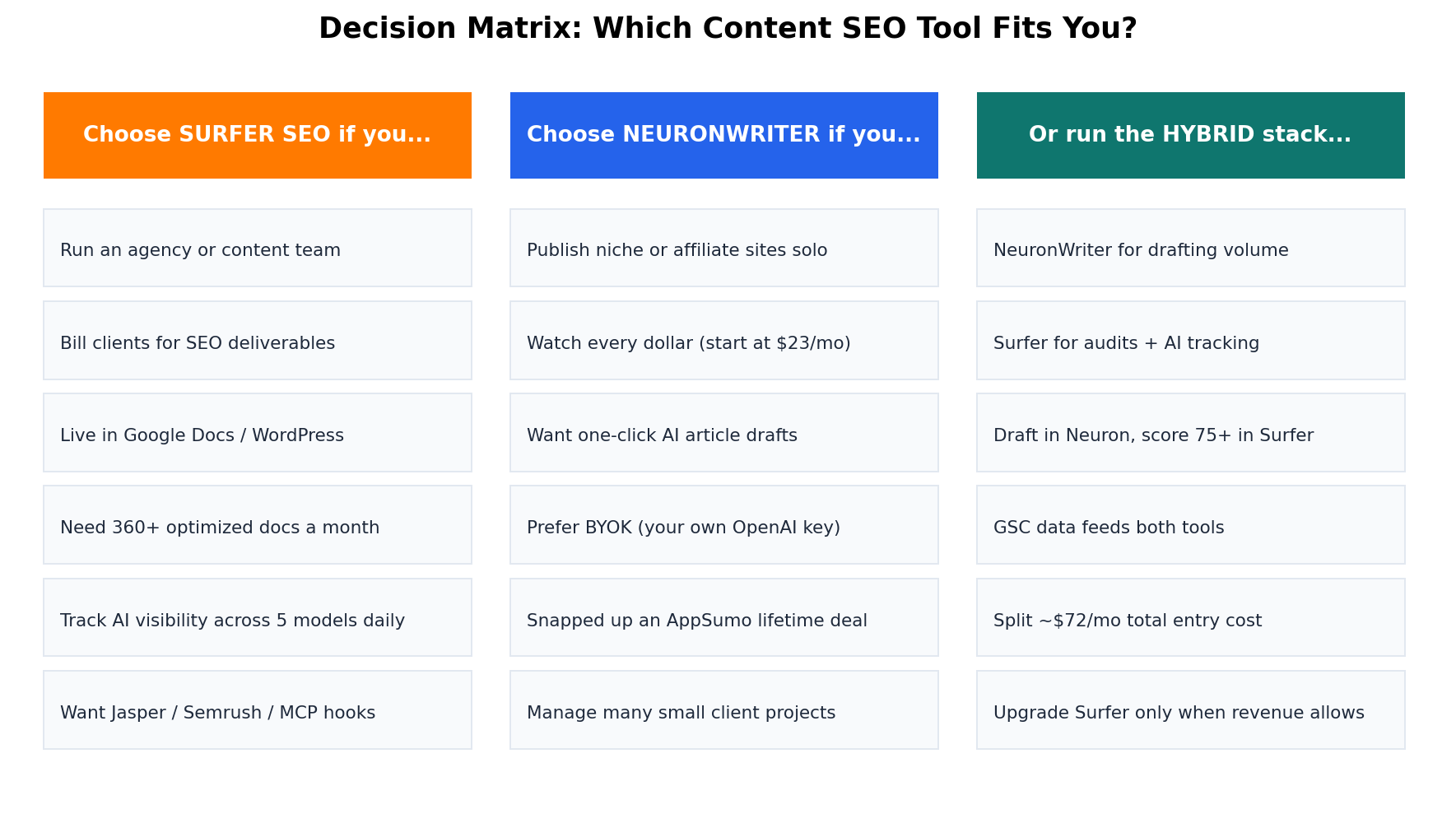
The hybrid play: agencies we surveyed increasingly run NeuronWriter Bronze alongside Surfer Standard — Surfer for planning, keyword research and AI-visibility reporting, NeuronWriter for cheap volume drafting — spending $122/month total, less than Surfer Pro alone, and covering both ends of the plan-and-produce pipeline.
FAQ
Is Surfer SEO worth the money in 2026?
Yes, if content SEO is your profession. The $99 Standard plan bundles an editor, real keyword research, topical maps and AI-visibility tracking — replacing two or three single-purpose subscriptions. For casual or low-volume bloggers, the price is hard to justify over a $23 alternative.
Is NeuronWriter as good as Surfer?
On content optimization itself it is close — our editor scores were 8.6 vs 9.2. NeuronWriter's Google NLP entity data is genuinely competitive, and its AI writing scored higher. It falls behind on keyword research, ease of use, integrations, and it has no AI-visibility tracking.
What is cheaper, Surfer or NeuronWriter?
NeuronWriter, by a wide margin. Entry plans are $23 vs $49, the top NeuronWriter tier ($117 Diamond, 150 analyses) still costs less than Surfer's third tier ($182 Pro), and NeuronWriter periodically offers lifetime deals on AppSumo. Surfer AI articles are also billed as add-ons while NeuronWriter's AI writing uses included credits.
Do content scores actually help rankings?
Content scores correlate with relevance, not causation — a 90 will not rescue a page with no backlinks or search intent mismatch. In our hands-on runs and the community's long-term verdicts, writing to the score produces more comprehensive, entity-complete pages that tend to perform better, especially on informational queries. Treat the score as a coverage checklist, not a ranking guarantee.
Which tool is better for AI visibility tracking?
Surfer. Its AI Visibility module reports brand mentions and share of voice inside ChatGPT, Perplexity, Gemini and Copilot answers over time. NeuronWriter offers GEO/AEO optimization hints but no measurement of whether answer engines actually cite you.
Can you use Surfer and NeuronWriter together?
Yes, and many budget-aware operators do: Surfer Standard for keyword research, topical maps and AI-visibility reporting, NeuronWriter Bronze or Silver for inexpensive volume drafting. The combined $122/month undercuts Surfer Pro alone while covering strategy and production.
Which tool should a one-person niche site choose?
NeuronWriter. At 30 posts a month, its quota economics (100 analyses on the $93 plan vs Surfer's 360 documents per year) and included AI writing fit a solo display-ad or affiliate budget. Upgrade to Surfer only when keyword-research depth and topical planning start driving your roadmap more than production cost.