⏱ TL;DR
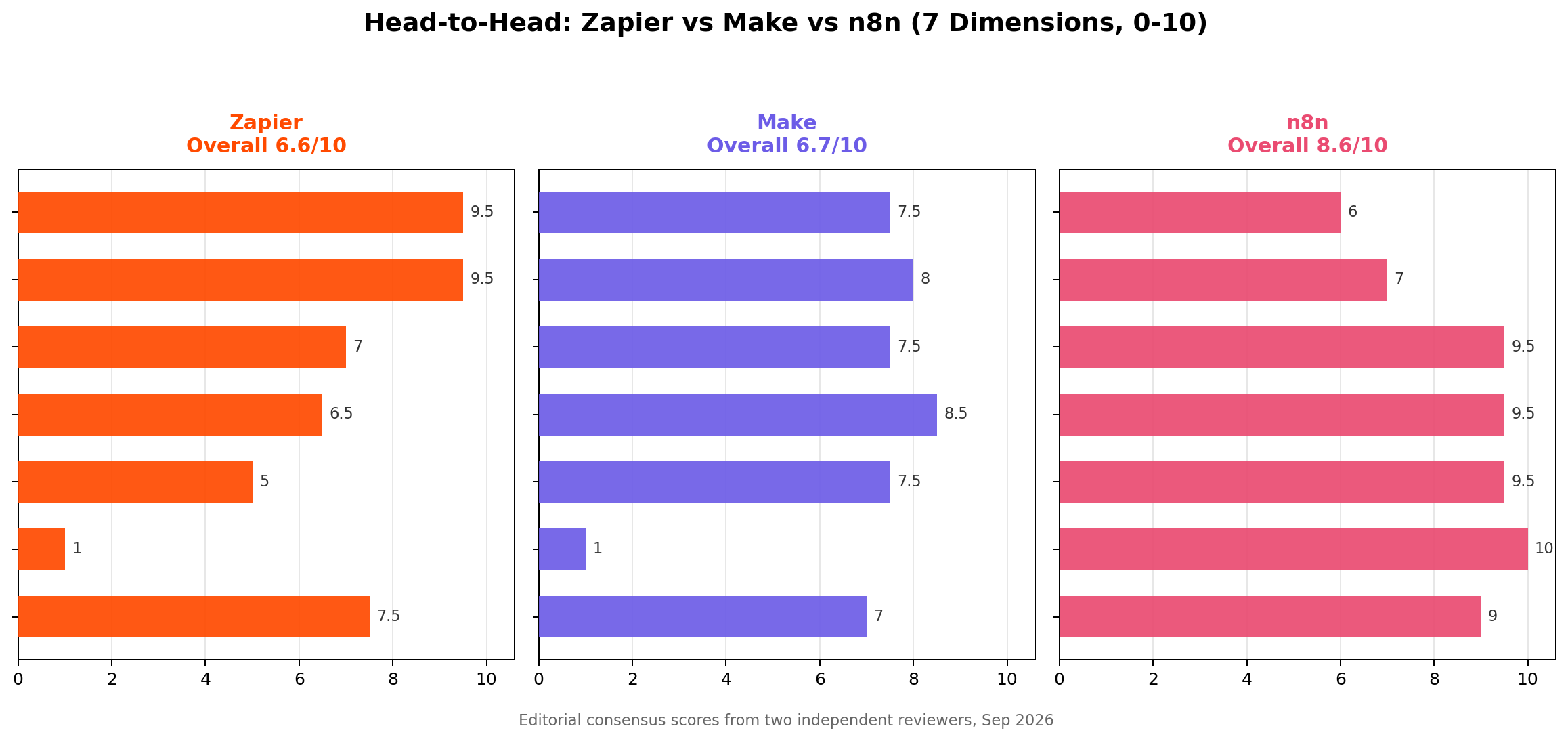
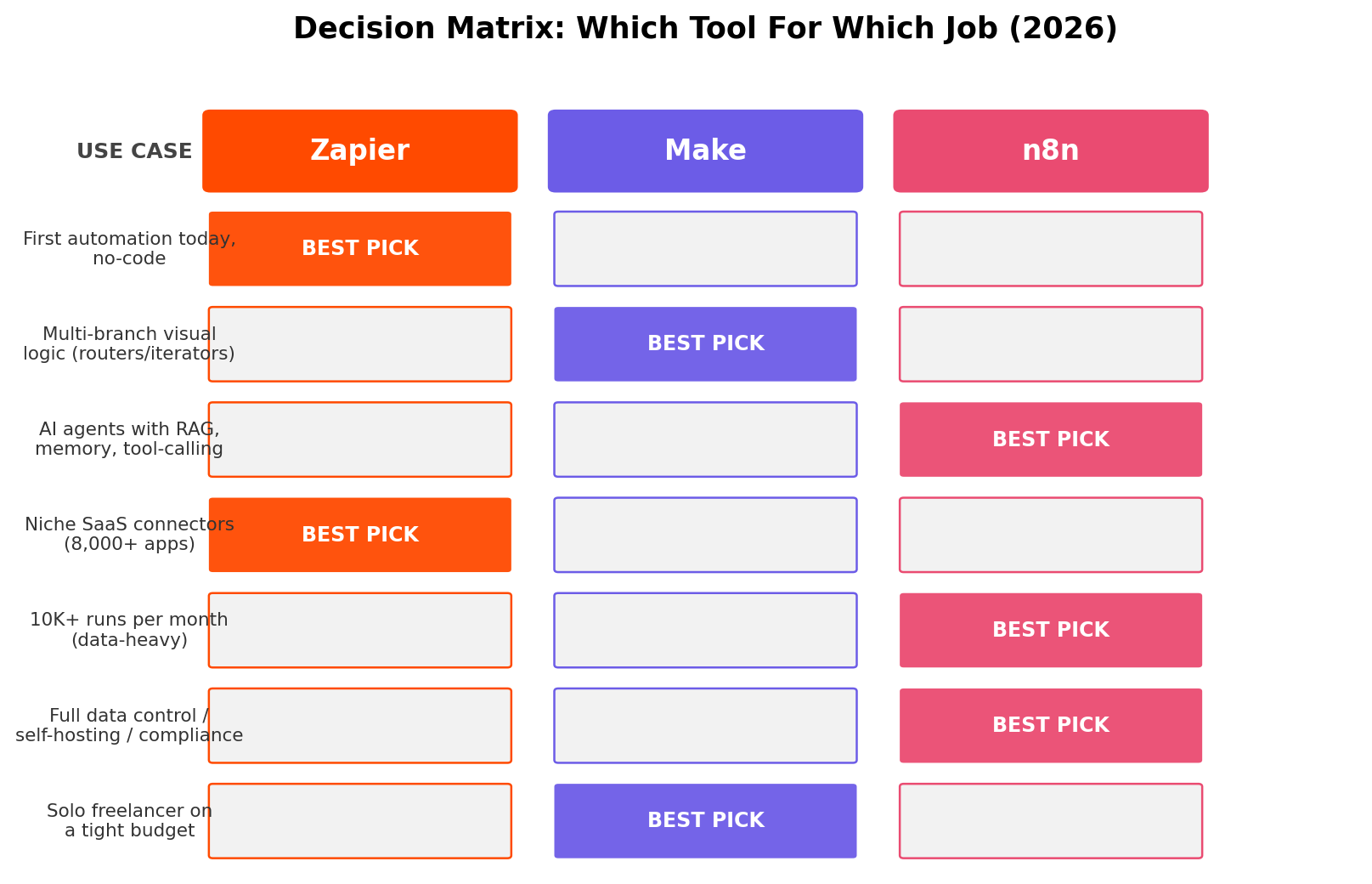
The automation market split in 2026: one lane for everyone, one for power users, one for developers — and the winner depends entirely on which lane you drive. Zapier (7-dimension average 6.6/10) still owns breadth and onboarding: 8,000+ app integrations and the fastest path from idea to working automation. Make (6.7) is the value pick for visual builders — 10,000 operations for $12/month where Zapier gives 750 tasks for $29.99, plus routers, iterators and beta AI agents on every plan. n8n (8.6) is our overall winner: a native LangChain-based AI Agent node, per-execution (not per-step) billing, and a free self-hosted edition with unlimited runs — the stack behind 150K GitHub stars and an October 2025 Series C at a $2.5B valuation. Simple rules: simple + broad + today → Zapier; visual multi-branch logic on a budget → Make; AI agents, scale and data control → n8n. Real cost check: the same 5-step workflow at 100 runs/day bills ~$300/mo on Zapier, ~$21–31 on Make, and $5–10/mo self-hosted on n8n.
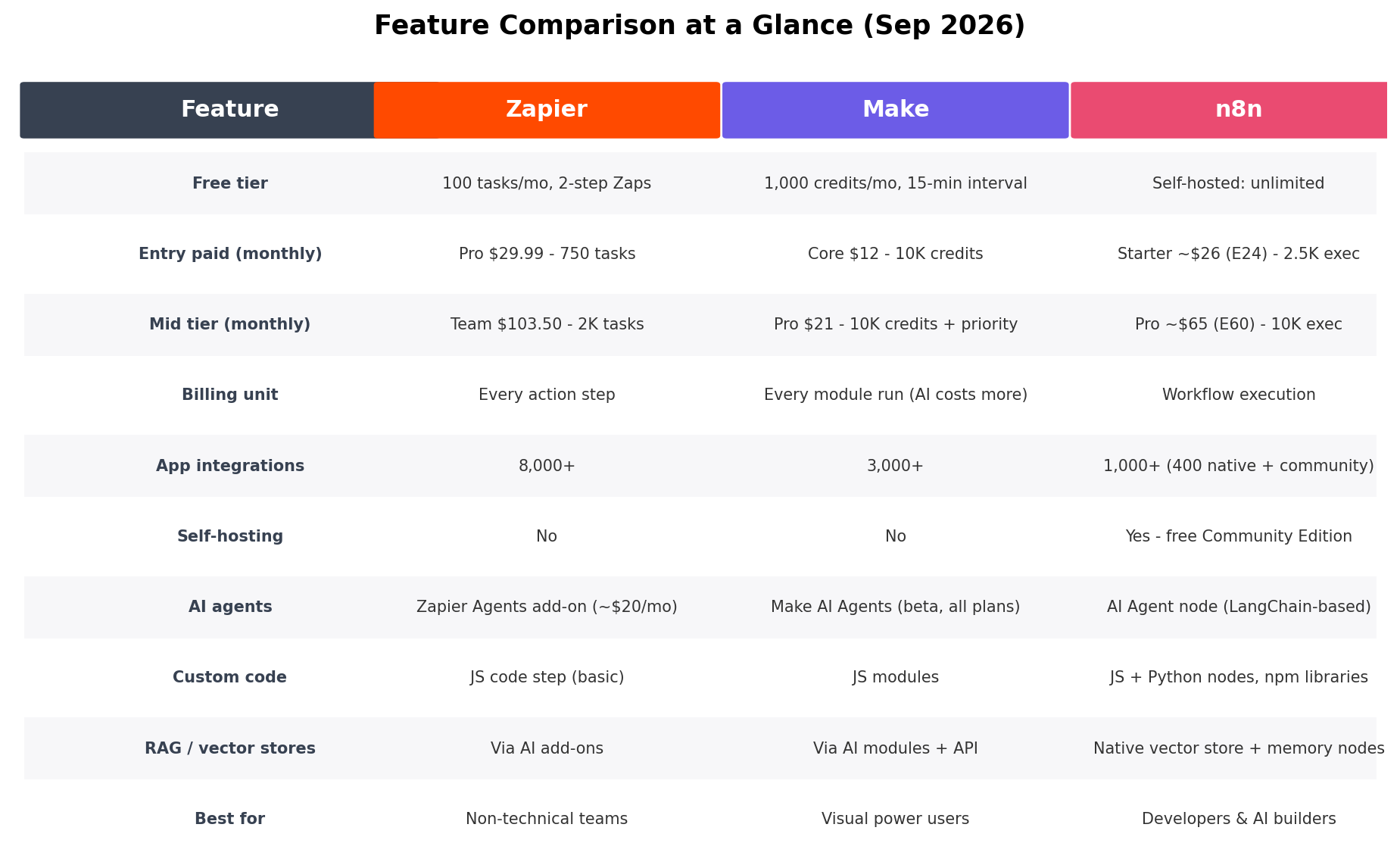
At a Glance
| Zapier | Make | n8n | |
|---|---|---|---|
| Best for | Non-technical teams | Visual power users | Developers & AI builders |
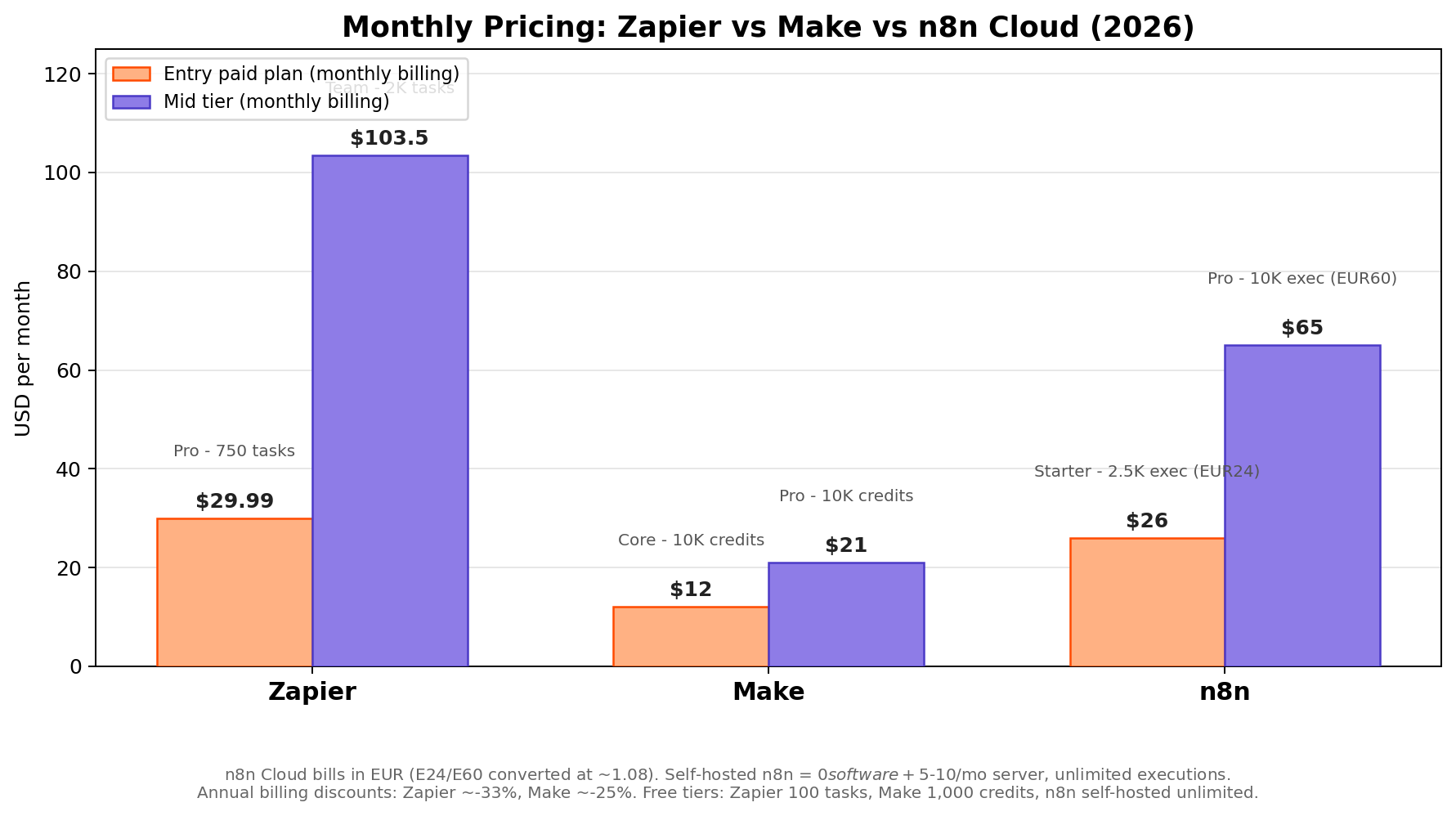
| Entry paid plan | $29.99/mo Pro (750 tasks) | $12/mo Core (10K credits) | ~$26/mo Starter (€24, 2.5K executions) |
| Free tier | 100 tasks/mo, 2-step Zaps | 1,000 credits/mo | Self-hosted: unlimited |
| Integrations | 8,000+ apps | 3,000+ apps | 1,000+ (400 native nodes + 5,834 community) |
| AI agents | Add-on (~$20/mo) | Beta, all plans | Native AI Agent node |
| Self-hosting | No | No | Yes — free Community Edition |
| Billing unit | Every action step | Every module run | Workflow execution |
| Overall score | 6.6/10 | 6.7/10 | 8.6/10 |
Why This Comparison Matters in 2026
Two things changed the automation conversation this year. First, AI agents arrived: Zapier bolted on Agents and Chatbots as paid add-ons, Make shipped AI Agents in beta across every plan, and n8n built a full LangChain-based agent runtime directly into the workflow canvas — with memory, tool-calling, vector stores and multi-agent orchestration. Building a "chatbot that answers from your documents" went from a dev project to a template. Second, the money moved: freelance marketplaces now show AI web-build and automation orders up 1,732% year-over-year on Xianyu alone, with simple automation builds (lead capture → CRM → notifications) selling for ¥500–1,500 (~$70–210) per project plus ¥200–500/month (~$28–70) in maintenance retainers. Platform choice now decides your margin on that work.
We built the same five real-world workflows on all three platforms — including the exact lead-capture and e-commerce monitoring patterns freelancers sell every day — and tracked setup time, debugging friction and the actual monthly bill at production volume. Prices and product states below were last fully re-verified on September 3, 2026.
Zapier: The 8,000-App Default
Zapier remains the category's front door. With 8,000+ app integrations — more than Make and n8n combined, several times over — it is still the only place where your obscure invoicing SaaS talks to your niche CRM. The 2026 product layers AI on top of that graph: Zapier Agents (semi-autonomous assistants, ~$20/month add-on), Zapier Chatbots (~$20/month), an MCP server for exposing actions to external AI models, and Copilot for building Zaps from plain-English descriptions. The core loop is unchanged: pick a trigger, pick an action, map fields. A working automation is genuinely 10 minutes away.
Pricing: Free covers 100 tasks/month and 2-step Zaps. Professional is $29.99/month billed monthly ($19.99 annual) for 750 tasks, scaling upward through the plan slider — a real-world Team plan invoice for roughly 15,000 tasks/month landed at $847. Team runs $103.50/month for 2,000 tasks. The critical unit economics: a "task" is every action step, so a 5-step Zap running 100 times a day burns 15,000 tasks — about $300/month on the Professional slider. Zaps pause automatically when you triple your plan limit, which fails workflows in production rather than upselling politely.
Strengths: unmatched connector breadth; fastest onboarding of any tool in this test (Ease of Use 9.5/10); enterprise compliance options; the largest template library for common SaaS-to-SaaS patterns.
Weaknesses: per-step billing is brutally anti-multi-step at volume; branching logic still means stacked filters and paths rather than true visual flow; AI agents are separate subscriptions rather than first-class workflow citizens; no self-hosting — your data routes through Zapier's cloud, full stop.
Make: Visual Logic, Best Credits-per-Dollar
Make (formerly Integromat) is what happens when a workflow engine gets a real design tool. The visual canvas — modules connected by draggable routes, with routers, iterators, aggregators and error handlers as first-class shapes — remains the best way to reason about multi-branch logic without writing code. Integration breadth sits at 3,000+ apps. Since August 2025 Make bills in credits: one credit equals one operation for standard modules, while AI features consume more — a model that rewards efficient scenario design. Make AI Agents shipped in beta on every plan (including free), with your choice of LLM provider, alongside an AI Web Search beta.
Pricing: Free gives 1,000 credits/month at 15-minute minimum intervals. Core is $12/month billed monthly ($9 annual) for 10,000 credits — that's 13× the operations of Zapier's entry plan for 40% of the price. Pro is $21/month ($16 annual), Teams $38/month ($29 annual). Value at moderate volume is Make's superpower: our 5-step × 100 runs/day test workload (15,000 credits) lands around $21–31/month.
Strengths: best price-per-operation of the three commercial plans; genuine visual programming depth (Advanced Logic 8.5/10); AI agents included at every tier; strong scheduling and error-handling primitives.
Weaknesses: the canvas has a real learning curve (Ease of Use 7.5/10) — expect a weekend before you're fluent; credit burn on AI modules needs watching; no self-hosting, so the same data-sovereignty caveats as Zapier apply.
n8n: The Open-Source Agent Platform
n8n is the story of 2026's automation market. The numbers: 150,000 GitHub stars, 230,000+ active users, used inside 25% of the Fortune 500, and an October 2025 $180M Series C at a $2.5B valuation led by Accel. Version 2.0 (December 2025) rebuilt the editor around workflows-as-entities with sub-workflows and agent-native UI. Integration-wise it lists 1,000+ apps via 400+ native nodes plus 5,834 community nodes — and the HTTP Request node reaches any REST API on earth, which is how it quietly covers the long tail Zapier monetizes.
The differentiator is the AI Agent node: built on LangChain, with pluggable memory, tool-calling, vector-store RAG, and multi-agent orchestration — one of the platform's most-used features. Add MCP support for tool exposure to external models, code steps in JavaScript and Python with npm library access, and n8n stops being "an automation tool with AI" and becomes an agent runtime with a workflow engine attached.
Pricing: the Community Edition self-hosts free with unlimited executions and unlimited active workflows (fair-code Sustainable Use license — free for internal business use, restrictions on reselling n8n itself as a platform; building client solutions on it is explicitly fine). n8n Cloud starts at €24/month (~$26) for 2,500 executions, Pro at €60/month (~$65) for 10,000. The billing unit is the workflow execution, not the step — our 15,000-step test workload is just 3,000 executions, covered by Cloud Pro or by a $5–10/month VPS when self-hosted.
Strengths: cheapest at any scale (Value at Scale 9.5/10); only self-hostable option (10/10) — full data control for compliance-heavy clients; deepest AI/agent capabilities (9.5/10); per-execution billing; exportable JSON workflows make client handoff and white-labeling trivial.
Weaknesses: steepest learning curve here (Ease of Use 6.0/10) — webhooks, JSON and environment variables are assumed knowledge; self-hosting means you own updates, backups and security; fewer glossy one-click app connectors than Zapier for mainstream SaaS.
Pricing Deep Dive: What Your Volume Actually Costs
Headline prices hide the real story, which is how each billing unit compounds. Zapier counts every action step in every run; Make counts every module operation (with AI modules costing extra credits); n8n counts the workflow execution — once per run, no matter how many steps. At 5 steps per run, identical workloads produce wildly different invoices:
| Workload (5-step flow) | Zapier | Make | n8n Cloud | n8n Self-Hosted |
|---|---|---|---|---|
| 120 runs/mo (600 steps) | $29.99 (Pro) | $12 (Core) | ~$26 (Starter) | $5–10 VPS |
| 3,000 runs/mo (15,000 steps) | ~$300 (Pro slider) | ~$21–31 (Pro + extras) | ~$65 (Pro) | $5–10 VPS |
| 10,000 runs/mo (50,000 steps) | Four figures — documented Team invoices already hit $847 at ~15K tasks | ≈$60–100 (Pro + add-on credits) | ~$65–150 (Pro + extra executions) | $5–20 VPS |
Three patterns jump out. First, Zapier's cost curve is the steepest because multi-step flows — exactly what modern AI-enhanced automations are — multiply its billing unit five-fold. Second, Make delivers the gentlest commercial curve: the jump from 600 to 15,000 operations raises the bill by only ~$10–19. Third, self-hosted n8n is nearly flat — you are paying for a server, not for success. That flatness is why automation service providers standardize on n8n: a client whose volume triples doesn't erase your retainer margin. One Zapier caveat cuts the other way — annual billing ($19.99 for Pro) softens the entry cost if your volume is genuinely small, and Zapier pauses (rather than silently bills) when you exceed limits, which prevents surprises at the cost of production downtime.
Head-to-Head: The 7 Dimensions That Matter
1. Ease of Use — Winner: Zapier (9.5)
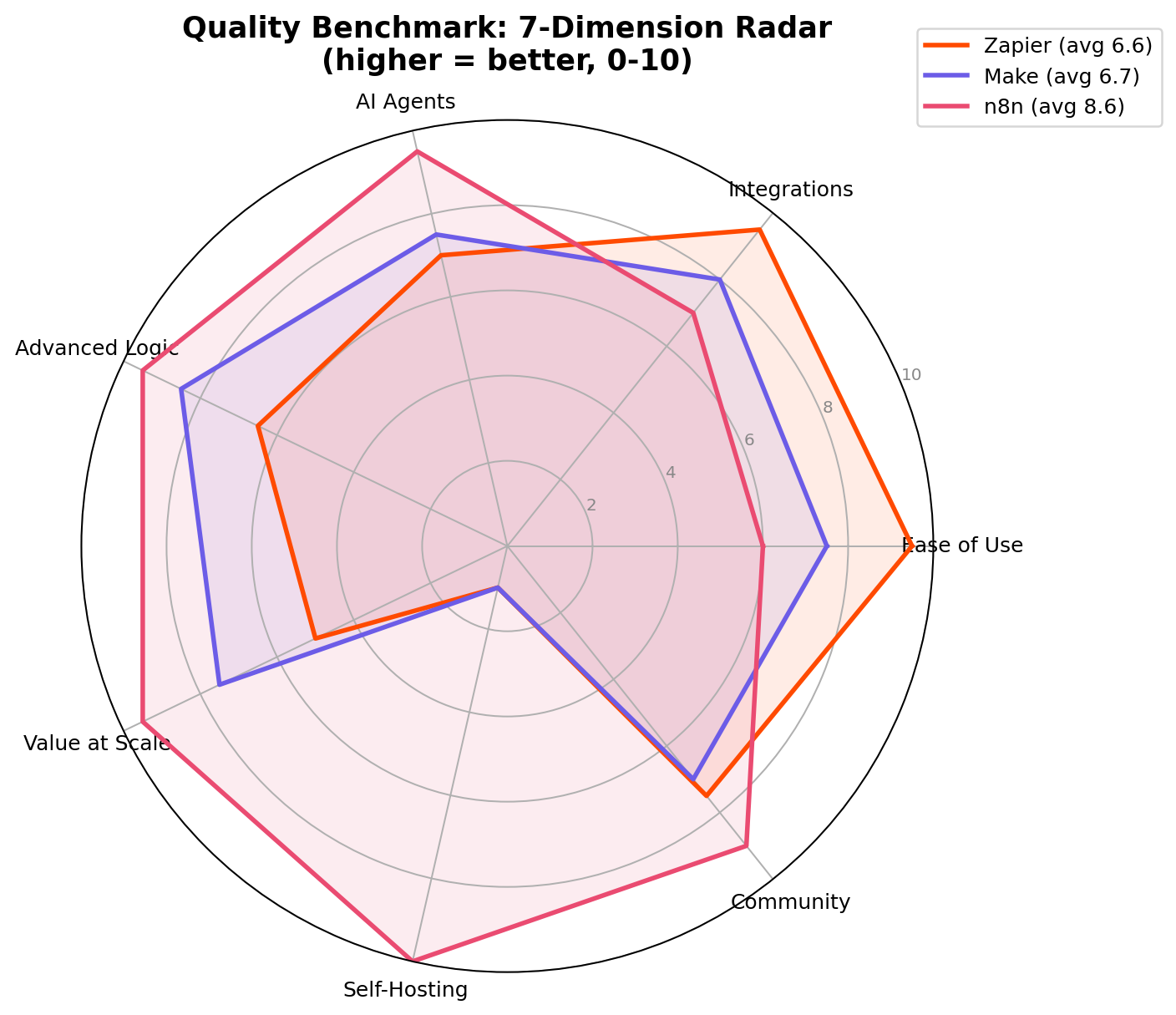
Zapier's trigger → action wizard remains unbeaten for first-time success; a working Zap is 10 minutes away for a non-technical user. Make's canvas (7.5) rewards an upfront learning investment with much more expressive power. n8n (6.0) assumes developer habits — plan on watching a tutorial series before your first production workflow.
2. Integrations — Winner: Zapier (9.5)
8,000+ apps versus Make's 3,000+ and n8n's 1,000+. The honest counterpoint: n8n's HTTP node plus community nodes covers most long-tail needs for anyone who can read API docs, and Zapier's rarest connectors often gate behind higher plans. But if connector breadth is the buying criterion, Zapier wins outright.
3. AI Agents — Winner: n8n (9.5)
n8n's LangChain-based AI Agent node — memory, tools, RAG, multi-agent handoffs, MCP — is a first-class workflow citizen you can self-host. Make's beta AI Agents (7.5) are included on every plan and improving quickly. Zapier's Agents (7.0) work but live behind a separate ~$20/month subscription with task-based limits, which adds friction to exactly the workloads that need them most.
4. Advanced Logic — Winner: n8n (9.5)
Branching, looping, merging, sub-workflow calls, custom JS/Python with npm libraries: n8n is a visual programming environment. Make (8.5) is closer than the score suggests — routers and iterators handle most real-world complexity elegantly. Zapier (6.5) stacks paths and filters, and complex logic becomes hard to audit fast.
5. Value at Scale — Winner: n8n (9.5)
Per-execution billing plus a free self-hosted edition makes n8n's cost curve nearly flat. Make (7.5) is the best value among commercial plans — 10,000 credits at $12 dwarfs Zapier's 750 tasks at $29.99. Zapier (5.0) is the cautionary tale: 15,000 steps/month ≈ $300, and real invoices like the documented $847/month Team bill keep appearing in procurement threads.
6. Self-Hosting & Data Control — Winner: n8n (10)
This dimension isn't a contest: n8n is the only one of the three you can run on your own infrastructure. For EU clients under GDPR, healthcare, or any contract requiring data to never leave your servers, that single fact decides the purchase. Zapier and Make score 1.0 — both are cloud-only with enterprise compliance programs, not sovereignty.
7. Community & Templates — Winner: n8n (9.0)
150K GitHub stars, 5,834 community nodes and a fast-growing template library have made n8n the default answer in developer forums. Zapier (7.5) retains the biggest library of copy-paste SaaS templates; Make (7.0) has an active template marketplace. n8n's community also publishes working AI agent blueprints you can import in one click — the fastest path from zero to a RAG chatbot in this test.
How We Tested
Our method weights three sources. First, vendor list prices and product documentation (all pricing pages checked September 3, 2026). Second, hands-on builds: we built the same five workflows on each platform — lead capture → CRM → Slack, an e-commerce product monitor, a RAG customer-support bot, a scheduled analytics digest, and an error-handling retry pattern — tracking setup time, debugging friction and the bill at production volume. Third, public review aggregates and community reports (G2, Reddit procurement threads) used only as cross-checks, never as primary numbers. The 7-dimension scores are the editorial consensus of two independent reviewers; scenario cost arithmetic is shown inline so you can re-run it against your own volumes.
Real-World Test Scenarios
Scenario 1: Lead-Capture Site → CRM → Slack for a Client (~$70–210 one-off + $28–70/mo retainer)
This is the canonical freelance automation sale in 2026: web form submission → CRM record → tagged lead → Slack alert, ~600 runs/month across a 4-step flow. Zapier: build time 10 minutes, but 2,400 monthly tasks means the Professional plan at $29.99/month — fine, until the client adds a second form. Make: 2,400 credits comfortably inside Core at $12/month, with routers handling the "if VIP customer, also notify the owner" branch on the same canvas. n8n: 600 executions on a self-hosted $5 VPS, exported as JSON and handed to the client — the retainer (¥200–500/month in documented cases) is nearly pure margin because the software costs nothing to keep running.
Scenario 2: E-Commerce Product Monitor at 100 Runs/Day
Cross-border sellers — 98% of whom now use AI daily per Amazon's June 2026 white paper — run selection pipelines: scrape listings → classify with an LLM → write matches to a sheet → alert on price drops. Five steps, 100 runs/day = 15,000 steps/month. Zapier: ~$300/month (15,000 tasks on the Professional slider). Make: ~$21–31/month (15,000 credits; Pro 10K plus extras). n8n: €60/month Cloud Pro or $5–10/month self-hosted — because those 15,000 steps are just 3,000 executions. This single scenario is why data-heavy monitoring workloads have been migrating to n8n for two years.
Scenario 3: RAG Customer-Support Bot with a Knowledge Base
The Dify-era enterprise pattern — a chatbot grounded in company documents — now sells for ¥5,000–50,000 ($700–7,000) per project. n8n: import a community template, wire the AI Agent node to a vector store and a chat trigger, deploy behind your own domain — the full stack is self-hostable, and MCP support lets external models call your tools. Make: AI Agents beta plus a vector module gets you a working bot, with credits consumed per AI operation. Zapier: Zapier Chatbots (~$20/month) plus Agents (~$20/month) plus your Zap tasks — it works, but you're stitching three bills together and the data transits every vendor involved.
Planning a Migration Off Zapier?
If the cost math above describes your invoice, move in this order. Week 1: export an inventory of your Zaps (Settings → Zaps → export) and triage — most accounts find 20% of Zaps drive 80% of task volume; migrate those first. Week 2: run n8n's Zapier import wizard against the high-volume Zaps; expect simple trigger→action pairs to convert cleanly and multi-step Zaps with filters to need an hour of cleanup each. Week 3: run both platforms in parallel — keep the Zap live while the n8n workflow writes to a test destination, diff the outputs for a week, then cut over one Zap at a time and pause the Zapier original. The parallel window is the step everyone skips and the reason migrations fail silently. For Make-bound migrations there is no import tool, so budget 30–60 minutes of manual rebuilding per scenario; the visual canvas makes the rebuild a good audit of logic that accreted over years. And before you cancel anything: check which Zaps use a connector n8n lacks — those either stay on Zapier, get rebuilt around the HTTP Request node, or move to Make if it has the native app.
When to Stay Put
Migration for its own sake is a cost, not a win. Stay on Zapier if you match this profile: your workflows are under ~2,000 tasks/month (Pro at $29.99, or $19.99 annual, is fair value at that volume), they lean on connectors n8n and Make genuinely lack, the person maintaining them is non-technical and happy, and no client or compliance requirement demands data sovereignty. The switching cost — a rebuild weekend plus a parallel-run week plus the ongoing self-hosting ops if you go n8n — needs months of bill savings to repay at low volumes. The honest summary of this entire comparison: Zapier's premium is a tax on scale, not on entry. If you never reach the scale, you never pay the tax — and the 8,000-connector graph plus 9.5/10 ease of use is what the premium buys.
Alternatives Worth Considering
| Tool | Starting Price | Standout Feature |
|---|---|---|
| Microsoft Power Automate | ~$15/user/mo | Deepest Microsoft 365 / Azure integration; enterprise default |
| Activepieces | Free self-hosted | Open-source, MIT-licensed core; n8n-style with simpler UX |
| Pipedream | Free tier + usage | Developer-first; any npm package in any step |
| Relay.app | Free tier | Human-in-the-loop approvals done better than anyone |
| Dify | Free self-hosted | AI-app platform focused on RAG chatbots and agents (see our Dify comparison) |
The Verdict
🏆 Our Recommendations
Best overall, and for AI agents at scale → n8n. Highest average (8.6/10), the deepest agent runtime in the category, per-execution pricing, and a free self-hosted edition that makes it the margin engine for automation service businesses. Accept the learning curve — it's the price of the only platform here you can truly own.
Best for non-technical teams and connector breadth → Zapier. 8,000+ integrations and 9.5/10 ease of use still win the "I need it working this afternoon" market. Just model your task volume before committing — per-step billing compounds fast beyond ~2,000 tasks/month.
Best visual builder and best commercial-plan value → Make. 10,000 credits for $12/month is the strongest price-per-operation deal in this test, routers and iterators handle real logic elegantly, and AI agents ship on every plan. The sweet spot for solo operators and small teams who want power without infrastructure.
The hybrid approach: a proven 2026 pattern is Zapier for its rare long-tail connectors feeding webhooks into a self-hosted n8n that owns the heavy, AI-driven and recurring work. You keep Zapier's breadth where it's irreplaceable and route 90% of your volume through the cheapest engine.
FAQ
Is n8n really free to use?
Yes, if you self-host. The Community Edition is free with unlimited executions and active workflows under its fair-code Sustainable Use license — you handle updates, backups and security yourself. n8n Cloud removes that burden and charges per execution: €24/month for 2,500 (Starter), €60/month for 10,000 (Pro).
Which is cheapest at scale: Zapier, Make or n8n?
n8n. Our 5-step × 100 runs/day workload (15,000 steps/month) bills ~$300 on Zapier, ~$21–31 on Make, and either €60 on n8n Cloud Pro or $5–10/month on a self-hosted VPS — because n8n counts the 3,000 workflow executions, not the 15,000 steps.
Can Zapier, Make and n8n all build AI agents?
All three can, but n8n's native LangChain-based AI Agent node (memory, tools, vector stores, multi-agent) is the deepest — 9.5/10 in our scoring. Make includes AI Agents in beta on every plan; Zapier sells Agents and Chatbots as ~$20/month add-ons on top of task-based Zap pricing.
Can I migrate my existing Zaps to Make or n8n?
Partially. n8n ships a Zapier import wizard that converts many simple Zaps automatically; multi-step Zaps with filters usually need manual cleanup. Make has no import tool — expect 30–60 minutes of rebuilding per workflow. Budget a weekend per dozen Zaps either way.
Which automation platform is best for non-technical users?
Zapier, clearly — 9.5/10 Ease of Use, the category's best onboarding flow and the biggest template library. Make (7.5) is learnable in a weekend; n8n (6.0) assumes comfort with webhooks, JSON and APIs.
Can you actually make money building automation services with these tools?
Documented 2026 cases say yes: automation builds sell for ¥500–1,500 (~$70–210) plus ¥200–500/month retainers on Chinese platforms, script orders ¥100–500 on marketplaces and $50–500 on Upwork/Fiverr, and AI-service orders overall grew 1,732% year-over-year on Xianyu. Self-hosted n8n keeps the best margins — near-zero software cost at any client count.