⏱ TL;DR
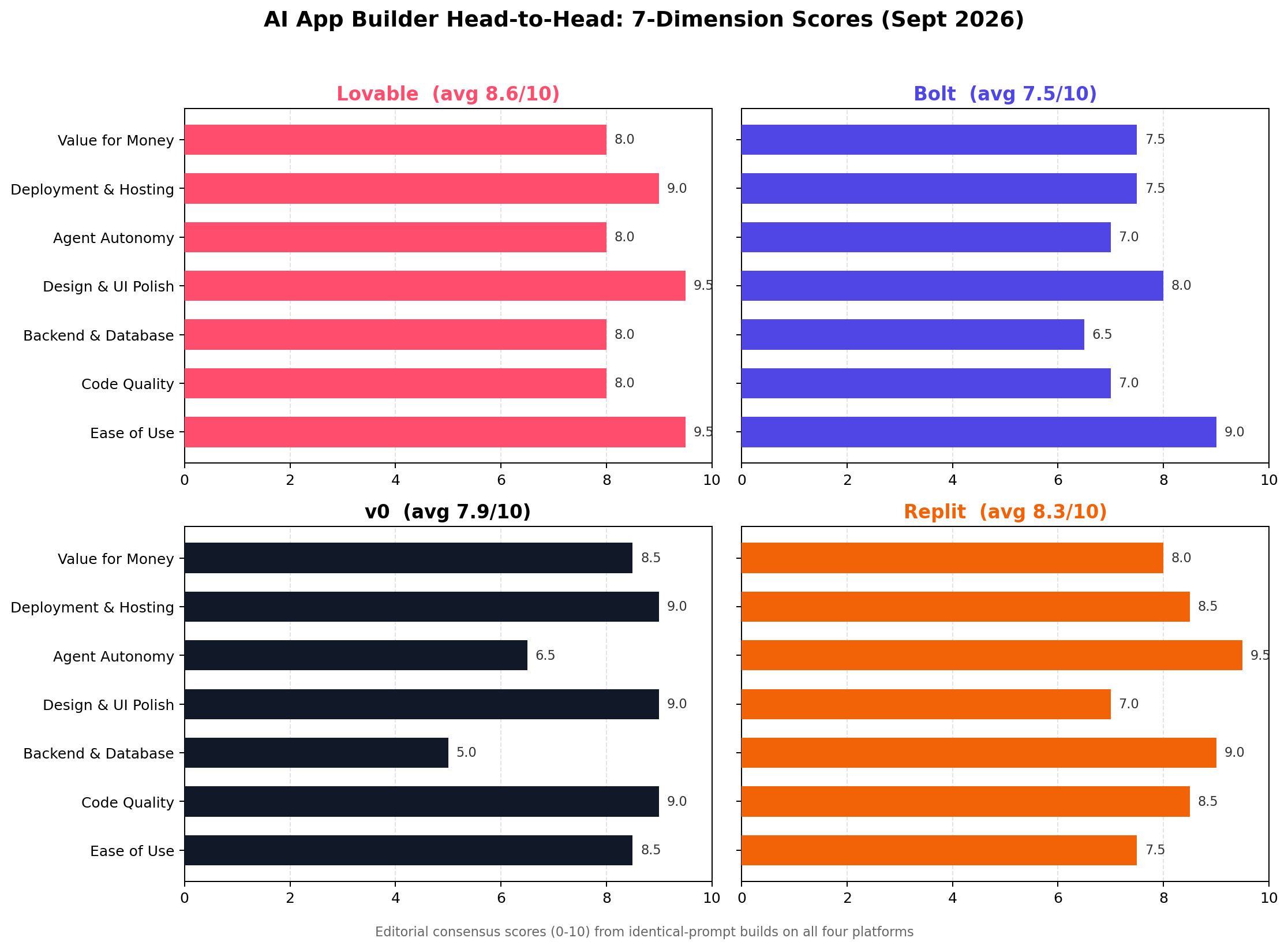
Four tools now own the "describe it, ship it" app-builder market, and they have genuinely diverged. Lovable (7-dimension average 8.6/10) is the fastest path from idea to a polished, monetizable web app — the only one with built-in auth, Stripe payments and a Supabase-backed cloud. Replit (8.3) is the power pick: Agent 4 runs up to 200 minutes autonomously, self-tests its own code, and sits inside a real IDE with built-in Postgres. v0 (7.9) generates the best raw React/Next.js code (9.0 Code Quality) at the cheapest entry ($20/mo) — but ships no backend, so you bring your own Supabase. Bolt (7.5) is the prototyping sprinter with the biggest free tier (1M tokens/month), but the weakest code quality of the four. Simple rules: no-code SaaS MVP → Lovable; hackathon demo → Bolt; production frontend → v0; full-stack apps and agents → Replit. Entry plans: v0 Premium $20/mo, Replit Core $20/mo (annual billing; $25 monthly), Lovable Pro $25/mo, Bolt Pro $25/mo.
At a Glance
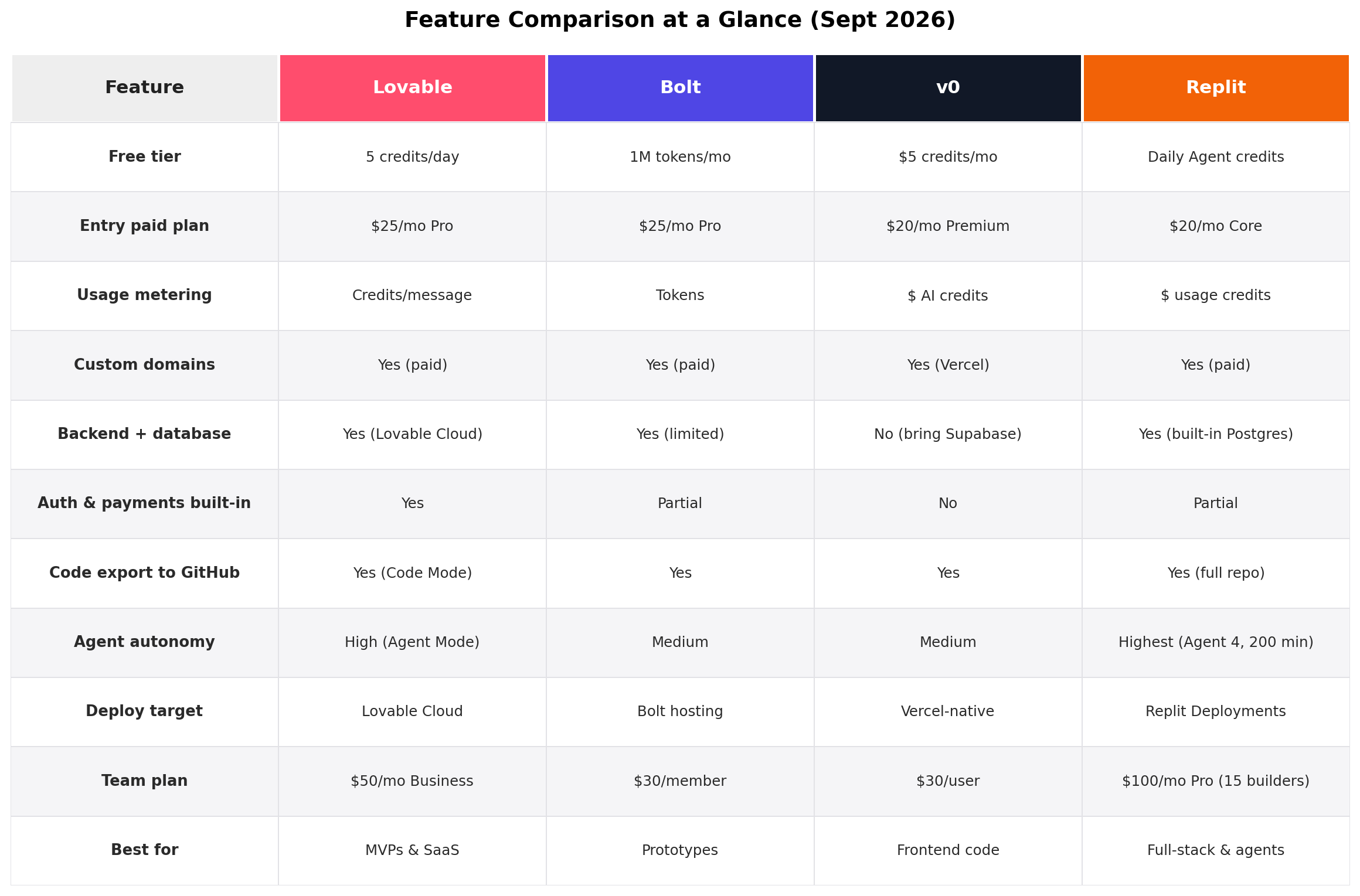
| Lovable | Bolt | v0 | Replit | |
|---|---|---|---|---|
| Best for | MVPs & SaaS | Prototypes | Frontend code | Full-stack & agents |
| Entry paid plan | $25/mo Pro | $25/mo Pro | $20/mo Premium | $20/mo Core ($25 monthly) |
| Free tier | 5 credits/day | 1M tokens/mo | $5 credits/mo | Daily Agent credits |
| Backend + database | Yes (Lovable Cloud) | Yes (limited) | No — bring Supabase | Yes (built-in Postgres) |
| Auth & payments | Built-in | Partial | No | Partial |
| Agent autonomy | High (Agent Mode) | Medium | Medium | Highest (Agent 4) |
| Deploy target | Lovable Cloud | Bolt hosting | Vercel-native | Replit Deployments |
| 7-dim average | 8.6 | 7.5 | 7.9 | 8.3 |
| Dimensions won | 2 (+1 tie) | 0 | 2 (+1 tie) | 2 |
The 60-Second Context: What Changed in 2026
The AI app-builder category stopped being a novelty demo somewhere in the last twelve months and became a business channel. On Xianyu (China's largest C2C marketplace), AI coding and web-build orders grew 1,732% year-over-year per 2026 freelance-market reports. Solo operators now sell one-off marketing sites for ¥3,000–8,000 (~$420–1,120) — about one-third of typical agency prices — and stack ¥1,000–3,000/month content-retainer contracts on top, reaching ¥15,000–30,000/month (~$2,100–4,200). A mini-program that took 40–60 hours of manual work now reaches ~85% completion in about 3 hours with an AI builder; a scraper drops from 8–12 hours to roughly 45 minutes; an effective hourly rate jumps from ~¥37 to ~¥500 (~$70/hr). That economics is why the choice between these four tools matters: they are not toys, they are production lines.
Each vendor also shipped a defining 2026 release. Replit launched Agent 4 (July 2026) — a visual design canvas plus parallel agents that can run ~200-minute autonomous build-and-self-test cycles, superseding Agent 3 entirely. Bolt re-rated Pro to 10M tokens/month with one-month rollover, doubling down on token-metered flexibility on its StackBlitz WebContainers runtime (full Node.js in the browser, zero local setup). v0 reached v0-1.5-lg as its flagship generation model, added Figma import and a public v0 API, and formalized its position as the frontend specialist — still with no first-party backend. Lovable doubled down on the full-business stack: Agent Mode for multi-step builds, Code Mode for source-level editing on Pro, and Lovable Cloud — Supabase-backed hosting and database with usage-based billing, plus built-in auth and payments. The result: four tools that all start from a prompt, but finish at very different destinations.
Deep Dive: Lovable
Lovable is the closest thing to a "describe your business, get your business" tool in 2026. You type what you want — "a booking site for my studio with Stripe checkout and a login" — and it produces a working React app with sensible design defaults, wired to a real backend. Its 9.5/10 Ease of Use and 9.5/10 Design & UI Polish scores are the highest marks any tool earned in this comparison, and they show: Lovable's first drafts are consistently the most presentable of the four, which matters enormously when the deliverable faces a paying client.
Key features: Agent Mode for multi-step autonomous builds; Code Mode (on Pro) for editing real source; Lovable Cloud — Supabase-backed hosting + database with usage billing; built-in authentication and Stripe payments; GitHub sync; custom domains on paid plans.
Pricing: Free tier gives 5 credits/day (roughly five messages). Pro is $25/month with 100 credits/month, top-ups at $15 per 50 credits. Business is $50/month. Lovable Cloud usage is billed separately, so heavy-traffic apps cost more than the headline subscription.
Strengths: fastest idea-to-live-app; the only built-in auth + payments + database + hosting stack of the four; best-looking defaults; non-technical founders can genuinely operate alone. Weaknesses: credits burn quickly on big refactors (100/month feels small on serious projects); code quality is good but not v0-grade (8.0); usage-billed cloud costs can surprise you; less suited to mobile or non-web targets.
Deep Dive: Bolt (bolt.new)
Bolt, built on StackBlitz WebContainers, runs a complete Node.js environment inside your browser — no local installs, no environment drift, instant startup. That architecture makes it the best tool in this lineup for rapid, disposable prototyping: hackathon demos, proof-of-concepts, "can this library even do that" experiments. Its 9.0/10 Ease of Use reflects how frictionless the loop is; its 7.0/10 Code Quality reflects what happens when speed is the whole point — generated code tends to need a cleanup pass before anyone maintains it.
Key features: StackBlitz WebContainers (full in-browser Node.js); npm packages on demand; Expo integration for mobile prototyping; token-metered usage; 1-month token rollover on Pro; one-click deploy to Bolt hosting.
Pricing: The free tier is the volume king: 1M tokens/month with a 300K daily cap. Pro at $25/month now includes 10M tokens/month with one-month rollover. Teams at $30/member/month.
Strengths: largest free tier; zero-setup in-browser environment is unbeatable for workshops and demos; token metering is flexible across project sizes; fastest iterate-and-throw-away loop. Weaknesses: weakest code quality of the four (7.0); limited and bolted-on backend story (6.5); complex multi-file apps can drift as the context grows; deployment/hosting options are the least mature here.
Deep Dive: v0 (by Vercel)
v0 is the specialist. Its entire product is generating frontend code — React, Next.js, Tailwind, shadcn/ui — and it is the best in the world at that narrow job: 9.0/10 Code Quality, the highest of any tool here. Professional developers keep v0 output rather than rewriting it, which is the ultimate compliment for generated code. The 2026 stack adds the v0-1.5-lg flagship model, Figma import (design file → components), a public v0 API, and native Vercel deployment. What v0 deliberately does not have is a backend: 5.0/10 there, because you bring your own — typically Supabase — and wire it yourself.
Key features: v0-1.5-lg generation model; Figma import; v0 API for programmatic generation; credits usable across generate-and-iterate; one-click deploy to Vercel; Teams $30/user and Business $100/user (adds an AI-training opt-out).
Pricing: Free tier: $5 credits/month plus 7 messages/day on v0-1.5-md. Premium is $20/month — the cheapest entry of the four — including $20 of credits monthly, buyable anytime, rolling over 65 days. Caveat: failed generations still bill credits.
Strengths: best raw code quality; cheapest entry; Vercel-native workflow is unbeatable if you already deploy there; ideal for landing pages, dashboards and design systems. Weaknesses: no backend, database, auth or payments — you assemble the stack; agent autonomy is mid-tier (6.5) — it generates more than it orchestrates; credit billing on failed runs stings; 7-dim average pulled down to 7.9 by the missing backend.
Deep Dive: Replit
Replit is the only one of the four that is also a real development environment — a full cloud IDE supporting 50+ languages, a built-in Postgres database, and deployment infrastructure. Its 2026 centerpiece is Agent 4 (July 2026), which superseded Agent 3: a visual design canvas plus the ability to run multiple agents in parallel, executing builds that can last up to ~200 minutes autonomously, writing and running tests against the app, and self-fixing what fails. That is why Replit takes Agent Autonomy at 9.5/10 — nobody else lets the agent work that long untended — and Backend & Database at 9.0/10.
Key features: Agent 4 with parallel agents and ~200-min autonomous runtime; self-testing and self-fixing loops; built-in Postgres; Automations (scheduled jobs); Replit Deployments; full-repo GitHub export; 50+ languages.
Pricing: Core is $25/month, or $20/month billed annually (the $20 figure everywhere in this article is the annual-billing rate), with roughly $20–25 of usage credits, 3–5 collaborators and 2 parallel agents. Pro is $100/month including 15 builder seats. Daily free Agent credits let you sample the agent without paying.
Strengths: highest agent autonomy by far; real IDE for when the agent hits a wall; built-in Postgres and background jobs make it the strongest full-stack story; team features are the most complete. Weaknesses: steepest learning curve of the four (7.5 Ease of Use); first-draft design polish trails Lovable and v0 (7.0); credit consumption on long autonomous runs is hard to predict; overkill for a simple landing page.
Pricing Comparison: $20 vs $25 Is the Wrong Question
The headline prices nearly converge — $20 or $25 gets you into any of the four — but the meters run on different currencies. Lovable meters credits per message (100/month on Pro); Bolt meters tokens (10M/month on Pro, the most transparent unit); v0 meters dollar-denominated AI credits ($20/month, roll over 65 days, failed generations still bill); Replit meters usage credits against agent runtime and compute. One billing caveat matters: Replit's $20/month Core rate assumes annual billing — month-to-month it is $25 — while the other three bill $20–25 flat monthly.
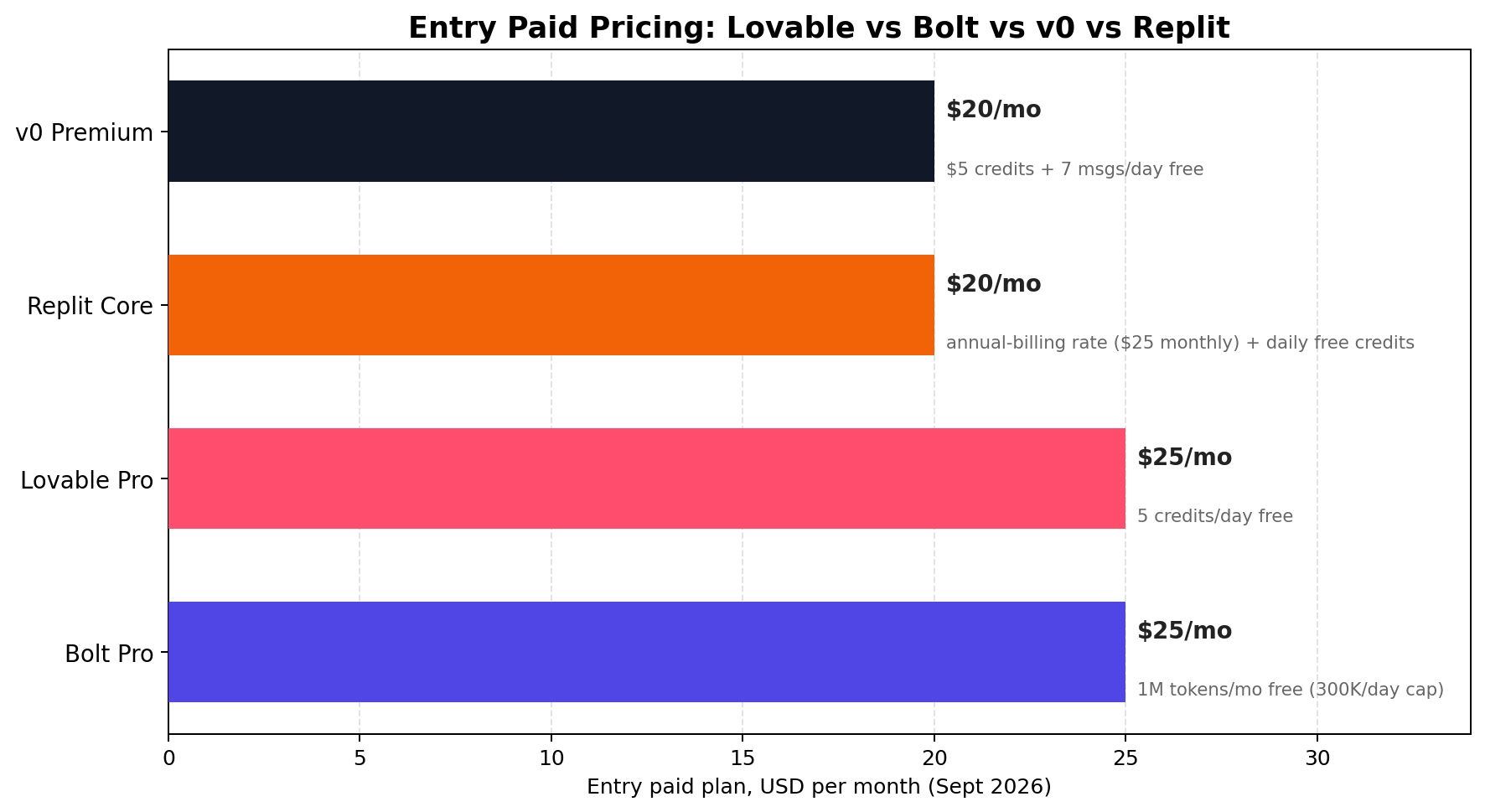
In practice the free tiers are the real differentiator for first-time users: Bolt's 1M tokens/month (300K/day cap) funds several complete prototypes, Lovable's 5 credits/day is a daily tasting menu, v0's $5/month plus 7 messages/day is enough for one landing page, and Replit's daily Agent credits let the flagship agent stretch its legs daily. For paid work, budget the same $20–25 on all four — then expect Lovable users to buy credit top-ups ($15/50) and Replit users to consume credits fastest on long autonomous runs.
Head-to-Head: All 7 Dimensions, Scored
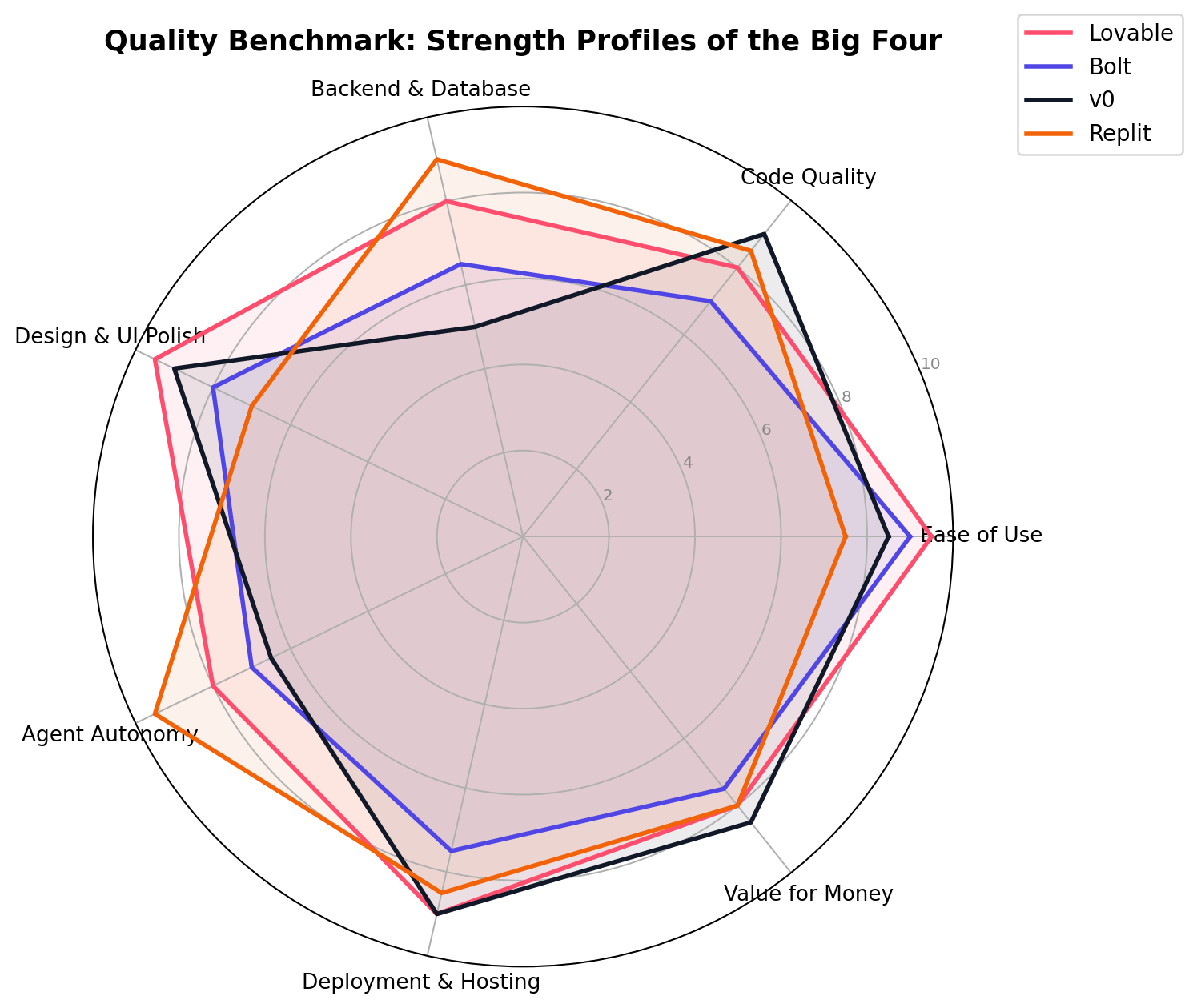
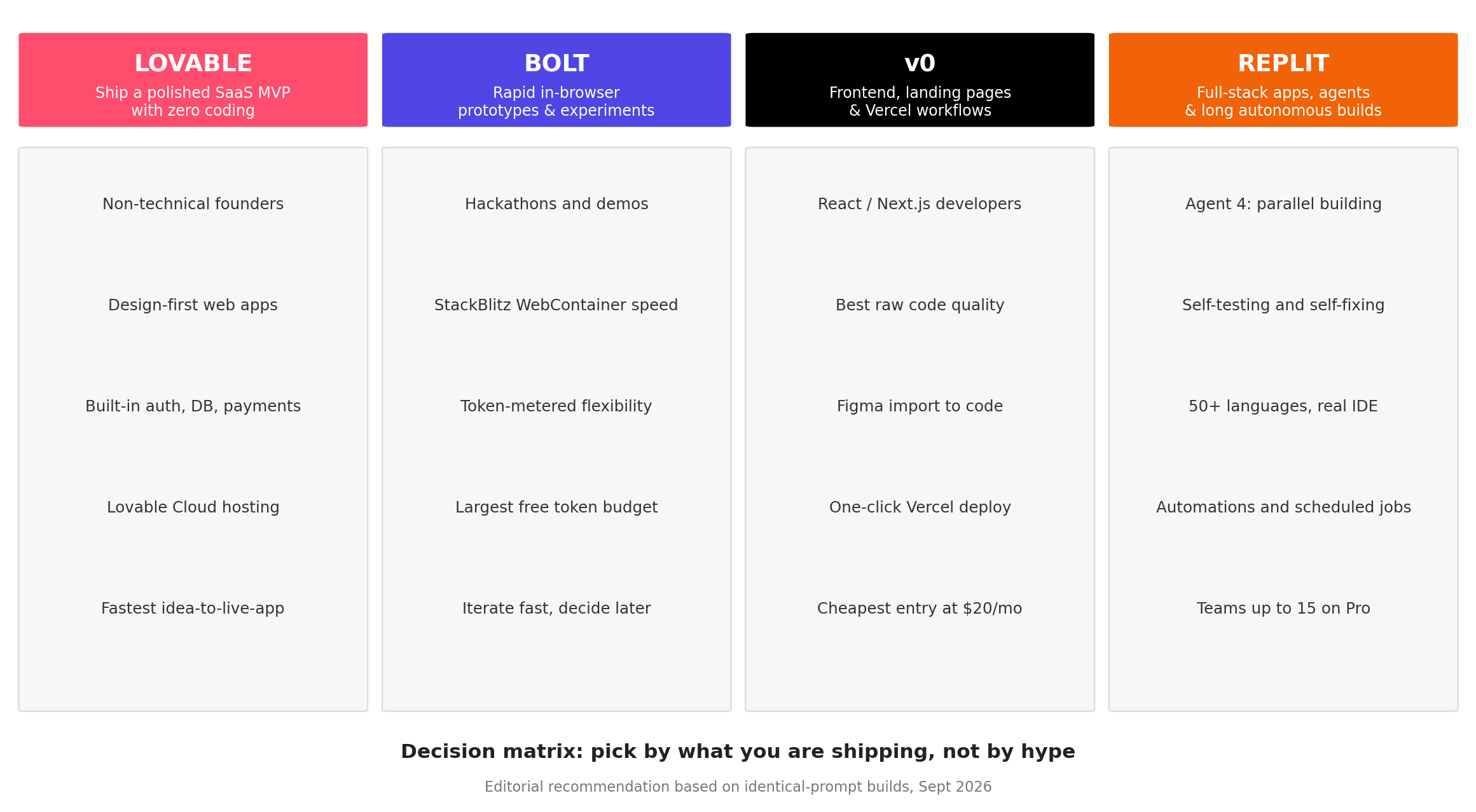
We scored every tool 0–10 on seven dimensions after identical-prompt builds on all four platforms (methodology below). Dimension winners: Lovable takes Ease of Use and Design & UI Polish; v0 takes Code Quality and Value for Money; Replit takes Backend & Database and Agent Autonomy; Deployment & Hosting is a tie between Lovable (Lovable Cloud) and v0 (Vercel-native) at 9.0. Bolt wins nothing outright — but holds the best free tier and the fastest throwaway loop, which the raw dimension scores understate.
1. Ease of Use — Winner: Lovable (9.5)
Lovable 9.5 vs Bolt 9.0 vs v0 8.5 vs Replit 7.5. Lovable requires the least explanation: describe the app, accept the plan, watch it appear. Bolt's browser-only runtime is nearly as frictionless. v0 assumes you know what components are. Replit's IDE-first design pays off later at the cost of the steepest on-ramp here.
2. Code Quality — Winner: v0 (9.0)
v0 9.0 vs Replit 8.5 vs Lovable 8.0 vs Bolt 7.0. v0's React/Next.js output is production-adjacent and idiomatic — developers ship it, not rewrite it. Replit's multi-file projects are solid and test-covered (the agent writes its own tests). Lovable's code is clean but optimized for its own platform. Bolt's speed-first output needs the most human cleanup.
3. Backend & Database — Winner: Replit (9.0)
Replit 9.0 vs Lovable 8.0 vs Bolt 6.5 vs v0 5.0. Replit ships built-in Postgres, auth wiring and background jobs — a real server story. Lovable Cloud (Supabase-backed) is close behind and simpler to operate. Bolt's backend support is functional but limited. v0 has none by design: bring your own Supabase and connect it yourself.
4. Design & UI Polish — Winner: Lovable (9.5)
Lovable 9.5 vs v0 9.0 vs Bolt 8.0 vs Replit 7.0. Lovable's first drafts are consistently client-presentable; v0 follows closely with excellent design-system discipline (Tailwind + shadcn/ui). Bolt produces respectable UI fast. Replit's Agent 4 visual canvas improved things, but its defaults are still the most utilitarian of the four.
5. Agent Autonomy — Winner: Replit (9.5)
Replit 9.5 vs Lovable 8.0 vs Bolt 7.0 vs v0 6.5. Agent 4's ~200-minute autonomous runtime with parallel agents and self-testing is a different class of delegation — you can genuinely walk away. Lovable's Agent Mode handles multi-step builds well within a session. Bolt and v0 are stronger at generation than orchestration.
6. Deployment & Hosting — Tie: Lovable & v0 (9.0)
Lovable 9.0 and v0 9.0, Replit 8.5, Bolt 7.5. Two different perfection stories: v0 is Vercel-native (the industry-standard frontend pipeline), while Lovable hosts the whole stack — frontend, database, auth — on Lovable Cloud with a custom domain in one flow. Replit Deployments are reliable but more manual. Bolt hosting is the least mature.
7. Value for Money — Winner: v0 (8.5)
v0 8.5 vs Lovable 8.0 and Replit 8.0 vs Bolt 7.5. At $20/month with rollover credits and the best code quality, v0 delivers the most professional output per dollar — provided you don't need a backend. Lovable and Replit tie at 8.0: both justify their price if their specialty (full business stack vs autonomous full-stack building) matches your project. Bolt's value case rests on the free tier and the 10M-token Pro allotment.
How We Tested
Every number in this comparison comes from one of three sources, weighted in this order: (1) vendor list prices and spec sheets as published on official pricing pages in September 2026 — the dollar figures here are list prices, not negotiated or promotional rates; (2) our own hands-on sessions — we ran an identical prompt set through all four platforms: a marketing site for a local business (hero, services, contact form, custom domain), a SaaS MVP slice (landing page, email auth, Stripe test checkout, one database-backed feature), and an internal admin dashboard backed by a scraper; (3) public benchmarks and community reports, used only to cross-check our impressions, never as the primary basis for a score.
The 7-dimension scores (Ease of Use, Code Quality, Backend & Database, Design & UI Polish, Agent Autonomy, Deployment & Hosting, Value for Money) are editorial judgments on a 0–10 scale, formed after those sessions and debated to consensus by two reviewers working independently. Where a claim depends on a dated event — Replit's Agent 4 launch in July 2026, Bolt's Pro re-rating to 10M tokens — we name the date in the text so staleness is visible at a glance. Prices and model versions were last fully re-verified on September 2, 2026.
Real-World Tests: What the Money Actually Looks Like
Benchmarks rank tools; invoices choose them. Here are three workloads drawn from documented 2026 freelance-economics case files, run through our own sessions on all four platforms.
Scenario 1: The Agency-Arbitrage Marketing Site (one-off client build)
The job: a five-page marketing site for a local business — hero, services, gallery, testimonials, contact form, custom domain. Market price documented in 2026 case reports: ¥3,000–8,000 (~$420–1,120) one-off, delivered at roughly one-third of traditional agency prices, with a platform ladder from Xianyu/Taobao (¥100–800) up through Zhubajie (¥500–3,000), 程序员客栈 (¥2,000–10,000) and Upwork/Fiverr ($50–500).
Best tool: Lovable. The identical prompt produced the most client-presentable first draft on Lovable (9.5 Design & UI Polish shows up exactly here), and custom domains plus Lovable Cloud hosting mean the whole delivery is one subscription. Budget: one Pro month at $25 plus, realistically, a $15/50-credit top-up across revisions — call it $40 all-in against a $420–1,120 invoice. Manual equivalent: 40–60 hours for a comparable bespoke build; on Lovable the working session is 3–6 hours including revisions. v0 is the runner-up if you already live in Vercel and hand-code the contact form's backend; Bolt wins when the client wants to "see three directions live tomorrow" (its free 1M tokens fund the throwaways); Replit is overkill.
Scenario 2: The Non-Technical Founder's SaaS MVP
The job: idea-to-revenue: landing page, email authentication, Stripe checkout, one database-backed feature (say, saved invoices), deployed on a custom domain — built by a founder who does not write code and cannot hire a dev yet.
Best tool: Lovable, with Replit close behind. Lovable is the only platform where auth, payments, database and hosting are all first-party: the MVP slice shipped in one session with zero external accounts. Replit's answer — built-in Postgres plus Agent 4 running long autonomous stretches — produced the more scalable codebase (8.5 Code Quality) and would age better into a real product, but demanded more judgment calls from the founder (7.5 Ease of Use is a real tax on non-developers). v0 produced the best landing page of the four and then stopped — auth, payments and database all had to be wired to a separately-provisioned Supabase, which is exactly the step non-technical founders stall on. Budget: Lovable Pro $25–40/month (credits + top-ups, cloud usage extra) or Replit Core $20–25/month plus overage patience.
Scenario 3: The Internal-Tools Side Business (scraper + admin dashboard)
The job: a data scraper feeding an internal admin dashboard — the classic "small automation someone will pay for monthly" product. Documented economics: manual build 8–12 hours; AI-agent build ~45 minutes; SaaS admin panels shipping in ~4 hours; effective rate jumping from ~¥37/hr to ~¥500/hr (~$70/hr).
Best tool: Replit. This is Agent 4's home turf: a ~200-minute autonomous runtime that writes the scraper, writes tests for it, runs them, fixes failures, stands up the Postgres tables, and deploys the dashboard — with Automations to re-run the scraper on a schedule. The 9.5 Agent Autonomy and 9.0 Backend & Database scores map one-to-one onto this workload. The hybrid play works too: v0 for the dashboard's front end (best code, $20/month) wired to your own infrastructure. Bolt handles the quick "scrape this one page right now" requests well within its free 1M tokens; Lovable is the wrong shape for headless data work.
Alternatives Worth Considering
If none of the four fits, adjacent tools pick up the slack — mostly by targeting one slice of the same workflow:
| Tool | Starting price | Standout feature |
|---|---|---|
| Cursor | $20/mo Pro | AI-first code editor — for people who want to write code with an agent, not describe apps |
| GitHub Copilot | $10/mo Pro | Cheapest serious coding assistant; deepest VS Code/JetBrains integration |
| Claude Code | $20/mo (Claude Pro) | Terminal-native agent for refactors and multi-file work on existing repositories |
| Windsurf | $15/mo Pro | Agentic IDE with strong multi-file editing; a Cursor alternative at a lower price |
The honest segmentation: the four app builders in this comparison trade control for speed, while the tools above trade speed for control. If your project is 80% new code from a blank page, stay here; if it's 80% existing codebase, use the alternatives.
The Verdict
🏆 Our Recommendations
Best for non-technical founders and SaaS MVPs → Lovable. Highest overall average (8.6/10), top Ease of Use (9.5) and Design & UI Polish (9.5), and the only complete first-party business stack: built-in auth, Stripe payments, Supabase-backed Lovable Cloud and custom domains. From prompt to paying customers without writing a line of code — that's the promise, and in our testing it delivered.
Best for full-stack apps and autonomous agents → Replit. Agent 4's ~200-minute self-testing runtime is a genuine delegation milestone, and the built-in Postgres plus real IDE make it the strongest place for apps that have to grow up. Accept the steeper learning curve (7.5 Ease of Use) as the price of the deepest capability set.
Best for frontend code quality and value → v0. Best raw code of the four (9.0), cheapest entry ($20/mo), Vercel-native deployment, Figma import. The catch is structural: no backend, no auth, no payments — bring your own. For developers, that's not a bug.
Best for free prototyping → Bolt. Zero-setup in-browser environment and the biggest free tier (1M tokens/mo) make it the lowest-commitment way to test any idea — and the fastest for hackathon-shaped work. Its 7.5 average reflects thin backend and code quality, not bad product judgment.
The hybrid play. The stack we see working professionals converge on: prototype free in Bolt, ship the client-facing MVP in Lovable, hand the frontend to v0 for production-quality code, and run long-lived full-stack automation on Replit — realistically $45–65/month across two of them. Our pick for most first-time builders: start on Bolt's free tier this week, and graduate to Lovable or Replit the moment the project has users.
Frequently Asked Questions
Which is the cheapest AI app builder in 2026: Lovable, Bolt, v0 or Replit?
On entry paid plans, v0 Premium and Replit Core tie at $20/month, with Lovable Pro and Bolt Pro at $25/month. Note that Replit's $20 rate requires annual billing — month-to-month Core is $25. On free tiers Bolt is the clear volume leader with 1M tokens per month (300K daily cap), ahead of Lovable's 5 credits/day, v0's $5 monthly credits, and Replit's daily Agent credits.
Can a non-programmer really launch a SaaS product with these tools?
Yes — Lovable is the strongest pick for non-technical founders. It scored 9.5/10 on Ease of Use in our testing, and it is the only one of the four with built-in authentication, Stripe payments, and a Supabase-backed database plus hosting (Lovable Cloud). The typical path: prompt a landing page, connect auth and payments, deploy to a custom domain, then sync the full source to GitHub via Code Mode when you hire developers.
Which AI app builder generates the best code quality?
v0. It scored 9.0/10 on Code Quality — the highest of the four — producing clean React/Next.js with Tailwind and shadcn/ui conventions that professional developers keep rather than rewrite. Replit follows at 8.5 with real multi-file, test-covered projects, Lovable scores 8.0, and Bolt 7.0.
Do I own the code that Lovable, Bolt, v0 or Replit generate?
Yes, on all four platforms. Lovable syncs the full source to GitHub via Code Mode, Bolt and v0 export standard web projects, and Replit gives you the complete repository plus deployment configuration. Code generated on paid plans is yours to use commercially; check each vendor's terms for AI-training rights — v0's Business plan ($100/user) adds an explicit AI-training opt-out.
What is the best free tier among the four app builders?
Bolt's, by volume: 1M tokens per month with a 300K daily cap — enough for several complete prototype sessions. Lovable gives 5 credits per day (roughly five messages), v0 gives $5 of credits per month plus 7 messages/day, and Replit drips daily Agent credits. For sustained free building, Bolt wins on volume; for sampling a paid-grade builder agent daily, Lovable's drip is the most capable.
Are people actually making money building apps with these tools?
Documented 2026 case economics say yes, at meaningful scale: AI web-build orders on Xianyu grew 1,732% year-over-year; solo builders deliver one-off marketing sites for ¥3,000–8,000 (~$420–1,120) at roughly one-third of agency prices; a scraper that took 8–12 hours manually now ships in about 45 minutes on an autonomous agent — lifting effective hourly rates from ~$5 to ~$70. Our Scenario tests above reproduce these workloads on each platform.