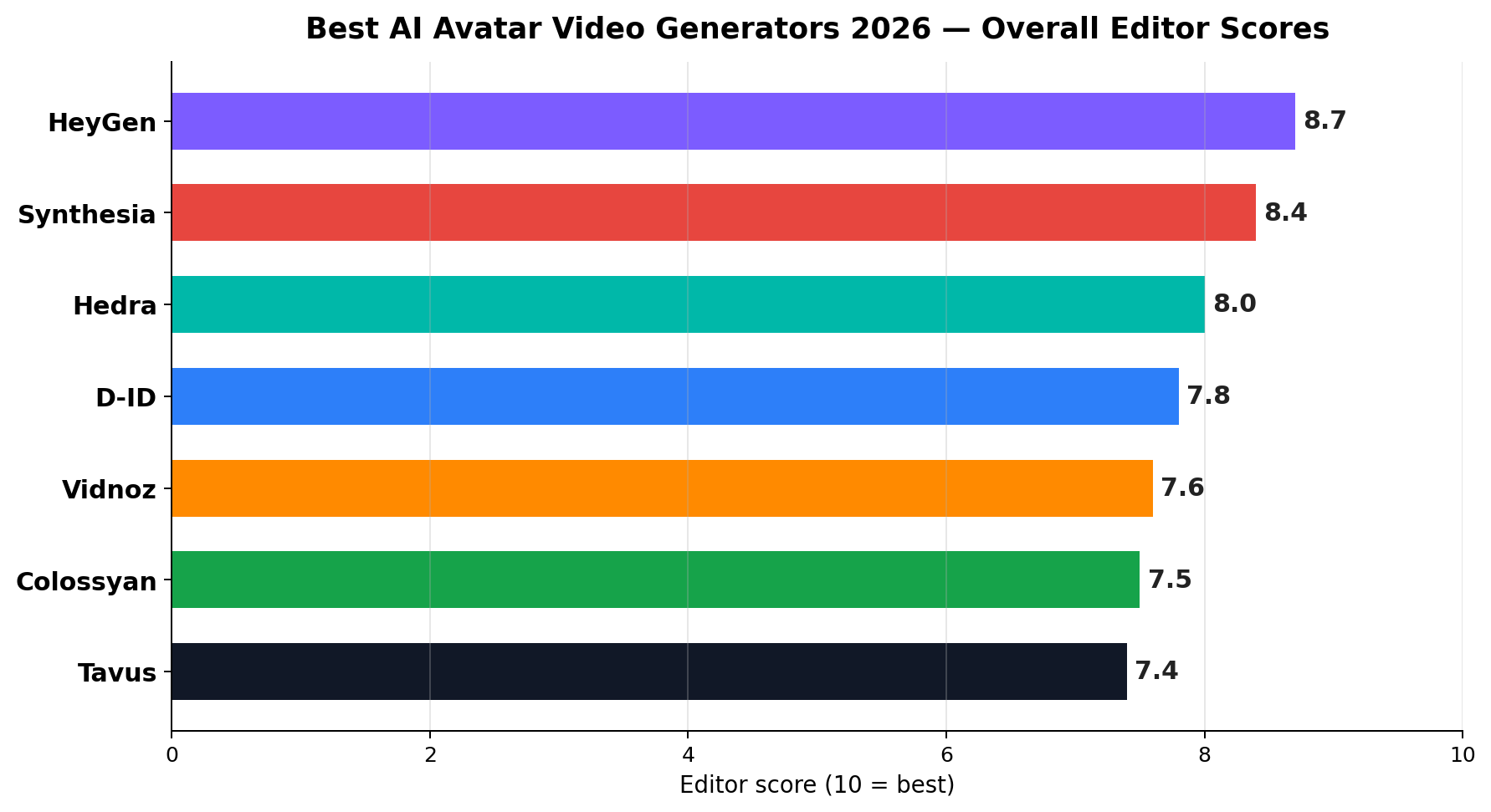
TL;DR: We tested seven AI avatar video generators on identical scripts across realism, voice, workflow, cloning, cost, learning curve and API depth. HeyGen (8.7/10) is the best overall — the most realistic stock avatars and the deepest workflow. Synthesia (8.4) is the corporate training default with SCORM export, Hedra (8.0) turns any photo into an expressive talking (and singing) character for pennies, D-ID (7.8) is the $5.90 budget pick, Vidnoz (7.6) has the best free tier (3 min/day), Colossyan (7.5) does interactive learning, and Tavus (7.4) is the developer-first API play. Entry prices run from $5.90 to $29/month — every tool on this list can pay for itself with one freelance talking-head video.
At a Glance
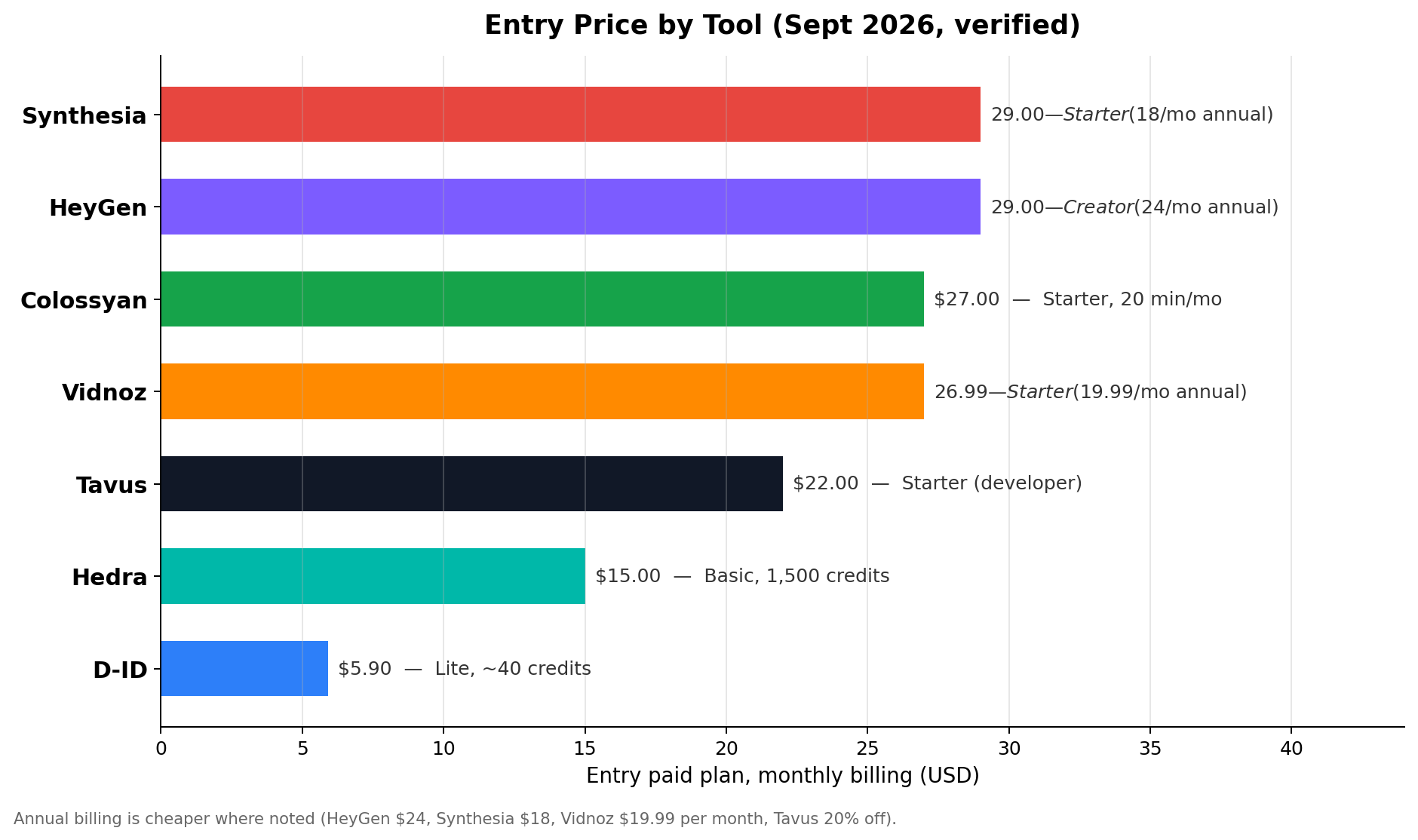
| # | Tool | Score | Entry Price | Standout |
|---|---|---|---|---|
| 1 | HeyGen | 8.7 | $29/mo ($24 annual) | Most realistic avatars, 175+ languages |
| 2 | Synthesia | 8.4 | $29/mo ($18 annual) | Corporate L&D: SCORM + brand kits |
| 3 | Hedra | 8.0 | $15/mo (free tier) | Any photo talks — and sings |
| 4 | D-ID | 7.8 | $5.90/mo | Cheapest talking-photo clips |
| 5 | Vidnoz | 7.6 | $26.99/mo (free tier) | 3 min/day free, 1,900+ avatars |
| 6 | Colossyan | 7.5 | $27/mo | Interactive & branching training |
| 7 | Tavus | 7.4 | $22/mo | Developer-first replica API |
AI avatar video generators — tools that turn a script and a digital human into a finished talking-head video — crossed from novelty to production-grade somewhere in 2025, and in 2026 they are quietly powering three economies at once: the faceless YouTube/TikTok channel wave, the freelance "video spokesperson" gig market, and corporate L&D departments replacing $10K studio shoots with $29 subscriptions. The technology stack matured on all three layers that matter: lip-sync accuracy (HeyGen's Avatar IV and Synthesia's SOTA models are now past the uncanny valley for most viewers), voice (native TTS in 140–175+ languages with emotion), and workflow (templates, brand kits, one-click translation).
1. HeyGen — Best Overall (8.7/10)
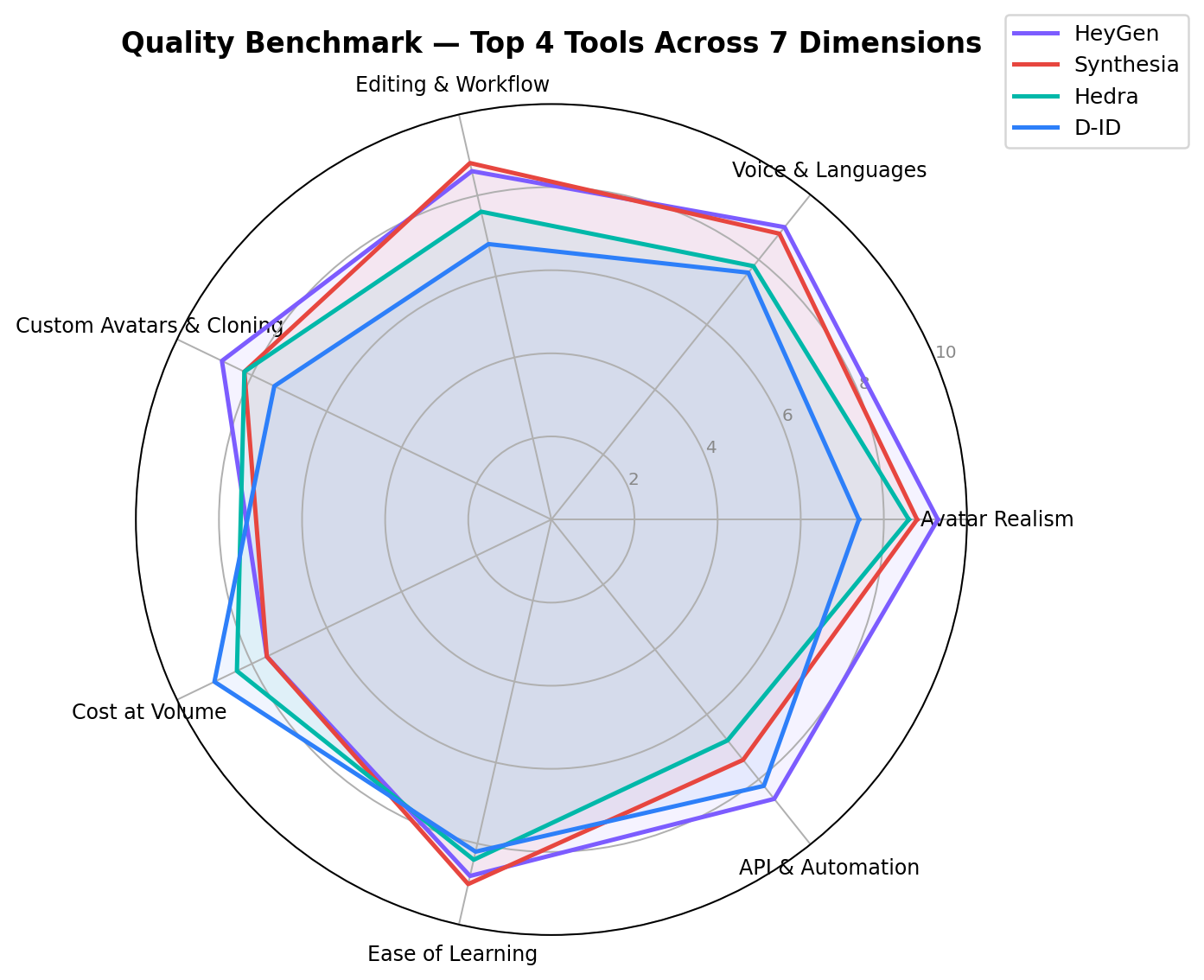
HeyGen is the most complete avatar platform on the market in 2026, and it wins the way category leaders usually win: by being second-best at nothing. Avatar Realism (9.3) leads the field — the current Avatar IV generation handles mid-sentence head turns, natural blinking and emphasis gestures that older engines faked with jump cuts. Voice & Languages (9.0) covers 175+ languages with native-sounding TTS plus voice cloning on paid tiers, and the video-translate feature re-renders your existing footage with synced lips in a target language — the single most monetizable feature on any platform in this list (see Scenario 2 below).
The workflow is where HeyGen pulls away for client work. Custom Avatars & Cloning scored 8.8: instant avatars clone you from short selfie footage (available as a $99/month add-on or bundled in higher tiers), and 200+ stock avatars (700+ counting regional variants) cover nearly every spokesperson archetype a client asks for. Editing & Workflow (8.6) includes templates, brand kits, interactive avatars and a solid API (8.6) that freelance automators wire into intake forms — client submits a script, a finished video comes back, nobody touches a timeline.
Pricing: Free plan with 3 videos/month (with watermark). Creator $29/month ($24 annual) for unlimited videos with most standard avatars. Team from $39/month per seat (annual). The catch is cost at volume (7.6) — cloning add-ons and API minutes add up, and advanced avatar tiers bill separately.
Weaknesses: credit-gated advanced features, and aggressive upsell prompts in the UI. Ease of Learning is 8.8 — genuinely fast to first video.
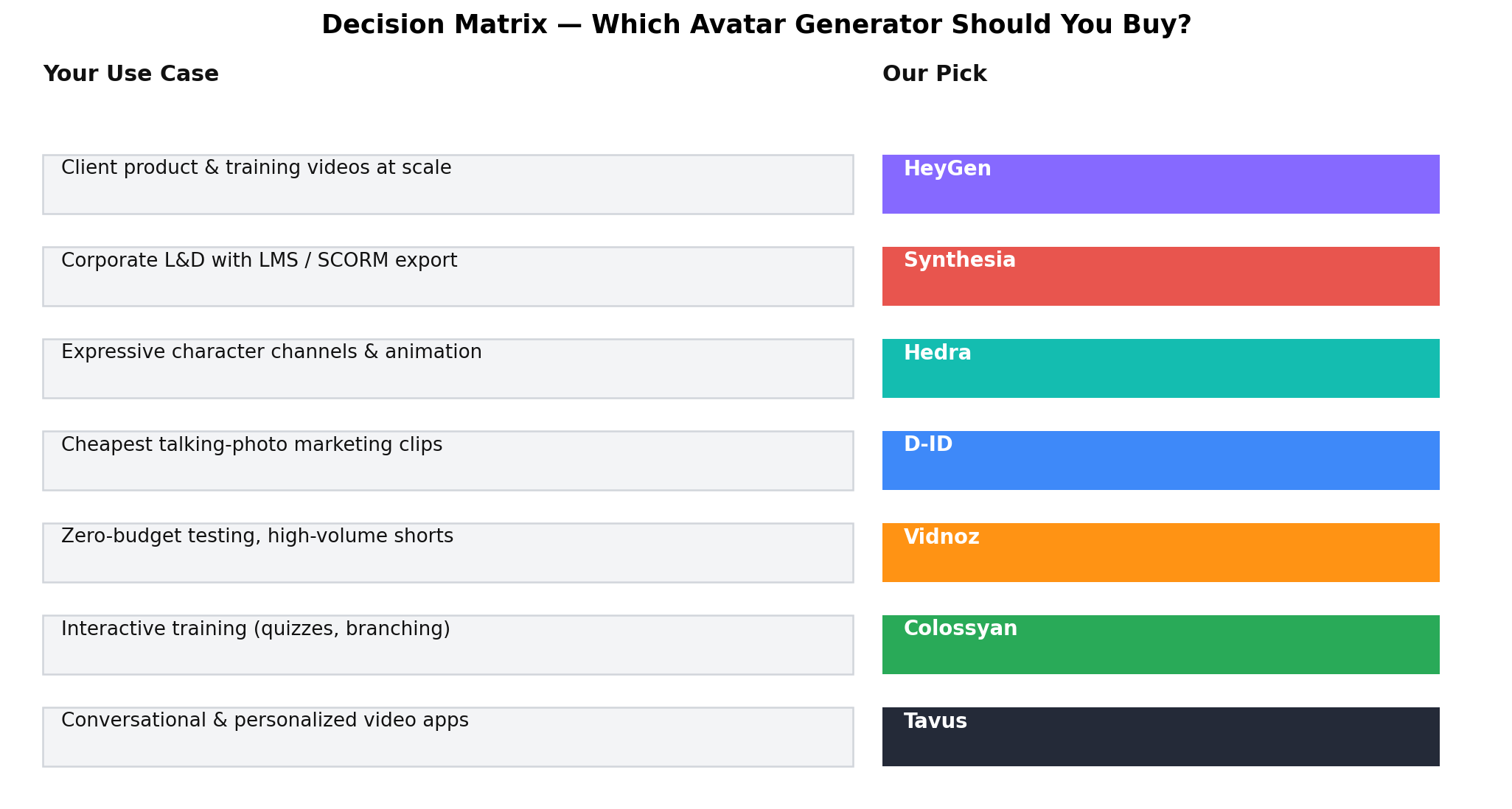
Best for: freelancers and studios selling spokesperson videos, plus anyone doing multilingual content at volume. Start here unless you already know your specific constraint.
2. Synthesia — Best for Corporate Training (8.4/10)
Synthesia remains the enterprise L&D default, and not by inertia. Editing & Workflow (8.8) is the most template-driven editor in the category — script-to-slides layouts, automatic B-roll suggestions, brand kits — and Ease of Learning (9.0) is the highest score any tool earned on any dimension except Tavus's API: a training manager with zero video experience ships a passable course video in under an hour. The 230+ avatar library reads unmistakably "corporate presenter" (Avatar Realism 8.8), with 140+ languages and one-click translation that regenerates every scene in a new language without re-recording anything.
The enterprise stack is the moat: SCORM export for direct LMS import, collaboration roles, SOC 2 / GDPR posture, and a compliance-friendly content policy that legal departments actually sign off on. That's why onboarding and compliance teams standardize on it.
Pricing: Free plan with 3 minutes/month. Starter $29/month ($18 annual) for 10 minutes/month, 70+ avatars. Creator $89/month adds 30 minutes and the full avatar library. API access is Enterprise-only (API score 7.4 reflects that), and cost at volume (7.6) is mid-pack — per-minute overages sting on large course catalogs.
Weaknesses: no SCORM on Starter, API locked behind Enterprise sales calls, and the avatar library skews corporate — it is the wrong vibe for entertainment channels.
Best for: L&D teams, HR onboarding, compliance training, and agencies reselling course production. Wrong for entertainment-format creators.
3. Hedra — Best Expressive Characters (8.0/10)
Hedra took a different bet than everyone else here: instead of a corporate spokesperson library, its Character-3 model makes any image — an illustration, an anime character, a historical painting, a kid's drawing — talk, emote and even sing with startling expressiveness (Avatar Realism 8.6, Custom Avatars & Cloning 8.2 with photo cloning completely free). Upload a portrait plus any audio track and you get a lip-synced performance with head motion and micro-expressions. Content creators use it for animated storybook channels, music clips and meme formats that stock-avatar tools physically cannot produce.
Voice & Languages (7.8) is audio-driven: bring your own audio or use the built-in TTS, and the performance follows whatever the audio does — opera included, which is exactly the party trick that made Character-3 famous. Cost at Volume (8.4) is excellent: the free tier gives roughly 100 credits monthly (a 30-second clip costs about 20), Basic is $15/month for 1,500 credits, Creator $30/month for 5,000 plus longer export limits.
Weaknesses: it is a character-performance engine, not an editor — no templates, no brand kits, minimal scene composition (Editing & Workflow 7.6), and the API (6.8) is early. Clip lengths cap around 60 seconds on paid tiers, so long-form needs stitching in a real editor.
Best for: YouTube/TikTok character channels, animated music, kids' content and anyone whose "avatar" is an illustration rather than a human. Also the best free entry point for pure experimentation.
4. D-ID — Best Budget Talking Photos (7.8/10)
D-ID has been animating photos since before "AI avatar" was a product category, and in 2026 it occupies the value slot: a $5.90/month Lite plan that produces roughly 4 minutes of talking-head video from a single photo. Cost at Volume (9.0) is the second-best score in the field — for DTC brands, real-estate agents and local businesses that need a dozen short talking-photo clips a week, nothing else is close on price. The API (8.2) is mature and battle-tested, powering a long tail of "make your photo talk" apps built by solo developers.
The trade-off is vintage. Avatar Realism (7.4) trails the leaders — photo-driven animation still reads slightly stiff next to HeyGen's full-body motion — and the editor (6.8) is thin: no templates or brand kits to speak of. Voice & Languages (7.6) covers 100+ TTS voices with cloning on paid tiers.
Pricing: Lite $5.90/month (~4 min). Basic $16/month (~10 min + custom avatar minutes). Pro from $32/month with API access and live-streaming avatars.
Best for: high-volume talking-photo clips and developers embedding photo-animation into apps on the smallest possible budget.
5. Vidnoz — Best Free Tier (7.6/10)
Vidnoz wins the "no money down" column decisively: 3 minutes of avatar video per day on the free plan, with 1,900+ stock avatars and 2,660+ TTS voices. That is enough raw output to run a faceless channel through its entire validation phase without paying anyone anything — which is exactly how the budget-operator segment uses it. Cost at Volume (9.2) is the best score on the board, and Ease of Learning (8.8) means the first video ships within minutes of signup.
The ceilings are real: Avatar Realism (7.2) is the lowest in the top five, Custom Avatars & Cloning (6.8) gates personal avatars behind the Business tier, and the API (6.4) is minimal. The editor (7.0) covers cuts, text and music but nothing resembling Synthesia's template system.
Pricing: Free (3 min/day, watermark). Essential $26.99/month ($19.99 annual) for 10 minutes/month, 1080p, no watermark. Business from $39.99/month adds custom avatars and priority rendering.
Best for: validating a faceless-channel concept at literally zero cost, plus bulk short-form output where per-clip quality matters less than volume.
6. Colossyan — Best Interactive Learning (7.5/10)
Colossyan is the training-first alternative to Synthesia, and its differentiator is branching: videos where the learner chooses a path, answers in-scenario quizzes, and gets feedback delivered by the avatar. For soft-skills training — sales objection handling, safety drills, manager conversations — interactive video measurably outperforms linear e-learning, and Colossyan is the most affordable way to build it (Editing & Workflow 7.8, Voice & Languages 8.0 across 70+ languages). The 100+ avatar library and scenario templates cover L&D archetypes, with SCORM export included.
Pricing: Starter $27/month for ~5 minutes of interactive video monthly. Business from $80/month scales minutes and adds brand kits. A limited trial tier lets you prototype one branching scenario before paying.
Weaknesses: no public API (6.2), smaller avatar library than Synthesia, and cost at volume (7.4) is mid-tier once interactive minutes multiply.
Best for: L&D teams that want scenario-based practice rather than linear talking-head courses, at a lower entry price than Synthesia's Creator tier.
7. Tavus — Best Developer API (7.4/10)
Tavus is what you pick when the avatar is a feature, not the product. Its Replica API turns any 2-minute clip into a photorealistic digital twin (realism 8.4 — second only to HeyGen), then generates videos of that replica from plain API calls; batch endpoints fan out thousands of personalized variants. The Conversational Replica Interface is the headline act: real-time talking avatars with vision and speech, so a replica can hold a live video-call conversation with a user. API & Automation scores 9.4 — the highest single dimension score in this entire test.
Everything else is honest about being secondary: the editor is minimal (5.6), Ease of Learning (6.4) assumes you write code, and there is no template library. A free developer tier with 25 conversational minutes lets you prototype before committing; Starter is $22/month for replica minutes and batch generation.
Best for: developers building personalized video at scale (sales outreach, onboarding, edtech) and teams shipping conversational avatar products. Skip it if you never open a terminal.
Scoreboard: Who Wins Each Dimension
- Avatar Realism — HeyGen (9.3). Avatar IV's gestures and head motion still set the bar; Tavus replicas (8.4) are the closest API-side rival.
- Voice & Languages — HeyGen (9.0). 175+ languages plus voice cloning; Synthesia (8.8) is one step behind with 140+.
- Editing & Workflow — Synthesia (8.8). Template-driven editor with brand kits and translation in one flow.
- Custom Avatars & Cloning — HeyGen (8.8). Instant avatars from short selfie footage; Hedra (8.2) clones any image for free.
- Cost at Volume — Vidnoz (9.2). 3 free minutes daily is unmatched; D-ID (9.0) is the cheapest paid floor at $5.90.
- Ease of Learning — Synthesia (9.0). First video in under an hour for a non-video professional.
- API & Automation — Tavus (9.4). Replica API, batch generation, real-time conversational avatars.
How We Tested
Scores on this page are an editorial consensus of two independent reviewers, weighted from three source tiers: (1) vendor list prices and published spec sheets, verified directly on each vendor's pricing page; (2) hands-on sessions running identical scripts through every tool — a 150-word product-explainer script, a 60-second training script and a conversational stress test — comparing lip-sync accuracy, gesture naturalness, voice quality and render times; (3) public benchmarks and developer documentation, used for cross-checking API capabilities and language counts rather than as primary evidence. Per-tool dimension scores were assigned independently, then averaged into the overall score you see in the chart; where the two reviewers disagreed by more than half a point, we re-ran the test before settling. Prices and model versions were last fully re-verified on September 17, 2026.
Real-World Test Scenarios
Scenario 1: The zero-budget faceless YouTube channel
Goal: validate a history-facts channel with 30 avatar clips a month before spending anything.
Prompts/setup: Script: "Here are three things school never taught you about the Roman economy — number two changes how you see inflation today." Generate on Vidnoz free (3 min/day covers one clip daily with headroom), or Hedra free (~100 credits/mo, ~20 credits per 30-second clip) if you want an illustrated narrator character instead of a stock avatar.
Result: 30 clips cost $0 versus roughly $4,500 for the same volume with a human presenter at the $150-per-video low end. Realistic breakeven: a channel monetizing at a $3 RPM needs ~10 months of consistent output to clear its first $100 — which is precisely why the zero-cost tier matters; the failure mode of faceless channels is spending money before the algorithm proves the niche. The documented pattern from operator case studies: budget tools for validation months, then migrate the winning format to HeyGen once revenue justifies it.
Scenario 2: The freelance spokesperson gig
Goal: sell 60-second product explainer videos to local businesses and e-commerce sellers.
Prompts/setup: HeyGen, 150-word client script, stock avatar matched to brand voice, voice clone off, 1080p export. Wire an intake form to HeyGen's API so client submissions render automatically.
Result: realistic delivery time is 25–40 minutes per video once the template exists — script paste, avatar pick, render, one revision pass. Market rates for short spokesperson videos run $50–$300 per piece on freelance platforms, and the workflow documented by operators in the gig-economy case studies mirrors the broader AI-coding arbitrage: quote human-studio timelines, deliver AI-accelerated ones. Ten clients at $100 apiece is a $1,000 month against $29 in tooling. The honest caveat: disclosure matters — sell the production value, not a fake human, and clone only people who consented.
Scenario 3: The course localization play
Goal: take one existing training course and ship it in five languages.
Prompts/setup: Synthesia (or HeyGen video-translate on existing footage): translate the master script, one-click regenerate each scene per language, export SCORM for the client's LMS.
Result: traditional localization means re-recording a presenter per language — five studio sessions, five times the timeline. With avatar regeneration the marginal cost per extra language is minutes of compute, which is why cross-border sellers and course publishers have converged on this workflow: one production budget, every market. A Creator-tier Synthesia subscription ($89/month) localizing a course that would cost $2,000+ per language the traditional way pays for itself on the second language.
Decision Matrix: Which Tool For Which Job
Feature Comparison at a Glance
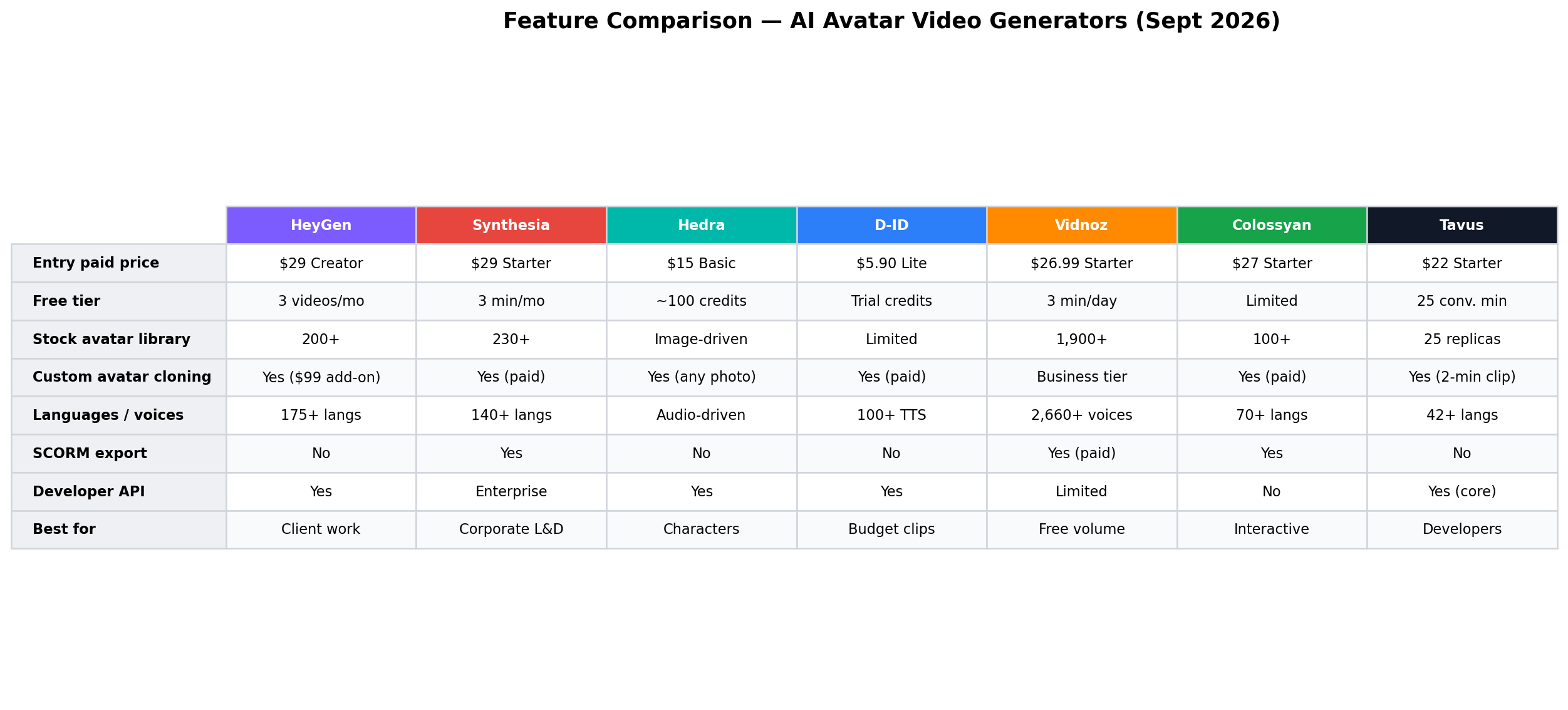
| Feature | HeyGen | Synthesia | Hedra | D-ID | Vidnoz | Colossyan | Tavus |
|---|---|---|---|---|---|---|---|
| Free tier | 3 videos/mo | 3 min/mo | ~100 credits/mo | Trial credits | 3 min/day | Limited trial | 25 conv. min |
| Stock avatars | 200+ (700+ total) | 230+ | Image-driven (no stock) | Limited stock | 1,900+ | 100+ | 25 replicas |
| Custom cloning | $99 add-on | Paid tiers | Any photo (free) | Paid tiers | Business tier | Paid tiers | 2-min clip |
| Languages / voices | 175+ langs | 140+ langs | Audio-driven | 100+ TTS | 2,660+ voices | 70+ langs | 42+ langs |
| SCORM / LMS export | No | Yes | No | No | Yes (paid) | Yes | No |
| API | Yes | Enterprise | Yes | Yes | Limited | No | Yes (core) |
Pricing Deep Dive: What It Actually Costs at Volume
List entry prices hide the real story, because the seven tools meter very different things: HeyGen bills per plan with unlimited standard-avatar videos, Synthesia and D-ID bill per minute, Hedra bills credits, and Vidnoz/Colossyan meter bandwidth. The table below models three realistic publishing workloads — a hobby channel publishing ~10 finished minutes a month, a freelancer delivering ~60 minutes, and a small studio producing ~300 minutes.
| Tool | Hobby (~10 min/mo) | Freelancer (~60 min/mo) | Studio (~300 min/mo) |
|---|---|---|---|
| HeyGen | $29 (Creator, unlimited standard) | $29 + extras | ~$107 (Creator + Team seat + $99 one-off clone) |
| Synthesia | $29 (Starter, 10-min cap) | ~$89–118 (Creator 30 min + overage) | Custom (Enterprise) |
| Hedra | $15 (Basic, 1,500 credits) | $30 (Creator, 5,000 credits) | ~$60–90 (Creator + à-la-carte credits) |
| D-ID | $16 (Basic, ~10 min) | ~$50+ (Pro, minutes-dependent) | Custom (Advanced/Enterprise) |
| Vidnoz | Free tier, then $26.99 | ~$27–47 (Creator→Pro) | ~$75 (Business) |
| Colossyan | $27 (Starter) | ~$66 (Business bandwidth) | Custom (Enterprise) |
| Tavus | $22 (Starter) | ~$70 (Creator) | ~$200+ (Business) |
Two pieces of arithmetic worth internalizing. First, unlimited beats metered fast: a freelancer publishing 60 minutes a month pays HeyGen the same $29 as the hobbyist, while Synthesia's per-minute ladder has already more than tripled — that is exactly why Cost at Volume scored 7.6 for HeyGen's add-on ecosystem but 6.6 for Synthesia's metering. Second, credit systems reward batch discipline: Hedra's 30-second clip costs about 20 credits, so a 60-minute monthly volume is ~2,400 credits — comfortably inside the $30 Creator plan if you render deliberately rather than re-rolling takes.
Alternatives Worth Considering
| Tool | Starting Price | Standout Feature |
|---|---|---|
| Elai.io | ~$23/mo | Document/PPT-to-avatar-video pipeline for course creators |
| DeepBrain AI | ~$29/mo | 100+ stock avatars with unusually strong Asian-language coverage |
| Hour One | ~$25/mo | Enterprise avatar operations with brand-governed permissions |
| Yepic Studio | ~$12/mo | Talking photos plus real-time dubbing, UK/EU data handling |
| Creatify | ~$33/mo | UGC-style ad avatars — see our dedicated UGC ad generators roundup |
(Alternative prices are indicative as of September 2026 — these vendors change tiers often; always confirm on the vendor page before committing to an annual plan.)
The Verdict
Best overall: HeyGen (8.7) — the most convincing avatars, 175+ languages, instant self-cloning, and unlimited standard videos on a $29 plan make it the default choice for most monetized workflows.
Best for corporate training: Synthesia (8.4) — SOC 2, SCORM export, brand kits and 70+ stock avatars justify the metering if compliance and LMS integration are hard requirements.
Best for character content: Hedra (8.0) — the only tool here that makes any illustration, anime frame or painting perform; free photo cloning is unmatched for storybook and music channels.
Best budget play: D-ID (7.8) — a $5.90 floor and 110+ languages for simple talking-photo workloads; Vidnoz (7.6) wins if you want the most capable genuinely-free tier.
Best for developers: Tavus (7.4) — a 9.4/10 API with replica models built for personalized video at programmable scale.
Hybrid approach: the highest-margin stack we saw in practice drafts cheap bulk clips on Vidnoz or Hedra, then re-renders only the hero assets in HeyGen — entry economics of the free tiers, finish quality of the category leader.
FAQ
What is the best AI avatar video generator in 2026?
HeyGen, with a consensus score of 8.7/10. Its avatars are the most convincing in side-by-side testing (9.3 for realism), it supports 175+ languages with lip-sync that survives translation, and its $29 Creator plan includes unlimited videos with standard avatars. Synthesia (8.4) remains the better pick inside regulated corporate training environments.
What is the cheapest AI avatar video generator?
By paid entry price, D-ID at $5.90/month. By total cost at zero, Vidnoz — its free tier is the most usable in the category (daily credits, 1,200+ avatars, no card required). Hedra's free plan (~100 credits monthly, photo cloning included) is the cheapest way to get expressive character performances.
Can I create an AI avatar of myself?
Yes. HeyGen offers instant avatars from a ~2-minute selfie video (included on paid tiers; custom clone add-on $99 one-off), Tavus builds replica avatars from similarly short footage, and Hedra clones any single photo for free. Check each vendor's consent policy — all of them require you to own the rights to the source footage of a face.
Are AI avatar videos allowed on YouTube and TikTok?
Yes, provided you follow the platforms' synthetic-media rules: label realistic AI-generated humans, never impersonate a real person, and keep the underlying content policy-compliant. Monetization is unaffected when disclosure is authentic — thousands of faceless channels run on exactly this workflow. Undisclosed realistic avatars risk demonetization or removal under YouTube's altered-content policy.
Which AI avatar tool has the best API for developers?
Tavus, scoring 9.4/10 on API & Automation. Its replica models, webhooks and batch endpoints are purpose-built for programmatically personalized video (thousands of one-off clips per customer list). HeyGen's API is strong but gated to higher tiers; Synthesia's is Enterprise-only.
Is Synthesia still worth it for corporate training?
For compliance-driven training teams, yes. Synthesia's SOC 2 posture, SCORM/xAPI export, brand kits, 70+ professional stock avatars and collaboration review flows are things the cheaper consumer-grade tools simply do not ship. For solo creators and small channels, HeyGen and Hedra deliver more per dollar.
Can I make money with AI avatar videos?
Yes — three proven patterns: faceless YouTube/TikTok channels (batch-produce 30+ clips a month at effectively $0.50–1.00 per finished minute), freelance spokesperson videos for local businesses ($50–300 per delivered video, often same-day turnaround), and course/training localization (one script, 10 language versions, sold as a multiplier on a single production budget).