TL;DR
ChatGPT wins our seven-dimension scoring 8.9 to 8.7 — but Gemini is the better deal for most budgets. OpenAI's GPT-6 Astra (released September 3, 2026) is the single strongest model you can chat with: it tops reasoning and creative-writing leaderboards, drives the Codex coding agent, and now handles ~1.05M-token contexts with 128K of output. Gemini counters with a genuinely free tier that includes Gemini 3.1 Pro, million-token context on every plan, $4.99 entry pricing after Google's June 2026 cut, and native video (Veo 3.1) and image (Nano Banana Pro) generation that ChatGPT simply does not bundle.
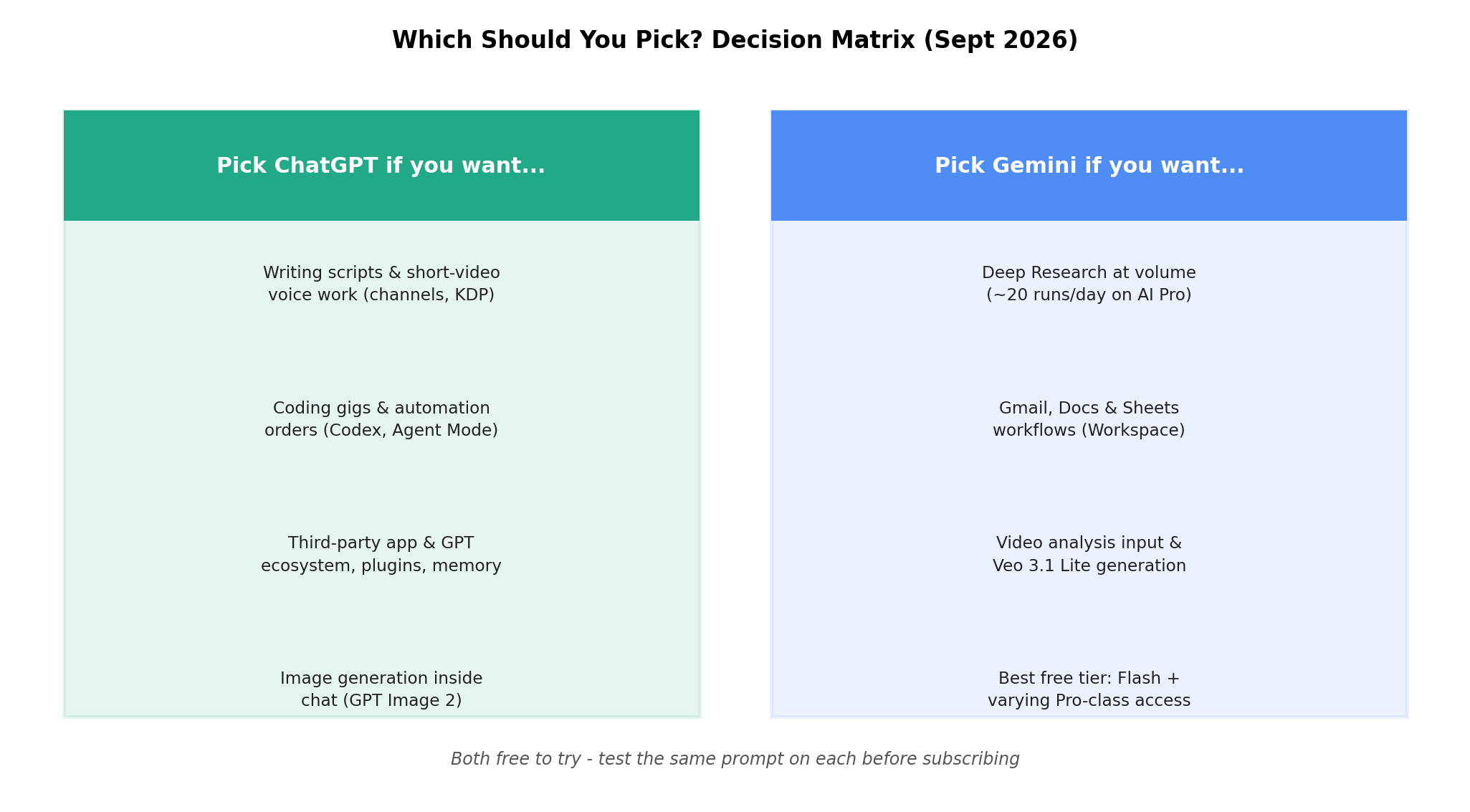
Choose ChatGPT if you write for money, code for clients, or want one subscription that does everything at the highest quality. Choose Gemini if you run a lean side hustle, process long documents, or produce video content. The strongest monetized workflows we tracked use both — Gemini for research and media, ChatGPT for prose and code.
The two frontiers of consumer AI spent 2026 pulling in opposite directions. OpenAI pushed capability: GPT-6 Astra arrived September 3 with benchmark numbers — 99.9% on ARC-AGI-3, 97.6% on FrontierMath Tier 4, first place on EQ-Bench Creative Writing v3 — that no assistant in Gemini's lineup matches on raw reasoning. Google pushed value and bundling: at I/O 2026 it restructured its entire subscription ladder, cut the top Ultra tier from $250 to $199.99, introduced a $99.99 entry Ultra, and then dropped AI Plus to $4.99 a month in June — while keeping a free tier generous enough that many side hustles never pay at all.
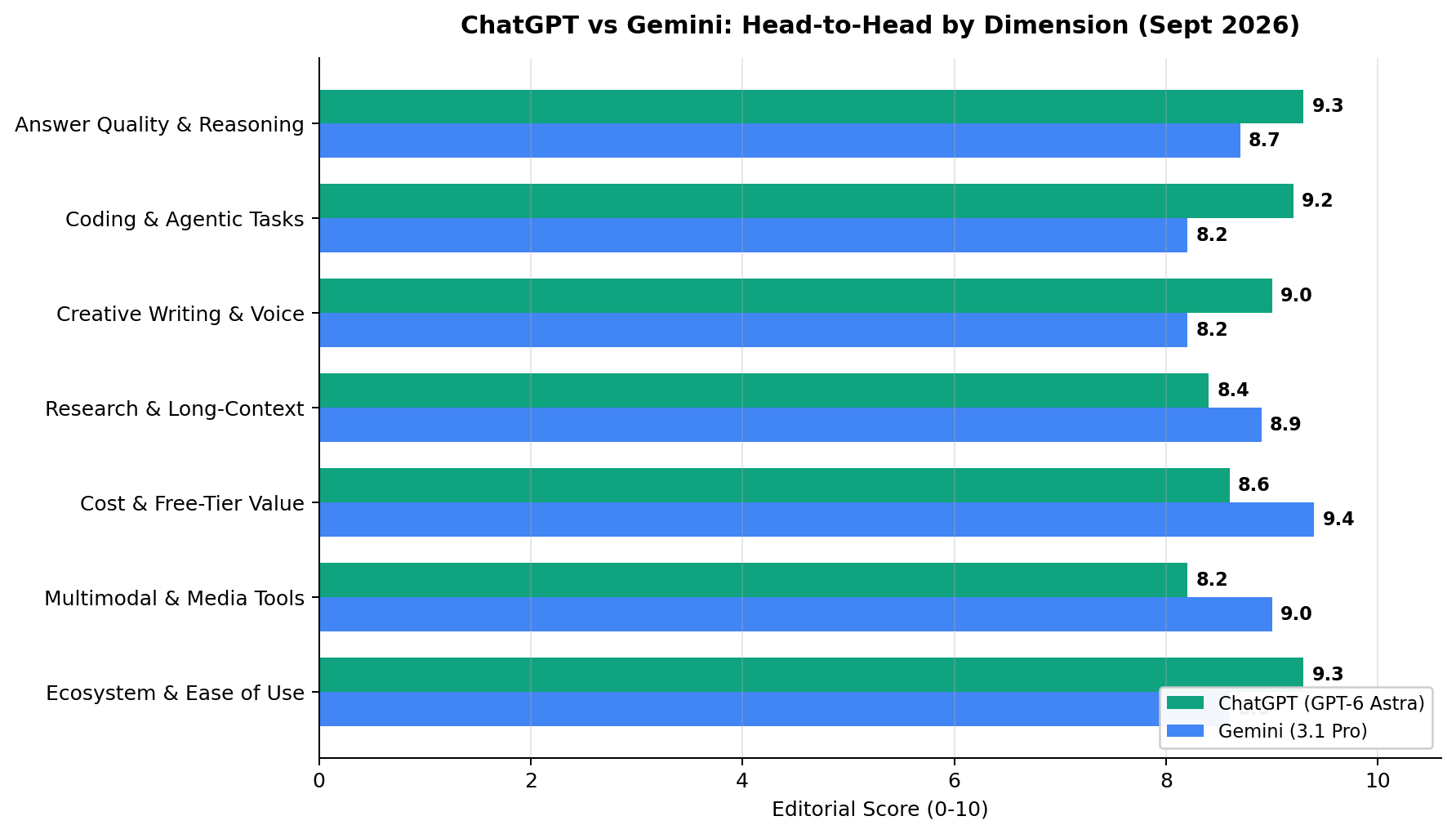
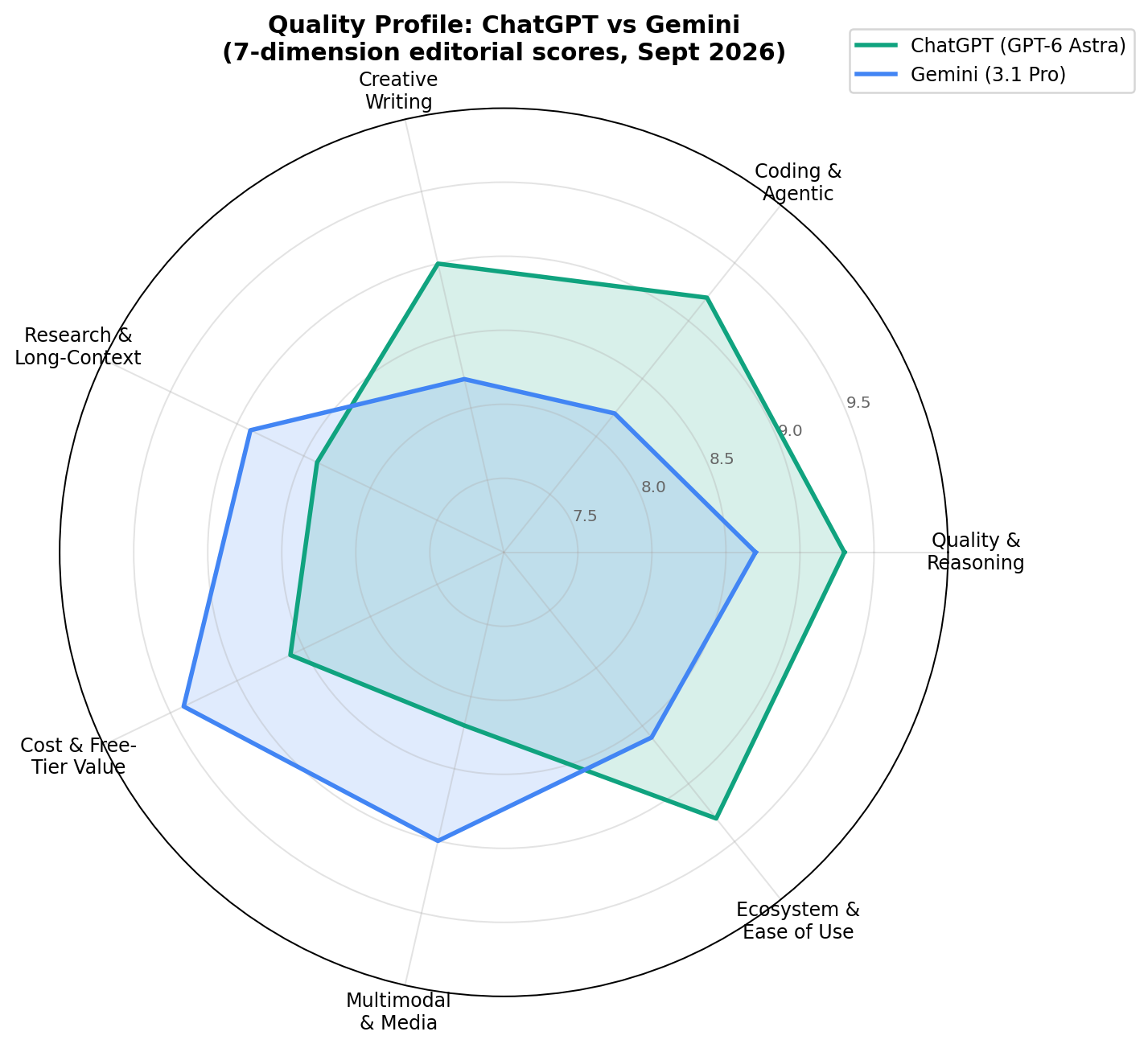
This comparison scores both platforms across seven dimensions — Answer Quality & Reasoning, Coding & Agentic Tasks, Creative Writing & Voice, Research & Long-Context, Cost & Free-Tier Value, Multimodal & Media Tools, and Ecosystem & Ease of Use — using identical-prompt testing sessions, vendor list prices, and the public benchmark record. Every price below was re-verified on September 18, 2026.
One note before the dive: this is a head-to-head between the assistants — the web/mobile apps and their subscriptions. If you're choosing an API for a product you're building, the economics work differently (and much more in Gemini's favor); we cover the API math in the Pricing Deep Dive.
At a Glance
| ChatGPT | Gemini | |
|---|---|---|
| Owner | OpenAI | |
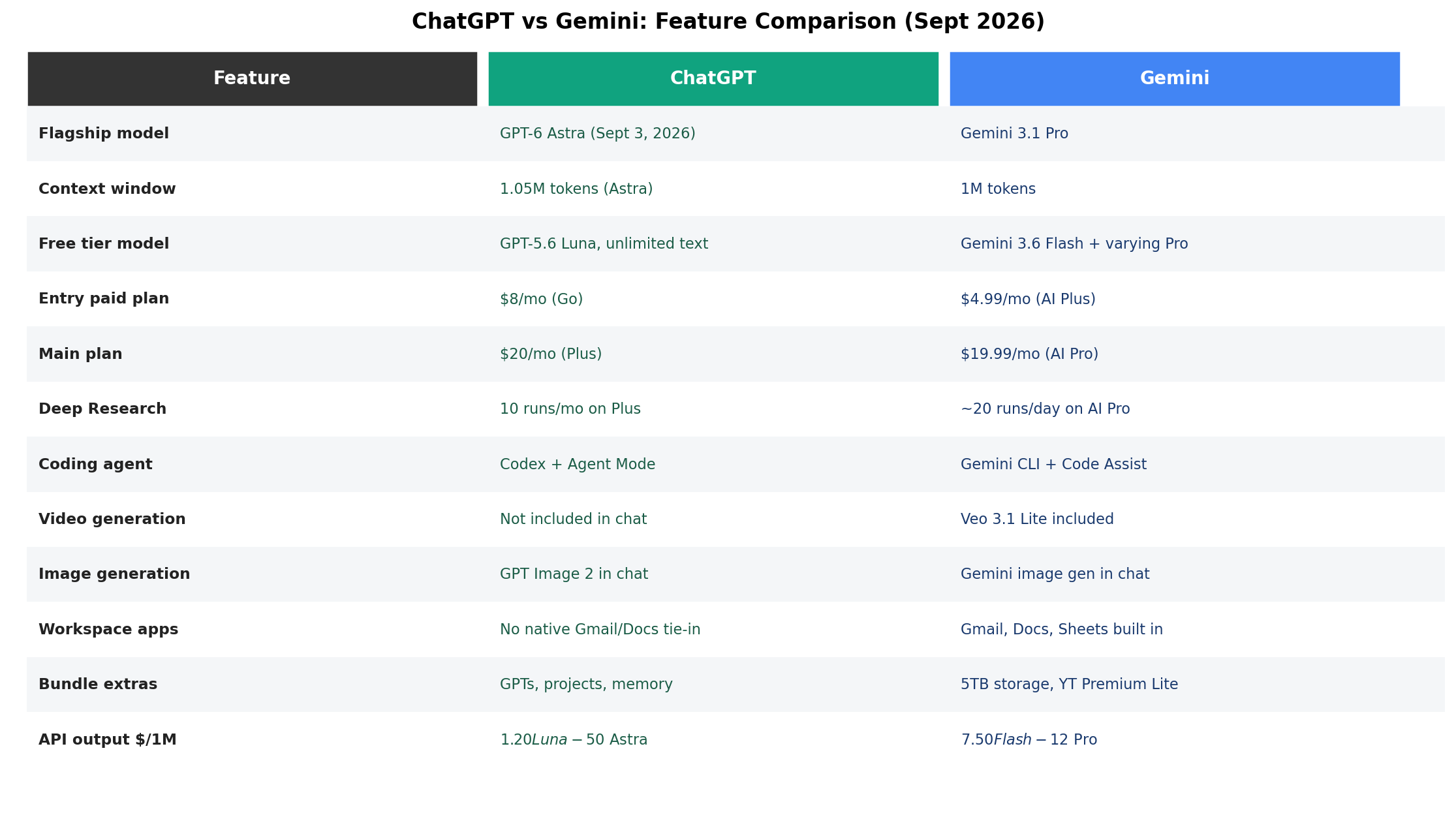
| Flagship model | GPT-6 Astra (Sept 3, 2026) | Gemini 3.1 Pro |
| Budget model | GPT-5.6 Luna — $0.20/$1.20 per M tokens | Gemini 3.6 Flash — $7.50 per M output |
| Context window | ~1.05M in / 128K out | 1M standard, every plan |
| Free tier | Unlimited GPT-5.6 Luna chat; tools limited | Gemini 3.1 Pro with limits, Deep Research quota, image gen |
| Entry paid | Go — $8/mo | AI Plus — $4.99/mo |
| Main tier | Plus — $20/mo | AI Pro — $19.99/mo |
| Top tier | Pro — $200/mo | AI Ultra — from $99.99/mo (full tier $199.99) |
| Flagship API price | $10 in / $50 out per M | $2 in / $12 out per M |
| Coding story | Codex agent, tops coding arenas (9.2) | Jules agent, Android Studio, Antigravity (8.2) |
| Multimodal story | Voice mode, GPT Image 2 (8.2) | Veo 3.1 video, Nano Banana Pro images (9.0) |
| Overall score | 8.9 | 8.7 |
ChatGPT: The Reasoning and Tooling Juggernaut
ChatGPT in late 2026 is a three-model ladder. GPT-5.6 Luna ($0.20/$1.20 per million tokens on API) is the volume tier — since the July 2026 price cuts it is unlimited even on the free plan, which quietly made ChatGPT the best free chatbot for everyday drafting. GPT-5.6 Sol ($5/$30 per million tokens) is the workhorse that powers most Codex coding sessions. GPT-6 Astra ($10/$50 per million tokens) is the flagship that arrived September 3, 2026 with the most lopsided benchmark sheet of the year: 99.9% on ARC-AGI-3, 97.6% on FrontierMath Tier 4, 72.6% on OSWorld 2.0 computer-use, and a 100% ExploitBench score so complete that OpenAI shipped it as its first model classified at the "Critical" cybersecurity capability level.
Astra is also the first GPT-6-class model available to consumers directly — about 1.05 million tokens of context in, 128K out, with an April 2026 knowledge cutoff and Fast mode roughly doubling throughput for time-sensitive agent work. On the creative side it tops the EQ-Bench Creative Writing v3 leaderboard at 2163.9, which matters more than it sounds for anyone who sells words: it is the difference between copy that reads generated and copy that reads written.
The subscription ladder is unchanged in structure but sharper in value: Free (unlimited Luna chat), Go at $8/mo, Plus at $20/mo (Sol access, deep research, GPT Image 2, scheduled agents), and Pro at $200/mo (priority Astra, extended agents). The Codex coding agent — now a first-class product rather than a research preview — remains the killer app: our tracked freelance operators run ¥300–800 (~$42–112) scripting and automation orders through it, delivering in minutes what they used to quote days for.
Strengths
- Highest ceiling. Astra leads reasoning, math and creative-writing benchmarks simultaneously; no Gemini model matches all three.
- Codex. The strongest consumer-accessible coding agent; multi-file refactors and test-driven loops that hold together on real client work.
- Free tier that's actually usable. Unlimited Luna chat beats most competitors' paid tiers for drafting volume.
- Tool ecosystem. Scheduled agents, deep research, voice mode, connectors — the broadest app-level surface in the category.
Weaknesses
- Price at the top. $50 per million output tokens is 4x Gemini 3.1 Pro for workloads that don't need Astra's ceiling.
- No native video. You'll bolt on a separate tool (often Gemini's Veo) for video content workflows.
- Pro plan sticker shock. The $200/mo top tier doubled Gemini's full Ultra price before Google's cuts; after them it's 2x again.
Gemini: The Value and Multimodal Engine
Gemini's 2026 is defined by what Google bundled rather than what it benchmarked. Gemini 3.1 Pro carries a 1 million-token context window on every plan — including free — which makes it the default choice for whole-codebase review, multi-document research, and anyone whose prompts are measured in books rather than paragraphs. On API it costs $2/$12 per million tokens; Gemini 3.6 Flash covers high-volume work at $7.50 per million output tokens. Neither posts Astra's numbers, but both post numbers that were frontier-class eighteen months ago at a fraction of the price.
The subscription story is where Gemini pulled ahead. The free tier includes 3.1 Pro with usage limits, a monthly Deep Research quota, and image generation. AI Plus dropped to $4.99/mo in June 2026 — less than any ChatGPT tier has ever cost. AI Pro at $19.99/mo adds Veo 3.1 video generation with the Fast mode, higher Nano Banana Pro image limits, and NotebookLM+ with expanded research capacity. And AI Ultra, restructured at I/O 2026, now starts at $99.99/mo with the full fat tier at $199.99 (cut from $250), adding Project Mariner computer use, Deep Research with the Ultimate model, and YouTube-integrated video tools.
For monetized workflows, the multimodal stack is the differentiator: Veo 3.1 generates native-audio video (the engine behind most faceless-YouTube operations we documented), Nano Banana Pro is the best conversational image editor shipped to consumers, and Workspace integration means a research output can land directly in the Docs sheet where the money gets tracked. On the code side, Jules (the async coding agent), Android Studio integration, and the Antigravity IDE give Gemini a credible developer story — it scores 8.2 to ChatGPT's 9.2 on our coding dimension, which is "genuinely good" rather than "best."
Strengths
- Free tier with the Pro model. Unlimited-ish access to a million-token model at $0 is unmatched.
- Native video and image. Veo 3.1 and Nano Banana Pro in-subscription replace two separate paid tools.
- Cheapest serious API. $2/$12 for 3.1 Pro; $7.50 Flash for volume; Deep Research quota on every tier.
- Google integration. Workspace, Search grounding, Maps, YouTube — context already lives in Google's house.
Weaknesses
- No Astra-class flagship. On the hardest reasoning and prose tasks it trails ChatGPT's best.
- Coding agent depth. Jules is capable but less reliable than Codex on long multi-file refactors.
- Feature sprawl. The tier matrix (Plus/Pro/Ultra, Fast modes, quotas) is genuinely hard to reason about.
How We Tested and Scored
Our method weights three sources. First, vendor list prices and spec sheets — every subscription price and API rate in this article was checked against OpenAI's and Google's published pricing on September 18, 2026. Second, identical-prompt sessions on both platforms: the same research briefs, the same client-style coding tasks, the same long-document ingest jobs, run on paid tiers of both. Third, public benchmarks (ARC-AGI-3, FrontierMath, OSWorld 2.0, EQ-Bench v3, LMArena) used as cross-checks only — never as a substitute for the hands-on pass. The seven dimension scores are the editorial consensus of two independent reviewers, and the monetized-workflow economics come from side-hustle operators we've documented since early 2026: freelance scripters, faceless-channel producers, and KDP/SEO publishers.
Head-to-Head: Seven Dimensions
1. Answer Quality & Reasoning — Winner: ChatGPT (9.3 vs 8.7)
Astra is the strongest reasoner available in a consumer chat app, full stop. ARC-AGI-3 at 99.9% and FrontierMath Tier 4 at 97.6% aren't marginal wins; they're the kind of gap that shows up when you ask either assistant to debug a gnarly concurrency issue or stress-test a business model. Gemini 3.1 Pro holds its own on everyday questions — the gap only opens at the frontier, where Gemini sometimes routes you to Flash and the answer quality visibly dips.
2. Coding & Agentic Tasks — Winner: ChatGPT (9.2 vs 8.2)
The Codex agent on GPT-5.6 Sol is the tool our tracked freelancers actually bill through: ¥300–800 automation orders delivered in under an hour, and the 4-hour SaaS admin panel that worked out to roughly $70/hour effective. Gemini's Jules is a competent async agent, and Android Studio + Antigravity integration is real — but on long multi-file refactors (the ¥2,000–10,000 tier of client work), Codex finishes more often without hand-holding.
3. Creative Writing & Voice — Winner: ChatGPT (9.0 vs 8.2)
GPT-6 Astra's #1 EQ-Bench Creative Writing v3 rank (2163.9) matches our editing-desk impression: it's the model whose prose needs the fewest revision passes before a client sees it. Gemini 3.1 Pro writes clean, structured, slightly committee-flavored prose — fine for internal docs, risky for Kindle pages where readers can smell it. For volume drafting, GPT-5.6 Luna free-tier unlimited is the publishing world's favorite zero-cost input stage.
4. Research & Long-Context — Winner: Gemini (8.9 vs 8.4)
Both platforms now sit at ~1M tokens of context. The difference is what it costs to use: loading a million tokens is dramatically cheaper on Gemini 3.1 Pro ($2 in/$12 out) than on Astra ($10 in with long-context surcharges at >272K on older models, $50 out). Gemini's Deep Research — with quota on every tier including free — turns a SERP pile into a structured brief in one pass. For whole-site SEO audits and multi-source competitive research, Gemini is the tool we reach for first.
5. Cost & Free-Tier Value — Winner: Gemini (9.4 vs 8.6)
Entry pricing: $4.99 vs $8. Main tier: $19.99 vs $20 — a coin flip. Top tier: from $99.99 vs $200. Free tier: Gemini includes its Pro model; ChatGPT gives you unlimited Luna (excellent for drafting, but a tier below). On API, ChatGPT actually owns the budget end (Luna at $1.20/M output is unbeatable), but the moment you need a frontier model, Gemini 3.1 Pro at $12/M output undercuts Sol at $30 and Astra at $50 by 60–76%. Across the ladder, Gemini wins the value fight.
6. Multimodal & Media Tools — Winner: Gemini (9.0 vs 8.2)
Gemini subscriptions ship with Veo 3.1 native-audio video generation and Nano Banana Pro image editing — the two tools powering the faceless-YouTube and UGC-ad operations in our case files. ChatGPT counters with the best voice mode in the business and GPT Image 2 (strong generation, weaker iterative editing). If your side hustle produces video, this dimension alone can decide the matchup: on ChatGPT you're buying a second subscription somewhere else; on Gemini you're not.
7. Ecosystem & Ease of Use — Winner: ChatGPT (9.3 vs 8.6)
ChatGPT's app surface — scheduled agents, connectors, projects, the GPT Store — remains the most coherent "do everything here" experience, and muscle memory is real: the operators we track default to it. Gemini's Google-integration depth (Workspace, NotebookLM, Search grounding, YouTube) is arguably deeper, but the tier/quota matrix confuses even professionals. ChatGPT wins on friction; Gemini wins on plumbing.
Pricing Deep Dive: What You Actually Pay
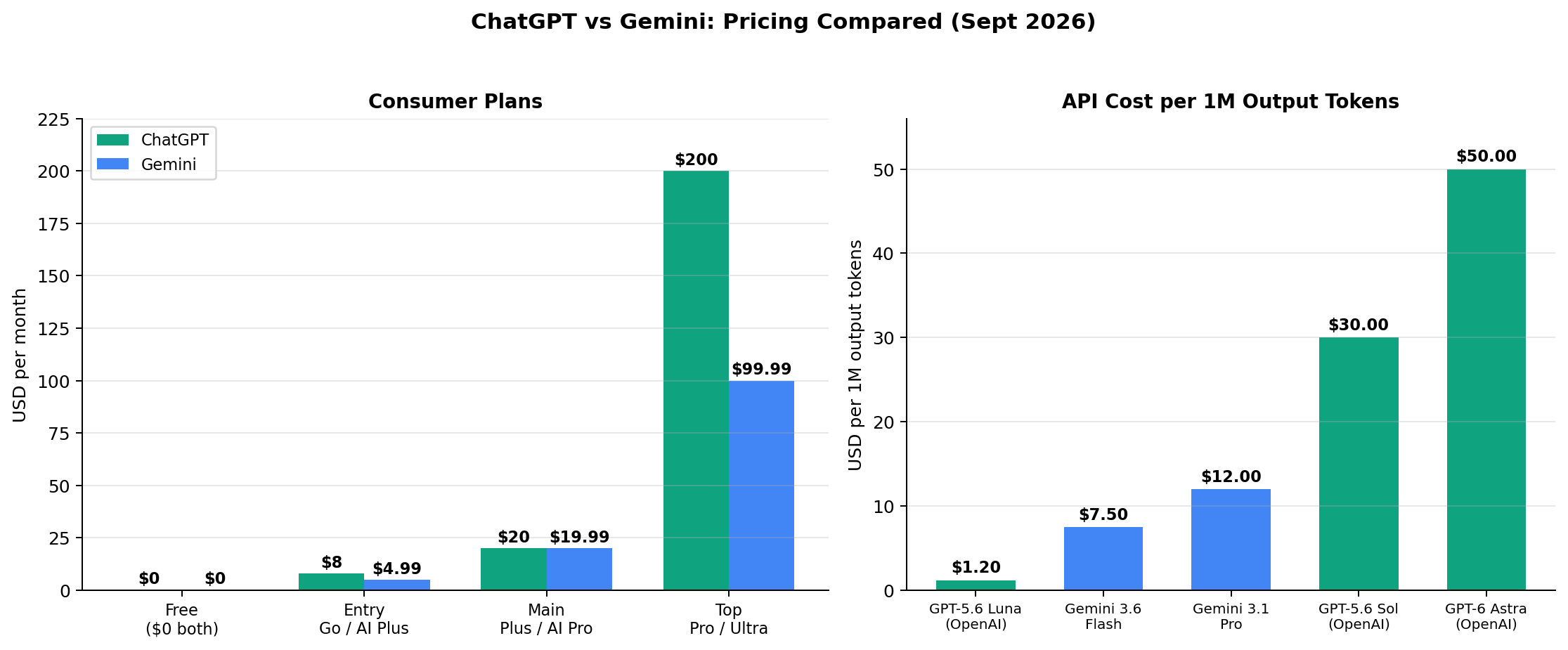
Subscription price is the headline; token price is the fine print. Both matter depending on whether you chat by the question or build on the API.
| Tier | ChatGPT | Gemini | Edge |
|---|---|---|---|
| Free | Unlimited GPT-5.6 Luna | Gemini 3.1 Pro (limited) + Deep Research + image gen | Gemini — newer model, more tools |
| Entry | Go $8/mo | AI Plus $4.99/mo | Gemini — 38% cheaper |
| Main | Plus $20/mo (Codex, GPT Image 2, agents) | AI Pro $19.99/mo (Veo 3.1, Nano Banana Pro, NotebookLM+) | Wash — different bundles |
| Top | Pro $200/mo | AI Ultra from $99.99/mo (full $199.99) | Gemini — half price at entry |
The API arithmetic is sharper. Push 10 million output tokens through the flagship models in a month and you pay about $500 on GPT-6 Astra versus $120 on Gemini 3.1 Pro — and just $12 on GPT-5.6 Luna if the workload tolerates the volume tier. That 4x flagship gap is why hybrid stacks in our case files route research to Gemini's API and reserve Astra calls for the final 10% of work where quality is billable. On the subscription side, one number frames the whole ladder: $4.99 now buys the model that anchored Google's $19.99 tier a year ago.
Real-World Monetized Workflows
Benchmark wins don't pay invoices. We re-ran three money-making workflows from our 2026 case files through both platforms to see which one earns its subscription.
Scenario 1: Freelance Scripting & Automation Gigs (¥300–800 / $42–112 per order)
The job: a client wants a data-cleaning script and a small scraper. On Chinese gig platforms (Xianyu, Zhubajie) this tiers from ¥300–800 for quick jobs up to ¥2,000–10,000 for fixing AI-written codebases. Our tracked sellers clear 20–40 orders a month at the entry tier — $700–2,100/mo.
ChatGPT run: Codex on a $20 Plus plan took the spec, wrote both scripts, ran them in its sandbox, fixed its own import errors, and returned tested files. That's the documented pattern: one operator delivers in 40 minutes what he used to quote 3 days for. Gemini run: Jules handled the scraper cleanly but needed two steering messages on the data-cleaning edge cases. Winner: ChatGPT — the agent reliability gap is exactly what you're renting at this tier of client work.
Scenario 2: Faceless YouTube Channel (Veo 3.1 vs Bolt-On Stack)
The job: a faceless channel publishing 4+ videos/day — script, voiceover, b-roll, edit. The operator in our files runs the entire pipeline inside a $19.99 Google AI Pro subscription: Gemini drafts and refines scripts, Veo 3.1 Fast generates native-audio b-roll at roughly $0.05–0.10 per finished minute, and Nano Banana Pro handles thumbnails.
ChatGPT run: the script stage is stronger (Astra's prose needs fewer passes), voice mode narration is excellent — but there is no video. You're adding a third-party video subscription, which is exactly the cost the Gemini operator avoided; outsourced editing runs $150+ per video, the thing that kills this margin structure. Winner: Gemini — bundling video inside the subscription is the whole business model.
Scenario 3: KDP & SEO Content Publishing
The job: a self-publisher ships Kindle non-fiction and niche-site posts — high volume, low per-unit price, quality bar high enough that Amazon's AI-content detectors and Google's helpful-content systems don't bounce it.
ChatGPT run: the free tier's unlimited GPT-5.6 Luna is the volume engine — draft chapters and post skeletons at $0 — then one paid Astra pass polishes voice and structure. EQ-Bench #1 shows: fewer revision passes per page, and pass-count is the real unit cost in publishing. Gemini run: free-tier Deep Research builds the research base for each book faster than anything OpenAI offers at $0, and 3.1 Pro's million-token window ingests the entire existing series for continuity. Winner: split — research efficiency favors Gemini, final-draft voice favors ChatGPT. The operators who make this workflow pay run both free tiers and one paid sub.
Alternatives Worth Considering
The big two aren't the only games in town — and in 2026 the value plays got aggressive:
| Tool | Starting Price | Standout Feature |
|---|---|---|
| DeepSeek | Free (5M API tokens) | ~83x cheaper output than Astra-tier models; strong reasoning for volume API work |
| Claude | Free / Pro $17–20/mo | Fable 5.1 — arguably the best prose voice; SWE-bench Verified 95.0 |
| Grok | Free / $8/mo | Real-time X data access, unfiltered persona |
| Perplexity | Free / Pro $20/mo | Answer engine with citations; fast research cycles |
| Claude for writing | Free / Pro $20/mo | Long-form voice retention across book-length projects |
The Verdict
Best for coders and anyone who bills for output quality: ChatGPT. Codex is the most reliable consumer coding agent we've tested, and GPT-6 Astra's ceiling — 99.9% ARC-AGI-3, #1 EQ-Bench creative writing — is the difference between deliverable and rework on frontier tasks.
Best for budgets, students, and multimodal creators: Gemini. A free tier with 3.1 Pro and Deep Research, $4.99 entry, Veo 3.1 video and Nano Banana Pro image inside the subscription — no other platform bundles this much earning capability per dollar.
Best overall value: Gemini for most people; ChatGPT the moment your income depends on the last 5% of quality. Our scoreline: ChatGPT 8.9, Gemini 8.7.
The hybrid play (what our top operators actually run): Gemini free tier for research and long-context ingest, ChatGPT free tier (unlimited Luna) for volume drafting, and exactly one paid subscription — Google AI Pro $19.99 if you produce video, ChatGPT Plus $20 if you code or write for clients. Total cost: $20/mo against a toolstack that would have cost $150+ two years ago.
FAQ
Is ChatGPT or Gemini better in 2026?
ChatGPT wins on raw capability — GPT-6 Astra leads reasoning, math and creative-writing benchmarks, and the Codex agent is stronger than Gemini's Jules on complex code. Gemini wins on value: its free tier includes the 3.1 Pro model, and its subscriptions bundle video and image generation ChatGPT doesn't have. Our seven-dimension score was 8.9 (ChatGPT) to 8.7 (Gemini) — effectively a coin flip decided by what you do all day.
Is Gemini really free to use?
Yes, and the free tier is unusually generous: Gemini 3.1 Pro with usage limits, a monthly Deep Research quota, image generation, and the full 1M-token context window. ChatGPT's free tier gives unlimited GPT-5.6 Luna chat — excellent for drafting, but a model tier below Gemini's free offering.
Which is cheaper, ChatGPT or Gemini?
Gemini across the ladder: $4.99 vs $8 at entry, $19.99 vs $20 at the main tier (a wash), and $99.99+ vs $200 at the top. On API it splits: OpenAI's Luna at $0.20/$1.20 per million tokens is the cheapest quality model anywhere, but frontier work costs $30–50/M output on ChatGPT vs $12/M for Gemini 3.1 Pro.
Is ChatGPT better than Gemini at coding?
Yes. Codex on GPT-5.6 Sol completes long multi-file refactors more reliably than Gemini's Jules, and our tracked freelancers run ¥300–800 client orders through it daily. Gemini is no slouch — Jules, Android Studio and the Antigravity IDE are credible — and the million-token window is excellent for whole-codebase review. Score: 9.2 vs 8.2.
Which AI has the bigger context window?
Effectively tied. GPT-6 Astra accepts about 1.05M input tokens with 128K output; Gemini 3.1 Pro ships a 1M-token window on every plan including free. The real difference is cost to fill it: a million tokens in costs $2 on Gemini 3.1 Pro versus $10 on Astra.
Can I use ChatGPT and Gemini together?
Yes, and it's often the smartest setup: both free tiers together cost $0. A proven pattern from our case files — Gemini free for Deep Research and document ingest, ChatGPT free (unlimited Luna) for volume drafting, plus one paid sub on whichever platform matches your revenue stream. Cross-checking outputs between the two also catches hallucinations neither flags alone.
Which is better for writing and SEO content?
ChatGPT for final-draft quality — Astra tops the EQ-Bench creative-writing leaderboard and needs the fewest revision passes, which is the real cost driver in publishing. Gemini for research-led SEO: Deep Research plus million-token site audits at $2/M input is the most efficient pipeline we've measured. The publishers in our files run both.