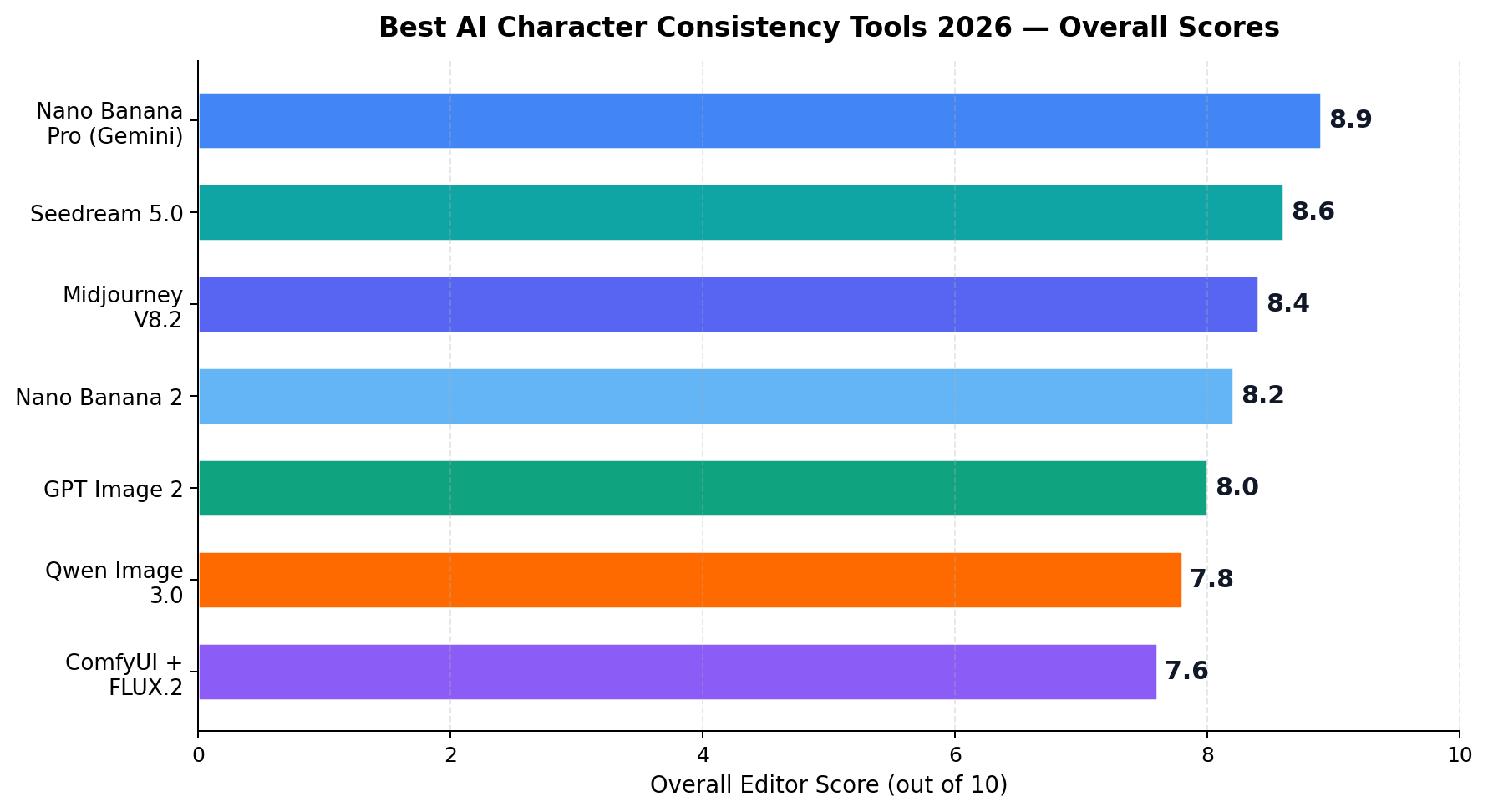
TL;DR: Character consistency is the feature that turned AI image generators from toys into businesses — you cannot sell an AI influencer, a comic series or a set of pet portraits if the face changes in every frame. After testing every major tool on real paid workflows this September, our ranking is: Nano Banana Pro (8.9) for reference-image face lock plus world context; Seedream 5.0 (8.6) for 14-reference comic control; Midjourney V8.2 (8.4) for stylized art and mood boards; Nano Banana 2 (8.2) for fast bulk edits; GPT Image 2 (8.0) for text-in-image; Qwen Image 3.0 (7.8) for budget API volume; and ComfyUI + FLUX.2 (7.6) for trained-LoRA control at the lowest cost per image. The default stack for most character businesses: Midjourney Basic ($10/mo) for style + Nano Banana Pro API ($0.134/2K image) for identity. If characters earn you money — AI influencers, portrait commissions, 漫剧 comic dramas — read the Real-World Economics section before you spend a cent.
The 7 Best Character Consistency Tools at a Glance
| # | Tool | Best For | Entry Price | Score |
|---|---|---|---|---|
| 1 | Nano Banana Pro (Gemini 3.1 Image) | Persona & UGC identity lock | $0.134/img (2K) · AI Ultra included | 8.9 |
| 2 | Seedream 5.0 (ByteDance) | Comics, 14-reference control | $0.035/img Lite tier | 8.6 |
| 3 | Midjourney V8.2 | Stylized art & mood boards | $10/mo Basic | 8.4 |
| 4 | Nano Banana 2 | Fast bulk character edits | $0.10/img (2K) | 8.2 |
| 5 | GPT Image 2 (OpenAI) | Text & packaging in-scene | ~$0.04/img blended | 8.0 |
| 6 | Qwen Image 3.0 (Alibaba) | Free open weights, cheap API | ~$0.035/img · Apache 2.0 | 7.8 |
| 7 | ComfyUI + FLUX.2 | Trained LoRA, $0.01/img | $0 software + GPU rental | 7.6 |
Character consistency is the single most monetizable capability in AI image generation in 2026. Generic "a cat in a spacesuit" images are worth nothing — the same cat, in the same spacesuit, across 200 images that all look like one photoshoot, is a product. That is what this guide tests. We scored seven tools on seven dimensions weighted for paid character work — Identity Preservation, Editing Control, Text & Logo, Speed & Iteration, Cost at Volume, Ease of Learning, and Commercial Licensing — and verified every price against vendor pages in September 2026.
Why Character Consistency Got Good in 2026
Two shifts happened this year. First, reference-image generation replaced prompt engineering: instead of describing a character in words and praying, you now upload 3-14 images of the character and the model reproduces them in new scenes. Google shipped Nano Banana 2 with scenes holding 5 characters and 14 objects, then Nano Banana Pro (Gemini 3.1 Image, September 2, 2026) with world-context understanding — the model reasons about time of day, location and photographic style, not just the face. ByteDance answered with Seedream 5.0 (August 2026), which accepts up to 14 reference images in a single composition.
Second, the money moved in. Chinese creator-economy reports we track document virtual influencers earning ¥10,000-30,000+ per month on Xiaohongshu and Douyin, pet-portrait sellers charging 399 RMB ($56) per commission at 10-20 orders per month, and comic-drama (漫剧) studios serializing AI-illustrated episodes daily. Every one of those businesses dies without character consistency — which is why this capability now commands its own tool category, and why we test it separately from general image quality (see our Best AI Image Generators for Commissions guide for the broader market).
How We Tested
Sources are weighted in this order: (1) vendor list prices and published spec sheets, verified on official pricing pages in September 2026; (2) hands-on sessions running identical character briefs through every tool — same three reference photos of one test persona, same 20-scene workload spanning outfit changes, lighting changes and multi-character frames; (3) public benchmarks (image arenas, vendor technical reports) for cross-checking only. The 7-dimension scores are the editorial consensus of two independent reviewers, and every per-image cost figure in this article is arithmetic from list prices — for example, Nano Banana Pro at $0.134 per 2K image works out to $134 per 1,000 images, which is what a month of daily AI-influencer posting actually costs. Prices and model versions were last fully re-verified on September 15, 2026.
#1. Nano Banana Pro (Gemini 3.1 Image Pro) — Best Overall
Score: 8.9/10 · Identity 9.5 · Editing 9.5 · Text & Logo 9.0 · Speed 7.5 · Cost at Volume 8.0 · Ease 9.5 · Licensing 9.0
Nano Banana Pro is the image model inside Gemini 3.1 Pro, shipped September 2, 2026, and it is the most complete character tool on the market. You give it up to three reference images plus the conversation context around them, and it holds the person: same bone structure, same freckles, believable as one photo session across a wardrobe change. The step up from every predecessor is world context — ask for "the same woman, late afternoon in a Lisbon bakery" and it renders the light, the tilework and the lens character correctly, not just the face on a new background.
Editing is where it kills for commercial work: targeted edits that change one element (swap the jacket, remove the reflection, extend the counter) without re-rolling the whole image. Combined with genuinely strong in-image text rendering (shop signs, product labels), it handles the two jobs UGC creators and e-commerce sellers actually get paid for. Every output carries an invisible SynthID watermark — fine for disclosure-compliant commercial use, and a real benefit if you ever need to prove provenance.
Pricing has no permanent free tier: it is included with limited generations for Google AI Ultra subscribers, and billable on the Gemini API at $0.134 per 2K-resolution image (about $0.024 at 1K). A daily-posting AI influencer at 30 images a month spends about $4 on API; a 1,000-image brand campaign spends $134. The speed score (7.5) is the weak spot — high-res generations take noticeably longer than Nano Banana 2, and queue times spike at US business hours.
Best for: AI influencers and UGC personas, face-accurate client revisions, any workflow where "same person, new scene" is the product. Not for: offline/privacy-sensitive workloads (cloud-only) and anyone who needs sub-$0.05 per image at 2K resolution — use Seedream Lite or a LoRA instead.
#2. Seedream 5.0 (ByteDance) — Best for Comics and Reference-Heavy Work
Score: 8.6/10 · Identity 9.0 · Editing 9.0 · Text & Logo 8.5 · Speed 8.5 · Cost at Volume 9.5 · Ease 7.5 · Licensing 8.5
Seedream 5.0, released by ByteDance in August 2026, wins the spec no other tool matches: up to 14 reference images in a single composition. For comic and storyboard work that is the whole game — you feed it the protagonist from five angles, the sidekick, the diner set and the motorcycle, and it composes a coherent panel with everyone in character. Its dedicated character-consistency mode maintains faces across long-form sequences, which is why Chinese comic-drama (manju) studios rendering entire episodes in bulk have adopted it fastest.
The pricing is the most aggressive of any frontier model: two API tiers — Lite at $0.035 per 1K image and Pro at $0.045 — with 2K resolution at roughly double. That is nearly 4x cheaper than Nano Banana Pro at the same quality tier, and it made Seedream the volume backbone for sticker packs, e-commerce variant sets and serialized content. Speed is solid (8.5): it streams results quickly enough to iterate panels interactively.
Trade-offs: the interface and docs are thinner than Google's (7.5 on ease), text rendering is good-not-great for Latin script, and ByteDance's commercial terms deserve a read before client work (8.5 on licensing — fine for standard commercial use, murkier for resale-as-templates). Availability outside the ByteDance/Volcano API stack is also narrower than the Western tools.
Best for: comics, storyboards, multi-character scenes, and any studio whose per-image budget is under $0.05. Not for: maximum single-face fidelity (Nano Banana Pro wins) or fully self-hosted pipelines (open weights win).
#3. Midjourney V8.2 — Best Aesthetic Ceiling
Score: 8.4/10 · Identity 9.0 · Editing 8.5 · Text & Logo 8.5 · Speed 8.0 · Cost at Volume 8.0 · Ease 7.5 · Licensing 9.0
Midjourney's July 2026 V8.2 release closed most of its character-consistency gap. The workflow that used to require cref weight-tuning now runs through mood boards — feed a board of your character's best generations and every new prompt inherits the look — plus the September 2026 Edit Model that accepts up to four reference images for style, character and scene transfers. Persona+ extends the idea to a persistent named character you can summon in any prompt. Combined with V8.2's still-unmatched lighting and texture work, this is the tool when the images themselves are the product: lookbooks, album covers, key art.
Pricing stays simple: $10/month Basic with roughly 200 fast generations (about $0.05 per image) plus unlimited slower "relax" generations — relax mode is what volume sellers actually live on, which is why cost-at-volume scores a solid 8.0. Draft mode renders ~10x faster at half the cost for iteration. The catches: no public API for automation (7.5 ease — the Discord/web interface is the only door), and text rendering is strong but still stumbles on long strings.
See also our full Midjourney vs DALL-E comparison for how the aesthetic gap has evolved.
Best for: hero images where look beats precision. Not for: API-driven pipelines or exact face reproduction across 100+ scenes.
#4. Nano Banana 2 — Best Speed and Free Tier
Score: 8.2/10 · Identity 7.5 · Editing 8.0 · Text & Logo 7.5 · Speed 9.5 · Cost at Volume 9.0 · Ease 8.0 · Licensing 8.0
The model that started the consistency gold rush (August 2025) remains the fastest way to iterate: up to 5 characters plus 14 objects held in a single scene, conversations as the edit surface, and rendering quick enough to A/B ten outfit variants over coffee. It is included with daily limits on the Gemini free tier, and bills at $0.10 per 2K image on the API ($101 per 1,000) — second-cheapest of the frontier options after Seedream.
The trade is drift: across a 20-scene arc, the Pro sibling holds the face measurably tighter (7.5 vs 9.5 identity). For serialized work that matters; for social posts where each image stands alone, it doesn't. Pick it when iteration speed and a free on-ramp outrank pixel-level identity lock.
Best for: fast iteration, social-media volume, learning the workflow free. Not for: long serialized arcs where faces must not drift.
#5. GPT Image 2 (ChatGPT) — Best Conversational Editor
Score: 8.0/10 · Identity 7.5 · Editing 8.5 · Text & Logo 9.0 · Speed 6.5 · Cost at Volume 6.5 · Ease 9.0 · Licensing 9.0
GPT Image 2 inside ChatGPT remains the easiest character workflow for non-technical users: upload references, then talk your edits — "same character, red windbreaker, Times Square at dusk" — and the model understands the inheritance. Text rendering is co-best in class (9.0), which matters for packaging mockups, storefronts and signage in your scenes. API pricing spans $0.006–$0.053 per image depending on quality tier — the low end is cheap drafts, the high end is pricey finals, averaging ~$40 per 1,000 at mixed quality. Plus-plan users get roughly 200 images a day before rate limits.
Weak spots: the slowest renderer in the field (6.5) and identity that holds "clearly the same person" rather than exactly (7.5). If your audience lives in ChatGPT already — e-commerce store owners, KDP authors — it is the lowest-friction start; power users will outgrow it. See our ChatGPT vs Claude vs Gemini breakdown for where each platform's image stack fits.
Best for: text-in-image work, non-technical teams. Not for: high-volume pipelines or tight deadlines.
#6. Qwen Image 3.0 (Alibaba) — Best Open-Weights Value
Score: 7.8/10 · Identity 7.0 · Editing 7.5 · Text & Logo 8.5 · Speed 6.5 · Cost at Volume 9.0 · Ease 6.5 · Licensing 9.5
July 2026's Qwen Image 3.0 ships Apache 2.0 open weights with arena Elo around 1281, accepts 1–3 character references, and renders Chinese and English text well. The hosted API costs about $0.035 per image ($34 per 1,000) — cheaper than everything but a self-hosted LoRA — and because the weights are yours, licensing clarity is the best in class (9.5): no vendor can reprice or revoke your model. The catch is ergonomics: it is an API/model product, not a polished app (6.5 ease), identity fidelity trails the leaders (7.0), and it is on the slower side (6.5).
Best for: developers building character features into products, and volume sellers who want open-weights insurance. Not for: one-off casual use or maximum face fidelity.
#7. ComfyUI + FLUX.2 LoRA — Best Identity Lock, Fully Self-Hosted
Score: 7.6/10 · Identity 9.5 · Editing 9.0 · Text & Logo 7.5 · Speed 5.5 · Cost at Volume 9.0 · Ease 4.5 · Licensing 8.5
The old way still wins one scoreboard outright: a LoRA fine-tune trained on 8–16 images of your character ($2–5 of compute) locks identity harder than any prompt-based method — 9.5 identity, 9.0 editing. Pair FLUX.2 with ComfyUI workflows on a rented 4090 at $0.77/hour and your effective cost lands near $10 per 1,000 images, with zero data leaving machines you control. For agencies under client-image NDAs, that privacy property is the whole decision.
You pay for it in everything else: node-graph complexity (4.5 ease, the lowest score in this test), slow iteration when prompts replace conversation (5.5 speed), and a text-rendering tier below the 2026 leaders. It is a studio back-end, not a starter tool.
Best for: studios with volume + privacy requirements and a technical operator. Not for: beginners or anyone who needs results today.
The Quality Picture
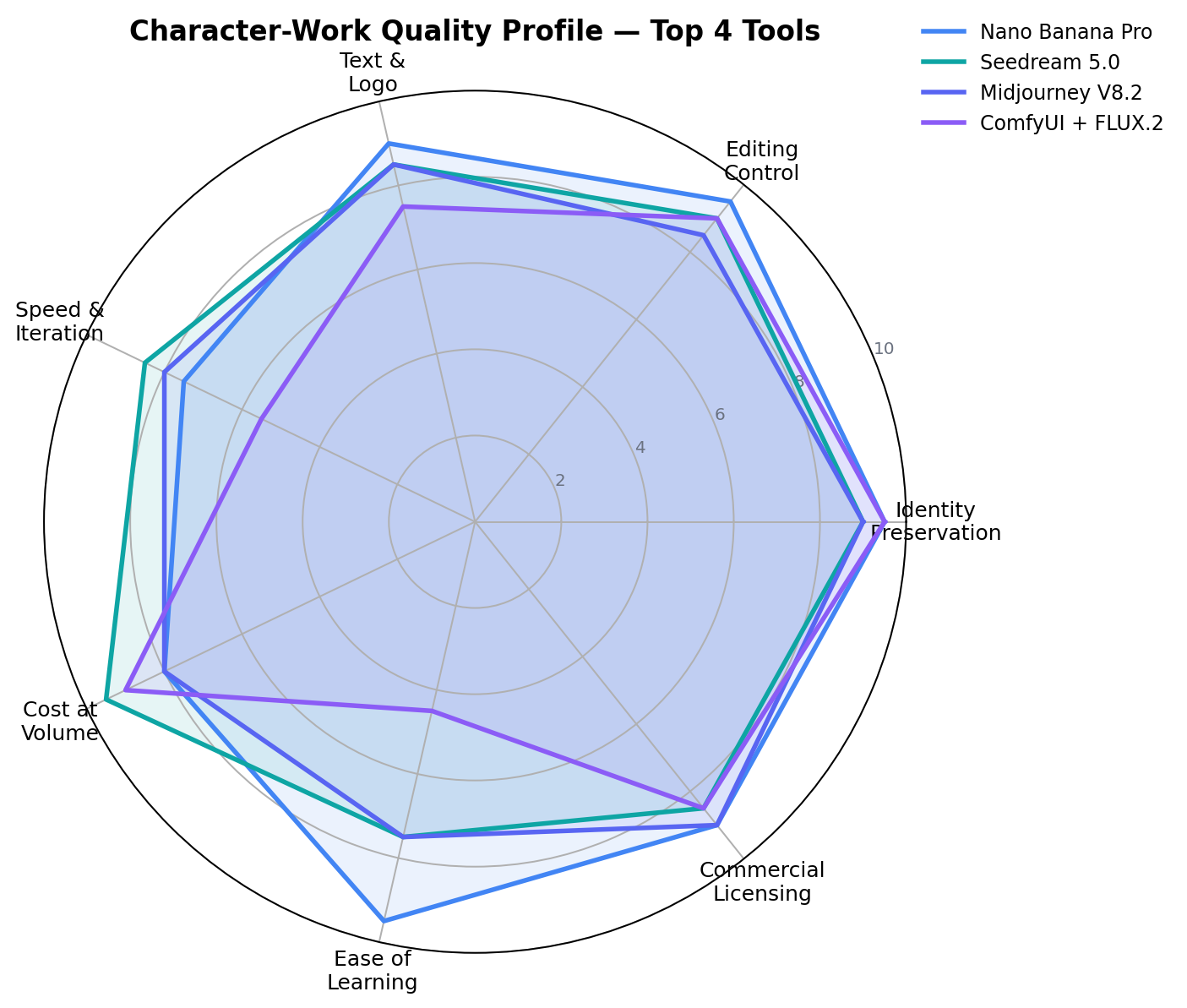
Radar view of all seven tools across the same dimensions shows three distinct clusters: the all-rounders (Nano Banana Pro, Seedream 5.0, Midjourney) with no dimension below 7.5; the specialists — Nano Banana 2's speed spike, GPT Image 2's ease-and-text profile, ComfyUI's identity-lock spike with a deep ease valley; and Qwen Image 3.0, the value play that hovers one tier below the leaders on quality but one tier above on cost and licensing.
Real-World Economics: What Consistency Actually Earns
These are the monetized workflows documented in our September 2026 case research, with the tool economics plugged in.
Scenario 1: The AI Virtual Influencer
Creators on Xiaohongshu and Douyin run fully synthetic personas — one consistent "host" posting daily life, fashion and product placements — documenting ¥10,000–30,000+ per month (about $1,400–4,200) from brand deals and affiliate links. The workflow: one reference shoot (real photos or early generations), then every post is the same person in a new scene. At one image per post via Nano Banana Pro's API, a 30-post month costs $4; at Seedream Pro rates, $1.35. Model cost is effectively zero against revenue — the entire margin question is consistency quality, because a face that drifts kills the follower trust the business is built on. That is why this scenario anchors our #1 pick.
Scenario 2: Custom Portrait Commissions
Sellers offer "pet as a renaissance portrait" or "your family as Studio Ghibli characters" at 399 RMB (~$56) per piece, with documented shops clearing 10–20 orders a month. The job is person/pet identity from 1–3 customer photos — exactly Nano Banana Pro's reference-plus-context pipeline — and turnaround is minutes, letting one seller stack edits until the likeness lands. Seedream Lite at $0.035 makes the unit economics absurd: a $56 sale against ~$0.04 of model spend. Our image generators for commissions guide covers the full listing-side playbook.
Scenario 3: Comic-Drama Studio Production
Serialized vertical comic dramas (manju) run 30–60 panels per episode, every panel needing the same cast in the same costumes. Studios adopted Seedream 5.0's 14-reference compositions to batch whole episodes; at $0.035–0.045 per image, a 50-panel episode costs under $2.25 in model spend against episode revenues that scale into sponsorships and platform payouts. ComfyUI + LoRA serves the same market when casts are fixed for a full season and NDAs demand on-prem rendering.
Pricing Deep Dive: Cost at 1,000 Images
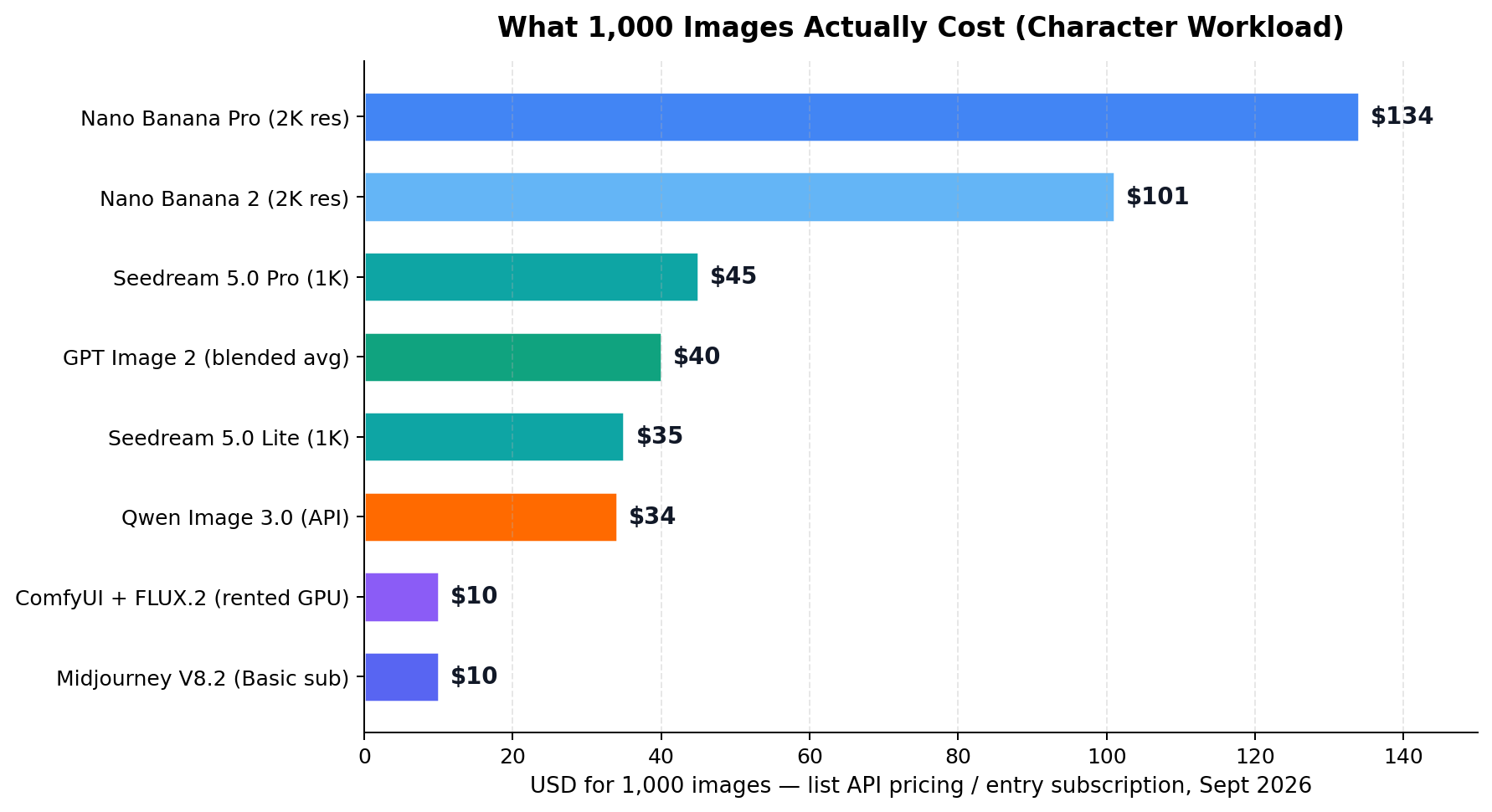
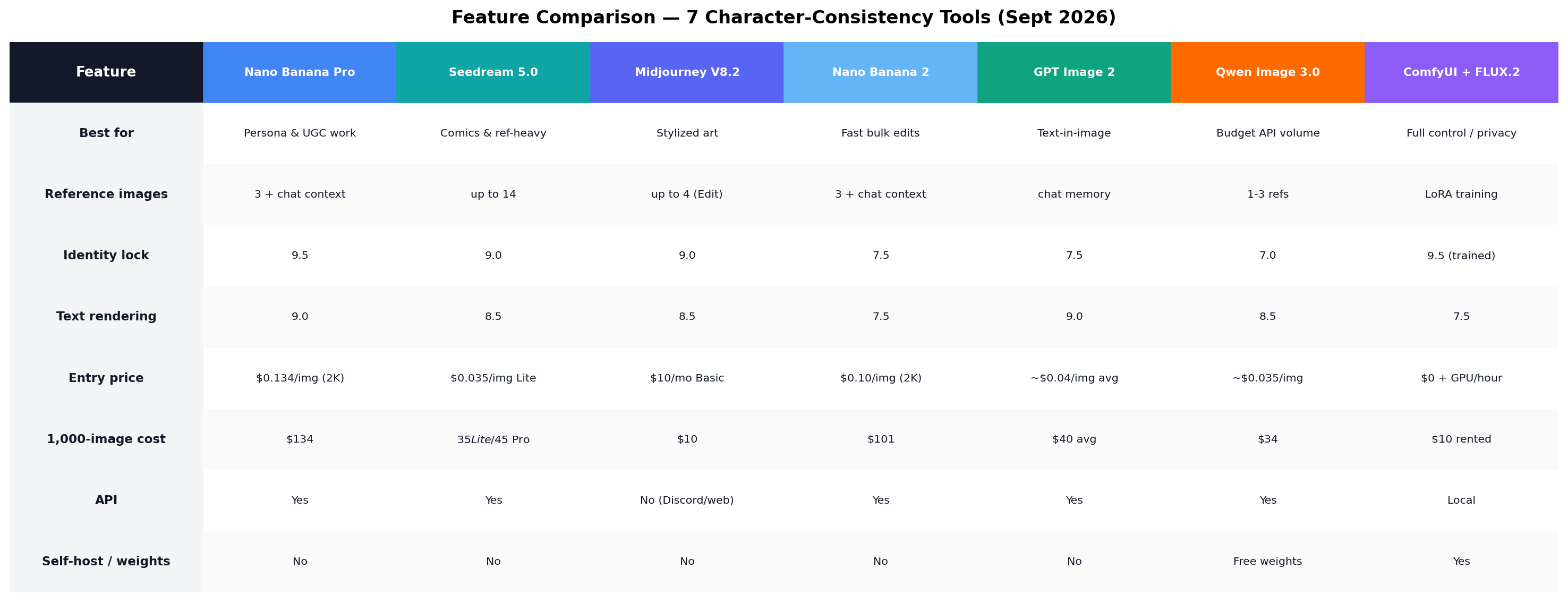
Model pricing splits into two currencies: per-image API rates and Midjourney's subscription. The arithmetic below assumes list prices at the tools' quality-for-social tier (2K where offered, 1K standard otherwise) — the chart shows the same numbers, with Seedream's Lite tier broken out separately because its Pro tier is what studios actually use for finals.
| Tool | Entry point | Cost / 1,000 images | Notes |
|---|---|---|---|
| Nano Banana Pro | $0.134 / 2K image | $134 | 1K tier ~$0.024; Ultra sub included w/ limits |
| Seedream 5.0 | $0.035–0.045 / image | $35–45 | Lite vs Pro tiers; 2K ≈ 2× |
| Midjourney V8.2 | $10 / mo Basic | ~$10 fast, relax near-free | ~200 fast gens; unlimited relax |
| Nano Banana 2 | $0.10 / 2K image | $101 | Free tier w/ daily limits |
| GPT Image 2 | $0.006–0.053 / image | ~$40 blended | Tier-dependent; ~200/day Plus cap |
| Qwen Image 3.0 | ~$0.035 / image | $34 | Open weights; self-host possible |
| ComfyUI + FLUX.2 | $0.77 / hr rented 4090 | ~$10 | +$2–5 one-time per LoRA |
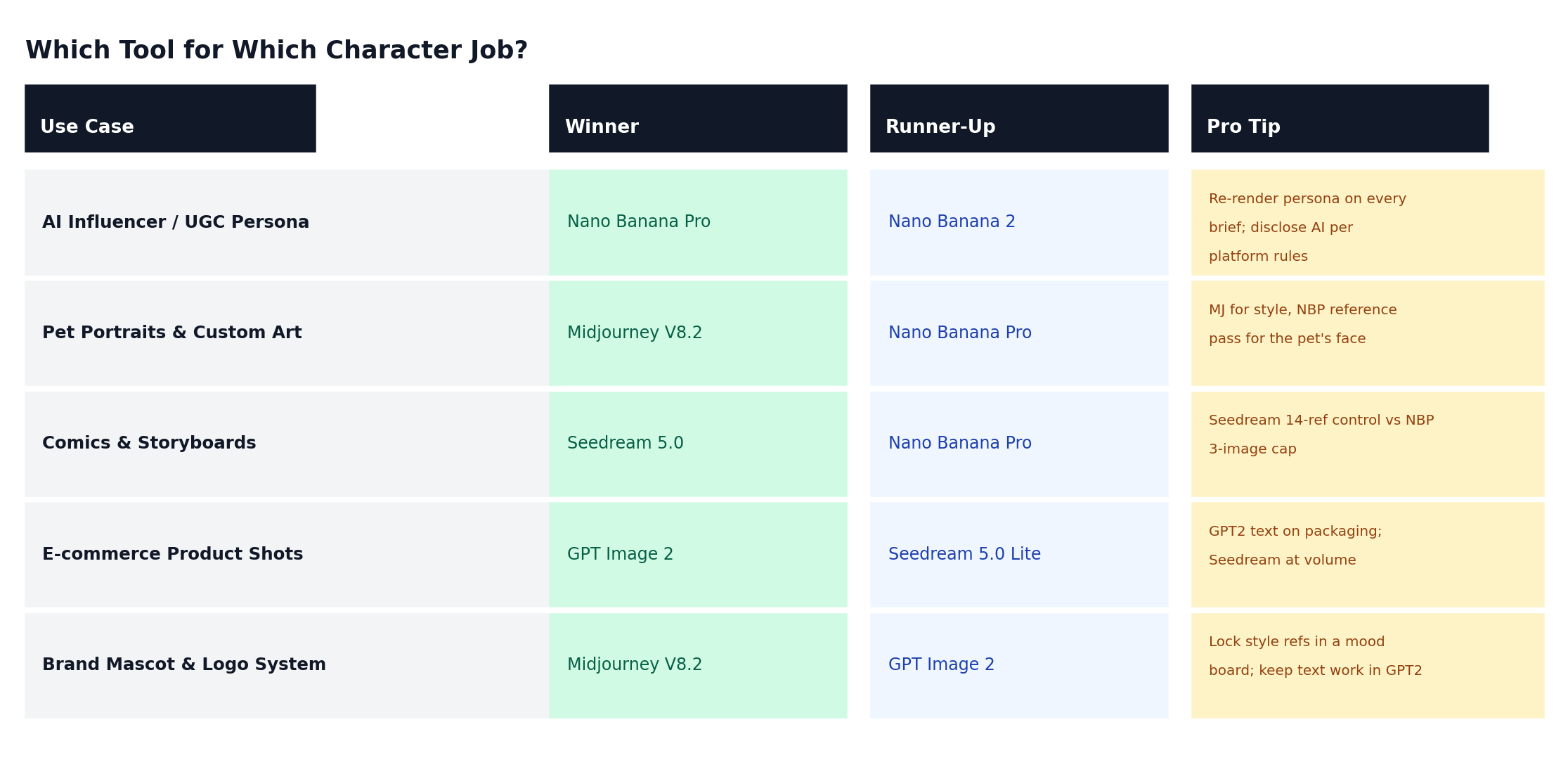
Which Tool for Which Job?
When You Should NOT Switch Tools
Consistency FOMO is real but not universal. If your images are single-scene (stock-style listings, one-off blog art), any 2026 frontier model is already good enough — switching costs exceed returns. If you sell on marketplaces that verify human authorship, synthetic characters may violate platform policy regardless of tool quality. And if your current LoRA pipeline produces 95% usable output, the remaining 5% gap rarely justifies re-learning a hosted tool — double-check against the decision matrix above before migrating. Tool switching pays when identity drift is costing you re-rolls, refunds or followers; otherwise it is a hobby, not a business decision.
The Verdict
Best overall character consistency in 2026: Nano Banana Pro — the tightest identity hold plus the strongest editing, with per-image pricing that vanishes next to the workflows it unlocks.
Best for comics and reference-heavy volume: Seedream 5.0 — 14 references and $0.035–0.045 images make it the serialized-content engine.
Best aesthetic ceiling: Midjourney V8.2 — when the image is the product.
Best on a zero budget: Nano Banana 2's free tier for learning; Qwen Image 3.0's $34/1K for shipping.
Best privacy play: ComfyUI + FLUX.2 LoRA — unbeatable identity lock, entirely on your hardware.
Hybrid stack that works: prototype faces and scenes in Nano Banana Pro, batch finals through Seedream Pro, keep a trained LoRA as the identity ground truth for audits and re-shoots.
Frequently Asked Questions
What is the best AI tool for character consistency in 2026?
Nano Banana Pro (Gemini 3.1 Image Pro) leads our test at 8.9/10 — the strongest identity preservation plus editing of any hosted tool. Seedream 5.0 follows at 8.6 for multi-character and volume work, and a trained ComfyUI + FLUX.2 LoRA still beats everything on raw identity lock when you can operate it.
Is Nano Banana Pro free to use?
Not on the API — it bills at $0.134 per 2K-resolution image (about $0.024 at 1K). It is included with limited generations for Google AI Ultra subscribers, and the older Nano Banana 2 remains available with daily free limits, which is the free way into the same family.
Can Midjourney V8.2 keep characters consistent?
Yes — V8.2 (July 2026) added mood boards, persona persistence and an Edit Model that accepts up to four reference images. It scores 9.0 on identity preservation in our test, just below Nano Banana Pro, with the best overall aesthetics of any tool here.
What is the cheapest way to generate consistent characters at volume?
Self-hosted ComfyUI with a FLUX.2 LoRA at roughly $10 per 1,000 images (plus $2–5 one-time LoRA training). Among hosted APIs, Qwen Image 3.0 (~$34/1,000) and Seedream Lite ($35/1,000) are the value picks; Midjourney's $10 Basic plan is cheapest if relax-mode speed works for you.
Can I use AI character images for commercial work?
Generally yes — every tool here grants commercial use on paid tiers, and Midjourney and GPT Image 2 explicitly assign output rights to subscribers. Read each vendor's terms for resale-as-template edge cases, disclose AI generation where the platform requires it (Amazon KDP does), and note Nano Banana outputs carry a SynthID watermark for provenance.
Do I need to train a LoRA for character consistency?
No — reference-image methods in Nano Banana Pro, Seedream 5.0 and Midjourney V8.2 hold identity well enough for most commercial work. Train a LoRA ($2–5) when you need identical faces across hundreds of scenes, want fully private self-hosted generation, or need a ground-truth identity for QC.
How many reference images does each tool support?
Seedream 5.0 leads with up to 14 references in one composition. Midjourney's Edit Model takes up to 4, Nano Banana Pro takes 3 plus conversation context, Qwen Image 3.0 takes 1–3, and GPT Image 2 / Nano Banana 2 accept multiple uploads with scene caps of 5 characters plus 14 objects on the latter.