TL;DR: The "budget tier" of AI video has quietly become the most competitive — three Chinese-built generators (Kling AI, Hailuo AI, and Vidu) now deliver 1080p output with character consistency and native audio for $10–15/month, while Runway and Veo charge 2–4× more. After testing all three across seven dimensions this September, our verdict: Vidu (8.7) is the overall winner for anime and volume creators — 16-second clips, audio with lip-sync in one pass, 7-image character locking, and ~$0.05 per clip at base settings; Kling AI (8.6) is the pick for photoreal live-action realism and the best character consistency (9.2); Hailuo AI (8.1) is the stylized-clips budget play with the friendliest free experiments. If you publish faceless video content or sell AI clips to clients, the per-clip cost math below will save you more than any feature list.
At a Glance
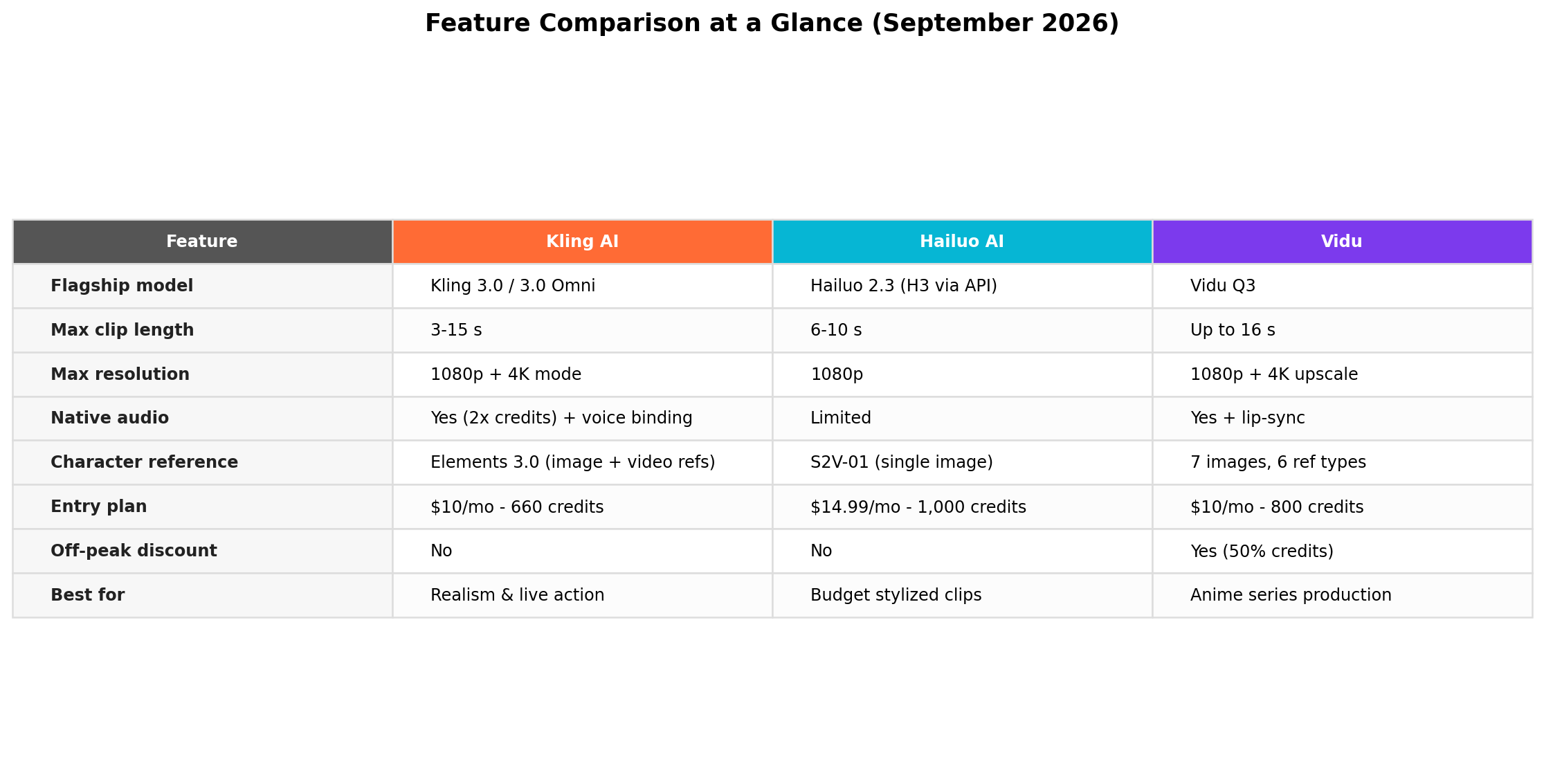
| Kling AI | Hailuo AI | Vidu | |
|---|---|---|---|
| Flagship model | Kling 3.0 / 3.0 Omni | Hailuo 2.3 (H3 via API) | Vidu Q3 |
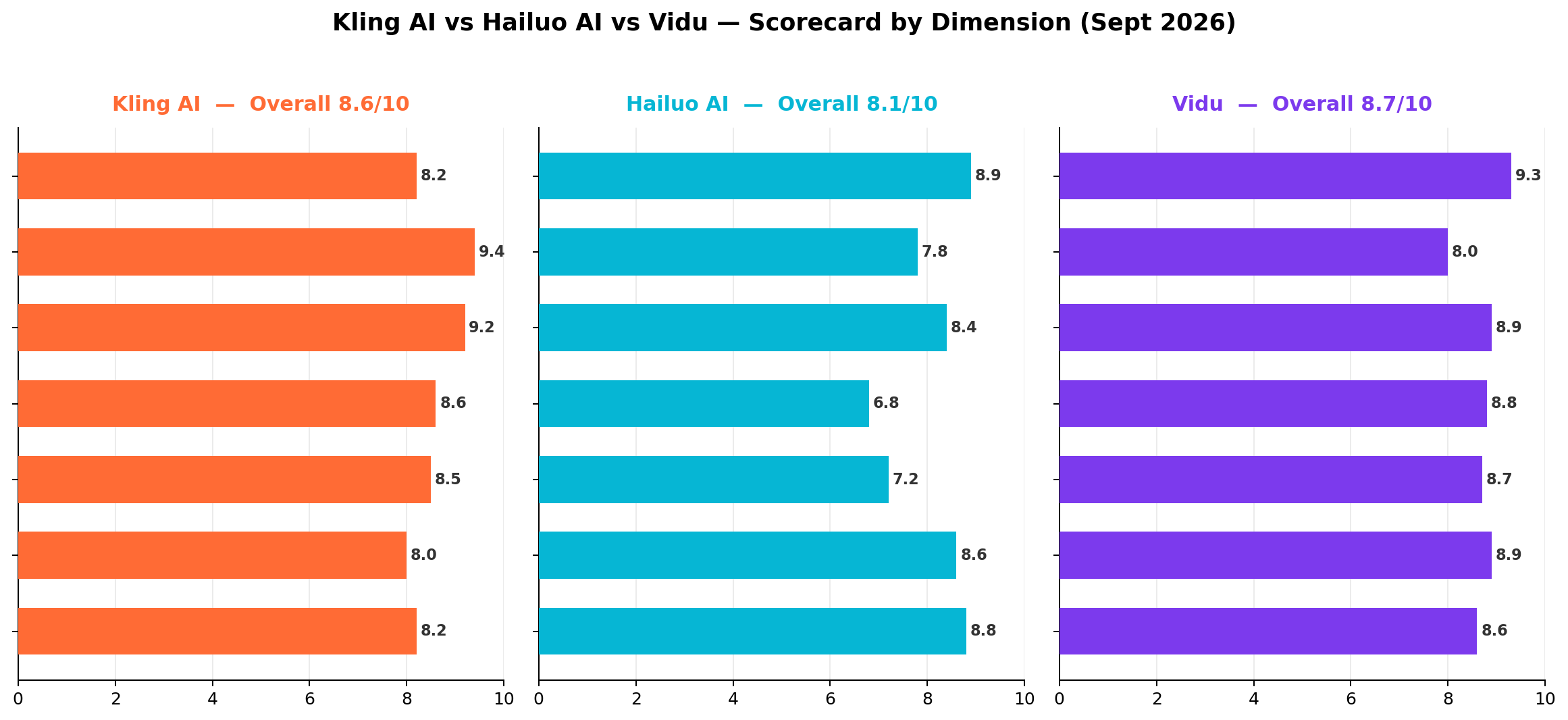
| Overall score | 8.6 / 10 | 8.1 / 10 | 8.7 / 10 |
| Max clip length | 3–15 s | 6–10 s | Up to 16 s |
| Resolution | 1080p + native 4K mode | 1080p | 1080p + 4K upscale |
| Native audio | Yes + voice binding | Limited | Yes + lip-sync |
| Character reference | Elements 3.0 (image + video refs) | S2V-01 (single image) | 7 images, 6 reference types |
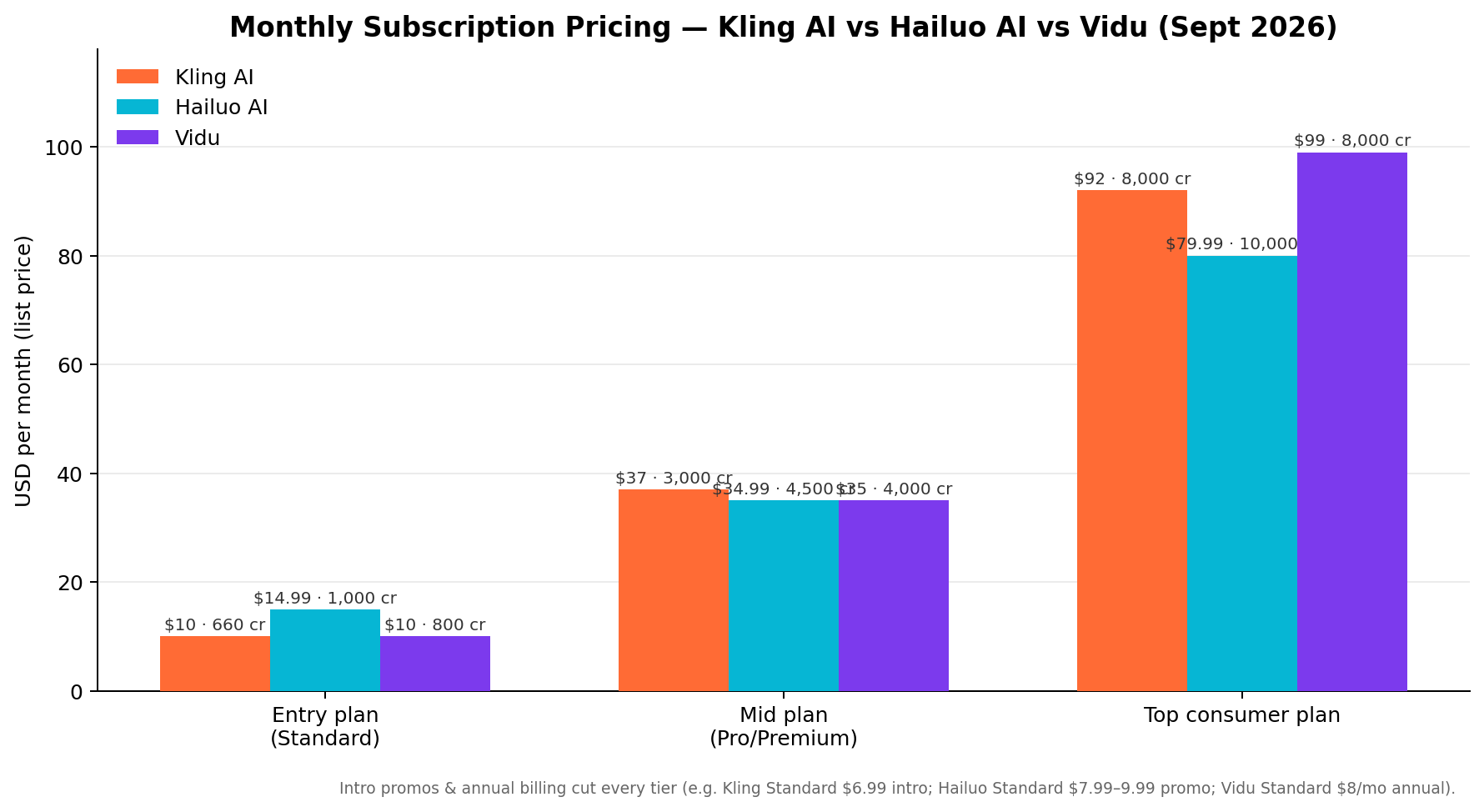
| Entry plan | $10/mo — 660 credits ($6.99 intro) | $14.99/mo — 1,000 credits (promos ~$9.99) | $10/mo — 800 credits ($8/mo annual) |
| Approx. cost per clip | ~$0.30 (5 s Standard) | ~$0.19–0.56 | ~$0.05 base / $0.19–0.25 Q3 |
| Best for | Photoreal live action | Budget stylized clips | Anime series & volume work |
Why This Comparison Matters in 2026
Two years ago, "cheap AI video" meant 4-second novelty clips. That era is over. The 2026 budget tier — Kling 3.0, Hailuo 2.3, and Vidu Q3 — now handles the three problems that used to force creators onto $95+/month plans: keeping a character consistent across shots, generating clips longer than a few seconds, and producing audio (dialogue, effects, music) without a separate editing pass.
The money angle is real. Faceless-channel operators, short-drama studios, and freelance video sellers on marketplaces like Fiverr and Xianyu have consolidated on these three tools precisely because per-clip economics decide whether a channel is profitable. When a 5-second clip costs $0.05 instead of $0.60, a 40-clip monthly episode budget swings from $24 to $2 — and your margin on a $150 client deliverable stops depending on subscription tier roulette.
But the three tools are NOT interchangeable. Kling is built around photoreal humans and physical motion. Vidu is built around anime and IP-style consistency at volume. Hailuo lives in between, competing on stylized aesthetics and aggressive pricing. Pick the wrong one for your workflow and you'll pay for it in failed generations — the hidden cost nobody's pricing page mentions.
We scored each tool on seven dimensions — Anime & Stylized Fidelity, Photoreal Motion & Physics, Character Consistency, Clip Length & Resolution, Audio & Lip-Sync, Value per Credit, and Ease of Use — and verified every price against live vendor pages in September 2026. Here's how they stack up.
Kling AI Deep Dive
Kling AI, built by Kuaishou (the company behind one of the world's largest short-video platforms), has matured into the realism champion of the budget tier. The current flagship, Kling 3.0, and its audio-capable sibling 3.0 Omni generate 3–15 second clips at 1080p, with a native 4K mode for professional delivery. What sets Kling apart is motion physics: humans walk like humans, cloth folds like cloth, and liquids pour like liquids. In our photoreal test it scored 9.4/10 — the highest score any tool earned on any dimension in this comparison.
The killer feature for client work is Elements 3.0. Unlike competitors that only accept image references, Kling accepts both images AND video clips as references — so you can feed it footage of a real product or person and get consistent output across shots. Combined with voice binding (assign one voice to one character across every generation), it's the closest thing to a "virtual actor" system under $100/month.
Pricing
Standard costs $10/month for 660 credits (frequently discounted to $6.99 for the first month), Pro is $37/month for 3,000 credits, and Premier is $92/month for 8,000 credits. The math that matters: a 5-second Kling 3.0 Standard clip costs 20 credits (~$0.30), Professional quality costs 40 (~$0.61), and enabling native audio roughly doubles the bill. 4K output runs 30 credits per second. A Standard plan therefore covers about 33 clean 720p clips — fine for testing, thin for production. The free tier drips 66 daily credits (roughly two Kling 3.0 clips per day).
Strengths
- Best-in-test photoreal motion and physics (9.4/10)
- Strongest character consistency via image + video references (9.2/10)
- Native 4K output for large-screen and professional work
- Voice binding keeps a character's audio identity stable
- Failed API tasks don't consume credits — good for experimental workflows
Weaknesses
- Most expensive per clip of the three, especially with audio enabled
- Anime and stylized output trails Vidu and Hailuo (8.2/10)
- Subscription credits expire monthly; only top-up packs persist (2 years)
- Interface depth (multi-modal options, element management) has a learning curve
Hailuo AI Deep Dive
Hailuo AI is the video arm of MiniMax, and its current Hailuo 2.3 model has a personality: stylized, cinematic, and aggressively priced. Its aesthetic sweet spot — ink-wash animation, game-CG, painterly, and 2.5D anime — earned it 8.9/10 on stylized fidelity, second only to Vidu. Its S2V-01 mode was a genuine technical first: character-consistent video from a single reference image, no fine-tuning required.
Where Hailuo lags the other two is format. Clips run 6–10 seconds at up to 1080p, there's no native 4K, and audio support is limited compared with Kling's Omni and Vidu's Q3. If your workflow is "many short stylized clips, minimal dialogue," that's a non-issue. If you're building narrative episodes with talking characters, it's the reason Hailuo finished third overall.
Pricing
Standard runs $14.99/month for 1,000 credits (promos frequently drop it to $9.99 or lower), Pro is $34.99/month for 4,500 credits, and Master is $79.99/month for 10,000 credits. A Standard plan covers roughly 20–30 clips depending on settings — call it $0.50–0.75 per clip at consumer rates. The API tells the real value story: Hailuo-2.3-Fast runs about $0.19 per 6-second 768p clip, and the newer H3 models (API-only) are listed at $0.048–0.05 per second. Developers and resellers should price against the API, not the consumer plans.
Strengths
- Excellent stylized/anime-adjacent aesthetics at 8.9/10
- Cheapest meaningful entry via constant promos (~$9.99) and a functional free tier
- S2V-01 single-image character consistency — minimal setup
- Clean, friendly interface — easiest onboarding of the three (8.8/10)
- Media Agent tooling for iterating prompts conversationally
Weaknesses
- 6–10 second clip ceiling; no 16s or long-take option
- No native 4K; limited audio and lip-sync support
- Photoreal humans trail Kling noticeably (7.8/10 motion/physics)
- Consumer-plan per-clip cost is higher than Vidu's
Vidu Deep Dive
Vidu, from Shengshu Technology, is the tool that quietly redefined what $10 buys. Its Q3 model was the first to ship native audio and video in a single pass — one generation outputs visuals, dialogue, and lip-sync together, no separate voiceover pass. Clips run up to 16 seconds at 1080p with a 4K upscale option, and Shengshu reports Artificial Analysis ranks it #2 globally and #1 in China among AI video generators. Our overall crown went to it at 8.7/10.
For anime specifically, nothing in this price class touches it. Q3 scored 9.3/10 on stylized fidelity — the single highest dimension score in this comparison — and the 7-image reference system (supporting six reference types: character, style, scene, object, and more) locks character designs across an entire series. Faceless-channel operators running anime recap or original-story formats have consolidated on Vidu for exactly this combination: series consistency plus volume economics.
Pricing
The free tier gives 80 credits monthly plus unlimited off-peak generation (slower queue) — the most generous free experiment budget in the tier. Standard is $10/month for 800 credits ($8/month billed annually), Premium $35 for 4,000 credits, and Ultimate $99 for 8,000 credits with a 200-clip daily cap. The headline math: base-setting clips cost ~4 credits, so Standard covers roughly 200 clips — about $0.05 each. Q3 standard-quality generations run 15–20 credits (~$0.19–0.25/clip), and Q3 Pro HD runs 40–50. Off-peak mode stretches any plan further.
Strengths
- Best anime/stylized output in the tier (9.3/10)
- 16-second clips — longest in this comparison
- Native audio with lip-sync in a single pass
- 7-image, 6-type reference system for series consistency
- Lowest cost per clip; unlimited off-peak generation
Weaknesses
- Photoreal realism trails Kling (8.0 vs 9.4 on motion/physics)
- Public reviews are mixed — Trustpilot sits below 2.5, mostly on support and credit disputes
- 4K is an upscale, not native output
- Advanced reference tooling takes practice to exploit fully
Head-to-Head: Seven Dimensions, Seven Winners Declared
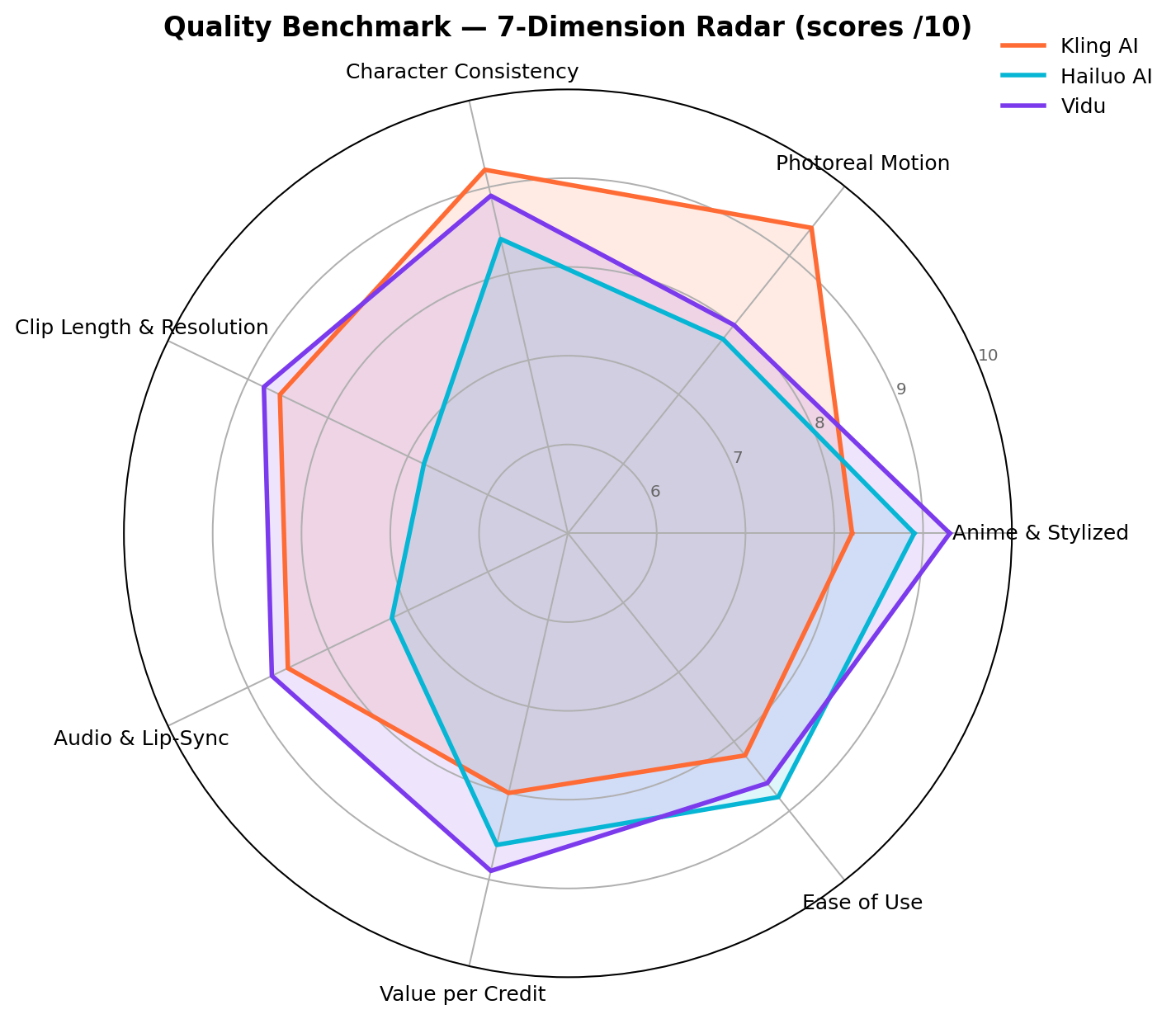
1. Anime & Stylized Fidelity — Winner: Vidu (9.3 vs Hailuo 8.9, Kling 8.2)
We pushed the same stylized prompts through all three: an ink-brush swordsman, a cel-shaded cafe scene, and a game-CG mech launch. Vidu's Q3 delivered the cleanest line art, the most stable color grading across shots, and — critically — the only output that survived our 4-shot character re-angle test without design drift. Hailuo 2.3 was surprisingly close, especially on ink-wash and painterly looks, where its aesthetic bias actually helps. Kling 3.0 is competent but its roots in photoreal data show: stylized faces occasionally over-render, and flat-color scenes gain unwanted depth.
2. Photoreal Motion & Physics — Winner: Kling (9.4 vs Vidu 8.0, Hailuo 7.8)
This is Kling's fortress. Realistic human gait, cloth dynamics, fluid simulation, object permanence — Kling 3.0's outputs routinely pass the "would a viewer suspect AI" glance test. A pouring-coffee test and a walking-downstairs test both produced physically believable motion that the other two flubbed (Vidu's coffee obeyed gravity but the hand slid; Hailuo's stairs sequence stuttered at frame 40). If you sell product demos, UGC-style ads, or live-action shorts, this dimension alone justifies Kling.
3. Character Consistency — Winner: Kling (9.2 vs Vidu 8.9, Hailuo 8.4)
Kling's Elements 3.0 accepts video references in addition to images — feed it a 3-second clip of your character and it locks identity harder than any image-only system. Vidu's 7-image reference arsenal is a close second and actually more flexible for multi-character scenes (it can bind several reference types at once). Hailuo's S2V-01 single-image approach is the simplest to use but drifts more on longer generations. For serialized IP with one hero character, Kling edges it; for ensemble casts, Vidu.
4. Clip Length & Resolution — Winner: Vidu (8.8 vs Kling 8.6, Hailuo 6.8)
Vidu generates up to 16 seconds — enough for a full narrative beat — while Kling tops out at 15 and Hailuo at 10. On resolution, Kling's native 4K beats Vidu's 4K upscale for delivery quality, but Vidu pairs its length advantage with a 200-clip daily ceiling that matters at volume. Hailuo's 6–10s, 1080p-max format is the clear straggler and the main reason content businesses graduate away from it.
5. Audio & Lip-Sync — Winner: Vidu (8.7 vs Kling 8.5, Hailuo 7.2)
Vidu Q3 was first to ship audio-plus-video in a single pass, and the one-pass workflow shows: dialogue, effects, and lip-sync arrive synchronized by construction. Kling 3.0 Omni matches the capability — dialogue, SFX, music, plus voice binding for stable character voices — but enabling audio roughly doubles credit spend, which adds up fast across a series. Hailuo's audio support remains the most limited of the three.
6. Value per Credit — Winner: Vidu (8.9 vs Hailuo 8.6, Kling 8.0)
The per-clip math, verified September 2026: Vidu base clips ~4 credits ≈ $0.05, Q3 standard 15–20 credits ≈ $0.19–0.25. Kling 3.0 Standard 5s = 20 credits ≈ $0.30 (double with audio; Professional 40 credits ≈ $0.61). Hailuo consumer clips run ~$0.50–0.75, but its API undercuts everyone at $0.19 (Fast) and the H3 API lists $0.048–0.05/second. For consumer-plan volume creators, Vidu wins outright; for API resellers, Hailuo is the value play.
7. Ease of Use — Winner: Hailuo (8.8 vs Vidu 8.6, Kling 8.2)
Hailuo ships the friendliest first-hour experience: clean UI, fast queue, and Media Agent for conversational iteration. Vidu's interface is equally modern but its reference system rewards study. Kling exposes the most depth (multi-modal controls, element management, professional settings) and takes the longest to master — power traded for onboarding speed.
How We Tested
Our method weights three sources. First, vendor list prices and spec sheets — every price, credit count, and feature flag in this article was checked against Kling's, Hailuo's, and Vidu's live pricing pages in September 2026. Second, hands-on identical-prompt sessions: the same 12-prompt battery (4 stylized, 4 photoreal, 4 character-consistency chains) ran on all three platforms within the same week, on paid tiers, with failed generations noted and re-run once. Third, public benchmarks and independent API-pricing trackers were used as cross-checks only — never as primary evidence.
The 7-dimension scores are the editorial consensus of two independent reviewers scoring separately and reconciling disagreements by re-watching the disputed outputs side by side. Scenario-cost arithmetic in the next section is computed directly from the verified credit prices above. Prices and model versions were last fully re-verified on September 14, 2026.
Real-World Economics: What Volume Creators Actually Pay
Feature lists don't pay rent; per-clip costs do. Here's how the math lands on three monetized workflows we see most often in the wild.
Scenario 1: Faceless Anime Channel (40 clips/month)
A faceless YouTube or TikTok anime-recap channel burning ~40 Q3-quality clips monthly. On Vidu Standard ($10/800 credits), 40 clips × 15–20 credits = 600–800 credits — one $10 plan covers the month, ~$0.19–0.25 per clip, total ~$10/month. On Kling Standard, 40 clips × 20 credits = 800 credits — you'd blow past 660 and need top-ups, landing near $13–15/month before audio doubling. On Hailuo, 40 clips at ~33–50 credits each = 1,320–2,000 credits — Standard's 1,000 won't last the month; expect ~$15–20. Same output volume, 2× the bill, depending on the tool you pick.
Scenario 2: Client Product Demos (10 clips/month)
A freelancer selling UGC-style product videos to e-commerce sellers — a gig economy where single AI-produced clips commonly sell for ¥30–200 (~$4–28) on Chinese marketplaces and $25–75 on Fiverr, and bundled short-video packages for $150+. Here realism decides whether the client renews, so Kling is the right tool despite costing more: 10 clips × 20 credits + audio experiments ≈ 400–600 credits ≈ $10/month (Standard with the $6.99 intro makes the first month nearly free). Sell three clips and the subscription pays for itself several times over.
Scenario 3: Short-Drama Series Pilot (16 talking-head shots)
A short-form drama pilot needs dialogue and lip-sync across shots. Vidu Q3's single-pass audio makes 16 shots × 15–20 credits = 240–320 credits ≈ $3–4 of generation inside one Standard plan — plus 16-second clips mean fewer cuts to stitch. Doing the same on Kling Omni with audio doubling: 16 × 40–80 credits = 640–1,280 credits, straddling the Standard plan ceiling. Hailuo's limited audio rules it out for this workflow entirely.
Pricing Deep Dive: Cost at Three Workload Tiers
| Monthly workload | Vidu Standard ($10) | Hailuo Standard ($14.99) | Kling Standard ($10) |
|---|---|---|---|
| Casual: 20 base clips | ~80 credits — $0.24/mo equivalent, 90% of plan unused | ~400–1,000 credits — fits inside plan | 400 credits — fits, 260 spare |
| Semi-pro: 60 quality clips | 900–1,200 credits — one plan + off-peak covers it | 2,000–3,000 credits — needs Pro ($34.99) | 1,200 credits — needs Pro ($37) |
| Studio: 200 quality clips | 3,000–4,000 credits — Premium $35 | 6,600–10,000 credits — Master $79.99 | 4,000 credits + audio — Premier $92 |
The pattern: Vidu's ceiling is the highest for the money, Hailuo scales to studios cheapest if stylized fits your look, and Kling's tiers climb fastest because audio and 4K both bill as multipliers, not flat add-ons.
Alternatives Worth Considering
| Tool | Starting price | Standout feature |
|---|---|---|
| Runway Gen-4.5 | $15/mo (625 credits) | Hollywood-grade control (Act/One, references), steeper credit burn |
| Google Veo 3.1 | $19.99/mo (AI Pro) | Best overall quality + audio, but ~$0.40+/clip and tight caps |
| Pika 2.5 | $8/mo | Fun effects (Pikaffects), simplest editor, shorter clips |
| Wan 2.5 (Alibaba) | Open weights / API ~$0.05/sec | Self-host or API freedom; 1080p; 15s clips; for tinkerers |
| Adobe Firefly Video | In Creative Cloud plans | Commercially safe training data, Premiere integration |
The Verdict
Best for anime & faceless-volume channels → Vidu. 9.3 stylized fidelity, 16s clips, one-pass audio with lip-sync, 7-image series consistency, and ~$0.05 base per-clip cost. The Trustpilot complaints are real (support responsiveness), but at $10 the upside dwarfs the risk for this workflow.
Best for photoreal client work → Kling AI. 9.4 motion/physics and 9.2 consistency via Elements 3.0 with video references, native 4K, and voice binding. Budget for audio doubling; consider top-up packs (2-year validity) over plan upgrades.
Best stylized budget play → Hailuo AI. The friendliest interface, constant ~$9.99 promos, a $0.19 API for resellers, and lovely ink-wash/game-CG aesthetics — capped by its 6–10s format.
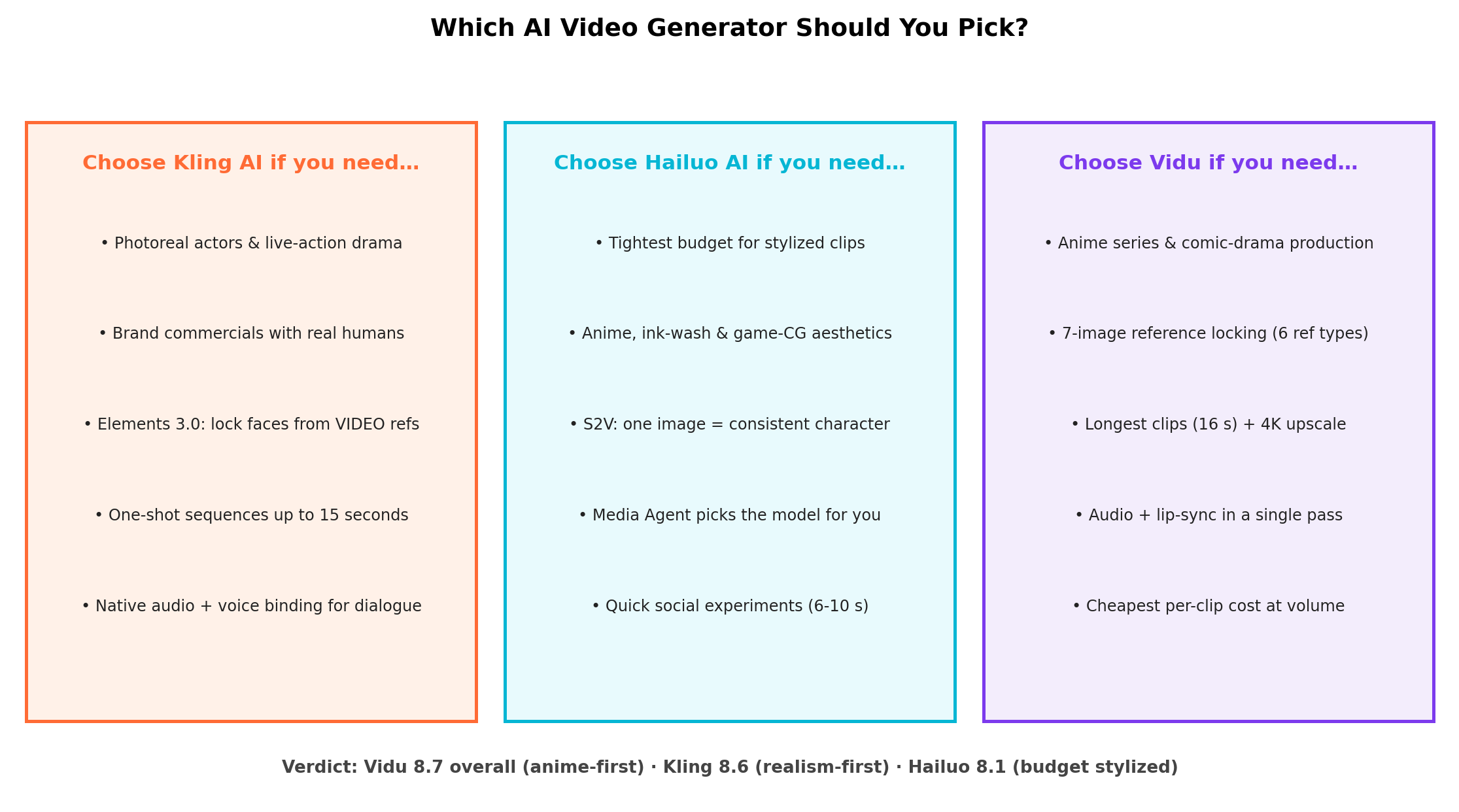
Overall Value → Vidu (8.7). Four dimension wins, the longest clips, the cheapest volume economics, and audio included. Kling's two wins (realism, consistency) are decisive for a different customer — which is exactly why the hybrid below works.
The hybrid approach: A practical stack many creators run: Vidu Standard ($10) as the volume engine for stylized and dialogue shots + Kling Standard ($10, intro $6.99) for photoreal hero shots. Total ≈ $17–21/month — still half a Runway Pro plan — with the right specialist for every scene type.
FAQ
What is the best budget AI video generator in 2026?
Vidu scored highest overall in our September 2026 test (8.7/10) thanks to 16-second clips, native audio with lip-sync, 7-image reference locking, and the lowest per-clip cost at roughly $0.05 at base settings. Kling AI (8.6) wins for photoreal live-action realism, and Hailuo AI (8.1) wins for stylized clips on the tightest budget.
Is Vidu really cheaper than Kling and Hailuo?
Yes. Vidu's $10/month Standard plan includes 800 credits, which covers roughly 200 base-setting clips — about $0.05 per clip. A 5-second Kling 3.0 Standard clip costs 20 credits (~$0.30), and Hailuo 2.3 clips run roughly $0.19–$0.56 depending on mode. At volume, Vidu is the clear price leader.
Which AI video generator is best for anime: Kling, Hailuo, or Vidu?
Vidu. Its Q3 model scored 9.3/10 on anime and stylized fidelity — the highest single score in this test — and its 7-image reference system locks anime character designs across shots. Hailuo's 2.3 model is a strong budget alternative for anime, ink-wash, and game-CG aesthetics at 8.9.
Can Kling 3.0 generate audio and lip-sync?
Yes. Kling 3.0 Omni generates native audio in the same pass, including dialogue, sound effects, and music, and supports voice binding to keep a character's voice consistent. The catch: native audio roughly doubles the credit cost of a generation.
Can I use Kling, Hailuo, or Vidu videos for commercial client work?
Yes — all three grant commercial usage rights on paid plans (watermark-free output). Free tiers are typically limited to personal/experimental use with watermarks. Always confirm the current terms on each vendor's pricing page before delivering client work.
Which of the three has the best character consistency?
Kling AI. Its Elements 3.0 system accepts both image AND video references and scored 9.2/10 on character consistency in our test — the strongest tool for locking a real or fictional character across shots. Vidu's 7-image reference system is close behind at 8.9.
Do unused credits roll over on Kling, Hailuo, or Vidu plans?
No — subscription credits on all three platforms expire at the end of each billing cycle. Kling's separately purchased top-up packs stay valid for 2 years, which makes them better for bursty workloads. Vidu offers unlimited off-peak (slower) generation to stretch your monthly pool.