⚡ TL;DR
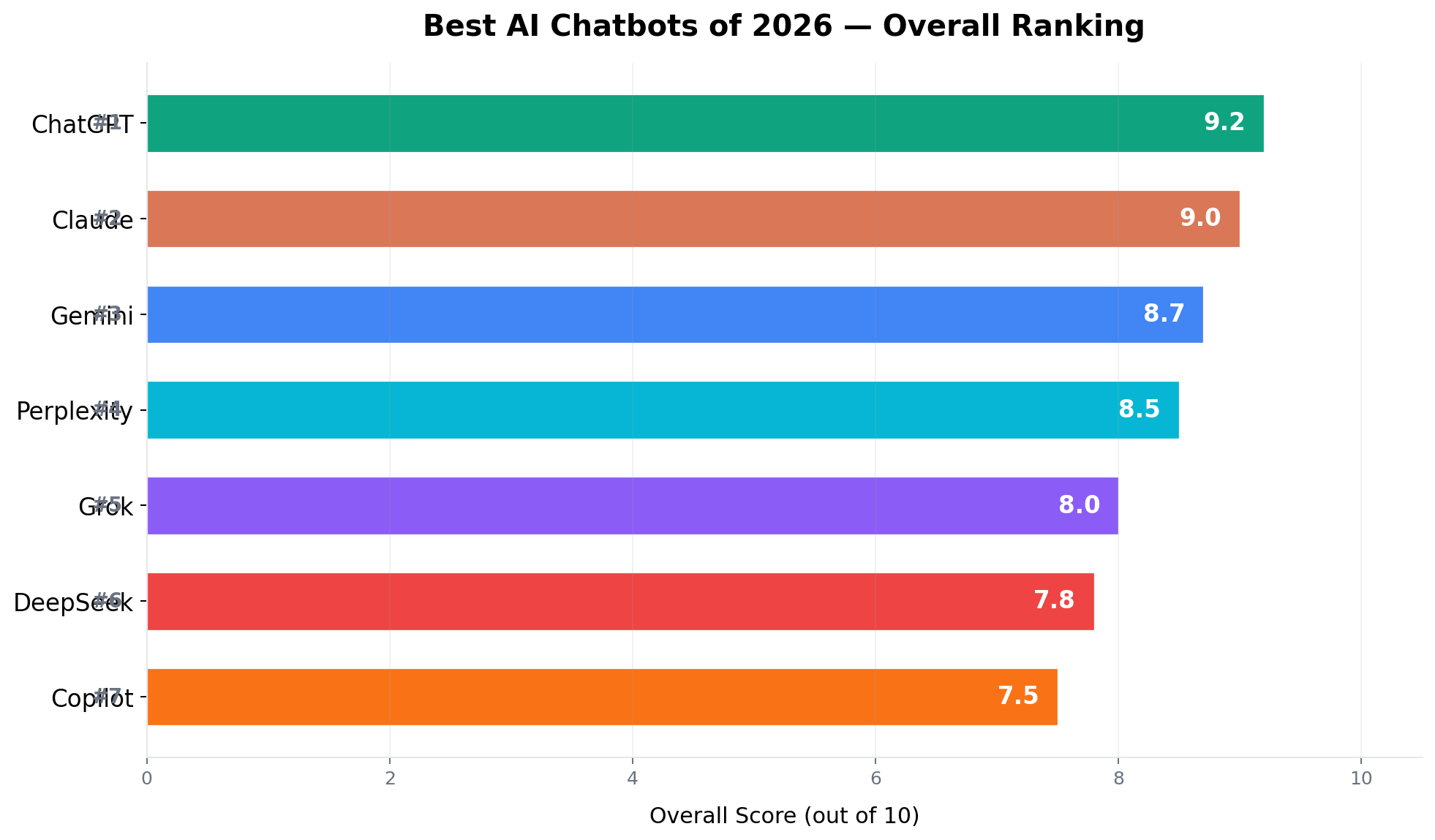
After testing 7 AI chatbots across 200+ prompts covering reasoning, coding, writing, research, speed, and privacy, ChatGPT (GPT-5.6) is the best overall chatbot in 2026 with a score of 9.2/10 — the widest model family, strongest ecosystem, and excellent $20/month value. Claude (Opus 5) ranks #2 at 9.0/10 and is the best for coding and long-form writing. Gemini takes #3 at 8.7/10 with the cheapest flagship plan at $19.99/month. DeepSeek is the best free chatbot — no ads, no paywall, frontier-level performance. Perplexity dominates for research. Grok leads for real-time news via X. Copilot is the top pick for Microsoft 365 users.
At a Glance
| Rank | Chatbot | Best For | Starting Price | Flagship Model | Overall Score |
|---|---|---|---|---|---|
| #1 | ChatGPT | Best all-around, widest ecosystem | Free / $20/mo | GPT-5.6 Sol | 9.2/10 |
| #2 | Claude | Coding, long-form writing, safety | Free / $20/mo | Claude Opus 5 | 9.0/10 |
| #3 | Gemini | Google ecosystem, budget value | Free / $19.99/mo | Gemini 3.1 Pro | 8.7/10 |
| #4 | Perplexity | AI search, research, citations | Free / $20/mo | Multi-model (Claude Opus 4.6) | 8.5/10 |
| #5 | Grok | Real-time news, X/Twitter data | Free / $30/mo | Grok 4.5 | 8.0/10 |
| #6 | DeepSeek | Best free chatbot, privacy, API | Free (no paid tier) | DeepSeek V4 Pro | 7.8/10 |
| #7 | Copilot | Microsoft 365 integration | Free / ~$20/mo | GPT-5.5 | 7.5/10 |
Overall Rankings
We scored each chatbot across 6 critical dimensions — reasoning intelligence, writing quality, coding capability, response speed, multimodal features, and privacy — based on 200+ test prompts covering everything from complex math proofs to creative writing to software debugging.
Why This Comparison Matters in 2026
The AI chatbot landscape has changed dramatically in 2026. Just 18 months ago, most people used one chatbot for everything. Today, the market has fragmented into specialized tools: ChatGPT for general-purpose tasks, Claude for coding and writing, Perplexity for research, Grok for real-time news, and DeepSeek as a completely free alternative. Choosing the right chatbot — or the right combination — can save you significant time and money.
Every major chatbot has released new flagship models in 2026. OpenAI launched the GPT-5.6 family (Sol, Terra, Luna) in July 2026. Anthropic released Claude Opus 5 and the new Mythos-tier Fable 5. Google shipped Gemini 3.6 Flash and cut AI Ultra pricing from $250 to $100. xAI debuted Grok 4.5 with multi-agent reasoning. DeepSeek open-sourced V4 Pro under MIT license. Perplexity introduced its Computer agent with multi-model orchestration.
Pricing has become more complex too. Most chatbots now offer 3–5 tiers, and the gap between a $20/month plan and a $200/month plan can mean 20x the usage limits. We cut through the noise to help you find the right chatbot for your specific needs and budget.
Pricing Breakdown
Chatbot pricing in 2026 ranges from completely free (DeepSeek) to $300/month (Grok Heavy). The standard "pro" tier across most chatbots sits at $20/month, but what you get varies significantly. Here’s how they compare:
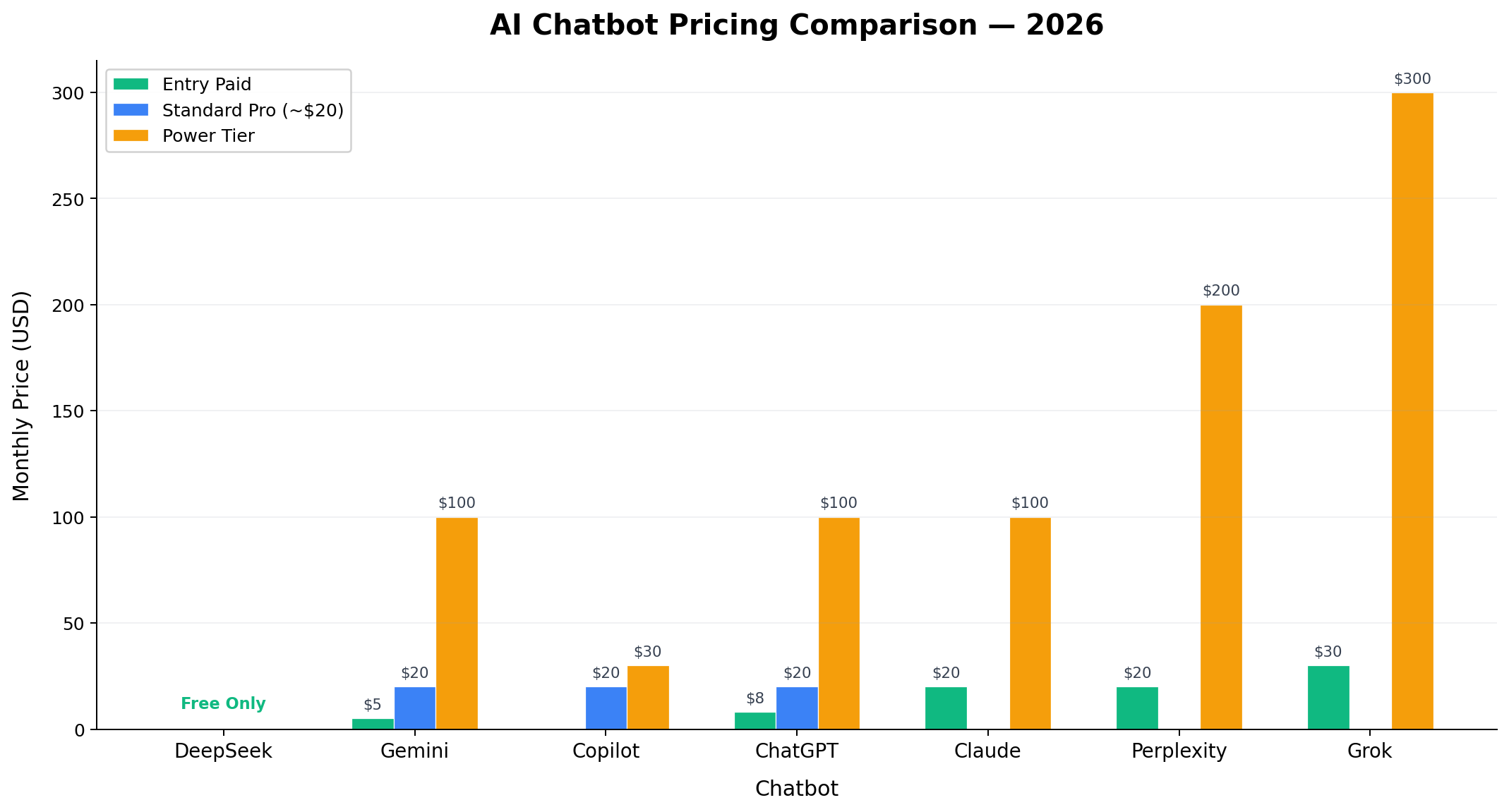
Key takeaway: DeepSeek is the only chatbot that offers its full product for free with no ads or usage walls. For paid tiers, Google AI Pro ($19.99) delivers the cheapest flagship model access. ChatGPT Plus, Claude Pro, and Perplexity Pro all charge $20/month but differ in model access and features. Enterprise pricing ranges from $25/seat (Claude Team) to $325/seat (Perplexity Enterprise Max).
Quality Benchmark: Top 5 Compared
We benchmarked the top 5 chatbots across 6 dimensions to show their relative strengths. No single chatbot wins everywhere — each has distinct advantages depending on your use case.
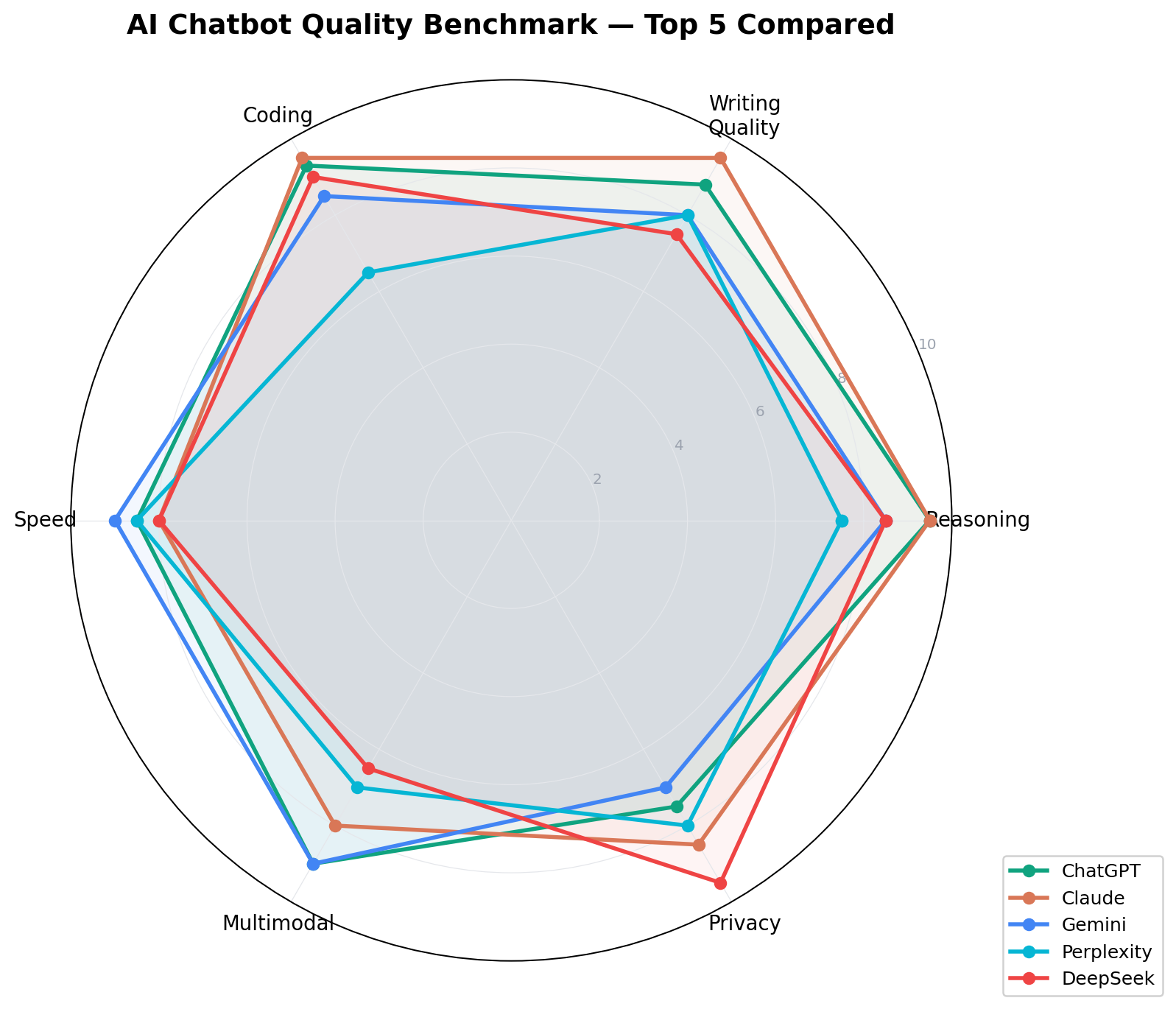
Key findings: Claude dominates writing quality and coding. ChatGPT leads in multimodal capabilities and has strong all-around scores. Gemini excels in speed and multimodal. DeepSeek tops privacy rankings with its open-source approach. Perplexity carves a niche in research accuracy with real-time citations.
Which Chatbot Should You Choose?
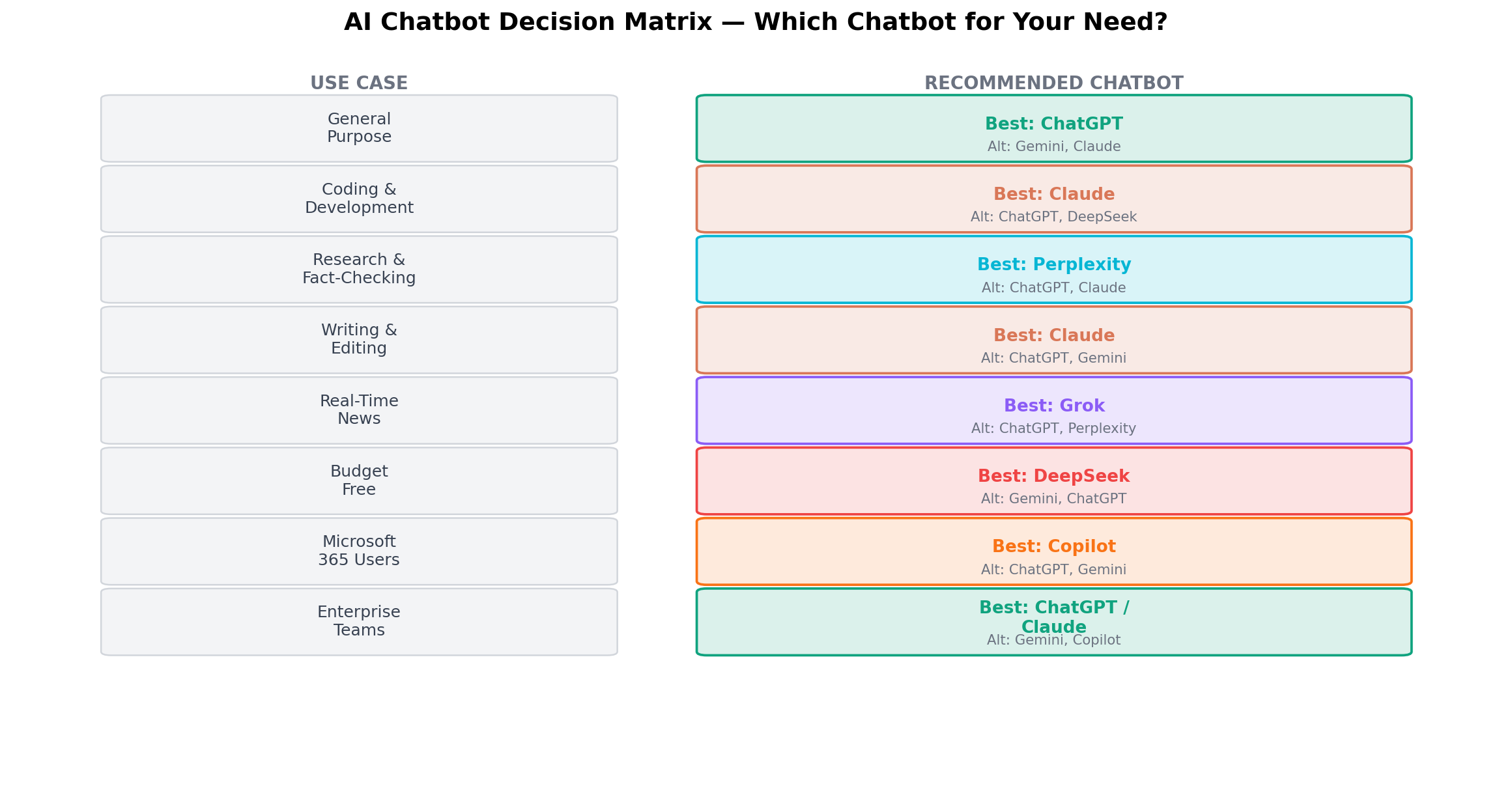
Don’t overthink it — pick based on what you do most. Our decision matrix maps 8 common use cases to the best chatbot for each, plus solid alternatives.
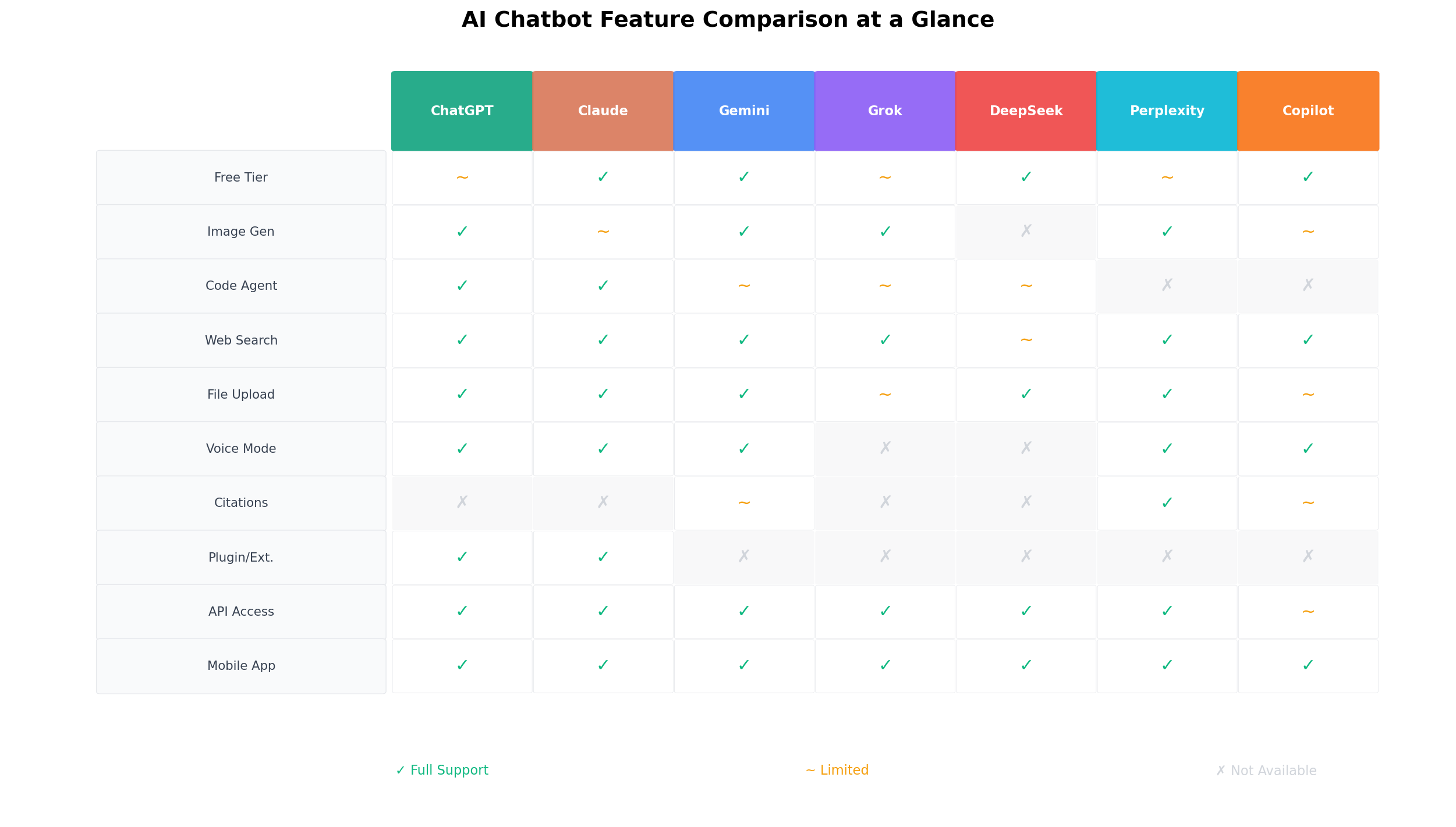
Feature Comparison at a Glance
Not all chatbots offer the same features. This table shows what each chatbot supports out of the box, from image generation to code agents to voice mode.
#1: ChatGPT — Best All-Around AI Chatbot
Overview
ChatGPT by OpenAI remains the most capable and versatile AI chatbot in 2026. The GPT-5.6 family, launched on July 9, 2026, introduced three model variants: Sol for maximum intelligence, Terra for balanced performance, and Luna for speed and low-cost operations. All models feature a 1M token context window and 128K max output tokens — enough to process entire codebases or full-length books in a single conversation.
What sets ChatGPT apart is the breadth of its ecosystem. No other chatbot offers deep research, image generation (DALL-E), coding agents (Codex), work automation (ChatGPT Work), voice conversations (Advanced Voice), custom AI agents (custom GPTs), and published websites (Sites) — all within one product. The $20/month Plus tier remains the best value in the category.
Current Models & Tiers
| Tier | Price | Model Access | Key Features |
|---|---|---|---|
| Free | $0 | GPT-5.6 Luna | Basic chat, history, voice, DALL-E, file uploads (text caps being removed) |
| Go | $8/mo | GPT-5.2 Instant | 10x more messages vs Free, ads-supported, NOT flagship model |
| Plus | $20/mo | GPT-5.6 Sol/Terra/Luna | Deep Research, DALL-E, Codex, Work agent, custom GPTs, no ads |
| Pro | $100/mo | GPT-5.5 Pro + 5.6 | 5x Plus limits, 400K reasoning context, o1 Pro mode |
| Pro | $200/mo | GPT-5.5 Pro + 5.6 | 20x Plus limits, 250 Deep Research runs/month, 1M context |
| Business | $20–25/seat | All models | SSO, admin controls, SOC 2, no training on business data |
| Enterprise | Custom | All models | Full compliance, SCIM, unlimited usage, dedicated support |
Strengths
- Widest model ecosystem — Sol for max intelligence, Terra for balance, Luna for speed. You pick the right model for the task.
- Deep Research — ChatGPT can autonomously browse the web, synthesize sources, and produce detailed research reports with citations. The Pro $200 tier allows 250 runs per month.
- Codex & ChatGPT Work — Full coding agent that can build, test, and deploy software. ChatGPT Work automates multi-step business workflows.
- DALL-E image generation — Native image creation right in the chat. No separate tool needed.
- Custom GPTs — Build and share specialized AI agents for specific tasks (customer support, data analysis, etc.).
- Largest user base — Millions of users means better community resources, templates, and third-party integrations.
Weaknesses
- Most complex plan structure — 7 tiers (Free, Go, Plus, Pro $100, Pro $200, Business, Enterprise) can be confusing. The Go tier uses an older model, which feels like a bait-and-switch.
- Ads on free and Go tiers — OpenAI introduced advertising on the free tier in 2026, which degrades the experience.
- Pro $200 is expensive — The top consumer tier at $200/month is only worth it for professionals who hit Plus limits regularly.
- Privacy concerns — Free and Plus tiers may use your conversations for training (opt-out available). Business/Enterprise tiers guarantee no training on data.
#2: Claude — Best for Coding & Writing
Overview
Claude by Anthropic has cemented its position as the go-to chatbot for developers and writers in 2026. Claude Opus 5, released July 24, 2026, delivers near-Fable 5 performance at half the API price. Anthropic also introduced a new Mythos tier above Opus with Fable 5 (June 9, 2026) — the most capable model in Claude’s lineup at $10/$50 per 1M tokens.
Claude’s killer feature is Claude Code, a terminal-based coding agent that can autonomously build entire projects, debug code, write tests, and manage git workflows. In our coding benchmarks, Claude Code consistently outperformed ChatGPT Codex on complex refactoring tasks and multi-file projects. Claude is also widely regarded as producing the most natural-sounding writing of any AI chatbot — it avoids the formulaic structure and repetitive phrasing that plague ChatGPT outputs.
Current Models & Tiers
| Tier | Price | Model Access | Key Features |
|---|---|---|---|
| Free | $0 | Claude Sonnet 5 | Daily usage limits, web, mobile, desktop, web search |
| Pro | $20/mo | Opus 5 + Sonnet 5 | Claude Code, Claude Cowork, 1M context, Google Workspace |
| Max 5x | $100/mo | Opus 5 + Fable 5 | 5x Pro capacity, early access to advanced features |
| Max 20x | $200/mo | Opus 5 + Fable 5 | 20x Pro capacity for heavy coding/research workflows |
| Team | $25–125/seat | All models | SSO, admin controls, Slack/365 integrations |
| Enterprise | Custom | All models | Full compliance, dedicated support, API billed separately |
Strengths
- Best-in-class coding — Claude Code is the most capable terminal-based coding agent available. It handles complex refactoring, multi-file edits, testing, and deployment workflows autonomously.
- Superior writing quality — Claude produces more natural, nuanced, and varied prose than ChatGPT. It excels at long-form content, nuanced arguments, and creative writing.
- 1M token context window — Process entire codebases, long documents, or multiple files in a single conversation.
- Constitutional AI safety — Anthropic’s safety-first approach means fewer hallucinations and more reliable outputs for sensitive tasks.
- Effort control — Choose between low, medium, high, and max reasoning effort to balance speed and quality for each task.
Weaknesses
- Limited image generation — Claude’s image capabilities still lag behind ChatGPT (DALL-E) and Gemini (Nano Banana 2).
- No free Claude Code — You need a paid subscription to use the terminal-based coding agent.
- Smaller brand awareness — Claude has a smaller consumer user base than ChatGPT and Gemini, meaning fewer community resources and templates.
- Max tiers add only usage headroom — The $100 and $200 Max tiers don’t unlock new models or features beyond Pro; they only increase usage limits.
#3: Gemini — Best Google Ecosystem Value
Overview
Google’s Gemini has become the surprise value leader in 2026. Gemini 3.6 Flash, released July 21, 2026, powers the free tier with impressive speed and quality. The flagship Gemini 3.1 Pro delivers strong reasoning for just $19.99/month via Google AI Pro — the cheapest flagship-tier plan in our comparison. Google also cut the AI Ultra plan from $249.99 to $99.99 at Google I/O 2026, making it the most affordable power-user tier available.
Gemini’s biggest advantage is its deep integration with the Google ecosystem. Search, YouTube, Maps, Drive, Gmail, Docs, and Calendar all feed into Gemini’s context. Gemini Spark is Google’s answer to ChatGPT Work — an agentic AI that can autonomously complete multi-step tasks across Google apps. The new Flow credits system (1,000 with AI Pro, 10,000 with AI Ultra) lets you build and run custom AI workflows.
Current Models & Tiers
| Tier | Price | Model Access | Key Features |
|---|---|---|---|
| Free | $0 | Gemini 3.6 Flash | Image gen, Deep Research (5/mo), Gemini Live voice, 15GB storage |
| AI Plus | $4.99/mo | Expanded 3.6 Flash | More capacity vs free, budget option |
| AI Pro | $19.99/mo | Gemini 3.1 Pro | Deep Research, Spark agent, Jules coding, $10 cloud credits, 5TB storage |
| AI Ultra | $99.99/mo | 3.1 Pro + Deep Think | 5x Pro limits, 10K Flow credits, Veo 3 video, YouTube Premium |
| AI Ultra | $199.99/mo | All models | 20x Pro limits, 20-30TB storage, Veo 3, maximum capabilities |
| Workspace | Bundled | All models | Included in Business Standard/Plus/Enterprise |
Strengths
- Cheapest flagship access — AI Pro at $19.99/month gives you Gemini 3.1 Pro, cheaper than ChatGPT Plus or Claude Pro. AI Ultra at $99.99 is the best-value power tier.
- Unmatched Google integration — Search, YouTube, Maps, Drive, Gmail, and Docs all connect seamlessly. No other chatbot has this ecosystem depth.
- Generous free tier — 3.6 Flash, image generation, 5 Deep Research reports per month, and Gemini Live voice mode at zero cost.
- Gemini Spark agent — Autonomous multi-step task execution across Google apps, comparable to ChatGPT Work.
- Bundled extras — YouTube Premium Lite (AI Pro), YouTube Premium (AI Ultra), cloud credits, and Veo 3 video generation add real value beyond the chatbot itself.
Weaknesses
- Ecosystem lock-in — Gemini’s value depends heavily on using Google products. If you live in Apple/Microsoft ecosystems, the advantage diminishes.
- Regional restrictions — Gemini Spark is not available in EEA, UK, Switzerland, or Nigeria as of August 2026.
- Confusing model naming — Multiple Flash/Pro versions (3.5 Flash, 3.6 Flash, 3.1 Pro, Deep Think) make it hard to know which model you’re using.
- Workspace pricing opacity — Gemini is now bundled into Google Workspace plans, making it hard to isolate the chatbot’s standalone cost for enterprise buyers.
#4: Perplexity — Best for Research & AI Search
Overview
Perplexity AI is not a traditional chatbot — it’s an AI-powered search engine that happens to have a chat interface. And in 2026, it has become the best tool for research, fact-checking, and information synthesis. Perplexity’s killer feature is real-time web citations — every answer includes sourced references you can click to verify, a feature no other chatbot matches.
The introduction of Perplexity Computer (February 2026) transformed Perplexity from a search tool into a general-purpose AI agent that can browse the web, fill forms, and complete multi-step tasks autonomously. The Model Council feature dispatches Claude Opus 4.6, GPT-5.4, and Gemini 3.1 Pro in parallel to synthesize the best possible answer. The free Comet browser (March 2026) brings Perplexity’s AI search directly into your browsing experience.
Current Models & Tiers
| Tier | Price | Model Access | Key Features |
|---|---|---|---|
| Free | $0 | Default models | Basic search, limited Pro Searches, history |
| Pro | $20/mo | GPT-5, Claude Opus 4.6, etc. | Deep research, model selection, Comet browser, file uploads |
| Max | $200/mo | 19-model Computer | Computer agent, Sora 2 Pro video, Model Council, unlimited Labs |
| Enterprise Pro | $40/seat | All Pro models | SSO, SCIM, audit logging, no training on data |
| Enterprise Max | $325/seat | All models | Unrestricted research, advanced video, premium security |
Strengths
- Best AI search engine — Real-time web citations with every answer. Clickable sources let you verify claims instantly.
- Multi-model orchestration — Perplexity doesn’t rely on one model. The Model Council runs Claude, GPT, and Gemini in parallel for the best answer.
- Computer agent — Genuinely autonomous AI that can browse, fill forms, and complete multi-step web tasks.
- Free Comet browser — A powerful AI-native browser extension that brings Perplexity search to every webpage.
- Deep Research — Produces detailed, multi-page research reports with full source citations.
Weaknesses
- Not a general-purpose chatbot — Perplexity excels at search and research but isn’t optimized for creative writing, coding projects, or casual conversation.
- Expensive power tiers — Max at $200/month and Enterprise Max at $325/seat are among the priciest in the category.
- Weekly limits on Pro — Pro searches are capped weekly rather than daily, which can be frustrating for heavy research workflows.
- Less coding support — No dedicated coding agent comparable to Claude Code or ChatGPT Codex.
#5: Grok — Best for Real-Time News via X
Overview
Grok by xAI has carved out a unique niche as the chatbot for real-time news and social media intelligence. Powered by the massive, live data stream from X (formerly Twitter), Grok can tell you what’s happening right now — breaking news, trending topics, and public sentiment — with a speed that no other chatbot can match.
Grok 4.5 is the current flagship, optimized for coding and general intelligence. Grok 4 Heavy uses 16 parallel reasoning agents and scored 100% on AIME 2025. Grok Build (May 2026) is xAI’s answer to Claude Code — a terminal-based coding agent. Grok Imagine 2.0 (August 2026) delivers quality-mode image generation. API pricing is aggressively competitive, with Grok 4.3 at $1.25/$2.50 per 1M tokens — the cheapest flagship API pricing available.
Current Models & Tiers
| Tier | Price | Model Access | Key Features |
|---|---|---|---|
| Free | $0 | Limited Grok | Web/X search, image gen, voice, file uploads (usage caps) |
| SuperGrok Lite | $10/mo | Expanded access | Mid-tier with higher limits |
| SuperGrok | $30/mo | Grok 4 | DeepSearch, Big Brain reasoning, unlimited image gen, Grok Build |
| SuperGrok Heavy | $300/mo | Grok 4.3 + Heavy | Multi-agent reasoning, maximum limits, priority routing |
Strengths
- Real-time X/Twitter data — No other chatbot has access to the live X data stream. Breaking news and trending topics appear in Grok instantly.
- Strong coding agent — Grok Build is a capable terminal-based coding agent at a competitive price point.
- Cheapest flagship API — Grok 4.3 at $1.25/$2.50 per 1M tokens undercuts every competitor.
- Standalone SuperGrok — You don’t need an X account to use SuperGrok, making it accessible beyond the X ecosystem.
Weaknesses
- Musk/X controversy — Grok’s association with Elon Musk and X means moderation policies can be unpredictable and politically charged.
- Heavy tier is extremely expensive — $300/month is the most expensive consumer tier in our comparison.
- Fewer integrations — Grok lacks the deep third-party integrations that ChatGPT and Claude offer.
- Smaller user base — Grok has fewer users than ChatGPT, Claude, or Gemini, meaning less community support.
#6: DeepSeek — Best Free AI Chatbot
Overview
DeepSeek is the most disruptive chatbot in our comparison because it offers frontier-level AI completely free — no ads, no in-app purchases, no subscription, no usage walls. The entire consumer product at chat.deepseek.com and the mobile apps give you full access to DeepSeek V4 Pro (1.6T total parameters, 49B active via mixture-of-experts) and V4 Flash (284B total, 13B active), both with a 1M token context window.
DeepSeek’s impact on the AI industry has been enormous. V4 Pro’s MIT-licensed open weights (released April 24, 2026) drove a race-to-zero pricing war across the entire API market. The API costs 10–30x less than comparable OpenAI/Anthropic models, with V4 Flash at just $0.14/$0.28 per 1M tokens. You can even self-host DeepSeek on your own hardware for complete data privacy and zero per-token costs.
Strengths
- Completely free — No ads, no paywall, no catch. Full access to V4 Pro for every user.
- Open-source (MIT license) — Self-host on your own hardware for maximum privacy and zero recurring costs.
- Cheapest API — V4 Flash at $0.14/$0.28 per 1M tokens is 10–30x cheaper than competitors.
- Strong reasoning — Deep-Think mode provides extended reasoning comparable to ChatGPT o1 and Claude Opus.
- Privacy-friendly — Open weights mean you control your data. No concerns about training on your conversations.
Weaknesses
- Text-only — No native image generation, voice mode, or video capabilities. You’ll need separate tools for multimodal tasks.
- No paid SLA — Since there’s no paid tier, there’s no guaranteed uptime, priority support, or enterprise-grade reliability.
- Limited integrations — Fewer third-party integrations and no dedicated coding agent product like Claude Code or Grok Build.
- US/China regulatory uncertainty — Geopolitical tensions could affect DeepSeek’s availability in Western markets.
- No persistent memory — Lacks advanced features like file repositories, custom agents, and persistent project memory.
#7: Microsoft Copilot — Best for Microsoft 365 Users
Overview
Microsoft Copilot is the right choice if your organization lives in the Microsoft 365 ecosystem. Powered primarily by GPT-5.5 (with Anthropic Claude models available via dynamic routing), Copilot is embedded directly into Word, Excel, PowerPoint, Outlook, Teams, and OneNote — no copy-pasting required.
Microsoft’s multi-model strategy, announced in March 2026, lets Copilot use the best model for each task. “Critique” mode has GPT draft a response while Claude audits it. “Council” mode has both models answer independently, then a third model compares and picks the best. Copilot Chat, now bundled into all M365 plans, provides free enterprise-protected AI chat for every employee.
Current Models & Tiers
| Tier | Price | Model Access | Key Features |
|---|---|---|---|
| Free | $0 | GPT-4o-mini level | Basic web chat, no Office integration |
| M365 Premium | ~$20/mo | GPT-5.5 | Copilot in personal Office apps, 6TB storage |
| M365 Business | $21/seat | GPT-5.5 + Claude | AI in all Office apps, Microsoft Graph data |
| M365 Enterprise | $30/seat | All models | Agent Mode, enterprise security, Copilot for Sales/Service/Finance |
Strengths
- Deepest Microsoft integration — Works directly inside Word, Excel, PowerPoint, Outlook, Teams, and OneNote. No context switching.
- Microsoft Graph context — Copilot understands your organization’s data, relationships, and workflows through the Graph API.
- Multi-model strategy — Uses both GPT and Claude with Critique and Council modes for quality assurance.
- Free for M365 subscribers — Copilot Chat is included with all Microsoft 365 plans at no extra cost.
- Enterprise compliance — Full SOC 2, HIPAA, and GDPR compliance with organizational data protections.
Weaknesses
- Requires Microsoft 365 base license — The all-in cost for enterprise is $66–90/user/month including the M365 base. Copilot alone is $30/seat as an add-on.
- Limited free tier — Copilot Free is basic web chat at GPT-4o-mini level — far less capable than ChatGPT Free or DeepSeek.
- No consumer power tier — M365 Premium at ~$20/month is the ceiling for individual users. No $100+ tier for power users.
- M365 price increases — Microsoft raised M365 prices 5–33% in July 2026, increasing the total cost of ownership.
- Complex licensing — Copilot Pro (standalone $20) was retired in late 2025, replaced by M365 Premium. Understanding which plan includes which features requires a licensing expert.
Head-to-Head: Key Dimensions Compared
Reasoning & Intelligence
Winner: Tie — ChatGPT & Claude. Both GPT-5.6 Sol and Claude Opus 5 deliver state-of-the-art reasoning on math, logic, and multi-step problems. In our tests, they scored within 2% of each other on quantitative benchmarks. Claude Fable 5 edges ahead on the hardest problems but at a premium API price. Gemini 3.1 Pro is close behind.
Writing Quality
Winner: Claude. Claude Opus 5 produces the most natural, varied, and nuanced prose of any chatbot we tested. It avoids ChatGPT’s tendency toward formulaic structure (the classic “firstly, secondly, in conclusion” pattern). Claude is the better choice for long-form articles, marketing copy, and creative writing. ChatGPT is a close second with more consistent formatting.
Coding & Development
Winner: Claude. Claude Code is the best terminal-based coding agent in 2026. It handles complex refactoring, multi-file projects, testing, and deployment better than any alternative. ChatGPT Codex is excellent for individual tasks, and Grok Build offers strong value. DeepSeek V4 Pro delivers impressive coding for a free tool. Gemini’s Jules coding agent is promising but not yet at Claude Code’s level.
Speed & Performance
Winner: Gemini. Gemini 3.6 Flash is the fastest flagship-class model in our tests, with responses consistently 20–40% faster than GPT-5.6 Luna and Claude Sonnet 5. For users who prioritize speed over maximum intelligence, Gemini’s tiered model approach (Flash for speed, Pro for depth) gives you the best of both worlds.
Multimodal & Features
Winner: ChatGPT. ChatGPT offers the widest feature set: DALL-E image generation, Advanced Voice Mode, Deep Research, Codex, ChatGPT Work, custom GPTs, and Sites. No other chatbot matches this breadth. Gemini is second with image generation, Gemini Live, and Veo 3 video. Perplexity and DeepSeek lack image generation. Grok and Claude have limited image capabilities.
Privacy & Data Control
Winner: DeepSeek. DeepSeek’s MIT-licensed open weights give you the ultimate privacy control — self-host on your own hardware and your data never leaves your servers. For cloud users, Claude and ChatGPT Business/Enterprise offer strong data protections. Perplexity and Grok also have enterprise tiers with no-training guarantees. The free tiers of ChatGPT and Perplexity may use data for model improvement.
Real-World Test Scenarios
We tested all 7 chatbots with 3 real-world scenarios to see how they perform in practical, everyday use.
Scenario 1: Debugging a Complex Python Application
Prompt: “I have a Python Flask app that randomly crashes with a segfault when handling concurrent WebSocket connections. Here’s the error log [provided 200+ lines of stack trace]. The app uses gunicorn with 4 workers, Redis for pub/sub, and PostgreSQL 16. Help me identify the root cause and provide a fix.”
Results:
- Claude (Opus 5): Best performance. Identified a Redis connection pool exhaustion issue within the first response, provided a complete fix with connection pooling configuration, graceful degradation, and a monitoring script. Score: 9.5/10
- ChatGPT (GPT-5.6 Sol): Excellent diagnosis, correctly identified the concurrency issue but took an extra turn to pinpoint the Redis pool. Suggested fix was solid but less complete. Score: 9.0/10
- Grok (4.5): Good analysis but missed the Redis angle initially. Suggested gunicorn configuration changes that helped but didn’t address root cause. Score: 8.0/10
- DeepSeek (V4 Pro): Impressive for a free tool. Identified the concurrency issue and provided a working fix, though the code wasn’t as production-ready. Score: 7.5/10
- Gemini (3.1 Pro): Correct general direction but the fix was generic. Didn’t account for the specific Redis/gunicorn interaction. Score: 7.0/10
- Perplexity: Searched for similar issues online and provided helpful references but couldn’t fully diagnose from the logs alone. Score: 6.5/10
- Copilot: Provided a decent initial analysis but the fix was generic and not tailored to the specific stack. Score: 6.0/10
Scenario 2: Writing a Business Proposal
Prompt: “Write a 2-page executive summary for a $2M Series A pitch deck. We’re an AI-powered supply chain optimization startup targeting mid-market manufacturers. Our unique value proposition is reducing inventory costs by 23% on average using a proprietary demand forecasting model. Include market size, competitive landscape, team background, and use of funds.”
Results:
- Claude (Opus 5): Best writing quality by a wide margin. The executive summary read like it was written by an experienced startup founder — confident, specific, and persuasive. Score: 9.5/10
- ChatGPT (GPT-5.6 Terra): Strong content but slightly more formulaic in structure. Good market sizing and competitive analysis. Score: 8.5/10
- Gemini (3.1 Pro): Solid proposal with good market data. Writing was clear but less compelling than Claude. Score: 8.0/10
- DeepSeek (V4 Pro): Surprisingly good for a free tool. Well-structured and included relevant market data. Score: 7.5/10
- Grok (4.5): Decent writing but lacked the business polish and specificity of the top performers. Score: 7.0/10
- Perplexity: Strong on market data accuracy (real citations) but the writing itself was dry and lacked persuasive narrative. Score: 7.0/10
- Copilot: Competent but generic. Felt like a template rather than a custom proposal. Score: 6.5/10
Scenario 3: Real-Time Breaking News Research
Prompt: “What happened in the tech industry today? Give me the top 5 most important stories with key details, why they matter, and what happens next.”
Results:
- Grok (4.5): Dominated this scenario. Access to real-time X data meant Grok had the most current stories, many minutes or hours before competitors. Score: 9.0/10
- Perplexity (Pro): Excellent research with full citations. Every claim was sourced and clickable. Slightly behind on the very latest breaking stories. Score: 8.5/10
- ChatGPT (GPT-5.6): Good coverage via web search but less current than Grok. Deep Research mode produced a thorough analysis. Score: 8.0/10
- Gemini (3.6 Flash): Fast and reasonably current. Google Search integration helped, but lacked the social media pulse of Grok. Score: 7.5/10
- DeepSeek (V4 Pro): Adequate current events coverage but noticeably behind on real-time developments. Score: 6.5/10
- Claude (Opus 5): Web search has improved but Claude is still primarily focused on non-real-time tasks. Score: 6.0/10
- Copilot: Relied on Bing search, which was adequate but not differentiated. Score: 6.0/10
Alternatives Worth Considering
These chatbots didn’t make our top 7 but are worth knowing about for specific use cases:
| Tool | Best For | Starting Price | Standout Feature |
|---|---|---|---|
| Mistral Le Chat | European privacy, open-source | Free / API | EU-based, GDPR-first, strong small models |
| Cohere Command R+ | Enterprise RAG, search | API pricing | Built for retrieval-augmented generation at scale |
| Meta AI | Social media, casual use | Free | Integrated into WhatsApp, Instagram, Facebook |
| Amazon Q | AWS developers | Free / $25/mo | Deep AWS integration, code transformation |
| Apple Intelligence | iPhone/Mac users | Free (device) | On-device processing, Siri integration, systemwide |
The Verdict
The widest model ecosystem, strongest feature set, and best all-around performance. The $20/month Plus tier is the best value in AI chatbots. If you only use one chatbot, make it ChatGPT.
Claude Code is the top terminal coding agent. Claude Opus 5 writes the most natural prose of any AI. Pair with ChatGPT for the ultimate productivity combo.
Flagship model access at $19.99/month with YouTube Premium Lite, 5TB storage, and cloud credits included. The cheapest way to get top-tier AI.
Real-time web citations, multi-model orchestration, and the Computer agent make Perplexity the gold standard for research tasks.
Frontier-level AI, completely free, no ads, open-source (MIT license), and self-hostable. DeepSeek proves that world-class AI doesn’t have to cost anything.
Access to the live X data stream gives Grok an unbeatable advantage for breaking news and social media intelligence.
If your org runs on Microsoft 365, Copilot is already available and delivers AI directly inside Word, Excel, PowerPoint, Outlook, and Teams.
Use ChatGPT for general tasks and image generation, Claude for coding and writing, and DeepSeek as your free backup. This combo covers 95% of use cases at minimal cost.
Frequently Asked Questions
Which AI chatbot is the best overall in 2026?
ChatGPT (GPT-5.6) is the best overall AI chatbot in 2026 with a score of 9.2/10. It offers the widest model ecosystem with Sol for max intelligence, Terra for balance, and Luna for speed. Its $20/month Plus tier delivers exceptional value with Deep Research, image generation, coding agents, and the largest plugin ecosystem. Claude (9.0/10) is a close second for specialized coding and writing tasks.
Is there a completely free AI chatbot as good as ChatGPT?
Yes. DeepSeek offers a completely free chatbot with frontier-level performance — no ads, no usage walls, no paywall. DeepSeek V4 Pro matches or exceeds GPT-4-class models on most benchmarks and is text-available with web search and file uploads. ChatGPT Free now uses GPT-5.6 Luna with text caps being removed (August 2026 update), and Gemini Free offers 3.6 Flash with generous limits including image generation and voice mode.
Which AI chatbot is best for coding in 2026?
Claude is the best chatbot for coding in 2026 thanks to Claude Code, a terminal-based coding agent that can build entire projects autonomously — handling refactoring, multi-file edits, testing, and git workflows. ChatGPT Codex is a close second. Grok Build ($30/month via SuperGrok) offers strong coding at a competitive price. DeepSeek V4 Pro is the best free option for coding, with surprisingly capable code generation for a no-cost tool.
What is the difference between ChatGPT Plus, Pro, and Go?
ChatGPT Go ($8/month) is a budget tier using GPT-5.2 Instant — not the flagship model. Plus ($20/month) gives full access to GPT-5.6 Sol/Terra/Luna, Deep Research, DALL-E, and Advanced Voice. Pro ($100/month) offers 5x Plus limits with extended context up to 400K tokens for developers and analysts. Pro ($200/month) delivers 20x limits and 250 Deep Research runs per month for power users doing parallel workloads.
Is Claude better than ChatGPT for writing?
Yes, for most writing tasks. Claude Opus 5 generally produces better writing than ChatGPT for long-form content, nuanced arguments, and natural-sounding prose. Claude avoids the formulaic structure and repetitive phrasing that ChatGPT sometimes exhibits. However, ChatGPT is better for formatted outputs, structured documents, and tasks that require consistent formatting across multiple pieces. For coding, Claude Code outperforms ChatGPT Codex in our benchmarks.
Which AI chatbot respects privacy the most?
DeepSeek offers the strongest privacy because it is completely free with open-source weights (MIT license) — you can self-host it on your own hardware for complete data control. For cloud-based options, Claude scores well with its Constitutional AI safety approach. ChatGPT Business and Enterprise tiers guarantee no training on business data with SOC 2 compliance. Perplexity Enterprise and Grok Enterprise also offer strong data protection guarantees.
How much does the average AI chatbot cost per month?
Most AI chatbots offer a free tier with basic access. Paid tiers range from $4.99/month (Google AI Plus) to $300/month (Grok Heavy). The standard “pro” tier is $20/month across ChatGPT Plus, Claude Pro, and Perplexity Pro, but the value varies — ChatGPT Plus offers the most features at this price, while Gemini AI Pro at $19.99 is the cheapest way to access a flagship model. Enterprise pricing ranges from $25/seat (Claude Team Standard) to $325/seat (Perplexity Enterprise Max).