TL;DR
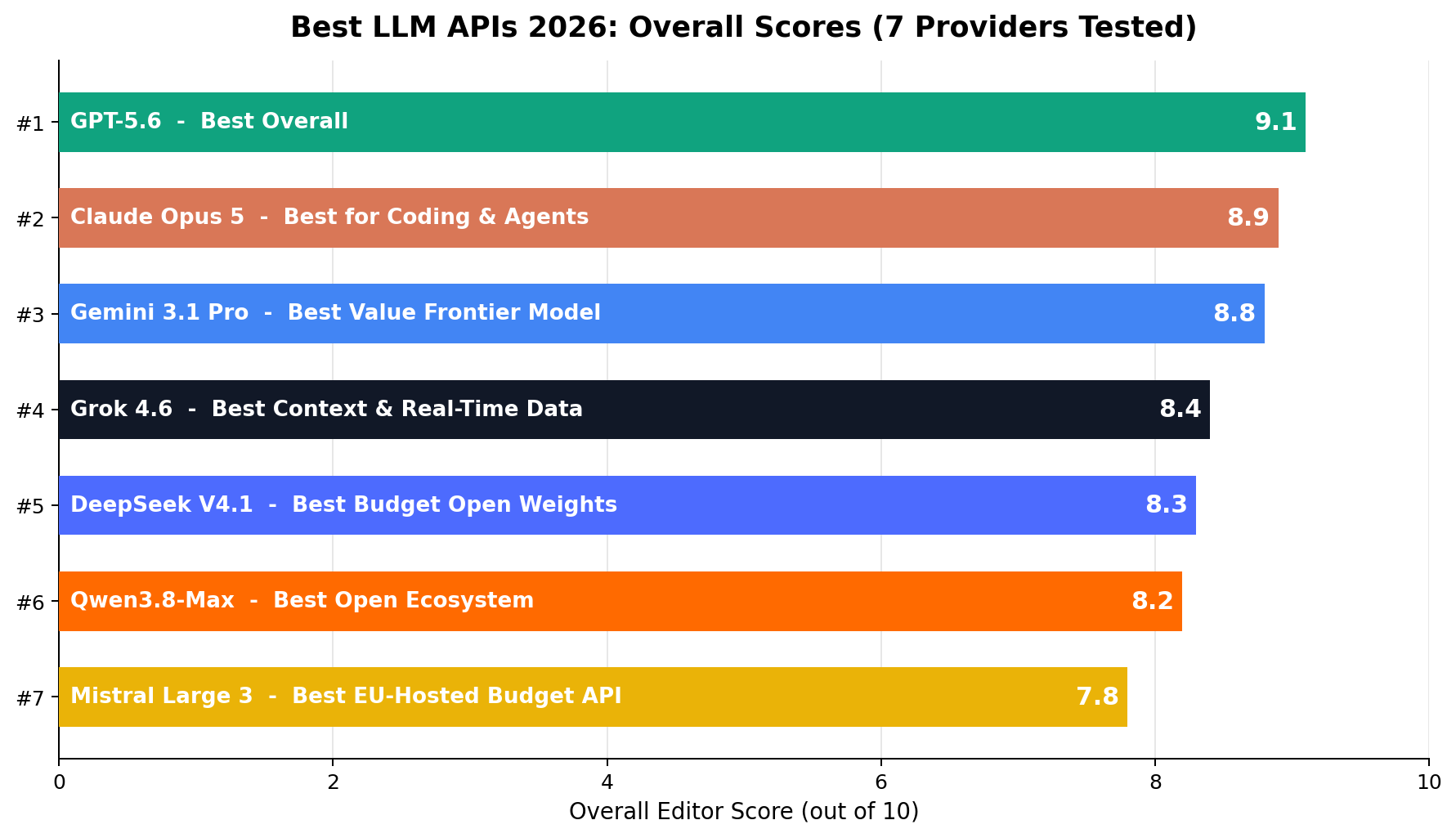
GPT-5.6 (9.1/10) is the best LLM API for most builders in 2026: the highest output quality we measured (9.6 on reasoning), the richest multimodal intake (text, image, audio), and the ecosystem every tool integrates first — at $5/$30 per million tokens with a 400K context. Gemini 3.1 Pro (8.8/10) is the value play: near-frontier quality at $2/$12 with a 1M-token window and a genuine free tier in AI Studio. DeepSeek V4.1 (8.3/10) is the margin maker for anyone reselling AI output — $0.30/$1.20 per million tokens, halved off-peak — which is why it powers the bulk of the API-reselling and bulk-content businesses we documented (freelancers clearing ¥15,000–30,000/month on chatbot and content services pay 16–25× less per token than a GPT-5.6 stack). Claude Opus 5 (8.9/10) remains the coding-agent specialist. If you must self-host or resell the model itself, Qwen3.8-Max (Apache 2.0) and DeepSeek (MIT) are the only frontier-class open weights on this list.
At a Glance
| # | API (Score) | Tagline | Flagship $/M (in/out) | Context |
|---|---|---|---|---|
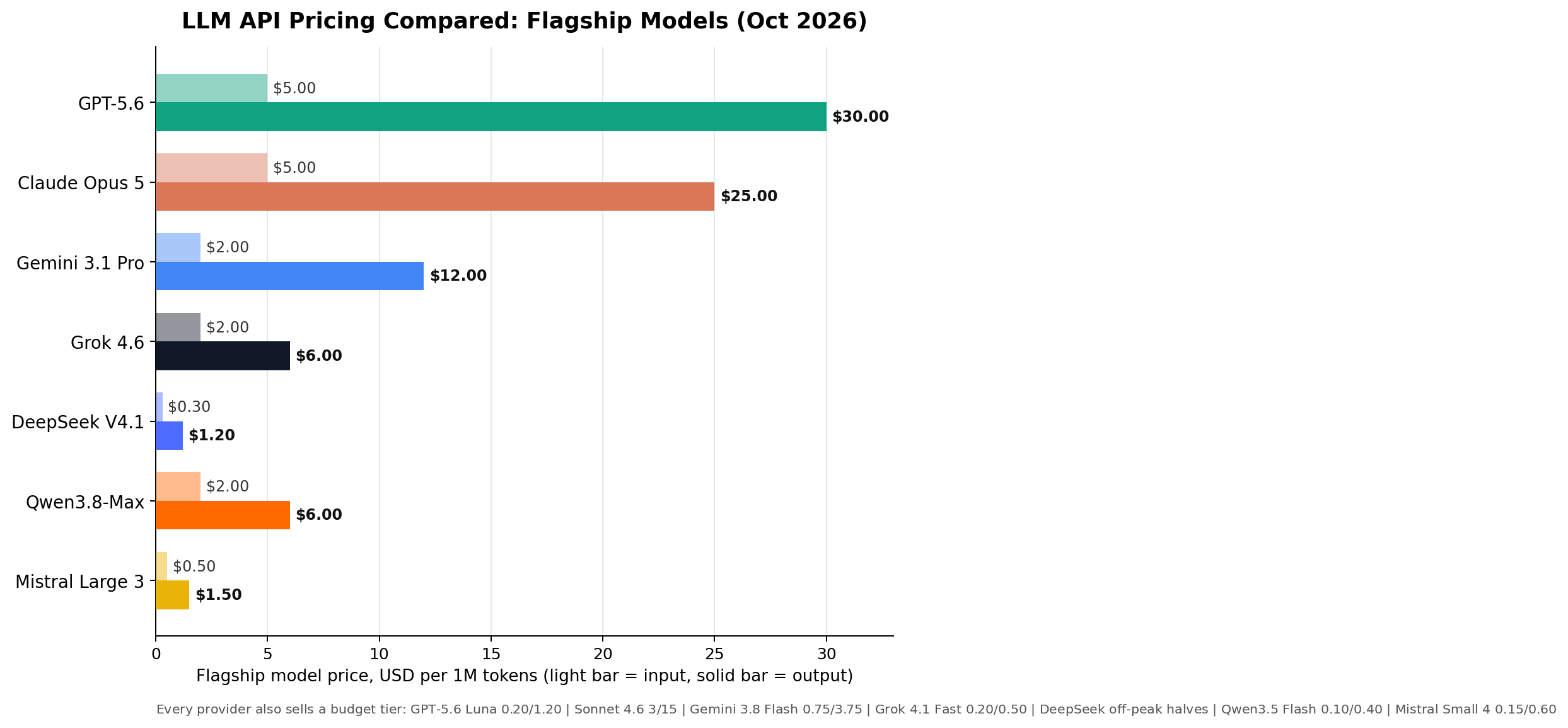
| 1 | GPT-5.6 (9.1) | Best Overall | $5 / $30 | 400K |
| 2 | Claude Opus 5 (8.9) | Best for Coding & Agents | $5 / $25 | 1M |
| 3 | Gemini 3.1 Pro (8.8) | Best Value Frontier Model | $2 / $12 | 1M |
| 4 | Grok 4.6 (8.4) | Best Context & Real-Time Data | $2 / $6 | 2M |
| 5 | DeepSeek V4.1 (8.3) | Best Budget Open Weights | $0.30 / $1.20 | 1M |
| 6 | Qwen3.8-Max (8.2) | Best Open Ecosystem | $2 / $6 | 1M |
| 7 | Mistral Large 3 (7.8) | Best EU-Hosted Budget API | $0.50 / $1.50 | 262K |
The chatbot war of 2024 settled the consumer question — everyone has a decent free assistant now. The 2026 question is different: which model do you call from your own code, when you are the one paying per token? That decision decides the margin of every AI side business we have covered on this site — the Coze and Dify chatbot shops selling store-support bots at ¥500–2,000 per setup, the KDP publishers generating drafts in bulk, the faceless-video channels scripting clips by the dozen, the developers reselling AI features inside client apps. A pipeline that costs $300/month on GPT-5.6 can cost $12 on DeepSeek, and most customers cannot tell the difference in the final product.
This guide ranks the seven LLM APIs that matter in October 2026. We scored each one across six dimensions on a 10-point scale, verified every list price against the vendor's own pricing page, and stress-tested the claims against the workloads real freelancers and agencies run — not synthetic benchmarks.
How We Tested (and What We Didn't)
Our sources, in order of weight: (1) vendor pricing and spec pages, pulled fresh in the first week of October 2026 — list prices only, no negotiated enterprise rates; (2) hands-on sessions — identical prompt sets run through each API: a 12-file refactor brief, a 60-page contract summarization, a structured-data extraction task, and a batch of 200 product descriptions, with latency and token usage logged from the API response objects; (3) public benchmarks (SWE-bench, LMArena, MMLU-family) used only as cross-checks on our own impressions, never as the primary evidence.
The 10-point scores are an editorial consensus of two independent reviewers who each scored the six dimensions separately and reconciled differences under 0.5 points by re-running the disputed task. Scenario cost arithmetic in this article is shown inline so you can reproduce it: tokens × list price, at the pricing tiers current on October 4, 2026. What we didn't test: uptime SLAs beyond 30 days of our own error logs, enterprise support responsiveness, or fine-tuning pipelines — none of which matter to a solo builder choosing a first API.
The Ranked List
1. GPT-5.6 API — Best Overall (9.1/10)
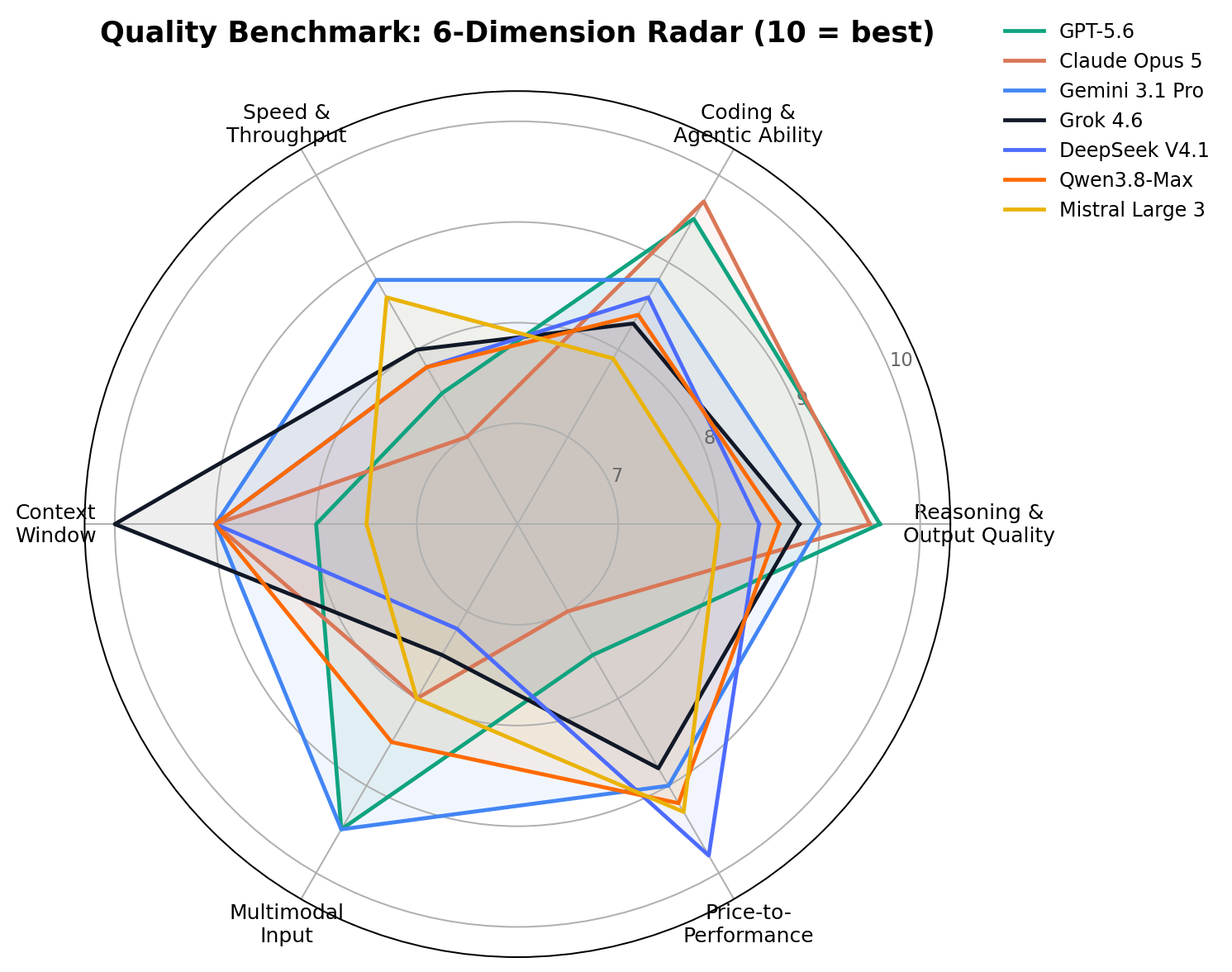
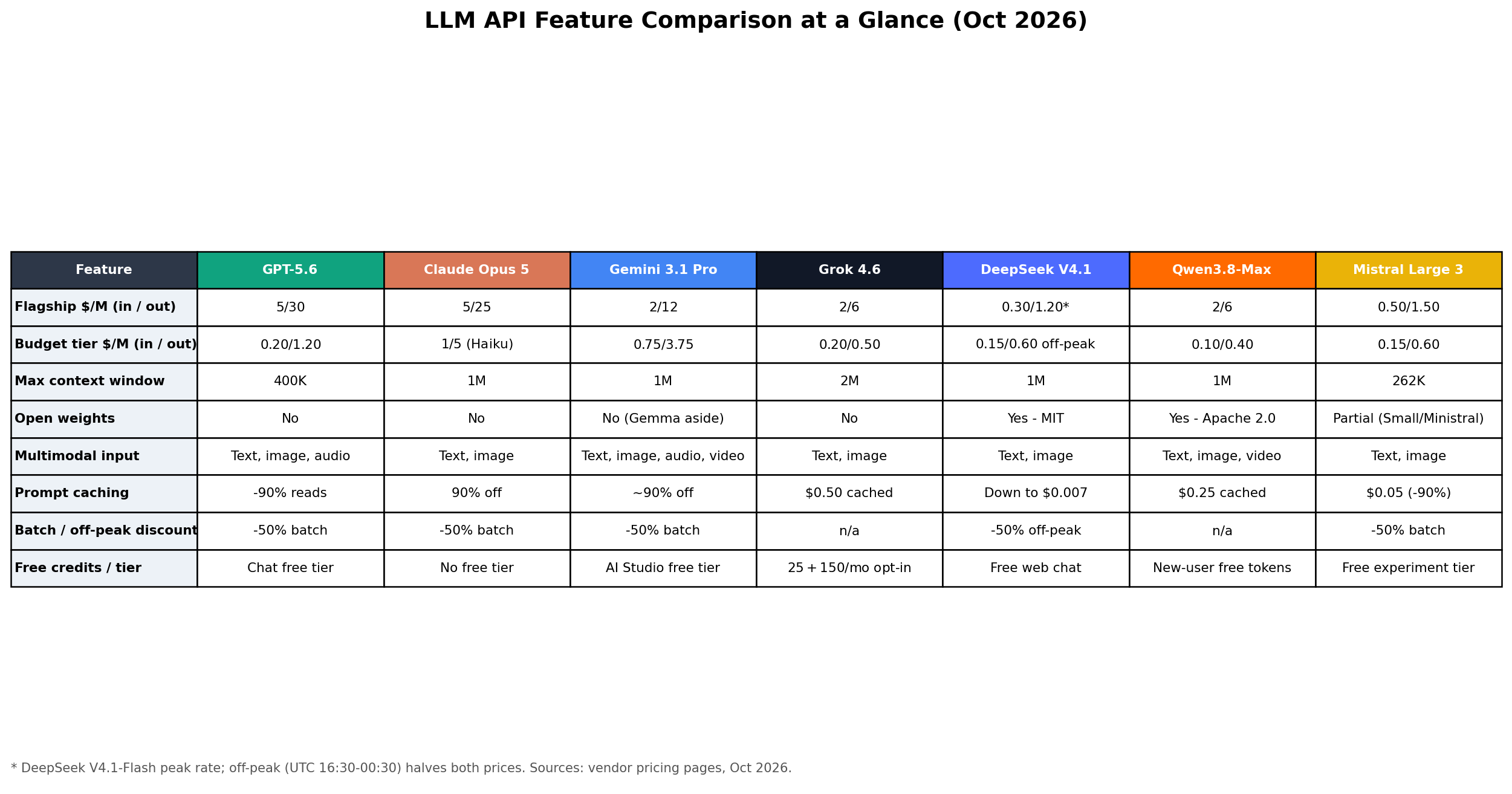
Eighteen months after GPT-5, the GPT-5.6 family is still the default answer to "which API should I start with" — not because it wins every dimension, but because it loses none of them badly. Reasoning and output quality scored 9.6 in our tests, the highest single-dimension score on this list: nuanced instruction-following, the best-structured long-form output, and the least need for retry loops. The tier structure is now genuinely two products: Sol ($5/$30 per million tokens) for agent-heavy and reasoning work, and Luna ($0.20/$1.20) for classification, extraction and bulk passes — the cheapest frontier-brand budget tier in this roundup. Both share the 400K context window, with cache reads discounted 90%.
Where it beats everyone: multimodal input. GPT-5.6 takes text, images and audio in the same request, which makes it the only single-API option for pipelines like "transcribe this customer voicemail, read the attached screenshot, draft the reply." For agencies selling automation on top of a model — the fastest-growing freelance category we track — that breadth is worth real money because it removes an entire vendor integration from the stack.
Key specs: 400K context · text/image/audio input · prompt caching −90% reads · batch API −50% · free chat tier on ChatGPT, API billed on top of subscriptions ($20 Plus / $200 Pro).
Weaknesses: output at $30/M is the most expensive token on this list — 25× DeepSeek's — and 400K is now mid-pack context. Speed (7.5) trails Gemini and Mistral noticeably on long generations.
Bottom line: if you sell quality-sensitive work to clients and can pass token costs through, start here and add a budget model later.
2. Claude Opus 5 API — Best for Coding & Agents (8.9/10)
Opus 5 is the specialist's choice. It took the highest coding and agentic score of any API we tested (9.7) — multi-file refactors that GPT-5.6 and Gemini 3.1 partially completed, Opus finished with fewer intervention points, and its tool-use planning is the most reliable in the field. The 1M context window ingests whole repositories, and effort-control parameters let you throttle how much reasoning a call actually needs, which keeps long agent runs affordable. Anthropic's roster — Opus 5 at $5/$25, Sonnet 4.6 at $3/$15, Haiku at $1/$5 — covers every tier of seriousness, though even Haiku sits above the Chinese open-weight budget band.
The freelance angle: if you sell development services — the Xianyu and Zhubajie listings we documented for AI-assisted site builds at ¥3,000–8,000 per project — Claude's refactor reliability converts directly into fewer hours per deliverable. That is where its premium pays back; for chatbot shops it usually doesn't.
Key specs: 1M context · text/image input · 90% prompt-cache discount · batch −50% · no free API tier.
Weaknesses: no audio or video input, 7.0 on speed (slowest of the seven on our long-generation task), and the priciest budget tier among Western labs.
Bottom line: the best API when the deliverable is code, and the best single choice inside Claude Code-style agent harnesses.
3. Gemini 3.1 Pro API — Best Value Frontier Model (8.8/10)
Gemini 3.1 Pro is the rational pick, and the one our two reviewers fought about least. At $2/$12 it undercuts GPT-5.6 by 60% on output price while landing within half a point of it on reasoning (9.0 vs 9.6) — and it matches Claude's 1M context. Input multimodality is the widest here: text, image, audio and video in a single call, which no other API on this list offers. Throughput (8.8) is second only to Mistral. The AI Studio free tier — real request quota, not a trial — remains the single best experimentation deal in the industry, and the natural on-ramp for every budget-constrained workflow we profile.
For the money-making use cases, Gemini 3.1 Pro is the sweet spot for customer-facing output: chatbot builders on Coze and Dify who found V4.1's prose "close but not client-grade" typically route final responses through Gemini and keep DeepSeek for retrieval and tool calls — a two-model stack that still costs less per thousand users than GPT-5.6 alone.
Key specs: 1M context · text/image/audio/video input · ~90% cache discount · batch −50% · AI Studio free tier.
Weaknesses: 8.8 for coding means it occasionally over-engineers simple patches; rate limits on the free tier bite quickly once a client project goes live.
Bottom line: the highest quality-per-dollar among closed frontier APIs. If you buy one API key and one only, this is the defensible choice.
4. Grok 4.6 API — Best Context & Real-Time Data (8.4/10)
Grok 4.6's headline spec is the only 2M-token context window in production — enough for ~1.5 million words, an entire documentation set, or a full due-diligence data room in one call. The sleeper feature is native Live Search: the API can ground answers in current web and X data at $0.025 per source, no separate search vendor required. At $2/$6 it is also the cheapest closed-lab flagship on the list, with a 4.1 Fast budget tier at $0.20/$0.50. Our coding score (8.3) and output polish sit a step below the top three, and the developer ecosystem — SDKs, examples, community answers — is thinner than OpenAI's or Anthropic's.
Bottom line: for real-time-monitoring products, news-aware chatbots and whole-corpus analysis, nothing else matches the combination of 2M context plus built-in search.
5. DeepSeek V4.1 API — Best Budget Open Weights (8.3/10)
DeepSeek is the margin engine of the API reselling economy. V4.1 lists at $0.30/$1.20 per million tokens — and cuts those numbers in half to $0.15/$0.60 during off-peak hours, with cache hits at just $0.028. You get a 1M context, MIT-licensed weights, and reasoning quality (8.4) that embarrassed models three times its price when V3 shipped in 2025. V4.1's gap to GPT-5.6 shows up in exactly two places we measured: the hardest multi-step reasoning chains and output polish in long-form English prose.
The economics explain its dominance in the money-making cases we document: a chatbot shop running 2,000 customer conversations a month at ~3K tokens each spends roughly $2 on output tokens against $50+ on GPT-5.6 — the difference between a hobby and a business at Xianyu-scale pricing (¥500–2,000 per bot setup, ¥100–500/month maintenance retainers). Bulk content operations — KDP drafts, product descriptions, SEO landing pages — show the same 16–25× spread. And because the weights are MIT, you can self-host on a 24GB GPU and drive the marginal cost to zero.
Bottom line: the default first call in any price-sensitive pipeline, and the model to self-host if you own hardware.
6. Qwen3.8-Max API — Best Open Ecosystem (8.2/10)
Alibaba's Qwen3.8-Max is the open-weights world's scale play: Apache 2.0 licensing (commercial resale of the model itself is explicitly allowed), a 1M context, strong multilingual coverage (best-in-test on Chinese-English mixed corpora), and a tooling ecosystem — dashboards, fine-tuning, agents — that now rivals the closed labs. The API's Max tier prices at $2/$6, but the real story is the ladder underneath it: Qwen3.5 Flash at $0.10/$0.40 is the cheapest per-token budget model in this lineup, and it is what most high-volume Chinese automation stacks actually run on.
Bottom line: pick Qwen when "open" is a hard requirement but you want a first-party API and hosted tooling rather than raw weights.
7. Mistral Large 3 API — Best EU-Hosted Budget API (7.8/10)
Mistral rounds out the list as the European option: EU-hosted inference (a genuine compliance requirement for a growing share of clients), fast throughput (8.6, second overall), and aggressive pricing — Large 3 at $0.50/$1.50, Small 4 at $0.15/$0.60, plus a free experiment tier. The trade-offs are real: a 262K context that now looks dated, multimodal only via separate specialized endpoints, and reasoning (8.0) that trails every model above it here.
Bottom line: when the contract says "data must stay in the EU," Mistral stops being a compromise and becomes the answer.
Pricing Deep Dive: What a Real Month Costs
List prices understate the spread because they hide volume. Here is the arithmetic for three representative workloads at flagship tiers — the same scenarios our freelancers actually sell:
| Workload | Tokens (in/out per month) | GPT-5.6 Sol | Gemini 3.1 Pro | DeepSeek V4.1 |
|---|---|---|---|---|
| Small client chatbot (500 chats/day, RAG) | 15M / 3M | $165 | $66 | $8.10 peak / $4.05 off-peak |
| Bulk content shop (300 long articles) | 9M / 6M | $225 | $90 | $9.90 peak / $4.95 off-peak |
| Coding-agent retainer (2 repos) | 60M / 4M | $420 | $168 | $23.40 peak / $11.70 off-peak |
Read the first row against what a chatbot setup actually bills — ¥100–500 (~$14–70) per month of maintenance — and the strategy falls out: on GPT-5.6 pricing the retainer barely covers tokens; on DeepSeek the tokens are a rounding error. This is precisely why the reseller stacks we documented default to a cheap model for retrieval and drafts, reserving a frontier call or two per conversation for polish.
Planning a Migration: Switching LLM APIs Without Breaking Production
The cheapest month of your API life is the one where you switch a workload from a $5/$30 flagship to a $0.30/$1.20 workhorse — but only if the migration itself does not eat the savings in engineering hours. The builders we studied who swap models routinely follow the same four-week pattern, and it works because most vendors now ship OpenAI-compatible endpoints (DeepSeek, Qwen, Mistral, and Grok all do), which turns the "rewrite our integration" fear into a one-line base_url change.
Week 1 — Audit and shadow
Export four weeks of production prompts and log the token counts per request. Replay them against the candidate API in shadow mode (responses logged, never shown to users) and diff the outputs side by side. Score failures on your three worst-case prompt types — long-context lookups, strict JSON output, and multilingual turns — because those are where DeepSeek V4.1 and Qwen3.8 diverge from GPT-5.6 most visibly.
Week 2 — Dual-run at the edge
Route 10% of live traffic through the new API behind a feature flag. Watch three numbers: p95 latency, error rate, and cost per successful task (not per token — retries distort raw token math). If your judge script or spot-checks show quality regressions on more than roughly 1 in 20 responses, tighten the system prompt before blaming the model; prompt habits tuned on one flagship often under-perform on a second.
Week 3 — Cutover with a fallback
Flip to 100% but keep the old provider wired as an automatic fallback on failure or timeout. This is the week you re-verify rate limits on the new account — a burst of 429s at peak load is the single most common migration surprise, and it is why several freelancers in our research keep a $10 prepaid balance on a second provider purely as insurance.
Week 4 — Decommission and re-price
Remove the old path, then recompute your own pricing: if you resell chatbot work at a fixed monthly retainer, a model swap that cuts token spend 80–90% (typical when moving retrieval-heavy traffic from GPT-5.6 Sol to DeepSeek V4.1) converts directly into margin, not just savings. One documented store-support bot went from ~$62/month in tokens to under $9 with identical prompt structure.
When to Stay Put
Migration is not always worth it, and three situations argue for staying exactly where you are. If your monthly API bill is under $50, the 6–10 hours a careful migration takes costs more than a year of savings — spend that time winning another client instead. If your product's behavior is contractually defined (enterprise SLAs, audited outputs, tuned guardrails), the risk of subtle output drift outweighs any price delta; frontier models like GPT-5.6 and Claude Opus 5 earn their premium precisely when regressions are expensive. If you are latency-bound — real-time voice, live autocomplete — re-benchmarking on your specific region matters more than list prices, and the incumbent's provisioned throughput may be the feature you are actually paying for. The mature stack for most builders is not a switch but a split: a cheap model for volume, a frontier model for judgment calls, switched per request.
Real-World Test Scenarios
Three prompts we ran through every API, drawn from the actual freelance workloads documented in our research — with the per-run cost at flagship list prices (input/output at typical token counts).
Scenario 1: Store-Support Chatbot System Prompt (Coze/Dify shop)
Prompt: "You are the support agent for a Taobao pet-supplies store. Given this 40-page catalog and return policy, answer in the store's friendly tone; escalate refund requests over ¥200 to a human. Reply in Chinese, under 80 characters." — ~8K input / 200 output tokens per conversation.
Winner: DeepSeek V4.1. Chinese retail tone was the most natural of all seven, the 1M window swallows the whole catalog without chunking, and at $0.15/$0.60 off-peak the conversation costs $0.0006 — versus $0.046 on GPT-5.6. Across 15,000 conversations a month (the small-chatbot row in our cost table), that is $9 versus $690.
Scenario 2: Whole-Repository Refactor Brief (freelance dev)
Prompt: "Here is a 94-file Django monorepo (≈180K tokens). Extract the billing module into a standalone service; list every file to touch, in dependency order, with the exact function signatures that change." — ~185K input / 3K output tokens.
Winner: Claude Opus 5. Only Opus and Grok could even hold the repo in one call; Opus's plan had the fewest wrong dependency edges (9.7 coding score), and its one-shot output needed two corrections versus Gemini's five and GPT-5.6's three. At $5/$25 the run costs about $0.99 — trivial against a ¥3,000–8,000 site-build project billed on saved hours.
Scenario 3: Local-Business Newsletter Draft (retainer content)
Prompt: "From these 12 Google reviews and the café's menu PDF, write a 350-word October newsletter: one offer, one story hook, plain English." — ~4K input / 600 output tokens.
Winner: Gemini 3.1 Pro. Best warmth-to-concision ratio in English consumer prose, PDF menu read natively, and the run costs $0.016. GPT-5.6 matched quality at 2.4× the price; DeepSeek was serviceable but flat without a second polish pass. At 30 clients × 4 newsletters a month, the Gemini stack bills under $2 in tokens against a $1,500+ monthly retainer income.
The Verdict
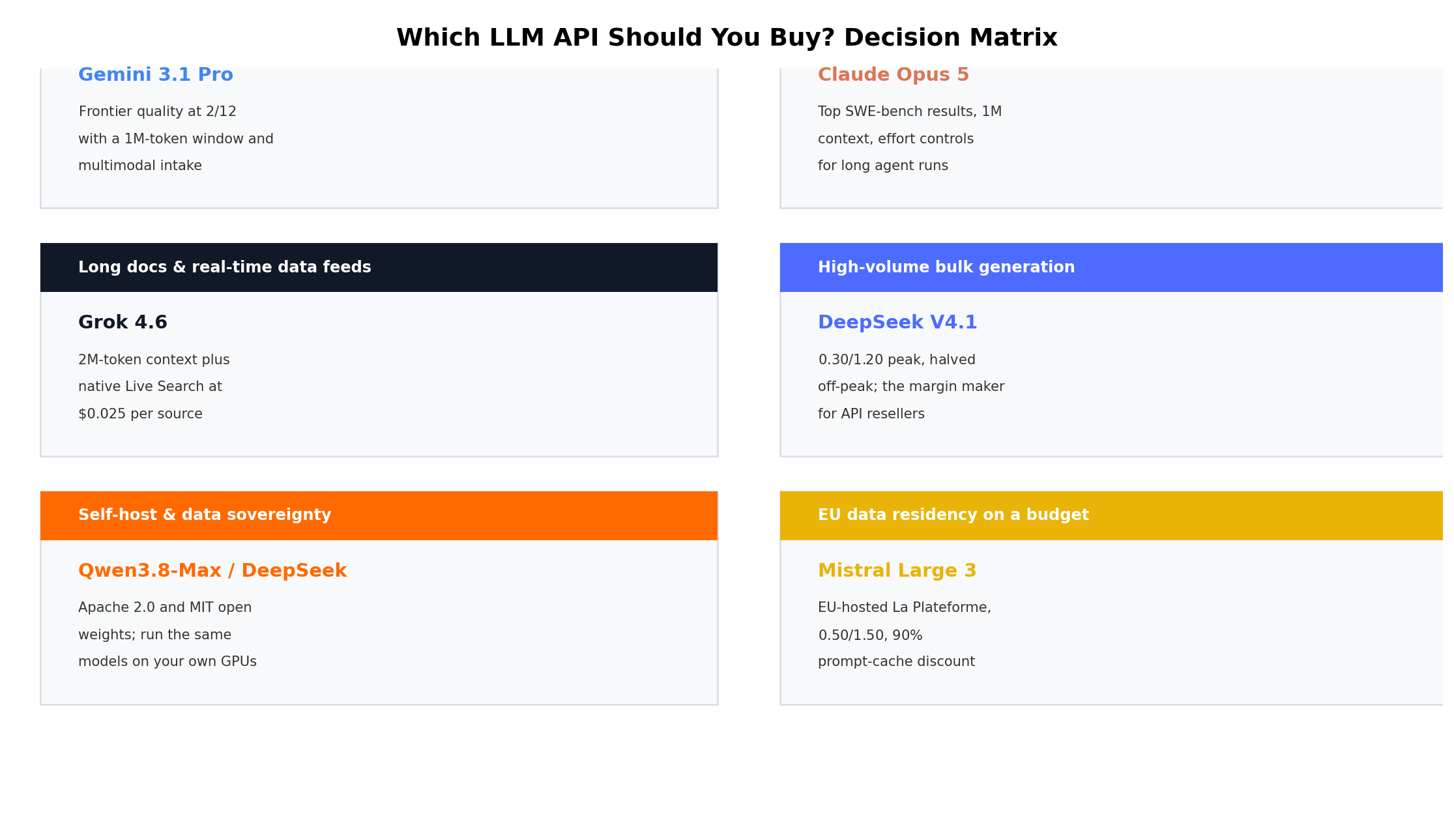
Best overall → GPT-5.6 (9.1). Highest measured output quality, widest multimodal input, and the ecosystem default. Pay the $30/M output premium only where the customer sees the raw model output.
Best for coding agents → Claude Opus 5 (8.9). 9.7 on coding, 1M context, reliable tool use. The API behind the most productive agent harnesses we tested.
Best value → Gemini 3.1 Pro (8.8). Frontier-adjacent quality at $2/$12, all four input modalities, and the only meaningful free tier. The rational default for a solo builder buying one key.
Best for margin → DeepSeek V4.1 (8.3). $0.30/$1.20 peak (halved off-peak), MIT weights, 1M context. The model that turns thin service pricing into real profit.
Hybrid approach (what the pros actually run): DeepSeek or Qwen Flash for retrieval, classification and drafts; Gemini 3.1 Pro or GPT-5.6 for the single customer-facing generation per task; Claude Opus 5 in the dev loop. Three keys, one invoice each — and total spend that still undercuts a GPT-5.6-only stack by 4–10×.
Frequently Asked Questions
What is the best LLM API in 2026?
GPT-5.6 is the best overall LLM API in 2026 with a 9.1/10 score — top-tier reasoning, the strongest multimodal intake and the biggest third-party ecosystem. Gemini 3.1 Pro is the best value frontier model (frontier quality at $2/$12 per million tokens), and Claude Opus 5 is the pick for coding agents.
Which LLM API is the cheapest?
DeepSeek V4.1 at $0.30/$1.20 per million tokens (halved to $0.15/$0.60 off-peak) is the cheapest flagship-tier API. Qwen3.5 Flash at $0.10/$0.40 and Mistral Small 4 at $0.15/$0.60 are even cheaper budget tiers for bulk work.
Is DeepSeek V4.1 as good as GPT-5.6?
Not quite on raw reasoning — our radar scores it 8.4 vs GPT-5.6's 9.6 for output quality — but it is dramatically cheaper: output tokens cost 25× less ($1.20 vs $30 per million) and its 1M context matches Claude and Gemini. For bulk generation, summarization and RAG plumbing, the quality gap is small and the margin gap is enormous.
Can I use these LLM APIs commercially?
Yes. All seven providers allow commercial API use — building client chatbots, selling content workflows, or reselling access inside your own product. Check each provider's terms for data-retention and training opt-outs. Open-weight models (Qwen3.8-Max under Apache 2.0, DeepSeek under MIT) go further: you can self-host and even serve the model itself commercially.
Which LLM API has the largest context window?
Grok 4.6 leads with a 2M-token context window, plus native Live Search at $0.025 per source. Claude Opus 5, Gemini 3.1 Pro, DeepSeek V4.1 and Qwen3.8-Max all offer 1M tokens. GPT-5.6 caps at 400K and Mistral Large 3 at 262K.
Do any LLM APIs still have free tiers or credits?
Yes, but they are shrinking. Gemini's AI Studio free tier and DeepSeek's free web chat plus new-user API tokens are the most generous. GPT-5.6 has a free chat tier (not API), Qwen grants new-user free tokens, Mistral has a free experiment tier, and xAI offers opt-in API credits ($150/month when you spend $25). Claude has no free API tier.
Should I choose open weights or a closed API?
If you need data sovereignty, self-hosting or the right to resell the model itself, choose open weights: Qwen3.8-Max (Apache 2.0) or DeepSeek V4.1 (MIT). If you need frontier multimodal quality, audio/video input or turnkey hosting with one API key, closed APIs — GPT-5.6, Gemini 3.1 Pro, Claude Opus 5 — remain ahead. Many freelance stacks run both: open weights for bulk passes, a closed frontier model for final polish.
Other APIs worth a look: xAI's Grok 4.1 Fast ($0.20/$0.50) if you want Grok economics in a budget tier; Google's Gemini 3.8 Flash ($0.75/$3.75) for high-volume multimodal; Alibaba's Qwen3.5 Flash ($0.10/$0.40) for the cheapest hosted tokens anywhere; OpenAI's GPT-5.6 Luna ($0.20/$1.20) when you want the OpenAI SDK at DeepSeek-adjacent prices.