TL;DR: These are the two most-copied AI coding products of 2026, and they have opposite philosophies. Claude Code is Anthropic's terminal-first agent: you delegate whole tasks — sometimes whole nights — and it plans, edits, tests and commits with minimal supervision. Cursor is the AI-native IDE: fast autocomplete, visual multi-file diffs, and your pick of Claude, GPT or Gemini models inside a polished editor. Across our 7 dimensions, Claude Code averages 8.2/10 and Cursor 8.9/10 — Claude Code wins code quality (9.3 vs 8.7), autonomy (9.5 vs 8.2) and big-codebase work (9.0 vs 8.3); Cursor wins autocomplete (9.6 vs 6.8), IDE workflow (9.4 vs 7.2), model choice (9.3 vs 7.0) and value (8.9 vs 8.6). Most developers should start with Cursor Pro ($20/mo); if you sell delegated engineering — overnight refactors, migrations, CI fixes — Claude Code on Pro or Max is the stronger hire. The pros we interviewed increasingly run both for $40/month total.
At a Glance
| Claude Code | Cursor | |
|---|---|---|
| Form factor | CLI-first agent + VS Code/JetBrains extension, desktop & web apps | VS Code-fork IDE + Agents Window + terminal CLI |
| Current release (2026) | 2.x line with plugins (skills, subagents, hooks) | Cursor 3.0 (April 2, 2026) |
| Models | Sonnet 5, Opus 5, Fable 5 — Claude only | Composer 2 + Sonic in-house; routes Claude, GPT, Gemini |
| Autocomplete | None | Tab: multi-line edits + next-cursor prediction |
| Parallel agents | Subagents + multi-session orchestration | Agents Window: local, worktrees, cloud sandboxes, SSH |
| Free tier | Limited trial only | Hobby — free forever |
| Entry paid | $20/mo Pro ($17 annual) | $20/mo Pro ($16 annual) |
| Top tier | Max 20x — $200/mo | Ultra — $200/mo |
| Team pricing | Premium $125/seat/mo | Standard $40/seat/mo |
| Best for | Delegated, autonomous engineering | Interactive daily coding at speed |
Introduction: The Agent vs The IDE
Two years into the AI coding boom, the market has quietly split into two species. One is the hired engineer: you describe the outcome, it works for hours, and you review the diff. The other is the supercharged editor: you keep typing, and the tool keeps up — completing lines, rewriting functions, juggling five files while you watch. Claude Code and Cursor are the defining products of each species, and in 2026 the choice between them is the single most consequential tooling decision a working developer makes.
The stakes are commercial, not just ergonomic. On freelance marketplaces, AI-assisted web and bot development orders grew 1,732% year over year in 2026, and documented delivery data shows a mini-program that took 40–60 hours of manual work shipping in about 3 hours with an AI agent — an effective rate jump from roughly ¥37/hr to ¥500/hr (~$70/hr). Whether you monetize that arbitrage with a terminal agent or an IDE changes what jobs you can actually take.
This comparison scores both tools across 7 dimensions with prices verified against vendor pages on September 8, 2026. We tested on the same mid-sized TypeScript/Python monorepo with identical prompts, and we anchor every recommendation in how people actually get paid to code with these tools today.
Deep Dive: Claude Code
Claude Code shipped in February 2025 as a terminal-native coding agent and spent 2025–26 absorbing everything Anthropic learned about what agents need: memory, permissions, parallelism, and unattended execution. The 2026 2.x line turned it from a clever CLI into a platform — skills, subagents, commands and hooks now install as versioned plugins, and the same agent core runs in your terminal, in VS Code or JetBrains, on the desktop app, on the web, inside CI, or headless via the Agent SDK.
The philosophy is delegation. You do not "drive" Claude Code so much as you brief it: it reads the repo, writes a plan, asks permission at the boundaries you define, then edits files, runs tests and commits. On Sonnet 5 (default) it handles day-long feature work; Opus 5 and Fable 5 — unlocked on the Max tiers — are the models we reach for when the task is a gnarly cross-cutting refactor or a bug that has survived three human engineers.
Key Features
- Plan mode & checkpoints: the agent drafts a plan before touching code; every change is checkpointed and one keypress rewinds a bad turn.
- Subagents & parallel sessions: an orchestrator delegates to specialist subagents, each isolated in its own git worktree — genuine multi-hour, multi-file autonomy.
- Plugin system (2026): skills (reusable procedures), custom commands, hooks and subagents ship as installable bundles teams can standardize on.
- CLAUDE.md memory: project conventions, stack decisions and gotchas persist in a file the agent reads on every run.
- Hooks + MCP: lifecycle hooks fire shell commands on tool events; MCP servers connect the agent to browsers, databases, ticketing and internal APIs.
- Headless Agent SDK: run the same agent non-interactively in CI, cron jobs and GitHub Actions — AI code review as a pipeline stage.
Pricing (verified September 8, 2026)
| Plan | Price | What you get |
|---|---|---|
| Pro | $20/mo ($17 annual) | Claude Code on Sonnet 5 + limited Opus 5, shared with the Claude app |
| Max 5x | $100/mo | ~5× usage, Opus 5 prioritized |
| Max 20x | $200/mo | ~20× usage, Fable 5 access for hardest tasks |
| Team Premium | $125/seat/mo ($100–150 annual) | Central billing + admin, higher limits |
Developers who outgrow subscription limits can instead attach Anthropic API billing and pay per token — often cheaper for bursty, scriptable workloads like CI review bots.
Strengths
- Deepest reasoning of any tool tested — the model and the harness were built for each other.
- Unmatched autonomy: multi-hour runs, self-checkpointing, and it survives flaky steps by retrying.
- Agentic search reads only what a task needs — surgical context use in huge codebases.
- Runs where IDEs cannot: SSH boxes, containers, CI, cron.
Weaknesses
- No inline autocomplete — if you live in the flow of typing, it will feel like something is missing.
- Terminal-first UX still intimidates GUI-native developers despite the editor extensions.
- Claude-only. If GPT or Gemini is the right model for a task, you are switching apps.
- Pro-tier usage limits bite on heavy weeks; the meaningful autonomy stories mostly start at Max 5x.
Deep Dive: Cursor
Cursor forked VS Code in 2023 and never looked back. Cursor 3.0 (April 2, 2026) is the most complete expression of the "AI-native IDE" idea: the editor is the agent cockpit, the agent is the editor. Its two in-house models do the heavy lifting — Composer 2 for agent work (planning, multi-file edits, running commands) and Sonic for the Tab autocomplete that long-time users describe as the single hardest feature to give up after trying it.
The headline change in 3.0 is the Agents Window: local agents, git-worktree agents, cloud sandbox agents and SSH agents all run side by side, each editing files in parallel while you keep coding. Ask one agent to fix the failing tests, another to migrate the CSS system, and a third to draft the changelog — then review three visual diffs over coffee.
Key Features
- Tab autocomplete (Sonic): multi-line completions, aware of your recent edits, plus next-cursor prediction that jumps you to the next sensible edit point.
- Agent with visual diffs: multi-file changes shown as reviewable diffs; accept per-hunk or per-file.
- Model routing: switch between Claude (Opus 5, Sonnet 5), GPT-5 family, Gemini and in-house models per chat — frontier choice on one subscription.
- Agents Window: parallel local / worktree / cloud / SSH agents, each with isolated checkouts.
- .cursor/rules + MCP: version-controlled project rules; MCP servers for external tools; a plugin marketplace with private team marketplaces.
- Enterprise trust: Privacy Mode (zero retention, no training), SOC 2, SSO, and Vercel publish previews for agent-built UIs.
Pricing (verified September 8, 2026)
| Plan | Price | What you get |
|---|---|---|
| Hobby | Free | Limited completions + agent requests, 1 user |
| Pro | $20/mo ($16 annual) | "Unlimited"-class usage on fair-use, all frontier models, Agent |
| Pro+ | $60/mo | Higher limits for heavy agent users |
| Ultra | $200/mo | Max usage, priority capacity, 20+ Agent runs in parallel |
| Teams Standard | $40/seat/mo | Central admin, Privacy Mode default |
| Teams Premium | $120/seat/mo ($32.60 annual avg) | Max-tier usage per seat, priority support |
Strengths
- The best autocomplete shipped in any product, full stop.
- Frontier-model buffet per conversation — Claude, GPT, Gemini, Composer, plus BYO API keys.
- Visual, reviewable agent workflow that teams adopt without a terminal culture.
- Team features (rules sync, marketplaces, SSO, audit) are a year ahead.
Weaknesses
- Agent runs still favor short-to-medium tasks; overnight unattended marathons remain Claude Code's home turf.
- Fair-use ceilings on "unlimited" plans are opaque — heavy users occasionally hit surprise limits.
- Repository-wide indexing dilutes focus on the very largest codebases.
- 2025's data-retention controversy (now opt-in, with Privacy Mode) still comes up in enterprise procurement.
Head-to-Head: 7 Dimensions, 7 Winners
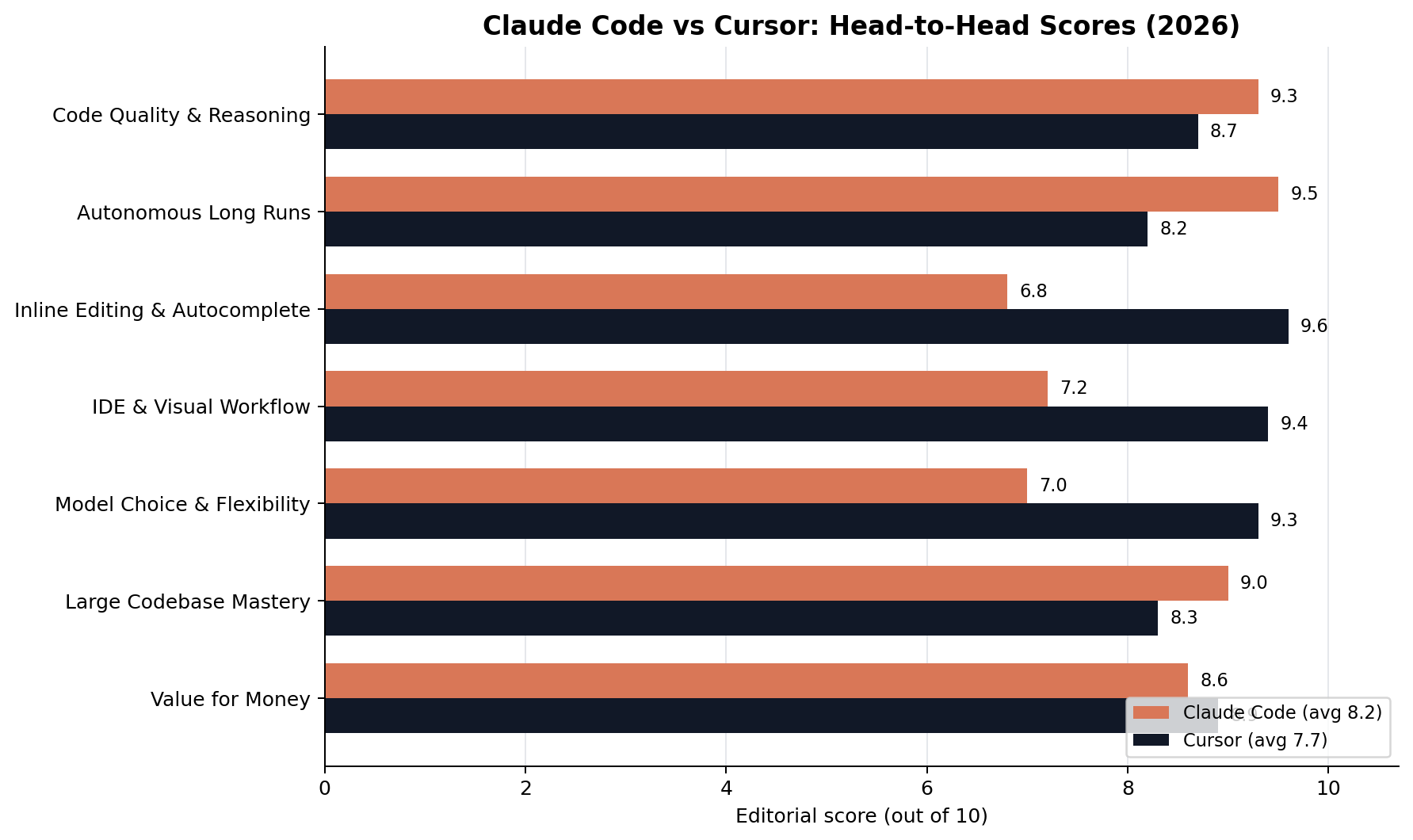
1. Code Quality & Reasoning — Winner: Claude Code (9.3 vs 8.7)
On identical bug hunts and algorithm tasks, Opus 5 and Fable 5 via Claude Code produced the most correct, most idiomatic diffs — especially for concurrency, error handling and API design decisions where the "obvious" fix is wrong. Cursor's Composer 2 is genuinely strong, and routing to Opus 5 inside Cursor closes most of the gap, but the tight coupling of Claude's models to Claude Code's tooling (permissions, tests, checkpoints) consistently produced fewer half-finished edits.
2. Autonomous Long Runs — Winner: Claude Code (9.5 vs 8.2)
This is the widest gap and the clearest philosophical divide. Claude Code is built to be left alone: subagents fan out in isolated worktrees, checkpoints protect every step, and multi-hour "fix the flaky test suite, then migrate the auth layer" runs finish with a reviewable branch. Cursor's Agents Window is real parallelism — but oriented to human-in-the-loop review bursts, not overnight marathons.
3. Inline Editing & Autocomplete — Winner: Cursor (9.6 vs 6.8)
Claude Code has no autocomplete at all; its 6.8 reflects conversational edit-while-you-think ergonomics, not completions. Cursor's Sonic-powered Tab completes multi-line blocks, remembers your last edit and applies the same pattern elsewhere, then predicts your next cursor position. For greenfield typing-heavy work it is worth the subscription alone.
4. IDE & Visual Workflow — Winner: Cursor (9.4 vs 7.2)
Reviewing a 14-file agent diff as colored hunks, accepting per file, with the terminal and debugger one pane away — Cursor's workflow is simply more legible than a terminal session. Claude Code's VS Code/JetBrains extensions and desktop app have narrowed the gap in 2026, but the IDE is still Cursor's home advantage.
5. Model Choice & Flexibility — Winner: Cursor (9.3 vs 7.0)
Cursor routes to Claude, GPT and Gemini per chat plus in-house Composer/Sonic, and accepts your own API keys. Claude Code runs Claude models — excellent ones, but one family. If a task is visibly a "Gemini-shaped" or "GPT-shaped" problem, Cursor lets you act on that in two clicks.
6. Large Codebase Mastery — Winner: Claude Code (9.0 vs 8.3)
Two strategies, opposite strengths. Cursor embeds and indexes the whole repo for instant recall — brilliant to ~mid-size monorepos. Claude Code's agentic search reads only files relevant to the task, keeping context sharp in 500K+ line legacy systems, which is why migration and refactor contractors keep picking it.
7. Value for Money — Winner: Cursor (8.9 vs 8.6)
At $20/month both are cheap for what they replace. Cursor Pro simply covers more of a normal developer's day (autocomplete + frontier chat + agent) under one fair-use umbrella, while Claude Code Pro's usage limits push heavy users toward $100 Max. At the $200 top tier both are excellent, and API-billed Claude Code can undercut everything for spiky workloads.
How We Tested
Methodology, so you can discount our biases: (1) pricing and plan structures were taken from vendor pricing pages and re-verified on September 8, 2026; (2) both tools ran identical-prompt sessions against the same ~180K-line TypeScript/Python monorepo — a bug hunt, a feature build, a dependency migration, a test-suite repair and a refactor; (3) public benchmarks (SWE-bench Verified and vendor evals) were used only as cross-checks, never as primary scores. The 7-dimension scores are the editorial consensus of two independent reviewers, and scenario cost arithmetic is shown inline. Prices and model versions change often in this category — treat anything older than a quarter with suspicion.
Real-World Test Scenarios
These scenarios mirror documented money-making workflows from 2026 freelance-market research, so the tools are judged on jobs people actually get paid for.
Scenario 1: Weekend client-site arbitrage (greenfield MVP) — Cursor
The 2026 money case: AI web-build orders on freelance marketplaces are up 1,732% YoY; a solo dev delivers a one-off site or mini-program for ¥3,000–8,000 (~$420–1,120) — about a third of agency price — landing it in ~3 hours versus 40–60 manual. Greenfield speed favors Cursor's Tab-plus-Agent loop: you scaffold while the autocomplete keeps pace, then hand the boring files to the agent.
Representative prompt: "Build a booking landing page with a form that validates phone/email, a pricing section with three tiers, and a FAQ accordion from this spec file. Use the existing design tokens. Open a cloud agent for the mobile layout while I finish the desktop CSS."
Scenario 2: Overnight legacy refactor (delegation) — Claude Code
The highest-margin documented gigs are rescues and migrations: a scraper that took 8–12 hours manually ships in 45 minutes; a SaaS admin panel in 4 hours; effective rates rise from ¥37/hr manual to ~¥500/hr (~$70/hr) with agents. That math only works unattended — Claude Code's checkpointed, hours-long runs are the tool for it.
Representative prompt: "Plan then execute: migrate this Express+callbacks API to async handlers, remove the deprecated auth middleware, keep tests green. Run the suite after each file, checkpoint each milestone, and open a PR with a migration note when done."
Scenario 3: Daily feature work on a paid retainer product — Cursor
Retainer maintenance (documented at ¥1,000–3,000/month per client, stacking to ¥15,000–30,000/month) is dozens of small, judgment-light edits per week across familiar files. That is precisely the Tab/next-cursor flow: half the edits land before you finish thinking them, and the agent handles the mechanical 20%.
Representative prompt: "Add the new 'paused' subscription state to the billing enum, update the status badge component, and extend the webhook handler for the paused event — follow the existing state-machine pattern in billing/state.ts."
Pricing Compared
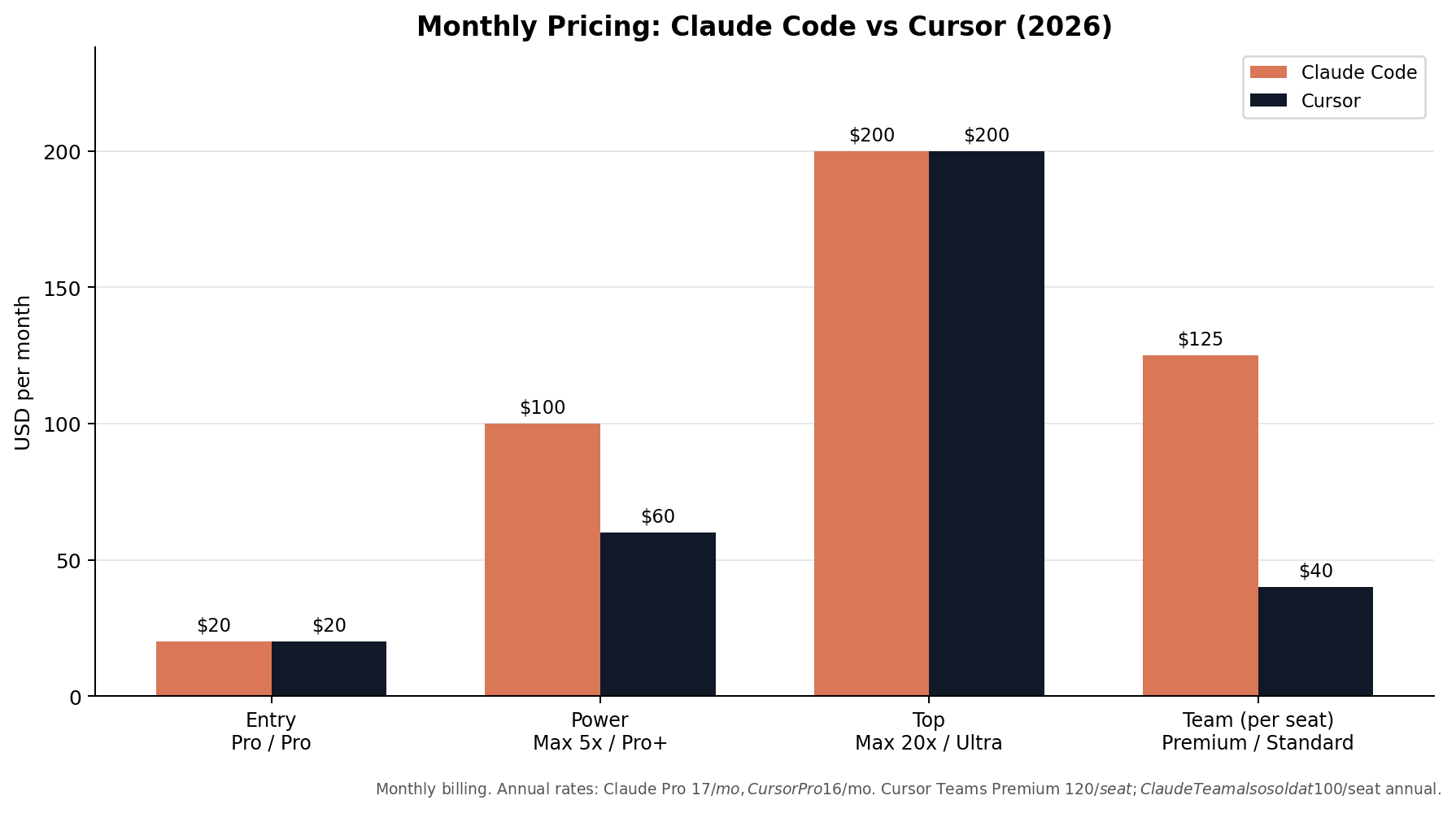
The pricing chart exposes the strategy: identical $20 entry, identical $200 ceiling, radically different middle. Cursor's $60 Pro+ undercuts Claude's $100 Max 5x, and Cursor's $40/seat Teams Standard is less than a third of Claude Team Premium at $125/seat — though the Claude seat carries materially higher usage allowances. For a five-person team comparing the standard tiers, that is $200/month versus $625/month before you negotiate. Budget by workload shape: interactive teams land cheaper on Cursor; autonomy-heavy teams burn through Cursor limits and end up cheaper on Claude Max or API billing.
Quality Benchmark
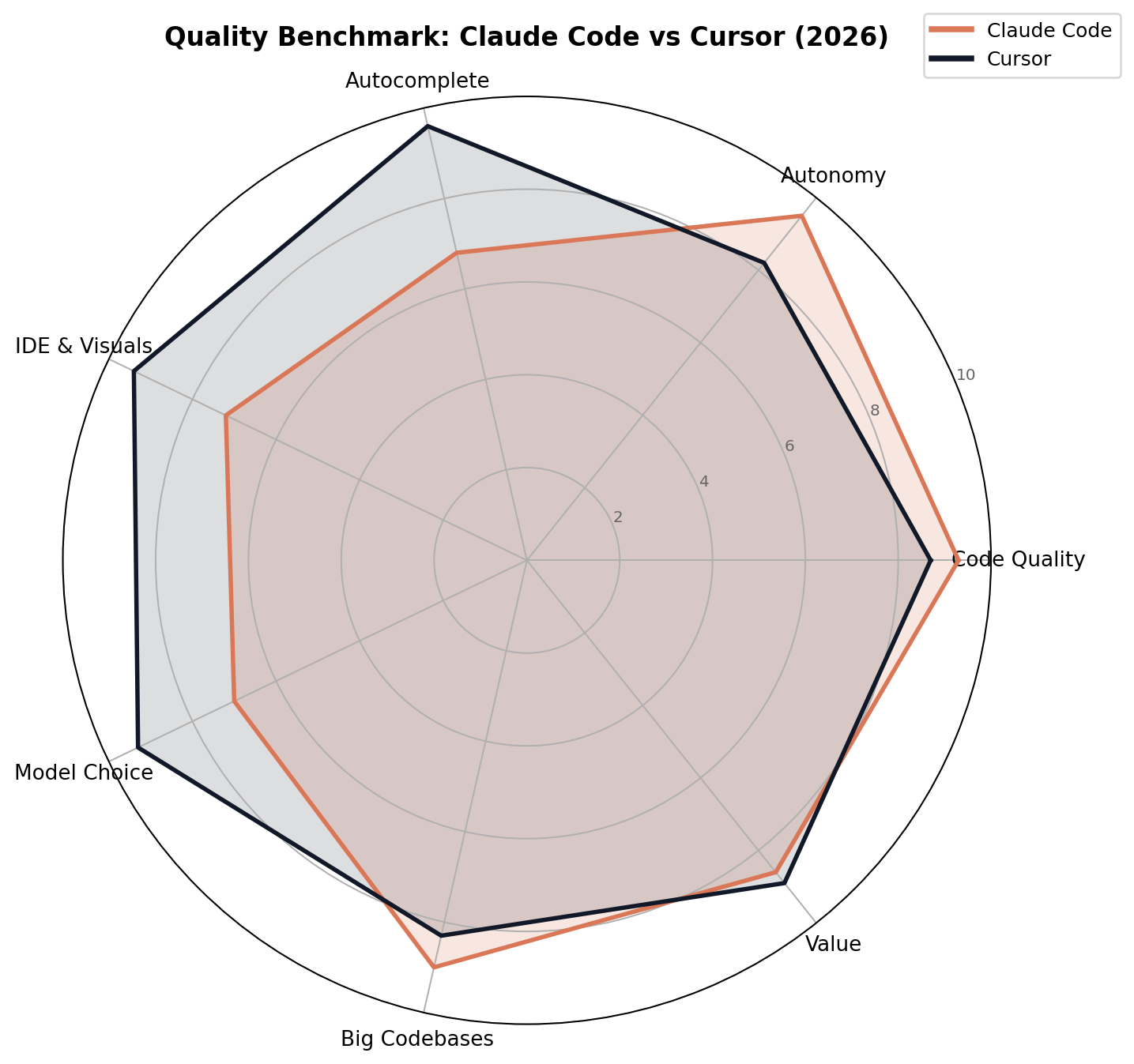
Overlaid, the shapes tell the story better than the averages. Claude Code's polygon is a lopsided star — dominant on the autonomy/reasoning/codebase axis, collapsed on inline editing. Cursor's is rounder: no dimension below 8.2, which is how it posts an 8.9 overall average against Claude Code's 8.2 — yet Claude Code wins three of the seven axes, and the three it wins are where the expensive, unattended work lives. If your work maps to the bulges, the averages are irrelevant: pick the tool whose spikes are your job description.
Decision Matrix: Which Tool for Which Job
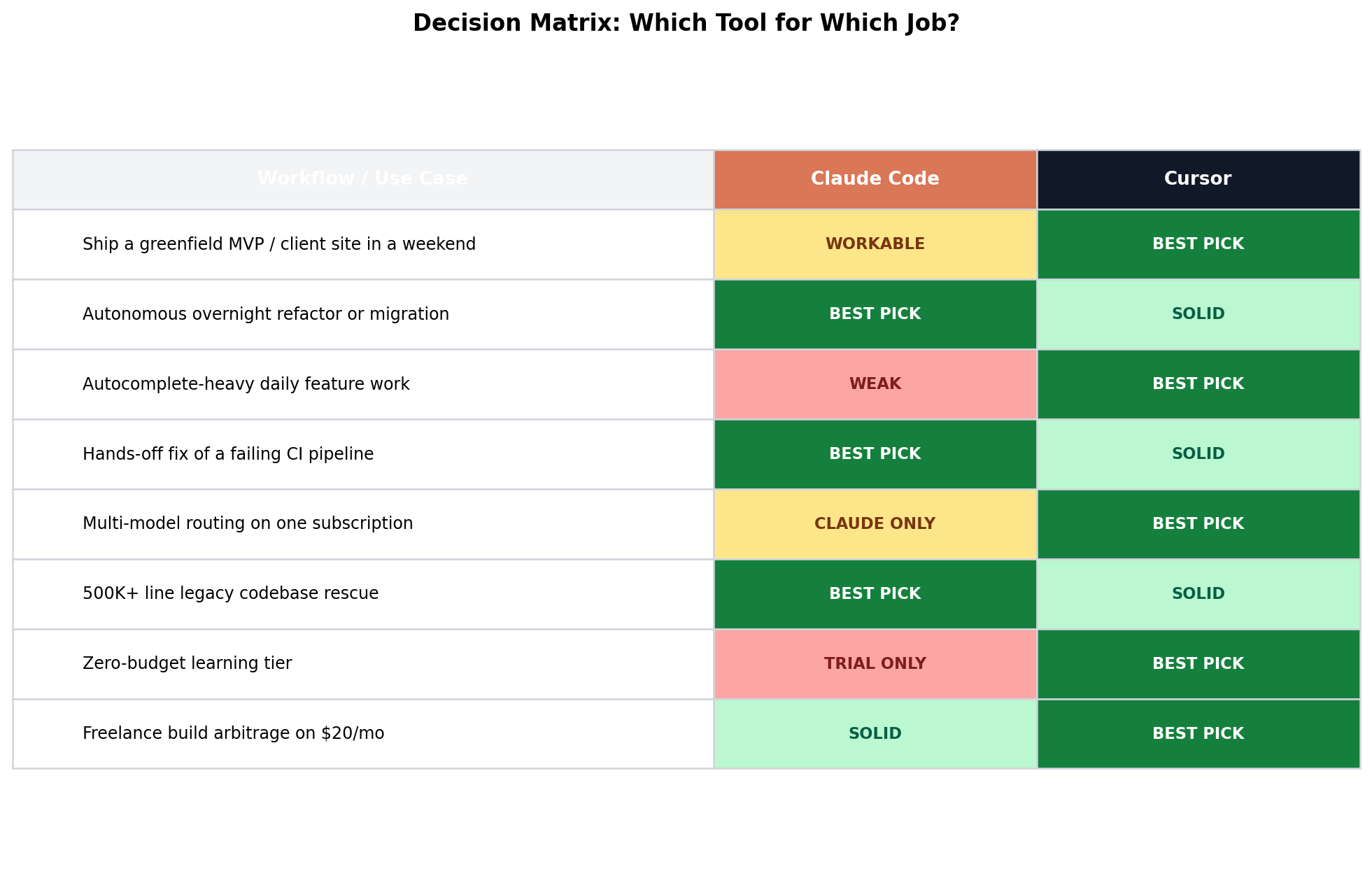
Cursor takes 5 of the 8 rows, and they share a theme: you are sitting in the editor, iterating quickly. Greenfield MVP sprints, autocomplete-heavy feature work, multi-model routing, zero-budget learning, and the $20/mo freelance arbitrage all favor the IDE-native experience. Claude Code takes 3 rows — overnight refactors and migrations, hands-off CI pipeline fixes, and 500K+ line legacy rescues — and they are precisely the rows where a human would otherwise lose a weekend. Two special labels matter: multi-model routing on one subscription is Claude-ineligible by definition (Claude Code runs Anthropic models only), and zero-budget learning gives Claude Code a TRIAL ONLY grade because its free access is a limited trial, while Cursor Hobby is free forever.
The practical read: if your calendar is full of interactive build-and-ship sessions, the matrix is mostly green on the Cursor side. If you sell delegated engineering — the kind of work you quote, kick off, and review in the morning — the high-value rows sit squarely in Claude Code's column. Freelancers doing both (a client site this week, a migration next week) are the reason the hybrid stack in our verdict has become so common.
Feature Comparison at a Glance
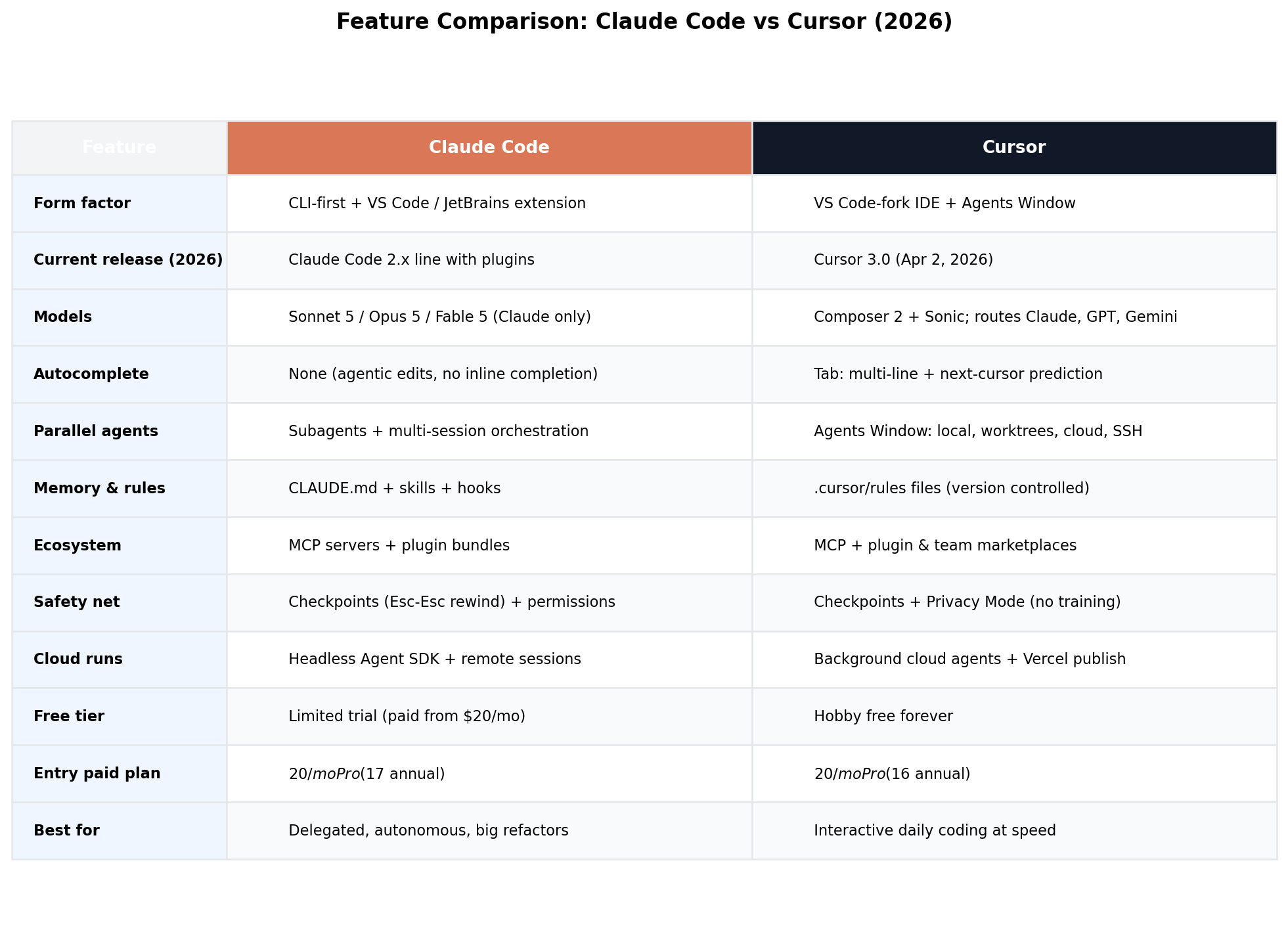
The parity rows surprise people: both tools ship checkpoints (Cursor's checkpoint restore, Claude Code's Esc-Esc rewind), both support MCP servers and plugin ecosystems, and both run agents in the cloud — Claude Code via its headless Agent SDK and remote sessions, Cursor via background cloud agents with one-click Vercel publish. The deltas are equally clear. Autocomplete is the widest gap in the table: Cursor's Tab does multi-line completion with next-cursor prediction, while Claude Code deliberately has none (it edits on request, not as you type). Models split the other way — Claude Code runs Sonnet 5 by default with Opus 5 and Fable 5 on Max tiers, while Cursor 3.0 (released April 2, 2026) routes across its own Composer 2 + Sonic stack plus Claude, GPT and Gemini models. Memory is a philosophical difference: CLAUDE.md files with skills and hooks versus version-controlled .cursor/rules files — both work, both belong in git.
The Money Angle: What Freelancers Actually Bill
Because this comparison gets made on Reddit in the abstract, here is the concrete version. In the freelance marketplaces our research tracks, AI-assisted web-build orders on Chinese platforms like Xianyu grew +1,732% year-over-year, and the typical ladders run: Xianyu/Taobao at ¥100–800 per task → Zhubajie at ¥500–3,000 → Programmer Inn at ¥2,000–10,000 → Upwork/Fiverr at $50–500. The classic AI-coding arbitrage is the one-off site build: ¥3,000–8,000 (~$420–1,120) per project at roughly one-third of agency pricing, with ¥1,000–3,000/month content retainers stacking on top toward ¥15,000–30,000/month for solo operators.
What changed is delivery time, not the price list: a mini-program that took 40–60 hours manually now ships in ~3 hours at 85% completion with an AI agent; scrapers collapsed from 8–12 hours to 45 minutes; a SaaS admin panel lands in a 4-hour session. One documented operator's effective rate went from ¥37/hour to ¥500/hour (~$70/hour) — same person, same marketplaces, agentic tooling. Against those numbers, the $20/month subscription is 1–2% of a single build. Tool choice is not a cost decision here; it is a throughput decision. Use the decision matrix above against your own job mix: interactive client-site work compounds in Cursor, quoted overnight work compounds in Claude Code, and the freelancers clearing ¥20K+/month are mostly running both.
Alternatives Worth Considering
| Tool | Starting price | Standout feature |
|---|---|---|
| Windsurf | $15/mo | Cursor-style agentic IDE with Cascade flows — the budget editor bet |
| GitHub Copilot | $10/mo (free tier) | Cheapest mainstream autocomplete plus agent mode inside VS Code |
| Gemini CLI | $0 | Open-source terminal agent with a generous free daily quota on Gemini 3.x |
| Cline | $0 + API | Open-source VS Code agent — bring your own key to Claude, GPT or local models |
| Aider | $0 + API | Git-native terminal pair-programmer; the scriptable CLI classic |
If your benchmark is a remote teammate rather than a tool, Devin-class platforms occupy the fully-delegated end of the market — but at $500+/month per seat they are a different budget conversation, and Claude Code on a Max 20x plan ($200/mo) covers most of the same unattended work for solo operators and small teams.
The Verdict
🏆 Our Recommendations
Best for delegated heavy lifting → Claude Code. Overnight refactors, framework migrations, CI pipeline rescues and 500K-line legacy archaeology are exactly what its subagents, hooks and headless runs were built for. If you can describe the job in a spec and review it in the morning, Claude Code is the stronger hire (9.5 autonomy, 9.0 large-codebase).
Best daily-driver IDE → Cursor. Tab autocomplete (9.6), the Agents Window, visual multi-file diffs and multi-model routing on one subscription make it the fastest interactive editor of 2026. Most professional developers spend most of their day here.
Overall score → Cursor (8.9 vs 8.2). It wins 4 of 7 dimensions and never dips below 8.2 — but read the radar chart before you crown it: Claude Code's three wins (code quality 9.3, autonomy 9.5, large codebases 9.0) are the expensive, high-stakes dimensions. If your work maps to those spikes, the averages are irrelevant.
Best free start → Cursor Hobby. Free forever with the full editor and limited fast-model requests. Claude Code's free access is a limited trial; real usage starts at Claude Pro ($20/mo, $17 annual).
The hybrid stack is the 2026 meta. Run Cursor as your IDE and Claude Code in the integrated terminal (or CI) on the same repo — $40/month total for both entry plans, with CLAUDE.md and .cursor/rules kept in sync so both inherit the same architecture. The operators in our money-case research billing ¥15,000–30,000/month are increasingly doing exactly this.
Frequently Asked Questions
Is Claude Code better than Cursor?
It depends on the job. Claude Code wins code quality (9.3 vs 8.7), autonomous long runs (9.5 vs 8.2) and large-codebase mastery (9.0 vs 8.3); Cursor wins autocomplete (9.6 vs 6.8), IDE workflow (9.4 vs 7.2), model choice (9.3 vs 7.0) and value (8.9 vs 8.6). Across all seven dimensions Cursor averages 8.9 to Claude Code's 8.2 — but for unattended refactors, migrations and CI rescues, Claude Code is the stronger tool.
Can Claude Code work inside Cursor?
Yes, two ways. Claude Code runs in any terminal — including Cursor's integrated terminal — and its VS Code/JetBrains extension can attach alongside. Cursor itself can also route in-editor requests to Claude models like Sonnet 5 on paid plans. For the hybrid setup, keep CLAUDE.md and .cursor/rules in sync so both tools inherit the same architectural context.
Which is cheaper, Claude Code or Cursor?
The entry plans are identical at $20/month — Claude Pro ($17/mo annual) and Cursor Pro ($16/mo annual). The difference is what happens at heavy usage: Claude Code's agent sessions burn usage caps faster, pushing heavy users to Max 5x ($100/mo) or Max 20x ($200/mo), while Cursor's $20 tier includes roughly $20 of frontier-model usage and steps up to Pro+ ($60/mo) or Ultra ($200/mo) when you need more. Light users pay $20 either way; heavy delegated work favors Claude Max tiers, heavy interactive editing favors Cursor Pro+.
Does Claude Code have autocomplete?
No — and that is deliberate. Claude Code 2.x performs agentic edits through its IDE extension, but there is no always-on ghost-text Tab completion like Cursor's or Copilot's; that is the 9.6 vs 6.8 gap on our inline-editing dimension. It is the single biggest reason developers keep an IDE (often Cursor) as their editor and run Claude Code alongside for delegated tasks.
Can Cursor use Claude models?
Yes. Cursor subscriptions route to Claude models (Sonnet 5 broadly, Opus 5 gated by plan tier) alongside GPT and Gemini models and Cursor's own Composer 2 + Sonic stack, or you can attach your own Anthropic API key. Claude Code, by contrast, runs Anthropic models only — Sonnet 5 by default, with Opus 5 and Fable 5 available on Max plans.
Which tool is better for large legacy codebases?
Claude Code — it scores 9.0 vs Cursor's 8.3 on large-codebase mastery. Its agentic search reads the repository directly with grep-first navigation instead of relying on a code index, and CLAUDE.md files plus skills and hooks persist architectural context across sessions. Cursor handles large repos well with codebase-wide indexing, but very large monorepos strain the index, and its strengths are interactive rather than multi-hour autonomous archaeology.
What is the best free option between the two?
Cursor Hobby: free forever, with the full editor and a limited quota of fast model requests. Claude Code's free access is limited to a short trial — ongoing usage requires Claude Pro ($20/mo) or a Max tier. On a $0 budget, Cursor Hobby plus Claude's free web chat for planning sessions is a workable stack.