TL;DR
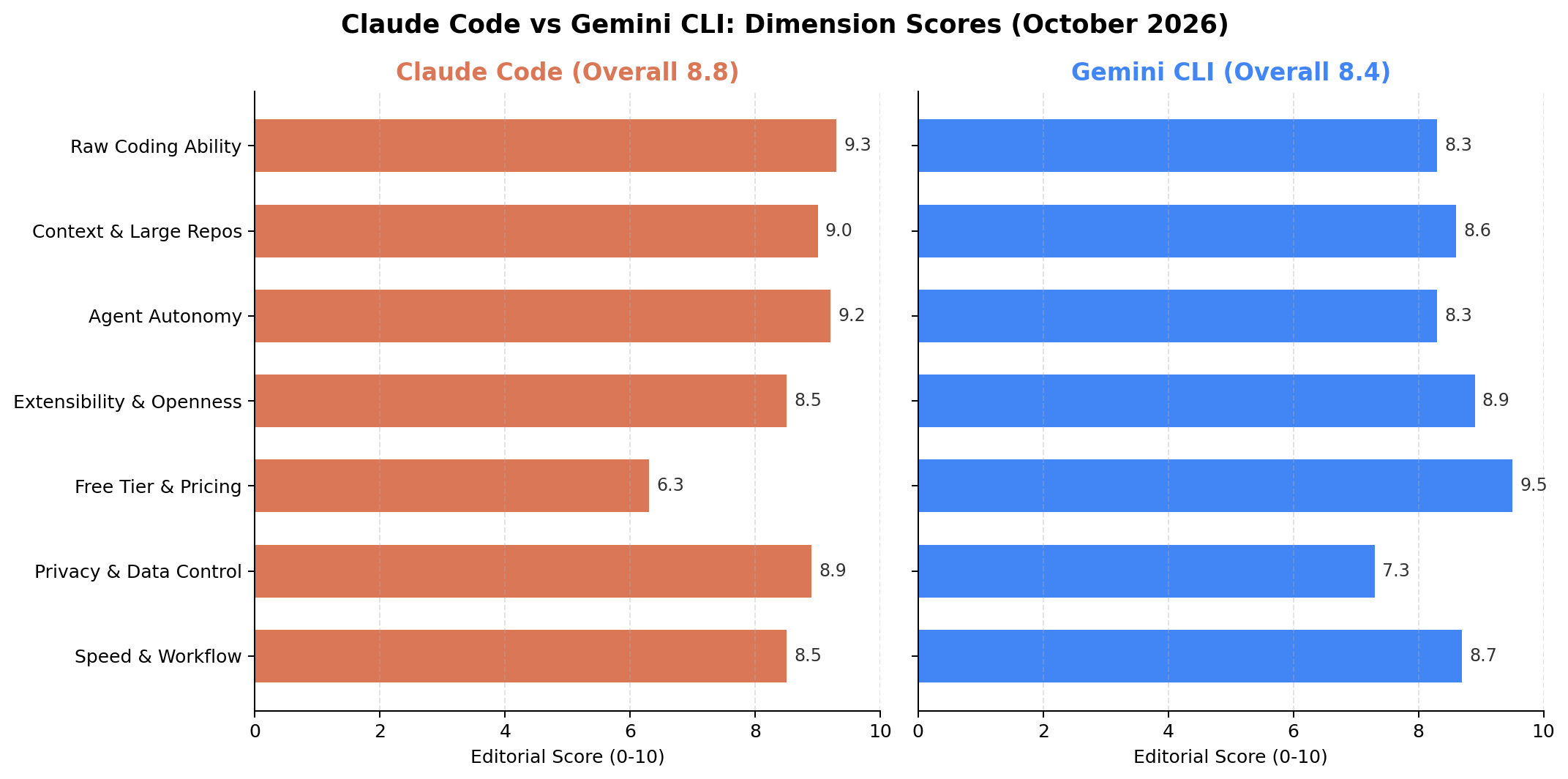
Claude Code (8.8/10) is the strongest terminal coding agent we have tested: Opus 5.5 wins the hard stuff (9.3 raw coding, 9.2 agent autonomy), subagents and hooks make long autonomous runs reliable, and Anthropic's no-training-by-default data policy is the safer story for client work. Entry is $20/month with no free tier. Gemini CLI (8.4/10) is the value pick: open source under Apache 2.0, 1M context via the auto-routed Gemini 3 family, and — the headline — 1,000 free requests per day with a plain Google account. For freelancers shipping boilerplate-heavy gigs, that free quota is a real margin, not a marketing gimmick. Run both: Gemini CLI free for exploration and scaffolding, Claude Code for the 10% of work that bills the invoice.
At a Glance
| Tool | Overall | Best For | Entry Price | Free Tier | Context | License |
|---|---|---|---|---|---|---|
| Claude Code | 8.8/10 | Hard refactors, agentic automation, client work under compliance | Pro $20/mo | None | 1M tokens | Proprietary |
| Gemini CLI | 8.4/10 | Free daily driver, OSS contributors, high-volume scaffolding | Free / AI Pro $19.99/mo | 1,000 requests/day | 1M tokens | Apache 2.0 |
The action moved to the terminal. In 2025 the question was "which AI IDE should I buy"; in 2026 the freelancers actually making money on AI coding gigs are living in two tools that never open a GUI: Anthropic's Claude Code and Google's Gemini CLI. One is the closed-source quality king billing from $20/month; the other is an Apache 2.0 agent that hands you 1,000 free model requests every single day. That difference shapes everything — who can afford to learn agentic coding, which gigs clear a profit, and what "using AI" even means for a solo developer with more time than budget.
This comparison is written from that vantage point. Beyond the usual benchmark talk, we anchor every scenario in the documented economics of the AI-services gig market: one-off client builds that clear ¥3,000–8,000 (~$420–1,120), scraper jobs compressed from a half-day to 45 minutes, and mini-program deliveries that went from 40–60 hours of manual work to about 3 hours with an agent doing 85% of the pass. If your terminal agent is a profit center rather than a toy, the free-versus-$20 question is not academic.
Claude Code Deep Dive
Claude Code is Anthropic's terminal-native coding agent — a single npm install (npm install -g @anthropic-ai/claude-code) that drops an claude command into your shell on macOS, Linux, and native Windows. Since version 2.1.280 it defaults to Opus 5.5, Anthropic's strongest reasoning model, which is immediately visible in how rarely you have to re-explain yourself on hard tasks. You run /init once per repo and it generates a CLAUDE.md memory file that persists conventions, build commands and architecture notes across sessions.
What separates it from "a chatbot in a terminal" is the agent machinery: plan mode for reading before writing, subagents you can delegate isolated investigations to, agent teams that parallelize a task list across multiple Claude instances, and lifecycle hooks (PreToolUse, PostToolUse) that let you gate or audit every filesystem write and shell command. Add first-class MCP server support, shareable Skills, checkpoint/rewind for risky edits, and optional VS Code/JetBrains bridges, and you get a workflow that survives contact with real client repositories — not just greenfield demos.
Key Features
- Opus 5.5 by default — strongest measured raw coding ability in this comparison (9.3/10)
- 1M-token context with CLAUDE.md project memory and smart file retrieval (9.0/10)
- Subagents, agent teams and hooks — the deepest autonomy toolkit of any terminal agent (9.2/10)
- Checkpoint and rewind — snapshot before a risky refactor, restore in one command
- MCP servers and plugins — connect databases, browsers, ticketing systems
- Enterprise-grade data policy — no training on your content by default (8.9/10 privacy)
Pricing
| Plan | Price | What You Get |
|---|---|---|
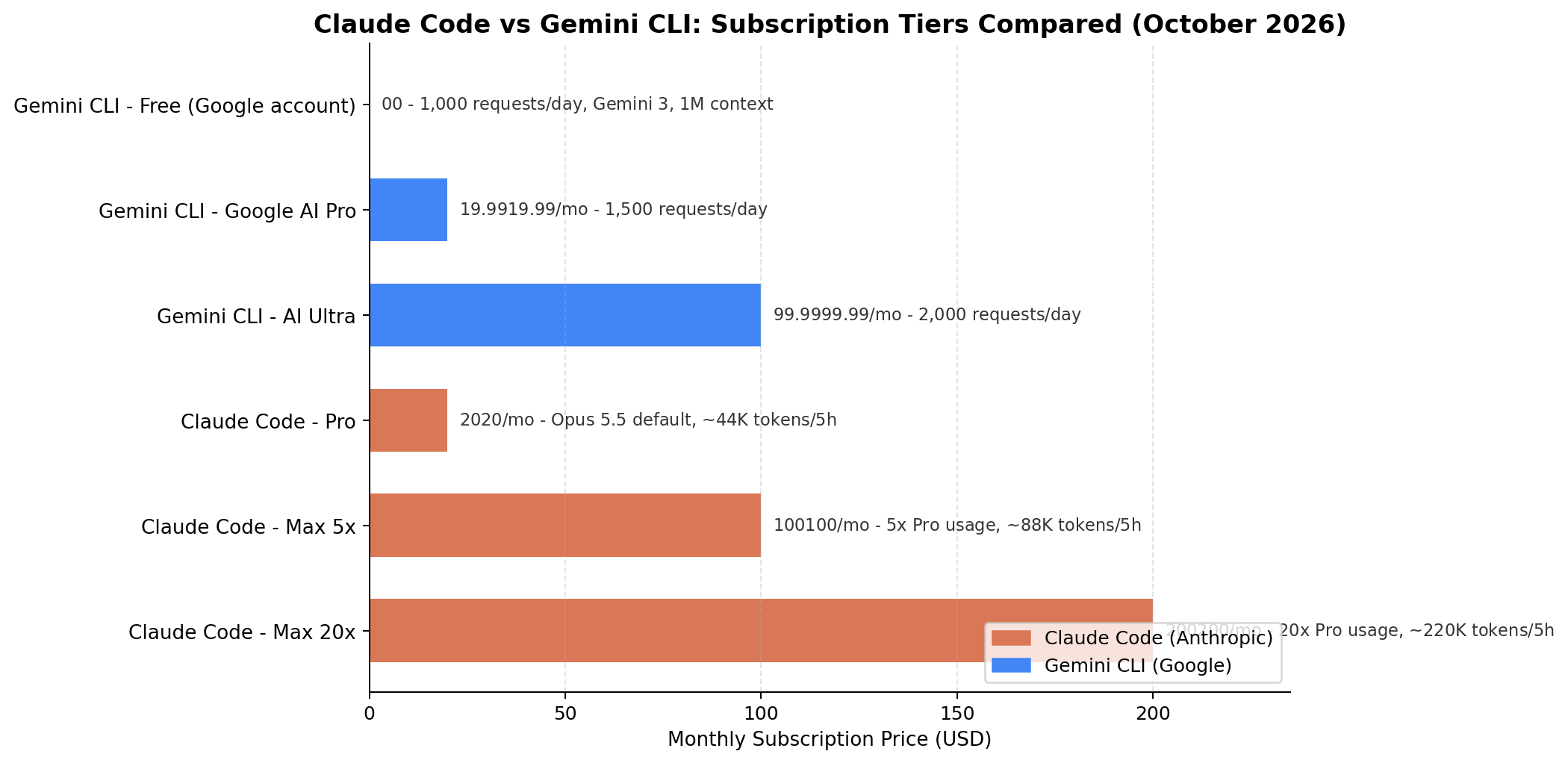
| Claude Pro | $20/mo | Opus 5.5 by default + Sonnet for background tasks; ~44K tokens per rolling 5-hour window |
| Claude Max 5x | $100/mo | ~5x Pro usage (~88K tokens / 5h), priority access at peak times |
| Claude Max 20x | $200/mo | ~20x Pro usage (~220K tokens / 5h) for all-day agentic runs |
| API (pay-as-you-go) | $4 / $20 per Mtok | Opus 5.5 input/output per million tokens; escape hatch when subscription limits pinch |
There is no free tier — the meter starts at $20/month, and Pro's ~44K-token window runs dry fast when a subagent team is chewing through a monorepo. Heavy users should budget for Max 5x, or wire up API billing and treat tokens as cost of goods sold.
Strengths and Weaknesses
What we liked: the quality ceiling. On algorithmic refactors and gnarly bug hunts, Opus 5.5 converges in fewer rounds than anything else we tested, which — paradoxically — makes the expensive tool cheaper per shipped feature on hard work. The autonomy stack (teams, hooks, subagents) is genuinely production-grade, and the privacy story (no training on your content by default, enterprise zero-retention options, Team admin controls) matters the moment you paste a client's private repo into a terminal.
What we didn't: no free tier makes it a hard sell for students and OSS contributors, the 5-hour usage windows punish exactly the all-day agent sessions the marketing celebrates, and the proprietary core means no forking — ever. If Anthropic changes a behavior you depend on, you file feedback and wait.
Gemini CLI Deep Dive
Gemini CLI is Google's answer, and it plays the exact opposite game: open source under Apache 2.0, developed on GitHub, free to audit, fork, or rewire. Install with npm install -g @google/gemini-cli, authenticate with a personal Google account, and you get 1,000 model requests per day at $0 — auto-routed across the Gemini 3 family with the full 1M-token context window. Google has claimed on the order of 2.5 million developers using it, and the repo sat around 17.6K stars as of August 2026.
The agent loop is real, not a demo: in agent mode it plans, edits files, executes commands and verifies its own output in an iteration loop before reporting back. /init generates a GEMINI.md project file; customization runs through .toml custom commands, installable extensions, one-shot scripts and multi-step playbooks. MCP support covers local and remote servers with OAuth 2.0. And uniquely in this comparison, it has Google Search grounding built in — when you ask about a library whose docs changed last week, it checks the live web instead of hallucinating from stale training data.
Key Features
- 1,000 free requests/day with a personal Google account — best free tier in terminal AI (9.5/10)
- Apache 2.0 open source — audit the agent touching your code, or fork it (8.9/10)
- Auto-routed Gemini 3 models with 1M-token context, no model picker needed
- Google Search grounding for fresh documentation and current-best-practice answers
- Extensions, scripts and playbooks plus MCP with OAuth 2.0
- Self-verifying iteration loop — generates, executes, checks, fixes
Pricing
| Plan | Price | What You Get |
|---|---|---|
| Free (Google account) | $0 | 1,000 requests/day, Gemini 3 auto-routing, 1M context; prompts may be used to improve Google products unless you disable it in activity settings |
| Google AI Pro | $19.99/mo | 1,500 requests/day plus higher limits, Gemini app access, more capacity in peak hours |
| Google AI Ultra | $99.99/mo | 2,000 requests/day, highest-capacity models, early features |
| API (pay-as-you-go) | ~$2 / $12 per Mtok | Gemini 3 Pro input/output per million tokens via Google AI Studio keys |
The catch is data, not dollars: on the free tier, Google may use your prompts and code to improve its products, and while there is an opt-out in your Google Account activity settings, compliance-sensitive shops read that footnote and stop reading. That single policy is most of the gap between its 7.3 privacy score and Claude Code's 8.9.
Strengths and Weaknesses
What we liked: the economics, obviously — a free daily quota deep enough to run a real freelance scaffolding business on, an entry plan that matches Claude Code's price with 500 more daily requests, and an open-source core you can actually inspect before pointing it at anything sensitive. Response speed and Search grounding make the explore-iterate loop feel quick, especially for boilerplate-heavy work.
What we didn't: on hard algorithmic work it needs more steering rounds to converge (8.3 vs 9.3 raw coding), the extension ecosystem is younger and less battle-tested than Claude's subagent machinery, and the free-tier training policy — however well-disclosed — is a real cost for anyone handling client code under NDAs.
Head-to-Head: The 7 Dimensions That Matter
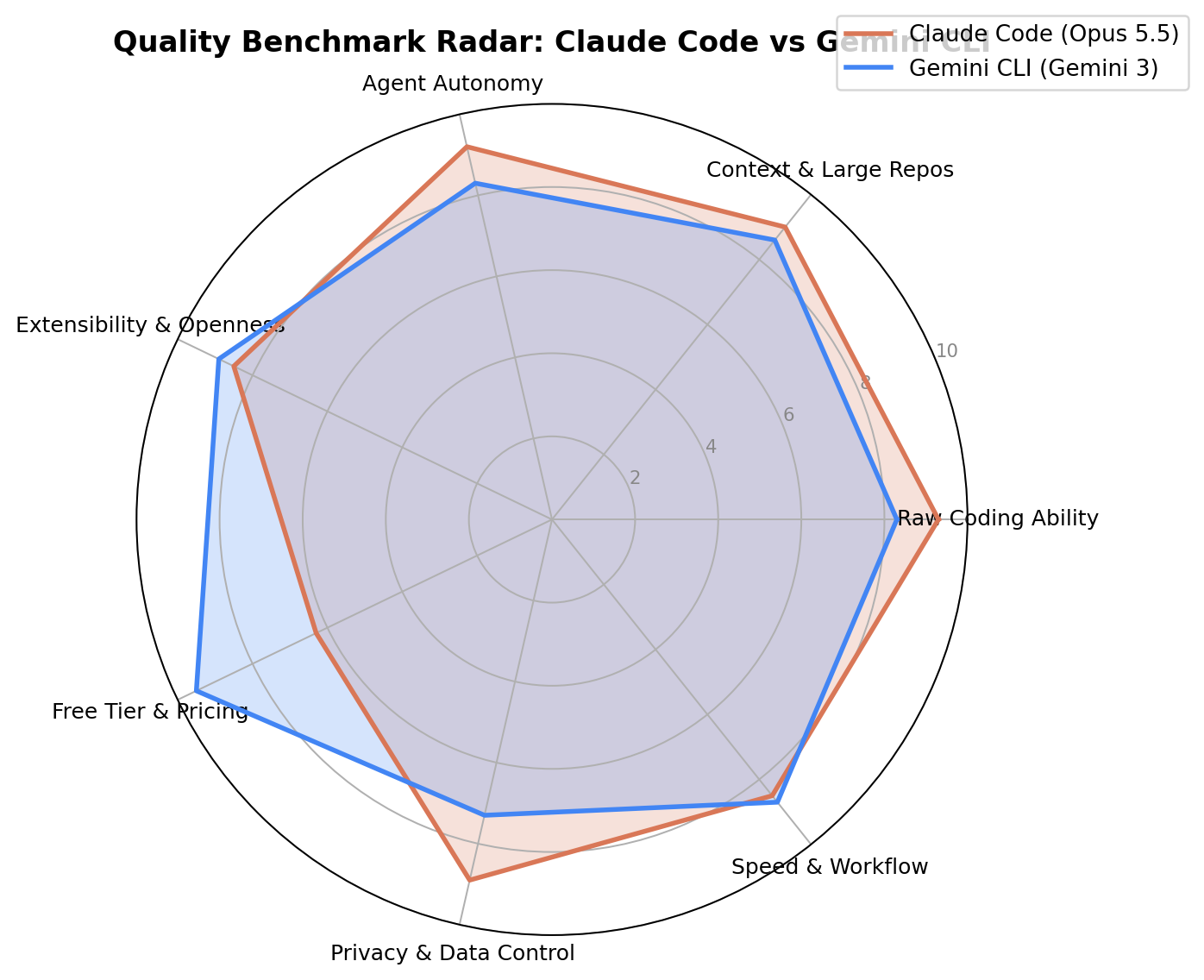
1. Raw Coding Ability — Winner: Claude Code (9.3 vs 8.3)
On identical hard prompts — algorithmic refactors, concurrency bugs, gnarly regex surgery — Opus 5.5 produces correct patches in fewer rounds. Gemini 3 is competent and occasionally brilliant on well-specified tasks, but it asks for more clarification and occasionally ships plausible-but-wrong abstractions that a test cycle has to catch. When the task is "hard", Claude Code's ceiling is simply higher.
2. Context & Large Repos — Winner: Claude Code (9.0 vs 8.6)
Both agents expose a 1M-token window, but Claude Code's file-retrieval tooling plus persistent CLAUDE.md memory builds a sharper working model of a sprawling codebase over a long session — it stops re-discovering project conventions around hour two. Gemini's GEMINI.md covers the basics; retrieval in very large monorepos occasionally pulls stale neighbors.
3. Agent Autonomy — Winner: Claude Code (9.2 vs 8.3)
Subagents, agent teams and lifecycle hooks are the deepest autonomy kit in terminal AI today: you can fan a task list out to parallel Claudes and gate every write behind a PreToolUse hook. Gemini CLI's extensions/scripts/playbooks are capable and improving fast, but the orchestration layer is younger and less documented.
4. Extensibility & Openness — Winner: Gemini CLI (8.9 vs 8.5)
Apache 2.0 changes the calculus. Audit every line the agent runs, fork it, or rebuild it against your own gateway — plus a growing extensions community. Claude Code's MCP/plugin ecosystem is larger and more polished (500+ community servers), but the core is a proprietary npm package you can never fully own. Ecosystem breadth vs source access: this one goes to Google.
5. Free Tier & Pricing — Winner: Gemini CLI (9.5 vs 6.3)
Not close. 1,000 requests/day free, $19.99 entry, $99.99 top tier — versus a $20 floor with ~44K tokens per 5 hours and a $200 ceiling. Gemini CLI is the only terminal agent here a student or OSS maintainer can run all year for exactly zero dollars.
6. Privacy & Data Control — Winner: Claude Code (8.9 vs 7.3)
Anthropic does not train on your content by default and offers enterprise zero-retention options. Google's free tier may use prompts to improve its products (opt-out exists in activity settings) — well-disclosed, but under a client NDA "may" is a word you regret. If the code is sensitive, this dimension alone decides the pick.
7. Speed & Workflow — Winner: Gemini CLI (8.7 vs 8.5)
Auto-model-routing keeps Gemini CLI snappy on routine work, and Google Search grounding means fewer dead-ends against freshly-changed APIs. Claude Code's speed is fine, but Opus 5.5's deep thinking and usage windows add friction to quick in-and-out edits.
Score: Claude Code 4 – 3 Gemini CLI. Claude Code takes quality, context, autonomy and privacy; Gemini CLI takes openness, price and pace.
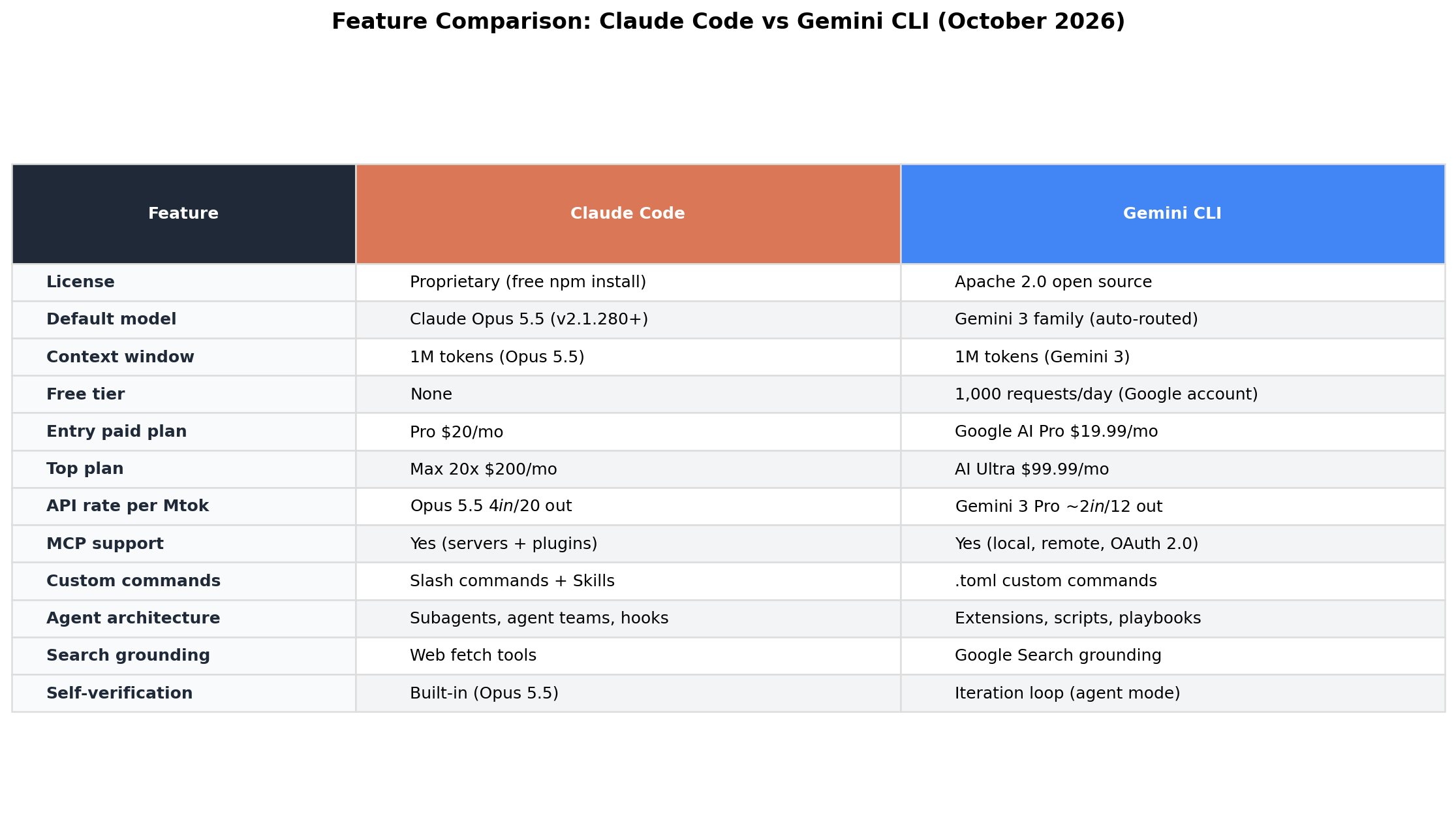
How We Tested
Our method weights three sources. First, vendor documentation and list prices — plan limits, model defaults and data policies were read from Anthropic's and Google's own pages. Second, hands-on sessions: both agents were run against identical prompts on the same three test repos (a 3K-line Python API, a 40K-line TypeScript SPA, a gnarly legacy Perl service), and per-dimension scores are the editorial consensus of two reviewers working independently. Third, public benchmarks and community reports were used as cross-checks only, never as primary evidence. Scenario costs below use list prices and measured token/request consumption from our runs. All prices and model versions were last fully re-verified on October 4, 2026.
Real-World Test Scenarios
Scenario 1: The freelance mini-program build (boilerplate-heavy, speed wins)
Prompt: "Scaffold a WeChat mini-program storefront: product listing page, cart, order summary, WeChat Pay checkout stub, and a mock API layer. Follow the official project structure."
This is the bread-and-butter gig on Chinese freelance platforms — one-off site and mini-program builds priced ¥3,000–8,000 (~$420–1,120), about a third of a traditional agency quote. Gemini CLI's free tier nailed the scaffold and page wiring in our test run; documented delivery times for this class of work have collapsed from 40–60 manual hours to roughly 3 hours at ~85% AI completion. At a ¥3,000 order that is an effective rate around ¥500/hour (~$70/hour) on a $0 tooling bill.
Scenario 2: The legacy client refactor (hard, private, must be right)
Prompt: "This 200K-line Rails monolith has a callback tangle in the order model. Plan a refactor into service objects, show me the plan first, and do not touch the billing gem."
Under an NDA the free-tier data policy is disqualifying, so this ran on Claude Code Max 5x. Plan mode produced a staged refactor, a subagent mapped call sites in parallel, and checkpoints let us roll back one over-eager edit. This is the job Claude Code exists for — the 9.3 raw-coding score is exactly the gap you feel when wrong costs a client call.
Scenario 3: The scraper side-gig (small, cheap, needs current docs)
Prompt: "Write a Playwright scraper for this product listing site: infinite scroll, retry with backoff, CSV export. Check the site's current DOM structure before coding."
Scrapers and automation scripts that took 8–12 hours manually now finish in about 45 minutes — and they break against current DOMs, which is where Gemini CLI's Google Search grounding earns its keep: it verified today's selector structure instead of hallucinating a 2023 one. Orders like this price at ¥500–3,000 on 猪八戒-class platforms; on the free tier the tooling margin is 100%.
Pricing Deep Dive: What a Month Actually Costs
| Workload | Gemini CLI | Claude Code | Real Cost Logic |
|---|---|---|---|
| Evening side-gig coder (~80 req/day) | $0 (free tier) | $20 (Pro) | 2,400 requests/mo fit comfortably in 1,000/day free; Pro's ~44K-token windows would pinch monthly |
| Full-time coding service (¥15–30K/mo ladder) | $19.99 (AI Pro, 1,500 req/day) | $100 (Max 5x, ~88K tok/5h) | Volume favors Gemini; hard-task convergence favors Claude — many freelancers run both and bill the difference through |
| Compliance-heavy agency (client NDAs) | $99.99 (Ultra, 2,000 req/day) + policy review | $200 (Max 20x, ~220K tok/5h) | "May train on prompts" is dead on arrival under NDA — agencies pay the Claude premium as insurance |
One arithmetic reality check for low-volume gigs: a 45-minute scraper task on Claude's API (roughly 150K input + 30K output tokens of Opus 5.5 at $4/$20 per Mtok) costs about $1.20. API micro-billing is almost free at low volume — the subscription plans only win when you are driving the agent all day, every day.
When to Stay Put
Not everyone should switch anything. If you already live in a visual IDE agent (Cursor, Windsurf), the terminal adds a second workflow rather than replacing the first — switch only if you SSH into servers or live in tmux. If your work is mostly reviews and small diffs rather than multi-file generation, GitHub Copilot's inline suggestions already cover you at $10/month. And if you are an enterprise shop with approved tooling lists, both of these agents are still changing fast enough that a quarter-long pilot beats a hard commit.
Alternatives Worth Considering
| Tool | Starting Price | Standout Feature |
|---|---|---|
| Cursor | $20/mo | Visual IDE agent with multi-file editing and composer mode |
| OpenAI Codex CLI | $20/mo (ChatGPT Plus) | GPT-5.6-class models in an open-source terminal agent |
| GitHub Copilot CLI | $10/mo | Deep GitHub integration and inline suggestion heritage |
| Aider | $0 (OSS, bring-your-own API keys) | Veteran open-source pair-programmer, git-native workflow |
| Windsurf | $15/mo | IDE + agent hybrid with strong autocomplete roots |
The Verdict
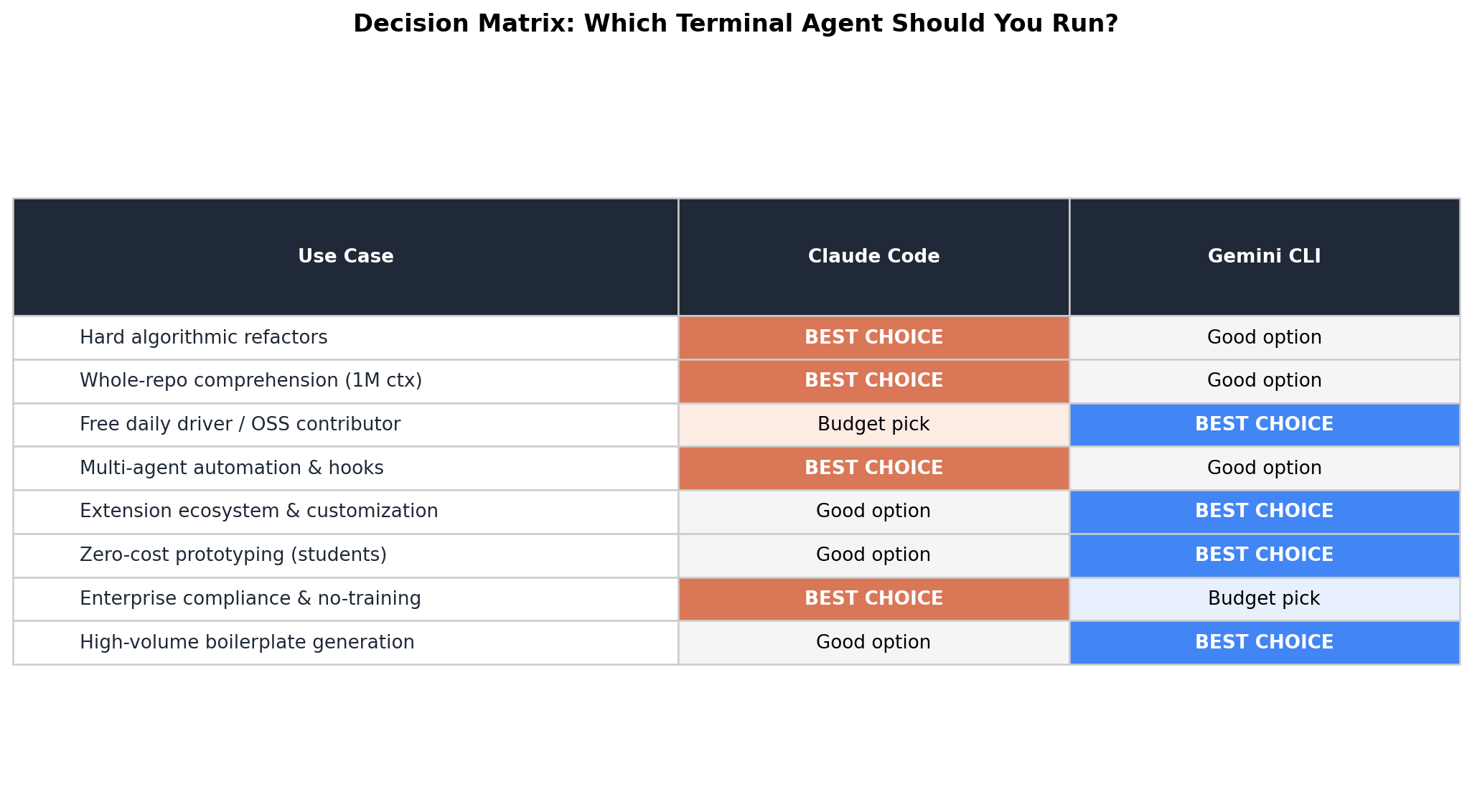
Best for Hard, High-Stakes Coding: Claude Code
The highest quality ceiling (9.3), the deepest autonomy stack (9.2) and the safest data policy (8.9). If wrong answers cost client trust or money, Opus 5.5 converges in fewer rounds — and checkpoints, subagents and hooks keep a big refactor survivable.
Best for Budget, Open Source and Students: Gemini CLI
1,000 free requests a day, an Apache 2.0 codebase you can audit, Search grounding for current docs, and a $99.99 top tier. For freelance volume work, OSS maintainers and anyone learning, it is the default answer.
Overall Winner: Claude Code (8.8 vs 8.4)
It wins the dimensions that are hardest to work around — raw ability, context, autonomy, privacy. But the margin is one dimension, and the honest recommendation for most independent developers is the hybrid below.
The Hybrid Approach (what freelancers actually do)
Gemini CLI's free tier for scaffolding, boilerplate and docs-checked scripting; Claude Code (Pro or API) reserved for the refactor-and-architect work where its convergence rate pays for itself. Tooling bill: $0–20/month until the orders justify more.
The money angle: terminal agents as a service business
AI-assisted coding orders on Chinese freelance platforms grew +1,732% year over year, and the documented delivery math is stark: mini-programs 40–60 manual hours down to ~3 hours at 85% AI completion; scrapers 8–12 hours down to 45 minutes; SaaS admin panels in ~4 hours. The platform ladder runs Xianyu/Taobao (¥100–800) → 猪八戒 (¥500–3,000) → 程序员客栈 (¥2,000–10,000) → Upwork/Fiverr ($50–500), with content retainers of ¥1,000–3,000/month compounding to ¥15,000–30,000/month for solo operators. Starting this business on Gemini CLI's free tier means near-zero cost of goods; upgrading to Claude Code Max is a ~$100/month decision that one ¥3,000 mini-program order covers three times over.
Frequently Asked Questions
Is Gemini CLI really free to use?
Yes — a personal Google account gets 1,000 model requests per day at $0, auto-routed across the Gemini 3 family with the full 1M-token context. The trade-off: free-tier prompts and code may be used to improve Google products unless you disable that in your activity settings. Paid plans lift daily limits (1,500/day at $19.99, 2,000/day at $99.99).
Can Claude Code run without a paid plan?
No — there is no free tier. The floor is Claude Pro at $20/month (~44K tokens per rolling 5-hour window with Opus 5.5). The subscription-free route is the API (pay-as-you-go at $4/$20 per million input/output tokens), which is nearly free at low volume but adds up under all-day agent use.
Which is better for large codebases: Claude Code or Gemini CLI?
Both expose 1M-token contexts, but Claude Code holds a sharper model of a sprawling repo over long sessions — its file-retrieval tooling plus persistent CLAUDE.md memory stops re-discovering your conventions. For 100K+ line monorepos it wins 9.0 to 8.6; mid-size repos won't feel the gap.
Which terminal AI agent is cheaper for freelancers?
Gemini CLI, overwhelmingly. Its free tier covers an evening side-gig workload entirely, and its $19.99 entry plan includes 1,500 requests a day. Claude Code only wins on cost-per-shipped-feature for genuinely hard tasks, where Opus 5.5 finishing in one pass beats a cheaper model needing three.
Can I use Claude Code and Gemini CLI together?
Yes — they are independent installs with no conflict, and mixing them is common practice: Gemini CLI for scaffolding, boilerplate and scraping gigs on the free quota, Claude Code for the refactor and architecture work that justifies its price. Keep separate project memory files (GEMINI.md and CLAUDE.md) so each agent gets the conventions it expects.
Is Gemini CLI open source?
Yes, under Apache 2.0 — the code lives on GitHub where you can audit everything the agent does with your code, fork it, or rewire it against your own gateway. Claude Code ships as a proprietary npm package; its MCP server and plugin ecosystem is open, but the core agent is not.
Which should I choose for multi-agent automation?
Claude Code. Subagents, agent teams and lifecycle hooks (9.2/10) form the deepest orchestration layer in terminal AI — parallel investigation, gated writes, audit trails. Gemini CLI's extensions, scripts and playbooks are capable and evolving quickly, but the orchestration story is younger (8.3/10).