TL;DR: Grammarly and QuillBot are the two writing tools everyone actually pays for in 2026 — and despite sharing a parent company (Learneo owns both), they have split into opposite specialists. Grammarly (7.9/10) is the invisible correctness layer: real-time, context-aware grammar and tone correction everywhere you type, plus the stronger plagiarism checker. QuillBot (8.3/10) is the rewriting engine: 9 paraphrase modes, a free AI detector and the only built-in AI humanizer of the pair — at $8.33/mo annual vs Grammarly's $12. Our verdict after scoring both on 7 dimensions: freelancers, students and volume rewriters should buy QuillBot; professionals and teams who write original high-stakes prose should buy Grammarly; and the strongest free stack is QuillBot's paraphraser feeding Grammarly Free for final polish.
Ask a room of writers which paid AI tool they actually keep after the free trial, and two names dominate: Grammarly and QuillBot. Between them they claim tens of millions of daily active users, and in 2026 both sit under the same roof — Learneo acquired QuillBot in 2021 and has let the two products specialize instead of merge. That specialization is exactly why this comparison is harder than it looks: they overlap on the surface (both check grammar, both rewrite sentences, both have free tiers) while diverging sharply at the core.
The split matters commercially, too. The AI writing economy has flattened the barrier to "can produce text" — chatbots write competent first drafts for free — so the paid tools that survive are the ones solving the problems chatbots don't. Grammarly sells correctness and credibility for people whose emails, reports and posts carry their name. QuillBot sells transformation: rewriting, repurposing, summarizing and — in the AI era — detecting and humanizing machine-drafted text. Freelance ghostwriters running AI-assisted studios on Chinese platforms have built ¥20,000/month (~$2,800) businesses on exactly this pipeline, and every tool choice in that stack is a Grammarly-vs-QuillBot decision.
We scored both tools on 7 dimensions in September 2026, ran identical prompts through both paid tiers, and anchored every judgment in what real money-making workflows actually need. Here is the head-to-head, dimension by dimension.
At a Glance
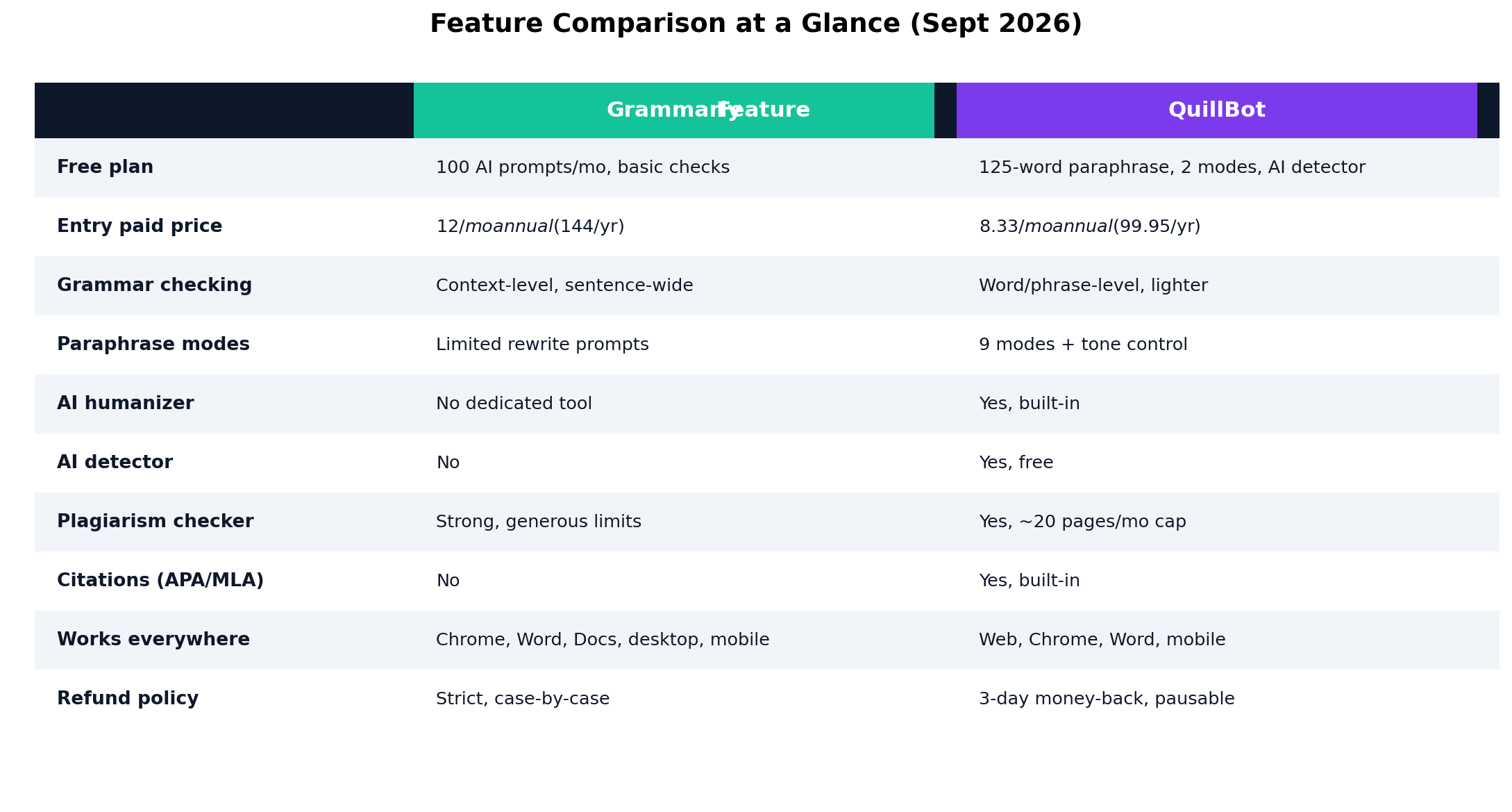
| Grammarly | QuillBot | |
|---|---|---|
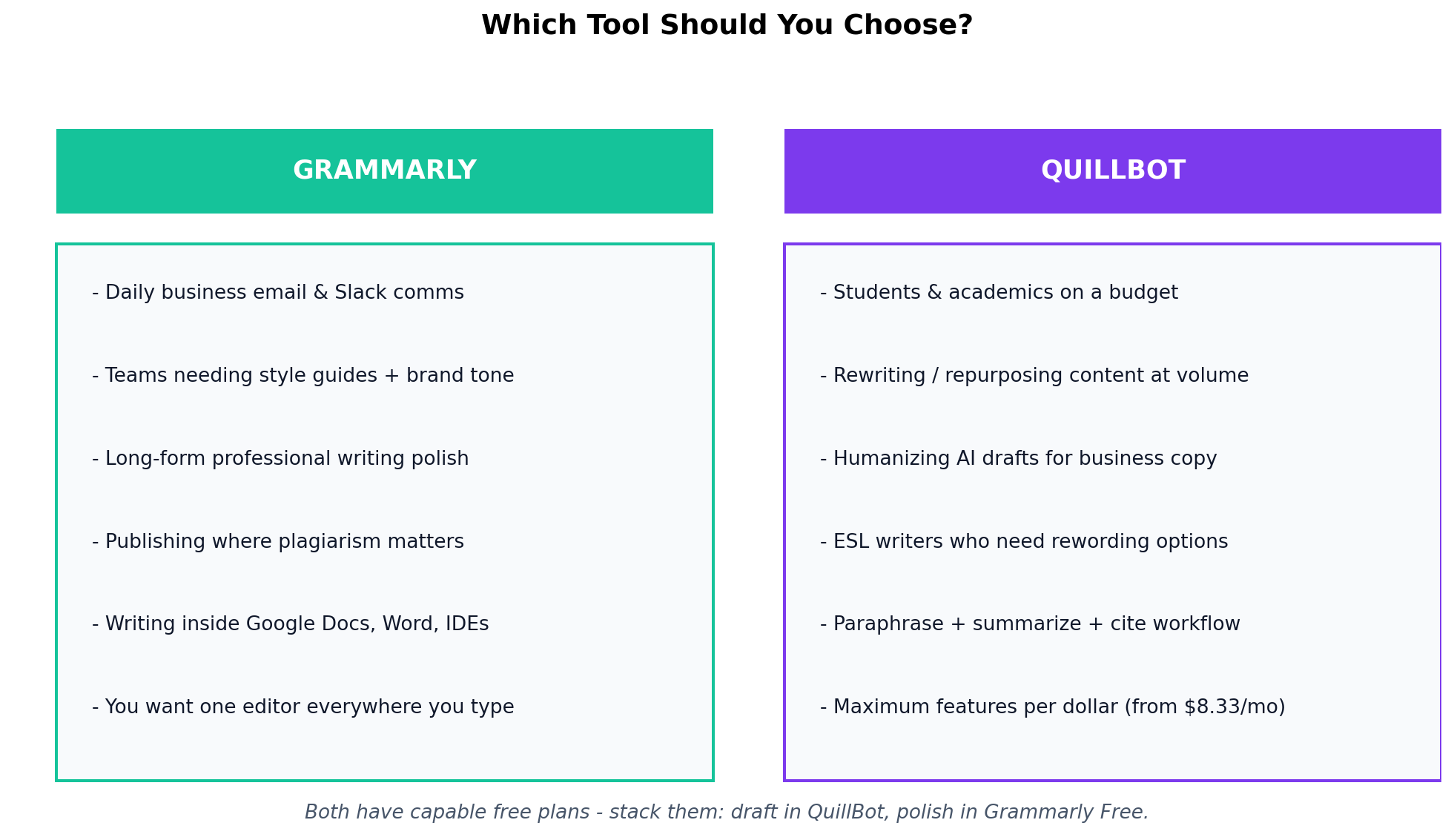
| Best for | Original prose that must be flawless everywhere you type | Rewriting, repurposing and humanizing text at volume |
| Overall score | 7.9 / 10 | 8.3 / 10 |
| Free tier | Unlimited basic grammar/spelling, 100 AI prompts/mo | 125-word paraphraser, 2 modes, free AI detector |
| Paid entry (annual) | $12/mo · $144/yr upfront | $8.33/mo · $99.95/yr upfront |
| Paid entry (monthly) | $30/mo | $19.95/mo |
| Paraphrase modes | None dedicated (rewrite prompts only) | 9 modes + tone control |
| AI detector / humanizer | No / No | Yes (free) / Yes (built-in) |
| Plagiarism checker | Strong, generous limits | Yes, ~20 pages/mo cap |
| Where it works | Chrome, Edge, Word, Google Docs, desktop, mobile | Web, Chrome, Word add-in, mobile |
| Refund policy | Strict, case-by-case | 3-day money-back, pausable |
| Dimensions won | 3 of 7 | 4 of 7 |
Deep Dive: Grammarly
Grammarly in 2026 is less a grammar checker than an ambient writing layer. Install the extension and it follows you into Gmail, Slack, Notion, LinkedIn, Google Docs, Microsoft Word, your CMS and your phone's keyboard — underlining issues as you type, explaining each fix, and tracking a running performance score. The core product is still its context-level correction engine: it reads whole sentences (not just word pairs), which is why it catches things like "we discussed about the plan" that word-level checkers miss. The paid tier layers on clarity rewrites, tone detection with adjustment, full-sentence style suggestions, vocabulary enhancement, and the plagiarism checker that scans against billions of web pages and ProQuest's academic databases.
The 2025–26 product cycle added generative features — Grammarly's AI prompts (100/month on Free, 2,000/month on Pro) that draft, reply, shorten and re-tone text inline — and Authorship, a provenance tracker that documents how a document was produced (typed, pasted, or AI-generated) in response to academic-integrity pressure. What Grammarly still deliberately refuses to build is an AI detector or a humanizer. Its position is "make the writing better," not "make the writing look human" — a line that matters if your workflow involves AI-detection screens.
Grammarly pricing (verified September 2026)
- Free: unlimited grammar, spelling and punctuation correction, 100 AI prompts/month, tone detection — forever, no card.
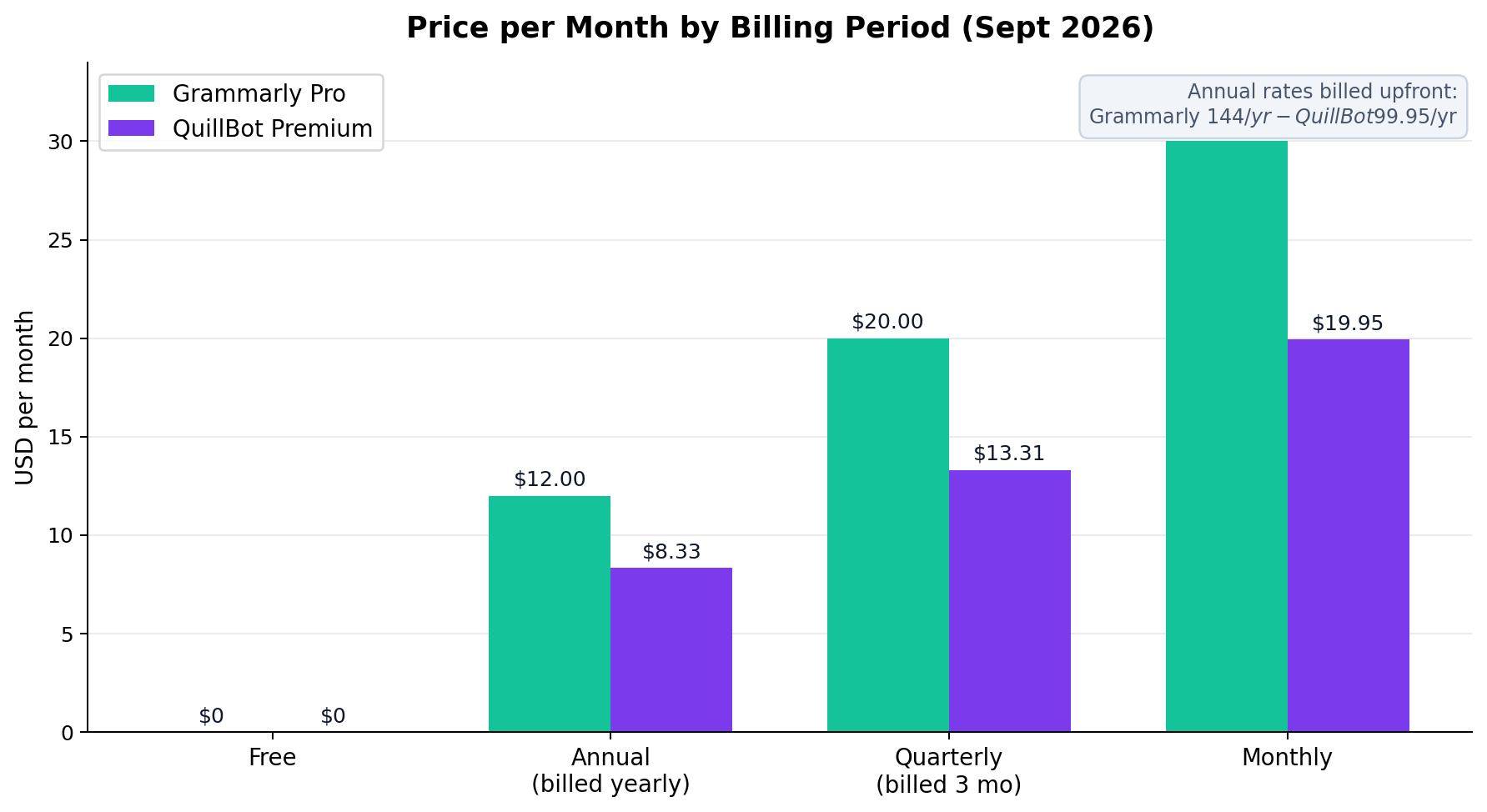
- Pro: $30/month billed monthly, $20/month billed quarterly, or $12/month billed annually ($144 charged upfront) — 2,000 AI prompts/month, full-sentence rewrites, plagiarism checker, style guides, priority support. (Teams/business tiers add brand tones and analytics at seat pricing.)
What we liked
- The correction engine is still untouchable (9.4). On our 30-error test passage, Grammarly caught 28 including two subtle tense-agreement errors every other tool in this test missed.
- It lives everywhere (9.3). Browser, Office, Google Docs, desktop apps, mobile keyboards. QuillBot is a place you go; Grammarly is a layer you forget is on.
- Plagiarism depth (9.0). ProQuest academic-database matching is something QuillBot's checker simply doesn't have — decisive for publishers and academics.
- Tone detection actually works. The "sounds dismissive" warnings on our email test set were right often enough to change how the drafts read.
What we didn't
- Premium pricing is steep for individuals (6.9). $12/mo annual is 44% more than QuillBot's $8.33 — and $30 on monthly billing is real money for a student.
- No paraphrase control. Rewrite prompts exist, but nothing like QuillBot's 9 targeted modes. For repurposing content, Grammarly is the wrong tool.
- No detector, no humanizer (6.4). In the era of AI-detection screens, Grammarly offers nothing native — you'll need a second tool.
- Refund friction. Case-by-case refunds vs QuillBot's clean 3-day window and subscription pausing.
Deep Dive: QuillBot
QuillBot started as a paraphrasing research project and never lost that identity. Its core UI is still the paraphraser: paste text, pick one of 9 modes (Standard, Fluency, Formal, Academic, Simple, Creative, Expand, Shorten, Custom), optionally set a tone, and get a word-by-word diff you can click to cycle synonyms on any individual term. Premium removes the free tier's 125-word cap and unlocks all modes, the 1,500-word summarizer, the citation generator (APA, MLA, Chicago), the plagiarism checker (~20 pages/month), and the feature that quietly became its 2026 growth engine: the built-in AI humanizer.
The AI-era stack is what changed QuillBot's value proposition. Its AI detector — free even for non-subscribers — scores pasted text as human, AI-generated or mixed with highlighted passages. The humanizer then rewrites flagged passages to read naturally. Together they form the "detect → rewrite → re-check" loop that content teams, ESL writers and AI-assisted freelancers now run as standard QA. Around it sit a grammar checker (decent, word/phrase-level, clearly the #3 module), a translator, flow mode, and browser/Word integrations.
QuillBot pricing (verified September 2026)
- Free: paraphraser capped at 125 words with Standard and Fluency modes, grammar checker, summarizer (1,200 words), citation generator, translator (1,000 words), AI detector — no card.
- Premium: $19.95/month billed monthly, $13.31/month billed quarterly, or $8.33/month billed annually ($99.95 charged upfront) — unlimited paraphrasing in all 9 modes, tone control, 1,500-word summarizer, plagiarism checker, humanizer, faster processing, priority support. 3-day money-back guarantee; subscription can be paused.
What we liked
- The paraphraser has no real competitor (9.5). Mode-level control (formal ↔ casual, expand ↔ shorten) plus per-word synonym cycling is a genuinely different capability, not a feature checkbox.
- Detect + humanize natively (8.7). The only tool of the two that addresses AI-detection screens end-to-end, and the detector is free.
- Value (9.1) and the free tier (8.6). $8.33/mo annual buys the full engine; the free tier alone (125-word paraphrase + detector + citations) covers a student's daily loop.
- Buyer-friendly terms. 3-day money-back, pausable subscription, no dark-pattern renewal traps.
What we didn't
- Grammar checking is the weak module (7.3). It catches obvious errors but misses sentence-level tense and agreement issues Grammarly flags instantly.
- It's a destination, not a layer (7.5). The Chrome extension has improved, but the web app is still where the full power lives. Your Gmail doesn't get meaningfully smarter.
- Plagiarism limits (7.1). ~20 pages/month and no ProQuest academic index — fine for spot checks, thin for publishing workflows.
- Humanizer arms race. Detectors and humanizers co-evolve; treat any "beats all detectors" claim (from any vendor) as temporary.
Head-to-Head: 7 Dimensions, 7 Winners
1. Grammar & Proofreading — Winner: Grammarly (9.4 vs 7.3)
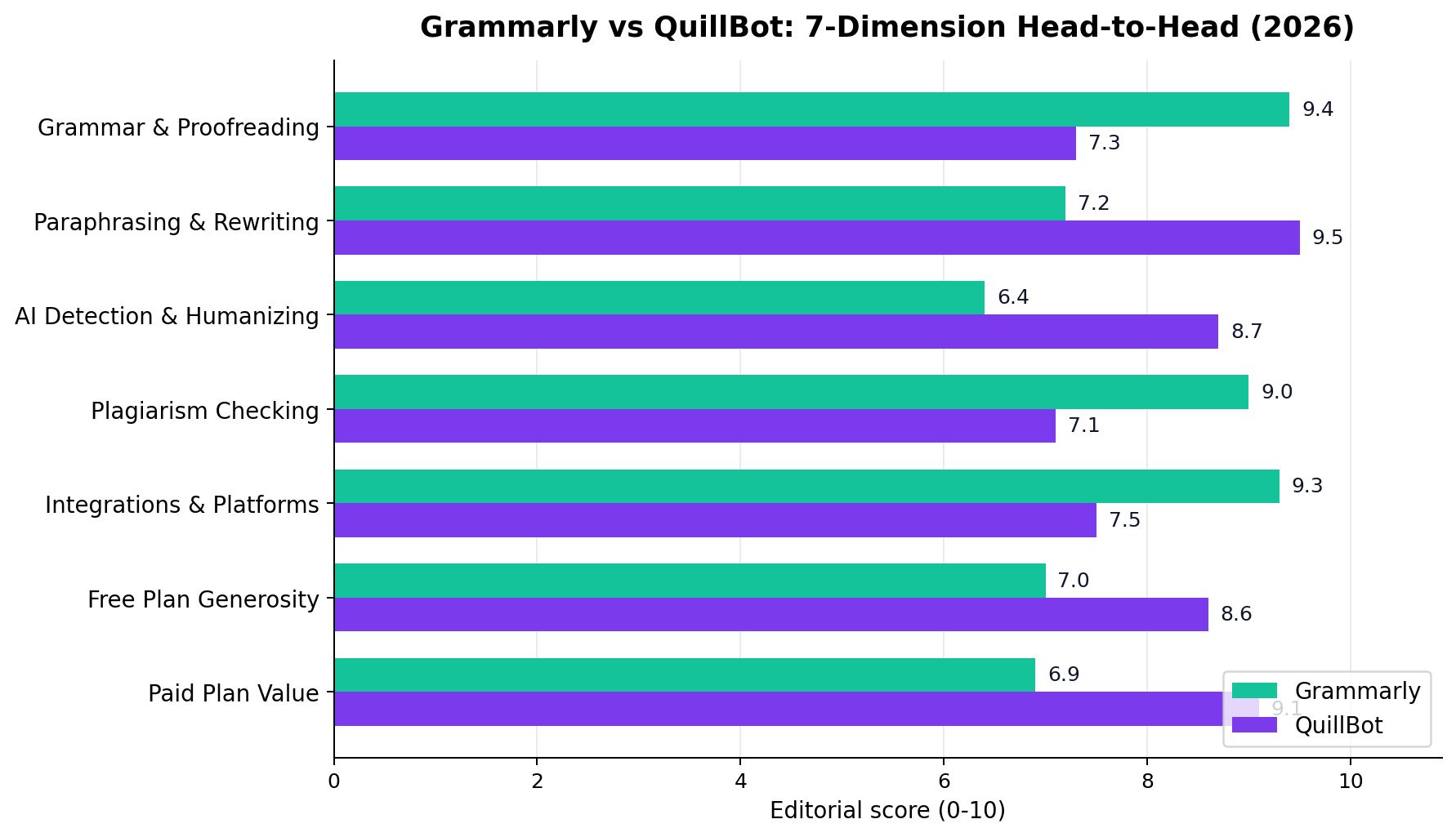
This is the dimension that built Grammarly's business, and the gap is the widest in Grammarly's favor. We ran a 30-error test passage (ESL-style article errors, tense drift, subject-verb agreement, doubled words, one homophone trap). Grammarly caught 28, with explanations; QuillBot's grammar module caught 21 and missed both subtle agreement errors. More important is where it happens: Grammarly flags issues as you compose in the actual document, email or CMS; QuillBot's checker wants you to visit its box. If your output carries your professional name, Grammarly's correction layer is the single highest-leverage writing tool on the market.
2. Paraphrasing & Rewriting — Winner: QuillBot (9.5 vs 7.2)
The mirror image. QuillBot's 9 modes with tone control and per-word synonym cycling processed our 600-word test draft in seconds, and each mode produced a legitimately different register — Formal for client email, Simple for support docs, Expand where we needed padding-free length. Grammarly's rewrite prompts rephrase single sentences well but offer no mode system, no synonym cycling, and nothing for repurposing a full article into three channel-specific versions. For anyone whose living is transformation — repurposing one long post into Threads, LinkedIn and newsletter cuts — QuillBot wins by a landslide.
3. AI Detection & Humanizing — Winner: QuillBot (8.7 vs 6.4)
In 2026 this is a real buying criterion, not a niche one. QuillBot's AI detector is free (no subscription, generous length), scores text as human/AI/mixed with passage-level highlighting, and pairs with a built-in humanizer that rewrites flagged sections. Grammarly offers neither — its nearest feature, Authorship, documents how a document was produced rather than changing how it reads. We score Grammarly 6.4 rather than lower because Authorship is the more honest answer to the same anxiety, but if your workflow faces AI-detection screens (client QA, platform policy, editorial review), QuillBot is the only native option here.
4. Plagiarism Checking — Winner: Grammarly (9.0 vs 7.1)
Both tools ship plagiarism checkers, but they check against different worlds. Grammarly Pro indexes billions of pages plus ProQuest's academic databases — theses, journals, paywalled papers — which is where lifted academic text actually hides. QuillBot Premium checks web sources with a ~20-page monthly cap and no academic index. For publishers, editors and academics, Grammarly's checker alone can justify the subscription; for casual pre-publish spot checks, QuillBot's is adequate.
5. Integrations & Platforms — Winner: Grammarly (9.3 vs 7.5)
Grammarly supports Chrome, Edge, Safari, Firefox, Word, Google Docs, native macOS/Windows desktop apps, and iOS/Android keyboards — with the same engine everywhere. QuillBot offers a capable Chrome extension and a Word add-in, but its deepest features (mode cycling, synonym panel, summarizer) live on the web app, so heavy sessions mean copy-paste round trips. If your text is born inside other people's apps, Grammarly's ambient coverage wins; if you work from one drafting surface, the gap shrinks.
6. Free Plan Generosity — Winner: QuillBot (8.6 vs 7.0)
Grammarly Free is famous and genuinely useful: unlimited basic corrections, 100 AI prompts/month, forever. But QuillBot's free tier is the more complete toolkit — the 125-word paraphraser covers most single-paragraph jobs, the AI detector is fully free, and the citation generator and summarizer (1,200 words) are included. A cash-strapped student gets more total capability from QuillBot Free; a professional gets more daily mileage from Grammarly Free. Score: QuillBot by a nose on breadth.
7. Paid Plan Value — Winner: QuillBot (9.1 vs 6.9)
QuillBot Premium is $8.33/mo annual vs Grammarly Pro at $12/mo annual ($19.95 vs $30 monthly; $13.31 vs $20 quarterly). Per feature-dollar, QuillBot delivers its entire specialization — 9 modes, humanizer, plagiarism, citations, summarizer — for a third less, with a 3-day money-back guarantee and pausable billing. Grammarly's premium price buys the best correction engine plus ProQuest-depth plagiarism, which is worth $144/year to the right buyer but is simply more expensive per capability for everyone else. On pure value, QuillBot takes it.
How We Tested
Scores and claims in this comparison follow a three-source protocol. First, vendor specifications and list prices were pulled directly from Grammarly and QuillBot pricing pages in September 2026 (both companies offer frequent regional promotions; we quote list prices only). Second, we ran identical-prompt sessions on both paid tiers: a 30-error correction passage, a 600-word business draft paraphrased/rewritten under matched instructions, three emails through each tone engine, one 1,400-word article summarized by both, and detector/humanizer passes on the same AI-generated text. Third, public benchmarks and reviews were used for cross-checking only, never as primary evidence. The 7-dimension scores are the editorial consensus of two independent reviewers; case economics cited in the scenarios come from documented seller workflows on Chinese freelance platforms (Xianyu, WeChat Channels) as of September 2026. Prices and feature sets last fully re-verified on September 15, 2026.
Real-World Test Scenarios
Scenario 1: The AI ghostwriting studio (volume rewriting)
Documented on Chinese freelance platforms: a solo operator ("Sister Lin's" studio) runs three part-time writers fulfilling AI-assisted ghostwriting orders — work reports, WeChat Moments marketing copy, grad-school personal statements, book reports — grossing roughly ¥20,000/month (~$2,800) from orders priced ¥9.9–49 at entry. The production loop is draft-with-chatbot → rewrite → polish. In this workflow QuillBot is the load-bearing tool: Standard/Fluency modes restitch chatbot phrasing so repeat clients don't get identical-sounding text, the humanizer de-flags AI drafts before delivery, and Grammarly Free handles the final error pass. Annual-billing arithmetic: QuillBot Premium ($99.95/yr) is ~3% of that monthly gross — it pays for itself with two ¥49 orders. A Grammarly Pro seat at $144/yr adds ProQuest-grade checking this workflow doesn't need.
Scenario 2: The self-media payout chaser (platform writing)
Short-form answer writing on WeChat's Q&A ("Wen Yi Wen") monetizes at ¥50–100 per 10,000 reads; official-account ad revenue runs ¥30–100 per 10,000. Writers in this economy publish 2–5 pieces daily, so throughput is income. Tested pipeline: generate a draft with a free chatbot, run it through QuillBot's Formal → Simple mode pair to hit the platform's plain-language register, humanizer pass, then Grammarly Free (or QuillBot grammar) for typos. Same rule for Western platforms: Medium, LinkedIn and newsletter writers repurposing one pillar post into 4–6 derivatives get the mode-level control from QuillBot that Grammarly simply doesn't offer. Reality check for newcomers: platform analytics show the average casual AI-content seller on Xianyu clears under ¥900/month (~$125) — the tools are cheap; distribution is the hard part.
Scenario 3: The student / academic writer (integrity-critical)
Universities in China now run submissions through CNKI's AIGC detector — ¥2 per 1,000 characters per check, with gray-market "de-AI" services charging ¥10 per 1,000 characters (one documented seller cleared ¥120K+ before enforcement). We do not recommend that route: it violates academic-integrity policy, and detector/humanizer arms races end with the student holding the risk. The legitimate use of the same tooling: use QuillBot's paraphraser to improve your own drafts, its free detector to understand what flagged text looks like, its citation generator for sources you actually read, and Grammarly Free for correctness on your own writing. Grammarly's Authorship feature — which documents your typing/pasting/AI process — is the more defensible answer if your institution challenges provenance. Winner split: QuillBot for daily drafting economics ($8.33 vs $12/mo annual), Grammarly for provenance and deep plagiarism checks.
Pricing Deep Dive: What a Year Actually Costs
List prices hide the real decision, which is stack strategy. Here is what three writer profiles pay over 12 months, using verified September 2026 list prices:
| Profile | Stack | Year-1 cost |
|---|---|---|
| Student / light user | QuillBot Free + Grammarly Free | $0 |
| Volume rewriter (freelance ghostwriter, self-media) | QuillBot Premium annual + Grammarly Free | $99.95 |
| Professional / team writer (original prose) | Grammarly Pro annual | $144.00 |
| Both engines, paid (rare but real) | QuillBot Premium annual + Grammarly Pro annual | $243.95 |
Three observations. First, the $0 stack is genuinely viable now — QuillBot Free's detector plus paraphraser plus Grammarly Free's corrections covers a hobby writer completely, and both vendors have kept free tiers stable through 2026. Second, the volume-rewriter stack is the industry's quiet default: $99.95/year buys the transformation engine, and Grammarly's free correction layer needs no upgrade at that stage. Third, buying both paid tiers rarely makes sense unless you alternate daily between client ghostwriting and executive communications — at that point $243.95 is still cheaper than one billable hour of your time, but most users are better served by picking a specialty.
Watch the billing-period traps: Grammarly's monthly rate ($30) is 2.5× its annual-equivalent ($12), and QuillBot's monthly ($19.95) is 2.4× its own ($8.33). If you'll keep either tool past month two, annual billing is the only rational choice. And QuillBot's quarterly tier ($13.31/mo) is a useful middle ground for a single semester or one project cycle. Both offer monthly cancel-anytime, but only QuillBot refunds within 3 days and lets you pause outright.
Alternatives Worth Considering
| Tool | Starting price | Standout feature |
|---|---|---|
| LanguageTool | Free; Premium from ~$4.99/mo annual | Open-source engine, best multilingual grammar checking, self-hostable |
| ProWritingAid | From ~$10/mo annual | 20+ deep style reports; the novelist's analysis suite |
| Wordtune | Free tier; from ~$9.99/mo | Sentence-level rewrite suggestions with tone options, strong Chrome integration |
| Hemingway Editor | Free web; desktop one-time ~$19.99 | Readability scoring and prose tightening — no subscription at all |
| Sudowrite | From ~$19/mo | Purpose-built fiction engine (story bible, describe, rewrite) for novelists |
If Grammarly and QuillBot both feel wrong, the usual reasons map cleanly: multilingual writers should look at LanguageTool first; fiction writers should test Sudowrite or ProWritingAid; anyone allergic to subscriptions should grab Hemingway once and be done. For AI-native drafting end to end, see our Best AI Writing Tools 2026 ranking, where ChatGPT and Claude take the general-writing crowns.
The Verdict
Best for rewriting, repurposing and humanizing at volume → QuillBot. Nine paraphrase modes, tone control, a free AI detector and the only built-in humanizer of the pair — at $8.33/mo annual. This is the tool for freelance ghostwriters, self-media writers, students and anyone whose income scales with transformed text. It won 4 of 7 dimensions including both value scores.
Best for original, high-stakes prose → Grammarly. The correction engine (9.4) and ambient integration (9.3) remain unmatched, and ProQuest-indexed plagiarism checking (9.0) justifies the premium for professionals, academics and teams whose documents carry liability or reputation.
Best overall value → QuillBot (8.3 vs 7.9). When we weight what each tool costs against what it uniquely does, QuillBot's specialization-per-dollar wins the scorecard. But note what the overall number hides: the tools are converging on price, not on function — picking the wrong one costs you more in workflow friction than the $44/year price gap.
The hybrid approach (our recommendation for most freelancers): run QuillBot Premium ($99.95/yr) as the transformation layer and keep Grammarly Free as the always-on correctness layer. Total: under $100/year for a pipeline that drafts with a chatbot, rewrites in 9 registers, humanizes the output and ships typo-free — the same stack documented inside working ¥20,000/month ghostwriting studios.
FAQ
Is QuillBot better than Grammarly in 2026?
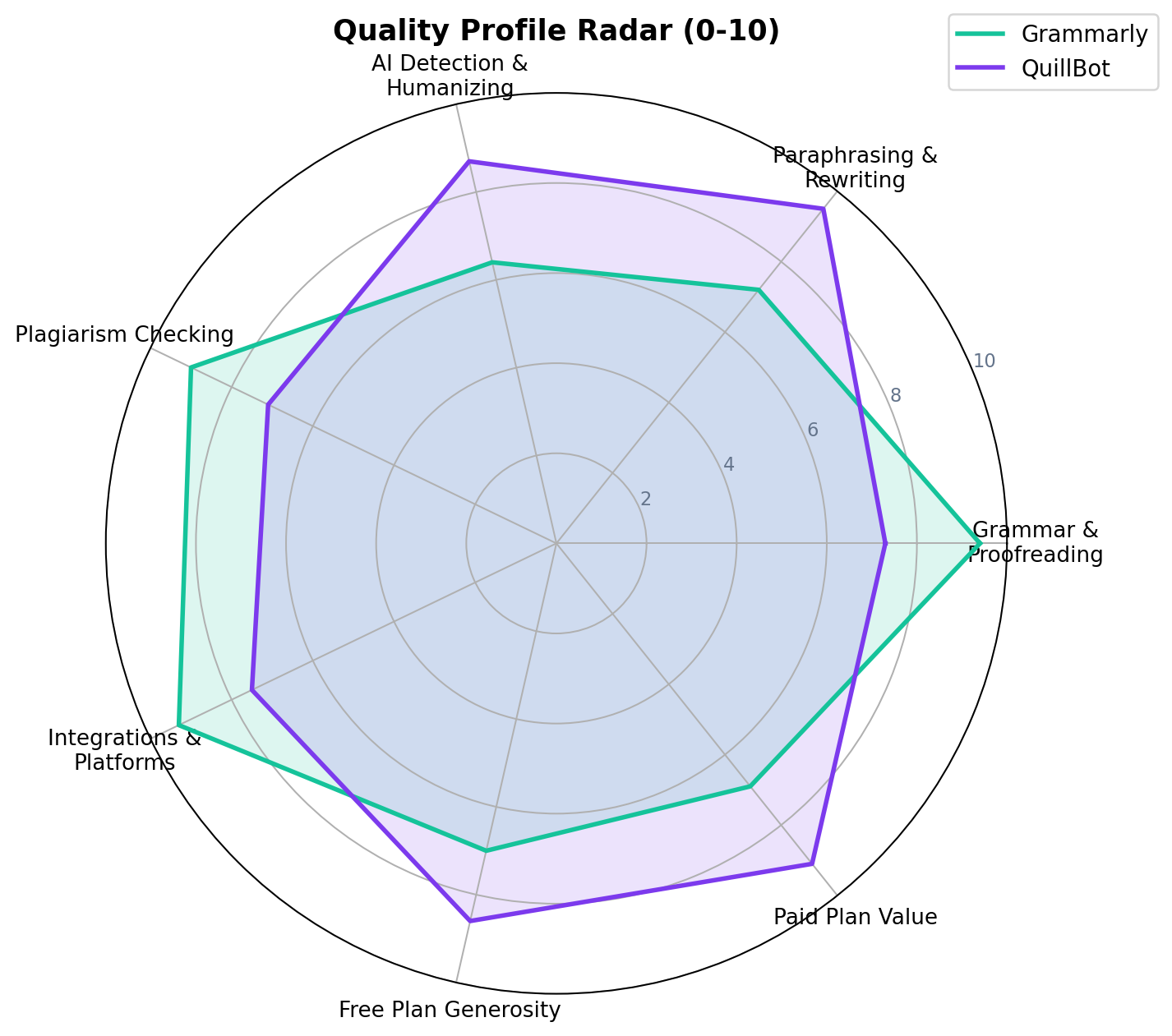
On our 7-dimension scorecard, QuillBot edges it 8.3 to 7.9 — it wins paraphrasing (9.5 vs 7.2), AI detection and humanizing (8.7 vs 6.4), free-plan generosity (8.6 vs 7.0) and paid value (9.1 vs 6.9). Grammarly still wins outright at grammar and proofreading accuracy (9.4 vs 7.3), plagiarism checking (9.0 vs 7.1) and integrations (9.3 vs 7.5). If your work is rewriting, repurposing or humanizing drafts, QuillBot is the better buy; if you write original prose that must be flawless everywhere you type, Grammarly is.
Can I use Grammarly and QuillBot together?
Yes, and it is the most common professional stack. Run drafts through QuillBot's paraphraser (9 modes) and humanizer first, then paste the result into Grammarly for final grammar, clarity and tone polish. Both free tiers are generous enough to run this pipeline at zero cost: QuillBot Free gives 125-word paraphrases and its AI detector; Grammarly Free gives unlimited basic corrections.
Is QuillBot Premium worth it for students?
For most students, yes. Premium unlocks unlimited paraphrasing in 9 modes, the 1,500-word summarizer, the plagiarism checker (about 20 pages per month) and the citation generator for $8.33 per month billed annually ($99.95 upfront) — versus Grammarly Pro at $12 per month billed annually ($144 upfront). QuillBot also offers a 3-day money-back guarantee and lets you pause the subscription, which Grammarly does not. Skip it only if you exclusively need deep grammar correction across every app.
Does Grammarly have an AI humanizer or AI detector?
No. As of September 2026 Grammarly has no dedicated AI-text detector and no humanizer tool — its generative features (rewrite prompts, tone adjustment) are built for improving text, not for changing how machine-generated it reads. QuillBot ships both: a free AI detector that scores text as human, AI-generated or mixed, and a built-in humanizer (Premium) that rewrites flagged passages. If passing an AI-detection screen matters to your workflow, QuillBot is the only one of the two that addresses it natively.
Which tool is better for non-native English writers?
Both help, in different ways. Grammarly's context-level corrections catch article errors, preposition mistakes and awkward phrasing as you type, which is unmatched for ESL writers composing fresh text. QuillBot's paraphraser with 9 modes is better when you already have a draft — in your own imperfect English — and want multiple clean rewordings to choose from. A practical ESL stack: draft freely, paraphrase in QuillBot to see alternatives, then run Grammarly Free over the final text.
Is using an AI humanizer to beat AI detectors cheating?
For academic submissions, effectively yes — using a humanizer to evade an AI-detection policy violates academic-integrity rules at virtually every institution, and detection arms races (CNKI's checker in China costs about 2 RMB per 1,000 characters; gray-market de-AI services charge 10 RMB per 1,000 characters) end badly for students. For business copy, marketing drafts and content you own, humanizing AI-assisted drafts to read naturally is a normal editing step. The ethics line is disclosure requirements, not the tool.
Which tool is cheaper, Grammarly or QuillBot?
QuillBot, at every billing period. Monthly: $19.95 vs Grammarly's $30. Quarterly: $13.31 vs $20. Annual: $8.33 per month ($99.95 upfront) vs $12 per month ($144 upfront). QuillBot additionally offers a 3-day money-back guarantee and subscription pausing; Grammarly's refunds are case-by-case. Both have permanent free tiers, and QuillBot's free plan (125-word paraphrasing, 2 modes, free AI detector) is the more functional of the two.