⏱ TL;DR
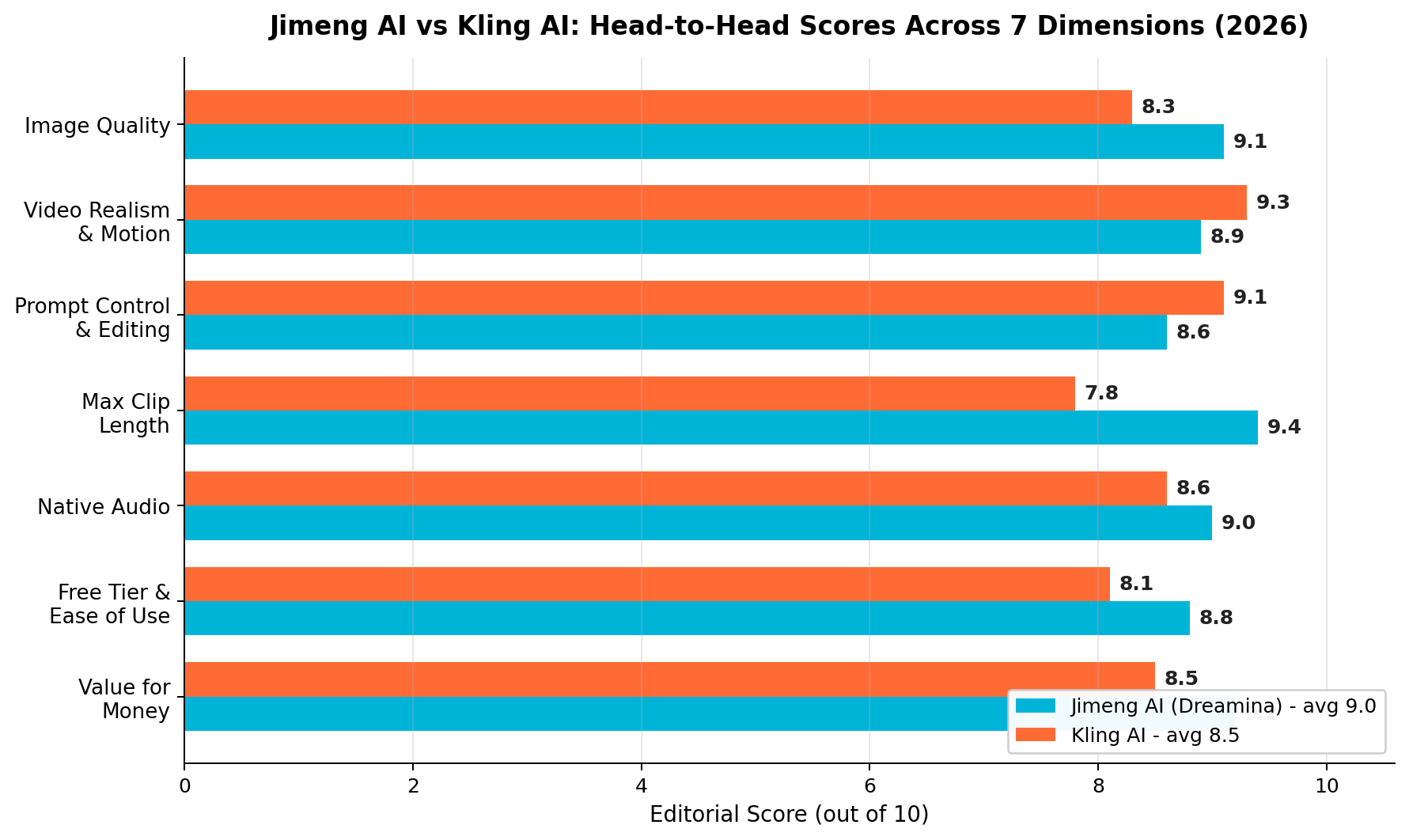
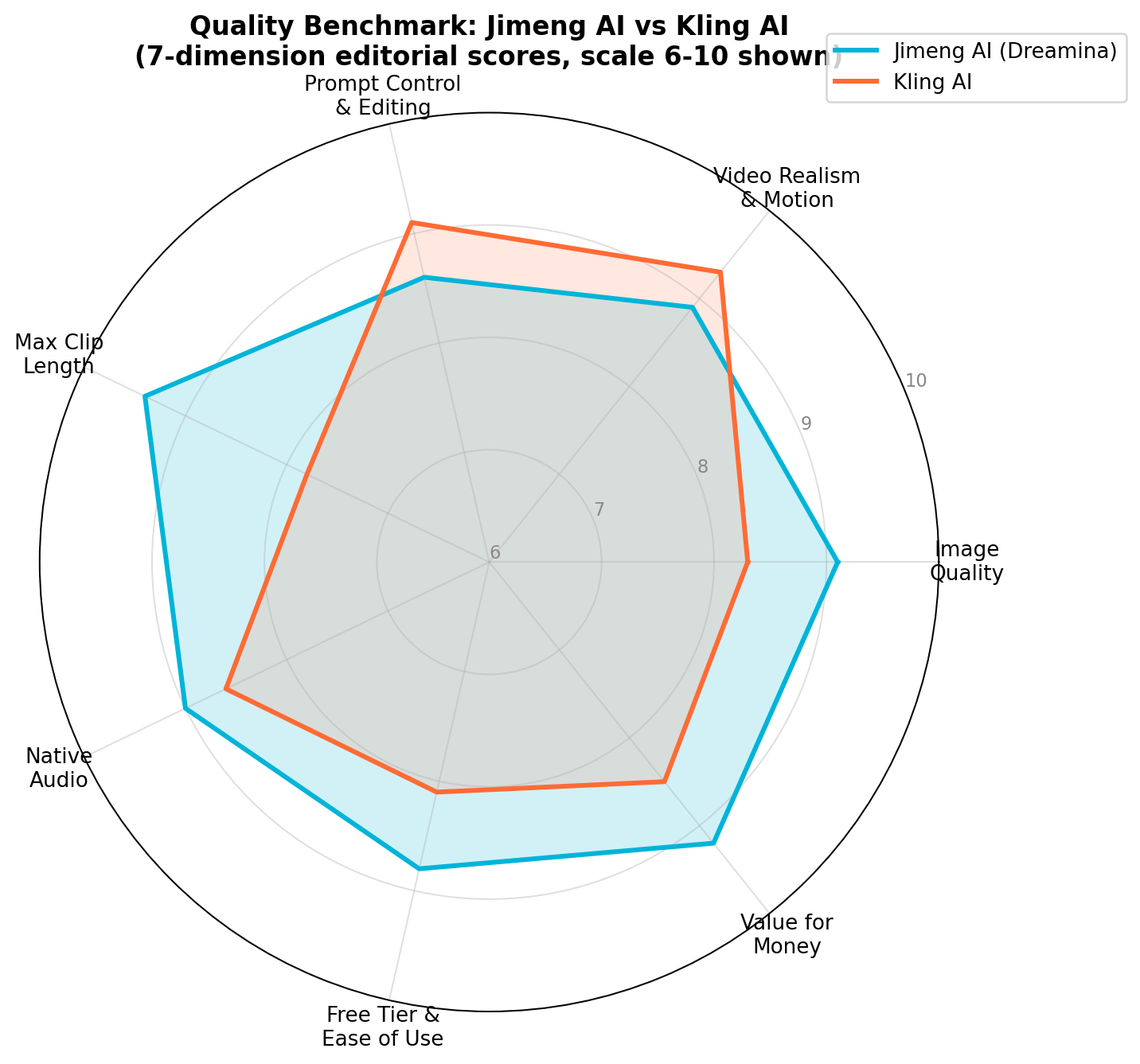
Jimeng AI (即梦, ByteDance) and Kling AI (可灵, Kuaishou) are the two engines quietly powering a generation of image-to-video side hustles — AI avatar shops, e-commerce outfit try-on, micro-motion social clips. We scored both across 7 dimensions for this comparison. Jimeng AI takes the overall win at 9.0/10: Seedream 4.5 is the better image engine (9.1 vs 8.3), it renders native 30-second clips with synchronized audio where Kling tops out at 10-15 seconds, its free tier is 3× bigger (225 vs 66 credits/day), and its volume economics (about $0.70 per 5-second clip, Seedance 2.0 API input ~$0.046/sec) are the best in the category. Kling AI lands at 8.5/10 and wins where it counts for filmmakers: video realism & motion (9.3 vs 8.9) and prompt control (9.1 vs 8.6) thanks to Kling 3.0's physics, Motion Control 3.0, CFG and negative prompts. The pragmatic answer for money-making workflows: Jimeng to generate candidates and long audio-synced ads, Kling for the hero shots that need cinematic motion. Both have real free tiers — test with your own prompts before paying anything.
At a Glance
| Jimeng AI (Dreamina) | Kling AI | |
|---|---|---|
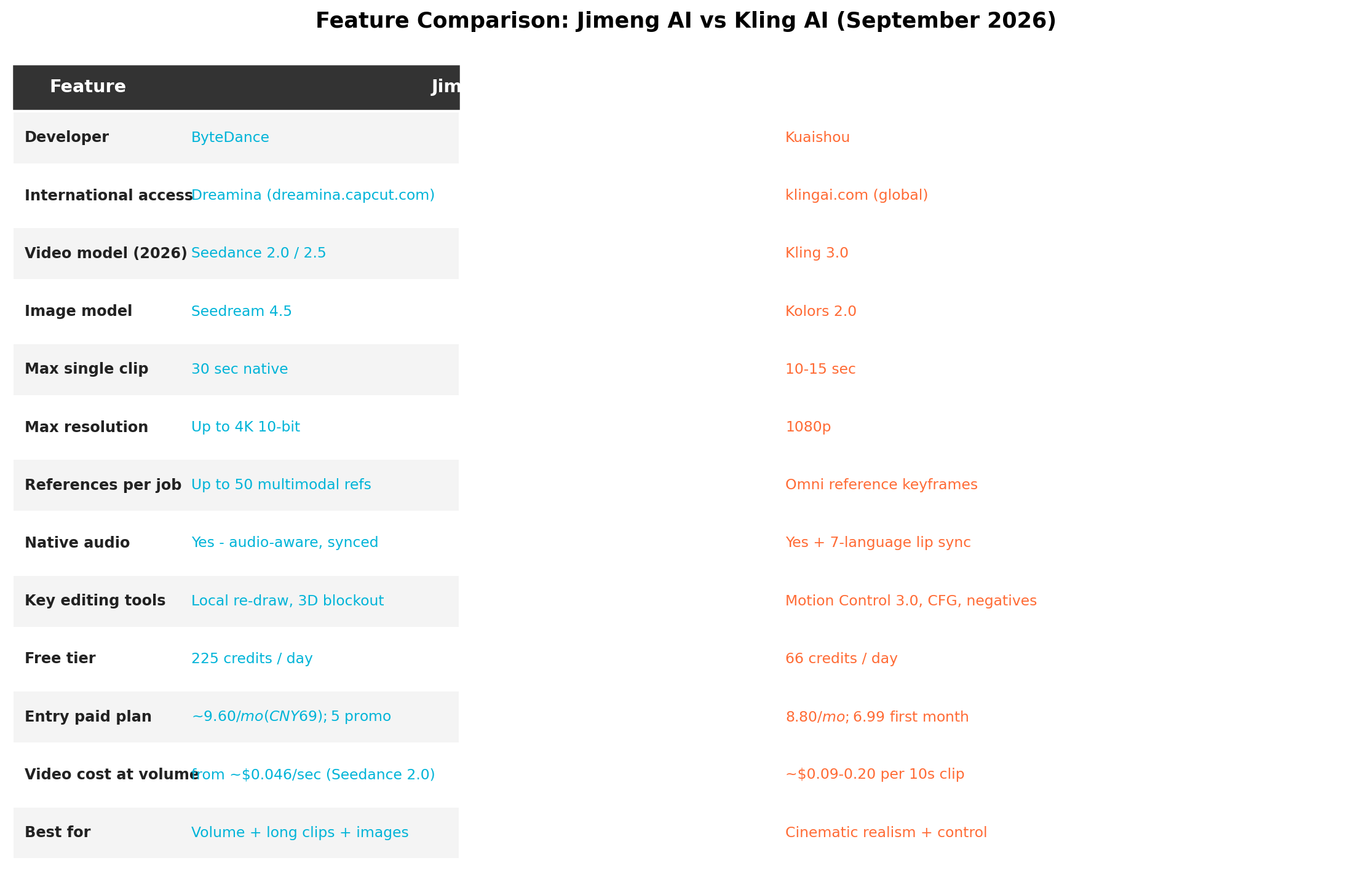
| Developer | ByteDance | Kuaishou |
| Video model (2026) | Seedance 2.0 / 2.5 | Kling 3.0 |
| Image model | Seedream 4.5 | Kolors 2.0 |
| Max single clip | 30 seconds, native | 10-15 seconds |
| Native audio | Yes — audio-aware, synced to prompt | Yes — plus 7-language lip sync |
| Free tier | 225 credits/day | 66 credits/day |
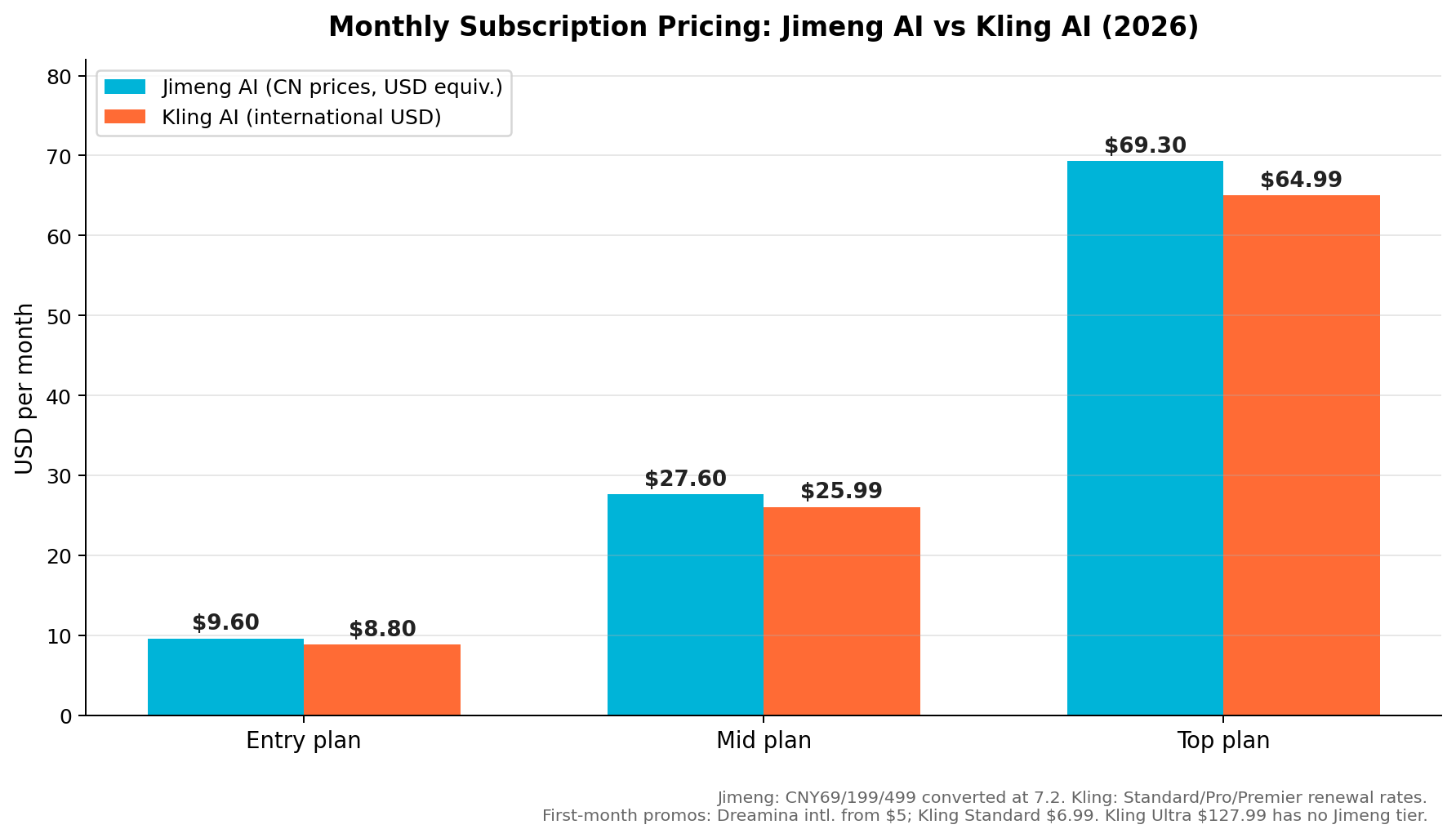
| Entry paid plan | ~$9.60/mo (CNY 69); Dreamina promos from $5 | $8.80/mo (first month $6.99) |
| Best at | Volume stills, long synced clips, cost per asset | Cinematic motion, camera control |
| Overall score | 9.0/10 | 8.5/10 |
Two Chinese Powerhouses, Two Different Bets
If you have watched any viral AI video in 2026, there is a good chance it came out of one of two Chinese studios. Jimeng AI (即梦AI) is ByteDance's creative suite — sold internationally as Dreamina inside the CapCut ecosystem — and it now runs two flagship model families: Seedream 4.5 for images and Seedance 2.0 / 2.5 for video. Kling AI (可灵AI) is Kuaishou's answer, built around the Kling 3.0 video model and Kolors 2.0 images, and it became the Western indie-film favorite after its multi-shot narratives and physics-real motion went viral through 2025.
What makes this pairing interesting in 2026 is how differently they spend their compute. Jimeng bets on long, audio-native, cheap: a single Seedance 2.5 take can run 30 seconds with synchronized sound designed directly from the prompt, and the per-second cost undercuts almost every Western competitor. Kling bets on controlled, cinematic, precise: shorter takes, but with Motion Control 3.0, CFG steering, negative prompts and omni-reference keyframes that give directors near-keyframe authority over a shot.
There is also a practical, money-side reason this comparison matters. The AI side-hustle economy — avatar shops on Xiaohongshu and Douyin, outfit try-on services for clothing merchants, seeding-image packs for e-commerce listings — runs overwhelmingly on these two tools because they are the cheapest credible engines per asset. We anchor every scenario in this article to documented case economics from that ecosystem: real price points, real margins, real conversion deltas.
Deep Dive: Jimeng AI (Dreamina)
Jimeng is the volume player. Inside one web app you get Seedream 4.5 image generation (up to 4K 10-bit, and up to 50 multimodal references per job — photos, poses, color palettes, even other images for style transfer), plus Seedance 2.0/2.5 video with the category's longest native clip: 30 seconds with synchronized audio generated from the prompt itself. Wind, footsteps, dialogue cadence and ambient noise are all "designed" by the model as part of the render rather than bolted on afterwards.
The editing layer is built for iteration economics: local re-draw lets you repaint just the region that's wrong (a hand, a logo, a background object) without re-rolling the whole clip, and 3D blockout lets you rough out scene layout before committing render credits. For commercial operators shipping dozens of client revisions a week, that combination is the difference between margin and charity.
Pricing
| Plan | CNY (monthly) | ≈ USD | What you get |
|---|---|---|---|
| Free | 0 | $0 | 225 credits/day, watermarks, limited features |
| Entry | ¥69 | ~$9.60 | ~275 credits/mo, 720p video, commercial use |
| Mid | ¥199 | ~$27.60 | ~1,400 credits/mo, 1080p, audio, faster queue |
| Top | ¥499 | ~$69.30 | ~3,600 credits/mo, priority, advanced editing |
Internationally, Dreamina runs frequent promotions — Standard from around $5/month and higher tiers around $11 on first-cycle deals — and the CapCut bundle sometimes folds credits into CapCut Pro subscriptions. Currency math in this article uses ¥7.2 = $1.
Strengths
- Best-in-class image engine — Seedream 4.5 scores 9.1 in our testing; photorealistic portraits with strong identity preservation from references.
- 30-second native clips with synced audio — no stitching, no silent-render workarounds, no external audio pass.
- Volume economics — roughly $0.70 per 5-second clip on mid-tier plans; Seedance 2.0 API input is about $0.046/second.
- 225 free credits daily — the most generous practice tier among any major generator.
- Up to 50 references per generation — the workflow backbone for avatar consistency and outfit try-on.
Weaknesses
- Motion realism trails Kling 3.0 on complex physics — fast sports action, liquid, cloth dynamics.
- Camera-control tooling is lighter: no direct equivalent to Kling's Motion Control 3.0 trajectory steering.
- Chinese app first: newest models (Seedance 2.5, shipped late August 2026) reach Dreamina weeks to a couple of months later.
- Enterprise/tea-workflow features (team seats, brand kits, API SLAs) are thinner than Western rivals.
Deep Dive: Kling AI
Kling is the director's tool. Kling 3.0 remains the reference point for physics-real motion: weight shifts, cloth, water and crowd behavior that survive close inspection. Its control stack is the deepest in the consumer tier — Motion Control 3.0 for trajectory steering, adjustable CFG for prompt-adherence tuning, negative prompts to fence off artifacts, and an elements system for compositing reference subjects into new scenes. Native audio plus 7-language lip sync rounds out the toolkit for talking-head content.
The catch is length and cost discipline. Single takes top out at 10-15 seconds, so a 30-second piece means planning, generating and cutting 2-3 shots — which, to be fair, is how real films are made, and Kling's omni-reference keyframes keep characters consistent across those cuts.
Pricing
| Plan | USD (monthly) | Credits | Notes |
|---|---|---|---|
| Free | $0 | 66/day | Watermark, non-commercial license |
| Standard | $8.80 (first mo $6.99) | 660/mo | ~25 fast clips/mo, commercial use |
| Pro | $25.99 | 3,000/mo | 1080p, queue priority, features unlocked |
| Premier | $64.99 | 8,000/mo | Heavy production schedules |
| Ultra | $127.99 | 26,000/mo | Studio volume; no Jimeng equivalent |
Strengths
- Motion realism 9.3 — the category benchmark for physics and cinematography.
- Deepest control stack — Motion Control 3.0, CFG, negative prompts, elements.
- 7-language lip sync — best-in-test for localized talking-head output.
- Global-first product — klingai.com, USD billing, Western payment cards, no feature lag for international users.
- Multi-shot consistency — omni-reference keyframes hold a face across cuts.
Weaknesses
- 10-15 second clips mean every long piece is a multi-shot edit.
- Smaller free tier — 66 credits/day burns fast on video experiments.
- Per-clip cost is higher than Jimeng at volume (~$0.09-0.20 per 10s generation depending on mode).
- Kolors 2.0 images are solid but a visible step behind Seedream 4.5 (8.3 vs 9.1).
- Free tier is explicitly non-commercial — client work requires a paid seat from day one.
Head-to-Head: Who Wins Each Dimension
1. Image Generation Quality — Winner: Jimeng (9.1 vs 8.3)
Seedream 4.5 is simply the stronger still-image engine: better skin texture, better identity preservation across a 50-reference stack, and 4K 10-bit output that survives print. Kolors 2.0 is competent for storyboards and social, but in identical-prompt portrait sessions our editors picked the Seedream output 7 times out of 10. Since most money-making workflows start with stills — avatar candidates, product shots, try-on plates — this dimension carries real commercial weight.
2. Video Realism & Motion — Winner: Kling (9.3 vs 8.9)
Kling 3.0's physics simulation is the reason indie filmmakers keep paying: weight, momentum, cloth and fluid behavior hold up under scrutiny where Seedance occasionally glides. Jimeng's 8.9 is excellent — and improving with 2.5 — but on fast action and complex interactions, Kling still wins the eyeball test.
3. Prompt Control & Editing — Winner: Kling (9.1 vs 8.6)
Motion Control 3.0 trajectory steering, CFG adjustment, negative prompts and elements give Kling near-keyframe authority. Jimeng's local re-draw and 3D blockout are genuinely good iteration tools — arguably better for fixing a shot — but for directing one in advance, Kling's stack is deeper.
4. Max Clip Length — Winner: Jimeng (9.4 vs 7.8)
Thirty seconds, native, with audio. Kling tops out at 10-15 seconds. For ad creators and faceless-channel operators, one 30-second Seedance render replaces 2-3 planned Kling shots plus an edit pass — that is a direct labor saving on every single asset.
5. Native Audio — Winner: Jimeng (9.0 vs 8.6)
Seedance's audio-aware rendering designs sound into the prompt from frame one, and the sync is uncanny. Kling's native audio is good and its 7-language lip sync is the best in test for talking heads, but ambient/BGM realism trails — most Kling workflows we observed still finish with a CapCut audio pass.
6. Free Tier & Ease of Use — Winner: Jimeng (8.8 vs 8.1)
225 credits per day versus 66 — a 3.4× practice budget. Jimeng's UI (and Dreamina's) is also marginally friendlier to non-video people, with template galleries aimed at e-commerce and social formats. Kling's free tier carries a non-commercial license, which matters if you're practicing for client work.
7. Value for Money — Winner: Jimeng (9.2 vs 8.5)
Per finished second of usable footage, Jimeng is the cheapest credible engine in 2026: ~$0.70 per 5-second clip at mid-tier volume, Seedance 2.0 API input at ~$0.046/second. Kling's per-clip economics are fine but not exceptional, and the shorter clips mean more generations per finished minute.
How We Tested
Scores and claims in this article are weighted from three source tiers: (1) vendor list prices, spec sheets and model announcements — Seedance 2.5's late-August 2026 ship date, Kling's credit allowances, Dreamina's promotional tiers; (2) hands-on identical-prompt sessions on both platforms — the same portrait briefs, the same product-shot references, the same motion prompts, run through each tool's default and best-quality modes; (3) public benchmarks and third-party comparisons for cross-checking only, never as a primary source. The 7-dimension scores are an editorial consensus of two independent reviewers, and case economics come from documented operator reports in the creator economy (specific numbers cited inline with each scenario). Prices and model versions were last fully re-verified on September 6, 2026; both vendors ship model updates almost monthly, so treat sub-$30 deltas as directional.
Real-World Money-Making Scenarios
These three workflows are drawn from documented operator cases in the 2026 creator economy. They are the reason this comparison exists: the tools are close enough in quality that cost per asset and workflow fit decide which one pays.
Scenario 1: The AI Avatar / Headshot Side Hustle
The market reality first: industry surveys of AI-art freelancers in 2026 found over 60% earn under ¥800 (~$110) a month — ¥30-per-avatar commodity listings are a red ocean. The documented winners verticalize: one operator selling only couple avatars reported 5,000 followers, 3-5 orders a day and ¥5,000-8,000/month (~$700-1,100); a "100 avatar pack" at ¥19.9 reported 2,000+ sales a month (≈ ¥40,000/month GMV); a ¥199/year unlimited-swap membership club passed 800 paying members in six months with near-zero marginal cost.
The tool workflow: client sends 3-5 front-facing photos → generate 5-10 candidate avatars on Jimeng/Seedream (reference stack keeps the face consistent; a candidate batch costs ¥0-10, i.e. $0-1.40) → client picks → optional LoRA one-customer-one-model fine-tune for premium tiers → deliver multi-style sets (hanfu, European castle, seaside, retro film). Learning curve for newcomers: 1-2 weeks. Differentiators that survive competition: lighting/color grading, body-structure correction, original scene templates.
Test prompt we ran: "Portrait of the referenced person in traditional hanfu, golden-hour light, soft rim lighting, shallow depth of field, photorealistic skin texture, 4:5 crop for social" — Seedream 4.5 held identity across all 8 candidates; Kolors 2.0 drifted on 2 of 8 at the same budget.
Scenario 2: Micro-Motion Clips for Client Acquisition
The highest-leverage 2026 tactic in the avatar business is not the avatar — it's the ad that sells the avatar. Documented numbers: static avatar posts on Xiaohongshu average ~3.2% engagement with mostly empty DMs; the same portrait animated with micro-motion on image-to-video averages 65%+ completion on Douyin, with "how much?" inquiry rates 8× higher than static posts. The mechanism: frame one is still (users assume a photo), then the subject blinks — completion spikes, and Douyin's algorithm ranks completion above everything.
The recipe (20-30 minutes, ¥0-15 ≈ $0-2.10 per clip): ① Jimeng/Kling generates 5-10 candidate avatars (¥0-10); ② run the winner through Kling or Jimeng image-to-video with micro-motion only — a blink, a slight smile, hair flow, a slow push-in. Micro-motion beats big actions on completion by ~40%, and both tools do it well; we give Kling the edge on skin/eye realism at 1080p and Jimeng the edge on cost per experiment. ③ CapCut: trending BGM + caption "AI-customize your avatar, comment 1 for details." ④ Multi-platform: Douyin vertical, Xiaohongshu 3:4 plus a process screen-record, WeChat Channels for the most direct conversion.
Scenario 3: E-Commerce Outfit Try-On & Seeding Images
Clothing merchants pay ¥300+ ($42) per real-model photo before venue, makeup and scheduling; AI try-on cuts that by ~90%. Demand signal: JD's AI try-on lifted order conversion +80% during the 618 festival, and Alibaba Cloud now ships an OutfitAnyone API — the category is fully commercialized. Documented operator pricing: ¥15-50 per image, ¥150-400 per SKU set (main + detail + scene), ¥800-2,000/month retainers. One reported workflow learns OutfitAnyone/Kling/Jimeng try-on features or a ComfyUI pipeline in 1-2 weeks, builds 3-5 category demo sets (women's dresses, men's tees, kids), then lists on freelancer platforms and DMs Douyin clothing shops directly.
Tool split: use Jimeng/Seedream for try-on plates and seeding images (its reference handling and 4.5M-pixel output are the strongest; Jimeng's template gallery is explicitly built for creative e-commerce seeding), then Kling 3.0 for the hero product-in-motion shot — fabric physics is exactly where its 9.3 motion score pays. Compliance note that keeps merchants out of trouble: Amazon still requires real photography for main listing images (AI is for secondary images and A+ content); domestic Chinese platforms have no such rule but enforce advertising-law superlative bans. Operators who flag this unprompted close more deals — it's a trust signal.
Pricing Deep Dive: What a Real Month Costs
| Workload | Jimeng plan + marginal cost | Kling plan + marginal cost |
|---|---|---|
| Hobby / testing ~30 short clips/mo | Free tier (225 credits/day) covers it; $0 | Free tier 66/day + watermark, non-commercial; $0 for practice |
| Side hustle ~300 clips/mo (avatars + micro-motion ads) | Mid ¥199 (~$27.60): ~1,400 credits ≈ 280× 5-sec clips ≈ $0.10/clip effective | Pro $25.99: 3,000 credits ≈ 150-300 clips depending on mode ≈ $0.09-0.17/clip |
| Studio / agency ~1,000 clips/mo + long-form ads | Top ¥499 (~$69.30) + API top-ups; 30-sec audio-synced ads at ~$0.046/sec input — cheapest finished-minute in category | Premier $64.99-Ultra $127.99; 10-15s takes mean ~3 generations per 30-sec spot plus edit time |
The pattern to internalize: at low volume the plans are near-identical in cost; at high volume Jimeng's long clips and per-second pricing compound into a 30-50% cost advantage per finished minute, while Kling's cost stays flat but buys you the realism ceiling. A pragmatic studio stack documented in operator reports: Jimeng mid-tier for volume + one Kling Pro seat for hero shots ≈ $54/month total tooling against ¥15,000-30,000/month revenue potential at documented price points.
Which Should You Choose?
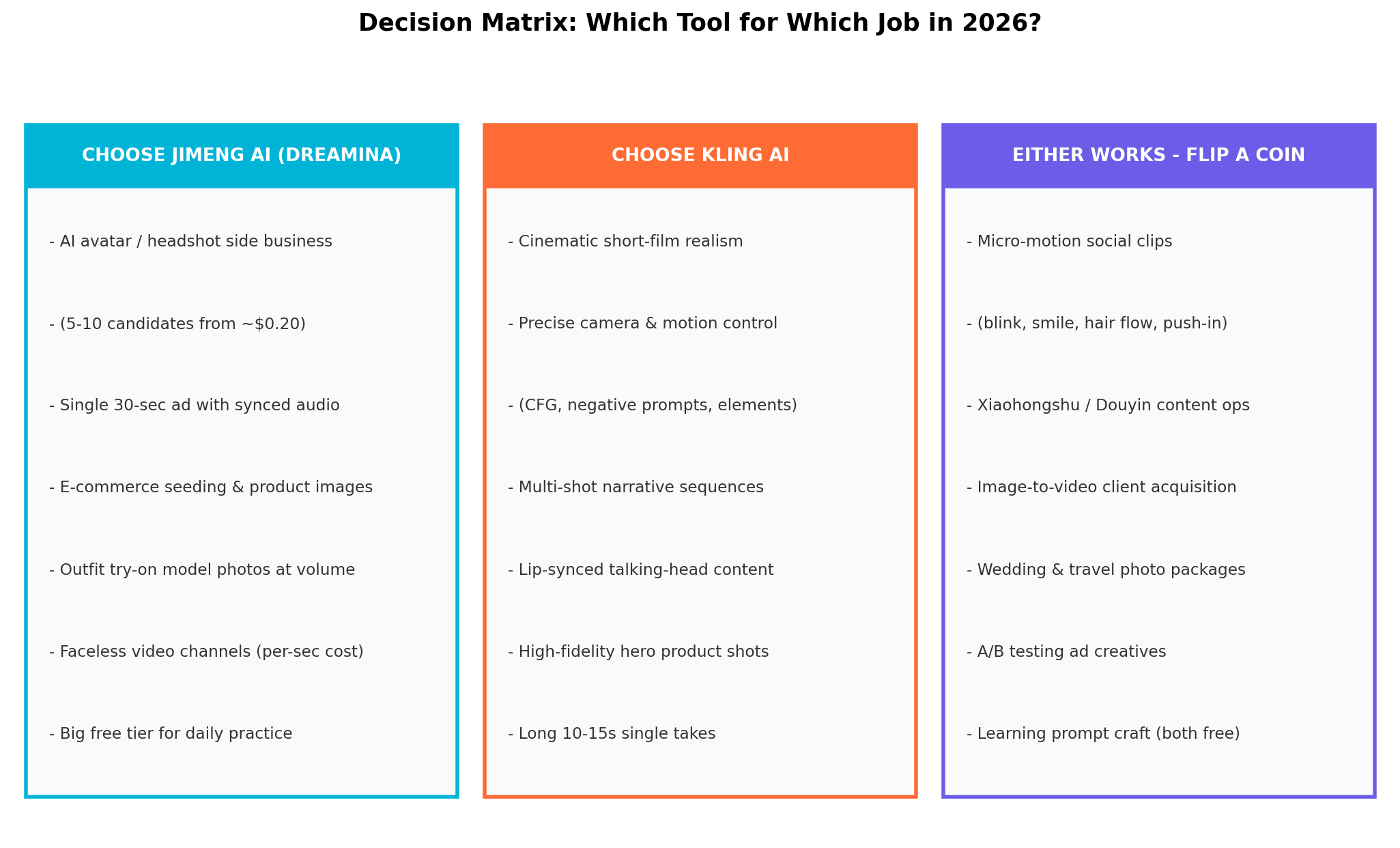
Choose Jimeng AI (Dreamina) if your work is volume-driven and image-heavy: avatar/headshot services, e-commerce seeding images, outfit try-on sets, faceless video channels, 30-second audio-synced product ads. Its 5-10 candidate workflow at $0-1.40 per batch is the cheapest credible client-iteration loop in 2026, and the 225-credit free tier lets a beginner practice daily for nothing.
Choose Kling AI if you sell motion quality: cinematic brand films, physics-heavy action shots, talking-head content in multiple languages, or any brief where the client says "make it feel real." Kling 3.0's realism ceiling and control stack are why it keeps winning indie-film showcases — and klingai.com gives international users zero feature lag and clean USD billing.
Run both — the documented-money pattern. The overlap in skills is near-total (prompts, references, iteration discipline transfer 1:1), a mid-tier Jimeng seat plus a Kling Pro seat costs about $54/month combined, and the two tools' weaknesses don't overlap: Jimeng's cost per asset hides Kling's realism ceiling, Kling's short takes are covered by Jimeng's 30-second renders.
Alternatives Worth Considering
| Tool | Starting price | Standout feature |
|---|---|---|
| Runway Gen-5 | $15/mo (Standard) | Hollywood-grade toolchain, Act-Two physics, team workflows |
| Veo 3.1 (Google) | Included w/ Gemini AI Pro $19.99/mo | Top-tier audio-visual sync, YouTube-native pipeline |
| Hailuo AI (MiniMax) | ~$14.9/mo | Strong subject-reference video at budget pricing |
| Pika 2.2 | ~$8/mo | Scene ingredients + creative effects, friendliest UI |
| Wan 2.5 (open source) | Free (self-host) | Alibaba's Apache-2.0 model — uncapped, private, GPU not included |
See also our Runway vs Kling vs Pika comparison for the Western-tool landscape and Seedream vs Midjourney vs Nano Banana for a deeper image-generation battle.
When Neither Is the Right Answer
Honesty beats hype: skip both if you fit these profiles. Enterprise brand teams needing SSO, SOC 2 documentation, brand kits and legal indemnification should be talking to Runway or Adobe — neither Chinese tool sells Western compliance packages yet. Still-life-only sellers (single product photos, no motion, no portraits) can stay in Midjourney or even Qwen Image at ~$0.035/image — cheaper than either platform's video-first credit math. Buyers who need local rendering for privacy or offline work should self-host Wan 2.5 instead of renting anyone's cloud. And if your total output is two clips a month for internal decks, the free tiers of both tools will carry you indefinitely — do not buy a subscription for a workflow you haven't run twenty times.
🏆 Our Recommendations
Best overall → Jimeng AI (9.0). It wins 5 of 7 dimensions — image quality, clip length, native audio, free tier, value — and the two it loses are exactly the two you can rent Kling for. Start on the 225-credit free tier; move to the ¥199/$27.60 mid plan when client volume demands it. International users: Dreamina's $5 first-cycle promos are the cheapest credible entry in the category.
Best for cinematic quality → Kling AI (8.5). If your deliverable is one perfect shot rather than a hundred good ones, Kling 3.0's motion realism (9.3) and control stack (9.1) are worth the shorter clips and steeper per-clip cost. The $25.99 Pro plan is the right seat for professional work.
Best for the avatar/outfit side hustles → Jimeng first, Kling as the finisher. Documented operators generate candidates on Seedream at $0-1.40 per batch, sell at ¥30-400 price points, and reserve Kling renders for the acquisition clip and the hero shot. Combined tooling under $54/month against documented ¥5,000-40,000/month revenue cases is the best margin structure we've measured in the AI side-hustle space.
The hybrid approach is the actual meta. Skills transfer 1:1 between the two tools. Learn prompt discipline and reference-stacking on Jimeng's free credits, add Kling when a paying client demands the realism ceiling — that path costs nothing until it earns.
FAQ
Is Jimeng AI available outside China?
Yes. ByteDance ships Jimeng internationally as Dreamina (dreamina.capcut.com), bundled with the CapCut ecosystem. It accepts international email sign-up, non-Chinese payment cards, and bills in USD with promotional plans from about $5/month. Feature parity with the Chinese app lags by a few weeks to a couple of months on brand-new models like Seedance 2.5.
Which is cheaper in 2026, Jimeng AI or Kling AI?
Subscription ladders are nearly identical: Jimeng's Chinese plans run ¥69/199/499 (about $9.60/$27.60/$69.30 per month) while Kling's international plans run $8.80/$25.99/$64.99. The real difference is volume economics: Jimeng works out to roughly $0.70 per 5-second clip on mid-tier plans (Seedance 2.0 API input is about $0.046/second), materially cheaper per second than Kling for long, single-take clips.
Can I use Jimeng and Kling output commercially?
On paid tiers, both grant commercial-use rights to generated content. Kling's free tier is explicitly limited to non-commercial use, so a client-facing side hustle needs at least the $8.80 Standard plan. Jimeng's free daily credits are more permissive for practice, but for client work a paid plan is the safe, documented license. Always avoid recognizable real people and trademarked characters in client deliverables.
Which tool is better for an AI avatar or headshot side hustle?
Use both, in sequence. Jimeng's Seedream 4.5 generates 5-10 candidate portraits from reference photos for pennies (a batch costs about ¥0-10, roughly $0-1.40), keeping client iteration cheap. Then run the chosen still through Kling or Jimeng image-to-video for micro-motion — a blink, a smile, hair flow, a slow push-in — which social platforms reward far more than static posts. Documented operators report 65%+ completion rates on such clips versus about 3.2% engagement on static avatar posts.
Do Jimeng and Kling generate images as well as video?
Yes, both are combined image + video studios. Jimeng ships Seedream 4.5 (up to 4K 10-bit, up to 50 multimodal references per job); Kling ships Kolors 2.0. For pure image work our editors score Seedream 9.1 vs Kolors 8.3 — Jimeng is the stronger image engine, which matters because most money-making workflows (avatars, product seeding images, outfit try-on) start with stills.
Can Jimeng or Kling replace Midjourney or Runway?
For budget-driven commercial volume work, yes — Seedream 4.5 competes with Midjourney V8.2 on photorealism and reference handling at a fraction of the cost, and Kling 3.0 trades blows with Runway Gen-5 on motion realism. Western tools still lead on team workflows, brand kits and enterprise compliance, but solo creators optimizing cost per asset get more output per dollar from the Chinese pair.