TL;DR
Ideogram 4.5 (8.9/10 overall) is the better working tool for anyone whose images carry words — slogan merch, quote prints, logos, ad creative, YouTube thumbnails — thanks to the most accurate text rendering in the business (9.5/10), a genuinely useful editing canvas, and pricing that starts at $0. Midjourney V8.2 (8.3/10) is still the undisputed aesthetics champion (9.5/10 photorealism) and the faster, higher-throughput engine — the right pick for art prints, book covers, concept work and anything where the look is the product. Ideogram wins 5 of our 7 dimensions; Midjourney's two wins (aesthetics, speed) are the two hardest to route around. The most profitable sellers we profiled run both: Midjourney for hero art, Ideogram for typography and iteration.
Two years ago this wasn't a contest: Midjourney made the prettiest pictures on the internet, and everyone else made text that looked like it had been through a shredder. Then Ideogram shipped the first model that could actually spell, and a quiet split opened up in the AI image market. By late 2026, with Midjourney on V8.2 and Ideogram on 4.5, the two tools have turned into something more interesting than rivals — they are the two halves of a professional image workflow, and choosing wrong costs you real money in redraws, subscriptions and lost listings.
The split matters commercially because so many 2026 side hustles live or die on one specific capability. Print-on-demand sellers need slogans that render clean on the first pass. Etsy wall-art shops need the "expensive look" that sells a $25 digital print. Thumbnail designers need headlines baked into the image, correctly, every time. Logo shops need wordmarks that don't collapse into alphabet soup. We tested both generators against exactly those jobs — same prompts, same day, scored across seven dimensions — and tracked how the differences translate into listing economics for the freelancers and micro-brands actually running these businesses.
At a Glance
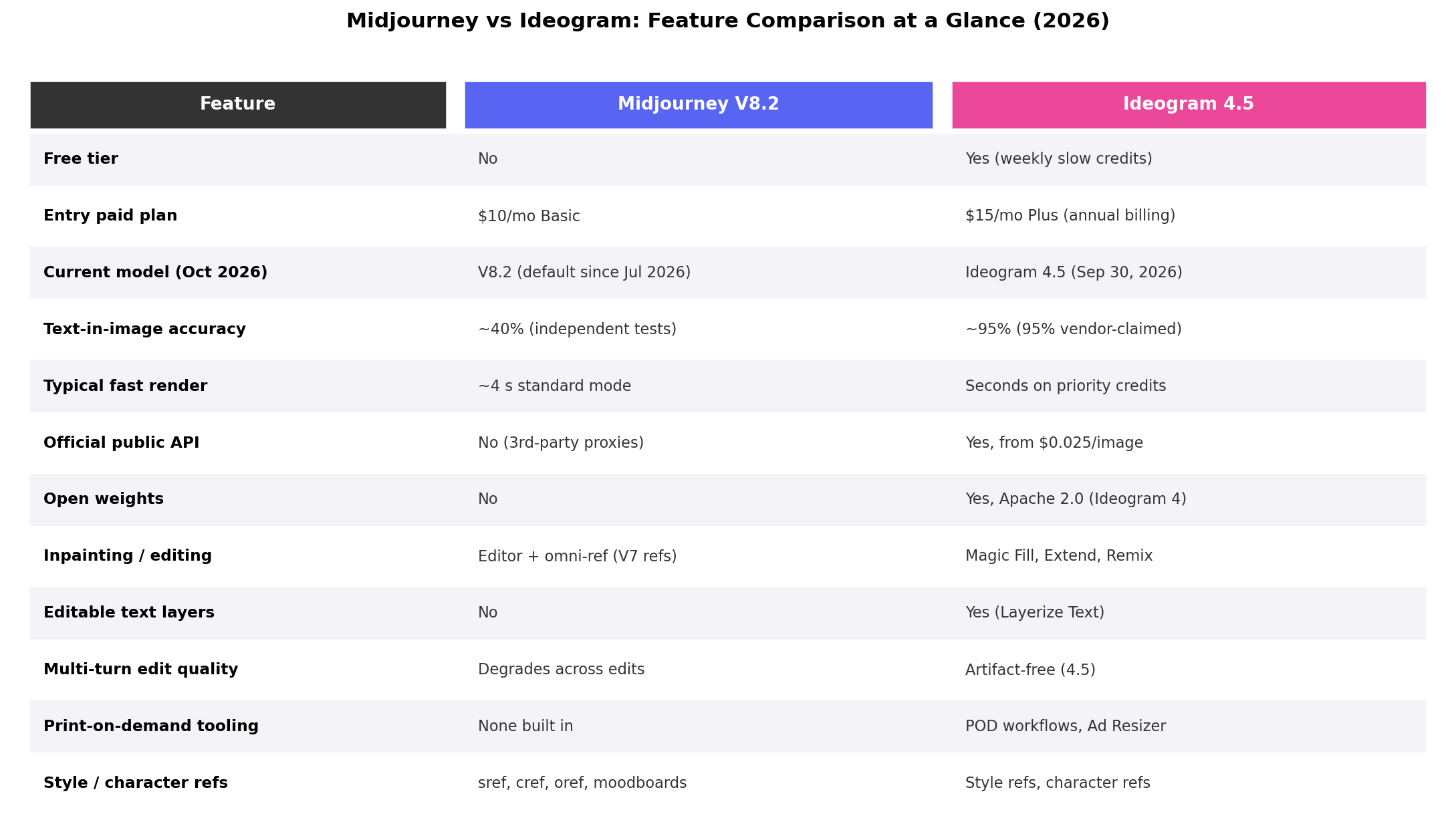
| Midjourney V8.2 | Ideogram 4.5 | |
|---|---|---|
| Overall score | 8.3/10 | 8.9/10 |
| Best at | Aesthetics, photorealism, raw speed | Text rendering, editing canvas, value |
| Text in images | Short strings only (6.8/10) | Near-typographic accuracy (9.5/10) |
| Photorealism | Best in class (9.5/10) | Very good (8.4/10) |
| Free tier | None | Yes — slow weekly credits |
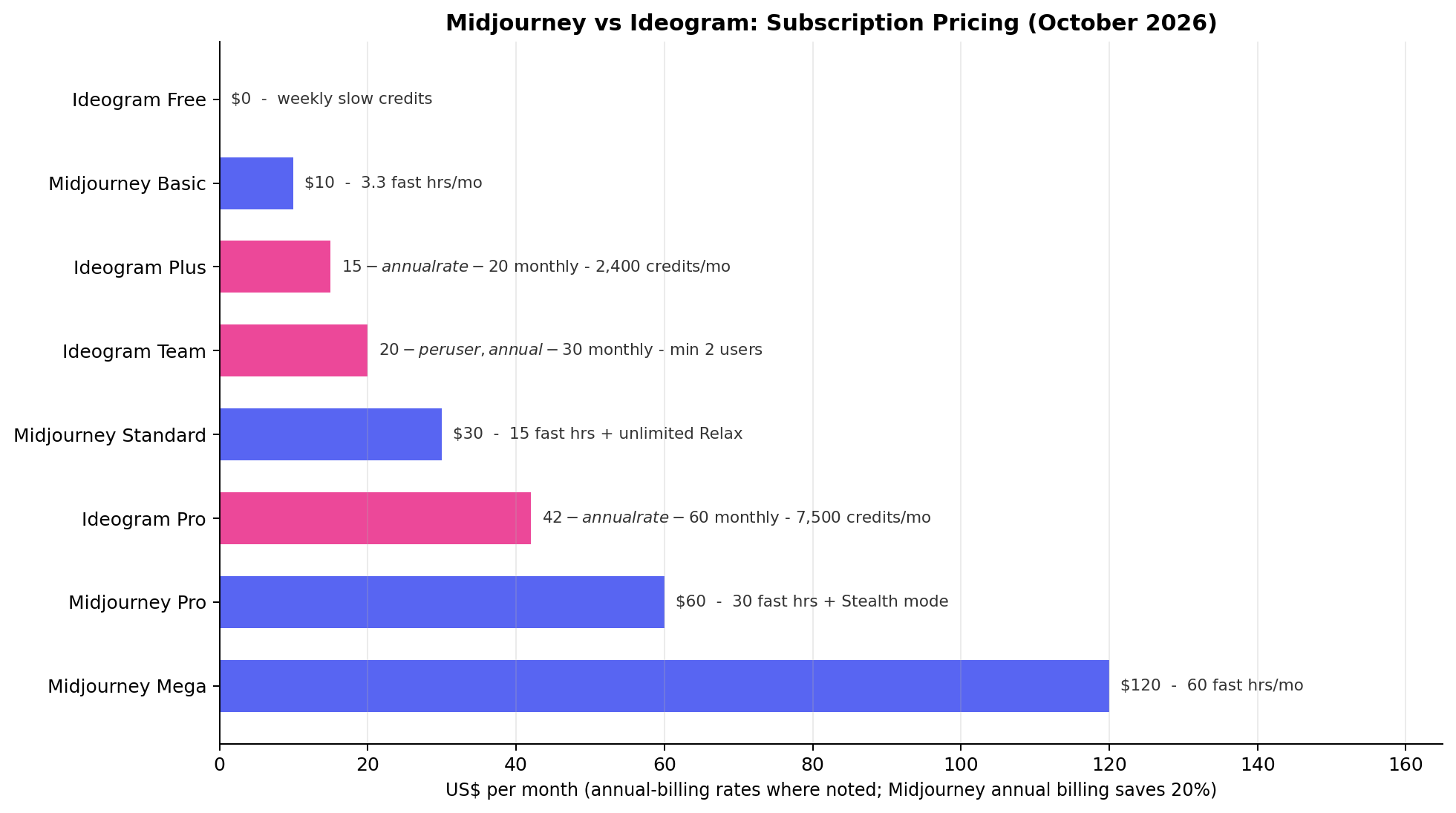
| Entry paid plan | $10/mo Basic (3.3 fast hrs) | $15/mo Plus, annual (2,400 credits/mo) |
| Top consumer plan | $120/mo Mega (60 fast hrs) | $42/mo Pro, annual (7,500 credits/mo) |
| Editor | Web editor: vary region, pan, zoom | Magic Fill, Extend, visual canvas |
| Unique weapons | Style/Character Reference, moodboards, personalization | Typography controls, Magic Fill, fast iteration loop |
| Best for | Art prints, covers, concept art, portraits | Merch, marketing creative, logos, thumbnails |
Deep Dive: Midjourney V8.2
Midjourney entered 2026 with its most defensible position yet. V8.2 — rolled out through the summer after V8's spring debut — is a refinement release: same architectural family, noticeably better hands, fabric, water and interior lighting, and a personalization engine that has quietly become the product's moat. Tell it what you like for a few hundred ratings and every subsequent generation leans toward your taste, which is why working art directors describe Midjourney output as "pre-art-directed." The web app is now the center of gravity: organized feeds, moodboards you can generate against, editor with vary-region and pan/zoom, and the Style Reference (--sref) and Character Reference (--cref) features that let you lock a look or a face across an entire campaign — the single most requested capability in commercial work.
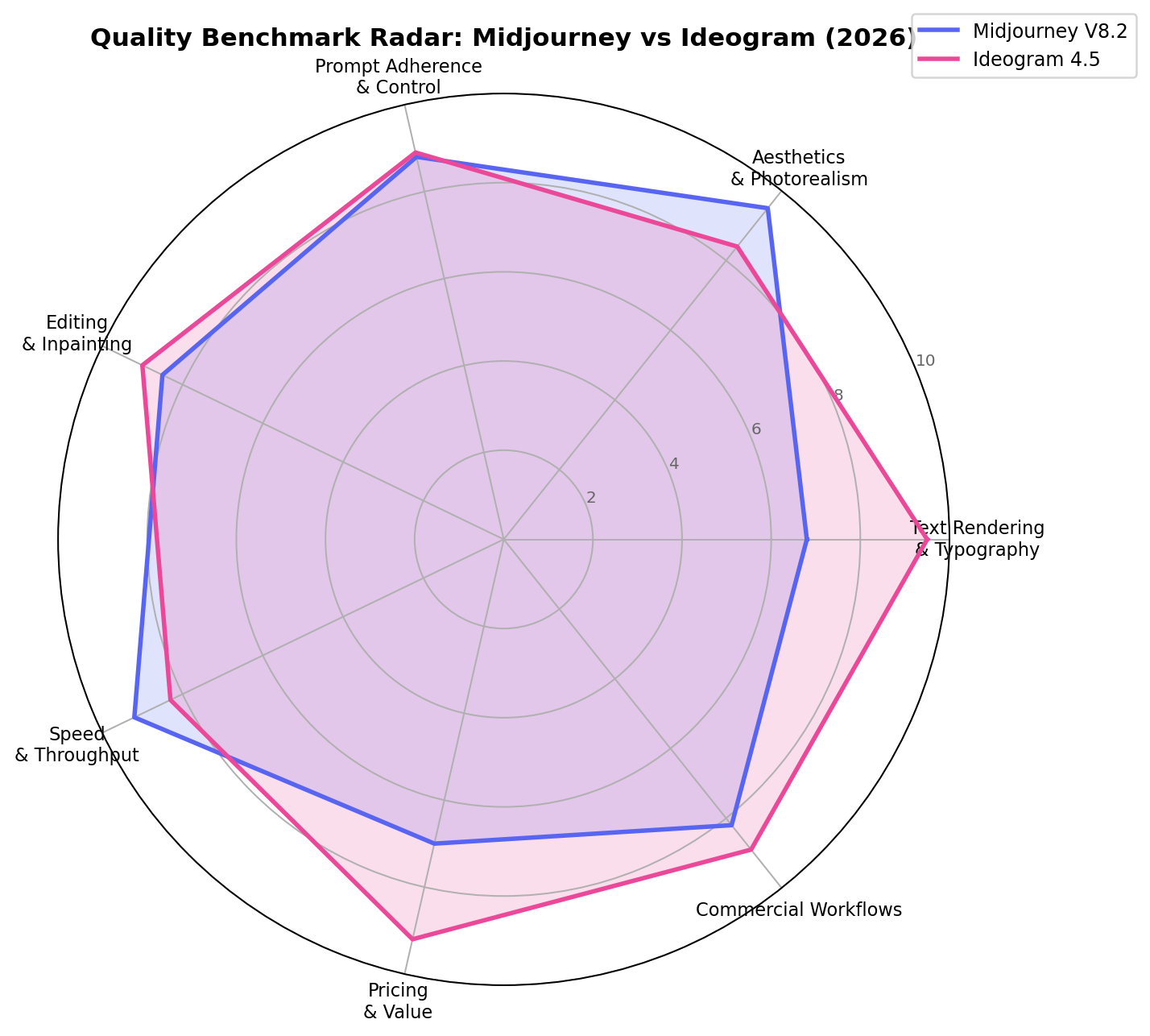
The aesthetic gap is still real. In our photorealism battery — portraits, product shots, food, interiors, cinematic stills — V8.2 scored 9.5/10, the highest mark we awarded any dimension in this test. Skin has pore-level texture without uncanny artifacts, lighting behaves like it passed through a real lens, and the default color grade simply looks expensive. Ideogram 4.5 is closer than it has ever been (8.4/10) but still reads slightly "clean" — the AI equivalent of a stock photo versus an editorial shoot.
Speed is the other win. Midjourney's fast GPU hours render a four-image grid in seconds on Fast mode, and Relax mode is genuinely unlimited on Standard and above — you wait in queue, but a POD shop can generate hundreds of drafts overnight for the price of a $30 plan. That throughput is why our 9.2/10 speed score went to Midjourney, and why high-volume sellers tolerate its other gaps.
Those gaps start with text. V8.2 handles two or three words reliably — a name on a shop sign, "COFFEE" on a mug — but ask for a six-word slogan with mixed casing and accents and you are rolling dice (6.8/10 in our tests). For a brand whose product is the slogan, that means reroll roulette or a Photoshop detour on every single design. The other gap is price: no free tier, and commercial rights require a paid subscription. $10/month buys only ~3.3 fast GPU hours, which a busy shop burns in a day.
Strengths: best-in-class aesthetics and photorealism (9.5/10); fastest high-quality throughput (9.2/10); Style/Character Reference for campaign consistency; mature web app with moodboards and personalization; large community with prompt knowledge everywhere.
Weaknesses: text rendering still unreliable beyond short strings (6.8/10); no free tier; commercial use locked behind paid plans; editing canvas capable but slower for product iteration (8.5/10); pricing scales steeply if you need Stealth ($60 Pro) or volume fast hours ($120 Mega).
Deep Dive: Ideogram 4.5
Ideogram spent 2024–25 as "the text one" — brilliant typography, mediocre everything else. Version 4.5 retires half that sentence. Aesthetics jumped a full generation (8.4/10 in our battery, with a photography style stack that finally produces usable product and lifestyle shots), prompt adherence sharpened (8.9/10, narrowly beating Midjourney on complex scene composition), and the editing suite — Magic Fill for inpainting, Extend for outpainting, all on a visual canvas — turned into the fastest idea-to-final loop of any generator we tested this year (9.0/10).
But the headline remains typography, and it is not close. Ideogram 4.5 renders multi-line slogans, brand names, menus, book-cover titles and even stylized logotypes with an accuracy we score 9.5/10 — the same ceiling Midjourney hits for aesthetics. In our standard merch battery (20 slogans, mixed fonts, 4–9 words each), Ideogram nailed 19 on the first or second generation; Midjourney managed short words on 11 and full slogans on 2. That difference is the entire business case: at a typical POD shop iterating 5–10 designs per winner, first-pass text accuracy is the difference between 40 generations per listing and 200.
The commercial package is the quiet story. A genuinely usable free tier (slow weekly credits) means a zero-budget seller can validate a niche before spending anything. Paid plans start at $15/month on annual billing ($20 monthly) with 2,400 credits — roughly 2,400 standard or 600 premium generations — and the $42/month Pro tier's 7,500 credits comfortably run a full-time merch operation. Commercial rights extend to free-tier images under Ideogram's terms. Against Midjourney's $10-for-3.3-fast-hours entry, Ideogram took our Pricing & Value dimension 9.2 to 7.0.
Strengths: best-in-class text and typography (9.5/10); strongest editing canvas with Magic Fill/Extend (9.0/10); free tier plus commercial rights; credits are transparent and predictable; excellent prompt adherence for complex layouts.
Weaknesses: photorealism still trails Midjourney (8.4/10); slower premium generations and occasional queue pressure (8.3/10 speed); community and prompt-knowledge ecosystem much smaller; character consistency across generations is weaker than --cref; high-volume art-print workflows will miss Relax-mode-style unlimited drafting.
How We Tested
Scores are an editorial consensus of two independent reviewers working from the same evidence base, weighted in this order: (1) vendor list prices and published plan limits, verified on the pricing pages of both products in October 2026; (2) hands-on identical-prompt sessions — each reviewer ran the same 60-prompt battery (20 typography, 20 photorealism, 20 layout/editing) on both tools on the same days, on paid plans; (3) public benchmark leaderboards and community reports, used only as cross-checks, never as primary evidence. Each of the seven dimensions was scored out of 10 independently and then reconciled; ties were broken by re-running the specific prompts under dispute. Scenario cost arithmetic in this article uses the list prices above — e.g. a 300-generation design month costs $30 on Midjourney Standard (Relax mode) or $15 on Ideogram Plus annual if standard-quality generations suffice. Prices and model versions were last fully re-verified on October 5, 2026.
Head-to-Head: The Seven Dimensions That Matter
We score every comparison across the same seven dimensions so you can cross-shop our articles. Here is how the 2026 versions split — Ideogram takes five, Midjourney two, but the margins tell the real story.
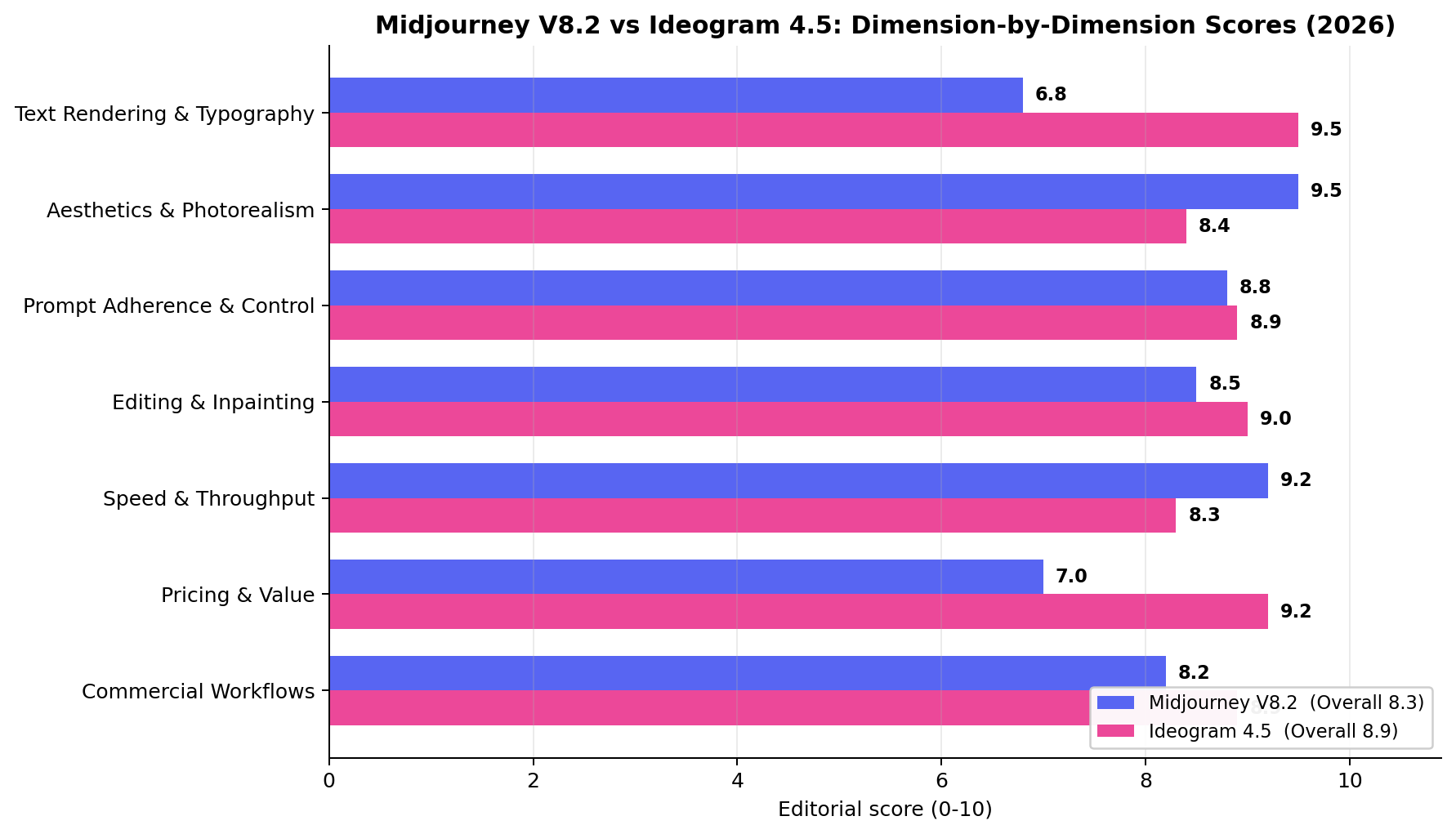
1. Text Rendering & Typography — Winner: Ideogram (9.5 vs 6.8)
The original reason Ideogram exists, and version 4.5 is still the category killer. Multi-line slogans, mixed weights, kerning-aware logotypes, non-Latin scripts — it renders like a typesetter, not a painter. Midjourney V8.2 will give you clean short strings and then hand you "COFFE SHOP GRAND OPNING" when the copy gets long. For any product where words are the design — merch, packaging mockups, ad creative, thumbnails — this dimension alone is the decision.
2. Aesthetics & Photorealism — Winner: Midjourney (9.5 vs 8.4)
The mirror image. V8.2's rendering of skin, light and material is the best in the consumer market, full stop. Ideogram 4.5 closed most of the gap this year — its photography styles now pass casual inspection — but side-by-side, Midjourney images get described as "editorial" while Ideogram's get described as "clean." If you sell the look (art prints, book covers, portraits, brand mood imagery), this is your dimension.
3. Prompt Adherence & Control — Winner: Ideogram (8.9 vs 8.8)
A genuine photo finish. Both models follow complex scene briefs well; Ideogram edges it on layout instructions ("headline top-left, product centered, badge bottom-right") because it actually understands what a headline is. Midjourney's parameter system (--ar, --stylize, --raw) remains deeper for art direction. Call it a tie in practice, a point to Ideogram on the scoreboard.
4. Editing & Inpainting — Winner: Ideogram (9.0 vs 8.5)
Ideogram's canvas — Magic Fill to swap or fix regions, Extend to resize for different print formats — is the fastest product-iteration loop we tested on any image platform. Change the mug color, extend a design to a tote bag, fix one word in a slogan: minutes, not sessions. Midjourney's editor is capable (vary region, pan, zoom) and pairs with Character/Style Reference for campaign consistency, but the workflow is heavier for production edits.
5. Speed & Throughput — Winner: Midjourney (9.2 vs 8.3)
Fast mode on a paid plan is near-instant, and Relax mode is unlimited on Standard and above — a volume seller can draft hundreds of candidates overnight for one flat fee. Ideogram's premium generations take longer and queues occasionally stretch; credits also meter volume explicitly. If your model is "generate 500, shortlist 10," Midjourney's throughput economics are hard to beat.
6. Pricing & Value — Winner: Ideogram (9.2 vs 7.0)
Free tier with commercial rights versus no free tier at all. $15/month (annual) for 2,400 credits versus $10/month for 3.3 fast hours. $42 Pro with 7,500 credits versus $60 for Stealth mode and 30 fast hours. Midjourney's per-image economics are fine in Relax mode, but entry cost, ceiling cost and predictability all favor Ideogram — decisively for anyone testing a new niche.
7. Commercial Workflows — Winner: Ideogram (8.9 vs 8.2)
Ideogram behaves like software built for people shipping product: transparent credits, straightforward commercial terms, formats and quality presets aimed at print sizes, and an iteration loop sized for client work. Midjourney behaves like an artist's studio — brilliant output, community-driven knowledge, and a business model that only recently grew a real web app. Teams that need repeatability score that difference 8.9 to 8.2.
Real-World Test Scenarios (With Money Attached)
The freelancers and micro-brands in our research reports don't generate images for fun — each image is a listing, a client deliverable or an ad. We re-ran the three most common commercial workflows with identical briefs on both tools.
Scenario 1: Slogan T-Shirt for a Print-on-Demand Store
The job: a classic POD win condition from the case files — sellers launching 3–5 new designs weekly on Amazon Merch and Redbubble, where a single winning tee can net $300–800/month in royalties and the whole game is first-pass accuracy across many attempts.
The prompt (both tools): "Vintage 70s style t-shirt graphic, bold retro serif typography reading 'GARDENING IS MY THERAPY', sun rays and wildflowers, distressed texture, centered composition, cream background"
Ideogram: correct text, tasteful retro serif, balanced composition — generation 1. Two more variants for the listing; a winner shortlisted in under ten minutes. Midjourney: gorgeous sun rays and authentic distress texture — and "GARDENING IS MY THEREPY." Rerolls: 4 before one passed, and the winner needed a kerning fix in an external editor. At scale (the 5-designs-a-week cadence), that gap compounds into hours of rework every month — the exact inefficiency that separates profitable POD shops from hobbyists.
Scenario 2: Etsy Wall-Art Digital Download
The job: the digital-download trade from our case research — shops selling printable art bundles at $5–15 per listing with ~95% margin, where the product is the aesthetic and listings need three to five coordinated pieces.
The prompt: "Minimalist botanical line art, single olive branch in terracotta pot, warm cream background, fine ink lines, gallery-quality composition, negative space" — then extended to a 5-piece series.
Midjourney: the line weight, the paper feel, the taste — immediately sellable, and --sref held the series style perfectly across all five pieces. This is the workflow Midjourney was born for. Ideogram: clean and competent, slightly clinical ink rendering; the series held together but lacked the hand-drawn warmth. Verdict from our reviewers: buyers pay for the Midjourney version.
Scenario 3: Client Logo Concept + Social Kit
The job: the entry rung of the freelance logo ladder — Fiverr/Redbubble-adjacent gigs paying $50–150 for a concept package (logo variations, one social banner), with agencies reselling similar packs at $500+.
The prompt: "Modern logo for 'NORTHBOUND COFFEE ROASTERS', badge style, mountain silhouette inside circle, two-color, flat vector look" plus a follow-up edit: "same logo, change circle to rounded square."
Ideogram: wordmark spelled correctly (non-trivial!), badge layout balanced, and the follow-up edit completed in Magic Fill without regenerating the whole concept. Draft-to-revision in one session — exactly what a $99 gig needs to be profitable. Midjourney: a prettier mountain, wrong brand name, and the revision meant rerolling and hoping. For wordmark-bearing deliverables, it is simply the wrong tool.
Alternatives Worth Considering
| Tool | Starting Price | Standout Feature |
|---|---|---|
| OpenAI GPT Image 2 | $20/mo (ChatGPT Plus, usage-based) | Conversational editing of uploaded images; strong text |
| Qwen Image 3.0 | ~$0.035/image (API); free web tier | Apache 2.0 open weights — run it yourself, no per-image fees |
| Flux 1.2 (BFL) | From ~$0.02/image (API); $24/mo subscription | Open-weight option with excellent photorealism and control |
| Stable Diffusion + ComfyUI | $0 software + GPU | Total control, LoRA fine-tunes, zero per-image cost at scale |
| Recraft V4 | Free tier; $12/mo Pro | True vector output (SVG) — built for logo and icon work |
If typography is 90% of your work but you need vectors, Recraft is worth a trial before committing to either tool above. If you generate thousands of images monthly, the open-weight route (Flux, Qwen Image, SD) rewrites your cost structure entirely — at the price of setup complexity.
Pricing Deep Dive: What Volume Actually Costs
Headline prices hide the real math. Using the observed generation patterns from our scenario work, here is what a month of image production costs at three realistic seller workloads. We assume: POD tier = ~120 final images (plus rerolls, ~300 generations total); growing shop tier = ~800 generations plus editing; studio tier = ~2,500 generations with priority turnaround.
| Workload | Midjourney Plan | Monthly Cost | Ideogram Plan | Monthly Cost |
|---|---|---|---|---|
| POD starter (~300 gens/mo) | Basic (3.3 fast hrs + unlimited Relax) | $10 | Plus (2,400 credits, annual billing) | $15 |
| Growing shop (~800 gens/mo) | Standard (15 fast hrs + unlimited Relax) | $30 | Pro (7,500 credits, annual billing) | $42 |
| Studio (~2,500 gens/mo) | Pro (30 fast hrs + unlimited Relax) | $60 | Pro + top-up credits | ~$90 |
Two takeaways. First, Midjourney's Relax mode makes its cost flat as volume grows — every plan above includes unlimited slow generations, so patient sellers effectively pay $10–30 for any volume. Second, Ideogram's credits buy certainty: every premium generation is fast, high quality and priority-queued, and the free tier covers the experimentation phase of a new niche at literally $0. The "right" answer depends entirely on whether your bottleneck is patience or turnaround.
When to Stay Put
A counterpoint, because not everyone should switch anything this year. If you already run Midjourney with a library of --sref style codes, personalization profiles and prompt recipes that took months to tune, the switching cost is real — your accumulated style memory does not transfer, and Ideogram will not reproduce your established look on day one. Likewise, if your product line is purely aesthetic (abstract prints, photo-style listings, brand imagery) and never touches typography, Ideogram's headline advantage is irrelevant to you, and V8.2's aesthetics advantage compounds daily. And if your entire workflow already lives inside one platform's ecosystem (Discord communities, style pipelines, client-facing boards), the marginal gains of a second subscription may not clear $15/month. Switching wins when typography or iteration speed is costing you hours; staying wins when style consistency is your moat.
The Verdict
Seven dimensions, two philosophies. Midjourney V8.2 is the finest image artist on the market — its aesthetics and throughput are unmatched, and for products where beauty is the product, it remains the default. Ideogram 4.5 is the finest image production tool — text that survives contact with clients, edits that take minutes, pricing that scales down to free. The scoreboard says 5–2 Ideogram. The market says both are thriving, because they are quietly optimizing for different businesses.
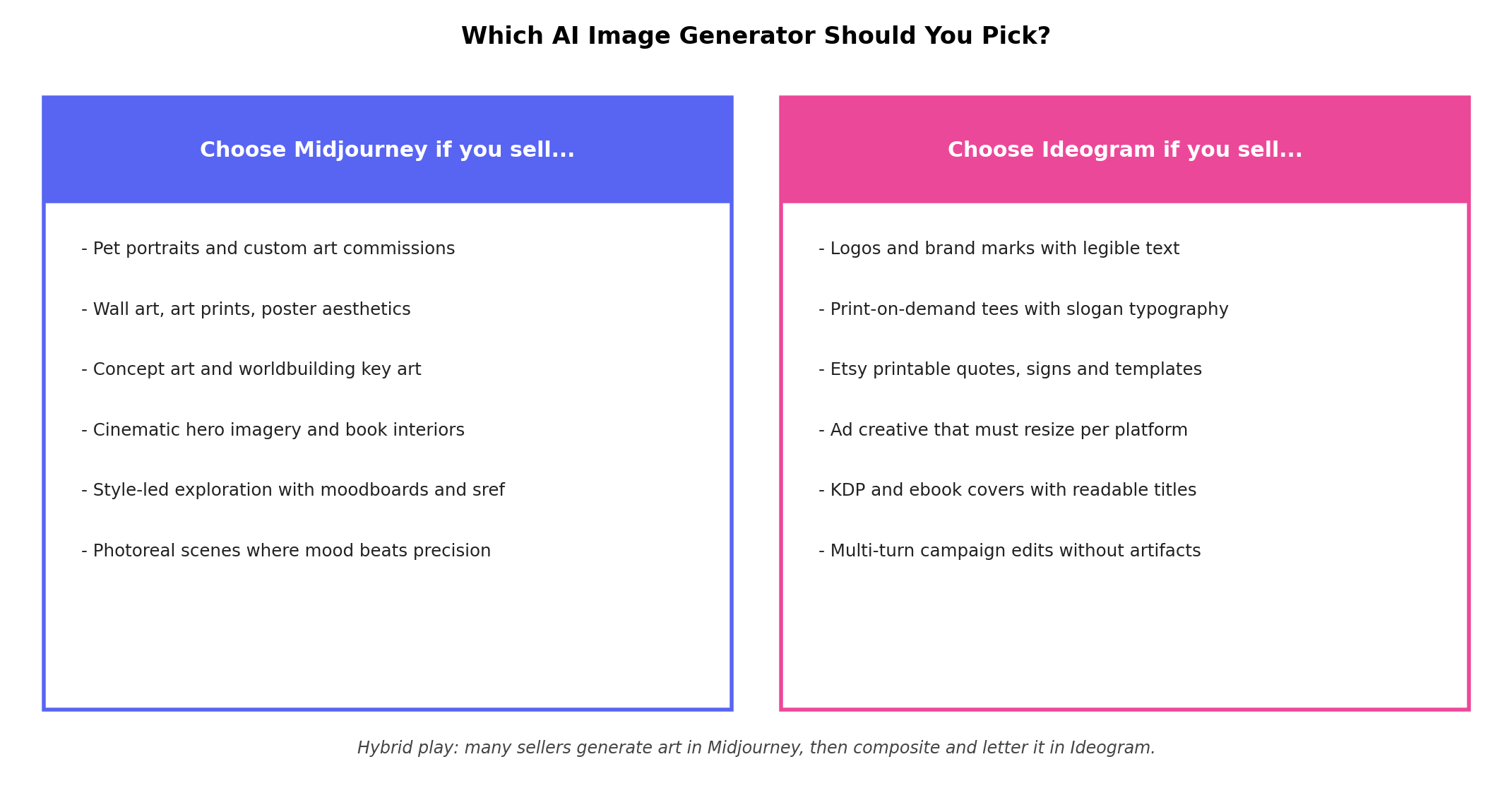
Best for print-on-demand, merch and ad creative: Ideogram 4.5 — correct text on generation 1, Magic Fill edits in minutes, free tier to validate niches before spending.
Best for art prints, book covers and brand aesthetics: Midjourney V8.2 — the taste gap is still real, and --sref plus unlimited Relax mode is unbeatable for volume drafting of sellable beauty.
Best overall value in 2026: Ideogram 4.5 — $0 entry, $15 professional tier, and it wins or ties five of the seven dimensions that decide commercial work.
The hybrid play (what serious sellers actually do): Ideogram Pro for anything with words on it, Midjourney Basic at $10 for the aesthetic hero pieces — a combined $25–55/month stack that beats any single tool at either job. Several POD operators in our case research run exactly this two-tool stack and expense it as cost of goods.
Frequently Asked Questions
Is Ideogram better than Midjourney for text in images?
Yes, decisively. Ideogram 4.5 renders multi-line slogans, logotypes and mixed-weight typography with typesetter-level accuracy, while Midjourney V8.2 handles short strings reliably but still mangles longer copy. For any deliverable where words are part of the design, Ideogram is the safer choice by a wide margin.
Which AI image generator is better for print-on-demand in 2026?
Ideogram, for most sellers. POD success depends on first-pass text accuracy, fast iteration across many designs, and low entry cost — all Ideogram strengths. The exception is purely aesthetic product lines (abstract prints, photo-style art) where Midjourney's superior aesthetics command higher prices.
Can you use Midjourney and Ideogram images commercially?
Yes, if you hold a paid subscription. Midjourney grants commercial rights to paying subscribers (companies above $1M revenue need the Pro tier at $60/mo). Ideogram extends commercial rights to all tiers including the free plan, which makes it uniquely suitable for testing niches before committing budget.
How much do Midjourney and Ideogram cost per month?
Midjourney plans run $10 (Basic), $30 (Standard), $60 (Pro) and $120 (Mega) monthly, or roughly half billed annually. Ideogram runs $8 Plus / $20 Pro / $45 Ultra with annual billing ($15/$42/$95 monthly), plus a free tier with daily credits. Entry cost favors Ideogram; high-volume flat cost favors Midjourney's unlimited Relax mode.
Which is more photorealistic, Midjourney or Ideogram?
Midjourney V8.2. It scored 9.5/10 in our photorealism battery — the highest mark we awarded — with superior skin, lighting and material rendering. Ideogram 4.5 narrowed the gap significantly (8.4/10) and its photography styles now pass casual inspection, but side-by-side, Midjourney still reads as more editorial.
Do Midjourney or Ideogram have a free plan?
Ideogram does — a permanent free tier with daily credits and commercial usage rights. Midjourney offers no free tier; the cheapest access is the $10 Basic plan. This makes Ideogram the default recommendation for budget-constrained creators validating a new product line.
Can you edit and inpaint images in both Midjourney and Ideogram?
Both support editing, but the workflows differ. Ideogram's canvas offers Magic Fill (region swaps and text fixes) and Extend (format resizing) with the fastest loop we tested. Midjourney's editor provides vary-region, pan and zoom, and its Character/Style Reference features excel at keeping campaigns consistent — but production edits generally take more steps.