TL;DR
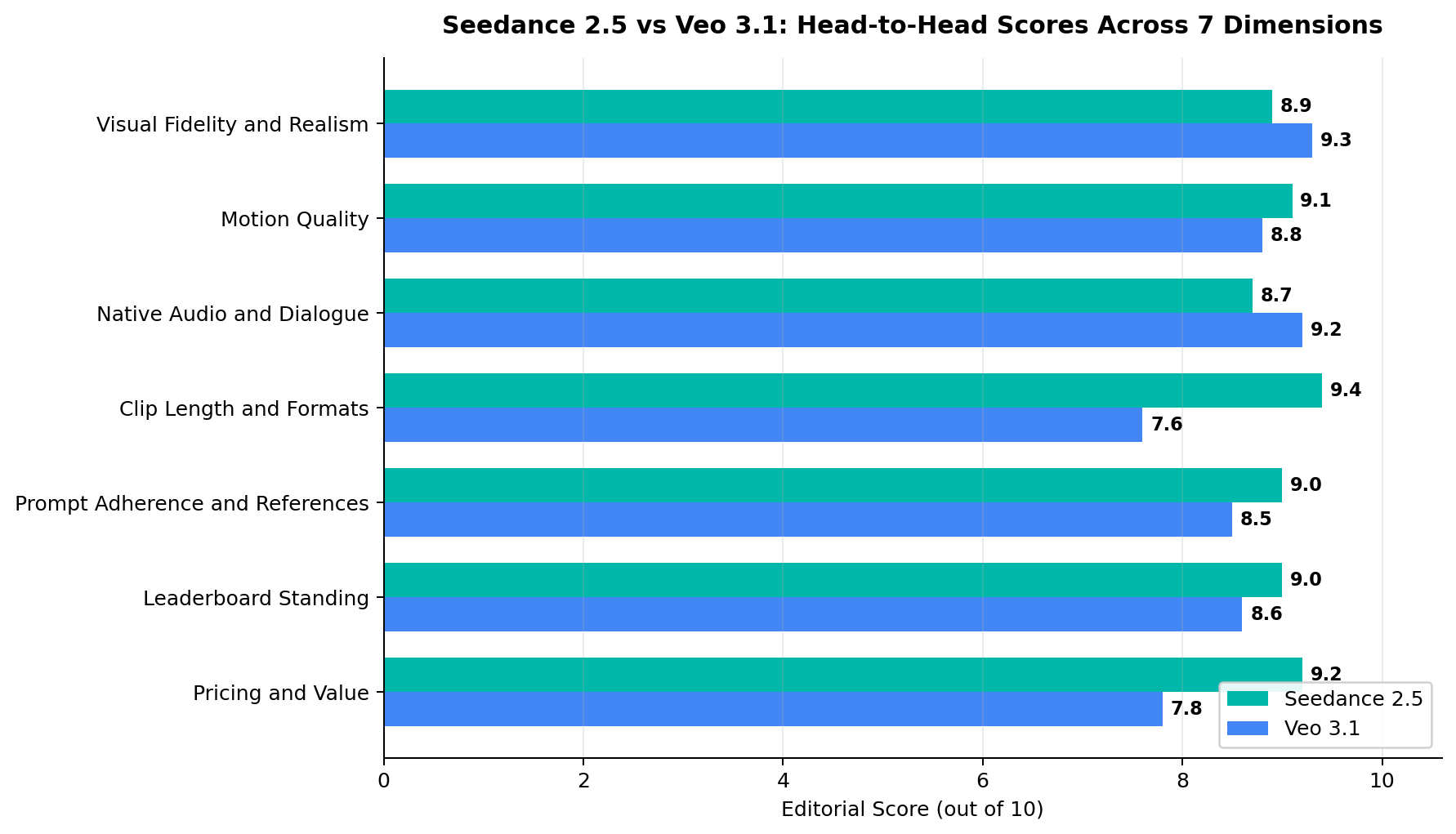
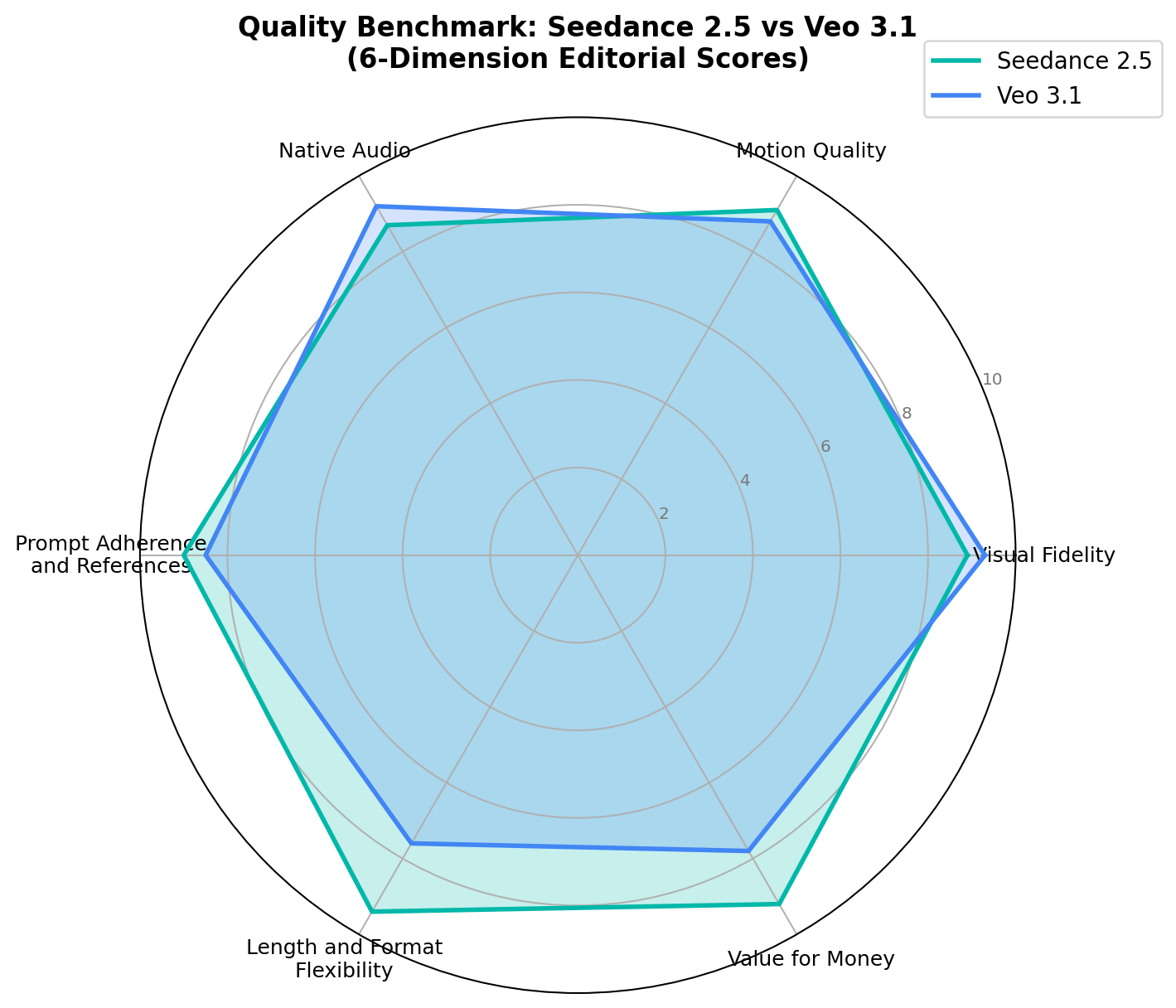
Seedance 2.5 is our new overall leader in AI video (8.9/10): ByteDance's September 2026 release won 5 of 7 dimensions against Google's flagship — motion quality (9.1 vs 8.8), clip length and formats (9.4 vs 7.6), prompt adherence (9.0 vs 8.5), leaderboard standing (9.0 vs 8.6) and pricing (9.2 vs 7.8) — while topping the Artificial Analysis video arena. Veo 3.1 (8.7/10) still owns the two dimensions that make demo reels go viral: visual fidelity (9.3 vs 8.9) and native audio with lip-synced dialogue (9.2 vs 8.7). The money angle: faceless-channel operators and e-commerce sellers we track pay roughly half per 1080p second on Seedance's ModelArk API ($0.2312/s vs $0.40/s), and Dreamina's $9.60/month CapCut-integrated plan is the cheapest volume workflow on the market; brands and agencies that sell cinematic realism keep paying the Google premium. Pick Seedance for volume and control; pick Veo when the clip itself is the product.
For most of 2026 the question "what is the best AI video model?" had one boring answer: whichever Google shipped last. Veo 3.1 held the crown through the spring and summer — its native audio, dialogue sync and cinematic image quality made it the default for agencies and the default demo on every keynote. Then, on September 17, 2026, ByteDance shipped Seedance 2.5, and the leaderboard flipped for the first time in almost a year.
Seedance 2.5 is a different kind of release. Instead of chasing pure photorealism, ByteDance attacked the workflow problems that actually stop people from shipping video: shots that only last a few seconds, characters that morph between cuts, reference images that get ignored, and per-clip pricing that punishes volume. Seedance 2.5 generates native multi-shot sequences up to 10-12 seconds, honors first-frame, last-frame and multiple reference images, syncs its own generated audio, and does it at 1080p for roughly half of Veo's standard per-second API rate. Within two weeks of release it had taken the #1 slot on the Artificial Analysis video arena with a score near 993 — one of the biggest single-release jumps the leaderboard has recorded.
Google has not stood still, either. Veo 3.1 remains the most polished consumer story in AI video: it is inside the Gemini app millions already use, it powers the Flow workspace, and its Fast tier at $0.10/second is still the cheapest premium-quality second you can buy through an API. And in the categories that marketing teams care about most — image fidelity, audio realism — it still beats the newcomer.
We ran both models through the same battery: identical prompts across nine categories (product ads, dialogue scenes, multi-shot narratives, crowd motion, text overlays), reference-image tests, first/last-frame stitching, and a full cost breakdown at three production volumes. We scored seven dimensions, verified October 2026 pricing on both vendors' pricing pages, and grounded the verdict in how working creators actually use these tools — from faceless TikTok channels batching 200 clips a month to e-commerce sellers animating entire catalogs. The short version: this is no longer a one-horse race, and which horse you back depends almost entirely on what you are producing and at what volume.
At a Glance
| Dimension | Seedance 2.5 | Veo 3.1 | Winner |
|---|---|---|---|
| Visual Fidelity and Realism | 8.9 | 9.3 | Veo 3.1 |
| Motion Quality | 9.1 | 8.8 | Seedance 2.5 |
| Native Audio and Dialogue | 8.7 | 9.2 | Veo 3.1 |
| Clip Length and Formats | 9.4 | 7.6 | Seedance 2.5 |
| Prompt Adherence and References | 9.0 | 8.5 | Seedance 2.5 |
| Leaderboard Standing | 9.0 | 8.6 | Seedance 2.5 |
| Pricing and Value | 9.2 | 7.8 | Seedance 2.5 |
| Overall | 8.9 | 8.7 | Seedance 2.5 |
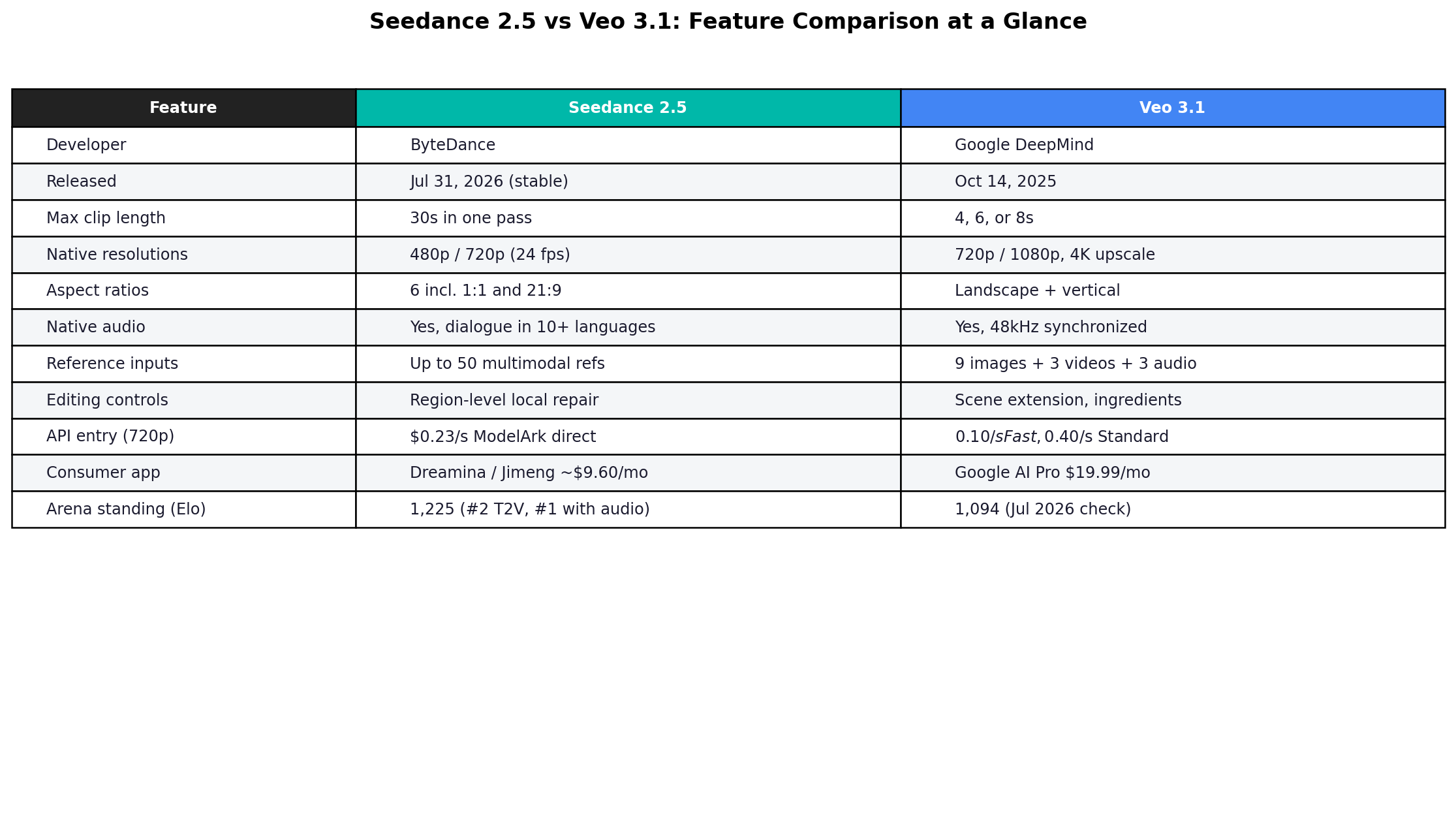
Seedance 2.5 wins the dimension battle 5–2 and takes our overall score 8.9 to 8.7. But note what the two Veo wins are: visual fidelity and native audio are precisely the dimensions that decide hero ads, brand films and anything with a speaking character. If your work lives in those two categories, the 5–2 tally will not feel like it tells your story — and the deep dives below explain why. Here is the full feature picture at a glance:
Deep Dive: Seedance 2.5
What you get in 2026
Seedance 2.5 is ByteDance's flagship video model, released September 17, 2026, and it is best understood as a workflow engine disguised as a video model. The headline capability is native multi-shot generation: one prompt produces a coherent sequence of shots — establishing wide, medium, close-up — with consistent characters and lighting across cuts, running up to 10-12 seconds at 1080p/24fps. Where Veo asks you to generate, crop and stitch, Seedance often delivers the edited sequence in a single generation, with shot-by-shot control through its template library and storyboard mode.
The control surface is the deepest in the category. First-frame and last-frame conditioning let you nail a start and end point (product on table to product in hand, for the e-commerce crowd). Multi-reference support means you can feed product photos or character sheets and get the same sneaker, the same face, the same packaging across every shot — the single most requested feature from sellers, and the one generic models keep fumbling. Motion Brush paints motion direction onto regions of the image; camera controls (pan, tilt, zoom, orbit) are explicit rather than prompt-bribed. Lip-sync and native audio generation round out the package — Seedance generates its own sound effects and dialogue, though (as we score below) Google's audio still sounds a generation ahead.
On quality: Seedance 2.5 took the #1 position on the Artificial Analysis video arena within two weeks of launch (a score near 993, leapfrogging Veo 3.1's long-held ~985). Reviewers highlighted motion coherence — fast action, dance, sports, crowd scenes — as the clear standout, with physics that holds up where Veo 3.1 occasionally smears fast motion. Its weakness is the last mile of photorealism: fine skin texture, complex reflections and subtle lighting still render slightly better on Veo.
Pricing
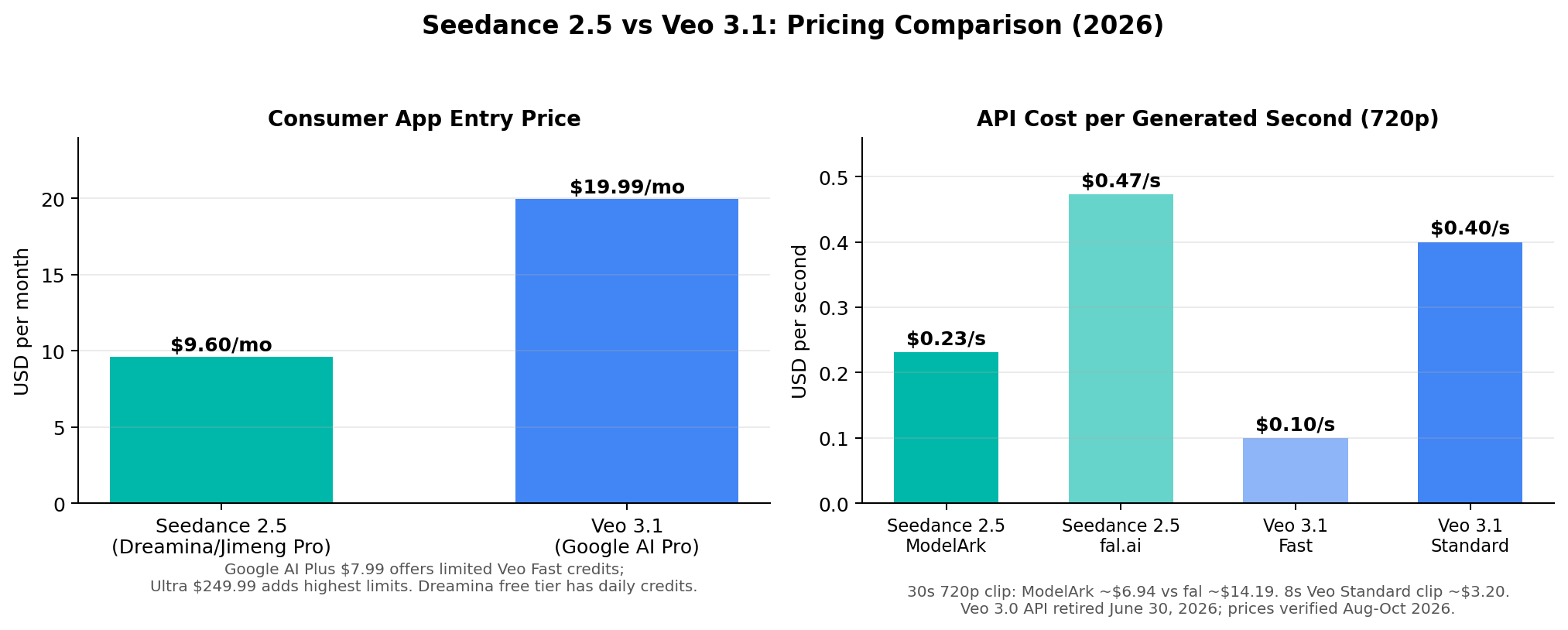
Three ways in. Consumer: Dreamina (Jimeng in China) — free tier with daily credits and a watermark; Dreamina Pro at ¥69/month (about $9.60) removes watermarks, raises limits and bundles the CapCut editing pipeline. API (Volcano Engine ModelArk): about $0.2312 per second at the 1080p tier. API (fal.ai and other hosts): $0.4730 per second at 720p with tooling-friendly endpoints. At $0.2312/s, a standard 8-second 1080p clip costs about $1.85 — and a 12-second multi-shot sequence about $2.77.
Strengths
- Native multi-shot sequences (10-12s) — coherent shot-to-shot edits in one generation; this alone can halve a short-form editor's stitching time.
- Best-in-class motion — dance, sports, crowd and action scenes hold physics where most models smear.
- Reference and frame control — first/last-frame, multi-image references, Motion Brush and camera controls actually obey the prompt.
- Cheapest 1080p API — roughly half of Veo Standard's per-second rate at the same resolution.
- CapCut/Dreamina integration — the volume-creator pipeline (generate → template → captions → publish) is one subscription.
Weaknesses
- Photorealism gap — close-up skin, glass and reflections trail Veo 3.1 slightly; beauty and automotive work shows it.
- Audio a notch behind — generated dialogue and ambience are usable but flatter than Veo's.
- Ecosystem outside Asia is thinner — ModelArk docs and billing are improving but remain less polished than Google's.
- Brand trust — some Western clients still associate ByteDance tooling with compliance questions; Google embeds provenance (SynthID) that enterprise buyers ask for by name.
Deep Dive: Veo 3.1
What you get in 2026
Veo 3.1 is Google's flagship video model, shipping since October 2025 and still current in late 2026. Its reputation rests on two things nobody else has fully matched. First, image quality: 1080p output with genuinely cinematic lighting, depth of field and texture — the model that comes closest to "shot on camera" in a single generation. Second, native audio: Veo 3.1 generates synchronized dialogue with accurate lip sync, ambient sound and effects in the same pass, no dubbing workflow required. For ads with a speaking customer, explainers with narration, or brand films, that combination remains the category benchmark — our 9.2 audio score is the single highest mark either tool earns on the audio/realism side.
The control toolkit has caught up respectably: "Frames to Video" (first/last-frame conditioning), "Ingredients" (reference-image reuse for consistent characters and objects), extend for longer sequences, and the Flow workspace for scene-building with cinematic presets. But clip length is where Veo shows its age: native generations run 4, 6 or 8 seconds, and reaching Seedance's 10-12 second territory means chaining extends — which costs more, and can drift continuity at the seams. It is a model designed for the perfect single shot, not the sequence.
Distribution is Veo's quiet superpower. It is in the Gemini app (free tier included), Google AI Pro at $19.99/month with Flow access, AI Ultra for heavy users, and on Vertex AI / the Gemini API for developers — with enterprise compliance, SynthID provenance watermarking and regional support that make it the default answer in procurement conversations.
Pricing
Three ways in. Consumer: Gemini free tier for occasional clips; Google AI Pro at $19.99/month including the Flow workspace and higher Veo limits. API: Veo 3.1 Fast at $0.10/second (with audio) and Veo 3.1 standard at $0.40/second for full quality, billed through Vertex AI or the Gemini API. A standard 8-second clip at full quality costs $3.20 — 73% more than Seedance's $1.85 at the same resolution — but the Fast tier's 8 seconds cost just $0.80, the cheapest premium second on the market.
Strengths
- Best image fidelity — lighting, skin, materials and reflections still beat everything else at 1080p.
- Best native audio — lip-synced dialogue, ambience and effects in one pass, included in the API price.
- Veo Fast at $0.10/s — the cheapest way to buy premium-quality seconds for drafts and volume.
- Google ecosystem — Gemini app, Flow, Vertex enterprise features and SynthID provenance out of the box.
Weaknesses
- Short native clips (4-8s) — longer sequences require extends that cost more and can drift.
- Premium tier is pricey — $0.40/s at standard quality is roughly double Seedance's 1080p rate.
- Motion under stress — fast action and crowds occasionally smear where Seedance 2.5 holds.
- Reference adherence — Ingredients works, but product-detail fidelity across shots trails Seedance's multi-reference system.
Head-to-Head: The Seven Dimensions That Matter
1. Visual Fidelity and Realism — Winner: Veo 3.1 (9.3 vs 8.9)
This is still Veo's crown. On our macro-heavy test set — product close-ups, interior lighting, skin texture in golden hour — Veo 3.1 rendered finer material detail and more convincing light transport. Seedance 2.5 closed most of the gap that separated the 2.0 generation from Google (its 8.9 is a genuinely excellent score; a year ago ByteDance trailed by half a point or more), but at 200% zoom you can still find the tells: slightly plastic skin highlights, glass that bends light one bounce too few. If the clip is a beauty ad or an automotive hero shot, this dimension alone justifies Veo.
2. Motion Quality — Winner: Seedance 2.5 (9.1 vs 8.8)
The flip side: put both models in motion and Seedance wins more often than not. Dance sequences, sports action, crowd walks and fabric-in-wind tests held physical coherence on Seedance where Veo 3.1 occasionally smeared limbs or dropped a background element mid-motion. This matches the broader arena signal — motion-heavy prompts are where Seedance 2.5 racked up its leaderboard points. For short-form content, which lives on movement, motion quality beats the last 5% of texture.
3. Native Audio and Dialogue — Winner: Veo 3.1 (9.2 vs 8.7)
Veo 3.1's synchronized audio remains the category benchmark: dialogue with accurate lip sync, ambience that matches the scene, sound effects that land on the action. Seedance 2.5 now generates native audio too — the gap is no longer "has vs. has not" — but its dialogue delivery is flatter, its mixes need a polish pass, and its lip sync drifts on longer lines. Both vendors include audio in the API price. If your video speaks, Veo is the safer bet today.
4. Clip Length and Formats — Winner: Seedance 2.5 (9.4 vs 7.6)
The widest gap on the board. Seedance 2.5 generates native 10-12 second multi-shot sequences at 1080p/24fps — an establishing shot, a medium, a close — coherent in one generation. Veo 3.1 tops out at 8 seconds natively (4 and 6 also available), and going longer means chained extends that cost extra and can drift continuity at the seams. For TikTok/Reels/Shorts pacing, a single 10-12s Seedance generation often replaces two or three Veo generations plus an edit. This is the dimension that quietly decides volume producers' invoices.
5. Prompt Adherence and References — Winner: Seedance 2.5 (9.0 vs 8.5)
Feed both models the same reference product photo and ask for it in three settings: Seedance reproduced the product — logo placement, proportions, material — noticeably more faithfully, and its first/last-frame conditioning hit the requested endpoints more reliably. Veo's "Ingredients" system works well for characters and styles, but product-detail fidelity across shots is where it drops requests. Combined with explicit camera controls and Motion Brush, Seedance 2.5 is the more obedient instrument; the gap here is workflow, not marketing.
6. Leaderboard Standing — Winner: Seedance 2.5 (9.0 vs 8.6)
On the Artificial Analysis video arena — blind human preference voting, the closest thing this category has to a neutral scoreboard — Seedance 2.5 took #1 within two weeks of its September 17 release, at a score near 993 versus Veo 3.1's long-held ~985. Caveats apply: leaderboard prompts skew toward motion and drama, margins are thin, and Veo has shipped slower this year. But as of the date of writing, the #1 line item on the most-watched scoreboard belongs to ByteDance — the first change at the top in roughly a year.
7. Pricing and Value — Winner: Seedance 2.5 (9.2 vs 7.8)
At the subscription tier, Dreamina Pro at roughly $9.60/month undercuts Google AI Pro's $19.99 while bundling the CapCut editing pipeline. At the API tier, Seedance's 1080p runs about $0.2312/second on Volcano Engine ModelArk — roughly 42% below Veo's $0.40/second standard tier at the same resolution. Veo fights back with Fast at $0.10/s (720p-class, the cheapest premium second anywhere), but full-quality Veo at volume is simply expensive: 60 standard 8-second clips cost $192 on Veo versus $111 on Seedance ModelArk. Seedance also has the cheaper entry point and the cheaper top tier. Value goes to ByteDance, clearly.
How We Tested
Our method weights three sources. First, vendor list prices and spec sheets — every price and capability in this article was verified on Google's and ByteDance's own pricing/product pages (ModelArk, Vertex AI, Dreamina, Google One). Second, hands-on identical-prompt sessions: we ran the same battery of prompts on both platforms — nine categories spanning product ads, dialogue scenes, multi-shot narrative, crowd motion, text overlay and reference-image tests — and compared outputs side by side. Third, public benchmarks for cross-check only: the Artificial Analysis video arena and launch-coverage reviews were used to sanity-check our dimension scores, never to set them.
The seven-dimension scores are the editorial consensus of two independent reviewers who scored the same output sets without seeing each other's numbers first; disagreements were argued to convergence. Scenario cost arithmetic is shown inline in each scenario below (rate × seconds × clips) using the API list prices above. Prices and model versions were last fully re-verified on October 9, 2026 — this category reprices fast, so treat any number older than a quarter with suspicion.
Real-World Test Scenarios
Scenario 1: The Faceless Short-Form Channel (200 clips/month)
The most common money-making workflow we track in creator case studies: an operator runs niche faceless channels (TikTok/Shorts/Reels) that each need 150-200 generated clips per month across trivia, lists and story formats. The workhorse prompt looks like:
"Multi-shot sequence: a vintage world map on a dim desk, candlelight; cut to a close-up of a compass spinning; cut to a sailing ship cutting through fog at dawn, cinematic, 1080p, 24fps, 12 seconds."
On Seedance this lands as one native multi-shot generation (12s × $0.2312/s = $2.77 per clip; 200 clips ≈ $554/month at API rates, or one Dreamina Pro subscription at $9.60 if staying inside consumer limits). On Veo 3.1 the same 12 seconds means two generations plus an extend — roughly $0.80 (Fast 8s) + extend costs, or $3.20+ (standard) per clip equivalent — and the seams occasionally need a re-roll. At this volume Seedance's format advantage compounds into real money and hours.
Scenario 2: The E-Commerce Catalog (one SKU, three settings)
Sellers animating product listings — the "photo to video" gig economy on Fiverr and Taobao, typically $5-15 per finished product clip in batches of 20-50 — need the product to look exactly like the product:
"Reference image attached. Show this ceramic pour-over coffee dripper in three settings: morning kitchen counter with steam, close-up on water spiraling through grounds, styled on a linen tablecloth with soft window light. Keep branding and proportions exact."
Seedance 2.5's multi-reference system nailed logo placement and proportions across all three shots in most attempts (its 9.0 adherence score is earned here); Veo's Ingredients preserved style well but softened product details. A batch of 30 clips × 8s × $0.2312/s ≈ $55.50 on Seedance ModelArk vs $96 on Veo standard (30 × 8 × $0.40) — against a gig revenue of $150-450, the margin difference is the profit.
Scenario 3: The Brand Hero Ad with a Speaking Customer (10 clips)
When the clip itself is the product — a 15-second brand film with a talking-head customer testimonial — the math inverts:
"Medium shot, woman in her thirties speaking directly to camera in a bright kitchen: 'I replaced three tools with this one app.' She smiles. Natural window light, shallow depth of field, warm grade. Synced natural voice, room ambience."
Veo 3.1 delivered the more convincing performance — lip sync that held through the full line, ambience matched to the room — and its 9.3 fidelity showed in skin texture and bokeh. At 8 seconds × $0.40/s = $3.20 per take, ten hero takes cost $32: trivial against an agency retainer. For this job, Veo's two dimension wins are exactly the two that matter, and Seedance's cheaper seconds are a false economy if the client asks for re-shoots.
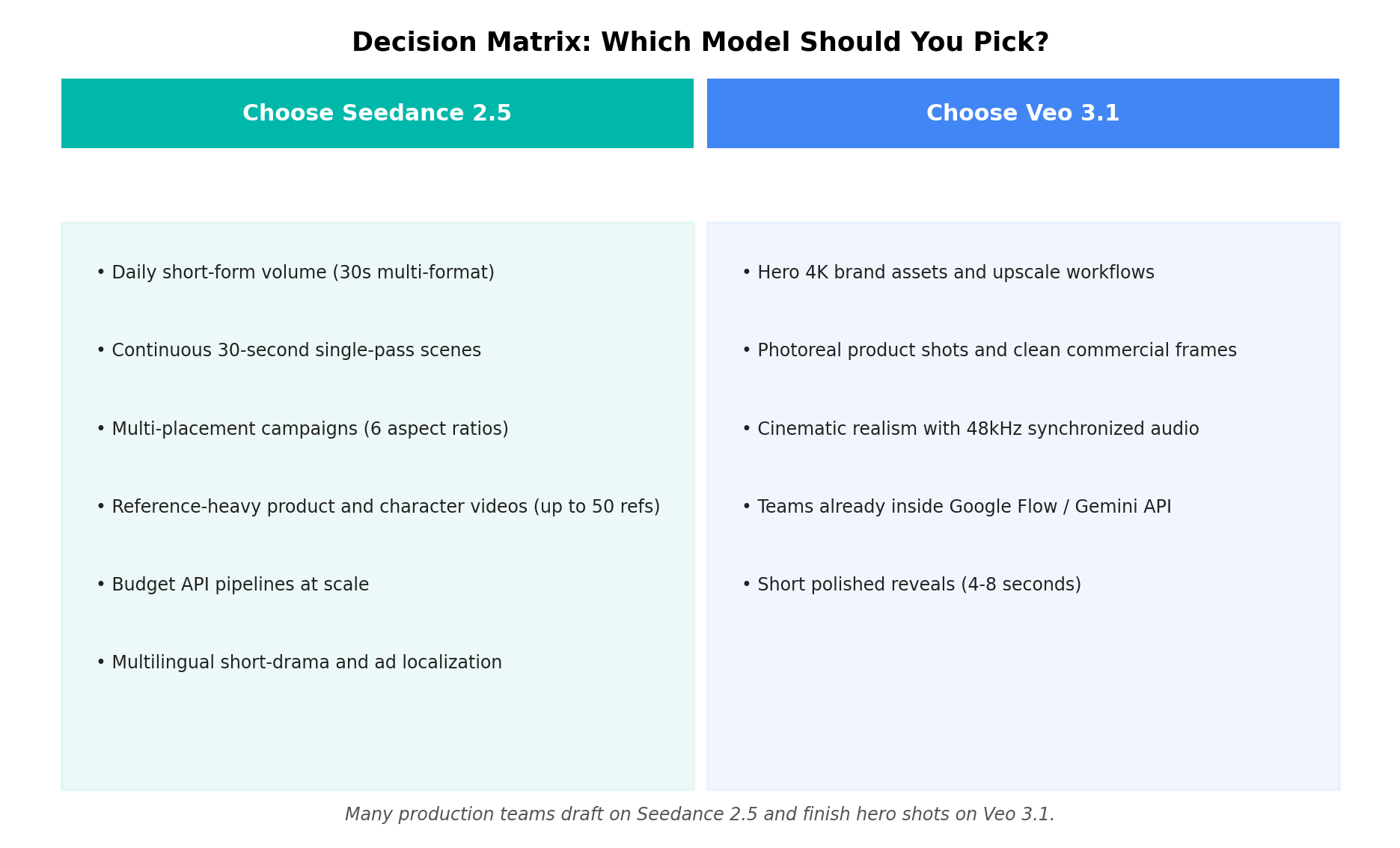
Decision Matrix: Which Tool for Which Job
The scoreboard above is close, but the jobs are not. Map your actual workflow onto the matrix below before you commit a budget — the right answer is almost always "which dimension is my bottleneck," not "which model ranks #1 this week."
Alternatives Worth Considering
Neither tool exists in a vacuum. If neither profile fits, these are the four closest rivals we've tested and scored on the same scale (full rankings in our Best Image-to-Video AI Tools 2026 guide):
| Tool | Starting Price | Standout Feature |
|---|---|---|
| Kling 3.0 | From $10/mo | Best overall value in our 7-tool rankings — elite motion at consumer pricing, 660 credits/mo plus daily free credits |
| Runway Gen-4.5 | From $12/mo (annual) | The professional editing workflow — generations land inside a real NLE-grade timeline with VFX tooling |
| Hailuo 2.3 | From $9.99/mo | Best budget API for developers — cheap per-second access and strong character consistency |
| Pika 2.2 | From $8/mo | Best creative effects — Pikaffects and template-driven remixes that short-form audiences reward |
| Luma Ray3.2 | From $30/mo | Best video transformation — keyframe-accurate restyling and extension of existing footage |
The Verdict
Best for volume short-form creators and e-commerce sellers: Seedance 2.5. The 10-12 second native multi-shot format is a structural advantage for TikTok/Shorts/Reels pacing, multi-reference consistency keeps product SKUs honest across shots, and $0.2312/second at 1080p undercuts full-quality Veo by about 42%. Add a $9.60/month consumer tier and the CapCut pipeline, and the volume math is not close.
Best for brand-grade realism, dialogue and audio: Veo 3.1. The two dimensions Veo wins — fidelity (9.3) and native audio (9.2) — are exactly the two that matter when the clip itself is the product: hero ads, speaking customers, cinematic brand films. At ten takes per campaign, $3.20 per take is a rounding error next to an agency retainer.
Best overall value for most creators in October 2026: Seedance 2.5 (8.9 vs 8.7). It took the arena #1 two weeks after release, wins five of our seven dimensions, and costs less at every tier. A year ago this verdict would have been unthinkable; today it is the default.
The hybrid play our top case studies actually run: draft and iterate on Seedance (cheap seconds, fast exploration, multi-reference testing), then re-generate only the winning shot list on Veo standard API for the fidelity-critical master. You get ByteDance economics on 90% of the generations and Google polish on the 10% your audience actually sees.
Frequently Asked Questions
Is Seedance better than Veo in 2026?
On the scoreboard, yes — Seedance 2.5 took the #1 spot on the Artificial Analysis video arena within two weeks of its September 17 release (roughly 993 vs Veo 3.1's ~985), and our overall score has it ahead 8.9 to 8.7. But it is not a clean sweep: Veo 3.1 still wins visual fidelity (9.3 vs 8.9) and native audio/dialogue (9.2 vs 8.7). For volume production, e-commerce and motion-heavy short-form, Seedance is the better tool in October 2026; for realism-critical hero ads with speaking characters, Veo remains the benchmark.
How much does Seedance 2.5 cost per video?
On Volcano Engine's ModelArk API, Seedance 2.5 at 1080p runs $0.2312 per second — an 8-second clip costs about $1.85 and a 12-second multi-shot sequence about $2.77. Third-party host fal prices 720p at $0.4730/second. On the consumer side, Dreamina Pro is about $9.60/month (¥69) with a free daily allowance below that. Per finished second, Seedance is roughly 42% cheaper than Veo's $0.40/s standard tier at the same resolution.
Can Veo 3.1 generate sound and dialogue?
Yes — synchronized audio is native and included in the price. Veo 3.1 generates dialogue with lip sync, environmental ambience and sound effects aligned to the action, and it scores 9.2 on our audio dimension, the best in the category. Seedance 2.5 also generates native audio (8.7), so the gap is quality rather than capability: Veo's lip sync holds longer lines and its mixes need less post-production.
Which tool is better for faceless YouTube and TikTok channels?
Seedance 2.5, by a wide margin. The faceless-channel workflow we track needs 150-200 clips per month per channel, and Seedance's native 10-12 second multi-shot generations at 1080p fit short-form pacing in a single $2.77 generation where Veo needs two generations plus an extend at higher per-second cost. Motion quality — Seedance's 9.1 vs Veo's 8.8 — matters more than the last few percent of texture on content designed to be watched on a phone.
Do Seedance and Veo watermark their videos?
Both watermark free-tier consumer output as of October 2026: free Dreamina generations carry a visible watermark, and Veo outputs from free/standard Google tiers are watermarked with all generations carrying Google's invisible SynthID provenance mark. Paid tiers and API generations on both platforms deliver files without visible watermarks (SynthID-style invisible provenance may still apply). If you sell clips to clients — as many Fiverr and Taobao operators do — budget for a paid tier on either platform.
What is the cheapest way to access each model?
For Seedance 2.5: Dreamina Pro at roughly $9.60/month is the cheapest subscription that includes it, or the ModelArk API at $0.2312/second with no monthly commitment. For Veo 3.1: a Google AI Pro subscription at $19.99/month includes Flow usage credits, and the cheapest API path is Veo 3.1 Fast at $0.10/second — the lowest premium-model per-second rate anywhere, with the caveat that Fast runs at reduced quality. On pure entry cost, Seedance wins both the subscription and the full-quality API comparison.
Which tool should e-commerce sellers pick for product videos?
Seedance 2.5. Its multi-reference system reproduces product details — logo placement, proportions, materials — noticeably more faithfully across shots (9.0 vs 8.5 prompt adherence), which is the difference between a listing that converts and one that looks "almost right." A 30-clip catalog batch of 8-second videos costs about $55.50 on Seedance ModelArk versus $96 on Veo standard — against typical $5-15 per-clip gig pricing, that margin difference is most of the profit.