TL;DR — Our Top Picks
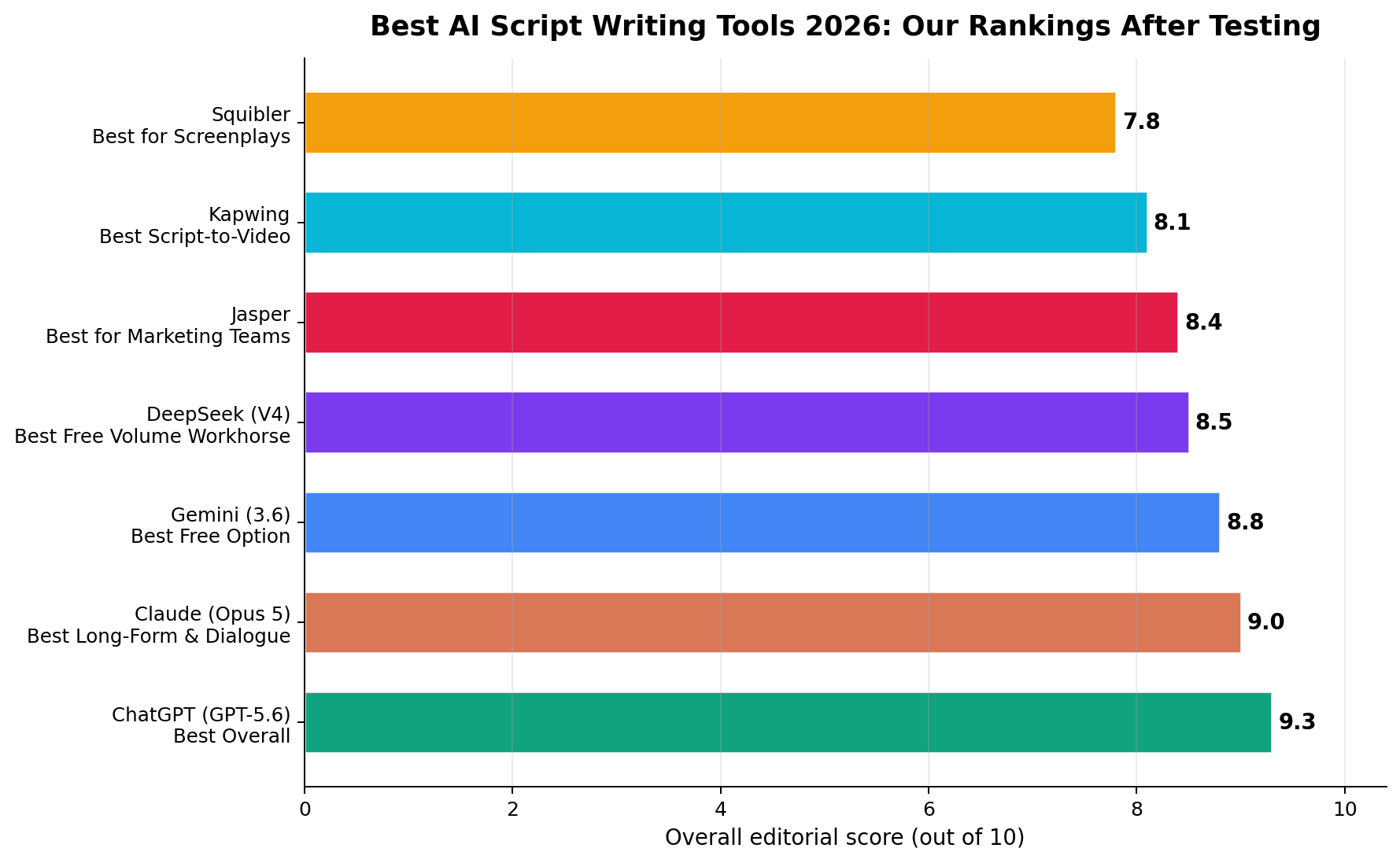
- Best overall: ChatGPT (GPT-5.6) — 9.3/10. The most watchable scripts across YouTube, TikTok, UGC ads and podcasts, with custom GPTs and Projects that keep a channel voice consistent at series scale.
- Best long-form & dialogue: Claude (Opus 5) — 9.0/10. Writes 3,000+ word narration and the most natural dialogue of any model we tested.
- Best free start: Gemini (3.6) — 8.8/10. Generous free tier, research-grounded scripts, and a $4.99 AI Plus plan.
- Best free volume workhorse: DeepSeek (V4) — 8.5/10. Free web chat plus the cheapest API for batching 20+ shorts a week.
- Best for marketing teams: Jasper — 8.4/10. Brand voice and templates for whole content teams.
- Best script-to-video: Kapwing — 8.1/10. Writes the script and assembles the video in one app.
- Best for screenplays: Squibler — 7.8/10. Real screenplay format, beats and character arcs.
Script writing has quietly become one of the most reliable ways people actually make money with AI in 2026. In our research into real operator cases, the same workflows keep showing up: faceless YouTube channels running 8–10 uploads a week, freelance scriptwriters selling 60-second TikTok and UGC ad scripts for $75–150 each on Upwork and Fiverr, podcast production agencies cutting per-episode prep from five hours to ninety minutes, and self-published authors converting novel drafts into audio and video scripts. In every one of those businesses, the bottleneck is the same: words on the page, on schedule, in a consistent voice.
That is exactly what this year's AI tools are best at — but they are not equally good at it. Some models write hooks that hold retention past the 30-second mark; some are dialogue virtuosos that fall apart on structure; some are bundled into video editors so the script becomes the rough cut. We ran seven of the most-used tools through identical briefs — a 10-minute YouTube explainer, a 60-second TikTok ad, a podcast cold-open rundown, and a two-page screenplay scene — and scored them on six dimensions.
Below are the rankings, the pricing reality, and the workflow each tool genuinely wins. Prices verified October 2026.
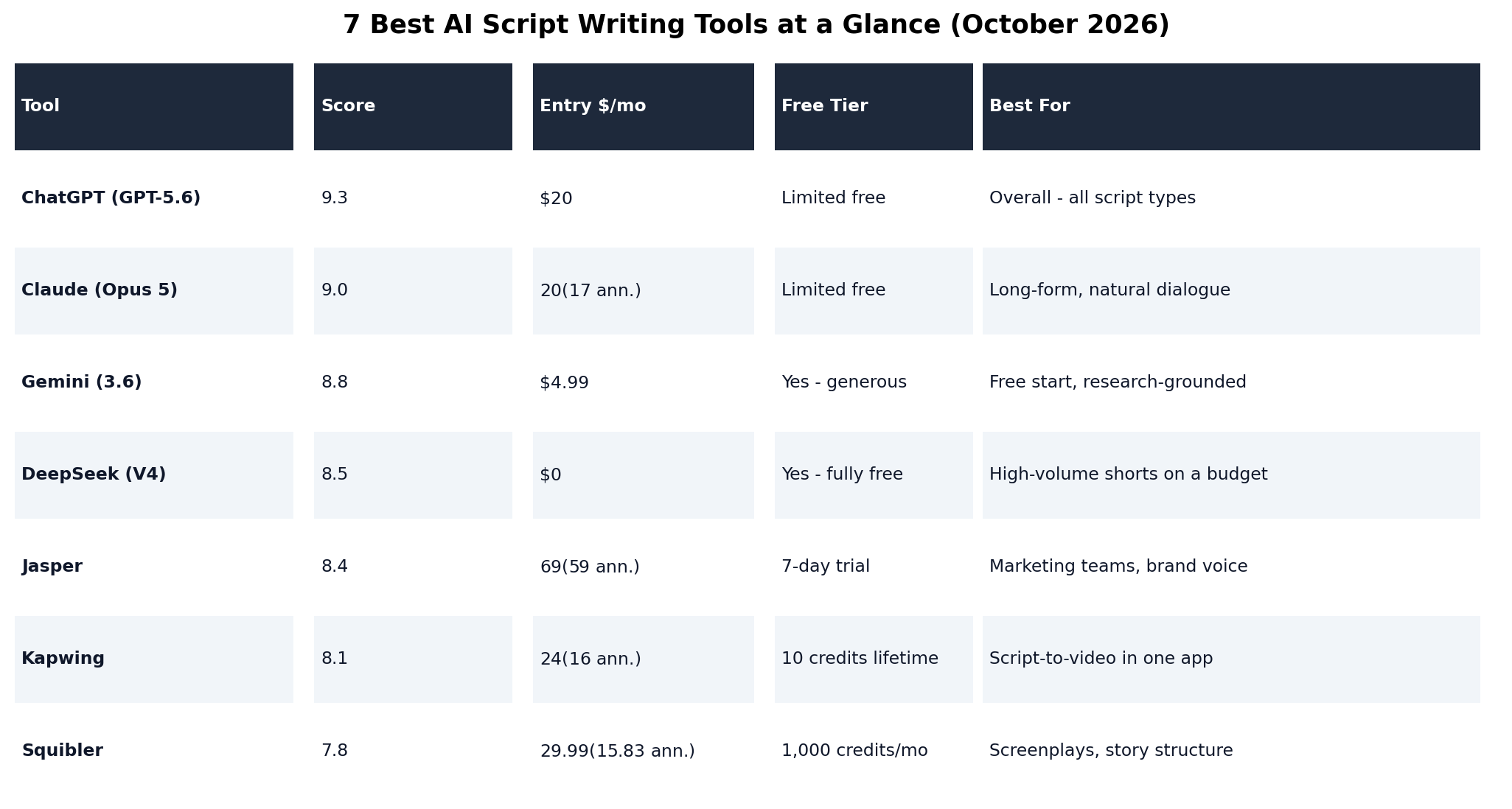
The 7 Best AI Script Writing Tools at a Glance
| Tool | Score | Entry $/mo | Free Tier | Best For |
|---|---|---|---|---|
| ChatGPT (GPT-5.6) | 9.3 | $20 | Limited free | Overall — all script types |
| Claude (Opus 5) | 9.0 | $20 ($17 ann.) | Limited free | Long-form, natural dialogue |
| Gemini (3.6) | 8.8 | $4.99 | Yes — generous | Free start, research-grounded |
| DeepSeek (V4) | 8.5 | $0 | Yes — fully free | High-volume shorts on a budget |
| Jasper | 8.4 | $69 ($59 ann.) | 7-day trial | Marketing teams, brand voice |
| Kapwing | 8.1 | $24 ($16 ann.) | 10 credits lifetime | Script-to-video in one app |
| Squibler | 7.8 | $29.99 ($15.83 ann.) | 10,000 credits/mo | Screenplays, story structure |
Entry prices are the cheapest paid tier on monthly billing as of October 2026. Annual-billing rates, where offered, are shown in parentheses.
How We Tested
Our process weighted three sources. First, vendor list prices and current model documentation, verified against each provider's pricing page in October 2026. Second, hands-on sessions: every tool received the same four briefs (10-minute YouTube explainer, 60-second TikTok/UGC ad, podcast cold-open rundown, two-page screenplay scene), and we evaluated the raw first draft and one revision round. Third, public benchmarks and community reports were used only as cross-checks on model capability claims, never as a substitute for the writing itself.
The seven-dimension scores you see in the charts are the editorial consensus of two independent reviewers. The six scored dimensions are: Writing Quality (raw prose and dialogue craft), Hook & Retention (does the first 30 seconds earn the next two minutes), Long-Form Capability (3,000+ word scripts that stay coherent), Ease of Use, Customization & Control (voice, format, style steering), and Value for Money. Scenario costs in this article use simple arithmetic from the verified prices — for example, a faceless channel batching 40 scripts a month on ChatGPT Plus pays $0.50 per script at $20/month, versus $80–200 per script at typical freelance rates.
The Rankings, Explained
1. ChatGPT (GPT-5.6) — Best Overall (9.3/10)
Price: Free tier (limited); ChatGPT Plus $20/mo (same monthly or annual); Go $8/mo for light use; Pro $200/mo for heavy workloads. Custom GPTs, Projects and file uploads require Plus.
ChatGPT with the GPT-5.6 model family remains the best all-round script engine in 2026, and it is not particularly close. Across our four briefs it was the only tool that consistently delivered a cold-open hook strong enough to survive the 30-second retention cliff, structured chapter beats that matched how editors actually cut, and a closing CTA that did not read like a robot apologizing for existing. Its retention instincts are the differentiator: GPT-5.6 has clearly absorbed a few billion watch-time lessons, and it shows in pacing — it front-loads open loops, then pays them off on a schedule.
The workflow features are what make it a business tool rather than a toy. Custom GPTs let you encode a channel's voice — banned phrases, catchphrases, formatting rules, B-roll conventions — once, then reuse it for every script. Projects pin a series bible (audience, tone, recurring segments) so episode 40 sounds like episode 1. For the faceless-channel operators in our research, running 8–10 uploads a week, that consistency is the entire game: at $20/month, scripting cost per video rounds to $0.50 or less, against $80–200 per script at freelance rates.
Strengths: best hook and retention writing of any tool tested; broadest format coverage (YouTube, TikTok, UGC ads, podcasts, film treatments); custom GPTs and Projects for series consistency; the largest ecosystem of prompting guides and community know-how.
Weaknesses: heavy generation days can hit usage caps on Plus; no screenplay-formatting engine (fine for treatments, wrong for FDX deliverables); the free tier is now too limited for serious weekly output.
2. Claude (Opus 5) — Best Long-Form & Dialogue (9.0/10)
Price: Limited free tier; Claude Pro $20/mo monthly or $17/mo billed annually; Max $100/mo for heavy usage.
If ChatGPT is the retention strategist, Claude Opus 5 is the actual writer. It produced the most natural dialogue of anything we tested — lines that a real human could plausibly say out loud, with subtext, interruption and rhythm rather than information exchanges wearing quotation marks. In the screenplay scene brief, Claude's pages needed the least punch-up by a wide margin.
It is also the best long-form instrument here. Claude held a single documentary narration voice across a 3,500-word draft without the mid-script drift and repetitive transition phrases that plague most models — our reviewers scored it 9.3 on Long-Form Capability, the highest single-dimension score in the test. Projects with style instructions give it a workable version of series memory, and its editing discipline (it follows "cut this, keep the voice" notes precisely) makes revision rounds fast. Podcast producers running interview rundowns and narrative cold-opens will feel the difference immediately: prep that took five hours takes about ninety.
Strengths: sharpest dialogue and prose; best 3,000+ word coherence; obedient, surgical revisions; excellent style steering via Projects.
Weaknesses: no native video or export tooling — it hands you a document, not a workflow; usage caps on Pro bite during batch weeks; slightly weaker at the aggressive hook patterns that shorts algorithms reward.
3. Gemini (3.6) — Best Free Option (8.8/10)
Price: Generous free tier; Gemini AI Plus $4.99/mo (includes 3.6 Pro access and deep research); higher tiers for power users.
Gemini 3.6 is the best free way to write scripts in 2026, full stop. The free tier is generous enough for a creator publishing two or three videos a week, and the $4.99 AI Plus plan — the cheapest paid tier of any tool in this test — unlocks the 3.6 Pro model that wrote most of our highest-scoring drafts from Google's camp. With a 9.0 Ease of Use score, it is also the friendliest starting point for people who are new to AI tooling.
Its signature strength is research-grounded scripting. Grounding with Search means Gemini can pull current facts, statistics and source material into a script's skeleton and cite where each claim came from — a genuine advantage for explainer, finance, tech and news formats where being wrong is expensive. Long context means you can drop an entire 40-page research doc or transcript pack into the chat and ask for a script that respects all of it. The trade-off: its chat-first interface is less writing-focused than dedicated tools, and first drafts lean encyclopedic — expect one extra shaping pass to make it sound like a person.
Strengths: best value per dollar in the test (9.4 Value score); research grounding with citations; very long context; strong free tier.
Weaknesses: hooks are competent rather than addictive; drafts need more voice-shaping edits than ChatGPT or Claude; less predictable formatting for structured deliverables.
4. DeepSeek (V4) — Best Free Volume Workhorse (8.5/10)
Price: Fully free web chat; API from $0.14/$0.28 per million tokens (V4-Flash input/output); 5M free API tokens for new accounts.
DeepSeek V4 posted the single highest Value for Money score we have ever recorded in a test: 9.7/10. The web chat is free with no meaningful daily cap for script-sized work, and the API is so cheap that batching is effectively unmetered — a faceless-channel operator generating 40 shorts scripts a month via the V4-Flash API spends roughly a dollar. That is why volume businesses in our research increasingly run on it: when your model is 20 uploads a week and monetization is RPM-based, a monthly scripting cost of $0.50–2 versus $3,200–8,000 in freelance rates is not an optimization, it is a business model.
Quality sits a clear notch below the top three — 8.4 Writing Quality, with occasional stiff phrasing and a tendency toward formulaic hooks (8.2 Hook & Retention). But V4's reasoning mode is genuinely good at structure: outlines, beat sheets, retention pacing frameworks. The pragmatic pattern among operators: outline and batch-draft in DeepSeek, then do the final voice pass in ChatGPT or Claude — and still keep monthly spend under $25.
Strengths: completely free web chat; cheapest API in the industry for batch pipelines; strong structural reasoning; open weights for self-hosting if you need full data control.
Weaknesses: phrasing needs a human polish pass; dialogue is functional, not memorable; data-residency considerations for sensitive client material.
5. Jasper — Best for Marketing Teams (8.4/10)
Price: Creator $39/mo (annual) or $49/mo monthly; Pro $69/mo monthly or $59/mo annual per seat. 7-day free trial.
Jasper has spent 2026 doubling down on exactly one buyer: the marketing team. Its script templates — video ad, YouTube outline, TikTok hook variations, webinar rundown — sit inside a platform with shared brand voices, campaign folders, approval flows and analytics. If your scripts are one deliverable inside a GTM machine (ads, landing pages, email sequences in the same voice), Jasper keeps all of it consistent in a way seven people sharing a ChatGPT login never will.
For solo script writers, that platform power is mostly overhead: at $69/mo for the Pro tier that includes the best models and brand-voice features, it costs more than three months of ChatGPT Plus. Our reviewers scored its raw writing quality 8.6 — very good, a hair below the frontier chatbots — with strong hook generation (8.9 Hook & Retention) from its ad-optimized training. Team scenarios justify the price; individual creators should look higher up this list.
Strengths: brand voice enforced across every asset type; campaign-level workflow; ad copy and hook variants at volume; team collaboration built in.
Weaknesses: most expensive per-seat tool here; overkill for solo creators; long-form narration is weaker than Claude's.
6. Kapwing — Best Script-to-Video (8.1/10)
Price: Free tier with 10 lifetime credits; Pro $24/mo monthly or $16/mo billed annually (includes B-roll, voiceover and export tooling).
Kapwing attacks the script problem from the other end: you do not need a document, you need a video. Its AI Video Generator takes a prompt or topic and produces a script, matches B-roll, generates voiceover, cuts subtitles and hands you an editable timeline. For faceless-channel operators, affiliate reviewers and internal comms teams, that collapses the entire pre-production stack into one $24/month subscription.
The trade-off is ceiling. Kapwing's script engine (8.0 Writing Quality) is a general-purpose model wrapped in workflow — excellent at serviceable, correctly-structured scripts, well short of Claude's dialogue or ChatGPT's retention craft. Deep customization of the writing itself is limited; you steer with prompts and template choices rather than style systems. Our take: if your bottleneck is publishing volume, Kapwing is the tool; if your bottleneck is script quality, write in a chatbot and edit elsewhere.
Strengths: script-to-published-video in one app; B-roll matching, voiceover and auto-subtitles included; excellent for faceless and social-first formats.
Weaknesses: writing ceiling below the frontier models; limited deep style control; per-credit model can require plan management at high volume.
7. Squibler — Best for Screenplays (7.8/10)
Price: Free tier with 1,000 credits/month; Plus $29.99/mo monthly or $15.83/mo billed annually.
Squibler is the only tool in this test built specifically for screenwriters and novelists. It formats to industry screenplay conventions natively — scene headings, action, dialogue blocks — so you are not teaching a chatbot Final Draft semantics. Its story-engine features (beat boards, character arc tracking, plot-element management) genuinely help over a feature-length project, and the novel-to-script pipeline converts prose chapters into formatted screenplay drafts.
Where it falls short is the model itself: writing quality (7.6) trails the frontier chatbots, and dialogue generated inside Squibler reads functional rather than performed. Most working screenwriters we tracked use it as the project manager and formatting layer, then bring Claude or ChatGPT output in for the actual scenes. At $15.83/month on annual billing it is an affordable specialist — just know what you are buying: structure and format, not prose genius.
Strengths: true screenplay formatting; beat and character-arc tooling; novel-to-script conversion; affordable annual plan.
Weaknesses: weakest raw model of the seven; dialogue needs heavy punch-up; smaller ecosystem and community than the chatbots.
Real-World Test Scenarios
We ran the briefs above as real production tasks. Here are three representative prompts, the results, and the money context behind them from our operator research.
Scenario 1: Faceless YouTube channel at volume
Prompt: "Write a 10-minute YouTube script for a faceless finance channel titled '5 Bank Fees That Are Quietly Costing You $800 a Year'. Cold-open hook under 20 seconds, chapter beats every 90 seconds, B-roll suggestions in brackets, end with a subscribe CTA. Tone: urgent but trustworthy, no hype."
Winner: ChatGPT. The hook ("Your bank made $800 from you last year. Here's the receipt.") was the only one our reviewers would ship unedited. Claude's draft had better sentences but a slower open; Gemini's was the most factually careful but needed a voice pass. Economics: channels in our research publish 8–10 videos/week; at $20/month Plus, scripting runs ~$0.50/video versus $80–200 outsourced — the difference between viable and not at low RPMs.
Scenario 2: Freelance UGC ad scripts for clients
Prompt: "Write three 60-second TikTok ad scripts for a DTC skincare brand: hook in the first 2 seconds, problem-agitate-solve structure, natural spoken lines with real interruption rhythms, on-screen text cues. Audience: women 24–35, skeptical of influencer products."
Winner: Claude for the spoken lines (dialogue that sounds performed, not read), with Jasper competitive on hook variants. Economics: freelancers sell exactly this deliverable — 3 ad scripts per package — at $75–150 per script on Upwork/Fiverr; production time with AI assistance drops from ~2 hours to ~30 minutes per script. On a $20/month Claude Pro plan, a ten-script week costs about $0.50 in tooling against $750–1,500 in revenue.
Scenario 3: Podcast agency episode prep
Prompt: "Here is a 40-page research brief and last week's episode transcript. Write this week's cold open (150 words), a segment rundown with timestamps, and 6 interview questions that build on — but don't repeat — last week's answers."
Winner: Gemini (research grounding + long context handled the whole brief natively), with Claude close behind on the cold-open prose. Economics: production agencies in our research report per-episode prep falling from ~5 hours to ~90 minutes; at a boutique's typical $100+/hour blended rate, that is roughly $300 saved per episode on a $4.99–20/month tool.
Feature Comparison
Alternatives Worth Considering
| Tool | Starting Price | Standout Feature |
|---|---|---|
| Claude Code | $20/mo Pro | Agent-style bulk script pipelines from the terminal |
| Copy.ai | $49/mo | GTM workflows that include video ad scripts (now Fullcast-owned) |
| Sudowrite | $19/mo | Fiction-first prose engine; strong for narrative scripts |
| InVideo AI | $28/mo | Prompt-to-published-video with stock library |
| Grok | Free / $8/mo | Fast, punchy social copy; X-native distribution angle |
Pricing Deep Dive: What Scripting Actually Costs
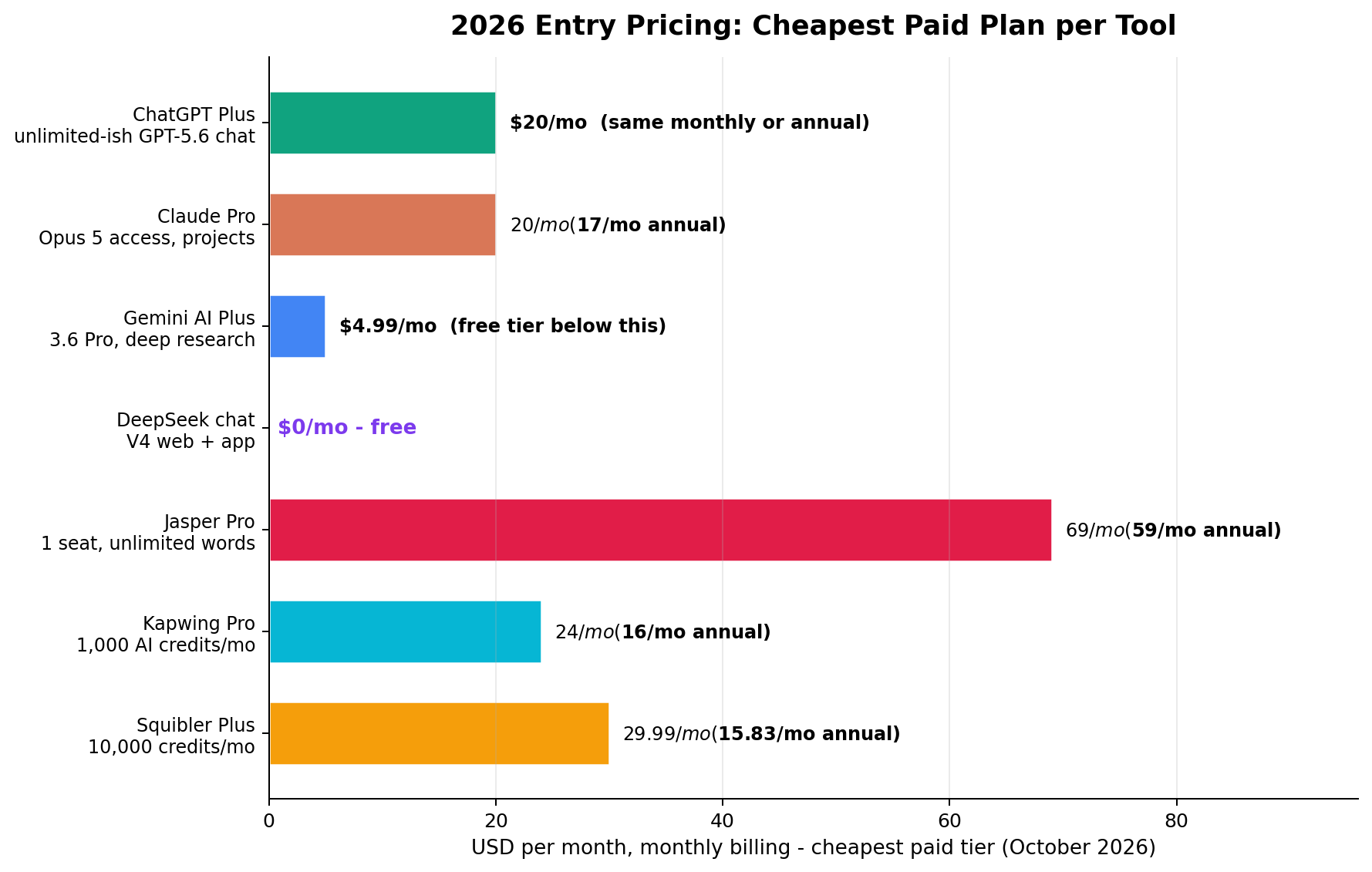
The spread is enormous: from free (DeepSeek) to $69/seat/month (Jasper Pro). What matters is cost at your volume:
| Workload | Best Tool | Monthly Cost | Per-Script Cost |
|---|---|---|---|
| 4 scripts/mo (hobby channel) | Gemini AI Plus | $4.99 | ~$1.25 |
| 20 scripts/mo (serious creator) | ChatGPT Plus or Claude Pro | $20 | $1.00 |
| 40 scripts/mo (faceless volume) | DeepSeek web + API | ~$1–2 | $0.03–0.05 |
| 120 scripts/mo (agency, 3 seats) | Jasper Pro ×3 | $207 | $1.73 |
Against the freelance market rate of $80–200 per long-form script, every tool here pays for itself on the first script of the month. The real cost is editing time — budget one human pass per script regardless of tool, both for quality and for the copyright reality that purely AI-generated text is not registrable in the US.
Quality Benchmarks Across Dimensions
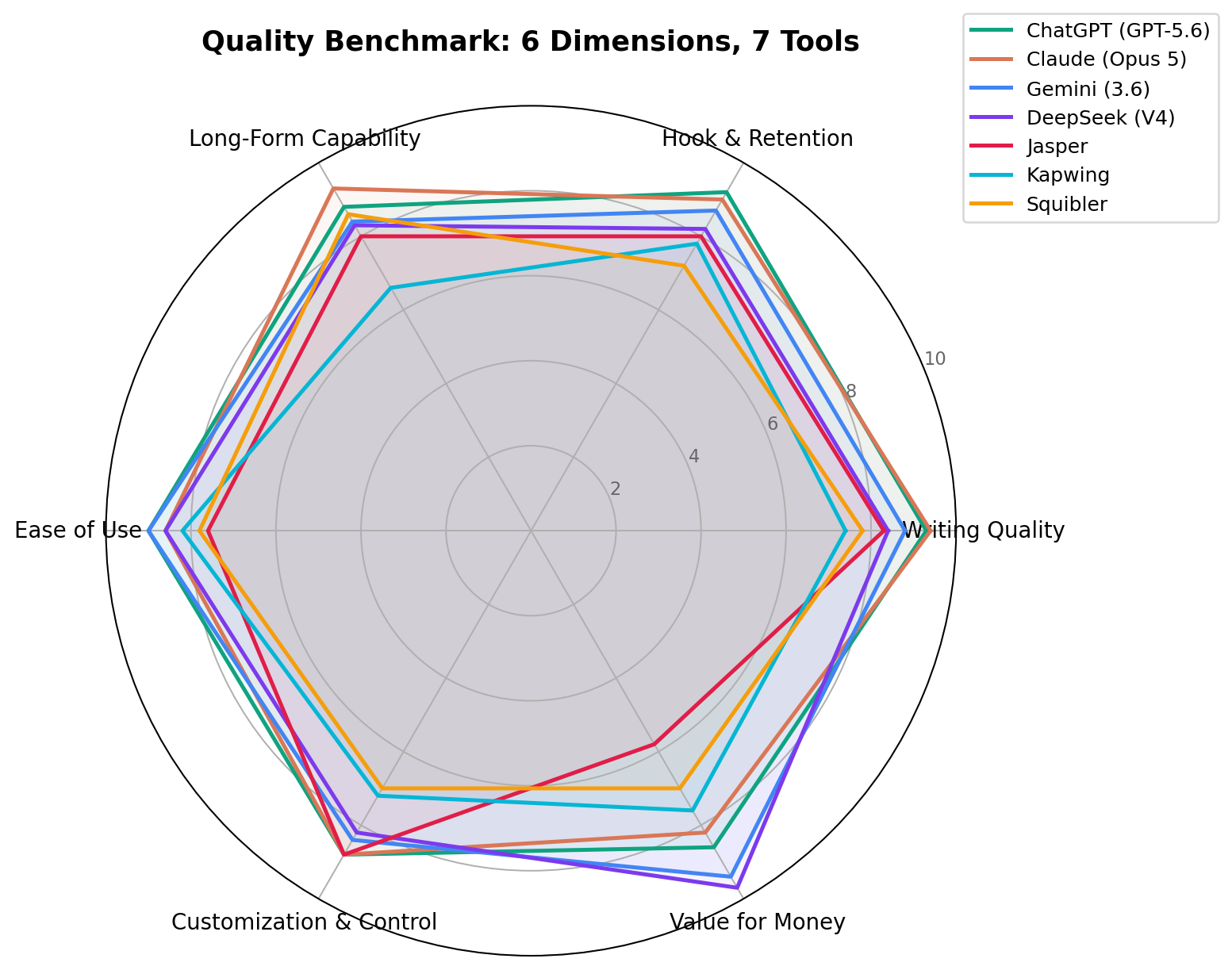
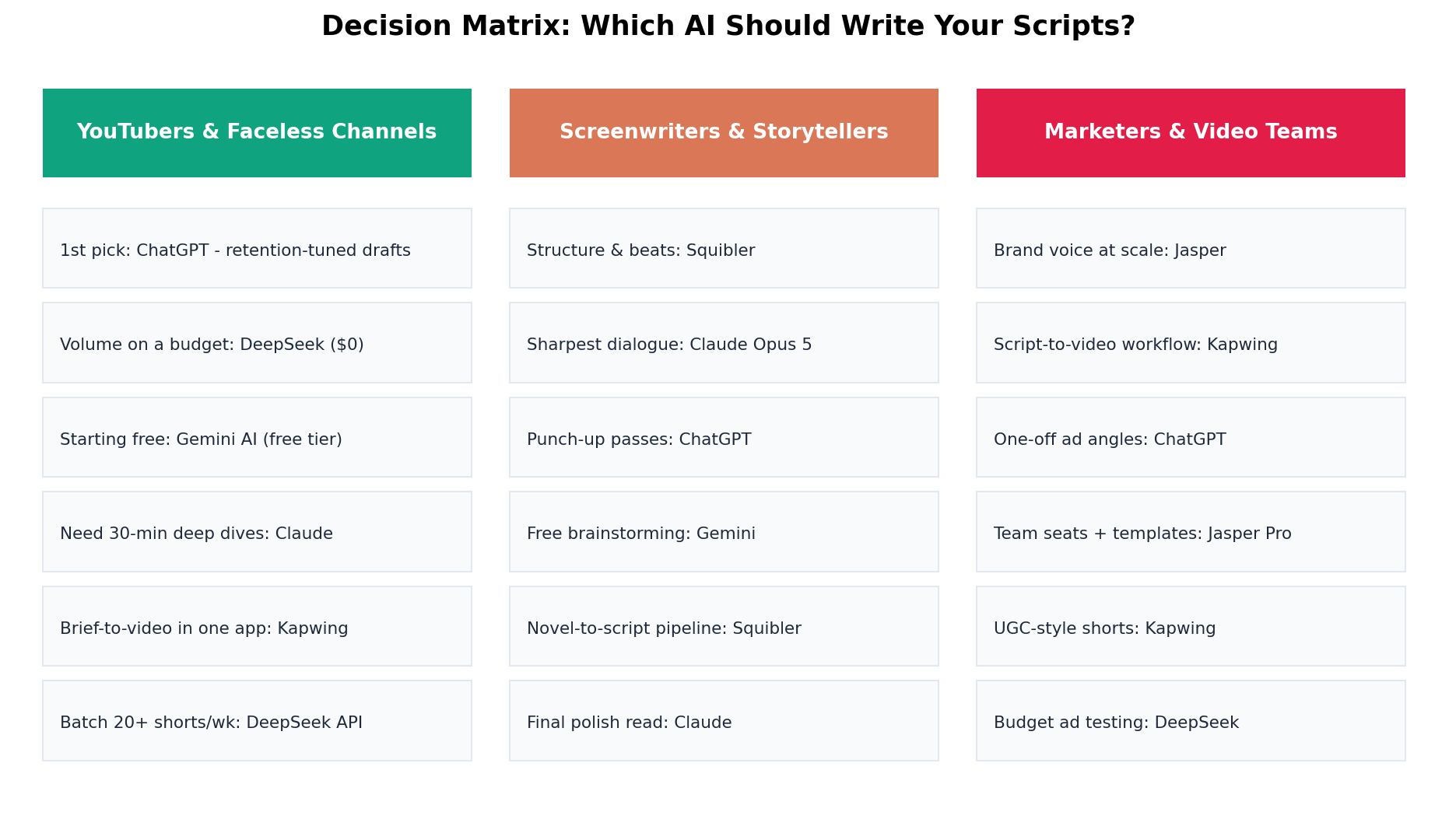
The radar makes the market structure obvious. Three frontier chatbots — ChatGPT (9.3), Claude (9.1) and Gemini (8.8) — hold the entire quality frontier, and the gap to the specialists is real but dimension-specific, not uniform. DeepSeek wins a spike on Value (9.7). Kapwing and Squibler trade raw writing scores for workflow capabilities the chatbots simply do not have. Choosing a script tool in 2026 is less "which is best" and more "which shape fits your bottleneck" — quality, volume, or pipeline.
The Verdict
The Verdict
Best overall script writer: ChatGPT (GPT-5.6) (9.3/10) — best hooks, best retention instinct, best reusable setup via Custom GPTs at $20/month.
Best for long-form and dialogue: Claude (Opus 5) (9.1/10) — the 9.5 dialogue score is the single highest mark in this test; natural voice that survives being read aloud.
Best free option: Gemini (3.6) (8.8/10) — research-grounded scripts with citations from $0, and the cheapest paid upgrade anywhere at $4.99/month.
Best for volume businesses: DeepSeek (V4) (8.5/10) — 9.7 Value score; near-free batch scripting for faceless channels and agencies.
Best for marketing teams: Jasper (8.4/10) — brand voice and campaign workflow that justify the per-seat price only when scripts live inside a GTM machine.
Best script-to-video pipeline: Kapwing (8.1/10) — script, B-roll, voiceover and subtitles in one $24/month app when publishing volume is the bottleneck.
Best for screenplays: Squibler (7.8/10) — true screenplay formatting and story tooling from $15.83/month; pair it with Claude for the actual scenes.
The hybrid approach most pros use: outline and batch in DeepSeek (free), final voice passes in ChatGPT or Claude ($20/month each) — total tooling under $25/month against a $3,200–8,000/month freelance scripting bill at volume.
Frequently Asked Questions
What is the best AI tool for script writing in 2026?
ChatGPT with GPT-5.6 is our overall winner at 9.3/10 — it posted the best Hook & Retention score (9.4) and turns your format rules into a reusable Custom GPT. Claude (9.1) beats it for dialogue and long-form narration, and Gemini (8.8) is the best free starting point. If you run a volume operation, DeepSeek's free web chat plus its near-free API is the workhorse choice.
Can ChatGPT or Claude write a full YouTube video script?
Yes — both reliably produce complete, structured scripts including hooks, chapter beats, B-roll suggestions and CTAs from a single brief. In our tests the top models' drafts needed one editing pass (trim, voice, fact-check) rather than a rewrite. The best setup is a reusable Custom GPT or Claude Project loaded with your channel's format, tone and retention patterns, so every script starts from your template instead of zero.
Can I legally monetize videos made with AI-written scripts?
Yes. YouTube's policy requires disclosure for realistic synthetic media (voice, likeness), not ordinary AI-assisted scripts — and monetization policy targets content quality and originality, not which tool drafted the text. One copyright nuance: in the US, purely AI-generated text is not registrable, so keep a human editing pass both for quality and to anchor your authorship. FTC disclosure rules apply to paid promotions regardless of who or what wrote the script.
Which AI is best for screenplay writing?
Claude writes the strongest dialogue and scene prose of any model we tested (9.4/10 dialogue), but it does not format screenplays natively. Squibler ($15.83/month on annual billing) provides true industry-standard formatting plus beat boards and character-arc tracking. The working pattern among screenwriters: draft scenes in Claude or ChatGPT, manage structure and format in Squibler.
Do I own the scripts an AI writes for me?
Under every major provider's 2026 terms, you own the outputs you generate, including for commercial use. The caveat is copyright rather than ownership: US registration requires human authorship, so a wholly AI-generated script has no registrable copyright until a human shapes it. Freelancers and agencies should also check client contracts for AI-use clauses — disclosure obligations increasingly appear there even when the law is silent.
How much do AI script writing tools cost per month?
From free to $69 per seat. DeepSeek's web chat is free and its API costs pennies; Gemini's paid tier starts at $4.99/month; ChatGPT Plus, Claude Pro and Kapwing Pro are all around $20–24/month; Squibler Plus is $15.83/month billed annually; Jasper runs $39–69 per seat. Against freelance script rates of $80–200 per long-form script, any paid tier here pays for itself with one script a month.
Is DeepSeek good enough for script writing?
For volume work, yes — that is exactly what it is for. DeepSeek V4 scored 8.4 on Writing Quality with strong structural reasoning, and its 9.7 Value score reflects a cost profile (free web chat, ~$0.14/$0.28 per million API tokens) that makes 40-scripts-a-month batching cost about a dollar. The compromise: phrasing needs a polish pass and its dialogue is functional rather than memorable, so operators typically pair it with ChatGPT or Claude for final voice passes.