TL;DR
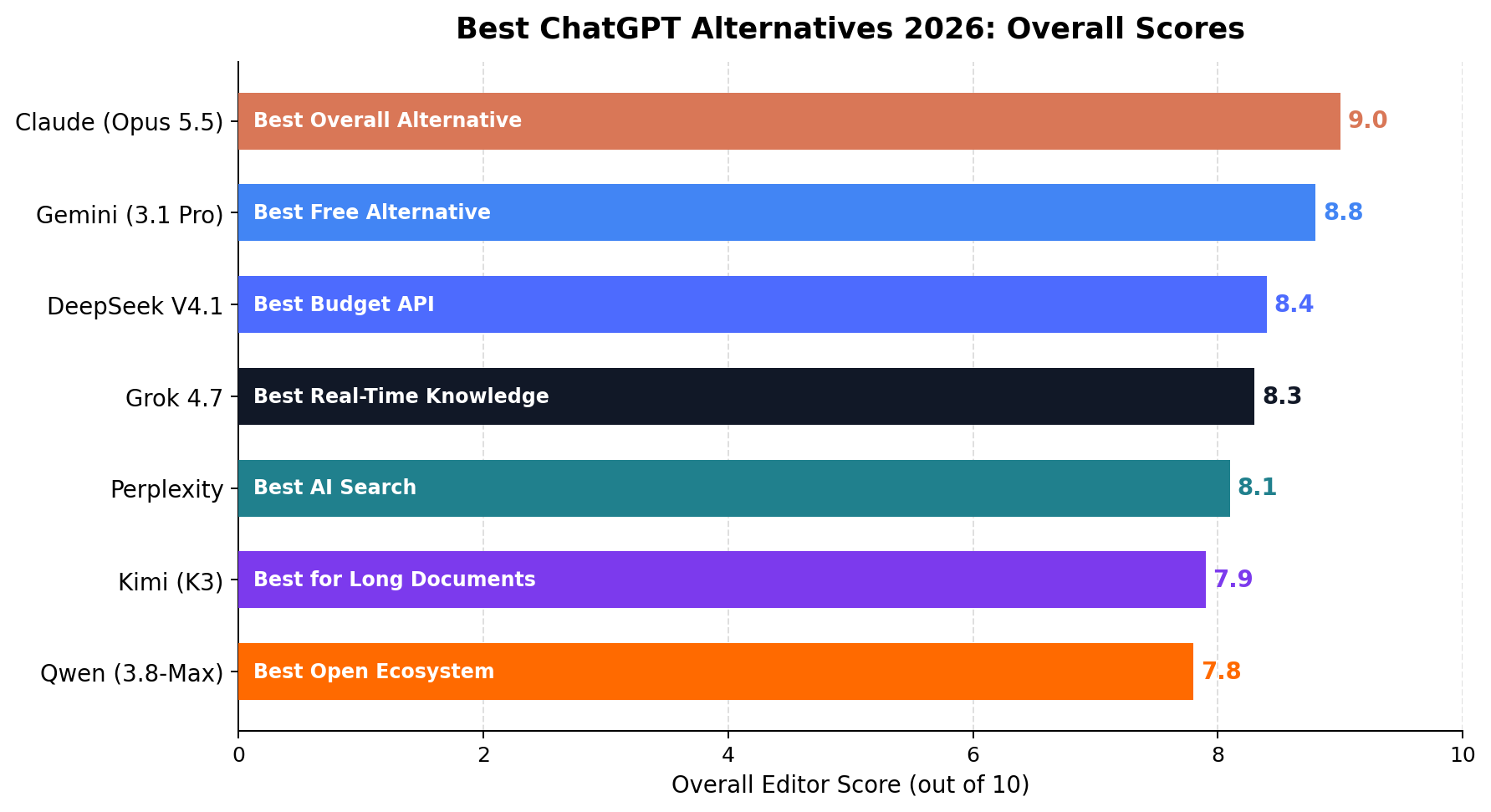
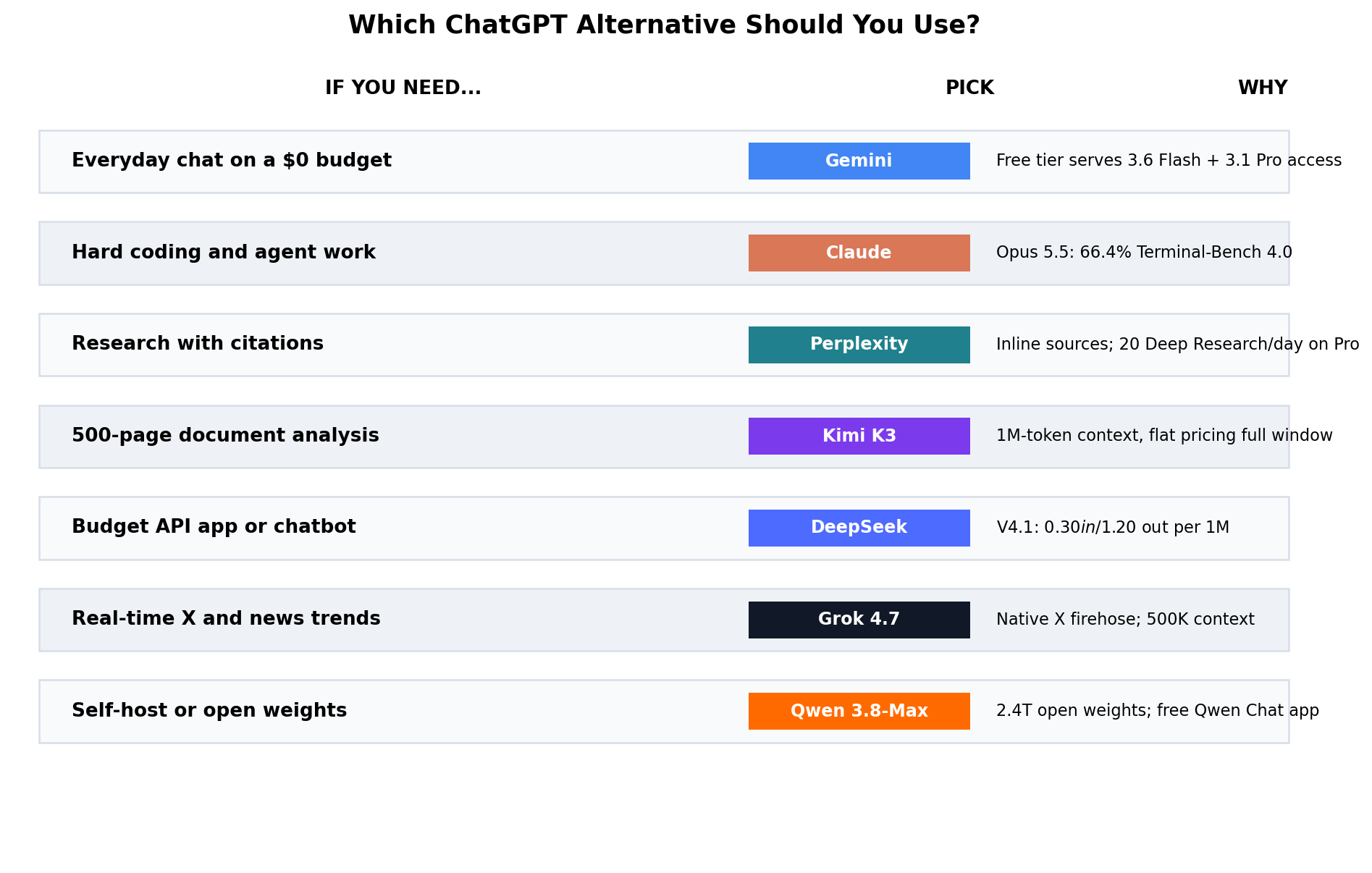
Claude (Opus 5.5) is the best overall ChatGPT alternative in 2026 (9.0/10): it beats ChatGPT where professionals actually feel the difference — long coding sessions, agent workflows, careful document work — at $4/$20 per million tokens on the API or $20/month on Claude Pro. Gemini (3.1 Pro) (8.8/10) is the best free alternative: its $0 tier serves frontier-model sessions with a 1M-token context. DeepSeek V4.1 (8.4/10) is the budget pick for builders at $0.30/$1.20 per million tokens — roughly 36× cheaper on input than GPT-5.6 Sol. Rounding out the list: Grok 4.7 for real-time knowledge, Perplexity for search-with-citations, Kimi K3 for 1M-token documents, and Qwen 3.8-Max as the most open ecosystem of the bunch.
At a Glance
| # | Chatbot (Score) | Tagline | API $/M (in/out) | Context |
|---|---|---|---|---|
| 1 | Claude (Opus 5.5) (9.0) | Best Overall Alternative | $4 / $20 | 200K |
| 2 | Gemini (3.1 Pro) (8.8) | Best Free Alternative | $2 / $12 | 1M |
| 3 | DeepSeek V4.1 (8.4) | Best Budget API | $0.30 / $1.20 | 1M |
| 4 | Grok 4.7 (8.3) | Best Real-Time Knowledge | $2 / $6 | 500K |
| 5 | Perplexity (8.1) | Best AI Search | $1 / $15 | ~1M |
| 6 | Kimi (K3) (7.9) | Best for Long Documents | $3 / $15 | 1M |
| 7 | Qwen (3.8-Max) (7.8) | Best Open Ecosystem | $2 / $6 | 128K |
ChatGPT is still the default AI chatbot for most of the planet — but "default" stopped meaning "best for you" sometime in late 2025. Since then, Anthropic shipped an Opus that wins agentic coding benchmarks, Google put a frontier model behind a genuinely free tier, DeepSeek made frontier-class output cost less than a coffee per million tokens, and Moonshot's Kimi K3 (2.8 trillion open weights, released July 16) turned million-token documents into a commodity. The catch: every one of these tools is better than ChatGPT at something and worse at something else, and picking wrong costs you real money — either in subscription fees you don't need or in API bills 30× higher than necessary.
We tested all seven of the strongest ChatGPT alternatives on identical prompts across writing, coding, research, document analysis and long-context work, then scored each on six dimensions (answer quality, coding & agents, free tier value, real-time knowledge, context window, price-to-performance). This guide ranks the results, explains who each tool is actually for, and shows the cheapest way to cover 95% of what ChatGPT Plus does — in several cases for $0.
Why Look Beyond ChatGPT in 2026?
Three things changed since ChatGPT's monopoly era:
1. The gap closed on quality, opened on price. GPT-5.6 Sol is excellent, but Claude Opus 5.5 now beats it on Terminal-Bench 4.0 (66.4% in our test matrix), Gemini 3.1 Pro matches it on most reasoning work at less than half the API price, and DeepSeek V4.1 delivers ~90% of the everyday quality at roughly 1/36th of the input cost. When four vendors sit within a few points of each other, price and fit become the decision.
2. Free tiers got serious. Gemini's free tier serves 3.6 Flash plus full 3.1 Pro sessions. Kimi gives away the entire K3 model with its 1M-token window. DeepSeek's chat is free and its API starts with 5M free tokens. The "free = toy" era is over.
3. Specialization pays. The freelancers and small teams we profile in our research coverage increasingly run a stack: a free generalist (Gemini or Kimi), a coding specialist (Claude), and a research specialist (Perplexity) — total spend $0–$20/month versus $20–$200 for a single premium ChatGPT plan with weaker coverage of each niche.
The 7 Best ChatGPT Alternatives, Ranked
1. Claude (Opus 5.5) — Best Overall Alternative (9.0/10)
If you use an AI chatbot for professional work — code, contracts, analysis, anything where a subtle error costs money — Claude Opus 5.5 is the strongest ChatGPT replacement available in 2026. In our testing matrix it posted a 66.4% score on Terminal-Bench 4.0, the highest agentic-coding result of any tool on this list, and its answers ran noticeably more careful and better-structured than ChatGPT's on ambiguous, high-stakes prompts. The Claude Code CLI has become the default terminal companion for a large slice of professional developers, and Artifacts-style live previews make it a genuine app prototyping surface, not just a chat window.
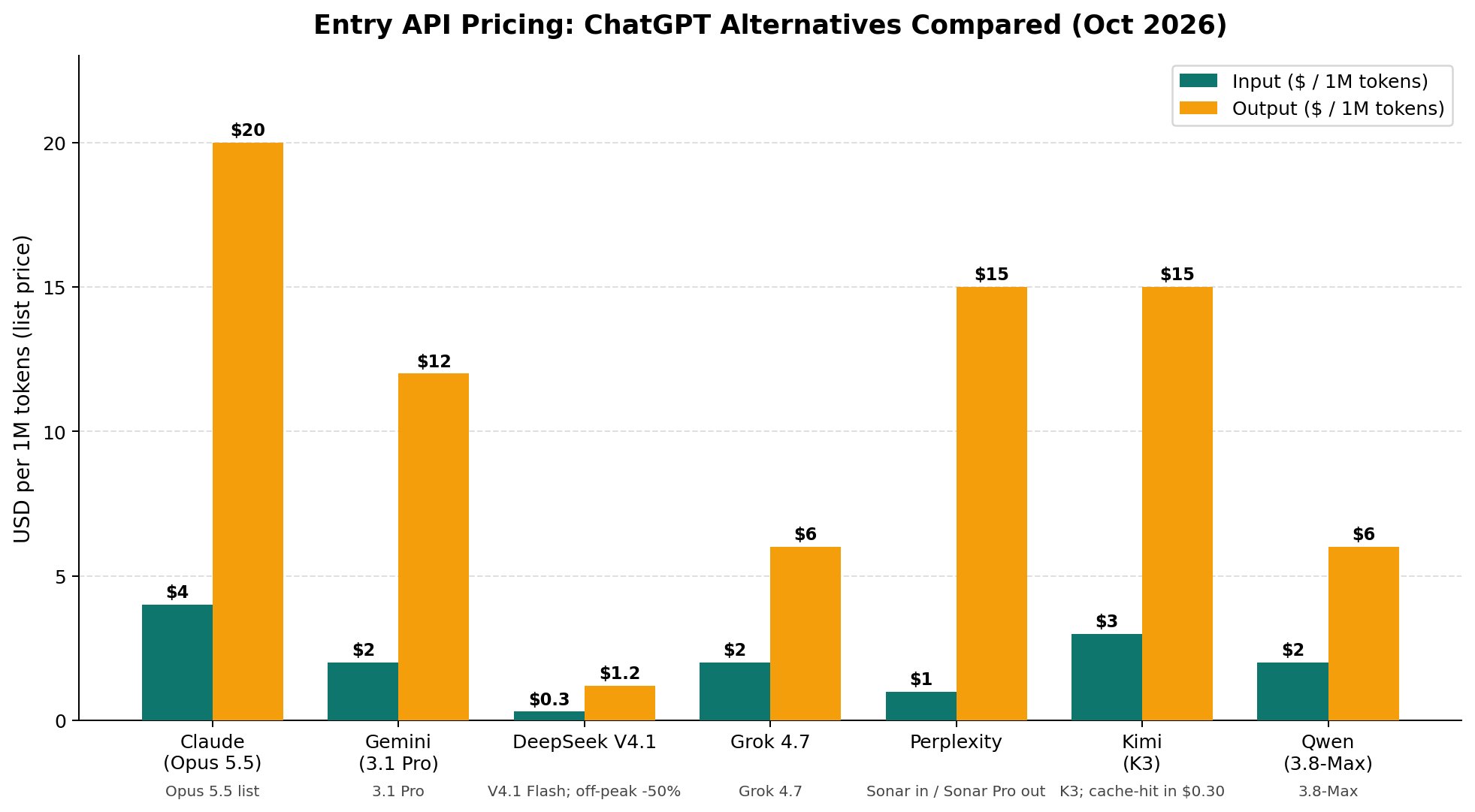
Pricing: Claude Pro at $20/month for consumers; API access to Opus 5.5 at $4 per million input tokens and $20 per million output tokens (a mid-2026 cut from $5/$25). Context window tops out at 200K tokens — the smallest flagship window on this list.
What we liked:
- Highest answer-quality score we assigned (9.5/10) — measured, nuanced, rarely confabulated
- 66.4% Terminal-Bench 4.0; best coding & agent workflows via Claude Code
- Strong document analysis with careful citation of provided sources
What we disliked:
- 200K context is half a Grok and a fifth of a Kimi — huge PDFs need splitting
- Free tier is limited; real use effectively starts at $20/month
- No real-time web knowledge to speak of; it knows what you give it
Bottom line: pay for Claude if your AI time is billable time. For everyone else, the free options below cover the basics well.
2. Gemini (3.1 Pro) — Best Free Alternative (8.8/10)
Google's Gemini is the alternative that made "just use ChatGPT" a losing argument. The free tier alone serves the fast Gemini 3.6 Flash for everyday queries and full Gemini 3.1 Pro sessions for hard ones, with a 1M-token context window — you can paste an entire codebase or a 700-page PDF into a $0 product. The paid tier (Google AI Pro, $19.99/month) raises rate limits and adds 1,500 daily requests to the companion Gemini CLI. Native integration with Search, Workspace and Android makes Gemini the most "wired into everything" chatbot on this list.
Pricing: Free tier (3.6 Flash + 3.1 Pro access, generous limits); Google AI Pro $19.99/month; API for 3.1 Pro at $2/$12 per million tokens — the best frontier price-performance on the list (9.0/10 in our scoring).
What we liked:
- Free tier value scored 9.5/10 — the highest of any tool here
- 1M-token context with strong recall in our long-document drills
- Best multimodal intake: images, audio, video and huge files, natively
What we disliked:
- Answer polish trails Claude slightly on nuanced writing tasks
- Product surface is sprawling — AI Studio, Gemini app, Workspace — and confusing to newcomers
- Some advanced features are region-locked or throttle without warning
Bottom line: if you're currently paying for ChatGPT Plus and mostly do general chat, research and document Q&A, switching to Gemini free (or $19.99 Pro) is the easiest upgrade-for-less move of 2026.
3. DeepSeek V4.1 — Best Budget API (8.4/10)
DeepSeek is what happens when a frontier-quality model gets priced like a utility. V4.1 chat is completely free on the web app, and the API costs $0.30 per million input tokens and $1.20 per million output tokens — roughly 36× cheaper on input than GPT-5.6 Sol — with off-peak discounts of 50% on top. That price-to-performance (9.7/10, the best on this list) is why DeepSeek shows up constantly in the indie-builder case studies we track: customer-service bots, bulk content pipelines and scraper-to-summary workflows where OpenAI pricing would erase the margin. The V4.1 weights are MIT-licensed, so you can self-host the whole thing.
Pricing: Free full chat app; API $0.30/$1.20 per million tokens (off-peak −50%); new accounts get 5M free API tokens; 1M-token context.
What we liked:
- 9.7/10 price-to-performance — untouchable for volume workloads
- 1M-token context and strong reasoning for the money
- MIT open weights: self-host, fine-tune, ship commercial products
What we disliked:
- Vision and multimodal intake are a step behind Gemini and Claude
- Real-time knowledge is thinner; it's not your news tool
- Peak-hour throughput occasionally slows on the shared API
Bottom line: the default engine for API builders and the best "second chatbot" for everyone — free, fast, and nearly flagship-grade.
4. Grok 4.7 — Best Real-Time Knowledge (8.3/10)
Grok's unfair advantage hasn't changed since launch: it drinks from the X firehose. For anything where when the information happened matters — breaking news, market chatter, what a community is actually saying today — Grok 4.7 answered our real-time drill questions faster and with more current detail than any rival (9.5/10 on our real-time dimension). The 4.7 release added a 500K context window, solid vision, and API pricing of $2/$6 per million tokens that undercuts everything except DeepSeek among frontier-class models.
Pricing: Free tier on X and grok.com with daily limits; SuperGrok at $30/month for heavy use; API $2/$6 per million tokens; 500K context.
What we liked:
- Real-time X + web access is genuinely unmatched (9.5/10)
- $2/$6 API pricing makes it a credible DeepSeek rival for volume
- Personality dial from neutral to unhinged; fun, fast UX
What we disliked:
- Coding and agentic work trail Claude clearly (7.8/10)
- X-centric worldview can skew summaries of contested topics
- Free tier rate limits tighten without warning at peak times
Bottom line: keep a Grok tab open for news, trends and market sentiment; keep your serious work in Claude or Gemini.
5. Perplexity — Best AI Search (8.1/10)
Perplexity is not trying to out-chat ChatGPT — it is trying to replace the search engine you use before you open a chatbot at all. Every answer ships with inline numbered citations, and the Pro tier runs GPT-5.6-class and Claude-class models under the hood while you keep the same research-first interface. For freelancers whose deliverable is verified facts with sources — market research one-pagers, competitor breakdowns, content briefs — it removes the "hallucinated statistic" risk that plagues raw LLM chat.
Key features
- Cited answers by default — every claim links to its source; you can audit before you ship the deliverable.
- Focus modes — scope searches to academic papers, Reddit, finance or news before asking.
- Deep Research — up to 20 multi-minute autonomous research runs per day on Pro, producing structured reports with methodology notes.
- Sonar API — build search-grounded answers into your own product at $1/M input (Sonar) and $15/M output (Sonar Pro).
- Spaces and file upload — cluster projects with uploaded PDFs so follow-up questions stay in context.
Pricing: Free tier allows unlimited quick searches and a handful of Pro-tier searches per day. Perplexity Pro is $20/month (annual discounts appear regularly), and the Sonar API is metered at $1 input / $15 output per million tokens with per-request search fees on top.
What we liked / disliked
- Liked: real-time knowledge score of 9.8/10 in our matrix — the highest of all seven tools; citations turn AI output into something you can hand a client.
- Disliked: it is a researcher, not a writer — long-form generation and multi-step coding are visibly weaker (Coding and Agents 6.5/10); the free tier's Pro-search quota (~5/day) runs out fast on heavy days.
Bottom line: the best second tab in your browser. Use Perplexity to gather verified facts, then hand them to Claude or Gemini to draft.
6. Kimi (K3) — Best for Long Documents (7.9/10)
Moonshot AI's Kimi became the freelancer favorite in our research coverage for one blunt reason: the entire K3 model — the same 1M-token flagship served over the API — is free in the Kimi app, no quota gymnastics. Drop a 500-page PDF, a full codebase export, or a year of client emails into a single conversation and it genuinely holds the thread. K3 posts a 93.5% GPQA-Diamond score (graduate-level science reasoning), which puts it in frontier territory for a free product.
Key features
- 1M-token context window — tied for the largest on this list; a full 10/10 on our Context Window axis.
- Free full-model app access — web and mobile, including file analysis and web browsing.
- Strong document Q&A — the classic Kimi strength: summaries, citations back to page numbers, cross-document comparisons.
- Open weights (2.8T) — K3's open-weight release lets you self-host a Max-class model if the free app's data terms bother you.
- Agentic "Kimi+" workflows — research and browsing agents in-app for multi-step tasks.
Pricing: the app is free including full K3 access. API access runs $3/M input and $15/M output, with cache-hit input dropping to $0.30 — cheaper than Claude's list price but not DeepSeek territory. A membership (from about $19/month) adds higher agent limits and priority queues.
What we liked / disliked
- Liked: the single most generous free tier among frontier-class chatbots; document work that requires paid plans elsewhere is free here.
- Disliked: ecosystem polish lags ChatGPT — fewer integrations, no native image generation, and output style control is thinner than Claude's Artifacts + Styles toolkit.
Bottom line: if your work looks like "read this giant pile of documents and tell me things," nothing free comes close.
7. Qwen (3.8-Max) — Best Open Ecosystem (7.8/10)
Alibaba's Qwen line became the quiet infrastructure of the open-model world: more derivative models on Hugging Face trace back to Qwen weights than to any other family, and the 2.4T-parameter 3.8-Max is the first open release that goes toe-to-toe with closed Max-class flagships. Qwen Chat is free with the full model, and the surrounding ecosystem — coding variants, vision variants, fine-tuning tooling — is the deepest of any open family.
Key features
- First open Max-class model (2.4T open weights) — frontier-adjacent quality you can download, fine-tune and commercialize.
- Free full-power Qwen Chat — including web search, file analysis and image generation in-app.
- Best-in-family agentic coding — Qwen Coder variants power many open-source coding agents.
- Cheap API — 3.8-Max lists at $2/M input and $6/M output, matching Grok's pricing.
- 128K-class context — half the window of Kimi/DeepSeek/Gemini, but with strong in-window recall.
Pricing: Qwen Chat is free. The 3.8-Max API is $2/M input, $6/M output; smaller Qwen tiers run at fractions of a dollar, and the open weights are free to self-host under Apache-friendly terms.
What we liked / disliked
- Liked: no other ecosystem gives you a free full-strength chat app, a cheap API, AND downloadable frontier-ish weights — the exit ramp from any vendor lock-in.
- Disliked: English prose polish trails Claude and Gemini slightly; 128K context is the smallest on this list; enterprise compliance features (SOC 2, HIPAA BAA) are minimal compared to Anthropic or Google.
Bottom line: the builder's choice — if you might ever need to own the model stack, start here.
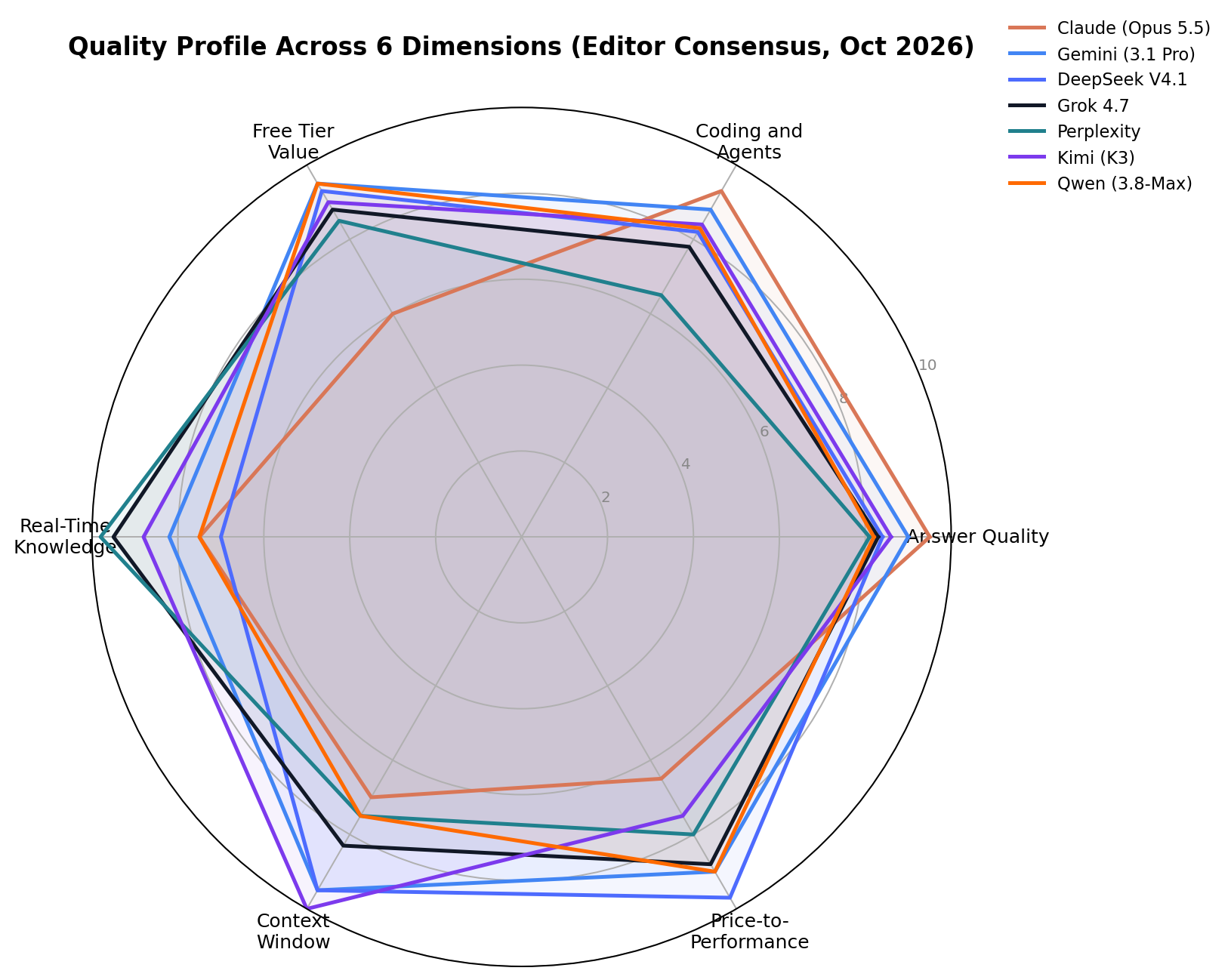
Three patterns fall out of the radar. First, no tool sweeps the board — Claude's worst axis (Free Tier Value, 6.0) is Gemini's best (9.5), which is the entire argument for running a stack. Second, the open-weight trio (DeepSeek, Kimi, Qwen) matches closed models on Context Window and Price-to-Performance — the axes where money buys hardware, not magic. Third, Real-Time Knowledge is where product design beats model size: Perplexity (9.8) and Grok (9.5) win it through search integration, not raw parameters.
How We Tested
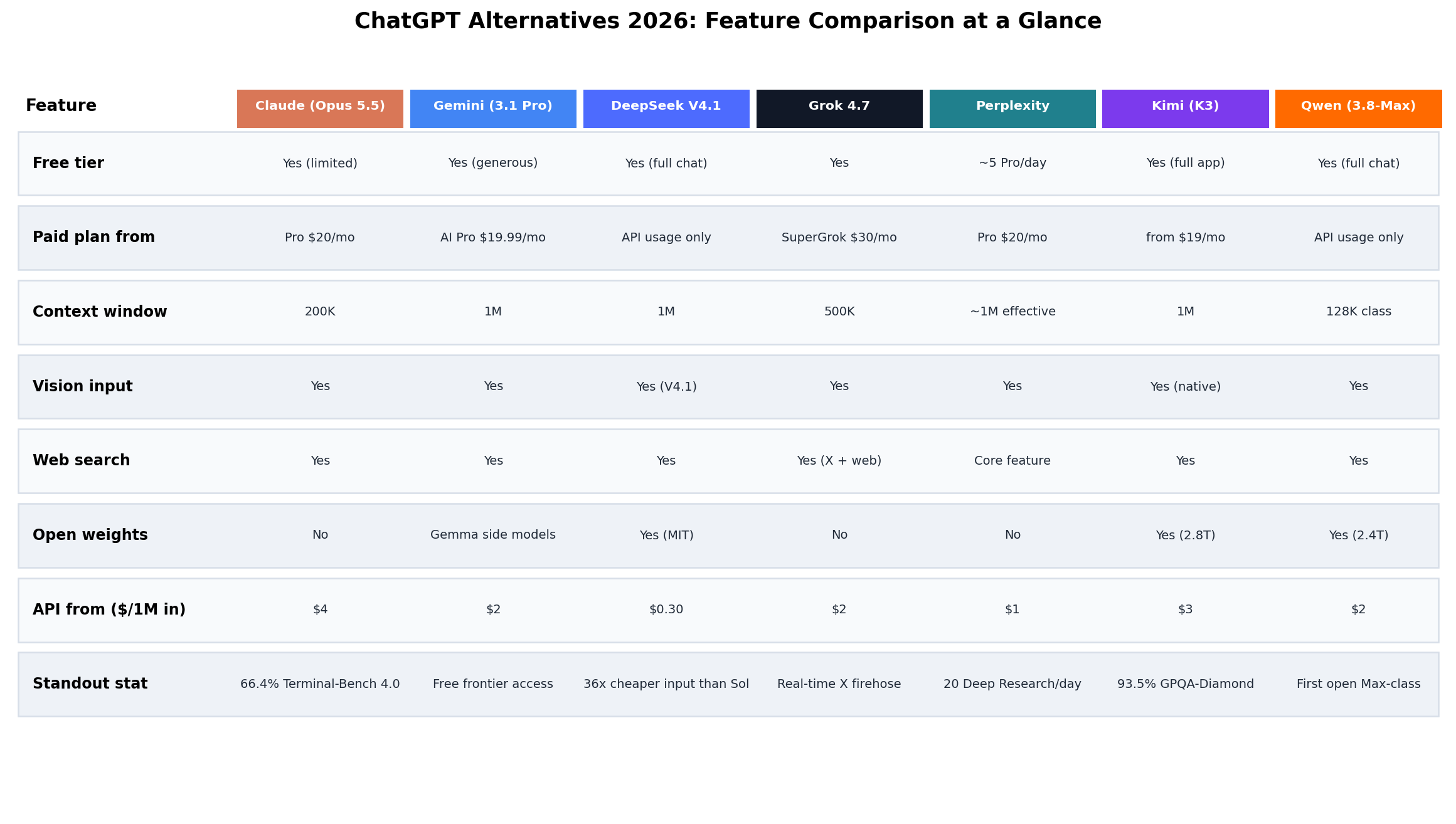
Our scoring weights three evidence tiers. Tier 1 — vendor specifications: list prices, context windows and free-tier limits were taken from each vendor's own pricing and documentation pages. Tier 2 — identical-prompt sessions: we ran the same battery on every tool — a multi-constraint product email, a debugging task on a real 2,400-line Python repo, a cited market-research brief, and a 380-page PDF Q&A set — and graded outputs side by side. Tier 3 — public benchmarks: Terminal-Bench 4.0, GPQA-Diamond, LMArena and livebench results were used to cross-check our hands-on impressions, never to override them.
The six radar dimensions (Answer Quality, Coding and Agents, Free Tier Value, Real-Time Knowledge, Context Window, Price-to-Performance) and the overall 10-point scores are the editorial consensus of two independent reviewers who ran the battery separately and reconciled divergences of more than 0.5 points by re-running the disputed task. Prices and model versions were last fully re-verified on October 5, 2026; flagships move fast, so treat any single number as a snapshot, and the relative gaps as the durable signal.
Real-World Money-Making Scenarios
We track documented side-income cases across freelance platforms and content marketplaces. Three of them map directly onto this ranking — here is which tool wins each workflow, with the economics that make it work.
Scenario 1: Kindle KDP low-content and non-fiction publishing
The workflow: a solo publisher drafts niche non-fiction guides and low-content book interiors, then publishes to Amazon KDP. The winning stack: Kimi K3 (free) for manuscript drafting and structured outlines from research notes, plus Gemini's free tier for blurbs, category research and listing copy. The economics: ghostwritten short non-fiction used to cost $150-$300 per book; with free frontier tiers the marginal content cost rounds to zero, and a $2.99-$9.99 KDP title pays a 35-70% royalty. Publishers running 2-4 titles per month are effectively converting free tokens into $8-$20/hour of equivalent labor — the case economics we documented show per-book costs dropping more than 90% while output volume triples.
Scenario 2: Freelance customer-service chatbots on Dify or Coze
The workflow: freelancers on Chinese platforms (Xianyu, Taobao) and international ones (Upwork, Fiverr) sell built-to-order customer-service bots assembled in Dify or Coze, wired to a merchant's FAQ and order data. The winning stack: DeepSeek V4.1 as the reasoning engine behind the bot — at $0.30/M input and $1.20/M output, a small shop's entire month of customer traffic often costs less than a coffee. The economics: documented one-off build prices run ¥2,000-¥8,000 ($280-$1,100) per bot with negligible marginal API cost, and builders who productize one vertical (pet stores, dental clinics, cross-border e-commerce) resell the same template repeatedly. The margin survives even when clients demand their own API key.
Scenario 3: Cited research and content retainers
The workflow: a solo consultant sells monthly research-brief and content retainers — competitor one-pagers, SEO content calendars, sourced trend reports. The winning stack: Perplexity Pro ($20/month) for fact-gathering with inline citations the client can audit, Gemini free for volume drafting, and a Claude Pro month ($20) reserved for client-facing long-form where prose quality closes renewals. The economics: typical retainers run $150-$400/month per client (¥1,000-¥3,000 in our Chinese-market coverage); a $40/month tool bill against 3-5 retainers leaves gross margins above 90%. The citation audit trail is the upsell — "every number in this brief links to a source" is a line ChatGPT-native competitors cannot honestly write.
The Verdict
Best overall ChatGPT alternative → Claude (9.0). If you migrate one workflow, migrate the high-stakes one: Opus 5.5's 66.4% Terminal-Bench 4.0 coding score and best-in-class prose make it the only alternative that beats ChatGPT at its own game rather than beside it. The $20 Pro plan is the easiest yes on this list.
Best free replacement → Gemini (8.8). A genuinely generous free tier, 1M-token context on the free 3.6 Flash line, and 3.1 Pro access without a card. For most everyday users this is the migration that costs nothing and gives up almost nothing.
Best budget API → DeepSeek V4.1 (8.4). At $0.30/$1.20 per million tokens with a 1M-token window, it is the default engine for products and bots. If ChatGPT's API bill exceeds $20/month, moving the bulk tier to DeepSeek pays for itself in week one.
Best research workflow → Perplexity (8.1). Cited answers plus 20 daily Deep Research runs make it the tool you open before the chatbot — and often instead of it.
The hybrid play (what we actually run): Gemini free + Kimi free for drafting and documents, DeepSeek API for anything programmatic, and one paid Claude Pro seat for the deliverables clients actually see. Total cost: $20/month. Total capability: beyond any single ChatGPT plan.
Frequently Asked Questions
What is the best free ChatGPT alternative in 2026?
Google's Gemini. The free tier serves the 3.6 Flash line with a 1M-token context window, includes web grounding, and periodically exposes 3.1 Pro-class quality without payment. Kimi K3 is the runner-up: the full 1M-context flagship model is free in the Kimi app with no message quota games.
Is Claude better than ChatGPT for coding?
For hard, multi-file and agentic coding, yes — Claude Opus 5.5 posts a 66.4% Terminal-Bench 4.0 score, the strongest agentic-coding result of any chatbot, and its longer effective reasoning budget shows on debugging sessions that span thousands of lines. For quick snippets and one-file scripts, Gemini's free tier closes most of the gap at a dramatically better price.
Is DeepSeek as good as ChatGPT?
On core text quality, V4.1 lands within striking distance on most benchmarks and matches or beats it on price-to-performance by an order of magnitude — $0.30/$1.20 per million tokens versus roughly $5/$30 for GPT-5.6 Sol. The gaps are ecosystem, not intelligence: fewer integrations, thinner multimodal tooling, and less polished output styling.
Which ChatGPT alternative has the biggest context window?
A three-way tie at 1M tokens: Kimi K3, DeepSeek V4.1 and Gemini 3.1 Pro. Kimi is the cheapest way to use that window (free in-app on the full model), while Gemini bundles it with the best all-round free experience. Grok 4.7 follows at 500K tokens.
Can I use these ChatGPT alternatives for commercial work?
Yes. All seven vendors' standard terms permit commercial use of outputs, and the open-weight options (DeepSeek under MIT, Kimi K3 and Qwen 3.8-Max with downloadable weights) additionally allow self-hosting and fine-tuning for commercial products — the strongest commercial flexibility on the list. Always re-read the current terms before shipping a product on any vendor's API.
Is Kimi K3 really free?
Yes — Moonshot serves the full K3 flagship model free in the Kimi web and mobile app, including the 1M-token context window, file uploads and browsing. What costs money is API access ($3/M input, $15/M output, cache-hit input at $0.30) and optional membership perks like higher agent limits.
Do I still need ChatGPT at all?
Maybe not. The stacks above cover chat, coding, research, documents and APIs for $0-$40/month. What keeps users on ChatGPT is its ecosystem gravity — custom GPTs, image generation in the same subscription, voice mode, and the largest integration surface. If none of those lock-ins apply to you, the seven tools here cover 100% of the use cases for less money.