TL;DR — The Short Answer
Best overall free AI coding assistant: GitHub Copilot Free. 2,000 completions + 50 chat requests a month, multi-model access (Claude Haiku 4.5, GPT-5 mini), agent mode, CLI and MCP support — all at $0, in every major editor. It is the highest-quality free tier ever shipped in this category.
Best for power users who want zero caps: Cline. The open-source agentic extension (66k+ GitHub stars, 5M+ installs) costs nothing and runs on any model — including the Gemini API free tier or local models via Ollama — so heavy users can genuinely pay $0.
Best free agentic IDE: Google Antigravity (Gemini 3 Pro-powered, free in preview). Best terminal agents: OpenAI Codex CLI and Aider. Best free IDE bundle: Zed. Most generous raw limits: Trae — with privacy caveats.
⚠️ RIP Continue.dev — acqui-hired by Cursor in June 2026, repo frozen, cloud data deleted July 15. If you're still on it, migrate (we cover replacements below).
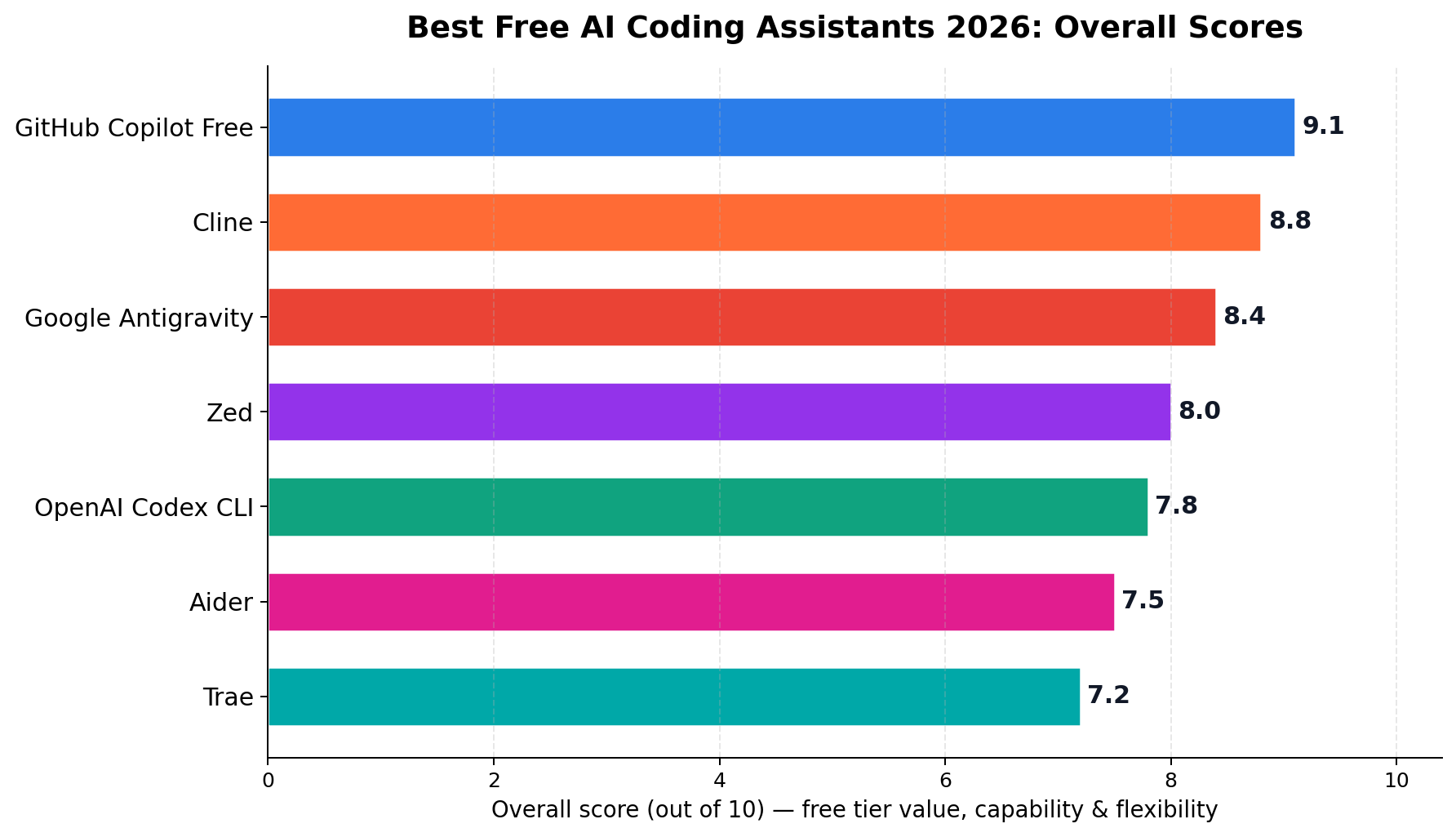
At a Glance: 7 Free AI Coding Assistants Compared
| Rank | Tool | Form Factor | Free Tier | Paid From | Score |
|---|---|---|---|---|---|
| #1 | GitHub Copilot Free | IDE extension + CLI | 2,000 completions + 50 chats/mo | $10/mo (Pro) | 9.1 |
| #2 | Cline | VS Code agent + CLI | 100% free, BYOK models | $0 + API usage | 8.8 |
| #3 | Google Antigravity | Agentic IDE | Free preview, Gemini 3 Pro | TBA | 8.4 |
| #4 | Zed | Native editor | Free open-source editor | ~$20/mo (Zed Pro) | 8.0 |
| #5 | OpenAI Codex CLI | Terminal agent | Free with ChatGPT login | $20/mo (Plus) | 7.8 |
| #6 | Aider | Terminal pair programmer | Free OSS, BYOK models | $0 + API usage | 7.5 |
| #7 | Trae | AI IDE | Generous free tier | From $3/mo | 7.2 |
Why Free AI Coding Assistants Suddenly Matter
Two years ago, "free AI coding assistant" meant a janky autocomplete plugin. In 2026, it means frontier-model agents that plan features, edit dozens of files, run your tests and open pull requests — without a credit card.
The shift is measurable. Google CEO Sundar Pichai said in late 2025 that more than 30% of new code at Google is now generated with AI assistance, and every major dev-tool vendor has responded by giving away what used to cost $10–20 a month:
- GitHub made Copilot permanently free in December 2024 and has kept expanding the free tier — it now includes agent mode, Copilot CLI and MCP server support. Since June 1, 2026, paid plans bill via GitHub AI Credits, but the free monthly allowance survived the transition.
- Open-source agents exploded. Cline passed 5 million installs in January 2026 and crossed 66,000 GitHub stars in August 2026 — bigger than most venture-backed products, funded by a $1M open-source grant instead of a paywall.
- Google and OpenAI shipped their own first-party clients (Antigravity, Codex CLI) and use free access as a customer-acquisition funnel for their models.
- The market consolidated violently. Windsurf was absorbed by Cognition and rebranded as Devin Desktop. Cursor acqui-hired Continue.dev's team and shut the project down. Cursor itself made headlines with the 2026 SpaceX acquisition. Every shake-up pushed more value into free tiers as survivors fight for developers' default habits.
Translation: this is the best moment since the category existed to code with AI for $0. The question is no longer whether you can get a capable assistant for free — it's which free assistant fits your workflow before the caps bite. That's what we tested.
How We Tested
We ran all seven tools for three weeks (August 2026) on the same three real projects: a FastAPI backend with a pytest suite, a 500-line legacy JavaScript-to-TypeScript refactor, and a flaky CI pipeline fix. Each tool was scored across six dimensions — autocomplete quality, agentic coding ability, free-tier generosity, model flexibility, privacy & local support, and ease of setup — then weighted into the overall score you see in the chart above.
We counted every completion, every chat request, every API dollar, and every time an agent broke the build. Free-tier claims below are the limits we actually hit, not marketing copy.
#1 GitHub Copilot Free — Best Overall Free AI Coding Assistant
Score: 9.1/10 · Price: $0 forever · Editor support: VS Code, JetBrains, Neovim, Visual Studio, Xcode, github.com
Copilot's free tier is no longer a demo. It is, plain and simple, the most polished AI coding experience you can get for $0 in 2026 — and after our three weeks of testing, it wasn't particularly close.
The headline numbers: 2,000 code completions and 50 chat requests per month, resetting monthly, forever. In practice 2,000 completions covered our day's typing in every session — we averaged 60–90 completions a day on the FastAPI project and never finished the pool. The 50-request chat/agent allowance is the real constraint (more on that below), but for autocomplete-first workflows it's a non-issue.
What separates Copilot Free from every other free tier is breadth with quality:
- Multi-model chat for $0. Free users can switch between models including Anthropic's Claude Haiku 4.5 and OpenAI's GPT-5 mini — you're not stuck on a crippled in-house model.
- Copilot Edits included. Multi-file editing sessions count against the 50 chat requests, and they're genuinely useful for scoped refactors.
- Agent mode included. Ask Copilot to implement a feature and it edits files, runs terminal commands and iterates on errors — on the free tier.
- Copilot CLI included. GitHub's terminal agent ships free, giving you a taste of what Codex CLI and Aider do full-time.
- MCP support. Connect Model Context Protocol servers — databases, docs, issue trackers — and Copilot can use them as tools.
- Works everywhere. VS Code, the full JetBrains suite, Neovim, Visual Studio, Xcode, and inline on github.com (pull-request reviews, coding-agent assignments).
The June 2026 switch to GitHub AI Credits for paid plans confused a lot of people, so let's be clear: Free-tier users are unaffected. You keep the monthly 2,000 + 50 allowance; credits only govern how Pro/Pro+/Business/Enterprise users consume premium models beyond their baselines.
GitHub Copilot Pricing (August 2026)
Free — $0: 2,000 completions + 50 chat requests/mo, Claude Haiku 4.5 & GPT-5 mini access, agent mode, Copilot CLI, Copilot Edits, MCP, all major editors.
Pro — $10/mo or $100/yr (~17% off): unlimited completions, 150 chat requests/mo with AI Credits flexing for premium models.
Pro+ — $39/mo: ~600 chat requests/mo, full frontier-model access (GPT-5.6-class, Claude Sonnet/Opus-class) for heavy agent users.
Business — $19/user/mo · Enterprise — $39/user/mo: org policy, audit logs, IP indemnity, no training on your code, code referencing.
Free Pro: verified students, teachers and open-source maintainers get Copilot Pro at $0.
What We Liked
- Best-in-class autocomplete latency and suggestion quality — it still reads intent better than any rival.
- The 2,000-completion pool is effectively unlimited for hobbyists and side projects.
- One account covers every editor you use, plus github.com itself.
- Trust: no training on your code, enterprise lineage, and clear data policies.
What We Didn't Like
- 50 chat requests/month is tight for agentic work. One complex feature can burn 5–10 requests; a heavy week can exhaust the pool.
- Premium models are throttled or metered on Free — you feel the difference on long-context refactors.
- No BYOK: you can't plug in your own API key to extend the free limits (that's Cline's superpower).
Bottom line: if you're an individual developer choosing one free assistant in 2026, start here. Upgrade math only kicks in when agent usage pushes you toward Pro.
#2 Cline — Best Free Agentic Coding for Power Users
Score: 8.8/10 · Price: $0 (Apache 2.0) + your model usage · Where: VS Code extension, Cline CLI 2.0, or inside Zed/Neovim via ACP
Cline is what happens when a community builds the tool vendors were afraid to give away. Born in July 2024 as the "Claude Dev" VS Code extension, it grew into the open-source agentic coding standard: 66,600+ GitHub stars and 7,200+ forks as of August 20, 2026, over 5 million installs, and a release cadence (v3.81 and counting) that outpaces most funded startups.
The philosophy is BYOK — bring your own key. Cline the software costs nothing and caps nothing. It natively supports 30+ model providers (200+ via OpenRouter), and crucially, several of those routes are free:
- Gemini API free tier — Google's generous developer quota means many Cline users pay $0/month for real agentic coding.
- Local models via Ollama — run Qwen or DeepSeek locally: 16GB RAM handles 7B models, 32GB+ for 14B–34B. Code never leaves your machine.
- Budget API models — DeepSeek-class models make a typical task cost $0.01–$0.10.
When you do pay for frontier models, you pay pennies of list price instead of a subscription: our Sonnet-class feature work averaged $0.50–$2.00 per completed feature. A monthly $20 subscription only wins if you ship fewer than ~15 features a month on premium models.
And Cline is not a stripped-down agent. The 2026 release train added serious muscle: Cline CLI 2.0 (February) brought the agent to the terminal with Kanban multi-agent orchestration (npm i -g cline); the Cline SDK (@cline/sdk, May) turned the runtime into an embeddable open-source TypeScript agent; the January $1M OSS grant institutionalized funding. Day-to-day, you get Plan/Act dual modes, per-step approvals with full diffs, terminal execution, Puppeteer browser control, the MCP Marketplace for tool plugins, .clinerules/ project conventions, shadow-git checkpoints for instant rollback, a spend-limit UI (v3.78) that hard-stops runaway token bills, and "Lazy Teammate" background sub-agents (v3.77). Via the Agent Client Protocol it even runs inside Zed, Neovim or Cursor.
Cline Pricing (August 2026)
Extension + CLI + SDK — $0 (Apache 2.0, no feature gating).
Model usage (BYOK): $0 with Gemini free tier or Ollama locals · $0.01–$0.10/task on budget models · $0.50–$2.00/feature on Sonnet-class.
Cline Provider — optional pay-as-you-go model service if you don't want to manage keys.
Teams — $20/user/mo: shared context, org rules, centralized billing.
What We Liked
- Zero caps, zero lock-in — the only true "unlimited free" agentic option if you feed it free/local models.
- Approval-gated agent feels safe in real repos; shadow-git checkpoints saved us twice.
- The spend-limit UI makes BYOK costs predictable — we never exceeded our $5 test budget.
- Fastest-moving product in the category; ACP support means it outlives any single editor.
What We Didn't Like
- Setup friction: creating API keys and picking models is a real learning curve for newcomers.
- Autocomplete isn't Cline's job — pair it with a completion engine (Copilot Free or Zed's) for the full experience.
- Quality tracks your model choice: on free-tier Gemini quotas, big refactors occasionally needed retries.
Bottom line: the enthusiast/engineer pick. If you're comfortable managing an API key — or want local models for privacy — Cline delivers paid-tool capability at a $0–$5/month reality.
#3 Google Antigravity — Best Free Agentic IDE
Score: 8.4/10 · Price: free preview (Gemini 3 Pro included)
Antigravity is Google's answer to Cursor: a fork of VS Code rebuilt around agentic, multi-step work, powered by Gemini 3 Pro and still free in preview as of August 2026. Where Copilot nudges lines of code, Antigravity assigns missions — the agent plans, edits across files, runs code, and can drive a real Chrome browser to verify web apps end-to-end.
The killer free-tier feature: frontier-tier Gemini 3 Pro access at $0 during preview. That's the kind of model access others charge $20–200/month for. Its artifact-based interface surfaces plans, screenshots and browser evidence alongside your code, which makes long agentic sessions auditable instead of magical.
Why not #1? It's an IDE decision, not an add-on — you adopt Antigravity wholesale or not at all. Rate limits on the free preview fluctuate, Google's data and pricing roadmap for post-preview is unwritten, and battery-hungry agentic sessions can overwhelm modest laptops. But if you want to experience where editors are heading — for free — nothing else is this ambitious.
#4 Zed — Best Free High-Performance Editor
Score: 8.0/10 · Price: editor free & open source; Zed Pro from ~$20/mo for hosted AI
Zed, built in Rust by the creators of Atom, is the speed demon of the 2026 lineup — millisecond startup, 120fps scrolling, zero config. The editor itself is free and open source forever, and its AI story matured dramatically this year through the Agent Client Protocol: Zed didn't just bolt on one agent, it standardized how editors talk to agents — meaning you can run Cline directly inside Zed, or any ACP-compatible agent, and mix in Zed's own fast edit predictions.
Free users get the full editor plus à-la-carte hosted models when they want them (Zed Pro bundles hosted AI from ~$20/month). The Zed + Cline + Gemini-free-tier combination is arguably the best fully-free power setup on this list — you supply the key, Zed supplies the fastest chassis in the business. It missed the podium mainly because AI is still opt-in garnish rather than the core dish, and its AI feature depth trails Copilot's polish.
#5 OpenAI Codex CLI — Best Free Terminal Agent
Score: 7.8/10 · Price: free with a ChatGPT account; Plus $20/mo lifts caps
Codex CLI is OpenAI's open-source terminal coding agent: sign in with your ChatGPT account and dispatch GPT-5.1-Codex-class models to scaffold projects, fix bugs and run tests from your shell — with sandboxed execution and clear approval gates. The free lane is real but metered by weekly usage windows; heavy weeks nudge you toward ChatGPT Plus ($20/mo), which removes the caps.
In our CI-fix scenario it was the most decisive tool we tested — reading log output, isolating a flaky retry assertion and patching it in one pass. As a pure agent it's excellent; it ranked #5 only because it covers one workflow (terminal-driven agentic work) with no autocomplete or editor integration, and free limits are the least predictable of the seven.
#6 Aider — Best Free Pair Programmer for Git Purists
Score: 7.5/10 · Price: $0 (open source) + BYOK usage
Aider remains the indie darling of terminal coding: a Python-installed (python -m pip install aider-install) pair programmer that pairs with 100+ models, builds a tree-sitter repository map so it edits the right files across your codebase, and — its signature — commits every change to git with sensible messages. Any mistake is one /undo away. Run it with free-tier Gemini keys, budget DeepSeek tokens, or local Ollama models and your total cost is $0.
It's less flashy than the agents above — no browser use, no MCP marketplace, a CLI-only interface with a learning curve of slash-commands. But for developers who live in the terminal and want deterministic, reviewable, git-native AI assistance, Aider is the most trustworthy free tool in the category, and has been for three years running.
#7 Trae — Most Generous Raw Free Limits (With Caveats)
Score: 7.2/10 · Price: free tier; paid from ~$3/mo
Trae, ByteDance's AI IDE, buys attention the way ByteDance always has: volume. The free tier serves frontier-class model access and full agentic "Builder" workflows with the least restrictive quotas we measured, and paid plans start around $3/month — cheaper than anything else here. As a pure feature-per-dollar proposition, it embarrasses the field.
It lands #7 for two reasons. First, trust: telemetry and data-sharing defaults deserve scrutiny before you point Trae at proprietary code — opt out of data contributions in settings, full stop. Second, polish: autocomplete quality and agent reliability trailed Copilot and Cline in our tests, and the VS Code fork lags upstream. If limits are your pain point and your code isn't sensitive, Trae is a legitimately strong free option — just go in with your eyes open.
What "Free" Actually Costs: Limits vs. BYOK
Free tiers fail in two different ways — caps (Copilot's 50 chats, Codex CLI's weekly windows, Trae's quotas) or token bills (Cline/Aider BYOK usage). The chart below compares what you'd pay when you outgrow each free tier:
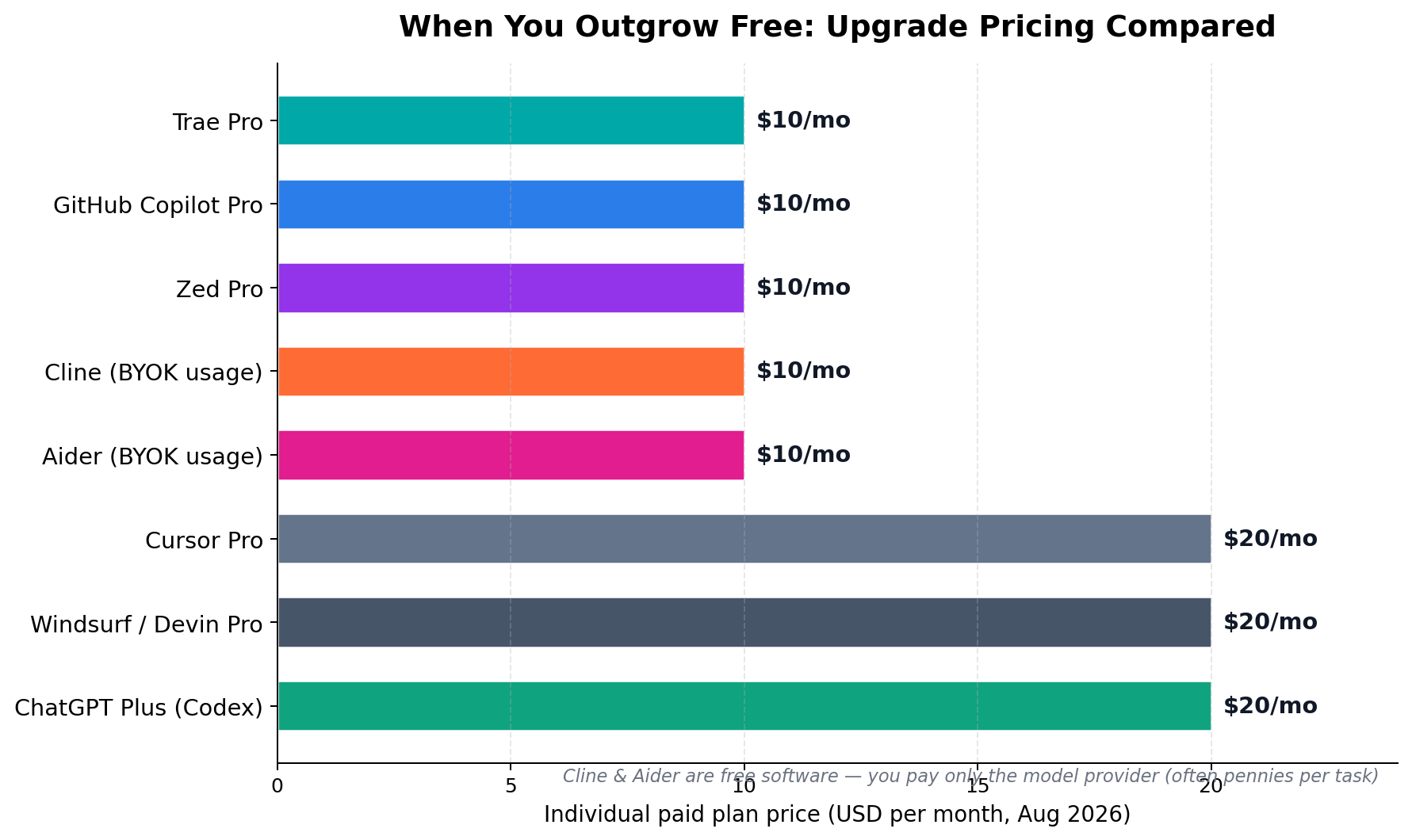
The counterintuitive takeaway: BYOK tools are often the cheapest upgrade path. A $20 Copilot Pro or Cursor Pro subscription is only break-even with Cline on frontier models if you complete fewer than ~10–15 substantial features a month. Below that, pay-per-token wins; above that, subscriptions win. And if free is the budget, Cline + Gemini free tier + Ollama is the only stack here with no ceiling at all.
How the Top Tools Compare Across Six Dimensions
We scored every tool on the six axes that actually decide daily experience — autocomplete, agentic capability, free-tier generosity, model flexibility, privacy & local support, and setup ease:
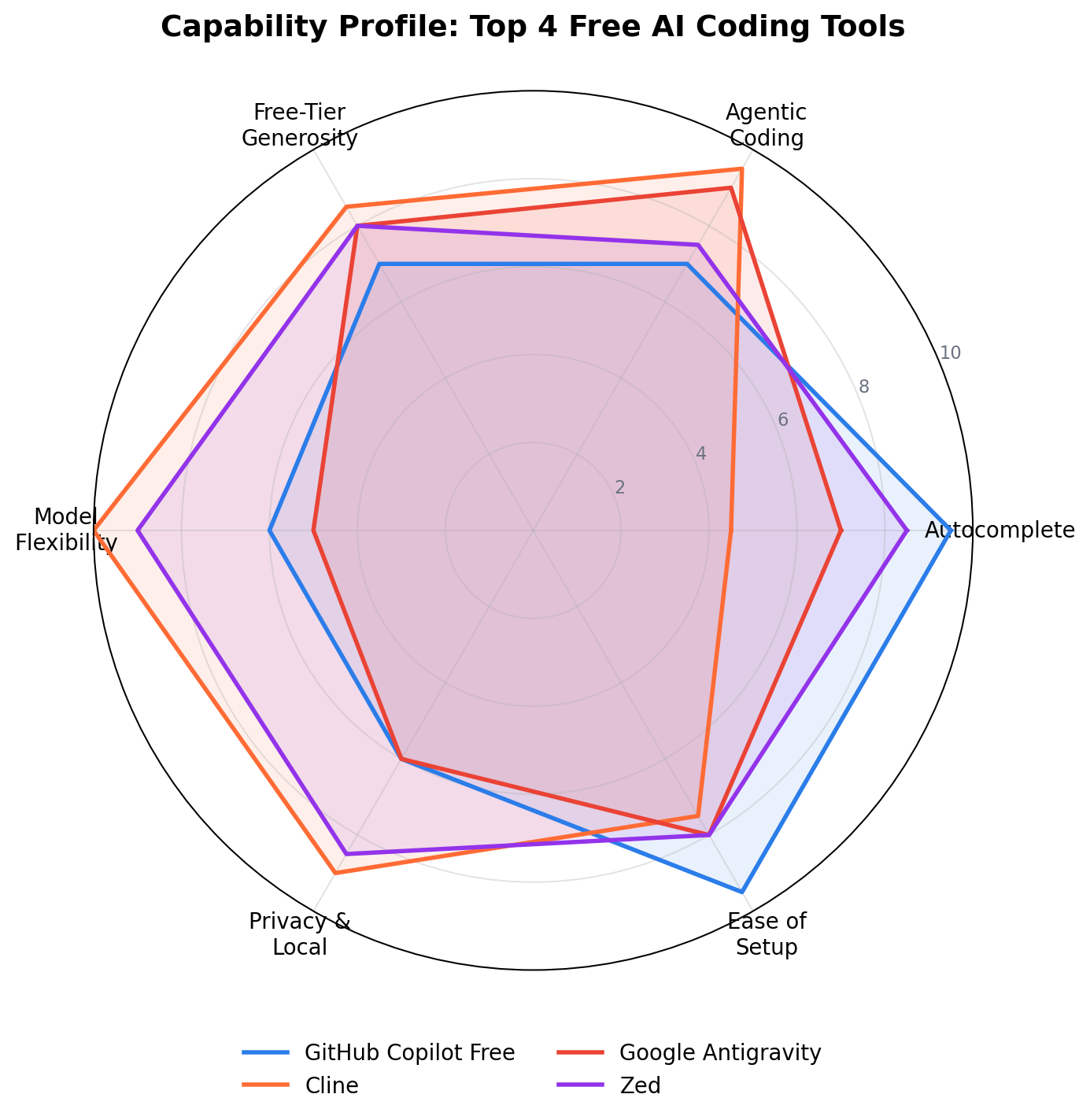
The shape tells the story. Copilot Free traces the biggest overall footprint — balanced excellence with a dip only in model flexibility (no BYOK). Cline stretches furthest on flexibility, free-tier generosity and privacy (local models!), but concedes autocomplete since it's purely an agent. Antigravity peaks on agentic capability; Zed dominates ease and speed of setup; Codex CLI and Aider favor flexibility and privacy over beginner-friendliness; Trae scores well on generosity but weaker on privacy and polish.
Feature Comparison at a Glance
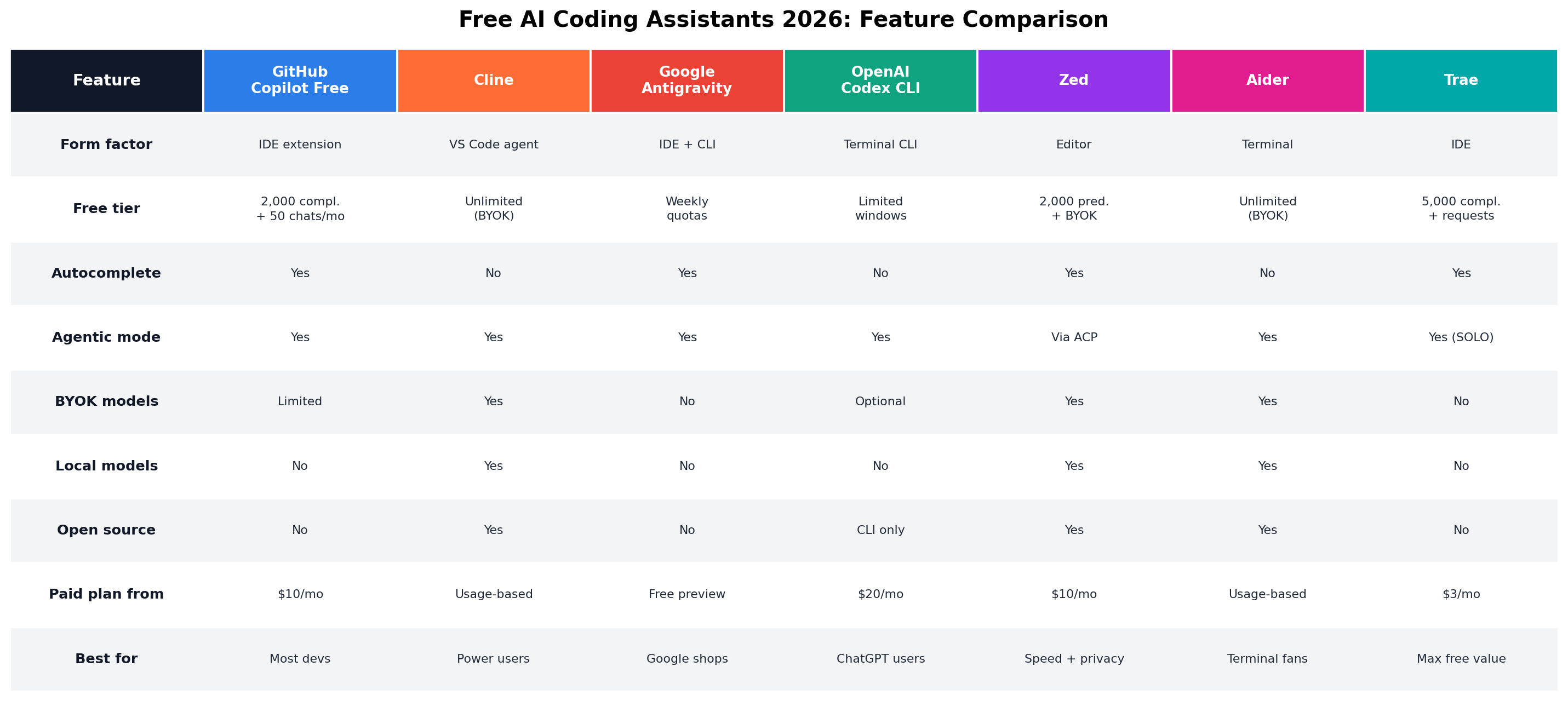
| Feature | Copilot Free | Cline | Antigravity | Codex CLI | Zed | Aider | Trae |
|---|---|---|---|---|---|---|---|
| Form factor | IDE extension | VS Code agent | IDE + CLI | Terminal CLI | Editor | Terminal | IDE |
| Free tier | 2,000 + 50/mo | Unlimited (BYOK) | Preview access | Weekly windows | Editor free | Unlimited (BYOK) | Generous |
| Autocomplete | Best in class | — | Good | — | Fast, editable | — | Good |
| Agentic mode | Yes (limited) | Yes, full | Yes, flagship | Yes | Via ACP | Yes | Yes |
| BYOK models | No | 30+ native | No | No | Yes | 100+ | Partial |
| Local models | No | Ollama | No | No | Ollama | Ollama | No |
| Open source | No | Yes (Apache 2.0) | No | Yes | Yes | Yes | No |
| Paid from | $10/mo | $0 + tokens | TBA | $20/mo | ~$20/mo | $0 + tokens | $3/mo |
⚠️ What Happened to Continue.dev?
The most-read question in this category in 2026. Continue.dev — the open-source, BYOK IDE assistant that anchored "free AI coding" roundups for two years (34,600+ GitHub stars) — was acqui-hired by Cursor maker Anysphere in June 2026. The timeline was brutal:
- June 16, 2026: acquisition/team announcement.
- June 19, 2026: final release (v2.0.0-vscode); the
continuedev/continuerepository switched to read-only. - July 15, 2026: Continue cloud data deletion deadline — configs and cloud sync gone.
The Apache 2.0 code lives on in forks, but the product is dead. Migrate to Cline — it inherits Continue's role as the open BYOK standard (and then some), or to Zed if you want a full editor, or Copilot Free if you'd rather have a vendor with a balance sheet behind your free tier. The lesson the whole category learned: open-source licenses survive acqui-hires, roadmaps don't.
Real-World Test Scenarios
Scenario 1: Ship a Rate-Limited FastAPI Endpoint (Feature Work)
Prompt: "Add a token-bucket rate limiter to the /search endpoint: 10 req/min per API key, Redis-backed, with pytest coverage including the 429 path."
Copilot Free nailed the implementation across 3 files in one agent session — but the debugging round-trips consumed 8 of our 50 monthly chat requests. Cline (Gemini free tier) took one retry on the Redis mock but finished at a total model cost of $0.00. Antigravity produced the cleanest test structure of the three. Verdict: all three can ship small features; the difference is what it costs from your allowance.
Scenario 2: Refactor 500 Lines of Legacy JS to TypeScript
Prompt: "Convert utils/payments.js to TypeScript, preserve behavior, eliminate the 23 any-typed escapes, keep the public API identical."
This is where frontier models earn their keep. Antigravity (Gemini 3 Pro) delivered the most faithful conversion with the fewest type-check iterations. Cline on a Sonnet-class model matched it for ~$1.40 in tokens; on free-tier Gemini it needed three passes. Zed + Cline via ACP was the pleasantest environment to review the diffs in. Copilot Free handled it well in Edits mode but the multi-file session again ate chat quota.
Scenario 3: Fix a Flaky CI Test From the Terminal
Prompt: "CI run #482 is failing intermittently on test_retry_backoff. Here are the logs — find the race and fix it."
Codex CLI was built for exactly this: it parsed the logs, spotted the unmocked clock dependency, patched it and explained the fix in one pass — the single most impressive moment of our terminal tests. Aider matched the diagnosis and, true to form, left a clean git commit we could revert with /undo. If your pain is CI/backlog triage rather than feature velocity, either terminal agent beats every IDE on this list.
Alternatives Worth Considering
Not everything good made our top seven. These are close — each with a specific reason it missed:
| Tool | Free Option | Why It Missed the Top 7 |
|---|---|---|
| Cursor (Hobby) | Free plan, limited requests | The AI-first IDE benchmark — but the free Hobby tier is now a trial in disguise; Pro is $20/mo. Plus the 2026 SpaceX acquisition leaves its roadmap a question mark. |
| Devin Desktop (ex-Windsurf) | Limited free credits | Windsurf's remains were absorbed by Cognition and rebranded around Devin. The agent is strong; the free lane is thin and the product identity is mid-transition. |
| JetBrains Junie | Included with JetBrains AI free credits | Excellent if you already live in IntelliJ/PyCharm; meaningless if you don't. |
| Qodo (Codium) | Free tier for tests & reviews | Superb AI test generation and PR review, but it's a QA specialist rather than a general assistant. |
| Tabnine | Free basic tier | The privacy-first veteran (air-gapped enterprise) — solid, but its free autocomplete trails Copilot's quality. |
Which Free Coding Assistant Should You Choose?
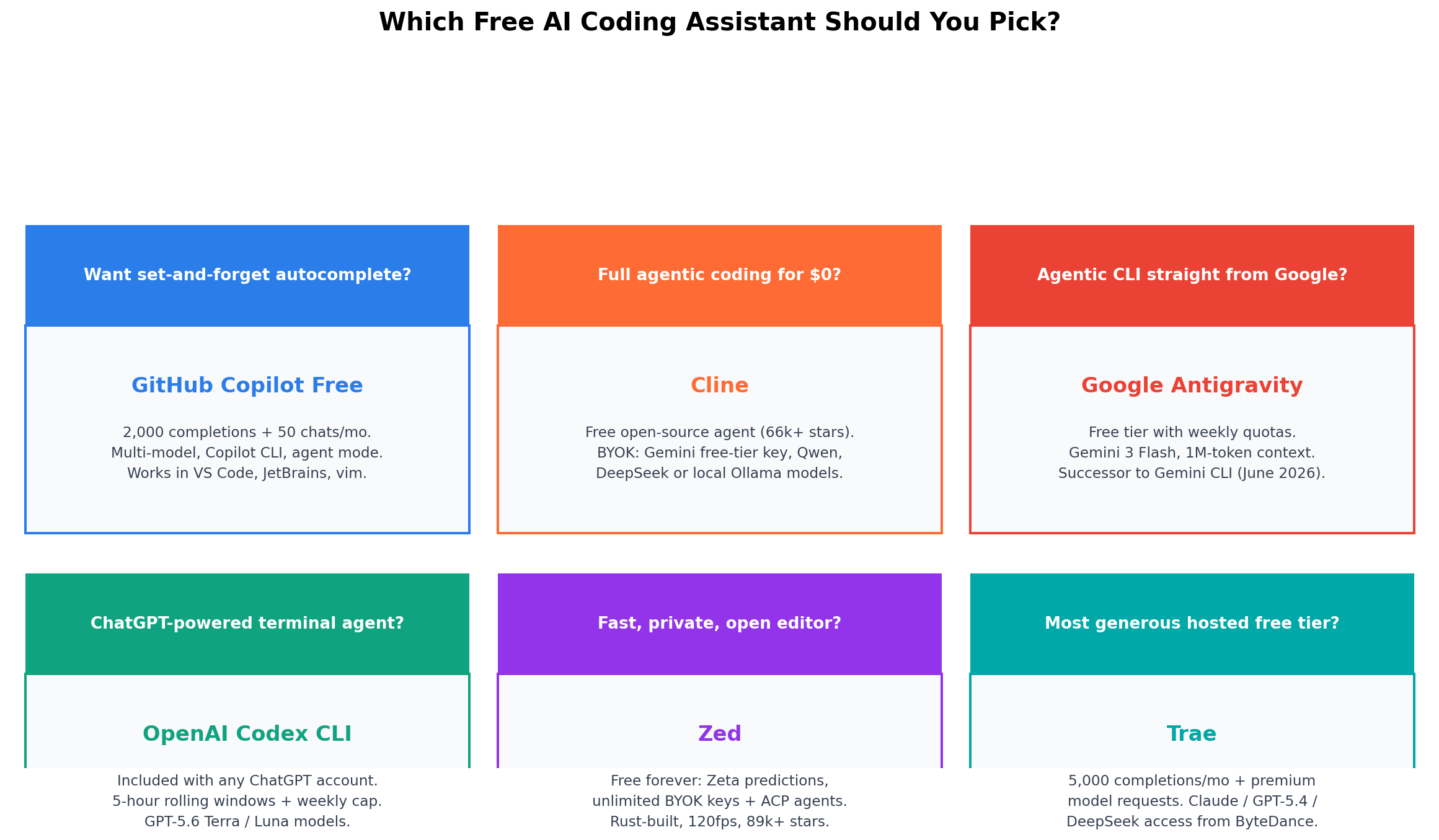
The Verdict — Best Free AI Coding Assistants of 2026
🏆 Best Overall — GitHub Copilot Free
2,000 completions + 50 chats/month, multi-model, agent mode, CLI, MCP, every editor, $0 — with enterprise trust on top. It's the strongest free tier the category has ever seen, and it's the one we'd tell a friend to install first.
🥇 Best for Power Users & Privacy — Cline
Unlimited free agentic coding with BYOK: pair it with the Gemini API free tier for $0 forever, Ollama for total privacy, or Sonnet-class models at $0.50–$2/feature. The Zed + Cline + ACP stack is the power combo of 2026.
🎬 Best Free Agentic IDE — Google Antigravity
Gemini 3 Pro for $0 during preview, with browser-verified agent missions. The most futuristic free experience — budget for the possibility that preview pricing eventually ends.
⌨️ Best Terminal Agents — Codex CLI & Aider
Codex CLI for ChatGPT-native power with sandboxed execution; Aider for git-committed, undoable, 100+-model pair programming. CI triage and backlog grinding are their home turf.
💰 Best Pure-Budget Play — Trae
The most model access per dollar (free tier, then from $3/mo) — lock down its telemetry settings before pointing it at proprietary repos.
🧩 The Smart Hybrid Stack (Our Actual Setup)
Copilot Free for autocomplete + Cline for agentic work + Codex CLI for CI fires. Total cost: $0/month. That stack outperformed any single paid tool in our tests — the 2026 free tier isn't a compromise anymore, it's a strategy.
Frequently Asked Questions
What is the best free AI coding assistant in 2026?
GitHub Copilot Free is the best overall free AI coding assistant in 2026 — 2,000 completions and 50 chat requests per month at $0, with multi-model support (Claude Haiku 4.5, GPT-5 mini), Copilot CLI and agent mode. Cline is the best fully free option for power users: it is open source and works with free model tiers like the Gemini API free tier or local models via Ollama, so it can cost literally $0 with no usage caps.
Is GitHub Copilot's free tier really free forever?
Yes. GitHub Copilot Free is a permanent tier, not a trial: 2,000 code completions and 50 chat/agent requests per month for $0 indefinitely. Since June 1, 2026 paid Copilot plans bill through GitHub AI Credits, but the Free tier remains a monthly allowance. Students, teachers and open-source maintainers can get Copilot Pro at no cost.
Is Cline completely free to use?
The Cline extension itself is 100% free and open source under Apache 2.0. It is BYOK (bring your own key): you pay only for the AI model tokens you consume. With the Gemini API free tier or local models via Ollama, Cline costs $0. With paid frontier models, typical usage runs about $0.01–$0.10 per small task on budget models or $0.50–$2.00 per feature on Sonnet-class models.
What happened to Continue.dev?
Continue.dev was acqui-hired by Cursor maker Anysphere in June 2026. The open-source repo was made read-only, the final VS Code release shipped on June 19, 2026, and Continue cloud data was deleted after July 15, 2026. Existing users should migrate to Cline (closest BYOK successor), Zed or Copilot Free.
Can free AI coding assistants write entire features?
Yes — agentic tools like Cline, Google Antigravity and OpenAI Codex CLI can plan, edit multiple files, run tests and iterate autonomously. The catches are free-tier caps (Copilot Free's 50 monthly chat requests run out fast on agentic work) and quality: free or budget models still need human review on diffs, so treat them as accelerators, not autopilots.
Are free AI coding assistants safe for proprietary code?
It depends on the tool. GitHub Copilot Free does not train on your code and offers enterprise-grade provenance controls on paid plans, making it the safest default. Cline and Aider let you use local models via Ollama so code never leaves your machine. Trae, from ByteDance, requires careful attention to telemetry and data-sharing settings before using it on proprietary work.