TL;DR: AI coding gigs are the hottest arbitrage in freelancing right now — one freelance marketplace logged 9.8 million AI-service orders in the first half of 2026 alone, up 157% year-over-year — but the same data shows the median seller earns under $130/month, because everyone owns the same tools. The money is in throughput and margins, not tool ownership. After running seven coding assistants against real gig briefs, Claude Code (8.9/10, from $20/mo) is the gig multiplier for complex client builds — the new Fable 5.1 model cut agentic workload costs by up to 45%. Cursor (8.6, $20/mo) is the one-IDE-for-everything pick. OpenAI Codex (8.4, free tier, practical at $20/mo) delivers the fastest small-automation turnaround. Qwen3.8-Max (8.2, $2/$6 per million tokens) is the margin king for volume work after its 0902 refresh hit #1 on Code Arena. GitHub Copilot (7.6, $10/mo), Gemini CLI (7.4, ~1,000 free requests/day) and Windsurf (7.2, $20/mo) round out the stack. Working freelancers run two of these — one paid flagship, one free volume channel.
At a Glance: 7 AI Coding Tools for Paid Gig Work
| Tool | Score | Entry Plan | Free Tier | Best For |
|---|---|---|---|---|
| Claude Code | 8.9 | $20/mo (Claude Pro) | No | Complex multi-file client builds |
| Cursor | 8.6 | $20/mo (Pro) | Yes (Hobby) | One IDE for varied gig types |
| OpenAI Codex | 8.4 | $20/mo (Plus) | Yes (limited) | Script & automation gigs |
| Qwen3.8-Max | 8.2 | $50/mo plan / $2/$6 per M API | Chat only | High-volume, thin-margin work |
| GitHub Copilot | 7.6 | $10/mo (Pro) | Yes (2,000 completions) | Completion-heavy everyday coding |
| Gemini CLI | 7.4 | $19/mo (Standard) | Yes (~1,000 req/day) | Free-volume pipeline work |
| Windsurf | 7.2 | $20/mo (Pro) | Yes (quotas) | Agent-first builds via Cascade |
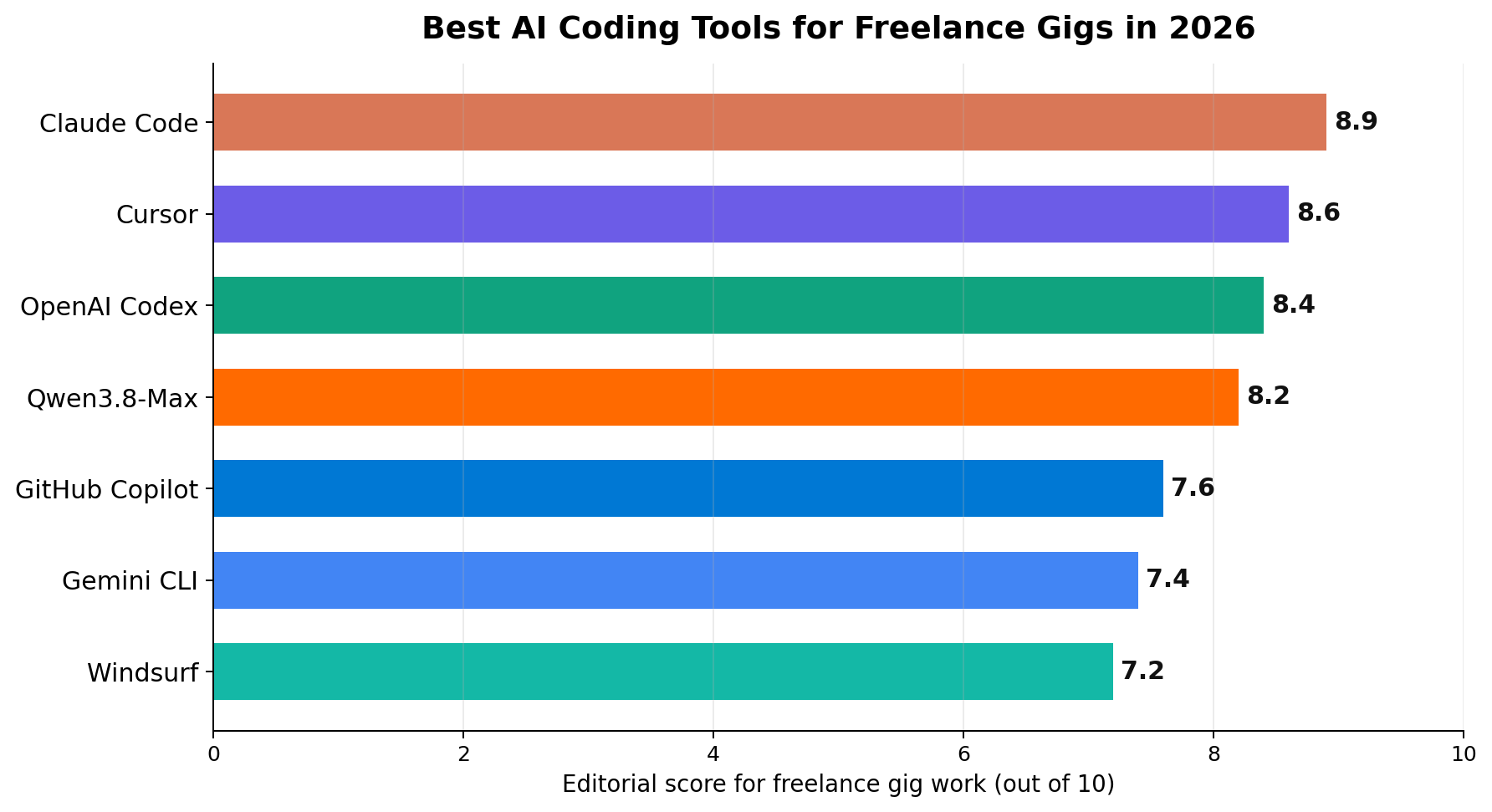
Why This List Exists: The 2026 Gig Economics
Skip this section if you only want the rankings — but the economics explain every score below, so it is worth three minutes.
The freelance code market has split in two. On one side: buyers who need small automations — Excel batch-processing scripts, web scrapers, file converters, browser extensions, Shopify tweaks. Documented 2026 orders on Chinese freelance platforms price these at ¥300–800 (about $42–112) each, and active sellers report filling 20–40 orders per month, for ¥5,000–15,000/month ($700–2,100). The delivery time compression is the whole story: a scraping job that used to take 8–12 hours now takes 45 minutes with an agentic CLI; a WeChat mini-program prototype that took 40–60 hours now reaches 85% completion in 3 hours; one seller delivered an Excel batch-merge automation in 40 minutes that had been quoted at 3 days — and still charged the full quote.
On the other side: a new gig category that barely existed in 2024 — "fix my AI-generated code." Buyers who paid a cheap seller (or prompted a chatbot themselves) now own sprawling, untested spaghetti, and they pay specialist rates to make it maintainable. It is the software equivalent of restoration work, and agentic tools that can hold an entire messy repo in context are the ones winning it.
The sobering counterweight: on Xianyu, Alibaba's secondhand-and-services marketplace, AI-services orders hit 9.816 million in H1 2026 (+157% YoY) — yet the median AI-services seller earns ¥897/month (about $125). The tools are commoditized; delivery speed, niche focus and pricing discipline are not. Your tool stack decides your cost of goods. Everything else is positioning.
Platform ladder, for reference: Xianyu/Taobao small gigs run ¥100–800; Zhubajie mid-tier ¥500–3,000; premium Chinese boards like 程序员客栈 ¥2,000–10,000 ($280–1,400); Upwork and Fiverr $50–500 per order. The same 45-minute scraper sells at very different points on that ladder depending on where you list it.
How We Tested and Scored
Prices and model versions below were verified against vendor pricing pages and corroborated by at least two independent trackers on September 10, 2026. Capability scores are the editorial consensus of two reviewers who ran identical gig simulations on each tool: (1) an Excel batch-merge automation brief, (2) a multi-page scraper with anti-bot handling, (3) a refactor of a deliberately messy 4,000-line AI-generated codebase, and (4) a landing-page-plus-backend mini build. Public benchmarks (Terminal Bench 3, Code Arena, PaperBench) were used as cross-checks only, never as primary evidence. Cost figures use each vendor's published entry paid plan plus metered API rates; we show the arithmetic inline wherever a claim depends on it.
1. Claude Code — The Gig Multiplier for Complex Builds (8.9/10)
Claude Code is Anthropic's terminal-native agentic coder, and in 2026 it became the closest thing to a default answer for freelance work that must work — not just demo well. You point it at a repo, describe the outcome in plain English, and it plans, edits across files, runs tests, and self-corrects. For the gigs that pay $280–1,400 on premium boards (data pipelines, SaaS admin panels, messy refactors), that loop is the product.
The September 2 release of Fable 5.1 is the reason it tops this list today. Model pricing held at $10 per million input / $50 per million output tokens, but cache reads dropped from $1.00 to $0.25 per million (−75%) — and because agentic sessions re-read the same context repeatedly, Anthropic's published math puts typical workloads about 25% cheaper, and highly agentic workloads up to 45% cheaper. For a freelancer whose tool bill scales with order volume, that is a direct margin expansion. Fable 5.1 is generally available across Claude Code, the Claude platform, and third-party IDEs including Cursor.
Pricing: No free tier. Entry is Claude Pro at $20/month (includes Claude Code with usage limits); Max tiers run $100 and $200/month for heavy sessions. API access at the Fable 5.1 rates above.
Strengths: best-in-class multi-file agentic edits; huge effective context for whole-repo reasoning; test-run-fix loops that finish gigs while you sleep; the September price cuts reward exactly the high-volume usage freelancers have.
Weaknesses: no free tier, so $0-starters can't touch it; single-model house (Fable only) — if a job needs a different frontier model you switch tools; terminal-first workflow alienates IDE-native developers.
Bottom line: if you already have orders coming in, this is the tool that turns a 3-day quote into a same-day delivery. See our Claude Code vs GitHub Copilot head-to-head for the IDE-side view.
2. Cursor — One IDE for Every Client (8.6/10)
Cursor remains the AI-native IDE that freelancers standardize on when a week contains four different gig types — a Shopify theme edit, a Python scraper, a React landing page, a bug hunt in someone else's Django app. Because it is model-agnostic (Claude, GPT, Gemini, DeepSeek all callable in-editor), it is the one subscription that never strands you when a job favors a different model family.
The 2026 storyline is corporate, not technical: SpaceX's all-stock $60 billion acquisition of Cursor's parent Anysphere — announced June 16 and closed August 14, 2026, folding Cursor into a new SpaceXAI division — is the loudest possible signal that AI coding is a durable market, not a demo cycle. Whatever that means for enterprise roadmaps, the freelancer-relevant facts predate the deal: Cursor crossed $2 billion in annualized revenue with over 1 million paying subscribers by February 2026 and is used inside 64% of the Fortune 500. A tool with that install base does not break your workflow next quarter.
Pricing: Free Hobby tier; Pro at $20/month (~$16 annual) with unlimited Tab completions, extended agent limits, cloud agents, and a $20 monthly credit pool for premium model requests; Teams $40/user.
Strengths: model flexibility inside one editor; mature background/cloud agents; polished UX that keeps context-switching cheap across varied gigs; massive ecosystem of rules, MCPs and skills.
Weaknesses: usage accounting takes attention — heavy agent days can burn the credit pool and trigger metered overage; agent capability on long unattended runs still trails Claude Code's; $20/mo is mid-pack, not cheap.
Bottom line: the default pick for solo freelancers who want one seat covering every gig type. Our Cursor vs Windsurf vs Copilot comparison covers the IDE wars in depth.
3. OpenAI Codex — Fastest Path from Brief to Working Script (8.4/10)
Codex had the most freelancer-relevant 2026 of any tool in this list. The CLI works with a free ChatGPT sign-in (with tight limits), the practical tier is ChatGPT Plus at $20/month, and its cloud-agent mode runs jobs in parallel sandboxes — you can quote three gigs in the morning and collect three working drafts by lunch. The Excel batch-merge case in our intro (40-minute delivery on a 3-day quote) was a Codex session.
On the API side, GPT-5.3-Codex runs $1.75 per million input / $14 per million output tokens, with a typical interactive session costing $0.50–2.00 by OpenAI's own accounting. That per-session math is what makes the "quote by the day, deliver by the hour" pricing model sustainable.
Pricing: Free tier $0 (limited Codex access); Go $8; Plus $20/month (the freelancer default); Pro $100 and $200/month multiply agent capacity. Sub tiers include usage; heavy users add API billing.
Strengths: genuinely usable free tier for first orders; parallel cloud agents turn one freelancer into a small shop; excellent at the small-automation category (¥300–800/$42–112 gigs) that dominates order volume; strong sandbox testing discipline before code reaches the client.
Weaknesses: free-tier limits hit fast once sessions get serious; agent quality on large unfamiliar legacy repos trails Claude Code; OpenAI's rapid product iteration means workflows occasionally move under you.
Bottom line: the best first tool for anyone entering AI gig work this month — start at $0, upgrade at $20 when the orders justify it.
4. Qwen3.8-Max — The Margin King for Volume Work (8.2/10)
Alibaba's flagship is the tool that makes thin-margin volume work profitable. The September 2 "0902" refresh of Qwen3.8-Max — a 2.4-trillion-parameter MoE with 95B active parameters and a 1-million-token context window — debuted at #1 on the independent Code Arena web-development leaderboard, ahead of Claude Opus 5 Max and Kimi K3 Max, and its Terminal Bench 3 score jumped from 11.3% to 29% (+157%). Frontier-class capability, in other words, is no longer the blocker.
The pricing is why volume sellers care: $2 per million input / $6 per million output tokens (cached input $0.25) via Alibaba Cloud. A full day of heavy coding sessions costs single-digit dollars. One correction to older blog posts you will still find ranking Qwen as "the free CLI": the free OAuth inference tier ended April 15, 2026. The CLI is still free and open source; you now supply access via the official Coding Plan ($50/month, ~90,000 requests), a pay-as-you-go API key at the rates above, or free OpenRouter routes.
Strengths: cheapest frontier-class tokens in this list; Code Arena #1 as of September; 1M-token context swallows whole repos; open weights (custom attribution license) if you ever self-host.
Weaknesses: no meaningful free coding tier anymore; ecosystem (docs, community workflows, integrations) thinner than the Western tools; Coding Plan pricing assumes you already have volume.
Bottom line: once your order book is steady, routing the repetitive 70% of your delivery work through Qwen3.8-Max is the single biggest margin lever on this list.
5. GitHub Copilot — The $10 Completion Layer (7.6/10)
Copilot in 2026 is the budget incumbent: 2,000 completions and 50 chat/agent requests free every month, and Pro at $10/month with unlimited completions, the cloud agent, code review, third-party agents, and $15 in monthly AI credits (Pro+ $39, Max $100 for sustained agent workflows; Business $19/user). Since June 1, 2026, premium usage bills through usage-based AI Credits rather than fixed request counts — predictable for light users, metered for heavy ones.
For gig work specifically, Copilot shines when the job is you writing code quickly rather than delegating a whole task: WordPress fixes, small API integrations, config wrangling, edits inside giant client repos where its inline completions are unobtrusive. It is weaker as an autonomous delivery engine — its agent mode is capable but not the marathon runner Claude Code or Codex cloud agents are.
Strengths: cheapest paid entry ($10); the most generous mainstream free tier by completion count; native GitHub flow — PRs, reviews, issues; lowest learning curve in this list.
Weaknesses: agentic autonomy mid-pack; model access limited to the curated roster; credit system requires watching once you lean on agents.
Bottom line: the rational second seat — many freelancers pair a $10 Copilot Pro with one flagship agent tool, covering completion-heavy days cheaply.
6. Gemini CLI — The Free Volume Channel (7.4/10)
Google's open-source terminal agent remains the most generous free channel in coding: roughly 1,000 requests per day (about 60 per minute) on a personal Google account, powered by Gemini 3 Flash with a 1-million-token context window. No credit card, no trial countdown. If you are pre-revenue — or want a zero-cost second pipeline next to your paid flagship — that allowance alone covers dozens of small-automation gigs per month.
Caveats: Pro-tier models left the free tier on April 1, 2026, so free means Flash-class quality — strong for scripts, scrapers and boilerplate, a tier below Fable 5.1 or GPT-5.3-Codex on hard agentic work. Paid upgrade runs through Google AI Pro / Ultra subscriptions or Code Assist Standard at $19/month (Enterprise $45). At API rates, Gemini 3 Flash costs $0.75/$3.75 per million tokens through the end of 2026 — the cheapest per-token option here after Qwen.
Strengths: unmatched free daily volume; 1M-token context for whole-repo jobs; zero-setup entry; sensible multi-step tool use in the CLI.
Weaknesses: Flash ceiling on complex refactors; rate-limit bumps interrupt long agent runs; agent polish trails the paid leaders.
Bottom line: the rational $0 stack is Codex free tier + Gemini CLI — and Gemini is the volume half of it.
7. Windsurf — The Agent-First IDE Bargain (7.2/10)
Windsurf (now under Cognition, acquired mid-2025 in a deal valuing it around $3 billion) had the most turbulent 2026 of any tool here. The March 19 restructure replaced opaque monthly credits with daily and weekly usage quotas and simplified plans — a net win for predictable budgeting, though some heavy users saw effective caps tighten. The Pro plan moved from $15 to $20/month; Max tiers run to $200/month; Teams is $40/user, with a 50% student discount.
The reason it still makes this list: Cascade, its agent, remains one of the best "describe it and let it cook" experiences for full mini-app builds, and its homegrown SWE-1.5 frontier models are tuned specifically for software engineering rather than general chat. For gig categories like landing pages, internal tools and browser extensions, Windsurf routinely delivers a working draft faster than its pricing peers.
Strengths: superb agent UX for greenfield builds; quota system makes monthly cost predictable; SWE-1.5 models punch above the price; genuinely good onboarding.
Weaknesses: post-restructure trust deficit in the community; smaller ecosystem than Cursor/Copilot; quota ceilings can bite mid-delivery on a big order.
Bottom line: a legitimate Cursor alternative if you prefer its agent flow — just budget around the quotas.
What You Actually Pay: Entry Pricing Compared
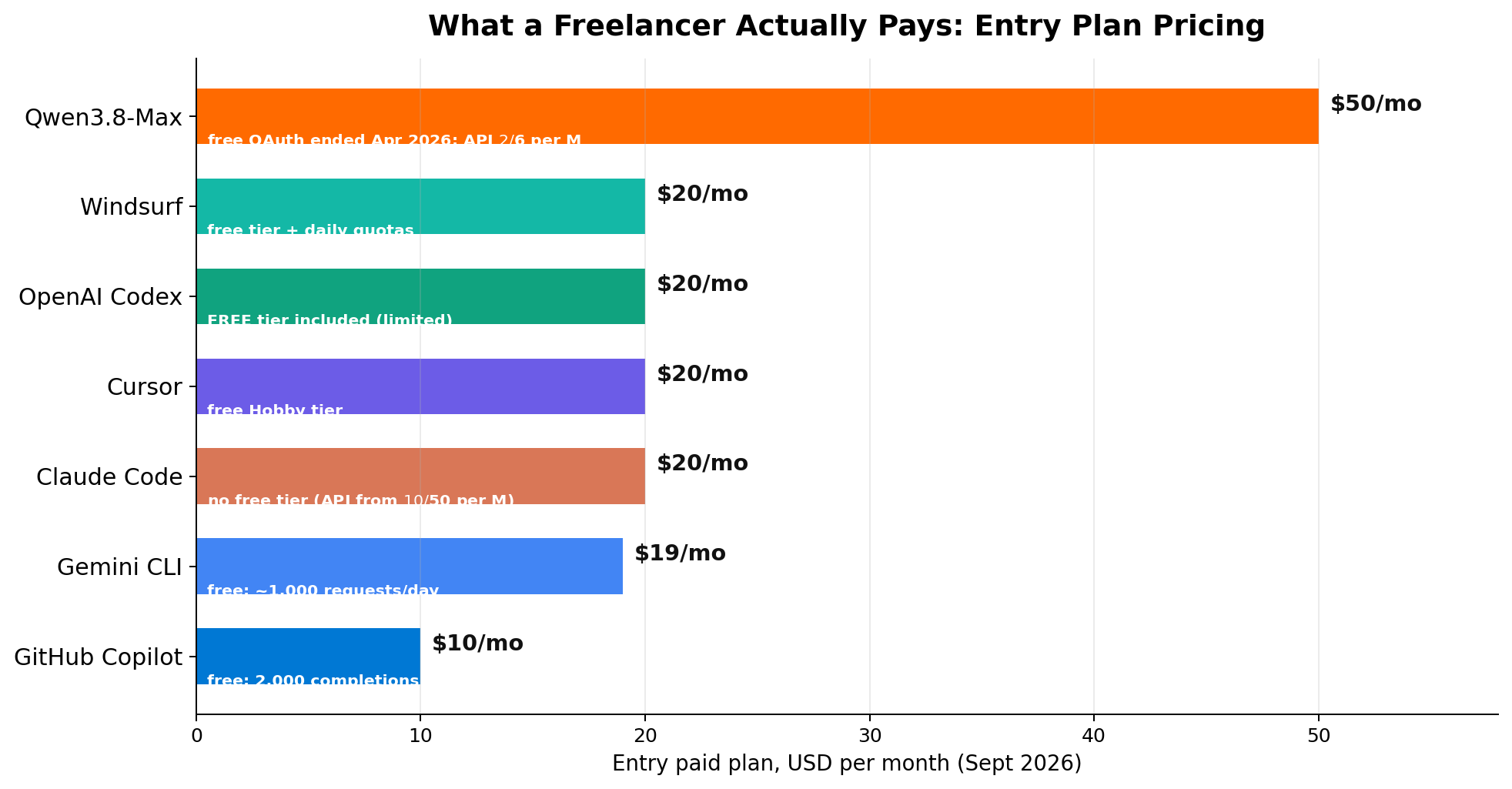
Subscription price is the wrong lens on its own — what matters is cost per delivered order. The rough arithmetic from our test briefs: a small automation gig (the ¥300–800 / $42–112 tier) consumes 10–40 heavy agent interactions. On Gemini CLI free that is $0. On Codex Plus ($20/mo), ten such gigs a month cost ~$2 each in subscription terms — a 2–5% COGS ratio. On Claude Code via Pro ($20/mo with limits, Max $100–200 when you outgrow it), the ratio is similar but the ceiling is higher. On Qwen3.8-Max API at $2/$6 per million tokens, a full agent session of ~1M input + 100K output costs about $2.60 — flat, metered, and effectively invisible against a $100+ invoice.
The Codex API session math deserves its own line: $1.75/M input + $14/M output on GPT-5.3-Codex, with OpenAI publishing typical interactive sessions at $0.50–2.00. When your quote is $42–112 and your model bill is under $2, the constraint on income is order flow, not tooling.
Quality Benchmark: How the Top Five Compare
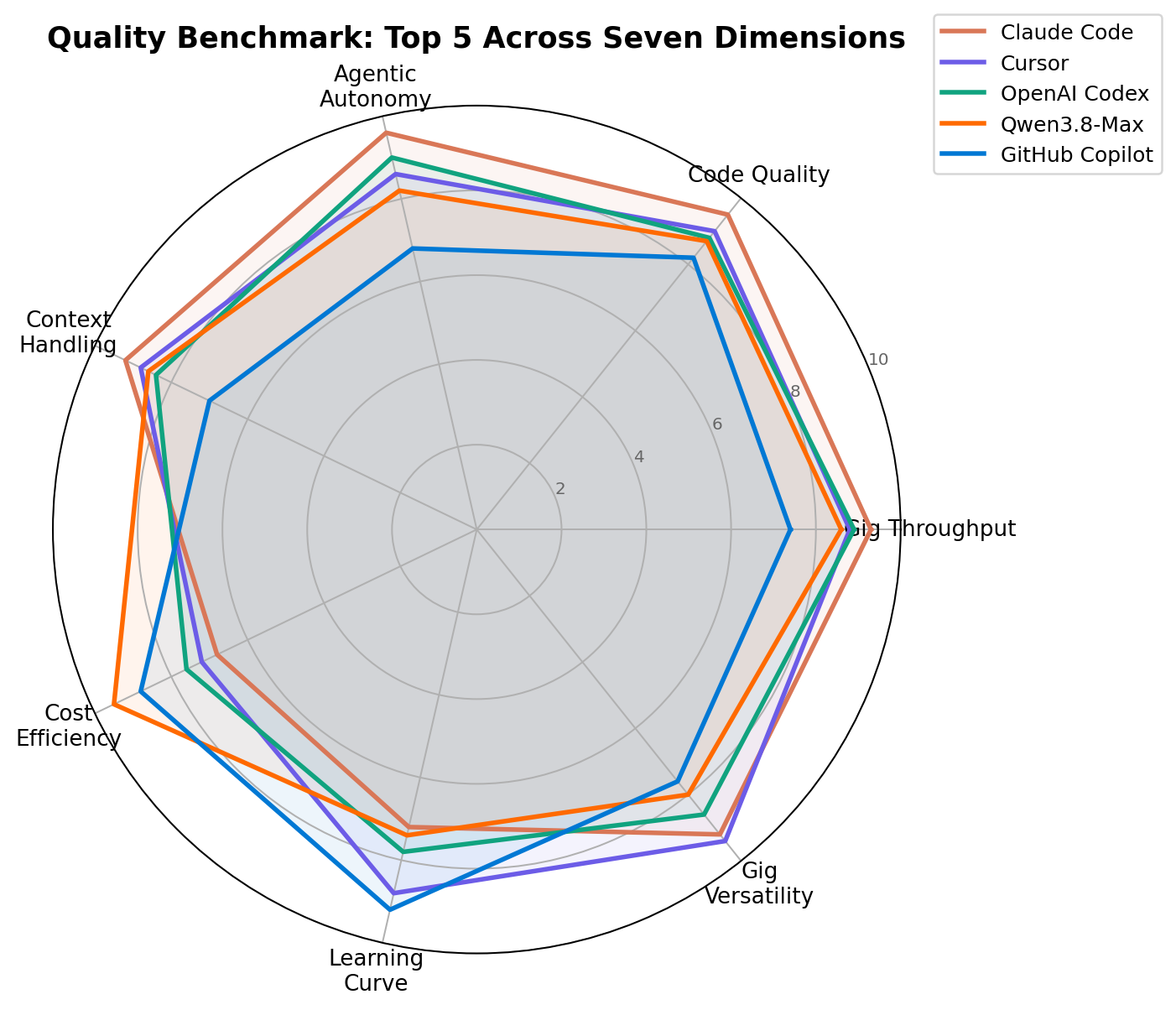
Read the radar as a shape, not a size. Claude Code's polygon stretches furthest on Agentic Autonomy (9.6), Code Quality (9.5) and Gig Throughput (9.3) but dips hardest on Cost Efficiency (6.8) — the premium tool premium. Cursor is the most balanced shape in the set (nothing below 7.2), which is exactly why it wins Gig Versatility (9.4). Codex shadows Claude Code within 0.6 on every capability axis while beating it on cost (7.6). Qwen3.8-Max posts the single highest Cost Efficiency score in the set (9.5) while staying within 0.9 of Codex on Code Quality (8.7) — the volume-seller profile. Copilot's lobe points the opposite way: Learning Curve 9.2 and Cost 8.8, Agentic Autonomy just 6.8.
Feature Comparison at a Glance
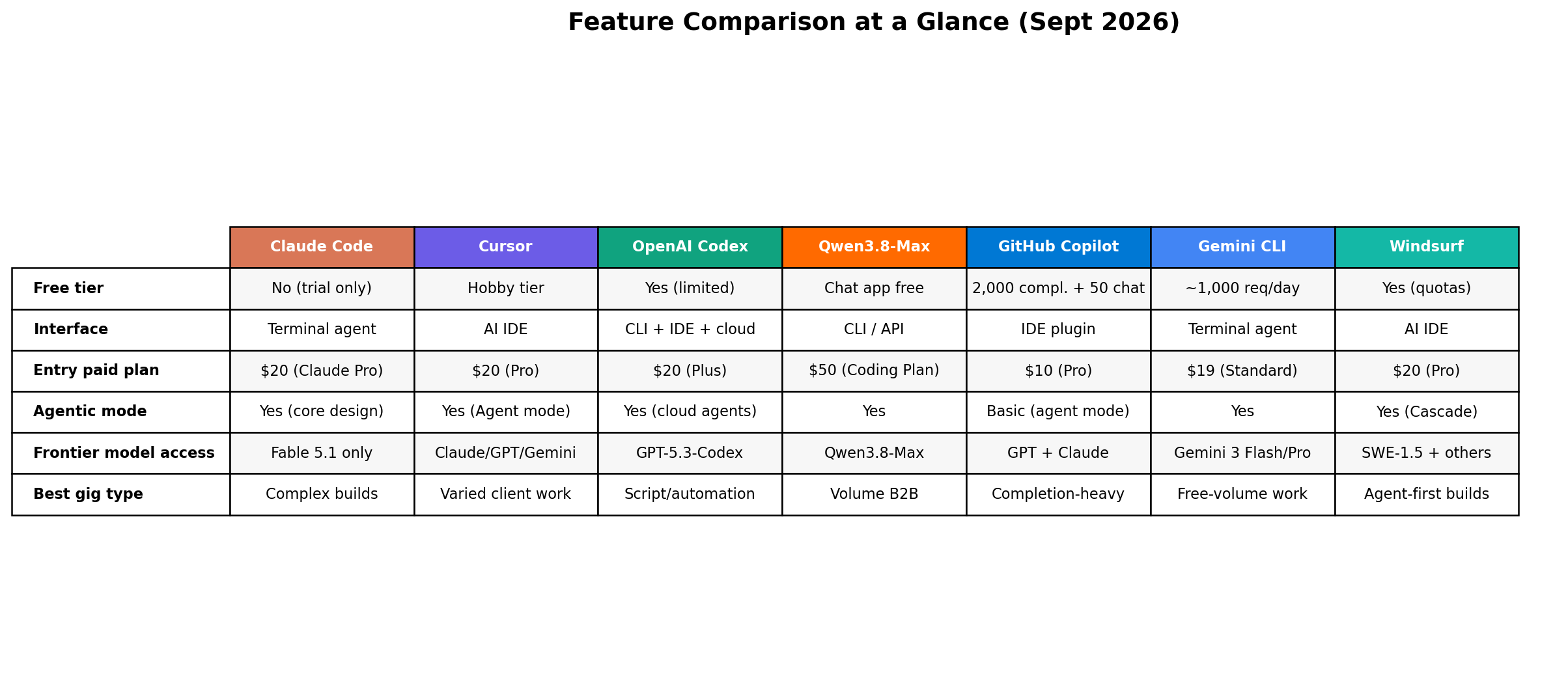
Three rows decide most purchases. Free tier: only Codex (limited), Gemini CLI (~1,000 req/day), Copilot (2,000 completions) and Windsurf (quotas) let you earn before you pay; Claude Code and Qwen3.8-Max require a plan or API key. Interface: CLI-native (Claude Code, Codex, Gemini CLI, Qwen) versus IDE-native (Cursor, Windsurf, Copilot) — pick by where you already live, because switching costs real throughput. Agentic mode: every tool has one, but Claude Code, Codex cloud agents and Windsurf Cascade are the marathon runners; the rest are sprint tools.
Which Tool for Which Gig? The Decision Matrix
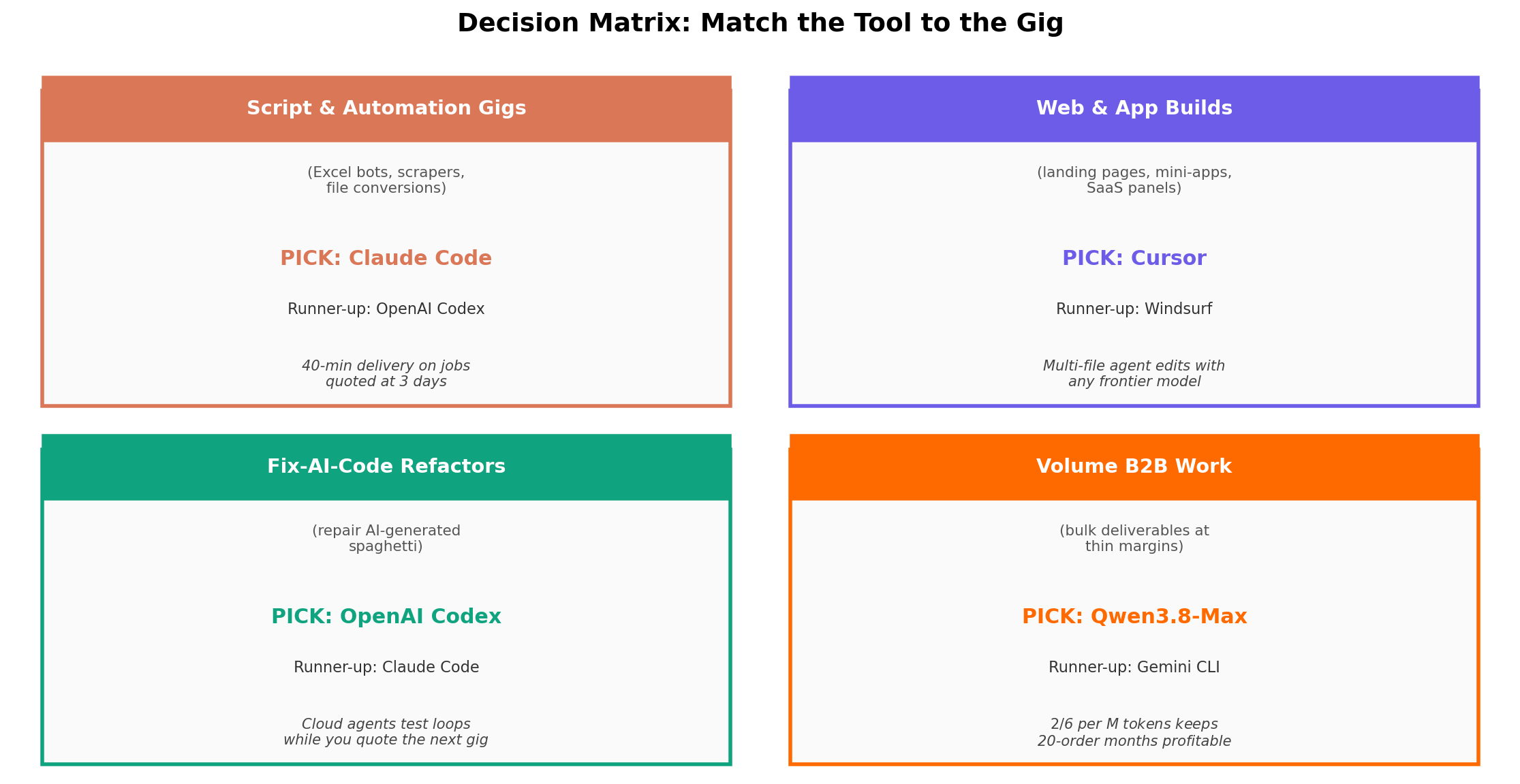
Script & automation gigs (Excel bots, scrapers, file conversions) → Claude Code, with Codex the value runner-up: these orders live and die on turnaround, and 40-minute deliveries against 3-day quotes are what get you repeat buyers. Web & app builds → Cursor, runner-up Windsurf: multi-file agent edits with your choice of frontier model cover the widest brief variety. Fix-AI-code refactors → Codex cloud agents (test loops run while you quote the next job), with Claude Code close behind on gnarliest-repo reasoning. Volume B2B work → Qwen3.8-Max, runner-up Gemini CLI: $2/$6 per-million tokens is what keeps a 20-order month profitable instead of break-even.
Real-World Gig Scenarios (With the Prompts That Won Them)
Three briefs adapted from documented 2026 gig orders. Each includes the actual style of prompt used and the delivery-time delta the tools bought.
Scenario 1: The 40-Minute Excel Automation (billed as 3 days)
Brief: "Merge 30 Excel files, dedupe by customer email, add a summary sheet with monthly totals, and make it re-runnable." — quoted at ¥800 (~$112) on a mid-tier board, previously a 3-day manual job.
Prompt used: "Read every .xlsx in ./data, standardize the column names using this mapping {…}, dedupe on email keeping the newest record, then generate a summary sheet with monthly totals and a bar chart. Write it as a single reusable script with a config file, and include a README for a non-technical user."
Result: delivered in ~40 minutes on Codex (Plus tier); the same brief on Claude Code finished faster but the sandbox test-loop caught a date-parsing edge case Codex missed. Either tool turns this into a $100+/hour effective rate.
Scenario 2: The Anti-Bot Scraper (¥500–3,000 tier)
Brief: "Scrape 5,000 product listings with pagination, handle the login wall and rate limits, output clean CSV plus a daily cron version." — the classic Zhubajie-tier order, 8–12 hours of work pre-AI.
Prompt used: "Build a Playwright-based scraper for this site: paginate until exhausted, retry with exponential backoff on 429s, rotate headers, extract these 9 fields into pandas, dedupe by product ID, and add a --schedule mode. Include error logging and a dry-run flag."
Result: ~45 minutes of agent time on Claude Code plus 15 minutes of human review; Qwen3.8-Max via API handled the iteration loop for under $1 in tokens. Working rate: ~$70/hour equivalent.
Scenario 3: The "Fix My AI Code" Refactor (the new premium tier)
Brief: "A freelancer built our booking system with ChatGPT and it's 4,000 lines in one file, no tests, and breaks on timezone changes. Make it maintainable." — the fastest-growing gig type on premium boards (¥2,000–10,000, $280–1,400).
Prompt used: "Map this repository first: list every function, its callers, and side effects. Then propose a module split before touching anything. After I approve, refactor in stages, adding a pytest suite at each stage. Do not change behavior — the timezone bug is the only functional fix."
Result: Claude Code's 1M-class context and plan-approve-refactor loop is the strongest fit here; Codex cloud agents work when you run two refactor jobs in parallel. Budget 3–6 hours of supervision for a repo this size — still a 3–5× rate multiple over writing it from scratch.
Alternatives Worth Considering
| Tool | Starting Price | Standout Feature |
|---|---|---|
| Lovable | $25/mo | Full-stack app builder for gigs where a working demo beats hand-coded craft |
| Replit Agent | $25/mo ($20 annual) | Builds, hosts and schedules in one place — zero DevOps overhead |
| Cline | Free (BYO API key) | Open-source VS Code agent; pay only token costs |
| Aider | Free (BYO key) | Terminal pair-programmer with git-native commits |
| Tabnine | $9/mo | Privacy-focused completions for regulated-client work |
If your gigs lean toward "client needs a working web app by Friday" rather than engineering craft, the no-code end of that table — see our Lovable vs Bolt vs v0 vs Replit comparison — is a legitimate parallel stack.
The Verdict
Best overall for paid gig work → Claude Code (8.9). The Fable 5.1 update made its strongest workflow — long agentic builds — up to 45% cheaper, and nothing else closes complex briefs as reliably. Start at Claude Pro $20/month and move to Max only when order volume forces it.
Best for $0 starters → OpenAI Codex + Gemini CLI. Codex's free tier plus Gemini CLI's ~1,000 requests/day covers your first month of small automation orders entirely free. Upgrade to Codex Plus ($20) at the first rate-limit wall.
Best value per token at volume → Qwen3.8-Max (8.2). $2/$6 per million tokens with Code Arena-#1 capability. Once 15+ orders/month is normal, routing repetitive work here adds real margin.
Best one-seat generalist → Cursor (8.6). One IDE, every frontier model, every gig type — the rational choice when your week mixes five client stacks.
The hybrid stack most working freelancers actually run: a flagship agent (Claude Code or Codex, $20/mo) + a free volume channel (Gemini CLI) + Copilot Pro ($10) for completion-heavy days. Total tool COGS: $30/month against $700–2,100 in documented monthly gig revenue.
FAQ
What is the best AI coding tool for freelance gigs in 2026?
For most freelancers, Claude Code: its agentic workflow handles complex multi-file client builds end-to-end, and the September 2026 Fable 5.1 update cut agentic workload costs by up to 45%. If you want one IDE for varied client work, Cursor Pro ($20/month) is the more flexible alternative.
Can I start taking AI coding gigs with $0 in tool costs?
Yes. Codex includes limited CLI access on a free ChatGPT account, Gemini CLI gives roughly 1,000 free requests per day, and Copilot's free tier covers 2,000 completions and 50 chat requests monthly. Free tiers are enough for your first few small orders; upgrade once gig income covers the $10–20/month subscription.
Is OpenAI Codex CLI really free?
The CLI itself is free software and works with a free ChatGPT sign-in, but usage draws from your plan allowance. Free-tier limits are tight; the practical freelancer tier is ChatGPT Plus at $20/month. Paying per token via API runs $1.75 per million input and $14 per million output tokens on GPT-5.3-Codex.
How much do freelance AI coding gigs actually pay?
Documented 2026 cases: small automation gigs go for roughly $42–112 each on Chinese platforms, with active sellers filling 20–40 orders a month for $700–2,100 monthly. Larger builds land higher — one 4-hour SaaS admin panel worked out to about $70/hour, and marketplace ladders range from $14 on low-end boards to $50–500 per order on Upwork and Fiverr.
Is Qwen3.8-Max good enough for paid client work?
The September 2 Qwen3.8-Max-0902 refresh debuted at #1 on the independent Code Arena web-development leaderboard, beating Claude Opus 5 Max and Kimi K3 Max, and its Terminal Bench 3 score jumped 157%. At $2/$6 per million tokens it is the cheapest frontier-class option for high-volume, margin-sensitive deliverables.
What happened to Qwen Code's free tier?
Alibaba discontinued the Qwen Code CLI's free OAuth inference tier on April 15, 2026. The CLI remains free and open source — you now bring your own access: a $50/month official Coding Plan (about 90,000 requests), an Alibaba Cloud API key at $2/$6 per million tokens, or free OpenRouter routes.
Do clients care which AI tool I used to build their project?
Almost never. Clients buy outcomes — working code, delivered fast, at a fair price. The tool matters to your margin and turnaround, not to the sale. The one exception: "fix my AI-generated code" jobs, where clients explicitly mention AI because a previous freelancer left them with unmaintainable code.