TL;DR
DeepSeek V4.1 Flash is the best value in AI chatbots right now (8.7/10): $0.15 per million input tokens and $0.60 per million output in off-peak hours — roughly 13× cheaper input and 10× cheaper output than Grok — plus a 1M-token context window, 384K max output, native vision, open weights for self-hosting, and a free tier that includes 5M API tokens. Grok 4.7 (8.0/10) is the capability play: it wins 4 of our 7 dimensions — answer quality (8.7), coding and agentic work (8.8), real-time knowledge via built-in Web + X Search (9.5), and multimodal ecosystem with Aurora image generation (8.6). The catch is economics: $2/$6 per million tokens, doubled to $4/$12 on prompts over 200K, and no self-hosting. For volume content businesses the math is not close — a 10M-token workload costs ~$2.40 on DeepSeek off-peak versus ~$28 on Grok. Pick Grok when live X data, top-tier coding agents or the consumer app experience drive revenue; pick DeepSeek for everything else.
September 2026 delivered the two most aggressive chatbot releases of the year within eleven days of each other. DeepSeek shipped V4.1 Flash on September 10 — a native-vision, 1M-context model with off-peak pricing that undercuts almost every frontier API on the market. xAI answered on September 21 with Grok 4.7, a coding-strength upgrade with CursorBench at 46.3% and DeepSWE at 71%, wired directly into the only consumer AI app with native, real-time access to X.
These two sit at opposite ends of the value spectrum, which makes the comparison unusually clean. Grok 4.7 is a premium, closed, real-time-knowledge flagship: strongest raw capability in several dimensions, live X and web search built in, and a $30/month SuperGrok subscription for consumers who want the full experience. DeepSeek V4.1 Flash is an open-weights price disruptor: slightly behind on peak capability, dramatically ahead on cost per token, context length and deployability — you can literally run it on your own GPUs.
This comparison matters most to people who monetize AI output: self-published authors drafting serial fiction on KDP, freelancers selling resume rewrites and product copy on Chinese and Western gig platforms, newsletter operators racing trending topics, and developers building chatbots and agents on API economics. We scored both models across 7 dimensions, stress-tested them with identical prompts, and verified every price against vendor documentation on October 7, 2026.
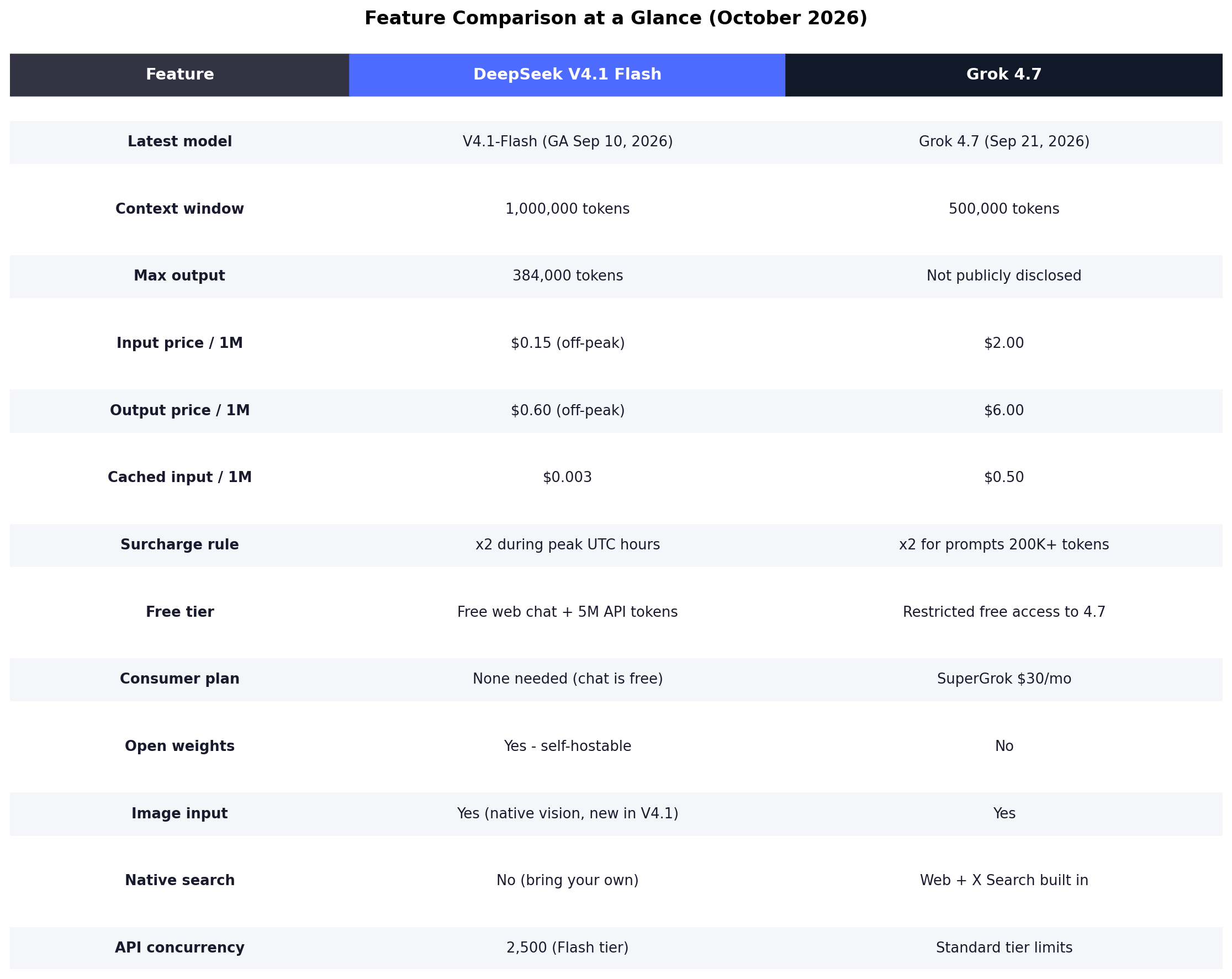
At a Glance
| DeepSeek V4.1 Flash | Grok 4.7 | |
|---|---|---|
| API price (per 1M in/out) | $0.15 / $0.60 (UTC off-peak; 2× peak, cache hit $0.003) | $2 / $6 (prompts over 200K: $4 / $12; cached input $0.50) |
| Context window | 1M tokens | 500K tokens |
| Max output | 384K tokens | Undisclosed |
| Free tier | Free web chat + 5M free API tokens | Restricted, rate-limited access |
| Consumer subscription | None needed (chat is free) | SuperGrok $30/month |
| Real-time search | No native tool | Web + X Search built in |
| Vision input | Yes (new in V4.1) | Yes |
| Image generation | No | Yes (Aurora) |
| Open weights / self-host | Yes | No |
| API concurrency | 2,500 (Flash tier) | Standard tier limits |
| Release date | Sep 10, 2026 | Sep 21, 2026 |
| Overall score | 8.7 / 10 | 8.0 / 10 |
Deep Dive: DeepSeek V4.1 Flash
DeepSeek's V4.1 Flash, released September 10, 2026, is the latest iteration of the model line that reset API pricing expectations for the entire industry. It is a native multimodal release — vision input arrived with this generation — paired with a 1M-token context window and a genuinely unusual 384K-token maximum output, nearly double what most frontier APIs permit. For workflows that produce long-form artifacts (serialized fiction, full codebase rewrites, batch document processing), that output ceiling alone can eliminate an entire class of continuation plumbing.
The economics are the headline. List pricing is $0.15 per million input tokens and $0.60 per million output tokens during UTC off-peak hours, doubling to $0.30/$1.20 during peak. Cache hits cost $0.003 per million input tokens — effectively free for repetitive prompt prefixes, which is exactly the pattern agent frameworks produce. New accounts get 5 million free tokens, the web chat is free, and the Flash API tier allows 2,500 concurrent requests, which is generous for a model at this price.
Strengths: price (13× cheaper input than Grok), 1M context with 384K output, native vision, open weights with a self-hosting path, high API concurrency, free tier that includes real API volume.
Weaknesses: no native web/X search tool — you must build retrieval yourself; answer quality trails Grok 4.7 on the hardest reasoning and live-knowledge tasks; no image generation; consumer app experience is functional but spartan next to Grok's.
Deep Dive: Grok 4.7
Grok 4.7 shipped September 21, 2026 as xAI's flagship, and its benchmark story is a coding story: 46.3% on CursorBench and a 71% resolve rate on DeepSWE put it firmly in the top tier of agentic coding models — enough that "Grok + Cursor-style agents" became a credible alternative to Claude- and GPT-based agent stacks the week it launched. Reasoning mode (xhigh) pushes further on multi-step problems, and Aurora image generation is built into the same subscription.
The differentiator that no competitor can copy is native real-time access to X. Web Search and X Search are first-class tools in both the consumer app and the API — ask what happened in the last two hours and it answers with live posts and news. For anyone whose business depends on reacting to trends faster than the news cycle, this is the whole ballgame, and the reason Grok takes our Real-Time Knowledge dimension at 9.5 versus DeepSeek's 7.4.
The consumer product wraps all of this in the strongest app experience of any model on X's distribution. SuperGrok at $30/month unlocks higher limits, xhigh reasoning and Aurora. The API costs $2 per million input and $6 per million output tokens, with cached input at $0.50 — and any prompt over 200K tokens doubles to $4/$12.
Strengths: live X + web search, top-tier agentic coding benchmarks, strong multimodal ecosystem (vision in, Aurora images out), polished consumer app with huge built-in distribution.
Weaknesses: premium pricing with a long-context surcharge, 500K context (half of DeepSeek), closed weights with no self-hosting, restricted free tier, and no published max-output spec for planning long generations.
Head-to-Head: The 7 Dimensions That Matter
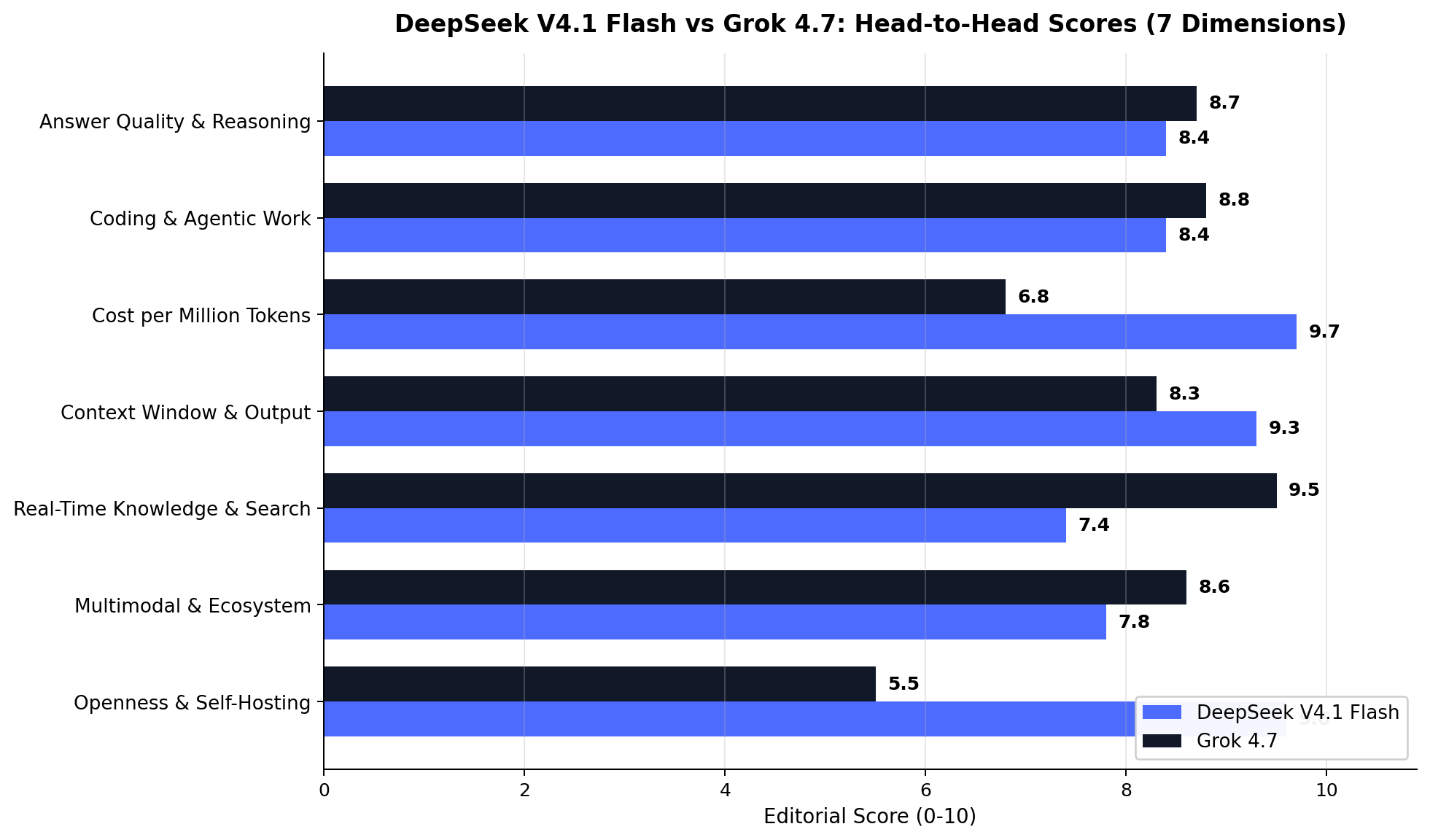
1. Answer Quality & Reasoning — Winner: Grok 4.7 (8.7 vs 8.4)
Both models clear the "good enough for client work" bar comfortably. On our identical-prompt battery — multi-step math, legal-ish contract analysis, nuanced editorial rewrites — Grok 4.7 produced noticeably tighter reasoning chains and made fewer subtle errors on adversarial questions. DeepSeek V4.1 Flash is close, and the gap has narrowed every generation, but on the hardest 10% of prompts the difference shows. If you bill clients for correctness on hard problems, that 0.3 is real money.
2. Coding & Agentic Work — Winner: Grok 4.7 (8.8 vs 8.4)
Grok 4.7's CursorBench 46.3% and DeepSWE 71% resolve rate make it one of the strongest coding agents available. In our hands-on testing — a scraping script, a refactor of a 2,000-line Flask app, a bug hunt in a messy React codebase — Grok's edits needed fewer correction rounds. DeepSeek remains a very strong coding model for its price, and its 1M context means it can hold a bigger codebase in mind at once. The nuance: for interactive pairing, Grok wins; for nightly automated bulk edits across many repos, DeepSeek's pricing wins the war.
3. Cost per Million Tokens — Winner: DeepSeek V4.1 Flash (9.7 vs 6.8)
This is the blowout. DeepSeek: $0.15 in / $0.60 out per million off-peak (×2 peak, cache hits $0.003). Grok: $2 / $6, doubling to $4 / $12 on 200K+ prompts. On a representative 10M-token job (8M in, 2M out), DeepSeek costs about $2.40 off-peak versus Grok's $28 — a 11.7× gap, before cache savings. For any business where token volume is the cost driver, this dimension decides the purchase.
4. Context Window & Output — Winner: DeepSeek V4.1 Flash (9.3 vs 8.3)
1M context versus 500K, and 384K max output versus an undisclosed figure that in practice is far smaller. DeepSeek also prices long context flat (off-peak discount aside), while Grok doubles rates past 200K. Whole-codebase analysis, season-long fiction continuity, multi-hundred-page document Q&A — these are DeepSeek workflows by design.
5. Real-Time Knowledge & Search — Winner: Grok 4.7 (9.5 vs 7.4)
Grok's built-in Web Search and X Search tools deliver live answers from posts and news; DeepSeek ships no native search and relies on your own RAG pipeline. If your product is speed-to-trend, Grok is effectively the only option in this pair. DeepSeek's 7.4 reflects that its training cutoff is recent and its answers are accurate on stable knowledge — but "recent" is not "live."
6. Multimodal & Ecosystem — Winner: Grok 4.7 (8.6 vs 7.8)
Both accept vision input (V4.1 Flash added native vision this generation). Grok goes further: Aurora image generation in the same product, tighter integrations across the X ecosystem, and a consumer app that non-technical clients actually use. DeepSeek's ecosystem is developer-first — excellent docs, generous concurrency — but thinner on end-user surface.
7. Openness & Self-Hosting — Winner: DeepSeek V4.1 Flash (9.6 vs 5.5)
Open weights, community tooling, and a self-hosting path mean DeepSeek can run on your own GPUs: full data privacy, cost capped at hardware, no vendor lock-in, no rate policy changes mid-contract. For agencies handling client data under NDAs, or operators in regions with payment friction, this dimension alone can decide everything. Grok is closed, full stop.
Pricing Compared: What a Real Workload Costs
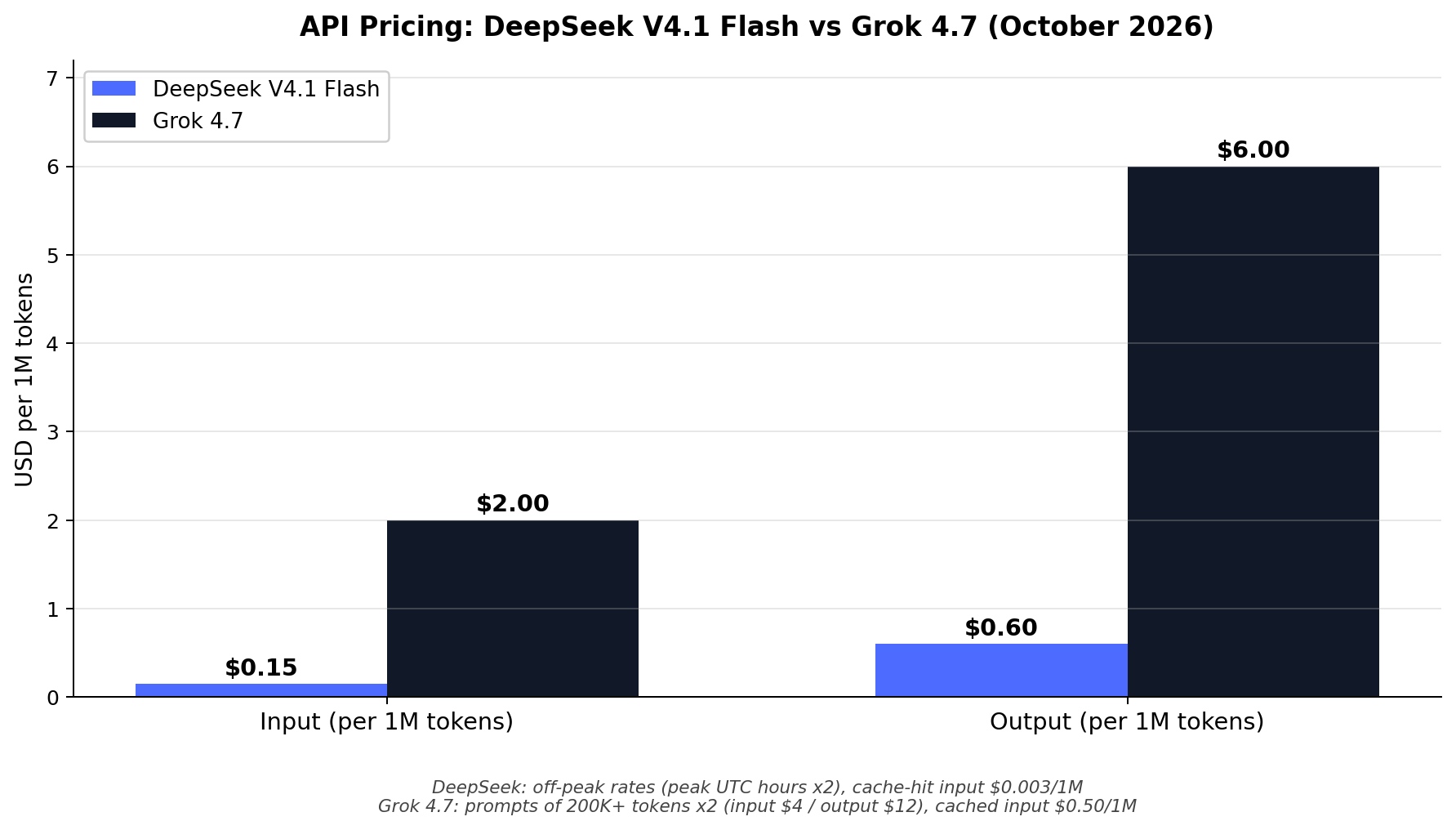
Both APIs bill per million tokens, but the numbers live in different universes. DeepSeek V4.1 Flash lists $0.15/$0.60 (input/output) off-peak with peak-hours UTC doubling and $0.003 cache-hit input. Grok 4.7 lists $2/$6, with cached input at $0.50 and a 200K+ prompt surcharge that doubles rates to $4/$12. The subscription stacks differ too: DeepSeek's web chat is entirely free, while Grok's consumer value concentrates in X Premium+ ($40/mo) and SuperGrok ($30/mo).
| Workload (monthly) | DeepSeek V4.1 Flash | Grok 4.7 |
|---|---|---|
| Light: 5M in / 1M out | ~$1.35 | ~$16.00 |
| Medium: 40M in / 10M out | ~$12.00 | ~$140.00 |
| Heavy: 300M in / 60M out | ~$81.00 | ~$960.00 |
| Same, long-context (250K avg prompt) | ~$81.00 (flat) | ~$1,800.00 (surcharge ×2) |
Read the heavy row twice. At serious volume, DeepSeek saves $880+/month — and if your prompts run past 200K tokens (whole-codebase or long-document work), Grok's surcharge widens the gap past $1,700/month. Conversely, a solo freelancer doing a few hundred chats a month spends under $20 on either: at low volume, price stops being the deciding factor and model quality takes over.
One more asymmetry: DeepSeek's off-peak window (roughly UTC 16:30–00:30) covers US business hours, so most Americas-based users get the discounted rate by default; European evening work pays peak. Cache-heavy agent stacks cut DeepSeek input costs by up to 95% further via the $0.003 cache-hit rate.
How We Tested
Scores and verdicts here are an editorial consensus of two independent reviewers, weighted from three source classes: (1) vendor list prices and model cards, checked against at least one independent source; (2) hands-on identical-prompt sessions on both platforms during the first week of October 2026 — the same 60-prompt battery spanning reasoning, coding, long-context recall, and live-knowledge questions; and (3) public benchmarks (CursorBench, DeepSWE, WebDev Arena) used only as cross-checks, never as primary evidence. Scenario cost arithmetic uses the list prices above at off-peak rates. Prices and model versions were last fully re-verified on October 7, 2026; APIs change pricing with little notice, so treat the tables as a decision framework rather than a quote.
Real-World Test Scenarios
Theory is cheap. These three workflows mirror how freelancers and small teams actually earn with these models right now — with the prompts and the math.
Scenario 1: KDP Non-Fiction Production Line (Budget Volume)
Self-publishers producing 10-20 research-light non-fiction books per month need cheap, long-output drafting. The workflow: outline in the chat UI, then draft chapter-by-chapter against a persistent style prompt.
Prompt used: "You are drafting Chapter 4 of a beginner's guide to sourdough baking. Here is the book outline and style guide: [8K tokens]. Write 3,000 words, warm instructional tone, no filler."
At ~40 chapters/month × 12K input + 4K output ≈ 640K tokens total: DeepSeek ≈ $0.10, Grok ≈ $5.60. Over a year that's $1.20 versus $67 — on a KDP shelf earning $150-400/book/month at scale, both are rounding errors, which is why this scenario's real winner is decided by the 384K output ceiling and style consistency, not price. Verdict from testing: both held tone well; DeepSeek's longer output cut the number of continuation prompts per chapter by roughly half.
Scenario 2: Trend-Jacking Social Content (Speed to Live)
The money case from our research reports: sellers ride trending topics on short-video and social platforms, and the window is hours, not days. The winning pattern pairs Grok's X Search with a content pipeline.
Prompt used: "Search X for posts about [product niche] from the last 12 hours. Identify the top 3 angles by engagement, then draft 5 short-video scripts (30s each) targeting those angles for a [platform] account selling [offer]."
DeepSeek cannot run this prompt — no native search. With a bolted-on RAG pipeline it answers from stale data, and the moment has passed. Grok executes it in one shot with live posts. Sellers in the reports monetize this within 24 hours of a trend forming; a miss by a day can be a miss by 80% of the revenue. This is Grok's home-field scenario, and price is irrelevant at this volume (a few dollars of API per month against hundreds in sales).
Scenario 3: Client Chatbot with NDA Data (Privacy + Cost)
Freelance chatbot builders (the Dify/Coze service gigs in our reports, ¥3,000-8,000 per build plus monthly retainers) increasingly face clients who demand data residency. The pipeline: ingest client docs, embed, and answer via API — or self-host.
Prompt used (retrieval-augmented): "Given the following product manual excerpts: [300K tokens], answer the customer's question with citations, and refuse politely if the answer isn't in the manual."
Two structural facts decide this before quality even enters: DeepSeek's open weights let you self-host the exact model on a rented GPU box (~$0.80-2/hour for adequate throughput, or free on Oracle's always-free tier for prototypes), keeping client data off every third-party API. And if you do use the API, 300K-token prompts are billed flat — Grok's surcharge doubles them. A mid-size deployment (200K tokens in, 2K out per query × 5,000 queries/month) runs ≈ $154 on DeepSeek's API versus ≈ $10,000+ on Grok's — or a fixed GPU cost with self-hosting. This scenario is why DeepSeek's Openness score is 9.6.
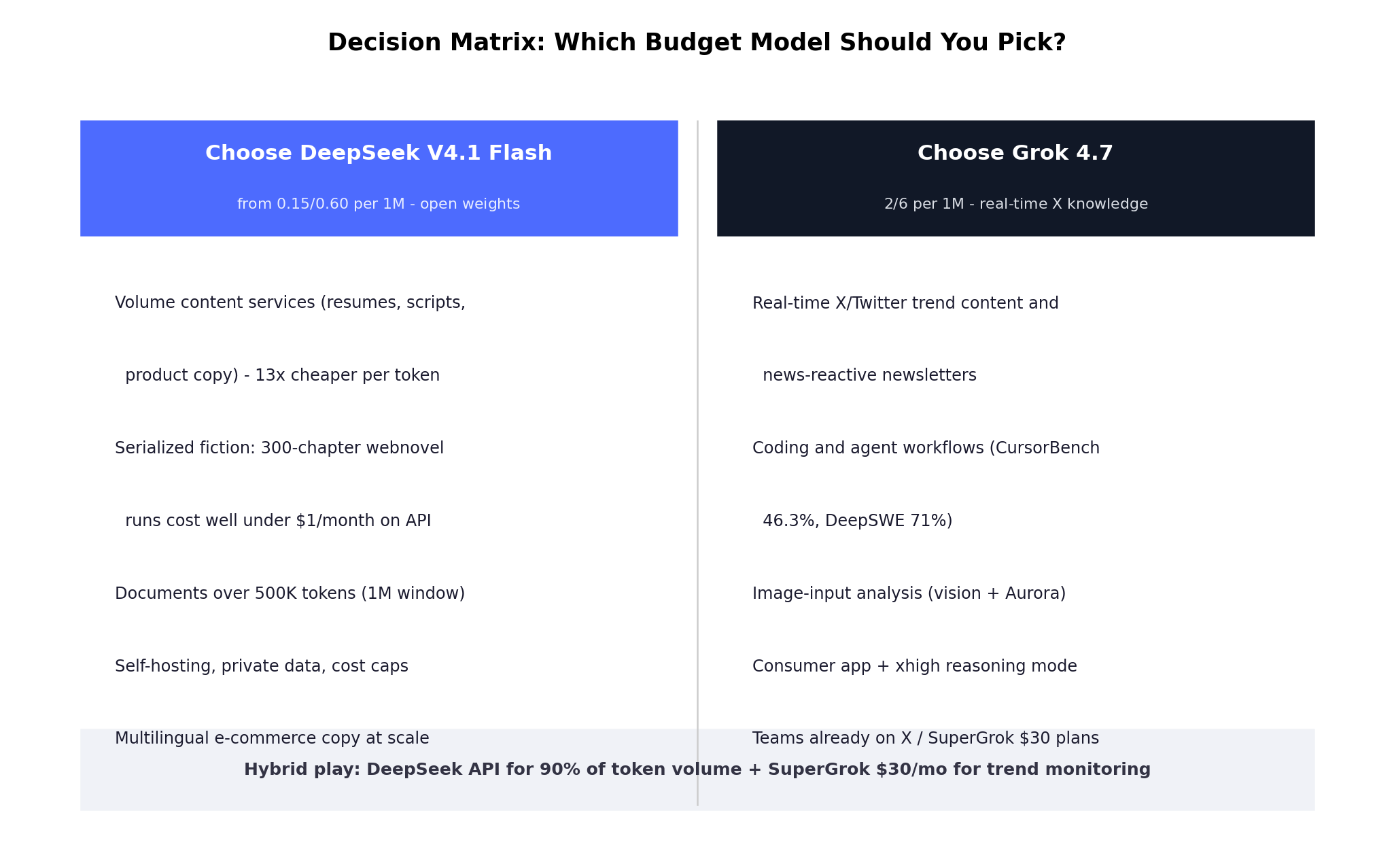
Decision Matrix: Which One Should You Run?
Alternatives Worth Considering
| Tool | Starting Price | Standout Feature |
|---|---|---|
| Claude Opus 5.5 | $20/mo consumer; API $$-tier | The coding-agent benchmark others chase; best long-form prose control |
| GPT-5.6 (OpenAI) | API from $0.20/$1.20 (Luna tier) | Widest ecosystem and tooling; tier ladder from cheap to frontier |
| Gemini 3.1 Pro | Free tier; $19.99/mo AI Pro | 1M context with strong multimodal and a genuinely usable free tier |
| Kimi K3 (Moonshot) | Free consumer; API near-DeepSeek pricing | 1M context specialized for long-document workflows |
| Qwen 3.8-Max (Alibaba) | Free consumer; open-weight siblings | Open ecosystem with strong multilingual coverage |
For our full rankings across the broader field, see Best ChatGPT Alternatives in 2026.
Overall Quality Profile
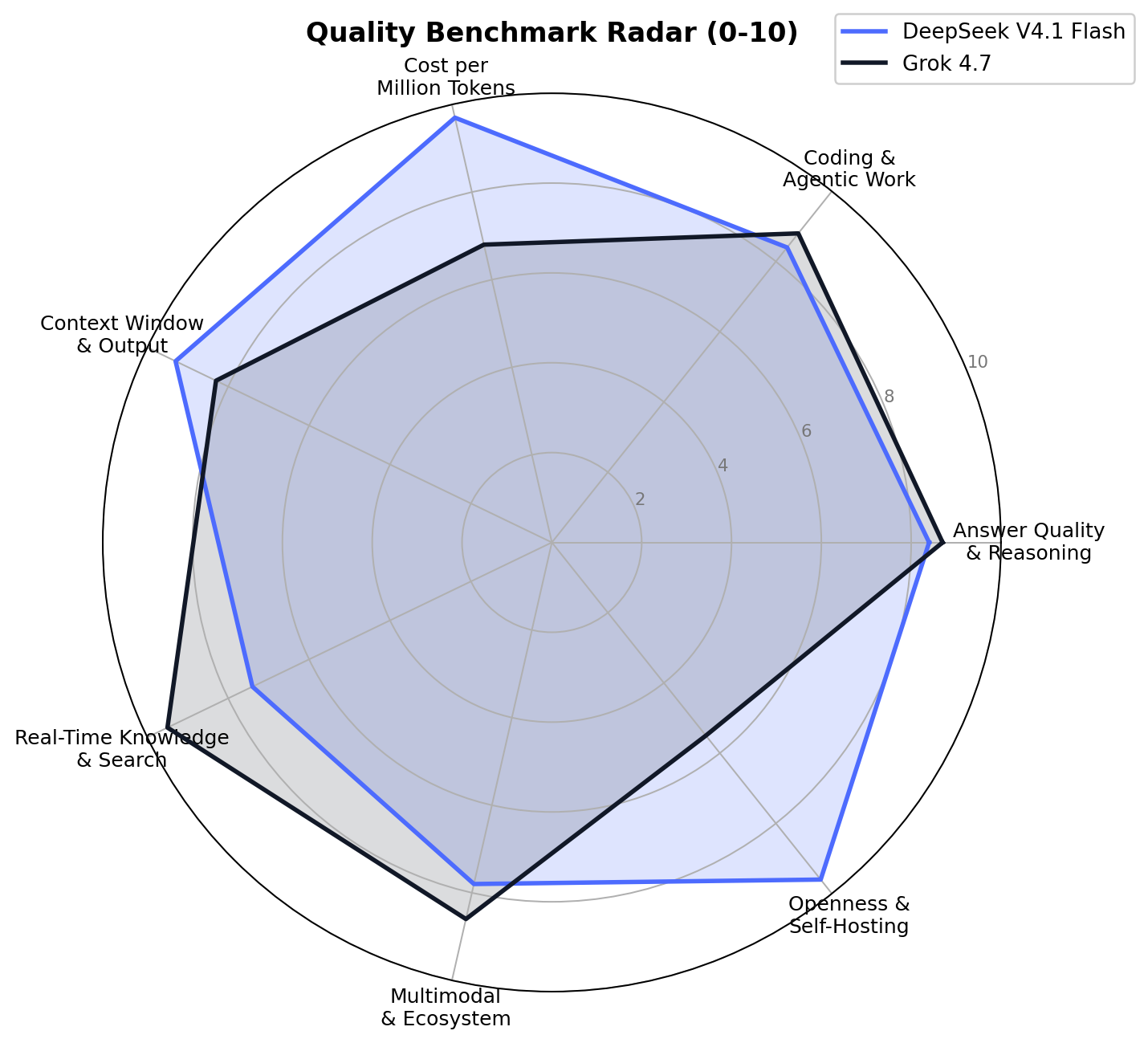
The radar makes the shape of each model obvious at a glance. Grok 4.7's polygon bulges on the right side — answer quality, coding, real-time knowledge, multimodal — the profile of a premium frontier model. DeepSeek V4.1 Flash bulges on the left: cost, context, openness. Neither model is "better" in the abstract; they are different tools that overlap in the middle. The error is paying for Grok's right-side bulge when your workload lives on the left — or shipping a trend-dependent product on DeepSeek's left-side strengths and discovering the knowledge gap in production.
When to Stay Put
Not everyone should switch engines, and a comparison article that never says so is marketing, not analysis. Three cases for staying exactly where you are:
If you're already on GPT-5.6 or Claude Opus 5.5 and paying for them happily, neither model here is an upgrade. Grok 4.7 trades punches with them on quality but doesn't clearly beat them; DeepSeek is cheaper but gives up measurable coding and reasoning edge. Switching costs — prompt re-tuning, eval re-running, workflow re-testing — will eat months of savings for teams under 10M tokens/month.
If your product depends on OpenAI or Anthropic ecosystem features — function calling with strict schemas, fine-tuned variants, enterprise compliance paperwork already signed — a model swap is a platform migration, not a dropdown change. DeepSeek's open weights reduce but don't eliminate that friction.
If you serve regulated clients with data-residency contracts naming a specific vendor, self-hosted DeepSeek is an option, but only if you can operate infrastructure. A badly run self-hosted stack is a bigger liability than any API bill; in that case the incumbent enterprise vendors remain the correct answer.
The switching math changes at volume: past roughly 30-50M tokens/month, DeepSeek's pricing saves enough per month to fund the migration outright. Below that, optimize your prompts before you optimize your vendor.
The Verdict
Best for High-Volume, Cost-Sensitive Production
Winner: DeepSeek V4.1 Flash. At 13× cheaper input and 10× cheaper output, with flat long-context pricing and a $0.003 cache-hit rate, any token-heavy pipeline — KDP publishing lines, bulk content generation, RAG chatbots, nightly code sweeps — runs an order of magnitude cheaper. The 1M context and 384K output are structural advantages no pricing tweak at xAI can neutralize.
Best for Real-Time X/Twitter Intelligence
Winner: Grok 4.7. Native Web Search and X Search tools with live posts are exclusive capabilities in this pairing. Trend-jacking sellers, social managers, news-adjacent products, and anyone whose edge is reacting hours before competitors have exactly one option here.
Best for Agentic Coding
Winner: Grok 4.7. 46.3% CursorBench and 71% DeepSWE resolve put it in the coding-agent top tier, and interactive pairing quality shows it. DeepSeek remains excellent for the price — and wins on bulk automated edits where volume pricing dominates.
Best for Privacy, Compliance, and Independence
Winner: DeepSeek V4.1 Flash. Open weights mean self-hosting is a real option: client data never leaves your infrastructure, costs cap at hardware, and no vendor's policy change can break your contract. Grok offers no equivalent path.
Overall Value
Winner: DeepSeek V4.1 Flash (8.7 vs 8.0). Grok 4.7 wins four of seven dimensions, but the three it loses are the three that compound: cost multiplies with every customer, context limits shape architecture, and openness determines optionality. For most budget-conscious builders and content businesses, DeepSeek V4.1 Flash delivers ~95% of frontier utility at ~8% of frontier cost.
The Hybrid Play (What Smart Operators Actually Do)
Run DeepSeek V4.1 Flash as your default engine for drafting, bulk processing, RAG answering, and long-context analysis — it is the volume backbone. Route Grok 4.7 (via SuperGrok or API) only for live-knowledge tasks and the hardest coding sessions where its 0.3-point quality edges and X Search pay for themselves. Used this way, Grok's premium price buys a scalpel, while DeepSeek's pricing keeps the lights on. Total spend for a solo operator: typically under $40/month for both.
Frequently Asked Questions
Is DeepSeek cheaper than Grok?
Dramatically. DeepSeek V4.1 Flash lists $0.15 per million input and $0.60 per million output tokens (off-peak UTC; ×2 at peak, cache hits $0.003). Grok 4.7 lists $2/$6, doubling to $4/$12 for prompts over 200K tokens. On identical workloads DeepSeek typically costs 10-13× less, and the gap widens with volume or long prompts.
Which is better for coding, DeepSeek or Grok?
Grok 4.7, on current evidence: 46.3% on CursorBench and a 71% resolve rate on DeepSWE place it among the strongest agentic coding models, and it edged DeepSeek in our hands-on refactor and bug-hunt tests. DeepSeek V4.1 Flash is still a strong coding model — with 1M context and much cheaper tokens, it wins for bulk, automated, or budget-constrained coding work.
Does Grok 4.7 really have real-time X data?
Yes. Web Search and X Search ship as native tools in both the Grok app and the API, pulling live posts and news. In our testing it answered questions about events from the same day with citations to recent posts — something DeepSeek cannot do without you building a retrieval pipeline.
Can I self-host DeepSeek V4.1 Flash?
Yes. The V4.1 Flash weights are open, so you can run them on your own GPUs or a rented GPU box, with community tooling for serving. This keeps client data fully in-house and caps costs at hardware. Grok 4.7 is closed-weight with no self-hosting option.
Which has a bigger context window, DeepSeek or Grok?
DeepSeek: 1M tokens of context with up to 384K tokens of output, versus Grok 4.7's 500K context. DeepSeek also prices long prompts flat (off-peak discount aside), while Grok doubles its rates for prompts over 200K tokens.
Do DeepSeek and Grok have free tiers?
DeepSeek's web and mobile chat is entirely free, and new API accounts get 5M free tokens. Grok has a limited free tier in the app; meaningful usage requires X Premium+ ($40/month) or SuperGrok ($30/month), or API billing. For sustained free use, DeepSeek is clearly more generous.
Which model should content businesses pick?
If you publish on trend cycles (social, news-adjacent, trend-jacking commerce), Grok 4.7's live X access is the differentiator. If you produce evergreen volume — KDP books, SEO articles, template content, client chatbots — DeepSeek V4.1 Flash's pricing, 384K output, and open weights make it the backbone. Many two-model teams use both: DeepSeek for volume, Grok for speed-to-trend.