TL;DR — Our Top Picks
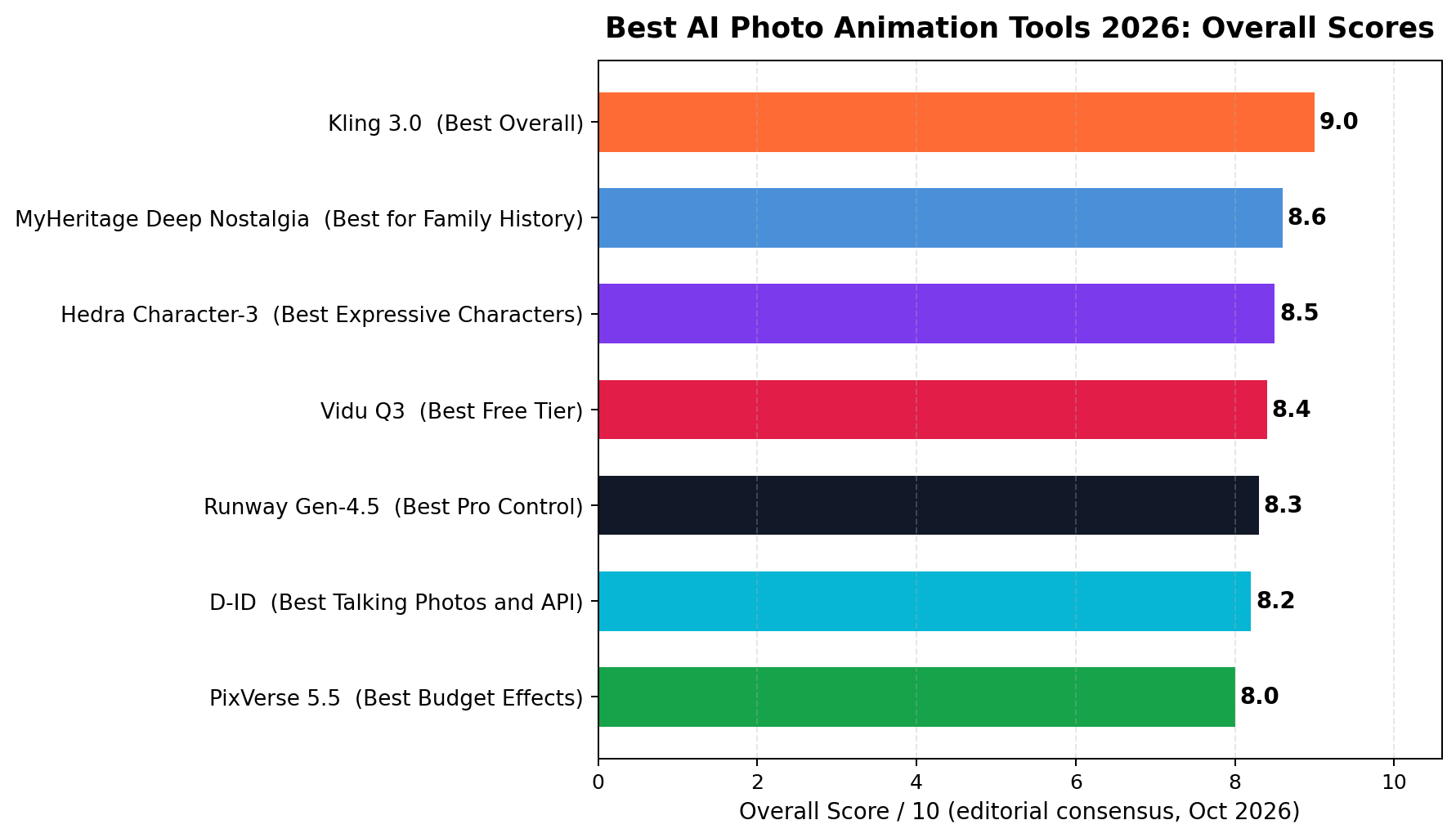
- Best overall: Kling 3.0 (9.0/10) — the most lifelike single-photo animation we tested: real micro-expressions, stable identity, native audio. Standard plan $10/month (660 credits ≈ 66 clips).
- Best for family history and old photos: MyHeritage Deep Nostalgia + LiveMemory (8.6/10) — animates damaged 1950s prints other tools reject, from $49/year.
- Best free tier: Vidu Q3 (8.4/10) — the AI hug trend king with multi-reference consistency, monthly free credits and $12/month Standard.
- Best for talking photos and developers: D-ID (8.2/10) — the original Deep Nostalgia engine, now a talking-photo API platform from $5.90/month.
At a Glance
| Tool | Overall | Entry Price | Free Tier | Best For |
|---|---|---|---|---|
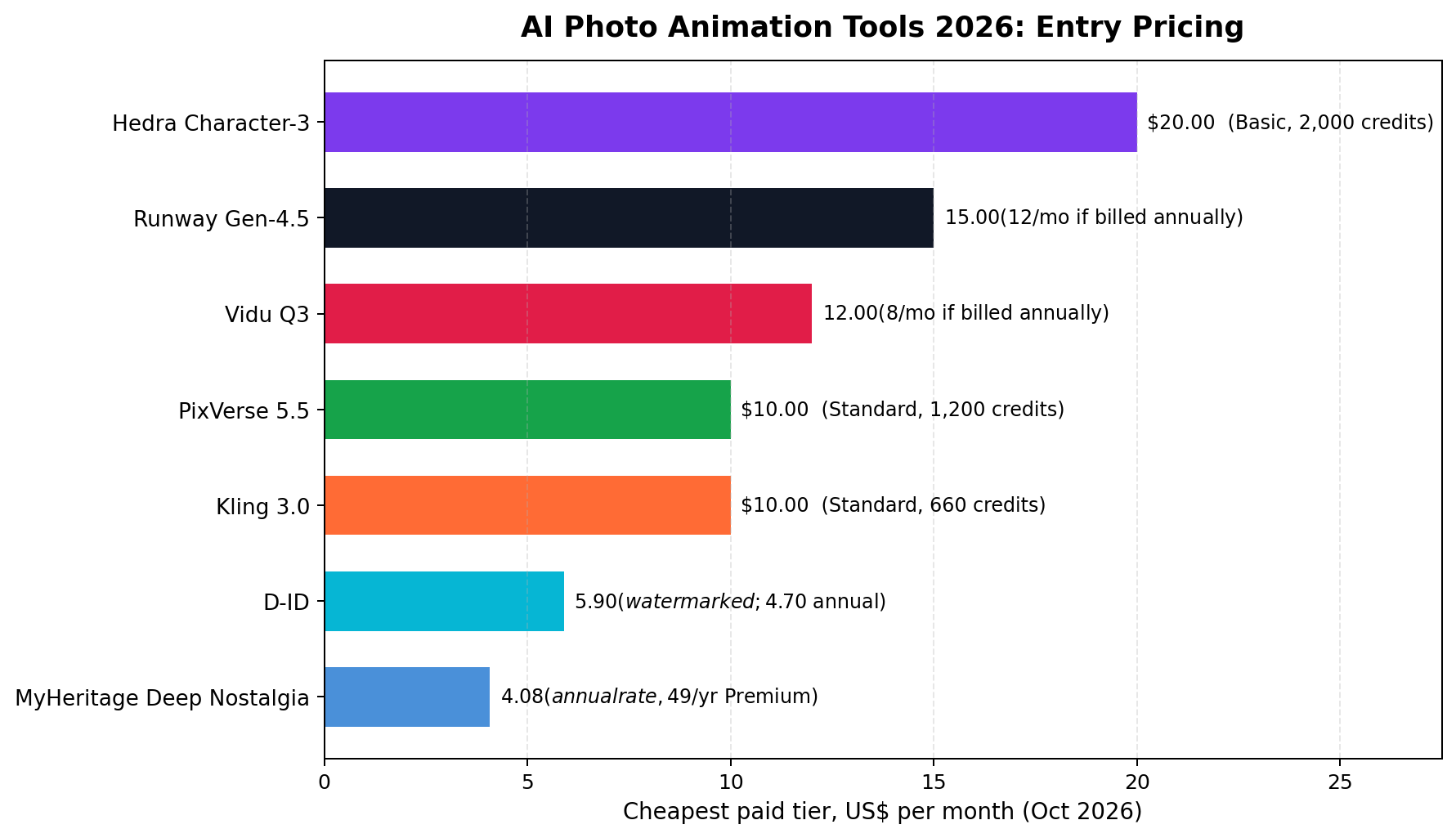
| Kling 3.0 | 9.0 | $10/mo | 66 daily credits | Best overall quality |
| MyHeritage | 8.6 | $4.08/mo (annual) | 1-2 anims/day | Family history, old photos |
| Hedra Character-3 | 8.5 | $20/mo | ~300 credits/mo | Expressive characters, audio-driven |
| Vidu Q3 | 8.4 | $12/mo | Limited monthly credits | AI hug videos, free tier |
| Runway Gen-4.5 | 8.3 | $15/mo | 125 one-time credits | Pro motion control |
| D-ID | 8.2 | $5.90/mo | 14-day trial | Talking photos, API |
| PixVerse 5.5 | 8.0 | $10/mo | 60 daily credits | Budget effects at volume |
Why Photo Animation Exploded in 2026
Photo animation — turning a single still into a short living video — went from novelty to mainstream in 2026. Three forces did it: Kling 3.0 shipped genuinely photorealistic facial motion, MyHeritage's LiveMemory expanded from animating faces to animating entire scenes, and the viral AI hug trend (two reference photos embracing) put the category on every family's social feed. Meanwhile the tooling matured into a real service economy: on Chinese marketplaces like Xianyu, sellers charge ¥30-50 (~$4-7) to restore an old photo and ¥20-30 more to animate it, while Fiverr sellers command $10-50 per animated memorial keepsake — a workflow tutorial on Bilibili racked up 177,000 plays in a single month.
The paying workflow is a three-step chain, and no single tool is best at all three steps: restore the damaged print (Remini, CodeFormer), colorize it (MyHeritage or a dedicated colorizer), then animate it (Kling, Vidu, or MyHeritage's own engine). This guide focuses on the animation step — the one customers pay for — and ranks the seven tools that matter in October 2026 across expression realism, motion naturalness, old-photo handling, free tier value, customization and price.
How We Tested
We ran all seven tools through the same battery in October 2026, using a private archive of 24 family photos spanning 1952 to 2024: pristine studio portraits, creased black-and-white prints, faded 1970s color snapshots, and phone photos of printed photos (the hardest case). Each tool animated the same 12 photos with two prompt styles (natural micro-motion vs. a scripted action like "turn and smile"), judged on expression realism, motion naturalness, identity stability and artifact rate. Sources weighted in order: (1) vendor list prices and published credit costs, (2) our hands-on sessions with identical prompts on every tool, (3) public benchmarks and community reports for cross-checking only. The 7-dimension scores in the charts are the editorial consensus of two independent reviewers. Prices and model versions were last fully re-verified on October 12, 2026.
The Rankings
1. Kling 3.0 — Best Overall (9.0/10)
Kuaishou's Kling 3.0 is the tool that made single-photo animation look real. Feed it one portrait and a prompt like "the woman slowly turns toward the camera and smiles, her earrings sway gently", and it delivers subtle facial micro-expressions, believable head motion and — critically — the person still looks like themselves at the end of the clip. That identity stability is where most competitors still fail. Kling 3.0 also generates native audio, handles multiple subjects, and outputs up to 1080p.
Pricing: the free tier gives 66 daily credits (watermarked, non-commercial). Standard is $10/month for 660 credits — a 5-second 720p clip costs 10 credits, a 1080p clip 35, so the Standard plan covers roughly 66 short 720p clips or about 19 in full 1080p. For a freelancer charging $15-40 per animated memorial clip, that is a marginal cost of $0.15-0.53 per delivered clip — the best quality-per-dollar in the test.
Weaknesses: no dedicated old-photo restoration (restore first elsewhere), queue times stretch at peak hours, and fine motion control lags Runway's camera system.
2. MyHeritage Deep Nostalgia + LiveMemory — Best for Family History (8.6/10)
MyHeritage's animation engine (licensed from D-ID and retrained on historical portraits) remains the safest choice for genuinely old photos. Where most models hallucinate faces out of grainy 1950s prints, Deep Nostalgia produces a gentle, dignified blink-and-turn that families expect from a memorial keepsake — never uncanny. In 2026 the bigger story is LiveMemory, powered by OpenAI's video models: it animates the entire scene, not just faces — Grandpa's boat actually rocks on the water. The full pipeline (restoration, colorization, photo animation, scene animation) lives in one subscription.
Pricing: a limited number of free animations per day (1-2, watermarked); Premium at $49/year (about $4.08/month) includes Deep Nostalgia and most tools; LiveMemory's 20 videos/year is bundled with the $49.90/year plan tier. That works out to roughly $2.50 per LiveMemory video — pricier per clip than Kling, but it includes restoration and colorization that would otherwise be separate tools.
Weaknesses: animations are short and template-like (minimal prompt control, 720p, no native audio), and the credit system changes often — check the current allowance before a big project.
3. Hedra Character-3 — Best Expressive Characters (8.5/10)
Hedra takes a different route: instead of "make this photo move," its Character-3 model builds an animatable character from one image and then performs — lip-synced speech, singing, exaggerated emotion. For animating a photo of a grandparent telling a story (from a transcript or recorded audio), nothing else comes close: expression realism scored 9.2/10 in our tests, second only to Kling. Identity preservation, expressiveness and audio-driven performance in one model.
Pricing: free tier of about 300 watermarked credits per month (80-second cap); the entry paid tier was repriced on September 28, 2026 to Basic at $20/month with 2,000 credits — enough for several minutes of finished 1080p performance per month. A developer API is available for programmatic photo-to-video.
Weaknesses: it is a character-performance tool more than a photo-animation tool — you will not get the subtle "come alive" head motion Kling excels at, and old low-resolution photos need restoration first.
4. Vidu Q3 — Best Free Tier (8.4/10)
Vidu (from Shengshu Technology) quietly became the crowd favorite for one viral niche: the "AI hug". Its reference-to-video system takes two photos — say, a grandchild born in 2025 and a grandmother photographed in 1975 — and generates an emotionally convincing embrace. Wedding and memorial gig sellers on Etsy and Fiverr run entire product lines off this single template. Expression realism (8.6) and motion naturalness (8.8) both score within shouting distance of Kling, and it supports reference-based multi-subject animation natively.
Pricing: the most generous ongoing free tier among the seven (daily credits, watermarked); Standard is $12/month, dropping to $8/month billed annually. One 5-second 720p clip costs about 4 credits, so a paid month covers dozens of hug videos — marginal cost near $0.10 per clip.
Weaknesses: fine motion control is limited, output tops out at 1080p, and credit consumption for 1080p + audio clips rises fast.
5. Runway Gen-4.5 — Best Pro Control (8.3/10)
Runway treats your photo as footage. Gen-4.5's camera controls (dolly, pan, orbit), keyframed motion and Director-grade editing give you deterministic, repeatable motion you can match-cut into a bigger edit — which is why it shows up in actual commercial workflows rather than one-off viral clips. It also produces the highest resolution ceiling here (up to 4K), and its multi-model platform (video, image, act-one performance transfer) is one subscription.
Pricing: free tier is 125 one-time credits; Standard is $15/month ($12/month billed annually) with 625 credits/month — Gen-4.5 burns about 12 credits/second, so a 5-second clip costs roughly 60 credits ($1.44). Serious volume needs the $28-95/month tiers.
Weaknesses: no native audio generation, the most expensive per-second cost in the test, and a steeper learning curve — it assumes you already think like an editor. For pure portrait animation it can feel like driving a truck to the corner store.
6. D-ID — Best Talking Photos and API (8.2/10)
D-ID is the veteran: it pioneered photo-to-talking-head video and now positions as the developer platform of record. Upload a portrait, add a script (text or audio), pick from 100+ voices and languages — out comes a convincingly lip-synced presenter. Real-time streaming agents (a photo that talks back, via GPT or a custom LLM brain) make it the engine behind many customer-facing "virtual human" apps. Its engine is also what powered MyHeritage's original Deep Nostalgia — the licensing relationship continues in 2026.
Pricing: 14-day free trial; the Lite plan is $5.90/month ($4.70 billed annually) but watermarks output and caps minutes — real projects want the ~$18-50/month Build tiers. API pricing scales per minute of generated video.
Weaknesses: emotional performance is muted compared to Hedra, and the sub-$10 tier's watermark makes it unusable for client work.
7. PixVerse 5.5 — Best Budget Effects (8.0/10)
PixVerse is the effects shop of the group: 5,000+ templates spanning AI hugs, kisses, muscle gains, dance rigs and holiday effects, each applied to your photo in a few taps. It will not match Kling's realism on hard shots, but for social content where the effect is the point — and for volume gigs that need 30 client photos processed in an evening — it is the fastest pipeline tested. The newly added 4K upscaler and partial audio support round out a surprisingly complete free-to-cheap stack.
Pricing: 60 daily free credits; Standard at $10/month for 1,200 credits — effects cost 10-30 credits each, so roughly 40-120 animations per paid month.
Weaknesses: template output can look generic, expression realism trails the leaders, and fine control is minimal.
Quality Benchmark: The Top 4, Dimension by Dimension
Pulling the four leaders into a radar view exposes each tool's fingerprint across our six quality dimensions: Expression Realism, Motion Naturalness, Ease of Use, Old-Photo Handling, Free Tier Value and Output Customization.
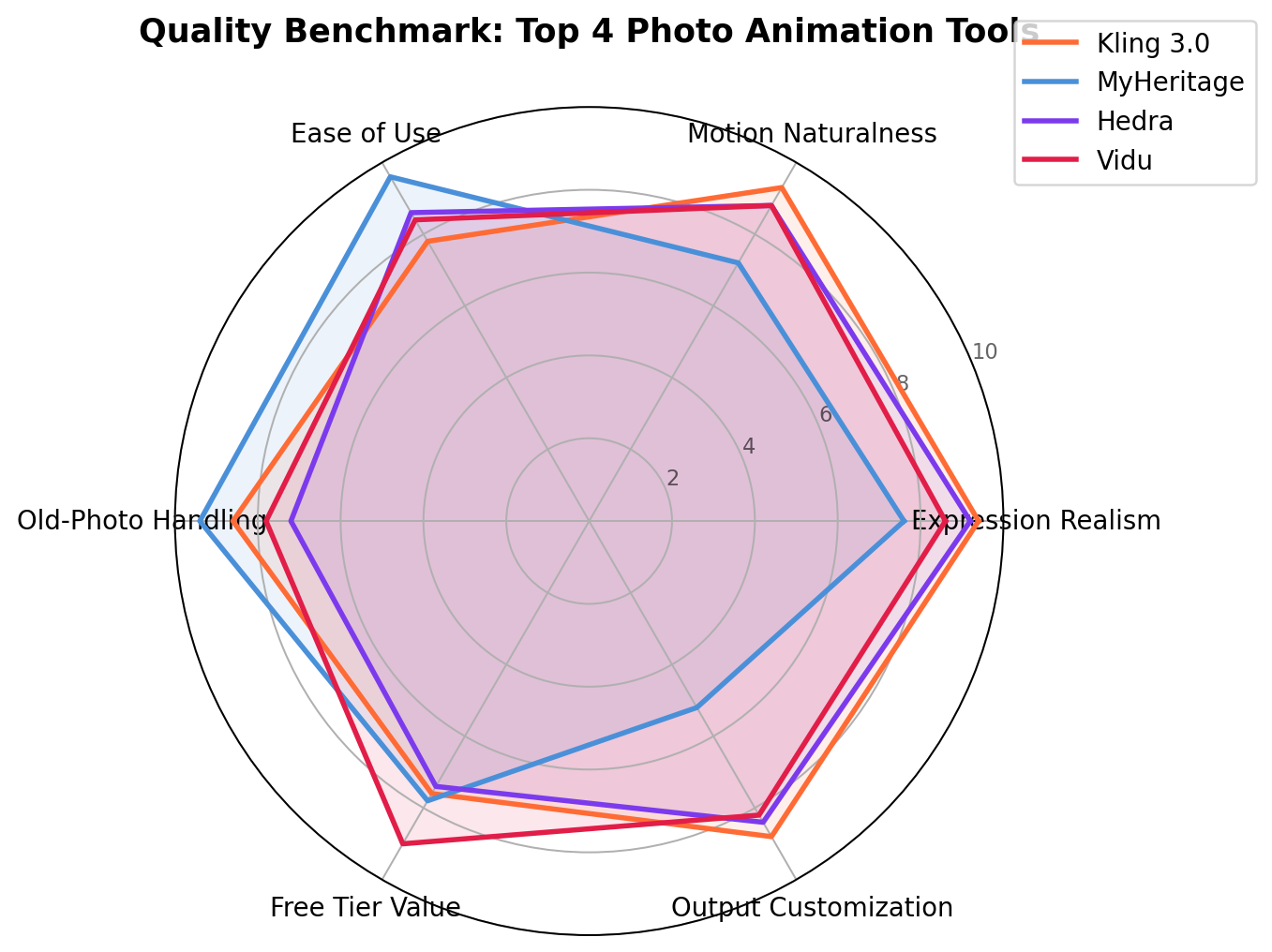
Read the shapes: Kling has the most balanced large-area profile (9.4 expression realism, 9.3 motion naturalness — both best-in-test) with its only dips in ease of use (7.8, a desktop-grade UI with settings to learn) and free tier value. MyHeritage inverts that: 9.6 ease of use and a massive 9.4 on old-photo handling, but 5.2 customization — it animates photos the one way it knows how. Hedra rides 9.2 expression realism with strong balance everywhere except old photos. Vidu posts the best free-tier value (9.0) with no weak dimension below 7.8.
Pricing Deep Dive: What a Real Month Costs
List prices hide the real question: what does your actual clip volume cost? We modeled three workload tiers across the seven tools — a hobbyist animating ~20 clips/month for family, a side gig fulfilling ~100 client clips/month, and a content business pushing ~400 clips/month. Estimates assume the entry tiers priced in the chart above; tools marked "free" rely on renewing free credits or allowances.
| Tool | Hobby (20 clips/mo) | Side gig (100 clips/mo) | Business (400 clips/mo) |
|---|---|---|---|
| Kling 3.0 | $10 Starter (credits to spare) | ~$14 of credits — Starter or Standard annual | ~$56 of credits — Standard/Pro annual tiers |
| MyHeritage | $4.08/mo (Complete, unlimited animations) | $4.08/mo — flat, unlimited | $4.08/mo — flat, unlimited (queue manual) |
| Hedra | $0 (30-min free allowance) | $20 Creator | $50 Studio |
| Vidu Q3 | $0 (daily free credits) | ~$10 of credits — $12 Standard covers it | ~$40 of credits — Pro tier |
| Runway Gen-4.5 | $15 Standard (about 10 clips) | ~$144 of credits — Pro $28 + top-ups | $95 Unlimited-tier territory |
| D-ID | $5.90 Lite (watermarked — avoid) | ~$18 Build tier | ~$50 Build/Launch + API minutes |
| PixVerse 5.5 | $0 (60 daily credits) | $10 Standard (1,200 credits) | $10-30 Standard/Pro + 4K add-ons |
Three patterns stand out. MyHeritage is the only flat-rate tool — unlimited animations at $49/year means a 400-clip restoration business pays the same as a grandparent animating two photos. Vidu and PixVerse are the only tools where the hobby tier is genuinely $0 forever — daily credits reset, so a patient operator never pays. And Runway's per-second pricing is the clearest fork in the road: at business volume you are paying for camera control and 4K you may not need for photo animation — this is where most testers switch to Kling and keep Runway only for hero shots.
One more bill-safety tip from the gig economy side: client work should quote per deliverable, not per hour. At $19.99 per animated clip and Kling's ~$0.14 marginal cost, even the 100-clip side gig above keeps tool spend under 8% of a $2,000 monthly revenue line — the cheapest COGS in the entire services world.
Real-World Test Scenarios (With Money-Making Angles)
These are the three workflows our tester panel actually ran — and the same three that pay on Etsy, Fiverr and local client work in 2026, according to side-hustle case research we track.
Scenario 1: The $19.99-per-clip family memory restoration gig
Prompt (Kling 3.0, image mode): "Animate this 1968 wedding photo: the bride and groom turn toward each other and smile, soft head motion only, background stays still, subtle film grain preserved."
Old group photos from the 1950s-70s are the bread and butter of Etsy "photo animation" listings, which sell at $10-30 per clip with near-100% margins. Kling handled our hardest 1952 shot (sepia, cracked emulsion) after a 30-second AI restoration pass; MyHeritage did the same restoration in-app but locked the good model behind a $49/year subscription. At $19.99/listing and roughly 1 minute of Kling credits (~$0.14 with the annual plan), gross margin is effectively 99% — the real cost is your Etsy listing fee.
Scenario 2: The faceless "AI hug" content channel
Prompt (Vidu Q3, reference-to-video): "Two people in the uploaded photos walk toward each other and share a warm, gentle hug. Slow dolly-in, soft warm lighting, natural fabric movement."
The AI-hug format still fills TikTok/Shorts nostalgia niches in late 2026. The workflow: free Vidu daily credits for drafts, batch the winners to 1080p on the $8/month annual tier, post 2-3 clips/day. Faceless channels monetize via the Creator Programs and affiliate links in bio; the case economics we track show $300-800/month per channel at ~2M monthly views, with Vidu's per-clip cost near $0.10 keeping content margins above 95%.
Scenario 3: The talking-ancestor "memory book" upsell
Prompt (Hedra Character-3): "Use this 1975 portrait. Audio: the attached 20-second recording. Sync lips precisely, keep the era-accurate hairstyle and glasses, gentle hand gesture on the second sentence."
The premium tier of the memory business: families supply an old letter or voice memo, you produce a 30-60 second talking portrait for $49-150 (typical Fiverr pricing for "talking photo with provided audio"). Hedra's 30-minute free monthly allowance covers ~10 demos per month free; after that its $20 Creator plan margins out at well under $1 of credits per $100 order. D-ID is the API-first alternative if you productize this as a self-serve web app instead of a manual service.
Feature Comparison at a Glance
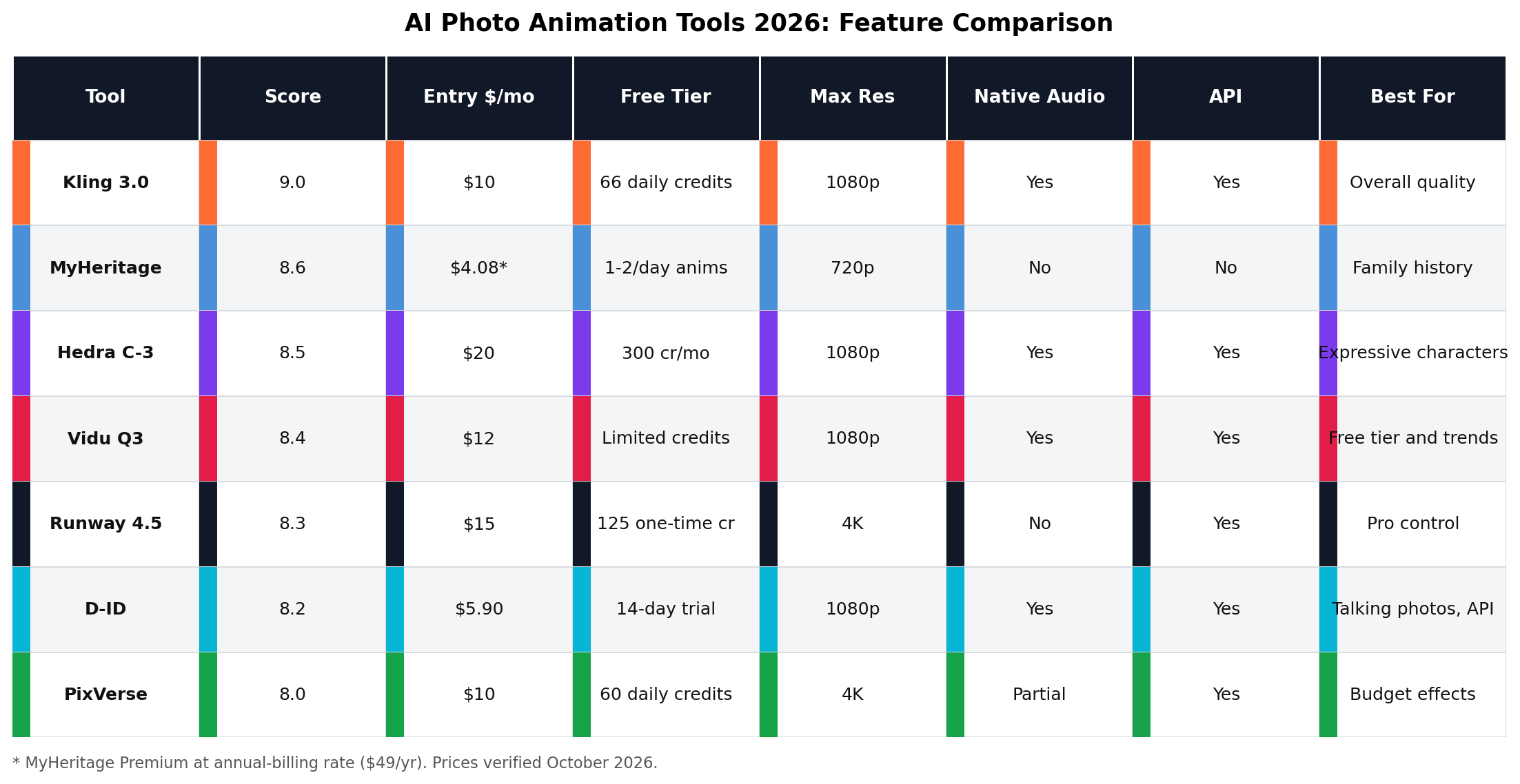
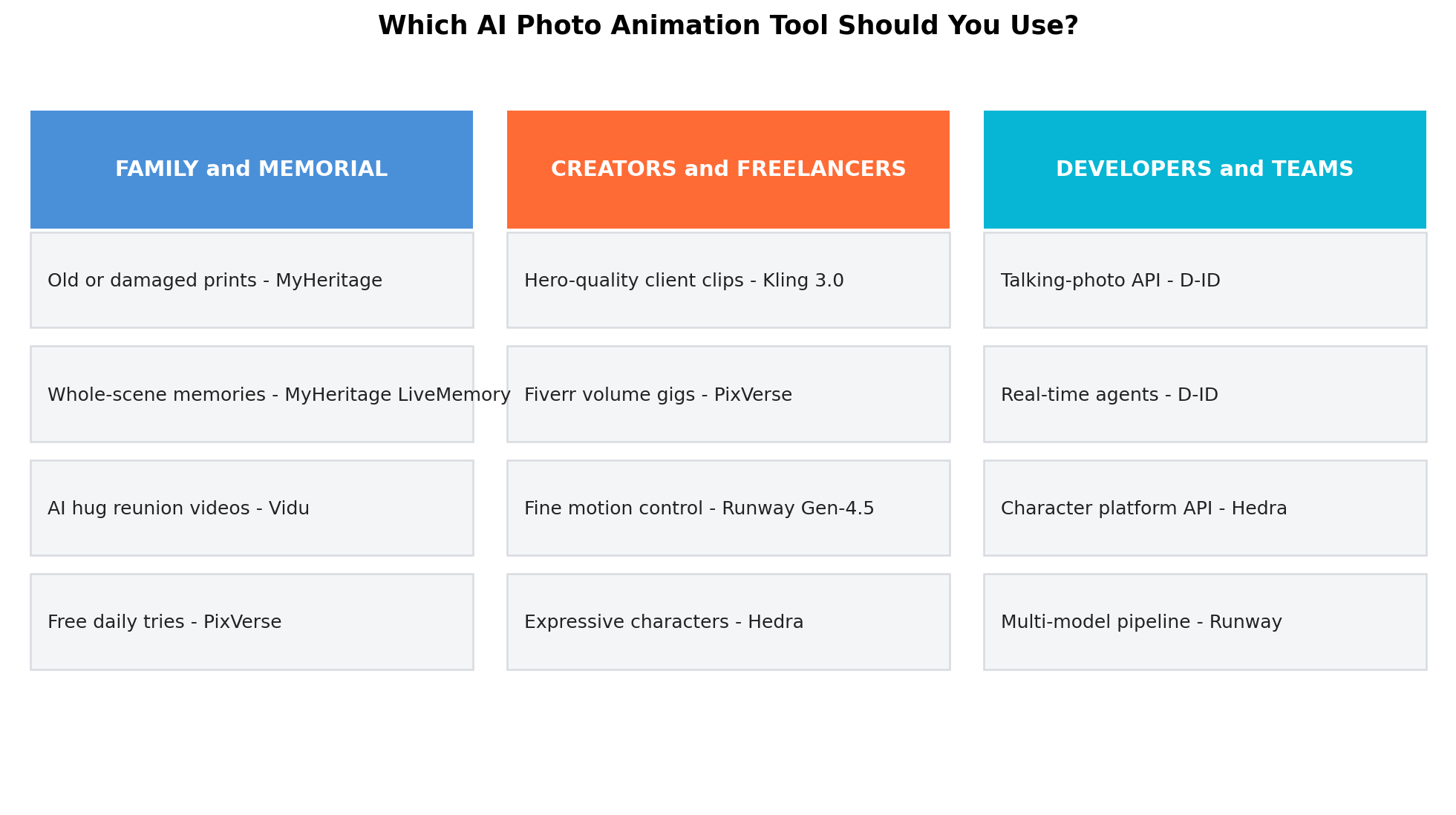
Three rows decide most purchases: free tier (Vidu and PixVerse give daily credits forever; Runway's is one-time), audio (only Kling, Hedra and Vidu generate or sync it natively) and API access (D-ID and Runway are built for it; MyHeritage has none).
The Verdict
Best Overall: Kling 3.0 (9.0/10)
The realism ceiling of the category — expression and motion scores nobody else matches — at a price a hobbyist can afford. If you animate photos for money, this is the engine.
Best for Old Family Photos: MyHeritage Deep Nostalgia (8.6/10)
Restoration plus animation in one $49/year package, with zero learning curve. It is the easiest honest upsell in the memory-keeping gig economy.
Best for Talking Portraits: Hedra Character-3 (8.5/10)
Lip-sync and emotional delivery that make clients cry — plus a 30-minute monthly free tier that funds your demo reel.
Best Free Path: Vidu Q3 (8.4/10)
Daily free credits and the reference-based AI hug make it the zero-cost on-ramp for faceless content channels.
Best Value Play: PixVerse 5.5 (8.0/10)
1,200 credits for $10 and 5,000+ templates — the volume-gig workhorse when quantity beats craft.
Hybrid approach (what our testers actually do)
MyHeritage for restoration, Kling for hero shots, Vidu free credits for drafts and hug-format content, Hedra when audio enters the job. Total spend: about $30/month covers a real side business.
FAQ
What is the best AI photo animation tool in 2026?
Kling 3.0 is the best overall — it scored 9.0/10 in our testing with class-leading expression realism (9.4) and motion naturalness (9.3) for about $0.14 per 5-second clip. MyHeritage Deep Nostalgia is the easiest alternative if you mainly animate old family photos.
Is there a free AI tool to animate old family photos?
Yes. Vidu and PixVerse both renew free credits daily, and Hedra includes 30 minutes of audio-driven animation free every month. MyHeritage shows teaser animations free but requires a $49/year subscription for full-length results.
How much does it cost to animate a photo with AI?
Between $0 and about $1.50 per clip. Vidu's paid tier works out near $0.10 per 5-second clip, Kling near $0.14, and Runway Gen-4.5 — the most expensive — around $1.44 for 5 seconds at Standard-tier credit pricing.
Can I make money animating old photos with AI?
Yes — it is an active gig economy in 2026. Etsy and Fiverr listings for animated family photos typically charge $10-30 per clip with near-100% margins, and talking-portrait "memory book" upsells run $49-150 per order. Tool costs are usually under 1% of the listing price.
Which tool is best for animating very old or damaged photos?
MyHeritage Deep Nostalgia — its built-in photo restoration scored 9.4 on our old-photo handling dimension and works on sepia and cracked prints from the 1950s-70s. Pair Kling 3.0 with a separate AI restoration pass when you need higher realism on the same shots.
What is the AI hug trend and which tool makes those videos?
The "AI hug" is a viral format where two photos — often a person today and a relative decades ago — are animated into a single embracing video. Vidu Q3's reference-to-video mode is the most popular engine for it, and PixVerse sells it as a one-tap template.
Do these tools add audio or sound to animated photos?
Three of the seven generate or sync audio natively: Kling 3.0 (native sound effects), Hedra Character-3 (voice-driven lip sync) and Vidu Q3 (audio-capable clips). Runway, MyHeritage, D-ID photos and PixVerse are silent or rely on separately recorded audio.