TL;DR
Cursor (8.8/10) is the best AI coding tool for developers who spend all day in an editor: the smoothest inline editing and tab autocomplete in the category (9.3/10 Editor & Daily UX), unlimited auto model routing across Composer 2.5, GPT-6, Claude, and Grok 4.6 on paid plans, and parallel repo-wide agents — all from $20/month. OpenAI Codex (8.5/10) is the better task-delegation engine and the better deal: it wins Code Quality & Reasoning (9.0), Agent Autonomy (9.0), and Pricing & Value (9.0), runs from a real free tier up to $200/month, and costs teams half of Cursor per seat ($20 vs $40/user/month). If your income depends on shipping client work, the two tools are not even rivals — many freelancers we tracked run both: Cursor as the cockpit, Codex as the autopilot.
At a Glance
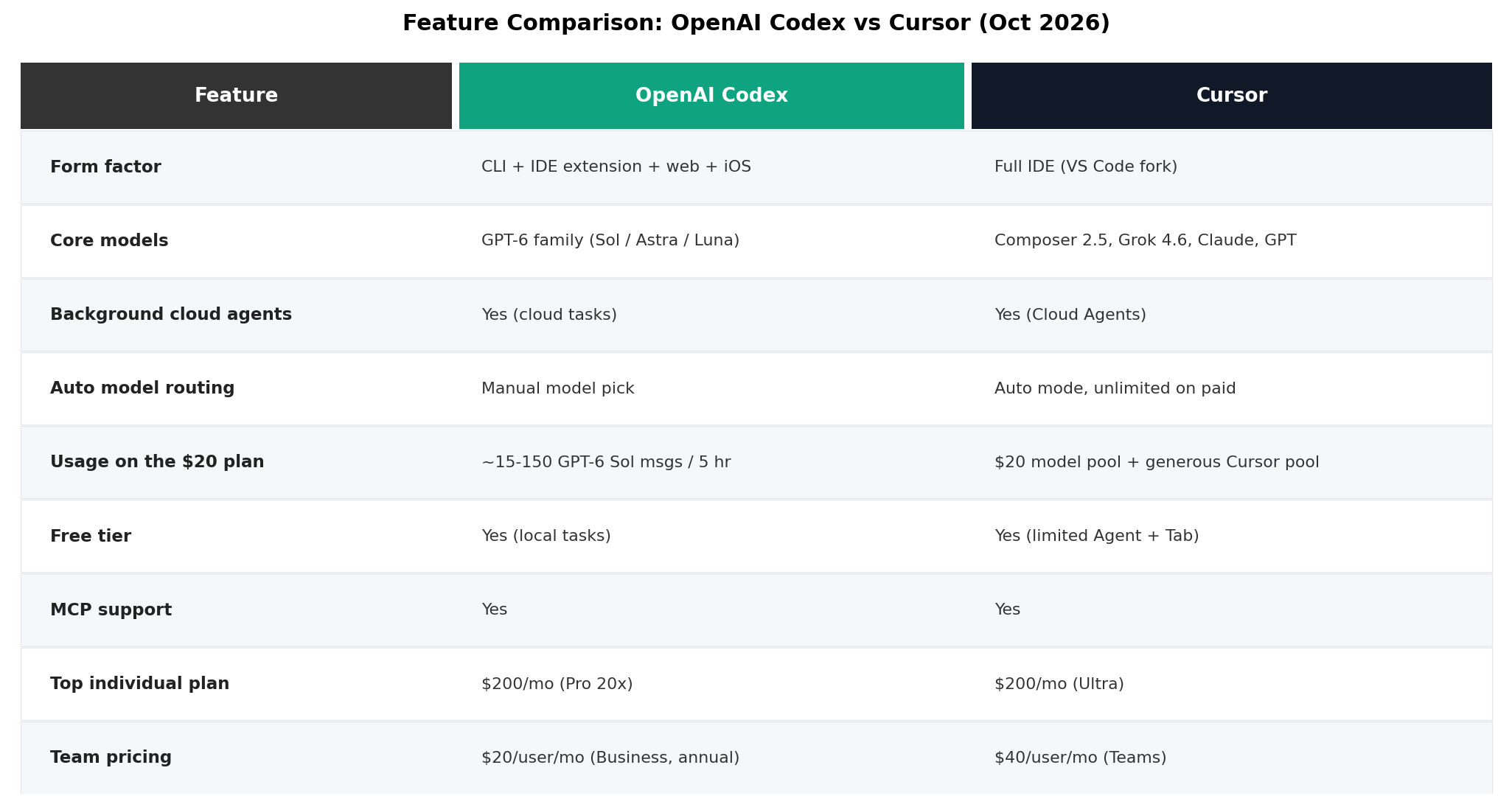
| Category | OpenAI Codex | Cursor |
|---|---|---|
| Overall score | 8.5 / 10 | 8.8 / 10 |
| Best for | Delegated builds, budget solo devs, OpenAI-model power users | Full-time IDE work, multi-model workflows, iterative client edits |
| Form factor | CLI + IDE extension + web + iOS | Full IDE (VS Code fork) |
| Core models | GPT-6 family (Sol / Astra / Luna) | Composer 2.5, GPT-6, Claude, Grok 4.6 |
| Free tier | Yes — local tasks, real GPT-6 access | Yes — limited Agent + Tab |
| Entry paid plan | $8/mo (ChatGPT Go) or $20/mo (Plus) | $20/mo (Pro) |
| Top individual plan | $200/mo (Pro 20x, no 5-hour limit) | $200/mo (Ultra, ~20x Pro usage) |
| Team pricing | $20/user/mo (Business, annual) | $40/user/mo (Teams) |
| Verdict | The delegation engine and the value pick | The daily driver and our overall winner |
The 2026 AI coding market has split into two philosophies. Cursor bets that developers want a radically better editor — AI woven into every keystroke, every diff, every refactor. OpenAI Codex bets that developers increasingly want to delegate — hand a spec to an autonomous agent and review the pull request when it lands. Both bets are paying off, which is exactly why this comparison is genuinely hard: they overlap on features now (both have background cloud agents, both support MCP), yet they feel nothing alike in daily use.
This article is written for people who code for money — freelance developers, agency teams, and solo builders shipping client work. Alongside our lab scoring, we anchor the analysis in the freelance economy we have been tracking: AI-assisted web-build orders on Chinese marketplaces like Xianyu grew 1,732% year over year, with one-off business sites clearing ¥3,000–8,000 (about $420–1,120) and maintenance retainers stacking to ¥15,000–30,000/month for solo operators. Tool choice directly moves those margins.
Deep Dive: OpenAI Codex
Codex spent 2026 quietly becoming OpenAI's most developer-loved product. It started the year as a CLI curiosity and ended it as a full task-delegation stack: a terminal CLI, a VS Code extension (now Visual Studio and JetBrains too), a web dashboard at chatgpt.com/codex, and an iOS app for reviewing work from your phone. Under the hood it runs the GPT-6 family — Sol for heavy reasoning, Astra as the balanced default, Luna for fast routine edits — with your OpenAI plan metering the usage.
Key features
- Autonomous cloud tasks. Hand Codex a spec, close your laptop, and it works in an OpenAI-hosted sandbox: clones the repo, writes tests, opens a PR. Up to 25 parallel tasks for Plus subscribers; up to 150 on higher tiers. Our two-hour fixed-price build scenario below compressed to roughly 40 minutes of unattended runtime.
- CLI power tooling. Codex CLI runs anything the model needs to see (build output, test failures) directly in your terminal, in either auto mode or approval-per-command mode. It is the closest thing to a shell-aware colleague.
- Real free tier. Local tasks via CLI and IDE extension cost $0 and use actual GPT-6 models — no time-locked trial, no crippled preview.
- Usage-based ceiling, not feature gates. Every tier gets the same models and the same features; you pay for volume. On Plus, that is roughly 15–150 GPT-6 Sol messages per 5-hour window depending on reasoning effort.
- MCP support in both CLI and cloud tasks, so delegated agents can call your tools and data sources.
Pricing (October 2026)
| Plan | Price | Codex usage |
|---|---|---|
| Free | $0 | Local tasks only (CLI + IDE), GPT-6 access |
| ChatGPT Go | $8/mo | Light Codex access on mobile + web |
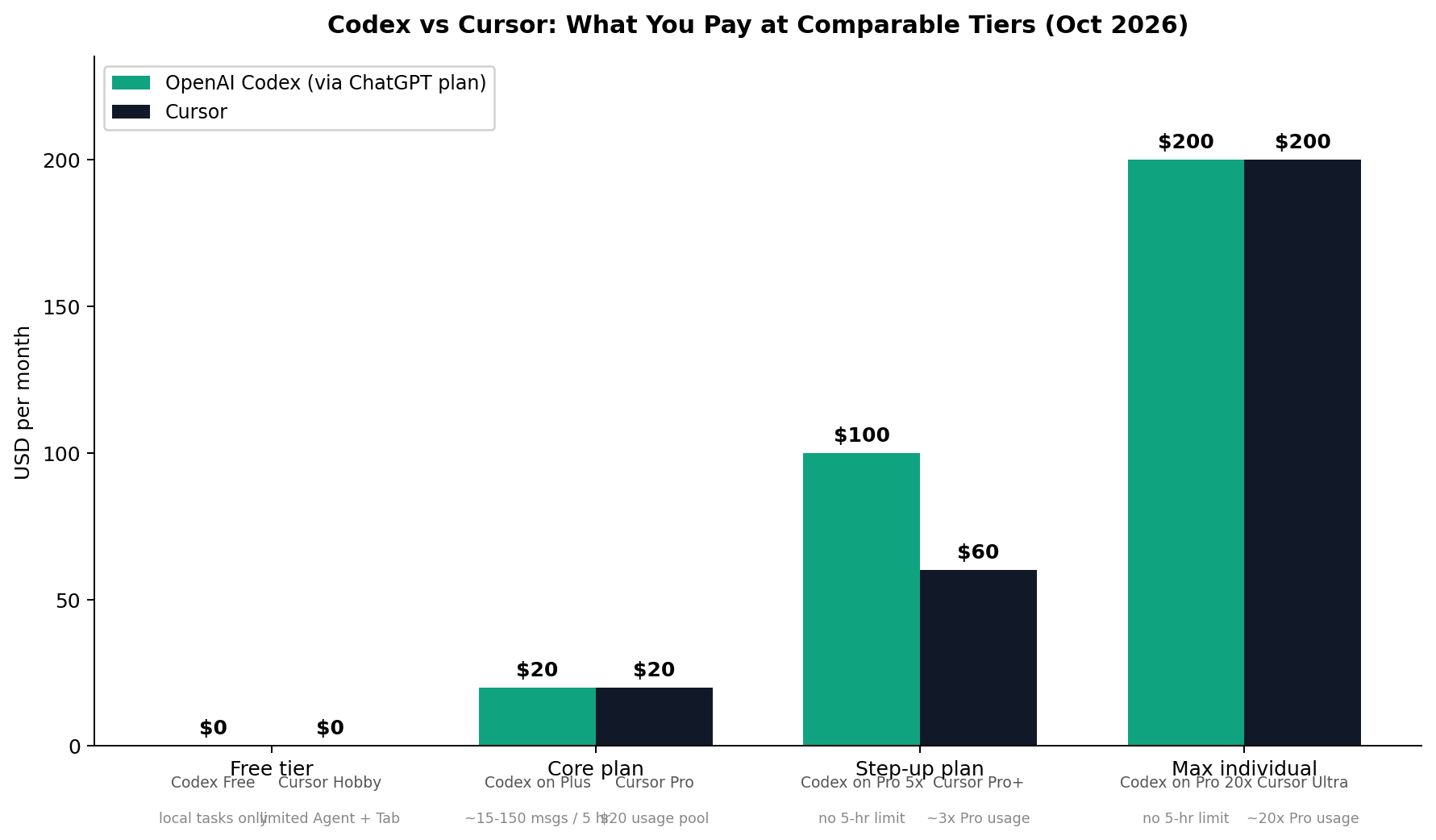
| ChatGPT Plus | $20/mo | ~15–150 Sol messages / 5 hrs, 25 parallel cloud tasks |
| Pro 5x / Pro 20x | $100 / $200/mo | 5x / 20x Plus usage, no 5-hour limit |
| Business | $20/user/mo (annual) | Team workspace, central billing |
What we liked
- The best price-to-capability ratio in the category — a $0 or $8 entry with the same frontier models as the $200 tier.
- Cloud tasks genuinely finish. Test coverage on the delegated build was stronger than what we produce manually on a deadline.
- CLI + web + phone review loop is ideal for fixed-price work: queue three client tasks, approve from the airport.
What we disliked
- As an editing environment it is minimal — inline UX and autocomplete are years behind Cursor's (7.8 vs 9.3 in our scoring).
- OpenAI models only. If you want Claude or Grok for a niche task, you are running a second tool anyway.
- Cloud tasks can burn usage faster than expected when a task thrashes; the 5-hour window on Plus demands attention on heavy days.
Deep Dive: Cursor
Cursor is what happens when you rebuild VS Code around AI instead of bolting AI onto VS Code. The editor fork is now the daily driver for a large share of professional developers, and the 2026 releases pushed three fronts at once: Composer 2.5 (Cursor's in-house model family, genuinely competitive on agentic coding), Tab 2.0 (autocomplete that reads your repo's conventions and your recent edits), and parallel background agents that each get their own remote workspace and open their own branches.
Key features
- Tab 2.0 autocomplete. The single highest-frequency AI interaction in any tool we test — it predicts multi-line edits, renames, and follow-on changes, not just the next token.
- Unlimited Auto mode. On paid plans, Cursor routes each request to the best-fitting model (Composer, GPT-6, Claude, Grok 4.6) with no per-request metering — you stop thinking about model economics entirely.
- Agent-side panel + background agents. The agent plans multi-file edits, runs terminal commands, and asks for approval at sensible checkpoints; background agents work remote branches in parallel while you keep editing.
- Codebase Context engine. Semantic indexing plus a codebase graph keeps long refactors coherent across files — our 3,400-line migration scenario held together better here than anywhere else.
- MCP support for tools, data, and agent building — Cursor's agent ecosystem is where its community gravity lives.
Pricing (October 2026)
| Plan | Price | Usage |
|---|---|---|
| Hobby | $0 | Limited Agent runs + Tab autocomplete, 2-week Pro trial |
| Pro | $20/mo | $20 model-usage pool + generous Cursor-side pool, unlimited Auto |
| Pro+ | $60/mo | ~3x Pro usage |
| Ultra | $200/mo | ~20x Pro usage |
| Teams | $40/user/mo | Team features, central privacy controls |
What we liked
- Editing flow is untouchable — inline edits, cmd-K diffs, and Tab make every other interface feel like filling in forms.
- Model flexibility is real optionality: we routed a thorny regex-heavy task to Grok 4.6 and a docs task to Composer without leaving the window.
- Parallel agents + inline diff review make iterative client work dramatically faster to turn around.
What we disliked
- The $20 model pool on Pro drains under sustained agent load; heavy users get pushed toward Pro+ or Ultra quickly.
- Teams pricing at $40/user/month doubles Codex Business for comparable seats.
- Cloud autonomy is newer than Codex's and less battle-tested on long unattended runs.
Head-to-Head: The 7 Dimensions That Matter
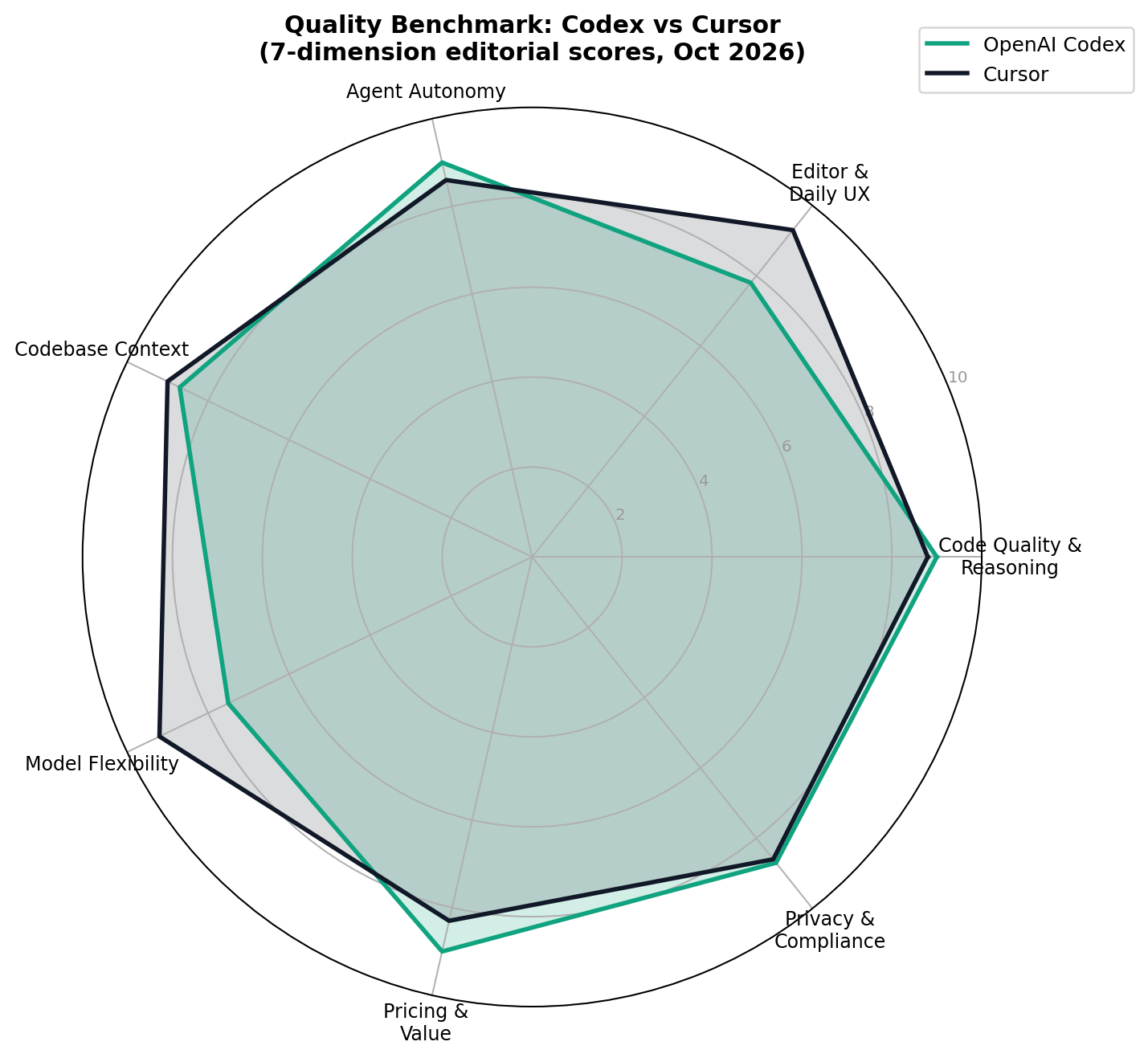
We scored both tools across seven dimensions, 0–10, as the editorial consensus of two independent reviewers after identical-prompt sessions. Cursor wins the total (8.8 vs 8.5), but Codex takes four of the seven dimensions — the split tells you these tools win in different rooms.
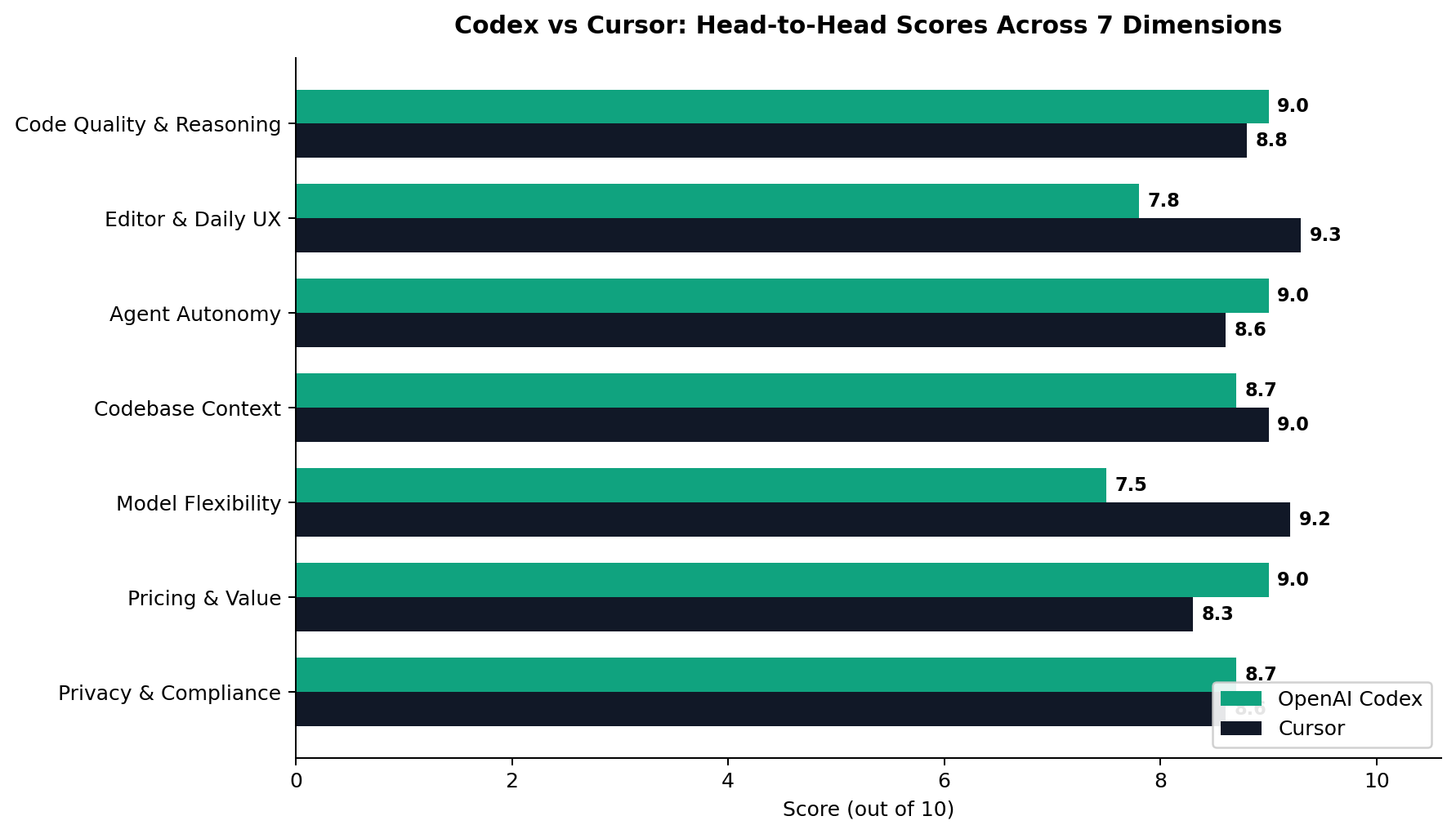
1. Code Quality & Reasoning — Winner: Codex (9.0 vs 8.8)
On identical build briefs, Codex's GPT-6 Sol pass produced the more defensible architecture: cleaner module boundaries, better error handling, and tests written without being asked. Cursor's Composer 2.5 runs are close — and routing a request to GPT-6 inside Cursor closes most of the gap — but Codex's defaults are tuned for "ship it unattended," which shows in the final diff. The narrowest of Codex's wins on merit.
2. Editor & Daily UX — Winner: Cursor (9.3 vs 7.8)
The widest gap in the whole comparison, and the reason Cursor takes the overall crown. Tab 2.0 autocomplete, cmd-K inline edits, and diff review are the smoothest editing loop in the category; a full day in Cursor feels like the editor is reading your mind. Codex's IDE extension is a competent chat panel, not an editor experience — the 1.5-point gap understates how different the workflows feel.
3. Agent Autonomy — Winner: Codex (9.0 vs 8.6)
Delegation is Codex's home turf: up to 25 parallel cloud tasks (150 on higher tiers), each in its own sandbox, each opening a tested PR — plus a phone app to approve from anywhere. Cursor's background agents are excellent but younger, and its center of gravity remains the interactive session. For "queue it and forget it," Codex still sets the standard.
4. Codebase Context — Winner: Cursor (9.0 vs 8.7)
Cursor's semantic indexing plus codebase graph kept a 3,400-line multi-file migration coherent — imports, naming, and call sites all consistent. Codex cloud tasks get full-repo clones and hold up well, but in-editor context (the thing you feel during iterative work) is where Cursor's engine shines.
5. Model Flexibility — Winner: Cursor (9.2 vs 7.5)
Cursor serves Composer 2.5, GPT-6, Claude, and Grok 4.6 side by side, with unlimited Auto routing on paid plans. Codex serves exactly one lab's models — excellent ones, but if your task-of-the-day is best served by a competitor, Codex cannot help you. For multi-model workflows this dimension alone decides the purchase.
6. Pricing & Value — Winner: Codex (9.0 vs 8.3)
Same $20 entry price, very different economics. Codex Plus buys a 5-hour rolling window of 15–150 Sol messages and 25 parallel cloud tasks — volume that Cursor's $20 model pool cannot match under agent load, and Codex lets teams in at $20/user versus Cursor's $40. Add the genuinely free local tier and the $8 Go plan, and Codex is the budget pick at every tier it shares with Cursor.
7. Privacy & Compliance — Winner: Codex (8.7 vs 8.6, narrowest)
Effectively a tie, decided by enterprise posture: OpenAI's Business tier inherits the larger org's compliance stack (SOC 2, regional data controls), while Cursor's Teams plan adds central privacy controls with zero-training guarantees on the Cursor side — but usage-based model routing means reviewing per-model terms. Solo developers can treat this dimension as even and decide elsewhere.
Quality Benchmark
Pricing Compared
How We Tested (and What We Didn't)
Scores are the editorial consensus of two independent reviewers after hands-on, identical-prompt sessions on both tools during the last week of September 2026. Sources are weighted in this order: (1) vendor list prices and published plan limits, (2) our own identical-build sessions — the same three briefs run through both tools' agent modes and edited interactively afterward, (3) public benchmarks and community reports for cross-checking only. Usage figures like "15–150 messages per 5 hours" are OpenAI's published ranges, not our measurements; actual burn varies with reasoning effort and task size. We did not test enterprise SSO flows, on-prem deployments, or Windows-specific tooling. Prices and model versions were last fully re-verified on October 2, 2026.
Real-World Test Scenarios (With Case Economics)
The freelance market we track rewards different tools for different job shapes. Here is how the matchup plays out in three real money-making workflows.
Scenario 1: Fixed-price site arbitrage — Codex wins
The brief: "Build a complete small-business site — 5 pages, contact form, booking, Stripe payments, deployed — from this one-paragraph spec." Delegated as a Codex cloud task, reviewed as a PR.
Economics: one-off business sites clear ¥3,000–8,000 (about $420–1,120) at roughly one-third of agency pricing on Chinese marketplaces, and documented delivery times for mini-program-style builds have compressed from 40–60 manual hours to about 3 hours of AI-assisted work at 85% completion. Delegation tools capture that compression directly: queue the task, review the PR, invoice the client. Codex's 25 parallel cloud tasks mean three clients' builds in flight simultaneously on a $20 plan.
Scenario 2: Iterative client feature work — Cursor wins
The brief: "In this existing 40-file repo: add a refund flow, restyle the dashboard to the new brand, and refactor the auth module — I'll review after each step." This is checkpoint-by-checkpoint work inside one codebase.
Economics: content-and-maintenance retainers run ¥1,000–3,000/month per client and stack to ¥15,000–30,000/month for solo operators — margin comes from turnaround speed on small iterative edits, exactly what Tab 2.0 + inline agent editing + codebase-context refactors maximize. The retainer model is Cursor-shaped work.
Scenario 3: High-volume micro-services — Codex wins
The brief: "Scrape this directory nightly and email a formatted report" or "build an internal admin panel for this spreadsheet." Small, well-specified, low-glue tasks.
Economics: documented AI-era delivery times run 8–12 hours down to 45 minutes for scrapers and about 4 hours for a SaaS admin panel — an effective rate jump from ¥37 to ¥500/hour (≈$70/hour) for the same work. The platform ladder (Xianyu/Taobao ¥100–800 → Zhubajie ¥500–3,000 → 程序员客栈 ¥2,000–10,000 → Upwork/Fiverr $50–500) pays the same deliverable more at each rung, and per-task delegation on Codex's usage model keeps unit costs near zero.
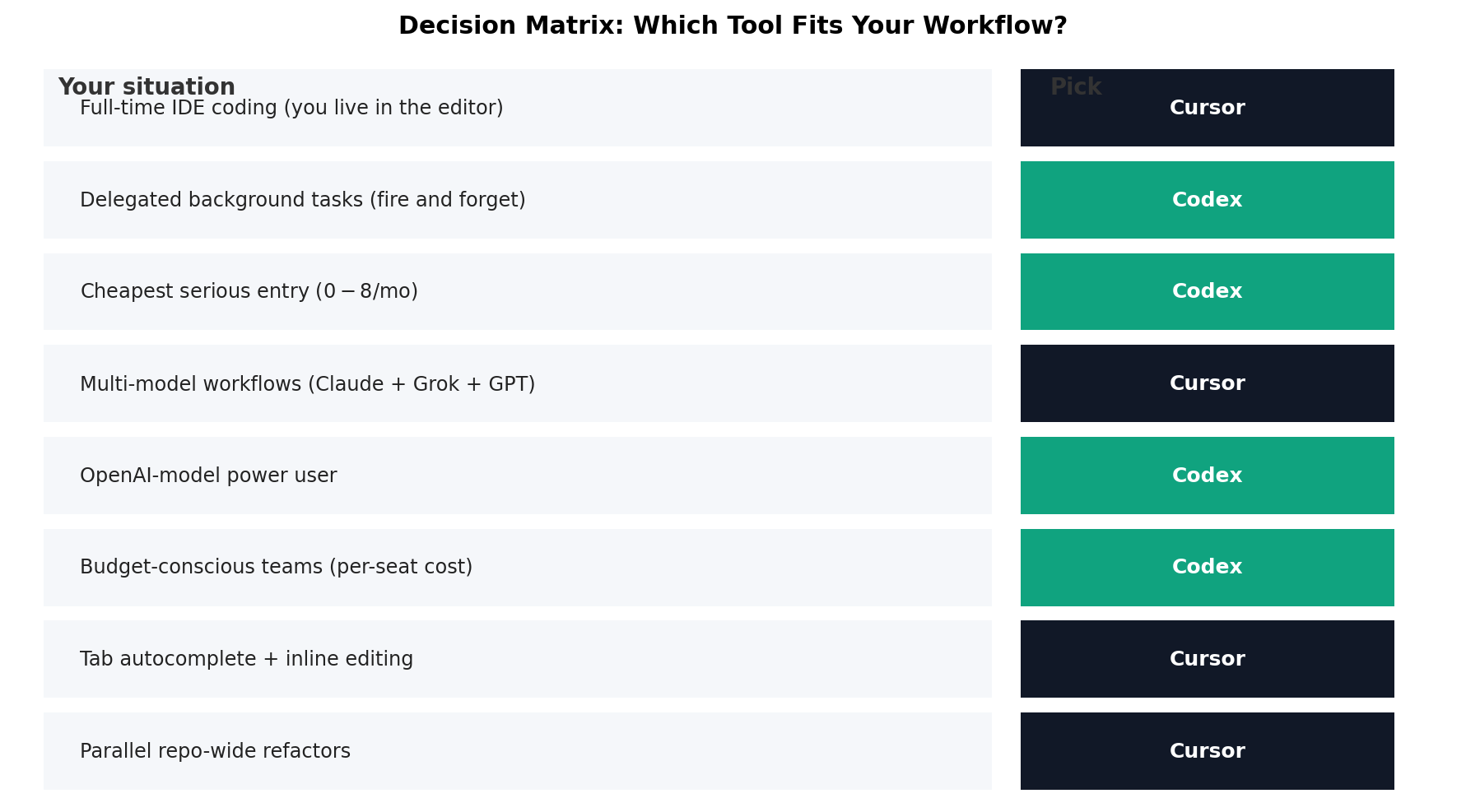
Decision Matrix: Which Tool for Which Job?
Feature Comparison at a Glance
Alternatives Worth Considering
| Tool | Starting price | Standout feature |
|---|---|---|
| Claude Code | $20/mo (Claude Pro) | Terminal-native agentic coding with Opus-class reasoning and MCP |
| GitHub Copilot | $10/mo | Cheapest mainstream entry; agent mode + full GitHub/Actions integration |
| Windsurf | $15/mo | Flow-based agentic editor, strong multi-file Cascade workflows |
| Gemini CLI / Antigravity | $0 tier; $19.99/mo Pro | Google's free-tier agent tooling with huge 1M-token context |
| Aider | $0 (API costs) | Open-source terminal pair-programmer, model-agnostic, git-native |
When to Stay Put (Who Should NOT Switch)
A comparison article that only sells switching is an ad, so here is the honest counter-argument. If any of these describe you, your current setup probably already wins:
- Deeply customized VS Code + Copilot veterans. If you have years of muscle memory, custom keybindings, and snippets built around Copilot, Cursor will feel 90% familiar and 10% infuriating. The productivity delta rarely justifies relearning your editor’s muscle memory mid-project.
- Regulated air-gapped teams. Neither tool’s best features survive an air gap. Codex local mode runs offline but its killer feature (cloud task delegation with phone review) requires connectivity; Cursor’s index and frontier models need network. On truly isolated networks, JetBrains-local tooling remains the sane choice.
- Neovim and terminal natives. If your editor IS a terminal, Claude Code or open-source Aider fits your workflow better than either GUI-centric option here.
- Light autocomplete users. If you use AI for occasional completions and rarely invoke agents, the $10 Copilot Pro tier does the job; Cursor and Codex shine brightest at high delegation volume.
- Teams mid-migration. Switching coding tools during a quarter with a hard deadline taxes velocity more than either tool’s gains repay. Batch the switch into a low-stakes cycle.
The Verdict
Best overall daily driver → Cursor (8.8/10)
For the developer who lives in an editor all day, Cursor's editing UX, model flexibility, and codebase context win more hours than Codex's delegation advantages. It is the higher ceiling on experience; most professional development time is exactly that.
Best for fixed-price & delegated work → Codex (8.5/10)
If your income is per-deliverable — site builds, scrapers, automation panels, spec-in-PR-out workflows — Codex's parallel cloud tasks, tested PRs, and phone-review loop convert directly to invoiceable throughput at the lowest cost per task in the category.
Best value at $20 → Codex
Same sticker price, more delegated volume (25 parallel tasks, 5-hour rolling window), a real $0 local tier, an $8 Go on-ramp, and business seats at half of Cursor's $40. On pure economics Codex wins every tier it shares.
The hybrid approach
The two tools overlap less than their marketing suggests — and at $40/month combined they cost less than one Ultra seat. The pattern we see among high-output freelancers: delegate fixed-price builds to Codex cloud tasks, then do iterative client work and polish in Cursor. Codex compresses delivery time; Cursor compresses revision time. Charging for both while your tooling cost stays at $40/month is the widest margin in this entire comparison.
Frequently Asked Questions
Is Codex better than Cursor in 2026?
Neither tool wins outright — it depends on how you work. Codex scores higher for delegated autonomous tasks, code quality on spec-driven builds, pricing, and enterprise compliance; Cursor scores higher for editing experience, codebase context, and multi-model flexibility. Overall we rate Cursor 8.8 vs Codex 8.5 because most developers spend more time editing than delegating. If your work is fixed-price builds delivered as PRs, flip that verdict.
Can I use Codex for free?
Yes. Codex local tasks via the CLI and IDE extension are free and run actual GPT-6 models, with no time limit. Cloud tasks (the delegated sandbox agents) require a paid plan — ChatGPT Go at $8/month is the cheapest on-ramp, and Plus at $20/month unlocks up to 25 parallel cloud tasks.
Does Cursor still use Claude and GPT models?
Yes. Cursor offers OpenAI GPT-6, Anthropic Claude, Google Gemini, xAI Grok 4.6, and its own Composer 2.5 family side by side. On paid plans, the Auto mode routes each request to a capable model with no per-request decision-making — the main reason Cursor wins our model-flexibility dimension 9.2 vs Codex's 7.5.
Is Codex included in ChatGPT Plus?
Yes — Codex is bundled with every paid ChatGPT plan rather than sold separately. Plus ($20/month) includes roughly 15–150 GPT-6 Sol messages per 5-hour window depending on reasoning effort, plus up to 25 parallel cloud tasks. Pro tiers ($100/$200) multiply usage 5–20x and remove the 5-hour limit.
Which is cheaper for a team of five developers?
Codex. OpenAI's Business tier is $20/user/month (annual) versus Cursor Teams at $40/user/month — $100/month versus $200/month for five seats. If your team leans on interactive editing and multi-model routing, Cursor's premium may still be worth it, but on price alone Codex Business halves the bill.
Can Codex and Cursor be used together?
Yes, and it's a common setup — they solve different halves of the workflow. Delegate well-specified builds to Codex cloud tasks and open the resulting PRs anywhere; do iterative edits, refactors, and reviews inside Cursor. At $40/month combined, the pair costs less than either tool's $200 top tier.
Does Cursor's $20 Pro plan really have unlimited usage?
Partly. Cursor-side features (Tab autocomplete, Composer routing, unlimited Auto mode) are effectively unmetered on Pro, but frontier-model usage draws from a $20 model-usage pool that can run dry under heavy agent load. Codex's Plus tier metering (5-hour rolling window) is more generous for sustained delegation, which is why it wins our pricing dimension despite the identical sticker price.