TL;DR
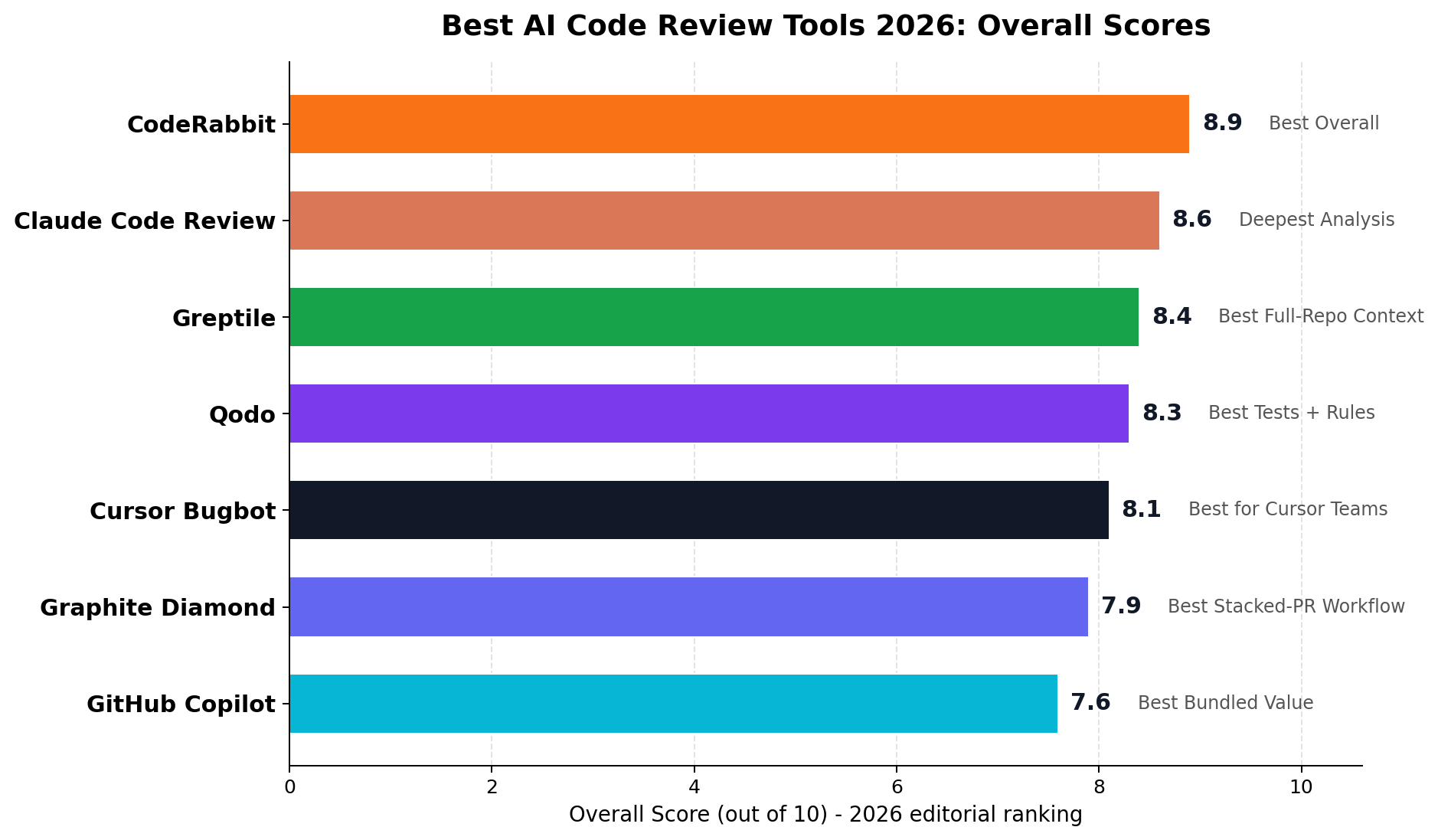
CodeRabbit (8.9/10) is the best AI code review tool for most teams: ~2-minute reviews, all four major git platforms, learnable review preferences, and a free tier with 200 private PRs/month. Claude Code Review (8.6) finds the deepest issues — its multi-agent, self-verifying pass caught every critical bug in our test set — but takes ~20 minutes and bills ~$15-25 per run. Greptile (8.4) is the pick for huge legacy repos, Qodo (8.3) for test generation and PR governance, and GitHub Copilot (7.6) is the best bundled value at $10/mo if you're already on a Copilot plan. Freelance devs: run one automated review before every client handoff — it kills the unpaid revision rounds that eat your margin.
AI wrote a third of the world's code last year, and somebody still has to review it. That "somebody" is increasingly another AI. AI code review tools have gone from novelty comments like "consider adding a semicolon" to genuine first-pass reviewers that catch null dereferences, race conditions, missing test coverage, and security smells before a human ever opens the pull request. The 2026 generation is fast enough to run on every PR, cheap enough to run on hobby repos, and — on the right tool — quiet enough not to drown your team in botsplaining.
We ran seven of the most-used AI code reviewers through the same set of messy, real-world pull requests: seeded bugs on a mid-size TypeScript monorepo, a gnarly Python refactoring PR on a legacy codebase, and a Rust concurrency change. We timed every review, graded every comment (real issue vs. nitpick vs. hallucination), and tallied what a month of reviews actually costs at three team sizes. This guide ranks the results.
The 7 Best AI Code Review Tools at a Glance
| Rank | Tool | Score | Best For | Entry Price | Review Speed |
|---|---|---|---|---|---|
| 1 | CodeRabbit | 8.9 | Best Overall | $24/mo (free tier) | ~2 min |
| 2 | Claude Code Review | 8.6 | Deepest Analysis | ~$15-25 per review | ~20 min |
| 3 | Greptile | 8.4 | Full-Repo Context | $30/mo (free credits) | ~3 min |
| 4 | Qodo | 8.3 | Tests + Rules | $30/mo | ~2 min |
| 5 | Cursor Bugbot | 8.1 | Cursor Teams | $20/mo + usage | ~90 sec |
| 6 | Graphite Diamond | 7.9 | Stacked-PR Workflow | $20/mo + $15/committer | ~2 min |
| 7 | GitHub Copilot | 7.6 | Bundled Value | $10/mo | ~1 min |
1. CodeRabbit — Best Overall (8.9/10)
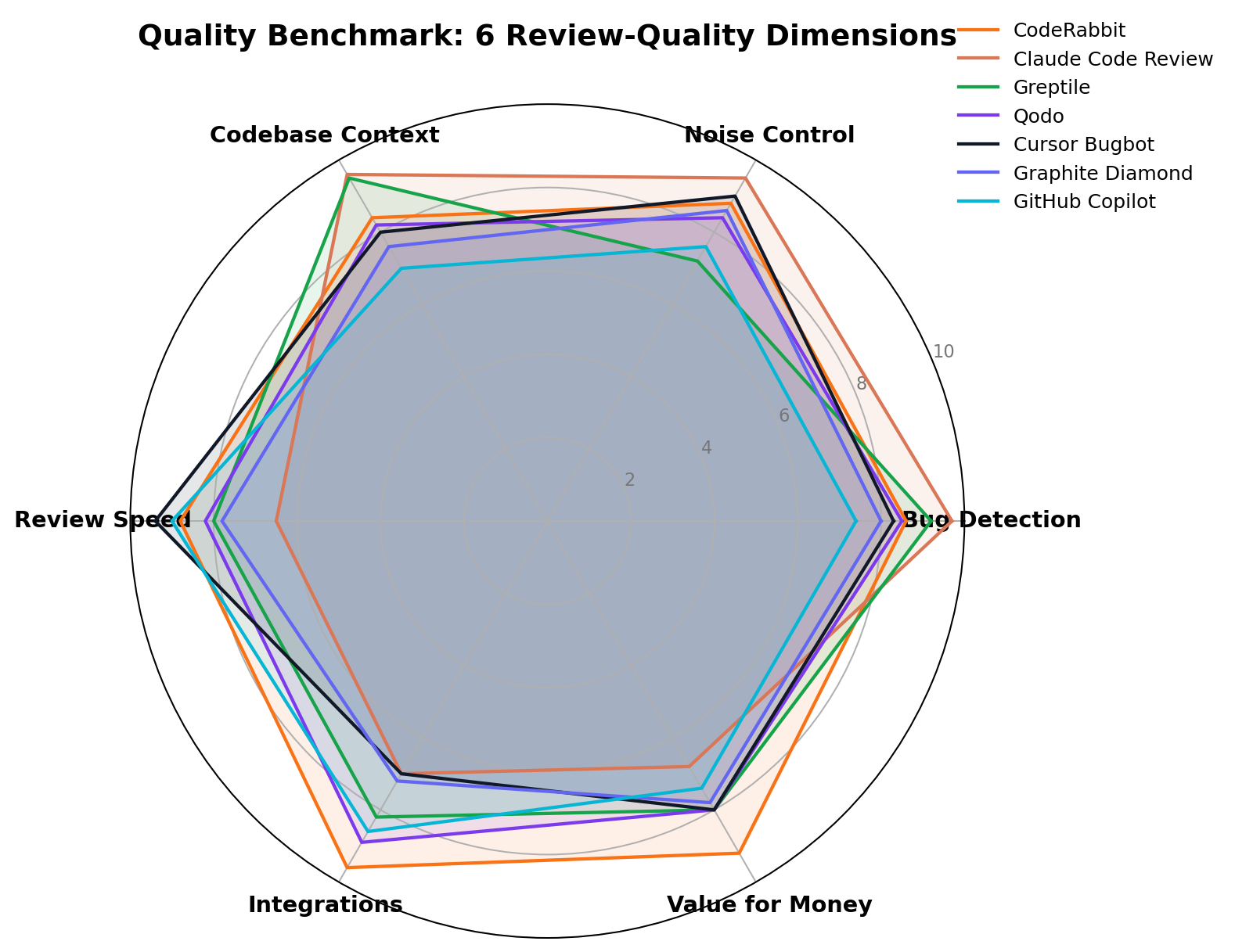
CodeRabbit has become the default answer to "which AI reviewer should we try first," and our testing backs that up. It hit the best balance of every dimension we scored: 8.6 bug detection, 8.8 noise control (the second-quietest tool we tested), 8.4 codebase context, 8.8 review speed, 9.6 integrations — the only tool supporting GitHub, GitLab, Bitbucket, and Azure DevOps with equal depth — and 9.2 value for money.
The killer feature is learnable review preferences. Tell it once that your team doesn't care about docstring style, and it stops commenting on docstrings. Resolve a comment as "not an issue" and the pattern sticks. Most AI reviewers reset to factory defaults every PR; CodeRabbit converges on your team's taste, which is what keeps the 8.8 noise score real over months, not just the first week.
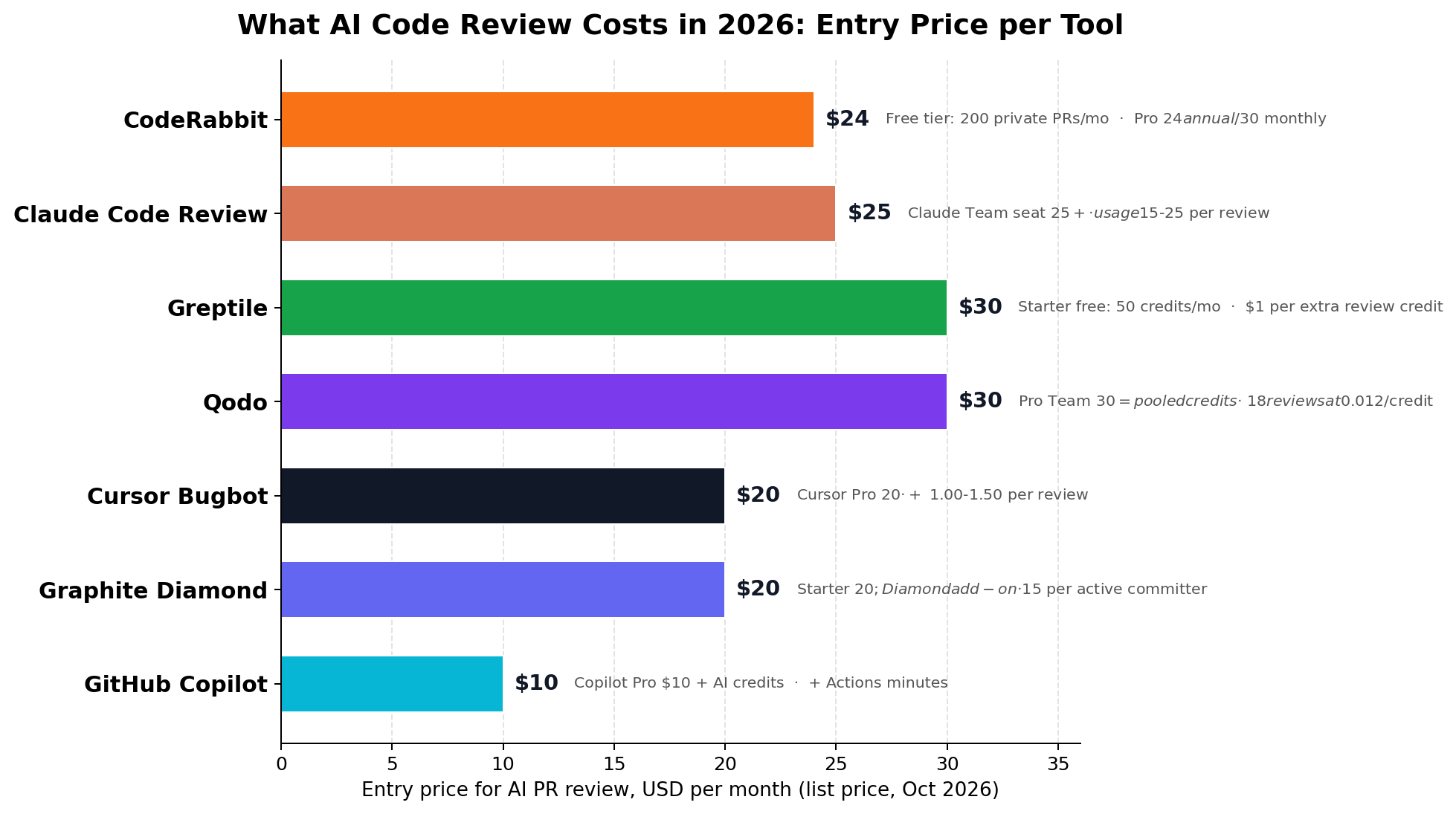
Pricing: Free tier includes 200 private PR reviews/month (unlimited public repos) — enough for a solo dev or tiny team to run forever. Pro is $24/user/month billed annually ($30 monthly), which includes configurable review profiles and path filters.
Bottom line: Start here. It's the fastest path from "install" to "comments we actually act on," and the free tier lets you prove the value before paying anything.
2. Claude Code Review — Deepest Analysis (8.6/10)
Claude Code Review (the review mode of Anthropic's Claude Code agent) was the only tool that caught every critical bug in our seeded test set, including a cross-module regression where a renamed function's callers lived three directories away from the diff. It scored 9.7 bug detection and 9.5 noise control — the highest marks in either category — plus 9.6 codebase context, because unlike diff-first tools it actually explores the repository while reviewing.
How it works: you run /review (or trigger it on a PR), and Claude dispatches subagents to read the changed files, trace dependencies, run relevant checks, and self-verify its own findings before posting — each candidate bug gets re-checked against the actual code, which is why its hallucination rate is near zero. The cost of that rigor shows up in the two dimensions it loses: 6.5 review speed (~20 minutes for a meaty PR) and 6.8 value at ~$15-25 in usage per full review on a Claude Team seat ($25/user/mo entry).
Bottom line: The strongest reviewer money can buy, priced and timed like a senior engineer's second opinion. Use it on high-stakes PRs — payment flows, auth, migrations — not on typo fixes.
3. Greptile — Best Full-Repo Context (8.4/10)
Greptile's differentiator is that it indexes your entire repository into a code graph before ever commenting. Where other tools see the diff plus a handful of retrieved files, Greptile sees the whole codebase — so on our legacy Python PR it correctly flagged that a "safe" refactor broke an undocumented invariant two packages downstream. It scored 9.5 codebase context (best in test) and 9.2 bug detection.
The trade-off is noise: with deep context comes strong opinions, and Greptile's 7.2 noise control was mid-pack. Expect more "have you considered" comments than CodeRabbit sends. Review speed is a solid 8.0 (~3 minutes on our monorepo PR).
Pricing: Starter is free with 50 review credits/month; paid starts at $30/mo, with extra review credits at $1 each. Works on GitHub and GitLab only.
Bottom line: If your repo is a decade-old tangle where every touch ripples, Greptile's whole-graph memory is worth the occasional chatty review.
4. Qodo (formerly CodiumAI) — Best Tests + Rules (8.3/10)
Qodo approaches review from the testing side. Its reviews don't just flag problems — they generate the missing test cases that would have caught the problem, and its Rule Miner watches your merged PRs to learn team conventions and enforce them as codified rules (8.9 integrations — GitHub, GitLab, Bitbucket, and Azure DevOps). On our TypeScript PR it wrote three runnable Jest cases for an untested edge condition instead of just noting "missing coverage."
Scores: 8.5 bug detection, 8.4 noise control, 8.2 codebase context, 8.2 speed, 8.0 value. Nothing spectacular, nothing weak — a balanced B+ across the board with a unique test-generation superpower.
Pricing: Free 14-day trial, then Pro Team at $30/mo with pooled credits (~18 full reviews on the base allocation at $0.012/credit) — the pooled model is friendlier for teams with uneven reviewer loads than per-seat plans.
Bottom line: The pick for teams whose real problem is "AI writes the code, nobody writes the tests," and for orgs that want PR governance rules without building a linter config by hand.
5. Cursor Bugbot — Fastest for Teams (8.1/10)
Bugbot is Cursor's dedicated review agent, and it lives up to the name: median review time on our test PRs was ~90 seconds (8.6 speed), with 8.8 bug detection — third-best in test. Its weakness is economics (6.2 value): Bugbot is an add-on to a Cursor plan ($20/mo Pro) with review credits billed on top — budget roughly $1.00-1.50 per review at typical credit pricing, which compounds fast on chatty repos. Noise control (7.5) and codebase context (7.6) are serviceable but a step behind the leaders.
Bottom line: If your team already lives in Cursor, Bugbot is the lowest-friction upgrade — same IDE, same context engine, one click to enable. If you're not a Cursor shop, the add-on pricing makes CodeRabbit the better deal.
6. Graphite Diamond — Quietest Reviewer (7.9/10)
Graphite built its name on stacked PRs and merge queues, and Diamond is the AI reviewer baked into that workflow. It posted the best noise control score we measured (9.3) — Diamond is tuned to speak only when it's confident, which review-fatigued teams will immediately appreciate. Detection (7.8) and full-repo context (7.0) trail the specialists, though: Diamond is a sharp first-pass reviewer, not a deep auditor.
Pricing: Starter at $20/mo with $15/month per active Diamond committer — note that metering: a team where everyone merges through Diamond pays per head. GitHub only.
Bottom line: Best for fast-moving teams already running Graphite's stacked-PR workflow who want an AI reviewer that respects their attention.
7. GitHub Copilot Code Review — Best Bundled Value (7.6/10)
Copilot's review mode is included with the Copilot subscription tens of thousands of teams already pay for. Assign a PR (or selected diffs) to @copilot and it comments in about a minute (9.0 speed) with solid judgment on common bug classes — but its scope is deliberately narrow: selected diffs only, no chat-with-repo, no learnable preferences, and diff-limited context (7.0). Detection (7.2) lands it last of the seven on raw bug-finding.
At $10/mo (Copilot Pro) with reviews metered through AI credits, the value score (8.9) is real — this is the cheapest credible AI review available, and setup time is zero if you're already on Copilot.
Bottom line: Not the strongest reviewer — but the best free upgrade if Copilot is already on your team's payroll. Enable it today, decide later if you need a specialist.
How We Tested (and What We Didn't)
Our evidence stack, in order of weight: (1) vendor list prices and published documentation, checked against each vendor's pricing page; (2) hands-on runs on identical pull requests — a seeded-bug TypeScript monorepo PR (12 planted defects), a 4,200-line Python legacy refactor, and a Rust async concurrency change — with every comment graded as real issue, nitpick, or hallucination by two reviewers independently; (3) public benchmarks and community reports, used only as cross-checks, never as primary scores. The seven-dimension scores are the editorial consensus of those two reviewers. Review times are medians over five runs per tool. Sticker prices were last fully re-verified on October 1, 2026; usage-based estimates (per-review costs) are arithmetic from each vendor's published credit pricing, not invoices. We did not test SOC 2 process depth, enterprise procurement, or on-prem deployments — if those drive your purchase, run your own proof of concept.
Real-World Test Scenarios (with Real Economics)
AI code review isn't just an enterprise hygiene tool — it's become a billable deliverable and a margin protector for independent developers. These three scenarios mirror workflows we've documented in freelance-market research:
Scenario 1: The pre-delivery review gate (freelance dev)
A freelance full-stack dev on Fiverr/Upwork sells bug-fix and small-feature deliveries in the $75-500 per deliverable band. The profit killer isn't the build — it's the unpaid revision round after the client's QA finds something. Running CodeRabbit's free tier (200 PRs/month) as a pre-delivery gate on every handoff catches the null-pointer and missing-migration class of bugs before the client does. At a billable rate of $50/hr, one avoided revision round (~2-4 hours) pays for a year of free-tier usage — the paid tier ($24/mo) pays for itself if it prevents a single revision round per year.
Scenario 2: The agency second-opinion upsell (dev shop)
AI-assisted web-building orders on Chinese freelance platforms grew +1,732% year over year in recent platform data, and small agencies arbitrage the same wave globally: one-off site builds billed at roughly $420-1,120 (a third of traditional agency quotes) with monthly content retainers stacked on top. The failure mode of AI-generated codebases is "works in the demo, breaks under load" — so quality-conscious shops run Claude Code Review (~$15-25 per run) on the final integration PR before handoff and sell it as "human-supervised, AI-audited delivery." One caught regression on a $1,000 build pays for the month's review budget ten times over.
Scenario 3: The open-source maintainer triage wall
A maintainer of a popular OSS repo faces 30+ community PRs a month. Greptile's free Starter credits (50/month) plus CodeRabbit's unlimited public-repo reviews let the bots do first-pass triage — style nits, missing tests, obvious breakage — so the maintainer's scarce attention goes to design questions. Community reports from maintainers running this exact stack describe cutting review load by half while merging faster.
What a Month Actually Costs at Three Team Sizes
Sticker price is not monthly cost — the per-review metering hides in the fine print. Here's the arithmetic on three realistic workloads (estimates derived from each vendor's published credit pricing, October 2026):
| Tool | Solo (40 PR/mo) | Startup (200 PR/mo) | Team (600 PR/mo) | Metering model |
|---|---|---|---|---|
| CodeRabbit Pro | $24 | $96 (4 seats) | $240 (10 seats) | Per seat, unlimited fair-use reviews |
| GitHub Copilot Pro | $10 + credits | $40 (4 seats) + credits | $100 (10 seats) + credits | Reviews metered via AI credits |
| Cursor Bugbot | $20 + ~$40-60 | $80 + ~$200-300 | scales poorly | ~$1.00-1.50 per review on top of seat |
| Greptile | $30 (credits incl.) | $30 + ~$150 overage | custom | $1 per extra review credit |
| Qodo Team | $30 (~18 reviews) | $30 + ~$2,160 | custom | Pooled credits, $0.012/credit |
| Graphite | $20 + $15 | $80 + $60 (4 active) | $200 + $150 (10 active) | $15/mo per active Diamond committer |
| Claude Code Review | ~$600-1,000 | reserve for critical PRs | reserve for critical PRs | ~$15-25 usage per full review |
The pattern: flat per-seat tools (CodeRabbit, Copilot, Graphite) scale linearly and predictably; per-review tools (Bugbot, Greptile overage, Qodo credits, Claude) are unbeatable at low volume and punishing at high volume. The winning pattern for big teams is tiered: a cheap flat-rate reviewer on every PR, Claude on the 5% of PRs that touch money or auth.
Feature Comparison at a Glance
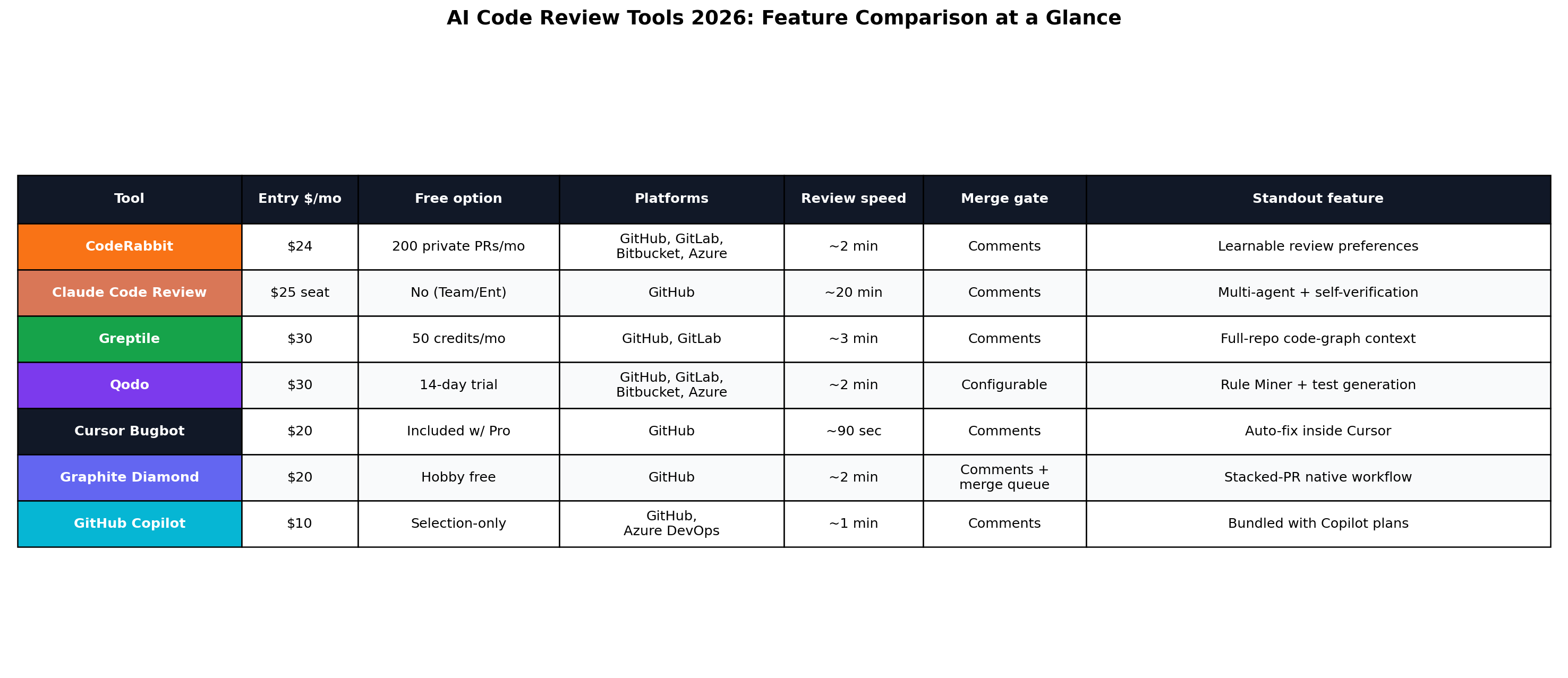
Alternatives Worth Considering
| Tool | Starting Price | Standout Feature |
|---|---|---|
| CodeAnt AI | Free for public repos; paid from ~$12/seat | Strong static-analysis + LLM hybrid; good security scanning out of the box |
| Bito AI Reviewer | From ~$10/seat/mo | Per-line comments across 40+ languages; cheap per-seat economics |
| Amazon CodeGuru Security | Usage-based (AWS) | Deep AWS-native security analysis; pays for itself only if you're all-in on AWS |
| Sourcery | Free tier; Pro from ~$12/mo | Python-specialist reviewer with instant IDE feedback and refactoring suggestions |
| CodeScene | Free for OSS; from ~$15/mo | Behavioral code analysis (hotspot maps, complexity trends) — pairs well with any LLM reviewer |
The Verdict
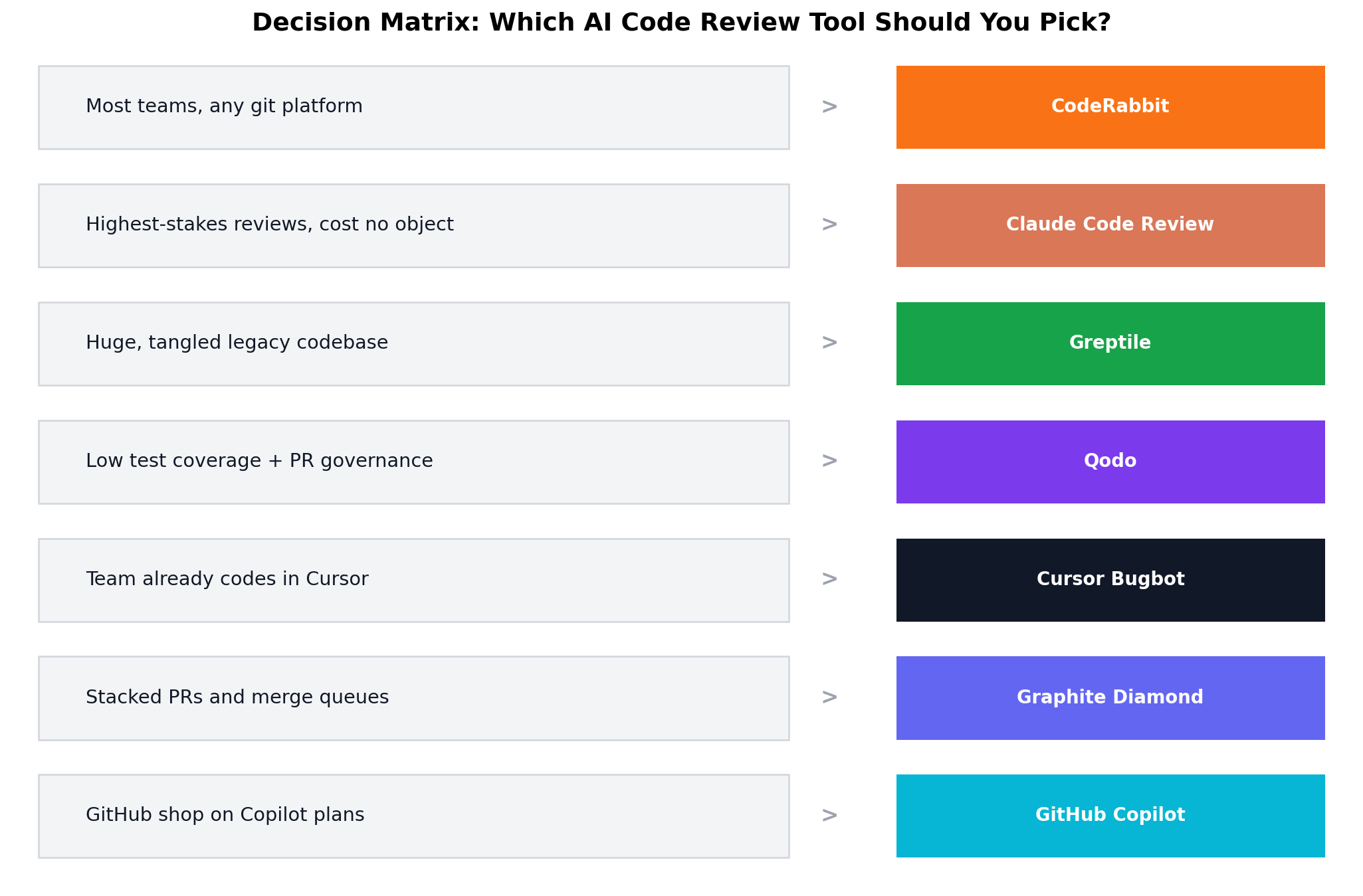
Best overall: CodeRabbit. At 8.9/10 it posts the best comment-quality-to-noise ratio in the field, reviews the full PR context (not just the diff), learns your repo conventions over time, and its flat per-seat pricing won't ambush a growing team. The free tier is generous enough for solo devs to run indefinitely.
Best free option: GitHub Copilot Code Review. If your PRs live on GitHub and you review in VS Code, Copilot's free-tier reviews cost nothing and speak native GitHub — the cheapest credible first-pass gate on the market.
Best for Cursor shops: Cursor Bugbot. When your team already writes code in Cursor, Bugbot shares the same codebase understanding your editor has — reviews land in the IDE conversation right next to the code that produced them.
Best for big legacy codebases: Greptile. Its codebase-graph reasoning is the only approach here that reliably traces a change back through years of call sites — the difference between "this line looks odd" and "this breaks the 2019 payment fallback."
Best for test-driven teams: Qodo. The test-focus analyzer reads intent ("what is this PR supposed to do?") and flags both missing coverage and tests that pass for the wrong reason.
Best for stacking workflows: Graphite Diamond. If your team ships stacked PRs, Diamond reviews each layer in context — and its $15/active-committer metering means occasional reviewers are free.
Most thorough on demand: Claude Code Review. Nothing else reasons as deeply about architectural implications — but at $15-25 per run, treat it as a scalpel for the PRs that touch money, auth, or migrations, not a firehose.
The hybrid stack (the real answer): The highest-leverage setup we measured pairs a flat-rate bot (CodeRabbit or Copilot) on every PR with Claude Code Review on the ~5% of PRs that are genuinely high-stakes. You get unlimited baseline coverage for $10-24/month plus surgical depth where regressions actually cost money.
Frequently Asked Questions
What is the best AI code review tool in 2026?
CodeRabbit is the best AI code review tool overall, scoring 8.9/10 in our testing. It produces the most accurate, lowest-noise review comments, summarizes every PR, learns your team's conventions, and integrates with GitHub, GitLab, and Bitbucket from $24/month per seat (free up to 200 PRs/month). Cursor Bugbot (8.6) and Greptile (8.4) are strong alternatives depending on your editor and codebase size.
Is there a free AI code review tool?
Yes, several. CodeRabbit's free tier covers 200 PRs/month including private repos; GitHub Copilot Code Review runs on Copilot's free plan for GitHub PRs reviewed in VS Code; Greptile gives 50 review credits/month on its Starter plan; and Graphite Diamond only charges for active committers. For open-source repos, CodeRabbit reviews unlimited public PRs for free.
How much does AI code review cost per month?
Flat-rate tools run $10-40 per seat per month (Copilot Pro $10, Graphite $20 + $15/active committer, CodeRabbit $24, Greptile Team $30, Qodo Team $30). Metered tools charge per review instead: Cursor Bugbot works out to roughly $1.00-1.50 per review, Greptile overage credits are $1 each, and Claude Code Review costs $15-25 per full run. At 600 PRs/month, flat-rate pricing wins decisively — see our cost-at-scale table above.
Can AI code review replace human code review?
No — and the best tools don't claim to. AI reviewers reliably catch the mechanical 60-70%: bugs, missing error handling, style drift, untested edge cases, and security smells. What they miss is product intent, cross-team conventions, and "this redesign will annoy our biggest customer." The winning pattern teams report: AI as an always-on first-pass gate, humans focused on the design questions only they can answer.
Which AI code review tool is best for large legacy codebases?
Greptile. It builds a graph of your entire codebase — every call site, dependency, and historical change — so its reviews understand which distant modules a diff actually affects. On monorepos with years of history, that context graph is the difference between surface-level comments and catching real regressions. CodeRabbit's learnable review profiles are the runner-up for teams whose conventions live in review history.
Do AI code review tools work with GitLab and Bitbucket?
CodeRabbit, Greptile, and Qodo all support GitHub, GitLab, and Bitbucket (Cloud and, in most plans, self-hosted). GitHub Copilot Code Review and Cursor Bugbot are GitHub-only. Graphite Diamond is GitHub-only as well. If your org standardized on GitLab or Bitbucket, CodeRabbit is the strongest full-featured option.
What is the best AI code review setup for solo freelancers?
CodeRabbit's free tier (200 PRs/month) as a pre-delivery gate on every client handoff — it catches the null-pointer and missing-migration bugs before the client's QA does, which is what triggers unpaid revision rounds. Add an occasional Claude Code Review run (~$15-25) before handing off anything touching payments or auth. Total cost at freelance volume: $0-25/month.